

Submitted:
13 May 2026
Posted:
14 May 2026
You are already at the latest version
Abstract
Isavuconazole is increasingly being used for the treatment of invasive fungal disease (IFD), although real-world pediatric data remain limited. We retrospectively reviewed patients aged ≤18 years who received isavuconazole for fungal infection at two tertiary centers in Chile between 2021 and 2025. Twenty patients were included, with a median age of 13.7 years (IQR, 9.4–15.5); 14 (70%) had an underlying malignancy, and 6 (30%) were allogeneic hematopoietic cell transplant recipients. Isavuconazole was used for treatment in 16 patients and for prophylaxis in 4, predominantly as second-line therapy due to prior antifungal intolerance, inadequate response, drug–drug interactions, or QT prolongation. Fifteen patients had IFD, with Mucorales (n=3) being the most frequently identified pathogens in proven cases and pulmonary involvement predominating in probable IFD. A succesful response at 90 days was achieved in 60% (6/10) of evaluable cases. No breakthrough fungal infections occurred during treatment or prophylaxis. Hepatic enzyme elevations were observed in four patients. Isavuconazole was associated with favorable outcomes and an acceptable safety profile, supporting its use as an alternative antifungal in pediatric patients.
Keywords:
isavuconazole
; pediatrics
; invasive fungal disease
1.Introduction
Invasive fungal diseases (IFD) are a major cause of morbidity and mortality in children, particularly among those with cancer or other immunocompromising conditions. Reported incidence ranges from 2–20%, with attributable mortality between 10–70%. The most frequent pathogens include Candida spp., Aspergillus spp., and Mucorales [1]. Management is often limited by antifungal toxicity, drug–drug interactions (DDIs), and the need for therapeutic drug monitoring (TDM) in pediatric patients, particularly with mold-active azoles. Isavuconazole is a broad-spectrum triazole approved for the treatment of invasive aspergillosis and mucormycosis in adults in 2015 and in pediatric patients in late 2023. It is active against yeasts, molds, and dimorphic fungi, including strains with reduced susceptibility to other azoles. Compared with other agents in its class, isavuconazole is a moderate CYP3A4 inhibitor, has fewer interaction concerns, more predictable pharmacokinetics, and is available in both oral and intravenous formulations [2]. Pediatric clinical experience with isavuconazole remains limited, with data derived from a reduced number of cohorts, predominantly from Europe and North America. We aimed to describe the real-world use of isavuconazole in pediatric patients from two tertiary care hospitals in Chile, where TDM was not available.
2.Methods
We conducted a retrospective, observational study including pediatric patients (≤18 years) who received isavuconazole for treatment of IFD, classified as proven, probable, or possible according to the European Organization for Research and Treatment of Cancer/Mycoses Study Group (EORTC/MSG) criteria [3], for other non-invasive fungal infections, or for antifungal prophylaxis (primary or secondary). Patients were included regardless of isavuconazole duration. Patients were enrolled from Hospital Dr. Sótero del Río and Red Salud UC–CHRISTUS between April 1, 2021, and March 31, 2025. The study was approved by institutional review boards at both centers.
Demographic and clinical data were obtained from medical records. Collected variables included underlying diagnosis, immunosuppressive status, transplantation history, fungal infection characteristics, and prior antifungal exposure. Isavuconazole use was recorded according to indication, dosing, route of administration, and duration. Safety data included serum aspartate aminotransferase (AST), alanine aminotransferase (ALT), and creatinine at baseline and peak during therapy. Hepatotoxicity was defined as >3× the upper limit of normal, and nephrotoxicity as creatinine levels >1.5× baseline, according to the Common Terminology Criteria for Adverse Events (CTCAE).
Clinical response was assessed at 90 days and classified as complete, partial, stable, or progressive disease according to EORTC/MSG criteria. Complete and partial responses were considered successful, whereas stable disease, progressive disease, or death (regardless of attribution) were considered treatment failure [4]. Patients who received <10 days of therapy were excluded from response assessment, as clinical outcomes cannot be reliably assessed after very short antifungal exposure.
Overall and IFD-related mortality were recorded at 30 and 90 days.
All eligible patients during the study period were included. Categorical variables were described as frequencies and percentages, continuous variables as medians and interquartile ranges (IQR). Descriptive analyses were performed using GraphPad Prism version 10.6.1.
3.Results
A total of 20 patients were included, with a median age of 13.7 years (IQR, 9.4–15.5). Most had an underlying hematologic malignancy (14/20, 70%), predominantly acute lymphoblastic leukemia (8/14, 57%). Nine patients were receiving chemotherapy at isavuconazole initiation, mainly during induction or reinduction phases (5/9, 55%), and six were allogeneic hematopoietic stem cell transplant recipients at the time of isavuconazole initiation (Table 1).
Isavuconazole was used for treatment in 16 patients (80%), including two receiving combination antifungal therapy with isavuconazole and liposomal amphotericin B. It was most commonly used as second-line treatment (13/16, 81%) due to intolerance or inadequate clinical response to prior antifungals. The median duration of treatment was 30.5 days (IQR, 7.3–47.0). Fifteen patients (15/16, 75%) met criteria for IFD, including four proven, four probable, and seven possible episodes. Of the four proven IFD cases, three were due to Mucorales: Rhizopus arrhizus and Lichtheimia corymbifera isolated from sinus by culture, and Rhizopus spp. detected in liver by panfungal polymerase chain reaction (PCR). The remaining case involved Candida tropicalis isolated from renal biopsy. Probable IFD consisted of four patients with pulmonary involvement suggestive of invasive aspergillosis, all of whom had positive serum and/or bronchoalveolar lavage galactomannan but without microbiological isolation. Possible IFD included four pulmonary, two rhinosinusal, and one central nervous system involvement. Overall, pulmonary involvement was the most frequent presentation (8/15, 53%), followed by rhinosinusal disease (4/15, 27%) (Figure 1).
A non-invasive urinary infection caused by Candida krusei was documented in one patient, who received isavuconazole due to lack of response or adverse reactions to echinocandins and amphotericin B deoxycholate. Fungal pathogens were identified in five patients by culture (n=4) or panfungal PCR (n=1), and susceptibility testing for isavuconazole was performed in two isolates, confirming in vitro activity.
Treatment response at 90 days was evaluable in 10 patients with IFD who received more than 10 days of therapy. Six patients (60%) achieved a successful response, including complete remission in four and partial response in two. By type of infection, complete responses were observed in one patient with rhinosinusal mucormycosis due to Rhizopus arrhizus, and three patients with pulmonary fungal infections without microbiological identification. A partial response was observed in one patient with renal infection due to Candida tropicalis and in one patient with pulmonary fungal infection without microbiological identification.
Four patients were classified as treatment failure, two due to stable disease and two due to death during follow-up. Neither death was attributed to fungal disease. No breakthrough IFDs were observed.
Four patients received isavuconazole as prophylaxis, three as secondary prophylaxis due to prior IFD (invasive aspergillus and one coinfection with Rhizopus spp). Among them, isavuconazole was used as first-line prophylaxis in two patients due to potential drug–drug interactions with chemotherapy (vincristine). It was used as second-line in two patients, one due to hepatic enzyme elevations with QT prolongation and the other due to QT prolongation. The median duration of prophylaxis was 41.0 days (IQR, 14.8–101.0). No breakthrough fungal infections occurred during prophylaxis.
In the overall cohort, administration was exclusively oral in 14 of 20 patients (70%), intravenous (IV) followed by oral in 4 (20%), and IV only in 2 (10%). Four patients developed hepatic enzyme elevations, two during prophylaxis and two during treatment, with severity ranging from CTCAE grade 2 to 3, at a median of 13 days (IQR, 9–23.8) after therapy initiation, leading to drug discontinuation in two cases, and both patients recovered completely (Table 1). In all cases, potential concomitant factors contributing to hepatic enzyme elevations were identified. TDM was not available at the participating centers during the study period.
Overall, five patients (25%) died during the study period. Two deaths were IFD-related, both due to mucormycosis, and none occurred while patients were receiving isavuconazole.
4.Discussion
In this two-center cohort, isavuconazole was mainly used as second-line treatment, and most patients had underlying hematologic malignancies. Clinical response was generally favorable in evaluable patients, and no breakthrough IFDs occurred during therapy. Hepatic enzyme elevations were observed in a minority of patients, with resolution after isavuconazole discontinuation.
Published pediatric experience with isavuconazole remains limited, consisting mainly of case reports, small retrospective cohorts, and case series. In a multicenter retrospective study, isavuconazole was used predominantly as second-line therapy in pediatric patients (20/24, 83%) [5]. In a recent Spanish multicenter cohort, second-line treatment was reported in most patients (64/95, 67%), mainly due to toxicity with previous antifungals or clinical therapeutic failure [6].
Pulmonary involvement was the most frequent presentation in our cohort, consistent with previous pediatric studies reporting lung disease as the predominant site of invasive fungal infection among children treated with isavuconazole [5,6,7].
The favorable outcome rate at follow-up was 60%, which is notable given that isavuconazole was predominantly used as second-line treatment. This finding is consistent with previously published pediatric data evaluating isavuconazole for invasive fungal disease, with reported response rates generally ranging between 50% and 70% [5,6,7,8]. In addition, published pediatric experience from large multicenter cohorts suggests that breakthrough invasive fungal infections during isavuconazole therapy are uncommon [6]. In contrast, a single-center report by Kunvarjee et al. described three breakthrough IFDs among 20 patients receiving isavuconazole prophylaxis [9]. The safety profile observed aligns with previously published pediatric experience, in which hepatic enzyme abnormalities are among the most frequently reported adverse events and are typically transient and manageable [5,6,7,8,10]. Although isavuconazole was used for prophylaxis in a subset of patients, this indication remains off-label, with limited high-quality evidence supporting its use.
Mortality rates reported in pediatric isavuconazole studies vary across cohorts, with higher rates observed in large real-world multicenter series [6] compared with prospective trials [8], likely reflecting differences in patient complexity and follow-up duration.
This study has some limitations to consider. Its retrospective design and small sample size reduce generalizability. Treatment response was assessable only in patients who received at least 10 days of therapy, a non-standardized cutoff chosen given the absence of a validated time point for early response assessment. In addition, most IFD episodes were classified as possible, reflecting the diagnostic complexity of real-world pediatric care in a Latin American setting. TDM was not available at our centers. Although emerging pediatric pharmacokinetic data suggest variable exposure in younger children, TDM may help optimize dosing in selected cases [8,11,12]. Follow-up assessments were not standardized.
This study provides real-world pediatric data on isavuconazole use from a Latin American clinical setting, supporting its safety and potential effectiveness in children with complex underlying conditions. Notably, dosing in our cohort was consistent with currently recommended weight-based strategies, despite the absence of TDM.
In summary, isavuconazole was associated with favorable clinical outcomes and an acceptable safety profile in this cohort, suggesting a potential role as an alternative when other antifungals are poorly tolerated or ineffective. Prospective studies incorporating standardized outcome assessment, hepatic enzyme monitoring and TDM are needed to better define its role in pediatric antifungal therapy.
Funding
This research received no external funding.
Institutional Review Board Statement
Not applicable.
Informed Consent Statement
Not applicable.
Data Availability Statement
The original contributions presented in this study are included in the article/supplementary material. Further inquiries can be directed to the corresponding authors.
Conflicts of Interest
The authors declare no conflict of interest.
References
- Pana, Z.D.; Roilides, E.; Warris, A.; Groll, A.H.; Zaoutis, T. Epidemiology of Invasive Fungal Disease in Children. J. Pediatr. Infect. Dis. Soc. 2017, 6 (suppl_1), S3–S11. [Google Scholar] [CrossRef] [PubMed]
- Miceli, M.H.; Kauffman, C.A. Isavuconazole: A New Broad-Spectrum Triazole Antifungal Agent. Clin. Infect. Dis. 2015, 61(10), 1558–65. [Google Scholar] [CrossRef] [PubMed]
- Donnelly, J.P.; Chen, S.C.; Kauffman, C.A.; et al. Revision and Update of the Consensus Definitions of Invasive Fungal Disease From the European Organization for Research and Treatment of Cancer and the Mycoses Study Group Education and Research Consortium. Clin. Infect. Dis. 2020, 71(6), 1367–1376. [Google Scholar] [CrossRef] [PubMed]
- Segal, B.H.; Herbrecht, R.; Stevens, D.A.; et al. Defining responses to therapy and study outcomes in clinical trials of invasive fungal diseases: Mycoses Study Group and European Organization for Research and Treatment of Cancer consensus criteria. Clin. Infect. Dis. 2008, 47(5), 674–83. [Google Scholar] [CrossRef] [PubMed]
- Decembrino, N.; Perruccio, K.; Zecca, M.; et al. A Case Series and Literature Review of Isavuconazole Use in Pediatric Patients with Hemato-oncologic Diseases and Hematopoietic Stem Cell Transplantation. Antimicrob. Agents Chemother. 2020, 64(3). [Google Scholar] [CrossRef] [PubMed]
- Mendoza-Palomar, N.; Simo Nebot, S.; Roig-Soria, L.; et al. Real-life use of isavuconazole in Spanish children and adolescents. J. Antimicrob. Chemother. 2025. [Google Scholar] [CrossRef] [PubMed]
- Ross, J.A.; Karras, N.A.; Tegtmeier, B.; et al. Safety of Isavuconazonium Sulfate in Pediatrics Patients With Hematologic Malignancies and Hematopoietic Cell Transplantation With Invasive Fungal Infections: A Real World Experience. J. Pediatr. Hematol. Oncol. 2020, 42(4), 261–265. [Google Scholar] [CrossRef] [PubMed]
- Segers, H.; Deville, J.G.; Muller, W.J.; et al. Safety, outcomes, and pharmacokinetics of isavuconazole as a treatment for invasive fungal diseases in pediatric patients: a non-comparative phase 2 trial. Antimicrob. Agents Chemother. 2024, 68(12), e0048424. [Google Scholar] [CrossRef] [PubMed]
- Kunvarjee, B.; Siver, M.; Mathew, S.; Steiger, S.; Lee, Y.J.; Spitzer, B. Characterization of the Use and Efficacy of Isavuconazonium Sulfate in a Pediatric Oncology and Stem Cell Transplant Population: A Single Institution Retrospective Review. J. Pediatr. Hematol. Oncol. 2024, 46(2), e143–e146. [Google Scholar] [CrossRef] [PubMed]
- Zimmermann, P.; Brethon, B.; Roupret-Serzec, J.; et al. Isavuconazole Treatment for Invasive Fungal Infections in Pediatric Patients. Pharmaceuticals 2022, 15(3). [Google Scholar] [CrossRef] [PubMed]
- Arrieta, A.C.; Neely, M.; Day, J.C.; et al. Safety, Tolerability, and Population Pharmacokinetics of Intravenous and Oral Isavuconazonium Sulfate in Pediatric Patients. Antimicrob. Agents Chemother. 2021, 65(8), e0029021. [Google Scholar] [CrossRef] [PubMed]
- Fernandez Ledesma, B.; Mendoza-Palomar, N.; Melendo Perez, S.; et al. Isavuconazole use and TDM in real-world pediatric practice. Antimicrob. Agents Chemother. 2023, 67(12), e0082923. [Google Scholar] [CrossRef] [PubMed]
Figure 1.
Distribution and Organ Involvement of Invasive Fungal Diseases (n = 15).Number of invasive fungal disease cases by clinical classification (possible, probable, or proven) and distribution by organ involvement among 15 episodes. Abbreviations: CNS, central nervous system; IFD, invasive fungal disease.
Figure 1.
Distribution and Organ Involvement of Invasive Fungal Diseases (n = 15).Number of invasive fungal disease cases by clinical classification (possible, probable, or proven) and distribution by organ involvement among 15 episodes. Abbreviations: CNS, central nervous system; IFD, invasive fungal disease.
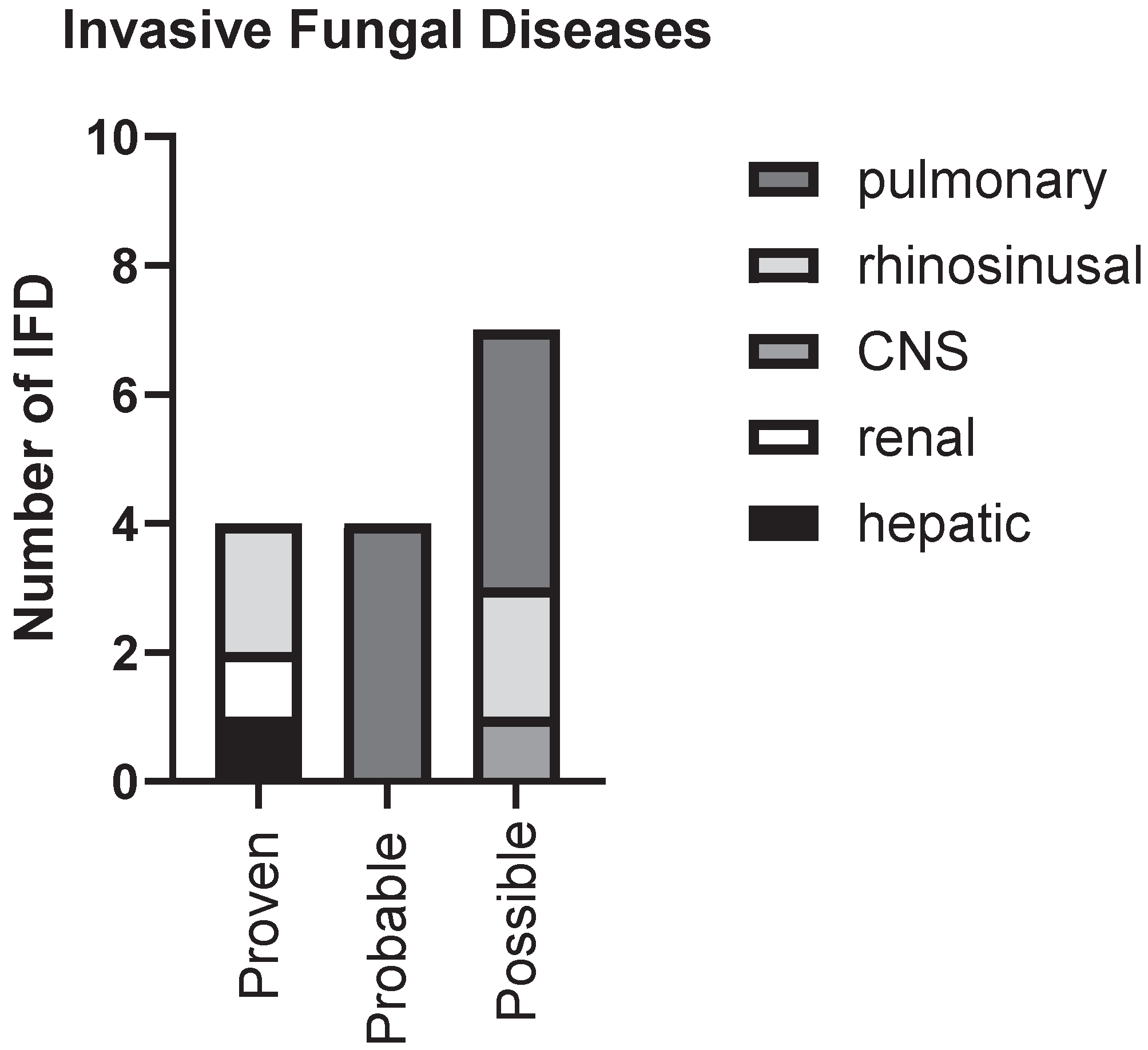

Table 1.
Patient Clinical Characteristics and Isavuconazole Therapy.
| Characteristics | Patients (N=20) |
| Male, n (%) | 10 (50) |
| Age, median (IQR) | 13.7 (9.4–15.5) |
| Underlying disease/condition | |
| Malignancy, n (%) | 14 (70) |
| ALL | 8 |
| AML | 4 |
| NHL | 1 |
| Osteosarcoma | 1 |
| Non malignancya, n (%) | 6 (30) |
| Transplant type, n (%) | |
| Allogeneic HCT | 6 (30) |
| SOT | 2 (10) |
| Laboratory at ISA initiation | |
| Neutropenia, n (%)b | 4 (20) |
| AST, median (IQR), UI/L | 23 (13.3-30) |
| ALT, median (IQR), UI/L | 20 (15-29) |
| On chemotherapy, n (%) | 9 (45) |
| GVHD prophylaxis or treatment, n (%) | 4 (20) |
| ISA indication, n (%) | |
| Prophylaxis | 4 (20) |
| First-line treatment | 3 (15) |
| Second-line treatmentc | 13 (65) |
| Maintenance dose according to weightd | |
| < 32 kg, median (IQR) | 6.3 mg/kg QD (5.5–6.9) |
| ≥ 32 kg,median | 200 mg QD |
| Median duration (IQR), dayse | 34.5 (7.3–47.0) |
| Patients who experienced an AE, n (%)f | 4 (20) |
| Days to AE after ISA initiation, median (IQR) | 13 (9-23.8) |
| Severity of AE according to the CTCAE criteria | |
| Grade 2 | 1 |
| Grade 3 | 3 |
Abbreviations: IQR, interquartile range; ALL, acute lymphoblastic leukemia; AML, acute myeloid leukemia; NHL, non-Hodgkin lymphoma; HCT, hematopoietic cell transplantation; SOT, solid organ transplantation; GVHD, graft versus host disease; ISA, isavuconazole; AST, aspartate aminotransferase; ALT, alanine aminotransferase; mg, milligram; kg, kilogram; AE, adverse event; CTCAE, Common Terminology Criteria for Adverse Events. aAplastic anemia, NFKB2 mutation, Diamond Blackfan anemia, dilated cardiomyopathy, vesicoureteral reflux, congenital nephrotic syndrome. bneutropenia is defined based on the absolute neutrophil count <500 cells/µL. cQT prolongation (n=3), renal injury (n=2), drug-drug interactions (n=1), treatment failure (n=4), adverse reaction first line treatment (n=5), non target voriconazole levels (n=2). dn=15 > 32 kg, n=5 <32 kg. e Median duration of treatment and prophylaxis. f All adverse events corresponded to hepatic enzyme elevations.
Disclaimer/Publisher’s Note: The statements, opinions and data contained in all publications are solely those of the individual author(s) and contributor(s) and not of MDPI and/or the editor(s). MDPI and/or the editor(s) disclaim responsibility for any injury to people or property resulting from any ideas, methods, instructions or products referred to in the content. |
© 2026 by the authors. Licensee MDPI, Basel, Switzerland. This article is an open access article distributed under the terms and conditions of the Creative Commons Attribution (CC BY) license (http://creativecommons.org/licenses/by/4.0/).
Copyright: This open access article is published under a Creative Commons CC BY 4.0 license, which permit the free download, distribution, and reuse, provided that the author and preprint are cited in any reuse.


