
Submitted:
13 May 2026
Posted:
14 May 2026
You are already at the latest version
Abstract
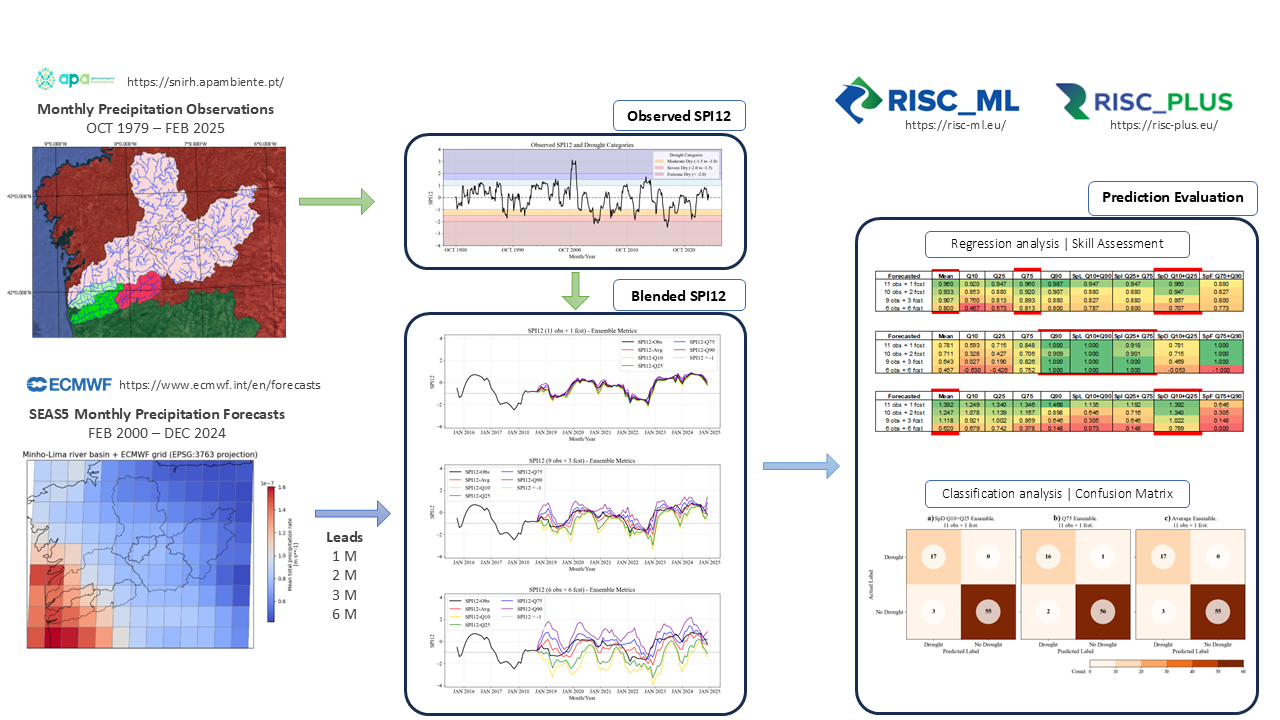
The cross-border Lima River Basin, shared between Portugal and Spain, is prone to recurrent meteorological droughts, which are projected to intensify under climate change. This trend underscores the need for robust early-warning systems to support proactive water management. Under the EU-funded RISC_PLUS project—aimed at strengthening resilience to hydro-climatic risks in the cross-border Minho–Lima River Basins—this study develops a regionalised forecasting framework to evaluate meteorological drought forecast skill using precipitation forecasts from the European Centre for Medium-Range Weather Forecasts (ECMWF) Seasonal Forecasting System 5 (SEAS5) for the Portuguese section of the Lima River Basin. The 12-month Standardized Precipitation Index (SPI12) is employed as a long-term drought indicator, computed from hybrid 12-month accumulations that combine observed monthly precipitation (October 1979 to February 2025) and SEAS5 forecasts (October 2018 to February 2025). These data are integrated into four hybrid configurations (1 to 6 months lead time) to maximise forecast skill while preserving observed drought memory: 11 months of observations plus 1 month of forecast (11 obs + 1 fcst), 10 obs + 2 fcsts, 9 obs + 3 fcsts, and 6 obs + 6 fcsts. Forecast performance is assessed over the period October 2018 to February 2025. Deterministic SPI12 forecasts and categorical drought classifications are evaluated using a suite of regression-based metrics (e.g., Pearson correlation, root mean square error (RMSE), and skill scores) and contingency-table-based metrics (e.g., false alarm rate (FAR) and F1-score), across SEAS5 ensemble members, percentiles, and spread-based indicators. The 11 obs + 1 fcst configuration, particularly when using the Dry Spread (SpD; defined as the Q10 + Q25 percentiles) and the Q75 percentile, exhibits the highest skill, achieving a Pearson correlation coefficient of r=0.97, an RMSE of approximately 0.17, and near-perfect categorical performance (probability of detection (POD) = 1.00; FAR = 0.00). Conversely, longer lead-time configurations (9 obs + 3 fcsts and 6 obs + 6 fcsts) exhibit degraded performance, with the 6 + 6 configuration providing limited added value relative to climatology. These results demonstrate that SEAS5 precipitation forecasts can provide skilful drought predictions at lead times of up to six months in the Lima River Basin when integrated within the SPI12 framework. The proposed blending methodology therefore provides a robust technical basis for the operational early-warning system being developed under the RISC_PLUS project to support transboundary drought risk management in the Minho–Lima region.
Keywords:
Lima River Basin
; climate change
; Standardized Precipitation Index
; drought forecast
; ECMWF SEAS5
Copyright: This open access article is published under a Creative Commons CC BY 4.0 license, which permit the free download, distribution, and reuse, provided that the author and preprint are cited in any reuse.


