

Submitted:
13 May 2026
Posted:
13 May 2026
You are already at the latest version
Abstract
(1) Background: Indonesia faces the dual challenge of a high tuberculosis (TB) burden and increasing drug resistance. Conventional molecular diagnostics frequently fail to detect isoniazid resistance and nontuberculous mycobacteria (NTM). This study evaluates a domestic multiplex Open PCR system in Medan, Indonesia.
(2) Methods: From July to November 2025, 1,569 sputum specimens from suspected TB pa-tients were analysed using the Indigen MTB/NTM/DR-TB Real-time PCR Kit Gen 2.
(3) Results: Mycobacterial DNA was detected in 421 specimens (26.8%). Among these, 396 (94.1%) were drug-susceptible TB, while 16 (3.8%) showed resistance, predominantly INH mono-resistance (n=14; 0.89% of total). Additionally, 9 cases (2.1%) involved NTM or TB-NTM co-infections. Tertiary hospitals showed significantly higher positivity rates (33.5%) than primary care (18.9%; p < 0.001). TB status was significantly associated with male (p = 0.0052) and older age (p = 0.006), whereas resistance profiles and NTM distribu-tion were consistent across all demographic groups (p > 0.80).
(4) Conclusions: The Open PCR system effectively identified INH resistance and NTM cases overlooked by standard rifampicin-only assays. By bridging diagnostic gaps across a decentralized referral network, this facilitates rapid and targeted therapy. Integrating multiplex domestic innovations into national diagnostic algorithms is essential for achieving Indonesia’s TB elimination targets.
Keywords:
tuberculosis
; Mycobacterium tuberculosis
; nontuberculous mycobacteria
; isoniazid resistance
; open PCR system
; TB-NTM coinfections
1. Introduction
Tuberculosis (TB) continues to pose a major global public health challenge and remains the leading cause of death from a single infectious agent. Although international interventions have been implemented, progress toward the 2030 elimination targets has been inadequate in most high-burden regions. In 2024, an estimated 10.7 million individuals fell ill with TB globally, resulting in 1.23 million deaths. Indonesia ranks second globally in TB burden, accounting for approximately 25% of global cases in 2024 and contributing to the observed increase in incidence between 2020 and 2023 [1,2]. North Sumatra represents a critical TB hotspot, ranking third nationally after West Java and East Java, with an estimated 74,434 cases in 2024 [3]. Within the province, Medan reports the highest number of cases among regencies and cities, with 10,050 cases in 2022, likely influenced by its high population density [4,5].
Indonesia’s TB diagnostic framework relies heavily on the Xpert MTB/RIF assay, but it is limited to detecting only rifampicin (RIF) resistance [6,7]. In contrast, the emergence of multidrug resistant TB (MDR-TB) necessitates broader surveillance, particularly for Isoniazid (INH) resistance and the presence of Nontuberculous Mycobacteria (NTM), which are frequently misidentified as TB in clinical settings [8,9]. The Indigen MTB/NTM/DR-TB Real-time PCR Kit Gen 2 addresses these gaps by detecting not only MTB and NTM but also drug resistance markers for RIF (RIF A, RIF B) and INH (inhA, katG), offering a more comprehensive diagnostic profile than closed systems [10].
In response to the 2022 TB Joint External Monitoring Mission (JEMM) recommendations [11], Indonesia’s National Tuberculosis Control Program prioritized diagnostic diversification by utilizing the post-COVID molecular testing network. Approximately 1,046 laboratories nationwide possess real-time Open PCR capacity, providing a rapid, scalable, and cost-effective platform for TB diagnosis. This transition is supported by Presidential Decree No. 67/2021 and Presidential Instruction No. 2/2022, which both emphasize intensified TB case finding and the adoption of locally made components (TKDN). Building on these policy directives, the Ministry of Health initiated operational research in 23 districts across 8 provinces to evaluate domestic multiplex PCR kit, including Indigen MTB/NTM/DR-TB Gen 2, for TB detection in sputum-suitable suspected cases [12].
Integrated into this national framework, the Prof. dr. Chairuddin P. Lubis Universitas Sumatera Utara (USU) Hospital was officially designated by the Ministry of Health in July 2025 as a reference hospital for Open PCR TB diagnostics following completion of the operational research. Since then, the facility has provided free Open PCR TBC diagnostic services to the public, significantly strengthening the detection capacity in Medan. By integrating advanced multiplex molecular assays, the site plays a critical role in mitigating the nation’s diagnostic gap, providing the evidence base necessary for targeted clinical interventions in high-burden settings while simultaneously advancing the molecular research necessary to combat drug-resistant TB.
2. Materials and Methods
2.1. Study Design, Clinical Specimen Collection, and Ethic Consideration
This study was conducted as part of a national initiative to implement Open PCR systems for TB diagnostics. In accordance with the national spot-morning or spot-spot protocol, two specimens were obtained from each patient: the first spot specimen at the initial clinical visit and the second spot-morning specimen collected immediately upon waking the following day, before oral hygiene or food intake [12]. A volume of 1 mL mucopurulent sputum per container was required to ensure sufficient material for molecular analysis. Ethical clearance was obtained from the Health Research Ethics Committee of Universitas Sumatera Utara] (No: 397/KEPK/USU2025).
2.2. Molecular Detection via Indigen MTB/NTM/DR-TB Assay
Molecular assay was performed using the Indigen MTB/NTM/DR-TB Real-time PCR Kit Gen 2 (PT Kalgen DNA, Indonesia) [10], designed to detect Mycobacterium tuberculosis (MTB), Nontuberculous Mycobacteria (NTM), and mutations in four gene regions associated with resistance to Rifampicin (RIF A, RIF B) and Isoniazid (inhA, katG).
2.2.1. DNA Extraction
DNA was isolated using a chemical liquefaction and thermal lysis protocol. Sputum samples (750μL) were liquefied with an equal volume of sputum liquefaction solution and incubated for 30 minutes at room temperature with periodic homogenization. Following centrifugation at 14,000 rpm, the resulting pellet was washed with TB Washing Solution. For lysis, the pellet was resuspended in 200μL of TB Solution A and supplemented with 2μL of TB Internal Control. Thermal lysis was executed at 100 °C for 30 minutes using a secured heat block. After a final centrifugation (10 minutes at 14,000 rpm), the DNA-containing supernatant was yielded and stored at -20 °C until PCR amplification process.
2.2.2. Real-Time PCR Amplification
Two master mixes for PCR Mix A and PCR Mix B, were prepared for each sample to accommodate the multiplex nature of the assay. Each 20μL reaction volume consisted of 18μL of Master Mix (comprising TB Reagent A/B, Enzyme Mix, and NFW) and 2μL of DNA template. Standardized Positive and Negative Controls were included in every run. The reactions were processed using the Rotor-Gene Q (Qiagen, Germany) real-time platform.
2.3. Data Interpretation
Data acquisition and analysis were performed using the Rotor-Gene Q software. Cycle threshold (Ct) values were analyzed across four fluorescent channels. Results were interpreted based on the exponential amplification phase of the fluorescence curves, with visual verification of the auto-threshold settings. The presence of MTB, NTM, and specific drug-resistance alleles was determined by comparing Ct values against the manufacturer’s standardized thresholds for each target.
2.4. Data Analysis
Diagnostic prevalence and descriptive statistics used to characterize the study population, and the significance of findings were analyzed using R Studio (v. 4.6.0).
3. Results
- 3.1.1. Study Population and Patient Demographic Distribution
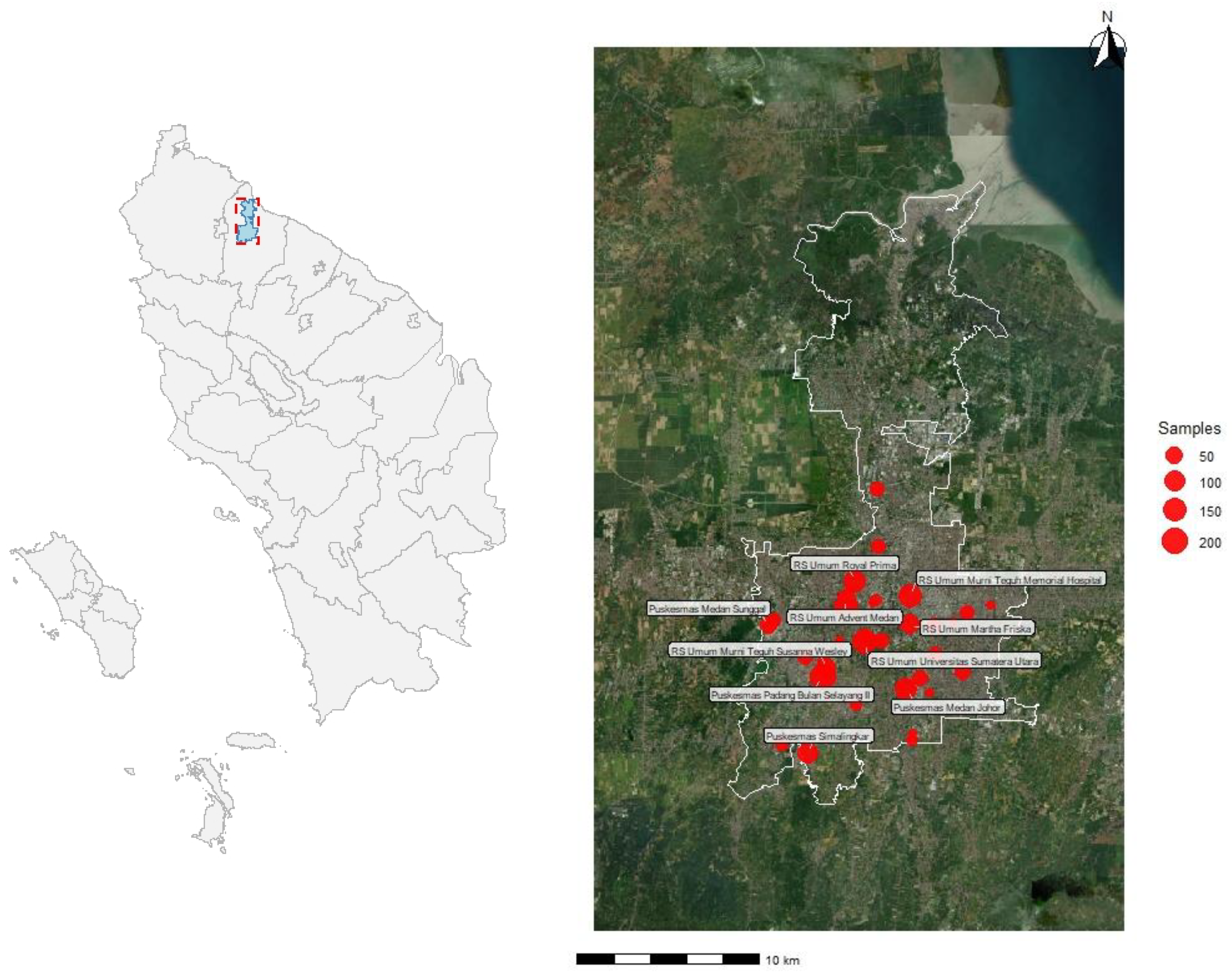
Between the study period, a total of 1,569 presumptive TB patients were enrolled and screened using the Open PCR system at the Prof. dr. Chairuddin P. Lubis USU Hospital. This study population was derived from a broad network of 35 participating healthcare facilities distributed across Medan City (Figure 1). As illustrated in Figure 1B, the geographic origin of these referrals spans the entire metropolitan area.
While referrals were widespread, the contribution of specimen volume was heterogeneous among participating sites. High-volume contributors included both primary and tertiary facilities, notably Puskesmas Padang Bulan Selayang II (n=214), the reference Prof. dr. Chairuddin P. Lubis USU Hospital (n=180), and Murni Teguh Memorial Hospital (n=144). Site-specific data available in Supplementary Data S1.
Figure 1.
Geographic distribution of participating health facilities in the Medan, North Sumatra.
The study population was predominantly male (n = 899; 57.3%) compared to female participants (n = 670; 42.7%). The mean age was 47.6 ± 19.0 years, reflecting a wide demographic range within the referred cohort (Table 1).
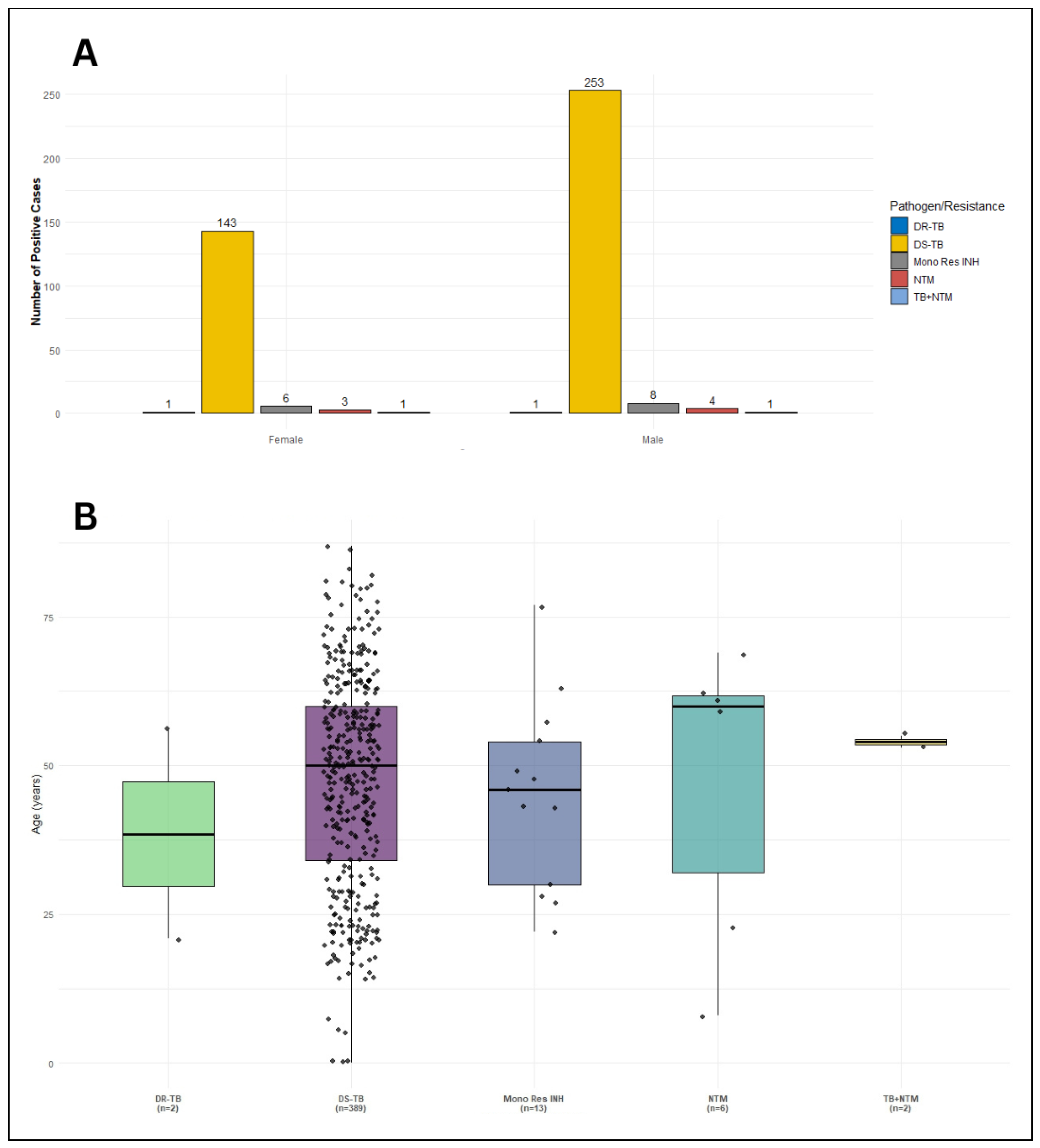
Statistical analysis of positive cases (n = 421) identified a significant difference in age distribution by sex. Male patients had a significantly higher median age than female patients (51 years versus 46 years; Wilcoxon rank-sum test, p = 0.006). In contrast, no significant age differences were identified across diagnostic categories (Kruskal–Wallis test, p = 0.867). Furthermore, sex was not significantly associated with the specific PCR result (Fisher’s exact test, p = 0.891). These results indicate that although age profiles differ by sex within the positive cohort, the type of infection, whether DS-TB, DR-TB, or NTM, is independent of these demographic factors in the Medan patient population.
Figure 2.
Diagnostic profiles and demographic distribution of confirmed mycobacterial cases (n = 421). (A) Distribution of specific diagnostic outcomes; DS-TB, Mono-Res INH, NTM, DR-TB, and TB-NTM co-infections stratified by sex. (B) Age distribution across diagnostic categories visualized using a combine scatter and boxplot. The scatter elements represent the probability density of the data, while the internal boxplots indicate the median and interquartile range (IQR).
Figure 2.
Diagnostic profiles and demographic distribution of confirmed mycobacterial cases (n = 421). (A) Distribution of specific diagnostic outcomes; DS-TB, Mono-Res INH, NTM, DR-TB, and TB-NTM co-infections stratified by sex. (B) Age distribution across diagnostic categories visualized using a combine scatter and boxplot. The scatter elements represent the probability density of the data, while the internal boxplots indicate the median and interquartile range (IQR).
3.3. Performance of the Open PCR System in TB and NTM Detection
Out of the 1,569 specimens analyzed, 1,148 (73.17%) were negative for mycobacterial DNA, while 421 (26.8%) came out positive for MTB, NTM, or TB-NTM co-infections (Table 2). Among the positive cohort, the vast majority were identified as drug-susceptible TB (DS-TB; n = 396; 25.24% of total). A key strength of the Indigen assay was its ability to differentiate drug resistance and NTM species effectively. Drug resistance was identified in 16 patients, dominated by Isoniazid (INH) mono-resistance (n=14; 0.89%), with only two cases (0.13%) classified as multidrug-resistant (DR-TB). Furthermore, the system identified 9 cases involving NTM (7 pure NTM; 2 TB-NTM co-infections). The detection of INH mono-resistance and NTM, which would likely be mismanaged under a Rifampicin-only screening algorithm, underscores the importance of clinical utility of the Open PCR system in this endemic setting.
Diagnostic results varied significantly according to healthcare facility type (χ² = 42.871, p = 4.904 × 10⁻¹⁰). Tertiary hospital-based facilities reported the highest number of positive detections, with 278 of 830 samples (33.5%) testing positive. This likely reflects a pre-selected patient population with more severe or classic symptoms of pulmonary TB. Primary care facilities (Puskesmas) submitted the largest number of specimens (n = 720) but demonstrated a lower positivity rate (136 of 720; 18.9%). This is typical for primary care settings where screening is broader and may include individuals with milder or more non-specific respiratory symptoms. Clinic and sub-center facilities showed 7 positive results among 19 specimens (36.8%). This estimate should be interpreted with caution due to the small sample size hence the percentage is less stable than the other tiers.
Figure 3.
Diagnostic results of Open PCR system by healthcare facility Tie.
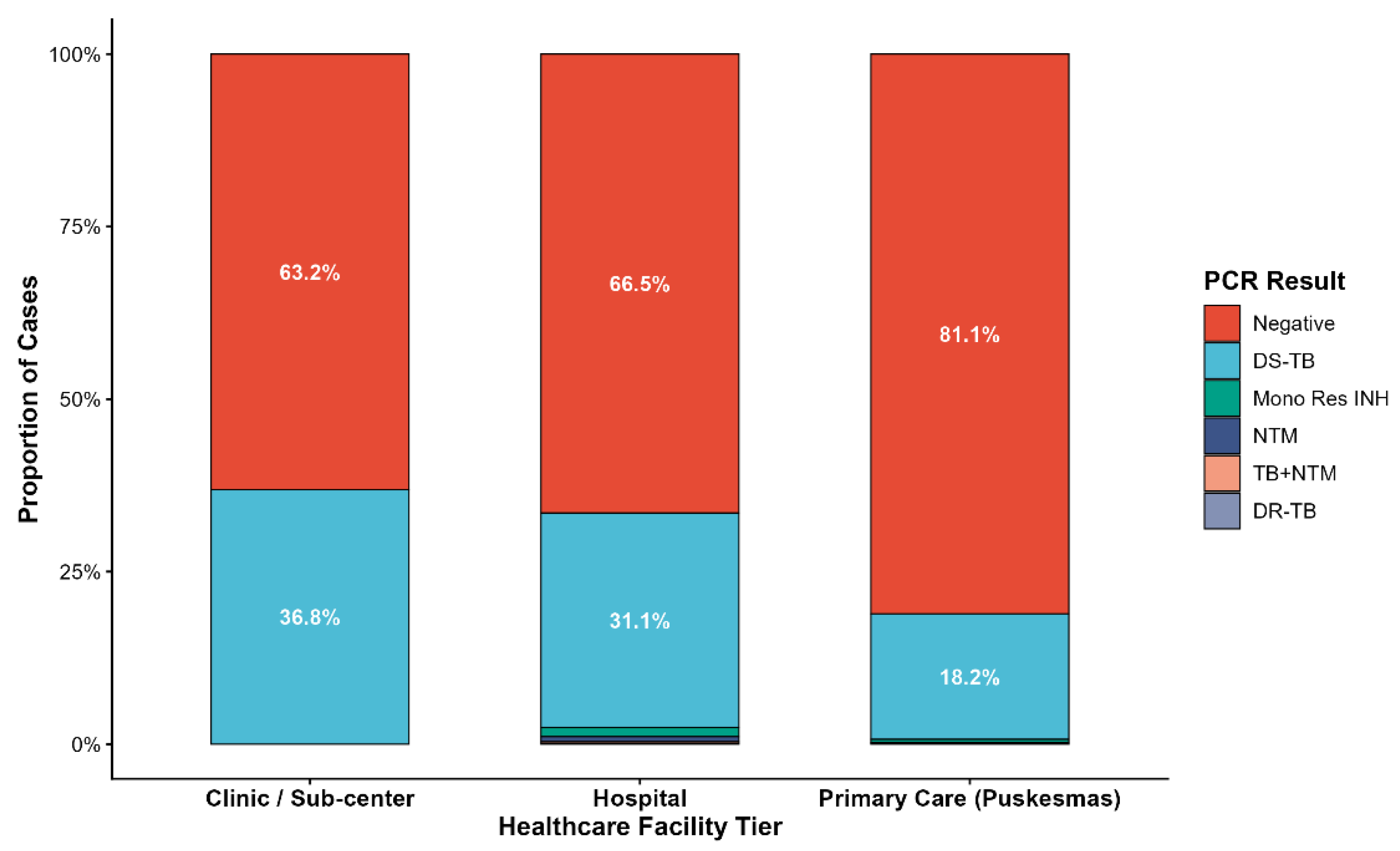
The reference hospital served as a pivotal diagnostic hub, contributing the second-largest sample volume and the highest number of DS-TB detections (n=47). There is a marked difference in positivity rates between primary care and tertiary hospitals. For example, Puskesmas Padang Bulan reports a positivity rate of approximately 14%, whereas RS Umum Royal Prima demonstrates a substantially higher rate of 40%. These results reflect the higher clinical suspected cases and disease severity typical of hospital-based referrals. Crucially, the detection of NTM and DR-TB across diverse facility tiers validates the effectiveness of decentralized Open PCR in detecting rare pathogens that might otherwise be overlooked in centralized routine testing workflows.
4. Discussion
The Open PCR system demonstrated effective case identification across all healthcare facilities in Medan, with the highest detection rates observed in hospital settings. The lower positivity rate at the Puskesmas level indicates the system’s broad screening capacity within the community, successfully ruling out approximately 81% of suspected cases. Conversely, the concentration of confirmed cases in tertiary settings justifies the Ministry of Health’s strategy to prioritize molecular infrastructure in reference hospitals to manage the complex diagnostic burden of North Sumatra (see Supplementary Data S2 for diagnostic outcome based on healthcare facility).
A critical finding of this study is the detection of NTM and TB-NTM co-infections. In many TB-endemic regions, NTM infections are frequently misdiagnosed as MDR-TB due to overlapping clinical presentations and the limitations of standard GeneXpert MTB/RIF assays, which only detect MTB [13,14]. Our detection of NTM cases, including those previously treated for TB, aligns with recent findings by suggesting that NTM remains a hidden challenge in Indonesia’s post-treatment surveillance [15].
While the WHO-recommended Line Probe Assay (LPA) can differentiate MTB from NTM, its technical complexity and 6-hour processing time often delay clinical decisions [16]. The Open PCR platform implemented here offers a superior alternative by providing simultaneous detection of MTB, virulent NTM species, and INH/RIF resistance markers with significantly faster sample preparation. This diagnostic capability facilitates the transition toward NGS-based surveillance to map NTM species-level diversity circulating in Medan. As evidenced by regional findings in Java, where the M. fortuitum and M. abscessus groups were predominant, precise identification is critical, as these pathogens necessitate therapeutic interventions that deviate significantly from standard anti-tuberculosis regimens [17].
Our analysis revealed a significant association between gender and TB status, with males exhibiting higher positivity rates and being significantly older than females. This male predominance likely reflects cumulative risk factors prevalent in the Indonesian male population, such as high rates of tobacco use and occupational exposure [18,19]. However, once infection was established, the distribution of specific pathogens (DS-TB, DR-TB, and NTM) was uniform across sexes and ages (p > 0.80).
This suggests that while demographic factors influence susceptibility to active disease, they do not selectively filter the genotypes or resistance profiles of circulating bacilli. The lack of demographic clustering among drug-resistant isolates (DR-TB and Mono-Res INH) reinforces the conclusion that antimicrobial resistance is a systemic challenge driven by prior treatment non-adherence or direct transmission within the community, rather than a biological vulnerability linked to age or sex.
The high prevalence of INH mono-resistance (0.89%) detected in this cohort—which would have been missed by standard RIF-only molecular tests—highlights the danger of the “diagnostic gap” in Indonesia. By utilizing a domestic IVD product with high TKDN, this study supports the mandates of Presidential Regulation No. 67 of 2021 and Presidential Instruction No. 2 of 2022 [12]. The implementation at Prof. dr. Chairuddin P. Lubis USU Hospital demonstrates that integrating COVID-19-era molecular infrastructure with domestic innovations can accelerate TB case-finding while ensuring health system resilience.
Effective communication between clinical microbiologists and lung specialists remains paramount, particularly when NTM is detected, to differentiate between causative pathogens and transient colonization [13]. The Open PCR system provides the necessary evidence base for these critical clinical decisions, ultimately preventing the misdiagnosis of NTM as MDR-TB and ensuring patients receive targeted, effective therapy.
5. Conclusions
The implementation of the Open PCR system in Medan successfully bridged critical diagnostic gaps by identifying not only Mycobacterium tuberculosis (MTB) but also Nontuberculous Mycobacteria (NTM) and isoniazid (INH) mono-resistance, cases frequently missed by standard GeneXpert assays. Our findings demonstrate that while tertiary hospitals serve as high-yield hubs, the system’s utility as a frontline tool across the referral network is vital for decentralized case-finding and rule-out screening.
The observed epidemiological patterns, which marked by a significant male predominance and the potential for NTM to clinically mimic drug-resistant TB, underscore the necessity of multiplex molecular surveillance. By providing rapid, simultaneous differentiation of mycobacterial species and resistance markers, this platform offers a scalable solution to mitigate misdiagnosis and ensure targeted therapy. Ultimately, integrating such versatile molecular infrastructure into national diagnostic algorithms is essential for optimizing treatment outcomes and reducing the systemic burden of mycobacterial diseases in Indonesia.
Supplementary Materials
The following supporting information can be downloaded at the website of this paper posted on Preprints.org.
Author Contributions
Conceptualization, R.L., M.H., and G.N.; methodology, R.L., M.H., N.T., L.I., AND T.T.; software, N.T; validation, R.L.; formal analysis, M.H. and T.T.; investigation, R.L., M.H., and G.N.; resources, R.L. and G.N.; data curation, M.H., N.T., C.G.; writing—original draft preparation, N.T.; writing—review and editing, N.T., and C.G.; visualization, N.T.; supervision, R.L., M.H., and G.N.; project administration, M.H., G.N., and L.I.; All authors have read and agreed to the published version of the manuscript.
Funding
This research received no external funding.
Institutional Review Board Statement
The study was conducted in accordance with the Declaration of Helsinki, and approved by the Health Research Ethics Committee of Universitas Sumatera Utara (protocol code 397/KEPK/USU2025, approved in May 20th 2025).
Informed Consent Statement
Informed consent was obtained from all subjects involved in the study.
Data Availability Statement
The data presented in this study are available on request from the corresponding author due to (specify the reason for the restriction).
Acknowledgments
The authors express their sincere gratitude to the Director of the Chairuddin P. Lubis Universitas Sumatera Utara (USU) Hospital for providing the facilities and support necessary in the implementation of the Open PCR system service in Medan. We also extend our appreciation to the Dinas Kesehatan Kota Medan (public health office) and all of the healthcare facilities staff for their invaluable cooperation in specimen delivery and data coordination. Finally, we thank the patients who participated in this study, whose contribution is essential to the advancement of tuberculosis research in North Sumatra. During the preparation of this manuscript, the authors used Grammarly Desktop (ver. 1.162.0.0) for the purposes of grammatical editing and improvements. The authors have reviewed and edited the output and take full responsibility for the content and integrity of this publication.
Conflicts of Interest
The authors declare no conflicts of interest.
Abbreviations
The following abbreviations are used in this manuscript:
| Ct | Cycle Threshold |
| DNA | Deoxyribonucleic acid |
| DR-TB | Drug-Resistant Tuberculosis |
| DS-TB | Drug-Susceptible Tuberculosis |
| inhA | Isoniazid-A (gene target) |
| INH | Isoniazid |
| IVD | In Vitro Diagnostic |
| JEMM | Joint External Monitoring Mission |
| katG | Catalase-peroxidase (gene target) |
| LPA | Line Probe Assay |
| MDR-TB | Multidrug-Resistant Tuberculosis |
| MTB | Mycobacterium tuberculosis |
| NGS | Next-Generation Sequencing |
| NTM | Nontuberculous Mycobacteria |
| PCR | Polymerase Chain Reaction |
| RIF | Rifampicin |
| TB | Tuberculosis |
| TKDN | Tingkat Komponen Dalam Negeri (Domestic Component Level) |
| WHO | World Health Organization |
References
- World Health Organization. Global tuberculosis report 2025. Geneva: World Health Organization; 2025. Available online: https://www.who.int/publications/i/item/9789240116924 (accessed on 20 April 2026).
- Lauchan, A.; Ashar, Y.K.; Siregar, P.A.; Samosir, H.E. Determinant factors of lung tuberculosis in North Sumatera Province: analysis of Indonesia Health Survey data 2023. GLK 2025, 23(2), 211–220. [Google Scholar] [CrossRef]
- Dinas Kesehatan Provinsi Sumatera Utara. Monitoring dan Evaluasi Program Tuberkulosis Provinsi Sumatera Utara Tahun 2023. Medan: Dinas Kesehatan Provinsi Sumatera Utara; 2024 Jun 1. Available online: https://dinkes.sumutprov.go.id/artikel/pltkepala-dinas-kesehatan-sumut-urutan-ke-3-kasus-tbc-di-indonesia-1717200000 (accessed on 20 April 2026).
- Hasibuan, E.K.; Silalahi, M.I.; Hartono. The environmental determinants of disease transmission in Medan City. BKKP 2025, 4(1), 146–154. [Google Scholar]
- Ismah, Z.; Erpiani; Siskia, M.; Simatupang, M.I.; Lestari, A.A.; Marbun, M.N.; Waluyani, I.R.; Carissa, T.; Hevanda, S.; Shafira, D.D.; Nst, A.N. Descriptive epidemiological study of the incidence of tuberculosis in Medan City at the North Sumatra Provincial Health Office. Hear. JKM 2024, 12(2), 281–289. [Google Scholar] [CrossRef]
- World Health Organization. WHO consolidated guidelines on tuberculosis: module 3: diagnosis - rapid diagnostics for tuberculosis detection, 3rd ed.; World Health Organization: Geneva, 2024; Available online: https://www.who.int/publications/i/item/9789240089488 (accessed on 20 April 2026).
- Nadjib, M.; Dewi, R.K.; Setiawan, E.; Miko, T.Y.; Putri, S.; Hadisoemarto, P.F.; Sari, E.R.; Pujiyanto; Martina, R.; Syamsi, L.N. Cost and affordability of scaling up tuberculosis diagnosis using Xpert MTB/RIF testing in West Java, Indonesia. PLoS ONE 2022, 17(3), e0264912: 1-16. [Google Scholar] [CrossRef] [PubMed]
- Saktiawati, A.M.I.; Vasiliu, A.; Saluzzo, F.; Akkerman, O.W. Strategies to enhance diagnostic capabilities for the new drug-resistant tuberculosis (DR-TB) drugs. Pathogens 2024, 13, 1045: 1–13. [Google Scholar] [CrossRef] [PubMed]
- Van der Merwe CJ. Undetected isoniazid mono resistance in rural Eastern Cape Province: a risk for the emergence of multidrug-resistant TB [thesis]. Stellenbosch: Stellenbosch University; 2021.
- KalGen DNA. INDIGEN MTB/NTM/DR-TB Real-time PCR Kit Gen. 2. Jakarta: KalGen DNA. Available online: https://kalgendna.co.id/products/indigen-real-time/ (accessed on 20 April 2026).
- World Health Organization. Indonesia tuberculosis joint external monitoring mission (JEMM) report 2022. Jakarta: World Health Organization; 2022. Available online: https://www.who.int/indonesia/news/publications/other-documents/tb-joint-external-monitoring-mission-(jemm)-report--2022 (accessed on 20 April 2026).
- Kementerian Kesehatan Republik Indonesia. Petunjuk teknis pemeriksaan tuberkulosis (TBC) menggunakan metode open PCR (polymerase chain reaction). Jakarta: Kementerian Kesehatan RI; 2024.
- Mertaniasih, N.M.; Kusumaningrum, D.; Koendhori, E.B.; Kusmiati, T.; Dewi, D.N. Nontuberculous mycobacterial species and Mycobacterium tuberculosis complex coinfection in patients with pulmonary tuberculosis in Dr. Soetomo Hospital, Surabaya, Indonesia. IJMY 2017, 6(1), 9–13. [Google Scholar] [CrossRef] [PubMed]
- Kusumaningrum, D.; Mertaniasih, N.M.; Soedarsono, S.; Setiawati, R.; Pradipta, C.P. Implication of Negative GeneXpert Mycobacterium tuberculosis/rifampicin results in suspected tuberculosis patients: A research study. IJMY 2024, 13(2), 152–157. [Google Scholar] [CrossRef] [PubMed]
- Biyang, F.I.; Massi, M.N.; Muslich, L.T.; Sultan, A.R.; Hatta, M.; Ramadhan, A.R.; Madjid, B. Identification of nontuberculous Mycobacterium and Mycobacterium tuberculosis complex in sputum patients with suspected tuberculosis. IJMY 2024, 13(4), 436–442. [Google Scholar] [CrossRef] [PubMed]
- Kusumawati, R.L.; Hasibuan, M.; Lestari, I.N.; Tari, N. Molecular Detection of Mycobacterium tuberculosis and Nontuberculous Mycobacteria with Drug Resistance Profiling Using Line Probe Assay in Clinical Samples from Suspected Tuberculosis Patients in North Sumatra, Indonesia. IJMY 2025, 14(4), 347–353. [Google Scholar] [CrossRef] [PubMed]
- Saptawati, L.; Primaningtyas, W.; Dirgahayu, P.; Sutanto, Y.S.; Wasita, B.; Suryawati, B.; Nuryastuti, T.; Probandari, A. Characteristics of clinical isolates of nontuberculous mycobacteria in Java-Indonesia: A multicenter study. PLoS NTD 2022, 16(12), e0011007: 1-17. [Google Scholar] [CrossRef] [PubMed]
- Koesoemadinata, R.C.; McAllister, S.M.; Soetedjo, N.N.; Febni Ratnaningsih, D.; Ruslami, R.; Kerry, S.; Verrall, A.J.; Apriani, L.; van Crevel, R.; Alisjahbana, B.; Hill, P.C. Latent TB infection and pulmonary TB disease among patients with diabetes mellitus in Bandung, Indonesia. Trans. R. Soc. Trop. Med. Hyg. 2017, 111(2), 81–89. [Google Scholar] [CrossRef] [PubMed]
- Hamada, Y.; Quartagno, M.; Law, I.; Malik, F.; Bonsu, F.A.; Adetifa, I.M.; Adusi-Poku, Y.; D’Alessandro, U.; Bashorun, A.O.; Begum, V.; Lolong, D.B. Association of diabetes, smoking, and alcohol use with subclinical-to-symptomatic spectrum of tuberculosis in 16 countries: an individual participant data meta-analysis of national tuberculosis prevalence surveys. ECM 2023, 63, 102191: 1–13. [Google Scholar] [CrossRef] [PubMed]

Table 1.
Demographic characteristic of suspected TB patients.
| Demographic characteristics | n (%) |
|---|---|
| Total cases | 1,569 |
| Sex | |
| Female | 899 |
| Male | 670 |
| Age, years | |
| Infant (0-2) | 9 |
| Child (3-12) | 45 |
| Adolescent (13-18) | 72 |
| Young Adult (19-24) | 129 |
| Adult (25-44) | 365 |
| Middle Aged (45-64) | 633 |
| Elderly (>65) | 316 |
Table 2.
Open PCR system diagnostic outcome.
|
Overall n = 1,5691 |
Female n = 6701 |
Male n = 8991 |
p-value2 | |
| Variable | ||||
| Age (years) | 50.0 (32.0, 62.0) | 49.0 (28.0, 61.0) | 51.0 (36.0, 63.0) | 0.001 |
| Open PCR Diagnostic Outcome | 0.040 | |||
| Negative | 1,148 (73.2%) | 516.0 (77.0%) | 632.0 (70.3%) | |
| DS-TB | 396.0 (25.2%) | 143.0 (21.3%) | 253.0 (28.1%) | |
| DR-TB | 2.0 (0.1%) | 1.0 (0.1%) | 1.0 (0.1%) | |
| Mono Res INH | 14.0 (0.9%) | 6.0 (0.9%) | 8.0 (0.9%) | |
| NTM | 7.0 (0.4%) | 3.0 (0.4%) | 4.0 (0.4%) | |
| TB+NTM | 2.0 (0.1%) | 1.0 (0.1%) | 1.0 (0.1%) | |
1Median (Q1, Q3); n (%). 2Wilcoxon rank sum test: Fisher’s exact test.
Disclaimer/Publisher’s Note: The statements, opinions and data contained in all publications are solely those of the individual author(s) and contributor(s) and not of MDPI and/or the editor(s). MDPI and/or the editor(s) disclaim responsibility for any injury to people or property resulting from any ideas, methods, instructions or products referred to in the content. |
© 2026 by the authors. Licensee MDPI, Basel, Switzerland. This article is an open access article distributed under the terms and conditions of the Creative Commons Attribution (CC BY) license (http://creativecommons.org/licenses/by/4.0/).
Copyright: This open access article is published under a Creative Commons CC BY 4.0 license, which permit the free download, distribution, and reuse, provided that the author and preprint are cited in any reuse.