

Submitted:
12 May 2026
Posted:
13 May 2026
You are already at the latest version
Abstract
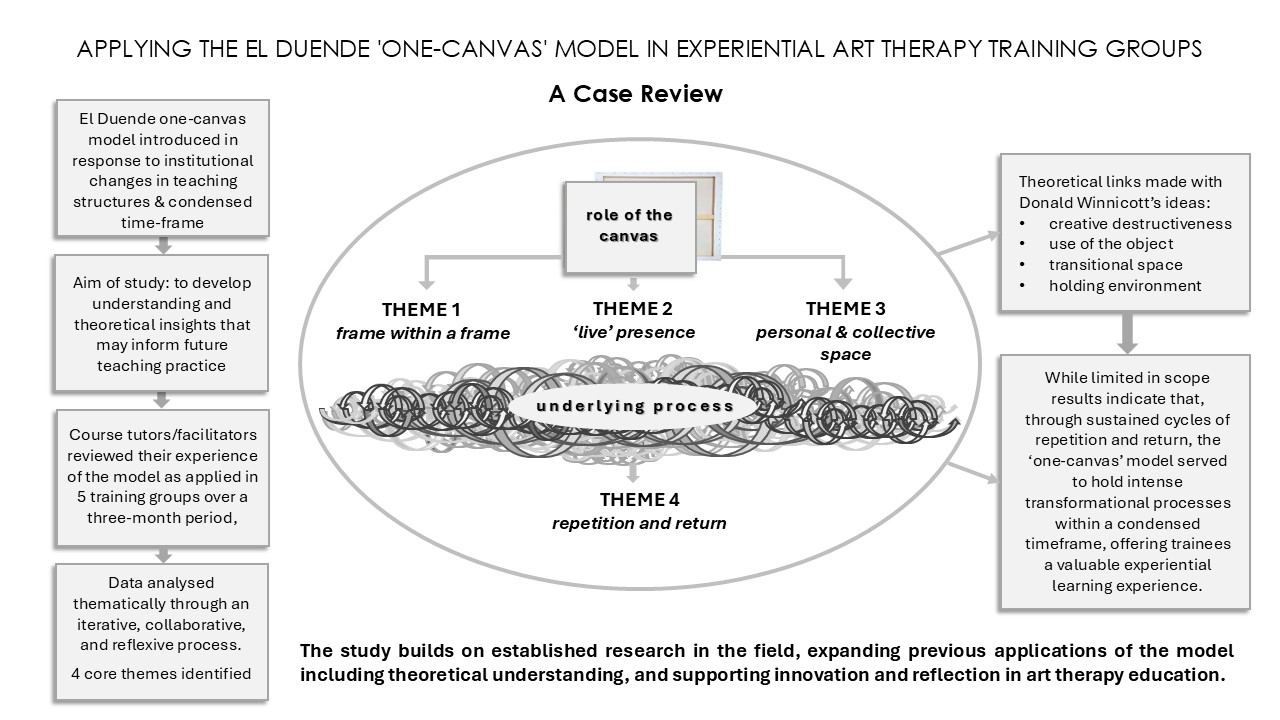
The El Duende ‘one-canvas’ model was developed as an arts-based practice for supervision in art therapy training. Responding to changes in institutional teaching structures, this case review reflects on its use in experiential training groups on one UK-based course, with the aim of developing understanding and theoretical insights that may inform future teaching practice. Eight training group facilitators retrospectively reviewed their experience of the model as applied in five experiential training groups over a three-month period. Data were analysed thematically through an iterative, collaborative, and reflexive process and four core themes were identified. Results are discussed with links made to Donald Winnicott’s ideas of creative destructiveness, use of the object, transitional space, and the holding environment. While limited in scope, results indicate that, through sustained cycles of repetition and return, the ‘one-canvas’ model served to hold intense transformational processes within a condensed timeframe, offering trainees a valuable experiential learning experience. The study builds on established research in the field, expanding previous applications of the model including theoretical understanding, and supporting innovation and reflection in art therapy education. Future research may consider further adaptations to the model, student perspectives, and its influence on personal and professional development.
Keywords:
art therapy education
; El duende one-canvas model
; experiential training groups
; Donald Winnicott
; creative destruction
; use of the object
; repetition and return
; transitional space
; holding environment
Introduction
The El Duende ‘one-canvas’ model was developed as an arts-based practice adapted for therapeutic supervision in art therapy training (Miller, 2012). Built on the premise of response art (Fish, 2012, 2019, 2023) it provides a structured, yet flexible, framework incorporating ongoing reflective process-led artmaking, and offers a unique way to explore and foster emotional, personal, and professional development and learning through a single canvas (Miller, 2020). Drawing on the Spanish concept of “duende” implying a heightened state of passion, intensity, and struggle (Hills de Zarate, 2011), the method involves four central elements: ‘(1) sustained art making over time on one surface; (2) artistic and imaginative exploration of evolving and transforming imagery; (3) the integral use of interim periods; and (4) the inclusion of continual visual documenting’ (Miller, 2022: 24).
International studies have evaluated the method, particularly through its application in supervision (Chilton et al., 2020; Garcia-Reyna, 2019; Gavron & Orkibi, 2021; Lis-Ron & Gavron, 2025; Miller, 2012, 2019; Miller & Robb, 2017; Miller & Schlanger, 2025; Robb & Miller, 2017). While there is limited literature concerning its use in training outside the supervisory context (Chen & O’Sullivan, 2023; Moulton, 2024) there are no studies to date that explore its potential as a teaching method in experiential training groups.
This study reflects on material that emerged in response to the introduction of the ‘one-canvas’ method in five experiential training groups on one UK-based art psychotherapy training course. Initiated in response to institutional changes to teaching structures, and drawing on the experiences, observations and reflections of training group facilitators, the study considers the learning and insights gained, challenges encountered, and the implications for future teaching practice.
Experiential Learning in Art Therapy Training
Experiential learning is an integral part of art therapy training in the UK. Along with the development of a capacity for critical reflection and self-analysis, it is deemed essential in developing, cultivating, and maintaining appropriate creative, therapeutic, and clinical skills as a professional practitioner (BAAT, 2025; HCPC, 2024). Experiential group work during art therapy training has been present since the 1970’s, encompassing a range of diverse approaches and theoretical perspectives (Liebmann, 2008 [1984]; McNeilly, 1983, 1987, 2006; Skaife & Huet, 2014 [1998]; Waller, 2015 [1993]). The introduction of ‘training therapy’ in the mid-1990’s arguably reduced the emotional intensity of such groups (Wood 2025); however, in order to demonstrate the potency of the group process, experiential training groups offer trainees a ‘live’ experience of what it is like to be in, make art in, and express themselves in a group whilst speaking to theory and future practice (Dudley et al., 2014 [1998]).
‘Training Groups’ on the Course
Established over forty years ago, the art therapy programme has undergone much change. Although training group models have varied over the years, historically they ran throughout the first academic year in parallel with other teaching, with a reflective report submitted by trainees at the end of the year. A change of educational institution and learning environment in 2021, and subsequent alterations to teaching structures in 2025 demanded further adjustments which meant that the training groups were now integrated into a three-month module (see Table 1)
The need to adapt the group structure to fit a compressed timeframe led to consideration of the El Duende ‘One-Canvas’ model (Miller, 2012); an approach that had captured the attention of one of the group facilitators at a conference workshop (Miller, 2024).
Method
Rationale
Collaborative and participatory in nature, this retrospective case review draws on the experiences, observations and reflections of training group facilitators with the aim of developing understanding and theoretical insights that may inform future teaching practice (Kapitan, 2018; Talari & Goyal, 2020). Motivated by a desire to understand more about the potential of the one-canvas model as a teaching method with training groups, the study was originally set up as an experiential, exploratory opportunity for staff to reflect on its implementation within the new, compressed, modular structure. It therefore looks back over events that have already happened.
Often criticised for lacking rigor, case studies are one of the earliest forms of psychotherapy research and are close companions to training (ATOL, 2025). In educational settings, they can reveal the efficacy of specific teaching methods and are known to recognise the contexts in which innovations are embedded (Simons, 2005 [1989]). While valid criticisms concern the risk of bias, inconsistency, and misinterpretation, a distinctive strength of the case study is its capacity to reflect in depth on multiple layers and complex real-life processes through generating contextually rich and empirically grounded insights (Annamalah, 2024). Case descriptions are therefore important as they potentially help generate hypotheses which can be put to test through further study (Talari & Goyal, 2020). Moreover, the descriptive nature of case study narratives often resonate with practitioners and educators, bridging the gap between theory and practice by providing compelling accounts of experiences (ATOL, 2025; Edwards, 1999; Kapitan, 2018; Savin-Baden & Major, 2023 in Annamalah, 2024).
Study Design
Participants
Participants comprised five core training group facilitators (including the co-author) with three facilitators (including the first author) providing occasional cover. All were HCPC registered art psychotherapists and members of the teaching staff on the MA Art Psychotherapy Practice.
Procedures
Data Collection
The first author and principal investigator (DM) distributed the research proposal to relevant staff in mid-June 2025 and in mid-July, prepared a recruitment letter. An information sheet describing the purpose of the research, what would be involved, risks and benefits, confidentiality, and data management protocols was also distributed to the relevant staff members along with consent forms.
Data, in the form of facilitator observations and reflections, were gathered in three stages between the end of July and early September 2025:
- Four out of five core facilitators participated in a one-hour group meeting at the end of July immediately after completion of the 14-week training group period, including the review and evaluation.
- All five core facilitators participated in a two-hour group meeting in early September after most trainee reflective reports had been submitted and marked.
- To obtain more detailed individual feedback and to ensure all participants had a voice, DM met with each of the other seven individually for one hour between the end of August and early September 2025; four in person, and three online via Teams.
Meetings were facilitated by DM and involved free-flowing conversation between participants about the experience of delivering the one-canvas model in the training groups; how it functioned, the challenges encountered, and the learning gained by trainees as indicated through their participation in the groups and in their reflective reports. Interventions from DM were minimal with reflections and questions based on responses (Given, 2008). This allowed for flexibility and spontaneity as well as in-depth exploration of participants’ individual perspectives and experiences. It also offered the opportunity to approach the material and the context in which it emerged with an attitude of curiosity, imagination, and discovery (Kapitan, 2018; McNiff, 2013, 2018; Michaels, 2022; Nash, 2021). Meetings were recorded with participants’ consent for subsequent transcription.
Data Analysis
Data analysis was carried out by the authors and followed the framework of reflexive thematic analysis (Braun & Clarke, 2006). Adopting an experiential rather than critical orientation to data offered a robust, yet flexible approach, aiming to give voice to experiences and the reality of participants in a meaningful way (Ahmed et al., 2025; Braun & Clarke, 2012). Reflexive iteration and revisiting of data provided opportunities for identifying and correcting misinterpretations, and refining focus, understanding and insights (Kekeya, 2016; Srivastava & Hopwood, 2009).
Fireflies AI software was used to aid in the transcription process. Transcriptions were read and corrected by DM who familiarised themselves with the data through repeated reading. Initial codes were generated manually and early thematic diagrams were circulated to participants prior to the second group meeting. Codes were revised in response and collated into broader themes. The co-author (AW) independently reviewed meeting transcripts, and developing themes and relationships were further revised and refined as understanding evolved. Interpretive depth was supported through regular meetings between the authors, revisiting data, ongoing notetaking, and critical review and discussion of definitions and names for themes. During the reporting stage, and in order to strengthen credibility, draft results/findings were circulated to all participants to check for resonance with experience and accuracy of researcher understanding (Lloyd et al., 2024).
Reflexivity
For both authors, their practical experience as art psychotherapists contributed to an awareness of the potency of the research material, and the potential for their own biases, preconceptions, and relationships with the research setting and other participants to influence how the data was interpreted and presented. DM’s prior research experience and knowledge of the course as an educator, but minimal direct contact with the 2025 training groups, offered organisational context and critical distance from the data. AW’s experience of qualitative research and direct facilitation of one of the 2025 training groups contributed to contextual sensitivity and close engagement with, and understanding of, the data. The authors acknowledge that patterns and themes do not emerge on their own (Srivastava & Hopwood, 2009) and that the data may be interpreted differently depending on the context and lens through which it is viewed. Nonetheless, they embrace their subjectivity as contributing to a more authentic and accountable research process (Finlay, 2002).
Ethical Considerations
The study was approved by SHU Research Ethics Committee (ID: ER80341837), and data were stored in accordance with data management policies and protocols. All audio-recordings were deleted after transcription.
The authors endeavoured to remain aware at all times of their dual roles as both University-based researchers and teachers. This power differential necessitated careful consideration in terms of how the research would be reported, and trainees’ voices represented (Ramrathan et al., 2017). With this in mind, and after completion of data analysis and reporting, the student cohort was invited to contribute images of their one-canvas process for the purposes of illustration. The principles of informed consent were respected at all times and written consent was obtained to use the material for publication.
Results & Analysis
Results are presented in a descriptive, narrative analysis in order to emphasise the experiences and perspectives of the training group facilitators as research participants, and to spark curiosity, interest and reflection in the reader (ATOL, 2025). Material is anonymised and generalised, except where informed consent has been obtained, and some details have been altered to protect identities.
Summary of Themes
The authors identified four core themes with related subthemes concerning the role of the canvas and the underlying process. These are discussed below and summarised in Figure 1. While the themes and subthemes foreground particular aspects, there are close interactions between them with each part contributing to the whole.
The Role of the Canvas
Theme 1: Canvas as a Frame Within a Frame
Unlike previous models, each trainee started from the same point with a blank, A2 size 50mm block canvas, and was invited to bring two objects/images to the first group: one symbolising something they’d like to unearth and the other something they’d like to bury or hide (Miller, 2024). After covering the surface of the canvas with two associated colours, they were then encouraged to begin experimenting with the canvas using the available materials, and to document their ongoing process, photographically and in a reflective journal.
- resistance, anger and frustration
Facilitators reported some initial resistance when directed to work in this way. One remarked how some group members were quite ‘angry with the canvas’ and ‘resentful of […] having to do it.’ Another noted how several people spoke about ‘canvas being something that they would never, ever choose to work on’. They described how some trainees also expressed discomfort with the words ‘unearth’ and ‘bury’ in relation to selecting two objects; with one facilitator reflecting that, ‘straight away it takes you into what’s beneath the surface.’ One facilitator reflected on how the canvases were subject to huge projections from trainees, with words used such as ’rebellion and fighting against it’. This was echoed in remarks by others who noted some trainees’ desire to ‘destroy the canvas’.
- exploration, play and risk-taking
The canvas offered each trainee the same physical as well as symbolic frame although, as one facilitator remarked, the trainees ‘were all so different […] and I think the canvas recognised that’. While a few nervously approached the task, facilitators reported that most engaged quickly, with some taking big risks early on; challenging the structure of the canvas and breaking the frame. This, in turn, emboldened group members to try new things, allowing others, as one facilitator reflected, to ‘take the risk of […] doing something that they wouldn’t have thought about doing before.’
While facilitators observed how some trainees seemed initially quite controlled in their use of materials; determined, as one remarked, ‘to go this way […] to do this’, others used the canvas to try out new materials and ways of working. It became, as another reflected, a ‘playground to play, explore and get creative with, try things out […] it gave [the trainees] permission to launch whatever you wanted to launch at it.’
Although some chose to work only on the top surface of the canvas, having both back and front of the canvas also offered something different from previous models. As one facilitator reflected, it ‘allowed them to explore both or realise that actually they’ve neglected one side for a little bit’.
- retreat, protection and avoidance
Facilitators also commented on the role of the canvas as somewhere to hide – a place of retreat and avoidance. One remarked on how it provided ‘protection as well, an isolation away from one another’. Similarly, another recalled how, particularly when things got ‘tough in the group’ trainees’ time with their canvas ‘was like the safety – my time with my canvas’; a dynamic that came to the fore for one group in the online session. Reflecting on the anger and tension, facilitators wondered about trainees ‘being away from canvas […] the room and […] their consistent facilitator’ and how this might have afforded ‘a breadth of space for [the trainees] to acknowledge feelings that maybe they’d been avoiding.’
- containment
One facilitator recalled the apparent sense of relief for some trainees that ‘they could put whatever they wanted out of their mind onto the canvas. It would contain, it would look after, it would help process, it would make sense of it.’ Another remarked on how the block frame meant that the underside offered a literal, as well as symbolic, container for ‘pouring into’. Echoing this, another reflected on occasions where they ‘could see a canvas was holding a lot’, with the risk of it ‘spilling everywhere’ if moved, and there was general consensus that, as one reflected, the process seemed ‘more visceral’ than previous models – that ‘it was the artmaking that really did it’.
Theme 2: Canvas as a ‘Live Presence’
- companion and friend
For some trainees, as one facilitator observed, the canvas ‘became a “living” presence’ and an ‘extension of themselves […] it was a companion’. Another recalled trainees ‘speaking about them almost like personifying the canvas, and it becoming the companion and friend and an extended part of them.’ Another spoke of the energy in a trainee’s process, the ‘sense of aliveness in the nature of the marks and their ‘investment’ in it; something which, another noted, seemed to take some trainees by surprise.
- object of ambivalence, attachment and loss
While connecting with their canvas came quickly to some, facilitators reported that the canvas was also a source of anxiety and ambivalence. As one remarked, ‘it could be freedom for one person and […] entrapment for someone else. Another noted how, early on, some trainees seemed ‘quite scared of it’ or ‘apprehensive’, and that in the reports, some had clearly felt ‘frustrated with themselves with the canvas [and] with what they’d done’. Another remarked on how trainees ‘dipped in and out of enjoying it, but also disliking it’ with one facilitator recalling trainees saying, ‘I can’t look at that canvas, I just hate it’. Another remarked on the initial ‘excitement when using unfamiliar materials such as ‘Brusho and PVA glue’, and how trainees then had to deal with the disappointment when returning a week later to find ‘they were as dull as anything’.
Reflecting on feelings of attachment and loss towards their canvas that emerged during the online session, another remarked that there was ‘almost a possessiveness of each canvas […] so the canvas became quite precious.’ Others appeared to struggle with making changes to their canvas, becoming very attached at particular points and experiencing, as one facilitator reflected, a ‘huge sense of loss’ for previous stages.
- confronting object
Reflecting on the process, one facilitator remarked that ‘the repetition – returning again and again […] meant they couldn’t hide and they had to confront what was […] there for them’. Others reported trainees describing how they were ‘blown away by being confronted with the canvases and with themselves’, with one describing how ‘there are these things coming out of the canvases and they were just in peoples’ lives as well’. This was echoed by another who noted that, for some trainees, ‘through the journey with the canvas, they sort of really faced [their] feelings’, leading to quite ‘powerful realisation[s]’.
- teacher
Having read the reflective reports one facilitator remarked on how the process of documenting and journalling ‘really gets them on a solid footing’ as a reflective practitioner. Another noted how it was making them ‘think about what it means to be an art therapist and how they want to be an art therapist’. Another remarked ‘it was a teacher wasn’t it, the canvas’. This was echoed verbally by one trainee who, a facilitator reported, had commented that it taught them ‘the power of the image’; and another who wrote in their reflective report ‘touch in art therapy is more than technique, it is presence [ … ] The canvas taught me that to be fully present with another’s pain, I must also remain open to my own’.
Theme 3: Canvas as a Personal and Collective Space
- Mutual influence, connection, support and learning
As might be expected, dynamics varied considerably within, and across, the different groups. Facilitators reported that some trainees experienced a strong connection and sense of containment within the group ritual and one-canvas process. Others seemed isolated, as if shutting off at times. One noted that the group they covered felt quite supportive, ‘like they had connected’ but that it ‘could also feel very exposing’ for a trainee to share any discomfort. Another recalled how their group ‘gelled and ungelled and gelled and ungelled throughout’, a process that, they later reflected, ‘was there in [the trainees’] own work with the canvas as well.’
Still, all facilitators observed connections begin to develop over time, with initial guardedness moving to increased openness. One observed how after several weeks of being covered over, an image might settle and begin ‘to be developed’ and then a trainee might start ‘to respond to more people in the group’. Recalling some trainees’ annoyance about being in a group rather than just with their canvas another recalled how ‘sharing that they felt disconnected then made them feel quite […] connected.’ Similarly, while generating frustration and anger, the disruption to the usual routine with the online session brought a realisation for another group that, as the facilitator reflected, they were ‘in this together’. Indeed, the group subsequently acknowledged that ‘this might happen when they’re delivering therapy’ and that ‘even if the safety is ruptured, it can come back’.
Reflecting on the influence trainees had on each other, one facilitator commented on trainees speaking of ‘the group as being an extra container and an extra holding environment […] sometimes influencing their canvas.’ Another described how, during the online session, some trainees collectively worked with similar materials ‘like they were trying to […] connect together somehow despite not having the canvas’.
Another facilitator remarked on how early challenges to the canvas structure immediately opened different possibilities, impacting everyone to be ‘braver and break […] or change the frame’. Some trainees, they recalled, invited others to ‘step into’ their canvas, and several group members had later incorporated into their canvasses material given to them by another. This sense of caring for, and holding each other through their canvases was echoed by another who described the care and sensitivity with which their group had held a member’s canvas during their absence. Commenting on trainees’ investment in the process, one facilitator wondered about the canvas as a ‘witness to something’, noting how trainees became more aware of changes in each other’s canvases, something that ‘was never really noticed before’ in previous training groups. They described how, at the end, their group had revisited a collective photograph of the canvases taken in week one, and how trainees had observed ‘how apart they were and how much closer their canvases are now’.
- mirroring and resonance
Facilitators remarked on how some trainees shared their experience through the use of materials, one noticing how they were ‘inspired and encouraged to see the differences’ and by ‘some of their artmaking and use of materials appearing on other people’s canvases’. Another observed how themes ‘overlapped on the canvasses’, and how trainees ‘started to notice that they were […] mirroring into each other’; also, how emotional themes began to ‘echo across the artworks’. Facilitators reflected that connections were also evident in some group pieces made alongside the canvases where, as one reflected, their process ‘sort of mirrored what […] they’d seen happening in the canvas’.
- individual and collective voice
The more experienced group facilitators remarked that there seemed to be less verbal sharing than with previous training groups; some expressing concern about the tension between individual time with the canvas and collective time together. However, reflecting on the struggle for some to find a voice and articulate their experience, and the challenge for others to sit with uncertainty, one remarked that ‘sometimes, it was enough that it was just there presented’. They remarked later ‘I think what the canvas did really well is, it was the voice that was there at the beginning of the group and then there at the end […] the whole group is seen and heard in some aspect.’ As another ventured, the canvases being all the same size, ‘in a way […] gave everybody […] an equal voice.’ Reflecting on the silences in their group, another noted how the canvasses seemed to hold these, offering a ‘reflection where people were paying attention’.
Underlying Process
Theme 4: Repetition and Return
- Connecting, disconnecting and reconnecting
All the facilitators commented on the powerful nature of repeatedly returning to the same canvas; a key difference from previous training group models where one story was generally developed one week and a new one the next. As one facilitator remarked, with the canvas ‘they could leave it, but return to it’. Covering one session a facilitator reflected on the consistency and containment this potentially offered and the ‘sense of connection from one week to the next’; however, it also meant ‘going back to the same thing; there’s no getting away from it.’
Some trainees ‘clearly thought about it in the week as well’ while some others took their canvases home in the interim period, with documentation over time offering important reference points and connecting trainees to past experiences. As one facilitator remarked, it’s ‘held the memory’; a comment picked up by another who reflected that ‘they come into the group with a history of themselves through time, and the canvas […] holds the history of […] it’s process’ over that period.
- layering, scraping away, covering and uncovering
All facilitators commented on how, over time, canvases were layered with different materials, the substance of which might also be torn or pulled out of the frame. One described how there were ‘bits of 3-d stuff […] bits growing out […] a bit of ripping and a bit of sewing’ and how some trainees were ‘using masking tape to […] hold parts of it and to […] unravel parts of it or to leave them caught’. Similarly, another reflected on the ‘covering up of things […] and then a kind of ripping these things off – like ripping a plaster off.’ Facilitators reported that intense processes of layering and scraping away, covering and uncovering, took some trainees very quickly from playful engagement to emotionally raw places. As one remarked ‘they had to come back to something […] and then they’ve gone away and left it and then they’ve come back to it and they’ve got to face that feeling again […] and they don’t want it’. Another observed how, over time, things that had been covered over ‘would start to come back through’. One acknowledged that, for some trainees, the process provoked ‘strong feelings and questions about safety’ in the group, and ‘whether it is ethical to use people’s personal material in this way’. However, reflecting on the whole process later, the same facilitator remarked on how ‘returning to it and the sort of repetition, I think really deepened the emotional response and the sort of self-awareness’.
- rupture and repair
As one facilitator observed, some trainees became ‘quite destructive with their canvases quite quick […] moving on to the back, the sides, taking it off, ripping it off, cutting the frame up’. However, they also noted how, approaching the end of the twelve weeks, there was a ‘sense of soothing, this kind of repair and realising we can’t put things back’. This was echoed by another, who recalled trainees ‘breaking their canvasses and then ‘putting them back, weaving them back together’, and how the group were able to acknowledge that working through a rupture was necessary for closure; ‘to get the feel that they’d processed everything.’
- staying with the process
It was expected that trainees’ experience of, and learning from, the groups would vary; nonetheless, facilitators reported that nearly all, including those who were quieter or seemed to have struggled initially, successfully engaged with difficult material and showed significant learning gains. Indeed, one remarked ‘I could really see how they were sticking with it. It was a real, like, persistence in that I’m going to return to this each week and come back to this.’
While there was consensus concerning, as another facilitator put it, ‘the challenge of it not being perfect, and sitting with unknown and uncertainty’, having read the reflective reports, there was also general agreement that most trainees had turned the learning experience round and looked at it as a really challenging but positive experience. As another reflected, they had ‘found a way of staying with it and were able to see the value of that process’.
Examples of Trainees’ One-Canvas Process
Responding to the invitation to submit process documentation of their one-canvas journey, six trainees generously offered material for the purposes of illustration (Figs 2-7).
Informed consent has been gained for the inclusion of the following images with associated reflections and each artist’s preference regarding accreditation by name or anonymity has been respected.
Figure 1.
Summary of themes.
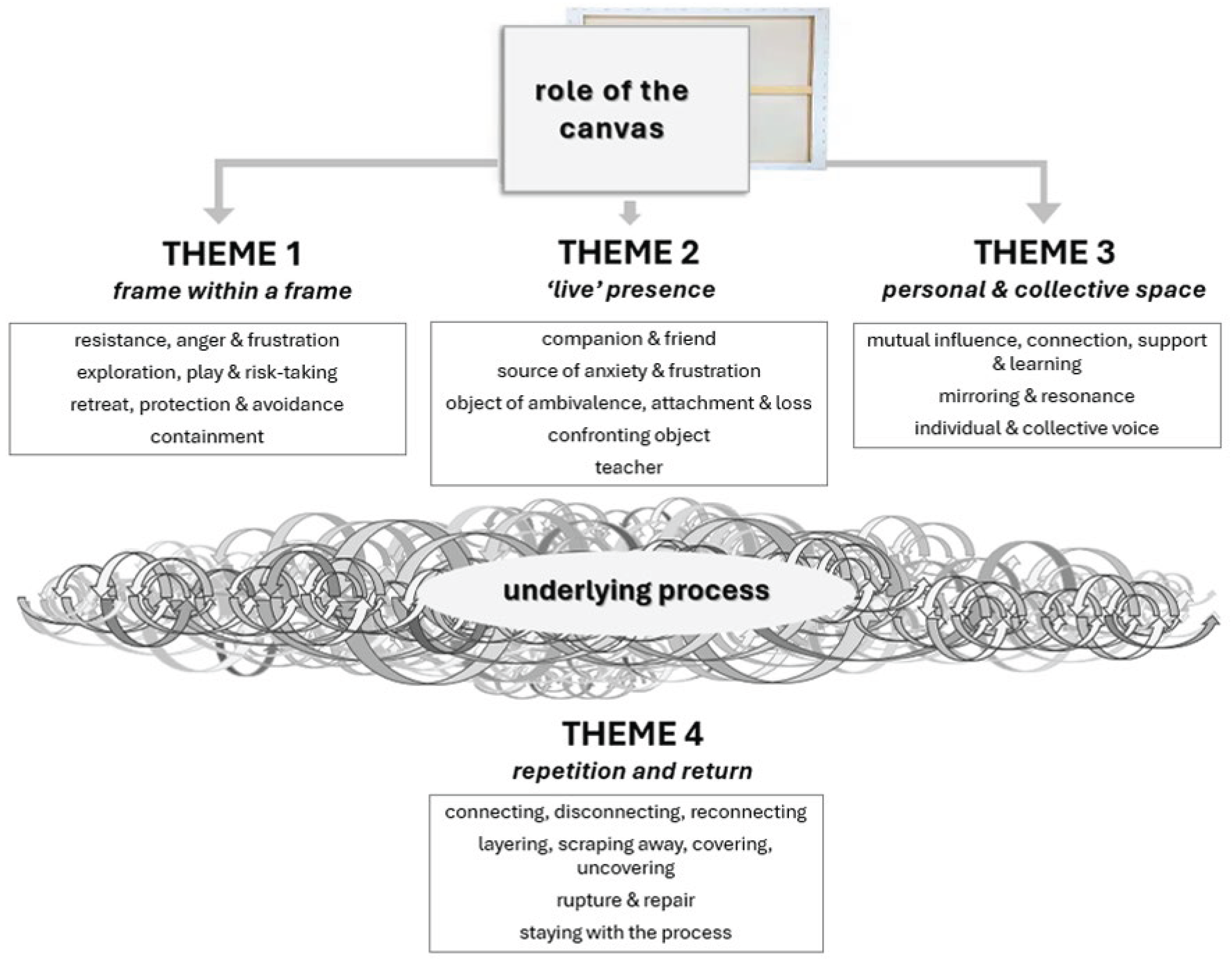
Figure 2.
Composite image including process documentation and reflections. Courtesy of the artist ©.
Figure 2.
Composite image including process documentation and reflections. Courtesy of the artist ©.
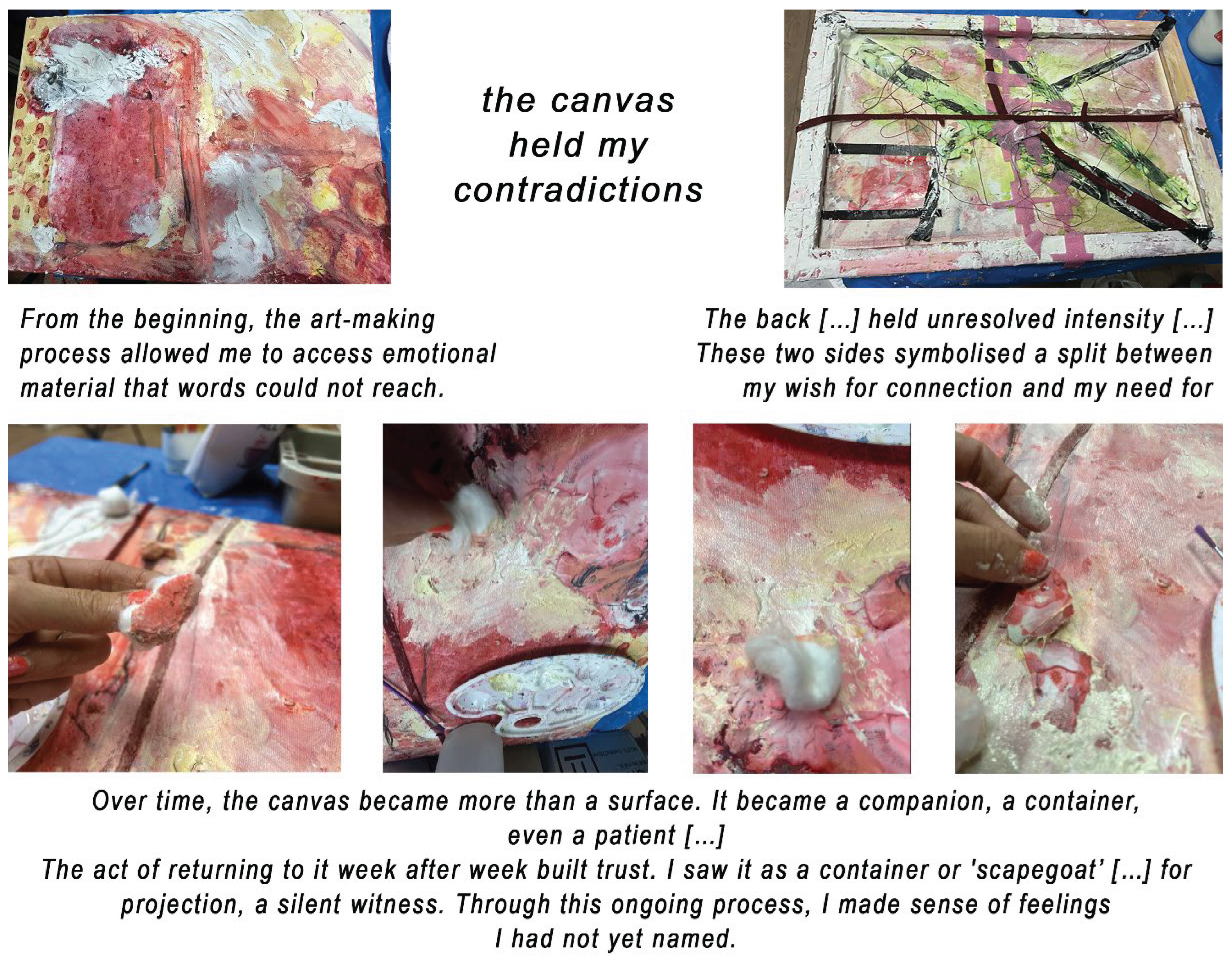
Figure 3.
Composite image including process documentation and reflections. Courtesy of Ruth Parker ©.
Figure 3.
Composite image including process documentation and reflections. Courtesy of Ruth Parker ©.
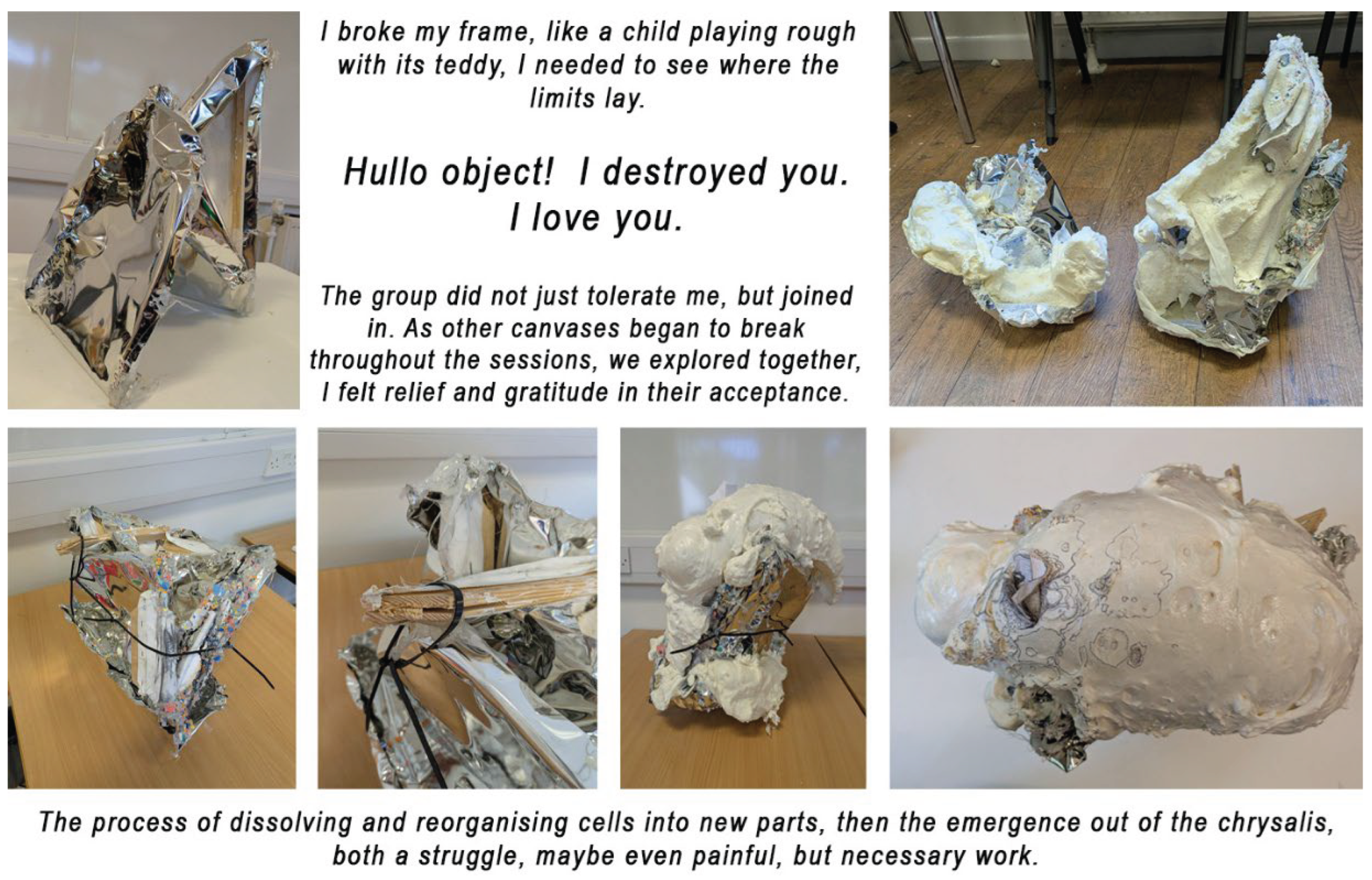
Figure 4.
Composite image including process documentation and reflections. Courtesy of Karen Selman ©.
Figure 4.
Composite image including process documentation and reflections. Courtesy of Karen Selman ©.
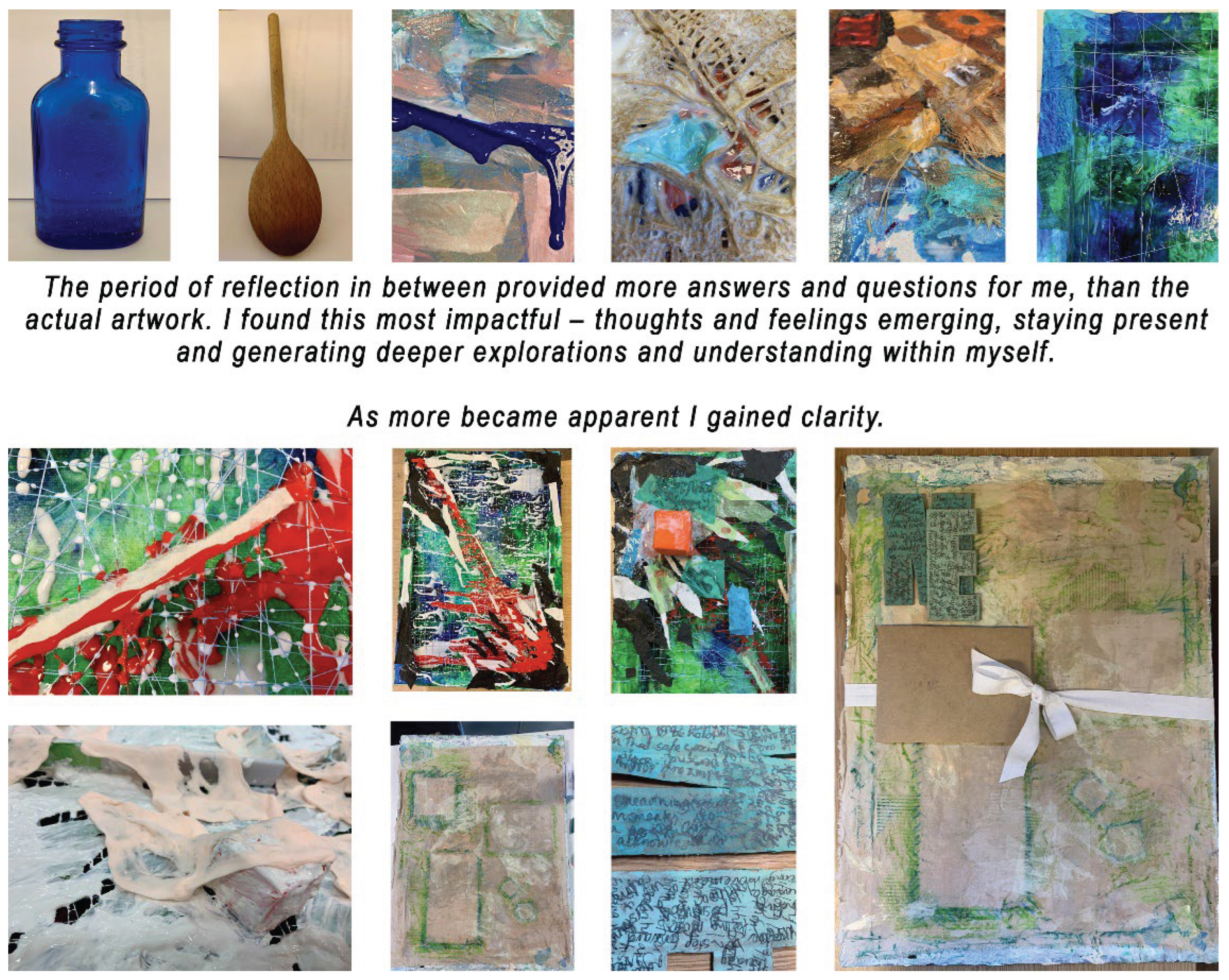
Figure 5.
Composite image including process documentation and reflections. Courtesy of Hattie Allan ©.
Figure 5.
Composite image including process documentation and reflections. Courtesy of Hattie Allan ©.
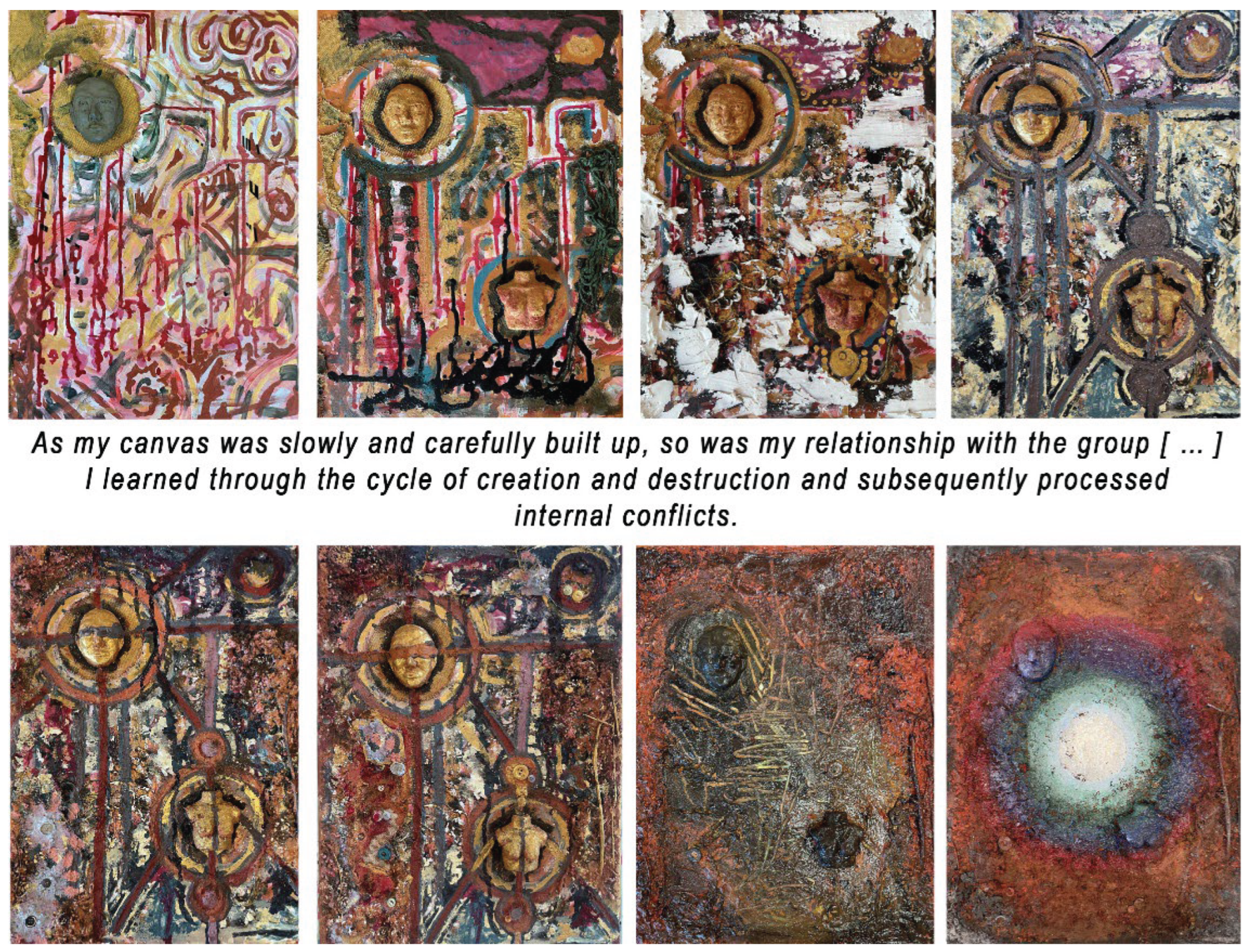
Figure 6.
Composite image including process documentation and reflections. Courtesy of Dennis Briggs ©.
Figure 6.
Composite image including process documentation and reflections. Courtesy of Dennis Briggs ©.
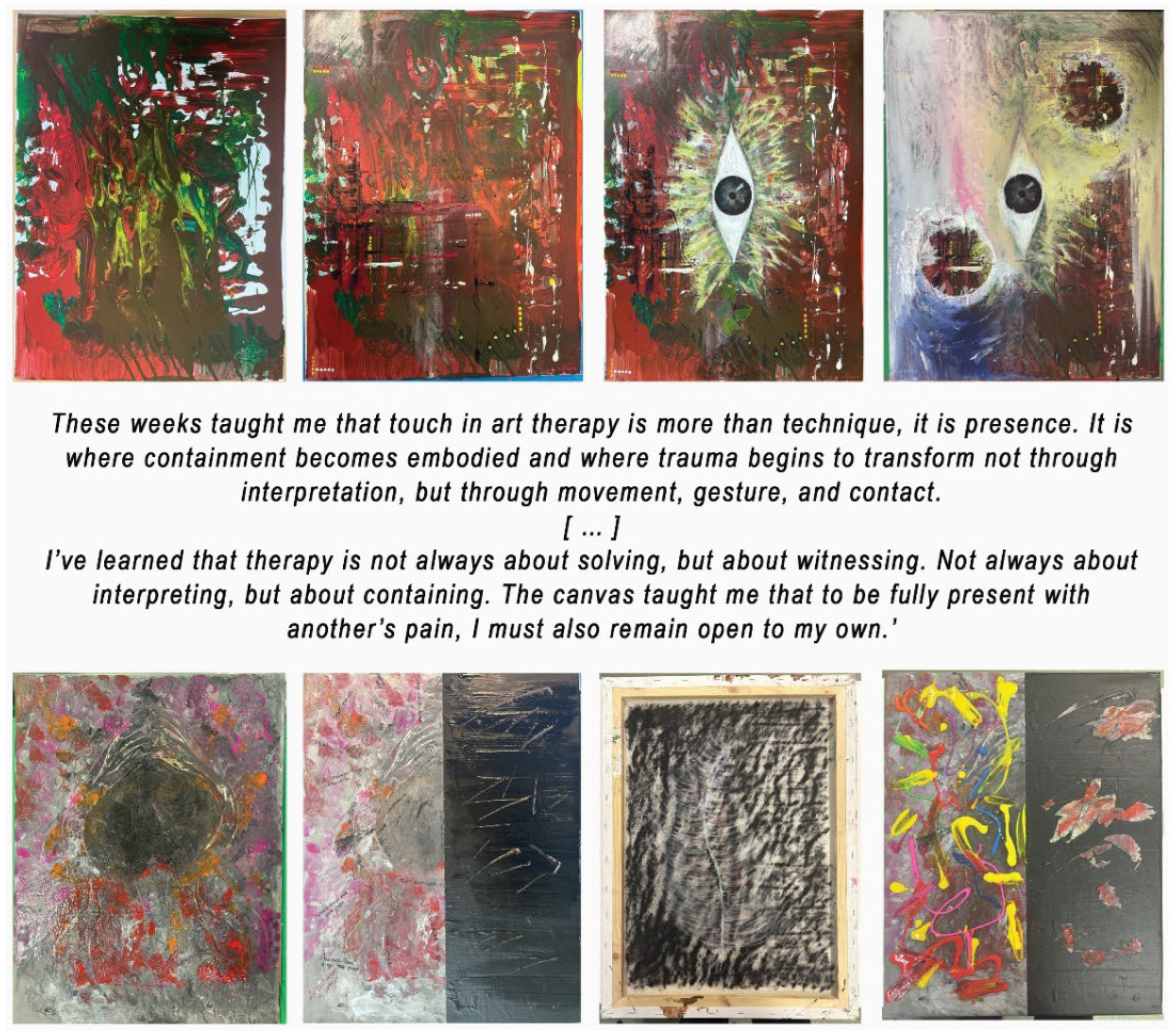
Figure 7.
Composite image including process documentation and reflections. Courtesy of Emma Brockbank ©.
Figure 7.
Composite image including process documentation and reflections. Courtesy of Emma Brockbank ©.
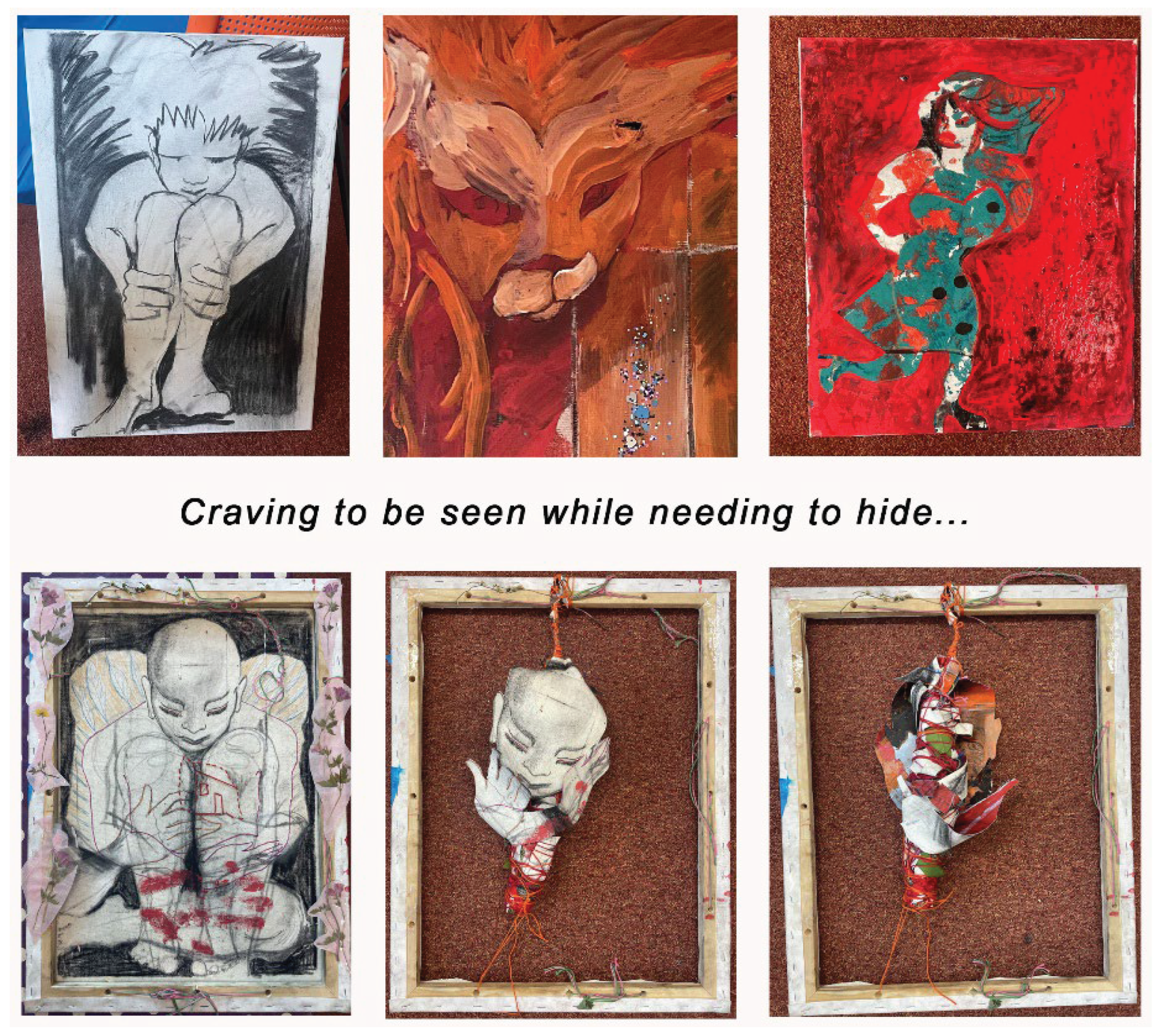
Discussion
One of the factors influencing the decision to adopt the one-canvas model was that it might offer additional containment and holding in an unsettled institutional environment. During the course of the research and reviewing the analysis, the authors found that the use of Miller’s one-canvas model in this context resonated strongly with Donald Winnicott’s ideas, bringing the presenting material to life through a different lens. Winnicott is familiar to most UK-based art therapists, and his thinking has also been applied to therapeutic groups (James, 1984; McNeilly, 2006; Noack, 2002; Skaife & Huet, 2014 [1998]); however, they are largely absent from the literature on the one-canvas method. The discussion therefore focusses on these potential links.
Creative Destructiveness and Use of the Object
Entering an experiential group can feel like stepping into the unknown (McNiff, 1998). While there may be a desire to explore the self – more or less consciously (Dudley et al., 2014 [1998]), Hogan (2014: 27) suggests that, even at the outset, experiential learning can take the trainee into ‘quite complex emotional terrain’. It is common for group members to resist, question, and challenge a facilitator’s ability as well as the group process (Dudley et al., 2014 [1998]; Nitsun, 2014 [1996]), and for some to withdraw into themselves; in a training situation, vulnerability, fear of exposure and judgement, and doubt in one’s abilities are ever present (McMahon & Rodillas, 2020). Still, facilitators noted high levels of investment in the process and a determination to ‘stick with it’.
Looking through a Winnicottian lens, trainees’ protests, challenges to the ‘frame’, and aggression towards the canvas (both creative and destructive) can be seen as a necessary developmental step, testing the durability and robustness of the environment and offering ‘evidence of life’ (Winnicott, 2018 [1965]: 127). As Hogan (2014:30) notes, in experiential learning the ‘emotions engendered whilst splashing, tearing, covering, hiding, destroying, scribbling or otherwise struggling to use the materials are highly significant’; potentially reflecting a deeper process of destruction and creation symbolic of therapeutic transformation. Indeed, the image – hated or loved – was effectively destroyed each week to allow for something new and different to emerge; a tension explored by Chen and O’Sullivan (2023). For Winnicott, destructive impulses are essential for growth, development and creativity. Integral to this is the ‘search for an object, or an environment, or a medium, sufficiently resilient and responsive’ to withstand the individual’s intense emotions (Phillips, 2007 [1988]:113). As Winnicott puts it ‘[y]ou have value for me because of your survival of my destruction of you’ (2005[1971]-b: 90).
Reworking the Past in the Present
Historically, on the course, each trainee explored their own path through the artmaking process; however, with the one-canvas model, each began their journey from a shared starting point. Trainees were not reviewing individual pieces of artwork made along the way as before. Rather, in the context of the group, and over an extended period of time, they repeatedly returned to revisit and ‘rework’ past material on the same canvas; to some extent, also revisiting and reworking parts of their own histories and identities.
Facilitators’ reflections suggest that the introduction of the one-canvas method acted as a significant stimulating input, evoking powerful responses and charging the group with energy (Roberts, 1984; Waller, 2015 [1993]). Processes of ‘repetition and return’ form part of the ‘frame’ in most forms of psychotherapy through the ritual of successive sessions. They are also foundational mechanisms in the one-canvas model; the ongoing layering and reworking of material over time providing reliable, ongoing experiences as well as fostering transformation, emotional containment and reflection (Miller, 2012, 2022). Encompassed within Winnicott’s thoughts on ‘regression’ (Winnicott, 2018 [1959,1960,1961,1962,1963,1964]) such processes are also central to the function of play as a therapeutic, restorative process where repetitively using things or engaging in creative acts within a safe, holding environment, may facilitate the revisiting of former stages of development; in turn, helping to integrate past and present through the ‘re-doing’ or re-working of earlier experiences (Abram, 1996b).
Encouraging trainees on a journey into the psyche, this creative risk-taking brought forth what Miller (2012) describes as ‘needed emotional vibrancy’. The canvas comes alive through the transference of energy invested in reworking it and the dynamic interplay of forces that can be both a source of creativity and a site of struggle (Abram, 1996a; Deleuze & Guattari, 2004 [1980]). The canvas might thus be understood both as a transitional space for exploration through imaginative play and dialogue (Winnicott, 2005[1971]-a), and a transferential site (Schaverien, 2005); a place where material made in the past is continually ‘unmade’ and ‘remade’ as it meets the stuff of new material in the present (Michaels, 2025). More than a theoretical construct, transference becomes a lived, felt experience (Hobson, 2013 [1985]; Wright, 2009), emerging in and through the transitional relationship with the canvas and group. Earlier layers inform subsequent ones with reflective journalling and process documentation helping to hold evolving, transformational states (Miller, 2022).
Emotional resonances were amplified through processes of repetition, return, re-working and ‘sticking with’ the changing image (Malchiodi, 2011; Skaife & Huet, 2014 [1998]). This intimacy and the associated ambivalence brought trainees face-to-face with the different qualities of energy through the ‘force of the artistic struggle (el duende)’, both personal and collective (Hills de Zarate, 2011; Miller, 2012: 168). Confronted (more or less consciously) with the tension between creating perfect art and embracing imperfection and risk-taking, the process of reworking the canvas invited trainees to let go of attachments to specific developmental stages and embrace the uncertainty of how the final canvas might appear. Facilitators’ observations suggest that the rhythm generated through repeatedly revisiting the canvas – unmaking and re-making – allowed for sustained engagement with change and transformation, encouraging ongoing dialogue with the evolving image (McNiff, 2004, 2013 [1992]). As Miller asserts, through cycles of leaving and re-engaging, the interim period assures that ‘you will meet again’ (Miller, 2022). Sequential layering as well as ongoing documentation of the process, in turn held the dynamic tension between trusting the process and trying to control it, as well as the conflict between what was lost and what remained. Even when not working directly on the canvas, it was the focal point; separation from the canvas during interim periods and moments of non-action affording time and space for reflection, with digital media providing visual evidence of what had been covered over and/or forgotten (Miller, 2022). Nothing is discarded; rather, the canvas is continually transforming – in a fluid state of ‘becoming’ (Deleuze & Guattari, 2004 [1980]). Offering a metaphor for the trainees’ evolving selves Miller (2012:167) proposes that the consistent presence of the canvas also teaches them to ‘identify the emergent relationship as an important resource in their work’.
Transitional Spaces Between
Winnicott emphasized an intermediate, illusory, area of experiencing, to which inner reality and external life both contribute. For him, there are no ‘individuals’, only ‘an environment-individual set-up’ (Winnicott, 2018 [1952]:99). The art in an art therapy group is also produced in the context of a relationship and setting rather than separate from it (Brown, 2017). The canvas offered a physical as well as symbolic frame; a transitional, potential, space where trainees could play, project and explore inner states and intense emotions, and test them against the tangible, independent reality of the canvas, and the group.
The two-sided structure of the canvas also enabled trainees to work in private while still engaging in the group process, offering the opportunity to both cover over and observe what emerged over time. For Winnicott (2018 [1963]) there is always an inherent tension between the desire to protect the authentic self and the deep need to be seen and recognised by others, a tension explored by Moulton (2024). Art therapy groups are functionally structured to mediate between privacy and interaction through time allowed for artmaking and for group sharing. Applying Winnicott’s ideas to groups Skaife and Huet (2014 [1998]) suggest that the image is transitional in that it stands between self and other and can be tangibly witnessed and responded to. Winnicott suggests that ‘playing leads into group relationships’, arguing that feeling able to play and experiment without fear of immediate judgement fosters a more authentic sense of self (Winnicott, 2005[1971]-a: 41).
Over time, facilitators observed unconscious ‘resonances’ emerging across artworks (McNeilly, 1987; Roberts, 1984) and a gradual movement from trainees being/feeling more isolated in their internal worlds to one of relatedness, care, and concern for others, where there was meaningful engagement with, and trust in, a shared external reality (Winnicott, 2005[1971]-b). This resonates with Miller’s suggestion that ‘[w]hen engaged in a semester-long relationship with one canvas, trainees gain direct experience with multifaceted reflective processing and aesthetically focused attention on the relationships that surround them’ (2012:167).
From Chasing Meaning to Artistic Attending
Winnicott emphasised the search for meaning from within. For him, this begins in the ‘potential’ intermediate area between inner and outer (Winnicott, 2005[1971]-a), the individual’s authentic voice emerging through play rather than interpretation. Perceived as a living, evolving, companion the canvas holds both personal subjective meaning while being an external object, acting as a central site for discovery (Miller, 2023); a creative, playful space for experimentation, with the potential to enhance emotional processing and presence, and encourage shared learning. Facilitators’ reflections suggest that the consistent presence of the canvas as part of the holding environment of the group enabled trainees to begin to externalise, symbolise, and voice difficult feelings and experiences; increasing group visibility and trust in the process. This resonates with Miller’s proposal concerning the significance of interim periods and time away from the canvas; allowing meaning-making to emerge spontaneously, ‘with time, patience, and being in the state of “not knowing”’ (Miller, 2012:167, Miller, 2022). Rather than chasing after the meaning of individual images (McNeilly, 1987) the emphasis shifts to ‘artistic attending’ (Miller, 2012, 2020) and the slow emergence of an authentic voice – both verbal and non-verbal – also enabled and encouraged through documentation of process. Miller (2012:167) suggests that, through facilitating self-reflexivity and professional growth, this can lead to ‘a sense of competence that is internally and relationally based, rather than externally dependent on performance feedback’.
The Significance of the Holding Environment
As with the therapeutic process, key to all the above was the capacity of the holding environment or ‘group as a whole’ (McNeilly, 2006) – including canvas, art materials, group, and facilitator – to accept, endure, and hold painful, messy emotional material and survive being ‘put through the mill’ (as one facilitator put it) without retaliation or withdrawal. Certainly, as is common in art therapy groups, the potent, regressive nature of using art materials, along with excessive amounts of material to process, and powerful projections and countertransference responses proved challenging for facilitators to hold (Skaife & Huet 2014 [1998]). This was amplified by large group sizes. However, applying Winnicott’s ideas to groups McNeilly (2006: 59) suggests that if the ‘group as a whole’ is seen as a ‘good-enough’ parent then individuals may ‘use the space more creatively with a sense of security and nurturance’, reinforcing trust in the process. This is evidenced by increased group cohesion, empathy and compassionate witnessing, with students finding inspiration and support through shared experiences. As one experienced facilitator remarked, reflecting on the introduction of one-canvas process, previous models and the structural change to a more condensed timeframe
‘It’s held something of something that we would want them to have gone through anyway, but in a shorter period of time […] I’m not sure they would have got the quality of experience and learning in the old traditional way […] the canvas took them where they tried not to go and […] through that.’
Limitations
This retrospective study responds to institutional changes in teaching structures. As a result there was no opportunity to directly compare it with other models; only historical comparisons under previous course structures with which some group facilitators had limited involvement. Much is left out of the narrative to preserve anonymity and results are inevitably partial and potentially biased as they rely heavily on facilitators’ experience as well as limited data collection methods and resources. Nonetheless, accepting its limitations, the authors suggest that the results of the study are valid in that they represent a foundational step to formulating a hypothesis that might be investigated and developed through further research.
Implications for Practice and Research
UK higher education institutions are navigating their way through difficult and uncertain times and art therapy educators, as well as practitioners, are under pressure to adapt the frame, prompting questions about how this can be achieved while maintaining sufficient containment and space for meaningful reflection. The introduction of the one-canvas model was prompted by a need to adapt and condense the training group model to fit new teaching structures imposed by the educational institution. While the ideas discussed in the article are not exclusive to this particular situation, and meaning continues to unfold, this study offers a rare opportunity for in-depth reflection on educators’ experience and teaching methods in a training context. Undoubtedly, there is more research to be done and, as Miller (2012:172) notes, ‘[w]hether the model translates as powerfully and effectively for other educators is a matter of significant interest that warrants further study’. Such studies may explore in more depth further adaptations to the El Duende one-canvas model as applied in experiential training groups, as well as trainees’ perspectives on their experience and the influence on personal and professional development.
Conclusion
This research reviews the application of the El Duende ‘one-canvas’ method for experiential training groups on one UK-based course. Results indicate that, through sustained processes of repetition and return the ‘one-canvas’ method served to hold intense transformational processes within a condensed timeframe, offering trainees a valuable experiential learning experience. The study builds on established research in the field, expanding previous applications of the model including theoretical connections, and supporting innovation and reflection in art therapy education.
Author Contributions
The first author was responsible for the conception, planning, ethics approvals, data collection and analysis, as well as writing and editing the article. The co-author contributed to the data analysis, as well as the development and editing of the article. Both authors have read and agreed to the published version of the manuscript.
Funding
The study was unfunded.
Informed Consent Statement
Written informed consent has been obtained from all participants involved in the research and from the trainees whose artwork and reflections are represented in the article.
Data Availability Statement
Data is stored on Sheffield Hallam University Research Archive (SHURDA) and is available at https://shurda.shu.ac.uk/id/eprint/322/. Restrictions on access are in place due to the sensitive nature of some of the data.
Acknowledgments
The authors would like to extend their sincere appreciation and gratitude to the following people: Caroline Turner, Nem Perry, Chrissy Lawrence, Catherine Blackburn, Paula Rolston and Tara Brown for taking part in the research; the broader art therapy team at Sheffield Hallam University for their encouragement and support; to Dr Chris Wood for sharing her experience and knowledge; and to those students who have generously consented for us to include their images and words to illustrate this article.
Disclosure Statement: No potential conflicts of interest were reported by the authors.
References
- Abram, J. Aggression. In The language of Winnicott: A dictionary of Winnicott’s use of words; Karnac, 1996a; pp. 5–30. [Google Scholar]
- Abram, J. Regression. In The language of Winnicott: A dictionary of Winnicott’s use of words; Karnac, 1996b; pp. 248–267. [Google Scholar]
- Ahmed, S. K.; Mohammed, R. A.; Nashwan, A. J.; Ibrahim, R. H.; Abdalla, A. Q.; Ameen, B. M. M.; Khdhir, R. M. Using thematic analysis in qualitative research. J. Med. Surg. Public Health 2025, 6. [Google Scholar] [CrossRef]
- Annamalah, S. The value of case study research in practice: A methodological review with practical insights from organisational studies. J. Appl. Econ. Sci. (JAES) 2024, 19(4 (86)), 485–498. [Google Scholar] [CrossRef]
- ATOL. Editorial: The Power and Potential of Case Studies in Art Therapy. Art. Ther. Online 2025, 15(1). Available online: https://journals.gold.ac.uk/index.php/atol/article/view/1913/2018.
- BAAT. Curriculum Guidance for the Pre-registration Education and Training of UK Art Therapists. In British Association of Art Therapists; 2025; Available online: https://baat.org/download/11676/baat-curriculum-guidance-2025.pdf.
- Braun, V.; Clarke, V. Using thematic analysis in psychology. Qual. Res. Psychol. 2006, 3(2), 77–101. [Google Scholar] [CrossRef]
- Braun, V.; Clarke, V. Thematic analysis. In APA handbook of research methods in psychology, Vol. 2. Research designs: Quantitative, qualitative, neuropsychological, and biological; Cooper, H., Camic, P. M., Long, D. L., Panter, A. T., Rindskopf, D., Sher, K. J., Eds.; American Psychological Association, 2012; Vol. 2, pp. 57–71. [Google Scholar]
- Brown, C. Inside out: Thoughts about the frame in art therapy. Art. Ther. Online 2017, 8(1). [Google Scholar]
- Chen, J. D.; O’Sullivan, J. An occupational therapist’s heuristic self-inquiry using the El Duende One-Canvas Process Painting to explore one’s emerging art therapist identity. Arts Psychother. 2023, 85. [Google Scholar] [CrossRef]
- Chilton, G.; Lynskey, K.; Ohnstad, E.; Manders, E. A case of El Duende: Art-based supervision in addiction treatment. Art. Ther. 2020, 38(3), 137–145. [Google Scholar] [CrossRef]
- Deleuze, G.; Guattari, F. A Thousand Plateaus: Capitalism and Schizophrenia; Massumi, B., Translator; Continuum, 2004 [1980]. [Google Scholar]
- Dudley, J.; Gilroy, A.; Skaife, S. Learning from experience in introductory art therapy groups. In Art psychotherapy groups: Between pictures and words; Skaife, S., Huet, V., Eds.; Routledge, 2014 [1998]; pp. 181–203. [Google Scholar]
- Edwards, D. The role of the case study in art therapy research. Int. J. Art. Ther. Inscape 1999, 4(1), 2–9. [Google Scholar] [CrossRef]
- Finlay, L. Negotiating the swamp: the opportunity and challenge of reflexivity in research practice. Qual. Res. 2002, 2(2), 209–230. [Google Scholar] [CrossRef]
- Fish, B. J. Response art: A resource for practice and supervision, in person and online. J. Appl. Arts Health 2023, 14(1), 73–84. [Google Scholar] [CrossRef]
- ________ Response art in art therapy: Historical and contemporary overview. Art. Ther. 2019, 36(3), 122–132. [CrossRef]
- ________ Response art: The art of the art therapist. Art. Ther. 2012, 29(3), 138–143. [CrossRef]
- Garcia-Reyna, N. I. Art-based supervision through artistic response creation. Assessment of its use in art therapy training. Art. Ther. Role Art. Ther. Educ. Soc. Incl. (Arteterapia). 2019, 14, 201–220. [Google Scholar] [CrossRef]
- Gavron, T.; Orkibi, H. Arts-based supervision training for creative arts therapists: Perceptions and implications. Arts Psychother. 2021, 75. [Google Scholar] [CrossRef]
- Given, L. M. The Sage encyclopedia of qualitative research methods; Sage publications, 2008. [Google Scholar]
- HCPC. Standards of Proficiency for arts therapists. Health and Care Professions Council. 2024. Available online: https://www.hcpc-uk.org/standards/standards-of-proficiency/arts-therapists/.
- Hills de Zarate, M. Muse and duende. In Navigating Art Therapy: A Therapist’s Companion; Wood, C., Ed.; Routledge, 2011; p. 151. [Google Scholar]
- Hobson, R. F. Forms of feeling: The heart of psychotherapy; Routledge, 2013 [1985]. [Google Scholar]
- Hogan, S. Reflections on experiential learning. In The introductory guide to art therapy: Experiential teaching and learning for students and practitioners; Hogan, S., Coulter, A. M., Eds.; Routledge, 2014. [Google Scholar]
- James, D. C. Bion’s “containing” and Winnicott’s “holding” in the context of the group matrix. Int. J. Group Psychother. 1984, 34(2), 201–213. [Google Scholar] [CrossRef] [PubMed]
- Kapitan, L. Introduction to art therapy research, Second ed.; Routledge, 2018. [Google Scholar]
- Kekeya, J. Analysing qualitative data using an iterative process. Contemp. PNG Stud. 2016, 24, 86–94. [Google Scholar]
- Liebmann, M. Art games and group structures. In Art as Therapy: An Introduction to the Use of Art as a Therapeutic Technique; Dalley, T., Ed.; Routledge, 2008 [1984]; pp. 157–172. [Google Scholar]
- Lis-Ron, V.; Gavron, T. The El Duende One-Canvas Process Painting (EDPP) Model in Creative Arts Therapies Supervision: An Integrative Synthesis. In The Arts in Psychotherapy; 2025. [Google Scholar] [CrossRef]
- Lloyd, N.; Hyett, N.; Kenny, A. To member check or not to member check? An evaluation of member checking in an interpretive descriptive study. Int. J. Qual. Methods 2024, 23, 16094069241301383. [Google Scholar] [CrossRef]
- Malchiodi, C. A. Handbook of art therapy; Guilford Press, 2011. [Google Scholar]
- McMahon, A.; Rodillas, R. R. Personal development groups during psychotherapy training: Irish students’ expectations and experiences of vulnerability, safety and growth. Couns. Psychol. Q. 2020, 33(2), 163–186. [Google Scholar] [CrossRef]
- McNeilly, G. Group analytic art therapy; Jessica Kingsley, 2006. [Google Scholar]
- ________ Further Contributions to Group-Analytic Art Therapy. Inscape-Int. J. Art. Ther. 1987, Summer, 8–11.
- ________ Directive and non-directive approaches in art therapy. Arts Psychother. 1983, 10, 211–219. [CrossRef]
- McNiff, S. Doing art-based research: An advising scenario. Using art as research in learning and teaching: Multidisciplinary approaches across the arts 2018, 79–89. [Google Scholar]
- McNiff, S.; ________ (2013). Introduction: A critical focus on art-based research. Stepping into the unknown. In Journal of Applied Arts & Health;Trust the process: An artist’s guide to letting go; Shambhala Publications, 2013; Volume 4, 1, p. 5–12 pp. 27-35. [Google Scholar]
- ________ Art as medicine: Creating a therapy of the imagination; Shambhala Publications, 2013 [1992].
- ________ Art heals: How creativity cures the soul; Shambhala Publications, 2004.
- Michaels, D. When past meets present: transference, art, and affectivity in reflexive research. Reflective Pract. 2025, 1–13. [Google Scholar] [CrossRef]
- ________ Organisational Encounters and Reflexive Undergoings: A Speculative Weaving in Three Transpositions. Ph.D. Thesis, Sheffield Hallam University, Sheffield, 2022. Available online: https://shura.shu.ac.uk/31989/.
- Miller, A. The innovative practice of El Duende One Canvas method: weaving artistic language across modalities and over time Placing Art at the Center of Practice, Teaching, and Research; University of Hertfordshire, July 2024. [Google Scholar]
- ________ Discovery of art-based distillation: Doctoral inquiry of the one-canvas method. J. Appl. Arts Health 2023, 14(3), 391–402. [CrossRef]
- ________ El Duende One-Canvas Art Making and the Significance of an Interim Period. Art. Ther. 2022, 39(1), 24–33. [CrossRef]
- ________ One-canvas method: Art making that transforms on one surface over a sustained period of time; Lesley University, 2020.
- ________ Multiple roles in art therapy supervision: Using el duende one-canvas process painting. In Exploring ethical dilemmas in art therapy; Maria, A. D., Ed.; Routledge, 2019; pp. 339–351. [Google Scholar]
- ________ Inspired by El Duende: One-canvas process painting in art therapy supervision. Art. Ther. 2012, 29(4), 166–173. [CrossRef]
- Miller, A.; Robb, M. Transformative phases in el duende process painting art-based supervision. Arts Psychother. 2017, 54, 15–27. [Google Scholar] [CrossRef]
- Miller, A.; Schlanger, Z. El duende one-canvas process painting as a method for individual arts-based supervision. Arts Psychother. 2025, 102371. [Google Scholar] [CrossRef]
- Moulton, C. The Unmasking Journey of a Neurodivergent Art Therapy Student using the El Duende One-Canvas Process Painting: An Art-based Heuristic Self-Inquiry; Syracuse University, 2024. [Google Scholar]
- Nash, G. The Principles of an Art-Based Research Design: Response Art and Art Therapy Research. In International Advances in Art Therapy Research and Practice: The Emerging Picture; Huet, V., Kapitan, L., Eds.; Cambridge Scholars Publishing, 2021; pp. 103–111. [Google Scholar]
- Nitsun, M. The anti-group: Destructive forces in the group and their creative potential; Routledge, 2014 [1996]. [Google Scholar]
- Noack, A. Working with trainees in experiential groups. Creat. Adv. Groupwork 2002, 14–39. [Google Scholar]
- Phillips, A. Winnicott; Penguin, 2007 [1988]. [Google Scholar]
- Ramrathan, L.; Le Grange, L.; Shawa, L. B. Ethics in educational research. Educ. Stud. Initial Teach. Educ. 2017, 432–443. [Google Scholar]
- Robb, M.; Miller, A. Supervisee art-based disclosure in El Duende process painting. Art. Ther. 2017, 34(4), 192–200. [Google Scholar] [CrossRef]
- Roberts, J. P. Resonance in art groups. Group Anal. 1984, 17(3), 211–220. [Google Scholar] [CrossRef]
- Savin-Baden, M.; Major, C. H. Qualitative research: The essential guide to theory and practice; Routledge, 2023. [Google Scholar]
- Schaverien, J. Art and active imagination: Reflections on transference and the image. Int. J. Art. Ther. 2005, 10(2), 39–52. [Google Scholar] [CrossRef]
- Simons, H. Ethics of case study in educational research and evaluation. In The ethics of educational research; Taylor & Francis, 2005 [1989]; pp. 106–130. [Google Scholar]
- Skaife, S.; Huet, V. Art psychotherapy groups: Between pictures and words; Routledge, 2014 [1998]. [Google Scholar]
- Srivastava, P.; Hopwood, N. A practical iterative framework for qualitative data analysis. Int. J. Qual. Methods 2009, 8(1), 76–84. [Google Scholar] [CrossRef]
- Talari, K.; Goyal, M. Retrospective studies–utility and caveats. J. R. Coll. Physicians Edinb. 2020, 50(4), 398–402. [Google Scholar] [CrossRef] [PubMed]
- Waller, D. Group interactive art therapy: Its use in training and treatment, 2nd ed.; Routledge, 2015 [1993]. [Google Scholar]
- Winnicott, D. W. The Maturational Processes and the Facilitating Environment: Studies in the Theory of Emotional Development; Routledge, 2018 [1965]. [Google Scholar]
- ________ Anxiety associated with insecurity. In Through paediatrics to psychoanalysis; Routledge, 2018 [1952]; pp. 97–101.
- ________ (2018 [1959-1964]). Classification: is there a psychoanalytic contribution to psychiatric classification? In The Maturational Processes and the Facilitating Environment: Studies in the Theory of Emotional Development; Routledge; pp. 124–139.
- ________ Communicating and not communicating leading to a study of certain opposites. In The maturational processes and the facilitating environment; Routledge, 2018 [1963]; pp. 179–192.
- ________ Playing and Reality; Routledge, 2005[1971]-a.
- ________ The Use of an Object and Relating through Identifications. In Playing and Reality; Routledge, 2005[1971]-b; pp. 115–127.
- Wright, K. Mirroring and attunement: Self-realization in psychoanalysis and art; Routledge, 2009. [Google Scholar]
- Wood, C. (2025) Personal communication, 17 September 2025.

Table 1.
Overview of the module structure.
|
12 sessions EXPERIENTIAL TRAINING GROUPS supported by associated teaching |
2 sessions REVIEW & EVALUATION |
REFLECTIVE REPORT submitted by trainees immediately following review & evaluation |
| Five closed groups of 11-12 trainees meet for 2 hours weekly at a regular time, usually in a regular place, with time for coming together as a group, artmaking, and reflection/discussion. Following institutional requirements, one on-line session was included. After each two-hour session, facilitators meet for peer supervision. | ||
Disclaimer/Publisher’s Note: The statements, opinions and data contained in all publications are solely those of the individual author(s) and contributor(s) and not of MDPI and/or the editor(s). MDPI and/or the editor(s) disclaim responsibility for any injury to people or property resulting from any ideas, methods, instructions or products referred to in the content. |
© 2026 by the authors. Licensee MDPI, Basel, Switzerland. This article is an open access article distributed under the terms and conditions of the Creative Commons Attribution (CC BY) license (http://creativecommons.org/licenses/by/4.0/).
Copyright: This open access article is published under a Creative Commons CC BY 4.0 license, which permit the free download, distribution, and reuse, provided that the author and preprint are cited in any reuse.


