

Submitted:
10 May 2026
Posted:
12 May 2026
You are already at the latest version
Abstract
Background: Current international hereditary angioedema (HAE) guidelines and treat-to-target recommendations consistently emphasize accurate diagnosis, early on-demand treatment of attacks, appropriate short-term prophylaxis for procedures, individualized long-term prophylaxis (LTP), and routine assessment of disease control and quality of life. Published information on how these recommendations are implemented in Latin America remains limited. We therefore aimed to assess the extent to which a Latin American expert panel converges with recommendations across current international HAE guidelines and consensus documents and to identify the principal barriers affecting real-world implementation in the region. Methods: A scientific committee developed and externally validated a 74-item questionnaire (domains summarized in Supplementary Table S1) and conducted a 2-round Delphi process among Latin American HAE experts. Consensus items were rated on a 9-point agreement scale, with consensus defined a priori as at least two-thirds of panelists scoring within a 3-point band in the agreement (7-9) or disagreement (1-3) range. Descriptive items captured expert-reported diagnostic testing, acute and preventive treatment patterns, monitoring practices, and implementation determinants using 5-point Likert scales. Instrument validation (July-November 2024) demonstrated high inter-rater agreement (Kendall W = 0.84; p < 0.001) and excellent internal consistency (Cronbach alpha = 0.92). Results: Thirty experts from 10 countries completed the process (Argentina, Brazil, Chile, Colombia, Ecuador, Mexico, Panama, Peru, Uruguay, Venezuela). Panel consensus broadly converged with recommendations across current international HAE guidelines and consensus documents on core diagnostic work-up (C4 plus C1-INH antigen and function; 84% consensus), selective use of genetics (97% consensus), first-line targeted LTP (pdC1-INH, Lanadelumab, Berotralstat; 94% consensus), retention of on-demand therapy for breakthrough attacks and for patients without access to LTP, routine monitoring, and management in special populations. The principal novel finding was an implementation feasibility gap: frequent or constant interruptions in prophylaxis supply were reported by 19/30 experts (63%), including 13/23 (57%) practicing in settings where public or insurance coverage was reported. Across the panel, cost (19/30; 63%) and medicine availability (8/30; 27%) were the most commonly cited barriers, with additional constraints related to diagnostic testing access and administrative pathways. Conclusions: Latin American expert consensus largely converges with recommendations across current international HAE guidelines and consensus documents on diagnosis, acute management, prophylaxis selection, monitoring, and special-population care. The dominant divergence is not clinical disagreement but implementation feasibility—particularly access to diagnostic testing, financing mechanisms, medicine availability, and continuity of supply. These findings provide region-specific evidence to contextualize international recommendations and support implementation strategies tailored to Latin America.
Keywords:
hereditary angioedema
; diagnosis
; on-demand therapy
; short-term prophylaxis
; long-term prophylaxis
; Delphi method
; Latin America
; guideline implementation
; access to medicines
; treat-to-target
Introduction
Hereditary angioedema (HAE) is a rare, potentially life-threatening bradykinin-mediated disorder characterized by recurrent, unpredictable episodes of subcutaneous and/or submucosal swelling affecting the skin, gastrointestinal tract, and upper airway. [1] Most cases are caused by C1 inhibitor (C1-INH) deficiency or dysfunction (HAE-C1-INH; types I/II), whereas HAE with normal C1-INH comprises genetically heterogeneous entities with evolving diagnostic criteria. The prevalence is often cited at approximately 1:50,000 worldwide. [2,3]
There is great variability in the clinical presentation between patients and within the same patient, but most HAE attacks affect the extremities and abdomen with the accompanying pain and disability. Some patients experience prodromic symptoms such as fatigue, numbness, tingling and erythema marginatum. [4,5]. There are multiple triggers of HAE attacks which include physical trauma, stress, infections, hormonal fluctuations, drugs, among others. [6]
Delayed diagnosis remains common and clinically consequential. Beyond the risk of asphyxiation from laryngeal attacks, prolonged diagnostic journeys amplify disease burden through repeated emergency visits, avoidable procedures, and psychosocial morbidity. In a patient-journey survey in Mexico, the mean time from symptom onset to diagnosis was 20 years and clinically relevant anxiety and depression were frequent, underscoring the real-world impact of system-level delays in parts of Latin America. [7]
International guidelines increasingly define the goal of care as total disease control and the “normalization” of daily life, supported by treat-to-target frameworks that integrate attack prevention, early treatment of breakthrough attacks, and routine measurement of disease control and health-related quality of life (HRQoL). The WAO/EAACI 2021 revision and the US HAEA 2020 guideline recommend that long-term prophylaxis (LTP) be considered for all patients and individualized according to disease activity, attack burden, HRQoL, and patient preferences; they prioritize targeted agents (plasma-derived C1-INH replacement, Lanadelumab, Berotralstat) and restrict attenuated androgens or antifibrinolytics to settings where preferred options are unavailable or unsuitable. [3,8,9,10]
However, prophylaxis does not eliminate risk. A 2024 systematic review of attacks occurring during LTP across multiple agents reported attack-free rates of approximately 40% with subcutaneous plasma-derived C1-INH at 16 weeks and 44% with Lanadelumab 300 mg every 2 weeks at 6 months (77% during steady state), with on-demand therapy used in 49%–94% of breakthrough attacks and laryngeal events still reported in 2%–7% of attacks. [1] These findings reinforce that effective on-demand therapy (ODT) remains essential even for patients receiving LTP. Pivotal trials have demonstrated clinically meaningful reductions in attack frequency with subcutaneous pdC1-INH, Lanadelumab, and once-daily oral Berotralstat, providing the evidence base for guideline-preferred prophylaxis. [12,13,14,15]
Even in high-resource settings, timely ODT use is inconsistent. In a US patient survey, 63.6% reported that they did not carry ODT at all times when away from home and 86% reported delaying treatment despite recognizing attack onset; when ODT was delayed, 75% experienced attacks that progressed in severity and 80% reported longer recovery.[16] In another survey, HRQoL and work productivity were substantially impaired during attacks, with worse EQ-5D-5L scores and greater work impairment as time to ODT increased, supporting guideline recommendations to treat early and to address practical barriers to prompt ODT administration. [17]
At a global level, implementation of guideline-based care is inconsistent and strongly shaped by access and reimbursement. In the MENTALIST international physician survey, 48% of respondents reported that fewer than half of their patients had achieved WAO/EAACI treatment goals, and the highest-priority challenges were gaps in non-expert physician knowledge, treatment costs, and reimbursement for LTP. [18] Recent correspondence has further emphasized that, for many low- and middle-income countries, HAE-specific medications remain unavailable or inaccessible, necessitating equity-focused strategies beyond guideline publication.[19]Real-world translation barriers are multifactorial: a qualitative study of US allergy/immunology clinicians identified insurance prior authorization, laboratory testing difficulties, time constraints, and deficits in physician and patient understanding as key barriers, while route/frequency of administration, medication samples, and shared decision-making were perceived as facilitators; notably, none of the clinicians used validated instruments to measure HAE-related QoL.[20]
Therapeutic burden and social determinants of health influence both treatment choice and outcomes. Reviews of HAE therapeutics highlight that oral preventive options may address practical needs and reduce injection-related barriers associated with parenteral prophylaxis and ODT, while future gene-targeted approaches may further reshape prevention strategies.[21] Disparities in diagnosis and management have been reported within diverse healthcare systems, including reduced diagnosis rates among Hispanic patients and historical underrepresentation of marginalized groups in clinical trials.[22] Strategies proposed to improve care in geographically underserved settings include earlier recognition, individualized management plans, telemedicine, and reliable access to ODT and prophylaxis.[23] A centralized comprehensive-care model has been associated with comparable disease control among rural vs urban patients, suggesting a scalable approach for regions with limited specialist density.[24] Finally, experiences from Japan and China illustrate that national recommendations often evolve alongside local access to diagnostics and approved therapies, reinforcing the need to contextualize international guidance for region-specific realities.[25,26]
Against this backdrop, we conducted a Latin American Delphi process to generate an implementation-focused consensus on HAE diagnosis and comprehensive management (diagnostic work-up, on-demand treatment of attacks, short-term prophylaxis, long-term prophylaxis, monitoring, and care in special populations) and to systematically document feasibility constraints that shape real-world care. Beyond confirming guideline-concordant clinical preferences, this study provides country-granular signals on reimbursement pathways and, importantly, continuity of supply - an underreported barrier distinct from reimbursement decisions alone - as well as practical constraints on diagnostic testing and on-demand treatment readiness. We therefore frame the work as a health-systems implementation gap analysis informed by expert consensus, with the goal of identifying actionable levers for moving treat-to-target HAE care from recommendations to routine practice across Latin America.
Materials and Methods
Design and reporting framework. This regional expert-consensus study used a structured two-round Delphi methodology to examine concordance between international hereditary angioedema (HAE) guidance and region-specific clinical practice realities in Latin America. The scope included diagnostic pathways (clinical suspicion, laboratory testing, and referral), acute (on-demand) treatment, short-term prophylaxis for procedures, long-term prophylaxis (LTP), monitoring with patient-reported outcome tools, and implementation determinants such as financing pathways, reimbursement, procurement, and continuity of supply. Reporting was informed by established Delphi conduct and reporting recommendations (CREDES). [27]
Panel recruitment, eligibility, and conflicts of interest. Eligible panelists were Latin American clinicians with documented experience in the diagnosis and management of HAE (adult allergists/immunologists and pediatric immunology specialists). Non-specialists (eg, primary care physicians) were excluded. Panelists were invited based on demonstrated clinical leadership and/or participation in regional angioedema networks. Thirty-three experts initiated participation; three were excluded for not meeting eligibility criteria or for incomplete participation beyond round 1, leaving 30 experts for analysis. Panelists were asked to disclose potential conflicts of interest in writing as part of study participation; disclosures are summarized in the Declarations section.
Questionnaire development and structure. A scientific committee reviewed contemporary evidence and international recommendations and drafted a 74-item questionnaire to capture: (i) clinical decision-making aligned with treat-to-target care (diagnostic approach and testing; attack recognition and early on-demand treatment; short-term prophylaxis; LTP initiation, switching, and management in special populations) and (ii) implementation determinants governing feasibility in Latin America (financing pathways, reimbursement mechanisms, access barriers, procurement processes, continuity of supply, and perceived applicability of international guidance). Questionnaire domains and the number of items per domain are summarized in Supplementary Table S1.
Content validation, item refinement, and reliability assessment. Internal and external validation were conducted between July and November 2024. Internal validation was performed by the core scientific committee through structured review of each item for semantic clarity, clinical relevance, and thematic coverage. External validation was performed by two independent panels of Latin American angioedema specialists who were not part of the scientific committee; external reviewers assessed interpretability and feasibility within regional health-system contexts and provided quantitative ratings and qualitative comments. Item relevance and clarity were rated on a 4-point Likert scale, and the content validity index (CVI) was used to confirm that items met prespecified thresholds (eg, CVI ≥0.78) consistent with common methodological standards.[28,29) Inter-group agreement was evaluated with Kendall’s coefficient of concordance (W), and internal consistency with Cronbach’s alpha. The final instrument demonstrated high agreement (W=0.84; p<0.001) and excellent internal consistency (α=0.92), with per-item agreement between 80% and 93%. The final instrument retained 74 items after revisions (Supplementary Table S1).
Delphi administration, scoring, and consensus criteria. Two online Delphi rounds were performed. For consensus items, panelists rated agreement on a 9-point scale (1–3 disagreement, 4–6 uncertainty, 7–9 agreement). Consensus was defined as at least two-thirds of participants’ ratings falling within a 3-point band in the agreement range (7–9) or disagreement range (1–3). Items not reaching consensus in round 1 were refined for wording/clarity based on panel feedback and re-rated in round 2. In therapy-specific descriptive blocks (eg, prescribing frequency), panelists were instructed to skip items for therapies not used in their setting; consequently, non-response may reflect true non-use or lack of access/experience.
Data handling and analysis. Results are presented as (i) consensus statements (proportion meeting the consensus definition) and (ii) descriptive summaries of expert-reported practices and implementation determinants (counts and percentages). Missing responses were not imputed; denominators are reported per item and, where applicable, per therapy. To reduce interpretive ambiguity arising from skip logic in therapy-specific blocks, summary tables label the non-prescription category as “not prescribed/unknown” where appropriate, acknowledging that lack of access may be a dominant driver of apparent non-use. Because responses reflect expert-reported experience rather than population-level measurement, country-level patterns are interpreted as exploratory signals rather than national estimates. The current manuscript is based on the aggregated findings of the Latin American Delphi consensus report (October 2025).[30]
Ethics. This Delphi exercise captured expert opinion without patient-level data. Participation was voluntary, and responses were anonymized for aggregate reporting.
Results
Thirty experts from 10 Latin American countries completed the Delphi process: Argentina (n=4), Brazil (n=3), Chile (n=2), Colombia (n=5), Ecuador (n=3), Mexico (n=8), Panama (n=1), Peru (n=1), Uruguay (n=2), and Venezuela (n=1). Twenty-nine panelists were trained in Immunology-Allergology and one in Pediatric Immunology.
Panelists estimated that HAE type 1 accounted for 77% of cases, type 2 for 14%, and HAE with normal C1 inhibitor for 8% on average (83% consensus that type 1 is the most frequent). The predominant age group in routine practice was adults aged 18-64 years (mean 74% of each expert's practice).
Diagnosis and comorbidities. The panel recommended combining C4 with C1-INH antigen levels and C1-INH functional assays to maximize diagnostic accuracy (84% consensus). Routine genetic testing was not recommended for HAE-C1-INH; genetic testing was reserved for cases with normal C1-INH to confirm uncertain diagnoses or to characterize variants (97% consensus). Expert-reported diagnostic testing varied by country (Table 1).
Most panelists (87%) reported that their HAE patients have clinically relevant comorbidities, most commonly arterial hypertension (69%), type 2 diabetes mellitus (46%), anxiety/depression (42%), and autoimmune disease (27%).
Based on a prioritization exercise, the highest-priority criteria for initiating long-term prophylaxis (LTP) were monthly attack frequency (priority 10), followed by attack severity, quality of life, and attack location (priority 9). Patient age and pregnancy/lactation status were also considered important (priority 8).
The highest-priority criteria for switching LTP were failure to reduce or an increase in attack frequency (priority 10), followed by lack of improvement in attack severity, adverse events, and increasing HAE symptoms (priority 9). Marked quality-of-life impairment and medication availability were additional drivers (priority 8).
Therapeutic management: prophylaxis within comprehensive care. The panel endorsed plasma-derived C1 inhibitor (pdC1-INH), Lanadelumab, and Berotralstat as first-line long-term prophylaxis (LTP) options (94% consensus), consistent with international guidelines. Panelists agreed that serious adverse events with these therapies are rare to very rare (83% for pdC1-INH, 88% for Lanadelumab, 84% for Berotralstat). Attenuated androgens were positioned as an alternative when first-line targeted therapies are unavailable, inappropriate, or not feasible (90% consensus), given their adverse-effect profile. Antifibrinolytics were relegated to third-line or non-recommended use, with selective consideration in children or pregnancy when targeted options are inaccessible (93% consensus). In keeping with guideline principles and the panel’s separate recommendations, effective on-demand therapy should be available to all patients, including those receiving prophylaxis.
Real-world preventive treatment patterns. Experts reported marked heterogeneity in therapies used as first-line prevention in day-to-day practice (Table 3) and in prescribing frequency by agent (Table 4). Because therapy-specific blocks used skip logic, apparent non-prescription should be interpreted cautiously: non-response may reflect restricted availability or limited experience rather than a negative clinical preference.
Access, reimbursement, and availability. Funding mechanisms differed substantially across participating experts (Table 2), reflecting heterogeneity in public coverage, private insurance pathways, and out-of-pocket payment. Across the panel, the most frequently cited barriers to accessing guideline-preferred prophylaxis were cost (19/30; 63%) and medicine availability (8/30; 27%). In addition to reimbursement, continuity of supply emerged as a dominant feasibility constraint: frequent or constant supply interruptions were reported by 19/30 experts (63%), including 13/23 (57%) practicing in settings where public or insurance coverage was reported (Table 2).

Table 3.
Treatments reported as first-line long-term prophylaxis in practice, by country (from Delphi report).
Table 3.
Treatments reported as first-line long-term prophylaxis in practice, by country (from Delphi report).
| Country | pdC1-INH mentions |
Lanadelu- mab mentions |
Berotralstat mentions |
Antifibrino- lytics mentions |
Attenuated androgens mentions |
| Argentina | 2 | 4 | 4 | 1 | |
| Brasil | 1 | 3 | 1 | 2 | |
| Chile | 2 | 1 | |||
| Colombia | 5 | 1 | 3 | ||
| Ecuador | 1 | 2 | |||
| México | 1 | 5 | |||
| Panamá | 1 | 1 | |||
| Perú | 1 | ||||
| Uruguay | Vía litigio | Vía litigio | 2 | 1 | |
| Venezuela | 1 |
Note: Counts indicate how many times each therapy was mentioned in expert free-text responses within each country; experts could report more than one first-line option. These data illustrate heterogeneity among participating experts and should not be interpreted as national estimates. Some mentions may reflect episodic access (e.g., litigation-based access) rather than routine reimbursement or procurement. The number of participating experts per country is provided in Table 2.
Table 4.
Overall frequency of prescribing long-term prophylaxis options (from Delphi report, N=30 experts).
Table 4.
Overall frequency of prescribing long-term prophylaxis options (from Delphi report, N=30 experts).
| Frequency category | pdC1-INH (n) | Lanadelumab (n) | Berotralstat (n) | Androgens (n) | Antifibrinolytics (n) |
| Not prescribed/unknown | 17 | 9 | 24 | 16 | 17 |
| Rarely | 7 | 2 | 1 | 3 | 2 |
| Sometimes | 5 | 5 | 3 | 6 | 5 |
| Frequently | 1 | 9 | 2 | 5 | 1 |
| Always | 0 | 5 | 0 | 0 | 5 |
Note: 'Not prescribed/unknown' combines explicit 'never' and missing responses generated by skip logic for therapies not prescribed in the expert’s setting. Accordingly, this category may reflect lack of access or limited experience rather than a negative clinical preference. Counts sum to N=30 experts per therapy.
Country-level tables are provided to illustrate within-region heterogeneity; however, per-country respondent numbers were small (often 1-3). Accordingly, country-specific distributions should be interpreted as descriptive signals among participating experts rather than estimates of national policy, population-level access, or quality of care.
Monitoring and patient-reported outcomes in routine practice. Routine assessment of quality of life, disease activity, and disease control using validated instruments was recommended (97% consensus). While 93% of experts stated they assess quality of life, only 60% specified which instruments they use, most commonly HAE-QoL and AE-QoL (Table 5). Expert-reported patient satisfaction was highest with targeted therapies (Lanadelumab, Berotralstat, pdC1-INH) and lower with antifibrinolytics and attenuated androgens (Table 6).
Special populations, short-term prophylaxis, and on-demand therapy. For pregnancy and lactation, pdC1-INH was recommended as the first-line LTP option (92% consensus). In pediatric patients, pdC1-INH and Lanadelumab were preferred (88% and 83% consensus), with Berotralstat mainly considered for adolescents aged 12 years and older. For short-term prophylaxis prior to procedures, pdC1-INH was the most commonly cited option in routine practice (Table 8). The panel recommended maintaining on-demand therapy during LTP (87% consensus); among respondents specifying their practice, Icatibant was the most frequently cited on-demand agent.
Perceived applicability of international guidelines. Among participating experts, 15/30 (50%) rated international guideline recommendations as highly or totally applicable to their daily practice (Table 7). The remainder reported moderate applicability (7/30; 23%), low applicability (6/30; 20%), or no applicability (1/30; 3%); one expert did not respond.
Table 8.
Short-term prophylaxis options used in practice by country (from Delphi report).
| Country | pdC1-INH | Icatibant |
Lanadelu- mab |
Berotral- stat |
Tranexamic acid |
Other / no response |
| Argentina | 4 | |||||
| Brasil | 3 | |||||
| Chile | 1 | 1 | ||||
| Colombia | 4 | 1 | ||||
| Ecuador | 1 | 1 | 1 | |||
| México | 3 | 3 | 1 | 1 (progestins and omalizumab) | ||
| Panamá | 1 | |||||
| Perú | 1 | |||||
| Uruguay | 2 | 1 | ||||
| Venezuela | 1 |
Note: Entries reflect free-text expert responses and may include local terminology.
Perceived changes in attack frequency and disease control after LTP initiation were reported as expert impressions rather than measured outcomes. Because the survey did not operationally define 'disease control' and these items are susceptible to recall bias and access-driven case selection, these results are presented as qualitative signal indicators (Supplementary Tables S2-S3) and interpreted cautiously in the Discussion.
Discussion
Guideline Concordance and the Treat-to-Target Rationale
This Latin American Delphi exercise demonstrates strong alignment between participating experts and international recommendations regarding diagnostic workup, preferred long-term prophylaxis (LTP) options, and the treat-to-target objective of total disease control with quality-of-life normalization.[3,8,9] While concordance is expected given the shared evidence base, the study’s primary contribution is that it pairs consensus with structured documentation of implementation feasibility constraints in Latin America. Specifically, it delineates how financing heterogeneity, procurement pathways, and continuity of supply can override guideline-concordant clinical intent, reframing the work as a health-systems implementation gap analysis rather than a regional guideline-alignment exercise.
Access, Reimbursement, and Continuity of Supply as Dominant Drivers of Divergence
Across participating experts, costs and medicine availability were the leading barriers to implementing guideline-preferred prophylaxis. Beyond reimbursement, continuity of supply emerged as a distinct and underreported feasibility constraint: frequent or constant supply interruptions were reported by 19/30 experts (63%), including 13/23 (57%) practicing in settings where public or insurance coverage was reported. This observation extends prior international surveys such as MENTALIST, which identified treatment costs, reimbursement challenges, and non-expert physician knowledge gaps as the highest-priority unmet needs after publication of updated guidelines.[18,19] Our findings suggest that, even when reimbursement is nominally achieved, procurement and distribution fragility can generate intermittent availability and thereby undermine treat-to-target goals. Implementation barriers also exist in high-resource settings: a qualitative study of US allergy/immunology clinicians highlighted prior authorization, laboratory testing difficulties, time constraints, and patient/primary-care knowledge deficits as barriers to evidence-based HAE care.[20] In Latin America, additional pathways such as litigation-based access may further contribute to episodic availability, reinforcing the need for procurement strategies that prioritize both coverage decisions and distribution resilience.
Breakthrough Attacks on Prophylaxis and the Imperative of On-Demand Readiness
A key point of convergence between international evidence and the Delphi panel is the necessity of maintaining effective on-demand treatment (ODT) for all patients, including those receiving LTP. The systematic review of attacks occurring during LTP showed that breakthrough attacks remain common across all anatomic locations, including the larynx, and that on-demand therapy is used in the majority of breakthrough attacks (49%–94%).[11] Accordingly, the panel recommended maintaining ODT during LTP; however, several experts did not specify which ODT agents were available in routine practice, which likely reflects limited formularies and intermittent access to specific products. Behavioral and practical barriers to early ODT are well documented: in a US patient survey, 63.6% reported not carrying ODT at all times when away from home and 86% reported delaying treatment; when ODT was delayed, 75% experienced attacks that progressed in severity and 80% reported longer time to recovery. [16]
Complementary patient-reported data show marked declines in HRQoL during attacks (mean EQ-5D-5L index 0.849 “today” vs 0.568 “during the last treated attack”) and a gradient of worse HRQoL and greater work impairment with increasing time to ODT; overall work impairment in the week following attack onset approached 39%. [17] These findings imply that in Latin America where access barriers and self-administration constraints may be more pronounced—interventions that improve reliable ODT availability, portability, and early-use education could yield disproportionate gains in clinical outcomes and societal productivity.
Treatment Burden, Route of Administration, and Implications for LTP Selection
The Delphi findings highlight a pragmatic tension between evidence-based preferences and access-driven prescribing. Although the panel endorsed targeted agents (pdC1-INH, Lanadelumab, Berotralstat) as first-line options, legacy therapies (attenuated androgens and antifibrinolytics) remained in routine use in some settings, plausibly reflecting restricted or intermittent access to preferred agents. Conversely, oral prophylaxis with Berotralstat was endorsed as a preferred option but was reported as infrequently prescribed, suggesting that regulatory, coverage, or distribution constraints may limit uptake of lower-burden modalities. Contemporary therapeutic reviews emphasize that route and frequency of administration meaningfully influence treatment burden and shared decision-making; oral options may reduce injection-related barriers, whereas parenteral regimens can amplify logistical constraints in real-world settings.[21] These observations are consistent with implementation research showing that practical considerations (administration logistics, time, and system processes) can promote or hinder translation of HAE evidence into routine care.[20]
Monitoring and Patient-Reported Outcomes: From Expert Endorsement to Routine Implementation
Treat-to-target care requires explicit targets and routine reassessment with validated instruments for disease control and health-related quality of life (HRQoL).[9] Although the Latin American panel strongly endorsed structured monitoring and HRQoL assessment, uptake of specific validated tools was incomplete in routine practice. This gap is not unique to Latin America: in a US qualitative study, none of the interviewed clinicians reported using a validated instrument to assess HAE-related QoL, despite guideline emphasis on patient-centered outcomes.[20] Given the demonstrated relationship between timely treatment, attack severity, and HRQoL/work impairment, implementing a small set of pragmatic measures could improve clinical decision-making and generate locally relevant real-world evidence for value-based access discussions.[17] To enhance translational utility, we propose a minimal, feasible treat-to-target package for Latin America below.
A Pragmatic Treat-to-Target Package for Latin America
To translate the panel’s treat-to-target endorsement into routine practice, we propose a minimal package designed to be feasible across diverse Latin American settings while remaining aligned with international guidance. [9]
- 1)
- Disease control instrument: Angioedema Control Test (AECT) at baseline and every follow-up visit. Suggested target: AECT ≥10 indicates well-controlled disease, whereas AECT <10 suggests inadequate control and should prompt reassessment of adherence, access to on-demand treatment, and the prophylaxis plan. A ≥3-point change can be considered clinically meaningful for monitoring response over time. [31]
- 2)
- HRQoL instrument: AE-QoL or HAE-QoL (choose the locally available language version) at baseline and at least every 6-12 months, and after major treatment changes. Routine HRQoL measurement supports shared decision-making and can strengthen local health-technology and reimbursement discussions by documenting benefit beyond attack counts. [9]
- 3)
- Reassessment interval and triggers: reassess within 8-12 weeks after initiating or switching LTP, then every 3-6 months once stable. Trigger an earlier review after any laryngeal attack, emergency visit, or repeated late-treated/untreated attacks, and ensure that effective on-demand therapy is continuously available even when on LTP. [9,11,17]
Diagnostic Delay, Geographic Inequity, and Implementable Care Models for Latin America
Several Delphi findings particularly the strong emphasis on standardized diagnostic testing alongside reports of country-level variability, should be interpreted considering documented patient journeys in the region. In Mexico, diagnostic delays of approximately 20 years have been reported, with substantial psychosocial impact, suggesting that the primary implementation gap may occur even before LTP selection (i.e., recognition, referral, and access to confirmatory testing).[7] Geographic barriers and low specialist density can further exacerbate delays; rural-care analyses recommend structured management plans, telemedicine, and reliable medication access at both home and emergency-department levels.[23] Encouragingly, a centralized comprehensive-care model achieved comparable angioedema control among rural and urban patients, indicating that concentration of expertise and coordinated multidisciplinary care can mitigate geographic inequities an approach that may be adapted to Latin American referral networks and national rare-disease programs.[24] Finally, national consensus efforts in other regions (e.g., Japan and China) illustrate how evidence-based recommendations can be pragmatically tailored to local availability of diagnostics and therapies, reinforcing that regional adaptation is complementary to, rather than in conflict with, international guidance.[25,26]
Contextualizing the Panel Against Current International Guidance
Current international HAE guidelines and consensus documents are useful for contextualizing our findings because they converge on the same overarching management priorities: standardized diagnosis with C4 plus C1-INH antigenic and functional testing, selective use of genetics, early treatment and home readiness for attacks, continued availability of on-demand therapy even during prophylaxis, intravenous pdC1-INH as the preferred short-term prophylaxis option, individualized long-term prophylaxis, and follow-up within comprehensive-care pathways. The recently published pediatric guideline extends these principles to age-specific care rather than changing their overall direction. Viewed against this broader framework, our panel does not reveal meaningful regional disagreement with guideline-based care; instead, it shows broad directional concordance in clinical intent across diagnosis, acute management, prophylaxis, monitoring, and special populations (Figure 1). [3,8,9,10,32]
The more relevant contrast for Latin America, therefore, is between what current international guidance recommends and what health systems can reliably deliver. In our panel, cost and medicine availability were the leading barriers to guideline-preferred prophylaxis, and frequent or constant supply interruptions were reported by 19/30 experts, including 13/23 practicing in settings where public or insurance coverage was reported. Read together with international guidelines and consensus documents, our results are best interpreted as evidence of an implementation feasibility gap rather than a clinical-priority gap (Figure 2). This distinction is central for Latin America, where laboratory access, financing pathways, procurement resilience, and continuity of distribution may determine whether treat-to-target care can be operationalized in routine practice. [3,8,9,10,32]
Overall, Latin American experts endorse guideline-concordant, modern HAE management; the critical gap lies in implementation capacity. In this context, policy solutions that stabilize procurement and supply, streamline reimbursement, expand centers of excellence and telemedicine, and institutionalize outcome measurement are likely to yield greater real-world impact than additional clinical consensus statements. Future research should prioritize prospective registries linking access status, treatment patterns, and patient-reported outcomes to quantify how closing access gaps translates into disease control and societal productivity across Latin America.
Limitations
This study reports expert consensus and expert-reported practice rather than patient-level, prospectively measured outcomes. Per-country respondent numbers were small (often n=1-3), and results should not be interpreted as national policy positions or population-level estimates of access or disease control. Several descriptive blocks used skip logic for therapies not prescribed in each setting; accordingly, apparent non-prescription can conflate true non-use with restricted availability or limited experience, and denominators vary by therapy and item. Perceived changes in attack frequency and 'disease control' represent subjective impressions; because control was not operationally defined and these items are susceptible to recall bias and access-driven case selection, they should be interpreted as qualitative signals rather than comparative effectiveness evidence. The study was supported by an unrestricted grant from Takeda; although the funder had no role in questionnaire design, data analysis, or manuscript drafting, residual perception of sponsor alignment bias is possible and should be considered alongside the methodological safeguards (anonymized scoring, prespecified consensus rules, and independent external validation). Finally, the analysis did not incorporate drug-level regulatory status, formal health technology assessment outcomes, or procurement contract data in each country.
Conclusions
Latin American experts reached strong agreement on evidence-based HAE diagnosis and comprehensive management, including standardized laboratory work-up, availability of effective on-demand therapy, appropriate short-term prophylaxis for procedures, individualized long-term prophylaxis, and routine monitoring within a treat-to-target framework. The principal divergence from international recommendations was not clinical preference but feasibility: variability in access to diagnostics, fragmented financing pathways, and frequent interruptions in medicine availability and supply continuity. Regional implementation strategies should therefore prioritize strengthening laboratory capacity, simplifying administrative pathways, securing sustainable reimbursement, and improving procurement and distribution resilience while embedding routine measurement of disease control and quality of life.
Supplementary Materials
The following supporting information can be downloaded at the website of this paper posted on Preprints.org.
Funding
This work was supported by an unrestricted grant from Takeda. The funder had no role in questionnaire design, study conduct, data collection, data analysis, interpretation of results, manuscript drafting, or the decision to submit for publication.
Conflicts of interest
All authors should disclose all relationships and activities that could be viewed as potential conflicts of interest (including consultancies, honoraria, speaker fees, advisory roles, research funding, and travel support).
Ethics approval and consent to participate
The Delphi study captured expert opinion without patient-level data. Participation was voluntary, and panelists provided informed consent electronically. Responses were anonymized and reported in aggregate.
Data availability
Aggregated data are derived from the Latin American Delphi consensus report (October 2025). De-identified item-level data may be made available upon reasonable request to the corresponding author, subject to panel consent and applicable regulations.
Abbreviations
AAS — Angioedema Activity Score
AECT — Angioedema Control Test
AE-QoL — Angioedema Quality of Life Questionnaire
C1-INH — C1 esterase inhibitor
C4 — Complement component 4
CREDES — Conducting and REporting of DElphi Studies
CVI — Content Validity Index
EAACI — European Academy of Allergy and Clinical Immunology
EQ-5D-5L — EuroQol 5-Dimensions 5-Levels
HAE — Hereditary angioedema
HAE-C1-INH — Hereditary angioedema due to C1-INH deficiency (types I/II)
HAEA — Hereditary Angioedema Association
LTP — Long-term prophylaxis
MENTALIST — UnMEt Needs in herediTAry angioedema-a gLobal physIcian perSpecTive (international physician survey)
ODT — On-demand therapy
pdC1-INH — Plasma-derived C1-INH
QoL — Quality of life
STP — Short-term prophylaxis
WAO — World Allergy Organization
References
- Busse, P.J.; Christiansen, S.C. Hereditary angioedema. N Engl. J. Med. 2020, 382(12), 1136–1148. [Google Scholar] [CrossRef]
- Sinnathamby, E.S.; Issa, P.P.; Roberts, L.; et al. Hereditary angioedema: diagnosis, clinical implications, and pathophysiology. Adv. Ther. 2023, 40(3), 814–827. [Google Scholar] [CrossRef] [PubMed]
- Maurer, M.; Magerl, M.; Betschel, S.; et al. The international WAO/EAACI guideline for the management of hereditary angioedema—the 2021 revision and update. Allergy 2022, 77(7), 1961–1990. [Google Scholar] [CrossRef]
- Jean-Baptiste, M.; Itzler, R.; Prusty, S.; Supina, D.; Martin, M.L. The symptom experience of hereditary angioedema (HAE) patients beyond HAE attacks: literature review and clinician interviews. Orphanet J. Rare Dis. 2022, 17(1), 232. [Google Scholar] [CrossRef] [PubMed] [PubMed Central]
- Leibovich-Nassi, I.; Reshef, A. The Enigma of Prodromes in Hereditary Angioedema (HAE). Clin. Rev. Allergy Immunol. 2021, 61(1), 15–28. [Google Scholar] [CrossRef] [PubMed]
- Azmy, V.; Brooks, J.P.; Hsu, F.I. Clinical presentation of hereditary angioedema. Allergy Asthma Proc. 2020, 41 (Suppl 1), S18–S21. [Google Scholar] [CrossRef]
- Vargas Camaño, M.E.; Buendía López, Y.O.; Garcés Flores, H.; Guzmán Vázquez, S. Hereditary angioedema: patient journey approach in Mexico. Rev. Alerg. Mex. 2023, 70(4), 121–128. [Google Scholar] [CrossRef]
- Busse, P.J.; Christiansen, S.C.; Riedl, M.A.; et al. US HAEA Medical Advisory Board 2020 guidelines for the management of hereditary angioedema. J. Allergy Clin. Immunol. Pract. 2021, 9(1), 132–150.e3. [Google Scholar] [CrossRef]
- Caballero, T.; Lleonart-Bellfill, R.; Pedrosa, M.; Ferrer, L.; Guilarte, M. Expert review and consensus on the treat-to-target management of hereditary angioedema: from scientific evidence to clinical practice. J. Investig. Allergol. Clin. Immunol. 2023, 33(4), 238–249. [Google Scholar] [CrossRef] [PubMed]
- Vázquez, D.O.; Giavina-Bianchi, P.; Josviach, D.; et al. The 2025 WAO Guidelines for the classification, diagnosis, and treatment of hereditary angioedema, with consideration of worldwide disparities. World Allergy Organ J. 2026, 19(3), 100XXX. [Google Scholar] [CrossRef]
- Longhurst, H.J.; Cancian, M.; Grivcheva-Panovska, V.; et al. Hereditary angioedema attacks in patients receiving long-term prophylaxis: a systematic review. Clin. Rev. Allergy Immunol. 2024, 67(1-3), 83–95. [Google Scholar] [CrossRef] [PubMed]
- Longhurst, H.; Cicardi, M.; Craig, T.; et al. Prevention of hereditary angioedema attacks with a subcutaneous C1 inhibitor. N Engl. J. Med. 2017, 376(12), 1131–1140. [Google Scholar] [CrossRef] [PubMed]
- Banerji, A.; Riedl, M.A.; Bernstein, J.A.; et al. Effect of lanadelumab compared with placebo on prevention of hereditary angioedema attacks: a randomized clinical trial. JAMA 2018, 320(20), 2108–2121. [Google Scholar] [CrossRef] [PubMed]
- Zuraw, B.L.; Lumry, W.R.; Johnston, D.T.; et al. Oral once-daily berotralstat for the prevention of hereditary angioedema attacks: a randomized, double-blind, placebo-controlled phase 3 trial. J. Allergy Clin. Immunol. 2021, 148(1), 164–172.e9. [Google Scholar] [CrossRef]
- Wedner, H.J.; Aygören-Pürsün, E.; Bernstein, J.; et al. Randomized trial of the efficacy and safety of berotralstat (BCX7353) as an oral prophylactic therapy for hereditary angioedema: results of APeX-2 through 48 weeks (part 2). J. Allergy Clin. Immunol. Pract. 2021, 9(6), 2305–2314.e4. [Google Scholar] [CrossRef]
- Betschel, S.D.; Caballero, T.; Jones, D.H.; et al. The complexities of decision-making associated with on-demand treatment of hereditary angioedema (HAE) attacks. Allergy Asthma Clin. Immunol. 2024, 20(1), 43. [Google Scholar] [CrossRef]
- O'Connor, M.; Busse, P.J.; Craig, T.J.; et al. Impact of hereditary angioedema attacks on health-related quality of life and work productivity. World Allergy Organ J. 2025, 18(8), 101083. [Google Scholar] [CrossRef]
- Buttgereit, T.; Aulenbacher, F.; Adatia, A.; et al. Unmet needs in hereditary angioedema: an international survey of physicians. Orphanet J. Rare Dis. 2025, 20(1), 383. [Google Scholar] [CrossRef]
- Jindal, A.K.; Li, P.H. From guidelines to global impact: updates to address disparities in hereditary angioedema care. Allergy Asthma Clin Immunol. Published online December 16, 2025. 16 December. [CrossRef]
- Langmack, E.L.; Ravyn, D.; Lowney, R.; Goodwin, B.; Lumry, W.R. Barriers and promoters to adapting research findings to clinical care in hereditary angioedema in the United States: a qualitative study. PLoS ONE 2025, 20(10), e0329585. [Google Scholar] [CrossRef]
- Zanichelli, A.; De Angeli, G.; Baroni, I.; et al. Hereditary angioedema treatment beyond biologics: current state of preventive and on-demand approaches and new perspectives. Expert Opin. Pharmacother. 2025, 26(10), 1221–1228. [Google Scholar] [CrossRef]
- Trickett, J.S.; Khan, D.A.; Chambliss, J.M. Disparities in hereditary angioedema in an urban medical district. J. Allergy Clin. Immunol. Pract. 2025, 13(1), 247–249.e1. [Google Scholar] [CrossRef]
- Riedl, M.A.; Johnston, D.T.; Anderson, J.; et al. Optimization of care for patients with hereditary angioedema living in rural areas. Ann. Allergy Asthma Immunol. 2022, 128(5), 526–533. [Google Scholar] [CrossRef]
- Holmes, A.; Srinivasan, C.; Borle, J.; et al. Centralized care model for hereditary angioedema overcomes geographical barriers. Front Immunol. 2024, 15, 1413547. [Google Scholar] [CrossRef]
- Hide, M.; Horiuchi, T.; Ohsawa, I.; Andresen, I.; Fukunaga, A. Management of hereditary angioedema in Japan: focus on icatibant for the treatment of acute attacks. Allergol. Int. 2021, 70(1), 45–54. [Google Scholar] [CrossRef]
- Xu, Y.; Liu, S.; Wang, X.; et al. Expert consensus on the diagnosis and treatment of hereditary angioedema in China (2024 edition). Int. Arch. Allergy Immunol. 2026, 187(1), 61–73. [Google Scholar] [CrossRef]
- Jünger, S.; Payne, S.A.; Brine, J.; Radbruch, L.; Brearley, S.G. Guidance on Conducting and REporting DElphi Studies (CREDES) in palliative care: recommendations based on a methodological systematic. [CrossRef]
- Polit, D.F.; Beck, C.T. The content validity index: are you sure you know what's being reported? Critique and recommendations. Res. Nurs. Health 2006, 29(5), 489–497. [Google Scholar] [CrossRef] [PubMed]
- Lynn, M.R. Determination and quantification of content validity. Nurs. Res. 1986, 35(6), 382–385. [Google Scholar] [CrossRef] [PubMed]
- Delphi Scientific Committee. Latin American Delphi consensus report on hereditary angioedema: diagnosis, long-term prophylaxis, and implementation barriers. Unpublished report. 10 October 2025.
- Weller, K.; Donoso, T.; Magerl, M.; et al. Validation of the Angioedema Control Test (AECT)—a patient-reported outcome instrument for assessing angioedema control. J. Allergy Clin. Immunol. Pract. 2020, 8(6), 2050–2057.e4. [Google Scholar] [CrossRef] [PubMed]
- Farkas, H.; Martinez-Saguer, I.; Bork, K.; Germenis, A.E.; Grumach, A.S.; Horvath, H.R.; et al. International Guideline on the Diagnosis and Management of Pediatric Patients With Hereditary Angioedema. Allergy 2026, 0, 1–31. [Google Scholar] [CrossRef]
Figure 1.
Guideline-defined priorities and Latin American panel findings. This original conceptual figure synthesizes key messages shared across contemporary international HAE guidelines and consensus documents and contrasts them with the main areas of agreement and implementation constraints reported by the Latin American Delphi panel. The dominant regional divergence is health-system feasibility rather than clinical intent. [3,8,9,10,32].
Figure 1.
Guideline-defined priorities and Latin American panel findings. This original conceptual figure synthesizes key messages shared across contemporary international HAE guidelines and consensus documents and contrasts them with the main areas of agreement and implementation constraints reported by the Latin American Delphi panel. The dominant regional divergence is health-system feasibility rather than clinical intent. [3,8,9,10,32].
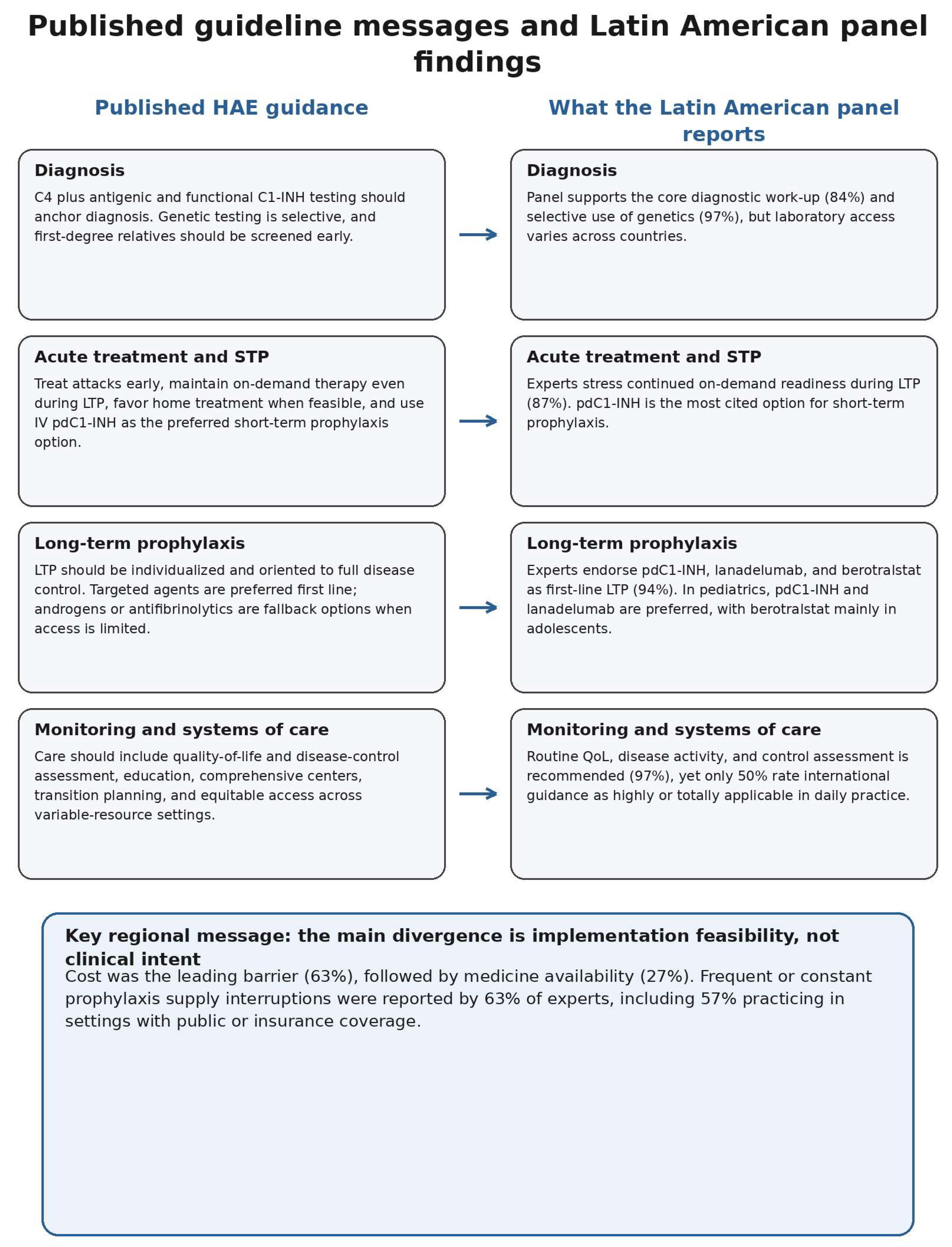
Figure 2.
From published recommendations to implementation in Latin America. This original conceptual figure summarizes the sequence from guideline-defined standards of care to Latin American clinical intent, implementation bottlenecks, and operational priorities for closing the implementation gap in routine practice. [32].
Figure 2.
From published recommendations to implementation in Latin America. This original conceptual figure summarizes the sequence from guideline-defined standards of care to Latin American clinical intent, implementation bottlenecks, and operational priorities for closing the implementation gap in routine practice. [32].
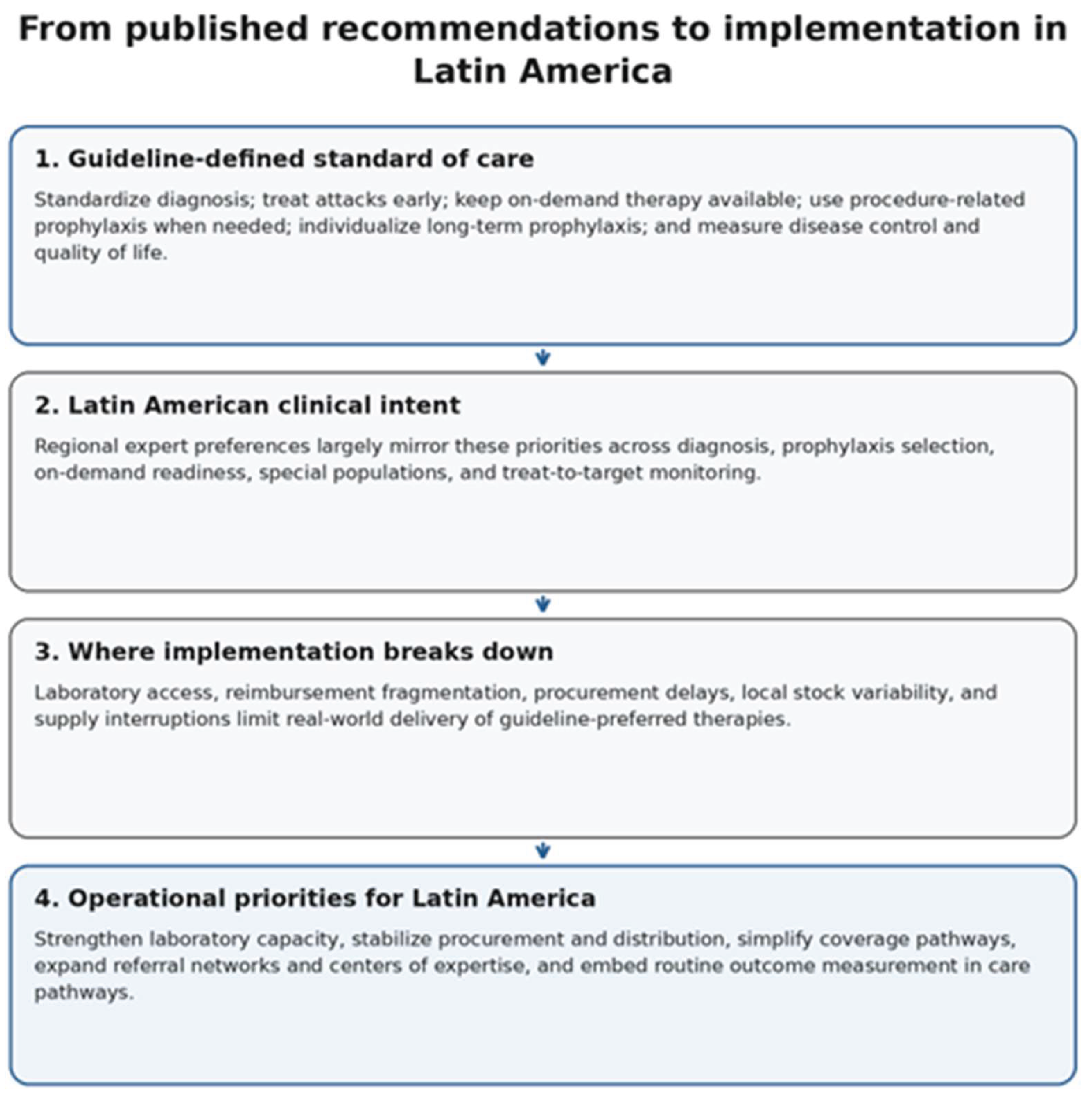
Table 1.
Expert-reported laboratory tests used for HAE diagnosis, by country (from Delphi report).
| Country | Experts (n) | C1-INH antigen (n) | C1-INH function (n) | C4 mentioned (n) | Genetic testing |
| Argentina | 4 | 1 | 3 | ||
| Brasil | 3 | 3 | 2 | 1 | 2 |
| Chile | 2 | 2 | 2 | 2 | |
| Colombia | 5 | 4 | 1 | ||
| Ecuador | 3 | 3 | 1 | ||
| México | 8 | 6 | 3 | 1 | |
| Panamá | 1 | 1 | 1 | 1 | Occasionally |
| Perú | 1 | 1 | 1 | 1 | Occasionally |
| Uruguay | 2 | 1 | 2 | 1 | |
| Venezuela | 1 | 1 |
Note: C4 was captured under 'Other' in the original instrument and may therefore be underreported. 'Occasionally' indicates non-routine genetic testing.
Table 2.
Country-level reimbursement, availability, and guideline applicability (from Delphi report).
Table 2.
Country-level reimbursement, availability, and guideline applicability (from Delphi report).
| Country |
Experts (n) |
Predominant funding (panel) |
Public coverage (majority) |
Availability issues (freq/always, %) |
Main access barrier |
Guideline applicability |
| Argentina | 4 | Insurance | Yes | 75 | Costs | Full |
| Brasil | 3 | Mixed | No | 100 | Costs | Low / Moderate / Full |
| Chile | 2 | Self-funded | No | 100 | Costs | Low / Moderate |
| Colombia | 5 | Insurance | Yes | 0 | Costs / drug availability | Moderate / High |
| Ecuador | 3 | Self-funded | No | 67 | Costs / drug availability | None / Low |
| México | 8 | State | Yes | 50 | Costs | High |
| Panamá | 1 | Mixed | Yes | 100 | Costs | Low |
| Perú | 1 | Self-funded | No | 100 | Drug availability | High |
| Uruguay | 2 | State / Mixed | Yes | 100 | Costs / drug availability | Low / Moderate |
| Venezuela | 1 | Self-funded | No | 100 | Drug availability | Low |
Note: Values reflect the distribution of responses among participating experts and may not represent national policy, reimbursement rules, or population-level access. Public coverage reflects the majority response within each country. In some settings, access to specific therapies may occur through exceptional routes (e.g., litigation-based access) rather than routine procurement. The 'availability issues' percentage corresponds to experts reporting that they 'frequently' or 'always' encounter access/supply problems.
Table 5.
Quality-of-life instruments used in routine follow-up (from Delphi report).
| Instrument | Mentions (total 24) | % |
| AE-QoL or HAE-QoL or HAQoL | 13 | 54% |
| AECT | 4 | 17% |
| QoL (unspecified) | 2 | 8% |
| DLQI | 2 | 8% |
| Number of attacks during the period | 1 | 4% |
| Clinical history only | 1 | 4% |
| AAS | 1 | 4% |
Note: Percentages are calculated among experts who specified instruments (n=18).
Table 6.
Patient satisfaction with long-term prophylaxis therapies as reported by experts (from Delphi report).
Table 6.
Patient satisfaction with long-term prophylaxis therapies as reported by experts (from Delphi report).
| Satisfaction level | pdC1-INH (N=20) |
Lanadelu- mab (N=22) |
Berotralstat (N=13) |
Antifibrino- lytics (N=23) |
Attenuated androgens (N=27) |
| Very dissatisfied | 0% | 0% | 0% | 9% | 7% |
| Dissatisfied | 5% | 0% | 0% | 17% | 19% |
| Neutral | 20% | 5% | 15% | 39% | 30% |
| Satisfied | 65% | 18% | 23% | 30% | 44% |
| Very satisfied | 10% | 77% | 62% | 4% | 0% |
Note: Percentages are calculated among experts responding for each therapy; N differs by therapy.
Table 7.
Applicability of international guideline recommendations to local practice, by country (from Delphi report).
Table 7.
Applicability of international guideline recommendations to local practice, by country (from Delphi report).
| Country | None | Low | Moderate | High | Full |
| Argentina | 0 | 0 | 0 | 0 | 4 |
| Brasil | 0 | 1 | 1 | 0 | 1 |
| Chile | 0 | 1 | 1 | 0 | 0 |
| Colombia | 0 | 0 | 2 | 2 | 1 |
| Ecuador | 1 | 1 | 0 | 0 | 0 |
| México | 0 | 0 | 2 | 4 | 2 |
| Panamá | 0 | 1 | 0 | 0 | 0 |
| Perú | 0 | 0 | 0 | 1 | 0 |
| Uruguay | 0 | 1 | 1 | 0 | 0 |
| Venezuela | 0 | 1 | 0 | 0 | 0 |
Note: Counts represent number of experts selecting each applicability level.
Disclaimer/Publisher’s Note: The statements, opinions and data contained in all publications are solely those of the individual author(s) and contributor(s) and not of MDPI and/or the editor(s). MDPI and/or the editor(s) disclaim responsibility for any injury to people or property resulting from any ideas, methods, instructions or products referred to in the content. |
© 2026 by the authors. Licensee MDPI, Basel, Switzerland. This article is an open access article distributed under the terms and conditions of the Creative Commons Attribution (CC BY) license (http://creativecommons.org/licenses/by/4.0/).
Copyright: This open access article is published under a Creative Commons CC BY 4.0 license, which permit the free download, distribution, and reuse, provided that the author and preprint are cited in any reuse.