

Submitted:
11 May 2026
Posted:
13 May 2026
You are already at the latest version
Abstract
Mangrove wetlands are important coastal ecosystems and are increasingly vulnerable to heavy metal contamination. The accumulation of heavy metals in man-grove ecosystems is well studied; however, studies on the seasonal variations of heavy metals in mangrove wetlands are scarce. This study investigated heavy metal (Cd, Cr, Cu, As, Pb, and Zn) accumulation in surface sediments of six typical mangrove wet-lands (DZG, QLH, XCP, SYR, SBW, and XY) in Hainan Island, China, during wet and dry seasons. In addition, potential ecological concerns and relationships between sedimentary physicochemical parameters and metal accumulation were assessed. The findings demonstrated significant spatial differences in heavy metal accumulation, with higher concentrations in the northern localities and lower concentrations in the southern areas. There were notable seasonal fluctuations in heavy metal concentrations, with higher levels in the dry season. Risk assessment models exhibited that Cadmium (Cd) and Arsenic (As) were the principal contaminants of concern in most research sites with moderate levels of contamination and posed at least moderate ecological concerns in both wet and dry seasons. The overall ecological risk index indicated a moderate risk to the environment, especially in the dry season. The principal component analysis (PCA) and correlation analysis results indicated that the physicochemical properties of sediments, mainly total organic carbon (TOC), total phosphorus (TP), total nitrogen (TN), and salinity, had significant effects on the heavy metals accumulation in the mangrove sediments. The present study helps raise awareness of seasonal fluctuations in heavy metal pollutants and provides strategies for the prevention and monitoring of metal pollution in mangrove wetlands.
Keywords:
heavy metals
; mangrove sediments
; seasonal variation
; ecological risk
; sedimentary physicochemical factors
1. Introduction
Mangroves are important wetland ecosystems in tropical and subtropical regions and are of great significance in shoreline protection, maintaining water quality, biodiversity, and socio-economic development [1,2]. However, these ecosystems have been seriously threatened in recent decades by a variety of pollutants introduced by anthropogenic activities, such as the rapid expansion of coastal cities and extensive industrial and agricultural development [3,4]. Among them, the most prevalent contaminants found in mangrove ecosystems are heavy metals [5]. Although some metals are essential for the well-being of living things, their high concentrations can also exert potential toxic effects [6]. For instance, excessive Mn has a detrimental effect on plant chloroplasts [7]. Owing to their non-biodegradability, potential ecotoxicity, bioaccumulation, and biomagnification in ecosystems, heavy metals readily threaten the stability of mangrove ecosystems, leading to degradation and destruction [8,9]. Consequently, they are considered the most toxic pollutants and have been the subject of extensive monitoring in mangrove ecosystems globally [5,10].
In mangrove wetlands, sediments are formed through the deposition of matter and energy and are generally considered as the major basins for heavy metal pollutants [11,12]. Thus, the extent of harm is reflected by levels of heavy metal accumulation in sediments [13]. The heavy metals distribution, bioavailability, and fate in mangrove sediments are primarily influenced by the input of terrestrial components and hydrological conditions [14], which are strongly correlated with seasonal variations. However, current studies on the seasonal variations in heavy metal distribution in mangrove sediments are still lacking, and the existing findings are inconsistent. A few studies reported that an increase in runoff and soil leaching during the monsoon season elevated the risk of heavy metal input in mangroves [15]; while some studies suggested that the increase in surface runoff and groundwater exchange might have a dilution effect on heavy metal accumulation in mangroves [16]. For the preservation of mangrove ecosystems and the sustainable development of coastal regions, it is crucial to pay attention to the potential ecological risks, underlying mechanisms, and seasonal variations of heavy metals in mangrove sediments.
Hainan Island, the second-largest island in China, is in the northern part of the South China Sea. It is home to the most diverse and richest mangrove forests in China [17,18]. Hainan has a limited number of industrial operations and is primarily recognized for its agricultural sector. However, over the past few decades, the decreased soil fertility and high land utilization rate have led to a sharp increase in the application of fertilizers and pesticides in Hainan, causing a large accumulation of heavy metals in the soils [19,20]. In addition, the ongoing establishment of the Hainan Free Trade Port and subsequent rapid coastal expansion are increasing the likelihood of heavy metals accumulation in the mangrove forests [2,21]. The distribution, origins, and ecological hazards of heavy metals in the mangrove ecosystems of Hainan Island have recently garnered significant attention. A study by Mao et al. [10] described the distribution characteristics of nine heavy metals in Dongzhai Harbor’s mangrove sediments and found that most of the studied metals (Cr, Cd, Zn, Cu, Co, and Ni) exceeded the quality standard. Similarly, Wang et al. [2] compared heavy metal pollution levels in mangrove sediments from Dongzhai and Qinglan Harbors, revealing higher ecological risks in the Dongzhai Harbor. Notably, existing studies have mainly focused on small areas and have not studied Hainan Island on a large scale. Therefore, there is an urgent need to investigate and evaluate the extent of metal pollution in mangrove wetlands across Hainan Island.
This study aimed to assess the seasonal variation in heavy metal accumulation and physicochemical parameters of surface sediments from six mangrove wetlands on Hainan Island in both the wet and dry seasons. The subject metals were Cd, Cr, Cu, As, Pd, and Zn, and physicochemical parameters were total organic carbon, total nitrogen, total phosphorus, pH, and salinity. The main objective was to characterize the distribution and ecological risk of these heavy metals in mangrove sediments across Hainan Island, with emphasis on seasonal variations, and determine the association between the variations in the distribution of heavy metals and sediment physicochemical properties, aiming to enhance the understanding of seasonal variations of metal pollution and establish a scientific basis for the management of heavy metal contamination in mangrove ecosystems.
2. Materials and Methods
2.1. Study Area
This study was performed in six mangrove wetlands along the entire coastline of Hainan Island, China (Figure 1). The sites included the Dongzhaigang National Nature Reserve (DZG) of Haikou City in the North, Qinglan Harbor Provincial Nature Reserve (QLH) of Wenchang County in the East, Xincun Port (XCP) of Lingshui County, Sanya River Mangrove Reserve (SYR) of Sanya City in the south, Sibi Wan (SBW) of Dongfang City and Xinying Mangrove National Wetland Park (XY) of Danzhou City in the West. These regions comprise the major mangroves on Hainan Island, with DZG (40.8%) and QLH (28%) [22]. All sites have a typical tropical island monsoon climate, characterized by distinctive wet and dry seasons (more than 80% of the rainfall occurs from May to October).
2.2. Sample Collection and Physicochemical Property Determination
The samples were collected from 18 sites designated in these six mangrove wetlands, with 3 sampling sites in each wetland. At each site, three plots were designed. In each plot, surface sediments (0-10 cm) were collected in October 2023 (wet season) and April 2024 (dry season), respectively. Five subsamples were gathered from each plot and combined into a sediment sample. The collected sediment samples were stored in sealed aluminum bags and then transported to the laboratory for analysis.
To ensure a pure sediment matrix, the collected samples were first carefully screened to eliminate visible fauna, necromass, trash, and root pieces in accordance with previous protocols [2]. The samples were freeze-dried, minced into fine powder, and then sieved using a 100-mesh sieve. The physicochemical characteristics of the sediment, such as total organic carbon (TOC), total nitrogen (TN), total phosphorus (TP), pH, and salinity, were assessed using a variety of conventional techniques. These measurements were conducted in accordance with the procedures described by Gong et al. [23].
2.3. Metal Analysis, Quality Assurance, and Control
In accordance with the prior methodology [20], 0.2 g of sieved sediment was introduced into Teflon vessels and subjected to digestion with 12 mL of Aqua regia (HNO3: HCl = 3:1) utilizing an intelligent digestion system (PreeKem TOPEX+, Shanghai, China). Subsequently, the digests were concentrated to ~1 mL at 105 °C. After cooling, the solutions were quantitatively diluted to 25 mL in a volumetric flask using deionized water, followed by filtration through a 0.45 µm membrane. The concentrations of Cd, Cr, Cu, As, Pb, and Zn in all digests were quantified using an inductively coupled plasma mass spectrometer (Agilent 7900, Santa Clara, CA, USA).
To prevent potential contamination from external metals, all containers were soaked in a 15% HNO3 solution for 24 h before use, rinsed thrice with deionized water, and dried at 60 ℃. In order to verify the accuracy of the measurement process, the blanks and sediment standard material (GBW07407) provided by the National Research Centre for Geoanalysis of China were adopted. The limits of detection for Cd, Cr, Cu, As, Pb, and Zn were 0.003, 0.004, 0.005, 0.008, 0.002, and 0.01µg/L, respectively. The recoveries for the analysed metals varied from 94% to 108%.
2.4. Risk Assessment
Geoaccumulation Index (Igeo), an indicator that reflects the influence of natural diagenesis and human activities on the sedimentary environment, was used to assess the extent of heavy metals enrichment in sediments relative to the baseline levels [2,24]. It was calculated according to the following equation [25].
where Cn represents the metal contents in the measured sediment samples, Bn is the local background value of the corresponding metal in sediments, k is a correction constant that compensates for the possible variations in the background value caused by natural diagenesis, and is usually regarded as 1.5. According to previous studies [22,26], the background values for Cd, Cr, As, Pb, Cu, and Zn in Hainan mangrove sediments were 0.04, 50.38, 2.75, 24.55, 10.56, and 27.58 µg/g dry weight, respectively. Igeo values were split into seven levels, as shown in Table 1.
Igeo = log2 (Cn/kBn)
The ecological risk of heavy metal pollution was evaluated by calculating the potential ecological risk factor (Er) and ecological risk index (RI). They were determined according to the following equation [27].
where Tri is the toxicity coefficient of the corresponding heavy metal; the Tri values are 30, 2, 10, 5, 5, and 1 for Cd, Cr, As, Pb, Cu, and Zn, respectively [2,27]; s the metal content in the measured sediment samples; the local background value of the corresponding metal (equivalent to Bn mentioned above). The classification of the Er and RI is listed in Table 2.
2.5. Statistical Analysis
SPSS version 22.0 was used for statistical analysis, and the data were presented as mean ± SD. The data normality was checked using the Shapiro-Wilk test, and the homogeneity of variance using the Levene test. One-way analysis of variance (ANOVA) with Duncan’s multiple range test was employed to compare differences in heavy metal content among sampling areas for the data following a normal distribution; otherwise, nonparametric analysis with the Kruskal-Wallis test was used. The differences between the dry and wet seasons within the same sampling area were determined by using an independent sample t-test. Principal component analysis (PCA) and Pearson correlation analysis were used to determine the relationship between heavy metal distribution and sediment physicochemical properties in different seasons. In all tests, p < 0.05 was considered as the significance level. ArcGIS (version 10.8) and Origin (version 2024) were employed to construct the sampling location map and graphs, respectively.
3. Results and Discussion
3.1. Spatio-Temporal Distribution of Heavy Metals in Mangrove Sediments Across Hainan Island
The comparisons in heavy metal contents in different mangrove sediments of Hainan Island in wet and dry seasons are shown in Figure 2 and Figure 3, respectively. Comparisons of heavy metal contents among mangrove sediments across Hainan Island exhibited significant spatial variations in both seasons. In the wet season, Cd contents in DZG, QLH, and SBW were significantly higher than those in other mangrove areas; whereas the Cd content in XCP was the lowest, significantly lower than that in other mangrove areas. Similarly, Pb content in XCP was the lowest, significantly lower than in other areas. As contents in SBW and XY were significantly higher than those in other areas, and As contents in DZG and QLH were significantly higher than those in SYR and XCP areas. Cr contents in SYR and XCP areas were the lowest, significantly lower than those in other areas. As for the Cu, the DZG area had the highest concentration (20.75 µg/g), followed by SBW (17.90 µg/g), QLH (16.40 µg/g), XY (15.91 µg/g), XCP (10.46 µg/g), and SYR (10.19 µg/g) areas. The distribution of Zn in different mangrove areas was similar to that of Cu, following the descending order of DZG, SBW, QLH, XY, SYR, and XCP areas (Figure 2). Similar to the wet season, higher concentrations of the studied metals were found in the DZG, QLH, SBW, and XY areas, while the SYR and XCP areas generally showed the lowest metal concentrations (Figure 3). In general, the spatial variations in heavy metal distributions in mangrove sediments on Hainan Island show higher levels in the northern region and lower levels in the southern region in both seasons, consistent with previous research results [22,28,29]. The spatial distribution of heavy metals in different mangrove sediments depends on a variety of factors, including the topography and hydrodynamic conditions of wetland areas, the sources and nature of heavy metals, as well as their sensitivity to physicochemical conditions, migration forms, geochemical behavior, and the adsorption capacity of sediment grains [12,30]. The regional discrepancies in population density and economic development levels align with the geographical distribution of heavy metals in mangrove sediments across Hainan Island [21], indicating that human activity is the primary cause of the disparities in spatial distribution.
The differences in heavy metal contents between the wet and dry seasons are shown in Figure 4. The Pb and As contents at the DZG area were significantly greater in the dry season than in the wet season. At the QLH area, the concentrations of Cd, Cr, As, Pb, and Cu were significantly higher in the dry season as compared to the wet season. At the SBW area, the contents of Cr, As, Cu, and Zn were significantly high in the dry season compared to the wet season. At the XY area, the contents of Cd, As, Pb, and Cu were significantly higher in the dry season than in the wet season. The contents of all examined metals at the SYR and XCP areas did not differ significantly between the dry and wet seasons, except for Cr in the XCP area (Figure 4). Overall, the concentrations of the majority of the analysed metals were markedly elevated during the dry season compared to the wet season in most study locations, suggesting that mangrove wetlands are more susceptible to heavy metal contamination in the dry season. Similarly, Wang et al. [2] discovered that in the DZG and QLH regions, the contents of heavy metals like Cd and Pb were substantially greater during the dry season than the wet season. Seasonal variations in heavy metal contents in mangrove sediments may be associated with anthropogenic activities. Human activities, such as agricultural production, construction, and tourism, are more intense compared to the wet season due to the more comfortable weather for humans in Hainan during the dry season, increasing pollutant emissions and subsequently higher contents of heavy metals in mangrove sediments [2,31]. Moreover, precipitation and atmospheric temperature play important roles in seasonal fluctuations in the concentrations of heavy metals. The microbial decomposition process and the formation of organic acids may be accelerated by the high temperature in summer (the wet season), thereby causing heavy metals to leach out from sediments [32]. The prolonged leaching caused by heavy rainfall in the wet season may mobilize the surface sediments and enhance the oxidation of sulphides, leading to the diffusion of heavy metals into the overlying water and decreasing the concentrations of heavy metals in the sediments [33]. Notably, the increasing leaching and runoff in the wet season were also reported to elevate the contents of heavy metals in mangrove sediments [15]. The specific mechanisms underlying the seasonal variations in heavy metal distribution in mangrove sediments remain to be elucidated.
3.2. Contamination Status and Potential Ecological Risk Assessment
The geo-accumulation index (Igeo) is an indicator for evaluating the extent of heavy metal pollution based on background values [34]. Igeo < 0 indicates a natural source with no pollution, while Igeo > 0 represents the potential anthropogenic source and the presence of pollution [35]. The results of Igeo in different mangrove sediments across Hainan Island in the wet and dry seasons are shown in Table 3. The enrichment degree of the studied metals in both seasons follows the pattern of Cd > As > Zn > Cu > Cr > Pb. Apart from the XCP and SYR areas, the average Igeo values of Cd and As in other mangrove areas were broadly near or exceeding 1, especially in the dry season, indicating that these coastal mangrove areas were moderately contaminated by Cd and As according to the grading criteria in Table 1. The average Igeo values of Pb and Cr in all mangrove areas were broadly negative in both wet and dry seasons, indicating that they were at a non-contamination level. Igeo values of Cu in QLH, SBW, and XY areas in the dry season and Zn in DZG, QLH, and SBW areas in both seasons showed a slight degree of contamination. The XCP and SYR regions exhibited the lowest Igeo values for all metals, predominantly at the non-contamination threshold.
It is crucial to ascertain whether the heavy metals in mangrove sediments have adverse effects on the coastal lifeforms [15,36]. Therefore, the potential risk or toxicity associated with heavy metals in the sediments of several mangrove wetlands surrounding Hainan Island was assessed utilising the potential ecological risk factor (Er) and the ecological risk index (RI). The results of Er and RI were shown in Table 4. According to the grading criteria in Table 2, all mangrove regions had average Er values of Pb, Cr, Cu, and Zn < 40 in both wet and dry seasons, indicating a minimal risk. Notably, Cd had the highest Er value in all studied sites. Cd was at a low ecological risk (Er < 40) in the XCP area and a moderate ecological risk (40 ≤ Er < 80) in the SYR area, regardless of seasons. The average Er values of Cd in other mangrove areas showed a considerable risk (80 ≤ Er < 160), except the XY area in the wet season (70.17, moderate risk) and the QLH area in the dry season (164.20, high risk). As was at a moderate risk in the SBW area in the dry season and in the XY area regardless of seasons, while it was at low risk in other areas in both seasons. The average Er values of the studied metals showed the trend of Cd > As > Cu > Pb > Cr > Zn. In the wet season, the RI value of heavy metals showed a moderate risk (150 ≤ RI < 300) only in the SBW area, while in the dry season, it showed moderate risk in most research areas (Table 4), suggesting a higher ecological risk in the dry season. The order of Igeo and Er values for Pb, Cr, and Zn was inconsistent, which might be due to the different toxicity coefficients of each metal [8,37].
Consistent with current findings, a previous study reported that the mangrove areas across Hainan Island were extensively contaminated by Cd and As with moderate to considerable ecological risk, and the overall risk was at the moderate level in most mangrove areas [29]. The extensive use of chemical fertilizers and pesticides in agricultural activities is a significant source of Cd and As in the soil [19]. Due to the higher land utilization rate and lower fertility, the overuse of chemical fertilisers and pesticides in recent decades has resulted in the excessive accumulation of Cd and As in the soil of Hainan [19,38]. In addition, the aquaculture activities nearby also exacerbate the deposition of Cd and As in mangrove sediments [22]. The higher enrichment of heavy metals in SBW and XY areas of the western part may also be related to the presence of abundant mineral resources [39,40]. These mangrove wetlands are typical coastal wetland reserves that provide important habitats for wildlife, including various waterbirds and fish. For instance, the SBW mangrove area serves as an important foraging habitat for the black-faced spoonbill (Platalea minor), a first-class protected bird in China. Therefore, the excessive accumulation of these heavy metals in mangrove sediments not only imposes toxic stress on mangrove flora but also poses threats to the endangered waterbirds and their biodiversity. The findings of present study indicate that Cd and As metal pollutants require priority attention in mangrove wetlands of Hainan, particularly in the dry season. There is an urgent need for the relevant ecotoxicological investigations in the future.
3.3. Relationship Between Sediment Physicochemical Factors and Heavy Metal Pollution
The previous findings suggested that the accumulation of heavy metals in mangrove sediments on Hainan Island varied seasonally. The mangrove sediments have multiple sources of heavy metals accumulation that are controlled by intricate hydrodynamic-biogeochemical pathways; their ultimate retention is governed primarily by sediment physicochemical properties [29]. Therefore, it is hypothesized that the seasonal changes in heavy metal contents in mangrove sediments are associated with the changes in the sediment physicochemical properties. To examine the relationship between the difference in heavy metal distribution and the sediment physicochemical properties, PCA (principal component analysis) was performed in this study, as shown in Figure 5. The PC1 (first principal component) explained 55.4% of the variance, with TN (0.36), TP (0.32), TOC (0.25), and salinity (0.20) exhibiting higher loadings. PC2 explained 12.2% of the variance with the main contribution from pH (0.69). The result of PCA showed a significant correlation between physicochemical properties (TN, TP, TOC, and salinity) and heavy metals, indicating that physicochemical parameters had a significant influence on heavy metal distribution in mangrove sediments.
The correlation analysis indicated that sediment physicochemical factors played a crucial role in governing heavy metal distribution (Figure 6). Salinity demonstrated significantly positive correlations with Cd, Cu, As, and Zn, while TOC, TP, and TN, except pH, had significant positive correlations with all heavy metals. The results suggested that nutrients and salinity facilitated the accumulation and retention of heavy metals in mangrove sediments. Heavy metals in sediments are classified into acid-extractable, residual, reducible, and oxidizable speciation, which are closely related to the migration and transformation of the metals [41,42]. Sediment physicochemical factors such as nutrient content, salinity, pH, and mechanical composition can alter the metal speciation, leading to desorption or adsorption, subsequently impacting the retention of heavy metals in mangrove sediments [2,43]. The organic matter in sediments can adsorb heavy metals through various processes, including cation exchange, chelation, and complexation reactions [44,45]. Nitrogen deposition can elevate the turnover time of organic matter, potentially hindering the desorption of heavy metals from organic matter by augmenting its adsorption capacity for heavy metals and extending their interactions [2,46]. The increase in sediment phosphorus can induce the release of organic acids from the roots of mangrove plants, thereby leading to rhizosphere acidification and the reconfiguration of heavy metal speciation [29]. Phosphates and their secondary derivatives can precipitate with heavy metals due to changes in the redox state and solubility of heavy metals, thereby enabling the sequestration of heavy metals in sediments [47,48]. In summary, the present study results suggest that the seasonal variations in the distribution of heavy metals in mangrove sediments can be partly ascribed to changes in the sediment physicochemical factors, particularly TN, TP, TOC, and salinity.
4. Conclusions
The current study revealed significant regional variations in the distribution of heavy metals (Cd, Pb, As, Cr, Cu, and Zn) in mangrove sediments across Hainan Island, with higher concentrations in the northern region and lower concentrations in the southern. Human activity appears to be the primary cause, as the spatial patterns of heavy metals are generally consistent with regional variations in population density and economic development level. Additionally, significant seasonal variations in the concentrations of these heavy metals were found in most study areas, with higher levels typically occurring during the dry season. Apart from the XCP and SYR areas, the overall ecological risk from heavy metals was predominantly at a moderate level in other areas, especially in the dry season. Cd and As showed moderate contamination in most study areas (except for the XCP and SYR areas), and they generally posed at least moderate ecological risks, especially for Cd, suggesting that Cd and As are the main metal pollutants that require priority attention in mangrove wetlands of Hainan. The extensive use of chemical fertilizers and pesticides in agriculture, along with aquaculture activities, is the primary source of these pollutants. The principal component analysis and correlation analysis showed that the variations in heavy metal distribution within mangrove sediments in different seasons were closely related to sediment physicochemical factors such as TN, TP, TOC, and salinity. Understanding these relationships is crucial for elucidating the mechanisms behind seasonal variations in heavy metal concentrations within sediments. In the prevention and management of heavy metal pollution in mangrove wetlands, future efforts should pay more attention to fluctuations of the potentially toxic metals in different seasons and implement a dual strategy of upstream source control and management of sedimentary environmental health.
Author Contributions
X.H.: investigation, data curation, visualization, and formal analysis. Y.M.: software, methodology, formal analysis, supervision, writing—review and editing. H.Q.: methodology, conceptualization, validation, investigation, data curation, funding acquisition, and writing—original draft preparation. K.N.:investigation, data curation. Y.S.; investigation, data curation. J.Z.: conceptualization, methodology, funding acquisition, project administration, supervision, writing—review and editing. All authors have read and agreed to the published version of the manuscript.
Funding
This research was funded by Hainan Provincial Natural Science Foundation of China (grant numbers: 424QN254 and 325RC755) and Hainan Provincial Key Research and Development Project of China (grant number: ZDYF2024SHFZ075).
Institutional Review Board Statement
Not applicable.
Informed Consent Statement
Not applicable.
Data Availability Statement
Data will be made available upon request. Should you require the data, please contact the corresponding author.
Acknowledgments
We sincerely thank the anonymous reviewers for their helpful suggestions and comments.
Conflicts of Interest
The authors declare no conflicts of interest.
References
- Hagger, V., Worthington, T.A., Lovelock, C.E., Adame, M.F., Amano, T., Brown, B.M., Friess, D.A., Landis, E., Mumby, P.J., Morrison, T.H., 2022. Drivers of global mangrove loss and gain in social-ecological systems. Nat. Commun. 13, 6373.
- Wang, M., Chen, Q., Cui, J., Yu, Z., Wang, W., Sun, Z., Chen, Q., 2024. Distribution, ecological risk, and sediment-influencing mechanisms of heavy metals in surface sediments along the intertidal gradient in typical mangroves in Hainan, China. Mar. Pollut. Bull. 206, 116677.
- Liu, X., Liu, H., Chen, L., Wang, X., 2022. Ecological interception effect of mangroves on microplastics. J. Hazard. Mater. 423, 127231.
- Robin, S.L., Marchand, C., 2022. Polycyclic aromatic hydrocarbons (PAHs) in mangrove ecosystems: a review. Environ. Pollut., 119959.
- Li, C., Wang, H., Liao, X., Xiao, R., Liu, K., Bai, J., Li, B., He, Q., 2022. Heavy metal pollution in coastal wetlands: a systematic review of studies globally over the past three decades. J. Hazard. Mater. 424, 127312.
- Qiu, Y.W., Yu, K.F., Zhang, G., Wang, W.X., 2011. Accumulation and partitioning of seven trace metals in mangroves and sediment cores from three estuarine wetlands of Hainan Island China. J. Hazard. Mater. 190, 631–638.
- Liu, Y., Li, Z.Y., Xu, R.K., 2019. Distribution of manganese (II) chemical forms on soybean roots and manganese (II) toxicity. Pedosphere, 29, 656–664.
- Wu, H., Liu, J., Bi, X., Lin, G., Feng, C.C., Li, Z., Qi, F., Zheng, T., Xie, L., 2017. Trace metals in sediments and benthic animals from aquaculture ponds near a mangrove wetland in Southern China. Mar. Pollut. Bull. 117, 486–491.
- Shah, S.B., 2021. Heavy metals in the marine environment-an overview. Heavy Metals in Scleractinian Corals 1–26.
- Mao, C., Du, S., Zhang, G., Wang, Y., Rao, W., 2022. Spatial distribution and ecological risk assessment of heavy metals in the sediment of a tropical mangrove wetland on Hainan Island, China. Water, 14(22), 3785.
- Yan, Y., Wan, R.A., Yu, R.L., Hu, G.R., Lin, C.Q., Huang, H.B., 2022. A comprehensive analysis on source-specific ecological risk of metal (loid) s in surface sediments of mangrove wetlands in Jiulong River Estuary, China. Catena 209, 105817.
- Fu, K., Chen, Z., Huang, C., Chen, Y., Wu, D., Li, X., Song, Y., Ding, W., Yang, X., Long, J., 2024. Distribution, sources, impact factors and ecological risks of sediment heavy metals from typical estuarine wetlands in tropical islands. Estuarine Coast. Shelf Sci. 307, 108922.
- Mishra, S., Bharagava, R.N., More, N., Yadav, A., Zainith, S., Mani, S., Chowdhary, P., 2019. Heavy metal contamination: an alarming threat to environment and human health. In: Environmental Biotechnology: For Sustainable Future, pp. 103–125.
- Bastakoti, U., Robertson, J., Marchand, C., Alfaro, A.C., 2019. Mangrove removal: Effects on trace metal concentrations in temperate estuarine sediments. Mar. Chem. 216, 12.
- Thanh-Nho, N., Strady, E., Nhu-Trang, T.T., David, F., Marchand, C., 2018. Trace metals partitioning between particulate and dissolved phases along a tropical mangrove estuary (Can Gio, Vietnam). Chemosphere, 196, 311–322.
- Hong, H., Zhang, B., Lu, H., 2021. Seasonal Variation and Ecological Risk Assessment of Heavy Metal in an Estuarine Mangrove Wetland. Water, 13, 2064.
- Meng, Y., Gou, R., Bai, J., Moreno-Mateos, D., Davis, C.C., Wan, L., Song, S., Zhang, H., Zhu, X., Lin, G., 2022. Spatial patterns and driving factors of carbon stocks in mangrove forests on Hainan Island, China. Global Ecol. Biogeogr. 31, 1692–1706.
- Herbeck, L.S., Krumme, U., Andersen, T.J., Jennerjahn, T.C., 2020. Decadal trends in mangrove and pond aquaculture cover on Hainan (China) since 1966: Mangrove loss fragmentation and associated biogeochemical changes. Estuarine Coast. Shelf Sci. 233, 106531.
- Wang, D., Dang, Z., Feng, H., Wang, R., 2015. Distribution of anthropogenic cadmium and arsenic in arable land soils of Hainan, China. Toxicol. Environ. Chem. 97, 402–408.
- Qiu, H., Huang, X., Xu, C., Zhang, J., 2025. Impaired Reproductive Performance of Waterbirds in Metal-Contaminated Tropical Rice Agroecosystems: Evidence from Little Egrets (Egretta garzetta). Toxics, 13(8), 676.
- Huang, Z., Guan, D., Wang, G., 2020. Heavy metal contents of mangrove surface soils affected by the social and economic development in Hainan Island. Mar. Environ. Sci. 39, 831–837.
- Li, P., Li, X., Bai, J., Meng, Y., Diao, X., Pan, K., Zhu, X., Lin, G., 2022. Effects of land use on the heavy metal pollution in mangrove sediments: Study on a whole island scale in Hainan, China. Science of the Total Environment, 824, 153856.
- Gong, J.C., Li, B.H., Liu, C.Y., Li, P.F., Hu, J.W., Yang, G.P., 2025. Impact of salinity gradients on nitric oxide emissions and functional microbes in estuarine wetland sediments. Water Research, 273, 123046.
- Sun, Y., Yang, J., Li, K., Gong, J., Gao, J., Wang, Z., Cai, Y., Zhao, K., Hu, S., Fu, Y., Duan, Z., Lin, L., 2023. Differentiating environmental scenarios to establish geochemical baseline values for heavy metals in soil: a case study of Hainan Island, China. Sci. Total Environ. 898, 165634.
- Muller, G., 1969. Index of geoaccumulation in sediments of the Rhine River. Geojournal 2, 108–118.
- Mo, D., Wu, R., 1988. Characteristics and geographical distribution of trace element contents in soils of Hainan Island. Trop. Geogr. 8, 73–81 (in Chinese with English abstract).
- Hakanson, L., 1980. An ecological risk index for aquatic pollution control. A sedimentological approach. Water Res. 14, 975–1001.
- Cai, P., Cai, G., Chen, X., Li, S., Zhao, L., 2021. The concentration distribution and biohazard assessment of heavy metal elements in surface sediments from the continental shelf of Hainan Island. Mar. Pollut. Bull. 166, 112254.
- Wang, M., Du, L., Chen, Q., Sun, Z., Chen, Q., 2026. Sediment physicochemistry outweighs anthropogenic factors in driving sediment heavy metals accumulation within mangrove forests across Hainan Island, China. Mar. Pollut. Bull. 223, 118944.
- Meng, S., Peng, T., Pratush, A., Huang, T., Hu, Z., 2021. Interactions between heavy metals and bacteria in mangroves. Mar. Pollut. Bull. 172, 112846.
- Ji, C., Liu, Y., Wu, D., Fu, B., Wang, L., Zhang, L., 2020. Dynamic change in particulate palladium concentrations in a mangrove wetland water environment and its mechanism in Dongzhai Harbor, China. Water Sci. Technol. 82, 2503–2512.
- Yan, Z., Sun, X., Xu, Y., Zhang, Q., Li, X., 2017. Accumulation and tolerance of mangroves to heavy metals: a review. Curr. Pollut. Rep. 3, 302–317.
- Bastakoti, U., Bourgeois, C., Marchand, C., Alfaro, A.C., 2019. Urban-rural gradients in the distribution of trace metals in sediments within temperate mangroves (New Zealand). Mar. Pollut. Bull. 149, 110614.
- Zhang, H., Liu, S., Wu, K., Cui, J., Zhu, A., Zhang, Y., et al., 2021. Distribution and assessment of heavy metal contents in surface sediments of the western sunda shelf. Mar. Pollut. Bull. 168, 112433.
- Li, T., Cai, G., Zhang, M., Li, S., Nie, X., 2021. The response of benthic foraminifera to heavy metals and grain sizes: a case study from Hainan Island, China. Mar. Pollut. Bull. 167, 112328.
- Zarezadeh, R.; Rezaee, P.; Lak, R.; Masoodi, M.; Ghorbani, M., 2017. Distribution and accumulation of heavy metals in sediments of the northern part of mangrove in Hara Biosphere Reserve, Qeshm Island (Persian Gulf). Soil Water Res. 12, 86–95.
- Ray, R., Mandal, S., Gonzalez, ’ A., Pokrovsky, O., Jana, T., 2021. Storage and recycling of major and trace element in mangroves. Sci. Total Environ. 780, 146379.
- Chen, W.X.; Li, Q.; Wang, Z.; Sun, Z.J. Spatial distribution characteristics and pollution evaluation of heavy metals in arable land soil of China. J. Environ. Sci. 2020, 41, 2822–2833. (In Chinese).
- Sun, Z., Xie, X., Wang, P., Hu, Y., Cheng, H., 2018. Heavy metal pollution caused by small-scale metal ore mining activities: a case study from a polymetallic mine in South China. Sci. Total Environ. 639, 217–227.
- Feng, Y.X., Yu, X.Z., Zhang, H., 2021. A modelling study of a buffer zone in abating heavy metal contamination from a gold mine of Hainan Province in nearby agricultural area. J. Environ. Manage. 287, 112299.
- Kang, M., Tian, Y., Peng, S., Wang, M., 2019. Effect of dissolved oxygen and nutrient levels on heavy metal contents and fractions in river surface sediments. Sci. Total Environ. 648, 861–870.
- Tu, Y.-J., Luo, P.-C., Li, Y.-L., Liu, J., Sun, T.-T., Li, G.-J., Duan, Y.-P., 2023. Seasonal heavy metal speciation in sediment and source tracking via Cu isotopic composition in Huangpu River, Shanghai, China. Ecotox. Environ. Safe. 260, 115068.
- Hu, C., Yang, X., Dong, J., Zhang, X., 2018. Heavy metal concentrations and chemical fractions in sediment from Swan Lagoon, China: their relation to the physiochemical properties of sediment. Chemosphere 209, 848–856.
- Zhang, G., Bai, J., Xiao, R., Zhao, Q., Jia, J., Cui, B., Liu, X., 2017. Heavy metal fractions and ecological risk assessment in sediments from urban, rural and reclamation affected rivers of the Pearl River Estuary, China. Chemosphere 184, 278–288.
- He, Y., Men, B., Yang, X., Li, Y., Xu, H., Wang, D., 2019. Relationship between heavy metals and dissolved organic matter released from sediment by bioturbation/ bioirrigation. J. Environ. Sci. 75, 216–223.
- Li, Y., Feng, W., Chi, H., Huang, Y., Ruan, D., Chao, Y., Qiu, R., Wang, S., 2019. Could the rhizoplane biofilm of wetland plants lead to rhizospheric heavy metal precipitation and iron-sulfur cycle termination? J. Soils Sediments 19, 3760–3772.
- Roussel, J., Carliell-Marquet, C., 2016. Significance of vivianite precipitation on the mobility of iron in anaerobically digested sludge. Front. Environ. Sci. 4, 60.
- Liu, J.J., Diao, Z.H., Xu, X.R., Xie, Q., 2019. Effects of dissolved oxygen, salinity, nitrogen and phosphorus on the release of heavy metals from coastal sediments. Sci. Total Environ. 666, 894–901.
Figure 1.
Map of sampling sites on Hainan Island.
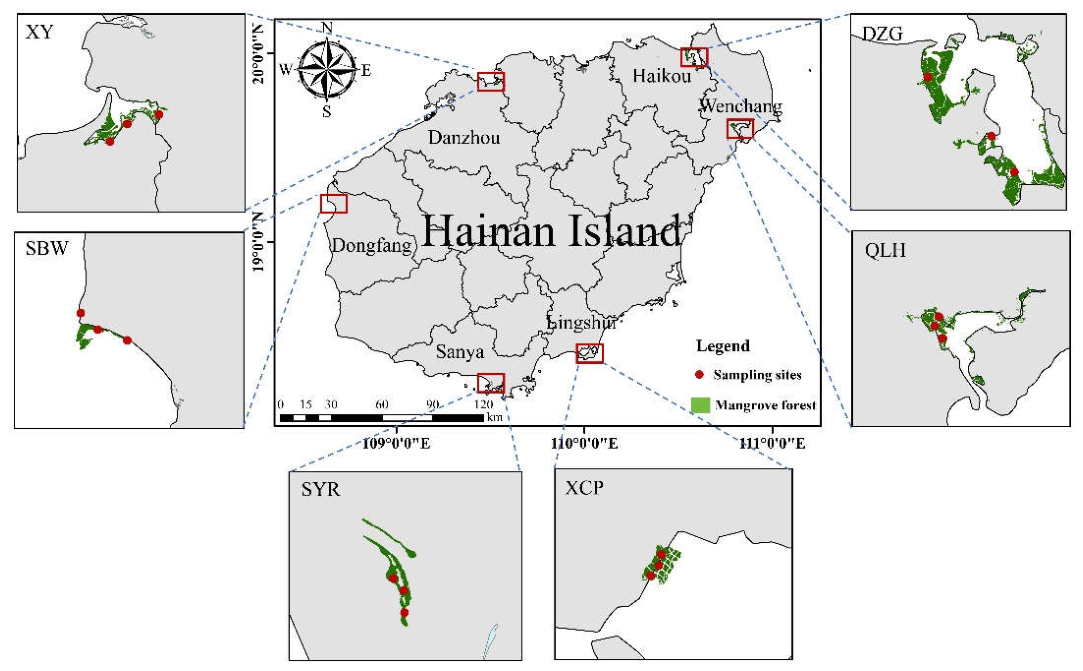
Figure 2.
Heavy metal contents of mangrove sediments in different sampling areas in the wet season. Different letters (a,b,c) represent significant differences (p <0.05) among sampling areas.
Figure 2.
Heavy metal contents of mangrove sediments in different sampling areas in the wet season. Different letters (a,b,c) represent significant differences (p <0.05) among sampling areas.
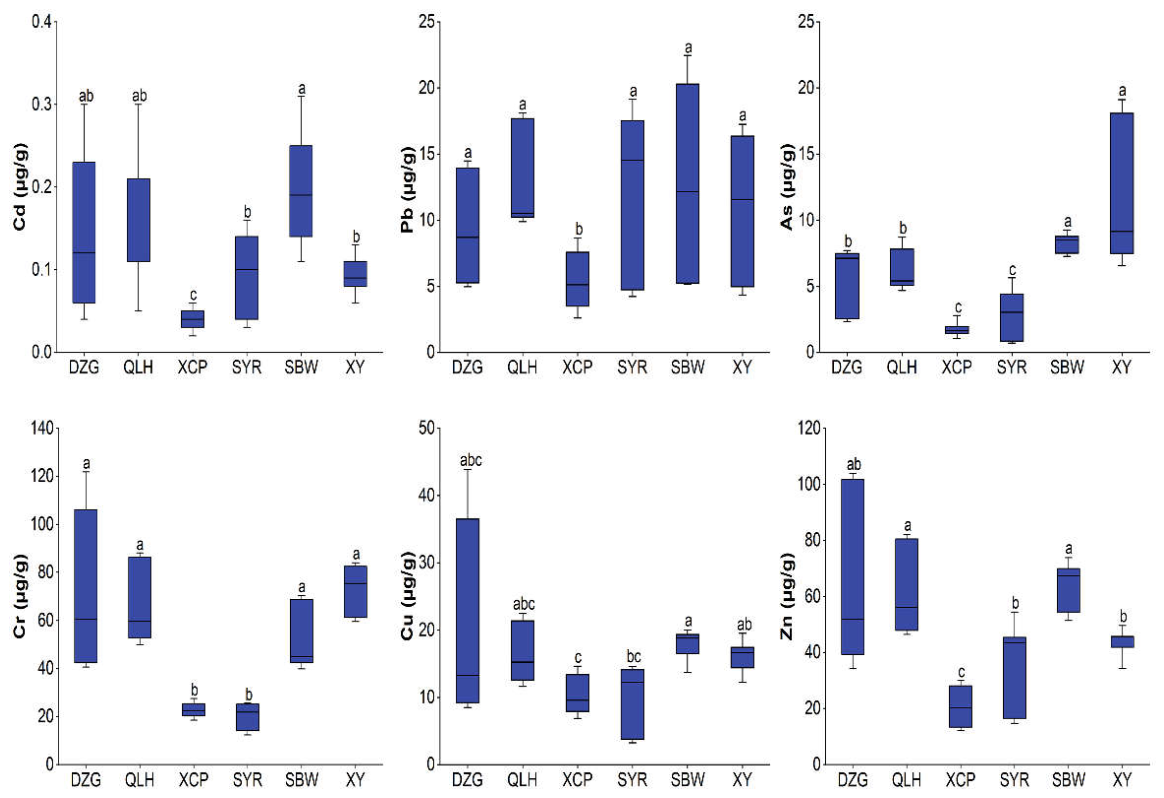
Figure 3.
Heavy metal contents of mangrove sediments in different sampling areas in the dry season. Different letters (a,b,c) represent significant differences (p <0.05) among sampling areas.
Figure 3.
Heavy metal contents of mangrove sediments in different sampling areas in the dry season. Different letters (a,b,c) represent significant differences (p <0.05) among sampling areas.
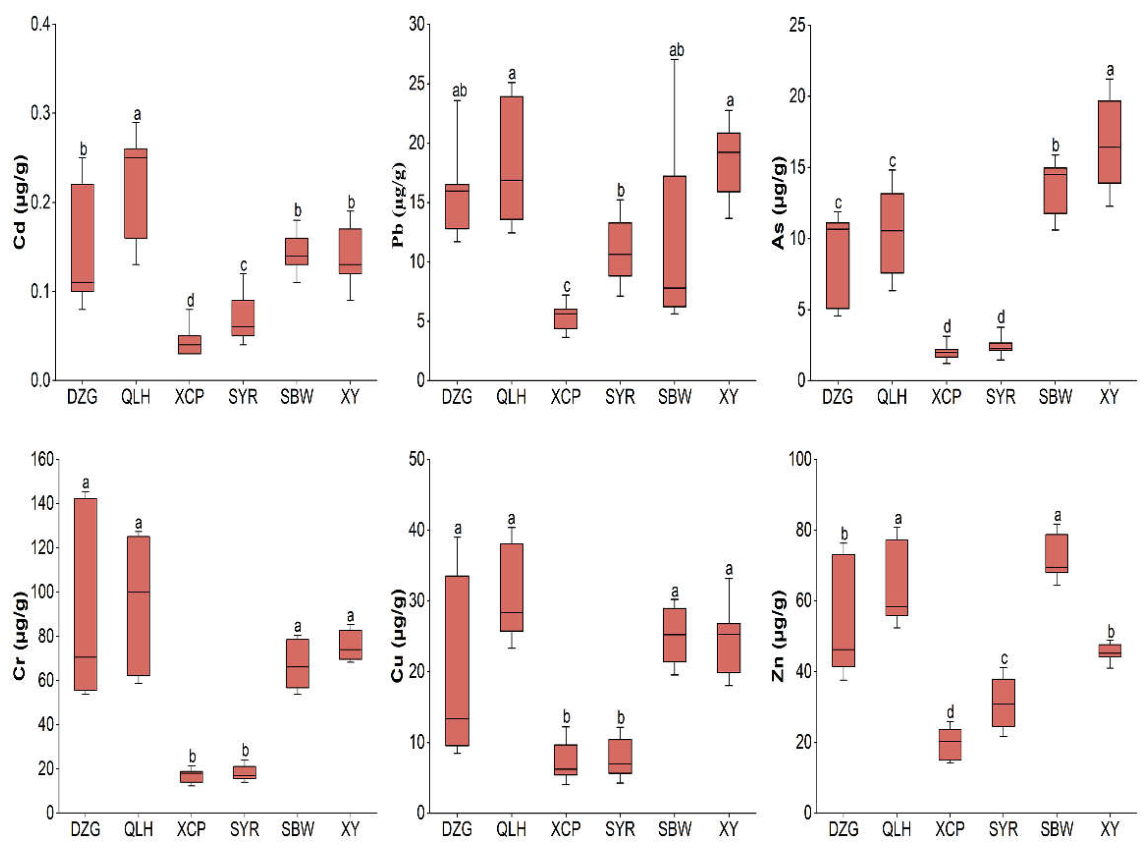
Figure 4.
Comparisons of heavy metal contents of mangrove sediments in different sampling areas between the wet and dry seasons. * Significant differences (p <0.05) between the two seasons.
Figure 4.
Comparisons of heavy metal contents of mangrove sediments in different sampling areas between the wet and dry seasons. * Significant differences (p <0.05) between the two seasons.
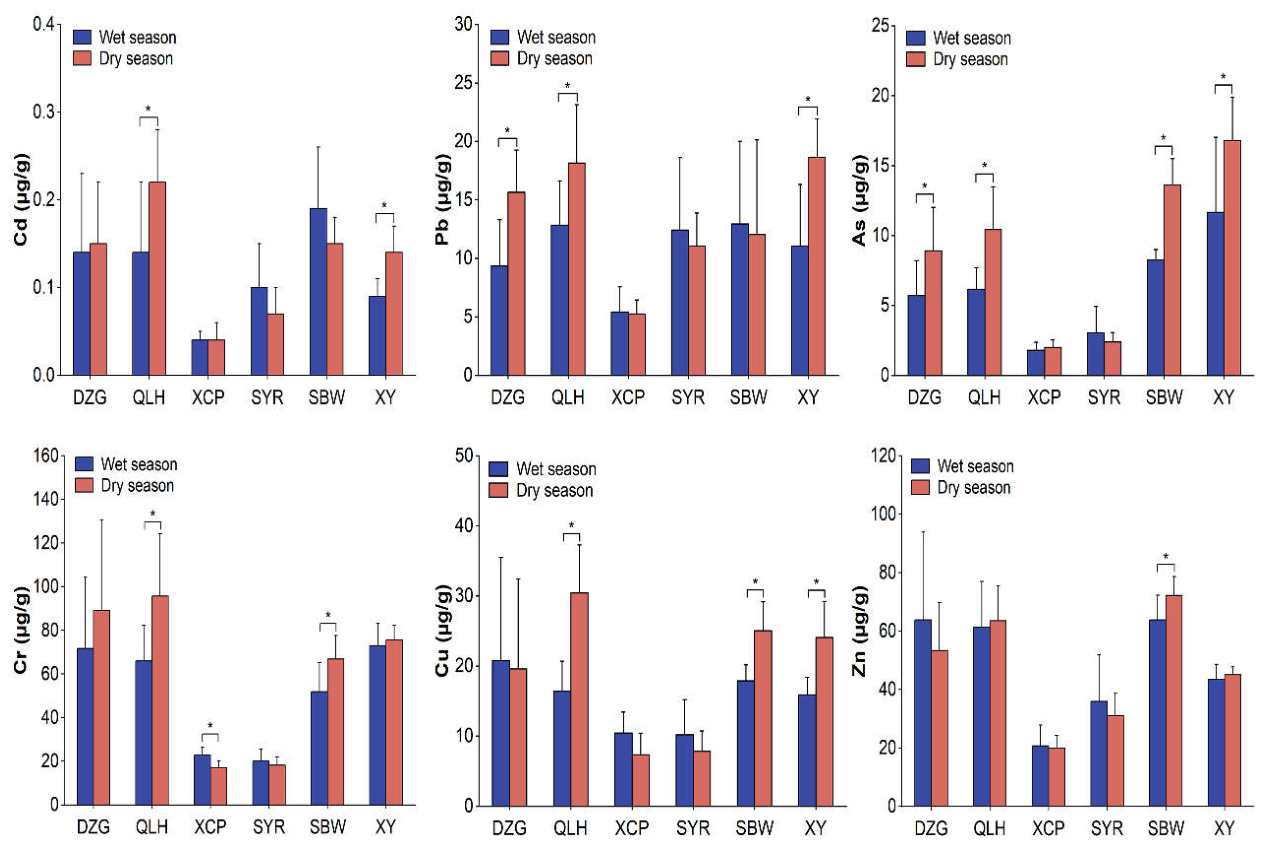
Figure 5.
Principal component analysis of heavy metals and physicochemical factors in sediment in different seasons.
Figure 5.
Principal component analysis of heavy metals and physicochemical factors in sediment in different seasons.
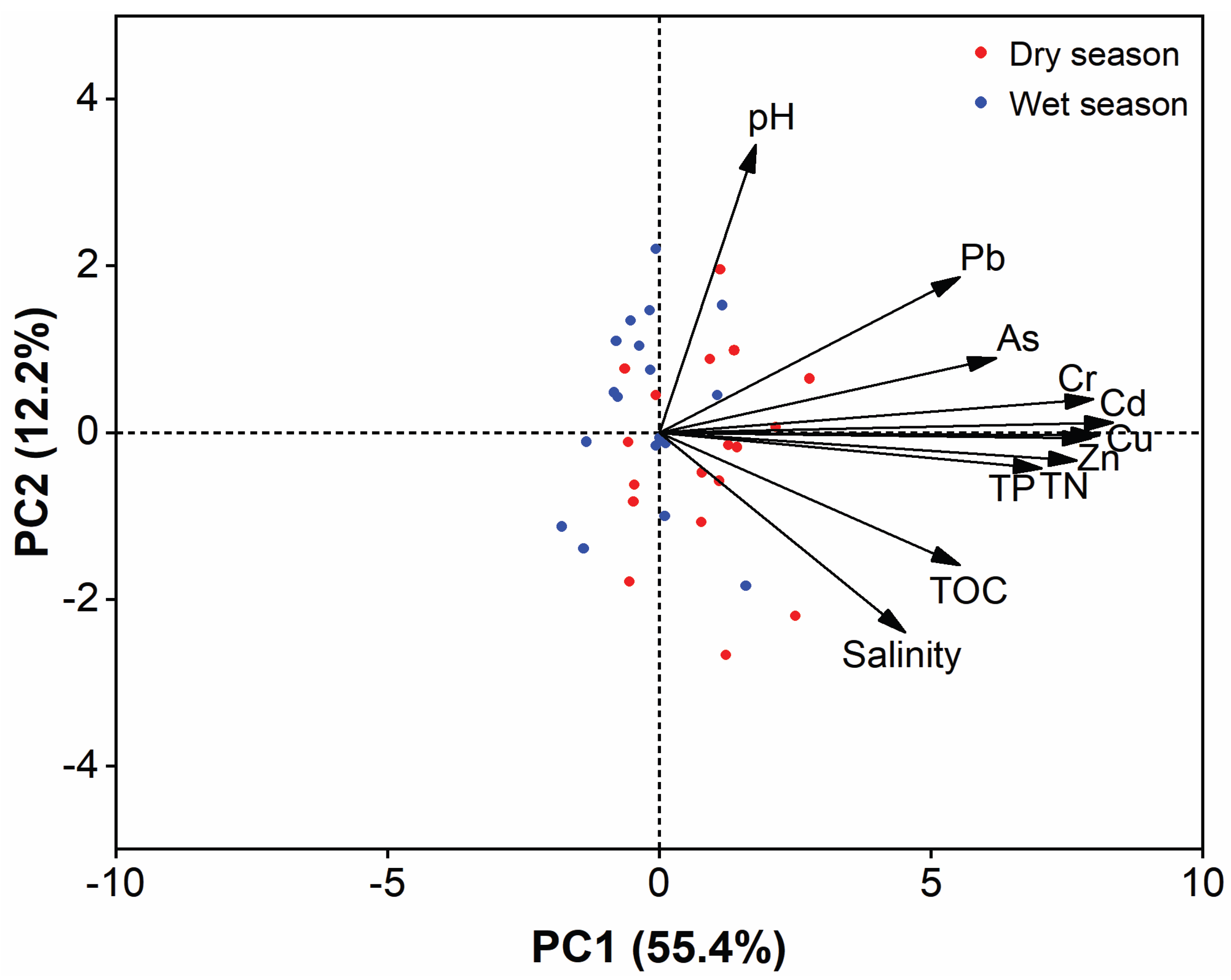
Figure 6.
Correlation between heavy metals and sedimentary physicochemical factors.
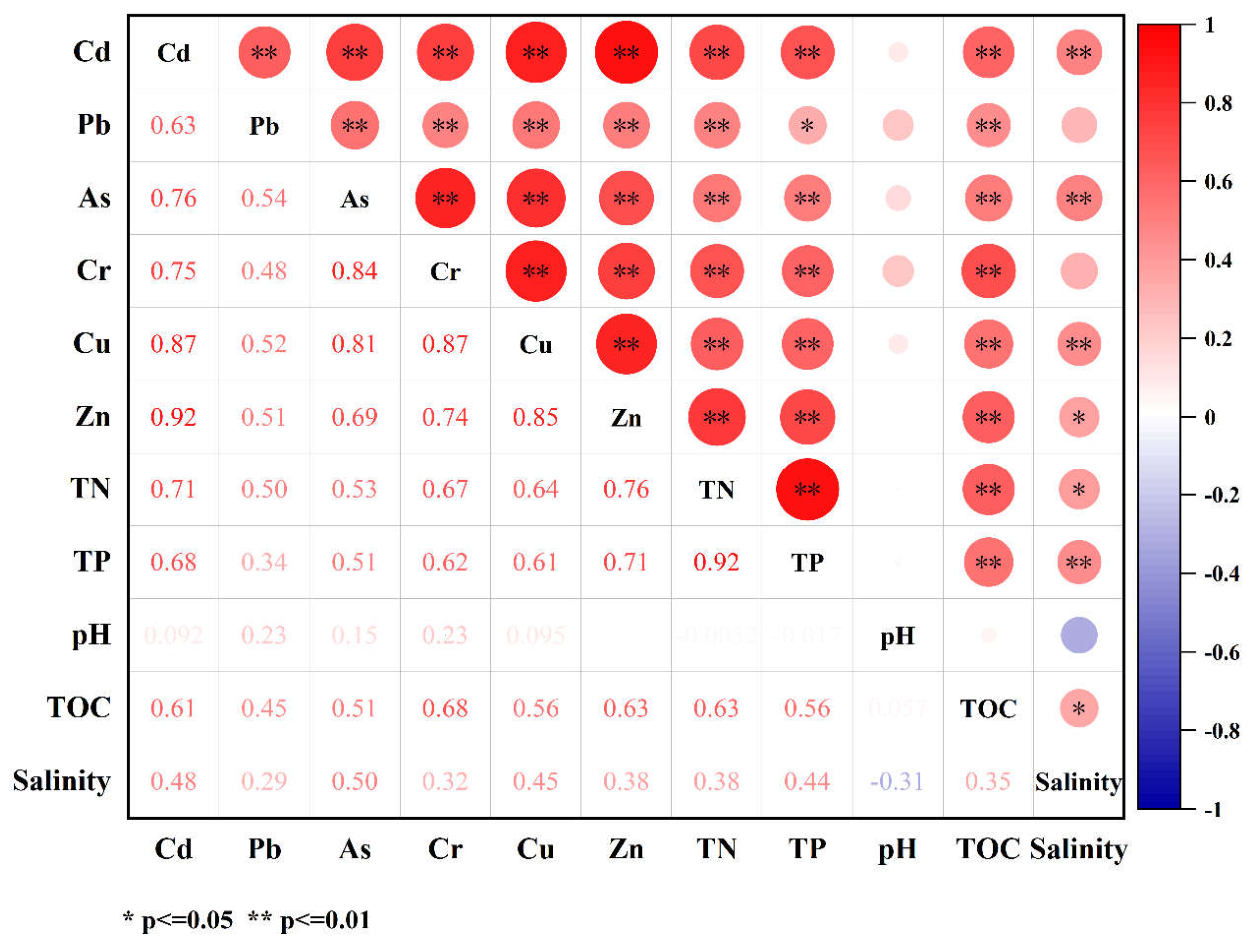

Table 1.
Grading standard for geoaccumulation index (Igeo).
| Igeo | Class | Pollution Degree |
| Igeo ≤ 0 | 0 | Unpolluted |
| 0 < Igeo ≤ 1 | 1 | From unpolluted to moderately polluted |
| 1 < Igeo ≤ 2 | 2 | Moderately polluted |
| 2 < Igeo ≤ 3 | 3 | From moderately to heavily polluted |
| 3 < Igeo ≤ 4 | 4 | Heavily polluted |
| 4 < Igeo ≤ 5 | 5 | Heavily to extremely polluted |
| Igeo > 5 | 6 | Extremely polluted |
Table 2.
Grading standard for potential ecological risk factor (Er) and ecological risk index (RI).
| Er | Ecological risk degree | RI | Ecological risk degree |
| Er < 40 | Low risk | RI < 150 | Low risk |
| 40 ≤ Er < 80 | Moderate risk | 150 ≤ RI < 300 | Moderate risk |
| 80 ≤ Er < 160 | Considerable risk | 300 ≤ RI < 600 | Considerable risk |
| 160 ≤ Er < 320 | High risk | RI ≥ 600 | High risk |
| Er ≥ 320 | Extremely high risk |
Table 3.
Geo-accumulation index (Igeo) of heavy metals in different mangrove sediments in the wet and dry seasons.
Table 3.
Geo-accumulation index (Igeo) of heavy metals in different mangrove sediments in the wet and dry seasons.
| Season | Region | Igeo | |||||
| Cd | Pb | As | Cr | Cu | Zn | ||
| Wet season | DZG | 0.94 ± 1.03 | -2.10 ± 0.64 | 0.30 ± 0.81 | -0.20 ± 0.64 | 0.08 ± 0.97 | 0.49 ± 0.66 |
| QLH | 1.06 ± 0.78 | -1.57 ± 0.40 | 0.54 ± 0.35 | -0.23 ± 0.34 | 0.01 ± 0.37 | 0.53 ± 0.35 | |
| XCP | -0.65 ± 0.48 | -2.87 ± 0.60 | -1.27 ± 0.45 | -1.74 ± 0.22 | -0.65 ± 0.40 | -1.08 ± 0.52 | |
| SYR | 0.40 ± 1.03 | -1.80 ± 0.93 | -0.81 ± 1.21 | -1.97 ± 0.43 | -0.87 ± 0.95 | -0.37 ± 0.79 | |
| SBW | 1.60 ± 0.55 | -1.73 ± 0.89 | 1.00 ± 0.13 | -0.58 ± 0.35 | 0.17 ± 0.19 | 0.61 ± 0.20 | |
| XY | 0.61 ± 0.34 | -1.92 ± 0.82 | 1.37 ± 0.63 | -0.06 ± 0.21 | -0.01 ± 0.23 | 0.06 ± 0.18 | |
| Dry season | DZG | 1.17 ± 0.61 | -1.27 ± 0.31 | 1.02 ± 0.59 | 0.11 ± 0.63 | 0.05 ± 0.90 | 0.31 ± 0.42 |
| QLH | 1.81 ± 0.44 | -1.07 ± 0.40 | 1.28 ± 0.45 | 0.28 ± 0.47 | 0.91 ± 0.31 | 0.60 ± 0.26 | |
| XCP | -0.45 ± 0.44 | -2.84 ± 0.34 | -1.11 ± 0.40 | -2.18 ± 0.28 | -1.22 ± 0.58 | -1.08 ± 0.33 | |
| SYR | 0.14 ± 0.52 | -1.78 ± 0.34 | -0.83 ± 0.39 | -2.08 ± 0.28 | -1.11 ± 0.55 | -0.45 ± 0.36 | |
| SBW | 1.27 ± 0.21 | -1.87 ± 0.87 | 1.71 ± 0.21 | -0.19 ± 0.23 | 0.64 ± 0.24 | 0.80 ± 0.13 | |
| XY | 1.19 ± 0.34 | -1.00 ± 0.27 | 2.00 ± 0.27 | 0.00 ± 0.13 | 0.57 ± 0.31 | 0.12 ± 0.09 | |
Table 4.
Geo-accumulation index (Igeo) of heavy metals in different mangrove sediments in the wet and dry seasons.
Table 4.
Geo-accumulation index (Igeo) of heavy metals in different mangrove sediments in the wet and dry seasons.
| Season | Region | Er | RI | |||||
| Cd | Pb | As | Cr | Cu | Zn | |||
| Wet season | DZG | 106.75 ± 70.01 | 1.90 ± 0.81 | 20.76 ± 9.06 | 2.85 ± 1.29 | 9.83 ± 6.98 | 2.31 ± 1.09 | 144.40 ± 46.88 |
| QLH | 107.18 ± 58.88 | 2.62 ± 0.77 | 22.37 ± 5.67 | 2.62 ± 0.65 | 7.77 ± 2.03 | 2.23 ± 0.57 | 144.77 ± 44.55 | |
| XCP | 30.08 ± 9.19 | 1.10 ± 0.44 | 6.52 ± 2.09 | 0.91 ± 0.14 | 4.95 ± 1.40 | 0.75 ± 0.26 | 44.32 ± 11.12 | |
| SYR | 71.76 ± 40.29 | 2.53 ± 1.26 | 11.07 ± 6.92 | 0.79 ± 0.22 | 4.82 ± 2.37 | 1.30 ± 0.58 | 92.28 ± 30.22 | |
| SBW | 145.41 ± 54.31 | 2.64 ± 1.44 | 30.04 ± 2.73 | 2.06 ± 0.53 | 8.48 ± 1.07 | 2.31 ± 0.31 | 190.94 ± 56.34 | |
| XY | 70.17 ± 15.93 | 2.25 ± 1.07 | 42.41 ± 19.49 | 2.90 ± 0.40 | 7.53 ± 1.18 | 1.58 ± 0.18 | 126.83 ± 28.19 | |
| Dry season | DZG | 110.26 ± 49.03 | 3.19 ± 0.74 | 32.42 ± 11.22 | 3.54 ± 1.65 | 9.28 ± 6.07 | 1.94 ± 0.59 | 160.62 ± 43.82 |
| QLH | 164.20 ± 46.78 | 3.70 ± 1.02 | 37.95 ± 11.09 | 3.80 ± 1.14 | 14.40 ± 3.24 | 2.31 ± 0.43 | 226.35 ± 61.36 | |
| XCP | 34.54 ± 11.79 | 1.07 ± 0.24 | 7.20 ± 2.02 | 0.67 ± 0.13 | 3.47 ± 1.45 | 0.72 ± 0.16 | 47.67 ± 13.09 | |
| SYR | 52.62 ± 20.04 | 2.25 ± 0.57 | 8.73 ± 2.43 | 0.72 ± 0.15 | 3.70 ± 1.37 | 1.13 ± 0.28 | 69.15 ± 20.33 | |
| SBW | 109.52 ± 15.66 | 2.45 ± 1.65 | 49.48 ± 6.91 | 2.65 ± 0.43 | 11.87 ± 1.95 | 2.62 ± 0.23 | 178.59 ± 40.28 | |
| XY | 105.00 ± 24.17 | 3.80 ± 0.67 | 61.07 ± 11.28 | 3.00 ± 0.26 | 11.39 ± 2.45 | 1.63 ± 0.10 | 185.88 ± 40.77 | |
Disclaimer/Publisher’s Note: The statements, opinions and data contained in all publications are solely those of the individual author(s) and contributor(s) and not of MDPI and/or the editor(s). MDPI and/or the editor(s) disclaim responsibility for any injury to people or property resulting from any ideas, methods, instructions or products referred to in the content. |
© 2026 by the authors. Licensee MDPI, Basel, Switzerland. This article is an open access article distributed under the terms and conditions of the Creative Commons Attribution (CC BY) license.
Copyright: This open access article is published under a Creative Commons CC BY 4.0 license, which permit the free download, distribution, and reuse, provided that the author and preprint are cited in any reuse.