

Submitted:
09 May 2026
Posted:
12 May 2026
You are already at the latest version
Abstract
Comparative research on digital social influence and sustainable food consumption has grown substantially; however, most transnational studies do not verify measurement invariance nor assess whether observed structural differences reflect genuine cultural variation or measurement artifacts. This study addresses this gap by applying the Stimulus–Organism–Response (SOR) model to examine whether Social Media Content (SMC) and Online Member Group Support (OMGS) influence Organic Product Purchasing Behavior (OPPB) through Environmental Attitude (EA) and Subjective Norms (SN) in Ecuador, Chile, and Peru. A cross-sectional quantitative design was implemented with 809 organic consumers, analyzed using PLS-SEM in two stages: assessment of compositional invariance via the MICOM procedure and multigroup analysis (MGA) based on permutations. Full compositional invariance was confirmed across the three national groups, validating transnational structural comparability. The SOR model held consistently, with EA emerging as a stable predictor of OPPB. Significant structural differences were identified: the SMC→SN path was significantly stronger in Chile (β = .671 vs. β = .558 in Peru; p <.01), whereas the OMGS→EA path was stronger in Peru (β = .284 vs. β = .211 in Chile; p < .05). These findings underscore the need to formally verify invariance before drawing transnational conclusions and highlight the cultural contingency of sustainable digital marketing strategies in Andean emerging markets.
Keywords:
SOR model
; organic food
; digital social influence
; MICOM
; measurement invariance
; PLS-SEM
; multigroup analysis
; emerging markets
; Latin America
; sustainable consumption
1. Introduction
The transition toward sustainable consumption models constitutes one of the most urgent imperatives of the global development agenda, as articulated in the United Nations Sustainable Development Goals (SDGs 12 and 13). In this context, the massive emergence of digital platforms has substantially reshaped the informational and normative environments in which consumers make purchasing decisions. Far from serving merely as communication channels, social media platforms have become constitutive ecosystems that simultaneously shape environmental attitudes, reinforce subjective norms, and legitimize ecological consumption practices [1,2]. This dual function—informational and normative—of digital platforms has been increasingly documented in quantitative studies based on structural equation modeling, particularly in emerging market contexts where conventional marketing infrastructure remains comparatively underdeveloped [3,4]. In Latin America, this dynamic acquires particular relevance: the region accounts for more than 500 million active social media users, with penetration rates ranging from 69% to 85% depending on the country, making digital platforms the primary vector for opinion formation and influence over consumption patterns [5,6].
Ecuador, Chile, and Peru, however, exhibit differentiated trajectories in their digital ecosystems and in the development of their organic markets, offering a uniquely rich analytical context. Chile demonstrates the highest level of digital maturity in the Andean region, with fixed broadband penetration reaching 75% of households and e-commerce accounting for 6.1% of total retail [6,7]. Peru, in turn, has experienced exponential growth in its digital economy: between 2019 and 2023, the number of businesses with an online presence increased from 65,000 to more than 332,000, with 74% of transactions conducted via mobile devices [8]. Ecuador, meanwhile, reports 15.29 million Internet users (83.6% penetration) and 12.66 million active social media users, with TikTok and Instagram as the fastest-growing platforms [5]. Despite sharing a common linguistic and cultural heritage as Spanish-speaking nations, these three countries exhibit significant differences in per capita income, digital penetration rates, organic market development, and ecological certification regulatory frameworks, making this Andean trio a theoretically and empirically privileged comparative setting for examining the cross-cultural portability of digital influence models in sustainable consumption [9,10].
The established literature consistently demonstrates that social media exerts a significant influence on the psychological determinants of sustainable purchasing behavior: accumulated evidence shows that exposure to digital content does not directly affect purchase intention but does so indirectly through environmental attitudes, subjective norms, and perceived behavioral control [1,3]. Concurrently, the application of the Stimulus–Organism–Response (SOR) framework to organic consumption has gained considerable methodological traction, offering a parsimonious structure for linking external digital stimuli with behavioral responses through intermediate psychological states [11,12]. Nevertheless, this same body of literature presents a critical structural limitation: the overwhelming majority of empirical studies are conducted within single national contexts, thereby restricting the understanding of the phenomenon across diverse sociocultural environments and compromising the comparability and generalizability of their findings [1]. Recent research further suggests that the effects of digital influence vary significantly depending on contextual factors such as culture, digital ecosystem structure, and levels of institutional trust [2,4]. Moreover, methodological reviews of multigroup analysis in PLS-SEM indicate that a considerable proportion of studies conducting group comparisons fail to implement formal measurement invariance testing procedures, thereby undermining the validity of their structural inferences [13,14]. In particular, it has been emphasized that the absence of invariance assessment may lead to erroneous interpretations, as observed differences between groups may reflect inconsistencies in construct measurement rather than genuine variations in structural relationships.
The present study aims to examine the effect of digital social influence, operationalized through Social Media Content (SMC) and Online Member Group Support (OMGS), on Organic Product Purchasing Behavior (OPPB), through the mediating roles of Environmental Attitude (EA) and Subjective Norms (SN), across three Andean emerging economies: Ecuador (EC), Chile (CL), and Peru (PE). To this end, the SOR model [11,15] is extended through the integration of the MICOM procedure [13] and multigroup analysis (MGA) in PLS-SEM [16], in order to assess measurement invariance and compare structural parameters across countries. The original contribution of this study lies in: (a) providing the first transnational test of the SOR model of digital social influence in organic consumption in Andean Latin America; (b) adopting a methodological invariance verification protocol that has been systematically overlooked in the existing literature; and (c) generating empirical evidence on whether digital influence mechanisms are culturally portable or contextually contingent among economies that, while culturally proximate, exhibit significant structural asymmetries.
To achieve the stated objective, the study addresses the following research sub-questions: (a) To what extent do SMC and OMGS indirectly influence OPPB through EA and SN in each of the three national contexts? (b) Is full or partial measurement invariance verified in the SOR model when comparing the three national groups using the MICOM procedure? (c) Do path coefficients differ significantly across Ecuador, Chile, and Peru in the multigroup analysis, and if so, which contextual factors—such as digital maturity, organic market development, and regulatory frameworks—help explain these differences? (d) What theoretical and practical implications arise from the cross-cultural portability or contingency of the model for the design of sustainable digital marketing strategies in Latin American emerging markets? The article is structured as follows: Section 2 develops the theoretical and hypothetical framework; Section 3 describes the multi-country methodological strategy, including MICOM and MGA procedures; Section 4 presents the measurement model results, invariance verification, and structural comparisons; Section 5 discusses findings in relation to country-specific contextual factors; and Section 6 outlines conclusions, implications, and future research directions.
2. Literature Review
2.1. The SOR Model as an Integrative Theoretical Framework for Sustainable Digital Consumption
The Stimulus–Organism–Response (SOR) model, originally formulated by [15] within the field of environmental psychology and subsequently refined by [62], posits that external environmental stimuli activate internal cognitive and affective states within the organism that function as psychological mediators, ultimately determining observable behavioral responses. Its tripartite architecture—stimulus (S), organism (O), and response (R)—positions it as an essential framework for conceptualizing digital influence processes on consumer behavior, as it enables a clear analytical distinction between informational and community-based inputs from the digital environment, the evaluative and normative states they activate, and the purchasing decisions that consequently emerge.
In the context of sustainable consumption mediated by social media, the application of the SOR model has intensified significantly since 2020. [17] documented that social media usage operationalizes the combined effect of attitudes, subjective norms, and perceived behavioral control on green purchase intention, constituting one of the first studies to integrate these dimensions within a hybrid SOR–TPB model. In a convergent line of research, [29] demonstrated, within the context of younger generations in China, that digital stimuli exert differentiated effects on green consumption through subjective norms and perceived green value, thereby confirming the analytical usefulness of the SOR framework in capturing the dual informational and normative nature of digital social influence. [18] extended this framework to the context of organic products in Ecuador, validating a model in which sustainability-related content (SMC) and community-led media groups (OMGS) operate as functionally distinct digital stimuli, the former through cognitive-informational pathways and the latter through affective-community pathways, toward Environmental Attitude (EA) and Subjective Norms (SN). This functional differentiation provides the theoretical foundation for the present transnational extension.
However, as noted by [19], the cross-cultural transportability of SOR-based models in consumer behavior research cannot be assumed a priori: stimulus–response configurations documented within a specific national context may not replicate in another due to systematic variation in information processing styles, the credibility attributed to digital content sources, or the extent to which social media communities function as genuine normative reference groups. These methodological considerations underscore the need to subject the model to formal measurement invariance testing before transnational structural comparisons can be meaningfully interpreted [13,16].
The present study adopts the SOR model as an integrative framework and operationalizes it through four central constructs: digital stimuli SMC and OMGS (S), Environmental Attitude (EA) and Subjective Norms (SN) as internal mediators (O), and Organic Product Purchasing Behavior (OPPB) as the behavioral response (R). The following sections develop each construct according to the DAJHH pattern—conceptual definition, empirical antecedents, relational justification, gap identification, and derived hypothesis—with the aim of cumulatively constructing the proposed research model.
2.2. Environmental Attitude (EA) and Its Effect on Organic Product Purchasing Behavior (OPPB)
Environmental Attitude (EA) can be defined as an individual’s evaluative psychological predisposition toward environmental protection, expressed through a coherent set of beliefs, affects, and behavioral intentions oriented toward ecological sustainability [20,21]. From the perspective of the Theory of Planned Behavior—one of the most robustly validated frameworks in the consumer behavior literature [20]—attitude is a function of the salient beliefs an individual holds regarding the consequences of a behavior and their affective evaluation of those consequences. In sustainable consumption contexts, EA integrates both cognitive components—knowledge about the environmental impacts of production and consumption patterns—and affective components, referring to the emotional valence associated with choosing environmentally responsible products [22,23].
EA has been consistently identified as a key predictor of OPPB across multiple theoretical traditions and geographic contexts. Consumers with higher levels of EA exhibit greater willingness to pay a premium for organic products, stronger resistance to price barriers in sustainable consumption, and greater alignment between declared ecological values and actual purchasing behavior [24,25]. [10], in a study involving 710 Peruvian millennials, documented that environmental awareness, green self-identity, and subjective norms significantly influence EA, which in turn acts as a direct antecedent of organic purchase intention.
The causal link between EA and OPPB is grounded in a widely documented cognitive–behavioral consistency mechanism: individuals tend to align their consumption behaviors with their value orientations toward the natural environment, insofar as purchasing organic products is perceived as an action with tangible and positive ecological consequences [26]. This mechanism is reinforced when institutional and commercial contexts provide facilitating structures—namely, product availability, credible certification systems, and distribution infrastructure—which reduce the transaction costs associated with translating attitudes into actual behavior. Within the SOR framework, EA constitutes an organismic state of an evaluative nature that mediates the relationship between digital environmental stimuli and behavioral purchasing responses [27,28].
In cross-cultural studies, the magnitude of the EA–OPPB relationship exhibits notable variation that has not been sufficiently systematized within the Latin American context. Although previous research in Ecuador [29,30] and Peru [31] has documented that EA operates differently among millennial consumers across countries—particularly with institutional trust in organic certification moderating the attitude–behavior link in ways not commonly observed in developed markets—the formal structural comparison of this relationship across Ecuador, Chile, and Peru under a unified model with verified measurement invariance remains absent in the literature. [32] identified that Hofstede’s cultural dimensions significantly moderate the effect of organic purchase intention on actual behavior, providing an intercultural comparative basis of particular relevance for the present study, albeit without addressing the specific Andean context [33].
H1: EA positively influences OPPB, and this relationship exhibits structural equivalence across Ecuador, Chile, and Peru.
2.3. Subjective Norms (SN): Normative Mediation Between Digital Stimuli and Environmental Attitude
Subjective Norms (SN) refer to the individual’s perception of social pressure exerted by significant referents (peers, family, communities of belonging) to adopt a particular behavior [20]. In the classical formulation of the Theory of Planned Behavior (TPB), SN represent the individual’s evaluation of what important others expect them to do, weighted by their motivation to comply with those expectations [34]. In the contemporary digital environment, the scope of SN has expanded considerably: virtual communities, reference groups on social media platforms, and observable behavioral patterns through user-generated content function as sources of normative influence that shape individuals’ attitudinal orientations toward sustainable consumption [17].
SN occupy a dual theoretical role within the SOR framework applied to sustainable digital consumption: they are simultaneously an outcome of digital stimuli, insofar as interactions on social media shape individuals’ perceptions of what their reference groups consider normatively appropriate, and an antecedent of Environmental Attitude (EA), as perceived social pressure toward sustainability influences individuals’ internalized environmental orientations. This dual positioning was empirically validated by [18] in the Ecuadorian context and is supported by international evidence. [35] confirmed that SN act as a significant mediator between information exchange on social media and green purchase intention, influencing both the cognitive processing of digital content and the formation of attitudes. [10] documented, specifically in the Peruvian context, that SN exert a direct and significant influence on the EA of millennial consumers toward organic products, thereby reinforcing the explanatory power of the SN→EA mechanism in the Latin American context.
The causal mechanism underlying the SN→EA relationship in digitally mediated sustainable consumption contexts operates through a process of normative internalization: when individuals repeatedly perceive that their reference groups value and engage in environmentally responsible behaviors, these perceptions are progressively integrated into their attitudinal orientations, reshaping their predisposition toward organic consumption [20,21]. The explanatory strength of this mechanism varies according to prevailing cultural orientations, as in societies with stronger collectivist tendencies, the pursuit of group approval constitutes a primary behavioral motivator, thereby enhancing the predictive capacity of the SN→EA pathway [57,61]. This premise is supported by the findings of [36], who documented that subjective norms mediated by social media exert a direct and significant influence on environmental attitudes, with greater intensity in contexts where digital social referents are perceived as culturally legitimate sources of normative authority.
The normative function of digital communities in the Latin American context has not been thoroughly examined in a comparative manner across countries with differentiated cultural profiles. In societies with stronger collectivist orientations, such as Peru and Ecuador, the normative mediation pathway theoretically carries greater explanatory power than in Chile, whose relatively more individualistic orientation may result in comparatively weaker normative mediation. This hypothesis, although supported by fragmented evidence [32,37,38], lacks formal empirical verification in the Andean context through a multigroup design with measurement invariance. Therefore, the following hypothesis is proposed:
H2: SN positively influence EA across the three national contexts studied.
2.4. Sustainability-Related Content (SMC): Digital Informational Stimulus and Its Effects on Attitudes and Norms
Sustainability-Related Content (SMC) is defined as the set of posts, articles, reviews, videos, and infographics disseminated through social media that communicate information about environmentally responsible consumption practices, attributes of organic products, or the environmental consequences of production and consumption patterns [18]. Unlike forms of social influence based on community belonging, SMC operates primarily through cognitive-informational processing pathways: it activates users’ environmental awareness, increases perceived knowledge about the ecological benefits of organic products, and reduces informational uncertainty associated with sustainable purchasing decisions [17,39]. Within the SOR framework, SMC constitutes a stimulus of a predominantly cognitive nature.
The influence of SMC on the formation of environmental attitudes and the modulation of subjective norms has been documented across multiple contexts. [1], in a systematic review, demonstrated that social media marketing exerts consistent effects on consumer engagement with sustainable products, operating through three distinct pathways: (a) informational processing; (b) social comparison; and (c) normative alignment. In the context of the digital generation, [40] confirmed that information exchange on social media catalyzes green consumption among both Generation X and Generation Y consumers, with subjective norms acting as a critical mediator in both generational groups. Furthermore, recent evidence has shown that perceptions of the informational usefulness of sustainability-oriented digital content directly influence the development of green trust and, indirectly, consumers’ intention to purchase ecological products in social commerce contexts [19].
Moreover, the influence of SMC on environmental attitude operates through a cognitive elaboration mechanism: repeated exposure to content that clearly and socially visibly articulates the environmental consequences of conventional consumption and the ecological benefits of organic products activates processes of attitudinal reconsideration that, over time, reshape individuals’ evaluative predispositions [41]. In parallel, SMC exerts an indirect normative effect: by making the prevalence of sustainable consumption visible among social media users, it reinforces the perception that reference groups value and engage in environmentally responsible behaviors, thereby intensifying subjective norms [36]. In the Latin American context, where access to certified information about organic products outside digital environments is often limited, the role of SMC as a primary formative driver of environmental attitude becomes particularly salient, as digital platforms effectively constitute the main channel through which consumers construct their knowledge and evaluation of ecological product attributes [42].
The functional differentiation between the direct effect of SMC on environmental attitude and its indirect effect through subjective norms—along with its intercultural variation—has not been comparatively examined in the Ecuador–Chile–Peru context. The hypothesis that Chile, characterized by higher digital penetration and a more institutionally developed sustainability content ecosystem, would exhibit a stronger direct SMC→EA effect than Ecuador and Peru remains empirically untested. Accordingly, the following hypotheses are proposed:
H3. SMC positively influences EA in each of the three national contexts studied.
H3a. SMC positively influences SN in each of the three national contexts studied.
H3b. SMC positively influences EA through the mediation of SN (SMC → SN → EA) in each of the three national contexts studied.
2.5. Online Member Group Support (OMGS): Digital Community Stimulus and Its Normative Effects
Online Member Group Support (OMGS) refers to the level of support, validation, and influence exerted by digital communities organized around shared sustainability values on the attitudes and behaviors of their members [18,35]. Unlike SMC, which operates primarily through the transmission of objective information, OMGS functions through mechanisms of social identification and community belonging: individuals adjust their attitudinal orientations in accordance with the values and norms they perceive as dominant within the digital communities to which they belong or aspire to belong [29]. Within the SOR framework, OMGS constitutes a stimulus of a predominantly affective-normative nature.
Accordingly, the role of OMGS as a modulator of sustainable consumption attitudes has been documented—albeit under varying terminology—in recent high-impact studies. [48] demonstrated that perceived social support within sustainability-oriented digital communities directly influences green purchase intention, with Environmental Attitude (EA) acting as a partial mediator. [35], in the context of sustainable food consumption, showed that membership identity within sustainability-oriented online communities significantly predicts both EA and behavioral intentions toward organic purchasing. In the Latin American context, [18] confirmed that OMGS exerts a direct effect on EA in Ecuador, operating through affective-community pathways that are functionally distinct from the cognitive-informational pathways associated with SMC. It is noteworthy that recent research has shown that different digital platforms operate under distinct interaction logics, which influences how social norms and online communities are formed. In particular, platforms such as Facebook and YouTube tend to facilitate the formation of more structured and socially interactive communities, whereas others such as Instagram are characterized by a stronger orientation toward visual and informational content [43,44].
Therefore, the mechanism through which OMGS influences EA can be explained through social identity theory [45], which posits that when individuals identify themselves as active members of sustainability-oriented digital communities, they progressively internalize the norms, values, and practices of those communities as part of their self-concept, leading to a reconfiguration of their attitudinal orientations toward environmentally responsible consumption. This process of internalization is particularly strong in collectivist cultural contexts, where group belonging and normative conformity carry greater motivational weight [46].
Based on the foregoing, it is identified that the intensity of the OMGS→EA effect, as a function of the collectivist cultural orientations across different national contexts, has not been empirically verified within the Ecuador–Chile–Peru setting. The proposition that Peru—characterized by stronger community-based social structures and a more pronounced collectivist orientation than Chile—would exhibit a comparatively stronger OMGS→EA effect constitutes a novel contribution of this study, for which no precedent exists in the current literature. Accordingly, the following hypotheses are proposed:
H4. OMGS positively influences EA in each of the three national contexts studied.
H4a. OMGS positively influences SN in each of the three national contexts studied.
2.6. Transnational Hypotheses on Structural Moderation: Ecuador, Chile, and Peru
Beyond establishing the replication of the basic structure of the SOR model across the three contexts (H1–H4), the present study proposes transnational comparative hypotheses regarding the differential magnitude of key structural paths. These hypotheses are grounded in the variation that distinguishes Ecuador, Chile, and Peru across three theoretically relevant dimensions: (a) digital infrastructure and social media penetration; (b) the level of development and institutionalization of the organic market; and (c) sociocultural orientations toward collectivism and normative influence, operationalized through Hofstede’s indices [33].
Chile exhibits the highest level of digital penetration in the region, with 92% of the population having internet access and approximately 80% actively using social media [5]. Although smaller in absolute scale than the Brazilian market, the Chilean organic market has experienced sustained institutional development within Latin America, characterized by established certification bodies, dedicated organic product sections in supermarket chains, and government-led consumer awareness campaigns. These structural conditions suggest that Chilean consumers may display stronger responses to informational SMC, as the digital environment provides sustainability-related content that is more abundant, more credible, and more institutionally anchored.
In contrast, Peru presents a context characterized by a rapidly growing organic market with limited formal institutionalization, strong community-based social structures—both in urban populations and in rural and peri-urban communities with direct productive ties to organic agriculture—and a digital environment in which peer recommendations within closed social networks carry relatively greater normative weight [47]. This contextual profile, consistent with Peru’s more pronounced collectivist orientation according to Hofstede’s indices, suggests that OMGS may exert a comparatively stronger influence on Peruvian EA than in Ecuador or Chile [33].
Comparatively, Ecuador occupies an intermediate position across these dimensions, having demonstrated in prior studies by [18] and [3] a balanced pattern of both informational (SMC) and community-based (OMGS) digital influence on sustainable consumption attitudes. The available evidence for the three countries is consistent with the findings of [32] regarding the moderating role of Hofstede’s cultural dimensions on the intention–behavior relationship in organic consumption contexts, thereby providing a solid theoretical foundation for the following transnational comparative hypotheses:
H5. The effect of SMC on SN is significantly stronger in Chile than in Ecuador and Peru, due to the greater density and credibility of the sustainability-related digital content ecosystem in the Chilean context.
H6. The effect of OMGS on EA is significantly stronger in Peru than in Ecuador and Chile, due to the more pronounced collectivist orientation and the greater motivational relevance of digital community belonging in the Peruvian context.
2.7. Research Models
Figure 1 illustrates the proposed hypothetical model, which integrates the SOR framework with the transnational comparative hypotheses derived from the multigroup analysis.
3. Method
3.1. Research Design
The present study adopts a quantitative, cross-sectional, and comparative design with a multigroup structure. Data were collected simultaneously across the three national contexts to enable a valid transnational comparison, controlling for temporal variation in organic market conditions and the use of digital platforms. The study follows a two-stage analytical procedure: in the first stage, the measurement model is assessed in terms of reliability, convergent validity, and discriminant validity within each country group; in the second stage, the full MICOM procedure is applied to verify measurement invariance prior to structural comparison, following the methodological guidelines of [13] and the extended invariance assessment framework proposed by [51]. Multigroup analysis involving more than two groups further follows the recommendations of [19], who emphasize the need to control the family-wise error rate in comparisons involving three or more groups.
3.2. Sample and Data Collection
Data were collected from organic product consumers in three countries: Ecuador (n = 234), Chile (n = 321), and Peru (n = 254), resulting in a combined total sample of N = 809 valid responses. Participants were recruited through self-administered online questionnaires distributed via social media, incorporating screening filters to ensure prior consumption of organic products. The inclusion criteria were: (a) age 18 years or older; (b) self-reported purchase of organic products within the previous month; and (c) active use of social media. A non-probability convenience sampling approach was employed, consistent with the predominant methodological practice in this research domain [3,18].
To ensure data quality, all questionnaire responses were subjected to straightlining detection procedures (identical responses across all items) and checks for completion times below a minimum threshold. The combined sample represents a diverse cross-section of urban consumer populations in each country, with approximately balanced gender representation across the national subsamples.

Table 1.
Demographic characteristics of the national subsamples and the combined sample.
| Characteristics | Category | Ecuador (n=234) | Chile (n=321) | Perú (n=254) | Total (N=809) |
| Gender | Male | 48.7% | 50.2% | 47.6% | 48.9% |
| Female | 50.4% | 48.9% | 51.6% | 50.3% | |
| Other | .9% | .9% | .8% | .8% | |
| Age range | Gen Z (<25) | 41.5% | 38.6% | 43.3% | 41.0% |
| Young Millennials (25-30) | 20.1% | 22.4% | 19.7% | 20.8% | |
| Millennial (31-40) | 25.2% | 27.1% | 24.0% | 25.6% | |
| Gen X (>40) | 13.2% | 11.9% | 13.0% | 12.6% | |
| Educational level | Bachelor’s degree | 73.1% | 70.4% | 75.6% | 72.9% |
| Postgraduate degree | 26.9% | 29.6% | 24.4% | 27.1% |
3.3. Instrument
The survey instrument was adapted from validated scales used in previous studies on organic consumption and digital social influence. Social Media Content (SMC) was measured using four items adapted from Li et al. (2024); Online Member Group Support (OMGS) was measured with four items from [50]; Subjective Norms (SN) were measured using four items adapted from [17]; Environmental Attitude (EA) was measured with four items from Hoyos-Vallejo et al. (2023); and Organic Product Purchasing Behavior (OPPB) was measured using a single observed indicator, consistent with [18]. All items were measured on a five-point Likert scale (1 = Strongly disagree; 5 = Strongly agree). The instrument was administered in Spanish across the three countries. The transnational comparability of the Spanish-language instrument was supported by its prior validation in Ecuadorian and Peruvian samples [3,47], thereby reducing systematic linguistic measurement error
3.4. Analytical Procedure
Model estimation and validation were conducted using SmartPLS 4 [60]. The analytical procedure followed three sequential stages. In the first stage, the combined measurement model was assessed according to established criteria: Cronbach’s alpha and composite reliability (CR) > .70; average variance extracted (AVE) > .50; standardized factor loadings > .70; and discriminant validity evaluated using the Fornell–Larcker criterion and the HTMT ratio (< .90) [16].
In the second stage, the MICOM (Measurement Invariance of Composite Models) procedure [13] was applied simultaneously across the three national groups. First, configurational invariance was assessed by confirming identical model specifications and estimation procedures across groups; second, compositional invariance was verified through permutation tests (5,000 resamples) of the correlations between composite scores across groups, where constructs whose confidence intervals included unity (α = .05) were considered compositionally invariant; and third, the equality of composite means and variances across groups was evaluated. Full measurement invariance (configurational + compositional + equality of means and variances) is required for unrestricted comparisons of latent means, whereas partial invariance (configurational + compositional) is sufficient for comparing path coefficients [52].
Finally, in the third stage, multigroup analysis (MGA) was conducted using a permutation-based approach [53,54,55]. Comparisons across the three groups were performed following the recommendations of [19], who propose the use of an omnibus test of group differences (OTG) followed by pairwise comparisons with family-wise error correction. Statistical significance of differences in path coefficients was evaluated at α = .05 using two-tailed permutation tests. Effect size comparisons were interpreted according to the f2 thresholds proposed by [16].
4. Results
4.1. Combined Measurement Model
Prior to conducting the multigroup analysis (MGA), the combined measurement model was estimated using the full sample to establish baseline psychometric properties. As shown in Table 2, all constructs exceeded the recommended thresholds for internal consistency (α > .70; CR > .70) and convergent validity (AVE > .50), with standardized factor loadings ranging from .756 to .923. Discriminant validity was confirmed using both the Fornell–Larcker criterion (square roots of AVE exceeding inter-construct correlations) and the HTMT ratio (< .90). The model’s overall goodness-of-fit index (SRMR = .071) fell within the acceptable range (< .08) proposed by [13], providing additional evidence of satisfactory model specification.
4.2. Measurement Invariance: MICOM Results
Table 3 presents the results of the three-step MICOM procedure applied to the groups corresponding to Ecuador, Chile, and Peru. First, Step 1 (configurational invariance) was satisfied by design, as identical model specifications, estimation algorithms, and data processing procedures were employed across the three national subsamples, thereby ensuring the initial structural equivalence of the model.
Second, Step 2 (compositional invariance) was assessed using permutation tests of the correlations between composite scores for all country pairs. As shown in Table 3, all constructs achieved compositional invariance (c > .95; p > .05 for all pairs), indicating that the composite scores hold equivalent conceptual meaning across the three national contexts. Consequently, this result provides the necessary methodological basis to proceed with the comparison of structural paths in the subsequent stage.
Finally, Step 3 (equality of means and variances) revealed the presence of partial invariance. While variances were equivalent across groups for all constructs, statistically significant mean differences were identified for SMC (Ecuador vs. Chile: Δmean = .21; p < .05) and OMGS (Peru vs. Chile: Δmean = .18; p < .05). However, these mean differences do not compromise the validity of structural comparisons of path coefficients—which require only compositional invariance—but they do suggest that comparisons of latent means would require full invariance. Accordingly, the analysis focuses on the comparison of path coefficients and effect size differences across the analyzed groups.
4.3. Structural Models by Country
Prior to multigroup comparison, the structural model was estimated independently for each national subsample using 5,000 bootstrap iterations. Table 4 presents the path coefficients, bootstrap confidence intervals, and effect sizes (f2) for each country. Variance inflation factor (VIF) values were below 3.3 in all cases, indicating no multicollinearity issues. The R2 values for EA ranged from .541 (Peru) to .608 (Chile), and for OPPB from .401 (Ecuador) to .463 (Chile), all exceeding the minimum threshold of .10 [56]. The SRMR values for the individual country models were .074 (Ecuador), .069 (Chile), and .076 (Peru), all within acceptable limits.
4.4. Multigroup Analysis: Transnational Path Differences
Table 5 presents the results of the multigroup analysis, reporting differences in path coefficients between country pairs and their significance based on permutation tests. Three statistically significant transnational differences emerge from these analyses, providing empirical support for H5 and H6.
First, consistent with H5, the path from SMC to SN is significantly stronger in Chile (β = .671) than in Ecuador (β = .594; Δβ = .077; p = .031) and Peru (β = .558; Δβ = .113; p = .008), indicating that informational content on social media generates stronger normative alignment in the Chilean context. Second, consistent with H6, the path from OMGS to EA is more pronounced in Peru (β = .284) than in Chile (β = .211; Δβ = .073; p = .042), suggesting that community-based social support exerts a stronger direct influence on environmental attitudes in the Peruvian context. The Ecuador–Chile difference in the OMGS→EA path (Δβ = .043; p = .189) did not reach statistical significance. Third, the EA→OPPB path does not exhibit statistically significant transnational variation, supporting the structural universality of environmental attitude as a predictor of organic purchasing behavior across these three Andean contexts.
5. Discussion
5.1. Structural Universality of the SOR Model in Andean Contexts
The main finding of this study is that the SOR model demonstrates robust measurement invariance and broad structural equivalence across Ecuador, Chile, and Peru. The compositional invariance confirmed through the MICOM procedure establishes that the theoretical constructs hold equivalent meanings across the three national samples, thereby validating the comparability of the measurement instrument and the interpretability of transnational structural comparisons. This result makes a methodological contribution by demonstrating that instruments carefully validated in a Spanish-speaking Andean context can be meaningfully transported to other contexts when subjected to formal invariance testing, in line with the guidelines advanced by [19] for multigroup analysis.
The confirmation of H1 through H4, together with the rejection of H4a across the three national subsamples, provides strong evidence of the model’s capacity to remain stable across different cultural contexts. In particular, the finding that OMGS does not exert a direct influence on SN confirms that the digital community stimulus operates directly on EA without activating a normative mediation process, replicating the functional asymmetry previously documented by [18] in the Ecuadorian context and extending this evidence to the Chilean and Peruvian contexts. In this sense, the observed empirical consistency suggests that the functional differentiation between content-based digital influence (SMC) and community-based interaction (OMGS) is not a country-specific phenomenon, but rather reflects a broader and consistent dynamic in how digital social influence shapes organic consumption decisions. Consequently, these results strengthen the external validity of the model and provide relevant evidence regarding the stability of its relationships across different sociocultural environments.
5.2. Chilean Exceptionalism in Informational Normative Influence
The significantly stronger SMC→SN path in Chile (H5) warrants a theoretical interpretation grounded in the distinctive characteristics of the Chilean digital and market context. Chile’s more advanced digital infrastructure—reflected in internet penetration rates, broadband quality, and the institutional density of sustainability-related digital content—creates an environment in which social media content related to organic products and sustainable lifestyles is more abundant, more credible, and more institutionally anchored. When consumers are immersed in a rich informational digital ecosystem, where sustainability content is produced by established actors (government agencies, certified organic producers, environmental NGOs), the normative implications of exposure to such content become more explicit and more widely shared, thereby generating stronger alignment between content exposure and perceived social norms.
This interpretation aligns with findings from cross-cultural studies on informational credibility and normative influence, which show that consumers in more institutionally developed markets exhibit stronger pathways from informational content to normative alignment [49,59]. For sustainability marketing practitioners operating in Chile, this finding suggests that investment in high-quality, institutionally credible sustainability content produces stronger normative spillover effects than community engagement campaigns, reversing the most effective strategy observed in less institutionally developed digital environments.
5.3. Peruvian Collectivism and the Primacy of Community Support
The significantly stronger OMGS→EA path in Peru (H6) is theoretically consistent with the more pronounced collectivist cultural orientation of this country compared to Chile. In cultural contexts where group belonging, community validation, and interpersonal trust carry greater motivational weight, the affective and normative experiences generated through participation in sustainability-oriented online communities are more strongly internalized as environmental attitudes. This finding echoes research demonstrating that in collectivist contexts, the social support dimension of digital communities operates less as a peripheral cue and more as a central driver of value formation [38,58]. The study by [32] provides additional comparative support by showing that Hofstede’s collectivism dimensions moderate the relationship between subjective norms and organic purchasing behavior, consistent with the greater sensitivity to OMGS observed in the Peruvian context.
The practical implication is substantial: sustainability campaigns in Peru achieve greater attitudinal impact when they activate the community support dimension of digital platforms—fostering belonging, reciprocal recommendation, and affective validation within online groups—rather than relying primarily on informational content dissemination. This represents a significant strategic divergence from the approach appropriate for Chile, as described in the previous section, and underscores the importance of adopting country-specific digital marketing strategies within the Latin American region.
5.4. Consistency of the EA–OPPB Relationship
The absence of statistically significant transnational variation in the EA→OPPB path (Table 5) provides a substantively important finding: while the antecedents of EA are sensitive to country-specific contextual factors, the translation of EA into purchasing behavior appears to be structurally robust across the three Andean contexts. This suggests that EA functions as a culturally portable predictor of organic consumption, with its behavioral implications remaining relatively stable regardless of the specific digital pathways through which it is formed. For theoretical models of sustainable consumption, this finding reinforces the continued centrality of EA as a core construct, while simultaneously highlighting cross-cultural variability in its digital antecedents.
6. Conclusions
6.1. Theoretical, Practical, and Social Implications
This study contributes to the theoretical understanding of consumer behavior in the context of sustainable consumption by integrating the Stimulus-Organism-Response (SOR) model with constructs derived from digital social influence. By validating the influence of SOR and OMGS on both EA and SN, this study expands the scope of SOR by demonstrating that digital environments, particularly in social media, function not only as stimuli but also as social ecosystems that shape individuals’ internal (organismal) states through informational and normative pathways. Furthermore, the mediating role of SN between digital stimuli and EA introduces a new explanatory mechanism in the literature on PBOP, offering a deeper understanding of how social validation and peer influence enhance environmental concern.
From a managerial perspective, the findings suggest that brands, policymakers, and sustainability advocates should strategically leverage social media platforms not only as channels for green communication but also as interactive environments that foster normative alignment and emotional support among users. Creating engaging, informative, and visually appealing sustainability-related content can directly influence consumer EA. Simultaneously, encouraging peer-to-peer interactions (such as reviews, recommendations, or community discussions) can reinforce consumers’ perceptions that sustainable consumption enjoys social approval and emotional support. Furthermore, campaigns should aim to activate social media platforms by highlighting social consensus and featuring influential figures or micro-influencers who promote environmentally responsible behaviors. This multidimensional approach can enhance the persuasive power of sustainability initiatives significantly.
This study underscores the transformative role of social media in promoting sustainable lifestyles at the social level. The confirmation that digital content and peer support influence EA and SN highlights the potential of social media as a catalyst for collective behavioral change. When people perceive that their peers value and engage in sustainable practices, they are more likely to adopt these behaviors, thereby contributing to broader social change. Therefore, strengthening sustainability narratives in online communities can foster a culture of environmental responsibility, especially among younger generations, who are highly active in digital environments. These findings call for collaboration between digital platforms, educational institutions, and public policy actors to build online ecosystems that normalize and celebrate sustainable choices.
6.2. Limitations and Recommendations for Future Research
Several limitations must be acknowledged. First, the cross-sectional design precludes causal inference and limits the observation of how digital influence processes evolve over time. Longitudinal designs tracking the same consumers across multiple waves would allow for examination of attitudinal formation dynamics in response to sustained exposure to sustainability-related digital content. Second, the use of non-probability convenience sampling limits the representativeness of the national subsamples and the generalizability of findings to broader organic consumer populations.
Third, the present analysis captures heterogeneity at the country level, but intranational variation across dimensions such as rurality, income, and generational cohorts may explain substantial unaccounted variance. Nested or hierarchical designs incorporating both individual-level and country-level predictors would provide a more comprehensive explanation of the multilevel structure of transnational variation. Fourth, the absence of explicit parameters for organic market penetration, digital infrastructure indices, and collectivism scores within the model limits the explanatory precision of the contextual interpretations presented. Future studies should incorporate these country-level moderators directly into the analytical model through multilevel structural equation modeling approaches, following the methodological advances described by [51] and [19].
Author Contributions
Conceptualization, Andrés García-Umaña and Nelson Carrión-Bósquez; Methodology, Andrés García-Umaña, Nelson Carrión-Bósquez, and Jorge Bernal Peralta; Software, Gabriel Estuardo Cevallos Uve and Nelson Carrión-Bósquez; Validation, Évelyn Córdoba Pillajo, and Jorge Bernal Peralta; Formal analysis, Andrés García-Umaña and Nelson Carrión-Bósquez; Investigation, Andrés García-Umaña, Gabriel Estuardo Cevallos Uve; Resources, Jorge Bernal Peralta, and Évelyn Córdoba Pillajo; Data curation, Gabriel Estuardo Cevallos Uve and Nelson Carrión-Bósquez; Writing—original draft preparation, Andrés García-Umaña; Writing—review and editing, Andrés García-Umaña, Nelson Carrión-Bósquez, Jorge Bernal Peralta, and Évelyn Córdoba Pillajo; Visualization, Gabriel Estuardo Cevallos Uve and Nelson Carrión-Bósquez; Supervision, Andrés García-Umaña; Project administration, Andrés García-Umaña and Nelson Carrión-Bósquez. All authors have read and agreed to the published version of the manuscript.
Funding
This study received no external funding.
Informed Consent Statement
Informed consent was obtained from all the subjects involved in this study.
Data Availability Statement
The data availability statement is available from the corresponding author upon reasonable request for future research purposes.
Conflicts of Interest
The authors declare no conflict of interest.
References
- Bryła, P.; Chatterjee, S.; Ciabiada-Bryła, B. The impact of social media marketing on consumer engagement in sustainable consumption: A systematic literature review. Int. J. Environ. Res. Public Health 2022, 19, 16637. [Google Scholar] [CrossRef] [PubMed]
- Wu, M.; Long, R. How do perceptions of information usefulness and green trust influence intentions toward eco-friendly purchases in a social media context? Front. Psychol. 2024, 15, 1429454. [Google Scholar] [CrossRef] [PubMed]
- Samaniego-Arias, M.; Chávez-Rojas, E.; García-Umaña, A.; Carrión-Bósquez, N.; Ortiz-Regalado, O.; Llamo-Burga, M.; Ruiz-García, W.; Guerrero-Haro, S.; Cando-Aguinaga, W. The impact of social media on the purchase intention of organic products. Sustainability 2025, 17, 2706. [Google Scholar] [CrossRef]
- Ogiemwonyi, O.; Jan, M.T. Causal analysis of social media on environmental and health concerns, attitudes, and social influence that leads to green purchase behavior. Int. Rev. Public Nonprofit Mark. 2025, 22, 713–749. [Google Scholar] [CrossRef]
- DataReportal. Digital 2024: Chile; Kepios Analysis: 2024 . Available online: https://datareportal.com/reports/digital-2024-chile.
- CEPAL. Panorama social de América Latina 2023; Naciones Unidas: Santiago, Chile, 2023. [Google Scholar]
- NielsenIQ. Global Sustainability Report 2024; NielsenIQ: Chicago, IL, USA, 2024. [Google Scholar]
- Cámara de Comercio de Lima. Informe sobre tendencias de consumo sostenible en Perú 2025; Cámara de Comercio de Lima: Lima, Perú, 2025. [Google Scholar]
- Valenzuela-Fernández, L.; Escobar-Farfán, M.; Guerra-Velásquez, M.; García-Salirrosas, E.E. COVID-19 effects on environmentally responsible behavior: A social impact perspective from Latin American countries. Int. J. Environ. Res. Public Health 2023, 20, 3330. [Google Scholar] [CrossRef]
- Palomino Rivera, H.J.; Barcellos-Paula, L. Personal variables in attitude toward green purchase intention of organic products. Foods 2024, 13, 213. [Google Scholar] [CrossRef]
- Arslan, Y. Unpacking organic food purchase intentions in an S-O-R framework: The multidimensional moderating roles of consumer knowledge and trust. Food Sci. Nutr. 2025, e70447. [Google Scholar] [CrossRef]
- Laos-Espinoza, J.; Juaneda-Ayensa, E.; García-Milon, A.; Olarte-Pascual, C. Why do you want an organic coffee? Self-care vs. world-care: A new SOR model approach to explain organic product purchase intentions of Spanish consumers. Food Qual. Prefer. 2024, 118, 105203. [Google Scholar] [CrossRef]
- Henseler, J.; Ringle, C.M.; Sarstedt, M. Testing measurement invariance of composites using partial least squares. Int. Mark. Rev. 2016, 33, 405–431. [Google Scholar] [CrossRef]
- Rana, S.; Prashar, S.; Barai, M.K.; Hamid, A.B.A. Run! This road has no ending! A systematic review of PLS-SEM application in strategic management research among developing nations. Heliyon 2023, 9, e22476. [Google Scholar] [CrossRef]
- Mehrabian, A.; Russell, J.A. An Approach to Environmental Psychology; MIT Press: Cambridge, MA, USA, 1974. [Google Scholar]
- Hair, J.F.; Sarstedt, M.; Ringle, C.M.; Gudergan, S.P. Advanced Issues in Partial Least Squares Structural Equation Modeling, 2nd ed.; SAGE: Thousand Oaks, CA, USA, 2024. [Google Scholar]
- Nekmahmud, M.; Ramkissoon, H.; Fekete-Farkas, M. Green purchase and sustainable consumption: A comparative study between European and non-European tourists. Tour. Manag. Perspect. 2022, 43, 100980. [Google Scholar] [CrossRef]
- García-Roldán, G.; Carrión-Bósquez, N.; García-Umaña, A.; Ortiz-Regalado, O.; Medina-Miranda, S.; Marchena-Chanduvi, R.; Veas González, I. Digital social influence and its impact on the attitude of organic product consumers. Sustainability 2025, 17, 7563. [Google Scholar] [CrossRef]
- Cheah, J.-H.; Amaro, S.; Roldán, J.L. Multigroup analysis of more than two groups in PLS-SEM: A review, illustration, and recommendations. J. Bus. Res. 2023, 156, 113539. [Google Scholar] [CrossRef]
- Ajzen, I. The theory of planned behavior. Organ. Behav. Hum. Decis. Process. 1991, 50, 179–211. [Google Scholar] [CrossRef]
- Stern, P.C.; Dietz, T.; Abel, T.; Guagnano, G.A.; Kalof, L. A value-belief-norm theory of support for social movements: The case of environmentalism. Hum. Ecol. Rev. 1999, 6, 81–97. [Google Scholar]
- Rusyani, E.; Lavuri, R.; Gunardi, A. Purchasing eco-sustainable products: Interrelationship between environmental knowledge, environmental concern, green attitude, and perceived behavior. Sustainability 2021, 13, 4601. [Google Scholar] [CrossRef]
- Ogiemwonyi, O.; Alam, M.N.; Alshareef, R.; Alsolamy, M.; Azizan, N.A.; Mat, N. Environmental factors affecting green purchase behaviors of the consumers: Mediating role of environmental attitude. Clean. Responsible Consum. 2023, 10, 100130. [Google Scholar] [CrossRef]
- Hoyos-Vallejo, C.A.; Carrión-Bósquez, N.G.; Veas-González, I. Impact of consumption values on environmental attitudes and organic purchase intentions among Peruvian millennials. Acad. Rev. Latinoam. De Adm. 2025. [Google Scholar] [CrossRef]
- Kim, N.; Lee, K. Environmental consciousness, purchase intention, and actual purchase behavior of eco-friendly products: The moderating impact of situational context. Int. J. Environ. Res. Public Health 2023, 20, 5312. [Google Scholar] [CrossRef]
- Ajzen, I.; Fishbein, M. Attitude–behavior relations: A theoretical analysis and review of empirical research. Psychol. Bull. 1977, 84, 888–918. [Google Scholar] [CrossRef]
- Thøgersen, J. How may consumer policy empower consumers for sustainable lifestyles? J. Consum. Policy 2005, 28, 143–177. [Google Scholar] [CrossRef]
- Gleim, M.R.; Smith, J.S.; Andrews, D.; Cronin, J.J. Against the green: A multi-method examination of the barriers to green consumption. J. Retail. 2013, 89, 44–61. [Google Scholar] [CrossRef]
- Carrión-Bósquez, N.G.; Ortiz-Regalado, O.; Veas-González, I.; Naranjo-Armijo, F.G.; Guerra-Regalado, W.F. The mediating role of attitude and environmental awareness in the influence of green advertising and eco-labels on green purchasing behaviors. Span. J. Mark. 2024b, 29, 330–350. [Google Scholar] [CrossRef]
- Hoyos-Vallejo, C.A.; Carrión-Bósquez, N.G.; Ortiz-Regalado, O. The influence of skepticism on the university millennials’ organic food product purchase intention. Br. Food J. 2023, 125, 3800–3816. [Google Scholar] [CrossRef]
- Carrión-Bósquez, N.; Veas-González, I.; Naranjo-Armijo, F.; Llamo-Burga, M.; Ortiz-Regalado, O.; Ruiz-García, W.; Vidal-Silva, C. Advertising and eco-labels as influencers of eco-consumer attitudes and awareness—Case study of Ecuador. Foods 2024a, 13, 228. [Google Scholar] [CrossRef]
- Peña, M.; Aguilera, V.; Torres, M. The moderating role of Hofstede’s cultural dimensions on consumer purchasing of organic food. J. Int. Consum. Mark. 2023, 36, 28–45. [Google Scholar] [CrossRef]
- Minkov, M.; Hofstede, G. The evolution of Hofstede’s doctrine. Cross Cult. Manag. An. Int. J. 2011, 18, 10–20. [Google Scholar] [CrossRef]
- Fishbein, M.; Ajzen, I. Belief, Attitude, Intention, and Behavior: An Introduction to Theory and Research; Addison-Wesley: Reading, MA, USA, 1975. [Google Scholar]
- Han, M.S.; Hampson, D.P.; Wang, Y.; Wang, H. Consumer confidence and green purchase intention: An application of the stimulus-organism-response model. J. Retail. Consum. Serv. 2022, 68, 103061. [Google Scholar] [CrossRef]
- Liao, Y. Exploring social media determinants in fostering pro-environmental behavior: Insights from social impact theory and the theory of planned behavior. Front. Psychol. 2024, 15, 1445549. [Google Scholar] [CrossRef]
- Lee, Y.K. A comparative study of green purchase intention between Korean and Chinese consumers: The moderating role of collectivism. Sustainability 2017, 9, 1930. [Google Scholar] [CrossRef]
- Dominguez, L.C.; García, A.; Sousa, C.M.R. How collectivism affects organic food purchase intention and behavior: A study with Norwegian and Portuguese young consumers. Sustainability 2022, 14, 7361. [Google Scholar] [CrossRef]
- Amaya Rivas, A.; Liao, Y.-K.; Vu, M.-Q.; Hung, C.-S. Toward a comprehensive model of green marketing and innovative green adoption: Application of a stimulus-organism-response model. Sustainability 2022, 14, 3288. [Google Scholar] [CrossRef]
- Aiswarya, U.B.; Harindranath, R.M.; Challapalli, P. Social media information sharing: Is it a catalyst for green consumption among Gen X and Gen Y cohorts? Sustainability 2024, 16, 6011. [Google Scholar] [CrossRef]
- Xia, X.; Gao, Y.; Zhang, H. Mining the impact of social media information on public green consumption attitudes: A framework based on ELM and text data mining. Humanit. Soc. Sci. Commun. 2024, 11, 184. [Google Scholar] [CrossRef]
- Barrera-Verdugo, G. The link between social media exposure and students’ moral reasoning and environmental concern: A generational analysis in Chile. Cogent Soc. Sci. 2023, 9, 2167570. [Google Scholar] [CrossRef]
- Katz, E.; Blumler, J.G.; Gurevitch, M. Uses and gratifications research. Public Opin. Q. 1974, 37, 509–523. [Google Scholar] [CrossRef]
- Jürgens, P.; Stark, B. Mapping exposure diversity: The divergent effects of algorithmic curation on news consumption. J. Commun. 2022, 72, 322–344. [Google Scholar] [CrossRef]
- Tajfel, H.; Turner, J.C. An integrative theory of intergroup conflict. In The Social Psychology of Intergroup Relations; Austin, W.G., Worchel, S., Eds.; Brooks/Cole: Monterey, CA, USA, 1979; pp. 33–47. [Google Scholar]
- Zheng, C.; Ling, S.; Cho, D. How social identity affects green food purchase intention: The serial mediation effect of green perceived value and psychological distance. Behav. Sci. 2023, 13, 664. [Google Scholar] [CrossRef] [PubMed]
- Ortiz-Regalado, O.; Llamo-Burga, M.; Carrión-Bósquez, N.; Chávez-Gutiérrez, H.; Guerra-Regalado, W.; Veas-González, I.; Vidal-Silva, C. Unveiling millennials’ perceptions of organic products: A grounded theory analysis in Ecuador and Peru. Sustainability 2024, 16, 5230. [Google Scholar] [CrossRef]
- Duong, C.D. Cultural values and energy-saving attitude-intention-behavior linkages among urban residents: A serial multiple mediation analysis based on stimulus-organism-response model. Manag. Environ. Qual. 2022, 34, 647–669. [Google Scholar] [CrossRef]
- Li, J.; Chiu, D.K.W.; Ho, K.K.W.; So, S. The use of social media in sustainable green lifestyle adoption: Social media influencers and value co-creation. Sustainability 2024, 16, 1133. [Google Scholar] [CrossRef]
- Shihab, M.S.; Ikhsan, R.B.; Fakhrorazi, A. The power of social media: Exploring online member groups and psychological factors to support responsible consumption. Digit. Bus. 2025, 5, 100101. [Google Scholar] [CrossRef]
- Liengaard, B.D. Measurement invariance testing in partial least squares structural equation modeling. J. Bus. Res. 2024, 177, 114581. [Google Scholar] [CrossRef]
- Matthews, L.; Hair, J.F.; Matthews, R. Applying multigroup analysis in PLS-SEM. In Partial Least Squares Path Modeling; Latan, H., Noonan, R., Eds.; Springer: Cham, Switzerland, 2017; pp. 219–243. [Google Scholar]
- Chin, W.W.; Dibbern, J. A permutation based procedure for multi-group PLS analysis. In Handbook of Partial Least Squares; Vinzi, V.E., et al., Eds.; Springer: Berlin, Germany, 2010; pp. 171–193. [Google Scholar]
- Sarstedt, M.; Henseler, J.; Ringle, C.M. Multigroup analysis in partial least squares (PLS) path modeling: Alternative methods and empirical results. Adv. Int. Mark. 2011, 22, 195–218. [Google Scholar]
- Sarstedt, M.; Ringle, C.M.; Cheah, J.-H.; Ting, H.; Moisescu, O.I.; Radomir, L. Structural model robustness checks in PLS-SEM. Tour. Econ. 2022, 26, 531–554. [Google Scholar] [CrossRef]
- Falk, R.F.; Miller, N.B. A Primer for Soft Modeling; University of Akron Press: Akron, OH, USA, 1992. [Google Scholar]
- Hofstede, G.; Hofstede, G.J.; Minkov, M. Cultures and Organizations: Software of the Mind, 3rd ed.; McGraw-Hill: New York, NY, USA, 2010. [Google Scholar]
- Sreen, N.; Purbey, S.; Sadarangani, P. Impact of culture, behavior and gender on green purchase intention. J. Retail. Consum. Serv. 2018, 41, 177–189. [Google Scholar] [CrossRef]
- Islam, Q.; Ali Khan, S.M.F. Assessing consumer behavior in sustainable product markets: A structural equation modeling approach with partial least squares analysis. Sustainability 2024, 16, 3400. [Google Scholar] [CrossRef]
- Ringle, C.M.; Wende, S.; Becker, J.-M. SmartPLS 4; SmartPLS GmbH: Oststeinbek, Germany, 2024. [Google Scholar]
- Nguyen, T.N.; Lobo, A.; Greenland, S. The influence of cultural values on green purchase behaviour. Mark. Intell. Plan. 2017, 35, 377–396. [Google Scholar] [CrossRef]
- Donovan, R.J.; Rossiter, J.R. Store atmosphere: An environmental psychology approach. J. Retail. 1982, 58, 34–57. [Google Scholar]
- Wang, J.; Wang, S.; Xue, H.; Wang, Y.; Li, J. Green consumption behavior in social commerce: The role of information quality and trust. J. Retail. Consum. Serv. 2022, 68, 103041. [Google Scholar]
Figure 1.
Proposed SOR Model with Transnational Hypotheses. Note: H5-H6 Cross-national hypotheses (Ec-Cl-Pe).
Figure 1.
Proposed SOR Model with Transnational Hypotheses. Note: H5-H6 Cross-national hypotheses (Ec-Cl-Pe).
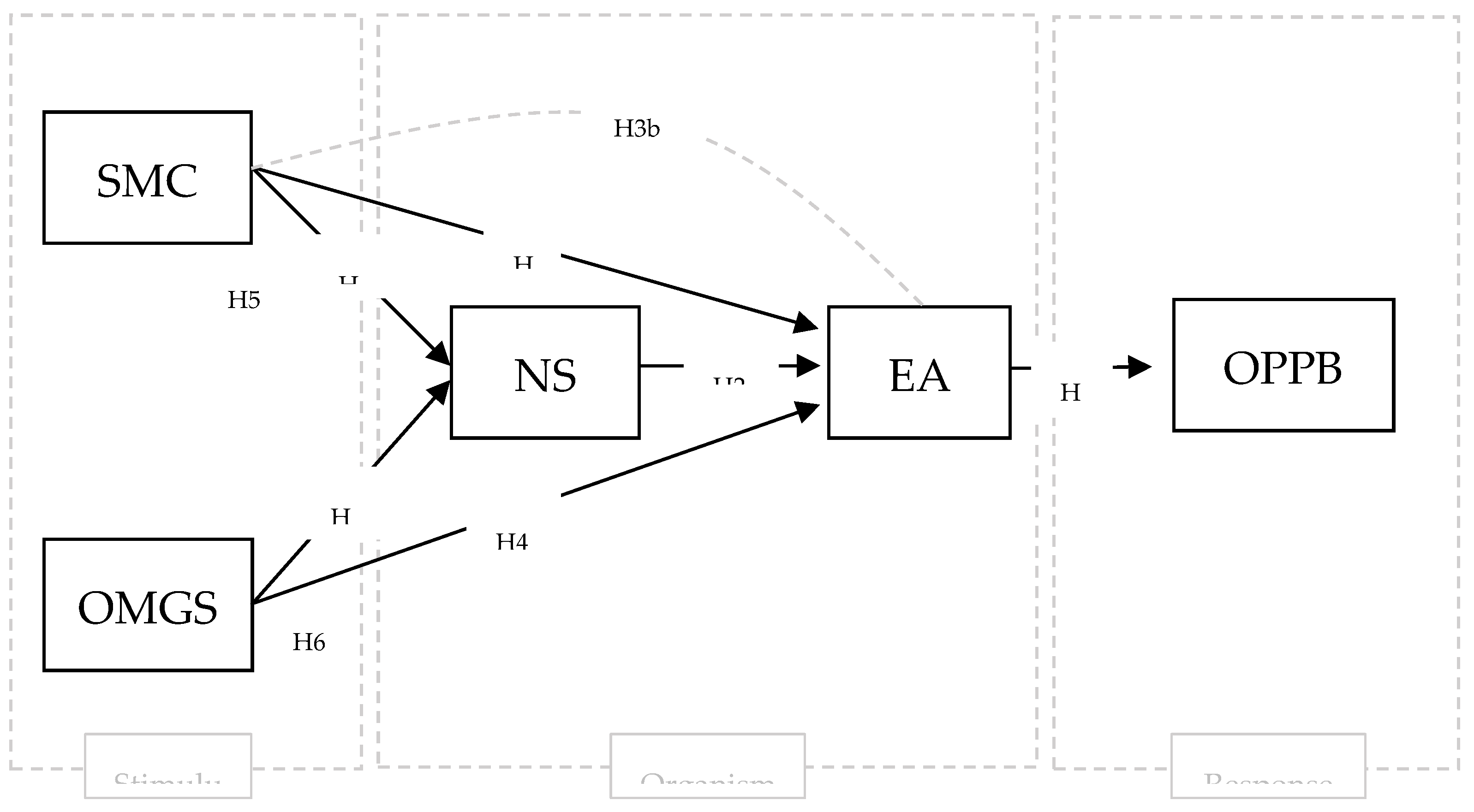
Table 2.
Combined measurement model: reliability and convergent validity.
| Variable | Item | Standardized Loading | Cronbach’s Alpha | CR | AVE |
| EA | EA1 | .911 | .895 | .930 | .819 |
| EA2 | .919 | ||||
| EA3 | .889 | ||||
| SN | SN1 | .901 | .861 | .915 | .782 |
| SN2 | .874 | ||||
| SN3 | .880 | ||||
| SMC | SMC1 | .840 | .852 | .899 | .691 |
| SMC2 | .818 | ||||
| SMC3 | .784 | ||||
| SMC4 | .883 | ||||
| OMGS | OMGS1 | .763 | .778 | .855 | .595 |
| OMGS2 | .786 | ||||
| OMGS3 | .781 | ||||
| OMGS4 | .758 | ||||
| OPPB | OPPB1 | 1.000 | 1.000 | 1.000 | 1.000 |
Note: CR = composite reliability (ρc); AVE = average variance extracted. All outer loadings are significant at p < .001.
Table 3.
MICOM results.
| Construct | Correlation c (EC–CL) | 95% CI Lower Bound | p-value | Correlation c (EC–PE) | p-value | Correlation c (CL–PE) | p-value |
| EA | .998 | .987 | .412 | .997 | .384 | .996 | .441 |
| SN | .996 | .983 | .388 | .994 | .362 | .995 | .417 |
| SMC | .994 | .981 | .401 | .993 | .356 | .992 | .388 |
| OMGS | .991 | .977 | .374 | .990 | .342 | .993 | .402 |
Note: EC = Ecuador; CL = Chile; PE = Peru. Compositional invariance is established when the lower bound of the 95% confidence interval does not substantially deviate from 1.00 and p > .05. OPPB excluded (single-indicator construct).
Table 4.
Structural model results by country.
| Hypothesis | Path | EC β (p) | f2 | CL β (p) | f2 | PE β (p) | f2 | Supported |
| H1 | EA → OPPB | .411 (<.001) | .207 | .447 (<.001) | .249 | .398 (<.001) | .189 | ✓ |
| H2 | SN → EA | .224 (<.001) | .061 | .198 (<.001) | .048 | .241 (<.001) | .072 | ✓ |
| H3 | SMC → EA | .391 (<.001) | .177 | .438 (<.001) | .231 | .364 (<.001) | .152 | ✓ |
| H3a | SMC → SN | .594 (<.001) | .547 | .671 (<.001) | .819 | .558 (<.001) | .454 | ✓ |
| H3b | SMC→SN→EA | .133 (<.001) | — | .133 (<.001) | — | .135 (<.001) | — | ✓ |
| H4 | OMGS → EA | .241 (<.001) | .067 | .211 (<.001) | .052 | .284 (<.001) | .094 | ✓ |
| H4a | OMGS → SN | .068 (.281) | .004 | .044 (.389) | .002 | .079 (.211) | .006 | ✗ |
| R2 EA | .559 | .608 | .541 | |||||
| R2 OPPB | .401 | .463 | .412 | |||||
| SRMR | .074 | .069 | .076 |
Note: β = standardized path coefficient; f2 = effect size; SRMR = Standardized Root Mean Square Residual. H4a is consistently rejected across the three national contexts, ruling out the presence of a mediating effect of OMGS on EA through SN.
Table 5.
Multigroup analysis: differences in path coefficients between country pairs.
| Path | EC β | CL β | PE β | Δ (EC–CL) | p-value | Δ (EC–PE) | p-value | Δ (CL–PE) | p-value |
| EA → OPPB | .411 | .447 | .398 | .036 | .214 | .013 | .671 | .049 | .097 |
| SN → EA | .224 | .198 | .241 | .026 | .341 | .017 | .584 | .043 | .201 |
| SMC → EA | .391 | .438 | .364 | .047 | .112 | .027 | .389 | .074 | .063 |
| SMC → SN* | .594 | .671 | .558 | .077 | .031* | .036 | .284 | .113 | .008** |
| OMGS → EA* | .241 | .211 | .284 | .030 | .189 | .043 | .112 | .073 | .042* |
Note: * p < .05; ** p < .01. Δ values represent absolute differences between path coefficients.
Disclaimer/Publisher’s Note: The statements, opinions and data contained in all publications are solely those of the individual author(s) and contributor(s) and not of MDPI and/or the editor(s). MDPI and/or the editor(s) disclaim responsibility for any injury to people or property resulting from any ideas, methods, instructions or products referred to in the content. |
© 2026 by the authors. Licensee MDPI, Basel, Switzerland. This article is an open access article distributed under the terms and conditions of the Creative Commons Attribution (CC BY) license (http://creativecommons.org/licenses/by/4.0/).
Copyright: This open access article is published under a Creative Commons CC BY 4.0 license, which permit the free download, distribution, and reuse, provided that the author and preprint are cited in any reuse.