
Submitted:
09 May 2026
Posted:
11 May 2026
You are already at the latest version
Abstract
Although the goal of a “sustainable” urbanism has generated an impressive array of international frameworks and declarations, systemic progress remains elusive. A prior paper by the author identified "lock-in" as a central cause: the economic incentives, professional standards, codes, and institutional feedback structures that reinforce un-sustainable patterns of urban development despite stated commitments to reform. This paper advances that diagnosis by asking what sustains the lock-in itself, and what structural intervention can address it at the root. We argue that the answer lies in a fundamental deficit in the feedback architecture governing urban development — a systematic failure to account for two categories of capital on which human welfare de-pends: natural and resource capital, whose depletion standard metrics render invisible, and human and value-added capital, including the built public realm and the economies of place that markets systematically undersupply. Standard welfare-economic instru-ments, including Pigouvian taxes, address this at the level of price signals but cannot resolve it there, because multiple forms of goods, which we term “polycapital”, are structurally interrelated and resist single scalar remedies. The paper advances two complementary conclusions: first, that a generative modeling methodology — capable of encoding the interrelated, multi-scale character of polycapital structures — is a necessary precondition for adequate institutional response, and that pattern language methodology provides this capacity; and second, that transactional mechanisms going substantially beyond Pigouvian instruments — non-linear, asymptotic, and per-capita in structure — represent a necessary but largely open research frontier.
Keywords:
sustainable urbanism
; lock-in
; feedback systems
; capital
; New Urban Agenda
; pattern language
; operating system
; natural capital
; place capital
1. Introduction
In recent years, the goal of a “sustainable” urbanism has been, in no small part, a history of ambitious agreements meeting stubborn realities. Over the past three decades, the international community has produced a remarkable succession of frameworks, declarations, and agendas — from the Brundtland Commission’s foundational definition of sustainable development in 1987, through the Millennium Development Goals, the 2030 Agenda for Sustainable Development and its seventeen Sustainable Development Goals (SDGs), and most recently the New Urban Agenda adopted by consensus by all 193 member states of the United Nations in 2016. Each of these represented a genuine and significant act of international commitment. Yet the systemic evidence of progress toward their urban aspirations remains, at best, deeply uneven.
A prior paper by the author examined this paradox in detail, and identified “lock-in” as a central structural cause [1]. The dominant model of unsustainable urbanism — characterized by auto-dependence, inefficient building envelopes, ecologically destructive infrastructure, and the progressive erosion of a walkable, functionally rich public realm — persists not so much from ignorance or indifference, but because it is actively reproduced by a dense web of economic incentives, professional standards, legal codes, financing structures, and institutional feedback loops that make reform structurally difficult, even when its necessity is widely acknowledged. Lock-in, in this sense, is not a failure of will, but an inherent property of the system.
This paper proceeds from that diagnosis, and advances to a deeper question: what sustains the lock-in itself, and what kind of intervention can address it not at the level of symptoms but at the level of structure? We argue that the answer lies in a fundamental deficit in the feedback architecture of the institutions governing urban development — a systematic blindness to the full range of capital forms on which human welfare and urban vitality depend, and on which a truly “sustainable urbanism” will therefore depend. Standard economic metrics and policy accountability frameworks render invisible precisely the goods whose depletion drives the long-term unsustainability of the dominant model: the quality and connectivity of public space networks, cultural continuity, ecological regeneration, and what we will describe as economies of place and local differentiation. The lock-in persists, in part, because the signals that would correct it are not registered by the systems designed to govern it.
The most common institutional response to this kind of structural externality is the one proposed by welfare economics: correct the price signals through Pigouvian taxes, cap-and-trade mechanisms, or related instruments that internalize the costs of depletion at the margin. This paper argues that such instruments, while necessary as far as they go, cannot resolve the feedback architecture deficit — and that understanding why reveals something important about the nature of the problem The full range of capital forms on which human welfare and urban vitality depend — financial and produced capital, natural capital, place capital, cultural capital, social capital, and ecological capital, which we collectively term polycapital — cannot be reduced to a single pricing metric without fundamental distortion. In the case of urbanism, the polycapital goods at stake — walkable public realm, ecological continuity, cultural memory embedded in urban fabric, social cohesion generated by well-designed shared spaces — are not merely underpriced. They are structurally constituted: they exist only as specific configurations of interrelated elements, across multiple scales, and their value cannot be captured by any scalar metric without losing precisely what makes them what they are. Applying linear pricing instruments to this non-linear, organic structure does not restore the missing feedback; it licenses illegitimate substitutions and generates the well-documented perverse incentives that have limited the effectiveness of such approaches in practice.
This paper explores how we might better address this deficit within a manageable process. We find that it will require more than revised metrics or corrected price signals. It will require, first, a methodology capable of encoding, transmitting, and institutionally operationalizing the qualitative, relational, and locally specific knowledge that standard policy frameworks structurally cannot represent — a generative model of the structural conditions under which polycapital goods are produced and sustained, not merely a description of their outcomes. We hypothesize that so-called pattern language methodology, which we will explain, offers precisely this capacity, and we describe a UN-Habitat initiative called “Local Patterns for Implementing the New Urban Agenda” as a live institutional experiment testing this proposition at international scale.
But we further find that restoring the generative model will not be, by itself, sufficient. Even a fully restored institutional feedback architecture will remain incomplete at the level of individual transactions — the countless daily decisions through which natural and human capital are either accumulated or depleted — without pricing and accounting mechanisms capable of making those consequences legible and consequential at the point of decision. This points toward a second and larger challenge: the development of transactional mechanisms that go substantially beyond Pigouvian instruments, toward pricing architectures that are non-linear and asymptotic in their rate structure, grounded in per-capita natural capital allotments, and possibly involving complementary currency mechanisms whose exchange rate is endogenously linked to aggregate depletion levels relative to planetary carrying capacity. This is a research frontier of considerable importance, and the paper identifies and frames it — but does not attempt to resolve it.
The Local Patterns initiative is best understood in this light not merely as an implementation tool for the New Urban Agenda, but as an institutional experiment in generative modeling of polycapital structure — designed to encode and transmit the structural conditions under which polycapital goods are generated, rather than simply describing their outcomes after the fact. This distinction between a representative and a generative model of polycapital is central to the paper’s argument, and to understanding what makes pattern language methodology structurally suited to the problem in ways that standard policy instruments are not. The paper therefore advances two complementary conclusions. The first is methodological and relatively near-term: that pattern language methodology provides a generative modeling architecture suited to the complex, multi-scale, interrelated character of polycapital structures, and that its institutional development — through initiatives such as Local Patterns — represents a tractable and urgent priority. The second is transactional and longer-horizon: that a fully adequate response to the feedback architecture deficit will ultimately require transactional mechanisms of a kind not yet developed, and that designing and evaluating such mechanisms constitutes an important agenda for future research and policy innovation. These two conclusions are related — the generative model is logically prior to the transactional architecture, since you cannot adequately price what you cannot adequately represent — but they require different institutional responses and operate on different timescales.
Figure 1.
Conceptual layout of the paper. The prevailing urban development system operates primarily through scalar price signals, producing structural lock-in and a feedback architecture deficit in which polycapital is not adequately registered. Pattern language methodology operates at the structural layer, providing a generative model of the conditions under which polycapital is produced. This model restores feedback capacity and enables, but does not replace, the development of more adequate transactional mechanisms at the signal layer.
Figure 1.
Conceptual layout of the paper. The prevailing urban development system operates primarily through scalar price signals, producing structural lock-in and a feedback architecture deficit in which polycapital is not adequately registered. Pattern language methodology operates at the structural layer, providing a generative model of the conditions under which polycapital is produced. This model restores feedback capacity and enables, but does not replace, the development of more adequate transactional mechanisms at the signal layer.
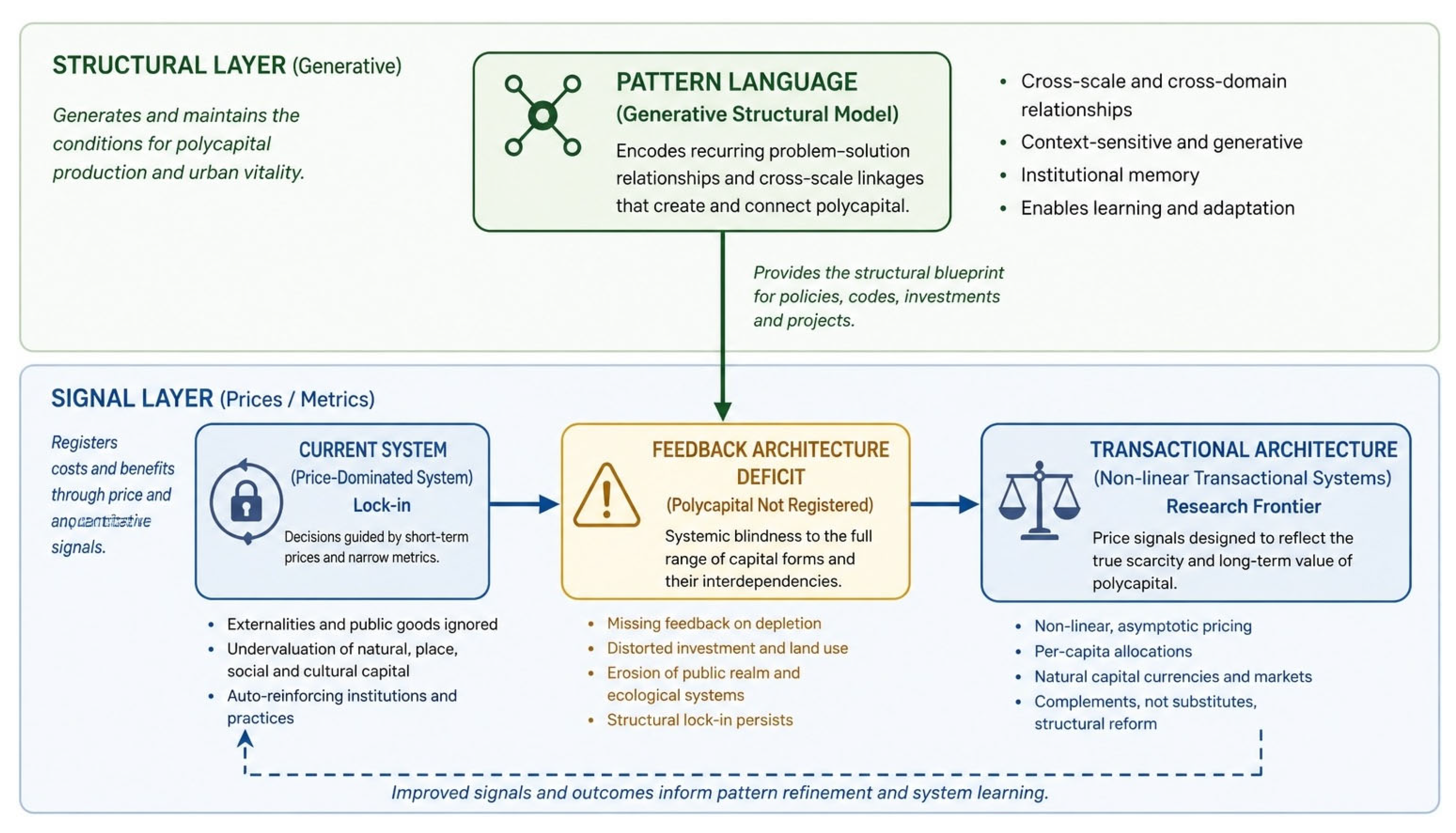
The paper proceeds as follows. Section 2 briefly surveys the empirical record of sustainable urbanism frameworks, noting where progress has and has not occurred and what that pattern reveals. Section 3 develops the theoretical argument about feedback architecture and the systematic exclusion of polycapital from institutional accounting. Section 4 examines why standard policy instruments — including welfare-economic approaches — are structurally ill-suited to resolve this deficit. Section 5 presents pattern language methodology as a structural response, including its character as a generative rather than merely representative model of polycapital structure. Section 6 describes the Local Patterns initiative as an institutional instantiation of this argument. Section 7 draws conclusions and sets out the two-part agenda for research and practice.
2. The Empirical Record: Declared Goals vs. Systemic Outcomes
The adoption of the Sustainable Development Goals in 2015, and of the New Urban Agenda in 2016, represented perhaps the most ambitious coordinated international commitment to sustainable urban development ever achieved. SDG 11 — “Make cities and human settlements inclusive, safe, resilient and sustainable” — established a suite of measurable targets covering access to housing, transport, public space, and urban planning, with a target date of 2030. The New Urban Agenda elaborated these commitments into a detailed framework emphasizing walkability, polycentrism, mixed use, public space quality, and the active role of streets and public realm in generating social, economic, and ecological value. Both documents reflected a genuine and hard-won international consensus, and both were adopted with unusually broad participation and goodwill.
Nearly a decade on, the evidence of systemic progress is sobering. The UN’s own reporting on SDG 11 acknowledges that most targets are significantly off track [3]. Urban land continues to expand faster than urban populations, driving sprawl and auto-dependence at accelerating rates [4]. Greenhouse gas emissions from the building and transport sectors — both directly shaped by urban form — remain on trajectories inconsistent with climate commitments [5]. Access to safe, inclusive, and well-connected public space, a priority emphasized repeatedly in the New Urban Agenda, has if anything declined in the dominant models of new urban development being deployed across the Global South, where the majority of new urbanization is now occurring [6].
What is particularly telling, however, is not simply the scale of the shortfall, but its pattern. Progress has been most visible where goals align with existing economic incentives and are measurable by standard metrics: incremental improvements in building energy efficiency, expansions of formal housing supply in some contexts, growth in transit infrastructure investment in certain regions. Progress has been weakest — often nonexistent or negative — precisely where the goals involve relational, qualitative, and long-cycle goods: the walkability and experiential richness of the public realm, the functional and cultural diversity of urban neighborhoods, the ecological continuity of urban landscapes, the social cohesion generated by well-designed shared spaces. These are the goods that the New Urban Agenda most distinctively emphasizes, and they are the goods on which the dominant model of urban development most consistently fails to deliver.
This pattern is not accidental, and it is not simply a matter of political will or resource constraint. It reflects something structural about the relationship between these goods and the institutional systems charged with delivering them. The relational and qualitative dimensions of urban sustainability are precisely the dimensions that standard monitoring frameworks, financing instruments, and professional accountability systems are least equipped to register, incentivize, or protect. They are, in the language we will develop in the following section, forms of capital that the dominant institutional accounting systematically renders invisible — and what is invisible to the system cannot be protected by the system, however sincerely its protection is declared as a goal.
This observation returns us to the lock-in diagnosis of the prior paper, but with a sharper edge. Lock-in is not merely a matter of path dependency and vested interests, real as those are. It is also, and perhaps more fundamentally, a matter of institutional blindness — a structural incapacity of the governing systems to perceive and respond to the signals that would prompt and sustain reform. Understanding that blindness, and identifying what would be required to correct it, is the task of the sections that follow.
3. The Deeper Problem: A Feedback Architecture Deficit
The pattern of failure documented in the previous section points toward a diagnosis that goes deeper than lock-in in the conventional sense. Lock-in, as described in the prior paper, refers to the self-reinforcing character of existing systems — the way that economic incentives, professional norms, legal codes, and financing structures combine to make the dominant model of unsustainable urbanism the path of least resistance, even for actors who would prefer otherwise. That diagnosis is correct as far as it goes. But it leaves open a prior question: why do the institutional systems charged with governing urban development fail to generate the corrective feedback that would, over time, overcome that inertia? Why, in other words, does the lock-in not unlock?
The answer can be found in several converging lines of established scholarship, which together point toward a fundamental deficit in what we will call the feedback architecture of these systems — the structured set of signals, accounting frameworks, and accountability mechanisms through which institutions perceive the consequences of their actions and adjust their behavior accordingly. In systems theory, the role of feedback in maintaining the regulatory coherence of complex adaptive systems is foundational, from Wiener’s early cybernetic work [7] through to more recent treatments of urban systems as complex adaptive phenomena [8]. In institutional economics, Ostrom’s work on common-pool resource governance identified the presence or absence of effective feedback mechanisms as a primary determinant of whether institutions successfully manage shared resources or drive them toward depletion [9]. In organizational theory, Argyris and Schön’s concept of double-loop learning similarly identified the capacity of institutions to perceive and correct their own governing assumptions — rather than merely their operational outputs — as the critical variable distinguishing adaptive from maladaptive organizations [10]. What these bodies of work share is the recognition that institutional failure is frequently not a failure of intent or resource, but a failure of the information architecture through which consequences are perceived and acted upon. It is in this well-established sense that we identify a feedback architecture deficit at the heart of the sustainable urbanism problem.
All complex adaptive systems depend on feedback for their regulatory coherence. Biological organisms maintain viability not through a single feedback loop but through a rich, redundant, hierarchically organized array of corrective signals operating across multiple timescales simultaneously — what physiologists call allostasis, the capacity to maintain functional integrity through continuous adaptive adjustment rather than simple equilibrium-seeking [11]. Cities and urban systems, as Jane Jacobs observed with characteristic precision, are also complex systems whose vitality depends on the richness and diversity of their internal feedback — the way that mixed uses, fine-grained street networks, and diverse building stocks generate the conditions for continuous self-correction and adaptation [12]. What Jacobs identified in cities, we argue, applies with equal force to the institutional systems that govern them.
This biological analogy carries a further implication that is theoretically important and practically consequential. Allostatic regulation is not achieved through the deliberate pursuit of specified goals by actors with complete information. It emerges from the interaction of many partial, local, and overlapping feedback processes, each operating with severely limited information about the system as a whole — what Simon termed “bounded rationality” [13]. The significance of this for institutional design cannot be overstated. Complex adaptive systems, including cities and the institutional systems that govern them, cannot be steered toward desired outcomes through the deliberate specification and pursuit of goals alone, precisely because no actor or institution commands the information that such steering would require. What can be done — and what biological systems, resilient cities, and effective institutions characteristically achieve — is the cultivation of conditions under which self-organizing processes can generate and maintain regulatory coherence without requiring central specification. This distinction between designing for outcomes and cultivating conditions for self-organization is fundamental to the argument that follows.
Before elaborating the full range of capital forms that institutional systems fail to register, it is useful to establish the structural distinction on which this paper’s argument turns. We propose that the diverse goods at stake can be organized under two fundamental categories of capital — natural and resource capital on the one hand, and human and value-added capital on the other — whose combined and interrelated stocks we refer to under the term polycapital. These two categories exhibit fundamentally different dynamics of formation, depletion, and institutional legibility, and it is their systematic joint invisibility to standard institutional accounting that constitutes the feedback architecture deficit at the heart of the sustainable urbanism problem.
The first is natural and resource capital: the stocks of materials, energy, biological systems, and ecological processes that exist prior to and largely independent of deliberate human investment — soils, watersheds, biodiversity, atmospheric carrying capacity, and the broader regenerative systems on which all human activity ultimately depends. The depletion of natural capital through urban development is now extensively documented in ecological economics and environmental science, and its failure to register in standard market accounts is well established [14,15].
The second is human and value-added capital: the stocks of productive capacity that human activity deliberately creates and accumulates over time, including not only physical infrastructure and buildings, but the built public realm — walkable streets, public spaces, civic institutions — as well as the cultural memory embedded in urban fabric, the social networks sustained by well-designed shared spaces, and the institutional knowledge accumulated in communities and organizations. These, too, are real capital in the precise economic sense: they accumulate through investment and maintenance, depreciate through neglect and destruction, and generate returns — in the form of economic productivity, social cohesion, cultural continuity, and ecological resilience — that are genuinely valuable even when they register in no standard account.
This two-capital framing is not a simplification that sacrifices theoretical precision. It is, rather, a clarification that reveals the common structural feature of the feedback architecture deficit: the institutional systems governing urban development systematically fail to account for the depletion of either form of capital. The depletion of natural capital proceeds invisibly through standard development finance; the depletion of human and value-added capital — the erosion of walkable public realm, the destruction of cultural continuity, the fragmentation of social networks — proceeds equally invisibly through the same systems. The multi-dimensional accounts of social capital, cultural capital, place capital, and ecological capital developed in the literature on polycapital [16] are better understood as elaborations within these two structural categories rather than as additional dimensions requiring independent accounting frameworks. This simplification matters practically: it focuses the feedback restoration agenda on what the institutional systems are structurally incapable of seeing, rather than multiplying the categories of things they are asked to measure.
The structural character of this dual blindness is easier to grasp when we recognize that urban development is governed not by any single policy or institution, but by what may usefully be called an implicit operating system for growth — a layered configuration of regulations, financial incentives, professional standards, infrastructure norms, governance procedures, and cultural expectations that together determine what kinds of development are feasible, financeable, and politically acceptable [1]. Like the operating system of a computer, this system establishes the default parameters within which most development activity occurs. Developers, planners, engineers, financial institutions, and communities all operate within these parameters — often without explicit awareness of their cumulative effects — in ways that reproduce existing development patterns even when individual actors would prefer otherwise.
What is critical for the feedback architecture argument is that the depletion of both natural and human/value-added capital is not an incidental side-effect of this operating system but a structural feature of it. The accounting frameworks, regulatory standards, professional norms, and financial instruments that constitute the operating system were designed — historically, and largely without conscious intent — around a narrow set of capital forms that are legible to market transactions. The forms of capital that matter most for long-term urban sustainability are precisely those that the operating system’s native accounting cannot register. The lock-in, in this sense, is not merely a property of path dependency and vested interests, real as those are. It is a property of the operating system itself: a system that reproduces unsustainable outcomes not despite but through its normal functioning, because the signals that would redirect it are architecturally invisible to it.
The result is that the institutional systems currently governing urban development operate with a severely impoverished feedback architecture. Their primary signal channel is the price system — market valuations that aggregate individual transactions into a single scalar metric of economic value. This is a remarkably thin information channel for systems of civilizational complexity. It is well understood in ecological economics that market prices systematically fail to register the depletion of natural capital — the exhaustion of fisheries, the degradation of watersheds, the loss of biodiversity — because these goods have no effective market voice [14,15]. Less well recognized, but equally consequential, is the parallel failure to register polycapital, that is, the full and diverse range of capital forms on which human welfare and urban vitality genuinely depend.
The concept of polycapital, as developed in the author’s ongoing theoretical work, holds that place-capital, cultural capital, social capital, and ecological capital are not merely qualitative complements to economic value, nor simply externalities to be corrected at the margins of an otherwise sound accounting system. They are real capital in the precise sense: they accumulate through investment and maintenance, depreciate through neglect and destruction, generate returns in the form of human welfare, economic productivity, and ecological resilience, and can be depleted to zero with consequences that are difficult or impossible to reverse [16]. A neighborhood’s accumulated walkability, its layered mix of uses, its legible and human-scaled public realm, its cultural memory embedded in building fabric and street pattern — these are not amenities. They are capital stocks whose depletion represents a real and measurable loss of productive capacity, even when that loss registers nowhere in standard accounts.
Central to this argument is what we term the economies of place and differentiation — the economic value generated by the specific, relational, and contextually embedded qualities of places that make them irreplaceable rather than interchangeable. These economies are systematically undervalued and undersupplied by markets because they are, in an important sense, structural public goods: their value is generated collectively, accrues diffusely, and cannot be fully captured by any individual actor [17]. Place networks — the connected systems of walkable streets, public spaces, active edges, and mixed uses that generate urban vitality — are perhaps the most important example. Their value is well documented empirically in the literature on walkability, property values, public health, and social cohesion [18,19]. Yet they are structurally absent from the financial models that drive development decisions, the regulatory frameworks that govern land use, and the performance metrics that assess urban policy outcomes.
Complementing the economies of place and differentiation are what we term the economies of depletion and repletion — the asymmetric dynamics through which polycapital is destroyed and restored over time. Depletion is typically rapid, cheap, and financially legible: a walkable neighborhood can be severed by an arterial road widening in months, at costs that appear modest in standard infrastructure accounting. Repletion — the restoration of the place-capital thus destroyed — is typically slow, expensive, uncertain, and financially illegible: the rebuilding of urban vitality in damaged neighborhoods may take generations, and its costs are diffuse and difficult to attribute. This asymmetry means that the dominant institutional systems are structurally biased toward depletion: the signals that would register its costs are absent, while the signals that register its apparent short-term benefits are loud and clear.
The consequences of this feedback deficit extend beyond individual policy failures. They constitute a systemic regulatory dysfunction analogous to what would occur in a biological organism if the majority of its homeostatic feedback mechanisms were suppressed, leaving only a single crude signal to govern the full complexity of its physiological regulation. The organism would function for a time, drawing down reserves whose depletion it could not perceive, until cascading failures made the deficit suddenly and catastrophically visible. This is, we suggest, a reasonably accurate description of the trajectory of the dominant model of urban development — and, more broadly, of the civilizational systems of which it is a part. Jane Jacobs posed the challenge with characteristic precision: ‘In creating city success, we human beings have created marvels, but we left out feedback’ [12] — an observation that applies with equal force to the institutional architecture of sustainable development itself.
Restoring that feedback architecture is therefore not a matter of adding new indicators to existing frameworks, or of strengthening the commitments already made in the SDGs and the New Urban Agenda. It requires a more fundamental intervention: the development of institutional mechanisms capable of perceiving, encoding, and transmitting the qualitative, relational, and long-cycle signals that polycapital depletion generates, and of doing so in forms that can influence the decisions of the actors — developers, planners, financiers, regulators, communities — who collectively determine the trajectory of urban development. The nature of that intervention is the subject of the sections that follow.
4. The Structural Inadequacies of Standard Policy Instruments
The feedback architecture deficit described in the previous section is not, it should be emphasized, a problem that has gone unrecognized. On the contrary, the international sustainable development community has devoted considerable effort over the past three decades to developing improved metrics, monitoring frameworks, and accountability mechanisms precisely in order to make visible the broader range of consequences that standard economic accounting obscures. The SDGs themselves represent an elaborate attempt to extend the reach of institutional perception beyond GDP and its cognates, establishing 169 targets and 232 indicators spanning social, economic, and environmental dimensions [2]. Natural capital accounting, ecosystem services valuation, the “triple bottom line,” and related frameworks have sought to bring ecological and social goods within the ambit of formal institutional accounting [20,21]. These are genuine and serious efforts, and they have produced real advances in our collective understanding of the dimensions of sustainability.
Yet the systemic evidence suggests that these efforts have not resolved the feedback architecture deficit, and there are structural reasons to think they cannot do so within their current conceptual frameworks. Three interconnected problems deserve particular attention.
The first is what we term the commensuration problem. Standard policy and accounting frameworks operate by reducing diverse goods to a common metric — typically monetary value, but also composite indices and weighted scoring systems — in order to make them comparable, tradeable, and subject to optimization. This commensuration is not merely a technical convenience; it is a structural requirement of the institutional systems through which policy decisions are made and resources allocated. The problem is that many of the goods most critical to urban sustainability — the experiential quality of a public space, the cultural legibility of a streetscape, the social cohesion generated by a well-designed neighborhood — resist commensuration without fundamental distortion. Their value is relational and contextual: it depends on specific combinations of elements, in specific configurations, in specific places, in ways that cannot be captured by scalar metrics without losing precisely the information that makes them valuable [22]. Ecosystem services valuation, for example, has produced important insights into the aggregate economic significance of natural capital, but has also been extensively criticized for the distortions introduced by the monetization process itself — distortions that can paradoxically accelerate the destruction of the goods being valued by making them appear substitutable for financial capital [21].
The second problem is what we have previously termed the institutional translation problem: the structural incompatibility between the information architecture of the goods that sustainable urbanism seeks to protect, and the information architecture of the institutional systems through which it must operate. Even when improved metrics and monitoring frameworks successfully capture dimensions of polycapital that standard accounting misses, the resulting information must pass through a series of institutional filters — financing decisions, regulatory frameworks, professional standards, political processes — each of which is optimized for a different and largely incompatible information structure. The qualitative, relational, and locally specific knowledge that characterizes place-capital, for example, must be translated into the language of zoning codes, development standards, and financial models before it can influence the decisions that shape urban form. In that translation process, the most essential characteristics of the knowledge are typically the first to be lost [23]. The result is that even sincere and well-resourced attempts to implement sustainable urbanism goals at the project or neighborhood scale frequently produce outcomes that satisfy the formal requirements of the relevant frameworks while failing to deliver the substantive qualities those frameworks were designed to protect.
The third problem is one of temporal and spatial scale mismatch. The depletion of polycapital typically operates across timescales and spatial extents that are fundamentally mismatched with the decision cycles and jurisdictional boundaries of the institutions charged with governing urban development. The erosion of a neighborhood’s cultural continuity, the fragmentation of an urban ecology, the progressive degradation of a public realm — these processes unfold over decades and generations, across boundaries that rarely correspond to administrative jurisdictions, generating diffuse costs that are difficult to attribute to specific decisions or actors. The institutional systems of urban governance, by contrast, operate on electoral cycles, fiscal years, and project timelines, within jurisdictional boundaries that frequently bear little relationship to the spatial extent of the processes they are notionally governing [9,15]. This mismatch means that the costs of polycapital depletion are systematically externalized — not only across space and between actors, but across time and between generations — in ways that no amount of improved metrics or strengthened commitments can fully correct without more fundamental institutional reform.
These three problems together define the structural inadequacy of the monitoring, metrics, and accountability approaches that have dominated the sustainable development response to date. But they also point toward a fourth and more fundamental problem — one that arises when we consider the most sophisticated class of policy instruments that welfare economics has proposed for exactly this kind of structural externality.
The natural response of welfare economics to the externality structure identified in this paper is the Pigouvian tradition: correct the price signals by taxing activities that generate negative externalities at a rate equal to their marginal social cost, thereby internalizing what the market fails to register [24,25]. In its more sophisticated contemporary forms — carbon taxes, cap-and-trade mechanisms, tradeable development rights, congestion charges — this approach represents the most intellectually serious attempt within mainstream economics to address the feedback architecture deficit that the present paper diagnoses. It deserves genuine engagement rather than dismissal.
The Pigouvian framework makes a crucial and largely unexamined presupposition, however: that the goods in question can be adequately characterized for pricing purposes — that a shadow price can be determined which, when applied at the margin, moves the system toward a social optimum. For polycapital goods, this presupposition fails prior to the pricing question. The value of a walkable neighborhood, a culturally continuous streetscape, or a connected public space network is not a quantity that exists independently of the structural configuration that generates it, waiting to be correctly measured and priced. It is constitutively dependent on that configuration: it exists only as the specific, interrelated ensemble of elements — mixed uses, fine-grained street networks, active edges, human-scaled buildings, layered cultural memory — whose organized co-presence generates the good. Reduce that ensemble to a scalar price and you do not merely approximate its value imperfectly; you assert that any combination of inputs producing the same price signal is equivalent, licensing substitutions that destroy the structural conditions on which the good depends.
This is not an argument against Pigouvian instruments as such — carbon taxes and congestion charges address genuine and important externalities within their proper domain. It is an argument about the ontological register at which those instruments operate. Pigouvian analysis works at the signal layer: it takes the structure of reality as given and attempts to correct the price system’s representation of it. For polycapital goods, the prior problem is at the structural layer: the institutional systems governing urban development are blind not only to the price signals of polycapital depletion, but to the structural forms — the public space networks, the walkable mixed-use fabric, the ecologically continuous landscapes — whose presence or absence determines whether those goods exist at all. No price signal, however well-calibrated, can generate a walkable neighborhood; it can only make the auto-dependent alternative marginally more expensive. The generative structure of the good must be modeled and institutionally operationalized before the question of how to price its depletion can be meaningfully posed.
The perverse incentives and unintended consequences well-documented in the literature on Pigouvian instruments [26,27,28] — displacement of depletion rather than its reduction, monetization that accelerates destruction by rendering goods apparently fungible, revenue capture that substitutes for rather than funds repletion — all share a common root in this ontological mismatch. They are not implementation failures of otherwise sound instruments. They are structural consequences of applying scalar remedies to goods whose value is constituted by non-scalar, relational structure. A carbon credit cannot restore place-capital. A congestion charge cannot regenerate a fragmented urban ecology. The substitutions that Pigouvian pricing implicitly licenses are, for these goods, categorically illegitimate.
What is required, therefore, is not a better price signal but a prior instrument: one that operates at the structural layer rather than the signal layer, and that can encode, transmit, and institutionally operationalize the generative conditions under which polycapital goods are produced and sustained. This instrument must be not merely representative — describing the outcomes of polycapital structures after the fact — but generative: modeling the actual forms through whose constitution the capital is created, in a way that can inform and guide the institutional decisions that shape urban development before those forms are foreclosed. It is precisely this kind of instrument that pattern language methodology, appropriately developed, is designed to provide — as we argue in the section that follows.
5. A Promising Structural Alternative
The three structural problems identified in the previous section — the commensuration problem, the institutional translation problem, and the temporal and spatial scale mismatch — converge on a common requirement: the need for an institutional methodology that can encode and transmit qualitative, relational, and locally specific knowledge without reducing it to a common metric; that can operate across multiple scales simultaneously; and that can maintain a living, adaptive connection between normative frameworks and local knowledge systems. The fourth problem — the structural inadequacy of Pigouvian and related welfare-economic instruments — adds a further and more fundamental requirement: that the methodology must operate not at the signal layer, correcting prices after the fact, but at the structural layer, modeling and institutionally operationalizing the generative conditions under which polycapital goods are produced and sustained. We argue that pattern language methodology, appropriately developed, meets all of these requirements in ways that no existing policy instrument does — not because it is a perfect solution, but because it is structurally suited to the nature of the problem in ways that standard instruments are not.
Before elaborating how pattern language methodology meets these requirements, it is important to be precise about what kind of instrument it is — because this is easily misunderstood, and the misunderstanding matters theoretically. Pattern language methodology does not provide a model of polycapital structure in the sense of an economic metric or a monitoring framework. It does not describe, measure, or price the outcomes of polycapital goods after they have been produced. Rather, it provides a generative model of the structure of reality in which those goods are actually generated — the specific configurations of public space networks, walkable mixed-use fabric, connected street systems, ecologically continuous landscapes, and human-scaled building ensembles through whose organized co-presence the capital is constituted. This distinction between a representative model, which describes outcomes, and a generative model, which encodes the structural conditions under which outcomes are produced, is fundamental to understanding both the nature of the methodology and the nature of its contribution to the feedback architecture problem.
This generative character is precisely what Pigouvian instruments lack and cannot supply. A carbon tax or a congestion charge operates on the signal layer: it modifies the price of an action after the structure of development has already been determined, making the unsustainable alternative marginally more expensive without providing any model of what the sustainable alternative would look like or how it would be constituted. Pattern language methodology operates upstream of the price signal, at the level of the development framework itself: it encodes the generative conditions — the street geometries, the network connectivities, the spatial relationships between uses and public spaces — that must be present if polycapital goods are to exist at all. In this sense it is not an alternative to Pigouvian instruments but their necessary precondition: you cannot meaningfully price the depletion of what you cannot represent the constitution of.
Pattern language methodology was introduced most influentially by Christopher Alexander and his colleagues in their 1977 work A Pattern Language: Towns, Buildings, Construction [29], though its theoretical foundations had been developed in Alexander’s earlier and more formally rigorous work Notes on the Synthesis of Form [30]. The core idea is deceptively simple: a pattern captures a recurring solution to a recurring problem in a specific context, expressed in a form that preserves the relational and qualitative character of the knowledge rather than reducing it to a specification or a rule. Each pattern is linked to other patterns at larger and smaller scales, forming a language-like network in which the patterns function as generative components — capable of producing an infinite variety of specific outcomes while maintaining the essential structural properties that make those outcomes successful. As Alexander and his colleagues expressed it, the goal is not to specify solutions in advance but to identify the most salient generative features that allow good solutions to emerge through an adaptive process [29].
This generative, network character of pattern language is precisely what distinguishes it structurally from standard policy instruments, and what makes it potentially capable of addressing all four problems identified in Section 4. Consider each in turn.
With respect to the commensuration problem, pattern language methodology does not require the reduction of qualitative goods to a common metric. Each pattern preserves the specific, relational, and contextual character of the knowledge it encodes — the particular configuration of elements, the specific problem it addresses, the range of contexts in which it applies — without translating that knowledge into a scalar value. Patterns can be compared, debated, refined, and applied without commensuration, in the same way that the propositions of a natural language can be evaluated for truth and usefulness without being reduced to numbers. This is not a weakness of the methodology but its central strength: it preserves the information that commensuration destroys, while still providing a structured and communicable form for that information [31].
With respect to the institutional translation problem, pattern language methodology operates precisely at the interface between normative frameworks and local knowledge systems. A pattern language can be organized hierarchically, from large-scale regional and urban patterns that express normative commitments — the kinds of street geometry, network connectivity, and public space systems that the New Urban Agenda endorses — down through neighborhood, block, building, and detail patterns that express locally specific adaptations of those commitments. This hierarchical structure provides a structured channel through which local knowledge can inform normative frameworks, and through which normative frameworks can be articulated into locally actionable guidance, without requiring the kind of lossy translation that standard policy instruments impose. Importantly, this is not a top-down specification system but a generative one: the higher-level patterns establish the essential structural conditions, while leaving the lower-level patterns free to adapt to local context, culture, and circumstance [32,33].
This two-tier architecture — a lean normative framework at the top, and a rich federated repository of local patterns below — directly addresses the concern, raised by one of the original pattern language authors, Shlomo Angel, that pattern language methodology must be sufficiently lean and agile to serve as a practical implementation tool rather than an exhaustive specification system [34,35]. The lean framework patterns — establishing critical street geometries, network connectivity standards, and public space systems — are few in number, directly implementable through codes and international frameworks, and empirically grounded in the extensive literature on walkable urbanism and urban network science [36,37]. The federated local pattern repository below provides the richness, cultural specificity, and contextual adaptability that the lean framework cannot and should not attempt to specify. Together, they constitute a methodology that is both normatively coherent and locally responsive — precisely the combination that the institutional translation problem requires.
With respect to the temporal and spatial scale mismatch, pattern language methodology has a structural advantage that derives from its network character. Because patterns are linked across scales — from the regional to the detail — a pattern language can in principle maintain coherent connections between processes operating at very different temporal and spatial extents. A regional pattern establishing a polycentric urban structure links downward to urban patterns of walkable mobility, which link to street patterns, neighborhood patterns, block patterns, and building patterns, each operating at its own characteristic scale and timescale, but all maintaining structural coherence through their pattern language relationships [38,39]. This cross-scale coherence is precisely what is missing from standard policy instruments, which typically operate within a single scale and timescale and have no structural mechanism for maintaining connections across them.
With respect to the Pigouvian inadequacy identified as the fourth problem, the generative character of pattern language methodology provides what Pigouvian instruments presuppose but cannot supply: a structural model of the conditions under which polycapital goods are constituted. This matters in two related ways. First, it makes the goods legible to institutional decision-making without first collapsing them into a scalar metric — preserving the relational and configurational information on which their value depends. Second, and more fundamentally, it provides the representational substrate that any more adequate transactional architecture would require. The non-linear, asymptotic, per-capita pricing mechanisms that a fully adequate response to the feedback architecture deficit would eventually demand — as discussed further in Section 7 — presuppose a sufficiently rich model of what is being priced. Pattern language methodology, in this reading, is part of what makes that richer transactional architecture conceivable: it establishes the generative model of polycapital structure that must exist before the question of how to price its depletion can be meaningfully posed.
Beyond these four structural advantages, pattern language methodology has a further property that is directly relevant to the feedback architecture argument: the network of links between patterns constitutes, in itself, a feedback structure. When a pattern is applied and its outcomes observed, those outcomes can be fed back into the pattern — refining its problem statement, adjusting its solution, extending or narrowing its range of application — in a continuous process of adaptive learning that mirrors the kind of corrective feedback that biological and urban systems use to maintain their regulatory coherence. This is not merely an analogy: Alexander explicitly framed each pattern as a hypothesis subject to empirical testing and revision, and the open-source, wiki-based architecture of the current generation of pattern language repositories is specifically designed to support this kind of continuous adaptive refinement [38]. In this sense, a living pattern language is not merely a tool for encoding existing knowledge, but a mechanism for generating new knowledge through the structured observation of outcomes — precisely the kind of feedback-restoring architecture that the institutional deficit described in Section 3 requires.
A further structural advantage of pattern language methodology — one that becomes clear when viewed against the institutional context in which it must operate — is its capacity to intervene upstream in the development process, before the operating system has pre-determined the basic parameters within which individual projects are conceived and evaluated. Most standard policy instruments, and most public participation processes associated with them, operate downstream: they engage with development proposals after they have been formulated within existing regulatory and financial frameworks, at a stage when the range of feasible alternatives has already been sharply constrained. At this stage, communities are typically in a reactive position — responding to proposals that appear to threaten established expectations, and whose modification is limited by the financial and regulatory logic within which they were generated. The result is the familiar dynamic of adversarial downstream conflict that reinforces institutional inertia and delays reform.
Pattern language processes, by contrast, are characteristically upstream. Patterns are developed collaboratively before specific projects are proposed — through participatory exercises that engage communities, practitioners, and policymakers in identifying recurring challenges and generative solutions at the level of the development framework itself, not the individual development proposal. By establishing shared frameworks for how streets should be structured, how public spaces should be connected, how uses should be mixed, and how development should relate to existing urban fabric, upstream pattern processes help align the expectations of all actors — developers, planners, communities, regulators — before the adversarial dynamics of downstream review take hold. This upstream alignment does not eliminate conflict, but it displaces it to a stage at which the range of feasible solutions is far wider and the costs of adjustment far lower. In this sense, the upstream character of pattern methodology is not merely a procedural advantage; it is a structural property that makes pattern processes capable of intervening in the operating system itself, rather than merely negotiating at its margins.
It is important to be clear about what pattern language methodology is not, and what it does not claim to achieve. It is not a comprehensive solution to the feedback architecture deficit — no single methodology could be. It does not resolve the deeper political and economic structures that drive polycapital depletion, nor does it substitute for the broader reforms in institutional accounting, financing, and governance that a full response to the sustainable urbanism challenge requires. And it does not, by itself, provide the transactional mechanisms through which polycapital depletion can be made legible and consequential at the level of individual decisions — that remains the larger and longer-horizon challenge identified in Section 7. What it does offer is a structurally appropriate instrument for one critical part of that challenge: the encoding, transmission, and institutional operationalization of the qualitative, relational, and locally specific knowledge that standard policy frameworks cannot represent, and the generative modeling of the structural conditions under which polycapital goods are produced and sustained. In that more modest but still significant sense, it represents a genuine structural contribution to the agenda that the lock-in problem demands.
Critically, the value of pattern language methodology lies not in its capacity to specify outcomes deterministically — which bounded rationality makes impossible for systems of this complexity — but in its capacity to cultivate the generative conditions from which good outcomes can self-organize. Patterns are not blueprints; they are, as Alexander explicitly framed them, hypotheses about the conditions that allow living structure to emerge [29]. This distinction between specification and cultivation, between blueprint and hypothesis, between deterministic pursuit and self-organizing emergence, is not a concession to the limits of the methodology. It is the theoretical core of why the methodology is structurally appropriate to the problem.
6. Developing a Pilot Project: ‘Local Patterns for Implementing the New Urban Agenda and the Sustainable Development Goals’
The theoretical argument developed in the preceding sections — that pattern language methodology offers a structurally appropriate response to the feedback architecture deficit at the heart of the sustainable urbanism problem — will require actual implementation in the form of a pilot project to implement and evaluate its conclusions. Such a pilot project is now under way, deploying pattern language methodology as an implementation tool within the international sustainable development system, at the scale at which the New Urban Agenda itself operates.
The initiative “Local Patterns for Implementing the New Urban Agenda”, a partnership of the US-based Sustasis Foundation, UN-Habitat, and other academic and institutional partners, represents precisely such an instantiation. The initiative has its origins in a multi-year collaboration between the author, UN-Habitat colleagues, and researchers at KTH Royal Institute of Technology, which produced the volume A New Pattern Language for Growing Regions: Places, Networks, Processes in 2020 (Figure 2) [39]. That volume, developed in explicit association with UN-Habitat and the Centre for the Future of Places at KTH, presented 80 new patterns organized across scales from the regional to the building detail, and explicitly framed as a contribution to the implementation of the New Urban Agenda. Its online companion repository at npl.wiki was designed from the outset as an open, federated, wiki-based platform capable of supporting the continuous addition, editing, and local adaptation of patterns by practitioners, communities, and researchers around the world — embodying in its architecture the feedback-restoring properties of pattern language methodology described in Section 5.
The Local Patterns initiative builds directly on this foundation, advancing from a curated global compendium toward a genuinely federated international network of locally developed and locally adapted pattern repositories. Its core proposition is that the New Urban Agenda’s normative commitments — to walkability, polycentrism, public space quality, mixed use, and the active role of streets and public realm in generating social, economic, and ecological value — can be most effectively implemented not through top-down specification but through a two-tier architecture of the kind described in Section 5: a lean normative framework of globally applicable patterns at the top, providing the essential structural conditions for sustainable urbanization, and a rich, culturally specific, co-produced repository of local patterns below, providing the contextual adaptability and local knowledge integration that the normative framework cannot and should not attempt to specify.
The lean framework dimension of the initiative reflects a principle articulated clearly by Shlomo Angel, one of the original authors of the 1977 A Pattern Language and a leading researcher on global urbanization patterns, in discussions about the initiative’s design [35]. Angel has emphasized that effective implementation tools must be agile and focused — identifying the critical leverage points, particularly street geometry and network connectivity, that establish the structural conditions for sustainable urbanization at the moment of initial development, when the costs of getting these conditions right are lowest and the consequences of getting them wrong are most durable [34,35]. This emphasis on lean framework patterns is directly supported by the empirical literature on urban network science, which has consistently demonstrated that street network geometry — block size, connectivity, intersection density — is among the most powerful determinants of walkability, economic vitality, and long-term urban adaptability [36,37]. Once established, these structural conditions are extremely difficult and expensive to retrofit; once foregone, the lock-in they generate is among the most durable and consequential of all the forms of lock-in identified in the prior paper.
At the same time, the initiative recognizes that a lean normative framework, however well-designed, cannot by itself deliver the full range of qualities that sustainable urbanism requires. The experiential richness of a public realm, the cultural legibility of a streetscape, the social practices that animate a neighborhood square — these are irreducibly local, and their successful cultivation requires the kind of locally embedded, contextually specific knowledge that no global framework can supply. The federated local pattern repository dimension of the initiative is designed to provide exactly this: a structured platform through which local practitioners, communities, researchers, and governments can develop, share, and adapt patterns that express the specific conditions, cultures, and aspirations of their own contexts, while maintaining coherent connections to the lean normative framework above and to the broader international network of pattern repositories around them.
Viewed against the theoretical argument developed in the preceding sections, the Local Patterns initiative is more than an implementation tool — more than a flexible and locally responsive way of delivering the New Urban Agenda’s normative commitments. It is an institutional experiment in generative modeling of polycapital structure. Tentative examples of this generative modeling can be seen in the example patterns from A New Pattern Language for Growing Regions: Places, Networks, Processes shown in Figure 3 and Figure 4.
A representative model of polycapital — a monitoring framework, a composite index, an ecosystem services valuation — describes outcomes after the fact, measuring the presence or absence of the goods that sustainable urbanism seeks to protect. The Local Patterns initiative, by contrast, is designed to encode and transmit the structural conditions under which those goods are generated: the specific configurations of street networks, public space systems, mixed-use fabric, and building relationships through whose organized co-presence place-capital, social capital, cultural capital, and ecological capital are constituted. In doing so, it preserves precisely the relational and configurational information that standard implementation frameworks — operating through scalar metrics and translational codes — systematically destroy. This is its central methodological contribution, and what distinguishes it structurally from the monitoring and accountability approaches that have dominated the sustainable development response to date.
This federated architecture has a direct analog in the development of wiki and open-source software methodologies, which themselves grew out of pattern language thinking [38]. Just as the open-source software ecosystem combines a small number of widely shared core components with a vast and diverse ecosystem of locally developed extensions, adaptations, and applications, the Local Patterns initiative envisions a global pattern language ecosystem combining a lean normative core with a rich and diverse federation of local pattern repositories. The feedback properties of this architecture are significant: as local patterns are developed, applied, and their outcomes observed, the resulting knowledge flows back into the repositories, refining existing patterns, generating new ones, and gradually building an empirical base of evidence about what works, in what contexts, and why — precisely the kind of adaptive, cross-scale feedback that the institutional systems of sustainable urbanism currently lack.
It is important to frame the initiative honestly as an experiment rather than a proven solution. The theoretical argument for its structural appropriateness is strong, but the empirical evidence of its effectiveness at institutional scale remains to be developed. Several significant challenges must be acknowledged. The governance of a federated pattern repository — ensuring quality, managing conflicts between patterns, maintaining coherence between local repositories and the normative framework — raises institutional design questions that have not yet been fully resolved. The relationship between the pattern language methodology and existing planning and regulatory instruments requires careful development: patterns must be translatable into the language of codes, standards, and development frameworks if they are to influence the decisions that shape urban form, without losing the qualitative and relational character that is their central methodological advantage. And the political economy of implementation — the question of how the initiative navigates the same lock-in forces that have frustrated previous sustainable urbanism frameworks — remains a central challenge that the methodology alone cannot resolve.
One of these challenges deserves particular elaboration, because it is both among the most significant and among the most tractable: the relationship between pattern language methodology and the existing regulatory instruments through which urban development is governed. Patterns must ultimately be translatable into the language of codes, standards, and development frameworks if they are to influence the decisions that shape urban form. But this translation cannot be a one-way transfer of information from pattern to code without loss — precisely because the qualitative, relational, and locally specific character of pattern knowledge is what standard codes systematically cannot represent. What is required, instead, is an iterative feedback loop: patterns inform pilot interventions or code experiments; those experiments generate observable outcomes; the outcomes are evaluated against the pattern’s stated goals and against the qualitative aspirations of the community; and that evaluation feeds back into the refinement of both the pattern and the regulatory instrument.
This iterative process is worth contrasting explicitly with the Pigouvian approach to feedback restoration. A Pigouvian instrument attempts to correct the behavior of the development system by modifying its price signals — applying a scalar remedy at the signal layer, after the structure of development has already been determined. The pattern→pilot→code→outcome→refined pattern loop operates differently in kind: it continuously refines the generative model of polycapital structure itself, incorporating observed outcomes back into the structural layer at which development decisions are framed, before those decisions have been constrained by the financial and regulatory logic of existing frameworks. Where Pigouvian correction asks “how much should this cost?”, the pattern feedback loop asks “what structural conditions need to be present for the good to exist at all?” — and answers that question iteratively, through disciplined observation of real outcomes in real places. This is a more demanding process than price correction, but it is also a more fundamental one: it restores feedback at the level where the lock-in is most deeply rooted.
This iterative loop — pattern → pilot → code → outcome → refined pattern — is the concrete institutional mechanism through which the feedback architecture restoration described in Section 3 can actually occur. It is not a theoretical abstraction: it describes how form-based codes, for example, have been developed through iterative practice in New Urbanist communities; how street design standards have been revised in response to observed outcomes in cities that have experimented with reduced parking requirements or narrowed travel lanes; and how neighborhood planning processes have evolved in cities that have adopted participatory design methodologies [40,41]. In each case, the essential structure is the same: qualitative knowledge, initially held in practice and community experience, is formalized into experimental regulatory language, tested in real contexts, and refined through observation of outcomes. What pattern language methodology adds to this well-established practice is a systematic architecture for encoding the qualitative knowledge that drives the loop, maintaining its relational character through successive translations, and connecting it across scales — from the neighborhood pilot to the municipal code to the regional framework — in ways that isolated regulatory experiments cannot achieve on their own.
These challenges define the research agenda that the initiative opens. They invite empirical investigation of how pattern language repositories are developed and used in practice across different institutional and cultural contexts; how the two-tier architecture performs in mediating between normative frameworks and local knowledge systems; how the feedback properties of living pattern repositories manifest over time; and how the initiative’s outcomes compare with those of alternative implementation approaches. This is, in the deepest sense, an invitation to the broader research community to engage with the initiative not merely as a program to be evaluated but as a theoretical proposition to be tested — and, where the evidence warrants, to be refined, extended, and improved.
While the Local Patterns initiative is best understood as an institutional experiment in generative modeling, its evaluation requires a degree of operational clarity regarding how its performance can be assessed in practice. This is not straightforward, because the primary outcomes at stake — improvements in place-capital, social cohesion, ecological continuity, and other dimensions of polycapital — are qualitative, relational, and long-cycle in character, and therefore not fully capturable through conventional scalar metrics. Nonetheless, a structured evaluation framework can be defined along three complementary dimensions.
The first is structural conformance: the degree to which implemented projects, codes, or plans reflect the generative conditions specified in the pattern language — including street network connectivity, block scale, public space integration, and mixed-use relationships. These elements are, in principle, directly observable and measurable using established tools from urban network analysis and morphological assessment. Structural conformance provides a near-term and relatively objective indicator of whether the generative model is being translated into the built environment.
The second is functional performance, assessed through proxy indicators that, while imperfect, are empirically associated with the presence of polycapital structures. These include measures such as walkability indices, modal share, public space utilization rates, small business diversity, property value stability, and selected public health indicators. While no single metric can capture the full value of polycapital, a convergent pattern across multiple indicators can provide evidence that the underlying structural conditions are generating the expected outcomes.
The third is adaptive feedback and learning capacity: the extent to which pattern repositories are actively used, revised, and extended in response to observed outcomes. This includes the frequency and quality of pattern updates, the degree of participation by local stakeholders, the incorporation of lessons from pilot implementations, and the emergence of cross-contextual learning within the federated repository network. Because the restoration of feedback architecture is itself a central objective, the vitality of this iterative learning process is not merely a means of evaluation but a primary indicator of success.
These three dimensions — structural conformance, functional performance, and adaptive feedback — correspond to different timescales and levels of analysis, and are best understood as complementary rather than substitutable. Together, they provide a pragmatic basis for evaluating the Local Patterns initiative as it develops, while remaining consistent with the paper’s central argument that the most important dimensions of urban sustainability cannot be reduced to any single scalar measure. Future research can build on this framework by developing more refined indicators, comparative case studies, and longitudinal analyses that test the effectiveness of pattern language methodology against alternative implementation approaches.
7. Conclusions and Further Agenda
This paper has advanced a diagnosis and two complementary propositions. The diagnosis is that the failure of sustainable urbanism frameworks — the persistent gap between the ambitious commitments of the SDGs, the New Urban Agenda, and related international instruments, and the stubborn realities of urban development on the ground — is not primarily a failure of political will, resource, or technical knowledge. It is a structural failure of feedback architecture: a systematic incapacity of the institutional systems governing urban development to perceive, register, and respond to the depletion of the full range of capital forms — polycapital — on which human welfare and urban vitality depend. The lock-in identified in the prior paper [1] is not merely a property of economic incentives and path dependencies, real and consequential as those are. It is sustained, at a deeper level, by an institutional blindness to the signals that would correct it — a blindness built into the accounting frameworks, monitoring systems, financing instruments, and regulatory structures through which urban development is governed.
The first proposition is methodological. Pattern language methodology, appropriately developed and institutionally situated, offers a structurally appropriate response to the feedback architecture deficit — not a comprehensive solution, but a genuine structural contribution to the part of the problem that standard policy instruments are least equipped to address. Crucially, it operates not at the signal layer — correcting prices after the structure of development has been determined — but at the structural layer, providing a generative model of the conditions under which polycapital goods are produced and sustained. This is what distinguishes it from Pigouvian and related welfare-economic instruments, which presuppose that the goods in question can be adequately characterized for pricing purposes, and which generate well-documented perverse incentives precisely because they apply scalar remedies to goods whose value is constitutively non-scalar. Pattern language methodology addresses the prior problem: it makes the generative structure of polycapital goods legible to institutional decision-making, in a form that preserves their relational and configurational character, before the question of how to price their depletion can be meaningfully posed. The two-tier architecture of lean normative framework patterns and federated local pattern repositories provides a methodology that is simultaneously normatively coherent and locally responsive, cross-scalar in its reach, and generative rather than merely prescriptive in its operation. The UN-Habitat Local Patterns initiative represents a live institutional experiment testing this proposition at the scale at which it matters most.
The second proposition is transactional, and operates at a larger scale and longer horizon. Even a fully restored institutional feedback architecture — one in which polycapital structures are adequately modeled, generatively encoded in regulatory frameworks, and continuously refined through living pattern repositories — will remain incomplete at the level of individual transactions. The countless daily decisions through which natural and human capital are accumulated or depleted are governed not primarily by institutional frameworks but by the price signals and accounting structures that determine what is financially viable, bankable, and individually rational. Restoring feedback at the institutional level is necessary but not sufficient: a fully effective feedback architecture will ultimately require transactional mechanisms capable of making the natural capital costs of development decisions legible and consequential at the point of decision itself.
This is where the limitations of Pigouvian instruments become most consequential, and where the research frontier opens most clearly. Standard Pigouvian approaches — carbon taxes, cap-and-trade, development impact fees, congestion charges — represent genuine attempts to internalize the costs of depletion at the margin. But as argued in Section 4, they operate at the signal layer and presuppose what they cannot supply: an adequate characterization of the goods being priced. Beyond this prior problem, they share a further structural limitation: they are linear instruments applied to a non-linear problem. The relationship between depletion and consequence in complex adaptive systems — urban, ecological, civilizational — is not linear. It is characterized by thresholds, tipping points, and asymptotic dynamics in which incremental depletion appears manageable until it suddenly is not, and in which the costs of restoration escalate rapidly as depletion approaches carrying capacity limits. A flat or gradually rising carbon tax, or a marginal development impact fee, cannot capture this dynamic. It prices depletion as though each unit of depletion were equivalent, when the welfare-theoretic reality is that the last units of natural capital depletion — those that push a system toward or beyond its carrying capacity threshold — are categorically more costly than the first.
What a more adequate transactional architecture would require, at minimum, is a non-linear rate structure: pricing instruments whose cost rises asymptotically as per-capita depletion approaches carrying capacity limits, and becomes highly punitive beyond them. This non-linearity is not arbitrary; it reflects the actual welfare economics of bounded and constitutive natural capital, in which the marginal cost of depletion increases steeply as stocks approach critical thresholds. Such an instrument would differ from standard Pigouvian taxes not merely in degree but in kind: it would encode, in its rate structure, the bounded and irreversible character of natural capital that flat or linearly rising taxes treat as merely one cost among others.
More ambitiously, the logic of the two-capital framework developed in this paper points toward the possibility of a complementary natural capital currency — an accounting and exchange mechanism that operates alongside standard financial currency rather than merely modifying its price signals. In such a system, a per-capita allotment of natural capital credits would be issued to all persons as a baseline entitlement, reflecting the equal share of planetary carrying capacity to which each person has a claim. Each transaction involving natural capital depletion would automatically debit the relevant credits in proportion to its computed depletion impact. The exchange rate between the natural capital currency and standard financial currency would not be fixed but endogenously determined — rising as aggregate depletion levels approach carrying capacity, falling as regeneration and repletion occur — thereby encoding the non-linear, asymptotic dynamics of carrying capacity directly into the price system rather than attempting to approximate them through externally set tax rates. Such a mechanism would give institutional force to the two-capital distinction at the level where development decisions are actually made, rather than only at the level of policy framework and regulatory standard.
The relationship between this transactional architecture and the methodological contribution of pattern language is important to state clearly. The transactional architecture is downstream of the generative model: it cannot function adequately without a sufficiently rich representation of what is being priced. Pattern language methodology, by providing a generative model of polycapital structure, supplies the representational substrate that a sophisticated natural capital currency would require. The three elements — generative model, institutional feedback restoration, and transactional architecture — form a coherent sequence, each presupposing the one before it. This sequence defines the full research and practice agenda that the lock-in problem demands, even as the present paper can only advance the first element with any completeness.
It is important to acknowledge the scale of the challenge that the transactional agenda represents. Complementary currency mechanisms of the kind sketched here raise profound questions of political economy, institutional design, international governance, and distributional justice that go well beyond the scope of this paper to resolve. The history of monetary innovation is not encouraging as a guide to feasibility. And the political economy of any mechanism that makes natural capital costs genuinely consequential at the point of transaction — rather than merely symbolic at the level of policy commitment — will be formidable. These are not reasons to abandon the agenda, but they are reasons to be honest about its horizon. The present paper identifies and frames the transactional challenge; developing and evaluating specific mechanisms, and situating them within the broader institutional reform agenda this paper has outlined, represents a largely open research frontier whose exploration will require sustained collaboration across economics, institutional theory, urban planning, complexity science, and governance studies.
Several further conclusions follow from the paper’s argument, with implications for both research and practice.
For research, the most immediate priority is the development of empirical methods for evaluating the performance of pattern language repositories as institutional feedback mechanisms. The theoretical case for their structural appropriateness is strong, but theory must be grounded in evidence. This requires longitudinal study of how pattern repositories are developed, used, and refined in practice across different institutional and cultural contexts; comparative analysis of outcomes in contexts where pattern language methodology has been applied against comparable contexts where it has not; and the development of indicators capable of capturing the qualitative, relational, and long-cycle dimensions of polycapital that standard metrics cannot reach. This last requirement is itself a significant research challenge, and one that connects directly to the broader agenda of natural capital accounting, ecosystem services valuation, and social capital measurement — but which requires more context-sensitive and less commensurate approaches than those fields have typically employed [22].
A second research priority is the theoretical development of the polycapital framework itself, and its relationship to existing bodies of work in ecological economics, institutional economics, complexity science, and urban theory. The concept of polycapital as developed here and in the author’s ongoing theoretical work [16] draws on a wide range of established scholarship, but has not yet been systematically integrated into a single coherent theoretical framework with clearly defined constructs, relationships, and empirical implications. That integration is the central task of the broader book project of which this paper is a first step — a project that seeks to develop a rigorous account of the feedback architecture of human civilization, the structural sources of its current regulatory dysfunction, and the institutional reforms that a genuine restoration of feedback would require.
For practice, the most immediate implication of this argument is the need to reframe the implementation challenge of the New Urban Agenda and the SDGs. The current dominant approach — establishing targets, developing indicators, monitoring progress, and strengthening commitments where progress falls short — will not resolve the feedback architecture deficit, because it operates within the same institutional information architecture that produces the deficit. What is needed instead is investment in the development of institutional mechanisms through which qualitative, relational, and locally specific knowledge can be encoded, transmitted, and operationalized within the systems of urban governance — and, eventually, transactional mechanisms through which the costs of polycapital depletion can be made consequential at the point of decision. The Local Patterns initiative is one such mechanism at the methodological level, and deserves sustained institutional support and rigorous evaluation. Complementary reforms in development financing, regulatory frameworks, professional education, and community engagement processes are all required, and all need to be understood as contributions to the same fundamental challenge of restoring the feedback architecture that sustainable urbanism requires [42].
A further practical implication concerns the role of local governments, communities, and practitioners in this agenda. The feedback architecture deficit is not only a failure of international frameworks and national policies — it is reproduced at every scale of urban governance, from the municipal zoning code to the neighborhood development plan to the individual building permit. Restoring feedback at these scales requires the active participation of local actors who hold the qualitative and contextual knowledge that the system currently fails to register. Pattern language methodology, with its emphasis on co-production, local adaptation, and the structured incorporation of local knowledge into shared repositories, is designed precisely to support this participation — not as a form of consultation appended to decisions already made elsewhere, but as a genuine contribution to the knowledge systems through which urban development decisions are informed and evaluated [32,33].
Finally, it is worth returning to the observation with which this inquiry began: that the history of sustainable urbanism is, in no small part, a history of ambitious goals meeting stubborn realities. That history need not be destiny. The lock-in that sustains unsustainable urbanism is a property of systems, and systems can be changed — not easily, not quickly, and not without sustained effort and political will, but changed nonetheless [43,44]. What this paper has sought to show is that the change required goes deeper than the reform of individual policies or the strengthening of individual commitments. It requires a transformation in the feedback architecture of the institutions through which urban development is governed: a restoration of the capacity to perceive, register, and respond to the full range of consequences that urban development generates, across the full range of capital forms on which human welfare depends. And it requires, ultimately, that this restored feedback architecture be grounded not only in better institutional models and more adequate regulatory frameworks, but in transactional mechanisms capable of making the bounded character of natural capital a structural feature of the economic systems through which urban development is financed and governed — not merely a principle acknowledged in policy, but a reality felt at the point of decision. Pattern language methodology, and the Local Patterns initiative that embodies it, represent one carefully considered step in that direction. The road ahead is long, but the direction is clear.
Funding
This research received no external funding.
Data Availability Statement
All relevant data is contained within the text.
Acknowledgments
During the preparation of this manuscript, the author used Claude.ai (Sonnet 4.6) to assist in drafting and editing. The author has reviewed and edited the output and takes full responsibility for the content of this publication.
Conflicts of Interest
The author declares no conflicts of interest.
References
- Mehaffy, M.W. UN-Sustainable Urbanism: The Challenge of “Lock-In.”. Sustainability 2024, 16(17), 7301. [Google Scholar] [CrossRef]
- United Nations. Transforming Our World: The 2030 Agenda for Sustainable Development; United Nations: New York, 2015. [Google Scholar]
- United Nations. The Sustainable Development Goals Report 2023; United Nations: New York, 2023. [Google Scholar]
- Angel, S.; Lamson-Hall, P.; Blei, A.; Shingade, S.; Kumar, S. Densify and Expand: A Global Analysis of Recent Urban Growth. Sustainability 2021, 13(7), 3835. [Google Scholar] [CrossRef]
- International Energy Agency. World Energy Outlook 2023; IEA: Paris, 2023. [Google Scholar]
- UN-Habitat. World Cities Report 2022: Envisioning the Future of Cities; UN-Habitat: Nairobi, 2022. [Google Scholar]
- Wiener, N. Cybernetics: Or Control and Communication in the Animal and the Machine; MIT Press: Cambridge, 1948. [Google Scholar]
- Batty, M. The New Science of Cities; MIT Press: Cambridge, 2013. [Google Scholar]
- Ostrom, E. Governing the Commons: The Evolution of Institutions for Collective Action; Cambridge University Press: Cambridge, 1990. [Google Scholar]
- Argyris, C.; Schön, D.A. Organizational Learning: A Theory of Action Perspective; Addison-Wesley: Reading, 1978. [Google Scholar]
- Sterling, P. Allostasis: A Model of Predictive Regulation. Physiol. Behav. 2012, 106(1), 5–15. [Google Scholar] [CrossRef]
- Jacobs, J. The Death and Life of Great American Cities; Random House: New York, 1961. [Google Scholar]
- Simon, H.A. The Sciences of the Artificial; MIT Press: Cambridge, 1969. [Google Scholar]
- Costanza, R.; d’Arge, R.; de Groot, R.; Farber, S.; Grasso, M.; Hannon, B.; et al. The Value of the World’s Ecosystem Services and Natural Capital. Nature 1997, 387, 253–260. [Google Scholar] [CrossRef]
- Daly, H.E.; Farley, J. Ecological Economics: Principles and Applications; Island Press: Washington, 2004. [Google Scholar]
- Mehaffy, M.W. Polycapital Culturalism [book manuscript in preparation]; Sustasis Press: Portland, forthcoming. [Google Scholar]
- Samuelson, P.A. The Pure Theory of Public Expenditure. Rev. Econ. Stat. 1954, 36(4), 387–389. [Google Scholar] [CrossRef]
- Litman, T. Economic Value of Walkability. Transp. Res. Rec. 2003, 1828(1), 3–11. [Google Scholar] [CrossRef]
- Gehl, J. Cities for People; Island Press: Washington, 2010. [Google Scholar]
- Elkington, J. Cannibals with Forks: The Triple Bottom Line of 21st Century Business; Capstone: Oxford, 1997. [Google Scholar]
- Gomez-Baggethun, E.; de Groot, R.; Lomas, P.L.; Montes, C. The History of Ecosystem Services in Economic Theory and Practice. Ecol. Econ. 2010, 69(6), 1209–1218. [Google Scholar] [CrossRef]
- The Quality of Life; Nussbaum, M.C., Sen, A., Eds.; Clarendon Press: Oxford, 1993. [Google Scholar]
- Scott, J.C. Seeing Like a State: How Certain Schemes to Improve the Human Condition Have Failed; Yale University Press: New Haven, 1998. [Google Scholar]
- Pigou, A.C. The Economics of Welfare; Macmillan: London, 1920. [Google Scholar]
- Baumol, W.J.; Oates, W.E. The Theory of Environmental Policy, 2nd ed.; Cambridge University Press: Cambridge, 1988. [Google Scholar]
- Nordhaus, W.D. Revisiting the Social Cost of Carbon. Proc. Natl. Acad. Sci. 2017, 114(7), 1518–1523. [Google Scholar] [CrossRef] [PubMed]
- Spash, C.L. The Brave New World of Carbon Trading. New Political Econ. 2010, 15(2), 169–195. [Google Scholar] [CrossRef]
- Robertson, M.M. The Neoliberalization of Ecosystem Services: Wetland Mitigation Banking and Problems in Environmental Governance. Geoforum 2004, 35(3), 361–373. [Google Scholar] [CrossRef]
- Alexander, C.; Ishikawa, S.; Silverstein, M. A Pattern Language: Towns, Buildings, Construction; Oxford University Press: New York, 1977. [Google Scholar]
- Alexander, C. Notes on the Synthesis of Form; Harvard University Press: Cambridge, 1964. [Google Scholar]
- Salingaros, N.A. Principles of Urban Structure; Techne Press: Amsterdam, 2005. [Google Scholar]
- Healey, P. Collaborative Planning: Shaping Places in Fragmented Societies; Macmillan: London, 1997. [Google Scholar]
- Innes, J.E.; Booher, D.E. Planning with Complexity: An Introduction to Collaborative Rationality for Public Policy; Routledge: New York, 2010. [Google Scholar]
- Angel, S. Planet of Cities; Lincoln Institute of Land Policy: Cambridge, 2012. [Google Scholar]
- Angel, S. Interview by M.W. Mehaffy. A Conversation with Solly Angel. Published March 11, 2026. Available online: https://www.youtube.com/watch?v=wvSIfeu7f1c&t=8s (accessed on 16 April 2026).
- Porta, S.; Crucitti, P.; Latora, V. The Network Analysis of Urban Streets: A Dual Approach. Phys. A Stat. Mech. Its Appl. 2006, 369(2), 853–866. [Google Scholar] [CrossRef]
- Marshall, S. Streets and Patterns; Spon Press: London, 2005. [Google Scholar]
- Cunningham, W.; Mehaffy, M.W. Wiki as Pattern Language. In Proceedings of the 20th Conference on Pattern Languages of Programs (PLoP’13); The Hillside Group: Monticello, 2013. [Google Scholar]
- Mehaffy, M.W.; Kryazheva, Y.; Rudd, A.; Salingaros, N.A. A New Pattern Language for Growing Regions: Places, Networks, Processes; Sustasis Press: Portland, 2020. [Google Scholar]
- Parolek, D.G.; Parolek, K.; Crawford, P.C. Form-Based Codes: A Guide for Planners, Urban Designers, Municipalities, and Developers; Hoboken: Wiley, 2008. [Google Scholar]
- Congress for the New Urbanism. Charter of the New Urbanism; McGraw-Hill: New York, 1999. [Google Scholar]
- Mehaffy, M.W.; Salingaros, N.A. Design for a Living Planet; Sustasis Press: Portland, 2015. [Google Scholar]
- Angel, S. Making Room for a Planet of Cities; Lincoln Institute of Land Policy: Cambridge, 2011. [Google Scholar]
- UN-Habitat. New Urban Agenda; UN-Habitat: Nairobi, 2017. [Google Scholar]
Figure 2.
A pattern from the volume A New Pattern Language for Growing Regions: Places, Networks, Processes, an example of a pattern to be applied to the “Local Patterns for Implementing the New Urban Agenda” project. This pattern governs the overall street geometry of new developments.
Figure 2.
A pattern from the volume A New Pattern Language for Growing Regions: Places, Networks, Processes, an example of a pattern to be applied to the “Local Patterns for Implementing the New Urban Agenda” project. This pattern governs the overall street geometry of new developments.
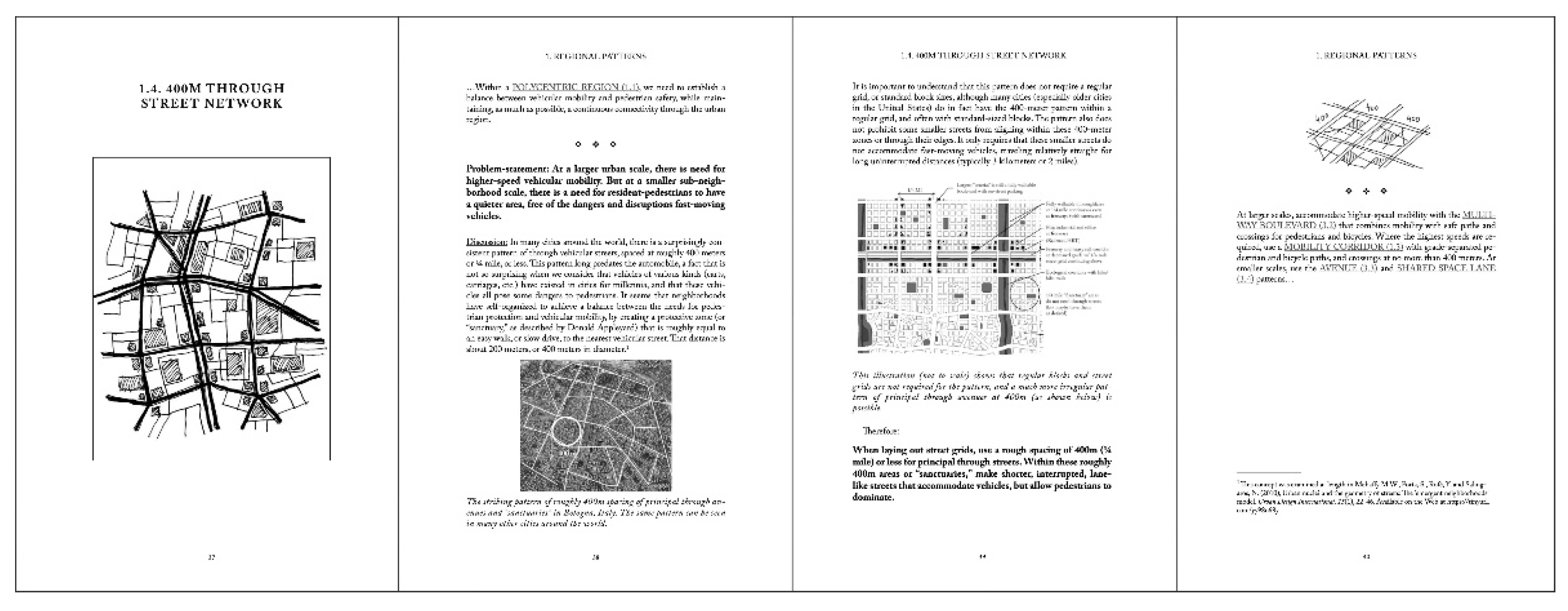
Figure 3.
A pattern from the volume A New Pattern Language for Growing Regions: Places, Networks, Processes, addressing the concept of “externality valuation” that is integral to the application of a polycapital methodology.
Figure 3.
A pattern from the volume A New Pattern Language for Growing Regions: Places, Networks, Processes, addressing the concept of “externality valuation” that is integral to the application of a polycapital methodology.
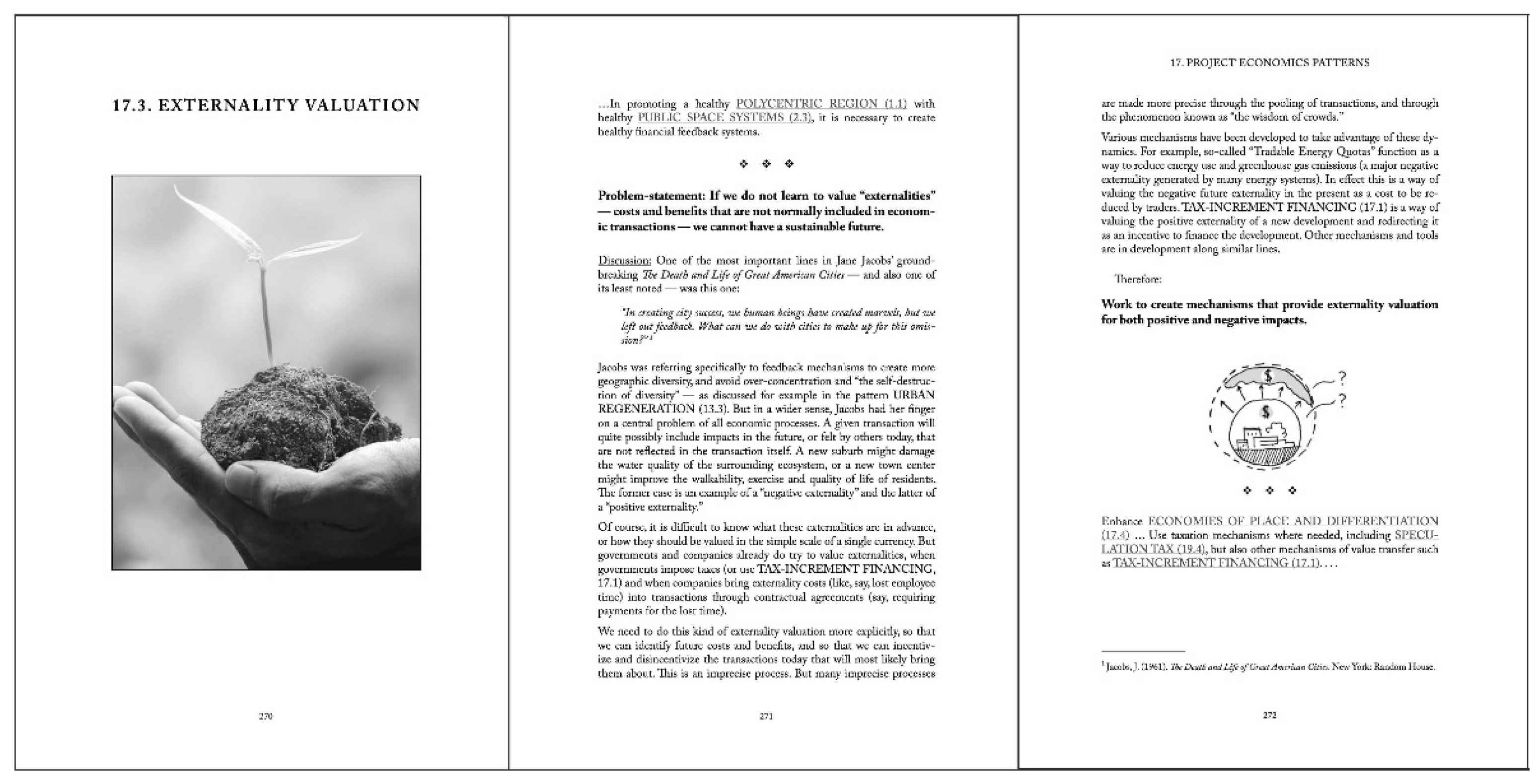
Figure 4.
Another pattern from the volume A New Pattern Language for Growing Regions: Places, Networks, Processes, dealing more explicitly with issues of polycapital and the divergence between different economies (“scale and standardization” versus “place and differentiation”).
Figure 4.
Another pattern from the volume A New Pattern Language for Growing Regions: Places, Networks, Processes, dealing more explicitly with issues of polycapital and the divergence between different economies (“scale and standardization” versus “place and differentiation”).
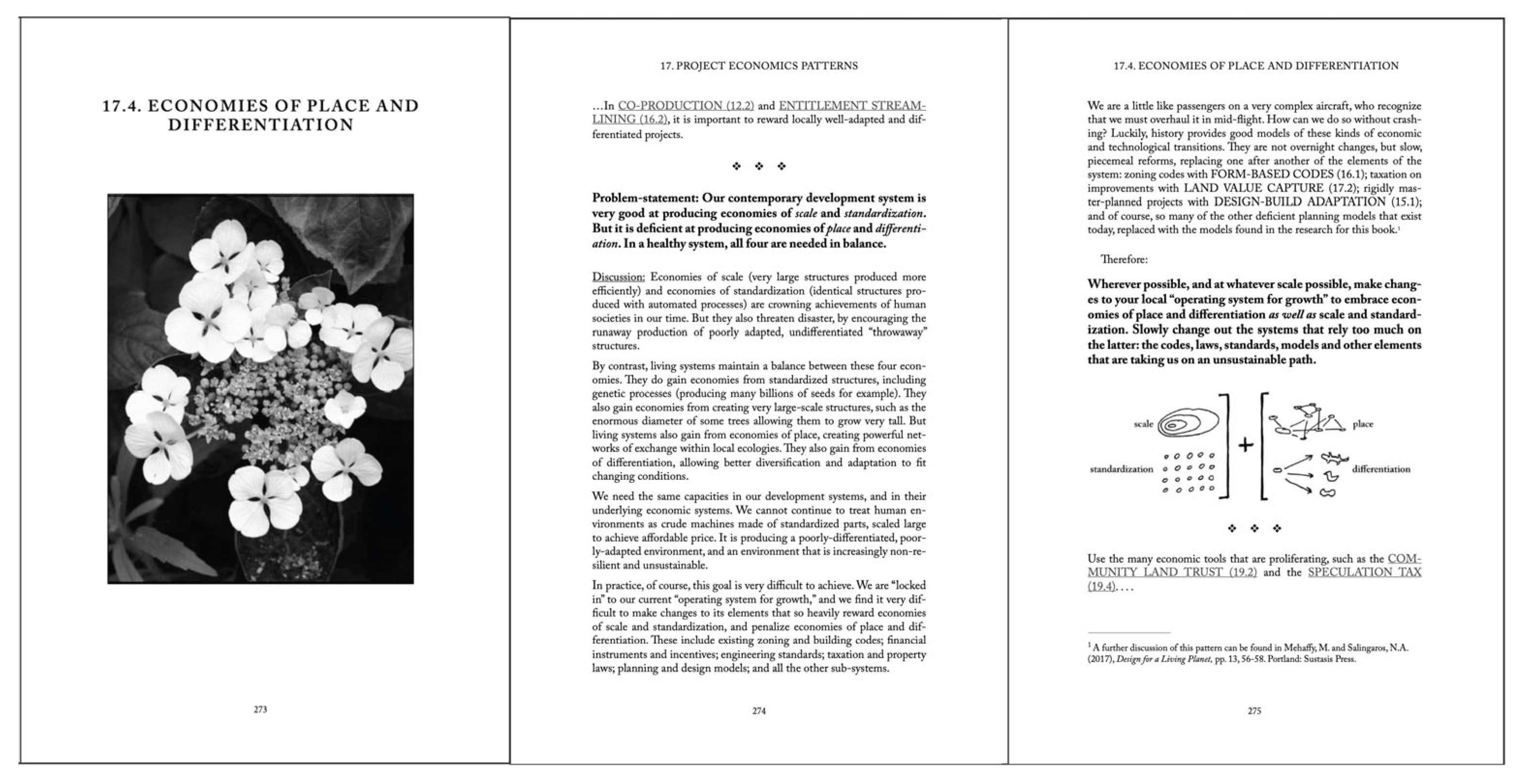
Disclaimer/Publisher’s Note: The statements, opinions and data contained in all publications are solely those of the individual author(s) and contributor(s) and not of MDPI and/or the editor(s). MDPI and/or the editor(s) disclaim responsibility for any injury to people or property resulting from any ideas, methods, instructions or products referred to in the content. |
© 2026 by the authors. Licensee MDPI, Basel, Switzerland. This article is an open access article distributed under the terms and conditions of the Creative Commons Attribution (CC BY) license (http://creativecommons.org/licenses/by/4.0/).
Copyright: This open access article is published under a Creative Commons CC BY 4.0 license, which permit the free download, distribution, and reuse, provided that the author and preprint are cited in any reuse.


