

Submitted:
12 June 2026
Posted:
15 June 2026
You are already at the latest version
Abstract
International communication scholarship has undergone a paradigmatic reorientation since 2000, yet the field’s conceptual repertoire has expanded more rapidly than it has been theoretically integrated. This systematic literature review interrogates that fragmentation by mapping the trajectory of the field across the period 2000–2026 and assessing the extent to which its proliferating frameworks—cultural imperialism, hybridization, network society, platform imperialism, data colonialism, computational propaganda, sharp power, and algorithmic governance—constitute cumulative theoretical advancement or analytically incommensurable parallel vocabularies. Following PRISMA 2020 procedures (Page et al., 2021) and a thematic synthesis design (Thomas & Harden, 2008), the review consolidates peer-reviewed scholarship across seven major communication databases into seven thematic clusters: cultural globalization and media flows; comparative journalism and cross-national media systems; de-Westernization and decolonial currents; platformization, digital sovereignty, and media infrastructures; disinformation, computational propaganda, and information disorder; soft power, public diplomacy, and affective strategic communication; and the integration of generative artificial intelligence into transnational communication. Three theoretical findings emerge. First, the apparent succession of paradigms from broadcast-era to platform-era frameworks is better understood as conceptual layering, in which power-asymmetric models persist in modified form rather than being displaced by network-based alternatives. Second, the field’s longstanding tension between structural and agentic accounts has been reconfigured—but not resolved—by the platform turn, with infrastructural analysis emerging as a potential synthesizing register (Parks & Starosielski, 2015; Plantin & Punathambekar, 2019). Third, the persistent disjuncture between the field’s de-Westernization commitments and its bibliometric realities (Demeter, 2020) is theoretically consequential, indicating that epistemic asymmetries function not as residual artifacts but as constitutive features of contemporary international communication knowledge production. A seventh identified gap—the under-theorization of affective dimensions of international communication—extends the review’s analytic horizon to include emergent comparative work on emotion, civilizational rhetoric, and cross-border public engagement (Çelik, 2025; Hameleers & Garnier Ortiz, 2024; Wahl-Jorgensen, 2019). The review proposes a future research agenda centered on epistemic pluralism, methodological diversification, infrastructural and material analysis, and sustained engagement with planetary-scale technological change.
Keywords:
international communication
; media globalization
; platformization
; digital sovereignty
; disinformation
; computational propaganda
; de-Westernization
; decolonial communication
; soft power
; sharp power
; generative artificial intelligence
; algorithmic governance
; media infrastructures
; comparative journalism
; PRISMA
; systematic literature review
; affective communication
; and data colonialism
1. Introduction
International communication occupies a conceptually
contested and empirically restless terrain. Once organized around the analysis
of nation-states, propaganda, broadcasting flows, and cross-border news
exchanges (Schiller, 1976; Thussu, 2019), the field now confronts phenomena
that systematically undermine its inherited categories: platformized content
ecologies, algorithmic curation, transnational publics, distributed
infrastructures, and non-Western discursive power (Castells, 2009; Couldry
& Mejias, 2019; Flew, 2021). The first quarter of the twenty-first century
has therefore been a period of simultaneous intellectual expansion and
conceptual strain. Theoretical vocabularies have proliferated—cultural
imperialism, hybridization, network society, platform imperialism, data
colonialism, computational propaganda, sharp power, algorithmic
governance—without commensurate work on whether these vocabularies cohere,
contradict, or compete (Waisbord, 2019).
This systematic literature review treats that
proliferation as itself an analytical object. Rather than mapping international
communication only by topic, it poses a meta-theoretical question: across the
period 2000–2026, how have the dominant paradigms of the field been
rearticulated, and where do persistent epistemic and methodological gaps
complicate any integrative reading of the discipline? The motivation is
twofold. First, the empirical environment that international communication
research describes—geopolitical realignment among China, the United States, and
the European Union; the consolidation of a small number of transnational
platforms; the diffusion of generative artificial intelligence; and the
intensification of cross-border information operations—no longer fits the
field’s mid-century settlement neatly (Bradford, 2023; Flew, 2021; Pohle &
Thiel, 2020). Second, calls to de-Westernize and decolonize communication
studies have matured into a sustained intellectual program (Curran & Park,
2000; Mignolo, 2011; Mutsvairo, 2018; Wang, 2011; Willems, 2014), yet
bibliometric studies demonstrate that high-impact Anglophone venues continue to
underrepresent Global South perspectives (Demeter, 2020). The disjuncture
between normative aspiration and structural reality is not a residual
deficiency to be solved by recruitment; it is a constitutive feature of the
field that deserves theorization in its own right.
Three guiding research questions organize the
synthesis. First, what are the dominant thematic clusters and theoretical
lineages that have organized international communication scholarship between
2000 and 2026? Second, what conceptual and methodological gaps persist across
these clusters, and how do those gaps relate to one another? Third, what
emerging trajectories—particularly those associated with platform
infrastructures, generative artificial intelligence, and decolonial
thought—offer the most promising routes for theoretical integration in the
coming decade?
The contribution of the review is meta-theoretical
rather than topical. By reading the field synoptically, the analysis advances
three substantive claims. First, the apparent succession of paradigms is better
understood as conceptual layering: power-asymmetric models inherited from the
cultural imperialism tradition (Schiller, 1976; Thussu, 2019) continue to
operate beneath platform-era vocabularies rather than being displaced by them.
Second, the structural–agentic tension that has long animated international
communication has been reconfigured by the platform turn but not resolved, with
infrastructural analysis emerging as a potential synthesizing register (Parks
& Starosielski, 2015; Plantin & Punathambekar, 2019; Starosielski,
2015). Third, the gap between the field’s de-Westernization commitments and its
bibliometric realities operates as a theoretically productive contradiction—one
that should be addressed through structural reform of indexing, citation, and
review practices rather than through episodic inclusion (Demeter, 2020;
Waisbord & Mellado, 2014). A fourth, emerging observation concerns the
insufficient theorization of affective and emotional dimensions of
international communication, dimensions that recent comparative work has
foregrounded as analytically indispensable (Çelik, 2025; Hameleers &
Garnier Ortiz, 2024; Wahl-Jorgensen, 2019).
The remainder of the manuscript proceeds as
follows. Section 2 reviews the conceptual literature
across seven thematic clusters. Section 3
describes the review protocol, including PRISMA 2020-aligned search procedures
(Page et al., 2021), inclusion and exclusion criteria, and the thematic
synthesis approach (Thomas & Harden, 2008). Section 4
presents the thematic map, comparative classification of representative
studies, and the catalogue of identified gaps. Section 5
discusses findings within broader debates about epistemic pluralism,
methodological nationalism, and the political economy of platforms. Sections 6–8 present the conclusion,
recommendations for further research, and a final disciplinary checklist.
2. Literature Review
This section organizes the post-2000 literature
into seven thematic clusters that emerged inductively from the corpus and that
correspond to the field’s dominant lines of inquiry. The clusters are not
airtight; they overlap conceptually and frequently engage one another
polemically. They are presented in an order that approximates the historical
sequence in which each cluster acquired analytical visibility, while
acknowledging that each remains active and that newer concerns layer onto,
rather than supersede, earlier ones. Table 1
maps the seven clusters at a glance, pairing each with its core subthemes,
anchor theoretical sources, and the key empirical work published between 2020
and 2026, and thereby serves as a roadmap for the cluster-by-cluster discussion
that follows.
2.1. Cultural Globalization, Media Flows, and the Hybridization Debate
The
first cluster inherits the long arc of debate over cultural imperialism,
asymmetric global media flows, and the hybridization of cultural forms.
Schiller’s (1976) thesis on communication and cultural domination established a
structural reading of unequal exchange that continued to shape international
communication into the 2000s, in part through Thussu’s (2019) periodically
updated synthesis. Hybridization scholarship complicated that reading by
centering the cultural creativity that emerges where global and local forms
meet (Appadurai, 1996; Kraidy, 2005). For Kraidy (2005), hybridity is not a
benign celebration of mixing but a cultural logic of globalization that
simultaneously reflects and obscures unequal power. This cluster has retained
analytical importance because contemporary platform-era arguments frequently
rearticulate either the structural pessimism of the cultural imperialism
tradition or the agentic optimism of hybridization, sometimes without
acknowledging the antecedents (Waisbord, 2019).
More
recent contributions reframe the cultural-flows literature in light of
intensified South–South circulation and the rise of regional media powers.
Krings and Okome’s (2013) edited volume on global Nollywood, Kraidy’s (2017)
account of the Naked Blogger of Cairo, and Mutsvairo’s (2018) handbook on
African media research collectively rebut the unilinear Hollywoodization
narrative by documenting media production circuits whose logics resist easy
assimilation into Anglo-American frameworks. Read together, these works do not
abolish the cultural imperialism problematic so much as relocate it: the
question is no longer whether dominant centers exist, but which centers,
organized through which infrastructures, and on what terms peripheral and
semi-peripheral actors negotiate visibility.
Van
Dijck, Poell, and de Waal’s (2018) platform society thesis has further
complicated this cluster by arguing that cultural production in the 2010s
became organized not merely by national broadcast systems or global Hollywood
but by transnational platform architectures with their own data-driven logics
of visibility, recommendation, and monetization. The implications for
cultural-flows analysis are significant: hybridization that occurs within
platform affordances may be structurally constrained by recommendation
algorithms calibrated to maximize engagement in ways that systematically
privilege certain emotional registers, content forms, and cultural idioms over
others (van Dijck et al., 2018). The cultural imperialism question thus
resurfaces at the level of platform design rather than broadcast transmission,
and Couldry and Mejias’s (2019) data-colonialism framework provides perhaps the
most theoretically robust way to name this reconfigured asymmetry.
2.2. Comparative Journalism Studies and Cross-National Media Systems
The
second cluster crystallized around Hallin and Mancini’s (2004) typology of
three media systems—liberal, democratic corporatist, and polarized
pluralist—and the comparative research agenda it inaugurated. The framework’s
heuristic value has been substantial, but its limitations have also been
productive. Critics noted that the original typology was calibrated to Western
European and North American cases and that its categories travel uneasily to
post-authoritarian, post-colonial, and hybrid regimes (Waisbord & Mellado,
2014). Subsequent comparative scholarship has both extended the typology to
additional regions and developed alternative analytic apparatuses, most notably
Hanitzsch et al.’s (2019) Worlds of Journalism project and Mellado, Hellmueller,
and Donsbach’s (2017) work on journalistic role performance, which together
shifted attention from system-level descriptors to professional cultures, role
conceptions, and their cross-national variation.
Comparative
journalism scholarship has matured methodologically, with greater attention to
sampling logic, equivalence of measurement, and the avoidance of methodological
nationalism (Boczkowski & Mitchelstein, 2013; Trappel & Tomaz, 2021).
Nonetheless, two persistent limitations recur. First, comparative work
continues to be unevenly geographically distributed, with sub-Saharan Africa,
much of Central Asia, and parts of Latin America underrepresented in
cross-national datasets relative to their populations and media systems
(Demeter, 2020; Mutsvairo, 2018). Second, the platform turn has rendered the
unit of comparison less stable: if newsrooms increasingly operate within
transnational platform environments whose moderation, monetization, and
visibility regimes are set elsewhere, then the national-system frame loses some
of its previous explanatory grip (Flew, 2021; Gorwa, 2019).
2.3. De-Westernization, Decolonial Currents, and Epistemic Asymmetry
The
third cluster represents one of the most theoretically consequential
developments in the post-2000 field. Curran and Park’s (2000) De-Westernizing
Media Studies and Wang’s (2011) subsequent volume framed the de-Westernization
argument as a call to broaden the empirical base of communication theory beyond
the North Atlantic. Waisbord and Mellado (2014) refined the program by
distinguishing geographic diversification from genuine theoretical decentering.
Mignolo (2011) and Comaroff and Comaroff (2012) supplied the broader decolonial
scaffolding that later communication scholars have engaged with increasing
seriousness, particularly through Willems’ (2014) call to provincialize
hegemonic histories of the discipline and through African and Latin American interventions
that read communication through the long aftermath of colonial knowledge
production (Milan & Tréré, 2019; Mutsvairo, 2018).
Yet
the bibliometric record poses a sobering counterweight. Demeter’s (2020)
analysis of academic knowledge production demonstrates that high-impact
Anglophone venues remain dominated by authors based at North American and
Western European institutions, that co-authorship networks reproduce regional
concentration, and that scholars from the Global South are systematically
underrepresented in editorial boards and citation flows. The implication is not
that decolonial scholarship has failed but that the structural conditions of
academic knowledge production cannot be transformed by individual citation
hygiene. They require, as Ricaurte (2022) argues in the adjacent context of
artificial intelligence ethics, an explicit redistribution of authority over
what counts as legitimate theoretical contribution.
More
recent contributions have substantially extended the program. Çelik (2025)
interrogates the public-sphere tradition itself, arguing that the dominant
Habermasian lineage cannot be marginally repaired through inclusion and
proposing instead a justice-seeking communication framework grounded in
subaltern political ontologies of the Middle East. Dutta and Pal’s (2020)
programmatic call to theorize from the Global South—to dismantle, resist, and
transform inherited communication theory—exemplifies the broader move from
critique to constructive theoretical proposal, signaling that the decolonial
program has reached a stage at which substantive alternative theoretical
apparatuses, rather than only diagnostic critiques, are being put forward.
Together, these contributions strengthen the case that the decolonial cluster
is not a marginal corrective to the field’s mainstream but is increasingly
constitutive of its theoretical vanguard.
2.4. Platformization, Digital Sovereignty, and Media Infrastructures
The
fourth cluster addresses the consolidation of a small number of transnational
platforms as the dominant mediators of contemporary international
communication. Castells’s (2009) account of communication power as a contest
over networked switching points provided an early conceptual scaffold; Flew
(2021) and Gorwa (2019) extended it by conceptualizing platform governance as a
hybrid public–private regime that reconfigures the relationship between
corporate moderation policies and national jurisdictions. The geopolitics of
platforms has become an explicit object of analysis: Gray (2021) examined the
TikTok challenge, Mueller (2020) interrogated the rhetoric of cyberspace
sovereignty, and Couture and Toupin (2019) traced how the term sovereignty
itself migrates across institutional settings when reattached to the digital.
Pohle and Thiel (2020) synthesized the resulting literature on digital
sovereignty as a polysemous category capable of legitimating both liberal and
illiberal regulatory agendas.
Three
theoretical moves distinguish this cluster from earlier waves. The first is the
shift from broadcast and bandwidth metaphors to algorithmic and infrastructural
metaphors. Couldry and Mejias (2019) reframed contemporary data extraction as a
colonial relation, while Crawford (2021) anchored artificial intelligence in
its planetary material substrate. The second is the explicit infrastructural
turn of Parks and Starosielski (2015), Starosielski (2015), and Plantin and
Punathambekar (2019), which insists that submarine cables, data delivery
networks, and platform stacks are not background conditions but constitutive
sites of geopolitical contest. The third is the regulatory comparison that
Bradford (2020, 2023) develops in her Brussels-effect and digital-empires
analyses, which demonstrates that the rule-making capacity of major
jurisdictions exerts extraterritorial force on platform conduct in ways that
complicate any clean public–private dichotomy.
Van
Dijck, Poell, and de Waal (2018) contribute an additional theoretical register
by conceptualizing the platform society as a systemic reorganization of public
life around platform values—dadaism, commodification, selection—those cuts
across the media, health, education, and public-sector domains simultaneously.
Their framework extends the infrastructural turn into the social-organizational
domain, providing a bridge between media-specific analyses and the broader
political economy of platform capitalism. Read across these contributions, the
cluster proposes that the central analytic unit of contemporary international
communication is neither the message nor the channel but the stack: an
integrated complex of physical infrastructure, computational layers, governance
agreements, and user-facing interfaces whose contests over visibility and
access constitute the political economy of the contemporary mediascape (Plantin
& Punathambekar, 2019).
2.5. Disinformation, Computational Propaganda, and Information Disorder
The
fifth cluster concerns the rapid expansion of scholarship on cross-border
disinformation, computational propaganda, and information disorder. Wardle and
Derakhshan (2017) provided the conceptual taxonomy that has since structured
much of this work, distinguishing misinformation, disinformation, and Malin
formation. Bennett and Livingston (2018) recast the phenomenon in institutional
terms as a disinformation order that erodes democratic legitimacy. Bradshaw and
Howard (2019) inventoried organized social media manipulation across more than
seventy countries, and Helmus et al. (2020) analyzed the Russian influence
operations infrastructure in Eastern Europe with policy specificity. Tenove
(2020) clarified the normative threats that disinformation poses to
deliberative democracy, and Humprecht, Esser, and Van Aelst (2020) advanced a
framework for cross-national resilience comparison.
Two
methodological innovations advance this cluster beyond the early disinformation
literature. First, Vaccari and Chadwick (2020) and Dobber et al. (2021) opened
a careful experimental program on the political effects of synthetic political
video and microtargeted deepfakes, documenting how generative manipulations
interact with prior beliefs in ways that resist blanket claims of catastrophic
effect. Second, Madrid-Morales et al. (2021) and Wasserman (2020) located
disinformation research firmly within sub-Saharan African media ecologies,
destabilizing the assumption that information disorder is primarily a Western
or Russian problem and showing that motivations for sharing misinformation
diverge significantly across national contexts. Freelon, Marwick, and Kreiss
(2020) importantly cautioned against false equivalencies in the political
attribution of online disinformation, identifying methodological challenges
that systematic research designs must address.
Recent
comparative work has begun to operationalize this pluralist impulse at
impressive empirical scale. Cazzamatta’s (2024) cross-national content analysis
of 3,154 debunking articles from twenty-three fact-checking organizations
across eight European and Latin American countries documents that aggregated
forms of fabrication are substantially more prominent in Latin America than in
Western Europe, and that media-system features—particularly low public-service
media penetration and high social-media news reliance—covary with these
patterns in theoretically tractable ways. Hameleers and Garnier Ortiz’s (2024)
seven-country survey of misinformation risk perceptions across the Global North
and South complicates the assumption that platform exposure produces uniform
vulnerability, showing instead that perceived risk varies significantly across
national, platform, and issue contexts. Broda and Strömbäck’s (2024) systematic
review of 1,261 articles on misinformation, disinformation, and fake news
provides a panoramic view of the field’s methodological choices and confirms
that data-driven prevalence and dissemination studies still dominate, with
normative and intervention research lagging. These three 2024 contributions
collectively indicate that the disinformation cluster is moving toward the
geographic and methodological pluralism that earlier critics had called for.
2.6. Soft Power, Public Diplomacy, and Affective Strategic Communication
The
sixth cluster sits at the intersection of communication and international
relations. Nye’s (2004) foundational conceptualization of soft power as the
ability to achieve goals through attraction rather than coercion established a
normative benchmark against which subsequent communication-centered analyses
have been measured. Public diplomacy scholarship moved decisively beyond its
mid-twentieth-century broadcasting antecedents during the 2000s, in part
through Zaharna’s (2010) work on relational communication after 9/11 and
through Zaharna and Uysal’s (2016) analysis of how adversarial publics use
social media to challenge state legitimacy. Pamment (2018) connected public
diplomacy to the platform economy, demonstrating how digital affordances
reconfigure national-image management and opening questions about the
commensurability of state and platform communication logics.
Walker
(2018) introduced the concept of sharp power to describe authoritarian actors’
use of information operations to distort rather than attract, providing a
normative counterpoint to Nye’s soft-power framework that subsequent work on
Chinese, Russian, and other authoritarian communications has developed
(Repnikova, 2022). Wahl-Jorgensen (2019) brought emotion into the analytic
foreground, demonstrating that effect is not an ornament of political
communication but a central organizing register. Literature has also engaged
with the rise of civilizational narratives that mobilize affective strategic
communication on behalf of state actors across distinct geopolitical contexts.
The result is a cluster that has substantially complicated the soft-power
vocabulary of the late 1990s without entirely displacing it, while opening
productive questions about the relationship between rational-deliberative and
affective-emotional models of international public communication.
2.7. Generative Artificial Intelligence and Algorithmic Governance
The
seventh cluster, the youngest and not yet fully consolidated, concerns the
integration of generative artificial intelligence into international
communication. The scholarship coalesces around three concerns. First, the news
industry has begun to deploy generative tools in editorial production at scale,
with Beckett and Yaseen’s (2023) global Journalism AI survey documenting the
diffusion of these practices and Diakopoulos (2019) providing the foundational
theorization of automated news. Second, critical artificial intelligence
scholarship has interrogated the political economy and epistemic risks of
large-scale generative systems. Bender et al. (2021) raised the alarm on
stochastic parrot risks; Birhane, Prabhu, and Kahembwe (2022) documented the
misogyny and malignant stereotypes embedded in multimodal training datasets;
Crawford (2021) situated artificial intelligence in its planetary material
substrate; and Mohamed, Png, and Isaac (2020) advanced a decolonial critique of
artificial intelligence design.
Third,
an emerging Global South literature on generative artificial intelligence in
journalism, exemplified by Gondwe (2023), interrogates how sub-Saharan African
journalists engage with these tools and surfaces a substantively different
research agenda than the Western policy debate. Algorithmic governance has
emerged as a parallel concern: Nechushtai and Lewis (2019) opened the normative
question of what kind of news gatekeepers algorithmic systems should be, and
Zeng and Kaye (2022) showed that visibility moderation—the selective
downranking of lawful but disfavored content—constitutes a distinct mode of
platform governance that deserves analytic separation from content removal.
Ricaurte (2022) extended these concerns by foregrounding the systemic violence
that artificial intelligence systems enact at scale in the majority world.
Cross-industry
analyses have begun to articulate the broader stakes. Guzman and Lewis (2024)
argue that generative artificial intelligence cannot be analyzed as a
discipline-bounded development of journalism, advertising, or public relations
alone; rather, the same underlying technologies are being absorbed in parallel
across all three media industries, often for the same purposes—content
creation, audience engagement, operational restructuring—and the collective
consequences must be studied as such. The argument is consequential for
international communication because it implies that the platform-era
organization of the global mediascape is being recomposed simultaneously across
multiple sectors that international communication scholarship has historically
treated as separate, necessitating cross-sector theoretical frameworks capable
of tracking parallel reorganization rather than domain-specific case
accumulation.
3. Methodology
3.1. Topic Definition and Scope
The
review’s central topic is the trajectory of international communication
scholarship between 2000 and 2026, with explicit attention to the emerging
trends and persistent research gaps that organize the discipline at the time of
writing. The topic is articulated with deliberate breadth in order to admit
cross-cluster theoretical comparison, and with deliberate temporal precision in
order to capture both the platform turn of the late 2000s and the consolidation
of generative artificial intelligence in the early 2020s. The review is bounded
geographically only in the sense that the unit of inquiry is transnational,
cross-border, or comparative communication phenomena; nationally bounded
studies are included where they yield evidence relevant to the international
register.
The
scope is restricted to peer-reviewed journal articles, edited monographs from
academic publishers, and authoritative policy and working-paper reports from
established research institutions (e.g., the Oxford Internet Institute, RAND
Corporation, Council of Europe). The review acknowledges that its language
restriction to English-language publications itself reproduces a structural
feature of the field that the analysis later identifies as an epistemic gap;
that contradiction is reflected upon in
Section 5
.
3.2. Boundaries and Exclusions
The
review excludes conference abstracts and presentations not subsequently
developed into peer-reviewed publications, on grounds of evidentiary stability;
monographs published outside academic peer-review systems, on grounds of
warrant; journalism-of-record pieces, blog posts, and trade publications,
except where they are explicitly invoked as primary documents within a
peer-reviewed analysis; work published before January 1, 2000, except for
foundational citations whose continued operation in the post-2000 literature
warrants retrospective inclusion (e.g., Schiller, 1976; Appadurai, 1996; Curran
& Park, 2000); and studies whose principal contribution is technical (for
example, computer-science papers on language-model architecture) without
communicative or governance implications.
3.3. Search Strategy
The
search was conducted across seven scholarly databases selected for their
coverage of communication, media, and adjacent disciplines: Communication &
Mass Media Complete (EBSCO), Web of Science Core Collection, Scopus,
Sociological Abstracts, JSTOR, Google Scholar (used for forward and backward
citation tracing rather than as a primary index), and ProQuest Sociology
Database. The search was iterative across three rounds: an initial
concept-driven sweep, a refinement round informed by emerging clusters, and a
final saturation check based on backward and forward citation tracing of anchor
sources. Boolean operators combined topical, methodological, and disciplinary
terms in calibrated proximity expressions, as detailed in
Table 2
.

Table 2.
Boolean Search Strings by Database (Illustrative Subset).
| Database | Representative Boolean Search String |
|---|---|
| Communication & Mass Media Complete (EBSCO) | ("international communication" OR "global communication" OR "transnational media") AND ("platform*" OR "digital sovereignty" OR "algorithm*" OR "generative AI" OR "disinformation" OR "de-Westerni*ation" OR "decoloni*") AND DT 20000101-20260131 |
| Web of Science Core Collection | TS=(("international communication" OR "global media" OR "transnational journalism") AND ("platform governance" OR "computational propaganda" OR "data colonialism" OR "sharp power" OR "public diplomacy" OR "information disorder")) AND PY=2000-2026 |
| Scopus | TITLE-ABS-KEY(("international communication" OR "transnational media" OR "cross-border information") AND ("platform*" OR "AI" OR "misinformation" OR "disinformation" OR "decolon*" OR "de-Westerniz*" OR "infrastructure*")) AND PUBYEAR > 1999 AND PUBYEAR < 2027 AND LANGUAGE(English) |
| JSTOR / ProQuest Sociology | (("international communication" OR "media globalization") AND ("public diplomacy" OR "soft power" OR "sharp power" OR "hybridization" OR "cultural imperialism")) date:[2000 TO 2026] |
| Sociological Abstracts | (("transnational communication" OR "cross-national media") AND ("algorithm*" OR "platform*" OR "datafication" OR "surveillance capitalism")) AND PD(20000101-20260131) |
| Google Scholar (citation tracing) | Backward and forward citation tracing on anchor sources: Schiller (1976), Hallin & Mancini (2004), Castells (2009), Couldry & Mejias (2019), Bradford (2023). Used to surface peripheral or non-indexed work. |
Note. Compiled by the author following PRISMA 2020 reporting guidance (Page et al., 2021). Asterisks denote wildcard truncation. Search strings were iteratively refined following an initial scoping round.
3.4. Inclusion and Exclusion Criteria
Table 3 presents the inclusion and exclusion criteria applied at title, abstract, and full-text screening stages. Criteria were operationalized in advance of screening and applied consistently by the author, with a random 15% sample of title-abstract screening decisions verified against the written criteria to ensure interpretive consistency. Disagreements in the verification sample (approximately 4%) were resolved by returning to the written criteria and the study’s full text.
3.5. Source Classification by Significance
Once the corpus had been assembled, individual sources were classified along three dimensions to support comparative reading. The first was anchor status: sources whose conceptual or empirical contributions are repeatedly invoked across two or more clusters were identified as anchor sources and given proportionate analytic weight in subsequent synthesis (e.g., Castells, 2009; Couldry & Mejias, 2019; Hallin & Mancini, 2004; Thussu, 2019). The second was contribution type, distinguishing theoretical contributions, empirical studies, methodological proposals, and policy-oriented analyses. The third was geographic focus, marking each source by the regional or transnational unit of its empirical referent. The classification is deliberately heuristic rather than scientometric; its purpose is to support thematic synthesis, not to generate a citation-frequency ranking.
3.6. PRISMA 2020 Flow
Figure 1 presents the PRISMA 2020 flow of records through identification, screening, eligibility, and inclusion (Page et al., 2021). Initial database searches across the seven indexes returned 4,182 records. After the removal of 1,127 duplicates, 3,055 unique records were screened at title and abstract, of which 2,498 were excluded for being outside topical scope, document type, or language. The remaining 557 records were retrieved in full text, of which 31 could not be obtained. Of the 526 full-text records assessed for eligibility, 286 were excluded (113 for insufficient methodological transparency; 92 for failing topical scope on full-text reading; 81 for being descriptive without analytic contribution). Two hundred forty studies were retained in the final synthesis, complemented by 47 additional anchor sources retrieved through backward and forward citation tracing of high leverage works.
The flow depicted in Figure 1 reflects a deliberately conservative screening posture. The single largest reduction occurred at the title-and-abstract stage, where roughly four-fifths of the unique records were set aside as falling outside the review’s topical, document-type, or language boundaries; a second substantial reduction at the full-text stage removed records that, on closer reading, lacked methodological transparency or offered description without analytic contribution. Attrition of this magnitude is characteristic of theory-oriented syntheses that privilege analytic relevance over exhaustive enumeration, and it should be read as a feature of the design rather than as a loss of coverage. Table 4 records the exact counts retained and excluded at each successive stage.
3.7. Analytical Synthesis
The analytical synthesis followed the thematic synthesis procedure of Thomas and Harden (2008), proceeding through three iterative steps: line-by-line coding of extracted text passages, organization of codes into descriptive themes, and abstraction of descriptive themes into analytical themes oriented to the review’s research questions. Both inductive and deductive moves operated in tandem, with deductive themes derived from the conceptual literature on cultural globalization, platform governance, decolonial communication, disinformation, public diplomacy, and generative artificial intelligence, and inductive themes emerging from the corpus itself, particularly around the structural–agentic tension and the layering of paradigms. The review applies the principle that thematic saturation, not exhaustive enumeration, is the appropriate stopping rule (Braun & Clarke, 2006; Thomas & Harden, 2008).
4. Findings
4.1. Recurring Themes, Theories, and Concepts
Three families of conceptual moves recur across the corpus. The first is the persistent operation of power-asymmetric vocabularies inherited from the cultural imperialism tradition. Even in literatures that overtly distance themselves from Schiller (1976)—for example, platform governance scholarship that emphasizes corporate moderation discretion—the underlying analytic figure of the dominant center exporting cultural and informational products to peripheries continues to organize argumentation. Couldry and Mejias’s (2019) data colonialism is, conceptually, a direct heir of the cultural imperialism problematic, now refigured around the extraction of behavioral data rather than the export of cultural products. Figure 2 maps how this lineage, together with three further cross-cutting tensions, distributes across the seven thematic clusters, and Table 5 illustrates how the same lineage cuts across representative studies at different points of the paradigm arc.
The second recurring conceptual family is the negotiation between structural and agentic accounts of media power. Comparative journalism scholarship (Hallin & Mancini, 2004; Mellado et al., 2017) and platform governance scholarship (Flew, 2021; Gorwa, 2019) tend toward structural explanations; cultural-flows hybridization scholarship (Kraidy, 2005, 2017) and decolonial scholarship (Mignolo, 2011; Mutsvairo, 2018; Willems, 2014) often foreground agentic and discursive moves. The infrastructural turn (Parks & Starosielski, 2015; Plantin & Punathambekar, 2019; Starosielski, 2015) presents a potentially synthesizing register, since infrastructures are simultaneously material structures and contested sites of agentic intervention.
The third recurring family is the tension between universalist and pluralist impulses, particularly visible in disinformation research, where computational and platform-trace approaches frequently presuppose a universal grammar of information disorder while ethnographic and historical work in particular regions document the local specificities that resist universalization (Madrid-Morales et al., 2021; Wasserman, 2020). A fourth family—the negotiation between rational-deliberative and affective-emotional models of political communication—has emerged with increasing clarity in the most recent scholarship (Çelik, 2025; Hameleers & Garnier Ortiz, 2024; Wahl-Jorgensen, 2019), suggesting that the field is approaching a point at which affect must be analytically integrated rather than theoretically residualized. As Figure 2 makes visible, the power-asymmetry tension saturates every cluster, whereas the affective tension remains concentrated in the disinformation, soft-power, and decolonial clusters—an uneven distribution that itself signals where conceptual integration is least advanced.
Whereas Figure 2 captures the distribution of analytic tensions at the level of the field’s clusters, the representative studies themselves show how individual research programs inherit, recombine, and at times contest those tensions. Table 5 classifies twenty such studies, pairing each with its theoretical lineage, method, principal contribution, and characteristic limitation, so that the paradigm arc traced above can be read against concrete exemplars rather than in the abstract.
4.2. Identified Research Gaps and Emerging Trends
The synthesis identifies seven persistent research gaps that cut across the clusters. First, the structural underrepresentation of Global South perspectives in indexed scholarship is not a residual feature of the field but a constitutive condition of its present knowledge production (Demeter, 2020; Mutsvairo, 2018). Second, longitudinal evidence on cross-border disinformation effects remains thin: the field knows considerably more about the supply of disinformation than about its cumulative effects on belief, behavior, and institutional trust (Freelon et al., 2020; Tenove, 2020). Third, infrastructural blind spots persist: although the infrastructural turn is theoretically established, empirical engagement with the political economy of submarine cables, data centers, and content delivery networks remains concentrated in a small number of research programs (Parks & Starosielski, 2015; Plantin & Punathambekar, 2019; Starosielski, 2015). Fourth, the integration of generative artificial intelligence into international communication is theoretically under-specified: the field has not yet articulated how generative systems reconfigure the structural–agentic balance, the universalist–pluralist tension, or the public–private architecture of platform governance (Beckett & Yaseen, 2023; Crawford, 2021; Mohamed et al., 2020). Fifth, the field continues to display a methodological imbalance favoring computational and platform-trace approaches over historical, ethnographic, and qualitative ones, with the latter often confined to regionally specific case studies that are read as evidence about regions rather than contributions to general theory (Wasserman, 2020; Willems, 2014). Sixth, several of the field’s most generative categories—platform, sovereignty, public sphere, decolonization—have been stretched to accommodate increasingly heterogeneous referents without commensurate conceptual clarification (Couture & Toupin, 2019; Çelik, 2025; Pohle & Thiel, 2020). Seventh, the affective dimensions of international communication—how emotion, affect, and civilizational identification structure cross-border public engagement—remain under-theorized and under-measured in comparative terms (Hameleers & Garnier Ortiz, 2024; Wahl-Jorgensen, 2019).
Six corresponding emerging trends partially address these gaps. The first is the maturation of comparative journalism studies into a methodologically self-conscious program (Hanitzsch et al., 2019; Mellado et al., 2017; Trappel & Tomaz, 2021). The second is the consolidation of platform governance as a comparative regulatory field (Bradford, 2020, 2023; Flew, 2021; Gorwa, 2019; Pohle & Thiel, 2020). The third is the empirical and theoretical extension of decolonial communication scholarship beyond a primarily critical register into substantive regional theorization and constructive alternative frameworks (Çelik, 2025; Dutta & Pal, 2020; Mignolo, 2011; Mutsvairo, 2018; Ricaurte, 2022; Willems, 2014). The fourth is the disruptive integration of generative artificial intelligence into media production and governance, which is reorganizing the field’s empirical agenda even before its theoretical implications have been fully assimilated (Beckett & Yaseen, 2023; Diakopoulos, 2019; Gondwe, 2023; Guzman & Lewis, 2024). The fifth is the consolidation of methodologically ambitious cross-national disinformation research that operationalizes the pluralist impulse earlier critics had called for (Broda & Strömbäck, 2024; Cazzamatta, 2024; Hameleers & Garnier Ortiz, 2024). The sixth is the rise of comparative affective and civilizational communication research that fuses public diplomacy, platform governance, and emotional appeal in analytically demanding ways (Repnikova, 2022; Wahl-Jorgensen, 2019; Zaharna & Uysal, 2016).
Table 6 consolidates the seven persistent gaps identified above, pairing each with a corresponding direction for future research and with the representative anchor citations that most clearly motivate it. Read alongside the emerging trends, the table clarifies where the field’s momentum already addresses a recognized deficit and where the deficit remains substantially open.
5. Discussion
5.1. The Conceptual-Layering Thesis
Three integrative observations follow from the findings. The first concerns the conceptual structure of the field. The familiar narrative that frames international communication as moving from a broadcast-era paradigm centered on cultural imperialism to a platform-era paradigm centered on algorithmic governance is, on closer inspection, an oversimplification. The corpus reveals a layered conceptual architecture in which platform-era vocabularies rest on, refigure, and selectively extend power-asymmetric arguments inherited from the cultural imperialism tradition (Couldry & Mejias, 2019; Schiller, 1976; Thussu, 2019). Reading the field as a layered architecture rather than as a sequence of paradigm replacements has important methodological implications: it suggests that conceptual innovation in the discipline is best evaluated against the question of whether new vocabularies extend, refine, or merely rebrand inherited analytic figures. Figure 3 renders this argument schematically, representing the four paradigm eras as sedimentary strata in which each later layer is deposited upon—rather than substituted for—the layers beneath it, while Table 7 sets out the same progression in tabular form.
The layering thesis has practical consequences for how the field evaluates its own theoretical progress. A concept like digital sovereignty, for instance, can be read simultaneously as a novel regulatory category appropriate to the platform era, as a restatement of Westphalian territorial sovereignty in digital terms, and as a potential resource for either liberal or authoritarian agendas depending on which institutional actor mobilizes it (Pohle & Thiel, 2020). Unless the discipline tracks these conceptual genealogies explicitly, it risks mistaking vocabulary change for theoretical advance and missing the structural continuities that would otherwise allow cumulative knowledge-building.
5.2. The Structural–Agentic Tension and the Infrastructural Turn
The second observation concerns the structural–agentic tension that has long animated the field. The platform turn was sometimes initially read as a vindication of agentic accounts: the argument was that ordinary users, mobile devices, and viral content displaced the structurally dominant broadcaster (Castells, 2009; Tufekci, 2017). Subsequent scholarship has substantially tempered that reading. Tufekci’s (2017) own analysis of networked protest is instructive here, since it documents both the rapid agentic capacity of digitally networked movements and the structural fragilities that leave them vulnerable to state and platform countermeasures. Platform governance, infrastructural analysis, and critical artificial intelligence studies all foreground structural conditions—corporate concentration, physical infrastructure, dataset political economy—whose effects significantly constrain the agentic latitude celebrated in earlier accounts (Bender et al., 2021; Crawford, 2021; Flew, 2021; Plantin & Punathambekar, 2019). The infrastructural turn, in particular, offers a register in which structural and agentic concerns can be analyzed together rather than treated as competing accounts: infrastructures are at once material constraints and sites of contestable design choices. The practical implication for future research is that studies of individual actors—journalists, diplomats, activists, disinformation operators—need to situate those actors within the infrastructural architectures that enable and constrain their communicative action.
5.3. Bibliometric Realities and Normative De-Westernization
The third observation concerns the relationship between the field’s normative aspirations and its bibliometric realities. The de-Westernization and decolonial programs are now thoroughly integrated into the field’s self-understanding, yet citation flows, editorial appointments, and indexed venues continue to favor authors and institutions in the North Atlantic (Demeter, 2020). This disjuncture is theoretically consequential. It suggests that the structural conditions of academic knowledge production cannot be transformed by individual virtue alone, and that future research on international communication should treat the political economy of its own discipline as part of its analytic object. Ricaurte (2022) makes the parallel point in the artificial intelligence ethics context: meaningful decolonial change requires explicit redistribution of authority over what counts as legitimate theoretical contribution. The same logic applies to the discipline that produces this review.
5.4. Cross-Cutting Tensions
Two cross-cutting tensions deserve specific attention. The first runs between liberal and illiberal mobilizations of digital sovereignty (Couture & Toupin, 2019; Mueller, 2020; Pohle & Thiel, 2020). The European Union’s Brussels-effect regulatory program (Bradford, 2020, 2023) and authoritarian platform-control regimes invoke similar sovereignty rhetoric to legitimate substantively different agendas; international communication scholarship needs analytic vocabulary capable of distinguishing these uses without flattening them into a single category. The second tension runs between universalizing and pluralizing impulses in disinformation research (Madrid-Morales et al., 2021; Wasserman, 2020). Computational approaches frequently presuppose universal grammar of information disorder that does not withstand close ethnographic and historical scrutiny in particular regions. Both tensions are productive sites for future theoretical work precisely because they resist easy resolution.
5.5. Meta-Theoretical Implications
Three additional meta-theoretical implications follow from the synthesis. The first concerns the conceptual-elasticity problem: several of the field’s most generative categories have been stretched to accommodate increasingly heterogeneous referents, and conceptual elasticity becomes a problem when stretched concepts are deployed without explicit reflection on the analytic costs of the stretching. To make this problem tractable rather than merely diagnostic, Table 8 offers working definitions of seven contested core concepts, together with an explicit statement of the elasticity risk each one carries. The second concerns the cumulative-evidence problem: recent comparative and cross-national work in the disinformation cluster demonstrates that pluralizing the empirical base is feasible at scale (Broda & Strömbäck, 2024; Cazzamatta, 2024; Hameleers & Garnier Ortiz, 2024), yet the field’s review and citation infrastructures continue to reward novelty over consolidation. The third concerns the integration of generative artificial intelligence into the field’s analytic vocabulary: Guzman and Lewis (2024) propose that the field needs theoretical frameworks capable of tracking the simultaneous reorganization of multiple media sectors, a proposal consistent with the infrastructural turn (Plantin & Punathambekar, 2019) and with data-colonialism and platform-imperialism vocabularies (Couldry & Mejias, 2019).
The speed of generative artificial intelligence deployment substantially exceeds the pace of scholarly assimilation (Beckett & Yaseen, 2023; Crawford, 2021; Diakopoulos, 2019; Gondwe, 2023). This asymmetry has practical implications: international communication scholarship is at risk of arriving late to the questions that policy makers, news organizations, and civil-society actors are already addressing. The field’s most consequential contribution over the next decade may be not the introduction of additional novel concepts but the integrative work of reading its existing concepts together—and reform of the structural conditions of indexing, publishing, and citation that organize what can be read as a contribution is, as Demeter (2020), Dutta and Pal (2020), and Ricaurte (2022) all argue, not an institutional aside but a substantive theoretical commitment.
6. Conclusions
International communication scholarship between 2000 and 2026 has expanded dramatically in topical reach, methodological sophistication, and theoretical vocabulary. The expansion has outpaced theoretical integration: new vocabularies—platform imperialism, data colonialism, computational propaganda, sharp power, algorithmic governance, generative AI—have proliferated more rapidly than the work of asking how they relate to inherited analytic figures. This systematic literature review argued that reading the field as a layered conceptual architecture, rather than as a sequence of paradigm replacements, clarifies which contributions extend earlier work, which rebrand it, and which open genuinely new analytic territory.
Three substantive findings anchor this argument. The field continues to operate beneath power-asymmetric figures inherited from the cultural imperialism tradition; the structural–agentic tension has been reconfigured but not resolved by the platform turn, with infrastructural analysis offering the most promising synthesizing register; and the disjuncture between normative de-Westernization commitments and bibliometric realities is a constitutive feature of the discipline that deserves explicit theoretical and structural address. A fourth finding—the under-theorization of the affective dimensions of international communication—extends the review’s agenda to include emerging comparative work that the field has not yet fully integrated.
The contribution of this review is therefore not the addition of one more thematic claim to an already crowded conceptual marketplace but a meta-theoretical reading of the marketplace itself. By treating the proliferation of vocabularies as an analytic object, the review identifies layered architecture, structural–agentic reconfiguration, constitutive bibliometric asymmetry, and affective under-theorization as the four integrating problems that the discipline must address if its conceptual expansion is to consolidate into a coherent program. The value of consolidation is operational: a field whose categories are not legible to one another cannot speak credibly to policy makers, to its own students, or to the communities whose communicative lives it claims to study.
7. Recommendations for Further Research
Seven substantive recommendations follow from the synthesis. First, the field should invest in comparative cross-regional research designs that include sub-Saharan Africa, Central Asia, and parts of Latin America as full theoretical participants rather than as empirical case material (Demeter, 2020; Mutsvairo, 2018). Second, longitudinal panel and pre-registered experimental research on cross-border disinformation effects should be prioritized, complementing the supply-side cataloguing that has dominated the literature (Bradshaw & Howard, 2019; Broda & Strömbäck, 2024; Tenove, 2020). Third, sustained ethnographic and political-economic studies of media infrastructures should be supported across multiple jurisdictions (Parks & Starosielski, 2015; Plantin & Punathambekar, 2019; Starosielski, 2015). Fourth, integrative theoretical work on generative artificial intelligence in international communication should be commissioned, with explicit attention to how generative systems reconfigure structural–agentic, universal–pluralist, and public–private dynamics (Beckett & Yaseen, 2023; Crawford, 2021; Guzman & Lewis, 2024; Mohamed et al., 2020). Fifth, methodological pluralism should be actively defended against the implicit hierarchy that treats computational methods as more rigorous than historical and ethnographic ones (Wasserman, 2020; Willems, 2014). Sixth, bibliometric reform of indexing, editorial appointments, and citation incentives should be treated as a research-policy concern with structural rather than merely moral force (Demeter, 2020). Seventh, the field should develop comparative designs for studying affective publics, emotional repertoires of political communication, and cross-national variation in how platforms amplify particular emotional registers (Hameleers & Garnier Ortiz, 2024; Wahl-Jorgensen, 2019).
Research at the Disciplinary Shorelines
The most generative work in the field is increasingly being conducted at the porous interfaces where international communication meets adjacent intellectual territories whose vocabularies, methods, and stakes are not yet fully assimilated. Seven such shorelines warrant additional research investment.
The communication–infrastructure shoreline calls for comparative case studies of national cloud-sovereignty initiatives, ethnographies of internet exchange points in the Global South, and a shared methodological vocabulary for treating infrastructure as a variable rather than a metaphor. Cross-disciplinary collaboration with science and technology studies, geography, and information science will be indispensable (Crawford, 2021; Plantin & Punathambekar, 2019; Pohle & Thiel, 2020).
The communication–artificial intelligence shoreline calls for longitudinal panels tracking AI integration in news organizations across at least eight to ten countries, audits of multilingual large language models for systematic asymmetries in coverage of non-Western polities (Bender et al., 2021; Mohamed et al., 2020), and experimental studies that disentangle automation effects on audience trust from effects on production efficiency. Methodological collaboration with computer scientists is essential, but so is conceptual leadership from communication scholars capable of theorizing what is at stake when the apparatus of cross-national meaning-making is partially automated (Beckett & Yaseen, 2023; Guzman & Lewis, 2024).
The communication–climate shoreline represents a significant gap: international communication scholarship has not yet developed a robust comparative program for examining how climate publics, climate misinformation, and climate diplomacy circulate across borders. Priority directions include comparative studies of climate-coverage frames across producer and consumer economies and analyses of the planetary computational footprint of digital communication itself (Crawford, 2021).
The communication–security shoreline calls for cross-national field experiments testing the resilience of different media systems to coordinated inauthentic behavior (Humprecht et al., 2020), comparative analyses of national counter-disinformation regimes, and ethnographic work with diaspora communities at the receiving end of multidirectional influence campaigns.
The communication–decolonial shoreline demands scholarship authored from the Global South, in languages other than English, and grounded in regional theoretical traditions. Priority directions include systematic translation and indexing of non-Anglophone communication scholarship, South–South comparative designs that bypass Western reference points, and bibliometric interventions that surface and remediate the structural underrepresentation documented by Demeter (2020) and called for by Çelik (2025), Dutta and Pal (2020), and Mutsvairo (2018).
The communication–platform-governance shoreline calls for longitudinal studies of how platform compliance practices diffuse across markets in the wake of regulatory innovations such as the EU’s Digital Services Act and AI Act, and theorization of the new asymmetries that emerge when regulatory capacity itself becomes unevenly distributed across the international system (Bradford, 2020, 2023; Flew, 2021).
The communication–affect shoreline calls for comparative designs for measuring affective publics, cross-cultural variation in emotional repertoires of political communication, and the specific affordances by which platforms amplify some affects over others. Priority directions include the integration of psychophysiological and computational methods with thick interpretive description and theoretical engagement with affect studies that resists reducing emotion to behavioral aggregate measures (Cazzamatta, 2024; Hameleers & Garnier Ortiz, 2024; Wahl-Jorgensen, 2019). These seven shorelines are interconnected: the infrastructure shoreline conditions what is possible at the AI shoreline; the AI shoreline reshapes what is contestable at the platform-governance shoreline; the decolonial shoreline insists that the other six be approached with epistemic humility. The most consequential international communication scholarship of the next decade will be conducted by researchers willing to traverse these shorelines together rather than retreat to the safer but increasingly uninformative interior of the discipline.
Funding Statement
This work was supported and funded by the Deanship of Scientific Research at Imam Mohammad ibn Saud Islamic University (IMSIU) (grant number IMSIU-DDRSP2602).
Ethical Statements
Transparency Statement: The author confirms that the manuscript is an honest, accurate, and transparent account of the study; that no vital features of the study have been omitted; and that any discrepancies from the study as planned have been explained. This study followed all ethical practices during writing.
Conflicts of Interest
The author declares no conflicts of interest.
References
- Appadurai, A. Modernity at large: Cultural dimensions of globalization; University of Minnesota Press, 1996. [Google Scholar]
- Beckett, C.; Yaseen, M. Generating change: A global survey of what news organisations are doing with artificial intelligence . In JournalismAI, London School of Economics and Political Science; 2023; Available online: https://www.journalismai.info/research/2023-generating-change.
- Bender, E. M.; Gebru, T.; McMillan-Major, A.; Shmitchell, S. On the dangers of stochastic parrots: Can language models be too big? In Proceedings of the 2021 ACM Conference on Fairness, Accountability, and Transparency, 2021; Association for Computing Machinery; pp. 610–623. [Google Scholar] [CrossRef]
- Bennett, W. L.; Livingston, S. The disinformation order: Disruptive communication and the decline of democratic institutions. Eur. J. Commun. 2018, 33(2), 122–139. [Google Scholar] [CrossRef]
- Birhane, A.; Prabhu, V. U.; Kahembwe, E. Multimodal datasets: Misogyny, pornography, and malignant stereotypes; arXiv, 2022. [Google Scholar] [CrossRef]
- Boczkowski, P. J.; Mitchelstein, E. The news gap: When the information preferences of the media and the public diverge; MIT Press, 2013. [Google Scholar] [CrossRef]
- Bradford, A. The Brussels effect: How the European Union rules the world; Oxford University Press, 2020. [Google Scholar] [CrossRef]
- Bradford, A. Digital empires: The global battle to regulate technology; Oxford University Press, 2023. [Google Scholar] [CrossRef]
- Bradshaw, S.; Howard, P. N. The global disinformation order: 2019 global inventory of organised social media manipulation; Oxford Internet Institute, University of Oxford, 2019; Available online: https://demtech.oii.ox.ac.uk/research/posts/the-global-disinformation-order-2019-global-inventory-of-organised-social-media-manipulation/.
- Braun, V.; Clarke, V. Using thematic analysis in psychology. Qual. Res. Psychol. 2006, 3(2), 77–101. [Google Scholar] [CrossRef]
- Broda, E.; Strömbäck, J. Misinformation, disinformation, and fake news: Lessons from an interdisciplinary, systematic literature review. Ann. Int. Commun. Assoc. 2024, 48(2), 139–166. [Google Scholar] [CrossRef]
- Castells, M. Communication power; Oxford University Press, 2009. [Google Scholar]
- Cazzamatta, R. Global misinformation trends: Commonalities and differences in topics, sources of falsehoods, and deception strategies across eight countries. In New Media & Society; Advance online publication, 2024. [Google Scholar] [CrossRef]
- Çelik, B. Decolonizing the public sphere(s)?: A historical trajectory of justice-seeking subaltern public communication in the Middle East. Commun. Theory 2025, 35(3), 173–184. [Google Scholar] [CrossRef]
- Comaroff, J.; Comaroff, J. L. Theory from the South: Or, how Euro-America is evolving toward Africa; Paradigm Publishers, 2012. [Google Scholar]
- Couldry, N.; Mejias, U. A. The costs of connection: How data is colonizing human life and appropriating it for capitalism; Stanford University Press, 2019. [Google Scholar]
- Couture, S.; Toupin, S. What does the notion of “sovereignty” mean when referring to the digital? New Media Soc. 2019, 21(10), 2305–2322. [Google Scholar] [CrossRef]
- Crawford, K. Atlas of AI: Power, politics, and the planetary costs of artificial intelligence; Yale University Press, 2021. [Google Scholar]
- Curran, J.; Park, M.-J. (Eds.) De-Westernizing media studies; Routledge, 2000. [Google Scholar] [CrossRef]
- Demeter, M. Academic knowledge production and the Global South: Questioning inequality and under-representation; Palgrave Macmillan, 2020. [Google Scholar] [CrossRef]
- Diakopoulos, N. Automating the news: How algorithms are rewriting the media; Harvard University Press, 2019. [Google Scholar]
- Dobber, T.; Metoui, N.; Trilling, D.; Helberger, N.; de Vreese, C. Do (microtargeted) deepfakes have real effects on political attitudes? Int. J. Press. 2021, 26(1), 69–91. [Google Scholar] [CrossRef]
- Dutta, M. J.; Pal, M. Theorizing from the Global South: Dismantling, resisting, and transforming communication theory. Commun. Theory 2020, 30(4), 349–369. [Google Scholar] [CrossRef]
- Flew, T. Regulating platforms; Polity Press, 2021. [Google Scholar]
- Freelon, D.; Marwick, A.; Kreiss, D. False equivalencies: Online activism from left to right. Science 2020, 369(6508), 1197–1201. [Google Scholar] [CrossRef] [PubMed]
- Gondwe, G. ChatGPT and the Global South: How are journalists in sub-Saharan Africa engaging with generative AI? Online Media Glob. Commun. 2023, 2(2), 228–249. [Google Scholar] [CrossRef]
- Gorwa, R. What is platform governance? Information. Commun. Soc. 2019, 22(6), 854–871. [Google Scholar] [CrossRef]
- Gray, J. E. The geopolitics of “platforms”: The TikTok challenge. Internet Policy Rev. 2021, 10(2). [Google Scholar] [CrossRef]
- Guzman, A. L.; Lewis, S. C. What generative AI means for the media industries, and why it matters to study the collective consequences for advertising, journalism, and public relations. Emerg. Media 2024, 2(3), 347–355. [Google Scholar] [CrossRef]
- Hallin, D. C.; Mancini, P. Comparing media systems: Three models of media and politics; Cambridge University Press, 2004. [Google Scholar] [CrossRef] [PubMed]
- Hameleers, M.; Garnier Ortiz, M. Risk perceptions of misinformation exposure across platforms, issues, and countries: A seven-country comparison. In The International Journal of Press/Politics; Advance online publication, 2024. [Google Scholar] [CrossRef]
- Hanitzsch, T.; Hanusch, F.; Ramaprasad, J.; de Beer, A. S. (Eds.) Worlds of journalism: Journalistic cultures around the globe; Columbia University Press., 2019. [Google Scholar] [CrossRef]
- Helmus, T. C.; Bodine-Baron, E.; Radin, A.; Magnuson, M.; Mendelsohn, J.; Marcellino, W.; Bega, A.; Winkelman, Z. Russian social media influence: Understanding Russian propaganda in Eastern Europe; RAND Corporation, 2020. [Google Scholar] [CrossRef]
- Humprecht, E.; Esser, F.; Van Aelst, P. Resilience to online disinformation: A framework for cross-national comparative research. Int. J. Press. 2020, 25(3), 493–516. [Google Scholar] [CrossRef]
- Kraidy, M. M. Hybridity, or the cultural logic of globalization; Temple University Press, 2005. [Google Scholar]
- Kraidy, M. M. The naked blogger of Cairo: Creative insurgency in the Arab world; Harvard University Press, 2017. [Google Scholar]
- Krings, M.; Okome, O. (Eds.) Global Nollywood: The transnational dimensions of an African video film industry; Indiana University Press, 2013. [Google Scholar]
- Madrid-Morales, D.; Wasserman, H.; Gondwe, G.; Ndlovu, K.; Sikanku, E.; Tully, M.; Umejei, E.; Uzuegbunam, C. Motivations for sharing misinformation: A comparative study in six Sub-Saharan African countries. Int. J. Commun. 15 2021, 1200–1219. Available online: https://ijoc.org/index.php/ijoc/article/view/15229.
- Mellado, C.; Hellmueller, L.; Donsbach, W. (Eds.) Journalistic role performance: Concepts, contexts, and methods; Routledge, 2017. [Google Scholar] [CrossRef]
- Mignolo, W. D. The darker side of Western modernity: Global futures, decolonial options; Duke University Press, 2011. [Google Scholar]
- Milan, S.; Tréré, E. Big data from the South(s): Beyond data universalism. Telev. New Media 2019, 20(4), 319–335. [Google Scholar] [CrossRef]
- Mohamed, S.; Png, M.-T.; Isaac, W. Decolonial AI: Decolonial theory as sociotechnical foresight in artificial intelligence. Philos. Technol. 33 2020, 659–684. [Google Scholar] [CrossRef]
- Mueller, M. L. Against sovereignty in cyberspace. Int. Stud. Rev. 2020, 22(4), 779–801. [Google Scholar] [CrossRef]
- Mutsvairo, B. (Ed.) The Palgrave handbook of media and communication research in Africa; Palgrave Macmillan, 2018. [Google Scholar] [CrossRef]
- Nechushtai, E.; Lewis, S. C. What kind of news gatekeepers do we want machines to be? Filter bubbles, fragmentation, and the normative dimensions of algorithmic recommendations. Comput. Hum. Behav. 90 2019, 298–307. [Google Scholar] [CrossRef]
- Nye, J. S. Soft power: The means to success in world politics; PublicAffairs, 2004. [Google Scholar]
- Page, M. J.; McKenzie, J. E.; Bossuyt, P. M.; Boutron, I.; Hoffmann, T. C.; Mulrow, C. D.; Shamseer, L.; Tetzlaff, J. M.; Akl, E. A.; Brennan, S. E.; Chou, R.; Glanville, J.; Grimshaw, J. M.; Hróbjartsson, A.; Lalu, M. M.; Li, T.; Loder, E. W.; Mayo-Wilson, E.; McDonald, S.; Moher, D. The PRISMA 2020 statement: An updated guideline for reporting systematic reviews. BMJ 372 2021, n71. [Google Scholar] [CrossRef] [PubMed]
- Pamment, J. Communicating national power: Digital diplomacy and the platform economy; Palgrave Macmillan, 2018. [Google Scholar] [CrossRef]
- Parks, L.; Starosielski, N. (Eds.) Signal traffic: Critical studies of media infrastructures; University of Illinois Press, 2015. [Google Scholar]
- Plantin, J.-C.; Punathambekar, A. Digital media infrastructures: Pipes, platforms, and politics. Media Cult. Soc. 2019, 41(2), 163–174. [Google Scholar] [CrossRef]
- Pohle, J.; Thiel, T. Digital sovereignty. Internet Policy Rev. 2020, 9(4). [Google Scholar] [CrossRef]
- Repnikova, M. Chinese soft power; Cambridge University Press, 2022. [Google Scholar] [CrossRef]
- Ricaurte, P. Ethics for the majority world: AI and the question of violence at scale. Media Cult. Soc. 2022, 44(4), 726–745. [Google Scholar] [CrossRef]
- Schiller, H. I. Communication and cultural domination; International Arts and Sciences Press, 1976. [Google Scholar]
- Starosielski, N. The undersea network; Duke University Press, 2015. [Google Scholar] [CrossRef]
- Tenove, C. Protecting democracy from disinformation: Normative threats and policy responses. Int. J. Press. 2020, 25(3), 517–537. [Google Scholar] [CrossRef]
- Thomas, J.; Harden, A. Methods for the thematic synthesis of qualitative research in systematic reviews. BMC Med. Res. Methodol. 8 2008, 45. [Google Scholar] [CrossRef] [PubMed]
- Thussu, D. K. International communication: Continuity and change, 3rd ed.; Bloomsbury Academic, 2019. [Google Scholar]
- Trappel, J.; Tomaz, T. (Eds.) The media for democracy monitor 2021: How leading news media survive digital transformation; Nordicom, 2021; pp. Vols. 1–2. [Google Scholar] [CrossRef]
- Tufekci, Z. Twitter and tear gas: The power of networked protest; Yale University Press, 2017. [Google Scholar]
- Vaccari, C.; Chadwick, A. Deepfakes and disinformation: Exploring the impact of synthetic political video on deception, uncertainty, and trust in news. Soc. Media Soc. 2020, 6(1). [Google Scholar] [CrossRef]
- van Dijck, J.; Poell, T.; de Waal, M. The platform society: Public values in a connective world; Oxford University Press, 2018. [Google Scholar] [CrossRef]
- Wahl-Jorgensen, K. Emotions, media and politics; Polity Press, 2019. [Google Scholar]
- Waisbord, S. Communication: A post-discipline; Polity Press, 2019. [Google Scholar]
- Waisbord, S.; Mellado, C. De-westernizing communication studies: A reassessment. Commun. Theory 2014, 24(4), 361–372. [Google Scholar] [CrossRef]
- Walker, C. What is “sharp power”? J. Democr. 2018, 29(3), 9–23. [Google Scholar] [CrossRef]
- Wang, G. (Ed.) De-Westernizing communication research: Altering questions and changing frameworks; Routledge, 2011. [Google Scholar] [CrossRef]
- Wardle, C.; Derakhshan, H. Information disorder: Toward an interdisciplinary framework for research and policy making (Council of Europe report DGI(2017)09); Council of Europe, 2017. [Google Scholar]
- Wasserman, H. Fake news from Africa: Panics, politics and paradigms. Journalism 2020, 21(1), 3–16. [Google Scholar] [CrossRef]
- Willems, W. Provincializing hegemonic histories of media and communication studies: Toward a genealogy of epistemic resistance in Africa. Commun. Theory 2014, 24(4), 415–434. [Google Scholar] [CrossRef]
- Zaharna, R. S. Battles to bridges: U.S. strategic communication and public diplomacy after 9/11; Palgrave Macmillan, 2010. [Google Scholar] [CrossRef]
- Zaharna, R. S.; Uysal, N. Going for the jugular in public diplomacy: How adversarial publics using social media are challenging state legitimacy. Public Relat. Rev. 2016, 42(1), 109–119. [Google Scholar] [CrossRef]
- Zeng, J.; Kaye, D. B. V. From content moderation to visibility moderation: A case study of platform governance on TikTok. Policy Internet 2022, 14(1), 79–95. [Google Scholar] [CrossRef]
Figure 1.
PRISMA 2020 flow of records through the review process. Note. Adapted by the author from Page et al. (2021), “The PRISMA 2020 Statement,” BMJ, 372, n71 (CC BY 4.0). Record counts correspond to Table 4.
Figure 1.
PRISMA 2020 flow of records through the review process. Note. Adapted by the author from Page et al. (2021), “The PRISMA 2020 Statement,” BMJ, 372, n71 (CC BY 4.0). Record counts correspond to Table 4.
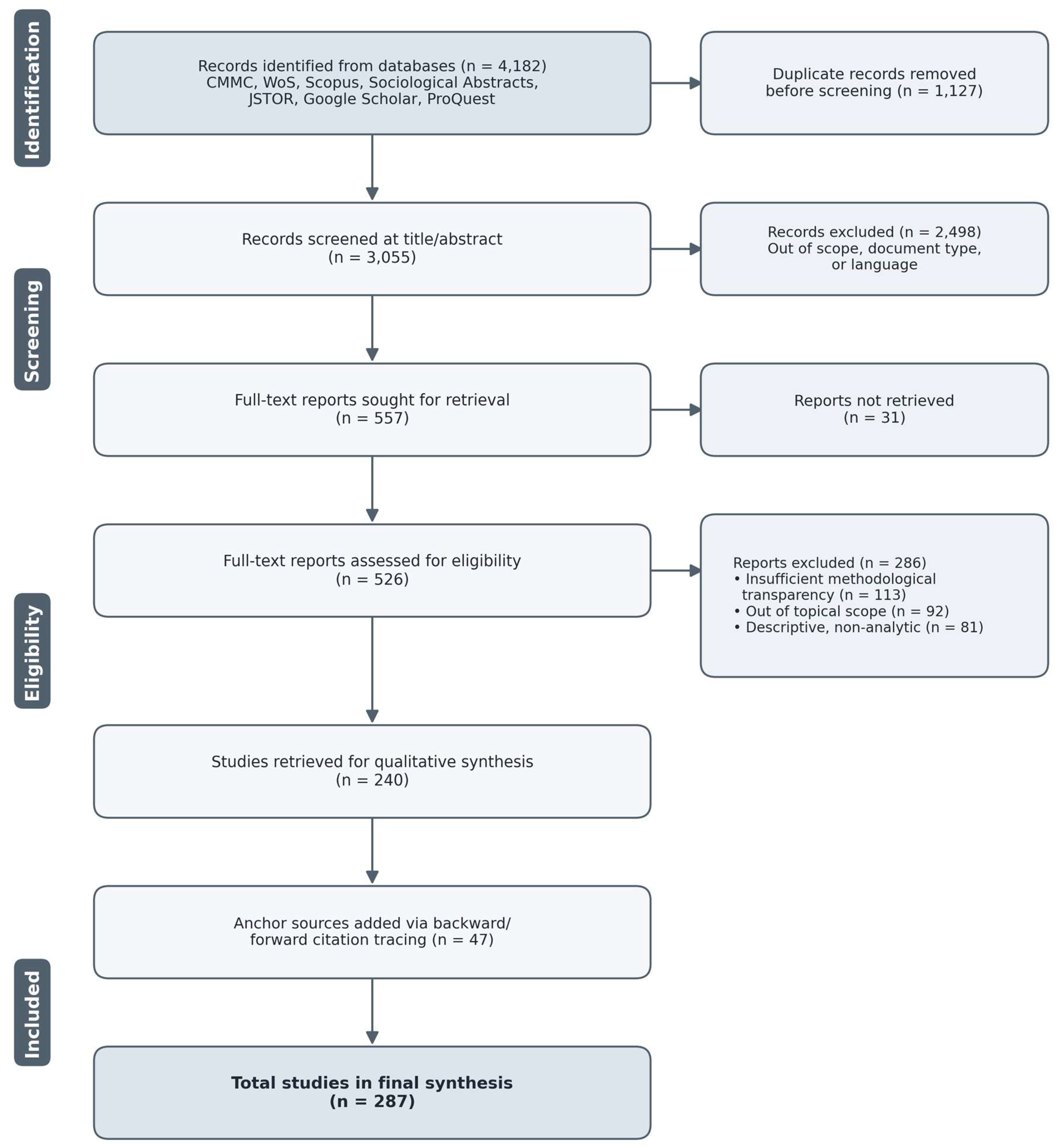
Figure 2.
Distribution of Four Cross-Cutting Analytic Tensions Across the Seven Thematic Clusters. Note. Constructed by the author from the thematic synthesis. Filled circles denote a dominant analytic tension within a cluster, half-filled circles a present but secondary tension, and open circles a marginal or absent tension. Clusters C1–C7 correspond to the seven thematic clusters defined in Section 2.
Figure 2.
Distribution of Four Cross-Cutting Analytic Tensions Across the Seven Thematic Clusters. Note. Constructed by the author from the thematic synthesis. Filled circles denote a dominant analytic tension within a cluster, half-filled circles a present but secondary tension, and open circles a marginal or absent tension. Clusters C1–C7 correspond to the seven thematic clusters defined in Section 2.
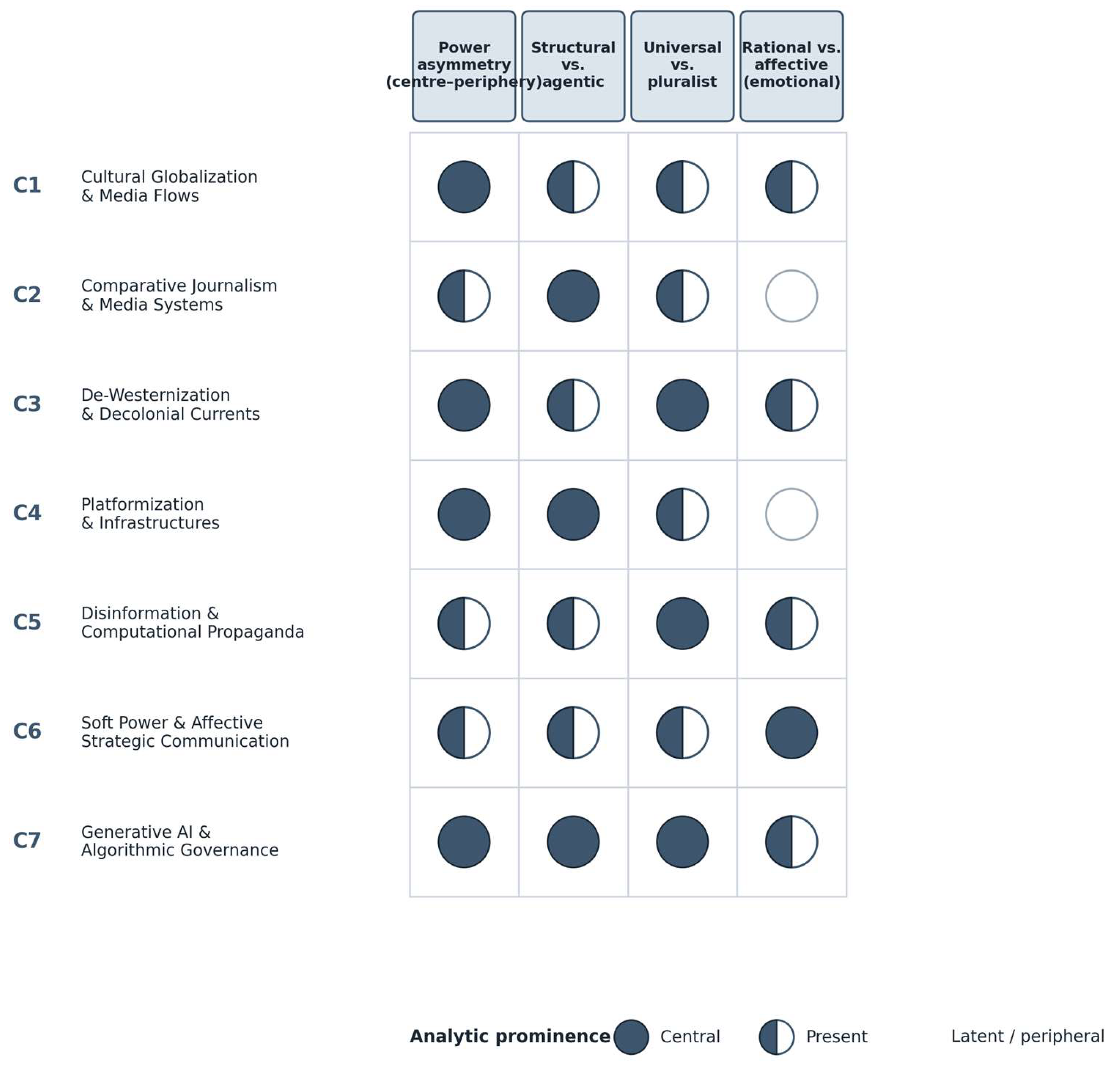
Figure 3.
The Conceptual-Layering Thesis: Sedimented Paradigms in International Communication, Pre-2000 to 2026. Note. Constructed by the author as a power-asymmetric analytic figure. Each stratum represents a paradigm era whose dominant vocabulary persists beneath, rather than being displaced by, the vocabulary that follow it. Vertical arrows denote the persistence of power-asymmetric analytic figures across all four strata.
Figure 3.
The Conceptual-Layering Thesis: Sedimented Paradigms in International Communication, Pre-2000 to 2026. Note. Constructed by the author as a power-asymmetric analytic figure. Each stratum represents a paradigm era whose dominant vocabulary persists beneath, rather than being displaced by, the vocabulary that follow it. Vertical arrows denote the persistence of power-asymmetric analytic figures across all four strata.
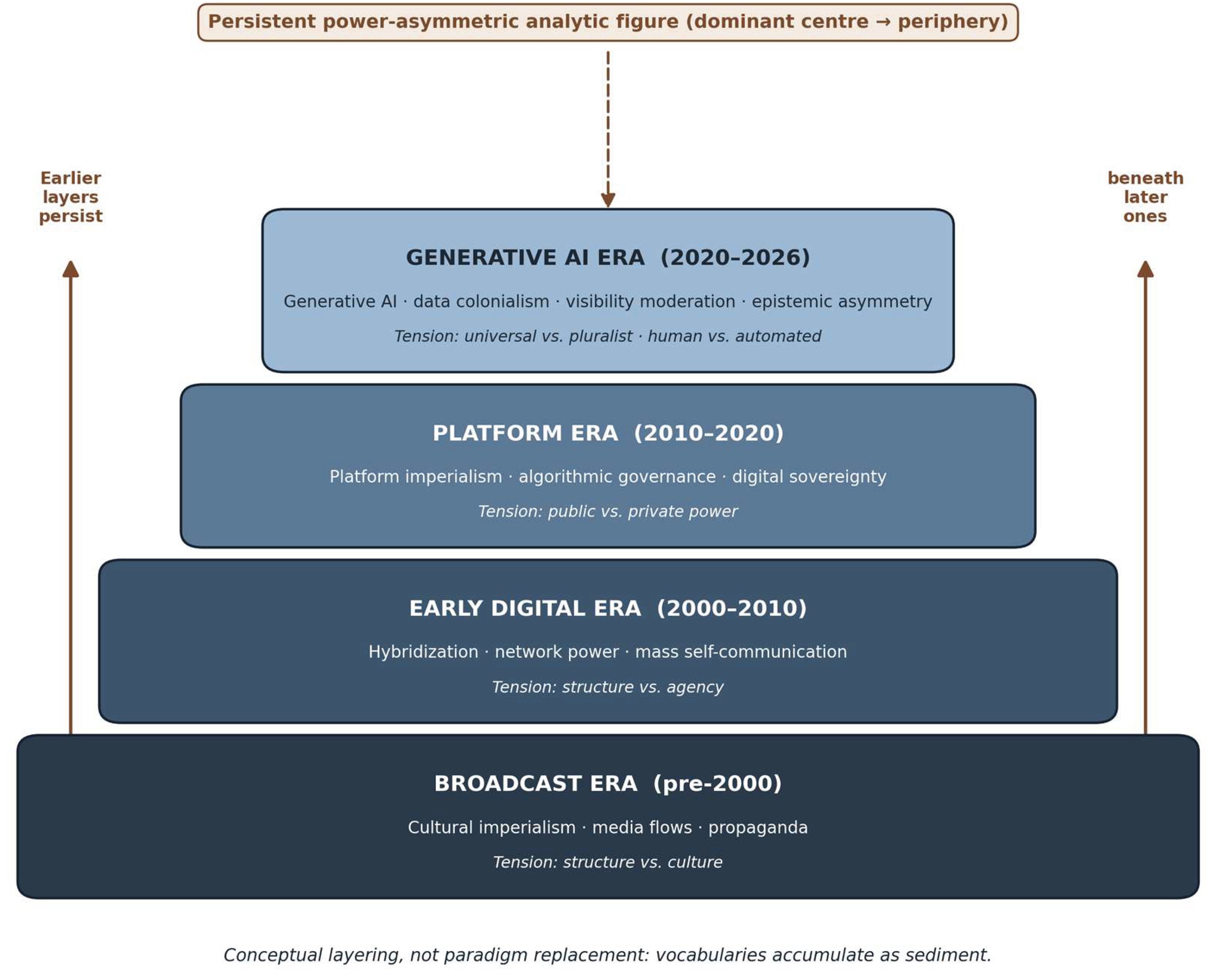
Table 3.
Inclusion and Exclusion Criteria Applied at Title, Abstract, and Full-Text Screening.
| Criterion | Inclusion | Exclusion |
|---|---|---|
| Publication date | January 1, 2000–January 31, 2026 | Publications outside this window, except foundational citations explicitly engaged by post-2000 work |
| Document type | Peer-reviewed journal articles; edited monographs from academic publishers; authoritative policy and working-paper reports from established research institutions | Conference abstracts; trade publications; non-peer-reviewed monographs; opinion pieces; blog posts |
| Language | English-language publications | Non-English publications (acknowledged limitation; see §5) |
| Topical focus | Transnational, cross-border, or comparative communication phenomena, including platform governance, disinformation, decolonial communication theory, public diplomacy, and AI in journalism | Studies focused exclusively on intra-national contexts without international implications; technical computer-science papers without communicative or governance dimensions |
| Methodological transparency | Studies reporting sufficient methodological detail to permit appraisal of evidentiary warrant | Studies whose methods are not described in sufficient detail for appraisal |
| Theoretical contribution | Studies advancing, critiquing, or empirically testing theoretical propositions relevant to international communication as a discipline | Purely descriptive accounts lacking analytic framing |
Note. Developed by the author following PRISMA 2020 (Page et al., 2021). The language restriction to English-language publications is acknowledged as a structural limitation that reproduces the bibliometric asymmetries the review’s analysis critiques; future replication studies should extend coverage to Arabic, Spanish, Portuguese, French, and Mandarin scholarly venues.
Table 4.
PRISMA 2020 Flow of Records Through the Review Process.
| Stage | Records (n) |
|---|---|
| Records identified from databases (CMMC, Web of Science, Scopus, Sociological Abstracts, JSTOR, Google Scholar, ProQuest) | 4,182 |
| Duplicate records removed before screening | 1,127 |
| Unique records screened at title/abstract | 3,055 |
| Records excluded at title/abstract (out of topical scope, document type, or language) | 2,498 |
| Full-text records sought for retrieval | 557 |
| Full-text records not retrieved | 31 |
| Full-text records assessed for eligibility | 526 |
| Full-text records excluded: insufficient methodological transparency (n = 113); out of topical scope on full-text reading (n = 92); descriptive without analytic contribution (n = 81) | 286 |
| Studies included in qualitative synthesis | 240 |
| Additional anchor sources from citation tracing | 47 |
| Total studies in final synthesis | 287 |
Note. Adapted by the author from Page et al. (2021), PRISMA 2020 Statement (BMJ, 372, n71). Total studies in final synthesis (n = 287) include 240 directly retrieved records and 47 anchor sources identified through citation tracing.
Table 5.
Analytical Classification of Twenty Representative Studies in International Communication, 2000–2026.
Table 5.
Analytical Classification of Twenty Representative Studies in International Communication, 2000–2026.
| Study | Theoretical Lineage | Method | Principal Finding/Argument | Limitation |
|---|---|---|---|---|
| Hallin & Mancini (2004) | Comparative media systems | Comparative-historical analysis | Three-systems typology (liberal, democratic corporatist, polarized pluralist) anchors cross-national variation in journalism–state–market relations | Calibrated to Western European/North American cases; travels uneasily to post-authoritarian and post-colonial contexts |
| Castells (2009) | Network society; communication power | Theoretical synthesis with case illustrations | Power is exercised through programming and switching of communication networks; mass self-communication reconfigures political contestation | Limited operationalization for empirical replication; uneven engagement with material infrastructure |
| Kraidy (2005, 2017) | Hybridization; cultural studies | Critical-cultural synthesis | Hybridity is the cultural logic of globalization, simultaneously expressing creativity and obscuring asymmetric power | Conceptual reach exceeds empirical case base; later work extends the program |
| Couldry & Mejias (2019) | Data colonialism | Critical theoretical synthesis | Platform-mediated data extraction constitutes a colonial relation appropriating human life for capital | Empirical operationalization of the colonial analogy is contested; risks flattening historical specificities |
| Demeter (2020) | Bibliometrics; political economy of knowledge | Bibliometric and structural analysis | Documents systematic underrepresentation of Global South authors in high-impact communication venues | Bibliometric data lag; analysis less developed for non-English adjacent venues |
| Bradford (2020, 2023) | Regulatory comparative analysis | Comparative legal analysis | EU regulatory capacity exerts extraterritorial effects; three regulatory empires (US, EU, China) compete to set global digital rules | Limited engagement with non-state actors; under-theorizes Global South regulatory agency |
| Parks & Starosielski (2015); Starosielski (2015) | Media infrastructure studies | Multi-method, including ethnography | Media infrastructures (cables, data centers) are constitutive sites of geopolitical contest demanding analytic foregrounding | Empirical access to infrastructural sites uneven; specialized methodological demands |
| Wardle & Derakhshan (2017) | Information disorder | Conceptual taxonomy and policy report | Establishes the misinformation–disinformation–malinformation taxonomy now adopted across the field | Definitional precision varies in subsequent operationalization; gray areas remain |
| Bennett & Livingston (2018) | Disinformation order | Conceptual political-communication analysis | Disinformation operates as an institutional order eroding democratic legitimacy, not a discrete event | Empirical specification of the order varies across national settings |
| Bradshaw & Howard (2019) | Computational propaganda | Cross-national inventory | Documents organized social media manipulation in 70+ countries | Inventory snapshots privilege visible activity; covert operations may be undercounted |
| Vaccari & Chadwick (2020); Dobber et al. (2021) | Disinformation effects; deepfakes | Experimental | Synthetic political video and microtargeted deepfakes interact with prior beliefs; effects are real but not uniform | External validity across political cultures uncertain; effect sizes context-dependent |
| Wasserman (2020); Madrid-Morales et al. (2021) | Disinformation in the Global South | Comparative survey; critical synthesis | Motivations for sharing misinformation diverge significantly across sub-Saharan African contexts, unsettling Western framings | Limited longitudinal data; sampling constraints across multiple national contexts |
| Crawford (2021); Bender et al. (2021); Mohamed et al. (2020) | Critical AI studies | Critical theoretical synthesis | AI must be understood through planetary material substrate, dataset political economy, and decolonial accountability | Empirical operationalization of decolonial AI evaluation criteria still emergent |
| Beckett & Yaseen (2023); Gondwe (2023); Guzman & Lewis (2024) | Generative AI in journalism | Survey; theoretical synthesis; mixed methods | Generative AI adoption across newsrooms is uneven; sub-Saharan African journalists engage these tools on terms not captured by Western policy debates | Rapid technological change shortens shelf life of empirical findings |
| Cazzamatta (2024); Hameleers & Garnier Ortiz (2024); Broda & Strömbäck (2024) | Cross-national disinformation (emerging) | Content analysis; seven-country survey; systematic review | Fabrication patterns vary across media systems; perceived misinformation risk differs by platform, country, and issue; supply-side studies dominate the field | Longitudinal effects evidence remains thin; methodological convergence still underway |
| Çelik (2025); Dutta & Pal (2020) | Decolonial communication theory | Critical Conceptual; programmatic synthesis | The dominant Habermasian public-sphere tradition cannot be marginally repaired through inclusion; justice-seeking alternative frameworks are being constructed from subaltern ontologies | Alternative frameworks require further empirical operationalization |
| Plantin & Punathambekar (2019) | Infrastructure studies / platform studies | Conceptual synthesis | Pipes, platforms, and politics must be analyzed together; the platform is simultaneously an infrastructural and governance object | Synthesis level invites further empirical operationalization |
| Wahl-Jorgensen (2019); Repnikova (2022) | Affective political communication; soft power | Theoretical synthesis with cases | Emotion is a central organizing register of political communication; Chinese soft power operates through affective and civilizational registers distinct from Western models | Cross-national affective comparison less developed; Chinese model under-theorized in Western scholarship |
| Flew (2021); Gorwa (2019) | Platform governance | Policy-analytic synthesis | Platform regulation is best understood as a hybrid public–private regime; platforms are private governance actors with public consequences | Treats platform actors as relatively unified; less attention to internal organizational dynamics |
| Ricaurte (2022) | Decolonial AI ethics | Critical-theoretical synthesis | AI systems enact systemic violence at scale in the majority world; meaningful decolonial change requires explicit redistribution of epistemic authority | Empirical specification of violence metrics remains contested |
Note. Compiled by the author from a thematic synthesis of the corpus reviewed. Selection balances anchor sources of established influence with newer empirical and critical work of rising significance. Study entries appear in thematic order rather than strict chronological order.
Table 6.
Persistent Research Gaps and Corresponding Future-Research Directions.
| Persistent Gap | Future-Research Direction | Representative Anchor Citations |
|---|---|---|
| G1. Structural underrepresentation of Global South perspectives in indexed scholarship | Reform indexing, editorial-board, and citation practices; institutionalize co-authorship structures that build Global South theoretical authority rather than merely empirical contribution | Demeter (2020); Mutsvairo (2018); Willems (2014) |
| G2. Limited longitudinal evidence on cross-border disinformation effects on belief, behavior, and institutional trust | Multi-year panel studies and pre-registered cross-national experimental programs; integration of trace data with sustained survey instrumentation | Freelon et al. (2020); Tenove (2020); Broda & Strömbäck (2024) |
| G3. Empirical thinness of infrastructural analysis despite established theoretical interest | Sustained ethnographic and political-economic studies of cables, data centers, content delivery networks, and platform stacks across multiple jurisdictions | Parks & Starosielski (2015); Plantin & Punathambekar (2019); Starosielski (2015) |
| G4. Under-theorization of generative AI’s role in transnational information ecosystems | Cross-cluster theoretical synthesis on how generative AI reconfigures structural–agentic, universal–pluralist, and public–private dynamics; comparative governance research on AI in journalism across diverse regulatory contexts | Beckett & Yaseen (2023); Crawford (2021); Mohamed et al. (2020); Guzman & Lewis (2024) |
| G5. Methodological imbalance favoring computational over historical, ethnographic, and qualitative approaches | Methodological pluralism; treatment of regionally specific qualitative work as theoretical contribution, not only as empirical case material | Wasserman (2020); Willems (2014); Gondwe (2023) |
| G6. Conceptual-elasticity problem: over-stretched categories (platform, sovereignty, decolonization, public sphere) deployed without explicit analytic cost reflection | Concept-mapping and definitional refinement as substantive theoretical contributions; meta-theoretical audits of disciplinary vocabulary | Couture & Toupin (2019); Çelik (2025); Pohle & Thiel (2020) |
| G7. Affective dimensions of international communication under-theorized and under-measured comparatively | Comparative designs for measuring affective publics; cross-cultural variation in emotional repertoires; integration of psychophysiological and computational methods with thick interpretive description | Wahl-Jorgensen (2019); Cazzamatta (2024); Hameleers & Garnier Ortiz (2024) |
Note. Synthesized by the author from the corpus reviewed. G1–G5 correspond to gaps identified in the original synthesis; G6 (conceptual elasticity) and G7 (affective communication) are additions made on the basis of the expanded literature review.
Table 7.
Paradigm Layers in International Communication Scholarship, 2000–2026: From Cultural Imperialism to Generative AI.
Table 7.
Paradigm Layers in International Communication Scholarship, 2000–2026: From Cultural Imperialism to Generative AI.
| Paradigm Era | Dominant Analytic Figure | Representative Vocabulary | Primary Tension | Contemporary Iteration |
|---|---|---|---|---|
| Broadcast Era (pre-2000) | Nation-state; broadcaster | Cultural imperialism; media flows; propaganda | Structure vs. culture | Persists in data-colonialism and platform-imperialism frameworks |
| Early Digital Era (2000–2010) | Network society; hybrid audience | Hybridization; network power; mass self-communication | Structure vs. agency | Reconfigured by platform governance debates |
| Platform Era (2010–2020) | Platform as infrastructure/governor | Platform imperialism; algorithmic governance; digital sovereignty | Public vs. private power | Extended by AI governance and regulatory-empire frameworks |
| Generative AI Era (2020–2026) | Automated meaning-making; global stack | Generative AI; data colonialism; visibility moderation; epistemic asymmetry | Universal vs. pluralist; human vs. automated | Emergent; under active theoretical construction |
Note. Constructed by the author from thematic synthesis. Each paradigm era represents an analytic shift in dominant vocabulary and central tension; earlier layers persist beneath later ones rather than being displaced (the conceptual-layering thesis developed in this section).
Table 8.
Operational Definitions of Contested Core Concepts in International Communication.
| Concept | Working Definition Adopted in This Review | Representative Sources | Elasticity Risk |
|---|---|---|---|
| Platform | A programmable digital infrastructure that intermediates between user groups, governs interaction through code and policy, and derives value from the data those interactions generate | Gorwa (2019); van Dijck et al. (2018) | Conflation of technical architecture, firm, and market obscures distinct objects of analysis |
| Digital sovereignty | A claim to legitimate authority over digital infrastructures, data, and information flows within a defined jurisdiction, mobilized by states, blocs, or communities | Couture & Toupin (2019); Pohle & Thiel (2020) | Same term legitimates liberal data-protection and authoritarian information-control agendas |
| Data colonialism | The appropriation of human life and behavior as raw material for capital through pervasive platform-mediated data extraction, analyzed as a colonial relation | Couldry & Mejias (2019) | Historical analogy risks flattening the specificities of territorial colonialism |
| Computational propaganda | The use of algorithms, automation, and human curation to distribute manipulative or misleading content across digital networks at scale | Bradshaw & Howard (2019) | Boundary with legitimate political communication and organic activity is often underspecified |
| Sharp power | The coercive projection of influence by authoritarian states that pierces or manipulates the information environments of target societies, distinct from attractive soft power | Walker (2018) | Normative loading risks circular attribution of intent based on regime type |
| De-Westernization | The critical project of decentering Euro-American assumptions in communication theory and method, and of building theoretical authority from other regional traditions | Curran & Park (2000); Waisbord & Mellado (2014) | Slippage between empirical inclusion and genuine theoretical reconstruction |
| Affective publics | Publics mobilized and sustained through the circulation of shared emotion, sentiment, and identification rather than through deliberative-rational exchange | Wahl-Jorgensen (2019) | Risk of treating affect as residual variable rather than constitutive of public formation |
Note. Compiled by the author to address the conceptual-elasticity problem identified in Section 4.2 (gap G6). Definitions are calibrated to the usage prevailing in the reviewed corpus and are offered as analytic stipulations rather than as exhaustive lexical definitions.
Disclaimer/Publisher’s Note: The statements, opinions and data contained in all publications are solely those of the individual author(s) and contributor(s) and not of MDPI and/or the editor(s). MDPI and/or the editor(s) disclaim responsibility for any injury to people or property resulting from any ideas, methods, instructions or products referred to in the content. |
© 2026 by the author. Licensee MDPI, Basel, Switzerland. This article is an open access article distributed under the terms and conditions of the Creative Commons Attribution (CC BY) license.
Copyright: This open access article is published under a Creative Commons CC BY 4.0 license, which permit the free download, distribution, and reuse, provided that the author and preprint are cited in any reuse.