

Submitted:
08 May 2026
Posted:
11 May 2026
You are already at the latest version
Abstract
Student safety during daily school transportation remains a major concern, particularly in systems that rely mainly on GPS tracking and manual supervision. Existing approaches often lack proactive safety mechanisms for monitoring both student attendance and driver condition in real time. This paper presents MUTMA’INN derived from the Arabic word “مطمئن”, meaning being reassured, at peace, or tranquil, reflecting the system’s role in ensuring the safety and security of students during transportation. The proposed system is an AI-powered school bus safety framework designed to improve the security and reliability of daily student transportation in alignment with Saudi Vision 2030’s Quality of Life Program. The proposed system consists of two integrated components: a cross-platform Flutter mobile application for parents, drivers, and school administrators, and a Python-based edge system connected to Firebase for real-time synchronization. The framework automates student attendance through facial recognition at the bus gate, reducing manual effort and the risk of human error. In addition, it monitors the driver using contactless remote photoplethysmography and facial analysis techniques to estimate heart rate and detect signs of fatigue or emotional distress. When abnormal conditions are detected, immediate alerts are sent to administrators to support timely intervention. By combining mobile computing, edge intelligence, computer vision, and cloud services into a unified platform, MUTMA’INN provides a proactive approach to school transportation safety. The proposed framework demonstrates how AI can support safer and more intelligent student transit systems.
Keywords:
remote photoplethysmography (rPPG)
; driver monitoring system
; computer vision
; facial recognition
; emotion detection
; smart transportation
; internet of things (IoT)
1. Introduction
The safety of students during daily transportation to and from school remains a significant concern worldwide. According to the World Health Organization, road traffic injuries are the leading cause of death among children and young people aged 5–29 years [1]. In Saudi Arabia, road safety continues to be a critical issue; recent statistics from the General Authority for Statistics report 17,231 serious traffic accidents, 4,282 fatalities, and 24,077 injuries in 2024 [2].
At the national level, student transportation is supported through formal services provided by the Ministry of Education, aiming to ensure safe and organized travel for students [3]. In addition, regulatory bodies such as the Transport General Authority emphasize compliance with safety standards in educational transport operations [4]. These efforts align with Saudi Vision 2030, which promotes safer and more efficient transportation systems as part of improving overall quality of life [5]. Despite these initiatives, many existing school transportation systems remain largely reactive, relying primarily on GPS tracking and post-event monitoring rather than proactive, real-time safety mechanisms. This limitation highlights the need for intelligent systems capable of preventing incidents before they occur.
Current school transportation systems face several critical limitations. First, student attendance is often verified manually or through basic tracking methods, making it prone to human error and increasing the risk of serious incidents, such as students being left unattended inside buses.
Second, these systems typically lack continuous and non-invasive monitoring of the driver’s physiological and emotional condition. This creates a significant safety gap, as fatigue, stress, or sudden health issues may go undetected until an accident or unsafe event occurs. Recent studies in driver monitoring systems [6] highlight the growing importance of real-time detection of driver state using computer vision and contactless sensing techniques.
Furthermore, while technologies such as facial recognition, driver monitoring, and object detection have been widely studied, they are often implemented as standalone solutions. The absence of an integrated platform that combines these capabilities limits the effectiveness of current systems in delivering proactive and comprehensive safety measures.
Research Objectives and Contributions
To address the limitations of existing school transportation systems, this paper proposes MUTMA’INN. As shown in Figure 1, the framework combines in-bus cameras, edge-based AI processing, cloud services, and mobile applications to support student protection and driver monitoring. Unlike conventional tracking systems, it enables real-time event analysis, automated attendance logging, rapid alert generation, and synchronized access to live transportation data.
The main objective of this work is to develop a unified system that can automatically record student boarding and alighting, continuously monitor the driver’s physiological and behavioral state, detect unsafe in-bus situations, and provide real-time visibility to administrators, drivers, and parents through connected mobile interfaces.
The main contributions of this work are as follows. First, it develops an edge-based driver monitoring module that processes live video from a driver-facing camera to estimate heart rate using contactless rPPG and support real-time analysis of the driver’s condition. Second, it implements a smart-gate facial recognition mechanism to automatically record student boarding and alighting, reducing reliance on manual attendance and minimizing human error. Third, it integrates computer vision-based bus safety analysis for occupancy checking and post-trip verification to detect unsafe situations, such as a student remaining inside the bus after the trip ends. Fourth, it connects edge-generated data to Firebase cloud services for real-time synchronization, centralized record management, alert delivery, and role-based access. Fifth, it designs a cross-platform Flutter mobile application that enables administrators, drivers, and parents to monitor attendance, alerts, and trip activity through role-specific interfaces. Finally, it presents a unified end-to-end architecture that combines driver monitoring, student attendance automation, bus safety verification, cloud synchronization, and mobile access into a cohesive framework for proactive school transportation safety management.
2. Related Work
School transportation safety has received increasing attention because of the need to protect students during daily trips and improve communication between schools, parents, and drivers. Existing smart school bus systems commonly use GPS, IoT devices, and mobile applications to track bus locations and notify parents about boarding, arrival, or delays [8]. These systems improve visibility and reduce communication gaps between stakeholders. However, most of them remain focused on tracking rather than proactive safety. They usually do not verify the driver’s physical condition, detect unsafe driver behavior, or confirm whether a student has been left inside the bus after the trip ends. This creates a need for systems that go beyond location monitoring and provide real-time safety intelligence.
Computer vision has also been widely used in biometric identification and intelligent transportation systems. Face recognition, supported by recent deep learning approaches such as convolutional neural networks and embedding-based models, has become a reliable method for contactless identification [7]. It is commonly applied in attendance systems and access control because it reduces manual effort and human error. In the context of school buses, face recognition can support automated student boarding and alighting records. However, bus environments introduce practical challenges such as changing lighting, motion blur, camera angle variation, and partial occlusion. Therefore, face recognition in this setting must be implemented as a lightweight and real-time pipeline suitable for edge processing at the bus gate.
Driver monitoring is another important area related to school transportation safety. Existing driver monitoring systems use computer vision techniques such as eye tracking, head-pose estimation, facial landmark analysis, and facial expression recognition to detect fatigue, distraction, or unsafe behavior. In parallel, remote photoplethysmography allows non-contact estimation of physiological signals such as heart rate from video by detecting subtle skin color changes caused by blood flow [10]. These technologies are useful for identifying early signs of fatigue, stress, or abnormal driver condition. However, both visual and physiological monitoring can be affected by real-world conditions such as motion, vibration, illumination changes, and camera noise. This is especially relevant inside moving vehicles, where the system cannot depend on controlled recording conditions.
Object detection has also become a key component in intelligent safety systems. Models such as YOLO provide real-time object detection capabilities and have been widely used in transportation applications [11]. While these models are often applied to road-scene analysis, vehicle detection, and pedestrian monitoring, their use inside school buses for post-trip safety verification remains limited. This is an important gap because one of the most critical risks in school transportation is the possibility of a child being left inside the bus after the trip ends. A post-trip object detection module can support automated inspection and reduce reliance on manual checking alone.
IoT, edge computing, and cloud-based communication provide the infrastructure needed to connect these safety functions into a practical system. Edge computing allows time-sensitive video and signal processing tasks to be performed locally, reducing latency and limiting unnecessary data transmission [12]. Cloud services, on the other hand, support centralized storage, real-time synchronization, and communication with mobile applications [13]. A hybrid edge–cloud architecture is therefore suitable for school transportation because urgent decisions can be handled locally, while processed results and alerts can be shared with parents, drivers, and administrators through a mobile platform.
Despite advances in smart transportation, driver monitoring, physiological sensing, object detection, and cloud communication, existing studies often address these functions as separate components. As summarized in Table 1, prior work typically covers selected capabilities, such as student tracking, driver vitals, drowsiness detection, or object detection, but does not provide a fully integrated school bus safety framework. This limits the ability of existing systems to deliver real-time and proactive protection.
MUTMA’INN addresses this gap through a unified edge–cloud framework that combines facial recognition for student attendance, rPPG-based heart-rate estimation, EAR-based drowsiness detection, emotion analysis, and YOLO-based post-trip occupancy scanning. Our work differs from prior work by integrating multiple AI-driven safety modules into one practical end-to-end school transportation monitoring platform.
3. Methodology
This section explains the design and implementation of the proposed system. It focuses on how the different components work together, including student attendance, driver health monitoring, and driver state analysis. The methodology combines computer vision and signal processing techniques to provide a reliable and real-time safety solution.
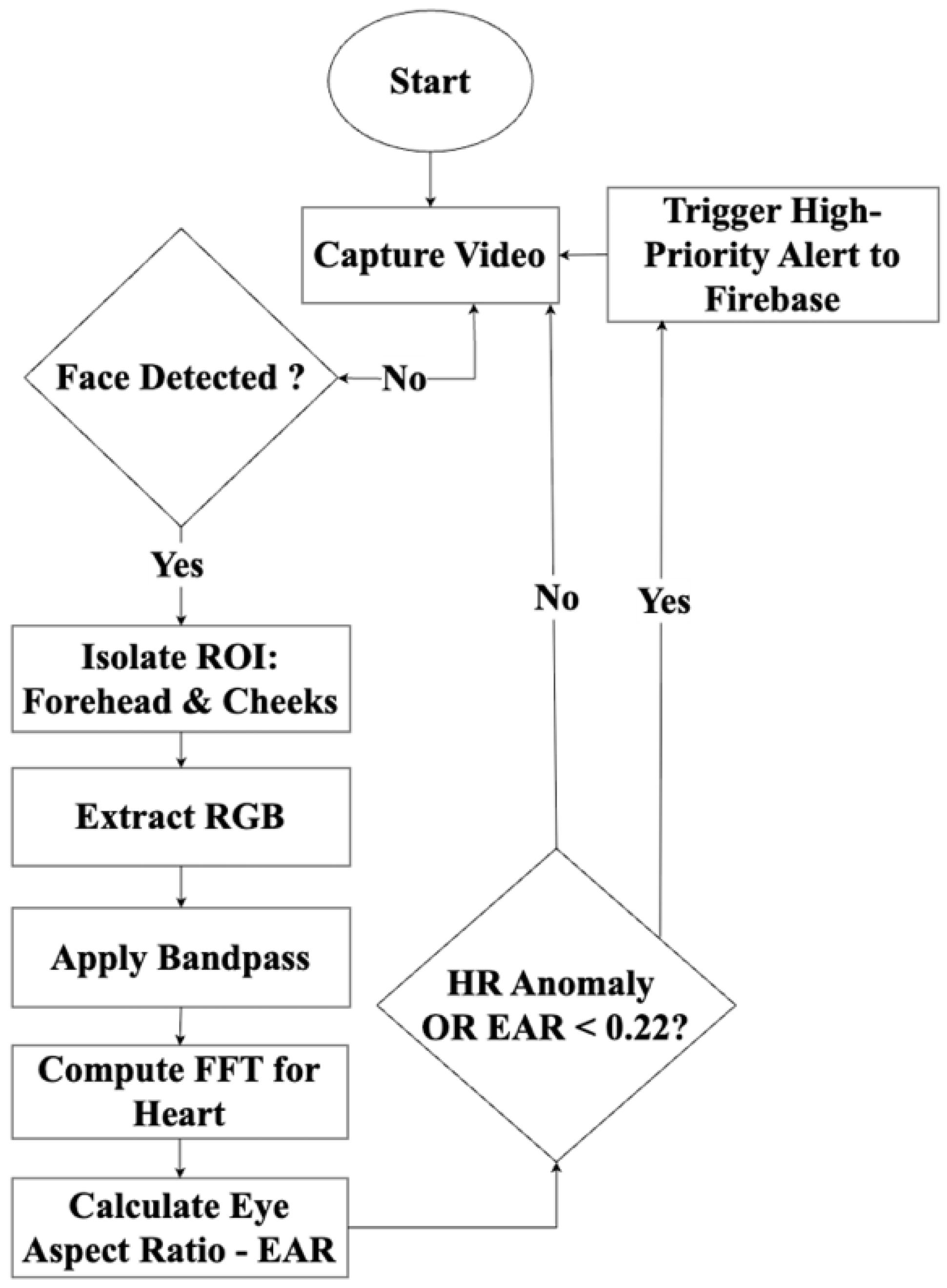
Figure 2.
Flowchart of the driver monitoring system and rPPG pipeline: The process begins with video capture, followed by face detection. When a face is detected, the region of interest (ROI) is extracted to obtain RGB signals, which are then filtered and analyzed using FFT to estimate heart rate. In parallel, they Eye Aspect Ratio (EAR) is calculated to assess drowsiness. If a heart rate anomaly or low EAR is detected, a high-priority alert is triggered and sent to Firebase.
Figure 2.
Flowchart of the driver monitoring system and rPPG pipeline: The process begins with video capture, followed by face detection. When a face is detected, the region of interest (ROI) is extracted to obtain RGB signals, which are then filtered and analyzed using FFT to estimate heart rate. In parallel, they Eye Aspect Ratio (EAR) is calculated to assess drowsiness. If a heart rate anomaly or low EAR is detected, a high-priority alert is triggered and sent to Firebase.
3.1. Student Attendance Through Facial Recognition Pipeline
This subsection describes how the system automatically records student attendance using facial recognition. The process is designed to work efficiently in real-time, even with changes in lighting or movement at the bus gate.
First, the system detects faces from the camera feed using lightweight models such as MTCNN or Haar Cascades (Zhang et al., 2016; Viola & Jones, 2001). These models are chosen because they are fast and suitable for real-time use.
Once a face is detected, it is aligned and processed before being passed to a deep learning model. This model extracts a 128-dimensional embedding that represents the unique features of the face.
To identify the student, the system compares this embedding with stored embeddings in the database using cosine similarity. If the similarity score is higher than a predefined threshold (λ > 0.85), the student is successfully recognized. The system then records the event as either boarding or alighting, depending on the situation. This approach reduces manual work and helps avoid common errors in attendance tracking.
3.2. Non-Contact Driver Vital Monitoring rPPG
The core physiological shield extracts the Blood Volume Pulse (BVP). The algorithmic steps include:
- Spatial Averaging: In each video frame t, the RGB pixel intensities of these ROIs are averaged to produce raw color signals denoted as CR(t), CG(t), CB(t).
- Pulse Rate Determination: After the filtering process is complete, fast Fourier transform (FFT) [19] is used to convert the signal from time domain to frequency domain and the Heart Rate (HR) is derived from the frequency with the maximum power spectrum (fmax):
3.3. Driver Emotion and Fatigue Detection
To detect driver drowsiness, the system monitors the ocular region using facial landmarks. Specifically, six landmarks around the eye, denoted as to , are used to compute the Eye Aspect Ratio (EAR) [20] for each video frame:
Figure 3 illustrates the EAR landmarks for open- and closed-eye states. EAR is used as a geometric indicator of eye openness. Under normal conditions, the EAR remains relatively stable when the eyes are open. As the eyes close, the vertical distances between the eyelids decrease, resulting in a lower EAR value. This property makes EAR an effective and computationally efficient measure for real-time drowsiness detection.
To improve reliability, the system combines the EAR threshold with temporal logic to distinguish prolonged eye closure from normal blinking. In the current implementation, a drowsiness alert is generated when the EAR remains below 0.22 for 10 consecutive frames (approximately 0.33 seconds). With this approach, MUTMA’INN system achieves its accident prevention system through its combined geometric and temporal analysis method which achieves precise safety alert timing through its connection to the Firebase dashboard.
4. Our System Architecture
The architecture follows a three-tier structure, consisting of the mobile application layer, the edge computing layer, and the cloud layer. Each layer plays a specific role, and together they form a unified system
4.1. Flutter Mobile Application Tier
The MUTMA’INN ecosystem adopts a decoupled three-tier architecture to ensure low-latency processing, reliable communication, and cross-platform accessibility. Its presentation layer is developed using the Flutter UI toolkit [21]. which provides near-native performance across both iOS and Android platforms. Through efficient state management, the application supports continuous synchronization of real-time data streams. As illustrated in Figure 4, administrators can access a centralized dashboard displaying live bus locations, driver vital status, and high-priority alerts, while parents can monitor their children’s boarding and alighting events in real time. Drivers interact with a simplified interface that supports trip management and route monitoring.
4.2. Python-Based In-Bus Edge System
This layer, which uses multithreading to manage two separate video feeds without frame blocking, is installed on onboard computing hardware [12]. While Thread 'B' processes the driver-facing camera for continuous rPPG and emotion analysis, Thread 'A' processes the gate-facing camera for student facial recognition. Payload sizes sent via mobile networks are significantly reduced when inferences are made at the edge.
4.3. Firebase Cloud Synchronization Services
Firebase serves as the real-time intermediary [22] The solution avoids the cost associated with conventional HTTP polling by using WebSockets and a NoSQL document structure. All connected Flutter clients immediately receive an asynchronous status update when the edge system reports a physiological abnormality and writes to the database.
5. Implementation and Results
This section presents the implementation of the proposed MUTMA’INN framework and its operational setup. It first describes the software environment used to develop the edge computing and mobile application components, then outlines the threshold-based alert mechanism and the evaluation setup adopted in simulated transit scenarios. Finally, it presents the mobile application interfaces developed to support administrators, parents, and drivers.
5.1. Software Development Environment
The edge computing pipeline was implemented using Python 3.10 to support real-time video processing within the bus environment. Computer vision techniques were applied to develop an automated student attendance system based on facial recognition, enabling a fully contactless identification process. NumPy was used to perform the required signal processing for heart rate estimation.
The mobile application was developed using Flutter SDK 3.x to provide a role-based interface for different users. Firebase Realtime Database was utilized to enable real-time communication between the edge computing system and the mobile application.
5.2. Operational Thresholds and Alert Mechanism
To prevent alert fatigue among school administrators, the system employs threshold-based logic before escalating physiological warnings to the cloud.
In the current implementation, alerts are triggered only when the driver’s heart rate falls outside the normal range for a sustained period.

Table 2.
Heart Rate Thresholds for Driver Monitoring.
| Parameters | Normal Range | Critical Threshold (Alert Trigger) | Duration Required |
| Heart Rate (HR) | 60-100 bpm | < 55 bpm OR > 110 bpm | > 10 seconds |
5.3. System Evaluation Setup
The proposed system was tested in simulated transit scenarios to examine its operation in a school transportation setting. This evaluation focused on the main functional modules of the framework, including student attendance, driver health monitoring, drowsiness detection, emotion analysis, and cloud-based communication.
The attendance module uses facial recognition to match the captured student face during boarding and alighting with the corresponding face record stored in Firebase, enabling automated attendance logging. The driver monitoring module estimates heart rate from the driver-facing camera using contactless rPPG. In the current implementation, the first heart rate reading becomes available after approximately 4–5 seconds (120 frames), which are required to fill the FFT buffer, and subsequent readings are updated every 2 seconds (60 frames). The drowsiness detection module computes the EAR ratio every 5 frames, and a drowsiness condition is flagged when the EAR remains below 0.22 for 10 consecutive frames (approximately 0.33 seconds). In parallel, the emotion analysis module is performed every 60 frames (approximately 2 seconds) to monitor the driver’s emotional state and highlight potentially negative conditions. To support system-wide communication, Firebase Realtime Database synchronizes outputs from the edge system with the mobile application, enabling continuous updates and alert delivery.
5.4. User Interface Mobile Application
The system includes a mobile application with three main user roles: administrator, parent, and driver. Each interface is designed to meet the requirements of its intended user. The administrator interface supports system monitoring and management, the parent interface provides access to student tracking and attendance information, and the driver interface assists with trip operation and execution. Figure 5 presents selected mobile application screens, including the route tracking interface, the emergency alerts section, and the main user dashboard, to illustrate how real-time transportation information is delivered to users. In addition, Figure 6 shows the driver drowsiness detection interface, where eye closure is monitored and the driver’s state is displayed in real time. Finally, Figure 7 illustrates the object detection module used after the trip ends to verify that no students remain inside the bus.
6. Conclusions and Future Work
This paper presented MUTMA’INN, an AI-driven edge–cloud framework for intelligent school transportation safety. The proposed system integrates facial recognition for automated student attendance, contactless rPPG for vital driver monitoring, and computer vision techniques for drowsiness and in-bus safety analysis within a unified architecture. By combining a Python-based edge system with a Flutter mobile application and Firebase cloud services, the framework enables real-time monitoring, alert generation, and continuous communication among administrators, drivers, and parents. Unlike conventional GPS-based systems, MUTMA’INN adopts a proactive approach by supporting real-time decision-making and early detection of potential safety risks.
Future work will focus on enhancing the robustness and reliability of the system under real-world conditions. Advanced deep learning-based rPPG models will be explored to improve signal quality and reduce the impact of motion and illumination variations in dynamic environments. In addition, further validation in real deployment scenarios and the incorporation of quantitative performance evaluation will be considered. Finally, integrating the system with national educational and transportation platforms could support large-scale analytics and contribute to the smart mobility objectives of Saudi Vision 2030.
Ethical Note. The displayed images are included with prior consent from the participant and are used for demonstration purposes only.
Acknowledgments
We extend our most sincere thanks to Saad Alhasaniah who works as a cardiologist and electrophysiologist at Johns Hopkins Aramco Healthcare for his essential medical advice about vital signs. The rPPG algorithms underwent precise development through his expertise which led to better physiological alert systems and helped our system achieve compliance with medical requirements. The special recognition of Nahier Ghaleb Aldhafeeri who works as Associate Professor and Vice Dean for Graduate Affairs at the College of Computer Science and Information Technology requires our appreciation. The project core idea and main development methods were determined through his assistance during the initial project period.
References
- W. H. Organization. Global status report on road safety 2023; World Health Organization: Geneva, 2023. [Google Scholar]
- f., G. A. Statistics, "Road Transport Statistics 2024; General Authority for Statistics: Riyadh, 2024. [Google Scholar]
- o., M. Education, "Student Transport Services," Ministry of Education. Available online: https://www.moe.gov.sa/en/knowledgecenter/eservices/pages/studentransport.aspx (accessed on 10 April 2026).
- Agency, S. P. TGA Urges Educational Transport Sector to Comply with Safety Standards," Saudi Press Agency, 2024. Available online: https://www.spa.gov.sa/en/N2153260 (accessed on 10 April 2026).
- Authority, T. G. "TGA and Vision 2030," Transport General Authority. Available online: https://www.tga.gov.sa/en/AboutTGA/TGAand2030Vision (accessed on 10 April 2026).
- Al-Quraishi, M. S. Technologies for detecting and monitoring drivers' states. Heliyon 2024, vol. 10(no. 8), e15623. [Google Scholar] [CrossRef]
- Deng, J.; Guo, J.; Xue, N.; Zafeiriou, S. ArcFace: Additive Angular Margin Loss for Deep Face Recognition. IEEE Trans. Pattern Anal. Mach. Intell. 2022, vol. 44(no. 10), 5962–5979. [Google Scholar] [CrossRef]
- Chen, L.; Ai, H.; Zhuang, Z.; Shang, C. Real-Time Multiple People Tracking with Deep Learning-Based Re-Identification. IEEE Access 2024, vol. 12. [Google Scholar]
- Alghamdi; Alotaibi, M.; Alqahtani, S. Real-Time Driver Drowsiness Detection Using Computer Vision Techniques. Sensors 2023, vol. 23(no. 5). [Google Scholar]
- Li, Z.; Wu, X.; Álvarez Casado, C.; Lindholm, V.; Mikkonen, K.; Xia, Z.; Feng, X.; Bordallo López, M. A comprehensive survey on contactless vital sign monitoring using vision-based, radio-based, and fusion approaches. Neurocomputing 2026, vol. 674, 132877. [Google Scholar] [CrossRef]
- Redmon, J.; Divvala, S.; Girshick, R.; Farhadi, A. You Only Look Once: Unified, Real-Time Object Detection. In Proceedings of the IEEE Conference on Computer Vision and Pattern Recognition (CVPR), Las Vegas, NV, USA, 2016. [Google Scholar]
- Shi, W.; Cao, J.; Zhang, Q.; Li, Y.; Xu, L. Edge Computing: Vision and Challenges. IEEE Internet Things J. 2016, vol. 3(no. 5), 637–646. [Google Scholar] [CrossRef]
- Satyanarayanan, M. The Emergence of Edge Computing. Computer 2017, vol. 50(no. 1), 30–39. [Google Scholar] [CrossRef]
- Zhang, K.; Zhang, Z.; Li, Z.; Qiao, Y. Joint Face Detection and Alignment Using Multi-task Cascaded Convolutional Neural Networks. IEEE Signal Process. Lett. 2016, vol. 23, 1499–1503. [Google Scholar] [CrossRef]
- Viola, P.; Jones, M. Rapid Object Detection Using a Boosted Cascade of Simple Features. In Proceedings of the IEEE Conference on Computer Vision and Pattern Recognition (CVPR), Kauai, HI, USA, 2001. [Google Scholar]
- de Haan, G.; Jeanne, V. Robust Pulse Rate From Chrominance-Based rPPG. IEEE Trans. Biomed. Eng. 2013, vol. 60(no. 10), 2878–2886. [Google Scholar] [CrossRef] [PubMed]
- Lewandowska, M.; Rumiński, J.; Kocejko, T.; Nowak, J. Measuring Pulse Rate with a Webcam – A Non-contact Method. Biomed. Eng. Online 2011, vol. 10(no. 10.1186/1475-925X-10-82), 82. [Google Scholar]
- Poh, M.-Z.; McDuff, D. J.; Picard, R. W. Advancements in Noncontact, Multiparameter Physiological Measurements Using a Webcam. IEEE Trans. Biomed. Eng. 2011, vol. 58(no. 1), 7–11. [Google Scholar] [CrossRef] [PubMed]
- Oppenheim, V.; Schafer, R. W. Discrete-Time Signal Processing; Pearson: Upper Saddle River, NJ, USA, 2010. [Google Scholar]
- Soukupová, T.; Čech, J. Real-Time Eye Blink Detection using Facial Landmarks. In Proceedings of the Computer Vision Winter Workshop (CVWW), Rimske Toplice, Slovenia, 2016. [Google Scholar]
- Palmieri, M.; Singh, I.; Cicchetti, A. Comparison of Cross-Platform Mobile Development Tools. In Proceedings of the IEEE International Conference on Mobile Cloud Computing, Services, and Engineering, San Francisco, CA, USA, 2012. [Google Scholar]
- DeCandia, G.; Hastorun, D.; Jampani, M.; Kakulapati, G.; Lakshman, A.; Pilchin, A.; Sivasubramanian, S.; Vosshall, P.; Vogels, W. Dynamo: Amazon’s Highly Available Key-value Store. In Proceedings of the ACM Symposium on Operating Systems Principles (SOSP), Stevenson, WA, USA, 2007. [Google Scholar]
Figure 1.
Overview of the proposed system architecture, illustrating the end-to-end workflow integrating in-bus camera modules with edge computing and cloud services. The system captures driver and student data through dedicated cameras, enabling real-time processing for face recognition (attendance), object detection (bus safety), and rPPG-based physiological monitoring of the driver. Processed data is transmitted to the cloud for storage, analysis, and synchronization with the mobile dashboard, supporting continuous monitoring, alert generation, and overall transportation safety management.
Figure 1.
Overview of the proposed system architecture, illustrating the end-to-end workflow integrating in-bus camera modules with edge computing and cloud services. The system captures driver and student data through dedicated cameras, enabling real-time processing for face recognition (attendance), object detection (bus safety), and rPPG-based physiological monitoring of the driver. Processed data is transmitted to the cloud for storage, analysis, and synchronization with the mobile dashboard, supporting continuous monitoring, alert generation, and overall transportation safety management.
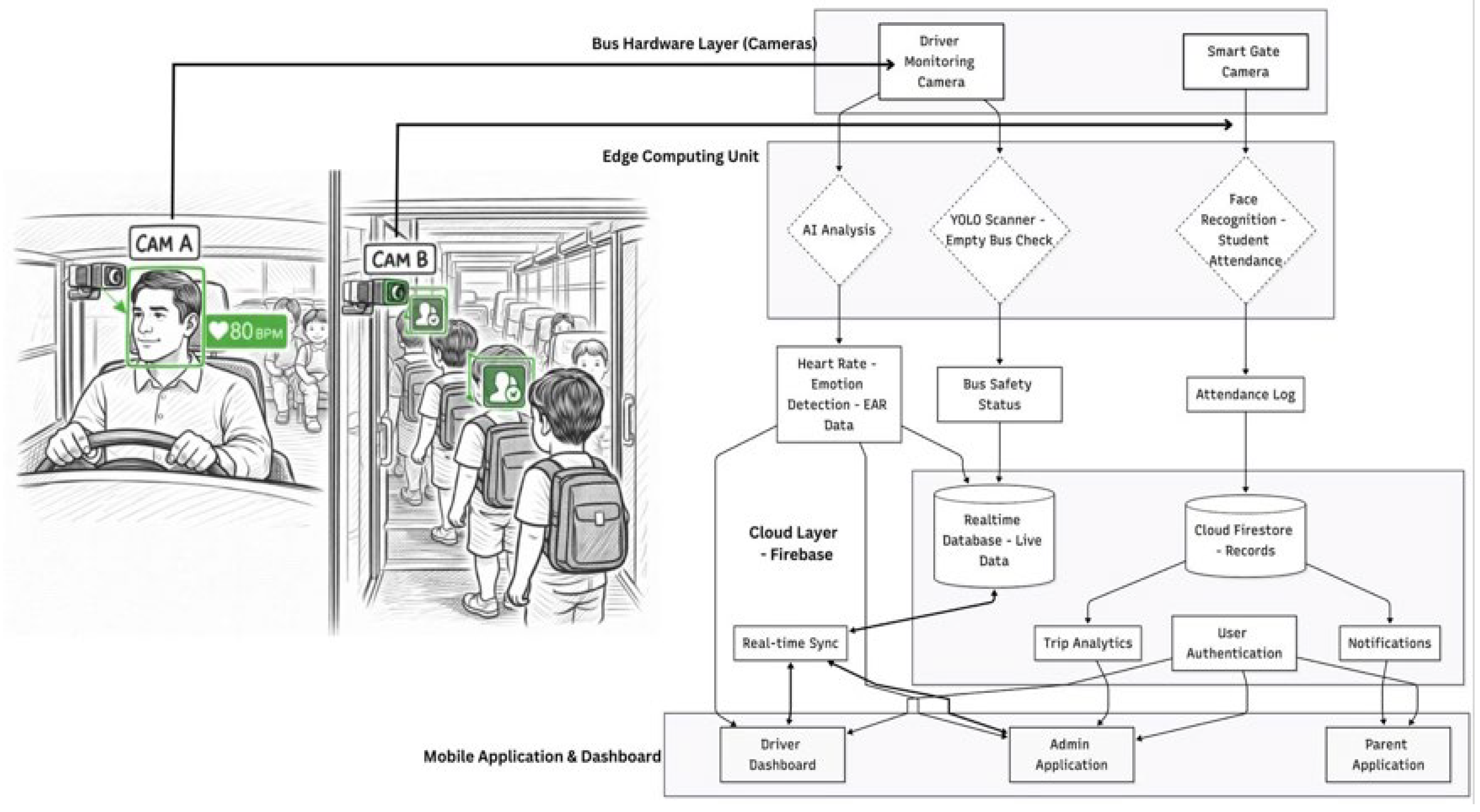
Figure 3.
Eye Aspect Ratio (EAR) landmarks showing the difference between open-eye and closed-eye states.
Figure 3.
Eye Aspect Ratio (EAR) landmarks showing the difference between open-eye and closed-eye states.
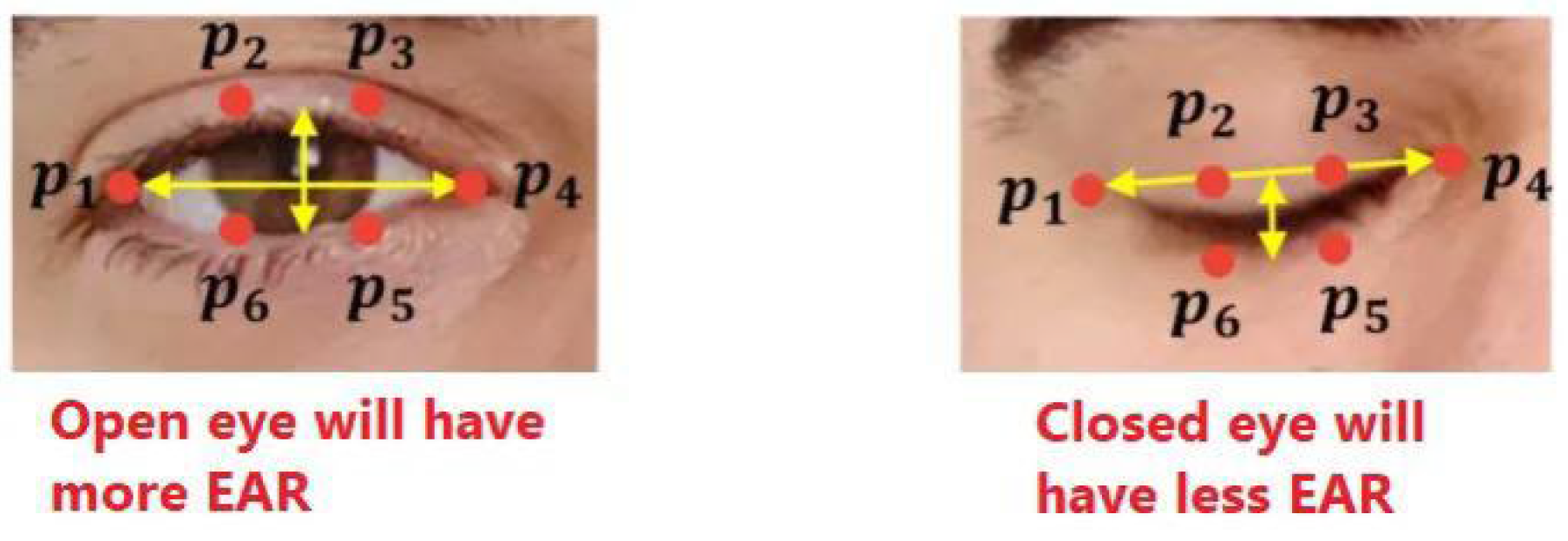
Figure 4.
Flowchart of the Proposed System Architecture of MUTMA’INN. The architecture follows a three-tier design consisting of an edge layer, a cloud layer, and a presentation layer. At the edge tier, in bus cameras (driver and gate) feed data into a Python based edge system for real time processing, including face recognition and driver monitoring. Processed data and alerts are transmitted to the Firebase Realtime Database, enabling continuous cloud synchronization. Finally, the presentation layer provides a unified Flutter based mobile application for administrators, drivers, and parents to monitor and interact with the system in real time.
Figure 4.
Flowchart of the Proposed System Architecture of MUTMA’INN. The architecture follows a three-tier design consisting of an edge layer, a cloud layer, and a presentation layer. At the edge tier, in bus cameras (driver and gate) feed data into a Python based edge system for real time processing, including face recognition and driver monitoring. Processed data and alerts are transmitted to the Firebase Realtime Database, enabling continuous cloud synchronization. Finally, the presentation layer provides a unified Flutter based mobile application for administrators, drivers, and parents to monitor and interact with the system in real time.
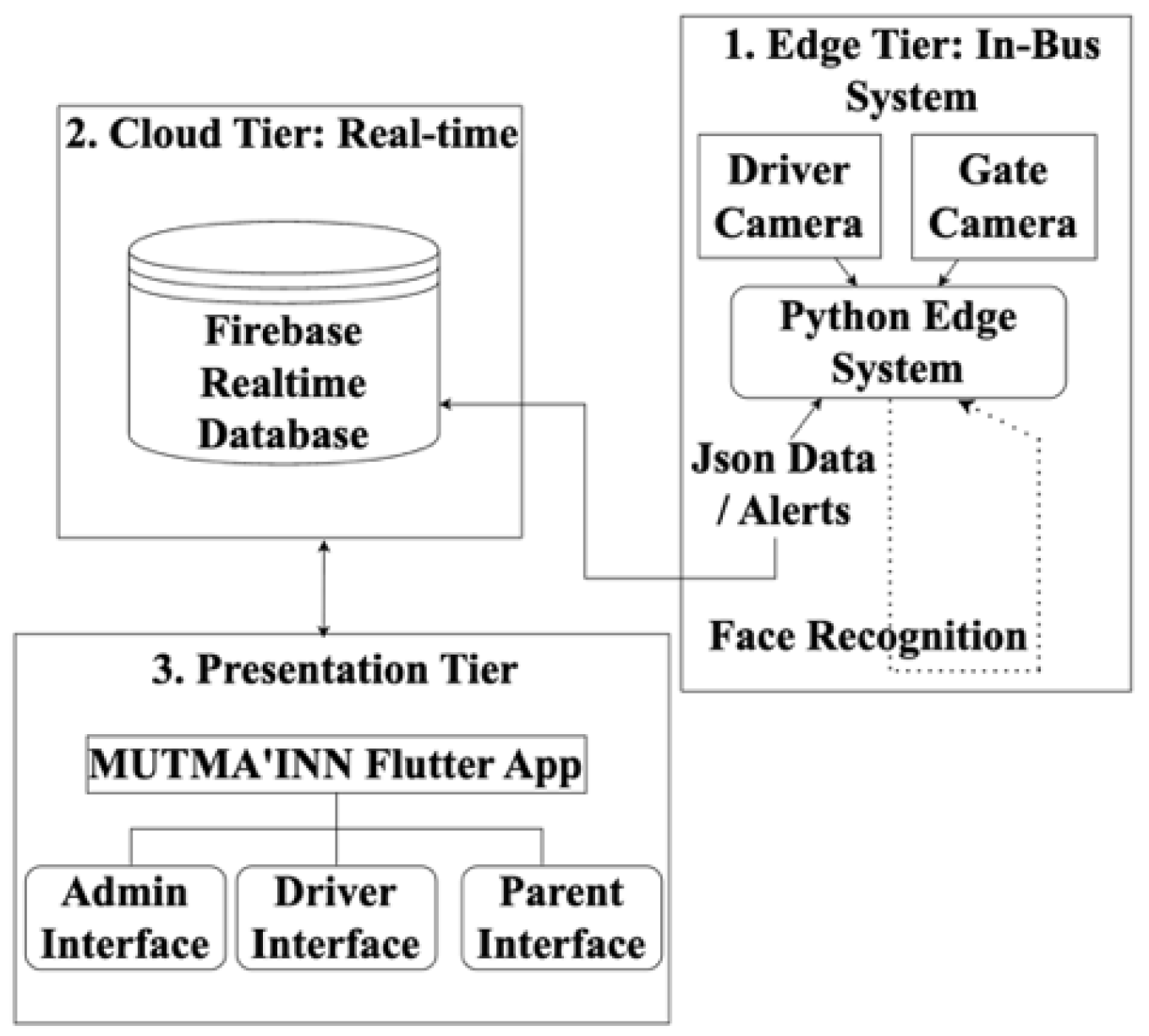
Figure 5.
Comprehensive overview of the MUTMA’INN mobile application interfaces. From left to right: (1) Route Tracking Interface, displaying real-time bus stops and student boarding status; (2) Emergency Alerts Section, highlighting critical driver health notifications (Heart Rate Monitoring) with quick-access emergency call features; (3) Main User Dashboard, providing a summarized daily trip log and student identification details.
Figure 5.
Comprehensive overview of the MUTMA’INN mobile application interfaces. From left to right: (1) Route Tracking Interface, displaying real-time bus stops and student boarding status; (2) Emergency Alerts Section, highlighting critical driver health notifications (Heart Rate Monitoring) with quick-access emergency call features; (3) Main User Dashboard, providing a summarized daily trip log and student identification details.
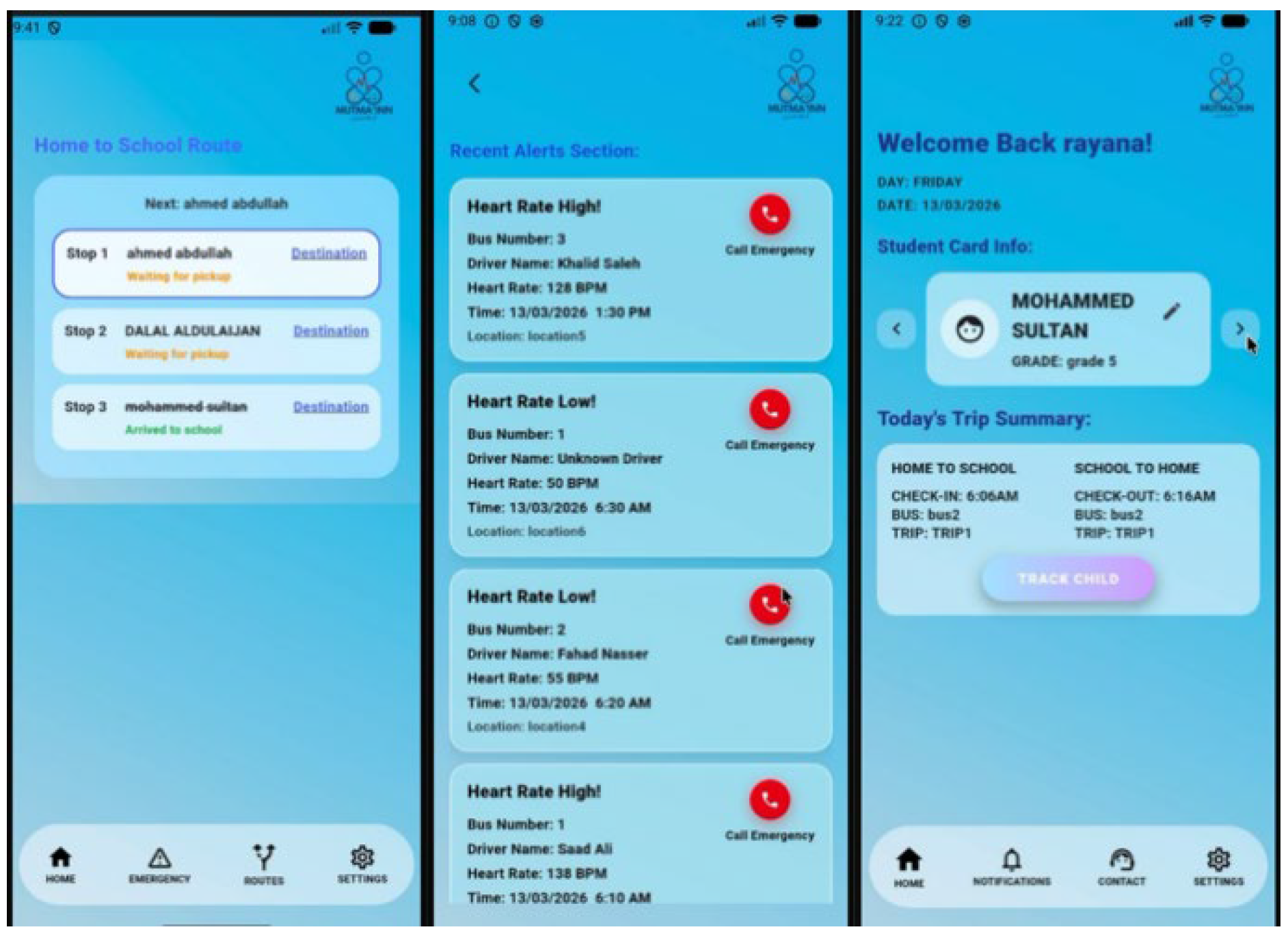
Figure 6.
The system includes a drowsiness detection feature that monitors eye closure and displays the driver’s state in real time.
Figure 6.
The system includes a drowsiness detection feature that monitors eye closure and displays the driver’s state in real time.
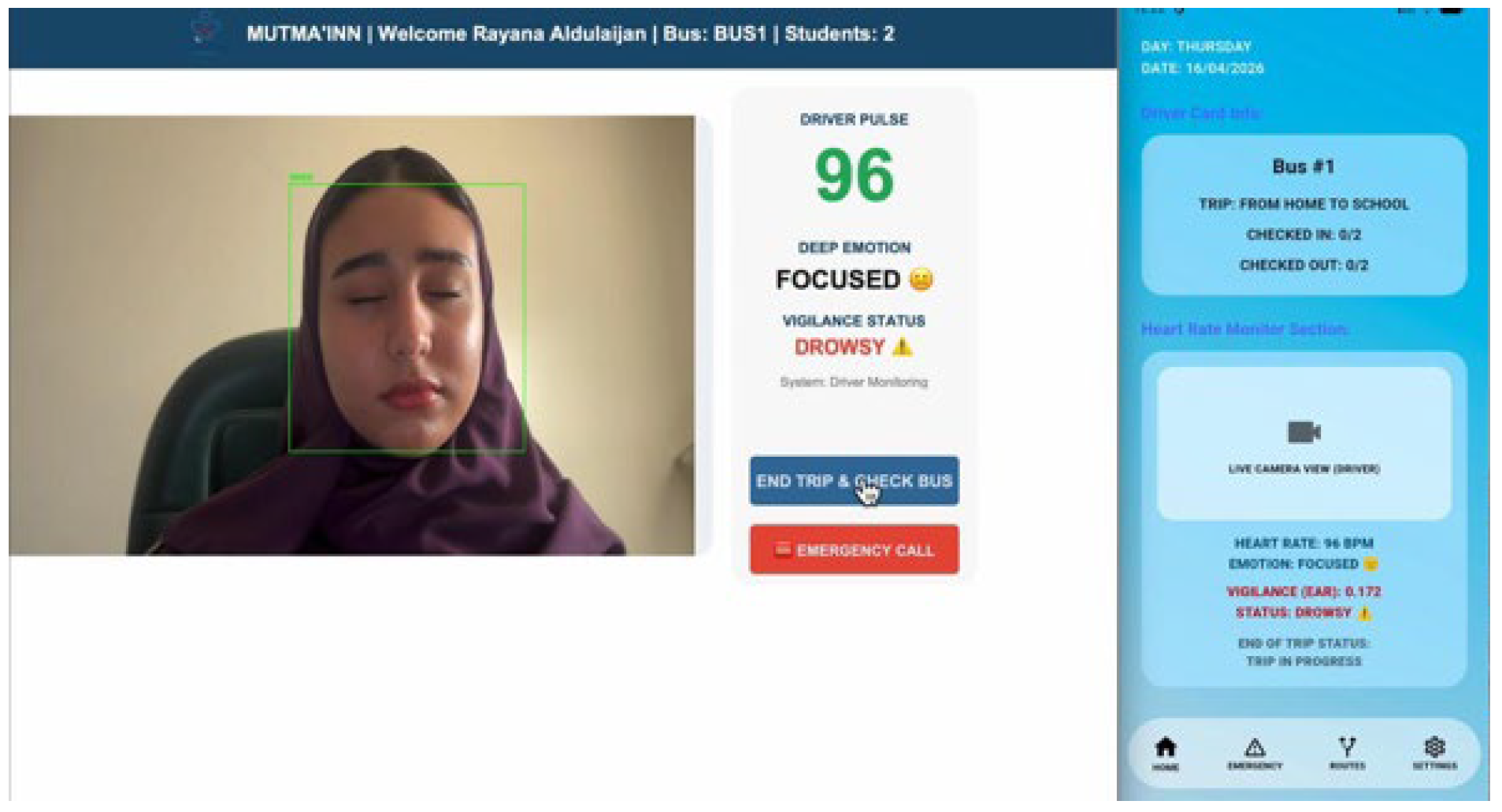
Figure 7.
Object detection performed after the driver ends the trip to verify that no students remain on the bus.
Figure 7.
Object detection performed after the driver ends the trip to verify that no students remain on the bus.
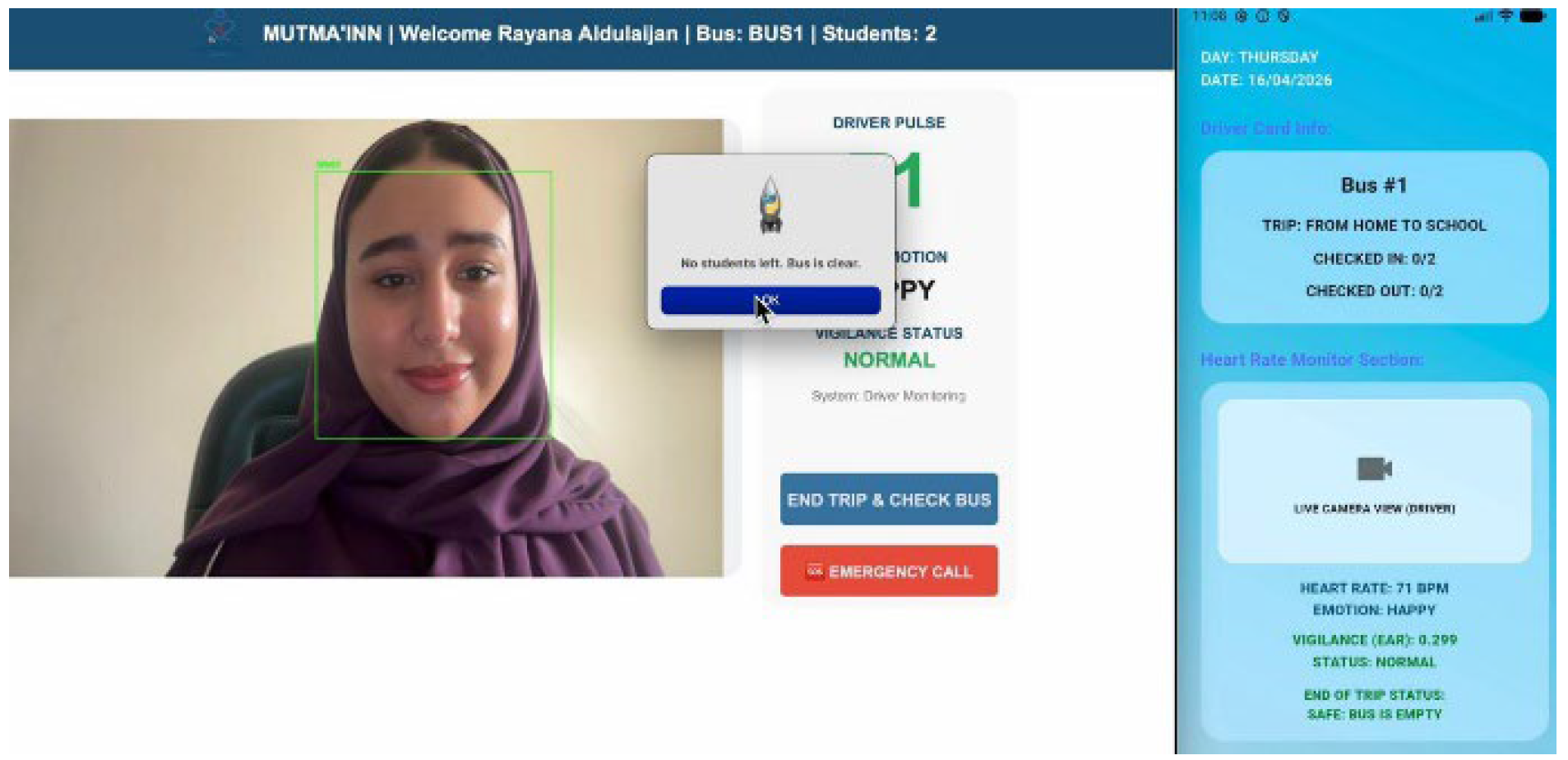
Table 1.
Research Gap Comparison Table.
| Research Reference | Student Tracking | Driver Vitals (rPPG) | Emotion Detection | Post-Trip Scan (YOLO) | Edge Computing | Integrated Platform |
| Al-Quraishi [6] | × | ✓ | × | × | × | × |
| Chen et al. [8] | ✓ | × | × | × | × | × |
| Alghamdi et al. [9] | × | × | × | × | ✓ | × |
| Li et al. [10] | × | ✓ | ✓ | × | × | × |
| Redmon et al. [11] | × | × | × | ✓ | × | × |
| Mutma'inn (Ours) | Full | Full | Full | Full | Full | Full |
Disclaimer/Publisher’s Note: The statements, opinions and data contained in all publications are solely those of the individual author(s) and contributor(s) and not of MDPI and/or the editor(s). MDPI and/or the editor(s) disclaim responsibility for any injury to people or property resulting from any ideas, methods, instructions or products referred to in the content. |
© 2026 by the authors. Licensee MDPI, Basel, Switzerland. This article is an open access article distributed under the terms and conditions of the Creative Commons Attribution (CC BY) license (http://creativecommons.org/licenses/by/4.0/).
Copyright: This open access article is published under a Creative Commons CC BY 4.0 license, which permit the free download, distribution, and reuse, provided that the author and preprint are cited in any reuse.