

Submitted:
08 May 2026
Posted:
09 May 2026
You are already at the latest version
Abstract
SRBD encompasses a spectrum of diseases that disrupt ventilation during sleep, that lead to fragmented sleep and impaired gas exchange. Their high prevalence and substantial neurocognitive and mental health outcomes make SRBD clinically significant across multiple medical disciplines. Traditional management includes lifestyle modifications and PAP. When non-surgical measures fail or anatomical factors predominate, a range of surgical approaches may be employed, such as UPPP or MMA. There are many notable emerging surgical advancements, such as hypoglossal nerve stimulation, transoral robotic surgery, and minimally invasive radiofrequency technologies that have offered improved outcomes for select patients. There are evolving advances in diagnostic tools, such as portable home sleep technologies and drug-induced sleep endoscopy, that further support precision-based care. Collectively, the expanding range of therapeutic and diagnostic innovations is enabling clinicians to deliver individualized care and improve long-term outcomes for patients with SRBD.
Keywords:
SRBD
; sleep related breathing disorders
; osa
; obstructive sleep apnea
; csa
; central sleep apnea
; bipap
; cpap
; apap
; asv
; positive airway pressure
; Uvulopalatopharyngoplasty
; uppp
; mad
; mandibular advancement device
; surgical intervention
1. Introduction
A. Overview of Sleep-Related Breathing Disorders (SRBD)
Sleep-related breathing disorders (SRBD) are a broad group of conditions that result in abnormal breathing during sleep [1]. These conditions disrupt gas exchange, leading to hypercapnea, surges in sympathetic tone, and fragmentation of the sleep cycle [2]. There are several anatomic features that can correlate with the development of SRBD, including micrognathia, excessive soft tissue around the neck, and a narrow oropharynx [3]. General symptoms often include snoring, frequent nighttime awakenings, daytime sleepiness, impaired memory, increased risk of motor collisions, and mental health issues including depression.
The primary categories of SRBD include obstructive sleep apnea (OSA), central sleep apnea (CSA), sleep-related hypoventilation disorder, and sleep-related hypoexmia disorders [4]. Obstructive hypopnea refers to a partial reduction in airflow, whereas obstructive apnea involves a complete obstruction of the upper airway or pharynx. In contrast, CSA is a result of the transient inhibition of the brainstem response rather than an anatomic obstruction. Presenting symptoms include frequent arousals through the night, loud snoring, and even episodes of desaturation [5]. Risk factors for the development of SRBD include male gender, obesity, head trauma, tonsillar hypertrophy, as well as craniofacial variations such as retrognathism, micrognathism, or macroglossia [5]. Obesity is a significant risk factor due to fat deposition in the parapharyngeal space, which can compress the upper airway.
B. Significance of SRBD in clinical practice
Sleep plays a critical role in nearly every organ system, with a significant impact on overall quality of life. The prevalence of SRBD is approximately 32.4% in the United States in adults over the age of 20, which makes this a highly prevalent disease [6]. Long-term consequences of SRBD include a range of cardiometabolic effects such as hypertension, chronic kidney disease, heart failure, and pulmonary hypertension [7]. SRBDs are closely associated with obesity, which contributes to systemic inflammation and oxidative stress from reactive oxygen species (ROS). These mechanisms promote endothelial injury through chronic macrophage activation and heightened sympathetic activity, in turn increasing the risk of atherosclerotic disease [8]. Additionally, patients diagnosed with OSA were found to have a statistically significant increase in adverse mental health outcomes. The study defined these outcomes as depressive symptoms, distress, diagnosis of a mental health disorder or anti-depressant use. Each of these outcomes was more likely to occur with increasing risk of OSA, with the strongest association observed for depressive symptoms [9]. SRBDs are highly relevant to clinical practice given the multi-system effects with reduced quality of life.
C. Purpose of this review
This review aims to provide an overview of the evolving technologies used to treat SRBD and a comprehensive review of current treatment modalities. Accordingly, this paper will predominantly focus on OSA, the most extensively studied form of SRBD, with the clearest evidence base and well defined indications for available interventions. Current therapies range from lifestyle modifications to supportive devices such as positive airway pressure (PAP) therapy, oral appliances and surgical techniques designed to address anatomic concerns to keep the airway patent. The surgical section will outline established interventions such as maxillomandibular advancement and uvulopalatopharyngoplasty and the modifications that have continued to evolve.
We aim to address the expansion of SRBD with new technologies such as implantable devices for nerve stimulation and the incorporation of virtual surgical planning with computer-aided design. Although the gold standard of diagnosis remains polysomnography, this paper will also highlight new diagnostic testing in the home setting with emerging technologies.
As the understanding of genetic, anatomic, and molecular factors related to SRBD continues to grow, this manuscript plans to address the significance and role of developing a personalized approach for each patient.
2. Current Diagnostic Tools in SRBD and New Developments
A. Current Diagnostic Tools
The gold standard for diagnosis of SRBD is polysomnography, which provides continuous monitoring throughout the sleep cycle. Key components include assessment of sleep stages using electroencephalogram (EEG) and electrooculogram (EOG), and evaluation of the cardiac function via electrocardiogram (EKG) and heart rate monitoring. Respiratory status is measured through oronasal thermistors and nasal pressure sensors, while thoracic and abdominal effort belts assess ventilatory effort [10]. Oxygen saturation is monitored with pulse oximetry.
OSA is typically classified by severity based on the apnea-hypopnea score, which reflects the mean number of apneic and hypopneic episodes per hour of sleep [11]. Apnea is defined at a complete cessation of airflow for at least 10 seconds, while hypopnea represents a partial reduction in airflow (typically ≥30%) accompanied by either oxygen desaturation or arousal from sleep [12]. The Apnea-Hypopnea Index (AHI) serves as a standardized metric for disease burden, incorporating both the frequency and physiologic impact of disordered breathing events during sleep [13]. The grade of severity ranges as follows: mild with AHI 5-15, moderate with AHI 16-30, and severe with AHI greater than 30. Primarily, this index is obtained using the polysomnography sleep testing, which remains the gold standard for both treatment and classification of severity [11].
B. Innovations in Diagnostic Tools
The current gold standard of diagnosis includes polysomnography; however, access may be limited due to high expense and time consumption, which can contribute to underdiagnosis [14]. A growing field is the at-home testing devices, which can reduce transportation issues, increase the level of comfort, and assess patients in their normal setting.
Peripheral arterial tonometry (PAT) provides an alternate home diagnostic testing via a device worn on the wrist and finger during sleep. PAT aims to measure changes in peripheral arterial volumes through a plethysmograph in combination with pulse oximetry and actigraphy. Arterial volume fluctuations are measured by changes in smooth muscle mediated through alpha receptors; these changes are correlated with oxygen desaturation [15]. Diagnostic accuracy is based on the severity of the patient’s OSA. A meta-analysis comparing PAT and polysomnography found pooled sensitivity and specificity of 96% and 44% at AHI ≥5 events/hour, 88% and 74% at AHI ≥15 events/hour, and 80% and 90% at AHI ≥30 events/hour. However, studies have also shown that significant misclassification occurs with this device [15]. When assessing the diagnostic accuracy, studies showed an overall accuracy rate of 53% when looking at all 3 categories of OSA. Current guidelines recommend confirmatory polysomnography for any patient with an abnormal PAT result. It should be noted, this method is only appropriate for patients who have a high pretest probability and do not have significant cardiopulmonary comorbidities, as this is a limitation for this method [16].
There are many theoretical plans for portable home systems with wireless sleep sensors, allowing for monitoring within the patient's home [17]. Proposed systems include a two-patch kit that is applied to the forehead and chin with soft, pliable material that conforms to the facial structures (figure 1). In real time, a patch over the forehead can record EEG and EOG, while the chin patch records electromyography (EMG) [17]. One of the more advanced features includes convolutional neural networks, which, in real time, can quantify the sleep staging as well as detect episodes of apnea. The information synthesized can be transmitted over Bluetooth to other devices. Although this is not yet on the market, the suggested system is going through trials to improve the adhesive layer and undergo large-scale testing to confirm the accuracy of results versus the gold standard polysomnography.
Emerging technologies for diagnosing SRBD aim to improve accessibility for patients by allowing them to perform the diagnostic test in their own home or indirectly assessing metrics that may be a consequence of SRBD. For the aforementioned tests, there are multiple confounding variables that may affect the accuracy of the tests.
C. Optical Coherence Tomography
Optical Coherence Tomography (OTC), can be used as an adjunct biomarker tool to assess the extent of peripheral damage from longstanding OSA. This method uses near-infrared light to create high-resolution, cross-sectional images of retinal and choroidal microstructure. OTC can detect long-term damage due to hypoxia from OSA, specifically choroidal microvascular remodeling leading to thinning of the retinal nerve fiber layer [18]. The degree of disease provides a measure of the cumulative hypoxic damage that has occurred over time [18]. This method offers a less intrusive and rapid assessment; however, other factors such as age, history of glaucoma, and history of diabetes can confound these measurements.
3. Traditional Approaches to Treatment
A. Conservative Management
Conservative management of SRBD aims to control symptoms, improve sleep quality, and reduce long-term complications. Core strategies focus on reducing upper airway obstruction and improving sleep quality, often alongside definitive therapy, such as pressure airway pressure (PAP) particularly with those with OSA.
Patients with OSA and modifiable risk factors should receive individualized behavioral recommendations. Obesity remains one of the most prominent risk factors, making weight reduction a central therapeutic target. A recent meta-analysis illustrated that a 20% reduction in body mass index (BMI) was associated with a 57% reduction in the severity of OSA, measured by the AHI [19]. Another study found that a 10% reduction in body weight correlated with a 26% decrease in AHI, underscoring the clinical impact of weight loss [20]. This improvement may be achieved by lifestyle modifications, such as increasing physical activity or diet modification. In patients with type 2 diabetes, a study reported the 10-year remission rate of OSA was 34.4% with lifestyle modifications, whereas those only receiving education and diabetic management was 22.2% [21].
Optimizing sleep habits is another core tenet of SRBD management. Severity of AHI has been associated with sleep position and is a simple and easily modifiable factor in addressing SRBD management. Patients should aim to maintain a non-supine sleep position, as the AHI can be nearly twice as high in individuals with normal BMI who sleep on their back compared to their side [22]. Although, it was noted that with increasing BMI the postural effect became more insignificant. Before sleep, patients should be advised to avoid or decrease alcohol usage. One meta-analysis showed that the prevalence of OSA in patients who consume alcohol was 25% and had longer duration of apnea and lower oxygen saturations [23].
PAP is the foundation of conservative management of SRBD. The American Academy of Sleep Medicine (AASM) recommends PAP therapy for all patients with OSA, given its efficacy in reducing AHI, improving daytime sleepiness, and enhancing quality of life [24]. PAP aims to prevent upper airway collapse during sleep by maintaining an intraluminal pressure exceeding that of the surrounding pressure, thereby preventing collapse of the upper airway during sleep. Several modalities of PAP exist, including continuous - PAP (CPAP), bilevel - PAP (BIPAP), and autotitrating-PAP (APAP). CPAP remains first-line therapy in SRBD; BIPAP may be preferred in patients with concurrent hypoventilation syndromes [19].
B. Pharmacological Interventions
Current clinical guidelines do not consistently identify effective pharmacologic therapies for SRBD, leaving a large gap in adequate patient care if they are unable to tolerate CPAP. There are studies exploring medications for off-label use in reducing the disease severity by targeting specific pathways involved in upper airway control.
Some studies involving norepinephrine reuptake inhibitors, including atomoxetine or reboxetine, with an antimuscarinic medication such as oxybutynin, have been shown to reduce the AHI. This combination aims to target hypotonia of the pharyngeal muscles by activating the muscarinic system and antagonizing noradrenergic activity. A phase II randomized controlled trial compared AD036 (fixed-dose combination of atomoxetine 80mg and oxybutynin 5mg) compared with atomoxetine 80 mg or placebo [25]. The primary endpoint involved time spent hypoxic with an SpO2 < 90%. Among patients with moderate pharyngeal collapsibility, AD036 had significant improvement in OSA severity with a reduction in AHI by greater than 50% relative to placebo or untreated controls [25].
One proposed mechanism for the development of OSA relates upper airway motor neurons with decreased serotonergic activation, leading to collapse of the upper airway. Subsequently, studies have evaluated medications targeting serotoninergic pathways. A prospective trial evaluated fluoxetine, which delivers central serotonergic stimulation, and ondansetron, which activates peripheral serotonin receptor antagonists [26]. This combination resulted in a mean reduction of AHI by 40%, but no notable improvement in daytime sleepiness [26]. The limitations of this study include a short treatment duration of 28 days and a small sample size, indicating a need for a larger-scale study.
Medications such as fluoxetine alone and protriptyline have been investigated, which are expected to decrease the duration of time spent in the rapid-eye movement (REM) cycle of sleep. These studies found a decrease in the number of apneic and hypopneic events in non-REM sleep. However, there was no consistent response and no decrease in desaturation or arousals, leaving these medications without significant improvement in sleep architecture [27]. Mirtazepine has been shown in animal models to decrease central apnea during non-REM and REM cycles, but has not been replicated in human models, and has led to weight gain, which may have contributed to worsening disease [28].
Several new ongoing clinical trials are advancing the pharmacological approach to SRBD. The AD109 (aroxybutynin and amoxetine combination pill) has gone into a phase 3 trial after showing significant reductions in AHI in the phase 2 MARIPOSA trial [29]. Tirzepatide is the first drug approved by the FDA for moderate-to-severe OSA in adults. In the SURMOUNT-OSA trial, the drug was shown to reduce AHI by 58.7% compared to baseline [30]. Given the success from this trial, more trials are occurring in similar drugs. Eloralintide, a selective amylin receptor agonist, is currently in a phase 3 study, measuring its relationship with OSA and overweight patients. Building on this, other metabolic agents are also under investigation such as the SGLT-2 inhibitor Bexagliflozin, currently in phase 4 trials [31]. Other new medications not mentioned previously which are currently under investigation include acetazolamide, trazodone, and dronabinol.
C. Mandibular Advancement Devices
Oral devices such as a mandibular advancement device (MADs) provide a viable alternative for patients unable to tolerate CPAP. These devices primarily act by advancing the mandible anteriorly, stabilizing and reducing lateral collapse in the velopharyngeal area [32]. MADs can be a first-line option for patients with mild-moderate OSA, and are considered in patients with severe OSA who decline CPAP [23]. Before device creation, patients should undergo a dental evaluation to assess mandibular-maxillary relationships and the range of motion of the mandible to create a custom device [33].
Studies have proven that oral appliances have been comparable in improving cardiovascular mortality, quality of life, and neurocognitive function when compared to traditional PAP therapy [34]. However, when comparing the effectiveness of the treatments, CPAP were found to have a decrease in AHI by 25.4 events/hr, while MADs were found to have a reduction of 9.3 events/hr [35]. Preliminary studies focused on combination therapy with CPAP have found that oral appliances used in combination with PAP therapy lower resistance of the upper airway, in turn, lowering the pressure required to keep the airway patent [36]. While CPAP remains superior in reducing AHI, MADs have been found to have a higher adherence rate. MADs, on average, had 6.5 hours of compliance nightly compared to CPAP, which was an average of 5.2 hours nightly [37]. This makes MAD a viable option for patients with mild to moderate disease who are intolerant of CPAP therapy to offer some improvement in AHI and symptomatic control. An adverse effect of MADs can be the development of temporomandibular joint (TMJ) pain; therefore, patients should be evaluated for TMJ pain before initiation of therapy and educated about the risk of developing TMJ-related symptoms.
4. Overview of Surgical Interventions for SRBD
A. Indications for Surgery
In addition to lifestyle modifications and PAP therapies, surgical intervention represents an important treatment option for selected patients with SRBD. Over time, numerous surgical approaches have been developed and refined, most of which target upper airway obstruction to prevent airway collapse. As a result, surgical management is primarily applicable to OSA, which is fundamentally an anatomic disorder. While certain surgeries may provide indirect benefit for CSA or sleep-related hypoventilation, they mainly focus on modifying underlying contributing conditions rather than correcting the fundamental physiologic defect. An overview of surgical modalities is highlighted in Table 1.
Appropriate surgical selection includes a comprehensive evaluation of disease severity, location of airway collapse, patient anatomy, and relevant comorbidities. While surgery plays a central role in the management of OSA due to its anatomic basis, other forms of SRBDs are typically managed with ventilatory support, neuromodulation, or targeted treatment of the associated systemic disease. Overall, surgical therapies are generally reserved for patients who fail conservative treatments such as PAP therapy and mandibular advancement devices. Early meta-analyses demonstrated reductions in AHI as well as improvements in symptoms such as daytime sleepiness, snoring, and overall quality of life [38].
Guidance from the 2021 AASM Clinical Practice Guideline provides recommendations regarding surgical referral for patients with OSA [38]. The guideline supports referral for patients with a BMI of greater than 40kg/m2 who are unwilling or unable to tolerate PAP due to pressure side effects. It favors referral of patients with a BMI of over 35kg/m2 for a sleep surgeon as well as a bariatric surgeon to optimize modifiable risk factors [38]. Additionally, anatomic features that suggest a high likelihood of benefit from surgical referral, such as tonsillar hypertrophy and maxillomandibular abnormalities, should prompt consideration of surgical evaluation.
Another major innovation in determining the need for operative intervention is drug-induced sleep endoscopy (DISE). This procedure can identify collapse patterns that are not seen while awake. This includes visualization of the upper airway, specifically anteroposterior and pharyngeal wall collapse, and determining if it is a complete or partial obstruction [39]. Evaluation is done through the VOTE classification system. Scoring is graded by level of obstruction at each site as: 0 (no obstruction—no vibration), 1 (partial obstruction—vibration), 2 (complete obstruction—collapse), or X (not visualized) [40]. DISE also evaluates specific patterns of collapse at each level, which are predictive of surgical outcomes. Complete circumferential collapse at the velum and complete anterior-posterior collapse at the tongue base are associated with poor surgical response, while grade 3-4 tonsillar hypertrophy and anterior-posterior partial collapse at the velum predict better outcomes following surgical intervention [41].
It is important to contextualize surgical outcomes against the well-documented challenges in CPAP adherence. Estimates suggest that 46 to 83% of patients demonstrate nonadherence to CPAP therapy, and up to 50% of patients experience side effects from their CPAP device [42]. Although surgery does not uniformly eliminate OSA, it may offer durable modifications to anatomy that reduce disease burden in patients unable to tolerate device-based therapy.
These recommendations are particularly relevant given real-world adherence challenges with PAP therapy. Large database analyses report short-term adherence of PAP therapy at 75%, with other sources estimating adherence as low as 54% [43]. These findings underscore the substantial number of patients for whom PAP therapy may be suboptimal or unsustainable. For this subset of patients, surgical intervention may represent a viable adjunct or alternative therapy for a significant subset of patients with OSA. Although patients who undergo surgery may still require PAP therapy postoperatively, surgical modification can reduce the pressure requirements needed to maintain airway patency. This, in turn, can decrease perceived adverse effects and improve patient comfort. Surgical evaluation should be integrated into a multi-modal approach to SRBD management alongside PAP therapy.
Authors should discuss the results and how they can be interpreted from the perspective of previous studies and of the working hypotheses. The findings and their implications should be discussed in the broadest context possible. Future research directions may also be highlighted.
B. Traditional Surgical Approaches
Surgical interventions for obstructive sleep apnea can be broadly classified into resective, non-resective, and skeletal (facial reconstruction) techniques. Resective procedures involve removing excess or obstructive tissue to enlarge the airway and increase airflow. Non-resective procedures focus on repositioning or stiffening airway structures to reduce collapsibility. Skeletal structures alter craniofacial anatomy to increase upper airway dimensions and address multilevel obstruction. Each category targets distinct anatomic mechanisms of airway compromise and varies substantially in invasiveness, efficacy, and durability of outcomes.
Surgical success in obstructive sleep apnea is most commonly assessed using changes in the AHI. Historically, surgical “success” has been defined as a reduction in AHI of at least 50% from baseline, often with a postoperative AHI <20 events/hour. However, Elshaug and colleagues have proposed more stringent criteria to define “cure”, recommending an objective cutoff of ≤ 5 or ≤10 events/hour [44]. Although these are stricter thresholds, they may reflect true normalization of breathing during sleep and may be appropriate to separate out those who will truly see resolution of sleep apnea-related sequelae. However, it should be noted that patients who do not meet criteria for cured disease will often have decreased pressure settings of their CPAP after surgery, potentially improving patient comfort and compliance.
Palatal and Pharyngeal Soft Tissue Procedures
Introduced in the United States in 1981, uvulopalatopharyngoplasty (UPPP) quickly became the most commonly performed surgical technique for treating soft tissue-related upper airway collapse in OSA [45,46]. UPPP enlarges the upper airway by removing and reshaping excess tissue at the back of the mouth and throat, allowing for improved airflow during sleep.
UPPP remains the most frequently performed surgical procedure for OSA, however, its success rates vary widely depending on the definition applied [47]. When strict cure criteria are applied, as described above, only 24% of patients achieve an AHI <5, and 33% had an AHI of <10 at six-month follow-up [47]. Numerous modifications of UPPP have been trialed and implemented, but the nature of surgery makes it difficult to have comprehensive, blind comparisons.
Randomized trials evaluating UPPP with tonsillectomy demonstrate more substantial improvements. In one study, patients undergoing surgery experienced a 60% reduction in AHI compared to 11% in the control group [48]. Mean AHI improved from 53.3 events/hour preoperatively to 21.1 events/hour postoperatively, representing a significant reduction, though disease severity would still fall under the moderate apnea severity range [48]. This study is also limited by its generalizability, as the patient population was younger, most had a BMI of <30kg/m2, and it excluded patients with Friedman stage III or severe comorbidity. UPPP with tonsillectomy appears to be especially promising for those with tonsillar hypertrophy, highlighting the need to individualize the surgical approach [49]. In this subgroup, mean AHI dropped from 33.7 to 15.4 events/hour, and 65% of participants no longer required additional treatment for OSA. Randomized controlled trials have strengthened the recommendation for tonsillectomy combined with UPPP, leading to higher levels of recommendation for this combined approach in appropriate patients [50].
Multilevel surgical approaches have also been evaluated in randomized settings. The SAMS Randomized Clinical Trial compared adults undergoing modified UPPP and radiofrequency tongue reduction to those receiving continued medical management [51]. At six-month follow-up, those who received palatal and tongue reduction surgery had a drop in mean AHI from 47.9 to 20.8 events/hour, as well as significant improvements in daytime sleepiness [51]. While these findings support the efficacy of multilevel airway surgery in selected patients, interpretation is limited by the inability to blind patients, lack of generalizability, and the fact that the post-operative AHI remained in the moderate apnea range.
Modifications to UPPP
Over time, UPPP has undergone numerous modifications to address limitations in outcomes and better target specific mechanisms of airway obstruction.
Patients with OSA are found to have a more collapsible lateral wall compared to that of a healthy person, making it a predominant anatomic contributor to airway narrowing in OSA [52]. In response, lateral expansion pharyngoplasty, first described by Calahi in 2003, was developed as a modification of UPPP [53]. This technique supports the lateral pharyngeal wall by repositioning the pharyngeal muscles, resulting in improved airway stability and greater sleep improvement. However, postoperative dysphagia limited its broader adoption.
These limitations prompted the development of expansion sphincter pharyngoplasty (ESP), which more effectively addresses lateral wall collapse during inspiration [54]. This technique functions by isolating and rotating the palatopharyngeus muscle, resulting in greater superior anterior tension on the lateral pharyngeal wall to improve airway stability.
Subsequent modifications include the barbed reposition pharyngoplasty (BRP), which was introduced as less invasive, more economical, and technically accessible [55]. This technique works via the use of barbed sutures to reposition and suspend the soft palate and lateral pharyngeal walls without the need for knots. Multiple studies have supported the safety and efficacy of BRP, though barbed suture extrusion remains a known complication [56,57]. Since 2020, studies evaluating the rate of extrusion in BRP procedures have found it to be relatively high, occurring in 18.4% of all BRP procedures [58]. Patients enrolled in the study received a pre-operative and post-operative polygraph to evaluate the effects of suture extrusion. The results showed that extrusion did not adversely affect patients’ perceived quality of life or the follow-up polygraphy outcomes, indicating patients’ sleep pattern was not negatively affected by extrusion [58].
Laser-assisted uvulopalatoplasty (LAUP) reduces AHI to below 10 events/hour in 50% of cases [59]. However, a large proportion of cases were found to have postoperative side effects, including dysphagia, uvular necrosis or velopharyngeal insufficiency leading to nasal regurgitation. This was introduced in the 1990s and performed in an outpatient setting, but has lost popularity due to the increased risk for post-operative complications.
Skeletal and Multilevel Airway Surgery
Maxillomandibular advancement (MMA) is a major orthognathic surgical procedure that advances both the upper (maxilla) and lower (mandible) jaws forward, thereby increasing the dimensions of the airway while reducing the probability of airway collapse [60,61]. In comparison to isolated soft tissue procedures, MMA addresses multilevel airway obstruction and has consistently demonstrated the highest success rates among surgical treatments for OSA. A 2010 meta-analysis reported a reduction in mean AHI from 63.9 events/hour to 9.5 events/hour following surgery [62]. By increasing the retropalatal and retrolingual regions, studies show a positive correlation between the degree of advancement and airway dimension. For approximately 1mm of expansion of these regions, there is a corresponding increase in airway dimensions by 0.5 mm and a reduction of AHI by 3.58 events/hour [63].
MMA demonstrates the highest success rates among contemporary surgical interventions for OSA, excluding tracheostomy, which bypasses the upper airway completely. A 2025 meta-analysis reported a considerable and consistent reduction in AHI across institutions [64,65]. A 2023 cohort study of 83 adults with OSA found that MMA was efficacious and achieved an average AHI reduction of 79.5, along with improvements in sleep architecture such as increased non-rapid eye movement (NREM) sleep [66]. Despite favorable outcomes, the overall quality of the evidence is limited as the data are based on cohort studies and given a classification of low-quality evidence based on the GRADE framework.
With MMA, a reported 86% cases achieved surgical success [67]. Cure rates are defined as AHI <5 events/hour, reported after MMA in 43-47% cases [68]. The optimal distance for advancement remains a topic of debate, though recent studies suggest a distance of around 6-10mm is effective. Individual adjustments for length are recommended for aesthetic and individual anatomy.
The mean hospitalization duration for this procedure is approximately 3.5 days [69]. Mouth opening amplitude is significantly decreased during the first two weeks, but gradually improves over three months, with most patients returning to regular functional status within 2-10 weeks [67]. Mild to moderate lateral pharyngeal wall edema occurs in most cases, peaking at 48-72 hours post-operatively. Significant facial edema is common, with mean increases of 4.53–7 mm in various facial measurements, which will also gradually subside [69]. Patients will require monitoring of airway safety with these complications in mind.
Complications of this procedure include hemorrhage, infection, hardware extrusion, and jaw stiffness. The most significant adverse effect is injury of the lower facial nerve occurring in about 83% of patients, commonly due to stretching or iatrogenic injury of the inferior alveolar nerve [64]. This most often resolves in 85-90% of patients by 6-12 months post-operative [67]. One unconventional outcome showed an effect on the perception of face aesthetics. In one study, 95% of external evaluators judged postoperative changes as positive or neutral, with mean esthetic scores improving significantly [70]. Numerous patients have had facial rejuvenation through a ‘reverse facelift’ effect due to the way the facial bones are rearranged, rather than having the skin of the face pulled back [68].
Due to its invasiveness and associated recovery, MMA is typically reserved for patients with moderate to severe OSA, craniofacial abnormalities, or persistent disease despite prior therapies [64]. This includes patients who are unable to tolerate CPAP or remain refractory after other surgical interventions.
Tongue Base and Hypopharyngeal Procedures
Several surgical techniques target tongue base collapse, a common contributor to hypopharyngeal obstruction. Mandibular osteotomy with genioglossus advancement repositions the genioglossus muscle anteriorly to prevent posterior tongue collapse during sleep, referred to as Genioglossus Advancement and Hyoid Myotomy (GAHM). It is often combined with hyoid suspension to further stabilize the hypopharyngeal airway (figure 2) [71]. Inferior sagittal mandibular myotomy and suspension represents a more comprehensive modification of this approach, involving an inferior sagittal split of the mandible with anterior repositioning and suspension of the genioglossus-hyoid complex to achieve more sustained enlargement of the hypopharyngeal airway. By addressing both tongue base position and hyoid stability, this technique aims to reduce dynamic airway collapse during inspiration. While these procedures can improve airflow and reduce AHI, outcomes are generally modest compared with MMA.
Several procedures, including nasal reconstruction, hyoid suspension, and radiofrequency ablation of upper airway structures, are generally non-curative when performed alone [59]. These adjunctive procedures may improve airway resistance or contribute to multilevel strategies, but rarely normalize AHI alone.
Definitive Surgical Intervention
Tracheostomy remains the most definitive surgical treatment for OSA, bypassing upper airway obstruction entirely [73]. However, creating a surgical opening in the neck has a profound impact on the quality of life and long-term care requirements. For this reason, it is reserved for patients with refractory and/or life-threatening obstructive sleep apnea. Tracheostomies also have utility for sleep-related hypoventilation disorders, particularly in patients with neuromuscular disease requiring lifelong ventilatory support [73].
Adjunctive Surgical Interventions
Bariatric surgery represents an indirect surgical option for SRBD, especially in patients with obesity hypoventilation syndrome and obesity-related OSA. Procedures such as sleeve gastrectomy and Roux-en-Y gastric bypass can result in significant weight loss, which is associated with improvements in OSA severity [74]. Gas exchange and oxygen exchange do improve post-operatively, though effects are not clearly seen until the patient achieves a weight reduction of more than 20% [74].
Nasal procedures, including septoplasty, turbinate reduction, and polypectomy, are not curative for OSA when performed in isolation. However, they may reduce nasal resistance, improve subjective sleep quality, and enhance tolerance to PAP therapy. Tonsillectomy and adenoidectomy remain first-line for pediatric OSA and may also benefit select adults with hypertrophic tonsils.
B. Minimally Invasive Surgeries
Pillar Implant
Pillar implants are one of the first major minimally invasive interventions used in OSA. These devices consist of polyethylene terephthalate rods inserted into the soft palate to reduce vibration and airway collapsibility [75]. The procedure involves the placement of three rods along the midline soft palate with local anesthesia (Figure 3). A meta-analysis demonstrated moderate efficacy in treating both snoring and mild-to-moderate OSA. Specifically, pillar implants were associated with a significant reduction in snoring intensity (standardized mean difference −0.591) [76]. Initial treatment response appears to be the strongest predictor of long-term outcomes. Patients who demonstrated improvement at 90 days maintained these gains at extended follow-up, whereas non-responders showed no significant change in AHI or daytime sleepiness over time [77]. However, even among initial non-responders, reductions in snoring persisted at longer-term follow-up, suggesting greater durability of subjective symptom improvement compared with objective polysomnographic measures. The major complication from this procedure is extrusion, or the protrusion of the implants from the soft palate. Pooled extrusion rate across studies was 9.3% (95% CI, 7.0–12.2%), indicating a modest but relevant clinical risk with the procedure [76].
Radiofrequency Ablation (RFA)
Radiofrequency ablation (RFA) works by using a probe to deliver energy, typically 600-700 joules per lesion, to create submucosal fibrotic tissue (Figure 4). This fibrotic tissue stiffens redundant upper airway soft tissue while sparing the overlying mucosa and adjacent structures [79]. RFA became a popular technique due to reduced recovery time, pain, and morbidity compared to normal resection. A recent meta analysis in severe OSA patients using CPAP demonstrated multilevel RFA of the tongue base, soft palate, and turbinates was associated with significant improvements in disease severity and treatment tolerance, including a reduction in AHI from 86.03 events/hour to 54.65 events/hour, decreased pressure requirements for from 17.13 cm H₂O to 10.97 cm H₂O, and increased nightly CPAP adherence (1.57 to 3.75 hours) [80].
Transoral Robotic Surgery (TORS)
Transoral robotic surgery (TORS) focuses on resecting tissue from the tongue base to decrease retrolingual obstruction that contributes to upper airway collapse during sleep. This procedure utilizes a da Vinci surgical robot to allow enhanced visualization of the airway and precision to avoid external excisions. Ideal candidates are those with a BMI <25 kg/m2 with a rather large tongue base, specifically from lingual hypertrophy instead of lymphoid hyperplasia [82]. TORS has shown improvement in functional sleep scores as well as no significant loss of swallowing function [83]. Morbidity is generally low, with most series reporting no requirement for tracheostomy. The most common major complication is postoperative hemorrhage requiring intervention, occurring in approximately 5–8% of cases [84]. Meta-analyses demonstrate significant improvements in both objective and subjective outcomes following intervention. AHI decreases by approximately 20–24 events/hour, with pooled data showing a reduction from 44.3 to 17.8 events/hour [85].
C. Combination Approaches
Single-stage minimally invasive surgery for OSA typically combines multiple procedures to improve airflow and oxygenation across several levels of obstruction. These approaches often address the nasal cavity (septoplasty, turbinate reduction), the palate (palatal implants, pharyngoplasty, UPPP), and the tongue base (RFA) [86]. By preserving the mucosa, these techniques are associated with lower postoperative morbidity compared to more invasive stand-alone procedures such as traditional UPPP [87]. The procedures are also relatively low intensity and can frequently be performed in an office-based setting rather than the operating room.
Multilevel surgical strategies are used to target both retropalatal and retrolingual obstruction in a single treatment plan. For example, UPPP may be combined with tongue base reduction techniques such as genioglossal advancement or radiofrequency ablation. Clinical trials have demonstrated that this multilevel approach can reduce AHI by approximately 20 events/hour and produce clinically meaningful improvements in daytime sleepiness in patients with moderate to severe OSA who have failed conventional medical therapy, quantified by a decrease in 3 points on Epworth Sleepiness Score decrease >3 points [51]. The SAMS trial showed that more extensive multilevel surgery had greater treatment effects than minimally invasive approaches, with serious adverse event rates similar to UPPP alone and no participants reporting significant long-term functional difficulties [51].
DISE, while originally used as a diagnostic tool to identify surgical candidates, has also had robust results when being used for surgical planning to individualize the surgical approach. Comparing surgical success rates with and without DISE demonstrates a marked improvement in surgical success rates (defined above), with 86% of patients achieving success with DISE vs 51.4% without [41]. When compared specifically in use with single-stage multilevel surgery, success rates range from 65-82%. A 2026 study evaluating expansion sphincter pharyngoplasty, anterior palatoplasty, and tongue base resection reported a 65% surgical success rate, with 45% of patients achieving an AHI <5 events/hour [88]. Another multilevel approach combining ESP, coblation tongue base reduction, and partial epiglottectomy demonstrated an 82.3% success rate, with AHI decreasing from 33.01 to 17.7 events/h and ESS improving from 11 to 7.9 (p < 0.05) [89].
5. New Technologies in the Management of SRBD
A. Emerging Surgical Techniques
Advances in diagnostic technologies have been mirrored by rapid innovation in the management of SRBDs, with a growing emphasis on precision, personalization, and minimally invasive approaches. Emerging surgical techniques and device-based therapies increasingly target specific anatomic and physiologic contributors to collapse. At the same time, technological improvements in PAP therapy and implantable devices have enhanced treatment efficacy, comfort, and adherence. These developments reflect a shift toward more tailored, patient-centered management strategies in SRBDs.
Virtual Surgical Planning
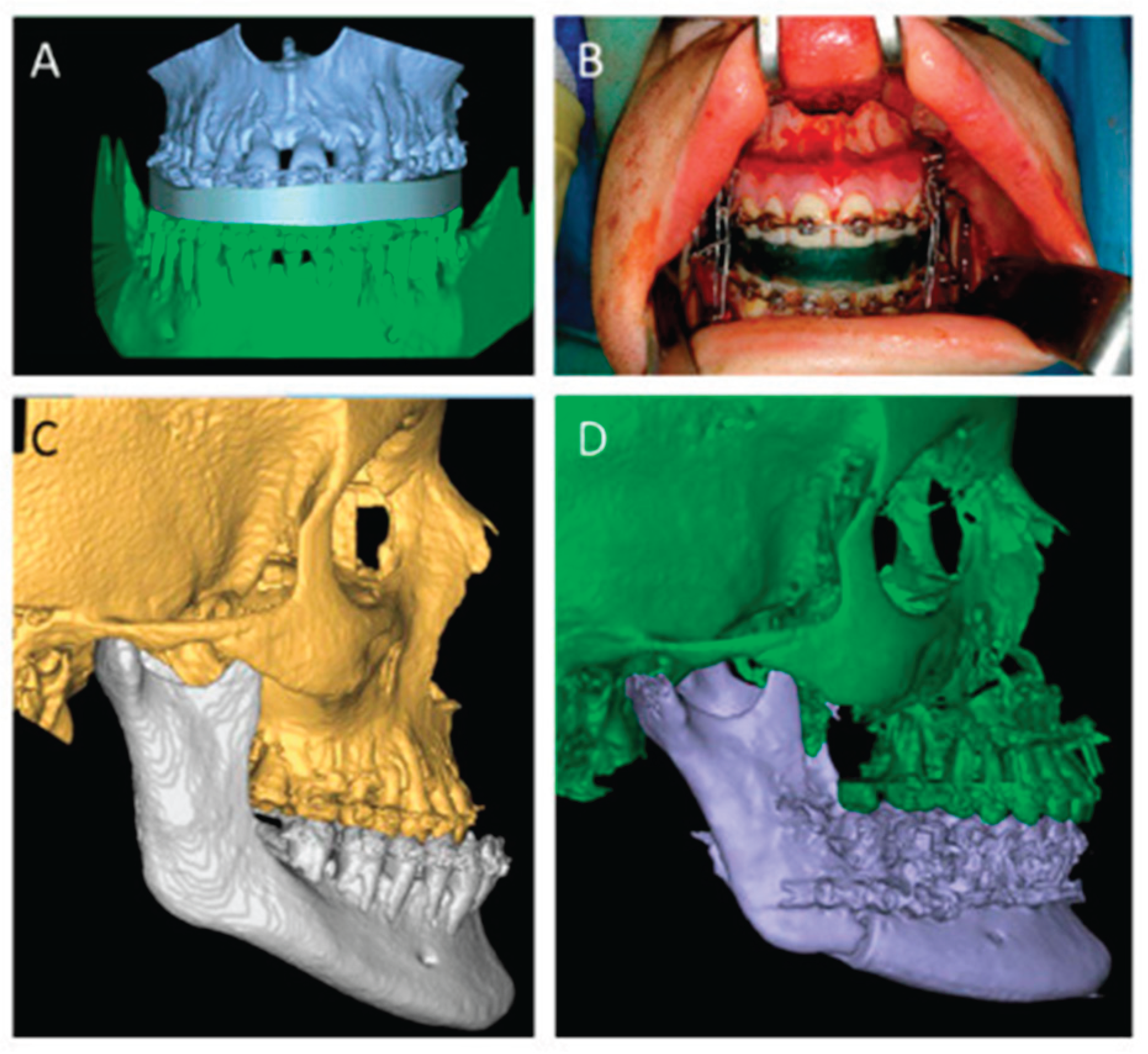
Virtual surgical planning (VSP) has been evaluated as an adjunct to maximize precision for MMA surgeries using computer-aided design (figure 5). This technology allows surgeons to create a three-dimensional model of the patient's anatomic features to pre-plan surgical interventions and minimize complications. The three dimensional (3D) models of the dental-skeletal anatomy prior to surgery, as well as allowing for proposed mechanisms for alignment during surgery.
In a small-scale study, the use of VSP reduced AHI by >50%, leading to a 100% success rate; however, this needs to be reproduced on a large scale [90]. A limitation of this method is that the design may not account for the change in facial structure while in the vertical plane.
Figure 5.
Example of VSP including 3d printed model of the maxillomandibular region. The model creates a hypothetical splint position (A) vs the intraoperative use of the splint (B). Also shown is the pre-operative (C) and post-operative (D) appearance of the model. Reproduced from: Zoabi A, et al. J. Clin. Med. 2022;11(9):2385. © Authors, distributed under CC BY 4.0. [91].
Figure 5.
Example of VSP including 3d printed model of the maxillomandibular region. The model creates a hypothetical splint position (A) vs the intraoperative use of the splint (B). Also shown is the pre-operative (C) and post-operative (D) appearance of the model. Reproduced from: Zoabi A, et al. J. Clin. Med. 2022;11(9):2385. © Authors, distributed under CC BY 4.0. [91].
Hypoglossal Nerve Stimulation
The hypoglossal nerve plays a central role in maintaining the pharynx patency by activating the genioglossus and other dilator muscles [92]. During the onset of sleep, there is a gradual decrease in the hypoglossal nerve output and, as a result, decreased muscular tone. This causes increased airway resistance and may cause the retrolingual region to narrow or completely collapse, leading to sleep apnea. To counteract this mechanism, in 2014, the USDA approved the use of implantable devices to stimulate the hypoglossal nerve. The method of action includes nerve stimulation via cuff electrode, which would, in turn, cause contraction of the genioglossus muscle either with inspiration or continuously. There was a significant decrease in the AHI of more than 75% within 6-12 months after implantation. Hypoglossal Nerve Stimulation (HNS) has emerged as a successful, FDA-approved, second-line surgical therapy for OSA patients who cannot tolerate PAP. Its high reported success rates and targeted mechanism of action which addresses retrolingual collapse. New models are being developed yearly, with a model released in 2025 that uses a battery-free implant instead of surgical implantation. Studies are being conducted on a model that places an electrode via ultrasound guidance with similar outcomes [93].
B. Technological Advancements in CPAP
Advancements in PAP technology have dramatically improved treatment accessibility, patient comfort, and adherence in the management of SRBD. Remote monitoring has also advanced the management of PAP therapy. Real-time transmission of data, including residual AHI, airflow leaks, and pressure requirements are now available to clinicians [94]. This information facilitates earlier recognition of issues with PAP therapy, promoting earlier interventions or adjustments of therapy to optimize treatment. Remote monitoring is also available through telemedicine services, improving access to specialty services while reducing the need for in-person follow-up visits.
Technological innovations in the CPAP interface have also been introduced to improve tolerance and adherence. Mask discomfort and air leak are common barriers to effective PAP use. Compared with traditional full-face masks, nasal masks and nasal pillows have been associated with improved comfort, reduced claustrophobia, and greater adherence [24]. Additionally, using lighter materials for masks, improving seal mechanisms, and customizing the mask fit have improved patient satisfaction. Heated humidification represents another important adjunct to PAP therapy, reducing mucosal dryness and upper airway irritation.
Advancement in PAP Modalities
One of the most significant developments is the APAP device, which continuously monitors airflow dynamics and automatically adjusts pressure on a breath-to-breath basis throughout the night. One major advantage of APAP devices is that it does not require a titration study to find the optimal pressure setting like earlier CPAP devices [94]. The ability to initiate PAP therapy without requiring a patient to stay overnight for in-person laboratory titration improves compliance and is more cost-effective. A 2019 systematic review found no clinically significant difference between CPAP and APAP devices, and results suggest improvement in adherence with APAP devices [24]. One caveat is that APAP is not appropriate for patients with CSA or hypoventilation syndromes.
Bilevel positive airway pressure (BiPAP) was developed to better approximate physiologic breathing patterns. In contrast to CPAP, which delivers a constant pressure throughout the respiratory cycle, BiPAP provides higher inspiratory positive airway pressure (IPAP) and lower expiratory positive airway pressure (EPAP), thereby reducing the work of breathing for patients [24]. Although CPAP remains the preferred initial therapy, studies have shown no significant differences between CPAP and BiPAP in adherence, daytime sleepiness, quality of life, or residual AHI. An important advancement in this modality is auto–bilevel positive airway pressure (Auto-BiPAP), which dynamically adjusts IPAP and EPAP in real time according to patient needs [95]. In a prospective study of patients transitioning from CPAP to Auto-BiPAP, there were significant reductions in expiratory pressure (from 12 to 8 cmH₂O), 95th percentile pressure, and mask leak. These physiologic improvements were accompanied by better Pittsburgh Sleep Quality Index scores and resolution of CPAP-related adverse effects, including xerostomia, choking sensation, and aerophagia, with 90% of patients ultimately preferring BiPAP over CPAP [96]. A comparison of PAP modalities is shown in Figure 6 and Table 2.
Further advancing noninvasive ventilation, volume-assured pressure support (VAPS) devices automatically adjust IPAP to maintain a preset target tidal volume or minute ventilation. These systems also modulate respiratory rate and auto-EPAP to address both hypoventilation and upper airway obstruction. BiPAP with a backup rate (BiPAP S/T) and VAPS are particularly beneficial in sleep-related hypoventilation disorders, such as obesity hypoventilation syndrome, restrictive lung disease, and neuromuscular conditions, where additional ventilatory support is needed to improve carbon dioxide clearance [97]. BiPAP is also a reasonable alternative for patients needing therapeutic pressures over 20 cmH2O, the maximum for CPAP devices.
Adaptive servo-ventilation (ASV) provides breath-by-breath adjustment of inspiratory pressure support. These devices will continuously measure minute ventilation or airflow to calculate a target ventilation level, after which the machine will adjust its pressure depending on readings [98]. It will increase inspiratory support during hypopnea, withdraw support during hyperventilation, and provide mandatory breaths during apnea. ASV is highly indicated in select patient populations, including patients with Cheyne–Stokes respiration and treatment-emergent (complex) CSA, where transitioning from CPAP to ASV may result in rapid improvement in residual apneas and adherence. This modality should also be considered in opioid-induced or idiopathic CSA, particularly when CPAP or bilevel PAP with a backup rate are ineffective [99].
In select patients, ASV has shown significantly more effectiveness than the other pathways, such as CPAP or BiPAP. When comparing treatment rates in complicated sleep apnea, a randomized controlled trial showed ASV achieved 89.7% success (AHI <10 events/hour) at 90 days versus 64.5% with CPAP (p=0.0214), with a mean AHI of 4.4 events/hour versus 9.9 events/hour, respectively [100].
One attractive outcome of SRBD therapy targets the downstream consequence of sleep apnea, particularly its natural course towards the possible development and progression of heart failure with reduced ejection fraction (HFrEF). However, ASV was not shown to improve or slow progression. The ADVENT-HF trial (2024) randomized 731 patients with HFrEF and severe OSA or CSA to receive ASV plus usual care versus usual care alone [101]. ADVENT-HF included a predominantly OSA population and largely nonsleepy individuals, in contrast to SERVE-HF, which primarily focused on CSA. ASV did not significantly reduce the primary composite endpoint (all-cause mortality, cardiovascular hospitalization, new-onset atrial fibrillation, or appropriate ICD shock) or the secondary endpoint of all-cause mortality. However, significant improvements were observed in sleep quality and overall quality of life. These symptomatic benefits highlight the need for future trials to clarify whether certain subgroups may still experience clinical or physiologic advantages from ASV therapy.
C. Transvenous Neurostimulation
Another device outside of PAP therapy is a transvenous neurostimulation, used specifically for CSA with concurrent heart failure, approved by the FDA in 2017. This is an implantable device that transvenously stimulates the phrenic nerve, causing contraction of the diaphragm that resembles normal breathing [102]. A randomized controlled trial showed that the group with the stimulator had a reduction in AHI >50% in 6 months, and 91% of patients had no adverse effects [102]. There were re-demonstrated improvements in oxygenation supporting the use of this new innovation.
6. Personalized Approaches in SRBD Treatment
A. Pathophysiologic and Molecular Mechanisms of SRBD
One of the main risk factors for OSA remains obesity; studies have been conducted linking genetic factors in obesity to OSA. Peroxisome proliferator-activated receptor gamma (PPAR- ɣ) has been a focus of obesity centered studies. The proposed mechanism involves activated macrophages in adipose tissue contributing to the pathogenesis of obesity and other complications, such as insulin resistance and inflammation. PPAR- ɣ helps regulate the inflammation caused by macrophages. However, in multiple lung pathologies such as adult respiratory distress syndrome, there are notable PPAR- ɣ deficiencies, suggesting that PPAR- ɣ has a role in the pulmonary system regulation. Studies on patients with OSA without underlying lung pathology have similarly demonstrated a notable decrease in alveolar macrophages’ PPAR- ɣ functional activity and expression [103]. This highlights a potential mechanism linking SRBD and metabolic dysfunction.
Leptin dysregulation provides another connection to obesity and OSA [104]. Leptin is a peptide hormone that promotes appetite control and boosts energy expenditure, and when resistance develops, it disrupts normal calorie regulation. Chronic intermittent hypoxia (CIH) is a physiologic stress marker associated with sleep disturbances from OSA. Studies found that after approximately 3.5 months of frequent CIH events, there was significantly increased circulating leptin as well as progressive leptin resistance, which is followed by weight gain, hyperglycemia, and increased oral intake. As soon as 2 weeks of CIH events led to increased leptin levels compared to patients without OSA [104]. These findings suggest that OSA may worsen existing obesity and related syndromes and contribute to the development of obesity in non-overweight patients with OSA.
Researchers obtained gene expression microarrays of patients' adipose tissue in patients with and without OSA. They isolated 25 total differentially expressed genes (DEG) related to obesity; 13 genes were upregulated, and 12 were downregulated [105]. Machine-learning models highlighted XRCC4 and ARL6 as promising biomarkers within the DEGs for distinguishing OSA from non-OSA patients. XRCC4 proposed mechanism of action included DNA damage from the chronic inflammatory state of obesity, while XRL6 was thought to intervene in the function of adipose and signaling pathways [105]. However, further studies are required to fully understand the mechanisms of these genetic markers.
Endothelial dysfunction has been evaluated as a contributor to the higher risk of atherosclerotic disease in OSA. Overall, endothelial dysfunction holds a high correlation with coronary events such as myocardial infarction or acute coronary syndrome [106]. The degree of endothelial vasomotor regulation can be assessed by measuring nitric oxide (NO), a critical vasodilator. Patients with OSA exhibited a reduced level of circulating NO compared with that of patients without OSA, suggesting that OSA can induce a chronic inflammatory state [106]. However, with adequate treatment, such as CPAP or surgical intervention, normalization of NO levels can occur [107].
Additionally, as a result of recurrent episodes of hypoxemia during the sleep cycle, it is proposed that there is ongoing vascular injury. The recovery process leads to the release of ROS, which perpetuate vascular injury and inflammation. Down cycle, this can further lead to decreased NO production and leave the patient at increased risk of other vascular conditions [108]. Levels of C40 ligand, which can be used as a surrogate marker for the presence of atherosclerotic disease, have been proven to be elevated in patients with OSA regardless of their other risk factors [109]. This perspective remains critical when caring for patients with OSA, to reinforce the need for treatment to decrease the risk of atherosclerotic disease.
Early studies are investigating the use of stem cells to protect and repair cells from inflammation, endothelial stress, and ROS, which are thought to contribute to the worsening of OSA. Available data is scarce; however, it remains a topic of interest, and stem cell research continues to evolve.
B. Personalized and Multidisciplinary Management of SRBD
With the advances in treatment of SRBD, each patient will require personalized treatment based on the severity of their disease and the possible etiology of their disease. While the gold standard for treatment remains the CPAP, providers will need to assess the need for surgical intervention for anatomical revisions or those refractory or unable to comply with CPAP machines. Advances in virtual surgical planning allow for the development of patient-specific guides, leading to precise and individualized approaches to anatomy during maxillo-mandibular advancement [90]. This results in improved patient outcomes, a significant reduction in AHI, and enhanced upper airway expansion.
Additionally, given the high relationship between SRBD and various other co-morbidities, management will need to aim to optimally address all other contributing or associated conditions as well. For example, studies found that there is an increased prevalence of OSA in patients with major depressive disorder and post-traumatic stress disorder (PTSD). Treatment of OSA was seen to have an improvement in psychiatric conditions as well, and practitioners should aim to select psychiatric medications that do not put the patient at risk for weight gain or metabolic disorders [110]. Veterans with PTSD demonstrate lower CPAP adherence, highlighting the importance of addressing underlying PTSD to improve compliance and overall quality of life. Similarly, obesity has a very high correlation with OSA; therefore, with the advance of obesity treatment comes new research targeting treatments such as GLP-1 in reducing OSA severity [111].
Given the concurrent elevated risk of cardiovascular and atherosclerotic disease, studies have been conducted to highlight the importance of the incorporation of physical activity into patients' routine in addition to CPAP therapy [112]. Researchers selected intervention mapping (IM) as a technique to help providers assess overall health risk and identify barriers to physical activity. Using this information, providers then developed strategies to meet predetermined objectives while also addressing the behavioral changes needed to achieve those goals via the IM technique.
With the exponential growth of artificial technology (AI) use in medicine, AI is expected to become an integral part of sleep medicine that will support faster diagnosis. With integration into reading patient sensor data, real-time information can be provided to adjust therapy strategy. Current reviews show 98.8% accuracy with 99.1% sensitive and 98.5% specificity for AI models being able to classify OSA and CSA [113]. As this field is further expanded, it may even lead to patients being able to screen themselves at home.
C. Patient-Centered Decision Making
Patient-centered decision making (PCDM) remains a cornerstone of delivering high-quality care, recognizing that patient preferences and treatment goals contribute to adherence and outcomes. The cornerstone of PCDM remains involving the patient in shared decision-making, offering them relevant clinical data and options for treatment plans that align with their priorities.
A focus of studies has been creating a patient-centered sleep study report (PCSR) to optimize patients' understanding of their disease and empower them to participate in decision-making [114]. The PCSR involved results from polysomnography reporting that included AHI, oxygen desaturation index, and arousal index in simple terminology; also included were simple explanations of treatment options. The implementation of this technique led to improved patient understanding, and the long-term effects on compliance remain under study.
An alternative decision aid has been developed, Decide2Rest, to guide PCDM in older adults above age 60 with OSA. The Decide2Rest similarly included general information about OSA, their treatment results, as well as explanations of different treatment options with risk-benefit analysis [115]. When compared to a control group without the intervention, those in the Decide2Rest program felt more informed about treatment options and prepared to make decisions [115].
Together, these findings support integrating PCDM and shared decision-making tools into SRBD treatment to ensure evidence-based choices that reflect patient values and improve engagement and long-term outcomes. Key features to highlight include providing the patient with information about their disease and severity, as well as varying treatment options so they can make an informed decision.
D. Barriers to Widespread Adoption of New Technologies
Despite substantial innovation in the form of technology to improve both diagnosis and treatment of SRBD, there remain multiple barriers to implementation. SRBD management continues to attract attention because of the well-documented difficulties patients face in adhering to traditional CPAP treatment. The future of SRBD hinges on the integration of home data collection and devices, as well as expanded therapeutic modalities.
Diagnosis has been developed beyond lab polysomnography and into the home, with innovation in remote testing strategies to optimize accessibility. These monitoring devices can facilitate improved patient-clinical interaction, automated data sharing from home devices, and early detection of compliance lapses, all of which lead to improvement in clinical outcomes.
Economic factors constrain the adoption of new technologies into regular practice. Even with the current standard therapy, CPAP, the cost creates a financial barrier to care for patients with poor socioeconomic status. Given that these new devices are novel and not yet standard of care, there is not yet a clear reimbursement pathway that can offload the cost onto patients. In a similar pattern, device affordability and the need for specialized diagnostic services disproportionately leave patients in underserved communities or low-resource regions unable to access this care [116]. It remains difficult for uninsured patients to be offered guideline-based therapy.
Notably, throughout the United States, there is a shortage of sleep medicine physicians who would serve as the primary means for communicating these innovations to patients and other providers [117]. Currently, there is a lack of formal training in fellowship programs for telemedicine or remote work in sleep medicine. As more advances in sleep medicine move toward home-based testing, this widens the gap between patients receiving care. Telemedicine-based sleep programs have improved access, but challenges with workflow changes, provider training, and patient onboarding show that even reliable technologies require considerable operational work before they fit seamlessly into routine practice.
Author Contributions
Conceptualization: AK, LM; Methodology: AK, LM; Software: N/A; Validation: N/A; Formal analysis: N/A; Investigation: N/A; Resources: AK, KM, JB, NL; Data curation: AK, LM, JB, NL; Writing—original draft preparation: AK, LM, JB, NL; Writing—review and editing: BY, JJ; Visualization: AK, BY; Supervision: BY, JJ; Project administration: AK, BY; Funding acquisition: N/A. All authors have read and agreed to the published version of the manuscript.
Funding
This research received no external funding.
Institutional Review Board Statement
Not applicable.
Informed Consent Statement
Not applicable.
Data Availability Statement
Not applicable.
Acknowledgments
Not applicable.
Conflicts of Interest
The authors declare no conflicts of interest.
Abbreviations
The following abbreviations are used in this manuscript:
| SRBD | Sleep-Related Breathing Disorders |
| OSA | Obstructive Sleep Apnea |
| CSA | Central Sleep Apnea |
| ROS | Reactive Oxygen Species |
| PAP | Positive Airway Pressure |
| EEG | Electroencephalogram |
| EOG | Electrooculogram |
| EKG | Electrocardiogram |
| AHI | Apnea-Hypopnea Index |
| PAT | Peripheral Arterial Tonometry |
| EMG | Electromyography |
| OTC | Optical Coherence Tomography |
| BMI | Body Mass Index |
| AASM | American Academy of Sleep Medicine |
| CPAP | Continuous Positive Airway Pressure |
| BiPAP | Bilevel Positive Airway Pressure |
| APAP | Autotitrating Positive Airway Pressure |
| REM | Rapid Eye Movement |
| MAD | Mandibular Advancement Device |
| TMJ | Temporomandibular Joint |
| DISE | Drug-Induced Sleep Endoscopy |
| UPPP | Uvulopalatopharyngoplasty |
| ESP | Expansion Sphincter Pharyngoplasty |
| BRP | Barbed Reposition Pharyngoplasty |
| LAUP | Laser-Assisted Uvulopalatoplasty |
| MMA | Maxillomandibular Advancement |
| NREM | Non-Rapid Eye Movement |
| GAHM | Genioglossus Advancement and Hyoid Myotomy |
| RFA | Radiofrequency Ablation |
| TORS | Transoral Robotic Surgery |
| VSP | Virtual Surgical Planning |
| 3D | Three-Dimensional |
| HNS | Hypoglossal Nerve Stimulation |
| IPAP | Inspiratory Positive Airway Pressure |
| EPAP | Expiratory Positive Airway Pressure |
| VAPS | Volume – Assisted Pressure Support |
| BIPAP S/T | Bilevel Positive Airway Pressure with a back up rate |
| ASV | Adaptive Servo-Ventilation |
| HFrEF | Heart Failure with Reduced Ejection Fraction |
| PPAR- ɣ | Peroxisome Proliferator-Activated Receptor Gamma |
| CIH | Chronic Intermittent Hypoxia |
| DEG | Differentially Expressed Gene |
| NO | Nitric Oxide |
| PTSD | Post-Traumatic Stress Disorder |
| AI | Artificial Intelligence |
| PCDM | Patient Centered Decision Making |
| PCSR | Patient Centered Sleep Study Report |
References
- “Management of Obstructive Sleep Apnea: An Evidence-Based, Multidisciplinary Textbook | Springer Nature Link.” Accessed: Apr. 14, 2026. [Online]. Available: https://link.springer.com/book/10.1007/978-3-030-54146-0.
- “A systematic review on sleep-related breathing disorders in athletes and para-athletes - ClinicalKey.” Accessed: Apr. 14, 2026. [Online]. Available: https://www.clinicalkey.com/#!/content/journal/1-s2.0-S138994572500557X?scrollTo=%23hl0001491.
- W. T. McNicholas, “Obstructive Sleep Apnoea: Focus on Pathophysiology,” Adv. Exp. Med. Biol., vol. 1384, pp. 31–42, 2022. [CrossRef]
- American Academy of Sleep Medicine, Ed., International classification of sleep disorders, 3. ed. Darien, Ill: American Acad. of Sleep Medicine, 2014.
- A. Ilea et al., “Oral appliance therapy in obstructive sleep apnea and snoring - systematic review and new directions of development,” Cranio J. Craniomandib. Pract., vol. 39, no. 6, pp. 472–483, Nov. 2021. [CrossRef]
- I. Sönmez, A. Vo Dupuy, K. S. Yu, J. Cronin, J. Yee, and A. Azarbarzin, “Unmasking obstructive sleep apnea: Estimated prevalence and impact in the United States,” Respir. Med., vol. 248, p. 108348, Nov. 2025. [CrossRef]
- Y. E. Li and J. Ren, “Association between obstructive sleep apnea and cardiovascular diseases,” Acta Biochim. Biophys. Sin., vol. 54, no. 7, pp. 882–892, Jul. 2022. [CrossRef]
- P. Lévy, S. Ryan, O. Oldenburg, and G. Parati, “Sleep apnoea and the heart,” Eur. Respir. Rev. Off. J. Eur. Respir. Soc., vol. 22, no. 129, pp. 333–352, Sep. 2013. [CrossRef]
- T. Kendzerska et al., “Obstructive Sleep Apnea Risk and Mental Health Conditions Among Older Canadian Adults in the Canadian Longitudinal Study on Aging,” JAMA Netw. Open, vol. 8, no. 12, p. e2549137, Dec. 2025. [CrossRef]
- J. Ngiam, R. Balasubramaniam, M. A. Darendeliler, A. T. Cheng, K. Waters, and C. E. Sullivan, “Clinical guidelines for oral appliance therapy in the treatment of snoring and obstructive sleep apnoea,” Aust. Dent. J., vol. 58, no. 4, pp. 408–419, Dec. 2013. [CrossRef]
- C. V. Senaratna et al., “Prevalence of obstructive sleep apnea in the general population: A systematic review,” Sleep Med. Rev., vol. 34, pp. 70–81, Aug. 2017. [CrossRef]
- R. B. Berry, A. R. Abreu, V. Krishnan, S. F. Quan, P. J. Strollo, and R. K. Malhotra, “A transition to the American Academy of Sleep Medicine-recommended hypopnea definition in adults: initiatives of the Hypopnea Scoring Rule Task Force,” J. Clin. Sleep Med. JCSM Off. Publ. Am. Acad. Sleep Med., vol. 18, no. 5, pp. 1419–1425, May 2022. [CrossRef]
- A. T. Thornton, P. Singh, W. R. Ruehland, and P. D. Rochford, “AASM Criteria for Scoring Respiratory Events: Interaction between Apnea Sensor and Hypopnea Definition,” Sleep, vol. 35, no. 3, pp. 425–432, Mar. 2012. [CrossRef]
- “Economic evaluation of diagnostic sleep studies for obstructive sleep apnoea: a systematic review protocol | Systematic Reviews | Springer Nature Link.” Accessed: Apr. 15, 2026. [Online]. Available: https://link.springer.com/article/10.1186/s13643-021-01651-3?utm_source=chatgpt.com.
- O. C. Ioachimescu et al., “Performance of peripheral arterial tonometry-based testing for the diagnosis of obstructive sleep apnea in a large sleep clinic cohort,” J. Clin. Sleep Med. JCSM Off. Publ. Am. Acad. Sleep Med., vol. 16, no. 10, pp. 1663–1674, Oct. 2020. [CrossRef]
- I. H. Iftikhar, C. E. Finch, A. S. Shah, C. A. Augunstein, and O. C. Ioachimescu, “A meta-analysis of diagnostic test performance of peripheral arterial tonometry studies,” J. Clin. Sleep Med. JCSM Off. Publ. Am. Acad. Sleep Med., vol. 18, no. 4, pp. 1093–1102, Apr. 2022. [CrossRef]
- S. Kwon et al., “At-home wireless sleep monitoring patches for the clinical assessment of sleep quality and sleep apnea,” Sci. Adv., vol. 9, no. 21, p. eadg9671. [CrossRef]
- M. G. İnam, O. İnam, J. M. Lin, J. Park, D. Gucer, and T. H. Tezel, “Predicting the presence and severity of obstructive sleep apnea with optical coherence tomography,” Ann. Am. Thorac. Soc., vol. 23, no. 3, pp. 438–449, Mar. 2026. [CrossRef]
- A. Malhotra, C. R. Heilmann, K. K. Banerjee, J. P. Dunn, M. C. Bunck, and J. Bednarik, “Weight reduction and the impact on apnea-hypopnea index: A systematic meta-analysis,” Sleep Med., vol. 121, pp. 26–31, Sep. 2024. [CrossRef]
- P. E. Peppard, T. Young, M. Palta, J. Dempsey, and J. Skatrud, “Longitudinal Study of Moderate Weight Change and Sleep-Disordered Breathing,” JAMA, vol. 284, no. 23, pp. 3015–3021, Dec. 2000. [CrossRef]
- “Effects of Weight Loss on Obstructive Sleep Apnea Severity. Ten-Year Results of the Sleep AHEAD Study | American Journal of Respiratory and Critical Care Medicine | Oxford Academic.” Accessed: Apr. 14, 2026. [Online]. Available: https://academic.oup.com/ajrccm/article-abstract/203/2/221/8490961?redirectedFrom=fulltext&login=false.
- O. Ozeke et al., “Influence of the right- versus left-sided sleeping position on the apnea-hypopnea index in patients with sleep apnea,” Sleep Breath. Schlaf Atm., vol. 16, no. 3, pp. 617–620, Sep. 2012. [CrossRef]
- E. Simou, J. Britton, and J. Leonardi-Bee, “Alcohol and the risk of sleep apnoea: a systematic review and meta-analysis,” Sleep Med., vol. 42, pp. 38–46, Feb. 2018. [CrossRef]
- S. P. Patil, I. A. Ayappa, S. M. Caples, R. J. Kimoff, S. R. Patel, and C. G. Harrod, “Treatment of Adult Obstructive Sleep Apnea With Positive Airway Pressure: An American Academy of Sleep Medicine Systematic Review, Meta-Analysis, and GRADE Assessment,” J. Clin. Sleep Med., vol. 15, no. 2, pp. 301–334, Feb. 2019. [CrossRef]
- P. K. Schweitzer, J. P. Maynard, P. E. Wylie, H. A. Emsellem, and S. A. Sands, “Efficacy of atomoxetine plus oxybutynin in the treatment of obstructive sleep apnea with moderate pharyngeal collapsibility,” Sleep Breath., vol. 27, no. 2, pp. 495–503, May 2023. [CrossRef]
- B. Prasad, M. Radulovacki, C. Olopade, J. J. Herdegen, T. Logan, and D. W. Carley, “Prospective Trial of Efficacy and Safety of Ondansetron and Fluoxetine in Patients with Obstructive Sleep Apnea Syndrome,” Sleep, vol. 33, no. 7, pp. 982–989, Jul. 2010. [CrossRef]
- D. A. Hanzel, N. G. Proia, and D. W. Hudgel, “Response of obstructive sleep apnea to fluoxetine and protriptyline,” Chest, vol. 100, no. 2, pp. 416–421, Aug. 1991. [CrossRef]
- N. S. Marshall et al., “Two Randomized Placebo-Controlled Trials to Evaluate the Efficacy and Tolerability of Mirtazapine for the Treatment of Obstructive Sleep Apnea,” Sleep, vol. 31, no. 6, pp. 824–831, Jun. 2008. [CrossRef]
- P. K. Schweitzer et al., “The Combination of Aroxybutynin and Atomoxetine in the Treatment of Obstructive Sleep Apnea (MARIPOSA): A Randomized Controlled Trial,” Am. J. Respir. Crit. Care Med., vol. 208, no. 12, pp. 1316–1327, Dec. 2023. [CrossRef]
- A. Malhotra et al., “Tirzepatide for the Treatment of Obstructive Sleep Apnea and Obesity,” N. Engl. J. Med., vol. 391, no. 13, pp. 1193–1205, Oct. 2024. [CrossRef]
- D. Movila, D. D. Seiman, and S. R. Dragan, “Next-Generation SGLT2 Inhibitors: Innovations and Clinical Perspectives,” Biomedicines, vol. 14, no. 1, p. 81, Dec. 2025. [CrossRef]
- A. S. L. Chan et al., “The effect of mandibular advancement on upper airway structure in obstructive sleep apnoea,” Thorax, vol. 65, no. 8, pp. 726–732, Aug. 2010. [CrossRef]
- M. Levine, M. K. Cantwell, K. Postol, and D. B. Schwartz, “Dental Sleep Medicine Standards for Screening, Treatment, and Management of Sleep-Related Breathing Disorders in Adults Using Oral Appliance Therapy: An Update,” J. Dent. Sleep Med., vol. 9, no. 4, Oct. 2022. [CrossRef]
- C. L. Phillips et al., “Health outcomes of continuous positive airway pressure versus oral appliance treatment for obstructive sleep apnea: a randomized controlled trial,” Am. J. Respir. Crit. Care Med., vol. 187, no. 8, pp. 879–887, Apr. 2013. [CrossRef]
- L. D. Sharples et al., “Meta-analysis of randomised controlled trials of oral mandibular advancement devices and continuous positive airway pressure for obstructive sleep apnoea-hypopnoea,” Sleep Med. Rev., vol. 27, pp. 108–124, Jun. 2016. [CrossRef]
- Y. Tanaka, J. M. Adame, A. Kaplan, and F. R. Almeida, “The Simultaneous Use of Positive Airway Pressure and Oral Appliance Therapy With and Without Connector: A Preliminary Study,” J. Dent. Sleep Med., vol. 9, no. 1, Jan. 2022. [CrossRef]
- S. Basyuni, M. Barabas, and T. Quinnell, “An update on mandibular advancement devices for the treatment of obstructive sleep apnoea hypopnoea syndrome,” J. Thorac. Dis., vol. 10, no. Suppl 1, Jan. 2018. [CrossRef]
- D. J. Bratton, T. Gaisl, A. M. Wons, and M. Kohler, “CPAP vs Mandibular Advancement Devices and Blood Pressure in Patients With Obstructive Sleep Apnea: A Systematic Review and Meta-analysis,” JAMA, vol. 314, no. 21, pp. 2280–2293, Dec. 2015. [CrossRef]
- A. De Vito et al., “The importance of drug-induced sedation endoscopy (D.I.S.E.) techniques in surgical decision making: conventional versus target controlled infusion techniques-a prospective randomized controlled study and a retrospective surgical outcomes analysis,” Eur. Arch. Oto-Rhino-Laryngol. Off. J. Eur. Fed. Oto-Rhino-Laryngol. Soc. EUFOS Affil. Ger. Soc. Oto-Rhino-Laryngol. - Head Neck Surg., vol. 274, no. 5, pp. 2307–2317, May 2017. [CrossRef]
- D. Park, J. S. Kim, and S. J. Heo, “Obstruction Patterns During Drug-Induced Sleep Endoscopy vs Natural Sleep Endoscopy in Patients With Obstructive Sleep Apnea,” JAMA Otolaryngol.-- Head Neck Surg., vol. 145, no. 8, pp. 730–734, Aug. 2019. [CrossRef]
- Y. Wang, C. Sun, X. Cui, Y. Guo, Q. Wang, and H. Liang, “The role of drug-induced sleep endoscopy: predicting and guiding upper airway surgery for adult OSA patients,” Sleep Breath. Schlaf Atm., vol. 22, no. 4, pp. 925–931, Dec. 2018. [CrossRef]
- T. E. Weaver and R. R. Grunstein, “Adherence to continuous positive airway pressure therapy: the challenge to effective treatment,” Proc. Am. Thorac. Soc., vol. 5, no. 2, pp. 173–178, Feb. 2008. [CrossRef]
- P. A. Cistulli et al., “Short-term CPAP adherence in obstructive sleep apnea: a big data analysis using real world data,” Sleep Med., vol. 59, pp. 114–116, Jul. 2019. [CrossRef]
- A. G. Elshaug, J. R. Moss, A. M. Southcott, and J. E. Hiller, “Redefining success in airway surgery for obstructive sleep apnea: a meta analysis and synthesis of the evidence,” Sleep, vol. 30, no. 4, pp. 461–467, Apr. 2007. [CrossRef]
- K. Yaremchuk and L. Garcia-Rodriguez, “The History of Sleep Surgery,” Adv. Otorhinolaryngol., vol. 80, pp. 17–21, 2017. [CrossRef]
- A. Maniaci et al., “Lateral pharyngoplasty vs. traditional uvulopalatopharyngoplasty for patients with OSA: systematic review and meta-analysis,” Sleep Breath. Schlaf Atm., vol. 26, no. 4, pp. 1539–1550, Dec. 2022. [CrossRef]
- A. Khan, K. Ramar, S. Maddirala, O. Friedman, J. F. Pallanch, and E. J. Olson, “Uvulopalatopharyngoplasty in the management of obstructive sleep apnea: the mayo clinic experience,” Mayo Clin. Proc., vol. 84, no. 9, pp. 795–800, Sep. 2009. [CrossRef]
- N. Browaldh, P. Nerfeldt, M. Lysdahl, J. Bring, and D. Friberg, “SKUP3 randomised controlled trial: polysomnographic results after uvulopalatopharyngoplasty in selected patients with obstructive sleep apnoea,” Thorax, vol. 68, no. 9, pp. 846–853, Sep. 2013. [CrossRef]
- U. J. Sommer et al., “Tonsillectomy with Uvulopalatopharyngoplasty in Obstructive Sleep Apnea,” Dtsch. Arzteblatt Int., vol. 113, no. 1–02, pp. 1–8, Jan. 2016. [CrossRef]
- “Partial update of the German S3 Guideline Sleep-Related Breathing Disorders in Adults | Somnologie | Springer Nature Link.” Accessed: Apr. 14, 2026. [Online]. Available: https://link.springer.com/article/10.1007/s11818-022-00349-5.
- S. MacKay et al., “Effect of Multilevel Upper Airway Surgery vs Medical Management on the Apnea-Hypopnea Index and Patient-Reported Daytime Sleepiness Among Patients With Moderate or Severe Obstructive Sleep Apnea: The SAMS Randomized Clinical Trial,” JAMA, vol. 324, no. 12, pp. 1168–1179, Sep. 2020. [CrossRef]
- S. A Han et al., “Sleep parameter characteristics of patients with OSA who have retropalatal circumferential narrowing and the clinical significance of lateral pharyngeal wall collapse during sleep,” Sleep Breath. Schlaf Atm., vol. 27, no. 6, pp. 2165–2173, Dec. 2023. [CrossRef]
- “Lateral pharyngoplasty: A new treatment for obstructive sleep apnea hypopnea syndrome - Cahali - 2003 - The Laryngoscope - Wiley Online Library.” Accessed: Apr. 14, 2026. [Online]. Available: https://onlinelibrary-wiley-com.ezproxy.library.unlv.edu/doi/10.1097/00005537-200311000-00020.
- “Expansion Sphincter Pharyngoplasty: A New Technique for the Treatment of Obstructive Sleep Apnea - Pang - 2007 - Otolaryngology–Head and Neck Surgery - Wiley Online Library.” Accessed: Apr. 14, 2026. [Online]. Available: https://aao-hnsfjournals-onlinelibrary-wiley-com.ezproxy.library.unlv.edu/doi/10.1016/j.otohns.2007.03.014.
- “Barbed reposition pharyngoplasty (BRP) for OSAHS: a feasibility, safety, efficacy and teachability pilot study. ‘We are on the giant’s shoulders’ | European Archives of Oto-Rhino-Laryngology | Springer Nature Link.” Accessed: Apr. 14, 2026. [Online]. Available: https://link-springer-com.ezproxy.library.unlv.edu/article/10.1007/s00405-015-3628-3.
- N. Madkikar, S. Pandey, and V. Ghaisas, “Multi Level Single Stage: Barbed Reposition Pharyngoplasty and Nasal Surgery in Treatment of OSA-Our Experience,” Indian J. Otolaryngol. Head Neck Surg. Off. Publ. Assoc. Otolaryngol. India, vol. 71, no. 3, pp. 309–314, Sep. 2019. [CrossRef]
- C. Vicini et al., “Effectiveness of barbed repositioning pharyngoplasty for the treatment of obstructive sleep apnea (OSA): a prospective randomized trial,” Sleep Breath. Schlaf Atm., vol. 24, no. 2, pp. 687–694, Jun. 2020. [CrossRef]
- G. Gulotta et al., “Barbed suture Extrusion and Exposure in palatoplasty for OSA: What does it mean?,” Am. J. Otolaryngol., vol. 42, no. 4, p. 102994, 2021. [CrossRef]
- C. H. J. Won, K. K. Li, and C. Guilleminault, “Surgical treatment of obstructive sleep apnea: upper airway and maxillomandibular surgery,” Proc. Am. Thorac. Soc., vol. 5, no. 2, pp. 193–199, Feb. 2008. [CrossRef]
- R. Varghese, N. G. Adams, N. L. Slocumb, C. F. Viozzi, K. Ramar, and E. J. Olson, “Maxillomandibular advancement in the management of obstructive sleep apnea,” Int. J. Otolaryngol., vol. 2012, p. 373025, 2012. [CrossRef]
- S. K. Tan, W. K. Leung, A. T. H. Tang, and R. A. Zwahlen, “How does mandibular advancement with or without maxillary procedures affect pharyngeal airways? An overview of systematic reviews,” PLOS ONE, vol. 12, no. 7, p. e0181146, Jul. 2017. [CrossRef]
- J.-E. C. Holty and C. Guilleminault, “Maxillomandibular advancement for the treatment of obstructive sleep apnea: a systematic review and meta-analysis,” Sleep Med. Rev., vol. 14, no. 5, pp. 287–297, Oct. 2010. [CrossRef]
- “Impact of surgical maxillomandibular advancement upon pharyngeal airway volume and the apnoea–hypopnoea index in the treatment of obstructive sleep apnoea: systematic review and meta-analysis | BMJ Open Respiratory Research.” Accessed: Apr. 15, 2026. [Online]. Available: https://bmjopenrespres.bmj.com/content/6/1/e000402.
- A. Walker, M. F. Kassir, V. Sama, S. A. Nguyen, and M. Abdelwahab, “Maxillomandibular Advancement Safety and Effectiveness in Obstructive Sleep Apnea: Systematic Review and Meta-Analysis,” Otolaryngol.--Head Neck Surg. Off. J. Am. Acad. Otolaryngol.-Head Neck Surg., vol. 172, no. 4, pp. 1142–1154, Apr. 2025. [CrossRef]
- R. Conradt, W. Hochban, U. Brandenburg, J. Heitmann, and J. H. Peter, “Long-term follow-up after surgical treatment of obstructive sleep apnoea by maxillomandibular advancement,” Eur. Respir. J., vol. 10, no. 1, pp. 123–128, Jan. 1997. [CrossRef]
- P. A. K. Trindade, V. dos S. N. Nogueira, and S. A. T. Weber, “Is maxillomandibular advancement an effective treatment for obstructive sleep apnea? Systematic literature review and meta-analysis,” Braz. J. Otorhinolaryngol., vol. 89, no. 3, pp. 503–510, May 2023. [CrossRef]
- S. Zaghi et al., “Maxillomandibular Advancement for Treatment of Obstructive Sleep Apnea: A Meta-analysis,” JAMA Otolaryngol.-- Head Neck Surg., vol. 142, no. 1, pp. 58–66, Jan. 2016. [CrossRef]
- F. Laganà, F. Arcuri, A. Spinzia, and B. Bianchi, “Maxillomandibular Advancement for Obstructive Sleep Apnea Syndrome: Long-Term Results of Respiratory Function and Reverse Face-Lift,” J. Craniofac. Surg., vol. 34, no. 6, pp. 1760–1765, Sep. 2023. [CrossRef]
- C. Dinu et al., “Recovery following Orthognathic Surgery Procedures-A Pilot Study,” Int. J. Environ. Res. Public. Health, vol. 19, no. 23, p. 16028, Nov. 2022. [CrossRef]
- J. Curran, M. Shimizu, and A. Tassi, “Evaluation of Facial Profile Esthetics After Maxillomandibular Advancement Surgery for the Treatment of Obstructive Sleep Apnea,” J. Oral Maxillofac. Surg. Off. J. Am. Assoc. Oral Maxillofac. Surg., vol. 80, no. 1, pp. 174–184, Jan. 2022. [CrossRef]
- C. Neruntarat, “Genioglossus advancement and hyoid myotomy under local anesthesia,” Otolaryngol. Neck Surg., vol. 129, no. 1, pp. 85–91, Jul. 2003. [CrossRef]
- C. Schaaff et al., “Evaluating outcomes of hyoid suspension combined with other upper airway surgery for obstructive sleep apnea,” Sleep Breath. Schlaf Atm., vol. 29, no. 4, p. 234, 2025. [CrossRef]
- R. C. Dedhia, V. K. Kapur, and E. M. Weaver, “Excessive Dynamic Airway Collapse of the Lower Airway: A Cause for Persistent Sleep Disordered Breathing after Tracheostomy,” J. Clin. Sleep Med. JCSM Off. Publ. Am. Acad. Sleep Med., vol. 11, no. 11, pp. 1337–1339, Nov. 2015. [CrossRef]
- S. Ma et al., “Impact of bariatric surgery on the resolution of obesity hypoventilation syndrome at 1-year follow-up: a retrospective study,” J. Clin. Sleep Med. JCSM Off. Publ. Am. Acad. Sleep Med., vol. 21, no. 10, pp. 1665–1678, Oct. 2025. [CrossRef]
- H.-C. Lin et al., “Minimally Invasive, Single-Stage, Multilevel Surgery for Obstructive Sleep Apnea in Asian Patients,” JAMA Otolaryngol. Neck Surg., vol. 143, no. 2, pp. 147–154, Feb. 2017. [CrossRef]
- J. H. Choi, S.-N. Kim, and J. H. Cho, “Efficacy of the Pillar implant in the treatment of snoring and mild-to-moderate obstructive sleep apnea: a meta-analysis,” The Laryngoscope, vol. 123, no. 1, pp. 269–276, Jan. 2013. [CrossRef]
- R. P. Walker, H. L. Levine, M. L. Hopp, and D. Greene, “Extended follow-up of palatal implants for OSA treatment,” Otolaryngol.--Head Neck Surg. Off. J. Am. Acad. Otolaryngol.-Head Neck Surg., vol. 137, no. 5, pp. 822–827, Nov. 2007. [CrossRef]
- L. Khasawneh et al., “Efficacy of pillar implants to reduce snoring and daytime sleepiness,” Future Sci. OA, vol. 7, no. 6, p. FSO701. [CrossRef]
- “Minimally Invasive, Single-Stage, Multilevel Surgery for Obstructive Sleep Apnea in Asian Patients | Surgery | JAMA Otolaryngology–Head & Neck Surgery | JAMA Network.” Accessed: Apr. 15, 2026. [Online]. Available: https://jamanetwork.com/journals/jamaotolaryngology/fullarticle/2583374.
- T. A. Emara, H. A. Ibrahim, A. E. Elmalt, K. G. Dahy, and M. S. Rashwan, “Upper airway multilevel radiofrequency under local anesthesia can improve CPAP adherence for severe OSA patients,” Am. J. Otolaryngol., vol. 44, no. 1, p. 103671, 2023. [CrossRef]
- Y.-A. Lu, C.-J. Wang, Y.-T. Chiang, and H.-Y. Li, “Volumetric Changes after Coblation Ablation Tongue (CAT) in Obstructive Sleep Apnea Patients,” J. Clin. Med., vol. 11, no. 14, Jul. 2022. [CrossRef]
- “Preliminary comparison of the efficacy of several surgical treatments based on maxillomandibular advancement procedures in adult patients with obstructive sleep apnoea: a systematic review and network meta-analysis | European Archives of Oto-Rhino-Laryngology | Springer Nature Link.” Accessed: Apr. 15, 2026. [Online]. Available: https://link.springer.com/article/10.1007/s00405-020-06287-y.
- A. G. L. Toppenberg, W. L. Lodder, R. E. Plaat, and L. Q. Schwandt, “Patient centered outcomes of transoral robotic surgery for obstructive sleep apnea: a retrospective analysis,” Eur. Arch. Otorhinolaryngol., vol. 282, no. 3, pp. 1459–1468, Mar. 2025. [CrossRef]
- P. M. Baptista et al., “TORS as Part of Multilevel Surgery in OSA: The Importance of Careful Patient Selection and Outcomes,” J. Clin. Med., vol. 11, no. 4, p. 990, Feb. 2022. [CrossRef]
- J. R. Lechien et al., “Surgical, clinical, and functional outcomes of transoral robotic surgery used in sleep surgery for obstructive sleep apnea syndrome: A systematic review and meta-analysis,” Head Neck, vol. 43, no. 7, pp. 2216–2239, Jul. 2021. [CrossRef]
- E. I. Huang, Y.-C. Lin, S.-Y. Huang, C.-K. Lin, and C.-M. Lin, “Shifting and reducing breathing disturbance in patients with very severe obstructive sleep apnea by modified Z-palatoplasty with one-layer closure in one-stage multilevel surgery,” Sci. Rep., vol. 11, no. 1, p. 8472, Apr. 2021. [CrossRef]
- S. Rahavi-Ezabadi et al., “Minimally invasive, single-stage, multilevel surgery for obstructive sleep apnoea: A systematic review and meta-analysis,” Clin. Otolaryngol. Off. J. ENT-UK Off. J. Neth. Soc. Oto-Rhino-Laryngol. Cervico-Facial Surg., vol. 48, no. 6, pp. 828–840, Nov. 2023. [CrossRef]
- Ö. F. Çufalı, K. M. Özcan, and S. Fırat, “Single-stage multilevel surgery: expansion sphincter pharyngoplasty, anterior palatoplasty, tongue base resection in obstructive sleep apnea,” Sleep Breath. Schlaf Atm., vol. 30, no. 1, p. 50, Feb. 2026. [CrossRef]
- G. Bosco et al., “One-Stage Multilevel Surgery for Treatment of Obstructive Sleep Apnea Syndrome,” J. Clin. Med., vol. 10, no. 21, p. 4822, Oct. 2021. [CrossRef]
- M. B. Anguita et al., “Virtual Guided and Customized Orthognathic Surgery in Patients with Obstructive Sleep Apnea Syndrome: Accuracy and Clinical Outcomes,” J. Clin. Med., vol. 14, no. 11, May 2025. [CrossRef]
- A. Zoabi et al., “3D Printing and Virtual Surgical Planning in Oral and Maxillofacial Surgery,” J. Clin. Med., vol. 11, no. 9, Apr. 2022. [CrossRef]
- J.-L. Pépin, P. Eastwood, and D. J. Eckert, “Novel avenues to approach non-CPAP therapy and implement comprehensive obstructive sleep apnoea care,” Eur. Respir. J., vol. 59, no. 6, Jun. 2022. [CrossRef]
- A. M. Osman et al., “Effect of Novel Hypoglossal Stimulation on Airflow and Airway Collapsibility in OSA,” CHEST, vol. 169, no. 1, pp. 257–268, Jan. 2026. [CrossRef]
- D. J. Gottlieb and N. M. Punjabi, “Diagnosis and Management of Obstructive Sleep Apnea: A Review,” JAMA, vol. 323, no. 14, pp. 1389–1400, Apr. 2020. [CrossRef]
- A. Carlucci et al., “Efficacy of Bilevel-auto Treatment in Patients with Obstructive Sleep Apnea Not Responsive to or Intolerant of Continuous Positive Airway Pressure Ventilation,” J. Clin. Sleep Med. JCSM Off. Publ. Am. Acad. Sleep Med., vol. 11, no. 9, pp. 981–985, Sep. 2015. [CrossRef]
- A. Palot et al., “Effect of switching from continuous to bilevel positive airway pressure on sleep quality in patients with obstructive sleep apnea: the prospective POP IN VAuto study,” J. Thorac. Dis., vol. 15, no. 2, pp. 918–927, Feb. 2023. [CrossRef]
- J. E. Orr et al., “Automatic EPAP intelligent volume-assured pressure support is effective in patients with chronic respiratory failure: A randomized trial,” Respirology, vol. 24, no. 12, pp. 1204–1211, Dec. 2019. [CrossRef]
- S. Javaheri, L. K. Brown, and W. J. Randerath, “Positive airway pressure therapy with adaptive servoventilation: part 1: operational algorithms,” Chest, vol. 146, no. 2, pp. 514–523, Aug. 2014. [CrossRef]
- T. I. Morgenthaler, A. Malhotra, R. B. Berry, K. G. Johnson, and M. Raphaelson, “Optimal NIV Medicare Access Promotion: Patients With Central Sleep Apnea,” Chest, vol. 160, no. 5, pp. e419–e425, Nov. 2021. [CrossRef]
- T. I. Morgenthaler, T. J. Kuzniar, L. F. Wolfe, L. Willes, W. C. McLain, and R. Goldberg, “The complex sleep apnea resolution study: a prospective randomized controlled trial of continuous positive airway pressure versus adaptive servoventilation therapy,” Sleep, vol. 37, no. 5, pp. 927–934, May 2014. [CrossRef]
- S. Javaheri et al., “Treatment of OSA and its Impact on Cardiovascular Disease, Part 2: JACC State-of-the-Art Review,” J. Am. Coll. Cardiol., vol. 84, no. 13, pp. 1224–1240, Sep. 2024. [CrossRef]
- M. R. Costanzo et al., “Transvenous neurostimulation for central sleep apnoea: a randomised controlled trial,” The Lancet, vol. 388, no. 10048, pp. 974–982, Sep. 2016. [CrossRef]
- S. Sharma et al., “Alveolar macrophage activation in obese patients with obstructive sleep apnea,” Surgery, vol. 151, no. 1, pp. 107–112, Jan. 2012. [CrossRef]
- J. Ciriello, J. Moreau, M. Caverson, and R. Moranis, “Leptin: A Potential Link Between Obstructive Sleep Apnea and Obesity,” Front. Physiol., vol. 12, Jan. 2022. [CrossRef]
- “Machine learning insights into obesity related genes XRCC4 and ARL6 in obstructive sleep apnea | Sleep and Breathing | Springer Nature Link.” Accessed: Apr. 15, 2026. [Online]. Available: https://link-springer-com.ezproxy.library.unlv.edu/article/10.1007/s11325-025-03472-3.
- M. M.-S. Lui, D. C.-L. Lam, and M. S.-M. Ip, “Significance of endothelial dysfunction in sleep-related breathing disorder,” Respirology, vol. 18, no. 1, pp. 39–46, Jan. 2013. [CrossRef]
- M. M. Ciccone et al., “Reversibility of the endothelial dysfunction after CPAP therapy in OSAS patients,” Int. J. Cardiol., vol. 158, no. 3, pp. 383–386, Jul. 2012. [CrossRef]
- T. Tanaka, H. Nakamura, J. Yodoi, and E. T. Bloom, “Redox regulation of the signaling pathways leading to eNOS phosphorylation,” Free Radic. Biol. Med., vol. 38, no. 9, pp. 1231–1242, May 2005. [CrossRef]
- A. Barceló et al., “Increased plasma levels of asymmetric dimethylarginine and soluble CD40 ligand in patients with sleep apnea,” Respir. Int. Rev. Thorac. Dis., vol. 77, no. 1, pp. 85–90, 2009. [CrossRef]
- “Obstructive Sleep Apnea and Psychiatric Disorders: A Systematic Review | Journal of Clinical Sleep Medicine | Springer Nature Link.” Accessed: Apr. 15, 2026. [Online]. Available: https://link.springer.com/article/10.5664/jcsm.4466.
- S. K. Park and J. H. Choi, “Advancing Obstructive Sleep Apnea Management: Recent Trends from Conventional to Innovative Therapies,” J. Clin. Med., vol. 14, no. 21, p. 7586, Oct. 2025. [CrossRef]
- “An individualized mobile health intervention to promote physical activity in adults with obstructive sleep apnea: An intervention mapping approach - Christophe Latrille, Blandine Chapel, Nelly Héraud, François Bughin, Maurice Hayot, Julie Boiché, 2023.” Accessed: Apr. 15, 2026. [Online]. Available: https://journals.sagepub.com/doi/10.1177/20552076221150744.
- N. T. H. Trang, T. T. D. Linh, D. Q. Vu, B. T. H. Loan, N. N. Vinh, and T. N. Dang, “Artificial intelligence-based approaches for sleep-related breathing events identification using EEG and ECG signals,” Sleep Breath. Schlaf Atm., vol. 29, no. 5, p. 276, Sep. 2025. [CrossRef]
- M. Srinivasan et al., “Effectiveness of a patient-centred sleep study report in the management of obstructive sleep apnoea,” Sleep Breath., vol. 26, no. 4, pp. 1931–1937, Dec. 2022. [CrossRef]
- C. H. Fung et al., “Efficacy of a patient decision aid for improving person-centered decision-making by older adults with obstructive sleep apnea,” J. Clin. Sleep Med., vol. 17, no. 2, pp. 121–128, Feb. 2021. [CrossRef]
- V. M. Research, “Sleep Apnea Devices Market is expected to generate a revenue of USD 14.59 Billion by 2031, Globally, at 10.42 % CAGR: Verified Market Research®,” GlobeNewswire News Room. Accessed: Apr. 25, 2026. [Online]. Available: https://www.globenewswire.com/news-release/2025/07/21/3118833/0/en/Sleep-Apnea-Devices-Market-is-expected-to-generate-a-revenue-of-USD-14-59-Billion-by-2031-Globally-at-10-42-CAGR-Verified-Market-Research.html.
- “Losing sleep! Are we missing the future of sleep medicine? | Journal of Clinical Sleep Medicine | Springer Nature Link.” Accessed: Apr. 25, 2026. [Online]. Available: https://link.springer.com/article/10.5664/jcsm.8404.
Figure 1.
Proposed mechanism for home monitoring system with EEG, EOG and EMG available to detect apneic episodes (A) with each probe showing forehead (B) and chin (C). Shown are the soft adhesive fabric for application (D-F). Reproduced from: Kwon S et al. Sci Adv. 2023;9:e adg9671. © Authors, distributed under CC BY-NC 4.0. [17].
Figure 1.
Proposed mechanism for home monitoring system with EEG, EOG and EMG available to detect apneic episodes (A) with each probe showing forehead (B) and chin (C). Shown are the soft adhesive fabric for application (D-F). Reproduced from: Kwon S et al. Sci Adv. 2023;9:e adg9671. © Authors, distributed under CC BY-NC 4.0. [17].
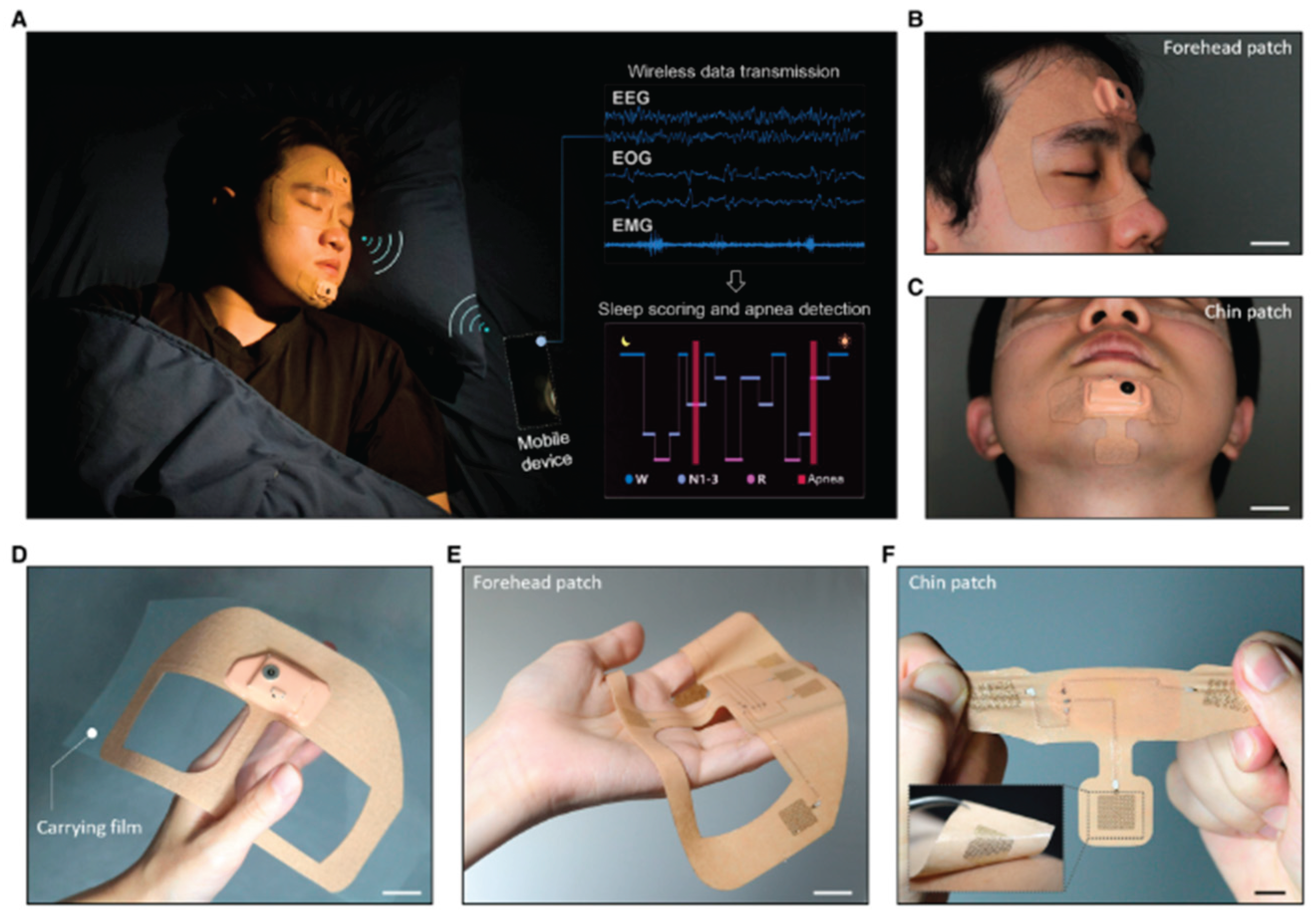
Figure 2.
Explanation of hyoid procedures: Schematic demonstrating (a) hyoid-mandibuloplexy and (b) hyoid myotomy with suspension, both of which reposition the hyoid complex anteriorly to stabilize the hypopharyngeal airway and reduce airway collapse during sleep. Reproduced from: Schaaff C, Patel TH, Alazawi D, et al. Sleep Breath. 2025;29(4):234. © Authors, distributed under CC BY 4.0 [72].
Figure 2.
Explanation of hyoid procedures: Schematic demonstrating (a) hyoid-mandibuloplexy and (b) hyoid myotomy with suspension, both of which reposition the hyoid complex anteriorly to stabilize the hypopharyngeal airway and reduce airway collapse during sleep. Reproduced from: Schaaff C, Patel TH, Alazawi D, et al. Sleep Breath. 2025;29(4):234. © Authors, distributed under CC BY 4.0 [72].
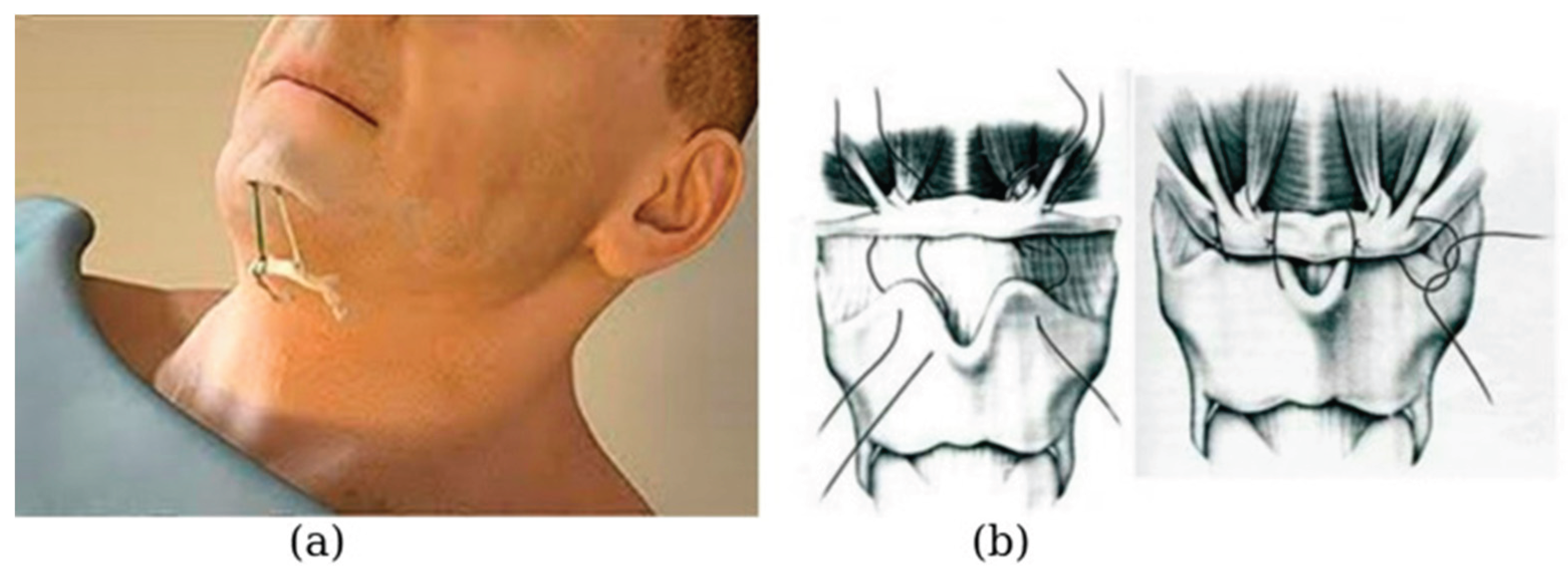
Figure 3.
Visualization of anatomy of the palate (left) with model of surgical implantation of pillar implants along the soft and hard palate. Reproduced from: Khasawneh L, Odat H, Khassawneh BY, et al. Future Sci OA. 2021;7(6):FSO701. © Authors, distributed under CC BY 4.0 [78].
Figure 3.
Visualization of anatomy of the palate (left) with model of surgical implantation of pillar implants along the soft and hard palate. Reproduced from: Khasawneh L, Odat H, Khassawneh BY, et al. Future Sci OA. 2021;7(6):FSO701. © Authors, distributed under CC BY 4.0 [78].
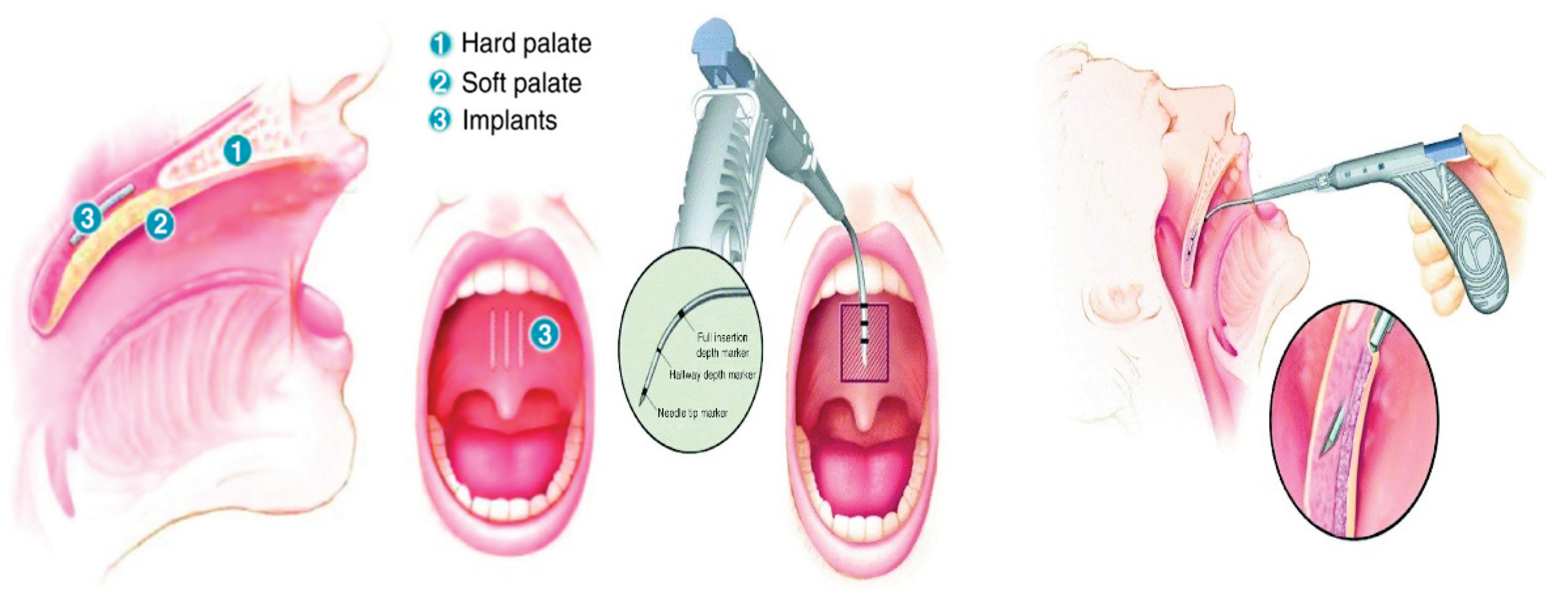
Figure 4.
Schematic of radiofrequency ablation of tongue base procedure. Transoral probe delivers radiofrequency energy to lingual musculature. Removal of the tissue allows for easier airflow while preserving overlying mucosa and swallowing function procedure. Reproduced from Lu YA et al., J. Clin. Med. 2022, 11, 4186 (CC BY 4.0) [81].
Figure 4.
Schematic of radiofrequency ablation of tongue base procedure. Transoral probe delivers radiofrequency energy to lingual musculature. Removal of the tissue allows for easier airflow while preserving overlying mucosa and swallowing function procedure. Reproduced from Lu YA et al., J. Clin. Med. 2022, 11, 4186 (CC BY 4.0) [81].
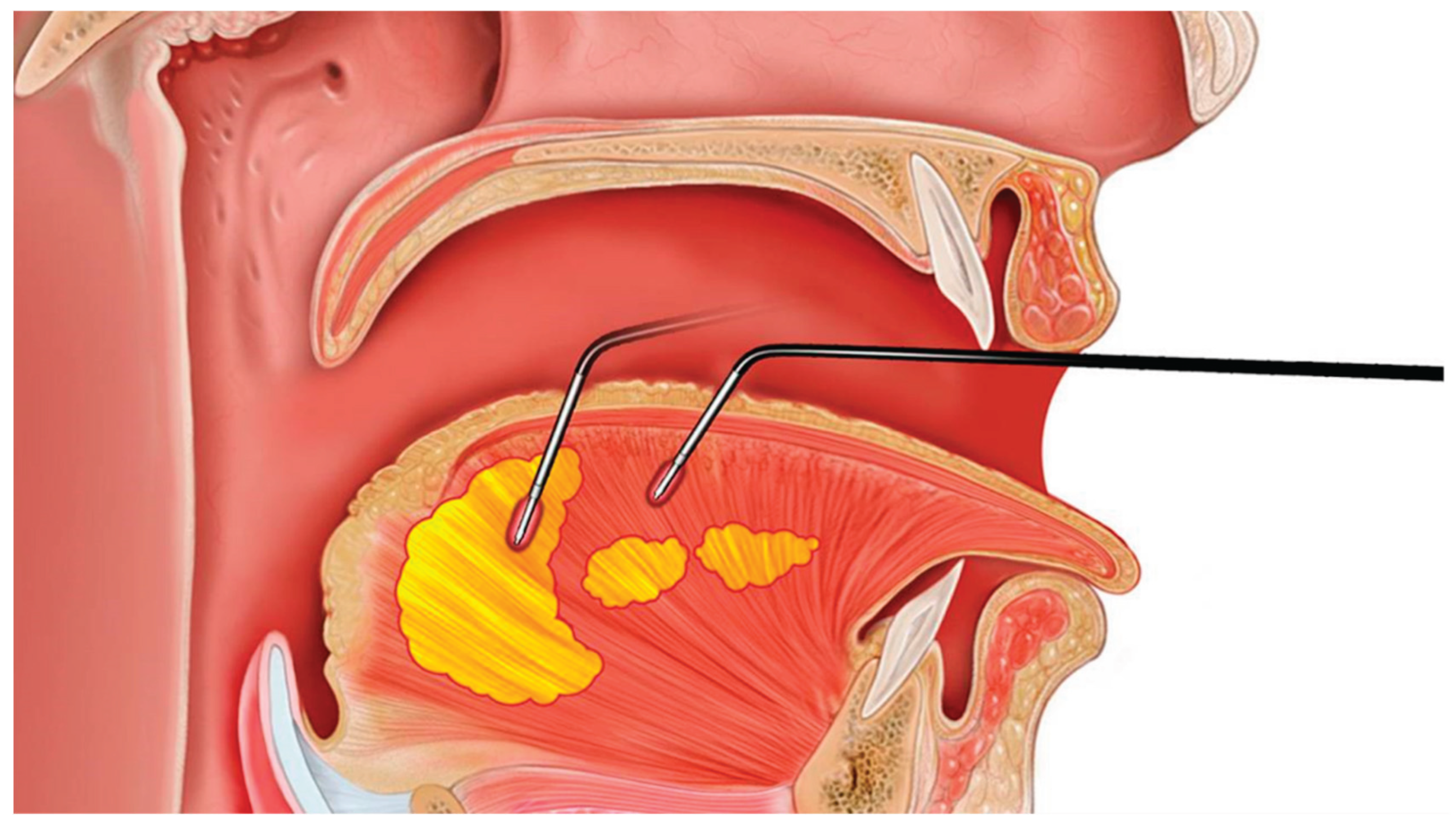
Figure 6.
Graphical representation of PAP modalities showing pressure changes over time. CPAP- which provides continuous pressure throughout (left), BiPAP- which offers differing force inspiration and expiration (middle), and APAP- which automatically adjusts based on detected pressures.
Figure 6.
Graphical representation of PAP modalities showing pressure changes over time. CPAP- which provides continuous pressure throughout (left), BiPAP- which offers differing force inspiration and expiration (middle), and APAP- which automatically adjusts based on detected pressures.
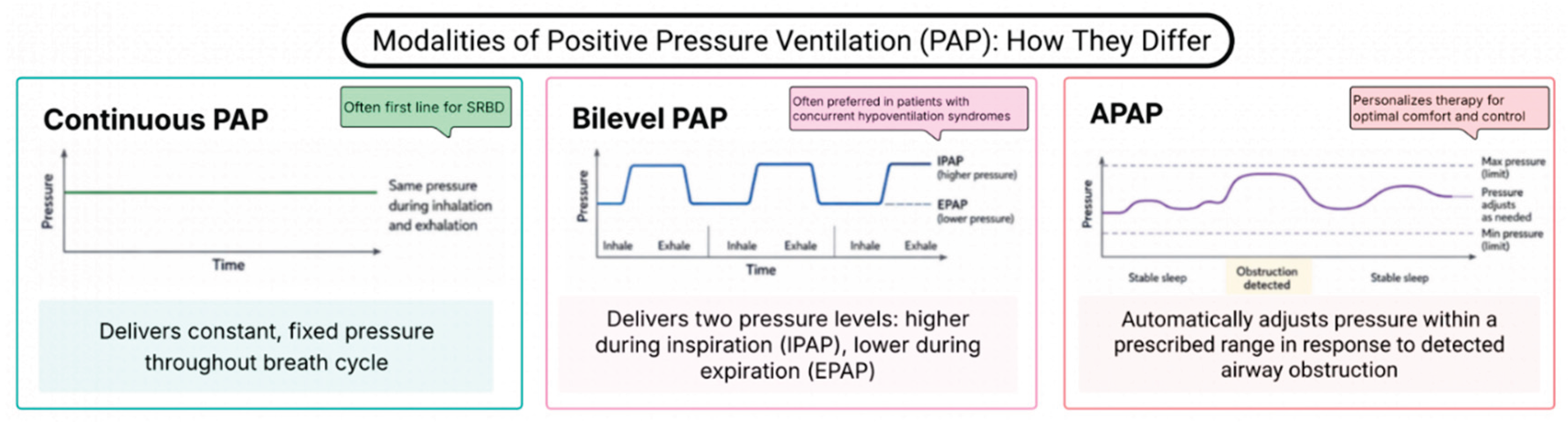

Table 1.
Comparison of surgical techniques listed by modality, examining key outcomes, advantages, and limitations.
Table 1.
Comparison of surgical techniques listed by modality, examining key outcomes, advantages, and limitations.
| Modality | Mechanism | Key Outcomes | Advantages | Limitations |
|---|---|---|---|---|
| Uvulopalatopharyngoplasty (UPPP) | Resection and reshaping of uvula, soft palate, and oropharyngeal soft tissue to enlarge retropalatal airway | Cure (AHI <5): ~24% AHI <10: ~33% at 6 months |
Most established palatal procedure; widely performed; can improve airflow in selected patients | Highly variable success; limited efficacy in multilevel collapse; outcomes depend on strict definition of “success” |
| UPPP + tonsillectomy | Palatal expansion with removal of tonsillar obstruction improving retropalatal patency | ~60% AHI reduction vs 11% control; mean AHI 53.3 → 21.1 events/h | Better outcomes in tonsillar hypertrophy; improved response vs isolated UPPP | Limited generalizability (younger, lower BMI cohorts); residual moderate OSA common |
| Lateral expansion pharyngoplasty (LEP) | Repositioning of pharyngeal musculature to increase lateral wall tension and stability | Improved airway stability and sleep outcomes (no standardized pooled AHI) | Targets lateral wall collapse; more physiologic than resection-based UPPP | Postoperative dysphagia; limited adoption |
| Expansion sphincter pharyngoplasty (ESP) | Isolation and anterior-superior rotation of palatopharyngeus to stiffen lateral pharyngeal wall | Improved lateral wall collapse; reduction in OSA severity in selected patients | Better control of lateral wall collapse vs UPPP | Technical complexity; variable outcomes; still procedure-dependent |
| Barbed reposition pharyngoplasty (BRP) | Soft palate and pharyngeal wall suspension using barbed sutures without knots | Extrusion rate ~18.4%; no significant impact on QoL or polygraphy outcomes | Minimally invasive; technically simple; cost-effective | Suture extrusion complication; long-term durability uncertain |
| Laser-assisted uvulopalatoplasty (LAUP) | Laser resection of uvula and palatal tissue to widen oropharyngeal airway | ~50% achieve AHI <10 | Outpatient procedure; minimally invasive | High complication rates (dysphagia, VPI, uvular necrosis) |
| Maxillomandibular advancement (MMA) | Advancement of maxilla and mandible to enlarge retropalatal and retrolingual airway space | AHI 63.9 → 9.5; success ~86%; cure (AHI <5): 43–47% | Highest surgical success rate; multilevel airway expansion; durable effect | -Highly invasive -Side effects: facial edema and neurosensory complications |
| Genioglossus advancement ± hyoid suspension | Anterior repositioning of tongue musculature and stabilization of hypopharynx | Modest AHI reduction -Inferior to MMA |
Targeted hypopharyngeal intervention, often adjunctive | Limited efficacy as standalone therapy |
| Inferior sagittal mandibular osteotomy (tongue base procedures) | Structural anterior repositioning of tongue base via mandibular manipulation | Moderate improvement in airflow | Useful in multilevel surgery protocols | Insufficient as monotherapy |
Table 2.
Comparison of PAP modalities for the management of sleep-related breathing disorders.
| Modality | Mechanism / Key Feature | Clinical Effect / Outcomes | Advantages | Limitations / Considerations |
|---|---|---|---|---|
| Continuous Positive Airway Pressure (CPAP) | Delivers fixed positive airway pressure to maintain upper airway patency during sleep | - Reduced AHI and daytime sleepiness - Improvement in QoL |
Widely available and well-established efficacy | - Requires titration in-lab in traditional systems - Adherence limited by mask discomfort and pressure intolerance |
| Auto-adjusting Positive Airway Pressure (APAP) | Automatically adjusts pressure on a breath-by-breath basis in response to airflow dynamics | Comparable efficacy to CPAP with no significant difference in AHI reduction | Does not require titration study like CPAP → increased compliance | Not appropriate for CSA or hypoventilation syndromes |
| Bilevel Positive Airway Pressure (BIPAP) | Delivers constant pressure throughout respiratory cycle via inspiratory PAP (IPAP) and expiratory PAP (EPAP) to reduce work of breathing | - Similar improvements to CPAP in AHI, sleepiness, and QoL - Beneficial in patients requiring higher pressures or ventilatory support |
- Similar improvements to CPAP in AHI, sleepiness, and QoL - Beneficial in patients requiring higher pressures or ventilatory support |
More complex titration; no clear superiority over CPAP for routine OSA |
| Volume Assisted Pressure Support (VAPS) | Automatically adjusts IPAP to achieve a target tidal volume or minute ventilation | Improves ventilation and CO₂ clearance in hypoventilation syndromes (e.g., OHS, neuromuscular disease) | - Provides guaranteed ventilation - Adaptive support for hypoventilation |
- Not indicated for uncomplicated OSA - Limited evidence in general OSA populations |
| Adaptive Sero-ventilation (ASV) | Provides breath-by-breath adjustment of inspiratory support based on detected ventilation to stabilize breathing patterns | - Highly effective in CSA and treatment-emergent CSA - Reduces residual AHI and improves sleep quality |
- Superior control of complex sleep-disordered breathing - Adaptive real-time ventilation targeting |
- Contraindicated in selected heart failure populations with reduced ejection fraction - Limited use outside CSA phenotypes |
Disclaimer/Publisher’s Note: The statements, opinions and data contained in all publications are solely those of the individual author(s) and contributor(s) and not of MDPI and/or the editor(s). MDPI and/or the editor(s) disclaim responsibility for any injury to people or property resulting from any ideas, methods, instructions or products referred to in the content. |
© 2026 by the authors. Licensee MDPI, Basel, Switzerland. This article is an open access article distributed under the terms and conditions of the Creative Commons Attribution (CC BY) license (http://creativecommons.org/licenses/by/4.0/).
Copyright: This open access article is published under a Creative Commons CC BY 4.0 license, which permit the free download, distribution, and reuse, provided that the author and preprint are cited in any reuse.


