

Submitted:
07 May 2026
Posted:
08 May 2026
You are already at the latest version
Abstract
Introduction: Transepithelial photorefractive keratectomy (Trans-PRK) offers superior re-epithelialization and visual recovery. This study evaluates the impact of preoperative refractive status on clinical outcomes and identifies prognostic factors across varying myopic severities. Methods: This retrospective observational study included 125 eyes [64 patients; age > 20 years; best-corrected visual acuity (BCVA) ≥ 20/25] that underwent Trans-PRK between March and December 2022. Patients were stratified into low myopia (LM: > -5.0 D), moderate-to-high myopia (MHM: ≤ -5.0 D to > -8.0 D) extremely high myopia (EHM: ≤ -8.0 D) groups. Analysis focused on preoperative refraction, intraoperative parameters, postoperative uncorrected visual acuity (UCVA) and corneal conditions of superficial punctate keratitis (SPKs) and haze. Results: The mean age was 30.20 ± 6.34 years, with a mean initial manifest sphere (MS) of -6.42 ± 2.27 Diopter (D) overall and -3.73 ± 0.15 D, -6.28 ± 0.13 D and -9.17 ± 0.15 D in the LM, MHM and EHM groups, respectively. At a mean follow-up of 6.69 ± 3.73 months, the overall mean final manifest spherical equivalent (MSE) was -0.12 ± 0.73 D and mean final UCVA was 0.01 [Snellen equivalent (SE), 205/200] ± 0.08 logMAR. Predictability was 94.4%, 88.88% and 94.3% for the final MS ≤ -1.0 D, final MSE ≤ -1.0 D and UCVA ≥ 0.8, respectively. In the LM and MHM groups, cycloplegic and subjective refractions showed the highest concordance with emmetropia, whereas initial manifest refractions were most accurate for the EHM group. Corneal SPK incidence declined from 32.2% (1 month) to 1.6% (6 months), primarily localized to EHM eyes. Corneal haze peaked at 28.2% at three months before receding to 9.4% by 6 months. Conclusions: Refractive and visual stability were achieved by the third month for the LM and MHM groups, whereas the EHM group required six months to reach both refractive and visual plateaus. Despite transiently higher rates of corneal SPKs and haze in EHM eyes, final visual outcomes remained excellent (UCVA 18/20).
Keywords:
photorefractive keratectomy
; refraction
; myopia
; astigmatism
; central corneal thickness
1. Introduction
In 2020, myopia, the leading cause of distance vision impairment, affected 34.0% of the global population, a figure projected to rise to 39.9% by 2030 [1]. The prevalence of myopia was 2620 million in 2020 [1], and 800,000 to 1.4 billion corneal refractive surgeries are performed annually in the United States, including photorefractive keratectomy (PRK), laser in situ keratomileusis (LASIK) and small incision lenticular extraction (SMILE) [2,3]. All three of these refractive surgeries are now safer and more accurate than ever; however, they still have some longstanding limitations and disadvantages, such as flap-associated complications in femtosecond LASIK, which was developed to minimize microkeratome-related complications; epithelial healing in single-step transepithelial PRK (Trans-PRK), which provides faster recovery than the conventional PRK [4,5,6] and high revisability but exhibits difficulty in extremely high myopia and revision after SMILE, which offers superior biostability than to Trans-PRK and femtosecond LASIK.
In 1996, PRK became the first form of refractive surgery to use the excimer laser for surface ablation [7,8]. Conventional PRK utilizes manual or alcohol-assisted epithelial removal, which may cause basement membrane injury, alcohol toxicity and delayed healing. These methods are frequently associated with significant pain and stromal haze, even with adjunctive Mitomycin-C (MMC) [9]. Introduced in 2007, the current generation of Trans-PRK performs a single-step ablation of both the epithelium and stroma [10], replacing earlier two-step procedures that used phototherapeutic keratectomy (PTK) to remove the epithelium first [11,12,13]. Ablative spot geometry, first reported in 2017, creating a shorter and smoother surface that promotes faster reepithelization, visual recovery, and painless [4,5].
In this study, we aim to compare with various preoperative refractive statuses including initial manifest, cycloplegic and subjective refractions before Trans-PRK which could achieve final manifest refractions closest to emmetropia. Furthermore, we aim to identify the prognostic factors and treatment outcomes for low, moderate-to-high and extremely high myopia following Trans-PRK.
2. Methods
2.1. Patients
This retrospective, observation study examined eyes that underwent Trans-PRK (Schwind Amaris 750 S laser, Schwind eye-tech-solutions GmbH & Co. KG, Kleinostheim, Germany) between March 2022 and December 2022 at the Kaohsiung Veterans General Hospital. All patients signed informed consent following the tenets of the Declaration of Helsinki. The study was approved by the institutional ethical board committee. The inclusion criteria for the study were as follows: age older than 20 years old, eyes with best-corrected visual acuity (BCVA) better than 16/20, and discontinuation of soft contact lens use for more than 2 weeks before treatment at least one month during postoperative follow-up. The exclusion criteria were as follows: eyes that had previous refractive surgery with residual myopia requiring revision, presbyopia requiring myopia treatment, corneal or lens opacity, corneal trauma with primary repair, prior cornea or lens surgeries, glaucoma history with medication and surgeries, retinal or foveal diseases with surgery history. A total of 125 eyes from 64 consecutive patients were included in the study.
2.2. Preoperative Factors
Preoperative evaluation of refractions [sphere, cylinder and spherical equivalent (SE)] included initial manifest, cycloplegic and subjective refractions. Subjective refraction was performed to achieve clear vision with balanced red—green light duo-chrome testing. BCVA was assessed using trial frames after a two-week soft contact lens holiday. The other recorded information included age, gender, central corneal epithelial thickness (CCET) and central corneal thickness (CCT). The data of both CCET and CCT were measured via anterior segment optical coherence tomography (ASOCT).
Patients were stratified into three groups based on initial manifest sphere (MS): extremely high myopia (EHM; ≤ -8.0 D), moderate-to-high myopia (MHM; ≤ -5.0 D and > -8.0D) and low myopia (LM; > -5.0D).
2.3. Intraoperative Factors
During surgeries, the recorded data included determined refraction, performed and residual CCT, measured and performed CCET, mitomycin (MMC) soaking duration, ablation zone diameter and laser application interval. We further analyzed the related factors of intraoperative factors including differences between the measured and performed CCET if they affected final corneal presentation, manifest refraction and uncorrected visual acuity (UCVA).
2.4. Surgical Technique
All surgeries were performed using a sixth-generation Amaris excimer laser, version 750 S (Schwind eye-tech-solutions). Treatments were planned based on the performed refraction with an aberration-neural profile and proper ablation zone according to patients’ profiles calculated using the ORKCAM software.
Following topical anesthesia (0.5% proparacaine) and standard disinfection, transepithelial laser ablation was performed after verifying the correct horizontal and torsional eye positions on the computer and with active eye tracking. After laser ablation, 0.02% MMC was applied with sponge, followed by chilled balanced salt solution irrigation. A bandage contact lens (BCL: ACUVUE Oasis, Johnson & Johnson Vision) was placed and a regimen of 1% Pred Forte, 0.5% Cravit, 0.1% Nevanac and autoserum was initiated. Postoperative medications were tapered after BCL removal once re-epithelialization was complete.
2.5. Postoperative Factors
Postoperative visits assessed manifest refraction, UCVA and corneal status—specifically superficial punctate keratitis (SPK) and haze. UCVA values were converted to the logarithm of the minimum angle of resolution (logMAR) for analysis.
2.6. Statistical Analysis
We compared preoperative refractive metrics to determine refractions using paired t-tests and Linear Mixed Models (LMMs). To account for inter-eye dependency (bilateral data), an LMM was used for continuous outcomes (SE and logMAR), while Generalized Estimating Equations (GEEs) were utilized for binary outcomes (haze and SPK). The results are reported as regression coefficients (B), Odds Ratios (OR) and 95% Confidence Intervals (95% CI). Post-hoc pairwise comparisons with Bonferroni correction were applied among myopia groups. Data were analyzed using the IBM SPSS version 31.0 (Armonk, NY, USA). P < 0.05 denotes statistical significance.
3. Results
One hundred and twenty-five eyes of sixty-four patients, comprixing twenty-one men (33.6%) and forty-three women (66.4%) underwent Trans-PRK during the study period. The mean age was 30.20 ± 6.34 years (range, 20-47; median, 29), and the mean follow-up was 6.69 ± 3.73 months (range, 1–13.96 months; median, 6.29). Among the treated eyes, 28% (35 eyes) were in the LM group, while 42% (53 eyes) were in the MHM group and 30% (37 eyes) were in the EHM group. The mean manifest sphere (MS) power was -6.42 ± 2.27 D in the total sample, -3.73 ± 0.15 D in the LM group, -6.28 ± 0.13 D in the MHM group and –9.17 ± 0.15 D in the EHM group while the mean manifest spherical equivalent (MSE) was -7.16 ± 2.31 D in the total sample, -4.69 ± 0.20 D in the LM group, -7.09 ± 0.16 D in the MHM group and -9.59 ± 0.20 D in the EHM group. The mean final MS was 0.17 ± 0.71 D in the total smaple, 0.33 ± 0.13 D in the LM group, 0.23 ± 0.11 D in the MHM group and -0.07 ± 0.13 D in the EHM group while the mean final MSE was -0.12 ± 0.73 D in the total sample, 0.05 ± 0.13 D in the LM group, -0.05 ± 0.11 D in the MHM and -0.38 ± 0.13 D in the EHM group. The mean final UCVA was 0.01 [Snellen equivalent (SE), 205/200] ± 0.08 logMAR in the total sample, 0.00 (SE, 200/200) ± 0.01 logMAR in the LM group, 0.01 (SE, 205/200) ± 0.01 logMAR in the MHM group, and 0.01 (SE, 205/200) ± 0.02 logMAR in the EHM group, with no significant difference between the three groups. Table 1 summarizes the baseline characteristics of the study population. Furthermore, the final MS ≤ -1.0D accounted for 100% in the LM, 94.3% in the MHM group, 89.2% in the EHM group and 94.4% in the total sample, while SE ≤ -1.0D accounted for 97.1% in the LM group, 88.7% in the MHM group, 81.1% in the EHM group and 88.88% in the total sample.
3.1. The Related Factors Affecting Final MSE and the Refractive Changes After Trans-PRK
An LMM was conducted to account for the correlation between eyes of the same patient, and sex was identified as a consistent and significant predictor of final MSE across all multivariate iterations (P=0.002). Male patients showed final hyperopia (0.22 ± 0.13 D) while female patients tended toward final myopia (-0.29 ± 0.09 D). CCT (P=0.011) and the presence of final corneal haze (P=0.043) were also significant independent factors influencing the final refractive outcome. Final UCVA was a significant predictor of the final MSE (P=0.009), confirming the close relationship between refractive accuracy and functional visual outcomes (Table1). However, the LMM analysis demonstrated high refractive precision with a final mean MSE in total near emmetropia (P= 0.880). The interaction between final corneal SPKs and final UCVA suggested a potential role for surface regularity in refractive outcomes (P= 0.060).
1. Spherical Power
Overall, mean spherical power shifted from -0.09 ± 0.38 D (1 week) to a peak hyperopic shift of 0.41 ± 0.71 D (1 month) before regressing toward emmetropia (0.17 ± 0.71 D at final visit; Figure 1A). Spherical power achieved statistical stability relative to the final refraction by the six-month mark. Postoperatively, all groups exhibited a hyperopic shift within the first month. The EHM group experienced a significant myopic regression, between one and six months, ultimately remaining in a myopic state. In contrast, the LM and MHM groups maintained a hyperopic state, though the MHM group showed mild myopic regression while the LM group trended toward further hyperopia.
Figure 1.
(A) Regarding spherical changes, all three groups of eyes experienced hyperopia shift within one month postoperatively. Between one and six months postoperatively, the extremely high myopia (EHM) eyes experienced the largest and fastest myopia shift while the moderate-to-high myopia (MHM) eyes showed a relatively mild myopia shift and the low myopia (LM) eyes showed the least myopia shift, but both groups remained hyperopia. After six months postoperatively, the EHM eyes remained myopia while the MHM eyes developed mildly myopic changes within a hyperopic state, and the LM group further progressed more hyperopia. Overall, the spherical powers did not differ significantly from the final values six months postoperatively. (B) The LM and MHM groups followed a similar trend, characterized by a linear decrease in astigmatism through the third month, followed by a slight increase. The EHM group conversely exhibited a continuous decline in astigmatism from the second month through the final follow-up. Overall, cylinder power achieved statistical stability relative to final outcomes by two months postoperatively. (C) Regarding changes in spherical equivalent, all three groups of eyes progressed to hyperopia by two months postoperatively. The EHM group subsequently reversed to myopia, the MHM group a slight reduction but remained hyperopia, and the LM group maintained a similar extent of hyperopia throughout. Overall, the MSE values did not exhibit significant differences from the final values at six months postoperatively.
Figure 1.
(A) Regarding spherical changes, all three groups of eyes experienced hyperopia shift within one month postoperatively. Between one and six months postoperatively, the extremely high myopia (EHM) eyes experienced the largest and fastest myopia shift while the moderate-to-high myopia (MHM) eyes showed a relatively mild myopia shift and the low myopia (LM) eyes showed the least myopia shift, but both groups remained hyperopia. After six months postoperatively, the EHM eyes remained myopia while the MHM eyes developed mildly myopic changes within a hyperopic state, and the LM group further progressed more hyperopia. Overall, the spherical powers did not differ significantly from the final values six months postoperatively. (B) The LM and MHM groups followed a similar trend, characterized by a linear decrease in astigmatism through the third month, followed by a slight increase. The EHM group conversely exhibited a continuous decline in astigmatism from the second month through the final follow-up. Overall, cylinder power achieved statistical stability relative to final outcomes by two months postoperatively. (C) Regarding changes in spherical equivalent, all three groups of eyes progressed to hyperopia by two months postoperatively. The EHM group subsequently reversed to myopia, the MHM group a slight reduction but remained hyperopia, and the LM group maintained a similar extent of hyperopia throughout. Overall, the MSE values did not exhibit significant differences from the final values at six months postoperatively.
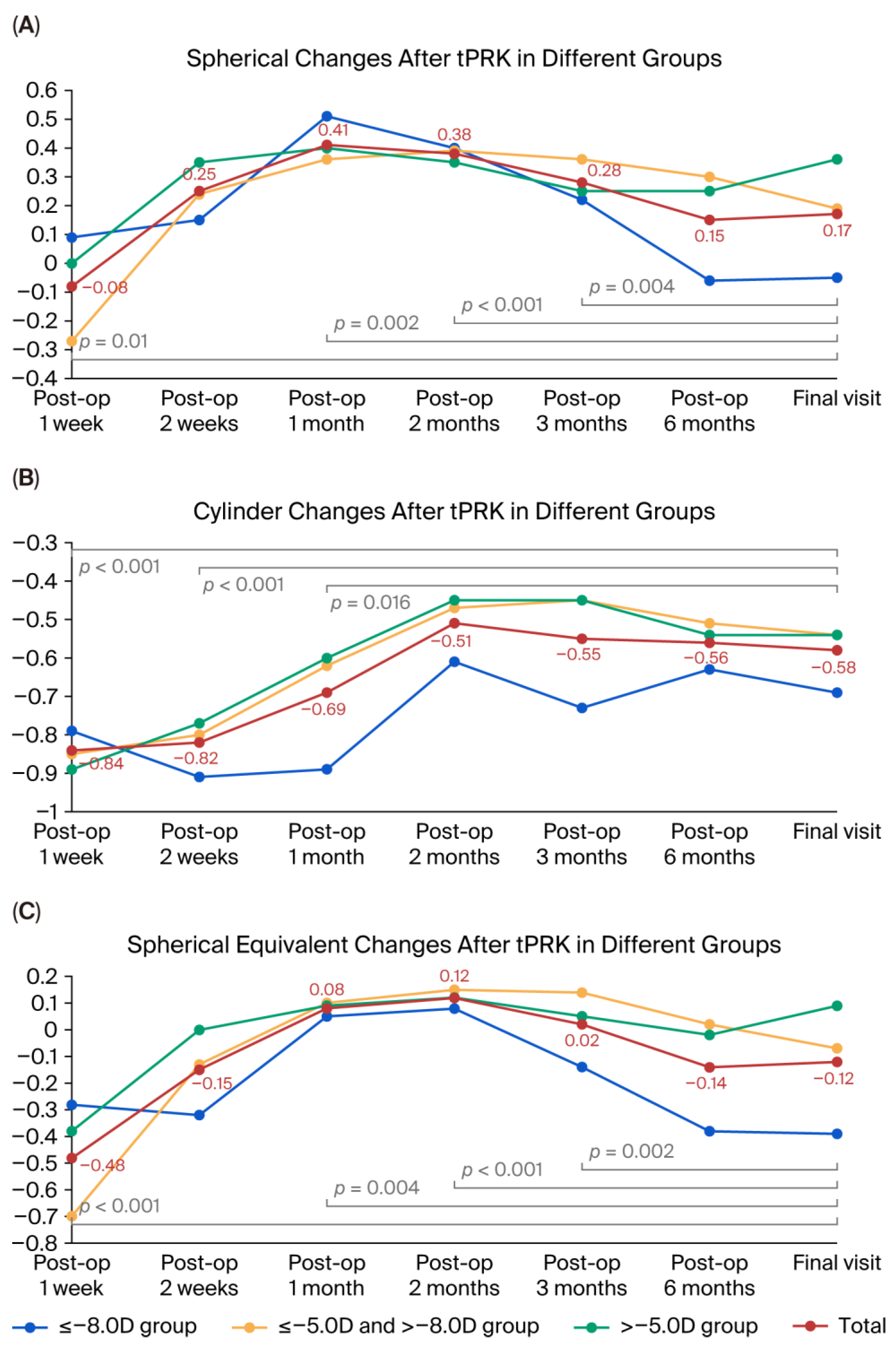
Figure 2.
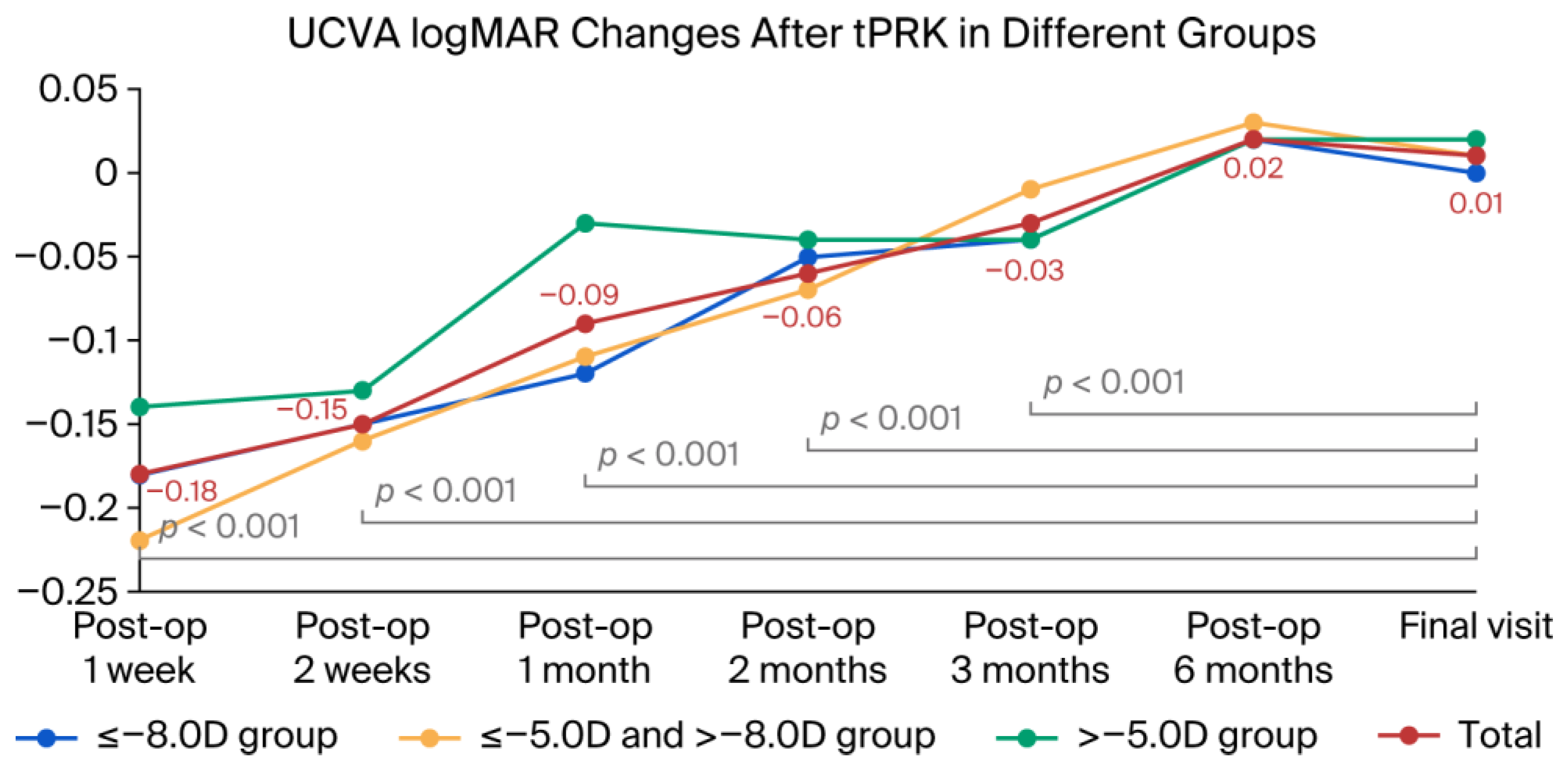
Overall, UCVA significantly improved following trans-PRK, stabilizing by six months postoperatively. Recovery kinetics were stratified by myopia severity: the low myopia group showed biphasic gains (pre-1 month and months 2–3), while the moderate-to-high group plateaued by month two. Conversely, the extremely high myopia group exhibited a prolonged improvement trend, continuing through the full three-month duration.
Figure 2.
Overall, UCVA significantly improved following trans-PRK, stabilizing by six months postoperatively. Recovery kinetics were stratified by myopia severity: the low myopia group showed biphasic gains (pre-1 month and months 2–3), while the moderate-to-high group plateaued by month two. Conversely, the extremely high myopia group exhibited a prolonged improvement trend, continuing through the full three-month duration.
2. Cylinder Power
The total population showed a gradual reduction in mean cylinder power, stabilizing by the second month postoperatively (-0.58 ± 0.43 D at final visit; Figure 1B). The LM and MHM groups demonstrated rapid astigmatic reduction, stabilizing within two months. The EHM group exhibited an initial transient increase in cylinder power during the first two weeks but reached stability by two months, maintaining consistently higher residual astigmatism than the other groups.
3. Manifest Spherical Equivalent (MSE)
In the total sample, the mean MSE trended from -0.48 ± 0.80 D (1 week) to a stable final value of -0.12 ± 0.73 D (Figure 1C). Significant differences in the final MSE in the overall cohort persisted throughout the first three months (P<0.001). The LM and MHM groups reached stability relative to the final visit by one month. Conversely, the EHM group showed a peak hyperopic shift at 2 months followed by regression into a persistent myopic state and stabilized by the six months, indicating a delayed stabilization period compared to lower myopia groups.
3.2. The Related Factors Affecting Final UCVA logMAR and UCVA Changes After Trans-PRK
The LMM analysis revealed that final corneal haze (P=0.04) and final MSE (P<0.001) emerged as the strongest drivers of final UCVA (Table 1). Furthermore, longer follow-up (P<0.001) was associated with better visual outcome, likely reflecting long-term corneal remodeling. The final UCVA ≥ 0.8 accounted for 94.3% in the LM group, 95.3% in the MHM group, 88.8% in the EHM group and 92.8% in the total sample.
Overall, mean UCVA significantly improved from -0.18 (SE, 132/200) ± 0.17 logMAR at 1 week to 0.01 (SE, 205/200) ± 0.08 logMAR at the final visit (P<0.001), with continuous recovery observed throughout the first three months. Progressive visual recovery was evident across all three subgroups; in the LM group, vision improved from -0.14 (SE, 145/200) ± 0.15 logMAR (1 week) to 0.04 (SE, 218/200) ± 0.10 logMAR at the final visit, with significant gains through the third month (P<0.001). In the MHM group, vision rose significantly from -0.22 (SE, 120/200) ± 0.17 logMAR (1 week) to -0.07 (SE, 170/200) ± 0.12 logMAR at two months (P=0.003), stabilizing at 0.03 (SE, 214/200) ± 0.06 log MAR (6 month). In the EHM group, vision significantly improved from -0.18 (SE, 133/200) ± 0.17 logMAR (1 week) to -0.04 (SE, 182/200) ± 0.10 logMAR by three months (P<0.001), reaching a final UCVA of 0.01 (SE, 205/200) ± 0.07 logMAR. Overall, UCVA stabilized by the sixth postoperative month across all myopia severities.
3.3. The Related Factors Affecting Corneal SPKs and Their Presentation After Trans-PRK
Multivariate GEE analysis identified the discrepancy between measured and performed CCET (B=-0.22; OR=0.806; 95% CI, 0.66-0.99; P=0.042), laser application interval (B=-0.01; OR=0.924; 95% CI, 0.86-1.00; P=0.046) and follow-up duration (P=0.031) as significant independent predictors of final corneal SPKs (Table 1). Negative coefficients indicated that smaller CCET differences and shorter laser durations increased risk of final corneal SPKs. Notable clinical trends were observed for ablation depth (P=0.064), linked to delayed epithelial stability and MMC soaking duration, and exhibited a marginal protective trend (B=-0.16; OR=0.851; 95% CI, 0.72-1.01; P=0.068), suggesting longer exposure may facilitate smoother epithelial remodeling by reducing stromal inflammation. Preoperative myopia severity (P=0.89) and refractive outcomes (P=0.596) showed no significant association with SPK occurrence.
Of the twelve eyes (9.6%) that had corneal SPKs at last visit, one eye (0.8%) was in the LM group with a mean follow-up of 6.26 ± 3.96 months, and five eyes (4%) were in the MHM group with a mean follow up of 6.02 ± 3.64 months while six eyes (4.8%) were in the EHM group with a mean follow-up of 8.05 ± 3.34 months.
Postoperative corneal SPK prevalence peaked at one week (40.8%; LM: 8.0%, MHM: 19.2%, EHM: 13.6%) and remained at 32.2% at one month (LM: 2.6%, MHM: 12.2%, EHM: 17.4%). By six months, the LM and MHM groups achieved complete resolution, whereas residual 1.6%
prevalence persisted exclusively in the EHM group. Long-term follow-up (9–12 months) showed a stable residual rate of 2.4%, isolated primarily to EHM eyes (Figure 3A).
3.4. The Related Factors Affecting Corneal Haze and Its Presentation After Trans-PRK
Multivariate GEE analysis identified age (B=0.31; OR=1.37; 95% CI, 1.062-1.758; P=0.015) and MMC soaking duration (B=0.13; OR=1.14; 95%CI, 1.01-1.29; P=0.030) as the primary significant independent predictors of final corneal haze (Table 1). For every one-year increase in patient age, the odds of developing haze increased by 36.7% (OR=1.37). Several other factors demonstrated borderline statistical significance or notable clinical trends, including initial MSE (P=0.055), ablation depth (P=0.055), differences of measured and performed CCET (B=-0.267, P=0.062), laser application interval (P=0.064), follow-up duration (P=0.063) and final UCVA logMAR (P=0.051). The negative correlation of the CCET discrepancy implies that a thinner-than-planned epithelial profile leads to premature ablation and basement membrane disruption, acting as a factor that promotes stromal haze during remodeling. Clinically, the presence of final corneal haze was associated with a +0.39 D hyperopia shift (haze/no haze= +0.23 D/-0.16 D), serving as a notable determinant of reduced final UCVA (P=0.051) with a mean -0.03 (SE, 186/200) ± 0.02 logMAR [final UCVA of no haze: 0.01 (SE, 205/200)]. All cases were less than Grade 1, which did not interfere with the visibility of fine iris details [14].
Eleven eyes (8.8%) developed corneal haze by the final visit. These eyes had a mean relative decline in final UCVA of 0.04 (SE, 182/200) ± 0.06 logMAR compared with eyes without haze a mean hyperopia shift in final SE of +0.23 D. In contrast, eyes without corneal haze demonstrated a mean final UCVA of 0.01 (SE, 205/200) ± 0.08 logMAR and a mean final MSE of -0.16 ± 0.74. However, the mean age of eyes with final corneal haze was 23.82 ± 5.51 years, compared to 30.82 ± 6.09 years in those without corneal haze. Among twelve eyes (9.6%) with final corneal haze, three eyes (2.4%) were in the LM group, and five eyes (4%) were in the MHM group, while three eyes (2.4%) were in the EHM.
Postoperative corneal haze prevalence peaked at three months (28.2%; LM: 6.8%, MHM: 16.2%, EHM: 5.1%) before declining. By six months, prevalence decreased to 9.4%, with the LM group achieving complete resolution while the MHM (3.1%) and EHM (6.3%) groups showed residual traces. By nine months, total prevalence fell to 0.8%, isolated entirely to the EHM group. Overall, haze followed a transient course in the LM and MHM groups but persisted longer in EHM eyes (Figure 3B).
3.5. Differences Between the Groups of LM, MHM and EHM Groups
An LMM and a GEE were used to compare the three groups—LM (> -5 D), MHM (≤ -5 and > -8 D) and EHM (≤ -8 D) —as shown in Table 2. The LMM analysis identified deeper ablation thickness (P<0.001), longer MMC soaking duration (P<0.001) and laser application interval (P<0.001) as the most critical predictors of final corneal haze and modulated haze risk. The LMM analysis also demonstrated no significant difference in final UCVA across the three initial myopia groups. Final UCVA remained stable (0.004 to 0.015 logMAR) with high pairwise consistency (all P>0.89). These results confirm the visual safety and predictability of Trans-PRK across a broad refractive range. The LMM analysis revealed a significant refractive impact from initial MSE (P<0.001), with the EHM group showing a slight myopic shift (-0.38 D; P=0.0363) relative to the LM group. An intraclass correlation coefficient (ICC) of 0.532 validated the use of LMM to account for inter-eye correlation, ensuring statistical robustness in these bilateral outcomes. No significant difference in final corneal haze and SPKs were observed.
3.6. Comparison of Various Refractions
We compared differences among several refraction types—initial manifest refraction, cycloplegic refraction and subjective refraction with determined refraction—against the final manifest refractions in three groups (Table 3). The EHM group exhibited a slight myopic shift (mean: -0.38 ± 0.13 D), which differed significantly from the LM group (mean: +0.05 ± 0.13 D). The LM and EHM groups remained near emmetropia (mean: -0.05 ± 0.11 D). Univariate analysis showed that for LM and MHM groups, cycloplegic and subjective refractions aligned most closely with emmetropia. In the EHM group, cycloplegic refraction tended toward myopia, while initial manifest MSE demonstrated the highest accuracy.
Multivariate analysis (LMM) confirmed that subjective refraction was the strongest predictor for emmetropia in the LM and MHM groups, whereas initial MSE was most accurate for both LM and EHM groups. Cycloplegic refraction served as a consistent secondary predictor across all cohorts.
In summary, treatment planning based on cycloplegic and subjective refractions yields outcomes closest to emmetropia for LM/MHM Groups. Utilizing initial MSE refraction for EHM group is recommended; though this targets a slight myopic shift, it achieves superior final emmetropic accuracy.
4. Discussion
Consistent with previous findings at the 12-month follow-up, refractive predictability and the proportion of eyes achieving a target refraction of ± 0.50 D were comparable or superior in Trans-PRK patients across myopic [15] and highly myopic [16,17,18] groups. Our study yielded comparable outcomes, with a mean final MSE of -0.12 D overall, and -0.38 D in the extreme high myopia (EHM) group. Predictability rates were 94.4%, 88.9% and 94.3% for the final MS ≤ -1.0 D, final MSE ≤ -1.0 D and UCVA ≥ 0.8, respectively. To achieve optimal emmetropic results, we evaluated the accuracy of various preoperative refractive metrics compared to the achieved postoperative outcomes. Our findings indicate that cycloplegic refraction was the most accurate predictor for both spherical power and MSE across the entire study population. This was followed closely by subjective refraction, which demonstrated high concordance with the final determined refraction. In contrast, initial manifest refraction was the least predictive metric. Notably, the EHM group consistently exhibited a greater degree of residual myopic shift relative to the MHM and LM groups across all refractive measures. These results suggest that for EHM, surgeons must not only prioritize residual stromal bed thickness but also rely heavily on initial MSE and cycloplegic refraction for surgical planning. A strategic mild overcorrection should be considered to mitigate the risk of late-stage regression in these eyes.
Multivariate analysis confirmed the high precision of Trans-PRK, with a final mean MSE in the total sample, showing no significant deviation from emmetropia. The lack of significance during the follow-up periods further suggests that refractive outcomes remain stable over time once the initial healing phase is complete. Without statistical significance, the hyperopic shift observed in the corneal haze group is clinically relevant, as it supports the concept that subepithelial fibrosis alters anterior corneal curvature, inducing central flattening and hyperopic regression. Additionally, the interaction between final corneal SPKs and final UCVA suggests that corneal surface regularity is a potential determinant of optimal functional outcomes, whereas final corneal SPKs (P=0.956) do not independently shift refractive power. MMC usage was not a significant predictor of final SE (P=0.988). This indicates that while MMC is essential for haze prophylaxis, its application does not introduce refractive unpredictability, supporting its safety profile in surface ablation.
Furthermore, the factors associated with the final UCVA were follow-up period, final corneal haze and final MSE. Refractive stability near emmetropia is fundamental to visual success. In the LM and MHM groups, rapid MSE stabilization by the second week facilitated early visual recovery. In contrast, the EHM group maintained a slight hyperopia tendency (+0.32 D), contributing to a final UCVA of 18/20. Corneal haze peaked at three months (28.2%) but was primarily limited to Grade I opacification, which did not significantly hinder recovery. As haze declined to 9.4% by six months, a corresponding "jump" in visual acuity occurred. This suggests that while mild haze may cause transient fluctuations, it does not limit final visual potential. Once remodeling concludes, visual outcomes normalize across all groups, confirming that Trans-PRK-induced haze is a temporary phenomenon with no long-term adverse effect on functional vision.
Trans-PRK recovery trajectories vary significantly with myopia severity. The LM and MHM groups achieved rapid stability, with cylinder and MSE outcomes stabilizing between two weeks and three months. These cohorts exhibited a transient hyperopic shift before settling into a stable, slightly hyperopic state. In contrast, the EHM group followed a volatile course, with hyperopia peaking at one month followed by significant myopic regression. Statistical stability was not reached until the third postoperative month. This delayed stabilization and higher residual cylinder likely reflect intensive epithelial remodeling and stromal healing following deeper ablations. While UCVA improved across all groups through six months, final visual outcomes remained superior in the LM and MHM cohorts. These findings suggest that extreme myopia requires a longer stabilization period and closer monitoring of the epithelial–stromal interaction to manage late-stage myopic shifts.
Bandeira et al. [19] reported that subbasal nerve regeneration reached 50% at 6-8 months and 90% by 2 years [20], while corneal sensitivity recovered to 80% at 1 week and nearly fully within 3-6 months [19,21,22]. However, reduced TBUT and Schirmer test values [21,22] and increased symptom scores [23] were noted at 1, 3 and 6 months post-PRK. In our study, significant predictors of final corneal SPKs included CCET discrepancy, laser interval and follow-up duration. The role of follow-up (P=0.031) confirms that surface and tear film stabilization is a progressive, long-term process. Consistent with our hypothesis, the negative correlation for CCET discrepancy (B=-0.22, P=0.042) suggests that a thinner-than-planned epithelial profile leads to premature stromal ablation, creating an irregular bed that impairs epithelial adhesion and sub-basal corneal nerve plexus. The negative coefficient for laser interval (B=-0.01, P=0.046) and the protective trend of MMC soaking duration (B=-0.16, P=0.068) conversely indicate that longer treatments—often involving sophisticated pulse delivery and extended MMC soaking—may better stabilize the healing environment and inhibit inflammatory reaction and myofibroblast growth. Furthermore, deeper ablations may challenge epithelial and sub-basal corneal nerve plexus healing due to increased neural disruption. A higher initial manifest refraction, corresponding to a deeper ablation, also tends to be associated with corneal SPK development. Overall, corneal SPKs after Trans-PRK decreased to less than 10% by three months postoperatively, though a higher prevalence remained in the high myopia group with deeper ablation thickness, lasting beyond 6 months.
Gadde et al. [24] observed a higher incidence of trace haze in single-step trans-PRK than in manual PRK, particularly in eyes with higher myopia. This aligns with Møller-Pedersen et al. [25] and Spadea et al. [26], who demonstrated that haze severity and duration increase proportionally with ablation depth. Abdel-Radi et al. [27] observed corneal haze at 3 months postoperatively in approximately 40% of eyes across two-step and single-step Trans-PRK, which is substantially higher than our rate of 11%. In the present study, age and MMC soaking duration were identified as significant factors influencing final corneal haze. The significance of age suggests that the aging cornea possesses an intrinsic susceptibility to myofibroblast transformation, potentially due to altered keratocyte density or slower basement membrane remodeling. Furthermore, a higher initial MSE requires a deeper ablation depth [28,29], leading to extended laser intervals and longer MMC exposure, reflecting an "energy-response" relationship; however, this pharmacological modulation did not always completely suppress the proliferation and differentiation of limbal epithelial stems cells [30] in extreme myopia and did not occur in mild and moderate myopia [31]. Here, the negative correlation of the CCET discrepancy indicates that a thinner-than-planned epithelial profile induces premature stromal ablation and basement membrane disruption, potentially contributing to stromal haze during healing. Clinically, subepithelial fibrosis induced haze served as a transient anatomical finding yet contributed to temporary refractive instability. This resulting hyperopic shift directly explains the reduction in final UCVA, highlighting the importance of haze prevention. In our cohort, all cases with final corneal haze maintained a mean final vision exceeding 18/20, with haze severity consistently below Grade I [13]. Corneal haze prevalence peaked at 1 month postoperatively and decreased thereafter, though it persisted beyond 6 months in the EHM group. These results are compatible with Lu et al., who demonstrated that intraoperative MMC application in Trans-PRK reduces haze incidence but has no long-term effect on epithelial remodeling [30], final visual and refractive outcome.
LMM analysis revealed that initial MSE significantly impacts final refractive outcomes (P=0.047). While the LM and MHM groups achieved near-perfect emmetropia, the EHM group exhibited a slight myopic shift. Although this shift only approached significance compared to low myopia (P=0.053), it suggests a biological trend toward regression in extreme cases. This is likely driven by a robust corneal wound-healing response and epithelial hyperplasia associated with deeper stromal ablations. The ICC of 0.532 confirmed strong inter-eye correlation, validating the use of LMM. This study is limited by its retrospective design, bilateral eye inclusion and variable follow-up periods. To ensure statistical robustness, we employed an LMM and a GEE. This approach accounts for nested data, preventing the inflated Type I error rates typically associated with standard t-tests in bilateral ophthalmic studies. Although follow-up durations varied, this confounder had a minimal impact on the results. Analysis of our longitudinal data confirmed that refractive and visual stability reached a plateau by the six-month mark. Because most assessments occurred after this stabilization phase, the variations in follow-up periods did not significantly alter the final clinical conclusions or the observed safety profile.
5. Conclusions
TPRK demonstrates excellent efficacy and stability, with MSE and UCVA stabilizing by the third and sixth postoperative months, respectively. Multivariable analysis identified postoperative UCVA, corneal haze and follow-up duration as primary determinants of refractive and functional outcomes. Additionally, corneal health—indicated by final corneal SPK and haze—was significantly influenced by ablation depth, laser duration, MMC soaking duration and the discrepancy between measured and performed epithelial thickness. Subgroup analysis revealed that while the LM and MHM groups achieved near-perfect emmetropia and complete resolution of final corneal SPKs and haze, the EHM group exhibited a distinct clinical profile. This cohort experienced a slight but significant myopic shift (-0.38 D) and maintained a residual haze prevalence of 6.3% at six months. These findings suggest that while Trans-PRK is effective across all severities, the EHM requires more intensive assessment according the initial MSE or cycloplegic refraction to avoid late-stage regression and monitoring of the wound-healing response to manage persistent epithelial instability.
6. Patents
Author Contributions
K-L P collected clinical data, wrote the statistical analysis plan, cleaned and analyzed the data, and drafted the manuscript. J-L C was responsible for the clinical treatment of the patients and revised the manuscript. Both the authors have read and approved the final version of the manuscript.
Funding
All authors declare that they have no funding.
Institutional Review Board Statement
This study was approved by the Institutional Review Board of Kaohsiung Veterans General Hospital (number 24-CT10-04).
Informed Consent Statement
Informed consent was waived due to the retrospective nature of the study.
Data Availability Statement
All data supporting this study will be shared upon request, although the majority are included within the manuscript.
Conflicts of Interest
All authors declare that they did not receive funding for the study.
Abbreviations
PRK: photorefractive keratectomy; Trans-PRK: transepithelial PRK; BCVA: best-corrected visual acuity; LM: low myopia; MHM: moderate-to-high myopia; EHM: extremely high myopia; UCVA: uncorrected visual acuity; MS: manifest sphere; MSE: manifest spherical equivalent; SE: Snellen equivalent; logMAR: the logarithm of the minimum angle of resolution; LASIK: laser in situ keratomileusis; SMILE: small incision lenticular extraction; CCET: central corneal epithelial thickness; CCT: central corneal thickness; ASOCT: anterior segment optical coherence tomography; SPK: superficial keratitis
References
- Holden, B.A.; Frick, T.R.; Wilson, D.A.; Jong, M.; Naidoo, K.S.; Sankaridurg, P.; et al. Global prevalence of myopia and high myopia and temporal trends from 2000 through 2050. Ophthalmology 2016, 123, 1036–1042. [Google Scholar] [CrossRef]
- Kohnen, T.; Schwarz, L.; Remy, M.; et al. Short term complications of femtosecond laser-assisted laser in situ keratomileusis cuts: Review of 1210 consecutive cases. J. Cataract. Refract. Surg. 2016, 42, 1797–1803. [Google Scholar] [CrossRef]
- Kenyin, K.R.; Paz, H.; Greiner, J.V.; et al. Corneal epithelial adhesion abnormalities associated with LASIK. Ophthalmology 2004, 111, 11–17. [Google Scholar] [CrossRef]
- Aslanides, I.M.; Kymionis, G.D. Trans advanced surface laser ablation (Trans-PRK) outcomes using Smart Pulse Technology. Cont. Lens Anterior Eye 2017, 40, 42–46. [Google Scholar] [CrossRef]
- Aslanides, I.M.; Padroni, S.; Arba Mosquera, S.; Ioannides, A.; Mukherjee, A. Comparison of single-step reverse transepithelial all-surface laser ablation (ASLA) to alcohol-assisted photorefractive keratectomy. Clin. Ophthalmol. 2012, 6, 973–980. [Google Scholar] [CrossRef] [PubMed]
- Chang, J.Y.; Lin, P.Y.; Hsu, C.C.; Liu, C.J. Comparison of clinical outcomes of LASIK, Trans-PRK, and SMILE for correction of myopia. J. Chin. Med. Assoc. 2022, 85, 145–151. [Google Scholar] [CrossRef] [PubMed] [PubMed Central]
- Guo, H.; Hosseini-Moghaddam, S.M.; Hodge, W. Corneal biomechanical properties after MILE versus Flex, LASIK, LESEK, or PRK: a systematic review and meta-analysis. BMC Ophthalmol. 2019, 19, 167. [Google Scholar] [CrossRef]
- Wen, D.; Mc Alinden, C.; Flitcroft, I.; Tu, R.; Wang, Q.; Alio, J.; et al. Postoperative efficacy, predictability, safety and visual quality of laser corneal refractive surgery: a network meta-analysis. Am. J. Ophthalmol. 2017, 178, 65–78. [Google Scholar] [CrossRef]
- Taneri, S.; Weisberg, M.; Azar, D.T. Surface ablation techniques. J. Cataract. Refract. Surg. 2011, 37, 392–408. [Google Scholar] [CrossRef]
- Adib-Moghaddam, S.; Soleyman-Jahi, S.; Sanjari Moghaddam, A.; Hoorshad, N.; Tefagh, G.; Haydar, A.A.; et al. Efficacy and safety of transepithelial photorefractive keratectomy. J. Cataract. Refract. Surg. 2018, 44, 1267–1279. [Google Scholar] [CrossRef] [PubMed]
- Johnson, D.G.; Kezirian, G.M.; George, S.P.; Casebeer, J.C.; Ashton, J. Removal of corneal epithelium with phototherapeutic technique during multizone, multipass photo-refractive keratectomy. J. Refract. Surg. 1998, 14, 38–48. [Google Scholar] [CrossRef]
- Lee, H.K.; Lee, K.S.; Kim, J.K.; Kim, H.C.; Seo, K.R.; Kim, E.K. Epithelial healing and clinical outcomes in excimer laser photorefractive surgery following three epithelial removal techniques: Mechanical, alcohol, and excimer laser. Am. J. Ophthalmol. 2005, 139, 56–63. [Google Scholar] [CrossRef]
- Shapira, Y.; Mimouni, M.; Levartovsky, S.; Varssano, D.; Sela, T.; Munzer, G.; et al. Comparison of three epithelial removal techniques in PRK: mechanical, alcohol-assisted, and transpeithelial laser. J. Refract. Surg. 2015, 31, 760–766. [Google Scholar] [CrossRef]
- Fantes, F.E.; Hanna, K.D.; Waring, G.O., 3rd; Pouliquen, Y.; Thompson, K.P.; Savoldelli, M. Wound healing after excimer laser keratomileusis (photorefractive keratectomy) in monkeys. Arch. Ophthalmol. 1990, 108, 665–675. [Google Scholar] [CrossRef] [PubMed]
- Luger, M.H.; Ewering, T.; Arba-Mosquera, S. Myopia correction with transepithelial photorefractive keratectomy versus femtosecond-assisted laser in situ keratomileusis: one-year case-matched analysis. J. Cataract. Refract. Surg. 2016, 42, 1579–1587. [Google Scholar] [CrossRef]
- Zhang, J.; Feng, Q.; Ding, W.; Peng, Y.; Long, K. Comparison of clinical results between trans-PRK and femtosecond LASIK for correction of high myopia. BMC Ophthalmol. 2020, 20, 243. [Google Scholar] [CrossRef]
- Ghadhfan, F.; Al-Rajhi, A.; Wagoner, M.D. Laser in situ keratomileusis versus surface ablation: visual outcomes and complications. J. Cataract. Refract. Surg. 2007, 33, 2041–2048. [Google Scholar] [CrossRef]
- Aslanides, I.M.; Georgoudis, P.N.; Selimis, V.D.; Mukherjee, A.N. Single-step transepithelial ASLA (SCHWIND) with mitomycin-C for the correction of high myopia: long term follow-up. Clin. Ophthalmol. 2015, 9, 33–41. [Google Scholar] [CrossRef]
- Bandeira, F.; Yusoff, N.Z.; Yam, G.H.; Mehta, J.S. Corneal re-innervation following refractive surgery treatments. Neural Regen. Res. 2019, 14, 557–565. [Google Scholar] [CrossRef] [PubMed]
- Erie, J.C.; McLaren, J.W.; Hodge, D.O.; Bourne, W.M. Recovery of corneal subbasal nerve density after PRK and LASIK. Am. J. Ophthalmol. 2005, 140, 1059–1064. [Google Scholar] [CrossRef]
- Lee, J.B.; Ryu, C.H.; Kim, J.; Kim, E.K.; Kim, H.B. Comparison of tear secretion and tear film instability after photorefractive keratectomy and laser in situ keratomileusis. J. Cataract. Refract. Surg. 2000, 26, 1326–1331. [Google Scholar] [CrossRef]
- Bower, K.S.; Sia, R.K.; Ryan, D.S.; Mines, M.J.; Dartt, D.A. Chronic dry eye in photorefractive keratectomy and laser in situ keratomileusis: Manifestations, incidence, and predictive factors. J. Cataract. Refract. Surg. 2015, 41, 2624–2634. [Google Scholar] [CrossRef] [PubMed]
- Murakami, Y.; Manche, E.E. Prospective, randomized comparison of self-reported postoperative dry eye and visual fluctuation in LASIK and photorefractive keratectomy. Ophthalmology 2012, 119, 2220–2224. [Google Scholar] [CrossRef] [PubMed]
- Gadde, A.K.; Srirampur, A.; Katta, K.R.; Mansoori, T.; Armah, S.M. Comparison of single-step transepithelial photorefractive keratectomy and conventional photorefractive keratectomy in low to high myopic eyes. Indian J. Ophthalmol. 2020, 68, 755–761. [Google Scholar] [CrossRef]
- Møller-Pedersen, T.; Cavanagh, H.D.; Petroll, W.M.; Jester, J.V. Corneal haze development after PRK is regulated by volume of stromal tissue removal. Cornea 1998, 17, 627–639. [Google Scholar] [CrossRef]
- Spadea, L.; Giammaria, D.; Trabucco, P. Corneal wound healing after laser vision correction. Br. J. Ophthalmol. 2016, 100, 28–33. [Google Scholar] [CrossRef]
- Abdel-Radi, M.; Shehata, M.; Mostafa, M.M.; et al. Transepithelial photorefractive keratectomy: a prospective randomized comparative study between the two-step and the single-step techniques. Eye 2023, 37, 1545–1552. [Google Scholar] [CrossRef] [PubMed]
- Kaiserman, I.; Sadi, N.; Mimouni, M.; Sela, T.; Munzer, G.; Levartovsky, S. Corneal breakthrough haze after photorefractive keratectomy with mitomycin C: incidence and risk factors. Cornea 2017, 36, 961. [Google Scholar] [CrossRef]
- Moller-Pedersen, T.; Cavanagh, H.D.; Petroll, W.M.; Jester, J.V. Corneal haze development after PRK is regulated by volume of stromal tissue removal. Cornea 1998, 17, 627–639. [Google Scholar] [CrossRef]
- Lu, N.J.; Koppen, C.; Awwad, S.; Aslanides, M.I.; Aslanides, I.M.; Chen, S.H. Effect of intraoperative mitomycin-C application on epithelial regeneration after transepithelial photorefractive keratectomy. J. Cataract. Refract. Surg. 2021, 47, 227–232. [Google Scholar] [CrossRef]
- Adib-Moghaddam, S.; Soleyman-Jahi, S.; Tefagh, G.; Tofighi, S.; Grentzelos, M.A.; Kymionis, G.D. Comparison of single-step transepithelial photorefractive keratectomy with or without mitomycin C in mild to moderate myopia. J. Refract. Surg. 2018, 34, 400–407. [Google Scholar] [CrossRef] [PubMed]
Figure 3.
(A) Postoperative corneal SPK rates were 40.8%, 32.2%, 22%, 8.8% and 1.6% at one week, one month; and two, three and six months, respectively. Prevalence within the myopia subgroups peaked at one week (low: 8.0%; moderate-to-high: 19.2%; extremely high: 13.6%) before declining steadily. Notably, the low myopia group achieved complete resolution of SPKs by two months postoperatively. While the moderate-to-high myopia group reached zero prevalence by six months, the extremely high myopia group maintained a residual SPK rate of 1.6% at six-month follow-up. B The overall incidence of postoperative corneal haze peaked at 28.2% (low: 6.8%; moderate-to-high: 16.2%; extremely high: 5.1%) by the third month, followed by a gradual reduction to 9.4% (low: 0.0%; moderate-to-high: 3.1%; extremely high: 6.3%) at the six-month follow-up. Progression varied significantly by subgroup: the low myopia group achieved complete resolution (0.0%) by the third month, whereas the moderate-to-high group exhibited a steady decline through the sixth month. In contrast, the extremely high myopia group reached a plateau, maintaining a haze prevalence of approximately 6.3% at the six-month follow-up.
Figure 3.
(A) Postoperative corneal SPK rates were 40.8%, 32.2%, 22%, 8.8% and 1.6% at one week, one month; and two, three and six months, respectively. Prevalence within the myopia subgroups peaked at one week (low: 8.0%; moderate-to-high: 19.2%; extremely high: 13.6%) before declining steadily. Notably, the low myopia group achieved complete resolution of SPKs by two months postoperatively. While the moderate-to-high myopia group reached zero prevalence by six months, the extremely high myopia group maintained a residual SPK rate of 1.6% at six-month follow-up. B The overall incidence of postoperative corneal haze peaked at 28.2% (low: 6.8%; moderate-to-high: 16.2%; extremely high: 5.1%) by the third month, followed by a gradual reduction to 9.4% (low: 0.0%; moderate-to-high: 3.1%; extremely high: 6.3%) at the six-month follow-up. Progression varied significantly by subgroup: the low myopia group achieved complete resolution (0.0%) by the third month, whereas the moderate-to-high group exhibited a steady decline through the sixth month. In contrast, the extremely high myopia group reached a plateau, maintaining a haze prevalence of approximately 6.3% at the six-month follow-up.
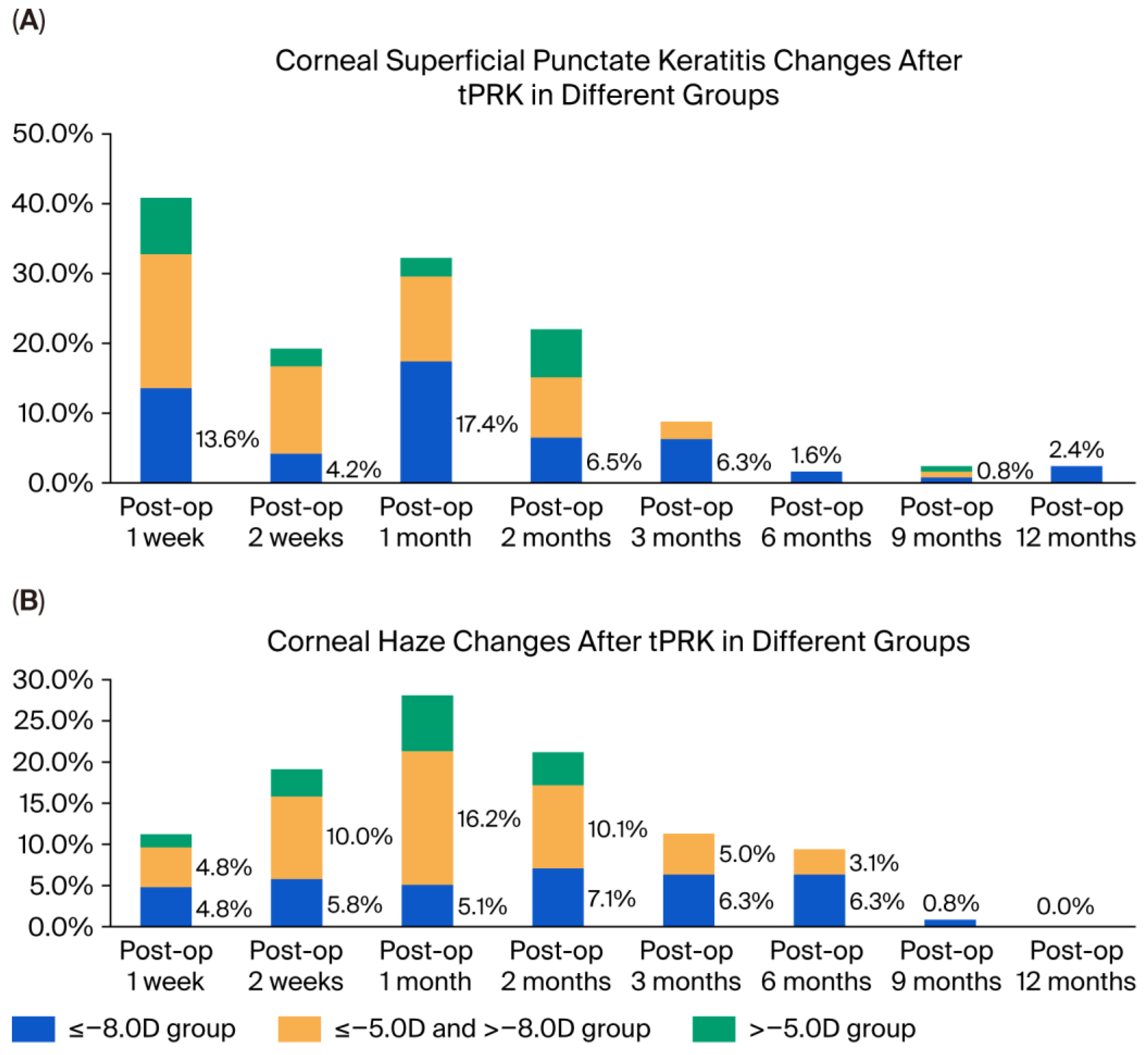

Table 1.
The baseline characteristics and related factors of the study population.
| Mean (SD) / N (%) / P | Total (125 eyes) |
P corneal spk | P corneal haze | P Final SE |
P Final UCVA logMAR |
|---|---|---|---|---|---|
| Age, y | 30.20 (6.34) | 0.977b | 0.015b* | 0.780a | 0.066a |
| Gender (M) | 42 (33.60%) | 0.849b | 0.931b | 0.002a* | 0.793a |
| OD | 51 (50%) | 0.104b | 0.773b | 0.538a | 0.990a |
| Preoperative factors | |||||
| Initial manifest refraction: sphere power, D | -6.42 (2.27) | 0.211b | 0.193b | 0.361a | 0.362a |
| spherical equivalent, D | -7.16 (2.31) | 0.890b | 0.310b | 0.110a | 0.185a |
| CCET, µm | 52.78 (4.19) | 0.336b | 0.454b | 0.568a | 0.380a |
| CCT, µm | 531.27 (30.60) | 0.682b | 0.988b | 0.011a* | 0.209a |
| Operative factors | |||||
| Determined refraction: sphere power, D | -6.01 (2.03) | 0.850b | 0.060b | 0.005a* | 0.295a |
| spherical equivalent, D | -6.66 (2.05) | 0.890b | 0.055b | 0.006a* | 0.373a |
| Ablation depth µm | 164.34 (29.33) | 0.064b | 0.080b | 0.228a | 0.499a |
| Residual thickness, µm | 366.90 (45.08) | 0.075b | 0.110b | 0.123 a | 0.738a |
| Differences in measured and performed CCET, µm | -2.75 (3.07) | 0.042b* | 0.062b | 0.246a | 0.642a |
| Ablation diameter, mm | 6.48 (0.24) | 0.090b | 0.130b | 0.671a | 0.834a |
| MMC soaking duration, second | 61.79(12.35) | 0.068b | 0.030b* | 0.532a | 0.627a |
| Laser applied interval, second | 57.56 (7.42) | 0.046b* | 0.064b | 0.274a* | 0.680a |
| Postoperative factors | |||||
| Follow-up periods, month | 6.69 (3.73) | 0.031b* | 0.063b | 0.091a | <0.001a* |
| Corneal superficial punctate keratitis | 12 (9.6%) | 0.518b | 0.704a | 0.580a | |
| Corneal haze | 11 (8.8%) | 0.518b | 0.043a* | 0.040a* | |
| Final manifest refraction: sphere power, D | 0.17 (0.71) | 0.677b | 0.451b | 0.874a | |
| spherical equivalent, D | -0.12 (0.73) | 0.596b | 0.834b | <0.001a* | |
| Final UCVA, logMAR | 0.01 (0.08) | 0.711b | 0.051b | 0.009a* | |
| *P<0.05, a Linear mixed model, b Generalized estimation equation; SD, standard deviation; N, number; %, percentage; D, diopter; CCET: central corneal epithelial thickness; CCT: central corneal thickness; SPK, superficial punctate keratitis; SE, spherical equivalent; UCVA: non-corrected visual acuity; D, diopter; y, year; M, male; logMAR, logarithm of minimum angle of resolution; | |||||
Table 2.
The baseline characteristics and related factors of three groups including low myopia (>-5.0 D), moderate-to high myopia (≤ -5.0 Dand >-8.0 D) and extremely high myopia (≤ -8.0 D).
Table 2.
The baseline characteristics and related factors of three groups including low myopia (>-5.0 D), moderate-to high myopia (≤ -5.0 Dand >-8.0 D) and extremely high myopia (≤ -8.0 D).
| Mean 8. | Extremely high myopia ≤ -8.0 D (37 eyes, 30%) |
Moderate-to-high myopia ≤ -5.0 D and > -8.0 D (53 eyes, 42%) |
Low myopia > -5.0 D (35 eyes, 28%) |
P |
|---|---|---|---|---|
| Age, y | 30.44 (0.89) | 30.01 (0.86) | 30.37 (0.88) | 0.486a |
| Gender (M) | 12 (32.40) | 17 (32.10) | 13 (37.1) | 0.756b |
| OD | 19 (51.40) | 27 (50.90) | 17 (48.6) | 0.745b |
| Preoperative factors | ||||
| Initial manifest refraction: spherical power, D | -9.17 (0.15) | -6.28 (0.13) | -3.73 (0.15) | <0.001a* |
| Spherical equivalent, D | -9.59 (0.20) | -7.09 (0.16) | -4.69 (0.20) | <0.001a* |
| Central corneal epithelial thickness, µm | 51.47 (0.74) | 3.15 (0.61) | 53.45 (0.73) | 0.104a |
| Central corneal thickness, µm | 536.44 (4.73) | 523.56 (4.32) | 525.51 (4.59) | 0.016a* |
| Operative factors | ||||
| Differences in measured and performed Corneal epithelial thickness, µm | -3.26 (0.54) | -2.43 (0.44) | -2.09 (0.53) | 0.246a |
| Ablation depth, µm | 182.67 (3.42) | 165.36 (2.90) | 141.67 (3.28) | <0.001a* |
| Mitomycin C soaking duration, second | 59.52 (1.13) | 57.92 (1.00) | 55.22 (1.09) | <0.001a* |
| Laser applied interval, second | 67.90 (1.79) | 61.72 (1.48) | 54.77 (1.72) | <0.001a* |
| Postoperative factors | ||||
| Follow-up periods, month | 7.43 (0.54) | 6.30 (0.49) | 6.35 (0.53) | 0.027 a* |
| Corneal superficial punctate keratitis | 6 (16.2) | 5 (9.40) | 3 (9.10) | 0.173b |
| Corneal haze | 3 (8.1) | 5 (9.40) | 2 (5.70) | 0.795b |
| Final manifest refraction: sphere power, D | -0.07 (0.13) | 0.23 (0.11) | 0.33 (0.13) | 0.052a |
| spherical equivalent, D | -0.38 (0.13) | -0.05 (0.11) | 0.05 (0.13) | 0.036a* |
| Final UCVA, logMAR | 0.01 (0.02) | 0.01 (0.01) | 0.00 (0.01) | 0.896a |
| *P<0.05, a Linear Mixed Models, b Generalized Estimating Equations; SE, standard error; N, number; %, percentage; SE, spherical equivalent; UCVA: non-corrected visual acuity; D, diopter; y, year; M, male; logMAR, the logarithm of the minimum angle of resolution | ||||
Table 3.
Differences between all refractions and determined refractions, and final refractions.
| Total: 64 patients, 125 eyes Mean (SD/SE)/ P |
Total (125 eyes) |
Extremely high myopia ≤ -8.0 D (37 eyes, 30%) |
Moderate-to-high myopia ≤ -5.0 D and > -8.0 D (53 eyes, 42%) |
Low myopia > -5.0 D (35 eyes, 28%) |
|---|---|---|---|---|
| Differences between initial manifest and determined refraction: Spherical equivalent, D Univariate (Pair t-test: mean, SD) Multivariate (LMM: mean, SE), P=0.002a* |
-0.17 (0.80)/P=0.02c* 0.67 (0.17) |
-0.12 (1.12)/P=0.504c -0.54 (0.11) |
-0.17 (0.68)/P=0.070c -0.26 (0.09) |
-0.21 (0.55)/P=0.032c* -0.03 (0.11) |
| Differences between cycloplegic and determined refraction: Spherical equivalent, D Univariate (Pair t-test: mean, SD) Multivariate (LMM: mean, SE), P=0.286a |
0.03 (0.74)/P=0.762c 0.26 (0.19) |
0.13 (1.01)/P=0.685c -0.02 (0.15) |
-0.01 (0.82)/P=0.960c -0.00 (0.09) |
0.02 (0.50)/P=0.817c 0.19 (0.10) |
| Differences between subjective and determined refraction: Spherical equivalent, D Univariate (Pair t-test: mean, SD) Multivariate (LMM: mean, SE), P=0.491a |
0.11 (0.77)/P=0.127c -0.35 (0.21) |
0.39 (0.88)/P=0.011c* 0.03 (0.07) |
0.03 (0.79)/P=0.811c -0.05 (0.06) |
-0.07 (0.50)/P=0.394c 0.04 (0.07) |
| Final manifest refraction: Spherical equivalent, D Univariate (Pair t-test: mean, SD) Multivariate (LMM: mean, SE), P=0.036a* |
-0.12 (0.73) -0.12 (0.08) |
-0.39 (0.86) -0.38 (0.13) |
-0.07 (0.72) -0.05 (0.11) |
0.09 (0.47) 0.05 (0.13) |
| *P<0.05; a LMM, linear mixed models; c Pair t-test; SD: standard deviation; SE, standard error | ||||
Disclaimer/Publisher’s Note: The statements, opinions and data contained in all publications are solely those of the individual author(s) and contributor(s) and not of MDPI and/or the editor(s). MDPI and/or the editor(s) disclaim responsibility for any injury to people or property resulting from any ideas, methods, instructions or products referred to in the content. |
© 2026 by the authors. Licensee MDPI, Basel, Switzerland. This article is an open access article distributed under the terms and conditions of the Creative Commons Attribution (CC BY) license (http://creativecommons.org/licenses/by/4.0/).
Copyright: This open access article is published under a Creative Commons CC BY 4.0 license, which permit the free download, distribution, and reuse, provided that the author and preprint are cited in any reuse.


