

Submitted:
06 May 2026
Posted:
08 May 2026
You are already at the latest version
Abstract
The paper shows how the ideas of Archimedes about integrating “mechanical methods” and formal reasoning can be connected with the modern-day use of three computer programs – Wolfram Alpha, Maple, and Excel – in exploring topics from elementary theory of numbers. Explorations deal with subsequences of integer sequences through step-by-step elimination of every other term obtained on the previous step. This process, resembling the sieve of Eratosthenes, is applied to tetrahedral numbers appearing in the social context of the family therapy triangulation method. It is demonstrated that symbolic computations of Wolfram Alpha enable generalization in the construction of the sieves that is confirmed by Maple and a spreadsheet. The paper addresses one of the aims of the special issue by demonstrating the duality of mathematics and technology in the sense that whereas the latter facilitates new approaches to knowledge acquisition, the former can be used to improve the efficiency of computations by reflecting on the results made possible by those approaches. The activities advocate for the value of integrating ancient ideas, digital tools, and elementary number theory in the education of mathematics teachers. Reflective comments by teacher candidates are included as appropriate.
Keywords:
mathematics education
; technology
; tetrahedral numbers
; Cullen numbers
; symbolic computation
; computational triangulation
1. Introduction
The genesis of this mathematics education paper can be traced back to the ideas of the 3rd century B.C. evidenced through the correspondence between Archimedes and Eratosthenes. In this correspondence, as mentioned in [1], the value of a “mechanical method” as a precondition to formal demonstration in mathematics was acknowledged. The name of Eratosthenes is known to every practitioner of the subject matter, mathematics teacher candidates included, due to the seminal sieve method of separating prime numbers from natural numbers by eliminating step-by-step multiples of a prime number obtained at the previous step of the elimination process. Whereas in the digital era a computational experiment can be considered a “mechanical method” for it allows one, in the course of learning mathematics, to “precede the phase of verbalization and concept formation” [2, p. 104], the idea of a sieve can also be applied to any integer sequence by defining an elimination rule. For example, the sequence of hexagonal numbers 1, 6, 15, 28, 45, … can be obtained from the sequence of triangular numbers 1, 3, 6, 10, 15, 21, 28, 36, 45, … by eliminating every other triangular number. Such elimination can be referred to as the development of the triangular number sieve of order one.
Triangular numbers are known from the time of Pythagoras when integers started being associated with geometric shapes [3] and culturally significant societal concepts such as justice and marriage [4]. In number theory, triangular numbers are most notably associated with the theorem (proved by Gauss) that any natural number is a sum of at most three triangular numbers [5] and it was extended by Cauchy to m-gonal numbers [6] allowing for such representations through a sum of at most six hexagonal numbers (m = 6). Teachers of mathematics in North America are familiar with triangular numbers in the context of reasoning and proof of the Principles and Standards for School Mathematics [7, p. 262] in which one can find how “rising seventh-grade students were studying figurate numbers … to generate representations for the first five triangular numbers”. Both triangular numbers and their partial sums, known already to mathematicians of ancient Greece as tetrahedral (or triangular pyramidal) numbers, are figurate numbers, which are also binomial coefficients appearing in Pascal’s triangle [8].
In this paper, such integration of mathematics, pedagogy, history and technology is utilized in the context of tetrahedral numbers appearing in the social context of family therapy [9]. In this context, the methodology of triangulation was used in connecting multiple individuals by triangles because for an emotional system of two individuals to be stable “it forms itself into a three-person or triangle under stress” [9, p. 478]. The concept of triangulation as an instrument used to connect different contexts was appreciated by one of the author’s students, a teacher candidate, who believed that “there absolutely exists a triangular relationship between mathematics, technology and real life”. Mathematically speaking, the number of triangles connecting n points (not having more than two points on the same line) is expressed by a tetrahedral number. Because tetrahedral numbers T(n) are partial sums of triangular numbers we have
However, in the context of constructing triangles by connecting three points selected out of n points available, the number of 3-combination of n objects without repetition is equal to Both expressions representing include the product of three consecutive counting numbers, but in the latter product we have n > 2, something that is necessary for the construction of a triangle. With this in mind, if in the latter form for T(n) one replaces n by n + 2, to allow n to start from one, the former form for T(n) results. Alternatively, if in the former form for T(n) one replaces n by n – 2 to allow n to start from three, the latter form for T(n) results.
As will be shown below, one’s ability to modify an integer variable expression to make it work starting from smaller (or larger) values is critical when using digital tools as means of algebraic generalization from numerical evidence. In the arithmetic of rational numbers, equivalent modifications can be described as the change of unit in the reduction of a common fraction to the simplest form. In the arithmetic of integers, equivalent representations of tetrahedral numbers provide an example of how the concreteness of context and the abstractness of content may have different (but equivalent) symbolic representations of the associated concept. In what follows, the expression will be used to talk about tetrahedral numbers.
The paper will demonstrate the joint use of Wolfram Alpha, Maple, and a spreadsheet in computational explorations of tetrahedral number sieves of different orders using Cullen-type elimination techniques [10] named after James Cullen (1867-1933), an Irish mathematician and Jesuit priest. Mathematics education contexts will include secondary and tertiary number theory and K-12 teacher preparation. The paper intends to address one of the aims of the special issue by demonstrating the duality of mathematics learning and technology uses in the sense that whereas the latter facilitates new approaches to knowledge acquisition, the former can be used to improve the efficiency of computations by reflecting on the results made possible by those approaches. Furthermore, it will be demonstrated that in the digital era such reflection can also be supported by technology.
2. Materials and Methods
One type of materials used by the author when working on this paper is digital. Those materials, called by educators “mathematical action technologies” [11], include computational knowledge engine Wolfram Alpha developed by Wolfram Research (www.wolframalpha.com., accessed on April 20, 2026), mathematical software Maple [12] and MS Excel spreadsheet. Another type of materials included historical documents enabling the use of classic ancient ideas in the digital era. These materials allowed the author to see mathematics of antiquity through the modern-day lens. The third type of materials is purely educational comprised of mathematics teaching and learning standards and recommendations for teacher preparation in North America [13,14,15,16]. The university where the author works is in upstate New York at the very border with Canada and many teacher candidates enrolled in graduate mathematics education courses taught by the author are Canadians whose presence in mathematics and other subject matter courses bestows upon the teacher education program an international flavor.
Methods specific for mathematics teacher education include computer-based explorations, standards-based pedagogy, and mathematical problem solving. In the context of elementary theory of numbers, problem solving enables future teachers’ professional development as they “use number theory to justify relationships involving whole numbers” [7, p. 290]. These methods emphasize the use of technology by students and teachers, and guide both groups in the development of computational skills that “make complex ideas tractable” [15, p. 57], and “enhance communication about mathematics within the classroom” [16, p. 125]. The spirit of these recommendations for teacher candidates is reflected in the following comment made by one of them: “technology has also changed how I view and teach mathematics … students don’t just learn math, but actually understand why it matters”. This and other reflective comments by teacher candidates (the author’s students), solicited through discussion forums of asynchronous courses, have been included in the paper in support of the standards-motivated methods and research-based recommendations [13,14,15,16].
3. Formulating Elimination Rule for Tetrahedral Number Sieves
As was mentioned above, tetrahedral numbers are partial sums of triangular numbers 1, 3, 6, 10, 15, 21, … We have 1 + 3 = 4, 1 + 3 + 6 = 10, 1 + 3 + 6 + 10 = 20, and so on. Therefore, the numbers 1, 4, 10, 20, 35, 56, 84, … are tetrahedral numbers and they represent the tetrahedral number sieve of order zero. Entering these numbers into the input box of Wolfram Alpha (Figure 1) confirms already mentioned the closed formula for the n-th tetrahedral number which, for consistency with other sieves to be developed in the paper, can be written in the form
The goal of this section is to collect numerical evidence, using the sieves of orders zero through six, for the development of the tetrahedral number sieve of order k. Whereas all the sieves are polynomials of the third degree, the coefficients of those polynomials, as will be shown below, vary according to the rules yet to be determined using Wolfram Alpha and confirmed by Maple in the spirit of computational triangulation [17]. Computational triangulation is an approach of using more than one digital tool to provide rigor in computations just as sociologists consider triangulation as “a plan of action that will raise sociologists above the personalistic biases that stem from single methodologies” [18, p. 300]. By reflecting on the so developed general sieve, the symbolically complex form of its coefficients can be further explored with technology to enable the recognition of unexpected simplicity of the coefficients and, consequently, of the sieve. This recognition will allow for the construction of sieves for other integer sequences without collecting numerical evidence for understanding the symbolic form of the corresponding coefficients.
Tetrahedral number sieve of order one consists of every other tetrahedral number: 1, 10, 35, 84, 165, 286, … . Entering these numbers into the input box of Wolfram Alpha (Figure 2) yields the formula
Tetrahedral number sieve of order two consists of every other number of the sieve of order one: 1, 35, 165, 455, 969, 1771, … . Entering these numbers into the input box of Wolfram Alpha (Figure 3) yields the formula
Tetrahedral number sieve of order three consists of every other number of the sieve of order two: 1, 165, 969, 2925, 6545, 12341, … . Entering these numbers into the input box of Wolfram Alpha (Figure 4) yields the formula
Tetrahedral number sieve of order four consists of every other number of the sieve of order three: 1, 969, 6545, 20825, 47905, … . Entering these numbers into the input box of Wolfram Alpha (Figure 5) yields the formula
Tetrahedral number sieve of order five consists of every other number of the sieve of order four: 1, 6545, 47905, 156849, 366145, … . Entering these numbers into the input box of Wolfram Alpha (Figure 6) yields the formula
Tetrahedral number sieve of order six consists of every other number of the sieve of order five: 1, 47905, 366145, 1216865, 2862209, … . Entering these numbers into the input box of
Wolfram Alpha (Figure 7) yields the formula
Formulas (1) – (7) provide numerical evidence for determining coefficients of the third- degree polynomials that are unknown functions of the order of the sieve. To this end, Wolfram Alpha will be used to generalize from the data obtained by the tool at the lower level of generalization. Such two-step process of generalization will be verified by using another digital tool, Maple, to move back from general (symbolic) to specific (numeric).
4. Symbolic Generalization from Numeric Data
To begin, consider the polynomial
which represents the tetrahedral number sieve of order k with coefficients to be determined. To this end, numerical evidence, provided by Wolfram Alpha in developing the sieves of orders zero through six, can be put to use. That is, Wolfram Alpha will assist in generalizing from the data it developed at the previous step of generalization. One can see that Wolfram Alpha will provide the “mechanical method” of the second order, something that clearly calls for an independent method involving a different tool. That is, on the first step, a “mechanical method” provides knowledge that can be verified by another “mechanical method” on the second step as a way of formal demonstration in the digital era. In the words of Archimedes, “it is of course easier … to supply the proof that is to find it without any previous knowledge” [1, p. 13].
According to formulas (1) – (7) the coefficients in n3 are One can see that the exponents in the powers of 2 form the sequence 3k – 1 where k is the order of the corresponding sieve. That is,
One can check to see that formula (9) yields – the result consistent with formula (1). However, if one uses Wolfram Alpha to confirm formula (9), the result is and . At the same time, . This inconsistency suggests that using technology as a “mechanical method” for algebraic generalization requires verification of the results through the use of special cases as an element of proof. Just as two different expressions for T(n) required a two-position shift to the left of the variable n to enable the inequality n > 2 to be replaced by the inequality n > 0 to enable smaller values of n work for T(n), the Wolfram Alpha result for is true for k > 0 and, in order to include the case k = 0 (tetrahedral numbers as the sieve of order zero), a one-position shift to the left is required by replacing k in the expression
obtained through the “mechanical method” by k + 1. This replacement turns into – the right-hand side of formula (9). It appears that such one-position shift to the left would have to be applied to all other coefficients of in (8) in order to include the case k = 0.
Next, according to formulas (1) – (7) the coefficients in n2 are . However, unlike the case of when six values were enough to generalize, even without Wolfram Alpha, a closed-form formula, the value of is required for generalization. This value is shown in Figure 7 and the generalization is shown in Figure 8 (noting ). Replacing k in the last expression by k + 1 yields the formula
One can check to see that – the result consistent with formula (1).
To continue, according to formulas (1) – (7), the coefficients in n are . However, unlike the case of when seven values were enough for Wolfram Alpha to provide closed-form formula, at least one more value is required for generalization. To this end, note that tetrahedral number sieve of order seven consists of every other number of the sieve of order six: 1, 366145, 2862209, 9585345, … . Entering these numbers into the input box of Wolfram Alpha (Figure 9) results in a closed formula
so that .
This allows one to enter the first eight values of into the input box of Wolfram Alpha to get as shown in Figure 10 (noting ). Once again, replacing k in the last expression by k + 1 yields the formula
One can check to see that the result consistent with formula (1).
Finally, according to formulas (1) – (7) and (11), the coefficients in n0 are . Entering the first eight values of into the input box of Wolfram Alpha yields (Figure 11) , noting ). Once again, replacing k in the last expression by k + 1 yields the formula
One can check to see that – making formula (14) consistent with formulas (1).
Now, one can use formulas (9), (10), (12), and (14) to rewrite formula (8) as follows:
Formula (14) can be used to construct tetrahedral number sieves of orders zero through nine as shown in Figure 12.
5. Computational Triangulation Using Maple and a Spreadsheet
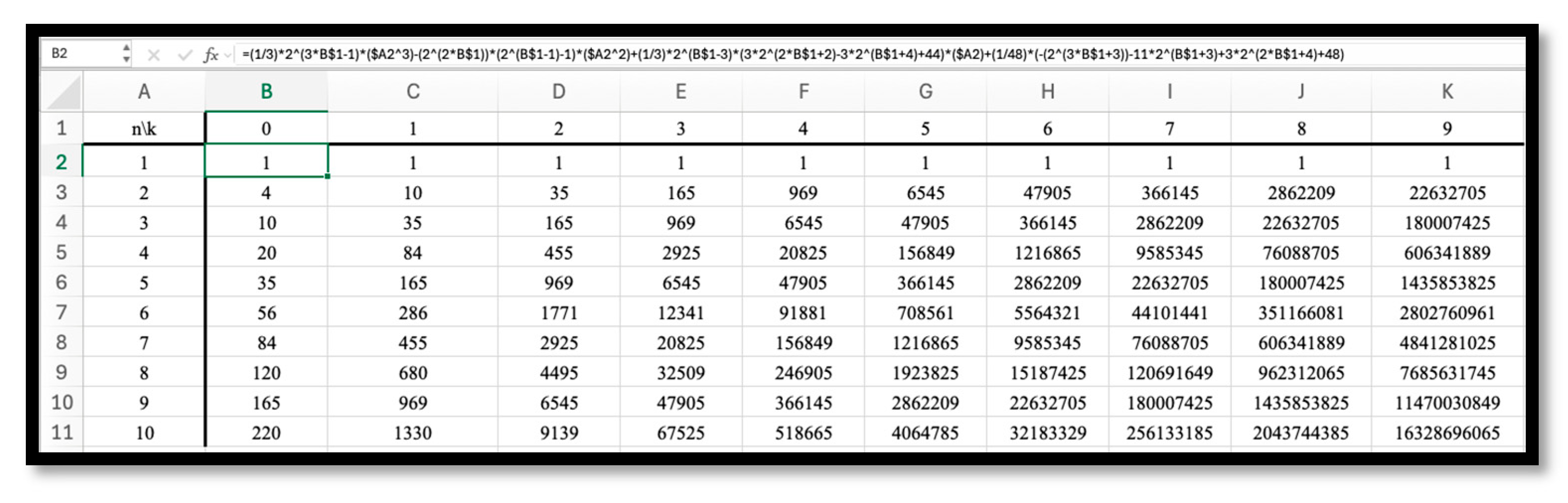
One can use Maple (Figure13) and a spreadsheet (Figure 14) as alternative “mechanical methods” to confirm the correctness of using Wolfram Alpha in developing and modeling formula (14). The numeric arrays generated by Maple and a spreadsheet are identical to that of Wolfram Alpha (Figure 12). In particular, the last integer generated by Maple (Figure 13), that is, is the same as the bottom-right integer in the matrix of Figure 12. Likewise, the same number can be seen in cell K11 of the spreadsheet of Figure 14. Such uses of Maple and a spreadsheet provide computational triangulation [17] of the results obtained by Wolfram Alpha. As mentioned in the pre-digital era by Freudenthal , the credibility of experimental problem-solving is provided by “independency of new experiments … [because] repeating does not create new evidence, which in fact is successfully aspired to by independent experiments” [19, pp. 193, 194). In the digital era, “in the realm of computers, unreliability sometimes seems to be the norm” [20, p. 1400]. This position might be due to an unwitting error used in computer code of one of the digital tools and it implies the need to verify computational results in order to be trusted.
Figure 13.
Using Maple to triangulate the results of Wolfram Alpha.
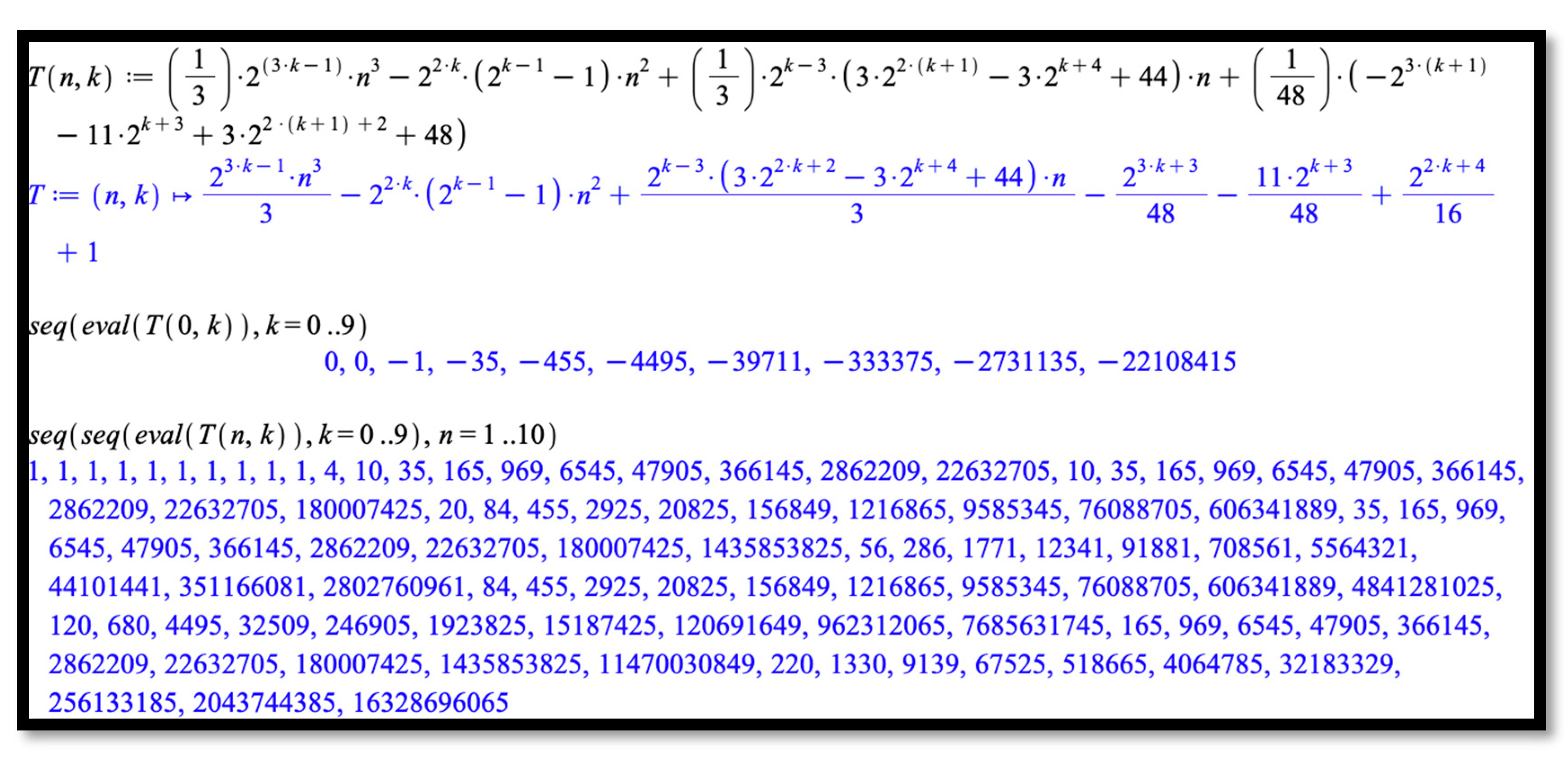
Figure 14.
Using a spreadsheet to triangulate the results of Wolfram Alpha.
At the elementary level, when using a calculator, a child might accidentally press the “” button when finding the sum 6 + 3 to get 2 instead of 9 – both outcomes looking grade-appropriate for the child without reflecting on the meaning of addition as operation on two positive integers. A teacher candidate, comparing her past and present experience with technology, reflected on the use of a calculator in grade school as follows: “ I often think back in the day when I went to school and was told that I would never have access to a calculator when I was older, and see where education is now with math and resources is truly amazing”. As will be shown in the next section, reflection not only serves as a means of reliability of computing in mathematics, whatever grade level, but it can also result in the improvement of a computational algorithm.
6. Reflection Towards Improving Computational Efficiency
Reflecting on the original expression for T(n) as a product of three linear expressions and formula (1) in which T(n) is presented as a third-degree polynomial, may prompt the idea of using technology to factor the expression for something that is too complex to carry out by paper and pencil. Indeed, in the words of a teacher candidate, “Using Wolfram Alpha was valuable experience for me … its ability to instantly compute answers made it a helpful companion to explore patterns that would have been time-consuming to analyze by hand”. While factoring will be done computationally, the very idea of factoring a polynomial belongs to the mathematical habit of mind and, if the result of factoring leads to the improvement of computation, it is due to mathematics that the efficiency of computations is achieved. With this in mind, by reflecting on the constructions of the sieves, one can use Wolfram Alpha (Figure15) to factor the right-hand side of formula (14) to get the following factorization
That is,
In particular, – the form for the tetrahedral numbers already mentioned in the introduction. One can see that just as , is the product of three linear combinations of n. Furthermore, by plugging the values of k = 1, 2, …, 6 into formula (15), formulas (2)–(7) result. Comparing formulas (14) and (15), one can see that the idea of factoring indeed bears fruit.
7. Cullen-Type Elimination in the Development of Sieves
As was mentioned at the conclusion of the last section, formula (15) looks similar to formula (1) in the sense that the value of n in the latter formula can be replaced by the value of to get the former formula. This observation suggests two things. First, just as n represents the rank of the tetrahedral number T(n), the expression represents the rank of – the n-th term of the tetrahedral sieve of order k. For example, is the rank of the number 165 – the third term (n = 3) of the tetrahedral number sieve of order two (k = 2). Likewise, is the rank of the number 2925 – the fourth term (n = 4) of the tetrahedral number sieve of order three (k = 3). Moreover, is the rank of the number 47905 – the fifth term (n = 5) of the tetrahedral number sieve of order four (k = 4). In all three cases, the exponent of and the coefficient in the power of 2 are the same. That is, k = n – 1. The numbers of the form are called Cullen numbers and they define ranks of the n-th terms of the tetrahedral number sieves of orders n – 1. For example, the number 16328696065 appearing at the bottom-right corners of the matrices of Figs. 12–14 is the tenth term of the tetrahedral number sieve of order nine the rank of which is Using formula (1), one can check to see that . The eliminations of every other term of the tetrahedral number sieves can be called the Cullen-type eliminations. One can see (Figs. 12–14) that the second number in the sieve of order one is 10 the rank of which as a tetrahedral number is 3. The third number in the tetrahedral sieve of order two is 165 the rank of which as a tetrahedral number is 9. In general, the n-th number in the sieve of order n – 1 is equal to the rank of which as a tetrahedral number is . In fact, whatever an integer sequence is, a step-by-step elimination of any other term of the corresponding sieves is the Cullen-type elimination because the ranks of surviving numbers are all the same.
Second, formula (15), obtained by factoring the right-hand side of formula (14), may prompt recognizing many familiar integers as special cases of Cullen numbers. For example, setting k =1 in the Cullen number yields – the sequence of odd numbers. Indeed, by eliminating step by step every other number from the sequence of natural numbers yields the natural number sieve of order one shown in Figure 16. One can see (Figure 16) that the second number in the natural number sieve of order one is 3 the rank of which as a natural number is 3. Indeed, The third number in the tetrahedral number sieve of order two is 165 the rank of which as a tetrahedral number is 9. Indeed, Likewise, by eliminating step by step every other number from the sequence of triangular numbers yields the triangular number sieve shown by the spreadsheet in Figure 17 and by Maple in Figure 18. One can see (Figure 17, cell C3) that the second number in the triangular sieve of order one is 6 the rank of which as a triangular number is 3. The third number in the triangular sieve of order two is 45 (Figure 17, cell D4) the rank of which as a triangular number is 9. Indeed, The triangular number of rank 161 is 13041 ( – the sixth number in the triangular number sieve of order five shown in Figure 17 (cell G7) and in Figure 18.
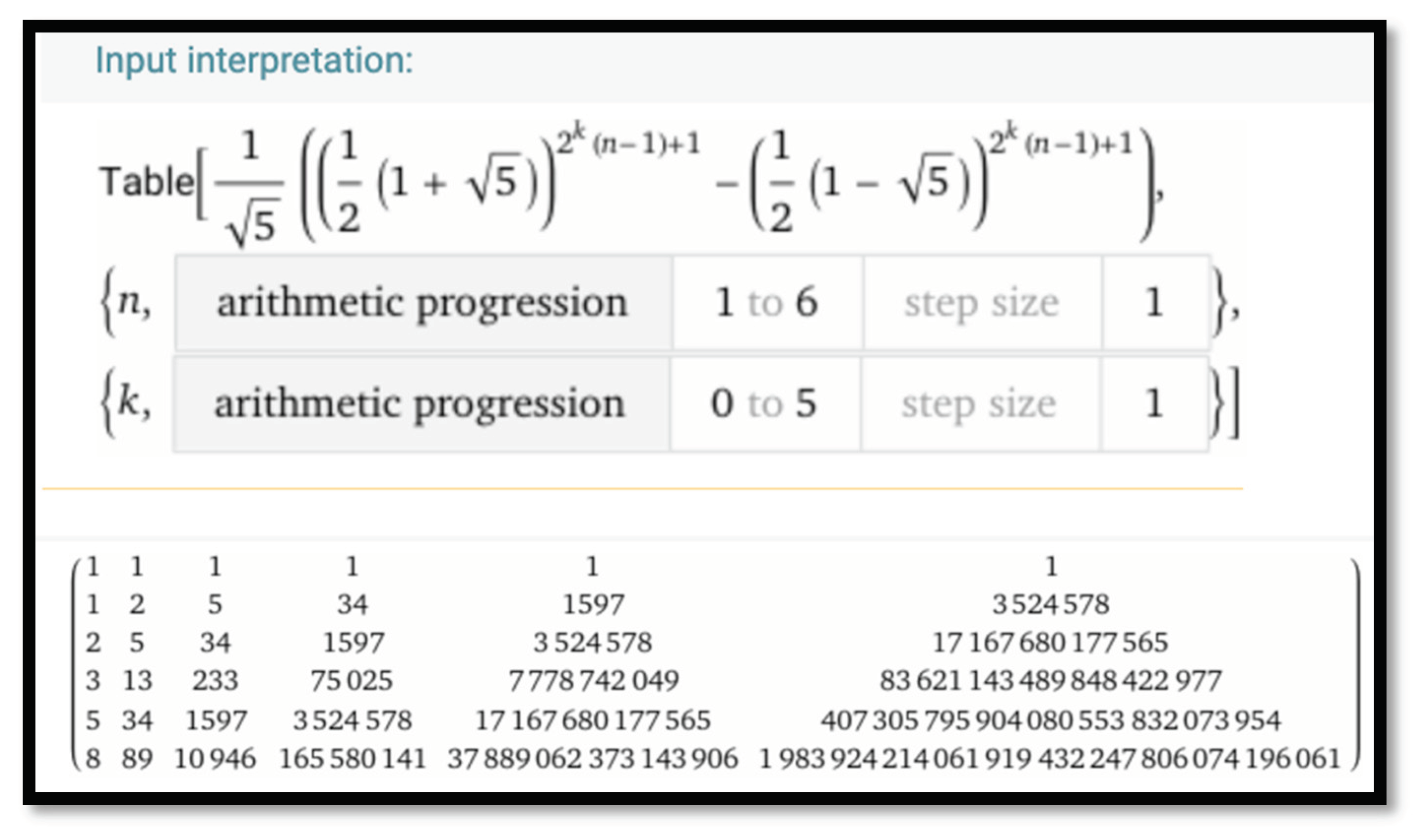
Furthermore, Cullen numbers can also be applied to Fibonacci number sieves defined by the same type of elimination. For example, by eliminating every other number from the sequence 1, 1, 2, 3, 5, 8, 13, 21, 34, 55, 89 yields the sequence called in [21] Matijasevic numbers[1] 1, 2, 5, 13, 34, 89. Substituting n in Binet’s formula for Fibonacci numbers yields – the Fibonacci number sieve of order k. One can see (Figure 19) that the second number in the Fibonacci sieve of order one is 2 the rank of which as a Fibonacci number is 3. The third number in the Fibonacci sieve of order two is 34 the rank of which as a Fibonacci number is 9. The Fibonacci number in the bottom-right corner of the matrix of Figure 19 generated by Wolfram Alpha has rank 161 as a Fibonacci number – the same rank as the corresponding natural number (161, cell G7 of the spreadsheet of Figure 16) and triangular number ( , cell G7 of the spreadsheet of Figure 17 and t(6, 5) in Maple-generated screen shot of Figure 18). This shows that regardless of an integer number sequence, any elimination of every other element of its sieves is the Cullen-type elimination because the ranks of the surviving numbers are all the same. Such integration of pragmatic and epistemic uses of technology beyond the gist of the original problem enabled a teacher candidate to suggest that “conceptual thinking allows us the chance to think “outside the box” and look deeper into variety of solutions”.
8. Conclusion
The paper was written to demonstrate the power of the modern-day “mechanical methods” in exploring topics of the elementary theory of numbers. Recommended for early mathematics instruction long before the digital era [23], number theory, due to advances in technology, provided new paths for computational experiments with numbers [24,25,26,27]. Whereas tetrahedral numbers and the sieve process as concepts of number theory came to us from antiquity, their integration in mathematical education of teachers became possible only recently under the general umbrella of experimental mathematics [28,29,30,31]. Wolfram Alpha is one of the tools that motivates teachers of mathematics using experimental approach to mathematical discovery, something that is appealing pragmatically and beneficial epistemically to the learners of mathematics. According to a teacher candidate, “The support of digital technology like Wolfram Alpha allowed me to deepen my understanding and effectively doing work that would take much longer if done by hand”.
To introduce tetrahedral numbers, the paper demonstrated their presence in a social context of family therapy [9] when connecting multiple individuals with triangles as a way of achieving the stability of, otherwise unstable, an emotional system between two individuals. Mathematically speaking, the number of triangles connecting n points (not having more than two on the same line) is expressed by a tetrahedral number. Proceeding from the original sequence of tetrahedral numbers as the sieve of order zero and defining the sieve of order k as the result of elimination of every other number in the sieve of order k – 1, the general formula for the tetrahedral number sieve of order k was developed through the use of symbolic computations of Wolfram Alpha. The formula was a third-degree polynomial the coefficients of which were linear combinations of the powers of two with exponents being linear combinations of the sieve’s order.
One of the teacher candidates reflected on the use of Wolfram Alpha by the learners of mathematics as follows: “As the problems students are learning begin to get increasingly more challenging, Wolfram Alpha is one of the best tools they can use to ensure correct mathematical answers”. Nonetheless, symbolic computations provided by Wolfram Alpha were computationally triangulated by Maple and a spreadsheet. Whereas a spreadsheet does not have capabilities of symbolic computations, it nicely presents in the matrix form the results of numeric modeling of two-dimensional structures of sieves developed by Wolfram Alpha and verified by Maple. In that way, the use of spreadsheets and Maple supplied computational experiments with a proof which, in the words of Archimedes, one would not be able “to find … without any previous knowledge” [1, p. 13]. Such triangulation was seen as a “mechanical method” of the second order through which the correctness of computations was confirmed as kind of a formal demonstration. The coefficients of the tetrahedral number sieve of order k were connected to Cullen numbers , which, when being substituted for n in the tetrahedral number sieve of order zero, turned the latter into the sieve of order k. This connection of the coefficients of the tetrahedral number sieve of order k to Cullen numbers enabled the straightforward construction of the natural, triangular, and Fibonacci number sieves of order k. It was shown that regardless of an integer number sequence, any elimination of every other element of its sieves is the Cullen-type elimination because the ranks of numbers surviving the elimination are all the same. For example, the first survivors on the fourth step of the Cullen-type elimination of natural, triangular, tetrahedral, Fibonacci numbers are (as shown in Figs. 16, 17, 14, 19), respectively, 17, 153, 969, 1597 – they all have the rank 17 ( ) on the corresponding sieves of order zero (that is, as the 17th terms of natural, triangular, tetrahedral, and Fibonacci numbers, respectively).
The framework that the paper pursued can be recommended for independent projects in secondary mathematics teacher education programs. First, an original problem, its content and the choice of technology were formulated. Then, technology was used to collect numerical evidence in special cases. This followed by the use of technology to generalize from numerical evidence. As the modern-day proof of generalization in mathematics, computational triangulation was employed using alternative digital tools. Then, technology was used to reflect on the results of generalization. This reflection allowed for improving computational efficiency in the context of the original problem that was applied to other mathematical contents. Finally, computational triangulation was carried out in new mathematical contents.
The described framework incorporated instruments quite different from those apparently used by Archimedes. Nonetheless, “mechanical methods” separated by two millennia always served for the advancement of mathematical ideas regardless of time. Therefore, integrating ancient ideas into the modern-day digital context of teacher education enables the unity of history, subject matter, and technology as a pedagogical approach that expands and diversifies the teaching of mathematics to schoolteachers who are eternally the major custodians of knowledge developed over the centuries.
Funding
This research received no funding.
Data Availability Statement
Not applicable.
Conflicts of Interest
The author declares no conflict of interest.
References
- Archimedes. The Method of Archimedes.; Heath, T. L., Ed.; Cambridge University Press: Cambridge, England, 1912. [Google Scholar]
- Pólya, G. Mathematical Discovery: On Understanding, Learning and Teaching Problem Solving; John Wiley & Sons: New York, NY, USA, 1965; volume 2. [Google Scholar]
- Beiler, A. H. Recreations in the Theory of Numbers; Dover: New York, NY, USA, 1966. [Google Scholar]
- Aristotle. Metaphysics.; Ross, W. D., Translator; Roman Roads Media: Moscow, Idaho, USA, 2013. [Google Scholar]
- Andrews, G. E. ! num = Δ + Δ + Δ. J. Num. Th. 1986, 23(3), 285–293. [Google Scholar] [CrossRef]
- Nathanson, M. B. A short proof of Cauchy’s polygonal number theorem. Proc. Amer. Math. Soc. 1987, 99(1), 22–24. [Google Scholar]
- National Council of Teachers of Mathematics. Principles and Standards for School Mathematics; The Author: Reston, VA, USA, 2000. [Google Scholar]
- Deza, E.; Deza, M. M. Figurate Numbers; World Scientific: Singapore, 2012. [Google Scholar]
- Bowen, M. Family Therapy in Clinical Practice; Jason Aranson: Lanham, MD, USA, 1994. [Google Scholar]
- Abramovich, S. Exploring polygonal number sieves through computational triangulation. MDPI Comput. 2023, 11, 251. [Google Scholar] [CrossRef]
- National Council of Teachers of Mathematics. Principles to Actions: Ensuring Mathematical Success for All; The Author: Reston, V, USA, 2014. [Google Scholar]
- Char, B. W.; Geddes, K. O.; Gonnet, G. H.; Leong, B. I.; Monagan, M. B.; Watt, S. Maple V Language Reference Manual; Springer, 1991. [Google Scholar]
- Common Core State Standards. Common Core Standards Initiative: Preparing America’s Students for College and Career. 2010. Available online: http://www.corestandards.org.
- Ontario Ministry of Education. The Ontario Curriculum, Grades 1–8, Mathematics (2020). Available online: http://www.edu.gov.on.ca.
- Conference Board of the Mathematical Sciences. Mathematical Education of Teachers II; Mathematical Association of America: Washington, DC, USA, 2012. [Google Scholar]
- Association of Mathematics Teacher Educators. Standards for Preparing Teachers of Mathematics. 2017. Available online: https://amte.net/standards.
- Abramovich, S. Computational Triangulation in Mathematics Teacher Education; Nova Science Publishers: New York, NY, USA, 2026. [Google Scholar]
- Denzin, N. K. The Research Act in Sociology: The Theoretical introduction to Sociological Methods; Butterworth: England, 1970. [Google Scholar]
- Freudenthal, H. Weeding and Sowing; Kluwer: Dordrecht, The Netherlands, 1978. [Google Scholar]
- Harrison, J. Formal proof – theory and practice. Not. Amer. Math. Soc. 2008, 55(11), 1395–1406. [Google Scholar]
- Abramovich, S.; Leonov, G. A. Revisiting Fibonacci Numbers through a Computational Experiment; Nova Science Publishers: New York, NY, USA, 2019. [Google Scholar]
- Matijasevic, J. V. Diophantine representation of enumerable predicates. Math. USSR – Izv. 1971, 5, 1–28. [Google Scholar] [CrossRef]
- Hardy, G. H. An Introduction to the Theory of Numbers. Bull. Amer. Math. Soc. 1929, 35(6), 778–818. [Google Scholar] [CrossRef]
- Abramovich, S.; Fujii, T.; Wilson, J. W. Multiple-application medium for the study of polygonal numbers. J. Comp. Math. Sci. Teach. 1995, 14(4), 521–558. [Google Scholar]
- Koshy, T. Elementary Number Theory with Applications; Academic Press: New York, NY, USA, 2002. [Google Scholar]
- Zazkis, R.; Campbell, S. R. Number Theory in Mathematics Education: Perspectives and Prospects; Lawrence Erlbaum: Mahwah, NJ, USA, 2006. [Google Scholar]
- Vavilov, N. A. Computers as novel mathematical Reality. II. Waring problem. Comput. Tools Educ. 2020, 3, 5–55. [Google Scholar]
- Epstein, D.; Levy, S.; de la Llave, R. About this journal. Exp. Math. 1992, 1(1), 1–3. [Google Scholar]
- Van Bendegem, J. P. What, if anything, is an experiment in mathematics? In Philosophy and the Many Faces of Science; Amapolitanos, D., Baltas, A., Tsinorema, S., Eds.; Rowman & Littlefield: New York, NY, USA, 1998; pp. 172–182. [Google Scholar]
- Borwein, J. M.; Bailey, D. H.; Girgensohn, R. Experimentation in Mathematics: Computational Paths to Discovery; AK Peters: Natick, MA, USA, 2004. [Google Scholar]
- Arnold, V. I. Experimental Mathematics; (In Russian). Fazis: Moscow, 2005. [Google Scholar]
Figure 1.
Tetrahedral numbers.
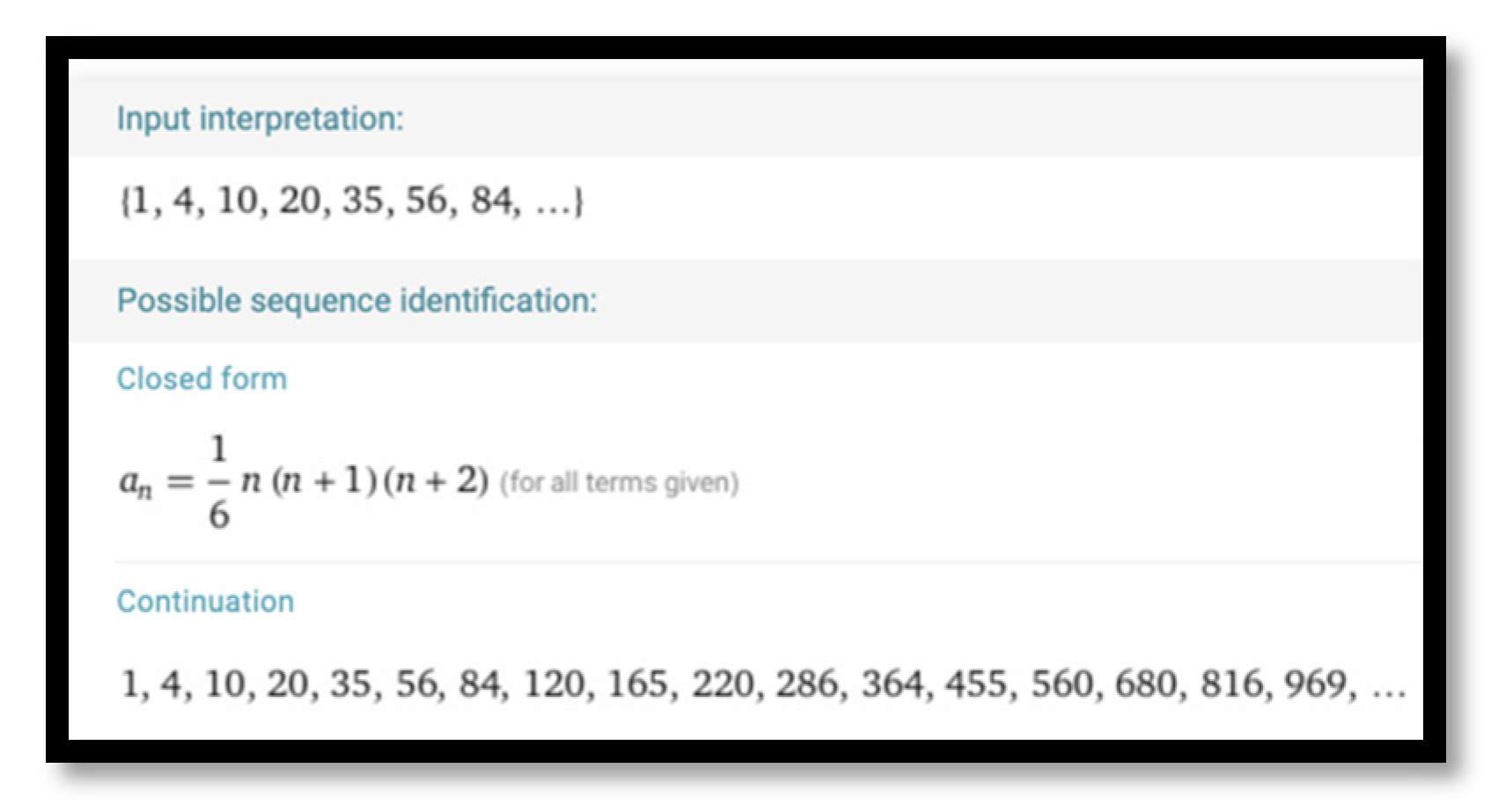
Figure 2.
Tetrahedral number sieve of order one.
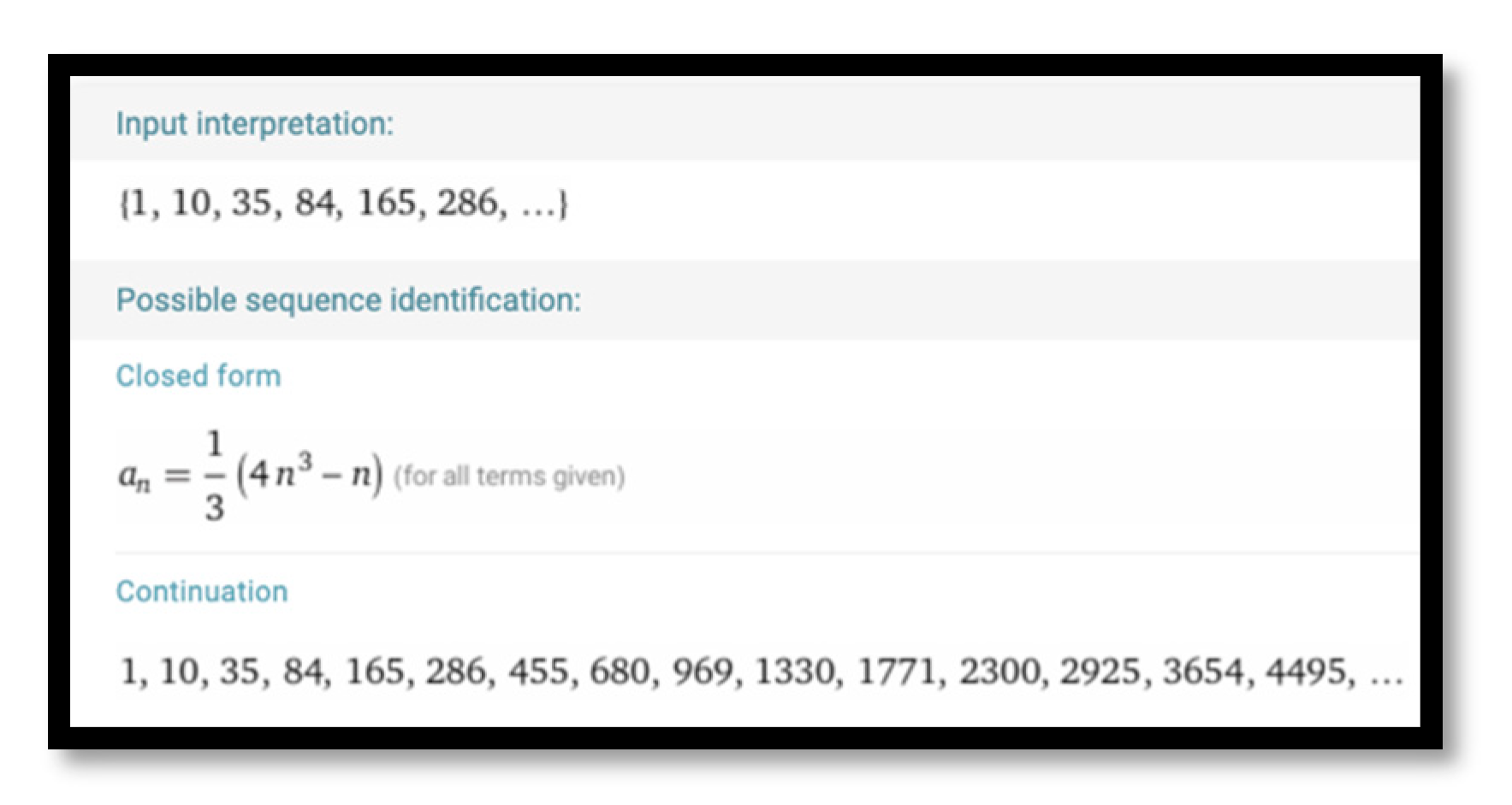
Figure 3.
Tetrahedral number sieve of order two.
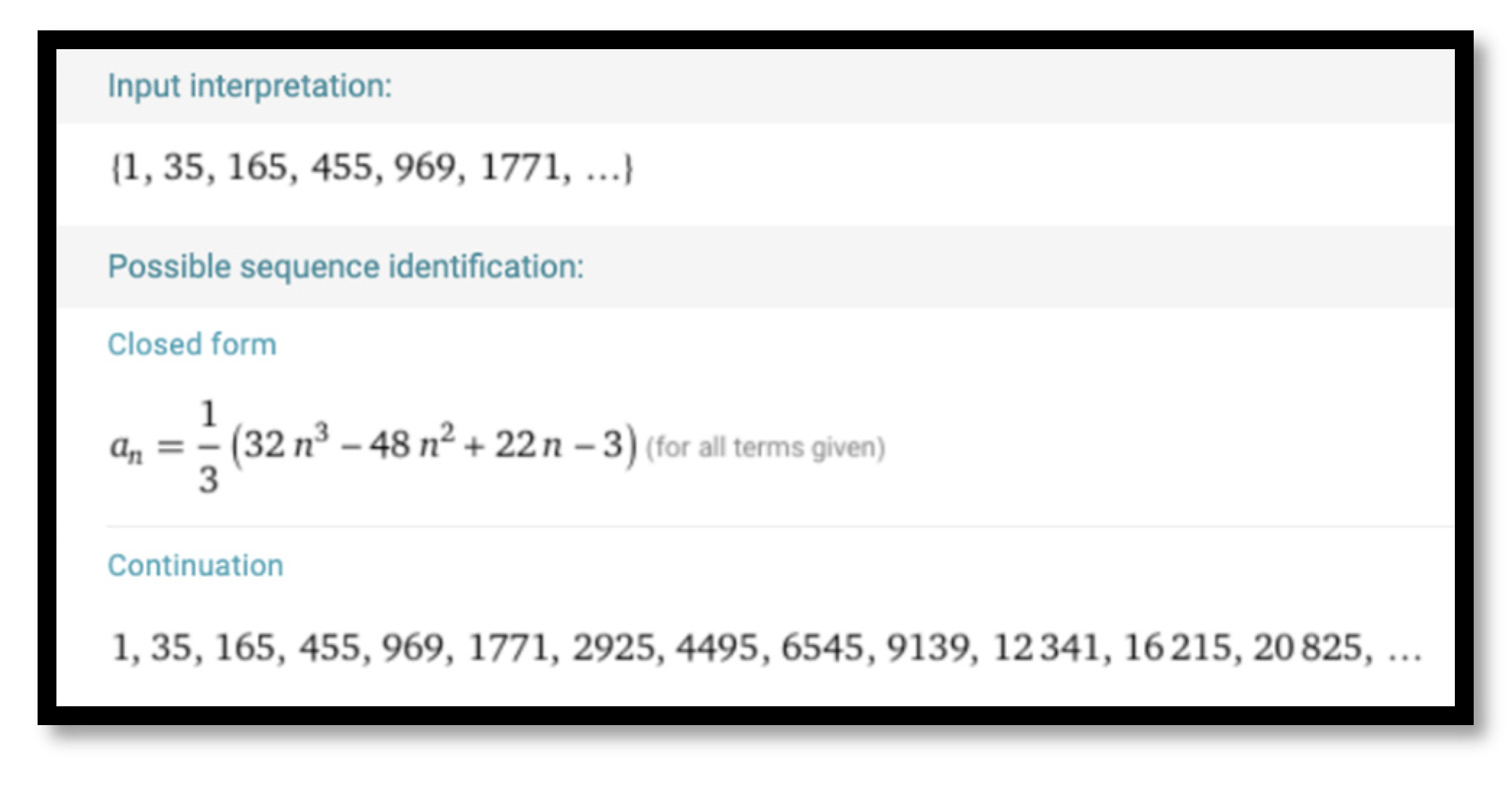
Figure 4.
Tetrahedral number sieve of order three.
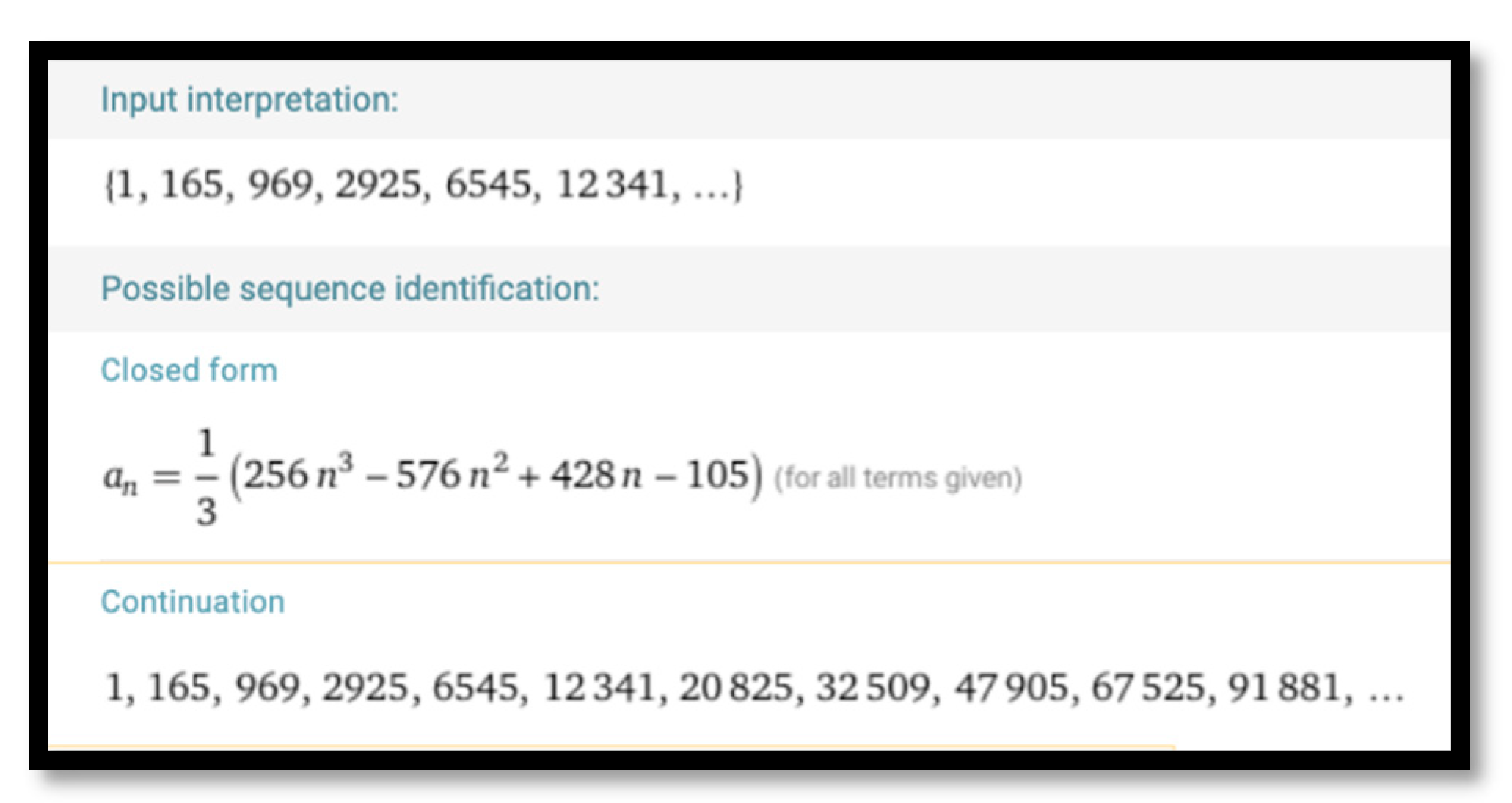
Figure 5.
Tetrahedral number sieve of order four.
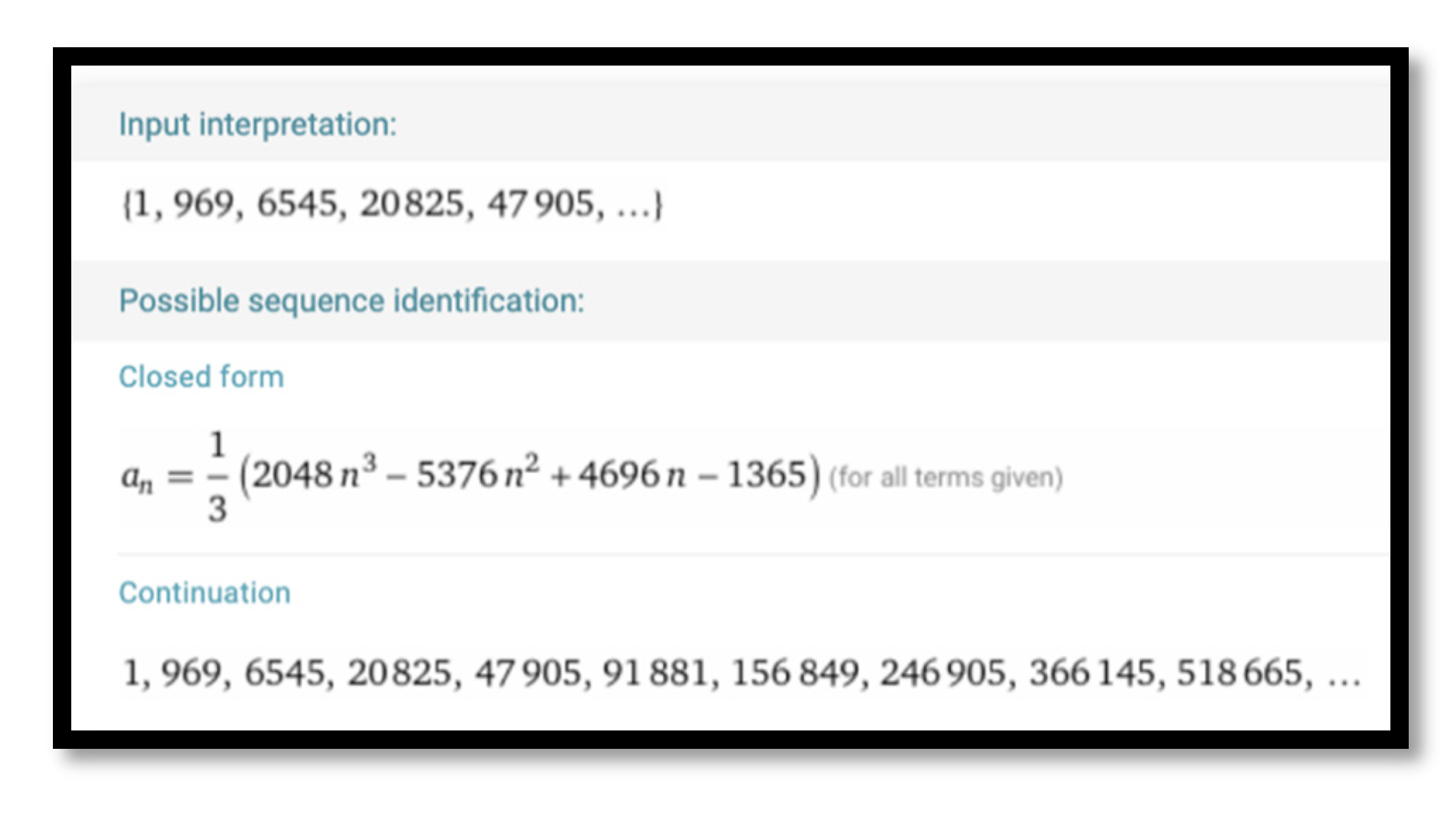
Figure 6.
Tetrahedral number sieve of order five.
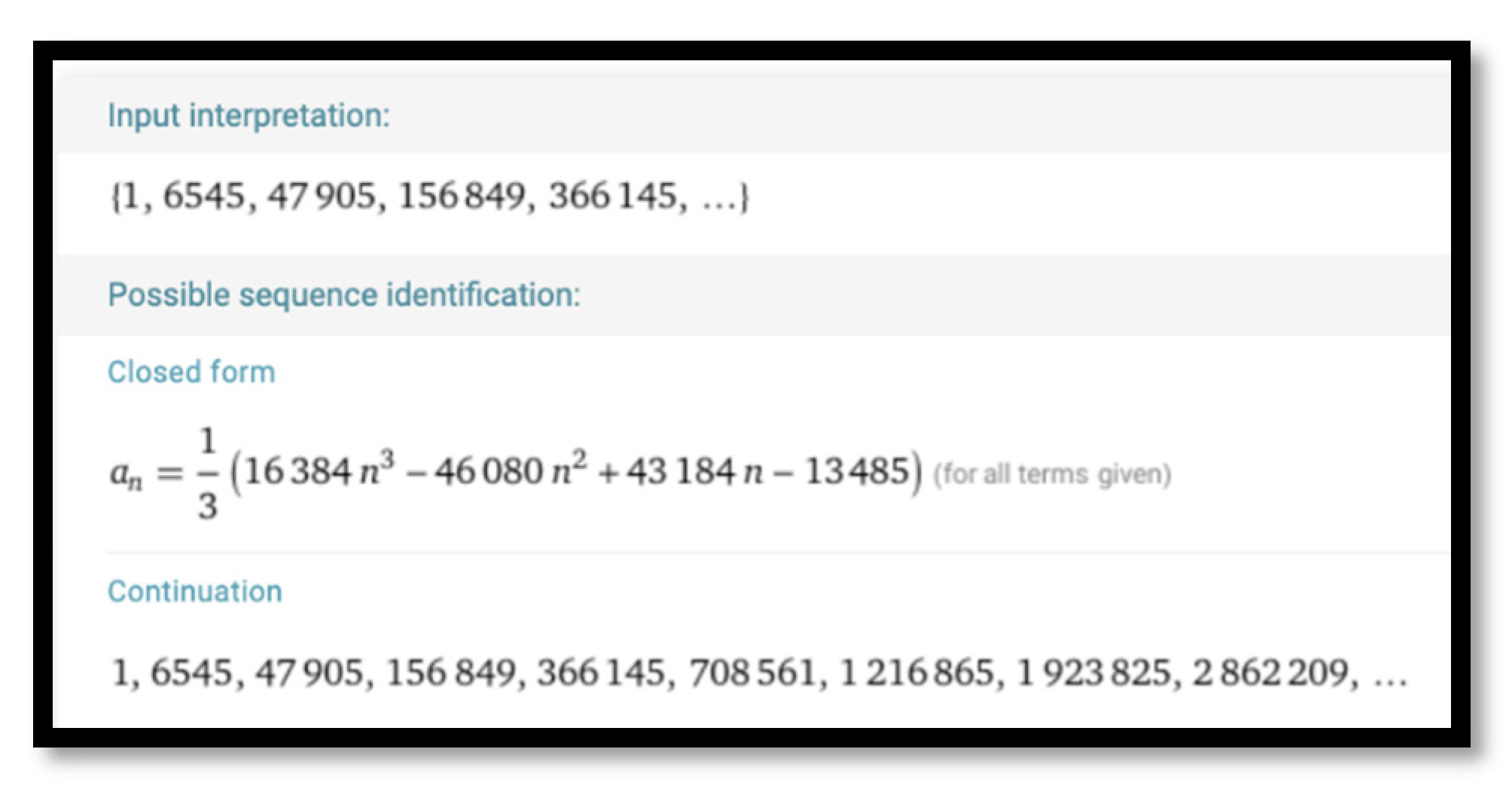
Figure 7.
Tetrahedral number sieve of order six.
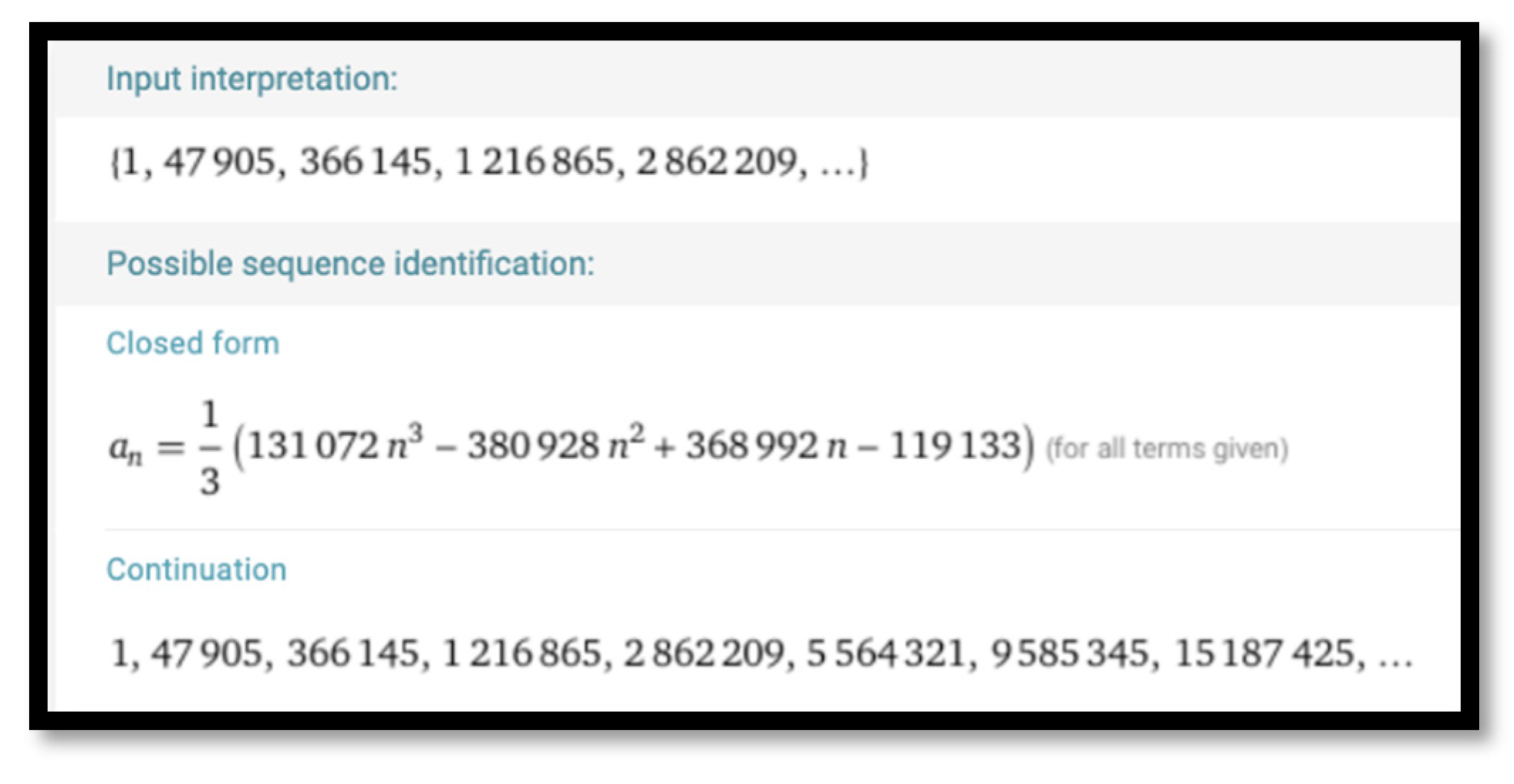
Figure 8.
Finding closed-form formula for the coefficient in n2.
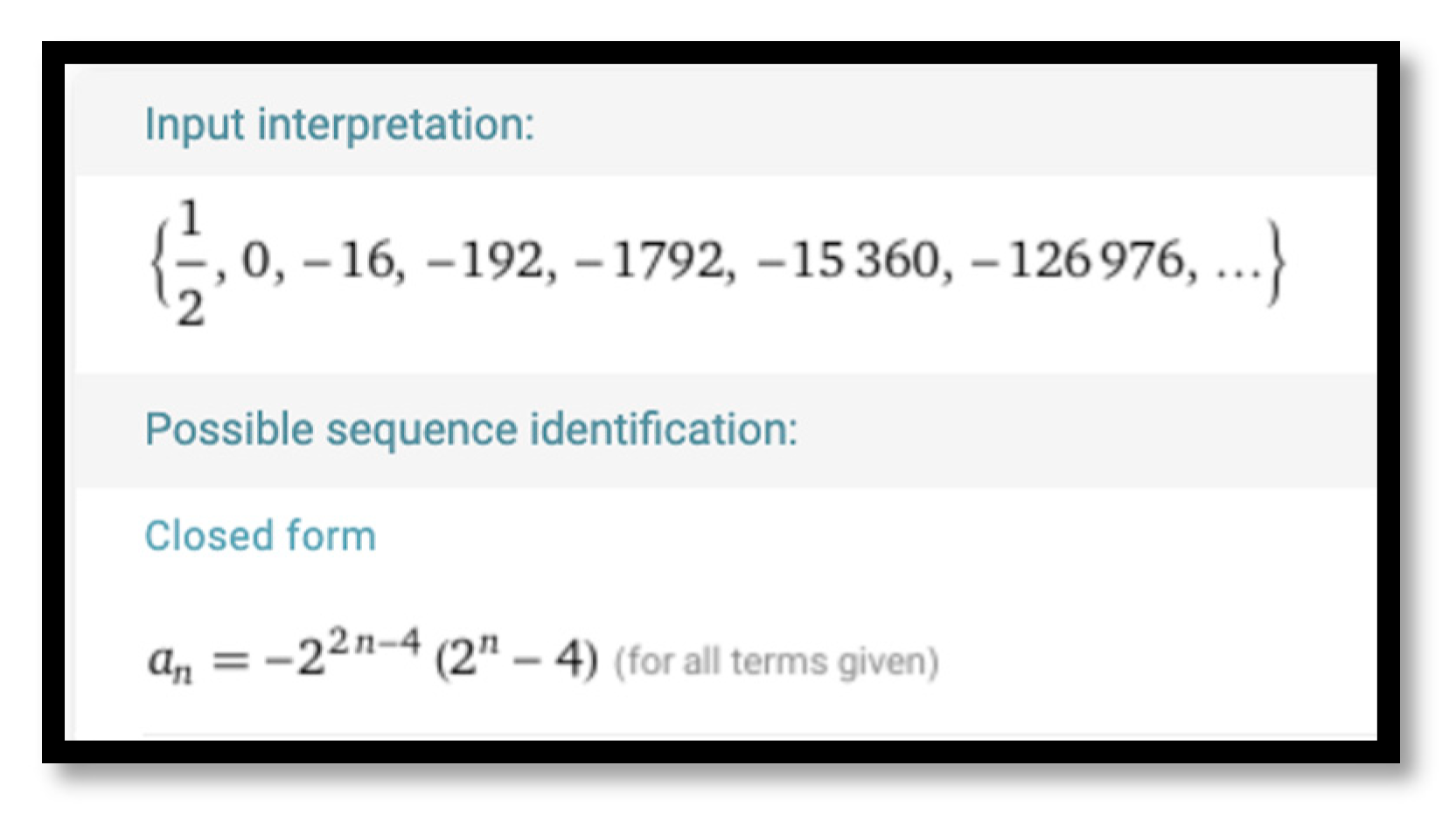
Figure 9.
Tetrahedral number sieve of order seven.
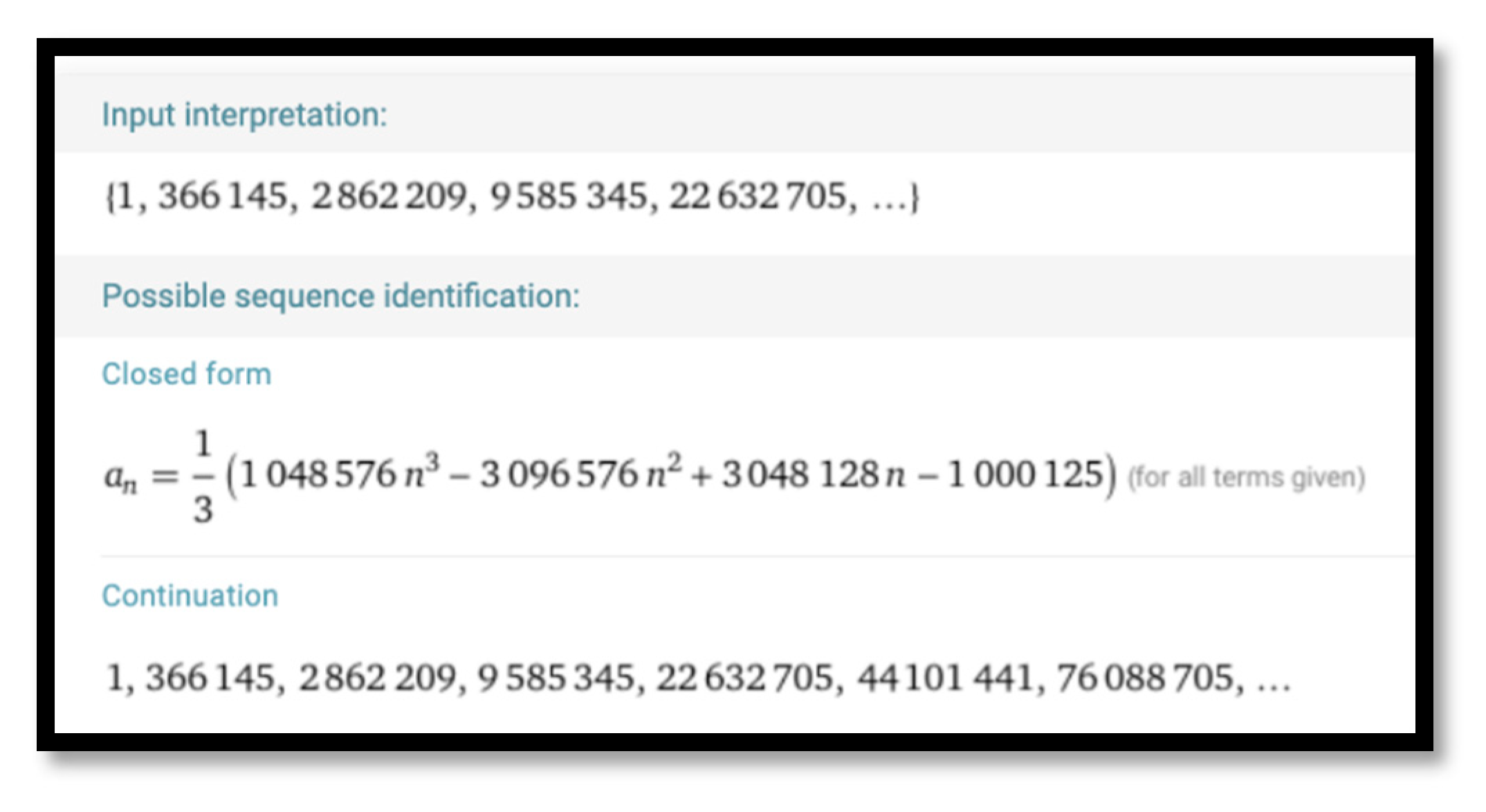
Figure 10.
Finding closed-form formula for the coefficient in n.
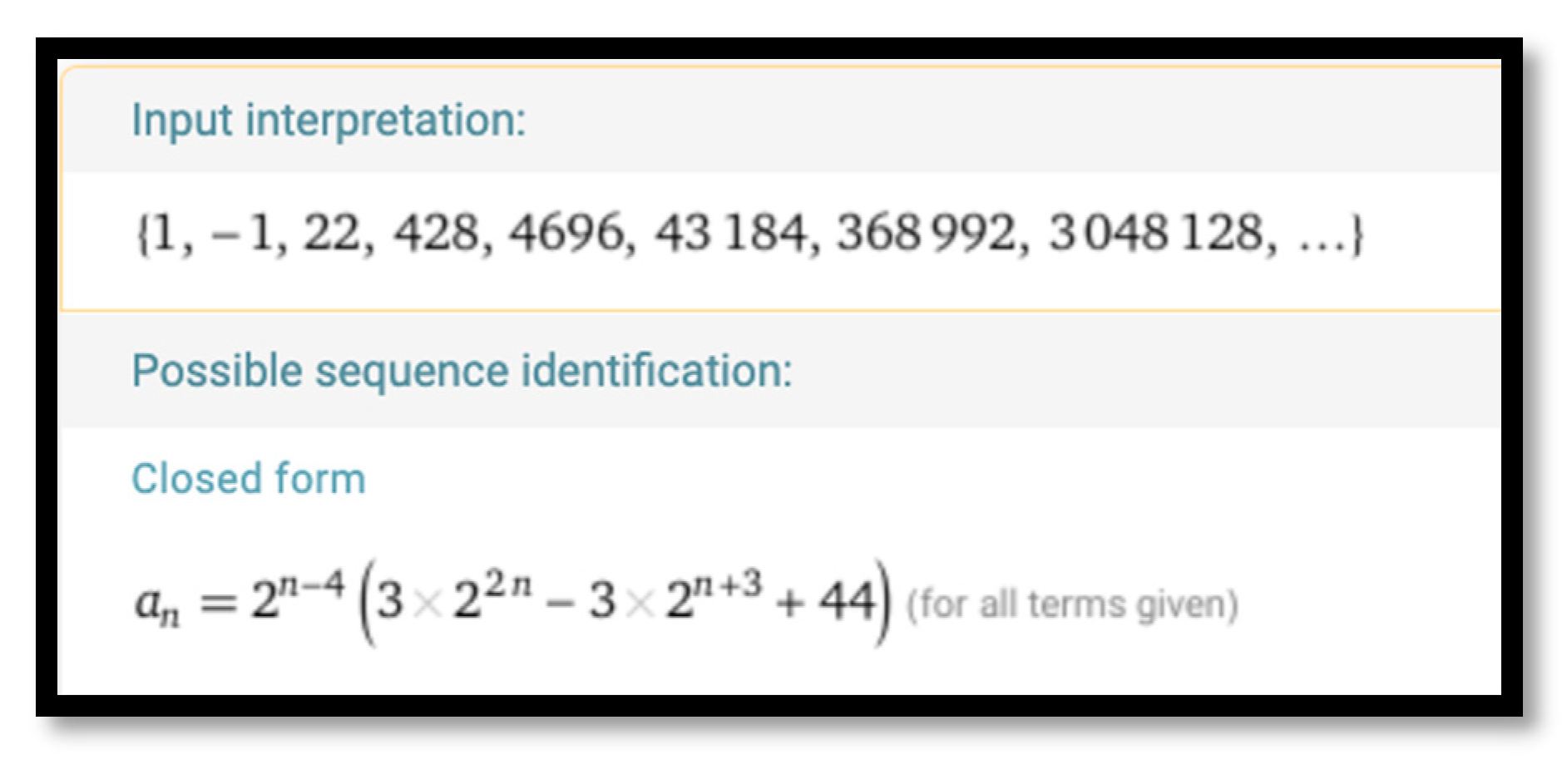
Figure 11.
Finding closed-form formula for the coefficient in n0.
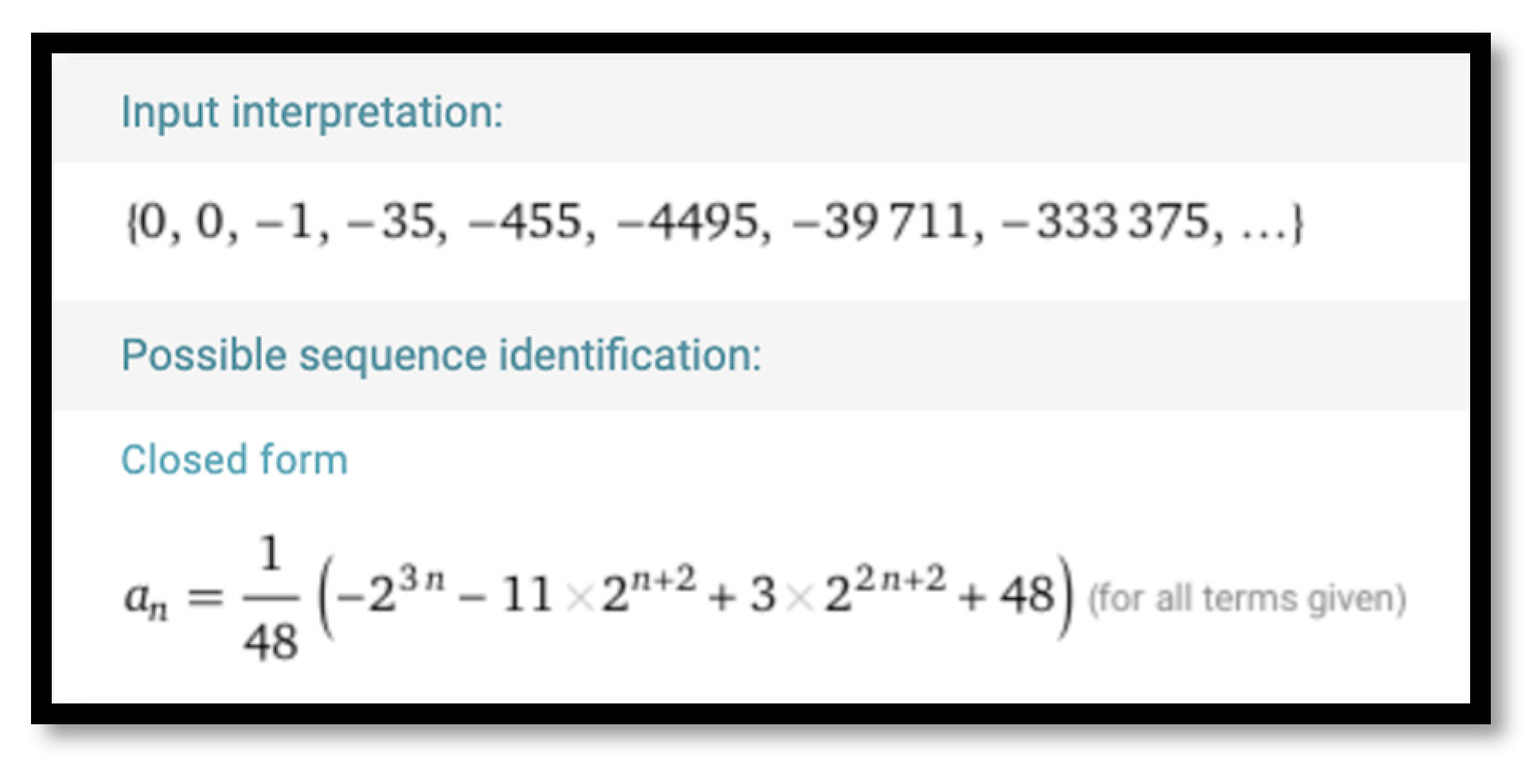
Figure 12.
Wolfram Alpha modeling of by formula (14).
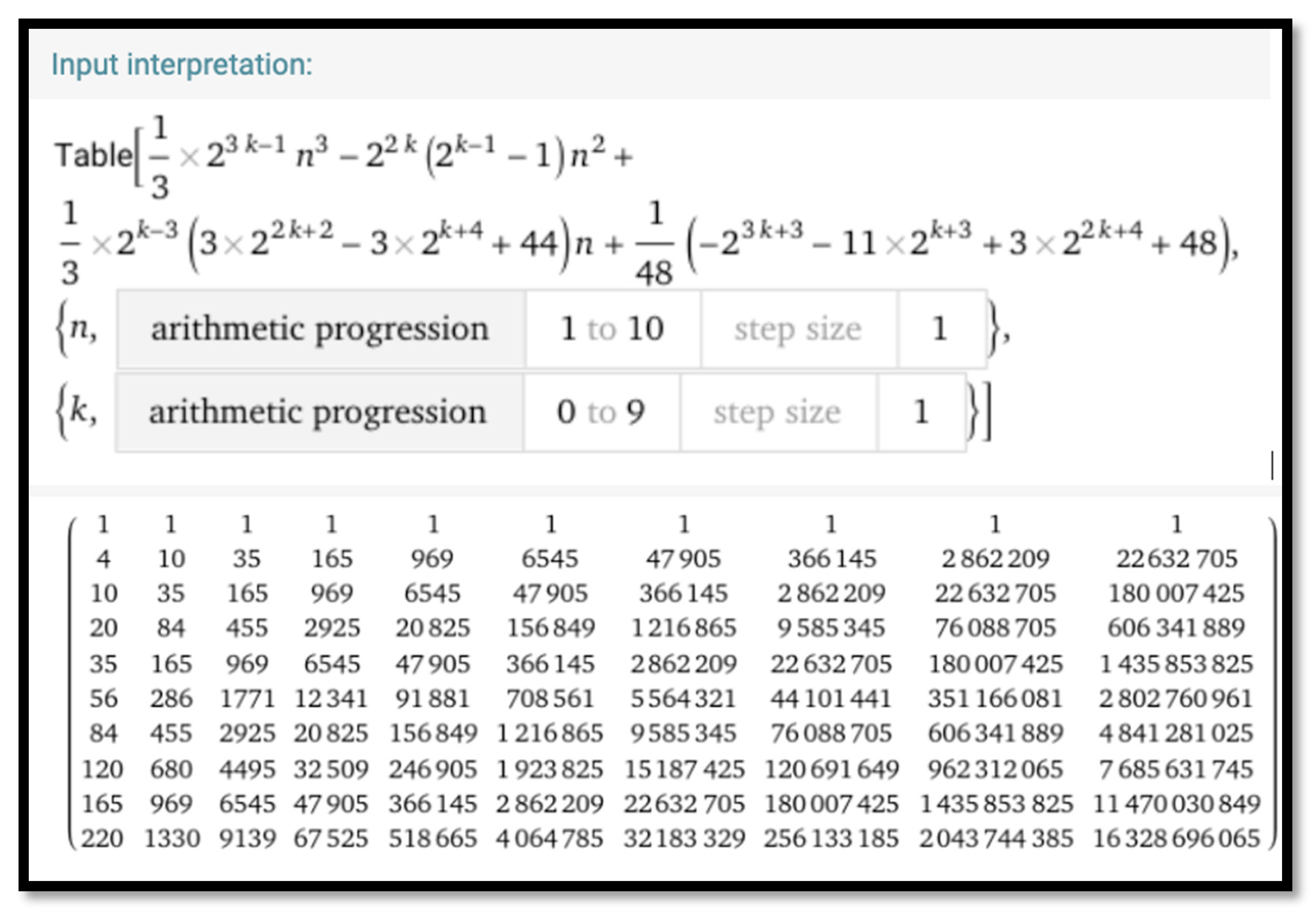
Figure 15.
Factoring the right-hand side of formula (14) using Wolfram Alpha.
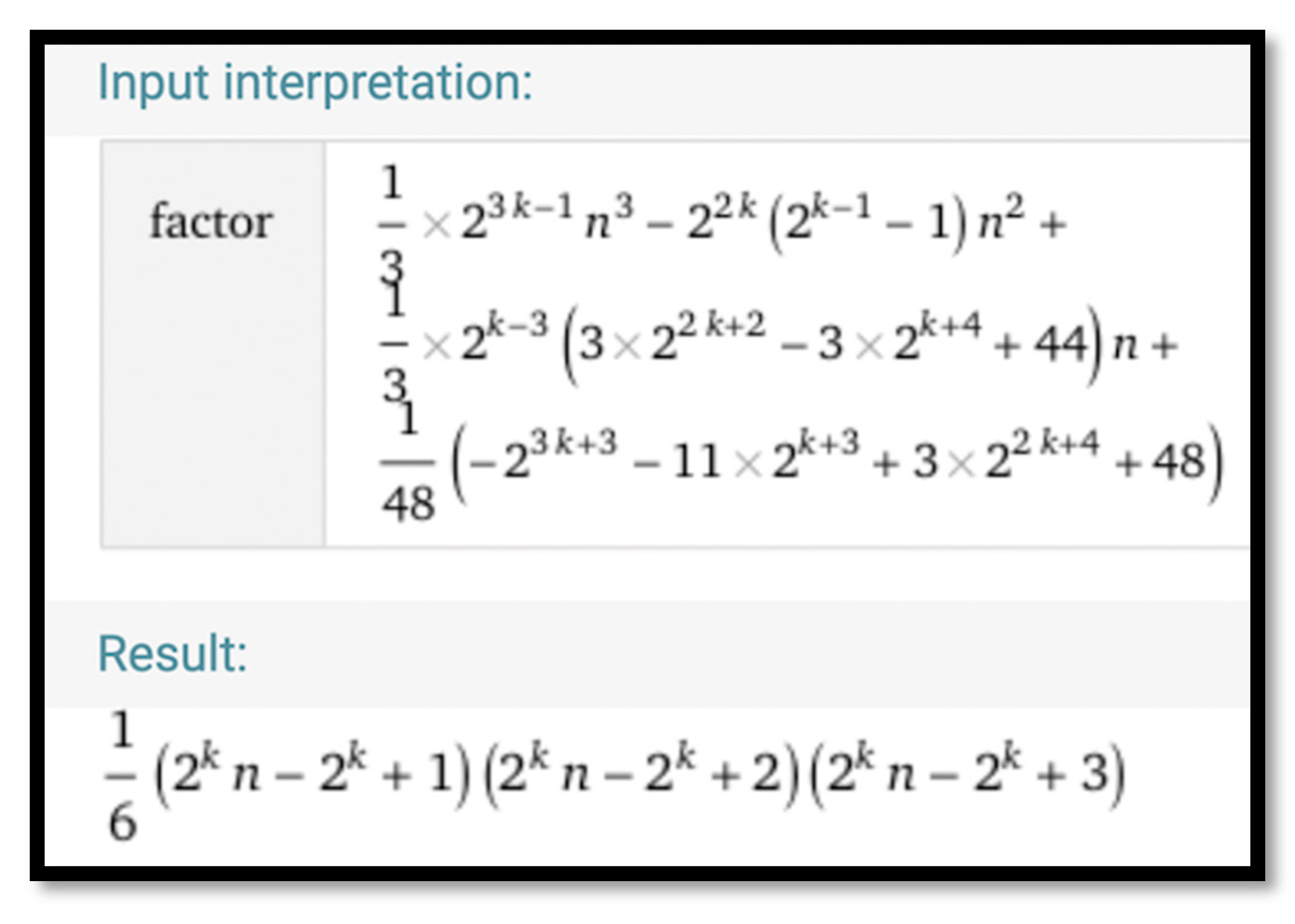
Figure 16.
Natural number sieve generated by a spreadsheet.
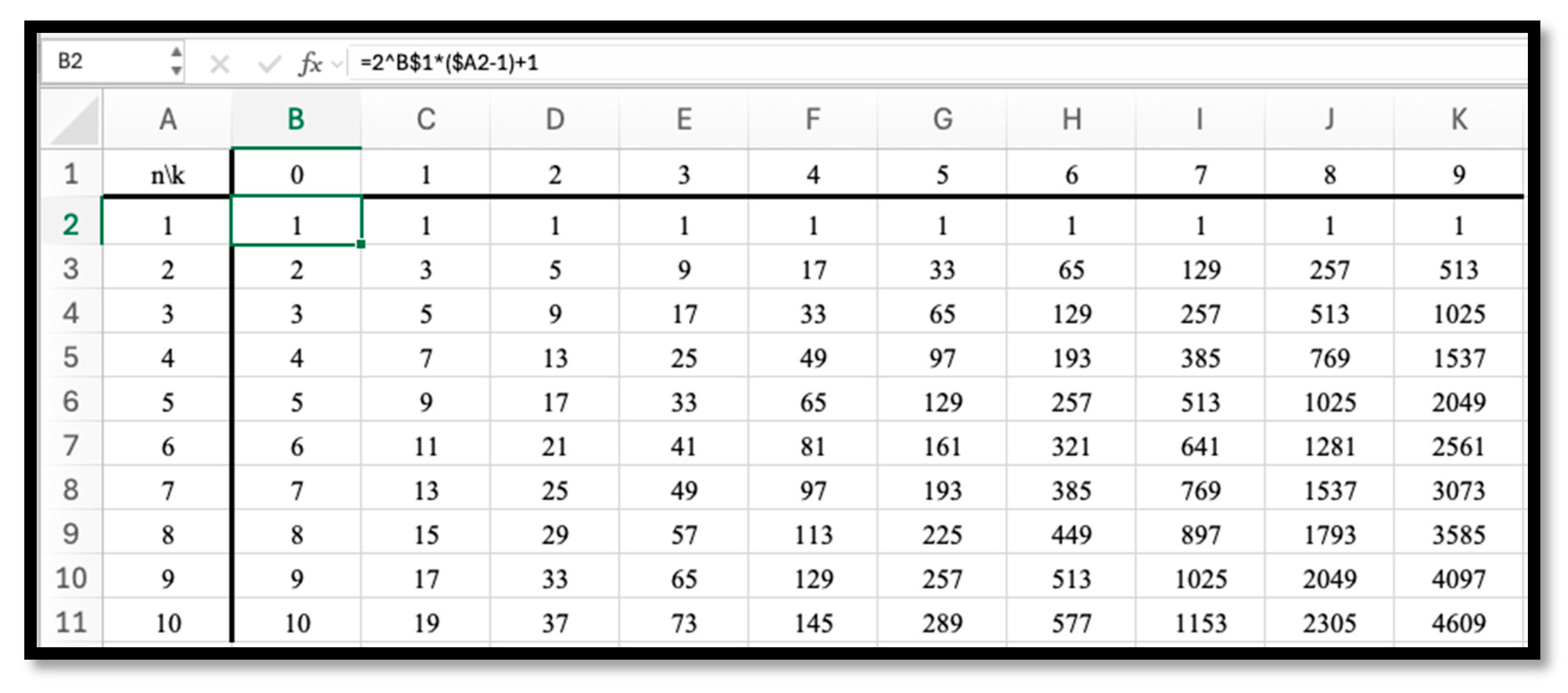
Figure 17.
Triangular number sieve generated by a spreadsheet.
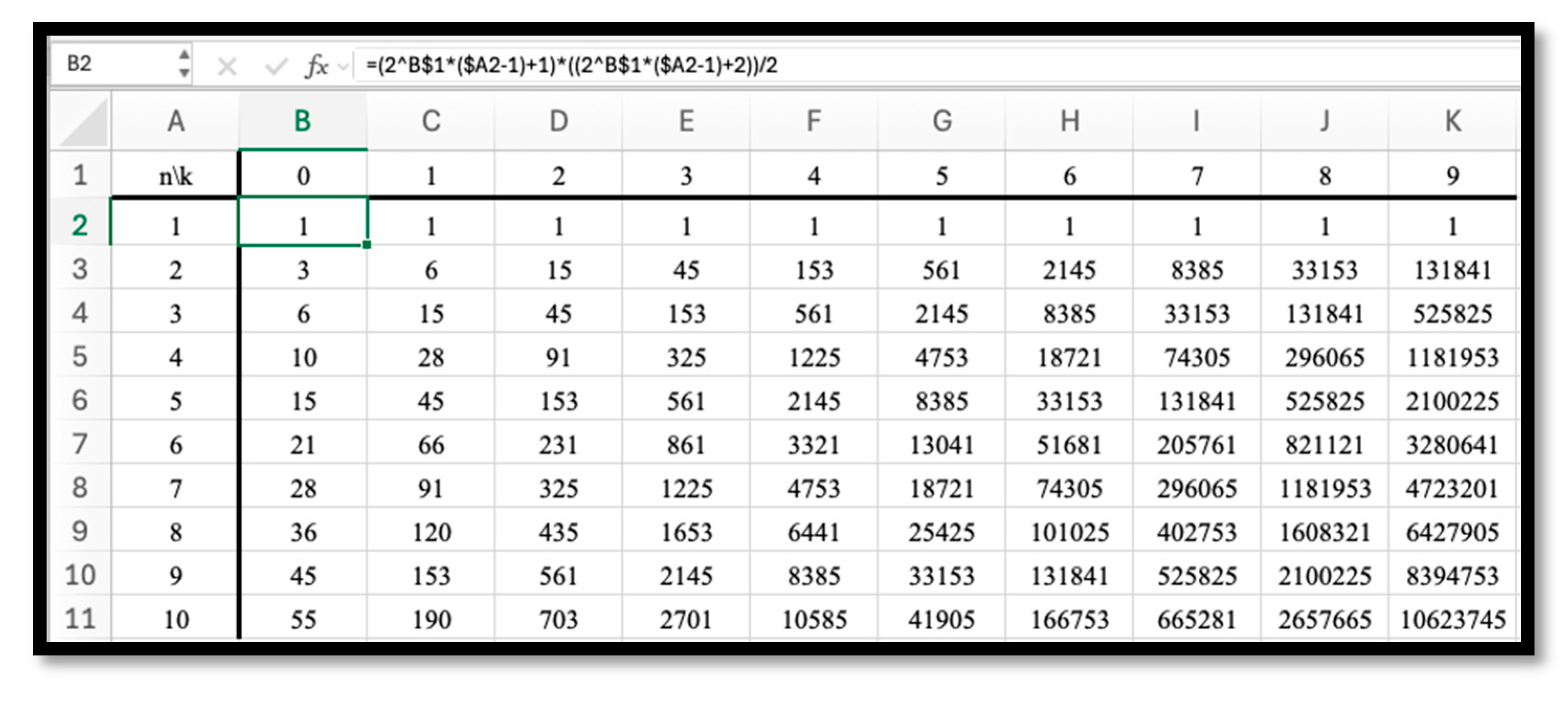
Figure 18.
Triangular number sieve generated by Maple.
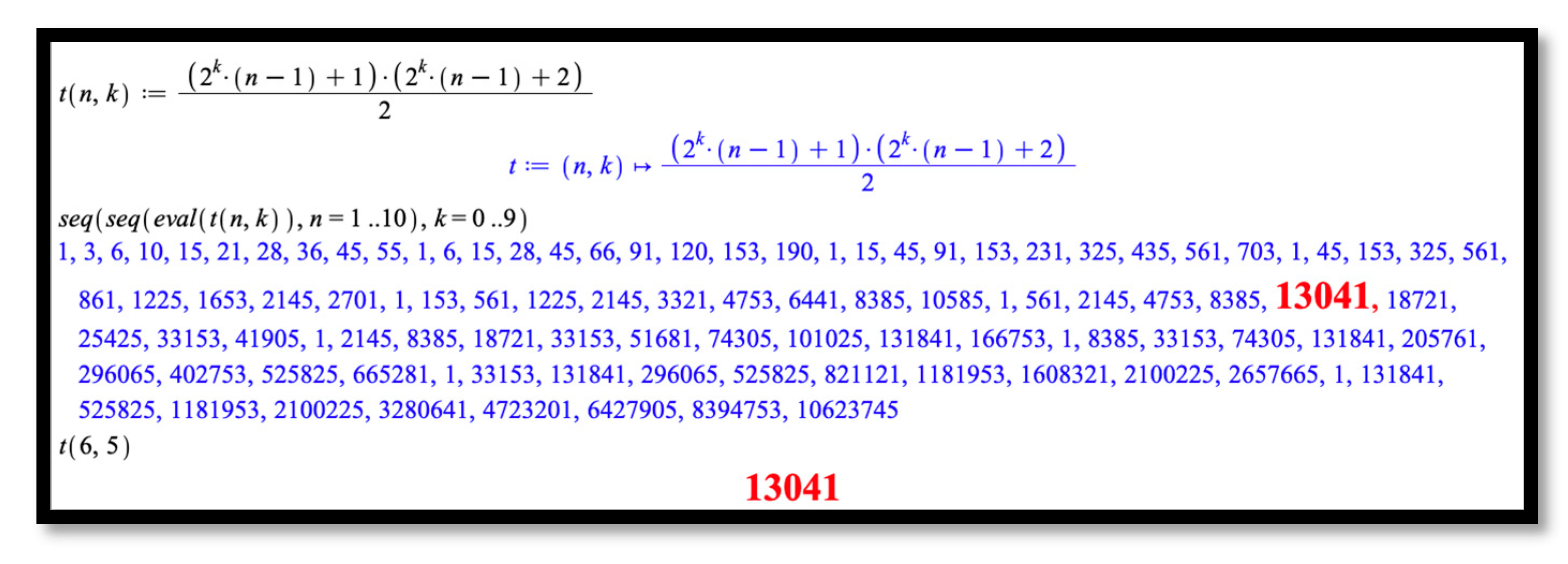
Figure 19.
Fibonacci number sieve generated by Wolfram Alpha.
| 1 | Recursive equation f(n+1) =3fn − f(n−1), n = 1,2,3,…, describing Fibonacci number sieve of order one can be found in the groundbreaking paper by Matijasevic [22] in which the famous Hilbert 10th Problem was announced to be solved. |
Disclaimer/Publisher’s Note: The statements, opinions and data contained in all publications are solely those of the individual author(s) and contributor(s) and not of MDPI and/or the editor(s). MDPI and/or the editor(s) disclaim responsibility for any injury to people or property resulting from any ideas, methods, instructions or products referred to in the content. |
© 2026 by the author. Licensee MDPI, Basel, Switzerland. This article is an open access article distributed under the terms and conditions of the Creative Commons Attribution (CC BY) license.
Copyright: This open access article is published under a Creative Commons CC BY 4.0 license, which permit the free download, distribution, and reuse, provided that the author and preprint are cited in any reuse.


