
Submitted:
07 May 2026
Posted:
07 May 2026
You are already at the latest version
Abstract
Optimisation algorithms play an important role in the solution of nonlinear engineering design problems, particularly where objective functions exhibit complex, nonconvex, and potentially multimodal behaviour. Classical gradient-based methods, including the Method of Moving Asymptotes (MMA) and Sequential Quadratic Programming (SQP), are widely recognised for their computational efficiency and rapid local convergence; however, their performance may be sensitive to the presence of local extrema. In contrast, metaheuristic approaches such as Particle Swarm Optimisation (PSO) generally provide enhanced global exploration capabilities, albeit often at significantly greater computational expense. This study presents a preliminary investigation of a hybrid optimisation framework termed the Constrained Adaptive Model-based Exploration Optimiser (CAMEO). The proposed approach combines bounded stochastic exploration with constrained local refinement in an attempt to improve robustness within multimodal optimisation landscapes whilst retaining the efficiency associated with deterministic optimisation methods. The performance of the proposed framework was examined using a series of benchmark optimisation problems and compared against MMA, SQP, and PSO. The numerical results indicate that CAMEO is capable of attaining solutions closer to the global optimum in several test cases, whilst maintaining stable convergence characteristics.
Keywords:
structural otimisation
; hybrid optimisation
; CAMEO optimisation
; hybrid optimisation algorithms
; global optimisation
; constrained optimisation
1. Introduction
Structural optimisation has become a central tool in the design of lightweight, high-performance components across aerospace, automotive, and civil engineering [1,2,3,4]. Its modern practice encompasses sizing, shape, and topology optimisation[5,6], often under multiple constraints such as volume fraction, stress, displacement, buckling, manufacturability, and frequency requirements.
The increasing demand for structures that exhibit enhanced mechanical efficiency while minimising material consumption has driven substantial advances in optimisation techniques and computational methods. Contemporary structural optimisation generally encompasses three principal categories: sizing optimisation, shape optimisation, and topology optimisation [5,6]. Sizing optimisation focuses on determining the optimal dimensions or thicknesses of structural members; shape optimisation seeks the most efficient geometric boundary configuration; whilst topology optimisation addresses the optimal distribution of material within a prescribed design domain.
In practical engineering applications, structural optimisation problems are rarely governed by a single objective or constraint. Instead, they are typically formulated under multiple and often competing requirements, including limitations on volume fraction, stress, displacement, buckling resistance, manufacturability, and dynamic characteristics such as natural frequencies. These constraints ensure that the optimised structure not only achieves minimal weight or maximal stiffness, but also satisfies safety, performance, and fabrication considerations. Consequently, modern optimisation frameworks frequently integrate multi-physics analysis and advanced numerical techniques to accommodate the increasing complexity of engineering design problems.
Formally, a broad class of structural optimisation problems may be expressed as
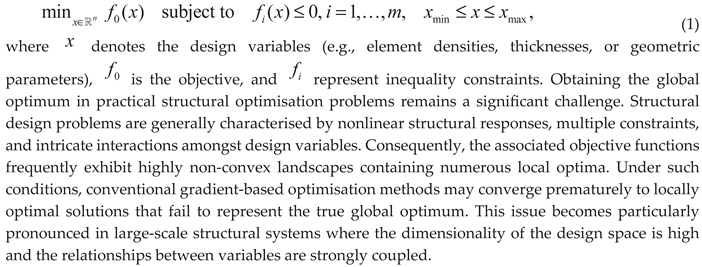
In addition to the mathematical complexity of the optimisation landscape, structural optimisation problems commonly require repeated evaluations through computationally expensive numerical simulations, most notably finite element analysis (FEA). Each design iteration may involve solving large systems of equations to evaluate stresses, deformations, stability behaviour, or dynamic responses. As the number of design variables and constraints increases, the computational burden associated with exploring the design space grows substantially. This challenge is further exacerbated in topology optimisation and multidisciplinary optimisation problems, where thousands or even millions of degrees of freedom may be involved [7,8,9].
To address these difficulties, considerable research has focused on the development of robust global optimisation strategies capable of balancing exploration and exploitation within complex search spaces. Metaheuristic algorithms, including genetic algorithms, particle swarm optimisation, simulated annealing, and differential evolution, have gained widespread attention due to their ability to escape local optima and search globally without requiring gradient information. Nevertheless, such methods often demand a large number of function evaluations, which may become prohibitively expensive when coupled with high-fidelity numerical simulations. Accordingly, recent developments increasingly incorporate surrogate modelling, machine learning techniques, and reduced-order models to alleviate computational costs whilst maintaining optimisation accuracy.
These challenges become even more pronounced in non-parametric optimisation problems, where the number of design variables is not explicitly prescribed by a small set of parameters but instead arises from the discretisation of the design domain. A notable example is topology optimisation, where the structural domain is typically discretised into a large number of finite elements. Each element introduces an additional design variable, resulting in optimisation problems with thousands or even millions of variables. The large dimensionality of the design space substantially increases the complexity of the optimisation process and amplifies the risk of convergence to suboptimal local minima.
Moreover, the computational effort associated with such problems is often dominated by repeated numerical analyses required to evaluate the structural response. Consequently, optimisation algorithms must achieve meaningful improvements in the objective function using a limited number of major iterations. At the same time, they must remain robust in the presence of numerical noise in sensitivity information and adapt effectively to variations in the local curvature of the objective landscape. These requirements place stringent demands on the design of optimisation algorithms intended for large-scale structural problems.
In practice, structural optimisation methodologies can broadly be classified within the family of deterministic gradient-based optimisation methods, which exploit sensitivity information to efficiently navigate the design space. Among the earliest and most widely applied approaches in structural optimisation is the Optimality Criteria (OC) method [10], which updates the design variables directly from the first-order optimality conditions of the constrained optimisation problem. Owing to its simplicity and very low computational cost per iteration, the OC method has historically been popular in structural design problems, particularly when the optimisation problem involves a limited number of constraints. However, despite its computational efficiency, the OC method lacks the robustness required for more general optimisation problems and may exhibit sensitivity to the optimisation landscape. In particular, due to its purely local update mechanism, the method has a tendency to converge to nearby local extrema when the objective function is strongly nonconvex. To address these limitations, more advanced gradient-based optimisation algorithms have been developed. Among these, the Method of Moving Asymptotes (MMA) [11,12,13] and Sequential Quadratic Programming (SQP) [14] have become widely adopted in structural optimisation. Both methods make systematic use of gradient information to construct improved approximations of the optimisation problem at each iteration, thereby enhancing numerical stability and robustness. As a result, these algorithms are capable of achieving rapid and reliable convergence while maintaining good scalability for problems involving a large number of design variables, which explains their widespread adoption in engineering optimisation workflows.
The second category includes metaheuristic or population-based algorithms, such as Particle Swarm Optimisation (PSO) [15,16,17], Genetic Algorithms (GA) [18,19,20,21], and Differential Evolution. These approaches aim to explore the design space more globally by relying primarily on objective function evaluations rather than gradient information. In principle, such algorithms can provide improved robustness against local minima by sampling multiple regions of the search space simultaneously [22,23].
However, in large-scale structural optimisation problems the practical applicability of metaheuristic methods is often limited. In particular, modern generative design and non-parametric optimisation frameworks—such as topology optimisation—frequently involve extremely high-dimensional design spaces arising from the discretisation of the structural domain. In these settings the number of design variables may reach several thousands or even millions, making population-based approaches computationally prohibitive due to the large number of function evaluations required per iteration. Consequently, deterministic gradient-based algorithms remain the preferred tools for such problems.
Nevertheless, the purely local nature of gradient-based optimisation methods implies that their performance may depend strongly on the initial design and the structure of the optimisation landscape. When the objective function exhibits multiple local minima, these algorithms may converge to suboptimal designs if no mechanism for broader exploration is present. This observation motivates the development of optimisation strategies capable of retaining the computational efficiency and stability of gradient-based methods while incorporating a controlled degree of exploration within the design space. The present work introduces a new optimisation framework i.e., Constrained Adaptive Model-based Exploration Optimiser (CAMEO). The novelty of the proposed method lies in its ability to combine the computational efficiency and stability of gradient-based optimisation with a controlled exploration mechanism designed to mitigate the limitations of purely local search strategies. In particular, CAMEO integrates a model-based local refinement step with a limited exploratory sampling strategy guided by surrogate information derived from gradient and curvature estimates. This hybrid formulation allows the algorithm to retain the scalability required for large-scale structural optimisation problems while introducing a structured mechanism for exploring alternative regions of the design space when necessary.
The remainder of this paper is organised as follows: Section 2 reviews existing optimisation approaches and discusses their limitations in attaining global extrema. Section 3 introduces the proposed CAMEO optimisation framework and presents its mathematical formulation. Section 4 describes the benchmark test functions used for evaluation. Section 5 presents the comparative results between CAMEO and existing optimisation methods. Finally, Section 6 summarises the main conclusions of the study.
2. Background and Motivation
Structural optimisation problems are typically characterised by high-dimensional design spaces, nonlinear responses, and the presence of multiple constraints. These characteristics often lead to complex optimisation landscapes that may contain numerous local extrema. Consequently, the selection of an appropriate optimisation algorithm plays a critical role in determining both the computational efficiency and the quality of the obtained design.
Over the past decades, several optimisation approaches have been successfully applied to structural optimisation problems. Among these, gradient-based deterministic algorithms remain the most widely used in engineering practice due to their efficiency and scalability. At the same time, population-based metaheuristic algorithms have been investigated as potential alternatives for exploring complex design spaces. However, each class of methods possesses inherent advantages and limitations, which motivates the development of hybrid optimisation strategies.
Gradient-based optimisation methods have become the primary tools for solving large-scale structural optimisation problems due to their computational efficiency and strong convergence properties. When reliable sensitivity information is available, these methods can exploit gradient information to rapidly identify descent directions and achieve significant improvements in the objective function within relatively few iterations. As a result, gradient-based algorithms are generally regarded as both fast and reliable, particularly for high-dimensional problems where exhaustive search strategies would be computationally infeasible.
Despite these advantages, gradient-based methods inherently perform local search, meaning that their convergence behaviour is strongly influenced by the initial design and the structure of the optimisation landscape. In problems characterised by multiple local minima or highly nonlinear responses, such methods may converge to suboptimal solutions if no mechanism for broader exploration is incorporated. Consequently, while gradient-based approaches provide excellent efficiency and scalability, they may lack robustness in strongly multimodal optimisation problems. Among the most widely used gradient-based algorithms in structural optimisation are MMA [11,12] and SQP [14,24].
MMA has become one of the most widely adopted techniques for structural optimisation. MMA constructs a sequence of convex separable approximations of the original nonlinear optimisation problem and introduces adaptive asymptotes that stabilise the optimisation process. This mechanism effectively regularises the search direction and provides behaviour similar to a trust-region strategy. As a result, MMA demonstrates excellent robustness in problems involving bound constraints and multiple inequality constraints, and it has become a standard solver in many topology optimisation frameworks.
Another widely used gradient-based approach is SQP. SQP methods solve a quadratic programming (QP) subproblem at each iteration, constructed from a quadratic approximation of the objective function and a linearisation of the constraints. When accurate gradient information is available, SQP can achieve rapid local convergence and high solution accuracy. Nevertheless, as with most local optimisation methods, SQP may exhibit sensitivity to the initial design and may converge to suboptimal local minima when the optimisation landscape is strongly nonconvex.
On the other hands, Population-based metaheuristic algorithms, such as PSO [25], GA [19], and Differential Evolution, have been proposed as alternative approaches capable of exploring the design space more globally. Unlike gradient-based algorithms, these methods rely primarily on objective function evaluations and stochastic search mechanisms, allowing them to investigate multiple regions of the design space simultaneously. Although such methods can be effective for moderate-dimensional optimisation problems, their direct application to large-scale structural optimisation is often limited. In particular, non-parametric optimisation frameworks—such as topology optimisation—typically involve very large numbers of design variables resulting from the discretisation of the structural domain. In such cases, the population sizes and number of generations required by metaheuristic algorithms can lead to prohibitively high computational costs, especially when each objective evaluation involves a finite element analysis. Furthermore, constraint handling in metaheuristic algorithms is frequently implemented through penalty functions, which may lead to inefficient searches in infeasible regions of the design space or unstable convergence behaviour.
3. The Proposed Method: CAMEO
3.1. CAMEO Overview

To address the limitations discussed above, this work proposes a new optimisation algorithm i.e., Constrained Adaptive Model-based Exploration Optimiser (CAMEO). The proposed method is designed to retain the computational efficiency and scalability of gradient-based optimisation while introducing a controlled exploration mechanism capable of improving robustness in multimodal optimisation landscapes.
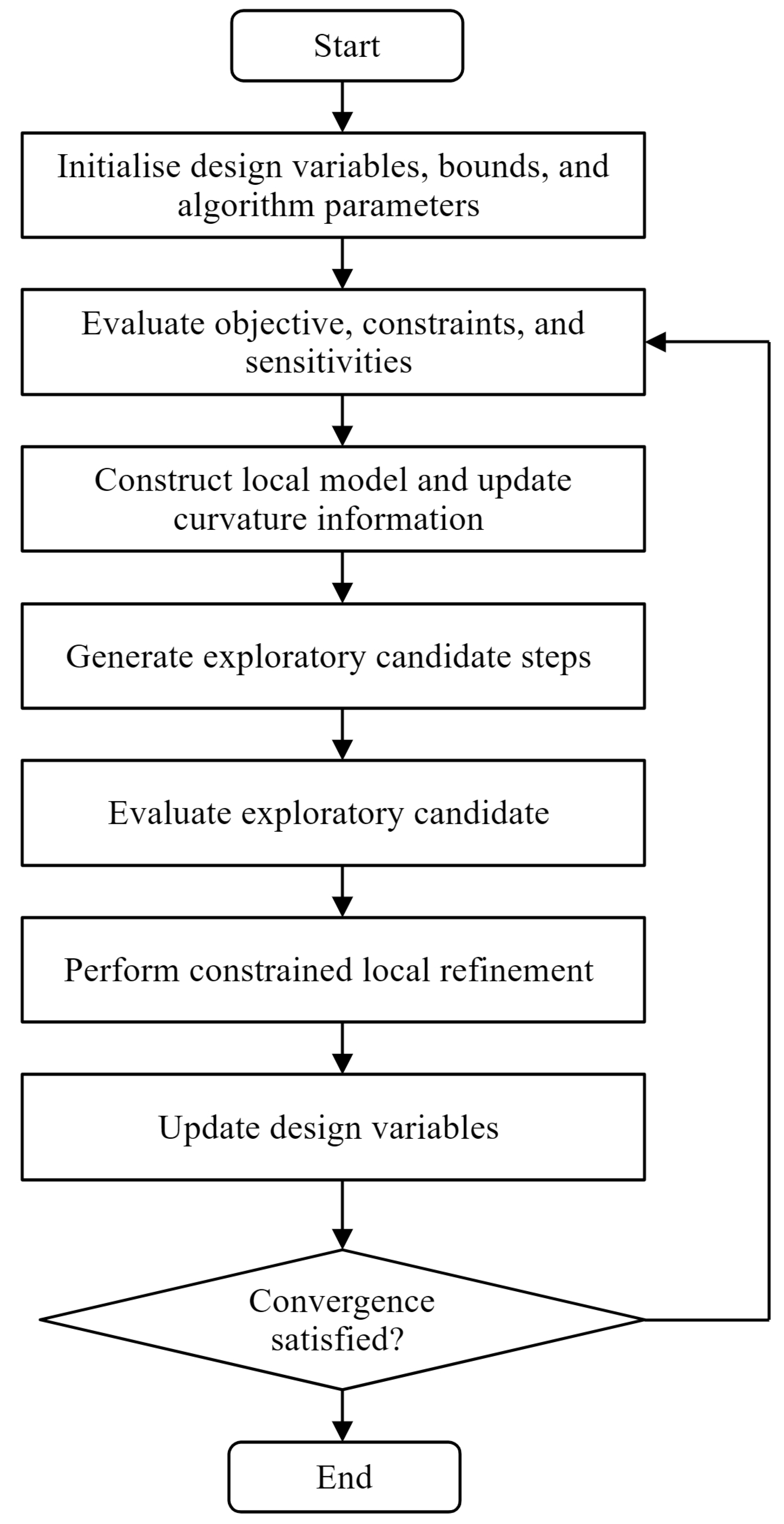
The CAMEO algorithm follows a hybrid strategy that alternates between two complementary steps. The first step consists of a model-based exploration phase, during which a small number of candidate search directions are generated around the current design point using stochastic perturbations guided by local model information. The second step involves a constrained refinement phase, where the most promising candidate solution is improved through the solution of a stabilised quadratic approximation of the optimisation problem subject to the relevant bounds and constraints.
This combination of exploration and refinement enables the algorithm to investigate nearby regions of the design space without sacrificing the fast convergence behaviour associated with deterministic optimisation methods. Consequently, CAMEO can be viewed as a compromise between purely local optimisation techniques, such as MMA and SQP, and global metaheuristic algorithms such as PSO.
3.2. Merit Function for Constraints
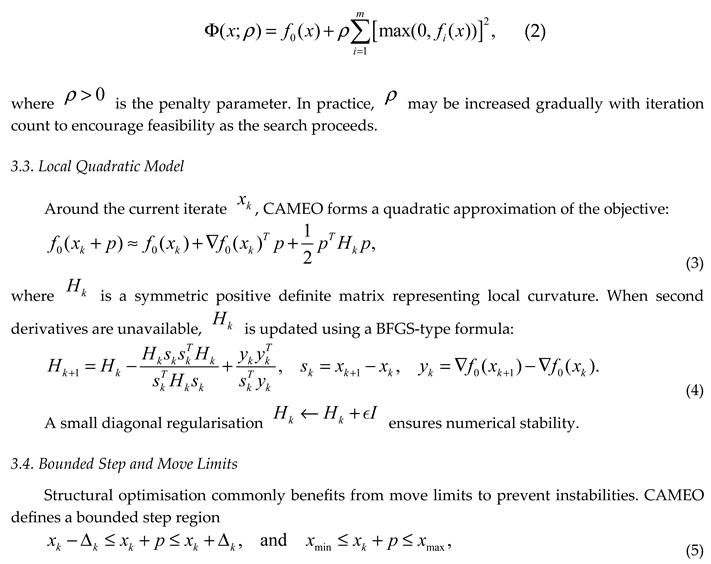
For general inequality constraints, CAMEO uses a merit function that measures both objective and infeasibility:
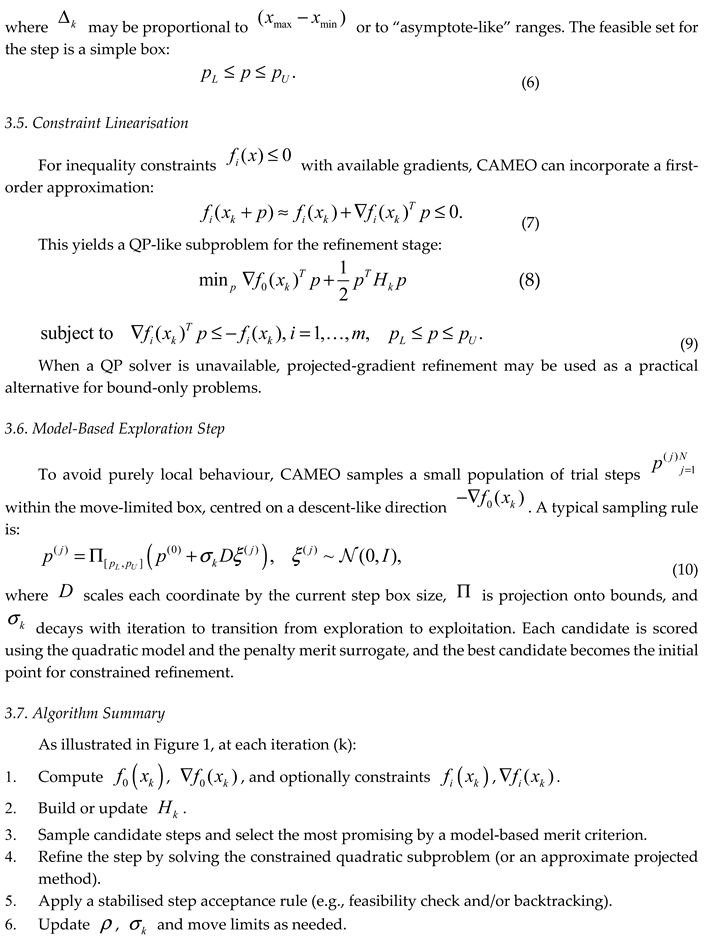
This structure is designed to be compatible with structural optimisation loops where gradients are computed by adjoint methods and where stable, bounded updates are essential.
Figure 1.
Flowchart of the proposed CAMEO optimisation algorithm.
4. Test Functions and Experimental Set-Up
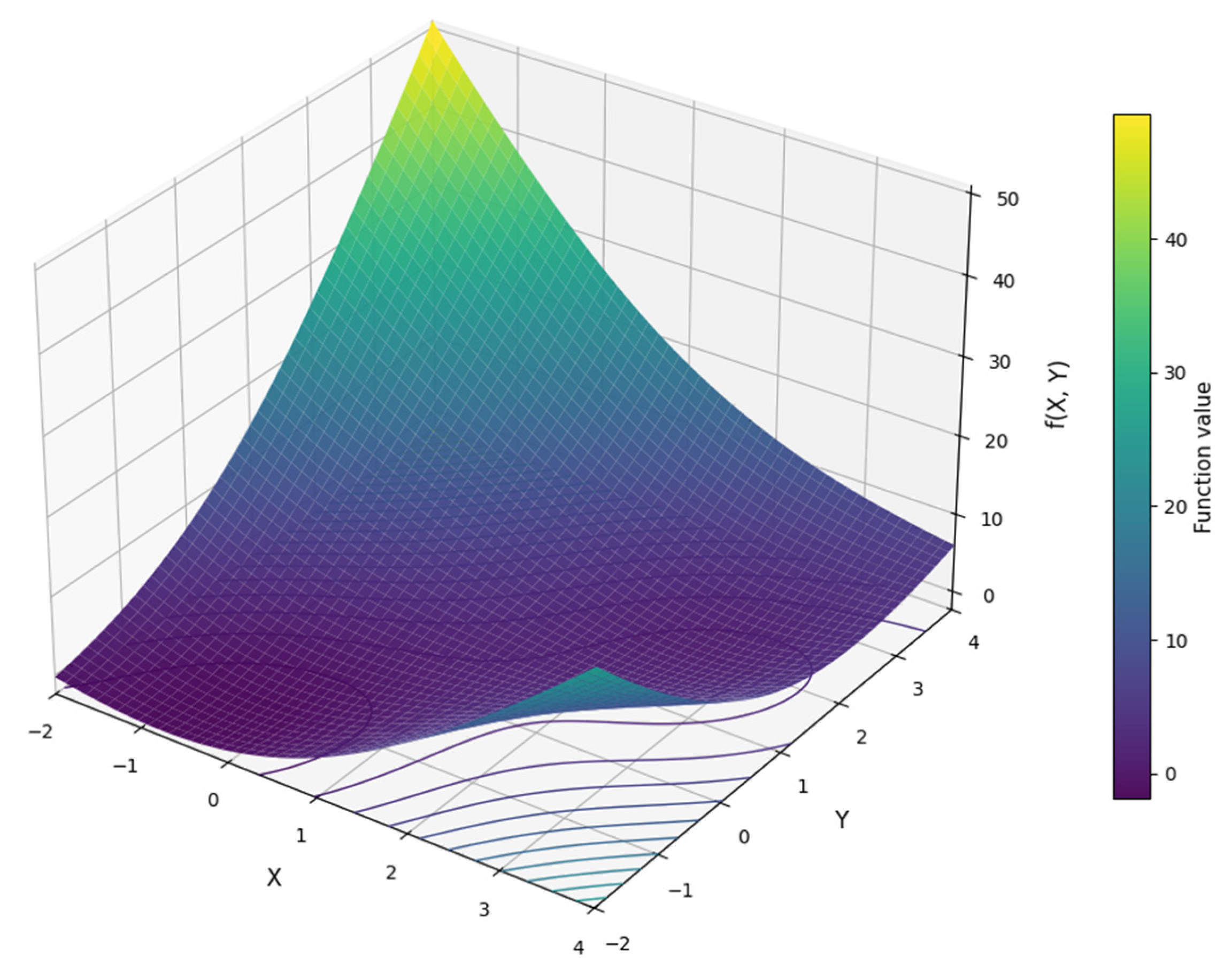
To illustrate behaviour on nonconvex landscapes, three analytic functions are selected as representative test cases. Each problem is posed as a bound-constrained minimisation

4.1. Hump Camel Function
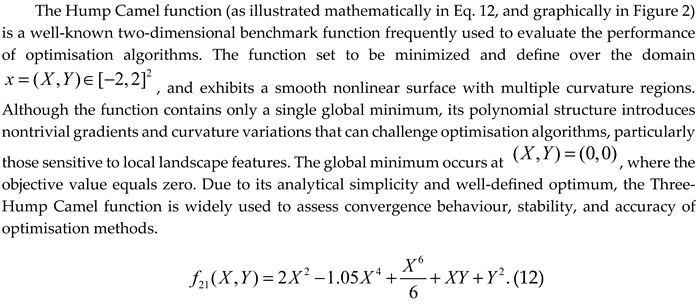
Figure 2.
Hump Camel Function.
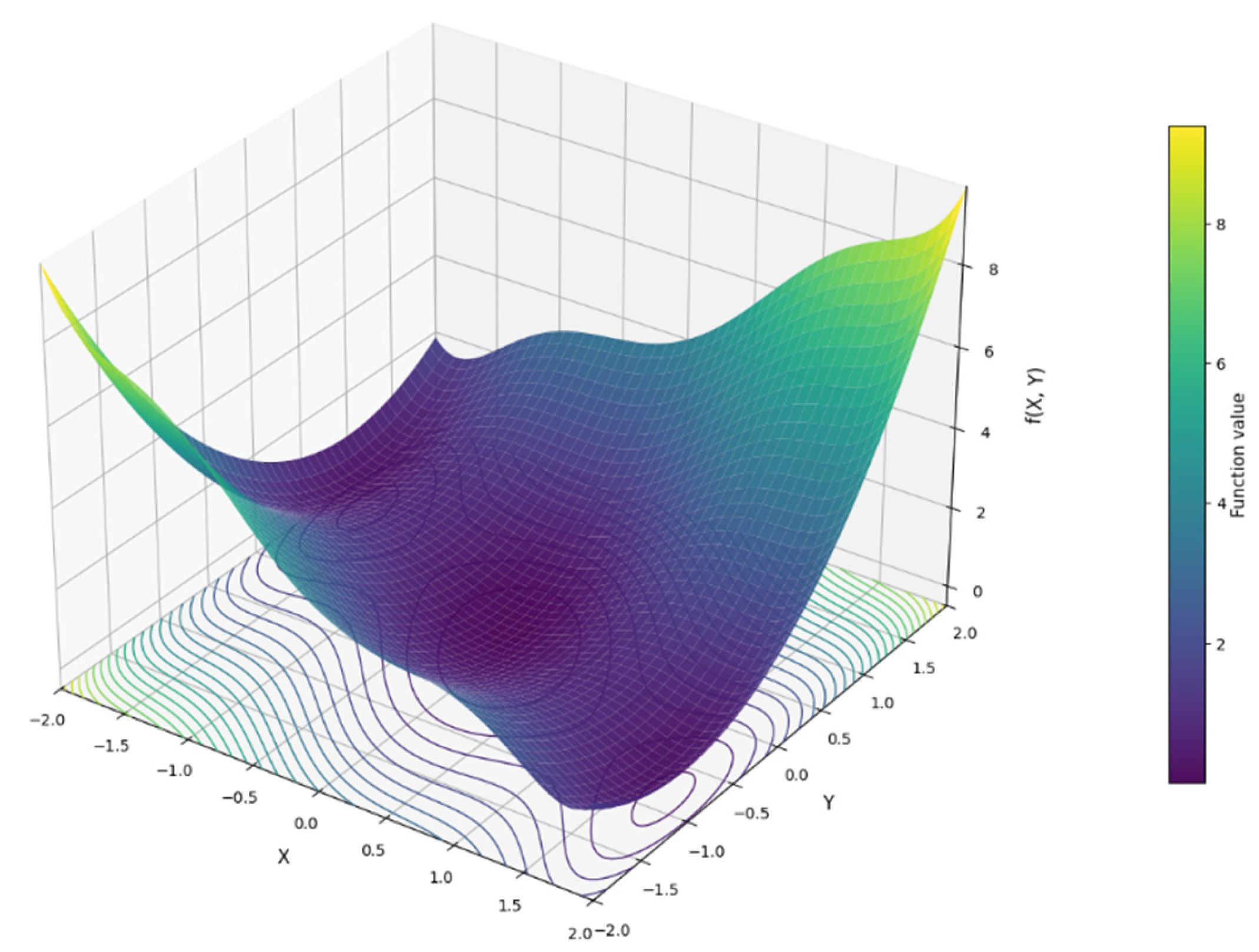
4.2. Beale Function
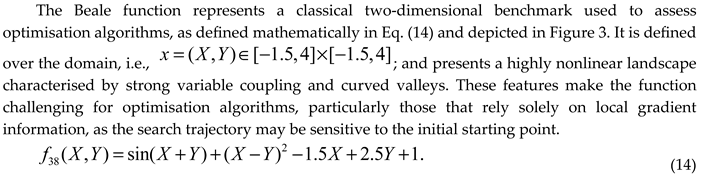
Figure 3.
Beale function.
5. Numerical Invesigation
The performance of the considered optimisation algorithms was first examined using the Three-Hump Camel function, a commonly used benchmark function for evaluating optimisation methods due to its nonlinear structure and the presence of a well-defined global minimum. The objective of this experiment was to assess the convergence behaviour and solution quality obtained by four different optimisation strategies: MMA, SQP, PSO, and the suggested CAMEO algorithm. Figure 4 illustrates the final objective values obtained by each algorithm. The results reveal noticeable differences in the convergence performance and solution accuracy among the tested methods.
The CAMEO algorithm demonstrated strong convergence behaviour, consistently approaching the theoretical minimum of the test function. The obtained objective value is very close to zero, indicating that the algorithm successfully identified the region of the global optimum. This result confirms the ability of CAMEO to effectively combine local gradient information with its model-based exploration mechanism, enabling it to navigate the optimisation landscape efficiently.
The PSO algorithm also converged towards a near-optimal solution, achieving an objective value comparable to that obtained by CAMEO. This behaviour is expected given the exploratory nature of PSO, which enables the algorithm to search multiple regions of the design space simultaneously. However, such population-based approaches typically require a larger number of function evaluations, which may become computationally expensive in practical structural optimisation problems where each evaluation may involve costly numerical simulations. In contrast, the SQP algorithm exhibited moderate performance. While the method converged to a feasible solution, the obtained objective value remained higher than those produced by CAMEO and PSO. This outcome reflects the local search characteristics of SQP, which may lead to convergence toward nearby stationary points when the optimisation landscape contains multiple potential minima. The MMA algorithm produced the least favourable result in this particular test case, yielding an objective value significantly higher than the global optimum. Although MMA is widely recognised for its robustness and efficiency in many structural optimisation applications, particularly topology optimisation problems, its purely local update strategy may occasionally limit its ability to escape unfavourable regions of the design space when the initial design is not sufficiently close to the optimal basin. Overall, the results presented in Figure X highlight the effectiveness of the CAMEO optimisation framework. By integrating controlled exploration with a model-based refinement strategy, CAMEO demonstrates the capability to achieve high-quality solutions while retaining the computational efficiency associated with gradient-based optimisation methods. This balance between exploration and exploitation represents a key advantage of the proposed method when compared with both purely local optimisation algorithms and population-based metaheuristic approaches.
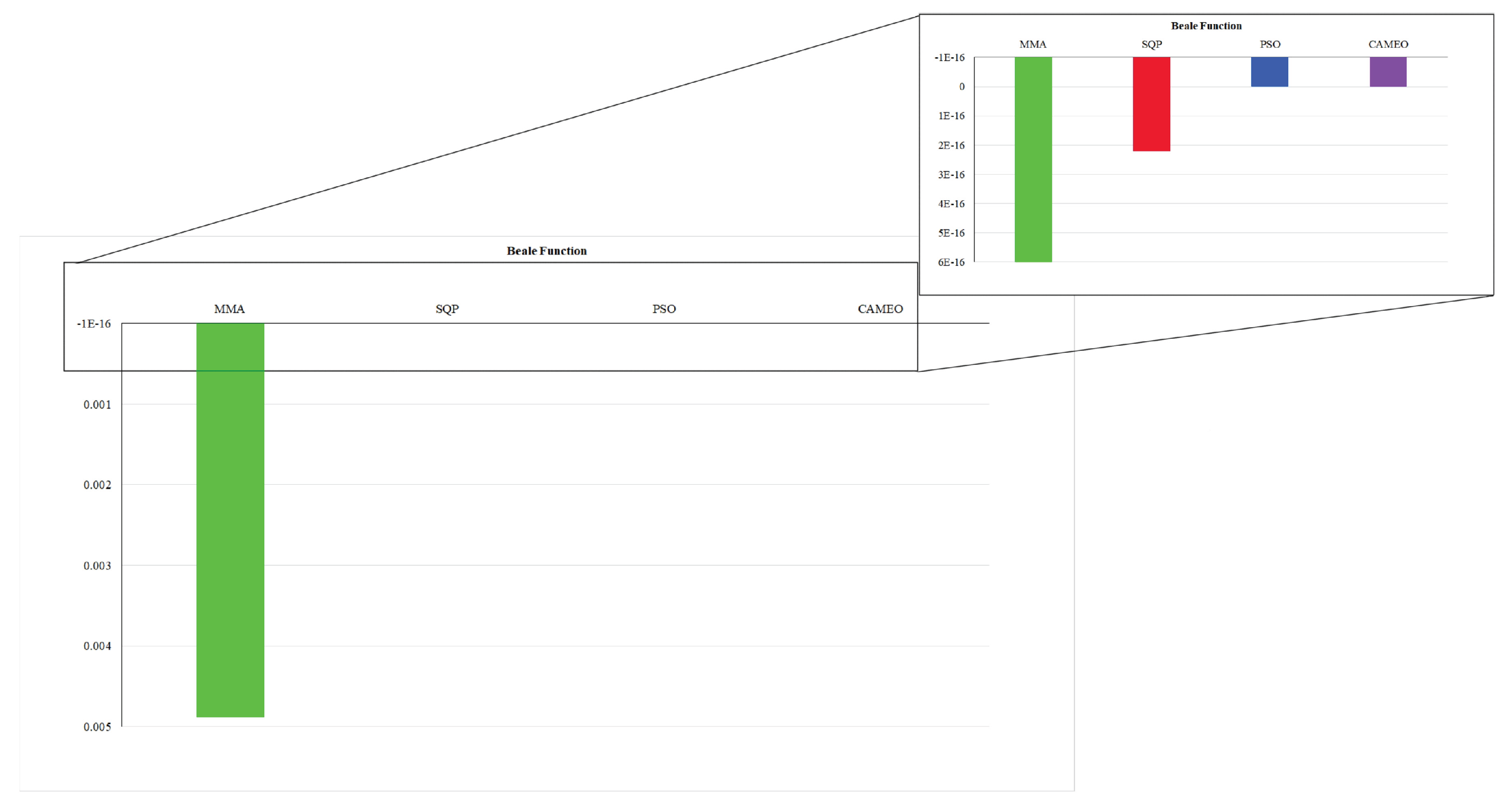
The performance of the optimisation algorithms considered was further evaluated using the Beale function. This function is known for its highly nonlinear surface and strong interaction between variables, which can convergence toward the global optimum challenging for certain optimisation methods. The results obtained from the comparative study between MMA, SQP, PSO, and CAMEO are presented in Figure 5. The figure illustrates the final objective values obtained by each optimisation algorithm after convergence.
The CAMEO algorithm demonstrated excellent optimisation performance, achieving a solution extremely close to the global minimum of the Beale function. The obtained objective value is nearly zero, indicating that the algorithm successfully identified the optimal region of the search space. This behaviour confirms the capability of the proposed method to effectively balance local refinement and controlled exploration of the design space.
The PSO algorithm also converged toward a near-optimal solution, producing an objective value comparable to that obtained by CAMEO. However, population-based algorithms such as PSO typically require a larger number of function evaluations to achieve such results, which may limit their practical efficiency in engineering optimisation problems involving expensive numerical simulations. The SQP algorithm achieved moderate optimisation result, converging to a feasible solution but with an objective value slightly higher than those obtained by PSO and CAMEO. This behaviour reflects the local search characteristics of SQP, which may cause the algorithm to converge toward nearby stationary points depending on the initial conditions. In contrast, the MMA algorithm produced a significantly higher objective value, indicating that the optimisation process converged to a less favourable region of the search space. While MMA is widely recognised for its stability and robustness in many structural optimisation problems, particularly topology optimisation, its purely local update strategy may limit its ability to escape unfavourable regions when the landscape exhibits strong nonlinear behaviour. Overall, the results demonstrate that the proposed CAMEO algorithm provides competitive optimisation performance, successfully achieving near-optimal solutions while maintaining the efficiency associated with gradient-based optimisation approaches.
7. Conclusions
This work presented the Constrained Adaptive Model-based Exploration Optimiser (CAMEO) as a hybrid optimisation approach designed to combine the efficiency of gradient-based methods with controlled exploration capabilities. The algorithm integrates a model-based exploratory step with a constrained local refinement stage, allowing it to maintain stable convergence while improving robustness in nonlinear optimisation landscapes. The performance of CAMEO was evaluated using benchmark optimisation functions and compared with three established optimisation methods: MMA, SQP, and PSO. The results demonstrated that CAMEO was able to achieve objective values close to the global optimum, showing performance comparable to PSO while maintaining the computational efficiency associated with deterministic optimisation techniques. In contrast, purely local methods occasionally converged to less favourable solutions depending on the problem landscape. Overall, the proposed method provides a balanced optimisation strategy that combines exploration and fast local convergence, making it a promising approach for nonlinear engineering optimisation problems. Future work will focus on applying CAMEO to large-scale structural optimisation problems involving high-dimensional design spaces and computationally intensive simulations.
References
- Jha, R.; Chattopadhyay, A. Multidisciplinary optimization of composite wings using refined structural and aeroelastic analysis methodologies. Eng. Optim. 1999, 32, 59–78. [Google Scholar] [CrossRef]
- Mohan, S.C.; Maiti, D.K.; Maity, D. Structural damage assessment using FRF employing particle swarm optimization. Appl. Math. Comput. 2013, 219, 10387–10400. [Google Scholar] [CrossRef]
- Mitjana, F.; Cafieri, S.; Bugarin, F.; Segonds, S.; Castanie, F.; Duysinx, P. Topological gradient in structural optimization under stress and buckling constraints. Appl. Math. Comput. 2021, 409, 126032. [Google Scholar] [CrossRef]
- Amoura, N.; Benaissa, B.; Al Ali, M.; Khatir, S. Deep Neural Network and YUKI Algorithm for Inner Damage Characterization Based on Elastic Boundary Displacement. Proc. Int. Conf. Steel Compos. Eng. Struct. ICSCES 2022, 2023, 220–233. [Google Scholar]
- Delgado, G.; Hamdaoui, M. Topology optimization of frequency dependent viscoelastic structures via a level-set method. Appl. Math. Comput. 2019, 347, 522–541. [Google Scholar] [CrossRef]
- Al Ali, M.; Shimoda, M. Exploring the influence of initial design domain dependencies in concurrent multiscale topology optimization for heat conductivity maximization. Comput. Phys. Commun. 2024, 295, 108968. [Google Scholar] [CrossRef]
- Musaddiq Al Ali, M.S. Toward Concurrent Multiscale Topology Optimization for High Heat Conductive and Light Weight Structure. 15th World Congr. Comput. Mech. 8th Asian Pac. Congr. Comput. Mech. 2022, 1–12. [Google Scholar] [CrossRef]
- Shimoda, M.; Fujita, J.; Al Ali, M.; Kamiya, A. Concurrent multiscale and multi-material optimization method for natural vibration design of porous structures. Int. J. Numer. Methods Eng. 2024, e7424. [Google Scholar] [CrossRef]
- Al Ali, M.; Shimoda, M.; Benaissa, B.; Kobayashi, M.; Takeuchi, T.; Al-Shawk, A.; Ranjbar, S. On metaheuristic aided structural topology optimization method for heat sink design with low electromagnetic interference. 2023. [Google Scholar] [CrossRef]
- Rozvany, G.I.N.; Zhou, M.; Rotthaus, M.; Gollub, W.; Spengemann, F. Continuum-type optimality criteria methods for large finite element systems with a displacement constraint. Part I. Struct. Optim. 1989, 1, 47–72. [Google Scholar] [CrossRef]
- Wang, H.; Ni, Q. A new method of moving asymptotes for large-scale unconstrained optimization. Appl. Math. Comput. 2008, 203, 62–71. [Google Scholar] [CrossRef]
- Svanberg, K. The method of moving asymptotes—a new method for structural optimization. Int. J. Numer. Methods Eng. 1987, 24, 359–373. [Google Scholar] [CrossRef]
- Jiang, T. others, A first order method of moving asymptotes for structural optimization. In Built Environ.; WIT, Translator; 1995; p. 14. [Google Scholar] [CrossRef]
- Long, K.; Wang, X.; Gu, X. Multi-material topology optimization for the transient heat conduction problem using a sequential quadratic programming algorithm. Eng. Optim. 2018, 50, 2091–2107. [Google Scholar] [CrossRef]
- Abed, K.A.; Khalil, E.E.; Abouel-Fotouh, A.M.; El-Hariry, G.; Abd El Salam, L.O. Optimal design of a counter flow cooling tower using PSO algorithm for operating cost minimization. Appl. Therm. Eng. 2018, 143, 149–159. [Google Scholar] [CrossRef]
- Ghorbani, F.; Gharehbaghi, H.; Farrokhabadi, A.; Bolouri, A. Evaluation of the mechanical properties and energy absorption in a novel hybrid cellular structure. Aerosp. Sci. Technol. 2024, 148, 109105. [Google Scholar] [CrossRef]
- H. Bargh, G.; Sadr, M.H. PSO algorithm for fundamental frequency optimization of fiber metal laminated panels. Struct. Eng. Mech. 2013, 47, 713–727. [Google Scholar] [CrossRef]
- Wang, S.Y.; Tai, K. Structural topology design optimization using genetic algorithms with a bit-array representation. Comput. Methods Appl. Mech. Eng. 2005, 194, 3749–3770. [Google Scholar] [CrossRef]
- Han, M.-M.; Tatsumi, S.; Kitamura, Y.; Okumoto, T. Parallel genetic algorithms based on a multiprocessor system fin and its application. In Fundam. Electron. Commun. Comput. Sci.; IEICE, Translator; 1995; Volume 78, pp. 1595–1605. [Google Scholar]
- Ghasemi, M.R.; Hinton, E.; Wood, R.D. Optimization of trusses using genetic algorithms for discrete and continuous variables. Eng. Comput. 1999, 16, 272–303. [Google Scholar] [CrossRef]
- Kane, C.; Schoenauer, M. Topological optimum design using genetic algorithms. Control Cybern. 1996, 25, 1059–1088. [Google Scholar]
- Al Ali, M.; Shimoda, M.; Benaissa, B.; Kobayashi, M. Non-parametric optimization for lightweight and high heat conductive structures under convection using metaheuristic structure binary-distribution method. Appl. Therm. Eng. 2023, 233, 121124. [Google Scholar] [CrossRef]
- Shimoda, M.; Hikasa, M.; Al Ali, M. Micropore shape optimization of porous laminated shell structures. Addit. Manuf. 2023, 69, 103530. [Google Scholar] [CrossRef]
- Arora, J.S. Discrete variable optimum design: concepts and methods. Introd. To Optim. Des. 2025, 699–723. [Google Scholar] [CrossRef]
- Azimifar, A.; Payan, S. Optimization of characteristics of an array of thin fins using PSO algorithm in confined cavities heated from a side with free convection. Appl. Therm. Eng. 2017, 110, 1371–1388. [Google Scholar] [CrossRef]
Figure 4.
Optimisation results for the Hump Camel function using MMA, SQP, PSO, and CAMEO.
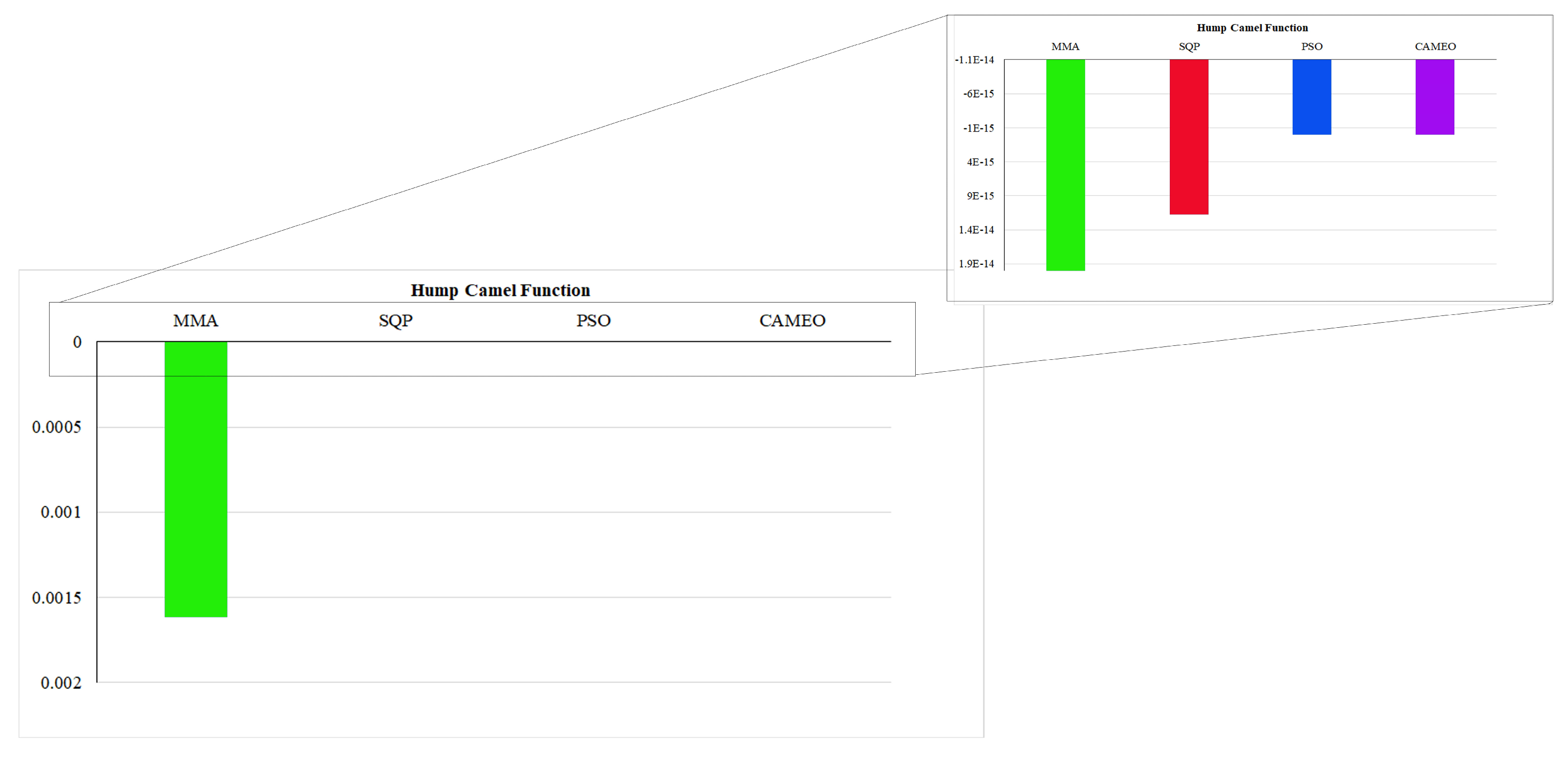
Figure 5.
Optimisation results for the Beale function using MMA, SQP, PSO, and CAMEO.
Disclaimer/Publisher’s Note: The statements, opinions and data contained in all publications are solely those of the individual author(s) and contributor(s) and not of MDPI and/or the editor(s). MDPI and/or the editor(s) disclaim responsibility for any injury to people or property resulting from any ideas, methods, instructions or products referred to in the content. |
© 2026 by the authors. Licensee MDPI, Basel, Switzerland. This article is an open access article distributed under the terms and conditions of the Creative Commons Attribution (CC BY) license (http://creativecommons.org/licenses/by/4.0/).
Copyright: This open access article is published under a Creative Commons CC BY 4.0 license, which permit the free download, distribution, and reuse, provided that the author and preprint are cited in any reuse.


