

Submitted:
06 May 2026
Posted:
07 May 2026
You are already at the latest version
Abstract
We demonstrate an 80-MHz, 350-mW, 120-fs, 770-nm femtosecond laser, based on a nonlinear compressed 1540-nm femtosecond fiber laser. The home-built 1540-nm fiber laser delivering the 80-MHz, 2.69-W, 269-fs laser pulses, was realized by employing the spectral pre-modulation and pre-chirp management inside the Er/Yb co-doped fiber power amplifier. Subsequent nonlinear fiber pulse compression stage was utilized to further nonlinearly compress the pulse duration to 128 fs, based on the Gaussian assumption. Detailed numerical simulation was also implemented to investigate the optical dynamics of the nonlinear compression process. A 0.5-mm-thick fan-out periodically poled lithium niobate (PPLN) crystal was finally utilized to generate the frequency-doubled, 350-mW, 770-nm laser pulses with a 120-fs pulse duration, based on the Gaussian assumption.
Keywords:
770-nm femtosecond laser
; spectral pre-modulation
; nonlinear chirped-pulse amplification
; nonlinear compression
; second-harmonic generation
1. Introduction
Femtosecond lasers operating around 780 nm are widely applied in the state-of-the-art research fields, such as multiphoton microscopy (MPM) [1,2,3], nonlinear micro/nano-fabrication [4,5,6], and terahertz (THz) wave generation [7]. In the past decades, the titanium-sapphire (Ti:sapphire) laser played a key role in providing the required ultrafast light source operating around 780 nm, based on its perfect characteristics of high power, hundred-femtosecond pulse duration, and wavelength tunability [1,8,9]. However, the free-space construction induced environmental sensitivity, the water-cooling requirements, the bulky footprints, and the high cost seriously restricted advanced applications of the Ti:sapphire laser [8,9].
Utilizing frequency doubling of the high-power 1560-nm femtosecond fiber laser to generate the high-power 780-nm femtosecond laser, has been proved to be an effective approach with high system stability, air cooling, compact footprints, and low cost [10,11,12,13,14,15,16]. The large-mode-area (LMA) Er/Yb co-doped double-clad (DC) fiber enables the watt-level average power scaling of the 1560-nm fiber laser based on the chirped-pulse amplification (CPA) [10,11,12]. However, the limited gain bandwidth of the Er/Yb co-doped gain fiber induces severe spectral gain narrowing inside the fiber amplifier, making it difficult to achieve the compressed 1560-nm laser pulses with sub-200-fs pulse duration. Considering the negative dispersion of the fused silica fiber at 1.5-µm, nonlinear self-compression can be employed to deliver the nonlinear compressed laser pulses with hundred-femtosecond pulse duration, after carefully managing the conjugation between the self-phase modulation (SPM) and negative dispersion inside the fiber [13,14,15,16]. Ref. [15] reported the 27-fs, 220-mW, 1560-nm laser generation based on the nonlinear self-compression inside the single-mode fiber (SMF) with negative group velocity dispersion (GVD). Further power scaling can be seriously restricted by the stimulated Raman scattering (SRS) inside the SMF with its small core diameter, which can induce the pulse splitting [17]. Ref. [18] reported the high-power nonlinear self-compression results with the LMA Er/Yb co-doped DC fiber, delivering 187-fs, 2.3-W, 1560-nm fiber laser. Due to the significant gain narrowing inside the DC gain fiber, further high-power, hundred-femtosecond 1560-nm laser pulses cannot be simply achieved by managing the SPM and the fiber dispersion. Based on the aforementioned approaches, it is difficult to realize the 1560-nm fiber laser simultaneously with high average power and hundred-femtosecond pulse duration. Therefore, in order to generate the 780-nm femtosecond laser with high average power and hundred-femtosecond pulse duration based on SHG, the investigations into realizing a novel and more practical approach in generating the required high-power femtosecond 1560-nm laser pulses are still necessary [10,11,12,13,14,15,16,18].
Investigations into ultrafast fiber optics over the past decades provide an effective approach in precisely modulating the optical spectrum and managing the optical chirp, making it feasible to generate the required high-power 1560-nm femtosecond fiber laser [17,19,20]. The spectral gain-narrowing and optical coherence degradation inside the Er/Yb co-doped fiber amplifier can be significantly inhibited by pre-modulating the spectrum of the 1560-nm signal laser [21]. Based on carefully managing the conjugation between the SPM and negative dispersion inside the Er/Yb co-doped fiber amplifier, the perfect high-power 1560-nm femtosecond laser pulse can be achieved after compression [19,20]. A further shorter pulse duration of the high-power 1560-nm signal laser can be realized by employing the nonlinear fiber compression, realized by managing the SPM process inside the non-zero dispersion-shifted fiber and compensating the optical chirp with bulk material. Furthermore, the high-power 780-nm laser with a hundred-femtosecond pulse duration can be finally achieved by utilizing the fan-out PPLN crystal, based on the broadband quasi-phase-matched SHG.
In this work, we report on an 80-MHz, 350-mW, 120-fs, 770-nm femtosecond laser, based on a spectral pre-modulated 1540-nm femtosecond fiber laser with the nonlinear fiber compression. The spectral pre-modulation and pre-chirp management were employed inside the nonlinear chirped-pulse Er/Yb co-doped fiber amplifier, realizing the 80-MHz, 2.69-W, 269-fs, 1540-nm signal laser after compression. Based on the SPM-induced nonlinear spectral broadening, the nonlinear fiber compressor was utilized to further compress the pulse duration of the 1540-nm signal laser to 128 fs, based on the Gaussian assumption. The measured optical power stability of the delivered 1.17-W, 128-fs, 1540-nm signal laser was 0.57% at 30 min. A 0.5-mm-thick fan-out PPLN crystal was subsequently utilized to generate the 120-fs, 770-nm frequency-doubled laser pulses with the average power of 350 mW. To our knowledge, it is the first time to utilize the cascaded stages of nonlinear chirped-pulse amplifier (NCPA), nonlinear fiber compressor, and SHG in generating the high-power, hundred-femtosecond signal laser operating around 780 nm, providing an effective illumination laser source for the aforementioned applications.
2. Experimental Setup
The schematic construction of the 770-nm femtosecond laser system is shown in Figure 1, consisting of a mode-locked fiber oscillator, a nonlinear fiber pre-amplifier, a free-space spectral pre-modulator, a fiber stretcher, an Er/Yb co-doped fiber power amplifier, a grating-pair compressor, a nonlinear compressor, and a SHG stage. The home-built 80-MHz Er-doped fiber oscillator was realized with the nonlinear amplifying loop mirror (NALM), delivering the 5.1-mW, mode-locked 1560-nm signal laser. The nonlinear fiber pre-amplifier was realized with a combination of a fiber pre-chirper, an Er-doped fiber amplifier and a nonlinear fiber compressor. The 5-m PM1550 fiber (≈− 22.96/mm, Coherent) was utilized to provide the -0.1148 group delay dispersion (GDD) to realize the nonlinear amplification process inside the subsequent Er-doped fiber amplifier. The 3.6-m PM Er-doped fiber (DHB1500, ≈30.61/mm, Newport) was utilized as the gain medium for the nonlinear fiber pre-amplifier to scale up the average power of the signal laser to 374 mW, pumped with two 950-mW, 976-nm SMLDs. The 1.55-m PM1550 fiber with negative dispersion was further employed to introduce the nonlinear spectral broadening process based on the enhanced SPM [22], ensuring a sufficient broadband spectrum for the subsequent spectral modulator. The cascaded combination of the half-wave plates and the isolator was utilized to prevent the potential backward reflection from the spectral modulator.
The pre-amplified signal laser was subsequently injected into a spectral modulator based on the 4-f optical system. This modulator consists of a transmission grating (1000 lines/mm, LightSmyth), a plano-convex lens with a 40-mm focal length, a home-built multi-dimensional spectral clipper, and a high-reflection mirror. The injected laser beam was diffracted by the grating, introducing significant spatial chirp in the horizontal (x) direction. The spatially chirped beam was then recollimated by the lens inside the 4-f optical system. A combination of the spectral clipper and the conical mask was utilized as the multi-dimensional spectral clipper to modulate the spatially chirped laser beam. The specific spectral shaping mechanism is illustrated in detail within the black dashed rectangle of Figure 1. The horizontal (x) modulation realized with the clipper was utilized to clip the short-wavelength contents with degraded coherence induced inside the fiber pre-amplifier [21]. The vertical (y) modulation realized with the conical mask was utilized to finely modulate the spectral formation inside the optical fiber, leading to a compensable spectral phase condition [22].
The spectrally modulated signal laser was re-coupled into the length-optimized 17-m PM2000D (≈64/mm, Coherent) dispersion compensation fiber to realize NCPA inside the subsequent Er/Yb co-doped fiber power amplifier. The pulse duration was increased from 2 ps to approximately 50 ps, based on the Gaussian assumption. The stretched signal laser was further injected into the Er/Yb co-doped fiber power amplifier to scale the average power up to 3.57 W. The fiber power amplifier consisted of the 1.8-m PM Er/Yb co-doped double-clad fiber (PM-EYDF-12/130-HE, Nefurn) with the core-diameter of 12 µm, a PM fiber combiner, and a 16-W, 976-nm MMLD. The optical power of the amplified signal laser decreased to 2.69 W after being compressed by the transmission-grating-pair compressor (1000 lines/mm, LightSmyth), with a compression efficiency of 75%. A home-built telescope consisting of two plano-convex lenses with the focal lengths of 50 mm and 40 mm, was utilized to optimize the mode-matching condition between the delivered laser beam and the non-zero dispersion-shifted fiber (DCF4, ≈5.1/mm, Thorlabs) of the nonlinear compressor. The 5-cm DCF was utilized to realize the nonlinear spectral broadening of the injected signal laser. A 17-cm-long high-purity fused silica block (≈−29.1/mm, Castech) was further employed to compensate the accumulated optical chirp during the nonlinear spectral broadening process. The SHG stage consisted of a half-wave plate, a plano-convex lens with the focal length of 15 mm, a 0.5-mm-thick fan-out PPLN crystal, and a plano-convex lens with the focal length of 25 mm. The poling period of the fan-out PPLN crystal ranged from 18.0 µm to 20.8 µm, ensuring broadband second harmonic generation of the 1540-nm signal laser. A dichroic mirror was utilized to separate the frequency-doubled 770-nm laser from the residual 1540-nm signal laser.
3. Experimental and Numerical Results
Figure 2 illustrates the measured optical characteristics of the signal lasers delivered by the home-built stretched pulse mode-locked oscillator and the nonlinear fiber pre-amplifier. The output spectrum of the 80-MHz, 5.1-mW signal laser delivered by the fiber oscillator was centered at 1555 nm. The corresponding measured spectral bandwidth was 42.6 nm. Based on the designed dispersion compensation inside the fiber pre-amplifier, the nonlinearly amplified 1555-nm signal laser was further compressed inside the subsequent fiber compressor built with the 1.55-m PM1550 fiber. The optical power of the amplified signal laser was significantly transferred to the blue-side and red-side of the nonlinearly broadened spectrum inside the fiber compressor, based on the conjugation between the SPM and the negative GVD of the PM1550 fiber, as shown in Figure 2(c). The measured spectral bandwidth of the dual-peak spectrum was broadened to 67 nm. The corresponding measured pulse duration was 2 ps, based on the Gaussian assumption, shown in Figure 2(d). The condition of the optical pulse train is shown in Figure 2(d), measured with the photodetector (15-GHz bandwidth, EOT) and the oscilloscope (1-GHz bandwidth, Tektronix). The measured temporal pulse interval was 12.5 ns, with the peak-to-peak intensity fluctuations of 3%.
Figure 3 demonstrates the measured spectra and the corresponding auto-correlation traces, delivered by the spectral modulator, the fiber stretcher, and the power amplifier. Detailed investigations of the spectral pre-modulation were implemented to realize the high-power 1540-nm femtosecond laser with optimized optical pulse profile, delivered by the NCPA system. The accumulated optical chirp via propagating through the optical fiber can be carefully modified by managing the intensity distribution of the spectral contents [22]. The conical mask illustrated in Figure 1 was employed to carefully modify the optical chirp condition of the signal pulses, ensuring that the accumulated nonlinear phase shift and optical dispersion can be finally compensated by the grating-pair compressor. Further, the mismatch between the gain spectrum of the fiber amplifier and the optical spectrum of the signal laser can lead to the degradation of optical coherence [21], leading to the uncompensated pedestals of the compressed signal pulses. The short-wavelength clipper illustrated in Figure 1 was employed to remove the short-wavelength contents with degraded coherence induced inside the fiber pre-amplifier. Therefore, the nonlinearly broadened spectrum delivered by the fiber stretcher can be realized with improved coherence based on the SPM. The coherent stretched signal pulses can sufficiently extract the optical gain provided by the Er/Yb co-doped fiber amplifier, ensuring a favorable optical phase condition. However, due to the mismatch between the spectrum of the signal laser and the gain spectrum of the Er/Yb co-doped gain fiber inside the fiber power amplifier, the coherence degradation can still be induced at the short-wavelength region, leading to the uncompensated pedestals.
Figure 3(a)–(d) illustrate the measured optical spectra obtained by modulating the nonlinearly pre-amplified spectra with or without the spectral clipper and the conical mask. The central wavelength of the conical mask was set at 1583 nm with a full width at half maximum (FWHM) of 9.4 nm, while the short-wavelength components below 1537 nm were truncated by the clipper. With combined modulation of the conical mask and the clipper, the pulse duration at the output of the spectral modulator was 2 ps, based on the Gaussian assumption. As shown in Figure 3(e)–(h), significant nonlinear spectral broadening processes were induced by the SPM inside the fiber stretcher. The corresponding measured spectral bandwidths were 72 nm, 76 nm, 67 nm, and 76 nm, respectively, indicating the residual coherence degraded spectral contents in Figure 3(f) and (h). Figure 3(i)–(l) illustrate the measured spectra delivered by the fiber power amplifier. Further, deeper modulation ripples can be observed on the amplified spectra pre-modulated with the conical mask, as shown in Figure 3(i) and (j), indicating a different optical chirp accumulation efficiency compared with pre-modulation conditions without the conical mask.
Figure 3(m)–(p) illustrate the measured auto-correlation traces delivered by the power amplifier. The optimized compression result was illustrated in Figure 3(m) with a pulse duration of 249 fs, based on the Gaussian assumption. The residual pedestals shown in Figure 3 (m) were caused by the newly generated coherence-degraded spectral contents in the short-wavelength region during the power amplification process. As shown in Figure 3(n) and (p), the coherence-degraded spectral contents distracted large amounts of optical gain provided by the Er/Yb co-doped fiber, leading to the significant pedestals. Significant improvements were achieved by pre-modulating the spectrum of the signal laser with the spectral clipper and the conical mask, indicating a conjugation condition between the accumulated nonlinear phase shift and the dispersion.
The output average powers delivered by the grating-pair compressor are illustrated in Figure 4, as a function of the coupled 976-nm multi-mode pump power. The corresponding calculated slope efficiencies were approximately 17%, nearly the same under different spectral modulation conditions. The average power of the signal laser can be scaled up to a maximum of 2.69 W with the optimized spectral pre-modulation, after being compressed by the grating-pair compressor. The minor differences in the maximum amplified average power were caused by the signal power differences introduced by the spectral pre-modulation. The linear increase tendency of the amplification curves indicates a potential power-scaling capability.
The output characteristics of the nonlinear compressed signal pulses are illustrated in Figure 5. The compressed 1540-nm signal laser was coupled into the 5-cm DCF4 fiber, with significant nonlinear spectral broadening achieved, as shown in Figure 5(a). The corresponding spectral bandwidth was broadened to 36 nm, indicating a calculated FTL pulse duration of 87 fs. The pulse duration after compression with the 17-cm fused silica block was 128 fs based on the Gaussian assumption, which is 1.47 times the calculated FTL pulse duration. The measured optical power stability of the nonlinearly compressed 1.17-W, 1540-nm pulses was 0.57% at 30 min, indicating good operating stability for practical applications. A further shorter pulse duration of sub-60 fs can also be achieved by enhancing the nonlinear spectral broadening process.
Numerical simulation was implemented to investigate the nonlinear pulse evolution dynamics inside the DCF4 fiber. A numerical simulation model based on the generalized nonlinear Schrödinger equation (GNLSE), considering the optical loss, optical dispersion, SPM, self-steepening, and stimulated Raman scattering, was constructed [23,24]. The simulated spectrum and the corresponding calculated auto-correlation traces of the nonlinearly compressed pulses are shown in Figure 6. The numerically simulated spectrum is in good agreement with the experimental result, confirming the effective optical chirp management. Figure 6(b) and (c) illustrate the calculated auto-correlation traces before and after the fused silica block, which perfectly match the experimental results, indicating a perfect nonlinear compression process was realized with this home-built nonlinear fiber compression stage.
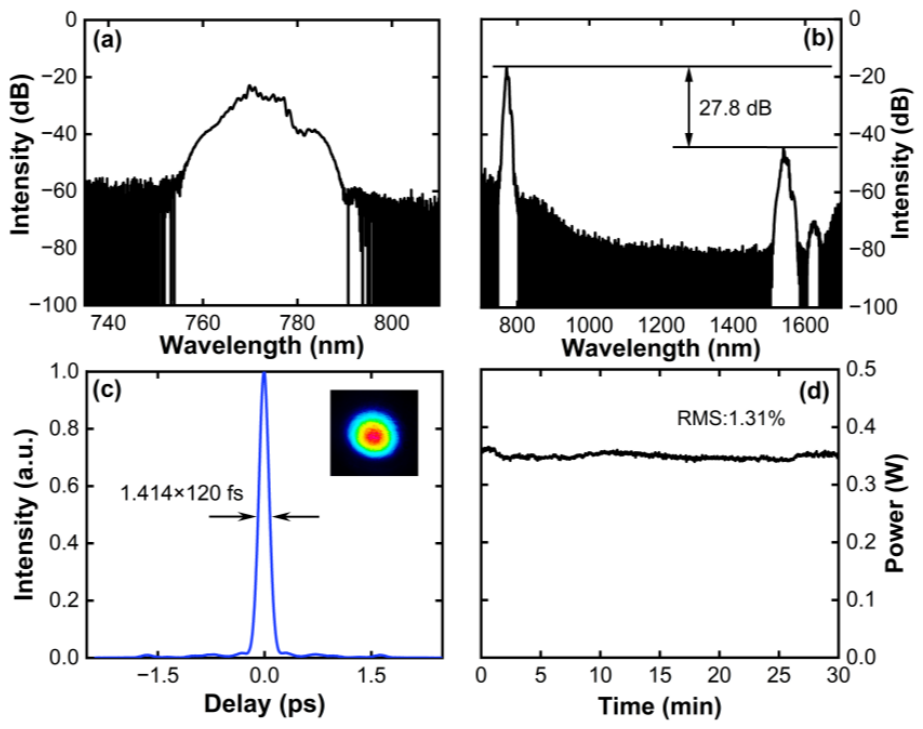
Figure 7 shows the measured spectra and the corresponding auto-correlation traces of the 770-nm pulses delivered by the SHG stage. The nonlinearly compressed 1540-nm pulses were injected into the 0.5-mm-thick fan-out PPLN crystal, delivering the 120-fs, 350-mW, 770-nm pulses, with the SHG conversion efficiency of 30%. The fan-out PPLN features the continuously varying poling period ranging from 18.0 µm to 20.8 µm. By carefully adjusting the position of the crystal, a favorable broadband phase-matching condition was achieved. In order to further increase SHG conversion efficiency, the 0.5-mm thickness of the PPLN crystal was selected to suppress the temporal walk-off effect inside the crystal. The focal length of the focusing lens was also optimized to generate sufficient optical power density without inducing severe thermal effects inside the crystal [25]. The measured optical power stability of the 770-nm laser was 1.31% at 30 min.
4. Conclusions
In conclusion, we report on an 80-MHz, 350-mW, 120-fs, 770-nm femtosecond laser, based on a spectral pre-modulated 1540-nm femtosecond fiber laser with the nonlinear fiber compression. The spectral pre-modulation and pre-chirp management were employed in the nonlinear chirped-pulse Er/Yb co-doped fiber amplifier, realizing the 80-MHz, 2.69-W, 269-fs, 1540-nm signal laser after compression. The spectral gain narrowing and optical coherence degradation inside the fiber amplifier were significantly suppressed by pre-modulating the spectrum of the 1540-nm signal laser. By carefully managing the conjugation between the SPM and negative dispersion inside the Er/Yb co-doped fiber amplifier, the perfect high-power 1540-nm femtosecond laser pulse was achieved after compression. Based on the SPM-induced nonlinear spectral broadening, the nonlinear fiber compressor was utilized to further compress the pulse duration of the 1540-nm signal laser to 128 fs, based on the Gaussian assumption. The measured optical power stability of the delivered 1.17-W, 128-fs, 1540-nm signal laser was 0.57% at 30 min. Detailed numerical simulation was also implemented to investigate the optical dynamics of the nonlinear compression process, indicating the effective optical chirp management. A 0.5-mm-thick fan-out PPLN crystal was subsequently utilized to generate the 120-fs, 770-nm frequency-doubled laser pulses with the average power of 350 mW. Delivering the hundred-femtosecond pulses operating around 780 nm, the high-power signal laser provides an effective illumination laser source for the aforementioned applications.
Author Contributions
Conceptualization, H.W. and Y.L.; methodology, K.G.; software, H.W.; validation, H.W., H.X., K.G., and X.Z.; investigation, H.W. and K.G.; resources, Y.L.; data curation, H.W.; writing—original draft preparation, H.W.; writing—review and editing, K.G., Z.Y. and Y.L.; visualization, H.W.; supervision, K.G., A.W. and Y.L. All authors have read and agreed to the published version of the manuscript.
Funding
This research was funded by the National Natural Science Foundation of China, grant numbers 62305186.
Institutional Review Board Statement
Not applicable.
Informed Consent Statement
Not applicable.
Data Availability Statement
Date underlying the results presented in this paper are not publicly available at this time but may be obtained from the authors upon reasonable request.
Conflicts of Interest
The authors declare no conflicts of interest.
References
- Hoover, E. E.; Squier, J. A. Advances in multiphoton microscopy technology. Nat. Photonics 2013, 7, 93–101. [Google Scholar] [CrossRef] [PubMed]
- Denk, W.; Strickler, J. H.; Webb, W. W. Two-photon laser scanning fluorescence microscopy. Science 1990, 248, 73–76. [Google Scholar] [CrossRef] [PubMed]
- Palczewska, G.; Stremplewski, P.; Suh, S.; Alexander, N.; Salom, D.; Dong, Z.; Ruminski, D.; Choi, E. H.; Sears, A. E.; Kern, T. S.; Wojtkowski, M.; Palczewski, K. Two-photon imaging of the mammalian retina with ultrafast pulsing laser. JCI Insight 2018, 3, e121555. [Google Scholar] [CrossRef] [PubMed]
- Serbin, J.; Egbert, A.; Ostendorf, A.; Chichkov, B. N.; Houbertz, R.; Domann, G.; Schulz, J.; Cronauer, C.; Fröhlich, L.; Popall, M. Femtosecond laser-induced two-photon polymerization of inorganic-organic hybrid materials for applications in photonics. Opt. Lett. 2003, 28, 301–303. [Google Scholar] [CrossRef] [PubMed]
- Xiong, W.; Zhou, Y. S.; He, X. N.; Gao, Y.; Mahjouri-Samani, M.; Jiang, L.; Baldacchini, T.; Lu, Y. F. Simultaneous additive and subtractive three-dimensional nanofabrication using integrated two-photon polymerization and multiphoton ablation. Light Sci. Appl. 2012, 1, e6. [Google Scholar] [CrossRef]
- Kim, D.; So, P. T. C. High-throughput three-dimensional lithographic microfabrication. Opt. Lett. 2010, 35, 1602–1604. [Google Scholar] [CrossRef] [PubMed]
- Stehr, D.; Morris, C. M.; Schmidt, C.; Sherwin, M. S. High-performance fiber-laser-based terahertz spectrometer. Opt. Lett. 2010, 35, 3799–3801. [Google Scholar] [CrossRef] [PubMed]
- Bueno, J. M.; Ávila, F. J.; Artal, P. Comparing the performance of a femto fiber-based laser and a Ti:sapphire used for multiphoton microscopy applications. Appl. Opt. 2019, 58, 3830–3835. [Google Scholar] [CrossRef] [PubMed]
- Tang, S.; Liu, J.; Krasieva, T. B.; Chen, Z.; Tromberg, B. J. Developing compact multiphoton systems using femtosecond fiber lasers. J. Biomed. Opt. 2009, 14, 030508. [Google Scholar] [CrossRef] [PubMed]
- Si, G.; Song, W.; Hou, Y.; Zhao, H.; Zhang, Q.; Wang, P. Generation of high energy 780 nm femtosecond pulses by frequency doubling of an all-polarization-maintaining Er-doped fiber laser. Opt. Commun. 2024, 561, 130451. [Google Scholar] [CrossRef]
- Luo, T.; Wen, J.; Wang, W.; Li, Z.; Zhu, Z.; Yang, J.; Wu, Y.; Xiu, H.; Fan, Y.; Liu, Y.; Wei, X.; Yang, Z. High-Power All-Polarization-Maintaining Fiber Femtosecond Pulse Laser at 780 nm and Its Engineering Integration (Invited). Chin. J. Laser 2024, 51, 1901012. [Google Scholar] [CrossRef]
- Liu, Z.; Zong, W.; Liu, Y.; Zuo, L.; Wen, C.; Jiang, T.; Zhang, J.; Ma, Y.; Zhang, Z.; Chen, L.; Wang, A. High power 780 nm femtosecond fiber laser; CLEO: 2015: San Jose, CA, USA, 10-15 May 2015. [Google Scholar]
- Stachowiak, D.; Bogusławski, J.; Głuszek, A.; Łaszczych, Z.; Wojtkowski, M.; Soboń, G. Frequency-doubled femtosecond Er-doped fiber laser for two-photon excited fluorescence imaging. BioMed Opt. Express 2020, 11, 4431–4442. [Google Scholar] [CrossRef] [PubMed]
- Boivinet, S.; Morin, P.; Yehouessi, J. P.; Vidal, S.; Machinet, G.; Boullet, J. 3.5nJ femtosecond pulses at 792 nm generated by frequency doubling of an all-PM fiber high energy 48 fs laser; Fiber Lasers XVI: Technology and Systems: San Francisco, CA, USA, 4-7 February 2019. [Google Scholar]
- Herda, R.; Zach, A. Generation of 32-fs pulses at 780 nm by frequency doubling the solitonically-compressed output of an erbium-doped fiber-laser system. Conference on Lasers and Electro-Optic, San Jose, CA, USA, 6-11 May 2012. [Google Scholar]
- Herda, R.; Brodschelm, A.; Hellerer, T.; Lison, F. Generation of frequency-doubled 55 fs pulses from an erbium fiber laser system. Conference on Lasers and Electro-Optics 2010, San Jose, CA, USA, 16-21 May 2010. [Google Scholar]
- Dudley, J. M.; Genty, G.; Coen, S. Supercontinuum generation in photonic crystal fiber. Rev. Mod. Phys. 2006, 78, 1135–1184. [Google Scholar] [CrossRef]
- Jiang, X.; Chen, F.; Yin, T.; Forsberg, E.; He, S. Generation of high-power 780 nm femtosecond pulses by an all-polarization-maintaining Er-doped fiber amplification system. Appl. Opt. 2019, 58, 4492–4496. [Google Scholar] [CrossRef]
- Becker, N. C.; Hädrich, S.; Eidam, T.; Just, F.; Osvay, K.; Várallyay, Z.; Limpert, J.; Tünnermann, A.; Pertsch, T.; Eilenberger, F. Adaptive pre-amplification pulse shaping in a high-power, coherently combined fiber laser system. Opt. Lett. 2017, 42, 3916–3919. [Google Scholar] [CrossRef] [PubMed]
- Prawiharjo, J.; Daga, N. K.; Geng, R.; Price, J. H. V.; Hanna, D. C.; Richardson, D. J.; Shepherd, D. P. High fidelity femtosecond pulses from an ultrafast fiber laser system via adaptive amplitude and phase pre-shaping. Opt. Express 2008, 16, 15074–15089. [Google Scholar] [CrossRef]
- Liu, Y.; Krogen, P.; Hong, K.-H.; Cao, Q.; Keathley, P.; Kärtner, F. X. Fiber-amplifier-pumped, 1-MHz, 1-µJ, 2.1-µm, femtosecond OPA with chirped-pulse DFG front-end. Opt. Express 2019, 27, 9144–9154.XXX. [Google Scholar] [CrossRef] [PubMed]
- Wang, J.; Chen, R.; Chang, G. On the frequency spanning of SPM-enabled spectral broadening: analytical solutions. Opt. Express 2022, 30, 33664–33679. [Google Scholar] [CrossRef] [PubMed]
- Schreiber, T.; Ortaç, B.; Limpert, J.; Tünnermann, A. On the study of pulse evolution in ultra-short pulse mode-locked fiber lasers by numerical simulations. Opt. Express 2007, 15, 8252–8262. [Google Scholar] [CrossRef] [PubMed]
- Voronin, A.A.; Zheltikov, A.M. Soliton self-frequency shift decelerated by self-steepening. Opt. Lett. 2008, 33, 1723–1725. [Google Scholar] [CrossRef] [PubMed]
- Lai, J.-Y.; Hsu, C.-S.; Hsu, C.-W.; Wu, D.-Y.; Wu, K.; Chou, M.-H. Single pass 7 watts continuous wave 532 nm generation by focusing optimized second harmonic generation in MgO:PPLN. Proceedings of Nonlinear Frequency Generation and Conversion: Materials and Devices XVIII, San Francisco, CA, USA, 5-7 February 2019. [Google Scholar]
Figure 1.
Schematic construction of the high-power, 770-nm femtosecond laser system. EDF: erbium-doped fiber, WDM: wavelength division multiplexer, SMLDs: single-mode laser diodes, EYDF: Er/Yb co-doped fiber, DM: dichroic mirror, ISO: isolator, RM: reflecting mirror, PPLN: periodically poled lithium niobate.
Figure 1.
Schematic construction of the high-power, 770-nm femtosecond laser system. EDF: erbium-doped fiber, WDM: wavelength division multiplexer, SMLDs: single-mode laser diodes, EYDF: Er/Yb co-doped fiber, DM: dichroic mirror, ISO: isolator, RM: reflecting mirror, PPLN: periodically poled lithium niobate.
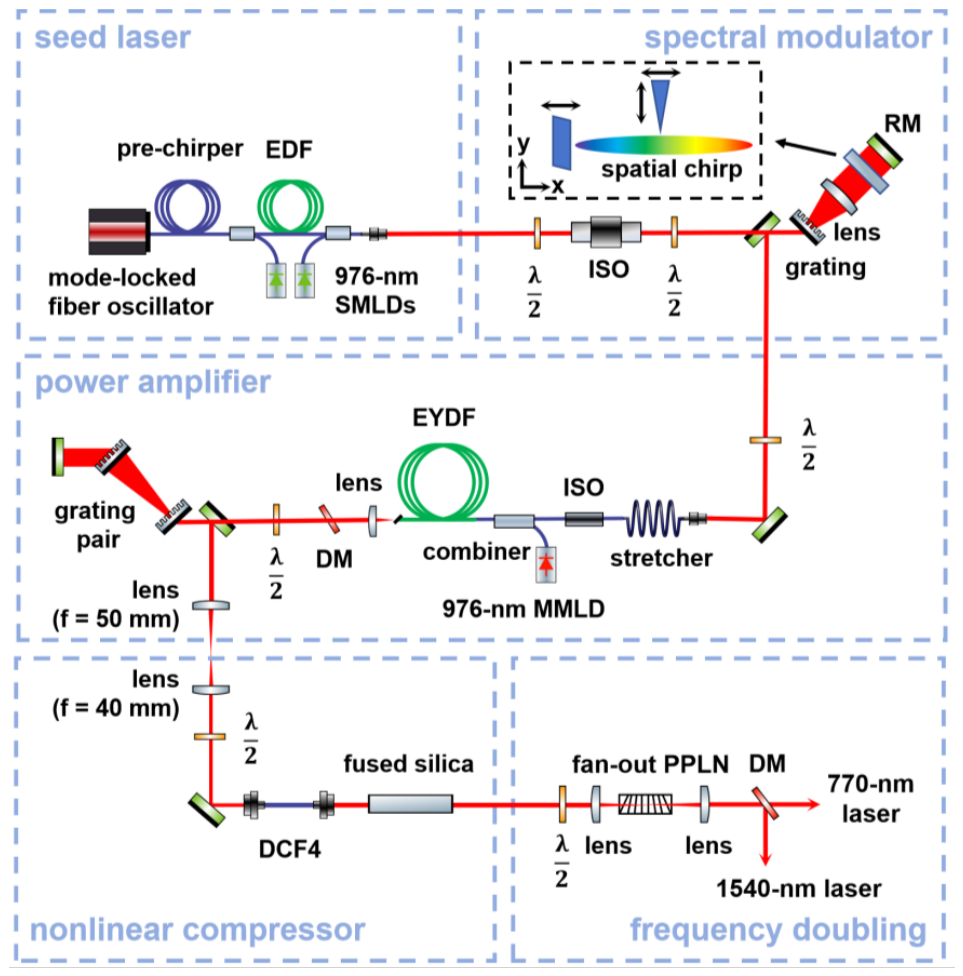
Figure 2.
(a) Optical spectrum and (b) pulse train of the mode-locked laser pulses. (c) Optical spectrum and (d) auto-correlation trace of the nonlinearly pre-amplified pulses, with the pulse duration of 2 ps, based on the Gaussian assumption.
Figure 2.
(a) Optical spectrum and (b) pulse train of the mode-locked laser pulses. (c) Optical spectrum and (d) auto-correlation trace of the nonlinearly pre-amplified pulses, with the pulse duration of 2 ps, based on the Gaussian assumption.
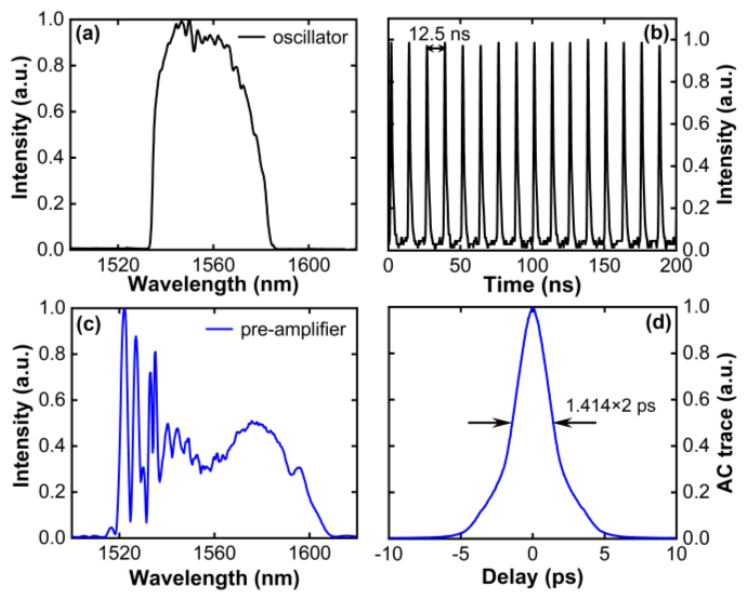
Figure 3.
Optical spectra delivered by the spectral modulator, the fiber stretcher, and the power amplifier, under different spectral modulation conditions: (a, e, i) modulated with the spectral clipper and the conical mask, (b, f, j) modulated with the conical mask, (c, g, k) modulated with the spectral clipper, (d, h, l) without modulation. The corresponding auto-correlation traces, delivered by the fiber stretcher and the power amplifier, under different spectral modulation conditions: (m) modulated with the spectral clipper and the conical mask, (n) modulated with the conical mask, (o) modulated with the spectral clipper, (p) without modulation.
Figure 3.
Optical spectra delivered by the spectral modulator, the fiber stretcher, and the power amplifier, under different spectral modulation conditions: (a, e, i) modulated with the spectral clipper and the conical mask, (b, f, j) modulated with the conical mask, (c, g, k) modulated with the spectral clipper, (d, h, l) without modulation. The corresponding auto-correlation traces, delivered by the fiber stretcher and the power amplifier, under different spectral modulation conditions: (m) modulated with the spectral clipper and the conical mask, (n) modulated with the conical mask, (o) modulated with the spectral clipper, (p) without modulation.
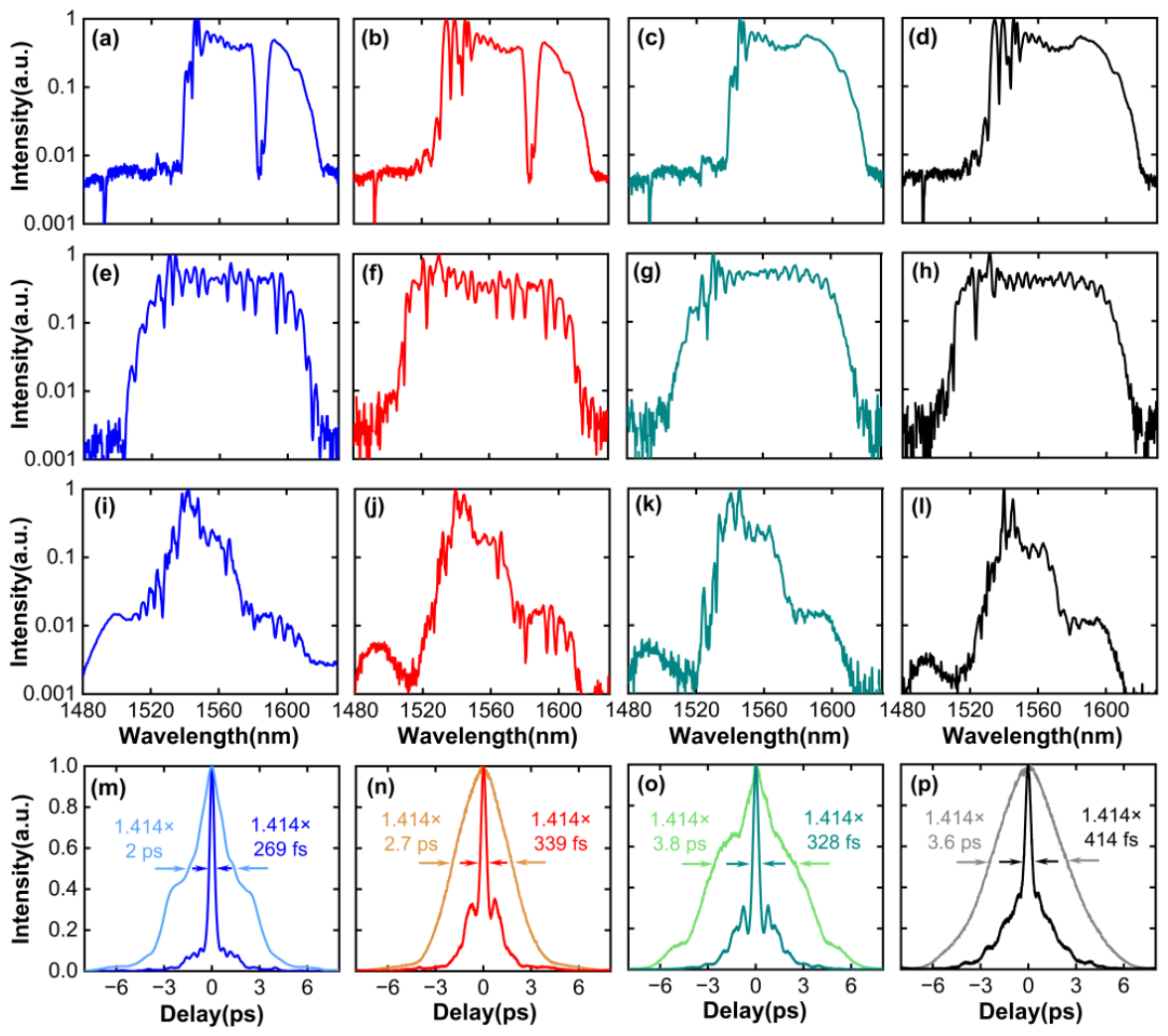
Figure 4.
Comparison on the output power of 1540-nm pulses from the power amplifier under different spectral modulation conditions.
Figure 4.
Comparison on the output power of 1540-nm pulses from the power amplifier under different spectral modulation conditions.
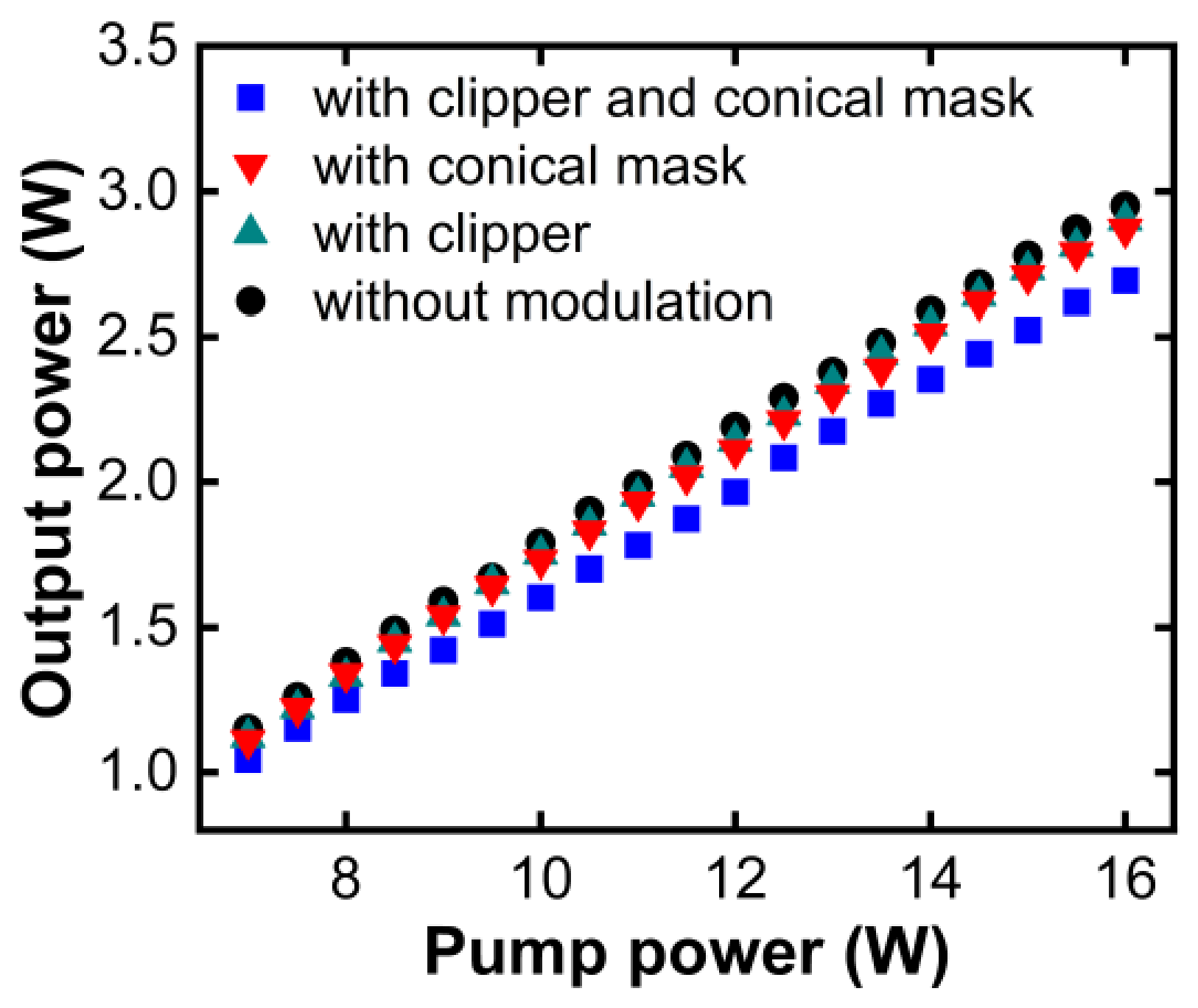
Figure 5.
(a) Optical spectra before (light black) and after (dark black) the nonlinear compression (NC) stage. (b) The corresponding auto-correlation trace and (c) power stability delivered by the 17-cm fused silica block.
Figure 5.
(a) Optical spectra before (light black) and after (dark black) the nonlinear compression (NC) stage. (b) The corresponding auto-correlation trace and (c) power stability delivered by the 17-cm fused silica block.
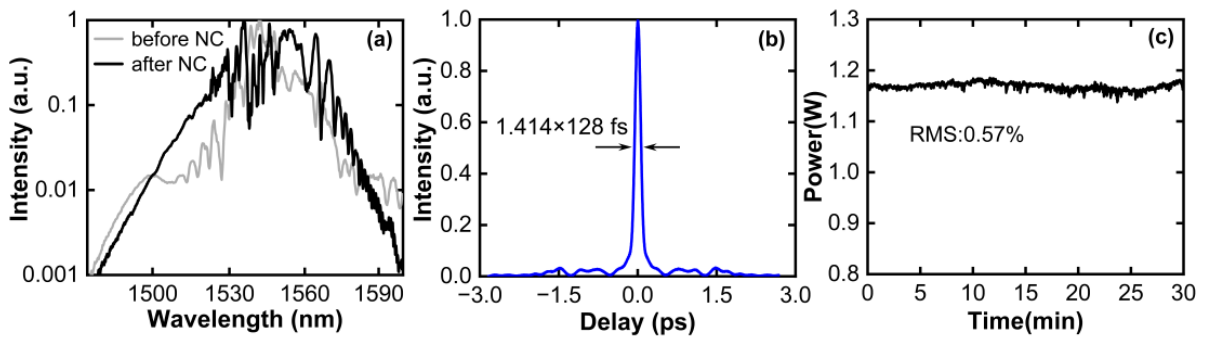
Figure 6.
(a) The simulated spectrum (red), the simulated spectral phase (blue), and the measured optical spectrum (black) at the output of the 5-cm DCF4 fiber. (b) The simulated (red) and measured (black) auto-correlation traces at the output of the 5-cm DCF4 fiber. (c) The simulated (red) and measured (black) auto-correlation traces after propagating through the 17-cm fused silica block.
Figure 6.
(a) The simulated spectrum (red), the simulated spectral phase (blue), and the measured optical spectrum (black) at the output of the 5-cm DCF4 fiber. (b) The simulated (red) and measured (black) auto-correlation traces at the output of the 5-cm DCF4 fiber. (c) The simulated (red) and measured (black) auto-correlation traces after propagating through the 17-cm fused silica block.
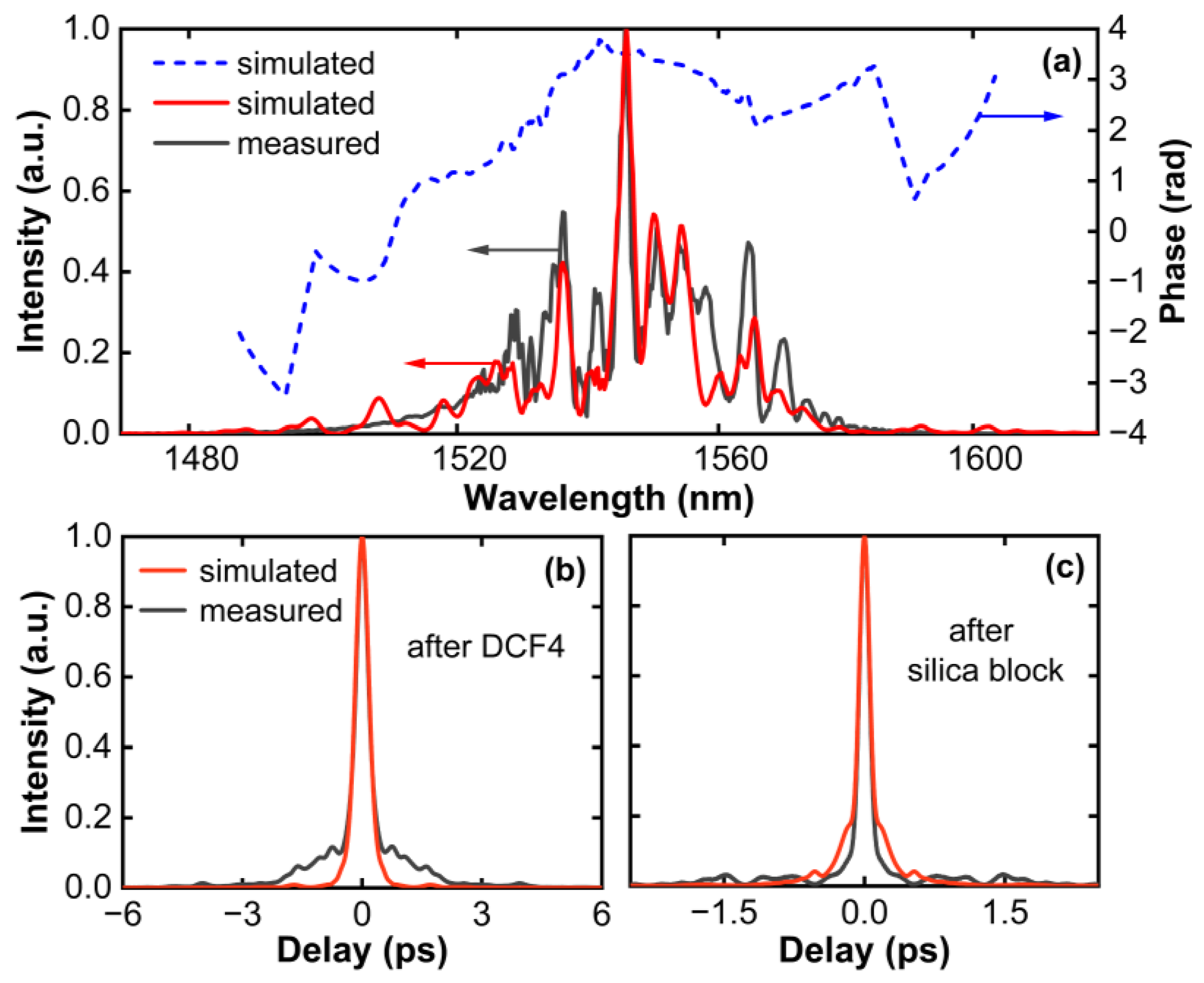
Figure 7.
The measured output characteristics of the 770-nm laser after propagating through the dichroic mirror: (a, b) spectra with different scanning ranges, (c) auto-correlation trace and spatial beam profile (inset), and (d) power stability.
Figure 7.
The measured output characteristics of the 770-nm laser after propagating through the dichroic mirror: (a, b) spectra with different scanning ranges, (c) auto-correlation trace and spatial beam profile (inset), and (d) power stability.
Disclaimer/Publisher’s Note: The statements, opinions and data contained in all publications are solely those of the individual author(s) and contributor(s) and not of MDPI and/or the editor(s). MDPI and/or the editor(s) disclaim responsibility for any injury to people or property resulting from any ideas, methods, instructions or products referred to in the content. |
© 2026 by the authors. Licensee MDPI, Basel, Switzerland. This article is an open access article distributed under the terms and conditions of the Creative Commons Attribution (CC BY) license (http://creativecommons.org/licenses/by/4.0/).
Copyright: This open access article is published under a Creative Commons CC BY 4.0 license, which permit the free download, distribution, and reuse, provided that the author and preprint are cited in any reuse.


