
Submitted:
06 May 2026
Posted:
07 May 2026
You are already at the latest version
Abstract
The most widely used method for trend estimation in economics is the Ho-drick-Prescott (HP) filter. The HP filter has various disadvantages as the arbitrary and frequency-dependent choice of the smoothing parameter λ, boundary problems and difficult interpretation when linking to economic theory. We suggest an alternative method by improving some of these disadvantages using a purely data-driven, endog-enous nonparametric trend estimation. A simulation study and different applications demonstrate the advantages of the nonparametric trend compared to the HP filter. We identify optimal time windows supporting the momentary growth trend. Within this window economic fundamentals smoothly change and drive the trend.
Keywords:
business cycles
; growth
; HP filter
; nonparametric methods
; trend identification
1. Introduction
For business cycle analysis, it is common sense to decompose the time series into trend and cyclical movements, because the different components have different determinants. Recently, [1] studies the relation between unsecured credit and unemployment insurance over the business cycle. To validate his model, he uses the HP filter for quarterly US GDP. His results demonstrate that increasing the duration of unemployment insurance during recessions is one of the best solutions for a government. However, the remaining question is about the optimal duration that depends on the used filtering method. [2] analyze the sensitivity of real-time output gap estimates by using different methods, especially the HP filter as a benchmark. Besides different results due to different vintages of the data, the authors highlight the importance of the filtering method. Among others, [3] state that the estimated business cycle depends on model specification as different methods lead to different trend and cycle decompositions because there is no generalized method of separating both components. This lack of a generalized method leads to enormous differences in economic thinking about trends, cycles, shocks and related concepts as the output gap and the unemployment insurance. In addition, trend and business cycles interact and in accordance with [4] no precise trend definition exists. According to [5], a trend is “a general direction in which a process, an average, general tendency or nation’s economy develops/moves over time”. [6] defines a trend as a component comprising non- and lowest frequency cyclical elements. [7] need a more precise trend definition and therefore attribute a quarterly mean growth rate change of 0.125% to the trend component in order to develop a filtering method.
In practice, several decomposition methods have gained attention over the last decades. The Beveridge-Nelson decomposition [8], band-pass filters [9] or more general Butterworth filters [10], [11] regime-dependent steady-state approach, linear trends, the Hodrick-Prescott filter [7] and more recently, spline smoothing are popular methods. Besides the simple linear trend, the HP filter, which according to [12] is a type of penalized spline smoothing, has become the standard method for estimating the trend and the cyclical component for macroeconomic variables with over 12700 citations following google scholar. [13] argue that “it is likely that the HP filter will remain one of the standard methods for detrending” ([13], p. 371). Furthermore, its importance increases after the Great Recession in 2008, since more than 70% of the citations of [7] are within the last 12 years. However, among others, [14,15,16,17] show that there are some problems with the application of the HP filter. These include the economic intuition behind the filter, the poor behavior at an unknown number of boundary points, the “spurious cycle” effects [14] and the arbitrary selection of the smoothing parameter λ, which leads to different trend and cycle estimations. Those deviations yield diverging stylized facts about macroeconomic activity and hence have ambiguous policy implications.
In recent literature, we see and interesting debate between Robert Hodrick and James Hamliton about disadvantage and advantages of two important trend estimation methods, the HP filter and the Hamilton filter. While in a widely cited contribution [17] lists a number of problems and disadvantages of the HP filter, [18] responds to the discussion and emphasizes on a number of advantages of the HP filter. [18] argues for the HP filter by showing its generality and its link to economic theory. Generally, one has to distinguish between one-sided and two-sided filters. Whereas [7] propose a two-sided filter, [17] suggests a one-sided filtering method that is only statistically-reasoned. [18] compares the HP, [9] and the [17] filter concluding that the HP filter works better for more complex time series.
While we see, like [19], a number of advantages of the Hamilton methodology for specific questions we stick on (follow) Hodrick’s argument that a broadly usable method is needed. Therefore, we introduce a general nonpapametric trend estimation method that is able to take care of disadvantages of the HP filter while sharing its advantages like the link to economic theory and its general application for more complex time series. Even more this nonparametric method is purely data driven.
In order to obtain a reliable method for trend, cycle and output gap estimation and to improve the properties of the HP filter, we propose an alternative nonparametric and fully data driven decomposition method. This method is explained theoretically in [20], who also made an R-package called “smoots” available on the CRAN network. That is, the trend is estimated fully endogenous and optimal without any parametric assumptions on the stationary part. We suggest an IPI algorithm for a local linear trend regression (LLR) with an endogenous bandwidth selection. With these results we determine the statistically optimized trend in a purely data-driven manner. In other words, no economic assumptions on the trend/growth component and no statistical assumptions on the frequencies, as proposed by the band-pass filter of [21], are needed in advance. However, our endogenous, fully data-driven local linear trend estimates are not necessarily completely different to the results of the HP filter. If λ for the HP filter is chosen appropriately, the HP trend generates similar results like our local linear trend. In other words, our identified trend can be similar to an HP filter estimation if λ is correctly chosen. With this method we can avoid the discussion of the best λ for the respective detrending problem. Against the backdrop of the existing literature, we can argue in line with [22] that the values for HP λ should be higher than usually proposed, e.g., in [13]. However, in our view the major contribution of this method is that there is no need for arbitrary parameter choices and that the trend identification is based on statistical criteria. Furthermore, the local linear estimation approach improves behavior at boundary points, allows for short range dependence and does not impose any assumptions on the correlation structure of the residual components. The bandwidth selection, which is based on the theoretical findings on the data-driven IPI algorithm of [23] as well as [20], determines a trend period which identifies the current trend appropriately. This is demonstrated in (i) a simulation study and (ii) different applications for the trend component. The current paper focuses on the trend or growth path estimation. By contrast, further analysis of the cyclical component is demonstrated in [24] and the improvement at boundary points is shown by providing evidence for secular stagnation in [25]. Here, we show a further advantage of the method that is, it is easy to link up trend estimation to economic growth theories. The trend estimation period (bandwidth of LLR) may be regarded as a stationary time range supporting the momentary growth trend. Hence, the trend estimation period may identify a kind of economically stationary growth periods in accordance with the underlying economic growth conditions of that period. In practice, those periods last around 16 years for postwar quarterly US GDP data from 1947.1-2016.1. As the estimated trend of the level data permanently adjusts, we henceforth refer to it as a continuously Moving Trend (MT) in the further analysis. This approach directly links to an interesting dynamic interpretation of the log linear growth processes we mostly see in our growth models. The smoothly changing fundamental conditions smoothly change levels and/or growth rates and drive the moving log linear trend. Thus, a log linear theory can be directly integrated in trend estimations showing longer term variations in trends and trend episodes.
Furthermore, the trend is reliably estimated for the unprecedented Great Depression period on an annual frequency covering a period from 1790 to 2015. Moreover, the application to the monthly US dollar-British pound exchange rate from 01.1971 to 11.2017 also supports the usefulness of a data-driven method. The proposed trend identification is thus applicable to different economic variables at different frequencies and it has an economically meaningful interpretation and is consistent with log-linear growth theories. Correspondingly, the local linear estimation approach with the purely data-driven bandwidth selection is preferred to the HP filter.
The remainder of this paper is structured as follows. As the HP filter is the most widely used trend identification we recall a short discussion of the HP filter - including major criticism - in section 2. Section 3 demonstrates the data-driven nonparametric trend estimation and the IPI procedure. Section 4 provides results from a simulation study. In section 5 our local linear trend is compared to the HP trend using US GDP and exchange rate data at monthly, quarterly and annual frequencies. Section 6 concludes.
2. The Benchmark - Recalling Characteristics of the HP Filter
A good trend “should be influenced by the cyclical movements in the data but it should also be smooth” [26], p. 1732. In 1980, Hodrick and Prescott introduced a method for the decomposition of time series into a trend and a cyclical component. In accordance with [18] the idea was to introduce a general method for trend and cycle decomposition that is able to process different macroeconomic time series. Over the years, the HP filter has become a standard tool for extracting trend and cycle in macroeconomic time series. For example, [27,28] and many economic institutions (IMF, OECD and ECB [29]) use or have used the HP filter for detrending actual data. The distribution of the HP filter is demonstrated in Table A.1 (appendix, based on Table 3 in [30]) and comprises the estimation of the output gap - the gap between actual and potential output - where the HP trend is often used to calculate potential output and hence determines the size of the gap.
In accordance with [7], the HP filter considers that the series can be separated into a growth or trend component and a cyclical component . Let be a time series, which is defined as
where denotes the time. By solving the following optimization problem, a smooth trend is estimated and removed from the data:
The remaining stationary residual series is known as the cyclical component. A crucial point is the prior, exogenous selection of the positive smoothing parameter , which enters equation (2) as a penalization of growth component variability and displays the inverse signal-to-noise ratio as proposed by [7]. Furthermore, [31] as well as [32] demonstrate that , which has no intuitive economic interpretation [33], determines the main period of the cycle that will be produced. That is, the larger the value of , the smoother the HP trend, because variability will be more heavily penalized. [7] propose using for quarterly data, which follows from their business cycle definition and which needs to be adjusted in accordance with the frequency of the underlying observations. It is important to mention that [7] were aware of the influence of on the results. However, no general agreement is reached on which value of may be used for annual or monthly data; even the choice to use quarterly data can be controversial. Thus, it is chosen arbitrarily, leading to values of the smoothing parameter chosen within the interval in the annual case. [9] use a value around 10, whereas [28] show that 100 works well for their purposes. By contrast, [34] argue for a higher value of for data on an annual frequency. [13,35] propose using , based on the idea that the filter representation for quarterly data have to be equal to the filter representation of an alternative frequency. That is, the smoothing parameter is adjusted in accordance with the fourth power of the frequency change based on the assumption that is the appropriate choice for quarterly data.
The adjustment for the application to monthly data covers even a wider range of values for the smoothing parameter. Following the calculations of [13] should be used in this case. However, [36] uses to analyze simulated data of aggregate inventories and total non-durables.
[22] argues that the optimal value of the smoothing parameter needs to be several times higher than proposed by the above-mentioned studies, depending on the underlying cyclical model. However, following [37] the choice of is not based on information available from the data set. Furthermore, the adjustment of [13] is based on the initial cycle definition of [7]. Thus, [17] argues that the adjustment is only correct if it were accurate to use for quarterly data. Besides [13], many authors propose adjustments for the smoothing parameter. For example, [38] determines data-driven by minimizing the mean squared error (MSE). [12] propose a data-driven method for estimating the smoothing parameter considering uncorrelated residuals and an AR(3) correlation structure for the residuals. However, their method assumes that the correlation structure follows an Autoregressive Moving Average (ARMA) process and is hence restricted to such cases. [39] performs preparatory work for a data-dependent method by building a fast algorithm for calculating the HP weights.
[40] criticize the HP filter for its suboptimality at an unknown number of boundary points. This is because the HP filter is non-causal, meaning that the value at one point in time depends on future values of the underlying time series. In the same vein, [17] argues it is more appropriate to estimate a trend regression depending on the last four lags.
Furthermore, [15,41], amongst others, warn that the HP filter may create “spurious cycles”. These originate from I(1) or I(2) components and result in spurious business cycle facts. In other words, if the underlying data follows a difference-stationary (DS) process, the results of the HP filter show, in accordance with [41], some artefacts that reflect the properties of the filter, but not the properties of the underlying data. As demonstrated in[10], filters can generate spurious cycles when applied immediately to nonstationary time series. However, on the debate concerning spurious cycles the reader is referred to [32,41].
An additional point concerns the dependence structure of the remaining stationary part, which is not considered at all. [37] demonstrate that the performance of the HP filter may be poor, if the errors are dependent, which is very likely for trend and cyclical components. Moreover, the HP filter is only optimal in the mean squared error-sense in particular circumstances [13]. Thus, the HP filter is just an ad-hoc approach, practicable if the time series is an I(2) process with uncorrelated errors. In accordance with [37], even the asymptotic properties of this filter under independent errors have not been studied yet. [14] develop asymptotic properties by arguing that the limit theory and features of the filter depend on the choice of in relation to the sample size .
3. Data-Driven Local Polynomial Trend Estimation
These properties of the well-known HP filter cast doubt on its application to real data. In order to overcome the difficulties of the HP filter, a local polynomial trend estimation is introduced as an alternative. Although the approach is explained using a univariate time series in the following subsection, extending it to multivariate time series is straightforward.
3.1. Local Polynomial Trend Estimation
Let be a sequence of macroeconomic time series with time . An additive component model, in accordance with [23], is given by slightly adjusting equation (1):
where denotes the rescaled time, s some smooth function and denotes a stationary time series with the autocovariances (ACF) .
23] propose a data-driven local polynomial estimator for the trend function in time series with short- or long-range dependence using a data-driven IPI algorithm for selecting the optimal bandwidth endogenously. This approach with short-range dependence is extended by [24] and applied to business cycle analysis under the assumption that quickly converges towards zero, so . In accordance with their idea, the -th derivative of defined as , can be estimated by minimizing the locally weighted least squares
where is the weight function and is the bandwidth, respectively. and need to be selected in accordance with the data [20] and are therefore optimally chosen w.r.t. statistical error criteria. For the application, we use a second order kernel as the weight function , more precisely an Epanechnikov kernel. It is worth to mention that the Epanechnikov kernel function is the optimal one in the MSE error sense. The obtained trend estimates are , where For our purpose, the local linear estimator with is used in accordance with log-linear growth theory. A crucial problem is to choose the optimal bandwidth In this paper s selected by minimizing the asymptotic mean integrated squared error (AMISE) given by:
where , , where is the asymptotically equivalent kernel in the interior. denotes the value of the spectral density of at the origin, with and is also estimated fully nonparametrically using another data-driven IPI algorithm adapted from [42]. For possible regime changes, as for example investigated by [43], and are introduced in order to use only a suitable range of the observations for bandwidth selection, e.g. 90% of observations. Thus, episodes can be captured, where the dynamic structure of the variable differ from the rest of the time series. In order to address the critic of [17] and similar to the idea of [10], an asymmetric boundary kernel is used for weighting the boundary points. The bandwidth at the boundary is kept constant such that the asymptotic properties at the boundary are the same as in the interior [20]. The asymptotical global optimal bandwidth for estimating is the one that minimizes the AMISE. As [3] require, our estimates of trend and cycle are optimal in the minimum mean squared error-sense. For estimating on , the asymptotical global optimal bandwidth is given by:
provided that . Details on the IPI algorithm for estimating are presented in the following subsection. Furthermore, is adjusted in accordance with the sample size. Its selection under dependent errors is well studied, for example in [44], whereas is fixed for any in the HP filter. Moreover, the dependence structure is reflected in the bandwidth. Additionally, it should be noted that the weights in the local polynomial approach are positive and at least zero, whereas [35] argue that the weights for some observations in the HP filter could be even asymptotically negative.
3.2. Data-Driven Iterative Plug-in Algorithm for Bandwidth Selection
In order to estimate the unknown parameter , [20,24] propose the following four-step estimation procedure:
Step 1: Start with an initial bandwidth , which is chosen beforehand by, e.g. the cross-validation (CV) method.
Step 2: Estimate for calculate the corresponding residuals and obtain from the residuals using the data-driven lag-window estimator.
Step 3: Obtain in the -th iteration by using the chosen inflation method, , where or for , and estimate . Let
Step 4: Increase by 1 and repeat Steps 2 and 3 until convergence or the maximal number of iterations is reached at some . Set .
In this paper we use two different inflation factors and , which yield the two different algorithms referred to as Alg. A and Alg. B. It is important to mention that Alg. A is theoretically optimal, in other words is the optimal choice in order to minimize the MSE of . Thus, the highest (relative) rate of convergence of a bandwidth is achieved using Alg. A. By contrast, Alg. B uses , which is chosen in order to minimize the MISE of . Hence, it is used for practical purposes.
As the algorithm for is quite similar and the estimation of is independent of the error correlation structure for a given bandwidth, both will be omitted in this paper. The interested reader is referred to [20], where also further details on the choice of key constants and their influence on the estimation approach are explained.
4. Comparing Local Linear Trend and HP Trend: A Simulation Study
To demonstrate the appropriateness of the local linear trend and compare it to the HP trend, we carry out a simulation study. Based on the simulation in [24], we consider six different models, where three regression functions are trend-stationary (TS) models with the following true data generating process (DGP):
where . Three random walk or DS models, without drift, with a constant drift and with a linear drift are also considered. Each DGP is combined with two different AR(2) models as error processes (ME). ME1 is an AR(2) model with the coefficients (1.05, -0.3) and a standard deviation of 0.1, whereas ME2 is an AR(2) model with (0.35, 0.15) and a standard deviation of 0.2. We hence examine different structures and variances for the residual or cyclical component. The simulation is carried out using three different sample sizes, and with 1000 replications in each case. To estimate the trend function, the Epanechnikov (optimal) kernel is used.
For a direct comparison, the MSE is calculated for our proposed alternative and for the HP trend, whereas the LLR is directly compared to the optimal HP filter according to the literature. In addition, different values of the smoothing parameter are compared. Tables A.2 and A.3 (see appendix) give a detailed summary of the results for ME1 and ME2, respectively. In almost all cases, using our local linear trend estimation method the MSE is smaller than that using the optimal value for the respective HP trend. Thus, for and the HP(6) trend and for the HP(1600) trend are identified as being optimal in the MSE-sense in accordance with [13]. For example in Table A.2, the first entry (Alg. A) must be compared to MSE(, which demonstrates the appropriateness of the LLR even for small sample sizes. Furthermore, an increase in the number of observations by a factor of four, decreases the MSE(LLR) values by the same factor, demonstrating the consistence of our approach that is not observed for any HP filter. We hence consider the data-driven local linear estimation approach to be the preferred method. Moreover, the simulation study demonstrates that the IPI algorithm works well, even for small sample sizes, whereas the HP filter displays difficulties in such cases. The local linear trend estimation approach with the extended IPI is able to handle sample sizes smaller than 75 observations, whereas the HP filter is defined for an infinitely long time series.
Obviously, the HP trend heavily depends on the smoothing parameter and the variance of the residual component, which can be detected by comparing the MSE values of different . Thus, sometimes the HP filter does not detect the underlying trend model correctly and the estimated trend reflects some cyclical variations. This is especially visible in the left column of Figure 1, where , ME=1 and the true DGP is linear (red dashed). In these cases, the HP filter, with the “optimal” smoothing parameter selected by [13], attributes some cyclical fluctuations to the estimated HP trend (blue dotted), although they come from the cyclical process (green dotted). However, the local linear trend (black) is able to detect the true DGP and it is quite similar to the simple linear trend, which is, as expected, the best model for this DGP. Nevertheless, the linear trend is only a special case for the underlying growth process in macroeconomic variables, although it is, in accordance with [45], a reasonable first approximation for some advanced economies. It is important to mention that the bandwidth selection in 1000 replications is asymptotically normal, as seen in Figure 1. Hence, the IPI algorithm works well in our simulated cases. Nevertheless, the theoretical optimal bandwidth cannot be calculated using equation (6) for a linear DGP, because the second derivative of does not exist (is zero).
However, the growth path of developing economies, which usually displays a catching-up growth pattern, looks economically more interesting. In this case the DGP is more likely to look like the red dashed process for , ME=1 in the left column of Figure 2. Again, the local linear trend (black) matches the true trend almost exactly. By contrast, the HP trend with (blue dotted) is distorted by the cyclical process (green dashed), especially at the beginning and end of the series. Hence, the HP filter attributes too much of the cyclical fluctuations to the estimated trend function. This explains the spurious cycle phenomenon that is favored by “powerful low-frequency components … [not] impeded by the filter” [6], p. 318. Furthermore, Figure 2 displays the distortion of the HP trend at the right boundary. The estimated HP trend is to low compared to the true DGP and the trend estimates of the local linear regression. This implies policy responses that may not be reliable. Interestingly, [18] shows that the HP and [9] filter are superior to the Hamilton filter for slowly moving growth trends. Thus, our LLR could further improve the advantages of the HP filter for macroeconomic processes.
The right column shows the histogram of the selected bandwidths in 1000 repetitions. Compared to the theoretical correct bandwidth (black vertical line), the IPI algorithm for bandwidth selection works well in practice.
The results slightly change in Figure 3, where the complexity of the trend increases and the variance structure (ME=2) changes. Obviously, the error process (green dotted) influences the trend estimation for the local linear and the HP trend. While the local linear trend (black solid) only reflects a biased trend level during the first peak, the error process dramatically drives the HP filter. In contrast to our approach, the HP filter (blue dot-dashed) does not detect the underlying true DGP and its estimated trend again reflects some cyclical fluctuations. This also becomes obvious in Table A.3, where the results with an increased variance of the error model favor the use of the LLR compared to the HP filter more strongly due to higher differences in the respective MSE values.
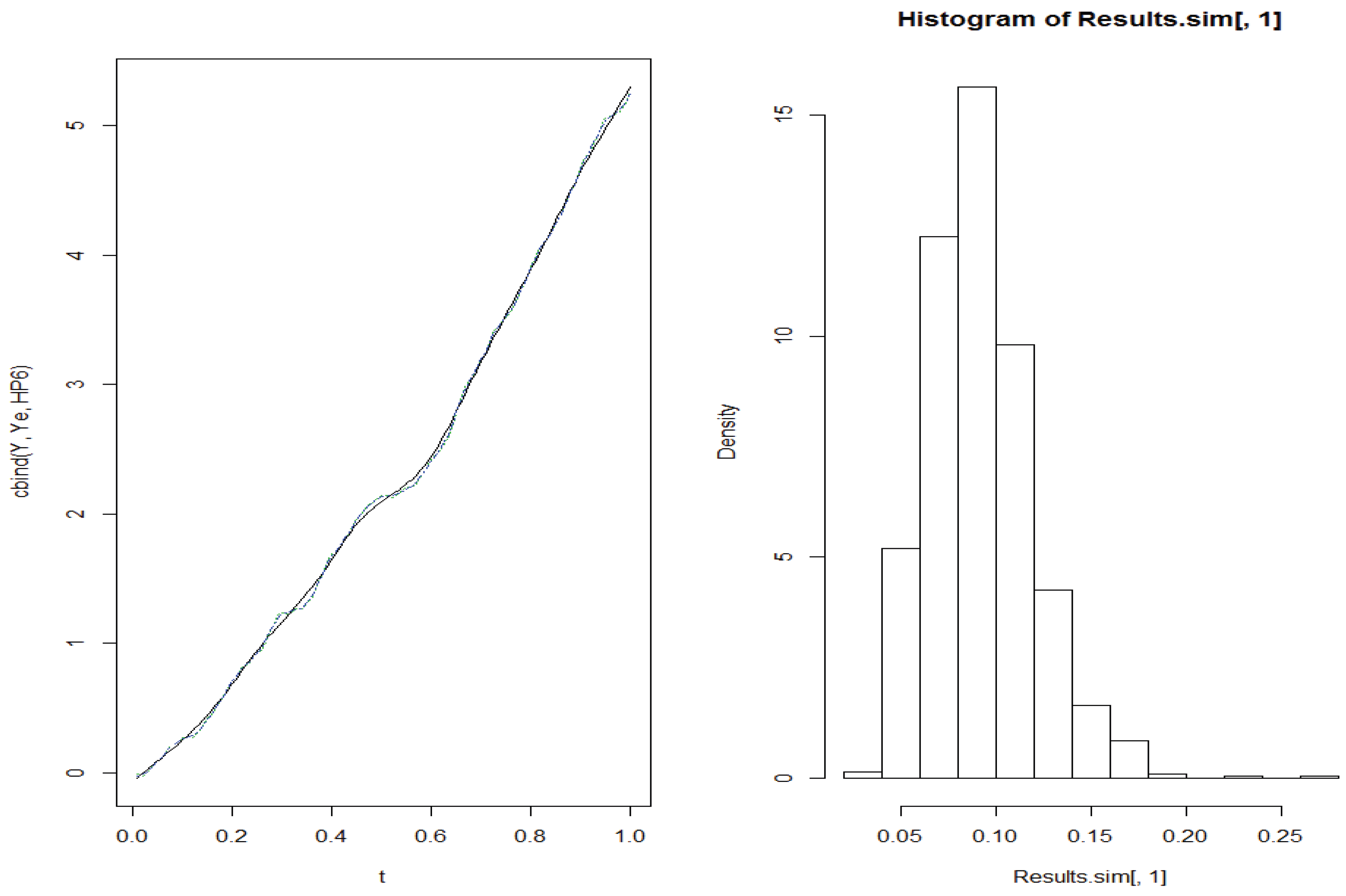
[18] argues that it is unlikely for slowly moving DGPs to behave like a Random Walk model, however, even when the trend follows a random walk without drift, with constant drift or with linear drift, the local linear estimation approach is able to detect the DGP. This can be exemplarily seen from a random walk without drift (green dot-dashed) with in Figure A.4 and a random walk with linear drift (green dot-dashed) with in Figure A.5 in the appendix. However, in such cases our approach must be applied to the first differences of the series. Thus, a unit root test first needs to be carried out for the residual series obtained with the local linear approach. Secondly, in the case of a DS time series, our approach can be applied to the first differences of the series and the trend can be estimated with the same IPI algorithm as in the TS case. In accordance with [24] it is important to note that “the application of a unit root test directly to a TS process without estimating and removing the trend properly is misleading, because the deterministic trend will usually be wrongly detected as a (spurious) unit-root” [24], p. 69. It is important to mention that the HP filter does not work adequately when the trend is a random walk [22], p. 15 and that stylized facts about comovement and periodicity display many movements implied by the HP filter. [18] shows that for such simple random walk models the Hamilton filter could be an interesting alternative. However, he also finds that for more complex models the Hamilton filter does not work well. For detailed results of the discussion on TS and DS time series see [41] and [24]. To sum up the results of the simulation study, the HP filter is not suitable for the analysis of long-term trends as it frequently attributes too much cyclical variation to the estimated trend function and depends highly on the smoothing parameter. Moreover, difficulties of the estimation of boundary points become visible.
5. Comparing Local Linear Trend and HP Trend: Real Data
In order to demonstrate the advantages of the local linear trend estimation with real data, the local linear and the HP trend are compared for different macroeconomic variables on different frequencies using US GDP data at a quarterly frequency covering the period from 1947.1 to 2016.1 and at an annual frequency covering a period from 1790 to 2015. The quarterly data are extracted from the [46] and the annual data are from [47]. Moreover, we use far higher-frequency monthly data, namely the US dollar-British pound exchange rate from 01.1971 to 11.2017, extracted from [48].
Figure 6 shows the quarterly US GDP data (red dots) together with the linear trend (blue dotted), the HP trend for (green thin solid) and the local linear trend (black thick solid) for the endogenously determined bandwidth of 16 years (). Figure 6 confirms [45] results involving approximately linear movements in some macroeconomic variables of advanced economies. Figure 7 displays the same results zooming into the period from 1990.1 to 2016.1.
As can be seen from Figure 7, some major differences for the trends at the boundary points exist in the sense that our local linear trend is more stable and not as sensitive as the HP trend. The stability of our local linear approach is a necessary requirement for long-term growth trends that should not display any cyclical movements [22]. Nevertheless, the trend must reflect the general tendency of the economy. This general direction of economic development is depicted by the local linear trend, which for example shows higher growth rates during the golden age after the Second World War. Hence, the proposed method is able to reflect important events in economic history, is broadly consistent with growth drivers, and clearly related to potential economic theories. As each local linear trend is estimated through an endogenously chosen, stationary growth period, we also identify a trend relevant growth period. This combination of growth trend and growth trend-period allow for a beneficial interpretation: a growth trend is economically explained by a (log-) linear growth model that relates empirically to the identified growth period. Trends are explained by theories using long-term determinants to explain growth. However, if there are gradual changes in fundamental determinants, these also gradually change the growth rates. With this identified moving growth trend from empirical data, our approach corresponds to the moving changes in growth conditions.
Figure 6 and Figure 7 demonstrate the problems associated with the HP trend for the usually considered quarterly data. However, whereas selecting the smoothing parameter for quarterly data with is more or less common sense, adjusting this parameter for other frequencies is less consistent. Figure 8 shows the annual data (red dots) together with the linear trend (blue dotted), the HP trend for (turquoise thin solid), (yellow thin solid), (pink thin solid), and the local linear trend (black thick solid) with a relative bandwidth . In other words, it presents different values for the smoothing parameter , ranging from the smallest to the highest values suggested in the literature, proposed by [13,28,34]. Again, Figure 8 demonstrates the same results zooming into the period from 1920 to 1970.
The HP trend obviously strongly depends on the value of the smoothing parameter, which is chosen arbitrarily. As a result, the extracted cycle highly depends on and is therefore extracted somehow arbitrarily as well. However, this paper focuses on the estimation of the trend component with the analysis of the residual component going far beyond the scope of the paper. An example of cyclical analysis using the LLR is shown in [24]. From Figure 8 and Figure 9 it is obvious that the HP filter with [34] and the local linear method could yield quite similar trends, in the sense that our trend estimation results are in line with the method used most frequently by [7], if for the HP filter is chosen appropriately. Consequently, the extracted cyclical components could be quite similar for this specific smoothing parameter. Yet, as can be seen from Figure 9, some major differences for the trends during 1925 to 1950 exist, where the local linear trend is smoother and more robust against outliers than the HP trend. This period comprises the Great Depression of the 1930s, which [49] analyzes using the HP filter. [49] concludes that the HP trend follows the observation of GDP too closely and accordingly exclude the effects of the Great Depression from the cycle and attributes them to the estimated HP trend. Consequently, the Great Depression portrayed less severely using the HP procedure than it actually was.
Thus, given our MT and the results from [49], needs to be larger than usually suggested in the literature. Our results are in line with [22] who requires higher values of , because low values yield trends that overestimate the trend component and are too sensitive to cyclical fluctuations. Higher values of can improve the relative efficiency of the HP filter. Arbitrarily selected values of the smoothing parameter hence result in a mixture of trend and cyclical movements and cause ambiguous stylized facts about trends and business cycles. Furthermore, the wrong smoothing parameter yields different values for the output gap, which could be - in accordance with [50] - either negative or positive highly depending on the selected .
Besides that, a main advantage of the local linear trend is the economic interpretation of the trend with the endogenously selected bandwidth as a Moving Trend MT. There are periods of continuous growth trend segments arguing in favor of moving steady states in contrast to the one overall steady state growth process. Consequently, economic condition changes smoothly over the observation period. This directly corresponds to the log-linear growth models often discussed in growth theory. This local linear MT allows for a direct connection to theoretical interpretations. In other words, the proposed method is theoretically reasoned and statistically justified. This is also in line with the economically-reasoned idea of [7]. The HP filter rests on the assumption that the decomposition needs to be supported by economic theory.
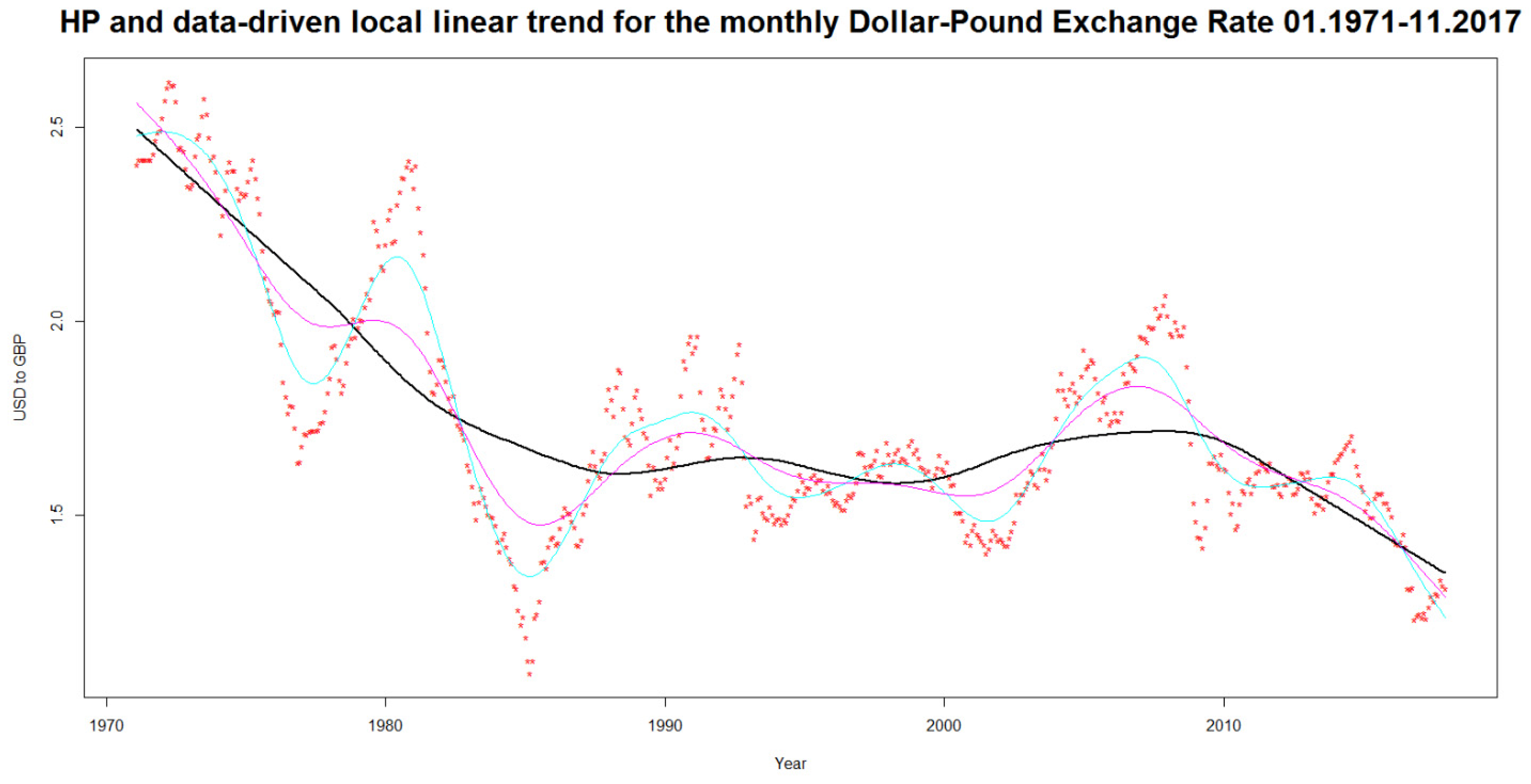
In order to demonstrate the wide range of applications for the local linear trend estimation approach, we apply it to some other data than the usually handled macroeconomic aggregates. Therefore, the US dollar-British pound exchange rate from January 1971 to November 2017 is shown in Figure 10, where the local linear regression (black thick solid) with a relative bandwidth is compared to the HP trend with (turquoise thin solid), suggested by [7] and in accordance with [13]’s (pink thin solid) for monthly data. It is important to note that the exchange rate is observed monthly and that the volatility of the smoothing parameter proposals is higher than in the annual case. Moreover, the exchange rate is far more volatile than GDP data and exhibits more pronounced upward and downward trend movements than macroeconomic aggregates. This more complex pattern is reflected within the data-driven local linear trend, which is able to capture all trend movements without reflecting cyclical behavior. By contrast, the HP trend, again depending heavily on the wide range of possible smoothing parameters, in the sense of [10] creates spurious effects, because many more cyclical fluctuations are attributed to the estimated trend function. This flexibility of the HP trend can again be penalized by higher values of the smoothing parameter.
In addition, Figure 10 demonstrates the poor behavior of the HP trend at boundary points as noted by [40]. This reaction stems from its non-causality and lack of adjustment near the boundary, a typical problem for unadjusted two-sided filters. Furthermore, Figure 10 displays the improvements in the local linear trend at these boundary points. Consequently, the estimated trend is much more stable at those points. It becomes clear why the output gap, calculated with the HP filter and different values of , needs to be interpreted with caution [51]. The implications for monetary policy following the output gap calculation using the HP filter need to be handled carefully, because they depend heavily on the HP specification used. Therefore, the local linear approach could be a better alternative for stabilizing the estimates of the output gap since it is compatible with economic theory.
To sum up, the proposed data-driven local linear estimation method is able to handle different economic data sets as well as different frequencies (annual, quarterly and monthly). It is important to note that in accordance with [52] this approach is also able to handle daily and even higher frequencies. Moreover, a reliable trend is estimated endogenously and justified theoretically.
5. Conclusions
Contributing to the economic interpretation of [1] and the methodological discussion controversy of [17,18] we argue for a nonparametric fully endogenous method of trend estimation. This paper suggests an alternative and superior procedure for trend and cycle decomposition, in particular compared to the widely used HP filter. First, the HP trend and its drawbacks are presented as a standard benchmark. Second, we explain our nonparametric estimation approach. We suggest an IPI algorithm for a local linear regression (LLR) with an endogenous bandwidth selection which is based on the MSE. Third, - and this is our main focus - we illustrate why we regard this new procedure as a superior substitute for the most widely used HP filter. Therefore, besides a detailed simulation study, real US GDP and exchange rate data demonstrate the usefulness of the local linear approach for trend estimation. The simulation study shows that the local linear trend is able to detect the true DGP, whereas the performance of the HP trend highly depends on the smoothing parameter and the error dependence structure. The comparison of our approach and the HP trend displays that the trend curves become similar for proper choices of , which needs to be several times higher than the inverse signal-to-noise ratio. Thus, our local linear trend improves the main disadvantages of the HP filter, such as the arbitrary selection of , its poor behavior at boundary points and the independent errors assumption. Moreover, the endogenously determined bandwidth, specified for an optimal trend and cycle decomposition, allows for the determination of continuously moving trend (MT) processes, which last around 16 years for postwar quarterly GDP data. Economically, these periods may represent stable macroeconomic decision-making segments. Hence, the proposed endogenous local linear trend estimation could be a preferred method as it refines the HP trend and directly relates to log- linear growth theories. Its simplicity and extensive application possibilities could make it the successor of the limited HP filter. It is left for future research to compare the asymptotic properties of both filtering methods in more detail, to analyze their effects on business cycle and output gap estimation, and to compare their forecasting ability.
Funding
“This research received no external funding”
Data Availability Statement
Data are freely available following the cited resources in the references.
Acknowledgments
We thank numerous reviewers and participants of the INFER conference in 2018 in Paris.
Conflicts of Interest
The authors declare no conflicts of interest.
Abbreviations
The following abbreviations are used in this manuscript:
| GDP | Gross Domestic Product |
| MT | Moving Trend |
| IPI | Iterative plug-in |
Appendix A
Appendix A.1
Table A.1. Distribution of HP filter.

| Institution | Trend Estimation |
| IMF | HP filter |
| OECD | HP filter, Phase-Average-Trend |
| EU Commission | HP filter, structural time series models |
| EU Economic and Financial Affairs Directorate | HP filter |
| ECB | HP filter |
| Banque de France | HP filter, etc. |
| Federal Reserve Board | HP filter, structural time series models, etc. |
| Bank of Japan | HP filter, etc. |
| Central Bank of Costa Rica | HP filter |
Notes: Distribution of the HP filter in practical applications (based on Table 3, Stamfort, 2005, p. 21).
Table A.2. MSE values for LLR, HP trend and LR, ME1, Alg.A and Alg.B.
| ME1 | Trend | |||||||||
| Size | ||||||||||
| 0.4900 | 0.4900 | 0.4900 | 0.1302 | 0.1133 | 0.0987 | 0.0836 | 0.0728 | 0.0634 | ||
| Alg.A | 0.1204 | 0.1467 | 0.1577 | 0.0983 | 0.0943 | 0.0876 | 0.0898 | 0.0678 | 0.0592 | |
| 0.0473 | 0.0647 | 0.0673 | 0.0166 | 0.0135 | 0.0097 | 0.0159 | 0.0119 | 0.0066 | ||
| MSE( | 0.1388 | 0.1220 | 0.1149 | 0.0013 | 0.0005 | 0.0002 | 0.0003 | 0.0002 | 0.0001 | |
| MSE-LLR | 0.0038 | 0.0019 | 0.0010 | 0.0045 | 0.0026 | 0.0014 | 0.0062 | 0.0036 | 0.0021 | |
| Alg.B | 0.2221 | 0.2449 | 0.2560 | 0.1157 | 0.1090 | 0.0988 | 0.1021 | 0.0959 | 0.0871 | |
| 0.0796 | 0.0786 | 0.0821 | 0.0143 | 0.0104 | 0.0072 | 0.0071 | 0.0063 | 0.0053 | ||
| MSE | 0.0781 | 0.0662 | 0.0615 | 0.0004 | 0.0104 | 0.0001 | 0.0004 | 0.0006 | 0.0006 | |
| MSE-LLR | 0.0026 | 0.0013 | 0.0007 | 0.0043 | 0.0025 | 0.0014 | 0.0065 | 0.0041 | 0.0025 | |
| MSE( | 0.0066 | 0.0066 | 0.0066 | 0.0068 | 0.0065 | 0.0066 | 0.0068 | 0.0066 | 0.0065 | |
| MSE( | 0.0043 | 0.0041 | 0.0040 | 0.0044 | 0.0041 | 0.0040 | 0.0050 | 0.0041 | 0.0040 | |
| MSE( | 0.0033 | 0.0031 | 0.0030 | 0.0036 | 0.0031 | 0.0030 | 0.0075 | 0.0032 | 0.0029 | |
| MSE( | 0.0026 | 0.0023 | 0.0022 | 0.0046 | 0.0023 | 0.0022 | 0.0223 | 0.0032 | 0.0022 | |
| LR MSE-LR | 0.0013 | 0.0006 | 0.0006 | 0.0704 | 0.0697 | 0.010 | 0.1007 | 0.0991 | 0.0983 | |
Table A.3. MSE values for LLR, HP trend and LR, ME2, Alg.A and Alg.B.
| ME2 | Trend | |||||||||
| Size | ||||||||||
| 0.4900 | 0.4900 | 0.4900 | 0.1572 | 0.1369 | 0.1191 | 0.1010 | 0.0879 | 0.0765 | ||
| Alg.A | 0.1329 | 0.1553 | 0.1609 | 0.1115 | 0.1080 | 0.1016 | 0.0957 | 0.0838 | 0.0729 | |
| 0.0574 | 0.0663 | 0.0692 | 0.0229 | 0.0189 | 0.0138 | 0.0183 | 0.0155 | 0.0102 | ||
| MSE( | 0.1308 | 0.1164 | 0.1131 | 0.0026 | 0.0012 | 0.0005 | 0.0004 | 0.0003 | 0.0001 | |
| MSE-LLR | 0.0089 | 0.0046 | 0.0024 | 0.0105 | 0.0061 | 0.0033 | 0.0127 | 0.0081 | 0.0046 | |
| Alg.B | 0.2357 | 0.2461 | 0.2569 | 0.1317 | 0.1261 | 0.1149 | 0.1061 | 0.1009 | 0.0933 | |
| 0.0836 | 0.0827 | 0.0848 | 0.0165 | 0.0134 | 0.0095 | 0.0099 | 0.0082 | 0.0060 | ||
| MSE | 0.0717 | 0.0663 | 0.0615 | 0.0009 | 0.0003 | 0.0001 | 0.0001 | 0.0002 | 0.0003 | |
| MSE-LLR | 0.0063 | 0.0033 | 0.0017 | 0.0095 | 0.0056 | 0.0031 | 0.0123 | 0.0080 | 0.0047 | |
| MSE( | 0.0171 | 0.0168 | 0.0171 | 0.0175 | 0.0172 | 0.0164 | 0.0175 | 0.0174 | 0.0168 | |
| MSE( | 0.0106 | 0.0103 | 0.0103 | 0.0110 | 0.0105 | 0.0101 | 0.0115 | 0.0107 | 0.0101 | |
| MSE( | 0.0082 | 0.0078 | 0.0077 | 0.0088 | 0.0080 | 0.0085 | 0.0124 | 0.0083 | 0.0075 | |
| MSE( | 0.0064 | 0.0059 | 0.0057 | 0.0086 | 0.0060 | 0.0055 | 0.0259 | 0.0069 | 0.0056 | |
| LR MSE-LR | 0.0033 | 0.0017 | 0.0009 | 0.0724 | 0.0708 | 0.0699 | 0.1027 | 0.1002 | 0.0989 | |
Figure A.4.
Simulation for 𝑔 = 4, Alg.A, 𝑛 = 75. Local linear (black), RW (green dashed) compared to HP trend 𝜆=6.25 (blue dashed).
Figure A.4.
Simulation for 𝑔 = 4, Alg.A, 𝑛 = 75. Local linear (black), RW (green dashed) compared to HP trend 𝜆=6.25 (blue dashed).
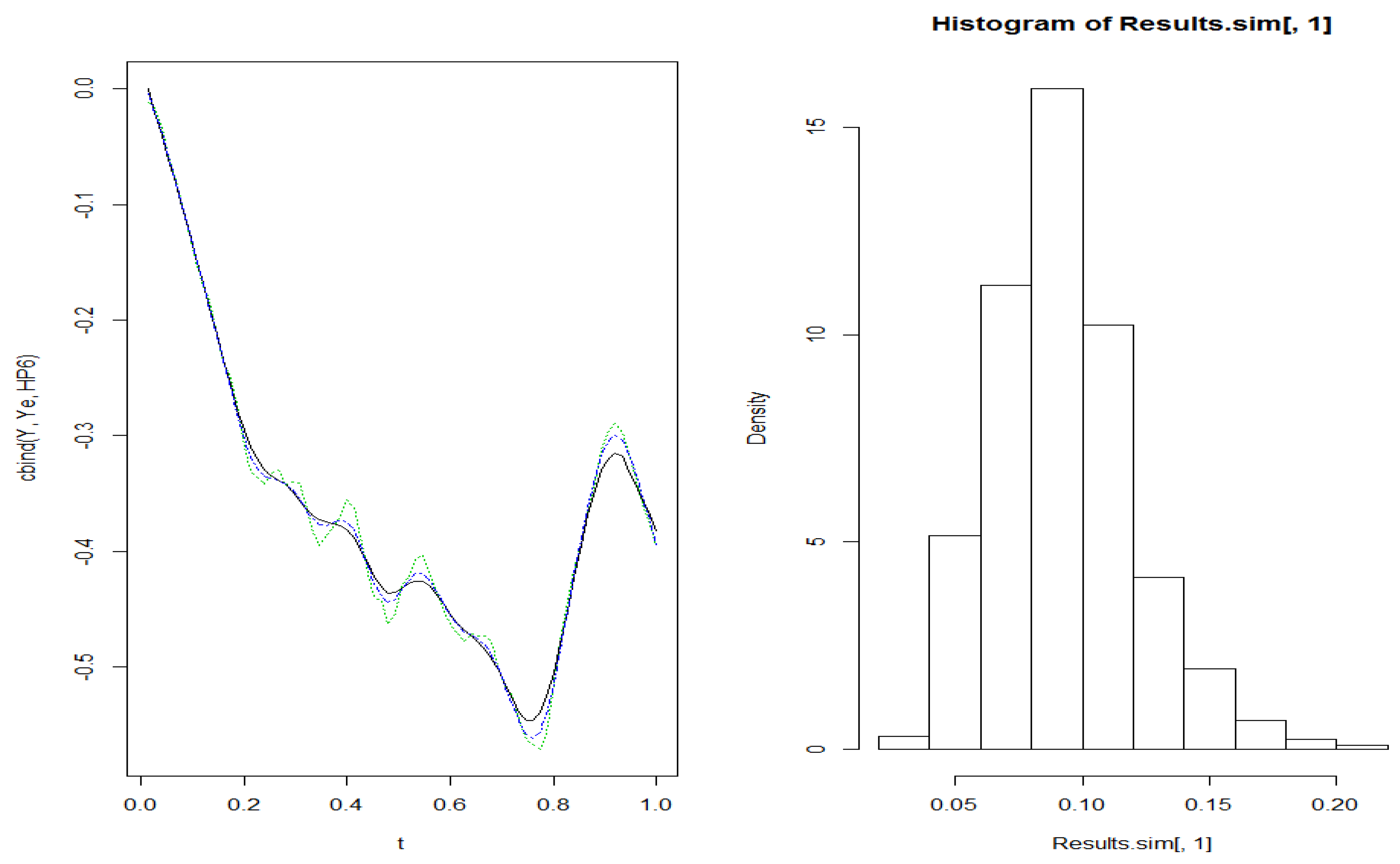
Figure A.5.
Simulation for 𝑔 = 6, Alg.A, 𝑛 = 150. Local linear (black), RW (green dashed) compared to HP trend 𝜆=6.25 (blue dashed).
Figure A.5.
Simulation for 𝑔 = 6, Alg.A, 𝑛 = 150. Local linear (black), RW (green dashed) compared to HP trend 𝜆=6.25 (blue dashed).
References
- Irwin, M. The Impact of Unemployment Insurance and Unsecured Credit on Business Cycles. J. Political Econ. Macroecon. 2025, 3(2), 199–240. [Google Scholar] [CrossRef] [PubMed]
- Quast, J.; Wolters, M. H. The Federal Reserve's output gap: The unreliability of real-time reliability tests. J. Appl. Econom. 2023, 38(7), 1101–1111. [Google Scholar] [CrossRef]
- Morley, J. C.; Piger, J. The Asymmetric Business Cycle. Rev. Econ. Stat. 2012, 94(1), 208–221. [Google Scholar] [CrossRef]
- Metz, R. Der Einsatz des Hodrick-Prescott Filters zur Trendbestimmung in ökonomischen Zeitreihen. Hist. Soc. Res. 21 1996, 48–80. [Google Scholar]
- Business Dictionary (2025). Available online: http://www.businessdictionary.com/definition/economic-trend.html (accessed on 14 December 2025).
- Pollock, D. S. G. Trend Estimation and De-Trending via Rational Square-Wave Filters. J. Econom. 99 2000, 317–334. [Google Scholar] [CrossRef]
- Hodrick, R. J.; Prescott, E. C. Postwar U.S. Business Cycles: An Empirical Investigation. J. Money Credit Bank. 29 1997, 1–16. [Google Scholar] [CrossRef]
- Beveridge, S.; Nelson, C. R. A New Approach to Decomposition of Economic Time Series into Permanent and Transitory Components with Particular Attention to Measurement of the Business Cycle. J. Monet. Econ. 7 1981, 151–174. [Google Scholar] [CrossRef]
- Baxter, M.; King, R. G. Measuring Business Cycles: Approximate Band-Pass Filters for Economic Time Series. Rev. Econ. Stat. 81 1999, 573–593. [Google Scholar] [CrossRef]
- Harvey, A. C.; Trimbur, T. M. General Model-Based Filters for Extracting Cycles and Trends in Economic Time Series. Rev. Econ. Stat. 85 2003, 244–255. [Google Scholar] [CrossRef]
- Morley, J. C.; Piger, J. Trend/cycle Decomposition of Regime-Switching Processes. J. Econom. 146 2008, 220–226. [Google Scholar] [CrossRef]
- Paige, R. L.; Trindade, A. A. The Hodrick-Prescott Filter: A Special Case of Penalized Spline Smoothing. Electron. J. Stat. 4 2010, 856–874. [Google Scholar] [CrossRef]
- Ravn, M. O.; Uhlig, H. Notes: On Adjusting the Hodrick-Prescott Filter for the Frequency of Observations. Rev. Econ. Stat. 84 2002, 371–380. [Google Scholar] [CrossRef]
- Phillips, P. C. B.; Jin, S. Business Cycles, Trend Elimination, and the HP Filter. Int. Econ. Rev. 2021, 62(2), 469–520. [Google Scholar] [CrossRef]
- Harvey, A. C.; Jaeger, A. Detrending, Stylized Facts and the Business Cycle. J. Appl. Econom. 8 1993, 231–247. [Google Scholar] [CrossRef]
- King, R. G.; Rebelo, S. T. Low Frequency Filtering and Real Business Cycles. J. Econ. Dyn. Control 17 1993, 207–231. [Google Scholar] [CrossRef]
- Hamilton, J. D. Why You Should Never Use the Hodrick-Prescott Filter. Rev. Econ. Stat. 100 2018, 831–843. [Google Scholar] [CrossRef]
- Hodrick, R. J. NBER Working Paper No. 26750.; An Exploration of Trend-Cycle Decomposition Methodologies in Simulated Data. 2020.
- Phillips, P. C. B.; Shi, Z. Boosting: Why you can use the HP filter. Int. Econ. Rev. 2021, 62(2), 521–570. [Google Scholar] [CrossRef]
- Feng, Y.; Fritz, M.; Gries, T. Data-driven Local Polynomial Estimation for the Trend and its Derivatives in Economic Time Series. J. Nonparametric Stat. 32 2020, 510–533. [Google Scholar] [CrossRef]
- Álvarez, L. J. Business Cycle Estimation with High-Pass and Band-Pass Local Polynomial Regression. Econom. 5 2017, 1–11. [Google Scholar] [CrossRef]
- Flaig, G. Why We Should Use High Values for the Smoothing Parameter of the Hodrick-Prescott Filter. J. Econ. Stat. (Jahrbuecher fuer Nationaloekonomie und Statistik) 235 2015, 518–538. [Google Scholar] [CrossRef]
- Beran, J.; Feng, Y. Local Polynomial Fitting with Long-Memory, Short Memory and Antipersistent Errors. Ann. Inst. Stat. Math. 54 2002, 291–311. [Google Scholar] [CrossRef]
- Fritz, M.; Gries, T.; Feng, Y. Growth Trends and Systematic Patterns of Booms and Busts -Testing 200 Years of Business Cycle Dynamics-. Oxf. Bull. Econ. Stat. 81 2019a, 62–78. [Google Scholar] [CrossRef]
- Fritz, M.; Gries, T.; Feng, Y. Secular Stagnation? Is There Statistical Evidence of an Unprecedented, Systematic Decline in Growth? Econ. Lett. 181 2019b, 47–50. [Google Scholar] [CrossRef]
- Zarnowitz, V.; Ozyildirim, A. Time Series Decomposition and Measurement of Business Cycles, Trends and Growth Cycles. J. Monet. Econ. 53 2006, 1717–1739. [Google Scholar] [CrossRef]
- Kydland, F. E.; Prescott, E. C. Business Cycles: Real Facts and a Monetary Myth. Fed. Reserve Bank. Minneap. Q. Rev. 14 1990, 3–18. [Google Scholar]
- Backus, D. K.; Kehoe, P. J. International Evidence on the Historical Properties of Business Cycles. Am. Econ. Rev. 82 1992, 864–888. [Google Scholar]
- Giorno, C.; Richardson, P.; Roseveare, D.; van den Noord, P. Potential Output, Output Gaps, and Structural Budget Balances. OECD Econ. Stud. 24 1995, 167–209. [Google Scholar]
- Stamfort, S. Berechnung Trendbereinigter Indikatoren für Deutschland Mithilfe von Filterverfahren. Diskuss. Reihe 1 Volkswirtschaftliche Stud. 2005, Nr. 19/2005, 1–148. [Google Scholar]
- Kaiser, R.; Maravall, A. Estimation of the Business Cycle: A Modified Hodrick-Prescott Filter. Span. Econ. Rev. 1999, 1, 175–206. [Google Scholar] [CrossRef]
- Maravall, A.; del Río, A. Temporal Aggregation, Systematic Sampling, and the Hodrick-Prescott Filter. Comput. Stat. Data Anal. 52 2007, 975–998. [Google Scholar] [CrossRef]
- Wynne, M. A.; Koo, J. Business Cycles under Monetary Union: a Comparison of the EU and US. Econ. 67 2000, 347–374. [Google Scholar] [CrossRef]
- Correia, I. H.; Neves, J. L.; Rebelo, S. T. Business Cycles from 1850-1950: New Facts about Old Data. Eur. Econ. Rev. 36 1992, 459–467. [Google Scholar] [CrossRef]
- De Jong, R.M.; Sakarya, N. The Econometrics of the Hodrick-Prescott Filter. Rev. Econ. Stat. 98 2016, 310–317. [Google Scholar] [CrossRef]
- Doorn, D. Consequences of Hodrick–Prescott Filtering for Parameter Estimation in a Structural Model of Inventory Behaviour. Appl. Econ. 38 2006, 1863–1875. [Google Scholar] [CrossRef]
- Kauermann, G.; Krivobokova, T.; Semmler, W. Filtering Time Series with Penalized Splines. Stud. Nonlinear Dyn. Econom. 15 2011, 1–26. [Google Scholar] [CrossRef]
- Pedersen, T. M. The Hodrick-Prescott Filter, the Slutzky Effect, and the Distortionary Effect of Filters. J. Econ. Dyn. Control 25 2001, 1081–1101. [Google Scholar] [CrossRef]
- Cornea-Madeira, A. The Explicit Formula for the Hodrick-Prescott Filter in a Finite Sample. Rev. Econ. Stat. 99 2017, 314–318. [Google Scholar] [CrossRef]
- Mise, E.; Kim, T.H.; Newbold, P. On Suboptimality of the Hodrick-Prescott Filter at Time Series Endpoints. J. Macroecon. 2005, 27, 53–67. [Google Scholar] [CrossRef]
- Cogley, T.; Nason, J. M. Effects of the Hodrick-Prescott Filter on Trend and Difference Stationary Time Series: Implications for Business Cycle Research. J. Econ. Dyn. Control 19 1995, 253–278. [Google Scholar] [CrossRef]
- Bühlmann, P. Locally Adaptive lag-window Spectral Estimation. J. Time Ser. Anal. 17 1996, 247–270. [Google Scholar] [CrossRef]
- Hamilton, J. D. Analysis of Time Series Subject to Changes in Regime. J. Econom. 45 1990, 39–70. [Google Scholar] [CrossRef]
- Francisco-Fernández, M.; Vilar-Fernández, J. M. Bandwidth selection for the local polynomial estimator under dependence: a simulation study. Comput. Stat. 2005, 20(4), 539–558. [Google Scholar] [CrossRef]
- Jones, C. I. Sources of U.S. Economic Growth in a World of Ideas. Am. Econ. Rev. 92 2002, 220–239. [Google Scholar] [CrossRef]
- US Bureau of Economic Analysis. Real Gross Domestic Product. Federal Reserve Bank of St. Louis, 2016. Available online: https://research.stlouisfed.org/fred2/series/GDPC1 (accessed on 24 April 2019).
- Johnston, L.; Williamson, S. H. “What Was the U.S. GDP Then?”. Measuring Worth 2011. The data bank can be accessed under. 2016. Available online: http://www.measuringworth.org/usgdp/ (accessed on 15 June 2016).
- Federal Reserve Bank of St. Louis. U.S. / U.K. Foreign Exchange Rate, U.S. Dollars to One British Pound, Monthly, Not Seasonally Adjusted. 2017. Available online: https://fred.stlouisfed.org/series/EXUSUK (accessed on 20 November 2017).
- McCallum, B. T. No. w7725.; Alternative Monetary Policy Rules: A Comparison with Historical Settings for the United States, the United Kingdom, and Japan. National Bureau of Economic Research, 2000.
- De Brouwer, G. Estimating Output Gaps. Research Discussion Paper 9809 Reserve Bank of Australia., 1998. [Google Scholar]
- Orphanides, A.; van Norden, S. The Unreliability of Output-Gap Estimates in Real Time. Rev. Econ. Stat. 84 2002, 569–583. [Google Scholar] [CrossRef]
- Feng, Y.; Forstinger, S.; Peitz, C. On the Iterative Plug-In Algorithm for Estimating Diurnal Patterns of Financial Trade Durations. J. Stat. Comput. Simul. 86 2016, 2291–2307. [Google Scholar] [CrossRef]
Figure 1.
Simulation for , Alg.B, , ME1. Local linear (black), DGP (red dashed), ME1 (green dashed) compared to HP trend =6.25 (blue dashed).
Figure 1.
Simulation for , Alg.B, , ME1. Local linear (black), DGP (red dashed), ME1 (green dashed) compared to HP trend =6.25 (blue dashed).
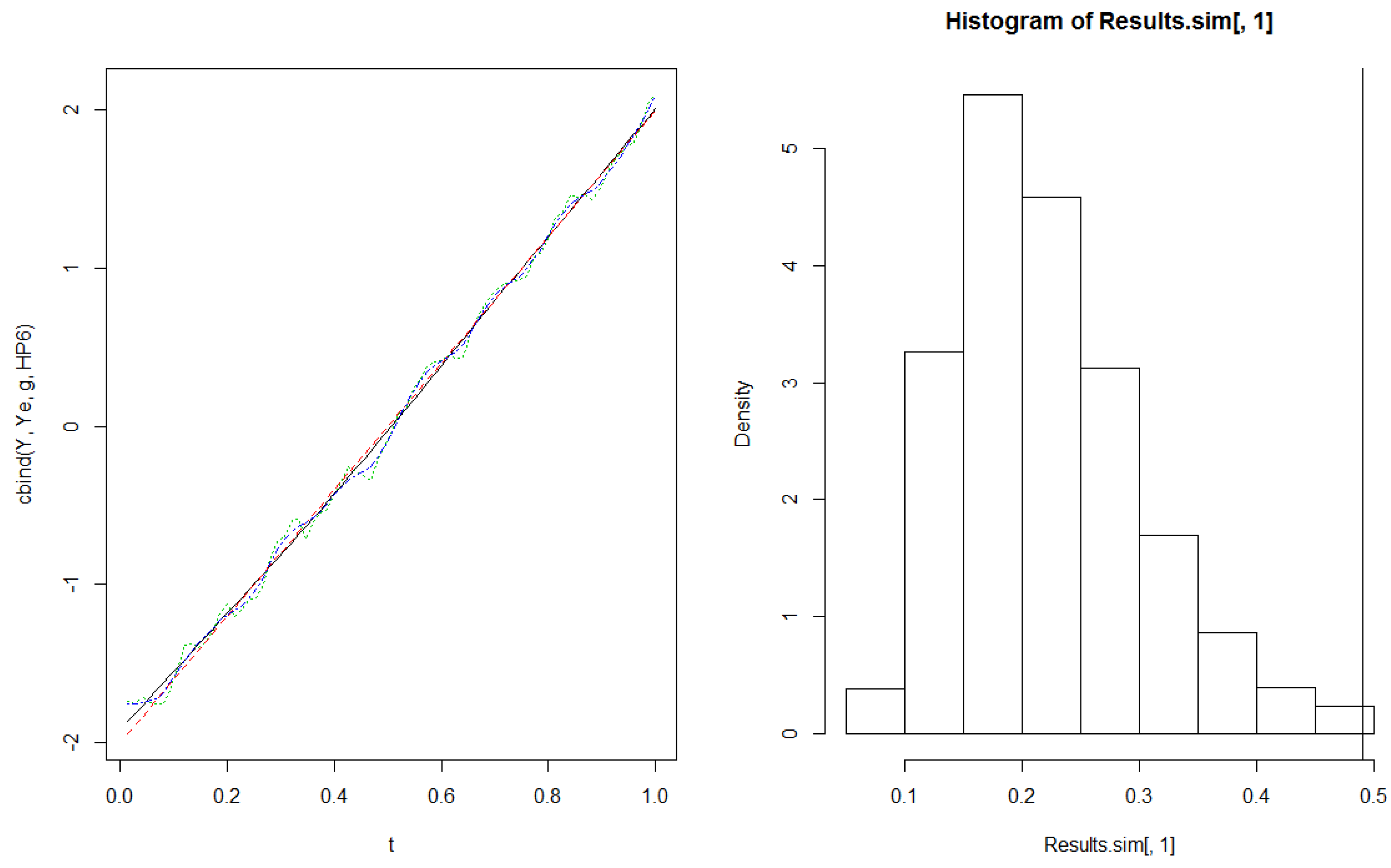
Figure 2.
Simulation for , Alg.B, , ME1. Local linear (black), DGP (red dashed), ME1 (green dashed) compared to HP trend =6.25 (blue dashed).
Figure 2.
Simulation for , Alg.B, , ME1. Local linear (black), DGP (red dashed), ME1 (green dashed) compared to HP trend =6.25 (blue dashed).
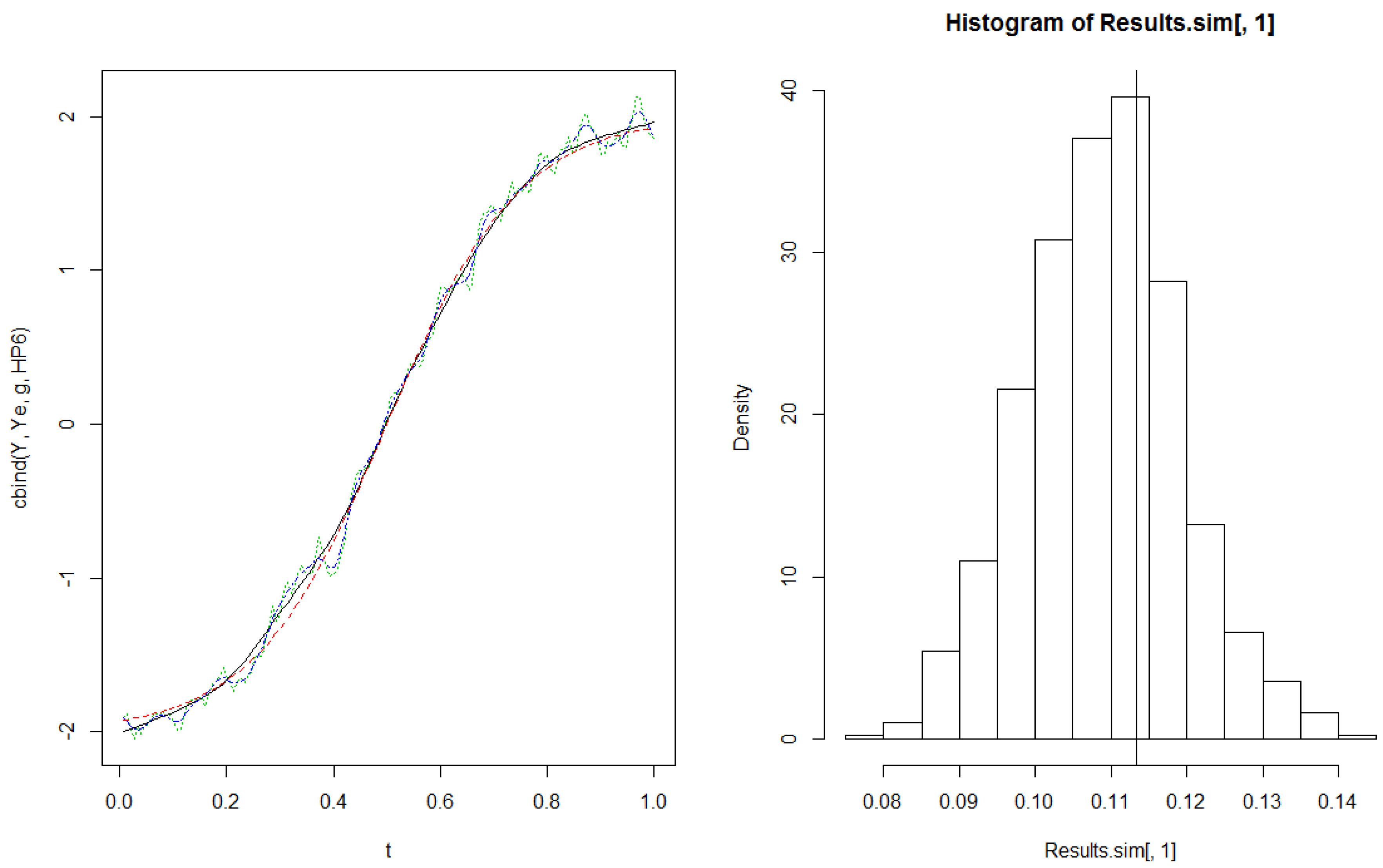
Figure 3.
Simulation for , Alg.B, , ME2. Local linear (black), DGP (red dashed), ME1 (green dashed) compared to HP trend =6.25 (blue dashed).
Figure 3.
Simulation for , Alg.B, , ME2. Local linear (black), DGP (red dashed), ME1 (green dashed) compared to HP trend =6.25 (blue dashed).
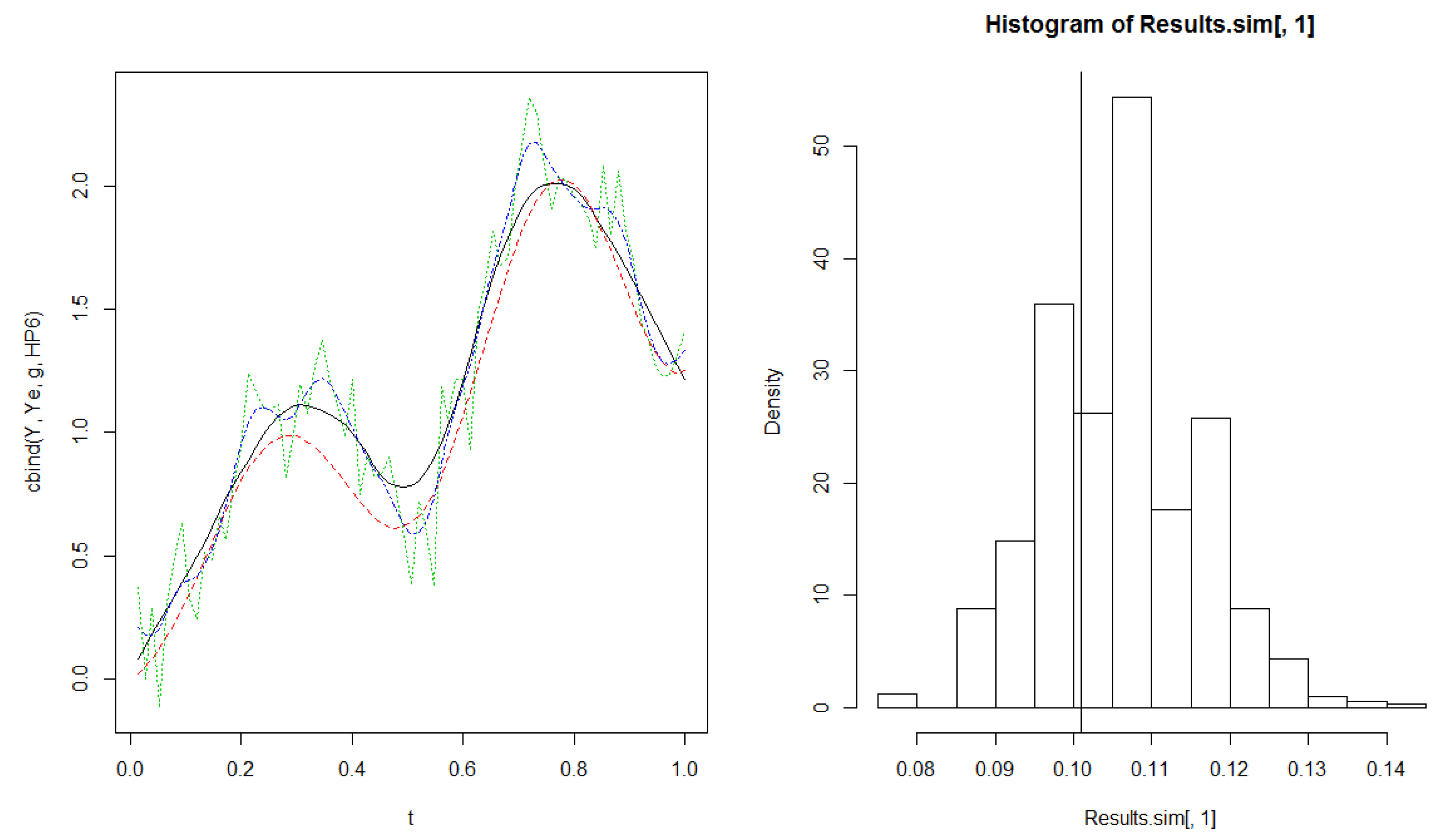
Figure 6.
Local linear (black), linear (blue) compared to HP =1600 (green) trend for quarterly LN-US GDP 1947.1-2016.1 data (red).
Figure 6.
Local linear (black), linear (blue) compared to HP =1600 (green) trend for quarterly LN-US GDP 1947.1-2016.1 data (red).
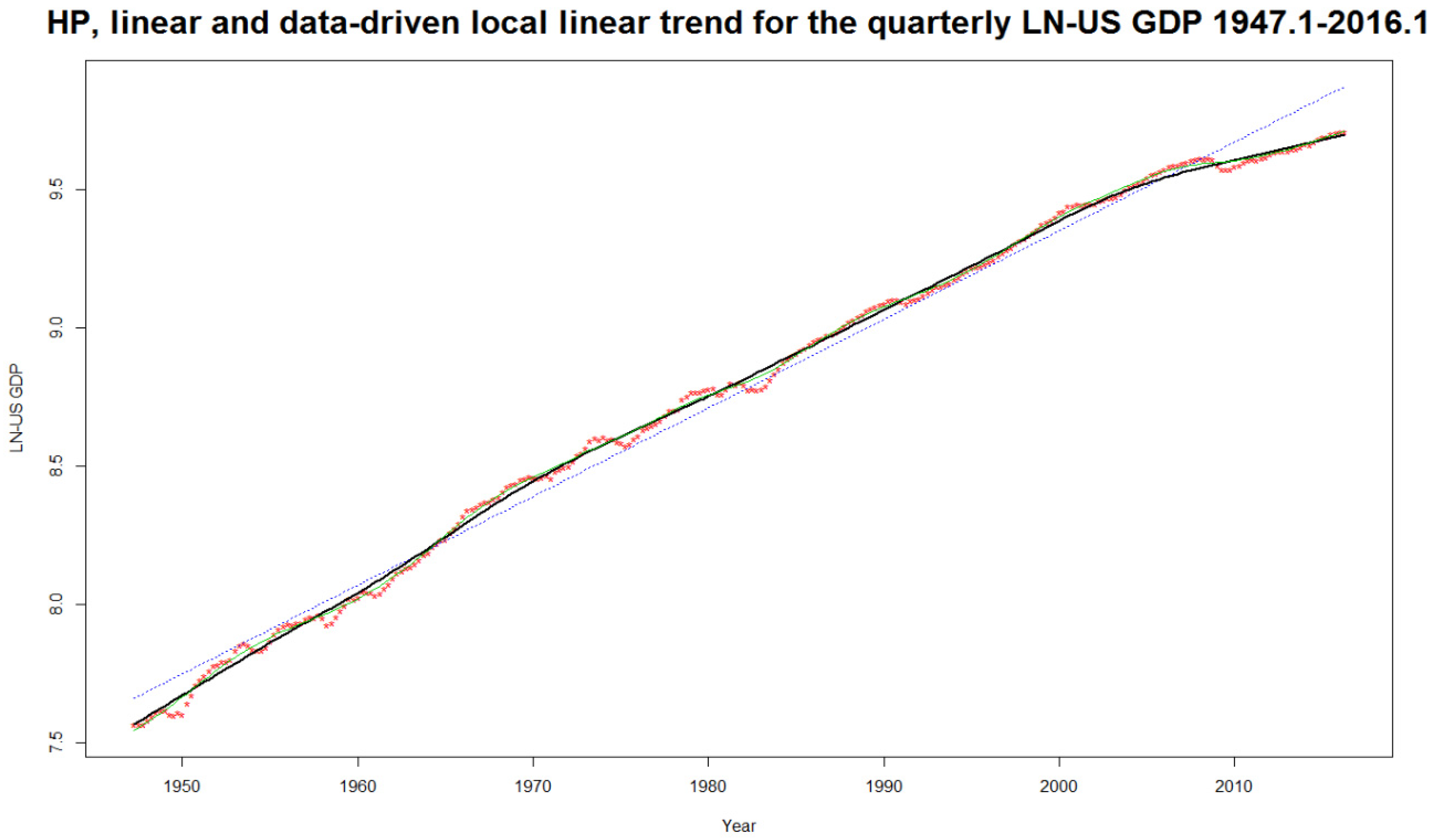
Figure 7.
Zoom in local linear (black), linear (blue) compared to HP =1600 (green) trend for quarterly LN-US GDP 1990.1-2016.1 data (red).
Figure 7.
Zoom in local linear (black), linear (blue) compared to HP =1600 (green) trend for quarterly LN-US GDP 1990.1-2016.1 data (red).
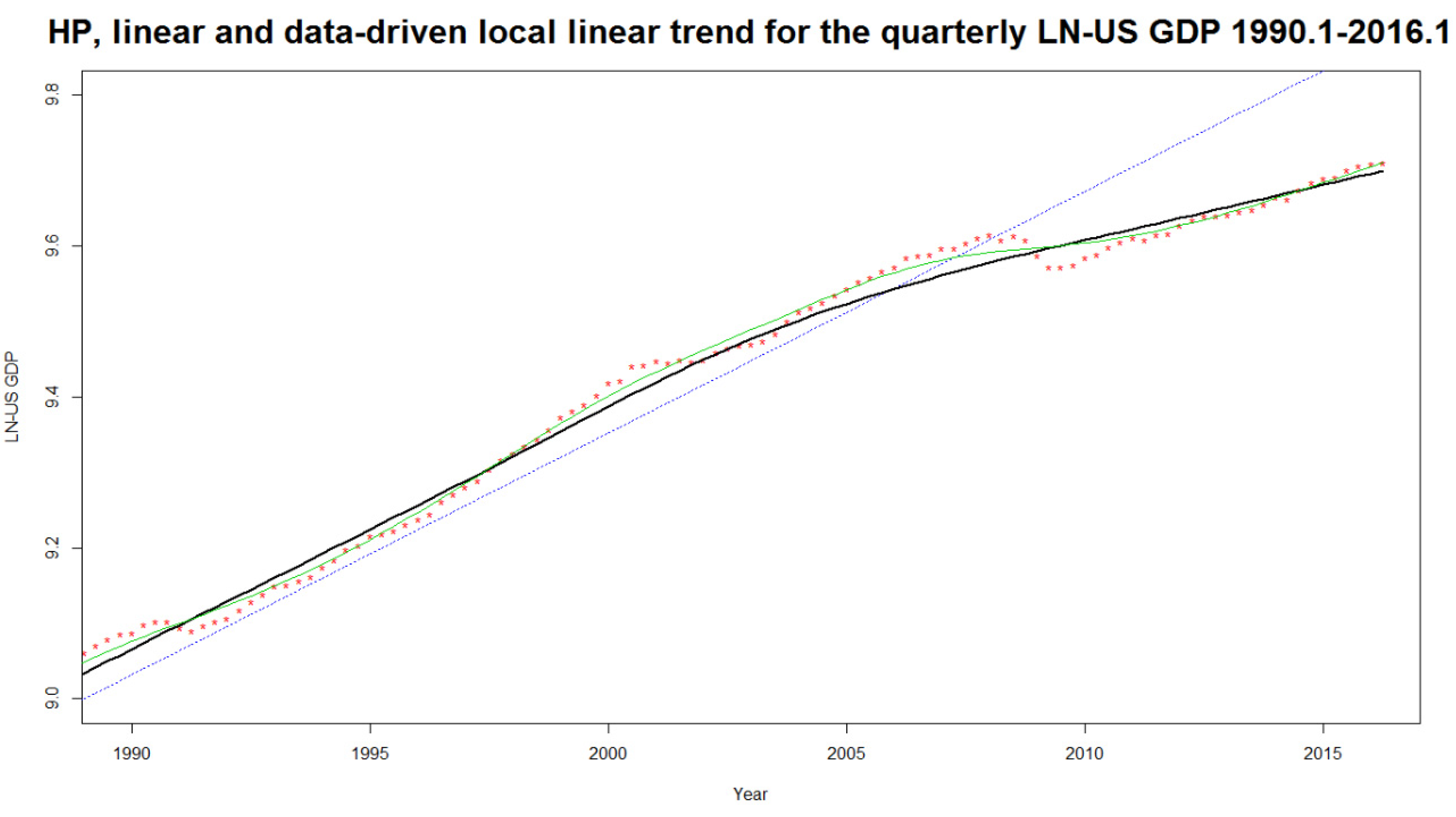
Figure 8.
Local linear (black), linear (blue) compared to HP =6.25 (turquoise), =100 (yellow), =400 (pink) trend for annual LN-US GDP 1790-2015 data (red).
Figure 8.
Local linear (black), linear (blue) compared to HP =6.25 (turquoise), =100 (yellow), =400 (pink) trend for annual LN-US GDP 1790-2015 data (red).
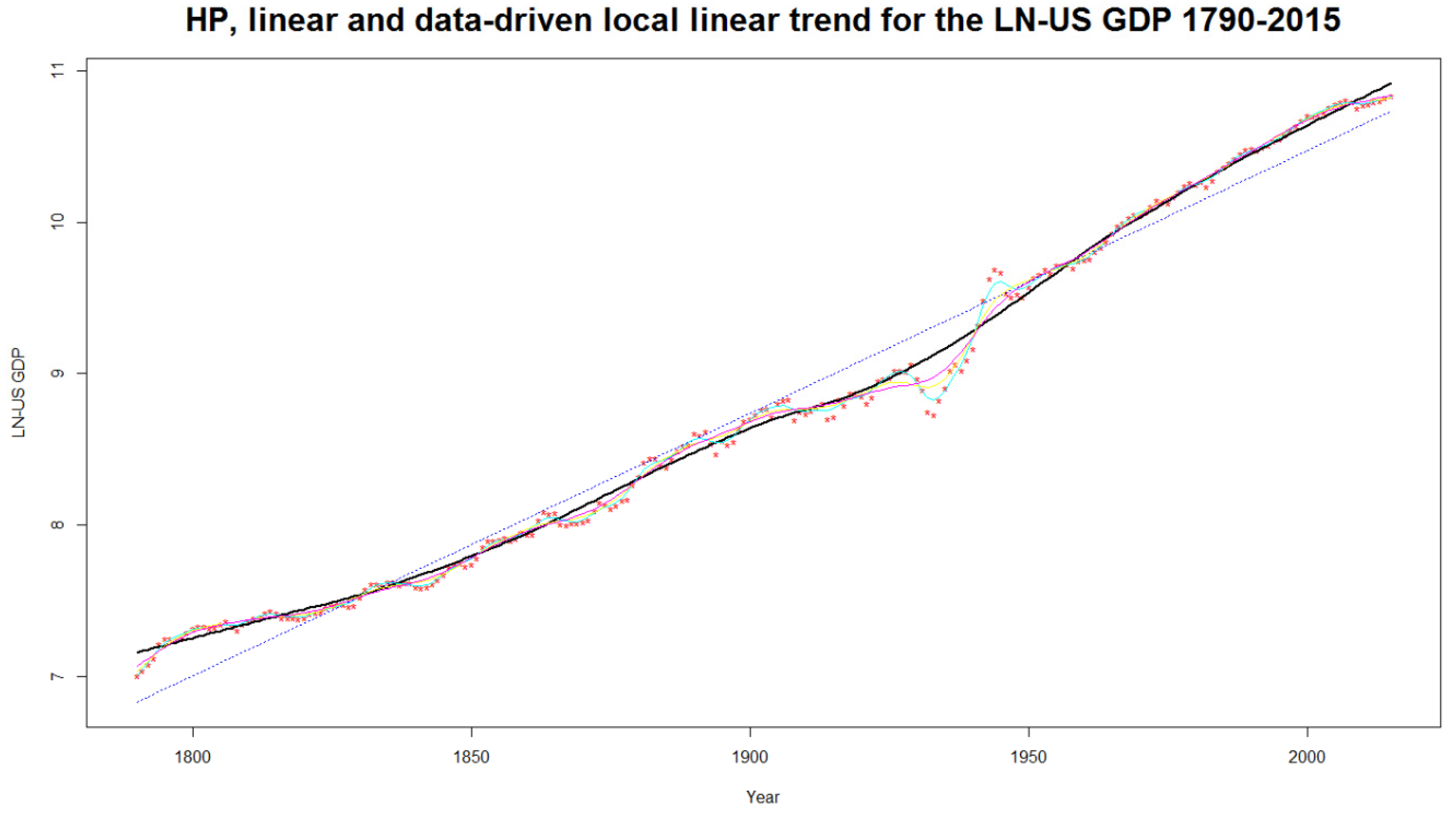
Figure 9.
Zoom in Local linear (black), linear (blue) compared to HP =6.25 (turquoise), =100 (yellow), =400 (pink) trend for annual LN-US GDP 1920-1970 data (red).
Figure 9.
Zoom in Local linear (black), linear (blue) compared to HP =6.25 (turquoise), =100 (yellow), =400 (pink) trend for annual LN-US GDP 1920-1970 data (red).
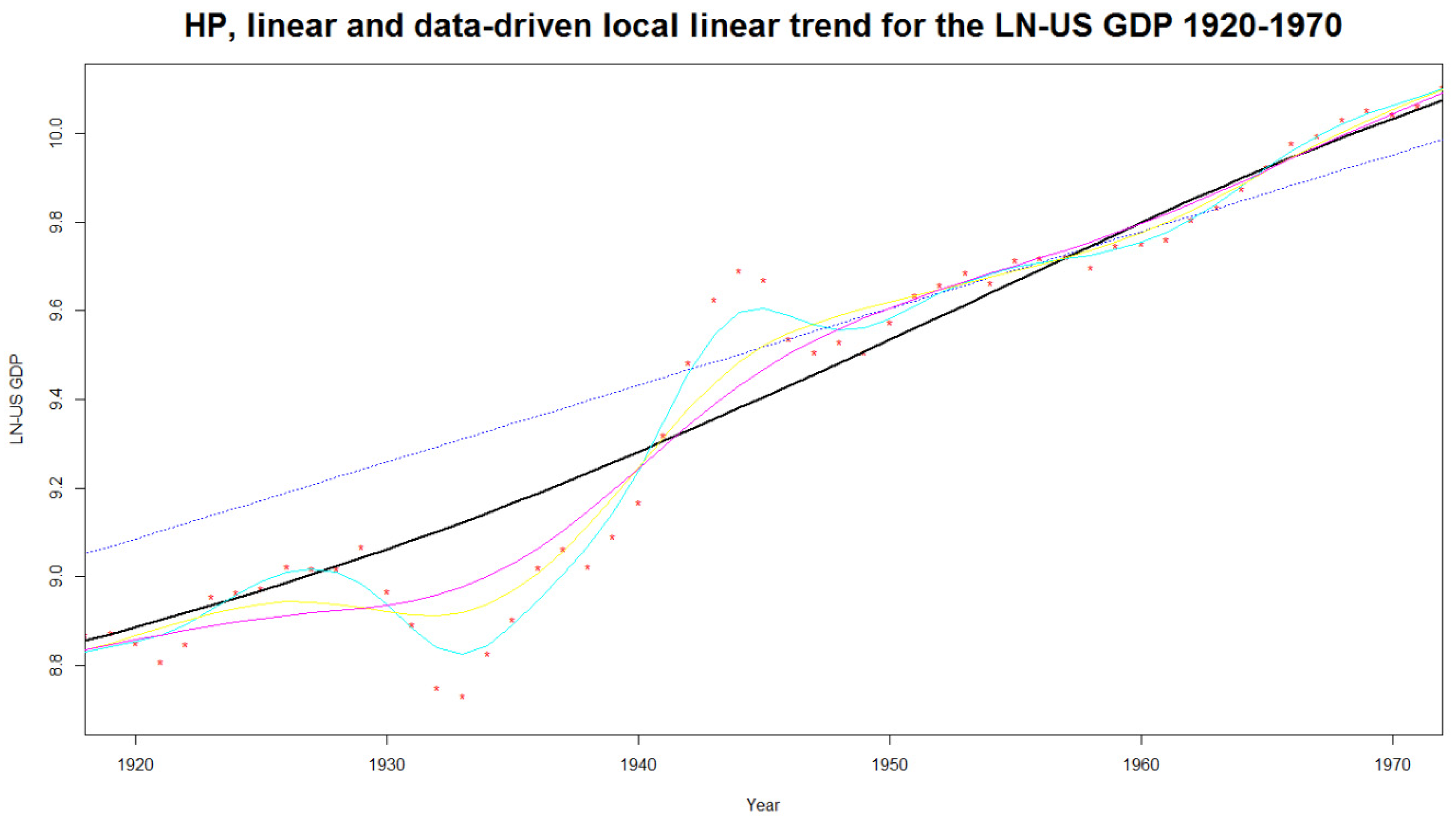
Figure 10.
Local linear (black) compared to HP =14400 (turquoise), =129600 (pink) trend for monthly US dollar-British pound exchange rate 01.1971-11.2017 data (red).
Figure 10.
Local linear (black) compared to HP =14400 (turquoise), =129600 (pink) trend for monthly US dollar-British pound exchange rate 01.1971-11.2017 data (red).
Disclaimer/Publisher’s Note: The statements, opinions and data contained in all publications are solely those of the individual author(s) and contributor(s) and not of MDPI and/or the editor(s). MDPI and/or the editor(s) disclaim responsibility for any injury to people or property resulting from any ideas, methods, instructions or products referred to in the content. |
© 2026 by the authors. Licensee MDPI, Basel, Switzerland. This article is an open access article distributed under the terms and conditions of the Creative Commons Attribution (CC BY) license (http://creativecommons.org/licenses/by/4.0/).
Copyright: This open access article is published under a Creative Commons CC BY 4.0 license, which permit the free download, distribution, and reuse, provided that the author and preprint are cited in any reuse.


