

Submitted:
06 May 2026
Posted:
07 May 2026
You are already at the latest version
Abstract
Channel estimation is important for Orthogonal Frequency-Division Multiplexing (OFDM) in wireless channel communication and requires algorithms that offer the best accuracy while at the same time have very low computational and runtime complexities. Newtonised Orthogonal Matching Pursuit (NOMP) is a promising algorithm for channel estimation; however, it suffers from high computational complexity due to repeated refinement and least-squares updates. In this paper, we propose a low complexity NOMP variant that reduces the dominant computational cost through three modifications: (i) a residual energy-based stopping criterion for NOMP to avoid expensive CFAR evaluation, (ii) a partial cyclic refinement with frozen atoms, and (iii) approximate one-sweep per atom least-squares updates. Complexity analysis shows a reduction from O(K3) to O(KN) in the gain update and from O(K2N) to O(KN) in refinement. Simulation results show that the proposed method achieves ∼87% reduction in runtime, while the symbol error rate (SER) performance is comparable to classical NOMP and outperforms Oversampled OMP at high signal-to-noise ratio (SNR). These results show that NOMP can be computationally efficient for OFDM systems without sacrificing estimation accuracy.
Keywords:
channel estimation
; NOMP
; oversampled OMP
; OFDM
; complexity
; stopping criterion
1. Introduction
Orthogonal Frequency Division Multiplexing (OFDM), a multicarrier transmission technology, has been a dominant technique in wireless communication systems, ranging from Fourth-generation (4G) networks to fifth-generation (5G), due to its robustness against multipath fading channels. It has also been confirmed for the sixth generation (6G) [1]. OFDM divides the data channel into multiple parallel, orthogonal subchannels in the frequency domain. While OFDM enhances transmission efficiency, it also faces challenges, such as in channel estimation, which is critical to its operation. Channel estimation involves determining the channel characteristics from the transmitter to the receiver to ensure that OFDM meets the strictest requirements for high data rates and low latency. There are numerous challenges that channel estimation in OFDM faces, including multipath effects, fast fading, spectrum efficiency requirements, computational complexity, pilot contamination, and the accuracy of channel state information [2]. To overcome these challenges, several techniques have been investigated and proposed.
Compressive sensing (CS) has gained significant interest in wireless channel estimation research. CS techniques exploit the channel’s sparsity. Various Compressive Sensing algorithms have been used for in-channel estimation tasks. They offer a trade-off between complexity and accuracy compared to legacy or traditional methods. Matching Pursuit techniques, a class of greedy sparse recovery approaches, have gained significant importance in channel estimation tasks for wireless communication systems. They decompose signals iteratively into linear combinations of selected elements (atoms) from an overcomplete dictionary. One of the most common is Orthogonal Matching Pursuit (OMP) due to its low computational complexity [3]. Despite the advantage, OMP suffers from basis mismatch between actual and assumed bases for sparsity [4]. Several methods and techniques have been proposed to deal with this OMP limitation. Notably, [5] proposed the use of Newton Optimization refinement to develop a matching pursuit algorithm, Newtonised Orthogonal matching Pursuit (NOMP). NOMP uses Newton steps to refine estimations at each iteration. Recently, [6] investigated an OMP variant that uses an oversampled delay grid to estimate the channel and capture fractional delays. They studied the impact of oversampling and shaping filters on estimation and equalization performance. In their findings, the oversampled OMP variant outperforms conventional OMP by mitigating fractional-delay effects. However, they observed that increasing the oversampling factor increases computational complexity. It is worth noting that the paper’s formulation relies on OFDM frequency-domain observations, in which channels are inherently continuous and are approximated through grid discretizations. This motivates the use of off-grid sparse recovery techniques, such as NOMP, which addresses basis mismatch by iteratively refining the support in continuous parameter space.
1.1. Idea
While NOMP provides estimation accuracy in off-grid sparse recovery, its computational complexity, arising from repeated cyclic refinement steps, CFAR-based stopping, and exact least-squares updates, limits its applicability. In this work, we aim to reduce the computational burden of NOMP without sacrificing estimation performance. We observe that not all refinement and update steps contribute equally to performance, and several operations can be approximated without significant degradation. We propose a low-complexity NOMP variant that introduces three key modifications: (i) a residual energy-based stopping criterion to avoid expensive stopping evaluation, (ii) partial cyclic refinement by freezing early atoms, and (iii) approximate least-squares updates using a one-sweep per atom strategy. These modifications significantly reduce computational complexity while maintaining estimation accuracy, making NOMP more suitable for OFDM channel estimation. This work is inspired by [6].
Contributions:
- A complexity-reduced NOMP based on residual energy stopping criterion for OFDM channel estimation.
- Performance analysis of Oversampled OMP and NOMP, and the impact of Least-Squares on the performance of NOMP.
- A complexity-performance analysis demonstrating significant runtime reduction with negligible impact on estimation accuracy.
2. System Model
The research was based on a conventional OFDM transmission system shown in Figure 1. The OFDM system has K subchannels in the frequency domain for transmission with the same number of pilots present in the symbol or equalization. The finite impulse response is given by after being converted from digital to analog. The discrete-time baseband channel impulse response is denoted as . The received signal is degraded by Additive White Gaussian Noise (AWGN), . The receiver filters the signal, removing the cyclic prefix, and transforms the N-element signal into the frequency domain as using the Fast Fourier Transform. Assuming that Inter Symbol Interference (ISI) and Inter Carrier Interference (ICI) are eliminated, the observed signal in the frequency domain is given in equation 1 as:
where is the channel frequency response on sub-carrier k and is the Additive White Gaussian Noise.
For estimation of the channel, the channel transfer function is given by :
where are the unknown complex gains, is the time delay.
2.1. Compressed Sensing
Considering the baseband channel and signal model of (1), the channel impulse response h (time domain, length N) with whose discrete Fourier transform yields is assumed s-sparse (only nonzero taps). Compressive Sensing (CS) technique can therefore be used to recover the h from the pilot measurements. CS algorithms aim to minimize the approximation error of the sparse response by finding the solution with a presumed number of non-zero coefficients. CS algorithms recover a sparse channel by solving a constrained approximation problem given as:
where is the sensing matrix built from the pilot symbols and s is the sparsity level.
This minimization problem with -norm can be achieved using greedy algorithms like OMP [3].
To ensure an accurate channel estimation, the following two conditions must be satisfied [7]:
- Restricted Isometry Property (RIP) – the sensing matrix should satisfy RIP to guarantee stable recovery of s-sparse channel h.
- Sufficient number of pilot measurements – the number of observations must scale appropriately with the sparsity level to enable reliable reconstruction.
2.1.1. Oversampled OMP
The authors of [6] propose a modification to OMP to ensure better estimation of equaliser coefficients in noisy OFDM transmission. It first addresses the problem of oversampling, which increases computational complexity due to the large size of the sensing matrix. To overcome this, it assumes that the actual maximum value obtained during the search phase of OMP is close to the values determined, leading to a significant modification of the OMP algorithm. The matrix utilized in the least-squares algorithm stage of OMP is composed of the maximum value found in each iteration of the search phase. Secondly, the sensing matrix used in OMP differs from the matrix used to compute the equaliser coefficients. In addition, the OMP algorithm uses a function-based filter in the search stage as a shaping filter, with a rectangular window during oversampling.
The OMP described in [6] is what we refer to as "oversampled OMP" in this paper. The algorithm can be summarized as follows:
- Construct the oversampled sensing matrix where denotes the truncated DFT matrix and represents the oversampling (interpolation) operator.
- Use OMP algorithm on oversampled sensing matrix for sparse detection. A sinc-shaped oversampling filter is used at this stage to provide the best possible path-discrimination properties in the upsampled signal.
- The estimated impulse response is reconstructed using a shaping filter followed by a fast Fourier transform to transform it back to the frequency domain for equaliser parameter adjustment.
2.1.2. NOMP Algorithm
NOMP, as defined in [5], holds the philosophy of iteratively detecting best atoms over a discrete grid but avoids basis mismatch by adding Newton refinement.
Given a received signal in (1), which can be rewritten as:
where are complex gains, are continuous frequency parameters and is the steering vector.
The maximum-likelihood estimate of minimizes the residual energy:
In particular, NOMP first greedily selects frequency components that best match the observed signal, and then applies the Newton method to refine the coefficients for the selected atoms, utilising a second-order derivative (Hessian) to achieve a more accurate representation. These two stages are importantly separated since it is difficult to directly optimize both amplitudes and frequency jointly [8].
As given in [5,8], a coarse estimate of the frequency is obtained during the detection stage using the generalized likelihood ratio test (GLRT) given by:
where r denotes the current residual. This provides an initial estimate of the pair .
After detection, the estimate is redefined using Newton updates, which exploit first- and second-order derivatives of the objective function. Given residual and initial , we define , , , and update .
This Newton refinement enables accurate off-grid estimation by locally optimizing the objective in the continuous parameter space.
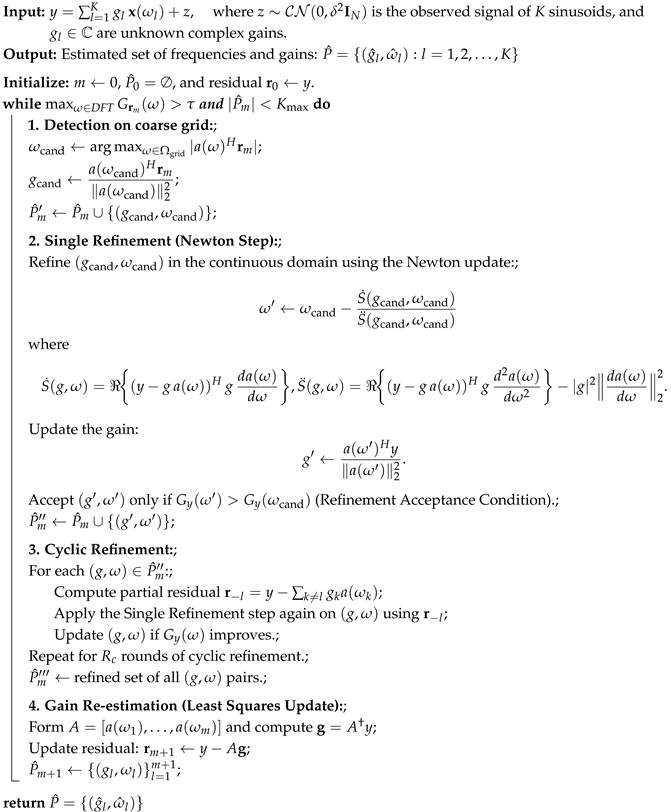
The procedure of NOMP from [5] is described below in Algorithm 1.
Let us summarise the role of the key NOMP components below:
- Single Refinement: this emulates the search over the continuum by locally refining the estimate of obtained by picking the maximum over the discrete set .
- Newton refinement: this is the step that makes NOMP unique from OMP. It provides feedback for local refinements of previously detected sinusoids. It is crucial for fast convergence and high estimation accuracy [5].
- Least-Squares Update: this minimizes the residual energy as much as possible by updating the gains by projecting the received signal y onto the subspace spanned by the estimated frequencies.
| Algorithm 1: Newtonized Orthogonal Matching Pursuit (NOMP) |
 |
While NOMP addresses basis mismatch by enabling off-grid parameter estimation, its computational complexity is dominated by cyclic refinement and the least-squares update steps. This motivates the development of low-complexity variants that approximate or reduce these operations while preserving estimation performance.
2.2. Overview of Proposed Low Complexity NOMP
In this section, we propose an approximate NOMP with low runtime complexity that achieves the same results as NOMP.
In this study, our main objective was to achieve these two objectives:
- To develop, analyse and evaluate a reduced complexity NOMP variant.
- To analyse and evaluate the proposed variant, demonstrating that it achieves comparable or improved channel estimation with lower computational cost compared to classical NOMP across the given range of SNR.
As a result, we propose a low-complexity NOMP variant that reduces computational complexity by targeting three dominant sources of complexity in classical NOMP: global residual-energy stopping and freezing early atoms in cyclic refinement, which prevents atoms from being re-recycled.
In classical NOMP, each iteration consists of a dense frequency search, Newton refinement steps, and a global least-squares update over all previously detected components. This results in heavy iteration, as the Constant False Alarm Rate (CFAR)- based stopping rule requires computing the maximum residual signal that can be explained well enough by noise to stop at the target false alarm rate. This is done at every iteration, even if the residual is close to pure noise, even though it is expensive. In contrast, global residual energy stopping criterion checks when the norm of the residual falls below a threshold, . This avoids global searches and is much cheaper, with lower runtime, while maintaining reconstruction quality [9].
From the original NOMP in [5], the single refinement and cyclic refinement steps already recompute gains with a single refinement step, enforcing the orthogonality locally of the gains, while cyclic refinement iteratively improves frequencies and gains. The cyclic refinement is computationally heavy. To further reduce the computational complexity, we use a one-sweep-per-atom LS that behaves like block Gauss-Seidel, since the refinements update the atoms. While this method does not converge to the least-squares solution, block Gauss-Seidel, which guarantees a monotonic decrease of the residual energy and converges to the least squares solution in multiple sweeps [10,11]. Least Squares is used to solve linear equations; therefore, the Gauss-Seidel method is based on approximate iteration to reduce the computational complexity of directly computing the matrix inversion operation in the least squares algorithm [12]. Furthermore, [13] provides that in greedy approximations, approximate updates can establish bounds on OMP convergence. Therefore, this approximation provides a trade-off consistent with greedy approximation theories. Finally, we can treat exact least squares as a design choice and not a requirement for correctness. To justify this, we shall present in our results a full least-squares variant and a 1-sweep-per-atom Gradient Descent variant for both NOMP and the proposed low-complexity NOMP.
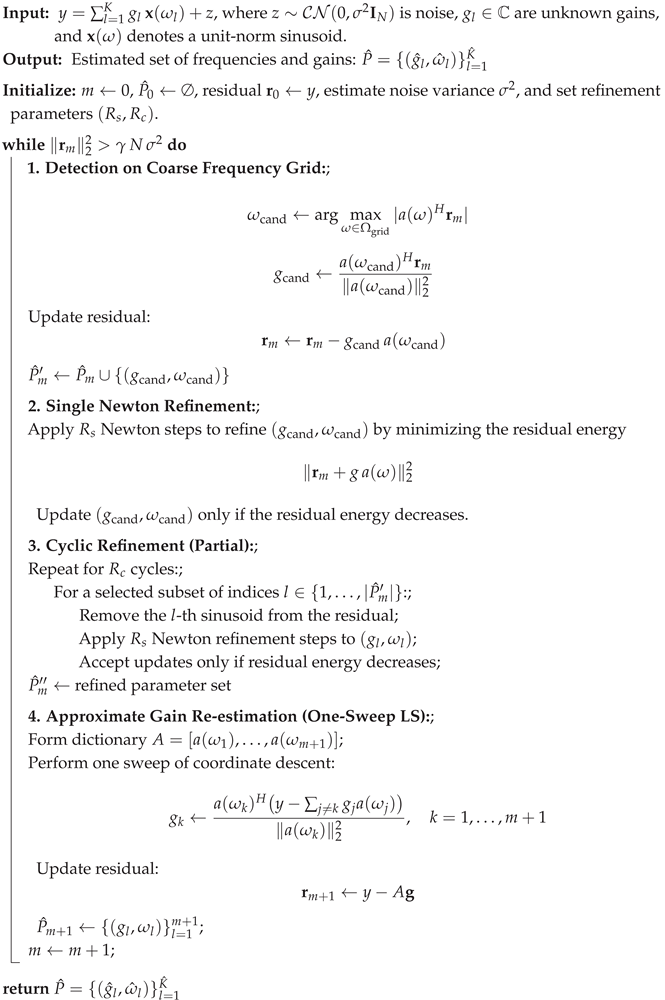
The proposed low complexity NOMP can be summarised as follows:
- We obtain a coarse estimate of just an in [5].
- Single refinement. This emulates the search over the continuum by locally refining the estimate obtained if only the residual energy is decreased.
- Partial Cyclic refinement. This is the feedback stage, and where NOMP varies from other forward greedy methods [5]. We use partial cyclic refinement because it has very little impact on NOMP’s performance. Not all atoms are recycled in every cycle; only a subset is refined and updated. Note that this step also accepts updates.
- Update by approximate Least squares. From the evaluation of the impact of the least square update step in NOMP, we use approximate least squares, which performs one sweep per atom and further reduces the complexity without harm to the performance, as will be seen in the results.
The procedure of the proposed Energy-based stopping NOMP is described below in Algorithm 2.
For the valaues of and we use 1 for simplicity since, as seen above, for our OFDM, the higher values increase complexity but have no significant impact on the results.
| Algorithm 2: Energy-Based NOMP |
 |
2.2.1. Stopping Criterion
NOMP is an iterative algorithm that requires stopping according to some criterion. The moment at which an iterative algorithm stops is vital to overall system performance, including computational complexity [14]. A natural way to stop OMP is to stop when the sparsity order is reached; however, information about the number of propagation paths is unavailable in practical scenarios. In such scenarios, using the power residual error to control stopping is ideal [14]. Various stopping criteria have been proposed for iterative algorithms in the OMP family. The authors of [15] discuss in detail the stopping criterion of OMP. For NOMP, the CFAR-based stopping criterion has been widely used so far. In this paper, like in [16], we use the residual energy-based stopping criterion where we assume that the sparsity level is unknown, and it is more computationally efficient for NOMP in OFDM compared to the CFAR based used in [5].
From equation (1), after k iterations the residual vector is:
The problem to decide if contains noise or not relies on the hypothesis:
where corresponds to noise only after the k iterations, hypothesis is the remaining signal present and denotes the additive white Gaussian noise.
Assume the residual after k iterations contains only noise , it follows the chi-square distribution with degrees of freedom and is given as:
where M is the . Then, the mean and variance are and respectively [17].
Estimating the noise variance within the NOMP framework can be challenging due to parameter refinement and off-grid modelling; therefore, we cannot assume a statistical distribution of residuals that matches the ideal noise-only model used in classical OMP analyses. As a result, directly relying on a precise estimate of can lead to unstable behaviour.
To address this, we adopt a heuristic stopping rule based on a scaled residual energy threshold. Specifically, the algorithm terminates when the residual energy falls below a threshold proportional to , scaled by two design parameters.
The stopping rule is given by:
where is a dimensionless scaling factor chosen between and and is a small constant set to , that controls the minimum resolvable residual energy relative to the received signal power. The parameter provides robustness to finite-sample fluctuations, while prevents the algorithm from fitting to vanishingly small residual components.
Although this stopping condition is heuristic, it has been shown to achieve very high estimation accuracy and very low computational complexity in OFDM-based NOMP, as we will see in the results section.
2.2.2. Complexity Analysis
Assuming that the algorithms run through K iterations with perfect stopping, the complexity can be analysed as follows: Coarse detection: Single Newton refinement has a total cost of . The Least squares with 1 sweep per atom changes from to . By freezing early atoms in cyclic refinement reduces cyclic refinement cost from to . This makes it more efficient as the cyclic refinement step dominates the overall computational cost of NOMP [5]. Below is a table summary comparison of our OFDM-NOMP compared to classical NOMP

Table 1.
Complexity Table.
| Metric | Detect | Refine One | Refine All | LS |
|---|---|---|---|---|
| Complexity (O-Notation) | ||||
| OFDM-NOMP | ||||
| Classical NOMP | ||||
Overall, the proposed low-complexity NOMP is more efficient than classical NOMP with a CFAR-based stopping criterion and full least squares, without incurring additional cost, as will be shown in the results later. The proposed modifications reduce the dominant computational terms of NOMP from cubic to linear scaling in K. In particular, the least-squares update is reduced from to , and cyclic refinement from to {O(KN)}. This significantly improves scalability and makes the algorithm suitable for OFDM systems.
In conclusion, the proposed low complexity NOMP is an improvement of the NOMP method [5] with a residual energy-based stopping criterion. This is the main improvement. Also, in cyclic refinement, we freeze early atoms so they are not recycled. This is practically heuristic. Finally, instead of using the full least-squares updates, we use the 1-sweep-per-atom least-squares update, as Newton refinement steps update the gains and frequencies. This helps avoid redundancy and further reduces the computational complexity.
3. Simulation Results
The primary objective of this work is to reduce computational complexity. Therefore, runtime and computational cost are evaluated alongside estimation performance to demonstrate the efficiency of the proposed method. The proposed low-complexity NOMP’s performance is evaluated using Monte Carlo simulations. Symbol Error Rate (SER) performance of the proposed low-complexity NOMP is compared against oversampled OMP and classical NOMP under different SNR conditions. In addition, we analyse the impact of the least-squares update on NOMP’s performance for OFDM channel estimation. We evaluate the normal least squares and 1 sweep per atom. Finally, we measure and report the algorithm’s runtime in CPU time.
3.1. System Parameters
The data used in this work is similar to data from [6]. It was run on MATLAB R2023b on Intel Core i3 processor. Basically, OFDM modulation with a Quadrature Phase Shift Keying (QPSK) constellation is used on each of the 128 subcarrier channels. The cyclic prefix was set to 32 samples. A two-path channel type with path delay separation between and sampling periods. Oversampling factor of NOMP was set to 4, with . SNR range used is to . The sensing matrix for NOMP was a DFT sampling matrix with filter response, no oversampling. It is worth noting that for oversampled OMP, we use an oversampling factor of 2 across the whole work. The Table 2 gives the summary.
3.2. Comparison of Performances
3.2.1. Analysis Performance of NOMP and Oversampled OMP
The Figure 2 and Figure 3 show the results of simulations of NOMP and oversampled OMP. We compare Oversampled OMP with Oversampling Factors of 2 & 4, and NOMP we compare with cyclic refinement values of 1 & 3. The results confirm the findings of [6] that the oversampling factor increases computational complexity without significant improvement in results. In fact, OMP with an oversampling factor of 2 performs better than both NOMP and OMP with higher oversampling factor values in regions of low SNR up to about . Even though NOMP outperforms both the oversampled OMPs in regions of high SNR, it incurs computational overhead. For NOMP, increasing the number of cyclic Newton refinements slightly improves SER performance at higher SNR; at low SNR, outperforms . Increasing the number of cyclic refinements also increases the computational complexity of NOMP.
3.2.2. Analysis of the Impact of Least Squares
Since single-Newton refinement and cyclic Newton refinement update gain and frequency, respectively, in NOMP, we evaluate the effect of removing the least-square update step or using the computationally light 1-sweep-per-atom Least-square. The Figure 4 and Figure 5 show the results for this, and it can be seen that there is very little impact from removing the least-squares step in NOMP for OFDM. However, completely removing the least square update step can result in overshooting or unstable results.
As shown in the results above, specifically in Figure 2, NOMP has very high runtime complexity. Increasing the number of cyclic refinements increases complexity without a significant improvement in SER performance. The least-squares step can also be replaced with low-complexity alternatives.
In the next section, we analyse the results from the approximate NOMP algorithm based on the residual energy stopping criterion.
3.2.3. Proposed Low Complexity NOMP Performance
In this section, we analyse the performance of the proposed low complexity NOMP that relies on the residual-energy stopping condition. From Figure 6, we compare the results of the proposed low complexity NOMP against benchmark oversampled OMP and classical NOMP. We can see that the proposed low-complexity NOMP performs slightly better than the classical NOMP across all SNR regions. Oversampled OMP still outperforms them in low SNR, however, all the NOMP variants perform better in SNR range of and above. Regarding the impact of cyclic refinements, as with NOMP, they have no significant effect; however, increasing the number of cyclic refinements increases computational complexity. In the same figure, we compare the impact of least squares on the proposed low complexity NOMP. We can generally conclude that it has very little impact on performance; removing it might lead to unstable results. A very simple technique, like gradient descent, works well for NOMP, and one-sweep per atom can still conditionally converge as a full least square, as also proved in [13].
The performance of the proposed algorithm is therefore satisfactory in this OFDM simulation. The Oversampled OMP, however, still performs better in regions of low SNR. In high SNR, above , its performance deteriorates.
3.2.4. Numerical Computational Complexity
In this subsection, for complexity, we presented the computational complexity of the energy-based NOMP. To validate this, this section provides measurements of CPU execution time and runtime execution for different algorithms. Both NOMPs have , and oversampled OMP has an oversampling factor of 2.
In Figure 7, we show the runtime execution times using the tic/toc MATLAB function of these code snippets, which are computed and then averaged. The Energy-based stopping NOMP is faster than classical NOMP. However, it takes longer than Oversampled OMP, but it achieves better estimation at high SNR, as shown in Figure 6.
These same results are confirmed in the CPU time calculations and summarised in Table 3, where Energy-based stopping NOMP costs about less computing power than classical NOMP and therefore about times faster than classical NOMP. The oversampled OMP, however, is the most efficient in terms of computational cost.
We can conclude that, since we keep the Monte Carlo simulations at 50 across all cases, NOMP with an energy-based stopping criterion is a computationally efficient improvement over NOMP. Note that the focus here is on the general trend in complexity, not on estimating absolute lower bounds for execution.
4. Conclusion
We demonstrate that the computational complexity of NOMP can be significantly reduced without sacrificing estimation accuracy. By introducing a residual energy-based stopping criterion, partial cyclic refinement, and approximate least-squares updates, the proposed method reduces the dominant complexity components of NOMP.
The proposed approach achieves approximately reduction in runtime compared to classical NOMP while maintaining comparable SER performance. The complexity reduction from cubic to linear scaling in key steps makes the algorithm more suitable for practical OFDM channel estimation.
These results show that high-accuracy off-grid sparse recovery methods, such as NOMP, can be adapted to low-complexity implementations without compromising performance.
Author Contributions
Conceptualization - Antonio Apiyo and Jacek Izydorczyk; Methodology - Antonio Apiyo; Software - Antonio Apiyo; Validation - Antonio Apiyo and Jacek Izydorczyk; Investigation - Antonio Apiyo; Resources - Antonio Apiyo and Jacek Izydorczyk; Writing -original draft - Antonio Apiyo; Writing- review and editing - Antonio Apiyo and Jacek Izydorczyk; Visualization - Antonio Apiyo and Jacek Izydorczyk; Supervision - Jacek Izydorczyk; Project administration - Jacek Izydorczyk. All authors have read and agreed to the published version of the manuscript.
Funding
This research received no external funding.
Institutional Review Board Statement
Not applicable.
Informed Consent Statement
Not applicable.
Data Availability Statement
All data are included in the main text.
Use of Artificial Intelligence
Generative AI tools, including ChatGPT and Gemini, were utilized in this work for editorial refinement, code optimization, and literature scoping. These tools served only as auxiliary instruments to enhance clarity and presentation, and they did not generate new scientific concepts or results. AI assisted contents have been verified for accuracy, integrity, and originality of the manuscript.
Conflicts of Interest
The authors declare no conflict of interest.
Abbreviations
The following abbreviations are used in this manuscript:
| CFAR | Constant false alarm rate |
| CPU | Central Processing Unit |
| CS | Compressive Sensing |
| DFT | Discrete Fourier Transform |
| LS | Least Square |
| NOMP | Newtonised Orthogonal Matching Pursuit |
| OMP | Orthogonal Matching Pursuit |
| OFDM | Orthogonal Frequency Division Multiplexing |
| QPSK | Quadrature Phase Shift Keying |
| RIP | Restricted Isometry Property |
| SER | Signal Error Rate |
| SNR | Signal to Noise Ratio |
References
- Marchese, M.; Tagliaferri, D.; Wymeersch, H.; Keskin, M. F.; Viterbo, E.; Savazzi, P. Beyond Legacy OFDM: A Mobility-Adaptive Multi-Gear Framework for 6G. arXiv 2026, arXiv:2603.29721. [Google Scholar]
- Li, B.; Zheng, Q.; Tian, X.; Yang, M.; Gui, G.; Jiang, W.; Lei, H.; Jiang, J.; Shu, F.; Elhanashi, A.; et al. The title of the cited article. Artif. Intell. Rev. 2025, 58(6), 1–35. [Google Scholar]
- Tropp, J. A.; Gilbert, A. C. Signal recovery from random measurements via orthogonal matching pursuit. IEEE Trans. Inf. Theory 2007, 53(12), 4655–4666. [Google Scholar] [CrossRef]
- Chi, Y.; Pezeshki, A.; Scharf, L.; Calderbank, R. Sensitivity to basis mismatch in compressed sensing. In Proceedings of the 2010 IEEE International Conference on Acoustics, Speech and Signal Processing, Dallas, TX, USA, 14–19 March 2010; pp. 3930–3933. [Google Scholar]
- Mamandipoor, B.; Ramasamy, D.; Madhow, U. Newtonized orthogonal matching pursuit: Frequency estimation over the continuum. IEEE Trans. Signal Process. 2016, 64(19), 5066–5081. [Google Scholar] [CrossRef]
- Kucharczyk, M.; Dziwoki, G.; Izydorczyk, J.; Sułek, W.; Dustor, A.; Filipowski, W.; Izydorczyk, W.; Kłosowski, P.; Zawadzki, P.; Sowa, P.; Rajzer, M. Equalizer Parameters’ Adjustment Based on an Oversampled Channel Model for OFDM Modulation Systems. Electronics 2024, 13(5), 843. [Google Scholar] [CrossRef]
- Gui, G.; Wan, Q.; Peng, W.; Adachi, F. Sparse multipath channel estimation using compressive sampling matching pursuit algorithm. arXiv 2010, arXiv:1005.2270. [Google Scholar] [CrossRef]
- Zhu, J.; Han, L.; Blum, R. S.; Xu, Z. Multi-snapshot Newtonized orthogonal matching pursuit for line spectrum estimation with multiple measurement vectors. Signal Process. 2019, 165, 175–185. [Google Scholar] [CrossRef]
- Chang, L.-H.; Wu, J.-Y. An improved RIP-based performance guarantee for sparse signal recovery via orthogonal matching pursuit. IEEE Trans. Inf. Theory 2014, 60(9), 5702–5715. [Google Scholar] [CrossRef]
- Du, K.; Ruan, C.-C.; Sun, X.-H. On the convergence of a randomized block coordinate descent algorithm for a matrix least squares problem. Appl. Math. Lett. 2022, 124, 107689. [Google Scholar] [CrossRef]
- Lyu, H. Convergence of block coordinate descent with diminishing radius for nonconvex optimization. arXiv 2020, arXiv:2012.03503. [Google Scholar]
- Huang, H.; Zhang, J.; Jiang, J. Low Complexity Hybrid-Field Channel Estimation Based on Simultaneous Weighted OMP Algorithm in Extreme Large-Scale MIMO Systems. IEEE Access 2024, 12, 46551–46561. [Google Scholar] [CrossRef]
- Barron, A. R.; Cohen, A.; Dahmen, W.; DeVore, R. A. Approximation and learning by greedy algorithms. Ann. Stat. 2008, 36(1). [Google Scholar] [CrossRef]
- Dziwoki, G.; Izydorczyk, J. Stopping Criteria Analysis of the OMP Algorithm for Sparse Channels Estimation. In Computer Networks; Springer: Cham, Switzerland, 2015; pp. 250–259. [Google Scholar]
- Cai, T. T.; Wang, L. Orthogonal Matching Pursuit for Sparse Signal Recovery With Noise. IEEE Trans. Inf. Theory 2011, 57(7), 4680–4688. [Google Scholar] [CrossRef]
- Zhu, J.; Guo, H.; Zhang, N.; Song, C.; Xu, Z. Newtonalized orthogonal matching pursuit for the linear frequency-modulated pulse frequency agile radar. IET Radar Sonar Navig. 2021, 15(12), 1670–1686. [Google Scholar] [CrossRef]
- Kay, S. M. Fundamentals of Statistical Signal Processing: Estimation Theory; Prentice-Hall, Inc.: Upper Saddle River, NJ, USA, 1993. [Google Scholar]
Figure 1.
OFDM Transmission.
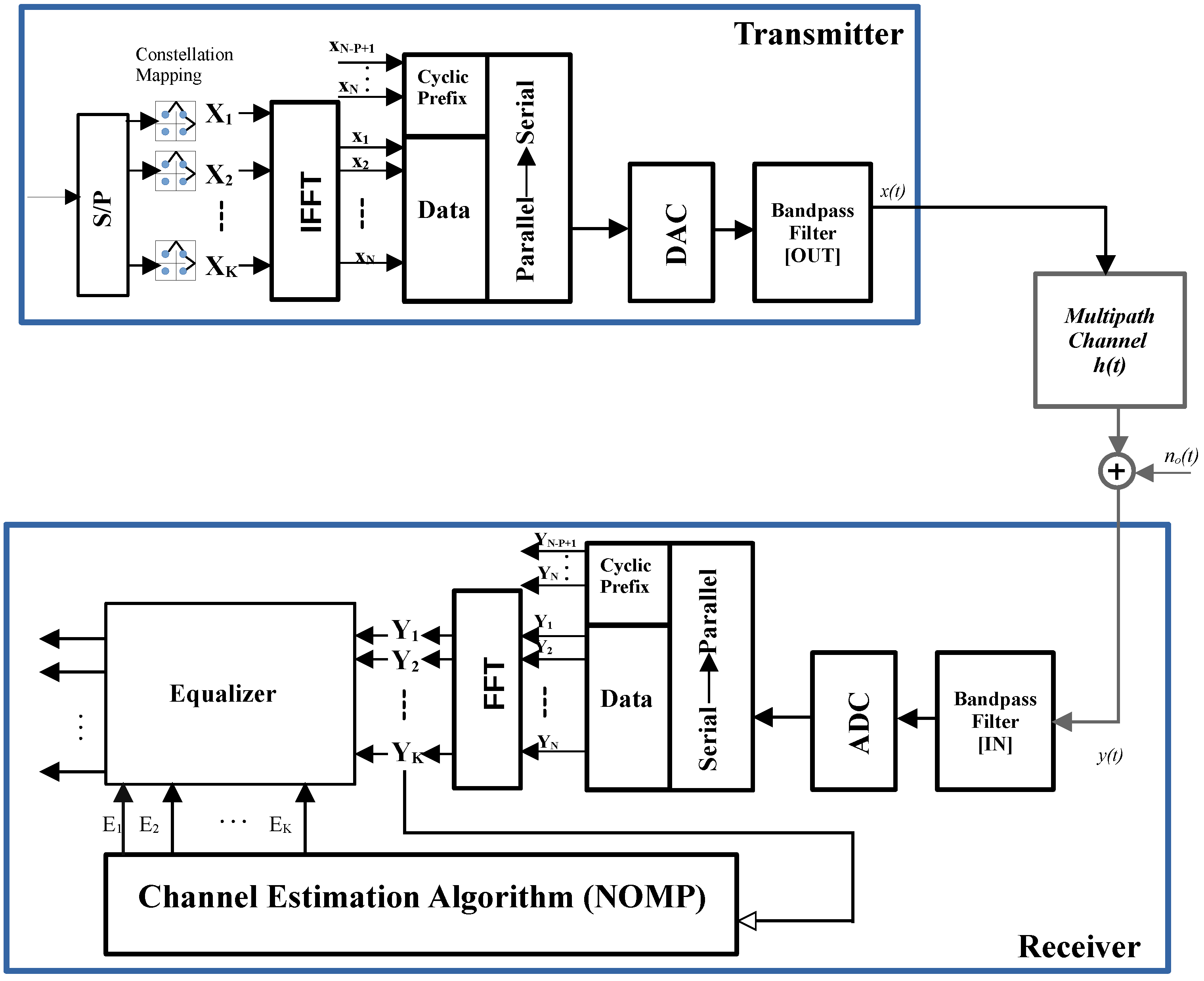
Figure 2.
SER vs SNR for NOMP and Oversampled OMP .
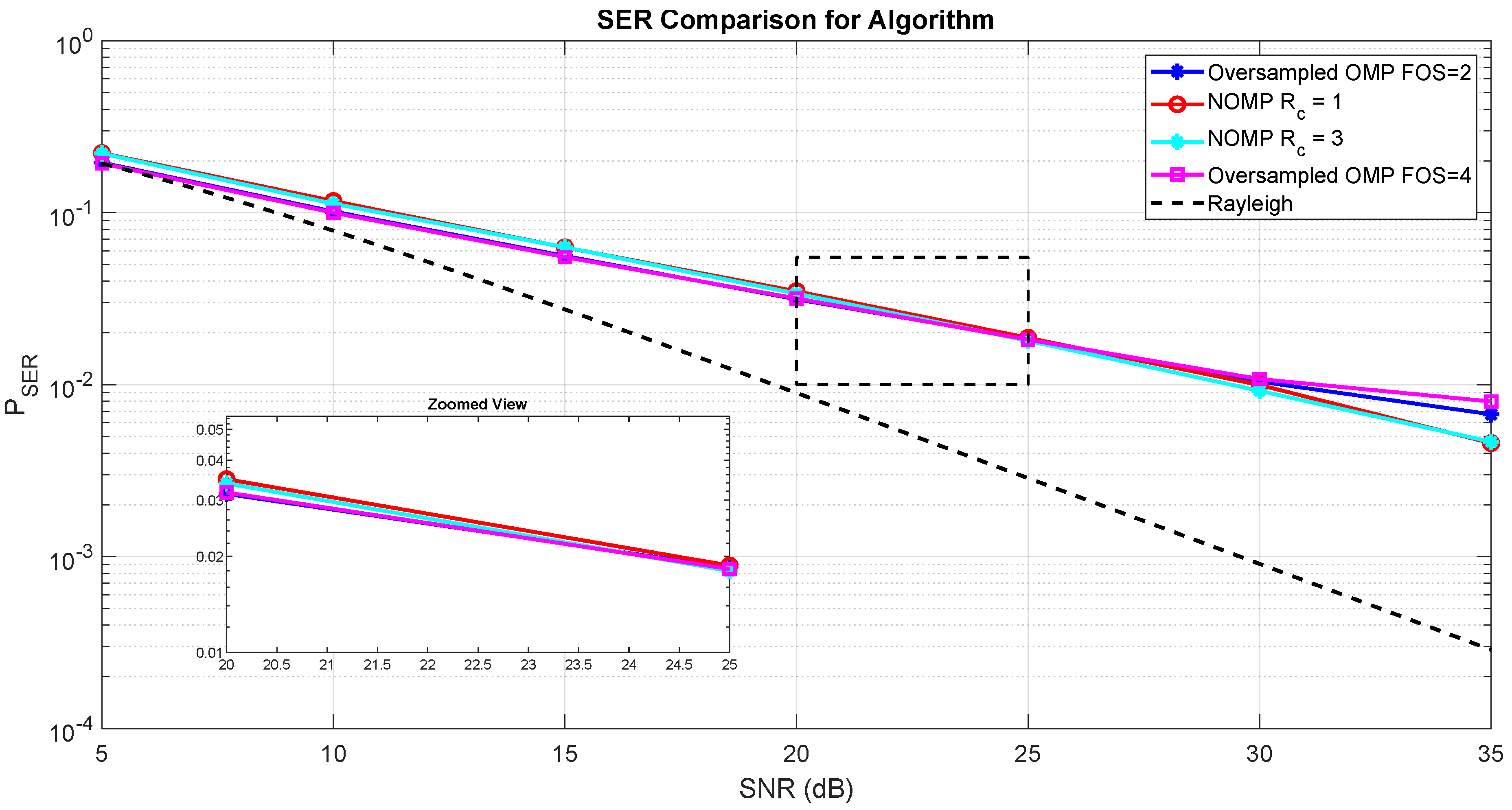
Figure 3.
Time Graph for NOMP and Oversampled OMP .
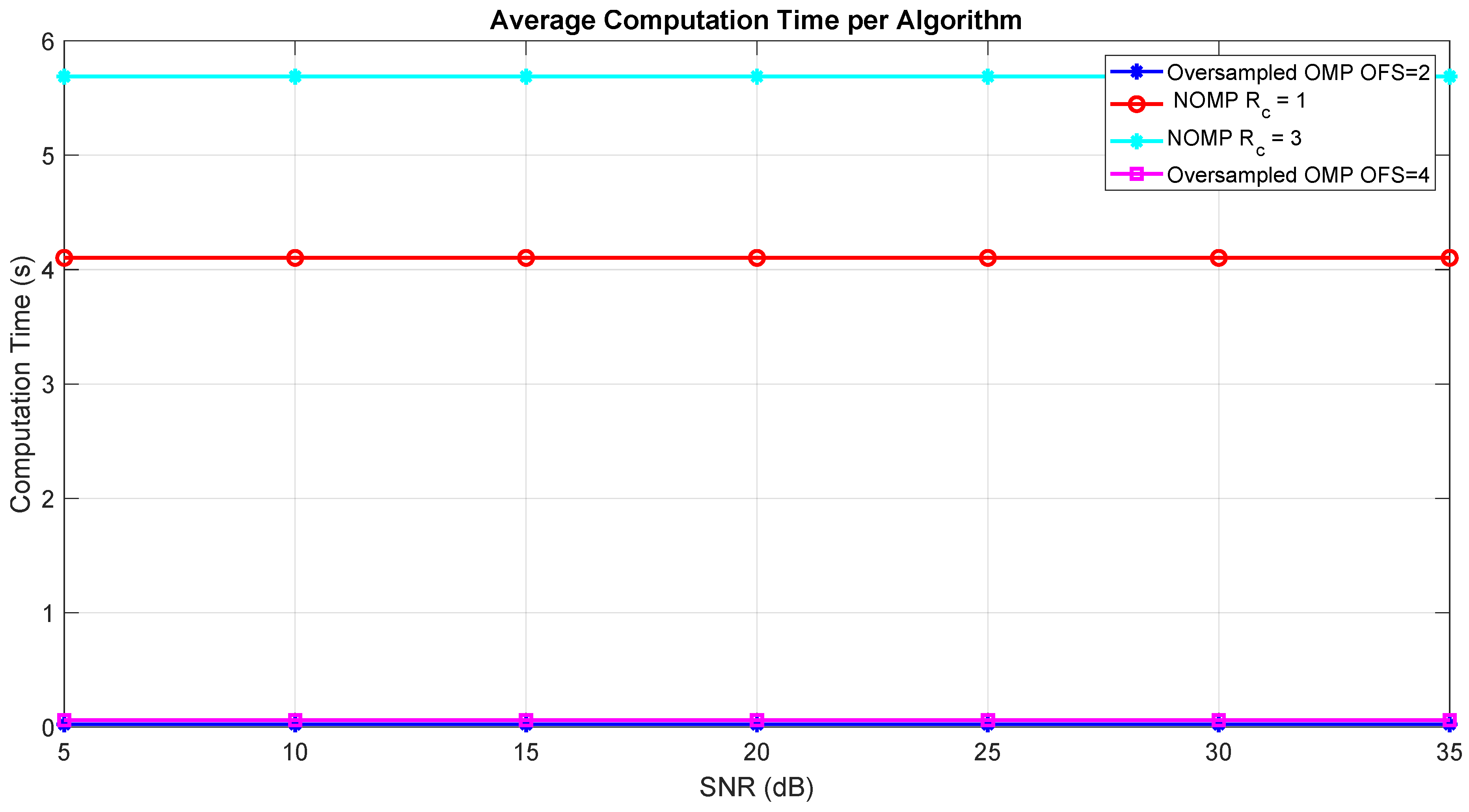
Figure 4.
Effect of Least-Squares on SER performance of NOMP.
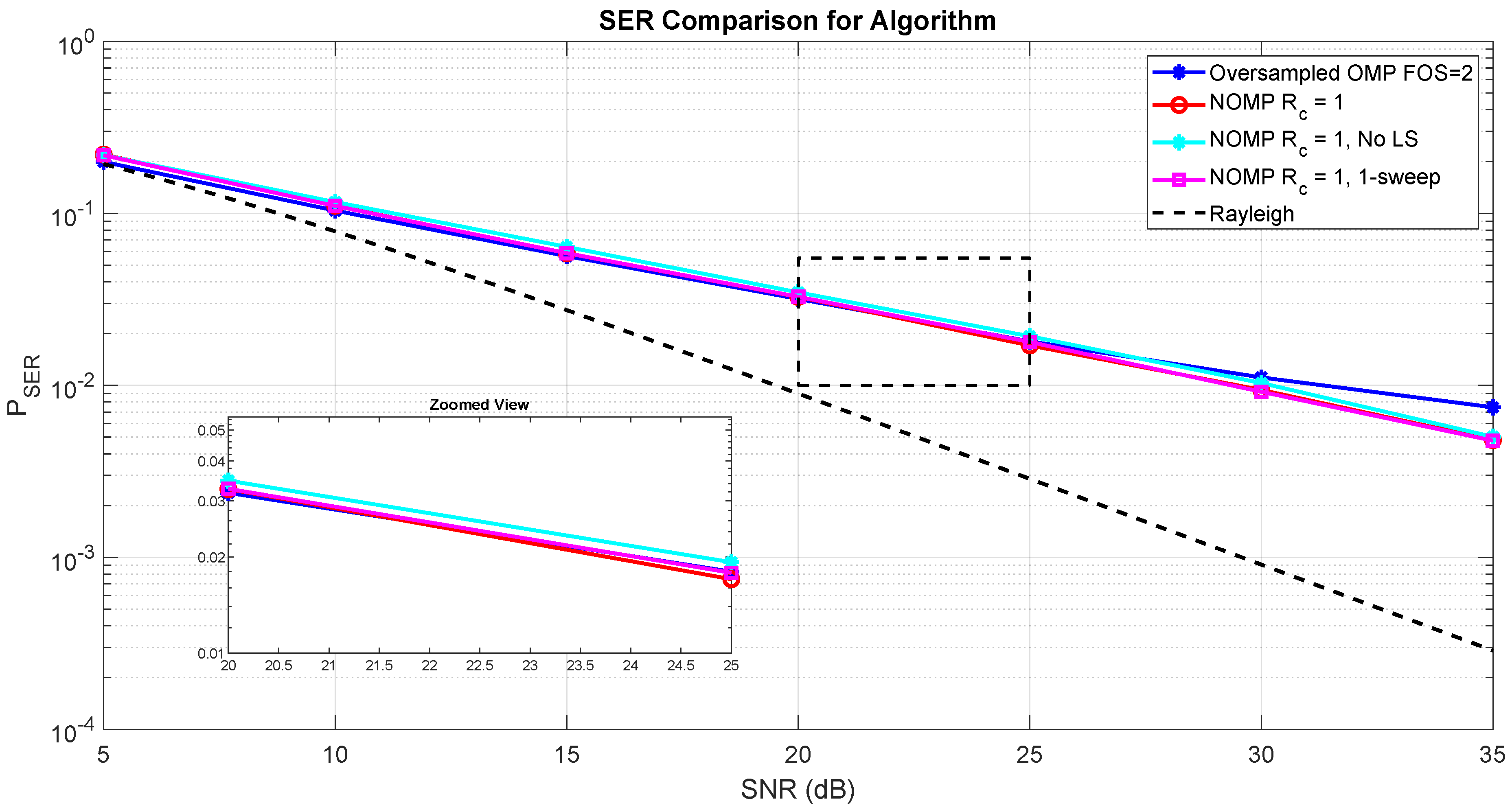
Figure 5.
Time Graph for the effect of Least-square on NOMP.
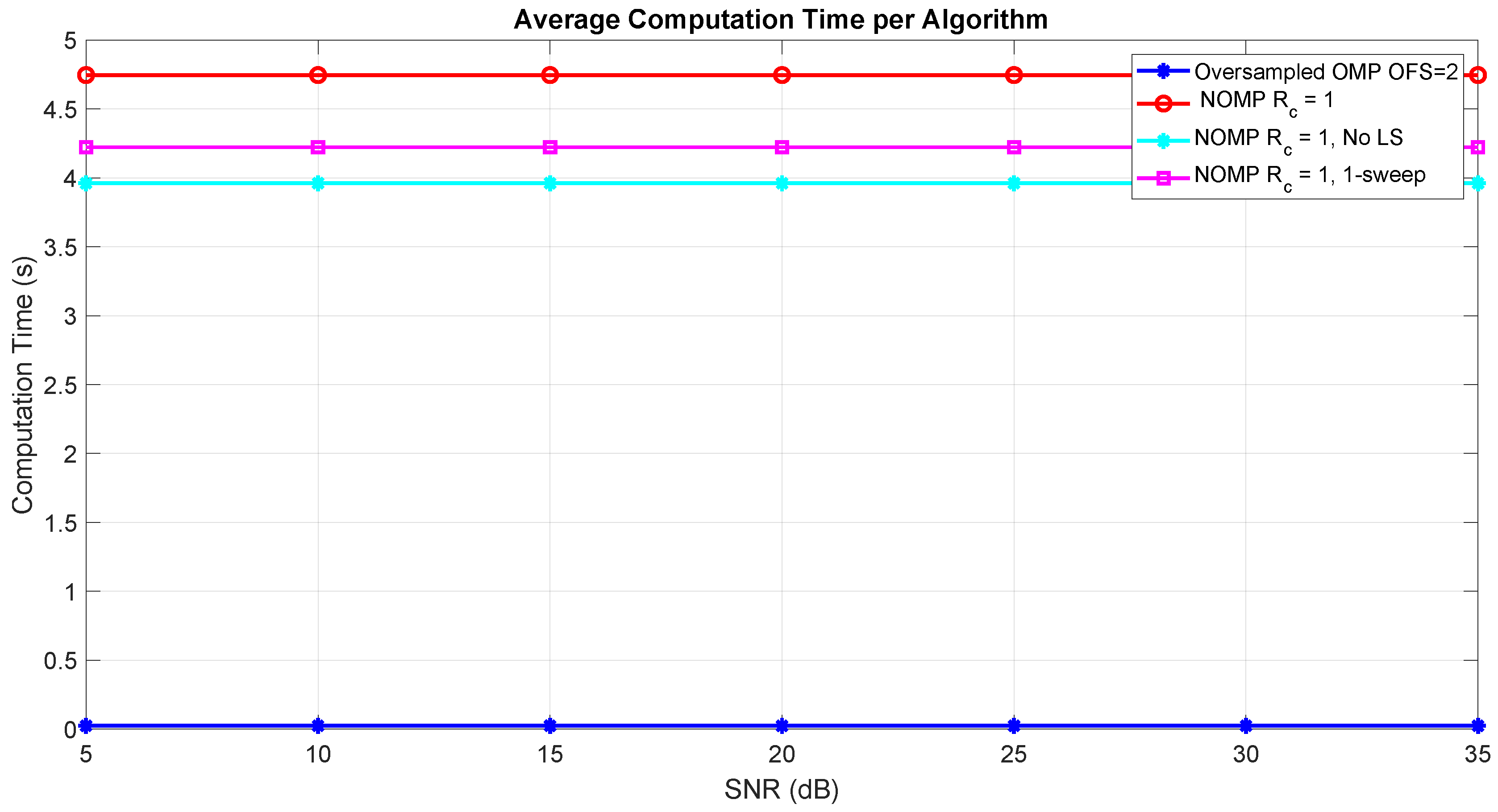
Figure 6.
SER Comparison of proposed low complexity NOMP compared to Oversampled OMP and NOMP.
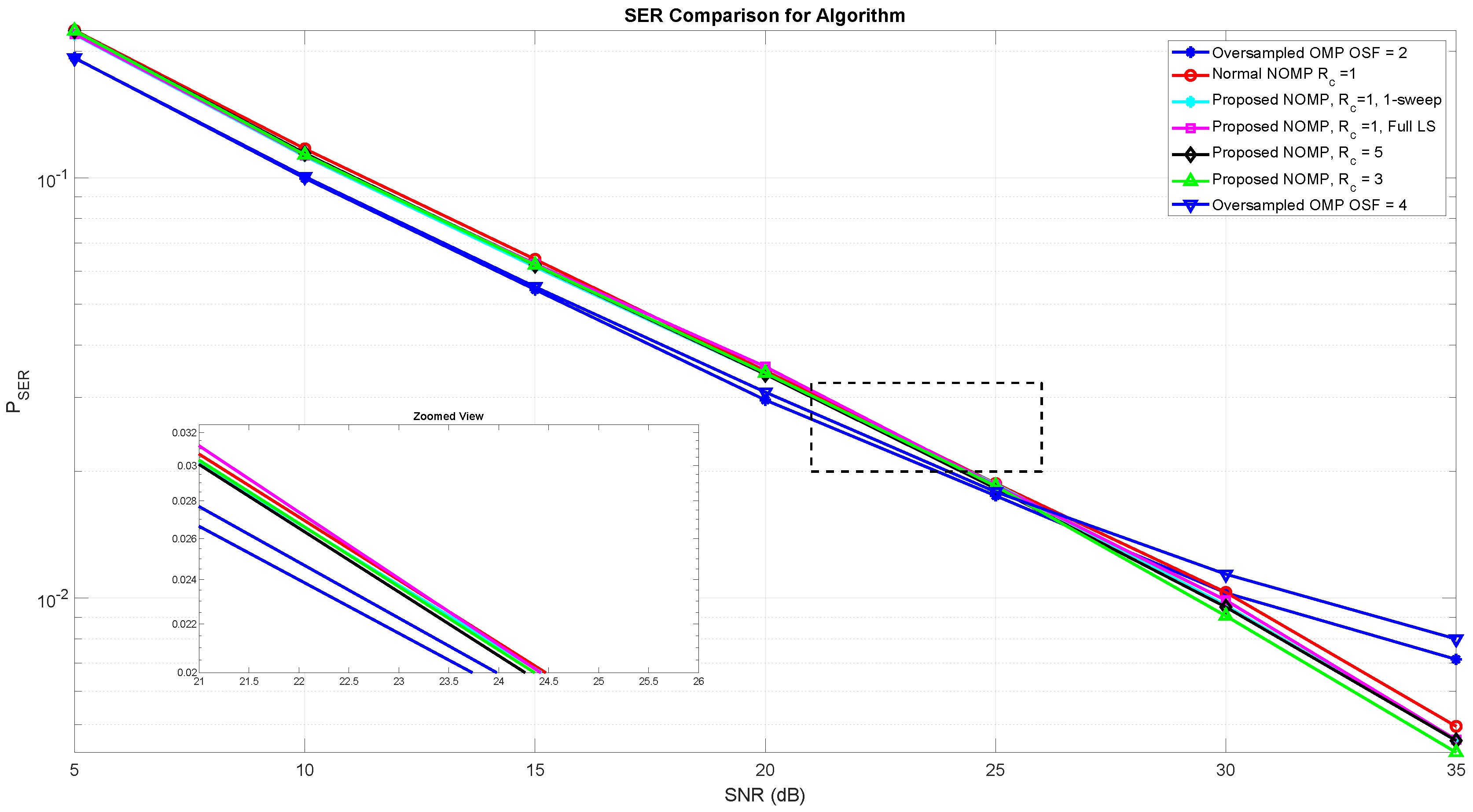
Figure 7.
Runtime Comparison of the Algorithms.
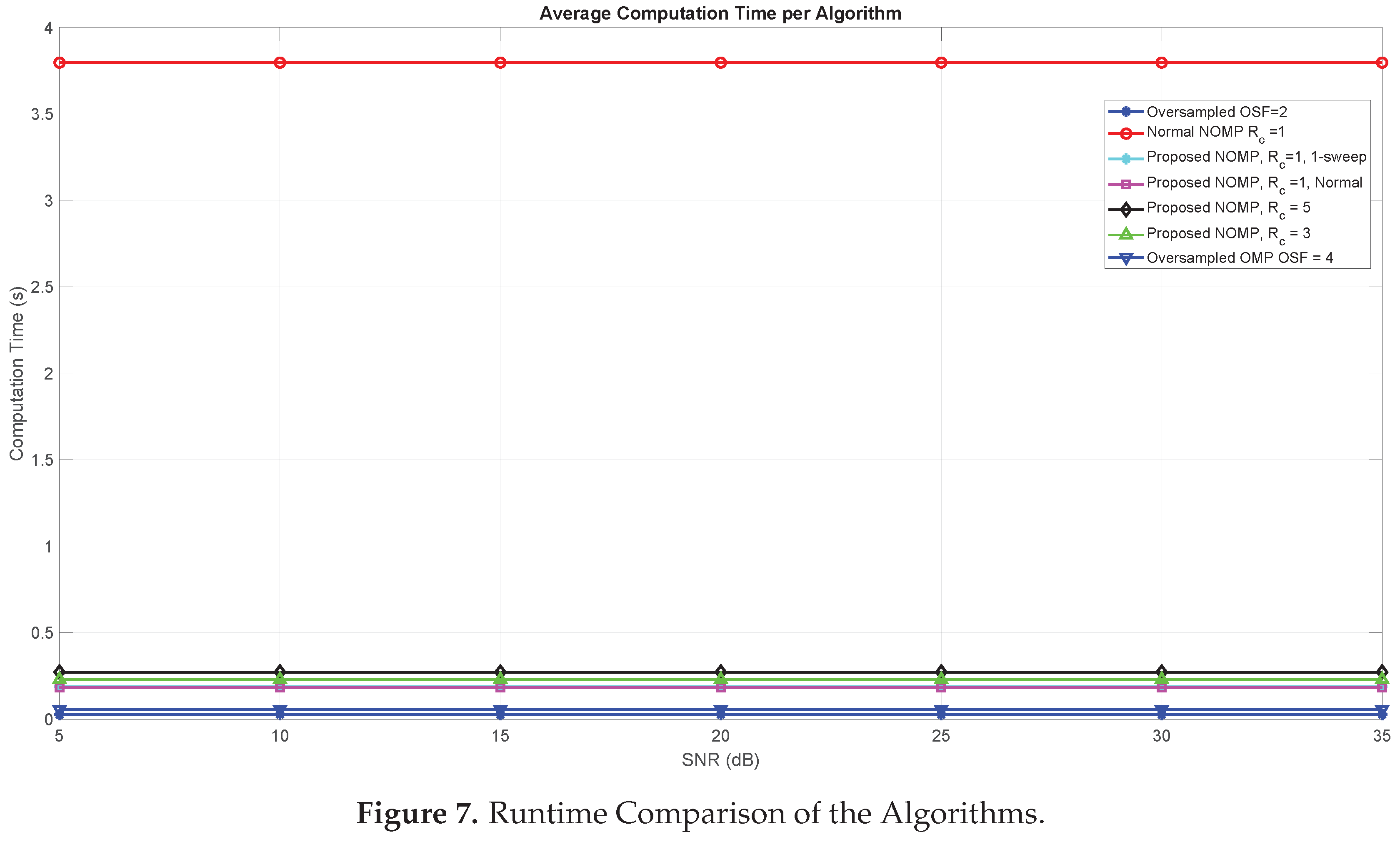
Table 2.
Simulation Parameters.
| Simulation Parameter | Value |
|---|---|
| OFDM Modulation | QPSK |
| Subcarrier channels | 128 |
| Cyclic Prefix Length | 32 |
| Channel Type | Two-path channel and Cost-207 channels |
| Path Delay range | to |
| Oversampling factor | 4 |
| SNR range | to |
| Monte Carlo Simulations | 50 |
Table 3.
CPU Time (seconds) of Algorithms for 50 monte-carlo simulations.
 |
Disclaimer/Publisher’s Note: The statements, opinions and data contained in all publications are solely those of the individual author(s) and contributor(s) and not of MDPI and/or the editor(s). MDPI and/or the editor(s) disclaim responsibility for any injury to people or property resulting from any ideas, methods, instructions or products referred to in the content. |
© 2026 by the authors. Licensee MDPI, Basel, Switzerland. This article is an open access article distributed under the terms and conditions of the Creative Commons Attribution (CC BY) license (http://creativecommons.org/licenses/by/4.0/).
Copyright: This open access article is published under a Creative Commons CC BY 4.0 license, which permit the free download, distribution, and reuse, provided that the author and preprint are cited in any reuse.


