

Submitted:
01 May 2026
Posted:
07 May 2026
You are already at the latest version
Abstract
Background: MASLD has a prevalence of almost one-third in adults worldwide and is not currently treated pharmacologically with a first-line therapy. Lifestyle change is still the foundation of management, however, the relative effectiveness of various behavioral and dietary intervention approaches is poorly defined in both metabolic and psychobehavioral outcome areas. Objective: We compared four classes of interventions, behavioral motivation support (BMS), biomarker-guided personalized diet management (BPDM), general diet education (GDE), and prescribed diet models (PDM) against usual care (UC) in patients with MASLD using network meta-analysis (NMA). Methods: Six electronic databases and two trial registerswere searched through 31 March 2026. Eligible studies were randomized controlled trials (RCTs) in adults with MASLD/NAFLD; risk of bias was assessed with the Cochrane ROB 2 tool, and evidence certainty was graded using the CINeMA-informed GRADE framework. A frequentist random-effects NMA was conducted using the R package netmeta; interventions were ranked by P-scores. Results: Fourteen RCTs (n = 1,805; published 2016–2026) were included. BMS showed the largest ALT reduction (MD −15.63 U/L, 95% CI −27.56 to −3.69; P-score 0.89) and ranked highest for dietary behavior and self-efficacy outcomes. BPDM ranked first for BMI (MD −1.84 kg/m², 95% CI −3.48 to −0.20; P-score 0.82), body weight (MD −5.80 kg; P-score 0.76), and HbA1c improvement (P-score 0.75). All certainty ratings were very low. Conclusions: These findings suggest that BMS and BPDM may target complementary outcome domains in MASLD; however, all estimates carry very low certainty, and adequately powered direct comparative trials are essential before clinical translation.
Keywords:
MASLD
; network meta-analysis
; behavioral intervention
; personalized dietary management
; self-efficacy
1. Introduction
Metabolic dysfunction-associated steatotic liver disease (MASLD), the nomenclature used by the 2023 Delphi multisociety consensus [1], is the most common chronic liver condition globally, with recent epidemiologic syntheses estimating a global adult prevalence of about 30% [2] and rising in parallel with the obesity and type 2 diabetes (T2DM) epidemics. The disease progression from simple steatosis to metabolic-associated steatohepatitis (MASH), progressive fibrosis, and ultimately cirrhosis or hepatocellular carcinoma underscores the urgency of effective early intervention. Although resmetirom received regulatory approval in 2024 for selected adults with noncirrhotic MASH and moderate-to-advanced fibrosis, lifestyle modification remains the dominant and most scalable therapeutic option across the broader MASLD population [3,4]. The evidence base for lifestyle interventions is, however, heterogeneous: calorie-restricted diets, Mediterranean patterns, intermittent fasting regimens, and behavioral counseling programs have each been studied in isolation, yet head-to-head comparisons between strategies remain scarce. Earlier pairwise meta-analyses of dietary interventions demonstrated modest benefits for liver and weight-related outcomes but could not answer which intervention class performs best for which outcome domain [5].
MASLD behavioral and dietary interventions may be generally divided into two dimensions, the level of psychological scaffolding (ranging between minimal general advice to structured behavioral counseling using validated behavior-change theories) and the level of dietary individualization (between standardized guideline-based recommendations to biomarker-driven precision nutrition). Behavioral motivation support (BMS) programs, which include health belief model education, transtheoretical model stage-matching or digital coaching platforms are designed to enhance self-efficacy and maintain long-term adherence through psychological processes. In contrast, personalized diet management based on biomarkers (BPDM) programs make use of individual metabolic profiles, continuous glucose monitoring, or digital-twin modeling to maximize macronutrient prescriptions and calorie targets. General dietary education (GDE) provides a non-individualized but organized nutritional instruction whereas prescribed dietary models (PDM) adopt fixed diets like intermittent fasting or certain macronutrient distributions. The question whether these conceptually different approaches result in meaningfully different effects on the domains of metabolic and behavioral outcomes is not clear.
NMA allows the comparison of several intervention nodes at the same time by combining direct and indirect evidence in a single statistical model, thus overcoming the shortcomings of traditional pairwise meta-analyses that can only compare two interventions simultaneously. Nevertheless, NMA has been rarely applied to behavioral and dietary interventions in MASLD and previous analyses have tended to collapse all the behavioral components into one undifferentiated lifestyle node thereby masking potentially significant between-strategy differences. The current analysis was inspired by the awareness that behavioral motivation programs and precision nutrition approaches are qualitatively different paradigms that have seldom been studied as distinct nodes. We consequently performed a pre-specified systematic review and NMA of four active classes of interventions (BMS, BPDM, GDE, PDM) versus usual care (UC) on metabolic outcomes (BMI, body weight, ALT, AST, LSM, HbA1c) and behavioral outcomes (nutrition behavior, self-efficacy), with the purpose of determining which paradigm of intervention yields the strongest signals in each outcome domain.
2. Materials and Methods
This systematic review and network meta-analysis was conducted and reported in accordance with PRISMA 2020 and the PRISMA extension for network meta-analyses [6,7]. The protocol was prospectively registered in PROSPERO before data extraction began (CRD420261371973), and no substantive changes were made after registration.A systematic literature search was performed in six electronic databases from inception to 31 March 2026.This systematic review was registered on 17 April 2026.Study selection was conducted on 18 April 2026, and data extraction was performed on 22 April 2026 by two independent reviewers.
2.1. Eligibility Criteria and Search Strategy
Eligible studies were RCTs enrolling adults (≥18 years) with confirmed MASLD or NAFLD based on imaging, histology, or validated non-invasive criteria. Any dietary or behavioral modification program within the five prespecified intervention nodes was eligible; usual care, standard lifestyle advice, or placebo-controlled arms served as comparators. Studies were required to report at least one primary or secondary outcome with extractable data. Abstracts-only publications, cross-over designs without washout data, and pediatric studies were excluded. Six electronic databases (PubMed, Embase, Scopus, Web of Science, WanFang, and Cochrane CENTRAL) were searched from inception through 31 March 2026, supplemented by two trial registers (ClinicalTrials.gov and WHO ICTRP). Searches combined controlled vocabulary and free-text terms covering MASLD/NAFLD, dietary and behavioral interventions, and RCT filters; the full search strategy is provided in Supplementary Table S1. No language restrictions were applied. Records were screened independently in duplicate at both the title/abstract and full-text stages; disagreements were resolved by consensus or consultation with a third reviewer. Data were extracted using a pre-piloted form capturing study design, population characteristics, intervention details (dietary prescription, behavioral techniques, delivery mode, contact frequency, duration), and outcome data (mean and standard deviation at baseline and follow-up, or change from baseline with SD, for each arm). When outcome data were reported as median and interquartile range, they were converted to mean and SD using the method of [8]. Corresponding authors were contacted for missing data where feasible.
2.2. Intervention Node Classification
Five network nodes were defined in advance. UC referred to routine clinical advice delivered without any systematic behavioral support. BMS denoted behavioral motivation support, covering structured interventions that used validated behavior-change techniques or coaching strategies, such as Health Belief Model-based education [9], transtheoretical model stage-matched intervention [10], theory of planned behavior-based programs [11], text-message or app-supported coaching [12,13,14], therapeutic lifestyle counseling [15,16], and multidisciplinary community management [17]. BPDM represented biomarker-guided personalized dietary management and included interventions based on individualized or structured calorie-targeted dietary prescriptions, digital feedback derived from patient records, metabolic biomarkers, continuous glucose monitoring, or digital twin modeling [18,19,20,21]. GDE referred to general dietary education, namely structured guideline-based advice delivered without individual tailoring [18]. PDM indicated prescribed dietary models, including fixed dietary regimens such as 5:2 intermittent fasting or a low-carbohydrate high-fat diet [22].
2.3. Risk of bias, Statistical Analysis, and Evidence Certainty
Two reviewers independently assessed risk of bias with the Cochrane ROB 2 tool across its five signaling domains [23]. All network and pairwise analyses were run in R (version 4.3) using the netmeta package (version 2.9) [24]. We fitted frequentist random-effects models that assumed a common between-study variance (τ²) across all comparisons within a given network; treatment effects were expressed as mean differences (MD) with 95% confidence intervals. To rank interventions we used P-scores, which range from 0 to 1 and can be read much like Bayesian SUCRA values, with higher values indicating better rankings, without needing to specify priors [24]. Global consistency was evaluated using the design-by-treatment interaction model; local consistency was tested by node-splitting where closed loops existed. Pre-specified subgroup analyses examined intervention duration (≤14 vs. >14 weeks) and T2DM burden (median split: 22.75%). Comparison-adjusted funnel plots and Egger, Begg, and Thompson–Sharp tests were applied for outcomes with ≥10 study arms. For multi-arm trials, within-study correlations were handled automatically by the netmeta contrast-based approach. When only the post-treatment mean and SD were reported, change-from-baseline values were derived assuming a within-patient correlation of r = 0.5; sensitivity analyses tested r = 0.3 and r = 0.7. For studies reporting multiple follow-up time points, the primary endpoint closest to 12 weeks was selected; where a single long-term endpoint was available, that value was used. Evidence certainty for each network estimate was graded using the CINeMA framework [25] across six domains (within-study bias, reporting bias, indirectness, imprecision, heterogeneity, incoherence).
3. Results
3.1. Study Selection
The electronic search retrieved 10,128 records: 10,069 from six electronic databases (PubMed n = 630; Embase n = 4,837; Scopus n = 7,899; Web of Science n = 965; WanFang n = 1,630; Cochrane CENTRAL n = 1,230) and 59 from two trial registers (ClinicalTrials.gov n = 25; WHO ICTRP n = 34). After removing 1,768 duplicates and 1,223 records excluded for other reasons (e.g., conference abstracts without full-text availability), 7,137 unique records underwent title/abstract screening; 7,031 were excluded as clearly irrelevant. Of the remaining 106 full-text reports assessed for eligibility, 92 were excluded for the following reasons: not eligible intervention or outside the pre-specified network (n = 52), same-node comparison without a UC arm (n = 12), ineligible population (n = 12), no usable full-text outcome data (n = 7), intervention duration <8 weeks (n = 7), and protocol-only or duplicate publication already matched to an included study (n = 2). A full list of excluded studies with reasons is provided in Supplementary Table S8. Fourteen studies reported in 14 publications met all eligibility criteria and were included in the quantitative synthesis (Figure 1). Inter-rater agreement at the full-text screening stage was substantial (Cohen’s κ = 0.87).
3.2. Study Characteristics
The 14 included randomized controlled trials were published between 2016 and 2026 and involved a total of 1,805 randomized participants from seven countries (Table 1). China contributed the largest number of studies (n = 6), followed by Iran (n = 2) and the United States (n = 2), while Sweden, India, Malaysia, and South Korea each contributed one study. Thirteen trials adopted a parallel two-arm design, whereas one studyused a three-arm design to compare two dietary regimens, namely 5:2 intermittent fasting and a low-carbohydrate high-fat diet, with standard care. Intervention duration ranged from 8 to 104 weeks, with a median duration of 16 weeks (interquartile range: 12–24 weeks). The largest trial (n = 319) evaluated a year-long digital-twin precision nutrition program, while the smallest (n = 30) examined a text-messaging-based behavioral support intervention. Mean baseline BMI ranged from 25.8 to 37.5 kg/m² across studies, and the prevalence of type 2 diabetes mellitus, reported in 8 of the 14 studies, varied from 5% to 45%. Diagnosis was based mainly on imaging methods: ultrasound was used in nine studies, FibroScan-derived controlled attenuation parameter (CAP) and/or liver stiffness measurement (LSM) in four studies, and MRI-derived proton density fat fraction (MRI-PDFF) in one study; one trial also included participants with a previous liver biopsy. Further details on study-level and arm-level characteristics are presented in Supplementary Table S6.
3.3. Risk of Bias in Included Studies
Across all evaluated outcomes, none of the study results was judged to be at overall low risk of bias according to ROB 2. More specifically, 20.7% of the results were rated as having some concerns, whereas 79.3% were classified as high risk (Figure 2A). The domains most commonly affected were bias in outcome measurement (Domain 4) and bias arising from deviations from intended interventions (Domain 2). The concern in Domain 4 was largely driven by the fact that outcome assessors were seldom blinded to treatment allocation. In Domain 2, the high level of risk likely reflected the practical challenge of blinding participants in dietary and behavioral intervention trials. In addition, most studies did not report complete or clearly documented prespecified analysis plans (Domain 5), which further increased the proportion of overall high-risk judgments.
As shown in the domain-level summary (Figure 2B), the randomization process was the only domain in which low-risk ratings appeared with any noticeable frequency, accounting for 14% of all judgments. The contribution matrix (Figure 2C) further showed that evidence rated as high risk accounted for more than 80% of the weighted contribution in three of the four primary comparisons against UC, namely 100% for BMS versus UC, 91% for BPDM versus UC, and 94% for GDE versus UC. For PDM versus UC, 42% of the weighted contribution came from high-risk evidence, while the remaining 58% was rated as some concerns. Detailed ROB 2 assessments for individual studies are presented in Supplementary Table S7.
3.4. Network Geometry
We built networks for six outcomes altogether: four metabolic (BMI, ALT, body weight, HbA1c), one additional hepatic marker (AST), and two behavioral (nutrition behavior, self-efficacy). Figure 3 shows the geometry for the four primary outcomes; the LSM and HbA1c network diagrams appear in Supplementary Figures S1–S2. The BMI and ALT networks were the richest, each connecting all five nodes through 11 studies and 22 arm-level observations, with enough closed loops to run formal consistency checks. The body-weight network was somewhat smaller (9 studies, 5 nodes; Supplementary Figure S3), and the HbA1c network smaller still (4 studies, 4 nodes; BMS dropped out because too few BMS trials reported HbA1c). By contrast, the behavioral networks were thin: just two studies feeding three nodes apiece (Figure 3C–D), with no closed loops at all, which rules out any consistency testing for those outcomes. One structural feature worth flagging is that no included trial directly compared GDE with UC, so the GDE:UC estimate in every network rests entirely on indirect evidence routed through BPDM or PDM (direct proportion = 0%). When we checked transitivity, the key effect modifiers, including age (means 36–56 years), baseline BMI (25.8–37.5 kg/m²), and T2DM prevalence (5–45%), were reasonably balanced across comparison sets for the metabolic outcomes (Supplementary Table S2). That said, intervention intensity and contact frequency differed quite a bit between nodes, which is a potential threat to transitivity that readers should bear in mind (arm-level details in Supplementary Table S6)
3.5. Network Meta-Analysis Results
Hepatic enzyme outcomes. ALT (11 studies, 1,299 participants, 5 nodes; I² = 90.7%; Table 2; Figure 4B) was first with a statistically significant decrease compared to UC (MD -15.63 U/L, 95% CI -27.56 to -3.69; P-score 0.89; p = 0.010), which was supported by 87.5% direct evidence of four BMS trials. BPDM exhibited a larger but not significant reduction (MD -8.74 U/L, 95% CI -22.48 to 5.00; P-score 0.65; p = 0.212), then GDE (MD -4.23 U/L, 95% CI -21.93 to 13.48; P-score 0.41) and PDM (MD -1.69 U/L, 95% CI -20.60 to 17.23; P-score 0.33). Global incoherence was non-significant (design-by-treatment interaction p = 0.916). AST also had been evaluated as secondary hepatic outcome using the same 11-study, 5-node network (I² = 96.1%; see Supplementary Table S3). BMS ranked first again (MD -10.36 U/L, 95% CI -21.99 to 1.27; P-score 0.83; p = 0.081) with a directionally consistent but non-significant effect; BPDM second (MD -5.40 U/L, 95% CI -19.10 to 8.31; P-score 0.61). The global incoherence of AST was not significant (p = 0.957).
Turning to body-composition and glycaemic endpoints, the BMI network (11 studies, 1,355 participants, 5 nodes; I² = 85.5%; Figure 4A) placed BPDM first (MD −1.84 kg/m², 95% CI −3.48 to −0.20; P-score 0.82; p = 0.028) with BMS a close second (MD −1.77 kg/m², 95% CI −3.08 to −0.45; P-score 0.77; p = 0.008); the gap between the two was small enough that confidence intervals overlapped considerably. GDE and PDM fell short of significance (GDE: MD −0.86, 95% CI −3.40 to 1.67; PDM: MD −0.38, 95% CI −2.31 to 1.55). An important caveat for the BMI network is that it was the only outcome to show significant global incoherence (design-by-treatment interaction p = 0.015), with a local inconsistency signal in the BPDM:UC versus PDM:UC loop (node-split p = 0.141; Figure 5B); the BPDM ranking for BMI should therefore be read with some skepticism. The body-weight network (9 studies, 1,072 participants; I² = 84.8%; Supplementary Figure S3) told a broadly similar story: BPDM ranked first (MD −5.80 kg, 95% CI −10.89 to −0.71; P-score 0.76; p = 0.026), BMS second (MD −4.82 kg, 95% CI −8.81 to −0.84; P-score 0.66; p = 0.018), and both reached significance. The GDE point estimate was sizeable (MD −5.40 kg) but carried such a wide interval (95% CI −16.64 to 5.84) that it remained non-significant; PDM had the smallest effect (MD −1.78 kg, 95% CI −7.55 to 3.98). For HbA1c only four studies contributed (641 participants, 4 nodes; I² = 99.4%; Figure 4D). BPDM ranked first (MD −1.04%, 95% CI −3.57 to 1.48; P-score 0.75) but no comparison was significant, and the extreme heterogeneity makes this network frankly exploratory. The LSM network (4 studies; Supplementary Figure S1) was similarly underpowered: point estimates favored BPDM and BMS over UC, but every 95% CI crossed zero, so we did not formally rank treatments and report the raw estimates in Supplementary Table S4.
Dietary behavior and self-efficacy outcomes. Two studies that used validated behavioral instruments contributed data to the dietary behavior network, which included three nodes (BMS, BPDM, and UC; Figure 3C), and to the self-efficacy network, which also comprised three nodes (BMS, BPDM, and GDE; Figure 3D). In the dietary behavior network, BMS ranked first and showed a large, statistically significant improvement compared with UC (MD +5.17, 95% CI 4.41 to 5.93; p < 0.001). BPDM ranked second, with a smaller but still significant benefit (MD +2.50, 95% CI 2.37 to 2.63). A similar pattern was observed for self-efficacy. BMS again ranked first and demonstrated a significant advantage over GDE (MD +6.29, 95% CI 4.47 to 8.11; p < 0.001), whereas BPDM ranked second. These behavioral outcomes were reported in too few studies to allow formal CINeMA grading. Because the network was extremely sparse, with only two studies and no closed loops, these findings should be interpreted as exploratory and primarily hypothesis-generating rather than conclusive. Individual study contributions are presented in Supplementary Table S5.
We had two subgroup analyses that were pre-specified, by intervention duration (≤14 vs. >14 weeks) and by T2DM burden (median split at 22.75%), but neither was found to be feasible in practice. The shorter stratum left too few studies on the majority of networks, and only eight of the 14 trials reported T2DM prevalence, which meant that each stratum ended up with less than three studies per network. We highlight this as a gap in relation to the protocol and observe that a future update involving more included trials should re-examine these questions as a priority. To test the strength of our change-from-baseline imputations, we reran all models using within-patient correlations of r = 0.3 and r = 0.7 instead of the default value of r = 0.5; both alternatives did not change any point estimate or reverse any significance threshold (Supplementary Table S9). In case of publication bias, we used comparison-adjusted funnel plots along with the Egger, Begg, and Thompson–Sharp tests to ALT and BMI, the only two outcomes that achieved the Cochrane-recommended minimum of 10 study arms (Supplementary Figure S4). None of the tests indicated significant asymmetry (ALT: Egger p = 0.637, Begg p = 0.484, Thompson–Sharp p = 0.846; BMI: Egger p = 0.636, Begg p = 0.938). These assessments could not be informative due to too few arms in the remaining outcomes, therefore the possibility of small-study effects cannot be excluded.
3.6. Inconsistency, Ranking, and Certainty of Evidence
Figure 5 combines the ranking and certainty evidence in four panels. The P-score bar chart (Panel A) visually presents the pattern of specialization: BMS is leading on ALT and HbA1c, BPDM is leading on BMI and body weight, and neither GDE nor PDM exceeds UC on any measure. Panel B zooms into the one outcome where there was significant global incoherence in the network: BMI. The node-split of BPDM:UC indicates that the direct estimate (MD -2.60 kg/m²) and indirect estimate are pointing to opposite directions but their confidence intervals still overlap (inconsistency p = 0.141). This discrepancy is aligned with the global incoherence signal (p = 0.015), which serves as a reminder that the advantage of BPDM over BMI may not be consistent when we consider various evidence pathways individually. CINeMA profile (Panel C) breaks down the certainty downgrading domain by domain. Within-study bias was identified as an important issue in all comparisons of BMS vs. UC, which is not surprising since the BMS studies were nearly all rated high risk on ROB 2. Indirectness brought up some concerns overall due to moderate population heterogeneity and imprecision was the main extra punishment to the PDM comparisons, in which the evidence base being especially thin. To sum it all up, all core networks estimates fell at very low GRADE certainty (Panel D; Table 3), mainly because of bias, imprecision, and heterogeneity (I² range 84.8%-99.4%). The fact that no comparison escaped this rating highlights how preliminary the existing evidence is.
4. Discussion
The main takeaway from this network meta-analysis is that BMS and BPDM may not actually be competing within the same therapeutic space. Rather, each seems to offer advantages in different outcome domains. BMS ranked highest for indicators of hepatocellular injury, particularly ALT and AST, and also showed the strongest performance on behavioral outcomes, including nutrition behavior and self-efficacy. BPDM, in contrast, produced the most favorable results for body composition and glycemic control, especially BMI, body weight, and HbA1c. This pattern remained broadly consistent across the four key metabolic outcomes, which lends a certain degree of internal coherence to the overall network. That said, these findings still need to be interpreted with caution. All estimated effects were judged to have very low certainty, so the true size of the benefit is still unclear. To our knowledge, no previous network meta-analysis has categorized dietary and behavioral interventions for MASLD using the four-category framework applied in the present study [26]. Earlier pairwise meta-analyses typically grouped Mediterranean diets, calorie-restricted strategies, and broader lifestyle interventions together, and they generally reported modest improvements in liver enzymes and body weight [5]. However, those studies were not designed to address a more practical question: which type of intervention may be better suited to a particular outcome domain. For instance, a recent meta-analysis of Mediterranean dietary interventions in NAFLD reported an ALT reduction of approximately 10 U/L [27]. This is broadly comparable to the estimate observed for the BPDM node in our analysis, although it is still smaller than the 15.6 U/L reduction associated with BMS. Similarly, the BMI reductions seen with both BMS and BPDM, each close to 1.8 kg/m², are generally consistent with findings from earlier reviews of lifestyle-based interventions lasting 12 to 24 weeks [5]. Even so, comparisons across separate meta-analyses should be made carefully, as differences in study populations and follow-up duration may limit the direct comparability of the results.
What makes the BMS findings especially noteworthy is that these interventions were not designed as liver-specific dietary programs. Instead, they centered on strategies such as Health Belief Model education [9], stage-of-change counseling [10], and app- or text-based coaching [12,13,28]. In other words, their main mechanism seems to be motivation rather than direct macronutrient control. One reasonable interpretation is that sustained behavioral support helps patients internalize healthier eating patterns, which may reduce hepatic lipid influx more effectively over time than short-term calorie restriction alone. The fact that BMS also produced the largest improvements in nutrition behavior and self-efficacy supports this explanation, since both variables are well-established upstream drivers of long-term dietary adherence [29,30]. If the ALT benefit is indeed mediated through behavior change, then it likely reflects a mechanism that differs from the weight-loss pathway underlying the apparent advantage of BPDM. Meanwhile, the BPDM findings fit well with the broader precision nutrition literature [31,32]. Interventions such as the year-long digital-twin program reported by [19] provided individualized energy targets together with real-time metabolic feedback, which may have helped participants maintain a greater caloric deficit. BPDM ranking first for BMI, body weight, and HbA1c further supports the view that its effects are mainly linked to negative energy balance and improved glycemic regulation. This pathway is mechanistically plausible, but it is quite distinct from the behavioral route suggested for BMS. Taken together, these findings raise the possibility that intervention choice could be aligned with clinical priorities: BMS may be more relevant when hepatic inflammation or poor adherence is the central issue, whereas BPDM may be more suitable when excess adiposity or dysglycemia is the dominant concern. That said, neither GDE nor PDM outperformed usual care for any outcome shown in Table 2, which naturally brings up a difficult question: can generic dietary advice, even when it is well organized, offer much benefit without either behavioral support or individualized tailoring? At the same time, the significant global incoherence in the BMI network (p = 0.015) and the discrepancy between the direct and indirect BPDM:UC estimates shown in Figure 5B call for caution. Put simply, the apparent superiority of BPDM for BMI may partly reflect differences in study intensity or patient selection rather than a stable treatment effect.
The major strengths of this review are the extensive search of six databases and two trial registers without any language restrictions, frequentist NMA with formal consistency testing (both global and local), and use of the CINeMA-informed GRADE framework to grade the certainty of each network estimate.
That said, a number of limitations need to be kept in mind. Perhaps the most consequential is that every core network estimate ended up rated very low certainty, a reflection of the nearly universal high ROB 2 ratings (79.3%), I² values that ranged from 85% to 99%, and confidence intervals wide enough to accommodate clinically opposite conclusions. Put plainly, the true treatment effects could look quite different from what we report here. The behavioral outcome networks are another weak spot: with only two contributing studies, three nodes, and no closed loops, there is no way to test consistency, and the rankings for nutrition behavior and self-efficacy rest on a very thin evidence base. The GDE:UC comparison is entirely indirect across every outcome (direct proportion = 0%), so any statement about where GDE sits relative to other nodes carries considerable uncertainty. The BMI incoherence signal (global p = 0.015; BPDM:UC node-split p = 0.141) is a further concern, because it raises the possibility that heterogeneity in study populations or intervention dose, rather than a real pharmacological-type effect, is driving the BPDM advantage for BMI. We also lack any trial that directly pitted BMS against BPDM head-to-head; the complementary profiles we describe are inferred via the shared UC node and could shift if such a trial were conducted. On a practical level, most studies ran for only 12 to 24 weeks (median 16), so whether these effects persist, or whether weight regain and behavioral relapse erode them, remains unknown. Our pre-specified subgroup analyses by duration and T2DM burden were not feasible owing to sparse stratification data, which means we cannot say whether certain patient subsets benefit disproportionately. Funnel plots and formal tests showed no asymmetry for ALT or BMI, but given the small number of studies, these null findings offer limited reassurance (Supplementary Figure S4). Going forward, multi-centre RCTs that directly compare BMS with BPDM, measure both metabolic and behavioral endpoints with validated instruments, stratify by diabetes status and metabolic syndrome severity, and follow patients for at least a year are the most important next step. Agreement on a core outcome set for MASLD dietary intervention trials would also make future syntheses more tractable.
5. Conclusions
This NMA suggests that BMS and BPDM may target complementary outcome domains in MASLD: BMS signals potential benefits for hepatic enzyme reduction and behavioral adherence, whereas BPDM signals advantages for weight loss and glycaemic control. All estimates carry very low certainty, and these findings should be regarded as hypothesis-generating. Adequately powered direct comparative trials co-assessing metabolic and behavioral endpoints are the essential next step.
Supplementary Materials
The following supporting information can be downloaded at the website of this paper posted on Preprints.org.
Author Contributions
C.W., Z.H. participated in the conception and design, and drafting and revising the manuscript. C.W., P.L. and Z.H. participated in the acquisition, analysis, or interpretation of the data. N.S. participated in revising the manuscript and supervision. L.R. contributed to data visualization and formatting. M.Q. participated in the acquisition, analysis, or interpretation of the data. All authors have read and agreed to the published version of the manuscript.
Funding
This research received no external funding.
Institutional Review Board Statement
Not applicable.
Informed Consent Statement
Not applicable.
Data Availability Statement
The data analyzed in this study were extracted from previously published studies included in the systematic review. All extracted data are available within the article and its supplementary materials.
Acknowledgments
The authors would like to thank all researchers whose studies were included in this systematic review and network meta-analysis.
Conflicts of Interest
The authors declare no conflicts of interest.
References
- Rinella, M.E.; Lazarus, J.V.; Ratziu, V.; Francque, S.M.; Sanyal, A.J.; Kanwal, F.; Romero, D.; Abdelmalek, M.F.; Anstee, Q.M.; Arab, J.P.; et al. A Multisociety Delphi Consensus Statement on New Fatty Liver Disease Nomenclature. Hepatol. Baltim. Md 2023, 78, 1966–1986. [CrossRef]
- Younossi, Z.M.; Golabi, P.; Paik, J.M.; Henry, A.; Van Dongen, C.; Henry, L. The Global Epidemiology of Nonalcoholic Fatty Liver Disease (NAFLD) and Nonalcoholic Steatohepatitis (NASH): A Systematic Review. Hepatol. Baltim. Md 2023, 77, 1335–1347. [CrossRef]
- Tilg, H.; Petta, S.; Stefan, N.; Targher, G. Metabolic Dysfunction-Associated Steatotic Liver Disease in Adults: A Review. JAMA 2026, 335, 163–174. [CrossRef]
- Tacke, F.; Horn, P.; Wong, V.W.-S.; Ratziu, V.; Bugianesi, E.; Francque, S.; Zelber-Sagi, S.; Valenti, L.; Roden, M.; Schick, F.; Gastaldelli, A.; Yki-Järvinen, H.; Schattenberg, J.M.; Romero-Gómez, M.; Berg, T.; Chait, A.; Czaja, A.J.; Møller, S.; Weickert, M.O.; ... Newsome, P.N. European Association for the Study of the Liver (EASL); European Association for the Study of Diabetes (EASD); European Association for the Study of Obesity (EASO) EASL-EASD-EASO Clinical Practice Guidelines on the Management of Metabolic Dysfunction-Associated Steatotic Liver Disease (MASLD). J. Hepatol. 2024, 81, 492–542. [CrossRef]
- Houttu, V.; Csader, S.; Nieuwdorp, M.; Holleboom, A.G.; Schwab, U. Dietary Interventions in Patients With Non-Alcoholic Fatty Liver Disease: A Systematic Review and Meta-Analysis. Front. Nutr. 2021, 8, 716783. [CrossRef]
- Page, M.J.; McKenzie, J.E.; Bossuyt, P.M.; Boutron, I.; Hoffmann, T.C.; Mulrow, C.D.; Shamseer, L.; Tetzlaff, J.M.; Akl, E.A.; Brennan, S.E.; et al. The PRISMA 2020 Statement: An Updated Guideline for Reporting Systematic Reviews. BMJ 2021, 372, n71. [CrossRef]
- Hutton, B.; Salanti, G.; Caldwell, D.M.; Chaimani, A.; Schmid, C.H.; Cameron, C.; Ioannidis, J.P.A.; Straus, S.; Thorlund, K.; Jansen, J.P.; et al. The PRISMA Extension Statement for Reporting of Systematic Reviews Incorporating Network Meta-Analyses of Health Care Interventions: Checklist and Explanations. Ann. Intern. Med. 2015, 162, 777–784. [CrossRef]
- Wan, X.; Wang, W.; Liu, J.; Tong, T. Estimating the Sample Mean and Standard Deviation from the Sample Size, Median, Range and/or Interquartile Range. BMC Med. Res. Methodol. 2014, 14, 135. [CrossRef]
- Nourian, M.; Askari, G.; Golshiri, P.; Miraghajani, M.; Shokri, S.; Arab, A. Effect of Lifestyle Modification Education Based on Health Belief Model in Overweight/Obese Patients with Non-Alcoholic Fatty Liver Disease: A Parallel Randomized Controlled Clinical Trial. Clin. Nutr. ESPEN 2020, 38, 236–241. [CrossRef]
- Li, L.; Hou, K.; Yuan, M.; Zhang, Y.; Zhang, Y. Change Lifestyle Modification Plan/Transtheoretical Model in Non-Alcoholic Simple Fatty Liver Disease: A Pilot Randomized Study. BMC Gastroenterol. 2022, 22, 483. [CrossRef]
- Mobasheri, N.; Ghahremani, L.; Fallahzadeh Abarghooee, E.; Hassanzadeh, J. Lifestyle Intervention for Patients with Nonalcoholic Fatty Liver Disease: A Randomized Clinical Trial Based on the Theory of Planned Behavior. BioMed Res. Int. 2022, 2022, 3465980. [CrossRef]
- Axley, P.; Kodali, S.; Kuo, Y.-F.; Ravi, S.; Seay, T.; Parikh, N.M.; Singal, A.K. Text Messaging Approach Improves Weight Loss in Patients with Nonalcoholic Fatty Liver Disease: A Randomized Study. Liver Int. Off. J. Int. Assoc. Study Liver 2018, 38, 924–931. [CrossRef]
- Stine, J.G.; Rivas, G.; Hummer, B.; Duarte-Rojo, A.; May, C.N.; Geyer, N.; Chinchilli, V.M.; Conroy, D.E.; Mitchell, E.S.; McCallum, M.; et al. Mobile Health Lifestyle Intervention Program Leads to Clinically Significant Loss of Body Weight in Patients with NASH. Hepatol. Commun. 2023, 7, e0052. [CrossRef]
- Sun, C.; Chen, G.; Shi, C.; Cao, H.; Yang, R.; Zeng, J.; Duan, X.; Sun, X.; Fan, J.-G. Therapeutic Effects of a WeChat Mini-Program on Metabolic Dysfunction-Associated Fatty Liver Disease: Randomized Controlled Trial. J. Med. Internet Res. 2026, 28, e76204. [CrossRef]
- Huang, X.; Luo, M.; Zeng, Y.; Yi, J.; Lin, S.; Wang, Y.; Zheng, X.; Luo, X. Effect of Therapeutic Lifestyle Changes on Patients with Overweight/Obesity and Non-Alcoholic Fatty Liver Disease: A Randomized Controlled Trial. Am. J. Med. Sci. 2025, 369, 373–379. [CrossRef]
- Dong, F.; Zhang, Y.; Huang, Y.; Wang, Y.; Zhang, G.; Hu, X.; Wang, J.; Chen, J.; Bao, Z. Long-Term Lifestyle Interventions in Middle-Aged and Elderly Men with Nonalcoholic Fatty Liver Disease: A Randomized Controlled Trial. Sci. Rep. 2016, 6, 36783. [CrossRef]
- Cai, H.-J.; Liang, H.-L.; Shi, L.-Y.; Rong, Y.-H.; Li, J.; Zhang, Y.; Ma, R.-F. Enhancing MAFLD Care: Efficacy of a Multidisciplinary Community Intervention on Self-Management and Hepatic Outcomes. Inq. J. Med. Care Organ. Provis. Financ. 2025, 62, 469580251380071. [CrossRef]
- Liu, Z.; Jin, P.; Liu, Y.; Zhang, Z.; Wu, X.; Weng, M.; Cao, S.; Wang, Y.; Zeng, C.; Yang, R.; et al. A Comprehensive Approach to Lifestyle Intervention Based on a Calorie-Restricted Diet Ameliorates Liver Fat in Overweight/Obese Patients with NAFLD: A Multicenter Randomized Controlled Trial in China. Nutr. J. 2024, 23, 64. [CrossRef]
- Joshi, S.; Shamanna, P.; Dharmalingam, M.; Vadavi, A.; Keshavamurthy, A.; Shah, L.; Mechanick, J.I. Digital Twin-Enabled Personalized Nutrition Improves Metabolic Dysfunction-Associated Fatty Liver Disease in Type 2 Diabetes: Results of a 1-Year Randomized Controlled Study. Endocr. Pract. Off. J. Am. Coll. Endocrinol. Am. Assoc. Clin. Endocrinol. 2023, 29, 960–970. [CrossRef]
- Johari, M.I.; Yusoff, K.; Haron, J.; Nadarajan, C.; Ibrahim, K.N.; Wong, M.S.; Hafidz, M.I.A.; Chua, B.E.; Hamid, N.; Arifin, W.N.; et al. A Randomised Controlled Trial on the Effectiveness and Adherence of Modified Alternate-Day Calorie Restriction in Improving Activity of Non-Alcoholic Fatty Liver Disease. Sci. Rep. 2019, 9, 11232. [CrossRef]
- Kwon, O.Y.; Lee, M.K.; Lee, H.W.; Kim, H.; Lee, J.S.; Jang, Y. Mobile App-Based Lifestyle Coaching Intervention for Patients With Nonalcoholic Fatty Liver Disease: Randomized Controlled Trial. J. Med. Internet Res. 2024, 26, e49839. [CrossRef]
- Holmer, M.; Lindqvist, C.; Petersson, S.; Moshtaghi-Svensson, J.; Tillander, V.; Brismar, T.B.; Hagström, H.; Stål, P. Treatment of NAFLD with Intermittent Calorie Restriction or Low-Carb High-Fat Diet–a Randomised Controlled Trial. JHEP Rep. Innov. Hepatol. 2021, 3, 100256. [CrossRef]
- Sterne, J.A.C.; Savović, J.; Page, M.J.; Elbers, R.G.; Blencowe, N.S.; Boutron, I.; Cates, C.J.; Cheng, H.-Y.; Corbett, M.S.; Eldridge, S.M.; et al. RoB 2: A Revised Tool for Assessing Risk of Bias in Randomised Trials. BMJ 2019, 366, l4898. [CrossRef]
- Gerta Rücker, Ulrike Krahn, Jochem König, Orestis Efthimiou, Annabel Davies, Theodoros Papakonstantinou, Guido Schwarzer Netmeta: Network Meta-Analysis Using Frequentist Methods 2024.
- Papakonstantinou, T.; Nikolakopoulou, A.; Higgins, J.P.T.; Egger, M.; Salanti, G. CINeMA: Software for Semiautomated Assessment of the Confidence in the Results of Network Meta-Analysis. Campbell Syst. Rev. 2020, 16, e1080. [CrossRef]
- Buzzetti, E.; Linden, A.; Best, L.M.; Madden, A.M.; Roberts, D.; Chase, T.J.G.; Freeman, S.C.; Cooper, N.J.; Sutton, A.J.; Fritche, D.; et al. Lifestyle Modifications for Nonalcohol-Related Fatty Liver Disease: A Network Meta-Analysis. Cochrane Database Syst. Rev. 2021, 6, CD013156. [CrossRef]
- Del Bo’, C.; Perna, S.; Allehdan, S.; Rafique, A.; Saad, S.; AlGhareeb, F.; Rondanelli, M.; Tayyem, R.F.; Marino, M.; Martini, D.; et al. Does the Mediterranean Diet Have Any Effect on Lipid Profile, Central Obesity and Liver Enzymes in Non-Alcoholic Fatty Liver Disease (NAFLD) Subjects? A Systematic Review and Meta-Analysis of Randomized Control Trials. Nutrients 2023, 15, 2250. [CrossRef]
- Kwon, O.Y.; Choi, J.-Y.; Jang, Y. The Effectiveness of eHealth Interventions on Lifestyle Modification in Patients With Nonalcoholic Fatty Liver Disease: Systematic Review and Meta-Analysis. J. Med. Internet Res. 2023, 25, e37487. [CrossRef]
- Nothwehr, F. Self-Efficacy and Its Association With Use of Diet-Related Behavioral Strategies and Reported Dietary Intake. Health Educ. Behav. 2008, 35, 698–706. [CrossRef]
- Prestwich, A.; Kellar, I.; Parker, R.; MacRae, S.; Learmonth, M.; Sykes, B.; Taylor, N.; Castle, H. How Can Self-Efficacy Be Increased? Meta-Analysis of Dietary Interventions. Health Psychol. Rev. 2014, 8, 270–285. [CrossRef]
- Munawaroh, E.F.; Herawati, D.M.D.; Megawati, G.; Wijayakesuma, A.; Apriani, L.; Sofiatin, Y.; Dani, D. Effectiveness of Personalized Nutrition on Management Diabetes Mellitus Type 2 and Prediabetes in Adults: A Systematic Review. Diabetes Metab. Syndr. Obes. Targets Ther. 2025, 18, 2783–2796. [CrossRef]
- Rein, M.; Ben-Yacov, O.; Godneva, A.; Shilo, S.; Zmora, N.; Kolobkov, D.; Cohen-Dolev, N.; Wolf, B.-C.; Kosower, N.; Lotan-Pompan, M.; et al. Effects of Personalized Diets by Prediction of Glycemic Responses on Glycemic Control and Metabolic Health in Newly Diagnosed T2DM: A Randomized Dietary Intervention Pilot Trial. BMC Med. 2022, 20, 56. [CrossRef]
Figure 1.
PRISMA 2020 flow diagram of study selection, showing the numbers of records identified, screened, assessed for eligibility, and included in the network meta-analysis.
Figure 1.
PRISMA 2020 flow diagram of study selection, showing the numbers of records identified, screened, assessed for eligibility, and included in the network meta-analysis.
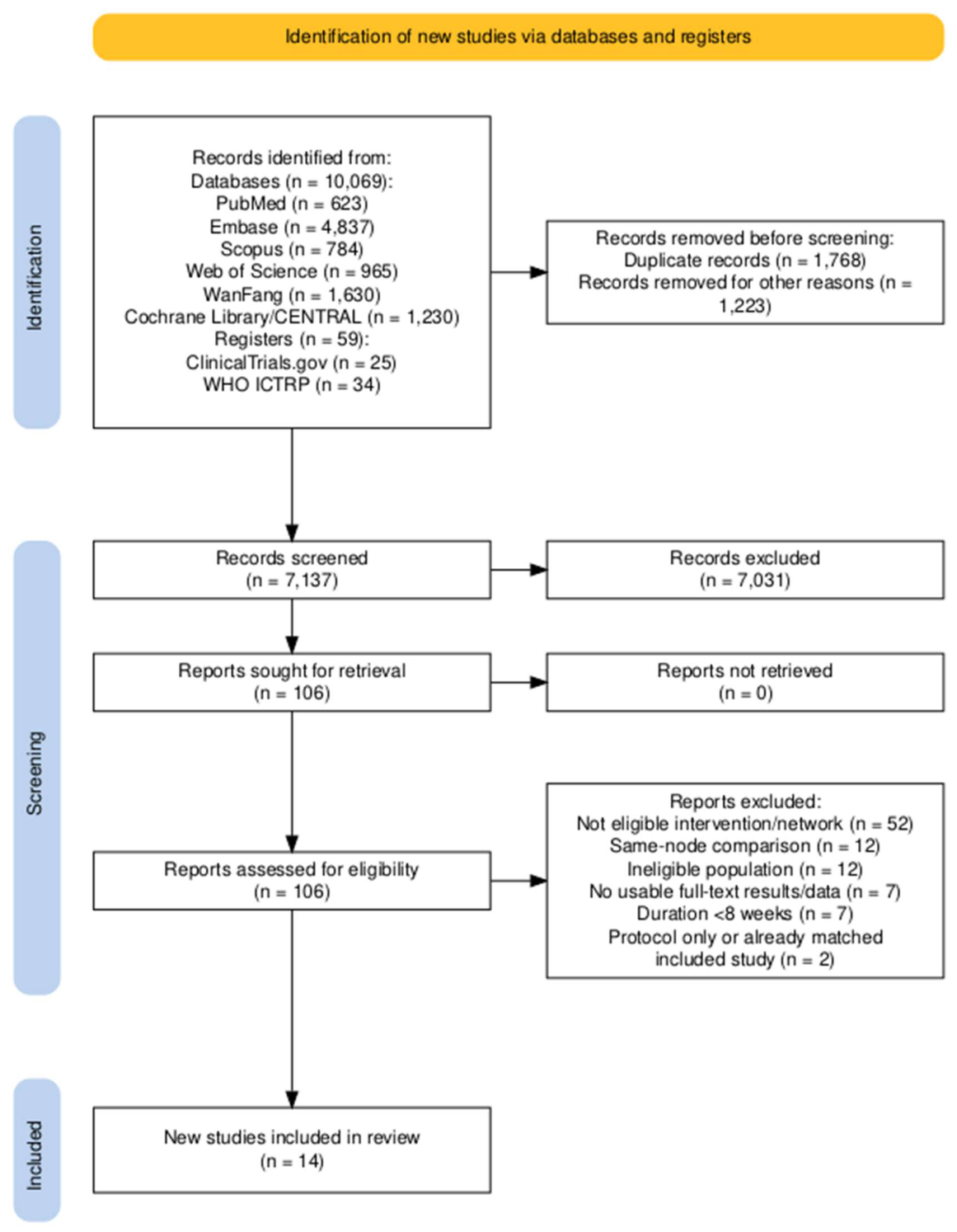
Figure 2.
Risk of bias assessment across included RCTs. (A) Overall ROB 2 judgment distribution across all outcome-level assessments; (B) Domain-level summary of low-risk, some-concerns, and high-risk judgments for each of the five ROB 2 domains; (C) Contribution matrix showing the weighted proportion of high-risk, some-concerns, and low-risk evidence feeding each primary comparison against usual care. Abbreviations: ROB 2, Cochrane Risk of Bias 2 tool; BMS, behavioral motivation support; BPDM, biomarker-guided personalized dietary management; GDE, general dietary education; PDM, prescribed dietary model; UC, usual care.
Figure 2.
Risk of bias assessment across included RCTs. (A) Overall ROB 2 judgment distribution across all outcome-level assessments; (B) Domain-level summary of low-risk, some-concerns, and high-risk judgments for each of the five ROB 2 domains; (C) Contribution matrix showing the weighted proportion of high-risk, some-concerns, and low-risk evidence feeding each primary comparison against usual care. Abbreviations: ROB 2, Cochrane Risk of Bias 2 tool; BMS, behavioral motivation support; BPDM, biomarker-guided personalized dietary management; GDE, general dietary education; PDM, prescribed dietary model; UC, usual care.
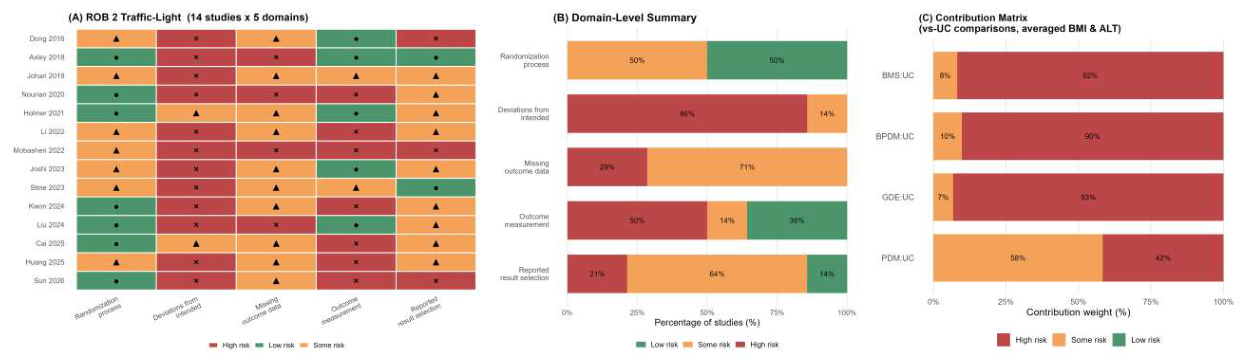
Figure 3.
Evidence networks for the four primary outcomes. (A) BMI network; (B) ALT network; (C) Dietary-behavior network; (D) Self-efficacy network. Node size reflects the number of randomized participants assigned to each intervention, and edge thickness reflects the number of direct comparisons contributing evidence between nodes. Abbreviations: BMI, body mass index; ALT, alanine aminotransferase; BMS, behavioral motivation support; BPDM, biomarker-guided personalized dietary management; GDE, general dietary education; PDM, prescribed dietary model; UC, usual care.
Figure 3.
Evidence networks for the four primary outcomes. (A) BMI network; (B) ALT network; (C) Dietary-behavior network; (D) Self-efficacy network. Node size reflects the number of randomized participants assigned to each intervention, and edge thickness reflects the number of direct comparisons contributing evidence between nodes. Abbreviations: BMI, body mass index; ALT, alanine aminotransferase; BMS, behavioral motivation support; BPDM, biomarker-guided personalized dietary management; GDE, general dietary education; PDM, prescribed dietary model; UC, usual care.
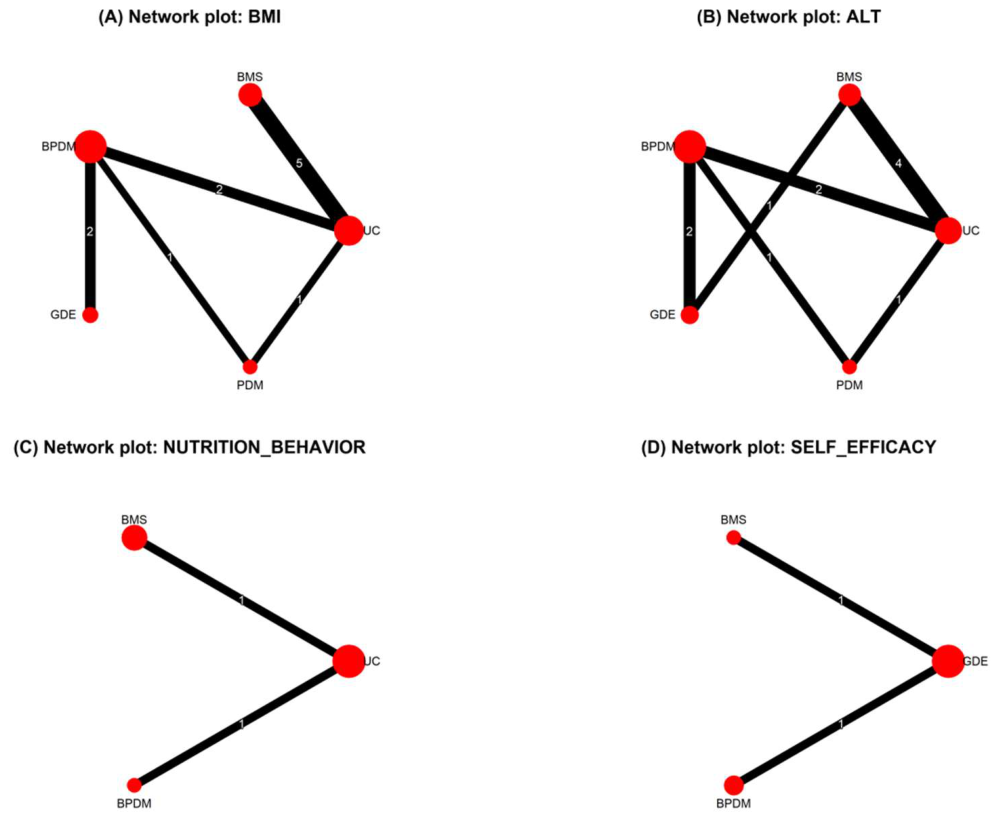
Figure 4.
Forest plots of network meta-analysis outcomes. (A) BMI; (B) ALT; (C) Body weight; (D) HbA1c. Each panel displays the mean difference (95% confidence interval) of each intervention versus usual care. Abbreviations: MD, mean difference; CI, confidence interval; BMI, body mass index; ALT, alanine aminotransferase; HbA1c, glycated hemoglobin; BMS, behavioral motivation support; BPDM, biomarker-guided personalized dietary management; GDE, general dietary education; PDM, prescribed dietary model; UC, usual care.
Figure 4.
Forest plots of network meta-analysis outcomes. (A) BMI; (B) ALT; (C) Body weight; (D) HbA1c. Each panel displays the mean difference (95% confidence interval) of each intervention versus usual care. Abbreviations: MD, mean difference; CI, confidence interval; BMI, body mass index; ALT, alanine aminotransferase; HbA1c, glycated hemoglobin; BMS, behavioral motivation support; BPDM, biomarker-guided personalized dietary management; GDE, general dietary education; PDM, prescribed dietary model; UC, usual care.
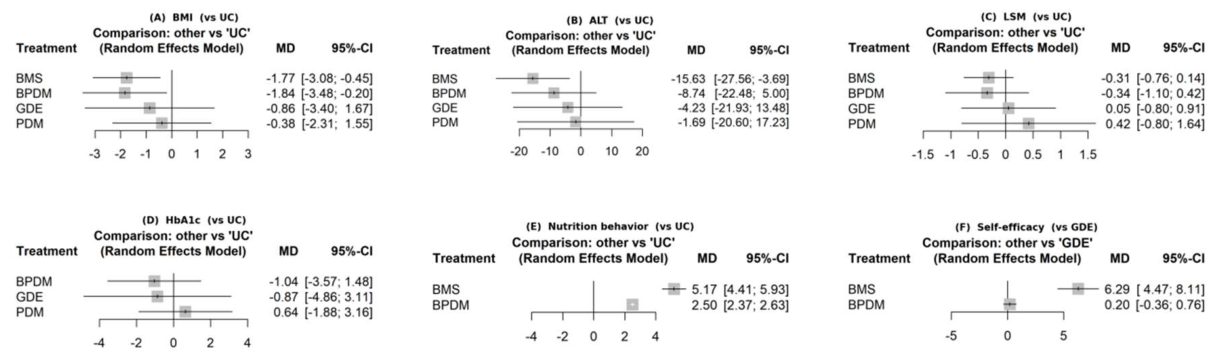
Figure 5.
Ranking and certainty of evidence across primary outcomes. (A) Intervention ranking by P-score across outcomes (higher P-score indicates higher rank); (B) Node-splitting comparison of direct and indirect BPDM versus UC estimates in the BMI network; (C) CINeMA evidence profile classifying each outcome–intervention comparison as “No concerns”, “Some concerns”, or “Major concerns” across the CINeMA certainty domains (within-study bias, indirectness, imprecision, heterogeneity, incoherence, publication bias) and the overall judgement; (D) Overall CINeMA-informed GRADE summary of certainty of evidence for every network estimate. Abbreviations: BMS, BPDM, GDE, PDM, UC as defined in Figure 3; MD, mean difference; CI, confidence interval; GRADE, Grading of Recommendations Assessment, Development and Evaluation; CINeMA, Confidence in Network Meta-Analysis.
Figure 5.
Ranking and certainty of evidence across primary outcomes. (A) Intervention ranking by P-score across outcomes (higher P-score indicates higher rank); (B) Node-splitting comparison of direct and indirect BPDM versus UC estimates in the BMI network; (C) CINeMA evidence profile classifying each outcome–intervention comparison as “No concerns”, “Some concerns”, or “Major concerns” across the CINeMA certainty domains (within-study bias, indirectness, imprecision, heterogeneity, incoherence, publication bias) and the overall judgement; (D) Overall CINeMA-informed GRADE summary of certainty of evidence for every network estimate. Abbreviations: BMS, BPDM, GDE, PDM, UC as defined in Figure 3; MD, mean difference; CI, confidence interval; GRADE, Grading of Recommendations Assessment, Development and Evaluation; CINeMA, Confidence in Network Meta-Analysis.
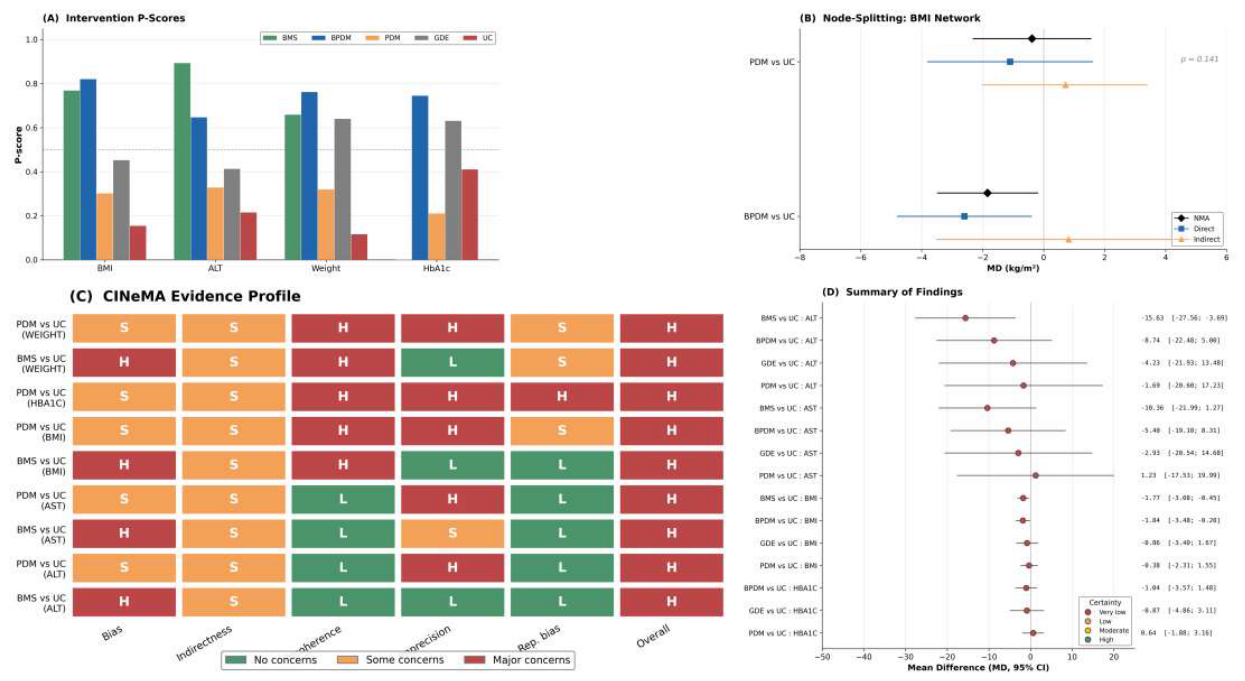

Table 1.
Characteristics of 14 included randomized controlled trials.
| Author, Year | Country | Design | Diagnostic criteria | Intervention arms (randomized n) | Duration (wk) | ROB 2 |
|---|---|---|---|---|---|---|
| Liu 2024 | China | Parallel | Radiology (US/CT/MRI) | ILI (BPDM) vs GDE; 111 vs 115 | 12 | High |
| Holmer 2021 | Sweden | Multi-arm | Radiology/CAP >280 dB/m | 5:2 (PDM) vs LCHF (PDM) vs SoC (UC); 25/25/24 | 12 | High |
| Joshi 2023 | India | Parallel | T2D + MRI-PDFF | Digital twin (BPDM) vs PDM; 233 vs 86 | 52 | High |
| Johari 2019 | Malaysia | Parallel | US + shear-wave elastography | Alt-day CR (BPDM) vs UC; 33 vs 10 | 8 | High |
| Kwon 2024 | South Korea | Parallel | Outpatient NAFLD practice | Mobile app (BPDM) vs GDE; 48 vs 54 | 24 | High |
| Nourian 2020 | Iran | Parallel | Sonography + elevated ALT/AST | HBM lifestyle (BMS) vs GDE; 41 vs 41 | 8 | High |
| Huang 2025 | China | Parallel | Ultrasound + transaminases | TLC lifestyle (BMS) vs UC; 60 vs 60 | 12 | Some concerns |
| Stine 2023 | USA | Parallel | Biopsy/FIB-4/FibroScan | Noom mHealth (BMS) vs UC; 20 vs 20 | 16 | High |
| Li 2022 | China | Parallel | Ultrasound (exclusion) | TTM lifestyle (BMS) vs UC; 100 vs 100 | 52 | High |
| Sun 2026 | China | Parallel | Ultrasound + CAP ≥248 dB/m | WeChat mini-prog (BMS) vs UC; 45 vs 44 | 24 | Some concerns |
| Axley 2018 | USA | Parallel | Ultrasound + elevated enzymes | Text messaging (BMS) vs UC; 13 vs 17 | 24 | High |
| Mobasheri 2022 | Iran | Parallel | Ultrasound grade 1–2 NAFLD | TPB education (BPDM) vs UC; 50 vs 50 | 12 | High |
| Dong 2016 | China | Parallel | Ultrasound ≥2 of 3 criteria | TLC lifestyle (BMS) vs UC; 141 vs 139 | 104 | High |
| Cai 2025 | China | Parallel | FibroScan CAP/LSM MAFLD | Multidisciplinary (BMS) vs UC; 50 vs 50 | 12 | High |
Abbreviations: BPDM, biomarker-guided personalized dietary management; BMS, behavioral motivation support; PDM, prescribed dietary model; GDE, general dietary education; UC, usual care; ROB 2, Cochrane Risk of Bias 2 tool; US, ultrasound; CAP, controlled attenuation parameter; T2DM, type 2 diabetes mellitus; TLC, therapeutic lifestyle changes; TTM, transtheoretical model; HBM, health belief model; TPB, theory of planned behavior; Alt-day CR, alternate-day calorie restriction. High = at least one domain rated high risk; Some concerns = no high-risk domain but at least one some-concerns domain.
Table 2.
Core network meta-analysis results: mean differences (95% CI) and P-scores for each intervention versus usual care.
Table 2.
Core network meta-analysis results: mean differences (95% CI) and P-scores for each intervention versus usual care.
| Outcome | BMS vs UC | BPDM vs UC | GDE vs UC | PDM vs UC | Studies (n) | I² (%) |
|---|---|---|---|---|---|---|
| BMI (kg/m²) | −1.77 (−3.08, −0.45)* P-score: 0.77 |
−1.84 (−3.48, −0.20)* P-score: 0.82 |
−0.86 (−3.40, 1.67) P-score: 0.45 |
−0.38 (−2.31, 1.55) P-score: 0.30 |
11 (1355) | 85.5 |
| ALT (U/L) | −15.63 (−27.56, −3.69)* P-score: 0.89 |
−8.74 (−22.48, 5.00) P-score: 0.65 |
−4.23 (−21.93, 13.48) P-score: 0.41 |
−1.69 (−20.60, 17.23) P-score: 0.33 |
11 (1299) | 90.7 |
| Weight (kg) | −4.82 (−8.81, −0.84)* P-score: 0.66 |
−5.80 (−10.89, −0.71)* P-score: 0.76 |
−5.40 (−16.64, 5.83) P-score: 0.64 |
−1.78 (−7.55, 3.98) P-score: 0.32 |
9 (1072) | 84.8 |
| HbA1c (%) | — | −1.04 (−3.57, 1.48) P-score: 0.75 |
−0.87 (−4.86, 3.11) P-score: 0.63 |
0.64 (−1.88, 3.16) P-score: 0.21 |
4 (641) | 99.4 |
| LSM (kPa) | −0.31 (−0.76, 0.14) | −0.34 (−1.10, 0.42) | 0.05 (−0.80, 0.91) | −0.42 (−1.64, 0.80) | 4 (exploratory) | — |
| Nutrition behavior† | 5.17 (4.41, 5.93)* P-score: best |
2.50 (2.37, 2.63)* P-score: 2nd |
— | — | 2 (sparse) | — |
| Self-efficacy† | 6.29 (4.47, 8.11)* P-score: best |
0.20 (−0.36, 0.76) P-score: 2nd |
0 (ref) | — | 2 (sparse) | — |
Values are MD (95% CI). *p < 0.05 vs. UC. †Self-efficacy expressed vs. GDE. P-scores range 0–1. I² = network heterogeneity. NA = not estimable. Abbreviations: BMS, behavioral motivation support; BPDM, biomarker-guided personalized dietary management; GDE, general dietary education; PDM, prescribed dietary model; UC, usual care; ALT, alanine aminotransferase; LSM, liver stiffness measurement; HbA1c, glycated haemoglobin.
Table 3.
Summary of Findings: certainty of evidence and illustrative absolute effects (GRADE/CINeMA).
Table 3.
Summary of Findings: certainty of evidence and illustrative absolute effects (GRADE/CINeMA).
| Outcome | Intervention | Absolute effect (95% CI) | Relative effect MD (95% CI) | Participants (studies) | GRADE certainty |
|---|---|---|---|---|---|
| ALT (U/L) | BMS | Mean UC = 1.49; BMS: −14.14 (−26.08, −2.21) | MD −15.63 (−27.56, −3.69) |
1299 (11) | Very low |
| ALT (U/L) | BPDM | Mean UC = 1.49; BPDM: −7.25 (−21.00, 6.49) | MD −8.74 (−22.48, 5.00) |
1299 (11) | Very low |
| ALT (U/L) | GDE | Mean UC = 1.49; GDE: −2.74 (−20.44, 14.96) | MD −4.23 (−21.93, 13.48) |
1299 (11) | Very low |
| ALT (U/L) | PDM | Mean UC = 1.49; PDM: −0.20 (−19.11, 18.71) | MD −1.69 (−20.60, 17.23) |
1299 (11) | Very low |
| BMI (kg/m²) | BMS | Mean UC = 0.05; BMS: −1.72 (−3.03, −0.40) | MD −1.77 (−3.08, −0.45) |
1355 (11) | Very low |
| BMI (kg/m²) | BPDM | Mean UC = 0.05; BPDM: −1.79 (−3.43, −0.15) | MD −1.84 (−3.48, −0.20) |
1355 (11) | Very low |
| BMI (kg/m²) | GDE | Mean UC = 0.05; GDE: −0.81 (−3.35, 1.72) | MD −0.86 (−3.40, 1.67) |
1355 (11) | Very low |
| BMI (kg/m²) | PDM | Mean UC = 0.05; PDM: −0.33 (−2.26, 1.60) | MD −0.38 (−2.31, 1.55) |
1355 (11) | Very low |
| HbA1c (%) | BPDM | Mean UC = −0.05; BPDM: −1.10 (−3.62, 1.43) | MD −1.04 (−3.57, 1.48) |
641 (4) | Very low |
| HbA1c (%) | GDE | Mean UC = −0.05; GDE: −0.93 (−4.91, 3.06) | MD −0.87 (−4.86, 3.11) |
641 (4) | Very low |
| Weight (kg) | BMS | Mean UC; BMS: −4.82 (−8.81, −0.84) |
MD −4.82 (−8.81, −0.84) |
1072 (9) | Very low |
| Weight (kg) | BPDM | Mean UC; BPDM: −5.80 (−10.89, −0.71) |
MD −5.80 (−10.89, −0.71) |
1072 (9) | Very low |
Illustrative values obtained by adding the network MD to the weighted mean of UC arms. All ratings are Very low, downgraded primarily for high within-study bias, substantial imprecision, and heterogeneity. CINeMA framework applied. Abbreviations as in Table 2.
Disclaimer/Publisher’s Note: The statements, opinions and data contained in all publications are solely those of the individual author(s) and contributor(s) and not of MDPI and/or the editor(s). MDPI and/or the editor(s) disclaim responsibility for any injury to people or property resulting from any ideas, methods, instructions or products referred to in the content. |
© 2026 by the authors. Licensee MDPI, Basel, Switzerland. This article is an open access article distributed under the terms and conditions of the Creative Commons Attribution (CC BY) license (http://creativecommons.org/licenses/by/4.0/).
Copyright: This open access article is published under a Creative Commons CC BY 4.0 license, which permit the free download, distribution, and reuse, provided that the author and preprint are cited in any reuse.