
Submitted:
05 May 2026
Posted:
07 May 2026
You are already at the latest version
Abstract
Background: Heme oxygenase (HO) is an antioxidant enzyme ubiquitously present in the body. Oxidative stress is one of the main causes of male infertility. Here, we aimed to analyze the correlation between serum heme oxygenase-1 (HO-1) level and sperm count, motility, normal morphology, and sperm DNA fragmentation index (DFI) in infertile male patients. Methods: In this retrospective cross-sectional study, serum HO-1 concentrations, routine semen parameters, sperm morphology, and DFI were analyzed in 178 patients. Subjects were stratified into high-HO-1 (≥278 ng/L; n=77) and control (<278 ng/L; n=101) groups. Intergroup comparisons and Spearman's correlation analyses were performed. Results: The high-HO-1 group demonstrated significantly increased normal sperm morphology (P<0.05) and reduced sperm DFI (P<0.05) versus controls. No significant intergroup differences existed in sperm concentration or progressive motility (P>0.05). Correlation analysis revealed positive associations between HO-1 levels and normal morphology (r=0.190, P<0.05), and negative correlations with DFI (r= -0.195, P<0.05).Conclusions: We first identified significant correlations between serum HO-1 levels and both sperm DFI and normal morphology in infertile men, suggesting HO-1's protective role in spermatogenesis. Serum HO-1 quantification may offer a novel strategy for male fertility assessment.
Keywords:
heme oxygenase-1 (HO-1)
; oxidative stress
; male infertility
; sperm DNA fragmentation index (DFI)
; sperm morphology
Highlight box
Key findings
- Elevated serum heme oxygenase-1 (HO-1) significantly correlates with improved sperm quality. Patients with high HO-1 levels show a higher percentage of morphologically normal sperm (P < 0.05) and a significantly lower sperm DNA fragmentation index (DFI) (P < 0.05).
What is known and what is new?
- HO-1 exhibits potent antioxidant and cytoprotective properties. Male factors contribute substantially to infertility, often involving sperm morphological defects and DNA damage (high DFI).
- This study provides direct clinical evidence linking higher HO-1 level in Infertile male to improved sperm morphology and reduced sperm DNA fragmentation. It identifies HO-1 as a novel biomarker positively associated with key sperm quality parameters indicative of fertility potential.
What is the implication, and what should change now?
- HO-1 plays a crucial role in protecting sperm structural integrity and genomic stability, likely via its antioxidant effects. Its measurable level in serum provides a clinically accessible biomarker. This significantly enhances the potential for integrating HO-1 assessment into fertility diagnostics.
- HO-1 should be further validated as a diagnostic biomarker for male infertility risk assessment. Research should now focus on developing therapeutic strategies targeting HO-1 induction to improve sperm quality and reproductive outcomes in infertile men.
1. Introduction
Infertility is clinically defined as the failure of couples of reproductive age to achieve a natural pregnancy within 12 months of unprotected intercourse[1]. As a major global public health concern, infertility affects approximately 15% of couples worldwide[2]. A wide spectrum of etiological factors underlies infertility, and male-related factors account for 30% to 50% of all cases[3,4]. Semen analysis represents the most widely employed approach for evaluating male fertility potential; however, it exhibits considerable variability and may not always precisely reflect actual male fertility status. In recent years, the sperm DNA fragmentation index (DFI) has garnered increasing attention. Accumulating evidence indicates that up to 40% of idiopathic male infertility cases may be associated with elevated DFI[5], and increased sperm DFI is closely linked to oxidative stress[6]. Excessive oxidative stress may consequently result in impaired sperm quality[7,8]. Heme oxygenase (HO) is an antioxidant enzyme ubiquitously expressed in the human body, which exists in two subtypes: the inducible heme oxygenase-1 (HO-1) and the constitutively expressed heme oxygenase-2 (HO-2). Both subtypes share similar physiological functions, cofactors, and substrates[9], and they are capable of catalyzing the conversion of heme into biliverdin, carbon monoxide, and iron ions[10]. Among these two subtypes, HO-1 is expressed in all mammalian species, with the highest expression level localized in the endoplasmic reticulum. Accumulating research evidence has demonstrated that HO-1 is the only inducible enzyme with potent antioxidant activity, and it can serve as a promising therapeutic target for the treatment of obesity, diabetes mellitus, and their associated complications.[11,12]. In addition, recent studies have indicated that HO-1 not only exerts protective effects in pulmonary inflammation[13], but also improves cardiac function and alleviates myocardial cell aging induced by ischemic injury and senescence[14]. However, current research regarding the potential impact of HO-1 on sperm quality in patients with male infertility remains limited. Therefore, the present study aims to analyze the correlation between serum HO-1 levels, semen parameters, and sperm DNA fragmentation index (DFI) in patients with male infertility, thereby providing a reference for identifying the factors influencing male infertility.
2. Methods
Participants
The study included infertile patients who initially visited the outpatient department of the 901th Hospital of PLA Joint Logistics Support Force from February 2024 to February 2025. Inclusion criteria: (I) Serum HO-1 levels were detected. (II) Sexual abstinence duration ranged from 2 to 7 days. (III) No adverse lifestyle behaviors (e.g., smoking, excessive alcohol intake, drug abuse) within the preceding six months. Exclusion criteria: (I) Abnormal genital manifestations, including varicocele, cryptorchidism, epididymitis and prior testicular trauma history. (II) Abnormal karyotype results. (III) Concomitant systemic diseases that may adversely affect semen quality, such as mumps, rheumatic autoimmune disorders, diabetes mellitus and cardiovascular diseases. Based on the serum HO-1 levels and combining with literature reports[15], patients were divided into a high HO-1 group (HO-1 ≥ 278 ng/L) with 77 individuals and a control group (HO-1 < 278 ng/L) with 101 individuals. The basic data between the two groups were compared and showed no statistically significant differences (P > 0.05), indicating comparable groups. This study was approved by the Medical Ethics Committee of the 901th Hospital of PLA Joint Logistics Support Force(Approval No. LY2023xkj124).
Semen Collection and Analysis
Patients abstained for 2-7 days before semen collection via masturbation. The collected semen was placed in a 37°C incubator for 30-60 minutes until complete liquefaction. After thorough mixing with a Pasteur pipette, 5μL was transferred to a Makler counting chamber for analysis by computer-assisted sperm analysis (CASA). Sperm concentration, progressive motility, and total motility were evaluated
Sperm Papanicolaou Morphology Analysis
Complete semen samples obtained by masturbation were delivered to the laboratory within 30 minutes, maintaining temperatures between 20-37°C to preserve sperm viability. Semen was placed in a 37°C incubator for 30-60 minutes until complete liquefaction. A micropipette was used to aspirate 5-10μL of liquefied semen onto one end of a clean glass slide for Papanicolaou staining. Post-Papanicolaou staining and fixation, microscopic examination was performed under oil immersion (100× objective) with systematic scanning of ≥200 spermatozoa. Classification followed WHO 6th edition criteria, assessing normal morphology in the head, midpiece, and tail. Normal sperm standards: oval head with acrosome covering 40%-70% of the head area (no large vacuoles); slender, straight midpiece; uniformly straight tail without coiling. The percentage of normal-form spermatozoa was calculated.
Sperm DFI Testing
Sperm DFI was assessed using Sperm DNA Fragmentation Staining Kit (Ankebio, Hefei, China) with the following procedure. Sample Preparation: Collect 100μL liquefied semen, wash twice with PBS buffer, and centrifuge to remove seminal plasma. Adjust sperm concentration to 1×10⁶ cells/mL. Acid Treatment and Staining: Add TNE buffer (containing detergent) for 5-minute treatment to expose DNA break sites. Add Acridine Orange dye under light-protected conditions to a final concentration of 50μg/mL, followed by 5-minute incubation at room temperature. Flow Cytometry: Load samples for detection using 488nm laser excitation. Monitor green fluorescence (525nm, representing double-stranded DNA) and red fluorescence (650nm, representing single-stranded DNA). Analyze ≥5000 sperm cells to calculate DFI (DFI = proportion of red-fluorescent sperm).
Serum HO-1 Detection
All study subjects had venous blood samples drawn from the upper limb after overnight fasting. Whole blood specimens were left at room temperature for 2 hours or refrigerated at 4°C overnight, then centrifuged at 3000 rpm for 15 min. The supernatant was aliquoted and stored at -80°C. Thawed samples were re-centrifuged before testing. Serum HO-1 levels were measured using using ELISA kits (Meimian, Jiangsu) according to the instructions.
Statistical Analysis
Statistical analysis was performed using SPSS 25.0 software (SPSS Inc., Chicago, IL, USA). Data are presented as number and percentage for categorical variables, and continuous data expressed as the mean ± standard deviation (SD) or median with interquartile range (IQR). Independent samples t-test was used for two groups basic characteristic comparisons. The Mann-Whitney test is used to test the significance of the difference between two independent groups. The degree of association between two variables was calculated using Spearman’s correlation coefficient rho. All tests with p < 0.05 were considered to indicate statistical significance.
3. Results
A total of 178 participants were enrolled and divided into two groups according to their serum HO-1 levels. The high HO-1 group consisted of 77 subjects, with a mean age of (34.36±4.89) years, height of (1.72±0.06) m, weight of (75.65±10.45) kg, and body mass index (BMI) of (25.39±3.35) kg/m². The control group included 101 subjects, with a mean age of (34.25±5.31) years, height of (1.73±0.05) m, weight of (77.00±11.59) kg, and BMI of (25.66±3.30) kg/m². No statistically significant differences were observed in these general parameters between the two groups (P > 0.05). The comparison of general characteristics between the high HO-1 group and the control group is presented in Table 1.
Table 2 presents the comparison of semen parameters between the high HO-1 group and the control group. The percentage of normal morphology detected by Papanicolaou staining in the high HO-1 group was significantly higher than that in the control group (P < 0.05) (Figure 1). In contrast, the sperm DNA fragmentation index (DFI) in the high HO-1 group was significantly lower than that in the control group (P < 0.05) (Figure 2). Both differences were statistically significant. No statistically significant differences were found in semen density or the percentage of progressive motility (PR) between the two groups (P > 0.05).
The correlation analysis between serum HO-1 levels, semen parameters, and sperm DFI is shown in Table 3. Correlation analysis of serum HO-1 levels and sperm parameters in 178 patients revealed a positive correlation between serum HO-1 levels and the normal morphology (r=0.190, P<0.05)(Figure3), as well as a negative correlation with sperm DFI (r= -0.195, P<0.05) (Figure4). No significant correlations were observed between serum HO-1 levels and semen concentration, the percentage of progressive motility (PR),the percentage of nonprogressive motility(NP) (P>0.05).
4. Discussion
In this study, we conducted a retrospective cross-sectional study to investigate the potential association between serum heme oxygenase-1 (HO-1) level and sperm count, motility, normal morphology, and sperm DNA fragmentation index (DFI) in infertile patients. Our study demonstrated a significant positive correlation between elevated HO-1 and improved sperm quality parameters. Specifically, patients with high HO-1 levels (HO-1 ≥ 278 ng/L) exhibited a statistically higher percentage of morphologically normal spermatozoa (P < 0.05) and a significantly lower sperm DNA fragmentation index (DFI) compared to those with low serum HO-1 level (P < 0.05).
Infertility is a global issue, and although its incidence varies by country, it shows a clear upward trend due to environmental factors, lifestyle influences, and other elements. Increasing epidemiological studies indicate declining semen quality in males, with male-related factors accounting for 30% to 50% of all infertility cases.(3, 4). Routine semen analysis is commonly used as the primary method to evaluate male fertility. However, results can fluctuate significantly due to abstinence duration, physical condition, subjective mood, and other factors, sometimes failing to reflect actual fertility potential[17]. Therefore, routine semen analysis may not be the optimal approach for male fertility assessment[18]. Studies show that up to 40% of unexplained male infertility cases may correlate with high DNA Fragmentation Index (DFI), and patients with high DFI experience longer durations of infertility than those with low DFI[5]. Conversely[19], excessive reactive oxygen species accumulation and low antioxidant enzyme expression in high-DFI semen may damage membrane lipids, sperm nuclei, and DNA strands, leading to reduced semen quality. Elevated sperm DFI is generally associated with oxidative stress, abnormal sperm apoptosis, and impaired sperm chromatin packaging[6,20,21].
Heme oxygenase-1 (HO-1), a widely distributed antioxidant enzyme, can exert antioxidative effects. Recent researches indicated that HO-1 can inhibit apoptosis, combat oxidation, and mitigate vascular damage through induction and extracellular signaling[22,23]. Dong Y et al.[23] demonstrated in rat models that the Phlegm-Resolving and Dampness-Eliminating Formula improves sperm quality by elevating OH-1 levels. Currently, limited studies report whether serum HO-1 levels in humans affect sperm quality and male fertility. Therefore, this study is the first to investigate the correlation between serum HO-1 levels and sperm quality in infertile men. Comparing high-HO-1 and control groups revealed significantly higher normal morphology (P<0.05) and lower sperm DFI (P<0.05) in the high-HO-1 group, suggesting serum HO-1 may protect sperm quality. This aligns with literature indicating oxidative-antioxidant imbalance in infertile patients damages sperm quality (e.g., reduced normal morphology, elevated DFI), while elevated serum HO-1 enhances endogenous antioxidant protection. We first discovered that serum HO-1 was positively correlated with sperm normal morphology (r = 0.190) and negatively correlated with sperm DNA fragmentation index (DFI) (r = -0.195), though both correlations were weak. However, the precise mechanism requires further exploration and our study has some limitations. This single-center cross-sectional study has limited sample size and the specific mechanism of protective effect about the HO-1 to sperm quality still needs further research.
5. Conclusions
In conclusion, serum HO-1 level in infertile male patients is correlated with sperm DFI and normal morphology. HO-1 appears to have a protective effect on sperm quality and represent a promising biomarker for male fertility evaluation. Detection of serum HO-1 may have potential application value in the assessment of male fertility.
Contributions
(I) Article design and manuscript writing: T Zeng; (II) Revising the manuscript and administrative support: F Ni; (III) Statistical analysis: J Cheng, J Yang; (IV) Collection and assembly of data: L Yu, M Liang, Z Cao; (V) Final approval of manuscript: All authors
Acknowledgments
The authors thank all individuals for participating in this research. This research was supported by the Anhui Medical University Research Foundation Project(2023xkj124)
Footnote
(If applicable) Reporting Checklist: The authors have completed the xxx reporting checklist.
Funding
Anhui Medical University Research Foundation Project(2023xkj124)
Conflicts of Interest
All authors declare no competing interests.
Ethical Statement
This study was approved by the Medical Ethics Committee of the 901th Hospital of PLA Joint Logistics Support Force (Approval No. LY2023xkj124).
Legends
- DFI, DNA fragmentation index.
- HO-1, heme oxygenase-1
- HO-2, heme oxygenase-2
- CASA, computer-assisted sperm analysis
- WHO, World Health Organization
- DNA, deoxyribonucleic acid
- BMI, body mass index
- SPSS, Statistical Package for the Social Sciences
References
- Minhas, S.; Boeri, L.; Capogrosso, P.; Cocci, A.; Corona, G.; Dinkelman-Smit, M.; et al. European Association of Urology Guidelines on Male Sexual and Reproductive Health: 2025 Update on Male Infertility. Eur. Urol. 2025, 87(5), 601–16. [Google Scholar] [CrossRef] [PubMed]
- Barati, E.; Nikzad, H.; Karimian, M. Oxidative stress and male infertility: current knowledge of pathophysiology and role of antioxidant therapy in disease management. Cell. Mol. Life Sci. CMLS 2020, 77(1), 93–113. [Google Scholar] [CrossRef] [PubMed]
- Agarwal, A.; Baskaran, S.; Parekh, N.; Cho, C.L.; Henkel, R.; Vij, S.; et al. Male infertility. Lancet 2021, 397(10271), 319–33. [Google Scholar] [CrossRef]
- Eisenberg, M.L.; Esteves, S.C.; Lamb, D.J.; Hotaling, J.M.; Giwercman, A.; Hwang, K.; et al. Male infertility. Nat. Rev. Dis. Prim. 2023, 9(1), 49. [Google Scholar] [CrossRef]
- Rex, A.S.; Wu, C.; Aagaard, J.; Fedder, J. Implementation of an in-house flow cytometric analysis of DNA fragmentation in spermatozoa. Asian J. Androl. 2020, 22(3), 246–51. [Google Scholar] [CrossRef] [PubMed]
- Marinaro, J.A.; Schlegel, P.N. Sperm DNA Damage and Its Relevance in Fertility Treatment: A Review of Recent Literature and Current Practice Guidelines. Int. J. Mol. Sci. 2023, 24(2). [Google Scholar] [CrossRef]
- Boeri, L.; Passarelli, F.; Basadonna, L.M.; Sorba, E.; Graps, G.; Ciamarra, F.; et al. Oxidative Stress and Semen Quality Among Night- and Day-Shift Workers: A Cross-Sectional Study. Antioxidants 2025, 14(7). [Google Scholar] [CrossRef]
- O'Flaherty, C. Redox signaling regulation in human spermatozoa: a primary role of peroxiredoxins. Asian J. Androl. 2025, 27(5), 556–63. [Google Scholar] [CrossRef]
- Abraham, N.G.; Kappas, A. Pharmacological and clinical aspects of heme oxygenase. Pharmacol. Rev. 2008, 60(1), 79–127. [Google Scholar] [CrossRef]
- Gomperts, E.; Belcher, J.D.; Otterbein, L.E.; Coates, T.D.; Wood, J.; Skolnick, B.E.; et al. The role of carbon monoxide and heme oxygenase in the prevention of sickle cell disease vaso-occlusive crises. Am. J. Hematol. 2017, 92(6), 569–82. [Google Scholar] [CrossRef]
- McClung, J.A.; Levy, L.; Garcia, V.; Stec, D.E.; Peterson, S.J.; Abraham, N.G. Heme-oxygenase and lipid mediators in obesity and associated cardiometabolic diseases: Therapeutic implications. Pharmacol. Ther. 2022, 231, 107975. [Google Scholar] [CrossRef]
- Tan, J.; Min, J.; Jiang, Y.; Liu, S.; Ke, M.; Wang, Z.; et al. CircCHSY1 protects hearts against ischaemia/reperfusion injury by enhancing heme oxygenase 1 expression via miR-24-3p. Cardiovasc. Res. 2024, 120(15), 1924–38. [Google Scholar] [CrossRef] [PubMed]
- Chen, W.; Zhang, Y.; Chen, J.; Dong, S.; Wu, X.; Wu, Y.; et al. Heme Oxygenase-1 Modulates Macrophage Polarization Through Endothelial Exosomal miR-184-3p and Reduces Sepsis-Induce Lung Injury. Int. J. Nanomed. 2025, 20, 5039–57. [Google Scholar] [CrossRef] [PubMed]
- Padda, I.; Sethi, Y.; Das, M.; Fabian, D.; Ralhan, T.; Aziz, D.; et al. Heme Oxygenase-1, Cardiac Senescence, and Myocardial Infarction: A Critical Review of the Triptych. Cardiovasc. Drugs Ther. 2025, 39(6), 1453–64. [Google Scholar] [CrossRef] [PubMed]
- JIN, C.; BAI, Y.; XU, L.; SHI, S.; ZHANG, B.; DONG; HJJoCP. The expression and significance of serum HO-1 and NQO-1 in children with different severity of mycoplasma pneumoniae infection. 2024, 408–12. [Google Scholar]
- Li, F.; Duan, X.; Li, M.; Ma, X. Sperm DNA fragmentation index affect pregnancy outcomes and offspring safety in assisted reproductive technology. Sci. Rep. 2024, 14(1), 356. [Google Scholar] [CrossRef]
- Douglas, C.; Parekh, N.; Kahn, L.G.; Henkel, R.; Agarwal, A. A Novel Approach to Improving the Reliability of Manual Semen Analysis: A Paradigm Shift in the Workup of Infertile Men. World J. Mens. Health 2021, 39(2), 172–85. [Google Scholar] [CrossRef]
- Barbăroșie, C.; Agarwal, A.; Henkel, R. Diagnostic value of advanced semen analysis in evaluation of male infertility. Andrologia 2021, 53(2), e13625. [Google Scholar] [CrossRef]
- Du, C.; Tuo, Y. Correlation of DNA fragments with routine semen parameters and lifestyle and their impact on assisted reproductive outcomes. Rev. Int. De Androl. 2023, 21(2), 100337. [Google Scholar] [CrossRef]
- Panner Selvam, M.K.; Ambar, R.F.; Agarwal, A.; Henkel, R. Etiologies of sperm DNA damage and its impact on male infertility. Andrologia 2021, 53(1), e13706. [Google Scholar] [CrossRef]
- Gajski, G.; Ravlić, S.; Godschalk, R.; Collins, A.; Dusinska, M.; Brunborg, G. Application of the comet assay for the evaluation of DNA damage in mature sperm. Mutat. Res. Rev. Mutat. Res. 2021, 788, 108398. [Google Scholar] [CrossRef]
- Zhang, J.J.; Ni, P.; Song, Y.; Gao, M.J.; Guo, X.Y.; Zhao, B.Q. Effective protective mechanisms of HO-1 in diabetic complications: a narrative review. Cell Death Discov. 2024, 10(1), 433. [Google Scholar] [CrossRef]
- Lee, J.J.; Ng, S.C.; Hsu, J.Y.; Liu, H.; Chen, C.J.; Huang, C.Y.; et al. Galangin Reverses H(2)O(2)-Induced Dermal Fibroblast Senescence via SIRT1-PGC-1α/Nrf2 Signaling. Int. J. Mol. Sci. 2022, 23(3). [Google Scholar] [CrossRef]
- Dong, Y.; Wang, Q.; Zheng, Y.-F.; Ma, J.-C.; Li, B.-Y.; Wang, JJZnkxNjoa. Huatan Qushi Decoction improves lipid metabolism and semen quality in obese rats with oligoasthenozoospermia: Effects and mechanisms. 2019, 25(11), 1015–20. [Google Scholar]
Figure 1.
Comparison of Normal morphology between the high HO-1 group and the control group. **Statistically significant (P < 0.01).
Figure 1.
Comparison of Normal morphology between the high HO-1 group and the control group. **Statistically significant (P < 0.01).
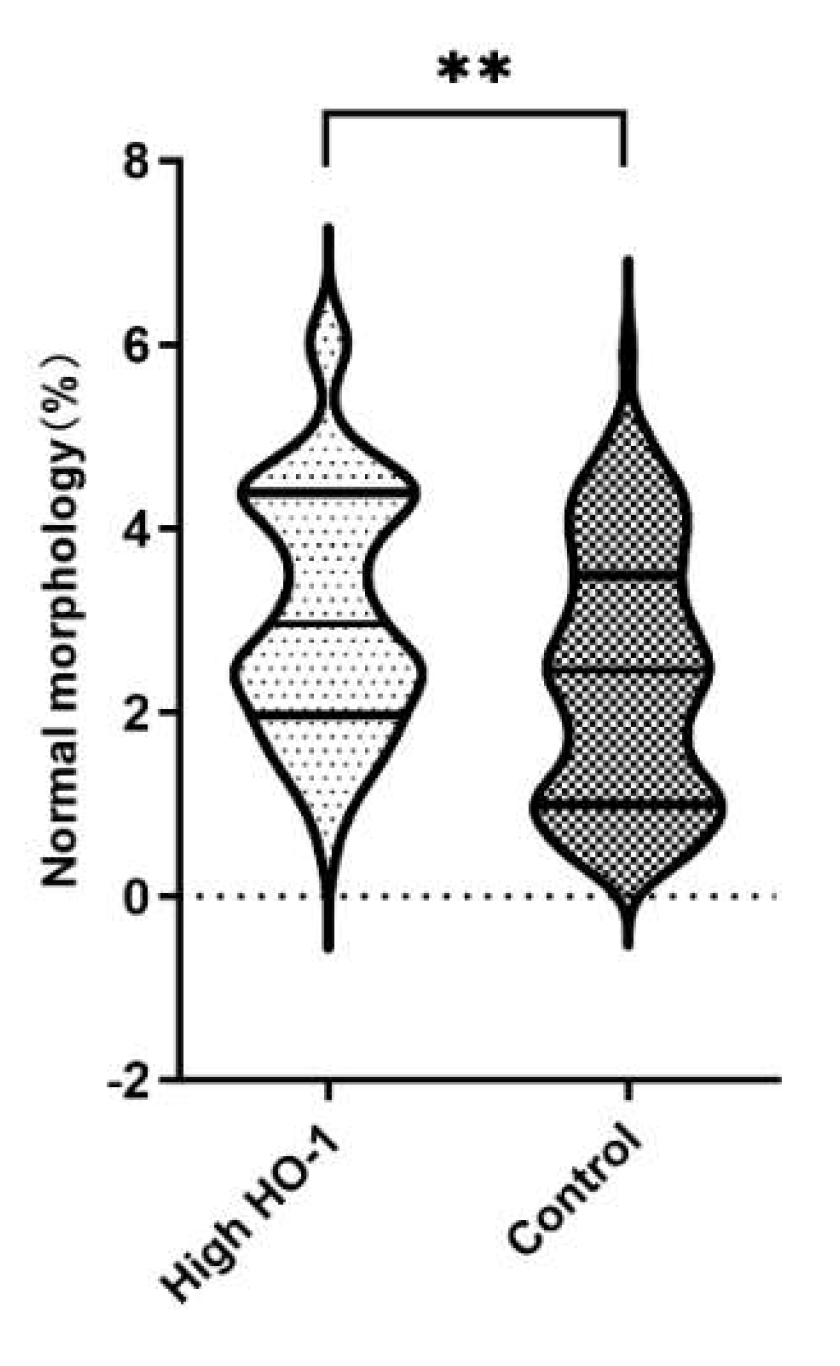
Figure 2.
Comparison of Sperm DFI between the high HO-1 group and the control group. *Statistically significant (P < 0.05).
Figure 2.
Comparison of Sperm DFI between the high HO-1 group and the control group. *Statistically significant (P < 0.05).
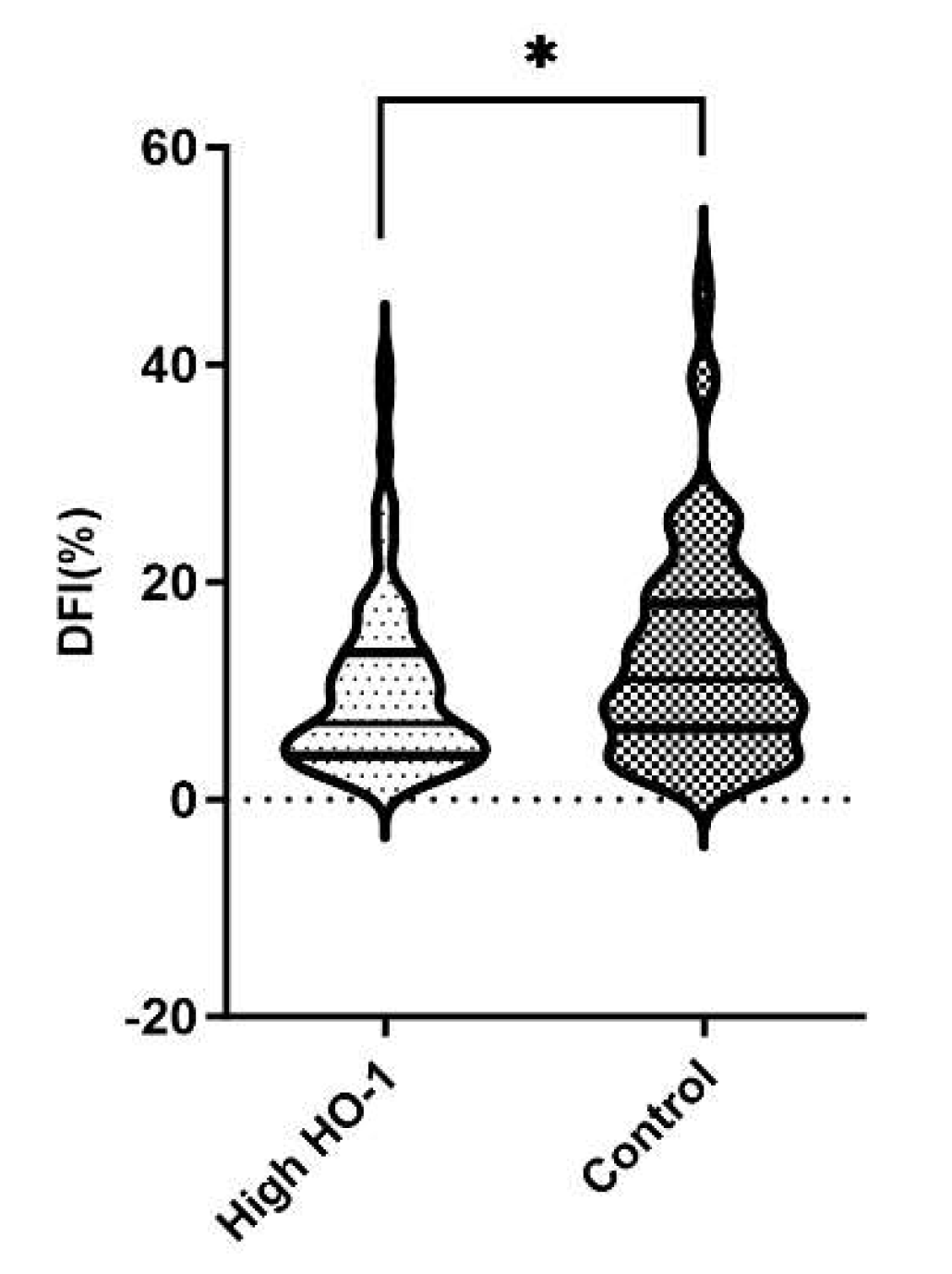
Figure 3.
Correlation between normal morphology and serum HO-1. Individual data points and the regression line are shown. Spearman´s correlation coefficient= 0.190 p=0.012.
Figure 3.
Correlation between normal morphology and serum HO-1. Individual data points and the regression line are shown. Spearman´s correlation coefficient= 0.190 p=0.012.
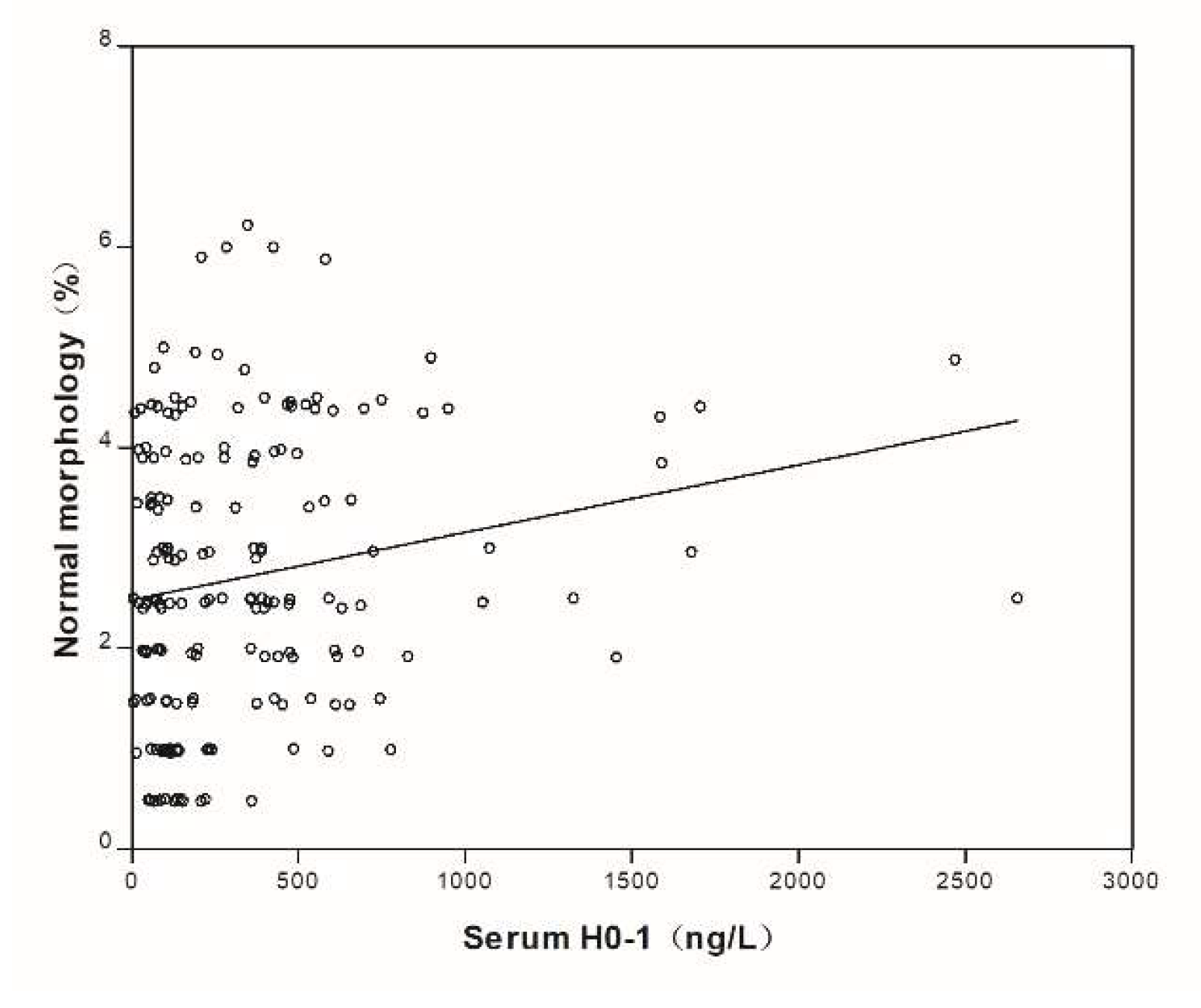
Figure 4.
Correlation between Sperm DFI and serum HO-1. Individual data points and the regression line are shown. Spearman´s correlation coefficient= -0.195 p=0.009.
Figure 4.
Correlation between Sperm DFI and serum HO-1. Individual data points and the regression line are shown. Spearman´s correlation coefficient= -0.195 p=0.009.
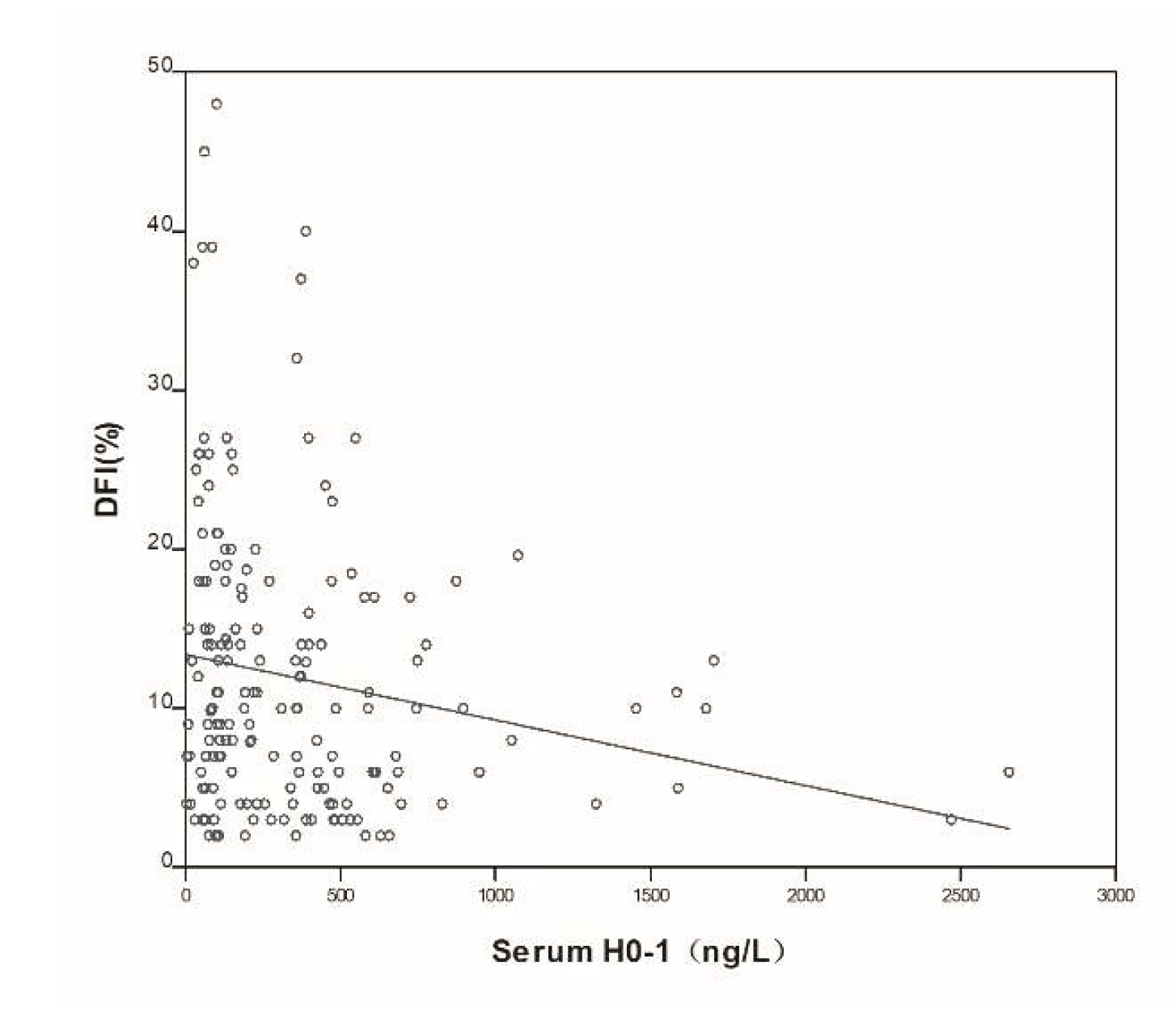

Table 1.
Basic Characteristics of Patients in Both Groups.
| Clinical characteristic | High HO-1 | Control | t | P |
| Age (year) | 34.36±4.89 | 34.25±5.31 | -0.150 | 0.881 |
| Hight(m) | 1.72±0.06 | 1.73±0.05 | 0.429 | 0.669 |
| Weight(kg) | 75.65±10.45 | 77.00±11.59 | 0.800 | 0.425 |
| BMI (kg/m2) | 25.39±3.35 | 25.66±3.30 | 0.552 | 0.582 |
| Abstinence duration (d) | 4.58±1.70 | 4.69±1.73 | 0.419 | 0.676 |
P values were derived from Student’s t-test for parametric comparisons BMI: body mass index
Table 2.
Comparison of semen parameters between the two groups of patients.
| Semen parameters | High HO-1 | Control | Z | p |
| Sperm concentration(×106 /ml) | 62.02(43.36,84.40) | 75.34(40.90,103.66) | -1.770 | 0.077 |
| PR(%) | 58.44(44.35,69.67) | 60.25(44.43,71.14) | -0.038 | 0.970 |
| NP(%) | 8.28(5.13,10.44) | 7.27(4.81,9.73) | -1.043 | 0.297 |
| Normal morphology (%) | 2.96(1.97,4.49) | 2.45(1.00,3.50) | -3.051 | 0.002 |
| DFI(%) | 7(4.00,14.00) | 11(6.26,18.00) | -2.396 | 0.017 |
P values were derived from Mann-Whitney test for parametric comparisons. PR: Progressive motility; NP: Nonprogressive motility DFI: DNA fragmentation index.
Table 3.
Correlation Analysis of Serum HO-1 with Semen Parameters.
| Semen parameters | HO-1 | |
| r | p | |
| Sperm concentration | -0.095 | 0.207 |
| PR(%) | 0.035 | 0.644 |
| NP(%) | 0.120 | 0.113 |
| Normal morphology | 0.190 | 0.012 |
| DFI | -0.195 | 0.009 |
The r value represents the Spearman’s correlation coefficients. PR: Progressive motility; DFI: DNA fragmentation index.
Disclaimer/Publisher’s Note: The statements, opinions and data contained in all publications are solely those of the individual author(s) and contributor(s) and not of MDPI and/or the editor(s). MDPI and/or the editor(s) disclaim responsibility for any injury to people or property resulting from any ideas, methods, instructions or products referred to in the content. |
© 2026 by the authors. Licensee MDPI, Basel, Switzerland. This article is an open access article distributed under the terms and conditions of the Creative Commons Attribution (CC BY) license.
Copyright: This open access article is published under a Creative Commons CC BY 4.0 license, which permit the free download, distribution, and reuse, provided that the author and preprint are cited in any reuse.