

Submitted:
04 May 2026
Posted:
07 May 2026
You are already at the latest version
Abstract
Objective: Preeclampsia (PE) is a serious pregnancy-related condition that accounts for a high proportion of maternal and fetal morbidity and mortality and falls under the category of hypertensive disorders of pregnancy (HDP). STOX1 has been identified as a potential paternally imprinted (maternally expressed) gene that influences placental development. Study design: We examined three STOX1 polymorphisms in two case-control studies, including rs10509305, rs1341667, and rs1694505. The first study included predominantly Latina women with HDP and the second included predominantly Caucasian women with severe preeclampsia (sPE) and/or HELLP Syndrome. The HDP cohort included 142 cases and 169 controls (mother-baby dyads) recruited at the Los Angeles County Women’s and Children’s Hospital, while the sPE/HELLP cohort included 178 cases and 33 controls (mother-baby-father triads) recruited through HELLP syndrome-focused social media platforms. Linkage disequilibrium (LD), single-SNP, haplotype association, and parent-of-origin (PoO) analyses were conducted using log-linear regression models in Haplin (R) (Version 4.4.1). Results: No significant associations were observed between STOX1 SNPs and HDP. In contrast, maternal carriage of the variant allele was significantly associated with increased risk of sPE/HELLP at rs10509305 for a heterozygous T allele (RR=1.96, p=0.002) and rs1341667 for a heterozygous C allele (RR=3.63, p< 0.001). Similar associations were observed in infants, where rs10509305 heterozygous T allele (RR=2.50, p< 0.001) and rs1341667 heterozygous C allele carriers (RR=3.93, p< 0.001) significantly increased the risk of maternal sPE/HELLP. No significant associations were observed for rs1694505 in either mothers or infants (all p-values>0.05). In the HDP cohort, no haplotype was identified as a risk factor for disease. In sPE/HELLP cohort, maternal heterozygous c-g-C (RR=2.25, p=0.004), heterozygous T-A-t (RR=4.29, p< 0.001), and homozygous T-g-t (RR=6.61, p=0.004) haplotypes were linked to increased risk. Infants carrying a heterozygous c-g-C (RR=2.30, p=0.003), heterozygous T-A-t (RR=5.71, p< 0.001) showed a significant increase in risk of sPE/HELLP. PoO analysis suggested risk of the mother developing sPE/HELLP associated with the fetal genotype when the child carries a paternally-inherited copy of the variant allele and decreased risk when the child inherits the variant allele from their mother for both rs10509305 and rs1341667 (RRR=0.07, p< 0.001 and RRR=0.02, p< 0.001, respectively). Conclusion: Maternal and fetal STOX1 polymorphisms may contribute to sPE/HELLP risk but not risk of less severe HDP. Significant PoO effects were noted, whereby paternally-derived alleles increase risk of sPE/HELLP while maternally inherited alleles decrease risk, highlighting a possible maternal-fetal genetic incompatibility pathway underlying sPE/HELLP.
Keywords:
preeclampsia
; HELLP syndrome
; STOX1
; haplotypes
; parent-of-origin
; imprinting
; maternal-fetal genotypic interaction
; genomic incompatibility
1. Introduction
Hypertensive disorders of pregnancy represent a spectrum of pregnancy-related hypertensive conditions, including gestational hypertension, preeclampsia (PE), severe preeclampsia (sPE), and the HELLP syndrome (Hemolysis, Elevated Liver enzymes, and Low Platelet count) [1]. Both sPE and HELLP syndrome are considered severe forms of PE, characterized by end-organ involvement and elevated maternal and fetal risks [2]. PE is a common pregnancy complication that affects about 3-7% of pregnant women [3,4] and is one of the leading causes of maternal and perinatal mortality. PE is characterized by hypertension, proteinuria, and multiorgan dysfunction at or after 20 weeks of gestation [2,3]. PE has been associated with adverse short- and long-term outcomes in both the mother and the offspring [2,5], including increased risk of cardiovascular disease [6], impaired fetal growth [7], preterm birth [8,9], placental abruption [10], and neurodevelopmental issues in the child [11,12,13,14]. With rates of PE increasing due to associated risk factors, including older maternal age and obesity [7,11], PE is increasingly recognized as a global public health problem [15].
The etiology of PE is complex and not well understood [15] but is widely believed to involve both genetic and epigenetic mechanisms controlling placental development [16,17]. Genetic studies have suggested that PE heritability accounts for approximately 50% of the risk [18] and involves the contribution of both maternal and fetal genes [19,20].
The STOX1 gene has been identified as a candidate for PE susceptibility [21,22] and is located in the 10q22 region [23]. It regulates the expression of genes related to placental development, cell cycle regulation, and maternal-fetal immune balance [24]. Several studies have identified an association with severe early-onset PE as a maternal-effect locus [21,24]. Specifically, PE has been associated with variation in the maternally expressed imprinted gene STOX1 [19]. Van Dijk et al. further reported that the risk of PE may depend on whether the risk allele is inherited from the mother or the father, which may contribute to the genetic architecture of preeclampsia in the 10q22. These findings have raised the possibility that epigenetic mechanisms, including allele-specific methylation or genomic imprinting, may regulate STOX1 expression in the placenta and influence disease risk.
Although evidence supports the critical role of maternal STOX1 variants in PE [25,26,27,28,29], the role of fetal STOX1 variants remains unexplored. Additionally, the imprinting status of STOX1 remains controversial [29]. Some studies suggested that STOX1 is paternally imprinted (i.e., only the maternal allele is expressed) [19,21], such as in columna extravillous trophoblasts. However, studies also reported that no obvious specific methylation of parental origin was observed [22] and some placental cell types exhibit biallelic expression of STOX1 [29], such as stromal cells within the villus and syncytiotrophoblasts [19]. This suggests that imprinting may be relaxed or cell-type specific within the placenta.
In this study, we aimed to investigate whether three polymorphisms within the STOX1 gene (rs10509305, rs1341667, and rs1694505) are associated with the risk of hypertensive disorders of pregnancy (HDP) and sPE or HELLP syndrome. We analyzed data from two independent cohorts: a HDP cohort consisting of mother-baby dyads, and a sPE/HELLP cohort consisting of mother-baby-father triads. We also examined the presence of any parent-of-origin (PoO) effects to shed light on the imprinting status of STOX1. By elucidating the genetic contribution of STOX1 to PE, this study seeks to advance our understanding of the genetic basis of PE and its potential molecular mechanisms.
2. Methods
Clinical Patient Recruitment and Participant Selection Criteria
This study was approved by the Institutional Review Board (Approval Number: HS-06–00111). All participants provided written informed consent after being informed about the study’s purpose and procedures.
HDP: Participants (mother-baby dyads) with a clinical diagnosis of PE were identified retrospectively from delivery log records at Los Angeles County and University of Southern California Women’s and Children’s Hospital (WCH) from 1999 to 2006 (n=105) or were recruited during their postpartum inpatient stay (n=206) from 2007 to 2008. Upon chart review, participants in the case group (n=142) were confirmed to have one of the following hypertensive disorders: PE, eclampsia, gestational hypertension, superimposed preeclampsia, or HELLP syndrome. Participants in the control group (n=169) included women recruited from the same obstetric population without an HDP diagnosis.
sPE/HELLP: Participants (mother-baby-father triads) were recruited online through HELLP syndrome-focused social media platforms, including the HELLP Syndrome Society website (www.hellpsyndromesociety.org) or Facebook research page (https://www.facebook.com/pages/Hellp-Syndrome-Research-at-USC/163745723652843). Cases (n=178) were women with self-reported HELLP syndrome. Participants in the control group (n=33) consisted of case acquaintances who had delivered a baby within 5 years of the index pregnancy and self-reported no history of HDP. All participants met the criteria for inclusion in the study. Namely, participants self-reported a history of HELLP Syndrome and were willing to provide DNA samples as well as obstetric and delivery records.
Case Selection Criteria
HDP: Participants were classified as PE if they had hypertension and proteinuria at or after 20 weeks of gestation and met the following criteria: (1) systolic blood pressure (SBP) ≥140 mmHg and/or diastolic blood pressure (DBP) ≥90 mmHg, measured twice at least 6 hours apart; (2) urine dipstick ≥+1 or ≥300 mg/dL in 24-hour urine collection.
Participants were classified as gestational hypertension if they had hypertension without proteinuria, according to the preeclampsia definition at the time of recruitment. No significant differences were observed between PE and gestational hypertension cases, so the cases were analyzed as a single group.
sPE/HELLP: Participants were classified as PE with severe-spectrum disease (sPE) if they had hypertension and proteinuria at or after 20 weeks of gestation and met the following criteria: (1) SBP ≥160 mmHg or DBP ≥110 mmHg, measured twice at least 6 hours apart; (2) urine dipstick ≥+3 or ≥500 mg/dL in 24-hour urine collection. All reviewed study participants met the diagnostic criteria for sPE or HELLP Syndrome.
Participants were further classified as HELLP Syndrome if they had documentation of the following criteria: (1) Hemolysis: abnormal peripheral blood smear or lactate dehydrogenase (LDH) ≥600 U/L; (2) Liver dysfunction: aspartate aminotransferase (AST) or alanine aminotransferase (ALT) ≥70 U/L; (3) Thrombocytopenia: platelet count <100,000/μL.
The diagnosis was initially based on self-report, with 68.5% (n=122 out of 178) cases confirmed through medical records. 31.5% (n=56 out of 178) cases were not verified due to unavailable medical records and were classified as sPE since all reviewed participants met sPE and/or HELLP criteria.
Questionnaire and Chart Abstraction
For both the HDP and sPE/HELLP cohorts, a standard risk assessment questionnaire was completed in English or Spanish covering risk factors, family and personal medical history, and obstetric history. In the HDP study, chart abstractions were performed (MLW) for all cases and controls to confirm the diagnosis or lack thereof, whereas in the sPE/HELLP cohort, abstractions were performed (MLW) only for cases. Abstracted information included prenatal care records, medical, sexual, obstetric history, and delivery information.
Single Nucleotide Polymorphisms Selection
Three single-nucleotide polymorphisms (SNPs) within the STOX1 gene were selected for analysis to capture the majority of genetic variation within this locus. The selected SNPs were rs10509305, rs1341667, and rs1694505. SNPs were chosen if they met at least one of the following selection criteria: (1) previously associated with health outcomes in at least one peer-reviewed publication; (2) identified as a functional polymorphism with biological relevance in prior studies; (3) located in a coding region, resulting in a non-synonymous amino acid substitution; (4) situated in a regulatory or non-coding region, potentially influencing gene expression; (5) present in an intronic region that is highly conserved among placental mammals, possibly impacting splicing or regulatory elements.
rs10509305 is a missense variant in exon 3 of STOX1, resulting in a glutamic acid to aspartic acid substitution (E608D). Although this residue does not reside within a well-characterized functional domain, missense substitutions can affect protein conformation, stability, or interaction affinity with transcriptional targets. The region surrounding E608D is highly conserved across mammals, indicating a potentially significant structural or regulatory function. Functional annotation from Ensembl VEP indicates that rs10509305 is located within a conserved coding context that affects the protein sequence, which may influence STOX1 transcription factor activity relevant to placental gene regulation [24,30].
rs1341667 (Y153H) is a missense variant in exon 2 that results in a tyrosine to histidine substitution within the predicted DNA-binding domain of STOX1. The tyrosine at position 153 is conserved among vertebrates and is located in a region implicated in DNA interaction and transcriptional regulation. Previous studies have demonstrated that variants affecting the Y153 residue can alter STOX1’s ability to regulate target gene expression, and this variant has been associated with early-onset or sPE in certain cohorts [15,30]. Potential functional consequences include changes in binding affinity to cis-regulatory elements or impaired recruitment of co-regulators, which may affect trophoblast differentiation and placental function.
rs1694505 is an intronic variant located within a predicted regulatory region overlapping enhancer elements that target STOX1. Enhancer-to-gene prediction data from ENCODE indicate that this locus interacts with STOX1 regulatory circuitry in multiple tissues, including ovarian and neural lineages, consistent with placental gene regulatory networks [28,31]. In addition, variants in linkage disequilibrium with rs1694505 have been implicated in eQTL credible sets affecting STOX1 expression across diverse cellular contexts, suggesting that this locus may modulate transcriptional output rather than protein structure. These regulatory features support the potential functional relevance of rs1694505 in influencing STOX1 expression and thereby altering placental development pathways implicated in sPE.
Hardy-Weinberg equilibrium (HWE) tests were performed for each SNP in both cohorts. HWE p-values (Chi-squared test) for HDP cohort were: rs10509305 p=0.7889, rs1341667 p=0.4857, and rs1694505 p=0.5241. HWE p-values (Chi-squared test) for sPE/HELLP cohort were: rs10509305 p=9.44e-15, rs1694505 p=0.0104, and rs1341667 p= 0.

Table 1.
summarizes the selected SNPs and their allele frequencies in the Latin American (HDP) and European (sPE/HELLP) populations. Variant information was sourced from the NCBI dbSNP database [32] and the variant types were genomic coordinates (GRCh38.p14).
Table 1.
summarizes the selected SNPs and their allele frequencies in the Latin American (HDP) and European (sPE/HELLP) populations. Variant information was sourced from the NCBI dbSNP database [32] and the variant types were genomic coordinates (GRCh38.p14).
| SNP (rs#) | Variant type | Position | Gene : Consequence | Allele | Reference Allele | Alternate Allele | Associations | ||
| Latin American | European | Latin American | European | ||||||
| rs10509305 | SNV | chr10:68885620 (GRCh38.p14) | STOX1: Missense Variant | A>C | A=0.84 | A=0.78 | C=0.16 | C=0.22 | PE/Eclampsia [21] |
| rs1341667 | SNV | chr10:68882104 (GRCh38.p14) | STOX1 : Missense Variant | T>A | T=0.42 | T=0.36 | C=0.58 | C=0.64 | PE/Eclampsia [21,29] |
| rs1694505 | SNV | chr10:68830135 (GRCh38.p14) | STOX1 : Intron Variant | A>G | A=0.66 | A=0.71 | G=0.34 | G=0.29 | None |
Linkage disequilibrium (LD) analysis was performed to examine the pairwise correlation among the three selected SNPs (rs10509305, rs1341667, and rs1694505) in two reference populations. Table 2 presents the LD values derived from individuals of predominantly Mexican ancestry in Los Angeles (MXL) and of European ancestry (EUR).
DNA Sample Collection
DNA samples were collected using mouthwash, blood samples, Oragene saliva collection kits (DNA Genotek, Ottawa, Ontario, Canada), or buccal swabs. Saliva-derived DNA was extracted using ethanol precipitation, following the manufacturer’s protocol. Buccal swab and blood DNA were extracted using the QIAmp DNA Mini Kit (Qiagen, Valencia, CA) following the manufacturer’s protocol. The DNA sampling method did not affect genotyping failure rate.
To assess genotyping reliability, 5% of the total samples were genotyped in duplicate; no discrepancies were observed.
HDP: maternal DNA samples (n=311) were collected using mouthwash-derived saliva samples (n=226, 72.7%), blood samples (n=15, 4.8%), Oragene saliva collection kits (n=29, 9.3%), or buccal swabs (n=39, 12.5%). Two samples (0.6%) did not have DNA source record. Fetal DNA samples (n=311) were collected using buccal swabs (n=241, 77.5%) or Oragene saliva kits (n=70, 22.5%).
sPE/HELLP:, maternal DNA samples (n=211) were collected using Oragene saliva collection kits (n=117, 56.8%) or buccal swabs (n=89, 43.2%). Five maternal samples (2.4%) did not have DNA source record. Fetal DNA samples (n=196) were collected using Oragene saliva collection kits (n=190, 99.0%) or buccal swabs (n=2, 1.0%). Four samples (2.0%) did not have DNA source record. Paternal DNA samples (n=192) were collected using Oragene saliva collection kits (n=187, 98.4%) or buccal swabs (n=3, 1.6%). Two samples (1.0%) did not have DNA source record. Triads with missing members were imputed using the EM algorithm.
Statistical Methods
The study populations’ maternal demographic and clinical characteristics were summarized and stratified by case-control status. Continuous variables were presented as mean ± standard deviation (SD) or median (interquartile range, IQR), while categorical variables were reported as counts and percentages.
Associations between STOX1 SNPs and PE were analyzed separately for mother-baby dyads (HDP) and mother-baby-father triads (sPE/HELLP). All statistical analyses were performed using R statistical software (Version 4.4.1) with the Haplin package (Version 7.3.0) implemented for genetic association testing (R Foundation for Statistical Programming, Vienna, Austria). Haplin performs a power analysis using a log-linear and multinomial framework specifically designed for genetic epidemiological studies involving family-based designs. It can analyze haplotypes and estimate maternal, child, and PoO effects [33]. The heterozygous and homozygous effects of STOX1 SNPs in mothers and infants were estimated using Haplin free response model, and relative risks (RRs) and 95% confidence intervals (CIs) were computed for each genotype and haplotype [33]). A two-sided significance level of α=0.05 was used. The most frequent allele or haplotype was used as reference in all calculations. Haplin R package reconstructs haplotypes from mother-infant and mother-father-infant triads using maximum likelihood under the assumption of HWE in founders. The frequency threshold for inclusion of haplotypes in the model was set to 1% (threshold=0.01), such that rare haplotypes with estimated frequencies below this cutoff were excluded from analysis to ensure model stability and avoid spurious associations from extremely low-frequency variants. Haplotypes with low frequencies (<4% frequency) were removed from the analysis, resulting in six haplotypes (HDP) and five haplotypes (sPE/HELLP). Haplin uses the expectation maximization (EM) algorithm to impute missing genotypes for missing dyad or triad members.
PoO effects were analyzed to determine if the effect of a given allele in the infant differed based on maternal or paternal origin. PoO effects are summarized by the relative risk ratio (RRR, denoted as m/p), which is the ratio of the risk associated with the maternally inherited allele (m) over the risk of the paternally inherited allele (p). Significant deviations from RRR equals to1 (m/p=1) indicate parent-specific effects for increasing disease (HDP or sPE/HELLP) risk: RRR significantly less than 1 (m/p<1) suggests the allele increases mother’s disease (HDP or sPE/HELLP) risk more when inherited from the father; RRR significantly less than 1 (m/p>1) suggests the allele decreases mother’s disease risk when inherited from the mother; non-significant result (m/p close to 1) indicated no significant PoO effect [34]. Pairwise LD analysis used LDlinkR [35]. For example, an RRR of 2.5 indicates a 2.5-fold increased risk of the mother developing disease associated with that fetal haplotype.
Power was calculated post-hoc, as the sample size was fixed. For the HDP cohort (142 cases and 169 control dyads), we would have 81% power to detect an odds ratio (OR) of 1.7 or higher, assuming a minor allele frequency of 16% (lowest expected minor allele frequency) and a Type I error rate of 5%. For a SNP with an allele frequency of 58% (highest expected minor allele frequency), we would be able to detect an OR of 1.5. We similarly calculated our power in sPE/HELLP cohort (178 cases and 33 control triads). With the same assumptions, we had 80% power to detect an OR of 1.6 or higher for an allele frequency of 16% and 1.5 for allele frequency of 58%. Power was calculated using Haplin Power [34].
3. Results
Participant Flow
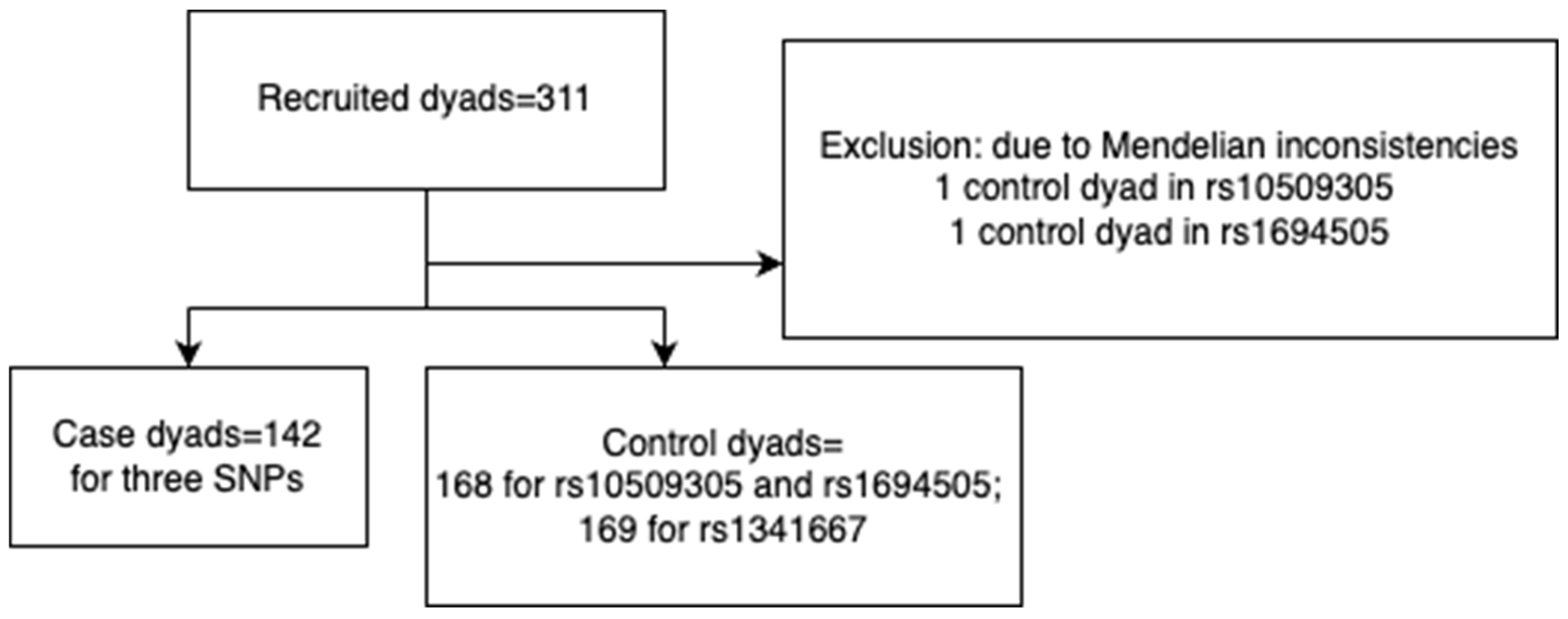
HDP: 311 mother-baby dyads were constructed from 142 case and 169 control families. For families with more than one eligible child, only one child was retained. No dyads were excluded due to missing genotype data. After quality control, one dyad was excluded due to Mendelian inconsistencies in rs10509305 (cases=142, controls=168) and one in rs1694505 (cases=142, controls=168), resulting in a total of 310 dyads retained for final analysis in these two SNPs.
Figure 1.
Participant flow in the HDP population.
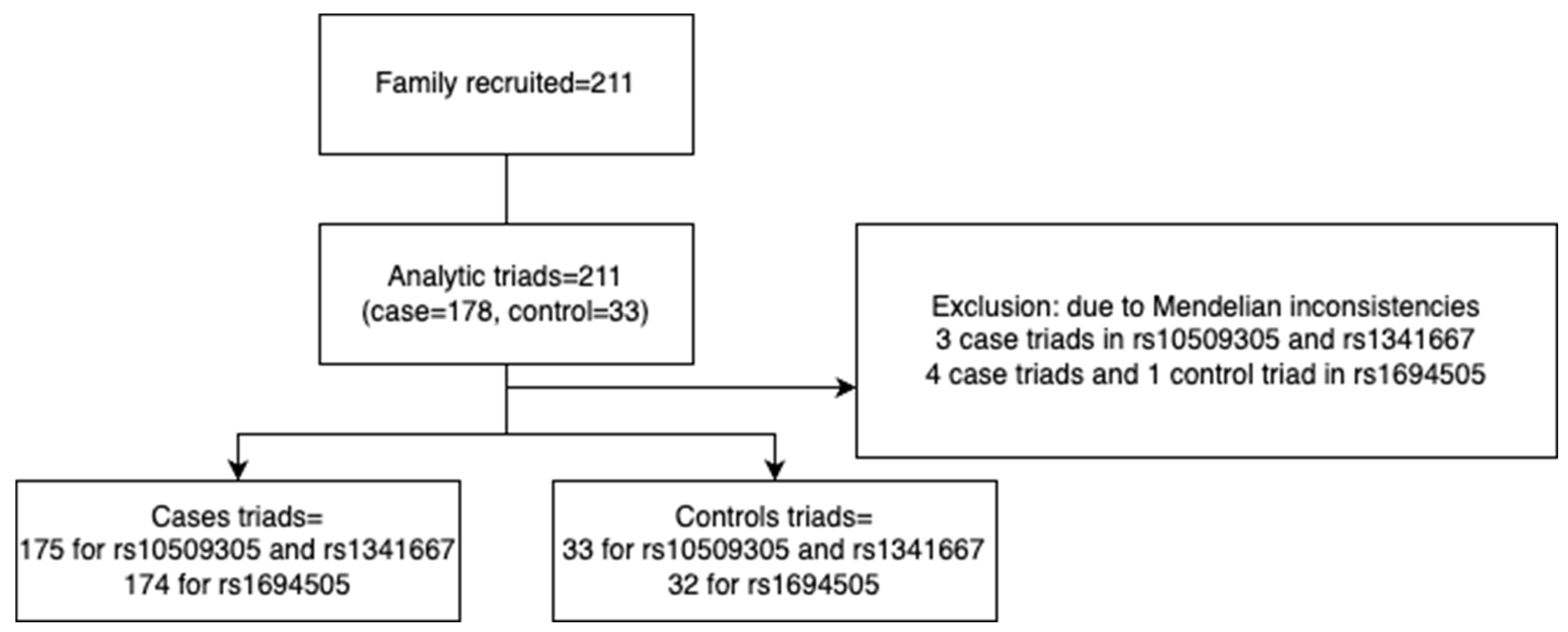
sPE/HELLP: The study population included 211 families, including 178 cases and 33 controls. For families with more than one eligible child, only one child was retained. No triads were excluded due to missing genotype data. After quality control, three triads were excluded due to Mendelian inconsistencies in rs10509305 and rs1341667, and five triads were excluded due to Mendelian inconsistencies in rs1694505. The final triad sample sizes included for this variant analysis were: 208 (cases=175, controls=33) for rs10509305 and rs1341667, and 206 (cases=174, controls=32) triads for rs1694505.
Figure 2.
Participant flow in sPE/HELLP population.
Demographic and Clinical Characteristics
Maternal demographic and clinical characteristics are presented in Table 3.
In the HDP cohort, among the 142 cases, 29.6% were classified as gestational hypertension (n=42), 68.3% as PE/E (n=97), and 2.1% as superimposed (n=3). The mean maternal age was 27.9±7.4 years in cases and 26.8±7.0 years in controls. Maternal race/ethnicity was recorded: in the case group (140 out of 142), there were 97.1% (n=136) Hispanic, 2.1% (n=3) non-Hispanic Black, and 0.7% (n=1) Arab; in the control group (168 out of 169), there were 97.0% (n=163) Hispanic, 1.8% (n=3) non-Hispanic Black, 0.6% (n=1) Arab, and 0.6% (n=1) Filipino. Nulliparity was more common in cases (43.5%) than in controls (31.0%). The mean gestational age at delivery in cases (36.76±3.35 weeks) was lower than that in controls (38.73±1.97 weeks), and maximum SBP and DBP were higher in cases (162.93±15.77 and 97.36±9.85, respectively) than in controls (117.89±10.91 and 68.81±8.97, respectively).
In the HDP cohort, fetal sex data were available for the first-born child in each family, with 137 cases (69 male, 55 female, 13 unknown) and 169 controls (88 male, 72 female, 9 unknown). No race or ethnicity information was available for fathers or children in this cohort.
In the sPE/HELLP cohort, 68.5% (n=122 out of 178) cases had available and sufficient medical records for diagnostic verification. Among these, 59.0% (n=72 out of 122) were classified as sPE and 41.0% (n=50 out of 122) as HELLP syndrome. The remaining 31.5% (n=56 out of 178) cases without medical record confirmation were classified as sPE according to the study protocol. The mean maternal age was 31.0±3.9 years in cases and 32.2±3.9 years in controls. All cases and controls were Caucasian. The mean gestational age at delivery in cases (33±4.48 weeks) was lower than in controls (39.64±1.71 weeks). SPE/HELLP classified criteria were only measured in case group, including maximum protein dipstick (median=2, IQR: 1–4), 24-hr urinary protein levels (1816.46±4159.19 mg/DL), AST level (median=252 U/L, IQR: 114–446), ALT level (median=204 U/L, IQR: 116.5–346.25), platelet count (median=60 × 109/L, IQR: 37.25–100), LDH (median=601.5 U/L, IQR: 339–1271), bilirubin level (median=0.90 mg/dL, IQR: 0.5–1.95), and creatinine level (median=0.80 mg/dL, IQR: 0.70–1.00).
In the sPE/HELLP cohort, fetal sex data were available for the first-born child in each family, with 163 cases (62 male, 64 female, 37 unknown) and 33 controls (15 male, 15 female, 3 unknown). Among the case group, 92 out of 163 children and 92 out of 164 fathers had available race/ethnicity records, all of whom identified as Caucasian. In the control group, 22 out of 33 children and 24 out of 29 fathers had race/ethnicity data, all of whom identified as Caucasian.
SNP Analysis
In the HDP cohort, no statistically significant associations were observed within any of the assessed polymorphisms in either mothers or babies (p>0.05 for all) (Table 4). All three STOX1 SNPs (rs10509305, rs1341667, and rs1694505) were consistent with HWE (all p-values>0.05).
In contrast, there was an increased risk of sPE/HELLP in mothers carrying the heterozygous T allele for rs10509305 (RR=1.96, 95% CI: 1.29-3.00, p=0.002) and the C allele for rs1341667 (RR=3.63, 95% CI: 2.28-5.81, p<0.001) (Table 5). Among infants, there was a significant increase in risk of sPE/HELLP for the heterozygous T allele for rs10509305 (RR=2.50, 95% CI: 1.59-3.96, p<0.001) and the C allele for rs1341667 (RR=3.93, 95% CI: 2.39–6.59, p<0.001). There was no association with rs1694505 in mothers (p=0.522) or children (p=0.446). The HWE p-values for each SNPs were: p<0.001 for rs10509305, p<0.001 for rs1341667, and p=0.010 for rs1694505.
Sample sizes were as follows: rs10509305: n(triads)=310; rs1341667: n(triads)=311; rs1694505: n(triads)=310.
Heterozygous and homozygous refer to individuals carrying single- or double-dose of the variant allele. Genotypes are described relative to the reference and variant alleles, consistent with conventions in genetic epidemiology.
Sample sizes were as follows: rs10509305: n(triads)=208; rs1341667: n(triads)=208; rs1694505: n(triads)=206.
Heterozygous and homozygous refer to individuals carrying single- or double-dose of the variant allele. Genotypes are described relative to the reference and variant alleles, consistent with conventions in genetic epidemiology.
Haplotype Analysis
In the HDP cohort, the T-C-A haplotype was used as the reference category for heterozygous RR in maternal and child analyses. No haplotype associations were observed in either mothers or children (all p-values>0.05) (Table 6).
In the sPE/HELLP cohort, the c-A-C haplotype was used as the reference category for heterozygous RR in maternal and child analyses. Among mothers, heterozygous c-g-C (RR=2.25, 95% CI: 1.31-3.88, p=0.004) and T-A-t (RR=4.29, 95% CI: 2.37-7.70, p<0.001) haplotypes were significantly associated with increased risk relative to the c-A-C haplotype. Homozygous T-g-t (RR=6.61, 95% CI: 1.77-24.10, p=0.004) was significantly associated with an increased risk of sPE/HELLP.
Among children, heterozygous c-g-C (RR=2.30, 95% CI: 1.32-3.91, p=0.003) and T-A-t (RR=5.71, 95% CI: 3.01-10.90, p<0.001) haplotypes were significantly associated with increased risk of maternal sPE/HELLP relative to the c-A-C haplotype (Table 7). No other haplotypes showed statistically significant associations.
Parent-of-Origin (PoO) Analysis
No significant PoO effects were detected in the HDP cohort (all p-values>0.05) (Table 8).
In the sPE/HELLP cohort (Table 9), maternal carriage of a heterozygous or homozygous variant allele rs10509305 (heterozygous RR=5.76, 95% CI: 3.47-9.56, p<0.001 and homozygous RR=12.60, 95% CI: 4.19-37.10, p<0.001) and rs1341667 (heterozygous RR=15.50, 95% CI: 9.10-26.50, p<0.001 and homozygous RR=42.70, 95% CI: 12.60-155.00, p<0.001) significantly increased the risk of the mother developing sPE/HELLP associated with the fetal genotype.
We observed significant PoO effects for both rs10509305 and rs1341667. Mother’s risk of developing sPE/HELLP was significantly reduced (RR=0.36, 95% CI: 0.13-0.99, p=0.048) when the variant allele for rs1341667 was maternally inherited. Conversely, paternally inherited variant allele for rs10509305 and rs1341667 significantly increased maternal risk (RR=7.02, 95% CI: 4.12-12.00, p<0.001 and RR=16.90, 95% CI: 9.64-29.40, p<0.001, respectively). The RRR comparing paternally- versus maternally inherited alleles for rs10509305 was 0.07 (95% CI: 0.02–0.18, p<0.001) and for rs1341667 was 0.02 (95% CI: 0.01–0.06, p<0.001). No significant PoO effects were detected for rs1694505 (all p-values>0.05).
Sample sizes were as follows: rs10509305: n(triads)=310; rs1341667: n(triads)=311; rs1694505: n(triads)=310.
Heterozygous and homozygous refer to individuals carrying single- or double-dose of the variant allele. Genotypes are described relative to the reference and variant alleles, consistent with conventions in genetic epidemiology.
Sample sizes were as follows: rs10509305: n(triads)=208; rs1341667: n(triads)=208; rs1694505: n(triads)=206.
Heterozygous and homozygous refer to individuals carrying single- or double-dose of the variant allele. Genotypes are described relative to the reference and variant alleles, consistent with conventions in genetic epidemiology.
4. Discussion
Principle Findings. This study investigated the genotypes and haplotypes of STOX1 SNPs in mother-baby dyads and mother-baby-father triads to assess their association with hypertensive disorders of pregnancy, including sPE and HELLP syndrome. Our findings indicate that both maternal and fetal variants for rs10509305 and rs1341667 were significantly associated with sPE/HELLP but not with HDP overall, and rs1694505 was not associated with either HDP or sPE/HELLP. Haplotype analysis revealed that the c-g-C and T-A-t haplotypes in maternal and fetal genotypes (relative to T-C-A) may contribute to an increased risk of the mother developing sPE/HELLP associated with the fetal genotype.
Additionally, we observed a PoO effect for both rs1059305 and rs1341667 whereby child carriage of the maternally inherited allele is associated with decreased risk of sPE/HELLP and carriage of the paternally-inherited allele is associated with an increased risk of the mother developing sPE/HELLP associated with the fetal genotype. These results may suggest a maternal-fetal genetic incompatibility [37], similar to that observed for RHD incompatibility and risk of schizophrenia [38], where the mother may produce an allogeneic response to the fetus’s antigen if a homozygous mother for the null allele (no antigen) carries a fetus who has an allele that codes for an antigen, which may negatively impact fetal or maternal health. No significant PoO effect was observed in the HDP cohort, indicating that the PoO of fetal STOX1 alleles may be particularly relevant in the context of sPE/HELLP, but not in HDP.
Result in the context of what is known. Compared with previous studies, our results are mostly consistent [21,37,38,40]. We observed a significant association between the C allele at rs1341667 (Y153H) resulting in increased risk of the mother developing sPE/HELLP associated with the fetal genotype (RR=3.63, 95% CI: 2.28-5.81, p<0.001), which supports earlier findings [21,39,40]. Van Dijk et al. first reported maternal inheritance of STOX1 mutations in familial PE cases, suggesting that STOX1 acts as a maternally inherited susceptibility locus. Berends et al. observed that, in maternal transmission of the STOX1 Y153H variant (rs1341667), the C allele exhibited preferential maternal transmission over the T allele, particularly when affected grandmothers were included in the analysis [39]. This distorted transmission pattern suggests that the C allele may be preferentially maternally inherited. Akin et al., while not assessing possible PoO effects, observed an association between early onset PE as well as less severe cases with rs884181 (-922 T>C), a promoter region polymorphism [40], suggesting that altered transcriptional regulation of STOX1 may contribute to disease risk. In contrast, Iglesias-Platas et al. did not observe an association between PE and rs1341667 (Y153H) and did not observe a PoO effect, possibly owing to a study population with less severe cases [29]. These findings suggest that different polymorphisms of STOX1 may exert population-specific or context-specific effects, suggesting a complex mechanism of action in PE inheritance patterns.
This study extends previous genetic association findings by formally evaluating PoO and maternal-fetal interaction effects using dyad and triad data. Van Dijk et al. identified maternally transmitted STOX1 variants in a multigenerational pedigree but did not directly model PoO effects [24]. In contrast, log-linear models within triads are employed to quantify the differential impact of paternally versus maternally inherited alleles on disease risk. The dyad design also enables detection of maternal-fetal incompatibility, which may be overlooked in population-based studies.These methodological features offer novel insights into the complex genetic architecture of sPE.
Clinical Implications. Although the exact mechanism of STOX1 in contributing to PE remains unclear, functional studies support its critical role in placental function [22,23,24,41]. Specifically, functional analyses demonstrated that STOX1 has gene regulatory effects, with overexpression in trophoblast cells leading to transcriptional alterations similar to those observed in PE placentas, including activation of oxidative stress pathways and nitroso-redox imbalance [22,41]. Rigourd et al. demonstrated that overexpression of STOX1 in choriocarcinoma cells resulted in transcriptional alterations similar to those observed in preeclamptic placentas, supporting a mechanistic link between STOX1 dysregulation and PE pathogenesis [22]. Among the more studied STOX1 variants, Y153H (rs1341667) is a missense variant that may alter the structural conformation of the STOX1 protein, affecting its DNA-binding ability and subsequently its regulation of downstream placental gene expression [21,29,38,42]. This effect may be particularly relevant in familial PE cases and could be helpful in determining etiologic factors or risk stratification. Considering the predominant placental expression of STOX1 and the increasing feasibility of cell-free RNA and DNA assays during early pregnancy, this transcriptomic approach may provide a non-invasive biomarker for early detection and individualized monitoring of preeclampsia risk. Based on the genetic findings, it is hypothesized that several STOX1 intronic and enhancer-proximal polymorphisms, such as rs1694505 located within a predicted enhancer region active in trophoblast and fetal brain tissues, may influence STOX1 expression in a PoO-dependent manner [28,31]. ENCODE indicate high-confidence regulatory links between these loci and STOX1 transcription across placental cell types, suggesting that these variants may modulate gene expression during early placental development. Disruption of STOX1 enhancer activity may impair regulation of oxidative stress pathways, trophoblast differentiation, or uterine spiral artery remodeling, which could contribute to the pathogenesis of PE. This mechanism may also account for the observed maternal-fetal genotype interactions in haplotype and PoO analyses. Further experimental validation of enhancer function and allelic expression in placental tissues is required to confirm this hypothesis.
Variants in the STOX1 gene (e.g., Y153H) may affect its transcription factor function, exacerbating placental dysfunction [25,26]. The Y153H missense mutation (rs1341667) in the DNA-binding domain of STOX1 has been proposed as a highly conserved, potentially pathogenic variant in PE [21]. Moreover, in vitro cellular experiments, overexpression of STOX1 in choriocarcinoma cells resulted in transcriptional alterations similar to those observed in PE placentas, supporting a mechanistic link between STOX1 dysregulation and PE pathogenesis [27].
STOX1 is primarily expressed in the brain and placenta [44]. As such, it is possible to develop an assay to identify placenta-specific STOX1 transcripts in maternal blood, allowing for prediction of disease severity and risk stratification [26].
Research Implications. Several of the results presented herein highlight the potential involvement of STOX1 in the etiology of PE, particularly through its placental expression and regulatory functions. Future studies should investigate maternal-fetal genomic incompatibility as a potential mechanism contributing to the development of PE, involving the exploration of allele-specific expression or differential transmission of risk alleles at the maternal-fetal interface. Additionally, detecting placenta-specific STOX1 transcripts in maternal plasma could facilitate non-invasive monitoring of STOX1-related placental dysfunction. The identification of this cell-free STOX1 marker will provide valuable insights into the temporal dynamics of placental stress and may serve as an early biomarker for risk stratification of PE.
Strengths and Limitations. Our study has several limitations. First, although we included a relatively large number of sPE/HELLP cases, the sample size remains limited and small effects (OR<1.5) would not be detectable. Individuals carrying two copies of a given risk allele (i.e., homozygous) were relatively rare, particularly in the control group. This scarcity of homozygous carriers would reduce the power to detect true association, and resulting estimates for homozygous effects had wide confidence intervals and made the estimates unstable [45], which increased the likelihood of failing to identify significant effects (Type II error). Second, the two cohorts (HDP cohort with Hispanic and sPE/HELLP cohort with Caucasian) were studied in parallel rather than combined. This approach minimizes the risk of population stratification. While allele frequencies may differ between ancestral groups, the effect of risk alleles on disease susceptibility is not anticipated to vary systematically across populations. However, a lower minor allele frequency in one cohort may reduce the statistical power to detect associations. Third, the sPE/HELLP cohort was recruited through HELLP syndrome-focused social media platforms, which may introduce selection bias (but only if genotype impacted participation) and limit generalizability. In sPE/HELLP cases, the participants not verified through medical record abstraction were included since all reviewed participants met criteria for sPE and/or HELLP, indicating that self-report of HELLP Syndrome accurately reflected maternal health at delivery. Medical records were not requested and lack of chart abstraction for control participants and therefore, it is possible that some controls may have been cases of less severe disease. However, such misclassification would lead to bias toward the null such that any effects would be stronger than they appear. Fourth, although the sample size of the sPE/HELLP cohort was relatively large for this rare condition, the number of controls (n=33) and homozygous risk allele carriers was small. This limited the precision of some estimates. Sparse genotype categories resulted in wide confidence intervals and an increased risk of Type II error. Finally, all three SNPs in the sPE/HELLP population were out of Hardy-Weinberg Equilibrium (p≤0.05). Deviations from HWE can indicate potential genotyping errors, population stratification, non-random mating, or biological effects such as selection or maternal-fetal interactions [46,47]. In sPE/HELLP syndrome, the observed deviations from HWE may reflect maternal-fetal genotype interactions or viability selection favoring specific heterozygous fetal genotypes [48]. In addition, the magnitude of the effect sizes observed in this study, specifically the RR and the PoO RRR, are notably large for a complex polygenic condition like PE. We acknowledge that these estimates are relatively imprecise, likely due to the limited sample size of our sPE/HELLP cohort and the rarity of certain genotype combinations. These findings should therefore be considered preliminary. While they align with the hypothesis of maternal-fetal genomic incompatibility at the STOX1 locus, they require validation in larger, more robustly powered cohorts or through large-scale genome-wide association studies (GWAS) that specifically focus on phenotypes like HELLP syndrome.
This study also has several strengths. To our knowledge, no prior reports have addressed the role of both maternal and fetal STOX1 variants in predisposing to maternal HDP or sPE/HELLP Syndrome. We used mother-baby dyads and mother-baby-father triads to incorporate parental genetic information, allowing us to estimate the effect of maternal and fetal STOX1 variants as well as to assess imprinting and PoO effects. Triad-based designs enable explicit modeling of maternally and paternally transmitted alleles, allowing for formal tests of PoO effects that are not possible with single-individual or population-based designs. Dyad-based analyses also facilitate the assessment of maternal-fetal genotypic relationships, including potential genetic incompatibility, which may remain undetected in studies without familial structure. Collectively, these complementary family-based designs are well suited to addressing ongoing debates regarding STOX1 imprinting and inheritance patterns in PE. While the sample sizes were relatively small, our study includes a substantial number of sPE/HELLP cases, which may be more likely to be associated with placental insufficiency and STOX1 variation. Whenever possible, we reviewed prenatal and delivery records for self-reported cases of HELLP to confirm the diagnosis; all reviewed cases minimally met criteria for sPE. Detailed chart abstractions were made for all HDP cases and controls to verify clinical diagnosis.
4. Conclusions
In conclusion, we found that the impact of maternal and fetal variants in STOX1 is only observed in sPE/HELLP cases. We also found a PoO effect of STOX1 variants on risk of sPE/HELLP cohortwhereby a child carrying a maternally inherited variant allele provides protection against maternal disease whereas paternally-inherited variants increase risk of the mother developing sPE/HELLP associated with the fetal genotype, likely reflecting maternal-fetal genotypic incompatibility. These findings suggest a potential role for STOX1 maternal-fetal genotypic incompatibility in the pathogenesis of sPE and HELLP syndrome. If validated in larger cohorts, fetal inheritance of parental STOX1 variants may serve as an early predictive biomarker for clinical pregnancy complications, enabling more personalized and preventive prenatal care. Further validation in independent, larger-scale cohorts is essential to confirm these inheritance patterns and their clinical relevance.
Scheme 1.
SNP genotype distribution in HDP cohort.
| Mother | Child | ||||
| Case | Control | Case | Control | ||
| rs10509305 | TT | 71 | 56 | 65 | 57 |
| TG | 73 | 65 | 72 | 55 | |
| GG | 20 | 16 | 23 | 15 | |
| Missing | 5 | 5 | 9 | 10 | |
| rs1341667 | CC | 33 | 29 | 40 | 29 |
| CT | 89 | 63 | 69 | 52 | |
| TT | 33 | 27 | 38 | 28 | |
| Missing | 14 | 23 | 22 | 28 | |
| rs1694505 | AA | 67 | 65 | 65 | 57 |
| AG | 75 | 55 | 51 | 59 | |
| GG | 15 | 18 | 21 | 10 | |
| Missing | 12 | 4 | 32 | 11 | |
Scheme 2.
SNP genotype distribution in sPE/HELLP cohort.
| Mother | Child | Father | |||||
| Case | Control | Case | Control | Case | Control | ||
| rs10509305 | TT | 24 | 5 | 21 | 8 | 22 | 8 |
| TG | 37 | 13 | 39 | 10 | 38 | 10 | |
| GG | 35 | 12 | 24 | 9 | 26 | 5 | |
| Missing | 82 | 3 | 93 | 5 | 77 | 6 | |
| rs1341667 | CC | 23 | 5 | 20 | 5 | 20 | 6 |
| CT | 26 | 9 | 26 | 6 | 28 | 5 | |
| TT | 13 | 2 | 9 | 3 | 10 | 3 | |
| Missing | 116 | 17 | 122 | 18 | 105 | 15 | |
| rs1694505 | AA | 86 | 20 | 78 | 16 | 79 | 10 |
| AG | 64 | 8 | 61 | 10 | 56 | 14 | |
| GG | 18 | 4 | 16 | 5 | 19 | 4 | |
| Missing | 10 | 1 | 22 | 1 | 9 | 1 | |
Funding
This research was partly funded by the Research Council of Norway through its Centres of Excellence funding scheme #262700 (H.K.G.). Partial support was also provided by National Institute of Child Health and Human Development Grant R21 HD046624-02.
Institutional Review Board Statement
This research was approved by the Ethics Committee of the University of Southern California Health Science Campus Institutional Review Board (Approval No.: HS-06–00111) and conducted in compliance with Good Clinical Practice (GCP) guidelines and the Declaration of Helsinki.
Acknowledgments
We would like to thank all the families that participated in these studies for enabling this research. We would also like to thank the many student volunteers who assisted with data collection.
Conflicts of Interest
The authors declare no conflicts of interest in relation to this study.
References
- Barry, M.J.; Nicholson, W.K.; Silverstein, M.; Cabana, M.D.; Chelmow, D.; Coker, T.R.; et al. Screening for Hypertensive Disorders of Pregnancy: US Preventive Services Task Force Final Recommendation Statement. JAMA. 2023, 330(11), 1074–82. [Google Scholar]
- American College of Obstetricians and Gynecologists’ Task Force on Hypertension in Pregnancy. Hypertension in pregnancy. Obstet. Gynecol. 2013, 122(5), 1122–31. [CrossRef]
- Say, L.; Chou, D.; Gemmill, A.; Tunçalp, Ö.; Moller, A.B.; Daniels, J.; et al. Global causes of maternal death: A WHO systematic analysis. Lancet Glob. Heal. 2014, 2(6), e323–e33. [Google Scholar] [CrossRef]
- Wallis, A.B.; Saftlas, A.F.; Hsia, J.; Atrash, H.K. Secular trends in the rates of preeclampsia, eclampsia, and gestational hypertension, United States, 1987-2004. Am. J. Hypertens. 2008, 21(5), 521–6. [Google Scholar] [CrossRef]
- Duley, L. The Global Impact of Pre-eclampsia and Eclampsia. Semin Perinatol. 2009, 33(3), 130–7. [Google Scholar] [CrossRef] [PubMed]
- Leon, L.J.; McCarthy, F.P.; Direk, K.; Gonzalez-Izquierdo, A.; Prieto-Merino, D.; Casas, J.P.; et al. Preeclampsia and cardiovascular disease in a large UK pregnancy cohort of linked electronic health records a CALIBER study. Circulation. 2019, 140(13), 1050–60. [Google Scholar] [CrossRef] [PubMed]
- Byers, B.D.; Betancourt, A.; Lu, F.; Hankins, G.D.V.; Longo, M.; Saade, G.R.; et al. The effect of prepregnancy obesity and sFlt-1-induced preeclampsia-like syndrome on fetal programming of adult vascular function in a mouse model. Am. J. Obstet. Gynecol. 2009, 200(4), 432.e1–7. [Google Scholar] [CrossRef]
- Gernand, A.D.; Simhan, H.N.; Baca, K.M.; Caritis, S.; Bodnar, L.M. Vitamin D, pre-eclampsia, and preterm birth among pregnancies at high risk for pre-eclampsia: an analysis of data from a low-dose aspirin trial. BJOG. 2017, 124(12), 1874–82. [Google Scholar] [CrossRef]
- Romero, R.; Espinoza, J.; Kusanovic, J.P.; Gotsch, F.; Hassan, S.; Erez, O.; et al. The preterm parturition syndrome. BJOG. 2006, 113(3), 17–42. [Google Scholar] [CrossRef]
- Parker, S.E.; Werler, M.M.; Gissler, M.; Tikkanen, M.; Ananth, C. V. Placental Abruption and Subsequent Risk of Pre-eclampsia: A Population-Based Case–Control Study. Paediatr. Perinat. Epidemiol. 2015, 29(3), 211–9. [Google Scholar] [CrossRef] [PubMed]
- Barron, A.; Mccarthy, C.M.; O’keeffe, G.W. Preeclampsia and Neurodevelopmental Outcomes: Potential Pathogenic Roles for Inflammation and Oxidative Stress? Mol. Neurobiol. 2021, 58(6), 2734–56. [Google Scholar] [CrossRef]
- Kong, L.; Chen, X.; Liang, Y.; Forsell, Y.; Gissler, M.; Lavebratt, C. Association of Preeclampsia and Perinatal Complications with Offspring Neurodevelopmental and Psychiatric Disorders. JAMA Netw. Open. 2022, 5(1), E2145719. [Google Scholar] [CrossRef]
- Zhen Lim, T.X.; Pickering, T.A.; Lee, R.H.; Hauptman, I.; Wilson, M.L. Hypertensive disorders of pregnancy and occurrence of ADHD, ASD, and epilepsy in the child: A meta-analysis. Pregnancy Hypertens. 2023, 33, 22–9. [Google Scholar] [CrossRef]
- Maher, G.M.; O’Keeffe, G.W.; Kearney, P.M.; Kenny, L.C.; Dinan, T.G.; Mattsson, M.; et al. Association of hypertensive disorders of pregnancy with risk of neurodevelopmental disorders in offspring a systematic review and meta-analysis. JAMA Psychiatry. 2018, 75(8), 809–19. [Google Scholar] [CrossRef]
- Chappell, L.C.; Cluver, C.A.; Kingdom, J.; Tong, S. Pre-eclampsia. Lancet. 2021, 398(10297), 341–54. [Google Scholar] [CrossRef]
- Haram, K.; Nagy, B.; Mortensen, J.H.; Keelan, J. Genetic aspects of preeclampsia and the hellp syndrome. J. Pregnancy. 2014, 2014, 910751. [Google Scholar] [CrossRef] [PubMed]
- Apicella, C.; Ruano, C.S.M.; Méhats, C.; Miralles, F.; Vaiman, D. The role of epigenetics in placental development and the etiology of preeclampsia. Int. J. Mol. Sci. 2019, 20(11), 2837. [Google Scholar] [CrossRef]
- Cnattingius, S.; Reilly, M.; Pawitan, Y.; Lichtenstein, P. Maternal and fetal genetic factors account for most of familial aggregation of preeclampsia: A population-based swedish cohort study. Am. J. Med. Genet A. 2004, 130A(4), 365–71. [Google Scholar] [CrossRef] [PubMed]
- van Dijk, M.; Drewlo, S.; Oudejans, C.B. Differential methylation of STOX1 in human placenta. Epigenetics. 2010, 5(8), 736–42. [Google Scholar] [CrossRef] [PubMed]
- Sakowicz, A.; Lisowska, M.; Biesiada, L.; Rybak-Krzyszkowska, M.; Gach, A.; Sakowicz, B.; et al. Association of maternal and fetal single-nucleotide polymorphisms in metalloproteinase (MMP1, MMP2, MMP3, and MMP9) genes with preeclampsia. Dis. Markers. 2018, 2018, 1371425. [Google Scholar] [CrossRef]
- van Dijk, M.; Mulders, J.; Poutsma, A.; Könst, A.A.M.; Lachmeijer, A.M.A.; Dekker, G.A.; et al. Maternal segregation of the Dutch preeclampsia locus at 10q22 with a new member of the winged helix gene family. Nat. Genet. 2005, 37(5), 514–9. [Google Scholar] [CrossRef]
- Rigourd, V.; Chauvet, C.; Chelbi, S.T.; Rebourcet, R.; Mondon, F.; Letourneur, F.; et al. STOX1 overexpression in choriocarcinoma cells mimics transcriptional alterations observed in preeclamptic placentas. PLoS One. 2008, 3(12), e3905. [Google Scholar] [CrossRef]
- Akin, S.; Cekin, N. Preeclampsia and STOX1 (storkhead-box protein 1): Molecular evaluation of STOX1 in preeclampsia. Gene. 2024, 927, 148742. [Google Scholar] [CrossRef]
- van Dijk, M.; Oudejans, C.B.M. STOX1: Key player in trophoblast dysfunction underlying early onset preeclampsia with growth retardation. J. Pregnancy. 2011, 2011, 521826. [Google Scholar] [CrossRef]
- Pinarbasi, E.; Cekin, N.; Bildirici, A.E.; Akin, S.; Yanik, A. STOX1 gene Y153H polymorphism is associated with early-onset preeclampsia in Turkish population. Gene. 2020, 754, 144894. [Google Scholar] [CrossRef] [PubMed]
- Dunk, C.E.; Van Dijk, M.; Choudhury, R.; Wright, T.J.; Cox, B.; Leavey, K.; et al. Functional Evaluation of STOX1 (STORKHEAD-BOX PROTEIN 1) in Placentation, Preeclampsia, and Preterm Birth. Hypertension. 2021, 77(2), 475–90. [Google Scholar] [CrossRef] [PubMed]
- Vaiman, D.; Miralles, F. Targeting STOX1 in the therapy of preeclampsia. Expert Opin. Ther. Targets. 2016, 20(12), 1433–43. [Google Scholar] [CrossRef]
- Rigourd, V.; Chelbi, S.; Chauvet, C.; Rebourcet, R.; Barbaux, S.; Bessières, B.; et al. Re-evaluation of the role of STOX1 transcription factor in placental development and preeclampsia. J. Reprod. Immunol. 2009, 82(2), 174–81. [Google Scholar] [CrossRef] [PubMed]
- Iglesias-Platas, I.; Monk, D.; Jebbink, J.; Buimer, M.; Boer, K.; van der Post, J.; et al. STOX1 is not imprinted and is not likely to be involved in preeclampsia. Nat. Genet. 2007, 39(3), 279–80. [Google Scholar] [CrossRef]
- Kivinen, K.; Peterson, H.; Hiltunen, L.; Laivuori, H.; Heino, S.; Tiala, I.; et al. Evaluation of STOX1 as a preeclampsia candidate gene in a population-wide sample. Eur. J. Hum. Genet. 2007, 15(5), 494–7. [Google Scholar] [CrossRef]
- ENCODE Project Consortium. An integrated encyclopedia of DNA elements in the human genome. Nature 2012, 489(7414), 57–74. [Google Scholar] [CrossRef]
- National Center for Biotechnology Information. NCBI - SNP. 2019. Available online: https://www.ncbi.nlm.nih.gov/snp/.
- Gjessing, H.K.; Lie, R.T. Case-parent Triads: Estimating Single-and Double-dose Effects of Fetal and Maternal Disease Gene Haplotypes. Ann. Hum. Genet. 2006, 70(3), 382–96. [Google Scholar] [CrossRef]
- Gjerdevik, M.; Haaland, Ø.A.; Romanowska, J.; Lie, R.T.; Jugessur, A.; Gjessing, H.K. Parent-of-origin-environment interactions in case-parent triads with or without independent controls. Ann. Hum. Genet. 2018, 82(2), 60–73. [Google Scholar] [CrossRef] [PubMed]
- Myers, T.A.; Chanock, S.J.; Machiela, M.J. LDlinkR: An R Package for Rapidly Calculating Linkage Disequilibrium Statistics in Diverse Populations. Front Genet. 2020, 11, 157. [Google Scholar] [CrossRef] [PubMed]
- Gjerdevik, M.; Jugessur, A.; Haaland, O.A.; Romanowska, J.; Lie, R.T.; Cordell, H.J.; et al. Haplin power analysis: A software module for power and sample size calculations in genetic association analyses of family triads and unrelated controls. BMC Bioinformatics. 2019, 20(1), 165. [Google Scholar] [CrossRef] [PubMed]
- Akin, S.; Pinarbasi, E.; Bildirici, A.E.; Cekin, N. STOX1 promotor region -922. J. Obstet. Gynaecol. . 2022, 42(8), 3464–70. [Google Scholar] [CrossRef]
- Doridot, L.; Châtre, L.; Ducat, A.; Vilotte, J.L.; Lombès, A.; Méhats, C.; et al. Nitroso-redox balance and mitochondrial homeostasis are regulated by STOX1, a pre-eclampsia-associated gene. Antioxid. Redox Signal. 2014, 21(6), 819–34. [Google Scholar] [CrossRef]
- Costa, L.; Bermudez-Guzman, L.; Benouda, I.; Laissue, P.; Morel, A.; Jiménez, K.M.; et al. Linking genotype to trophoblast phenotype in preeclampsia and HELLP syndrome associated with STOX1 genetic variants. iScience. 2024, 27(3), 109260. [Google Scholar] [CrossRef]
- Ducat, A.; Couderc, B.; Bouter, A.; Biquard, L.; Aouache, R.; Passet, B.; et al. Molecular Mechanisms of Trophoblast Dysfunction Mediated by Imbalance between STOX1 Isoforms. iScience. 2020, 23(5), 101086. [Google Scholar] [CrossRef]
- Berends, A.L.; Bertoli-Avella, A.M.; De Groot, C.J.M.; Van Duijn, C.M.; Oostra, B.A.; Steegers, E.A.P. STOX1 gene in pre-eclampsia and intrauterine growth restriction. BJOG. 2007, 114(9), 1163–7. [Google Scholar] [CrossRef]
- van Dijk, M.; Van Bezu, J.; Chim, S.S.; Lo, D.; Blankenstein, M.A.; Cees; et al. Reply to “STOX1 is not imprinted and is not likely to be involved in preeclampsia”. Nat. Genet. 2007, 39(3), 280–1. [Google Scholar] [CrossRef]
- Baldauf, C.; Wei, C.; Pickering, T.A.; Grubbs, B.; Gjessing, H.; Wilson, M.L. Hypoxia-Inducible Factor 1-Alpha Gene Polymorphisms Impact Risk of Severespectrum Hypertensive Disorders of Pregnancy: A Case-Control Study. Reprod. Sci. 2025, 32(4), 993–1002. [Google Scholar] [CrossRef] [PubMed]
- van Dijk, M.; van Bezu, J.; Poutsma, A.; et al. The pre-eclampsia gene STOX1 controls a conserved pathway in placenta and brain upregulated in late-onset Alzheimer’s disease. J. Alzheimers Dis. 2010, 19(2), 673–679. [Google Scholar] [CrossRef]
- Jugessur, A.; Skare, Ø.; Harris, J.R.; Lie, R.T.; Gjessing, H.K.; Gjessing, H.K. Using offspring-parent triads to study complex traits: A tutorial based on orofacial clefts. Nor. Epidemiol. 2012, 21(2). [Google Scholar] [CrossRef]
- Lachance, J. Detecting selection-induced departures from Hardy-Weinberg proportions. Genet Sel. Evol. 2009, 41(1), 15. [Google Scholar] [CrossRef]
- Sinsheimer, J.S.; Palmer, C.G.S.; Woodward, J.A. Detecting genotype combinations that increase risk for disease: The maternal-fetal genotype incompatibility test. Genet Epidemiol. 2003, 24(1), 1–13. [Google Scholar] [CrossRef]
- Alvarez, G. Deviations from Hardy-Weinberg proportions for multiple alleles under viability selection. Genet Res. (Camb) . 2008, 90(2), 209–16. [Google Scholar] [CrossRef]
Table 2.
Selected STOX1 SNPs Pairwise LD coefficient r2 and D-prime d.
| Pairwise SNP (rs#) | Pairwise linkage disequilibrium (r2, d) | |
| MXL* | EUR** | |
| rs10509305-rs1341667 | (0.40, 1.00) | (0.47, 0.97) |
| rs10509305-rs1694505 | (0.16, 0.42) | (0.14, 0.46) |
| rs1341667-rs1694505 | (0.22, 0.77) | (0.32, 0.65) |
LD refers to Linkage Disequilibrium. *MXL refers to Mexican ancestry in Los Angeles. **EUR refers to European ancestry.
Table 3.
Maternal Demographics and Clinical Features in HDP and Severe PE/HELLP Cohorts.
| Variable | HDP n=311 | Severe PE/HELLP n=211 | ||||||
| N | Cases (n=142) | N | Controls (n=169) | N | Cases (n=178) | N | Controls (n=33) | |
| Age | 140 | 27.88±7.49 | 168 | 26.86±7.01 | 131 | 30.99±3.92 | 30 | 32.18±3.88 |
| Hispanic (%) | 140 | 136 (97.1) | 168 | 163 (97.0) | - | NA | - | NA |
| Caucasian (%) | - | NA | - | NA | 129 | 129 (100) | 32 | 32 (100) |
| Gestational Age at Delivery (weeks) (mean±SD) | 140 | 36.76±3.35 | 168 | 38.73±1.97 | 126 | 33.00±4.48 | 22 | 39.64±1.71 |
| Pre-pregnancy Weight (lbs) (mean±SD) | 140 | 151.52±34.94 | 168 | 140.01±27.22 | 137 | 142.92±27.30 | 32 | 150.94±21.69 |
| Gestational Weight Gain (lbs) (mean±SD) | 136 | 30.12±15.45 | 150 | 27.09±13.82 | - | NA | - | NA |
| History of Diabetes before Pregnancy (%) | 134 | 7 (5.2) | 160 | 18 (11.3) | 127 | 8 (6.3) | - | NA |
| History of Chronic Hypertension (%) | 134 | 5 (3.7) | 160 | 2 (1.3) | 128 | 13 (10.2) | - | NA |
| Birthweight (grams) (mean±SD) | 125 | 2894.92±887.99 | 158 | 3290.09±536.46 | 83 | 1914.27±928.67 | - | NA |
| Max Systolic Blood Pressure (mmHg) (mean±SD) | 132 | 162.93±15.77 | 158 | 117.89±10.91 | 129 | 160.16±23.52 | - | NA |
| Max Diastolic Blood Pressure (mmHg) (mean±SD) | 132 | 97.36±9.85 | 158 | 68.81±8.97 | 129 | 97.96±13.28 | - | NA |
| Fetal Growth Restriction (%) | 133 | 6 (4.5) | 168 | 3 (1.8) | 117 | 16 (13.7) | - | NA |
| Chronic Hypertension (%) | 132 | 6 (4.5) | 160 | 2 (1.3) | 111 | 8 (7.2) | - | NA |
| Nulliparous (%) | 138 | 60 (43.5) | 168 | 52 (31.0) | 120 | 106 (88.3) | 25 | 12 (48) |
| Gravidity (%) | 140 | 168 | 121 | 25 | ||||
| 1 | 49 (35.0) | 43 (25.6) | 90 (74.4) | 12 (48) | ||||
| 2 | 34 (24.3) | 48 (28.6) | 22 (18.2) | 6 (24) | ||||
| 3 or more | 57 (40.7) | 77 (45.8) | 9 (7.4) | 7 (28) | ||||
| Status | ||||||||
| Gestational Hypertension (%) | 142 | 42 (29.6) | - | NA | - | NA | - | NA |
| Eclampsia (%) | -* | -* | - | NA | 115 | 2 (1.7) | - | NA |
| Preeclampsia (%) | 142 | 100 (70.4) | - | NA | - | NA | - | NA |
| Severe PE (%) | -* | -* | - | NA | 122 | 72 (59.0) | - | NA |
| HELLP (%) | - | NA | - | NA | 122 | 50 (41.0) | - | NA |
| Maximum Protein Dipstick (IQR) | - | NA | - | NA | 68 | 2 (1, 4) | - | NA |
| 24-hr Urinary Protein (mg/DL) | - | NA | - | NA | 50 | 1816.46±4159.19 | - | NA |
| Aspartate Aminotransferase (U/L) (IQR) | 80 | 26.5 (21, 37.25) | 2 | 23.5 (22.25, 24.75) | 113 | 252 (114, 446) | - | NA |
| Alanine Aminotransferase (U/L) (IQR) | 78 | 31.5 (24, 41) | 2 | 38 (33.5, 42.5) | 106 | 204 (116.5, 346.25) | - | NA |
| Platelet Count (10^9/L) (IQR) | 80 | 179.5 (136, 216.25) | 11 | 189 (136.5, 221.5) | 114 | 60 (37.25, 100) | - | NA |
| Lactate Dehydrogenase (U/L) (IQR) | - | NA | - | NA | 64 | 601.5 (339, 1271) | - | NA |
| Bilirubin (mg/dL) (IQR) | 75 | 0.3 (0.25, 0.55) | 2 | 0.45 (0.425, 0.475) | 83 | 0.90 (0.5, 1.95) | - | NA |
| Hemolysis (%) | - | NA | - | NA | 119 | 48 (40.3) | - | NA |
| Creatinine (mg/dL) (IQR) | 74 | 0.7 (0.6, 0.8) | 4 | 0.5 (0.5, 0.525) | 97 | 0.80 (0.70, 1) | - | NA |
*In the HDP case group, eclampsia and severe PE cases were grouped under the preeclampsia category for analysis.
Table 4.
Maternal and child carriage of STOX1 SNP and risk of HDP.
| SNP | Reference Allele | Reference Allele Frequency (%) | Maternal | Child | ||||||
| Heterozygous RR (95 CI%) | p-value | Homozygous RR (95 CI%) | p-value | Heterozygous RR (95 CI%) | p-value | Homozygous RR (95 CI%) | p-value | |||
| rs10509305 | T | 64.9 | 1.06 (0.70, 1.60) | 0.777 | 1.07 (0.55, 2.15) | 0.838 | 0.95 (0.63, 1.45) | 0.815 | 0.90 (0.46, 1.82) | 0.777 |
| rs1341667 | C | 50.5 | 1.04 (0.65, 1.71) | 0.867 | 0.85 (0.44, 1.66) | 0.628 | 0.97 (0.60, 1.58) | 0.892 | 1.11 (0.59, 2.13) | 0.742 |
| rs1694505 | A | 67.0 | 0.86 (0.57, 1.30) | 0.470 | 1.19 (0.62, 2.30) | 0.592 | 1.09 (0.72, 1.67) | 0.666 | 0.79 (0.37, 1.70) | 0.563 |
HWE p-values: rs10509305 (p=0.789), rs1341667 (p=0.486), rs1694505 (p=0.524).
Table 5.
Maternal and child carriage of STOX1 SNP and risk of severe PE/HELLP syndrome.
| SNP | Reference Allele | Reference Allele Frequency (%) | Maternal | Child | ||||||
| Heterozygous RR (95 CI%) | p-value | Homozygous RR (95 CI%) | p-value | Heterozygous RR (95 CI%) | p-value | Homozygous RR (95 CI%) | p-value | |||
| rs10509305 | T | 52.8 | 1.96 (1.29, 3.00) | 0.002 | 0.85 (0.46, 1.57) | 0.594 | 2.50 (1.59, 3.96) | <0.001 | 1.02 (0.53, 2.01) | 0.955 |
| rs1341667 | C | 53.4 | 3.63 (2.28, 5.81) | <0.001 | 0.66 (0.31, 1.43) | 0.296 | 3.93 (2.39, 6.59) | <0.001 | 0.56 (0.24, 1.34) | 0.191 |
| rs1694505 | A | 68.2 | 0.88 (0.60, 1.31) | 0.522 | 1.14 (0.58, 2.20) | 0.709 | 0.86 (0.58, 1.26) | 0.446 | 0.79 (0.39, 1.66) | 0.535 |
HWE p-values: rs10509305 (p<0.001), rs1341667 (p<0.001), rs1694505 (p=0.010).
Table 6.
Maternal and child STOX1 SNP haplotypes and risk in HDP: rs10509305 rs1341667 rs1694505.
| Haplotype | Frequency (%) | Maternal | Child | ||||||
| Heterozygous RR (95% CI) | P-value | Homozygous RR (95% CI) | P-value | Heterozygous RR (95% CI) | P-value | Homozygous RR (95% CI) | P-value | ||
| T-C-A** | 43.58 | REF | REF | 0.89 (0.41, 1.97) | 0.783 | REF | REF | 0.94 (0.42, 2.11) | 0.875 |
| g-t-A** | 15.86 | 0.66 (0.32, 1.40) | 0.268 | 0.44 (0.08, 2.33) | 0.335 | 0.89 (0.44, 1.79) | 0.740 | 2.54 (0.74, 8.87) | 0.141 |
| T-t-A** | 8.22 | 1.52 (0.70, 3.37) | 0.289 | 1.40 (0.15, 13.60) | 0.755 | 0.54 (0.23, 1.27) | 0.154 | 3.23 (0.85, 12.40) | 0.085 |
| T-C-g** | 5.84 | 1.01 (0.37, 2.72) | 0.988 | -* | -* | 1.07 (0.40, 2.76) | 0.911 | -* | -* |
| g-t-g** | 18.62 | 0.96 (0.51, 1.79) | 0.889 | 2.27 (0.80, 6.43) | 0.127 | 1.06 (0.55, 2.00) | 0.872 | 0.38 (0.06, 2.32) | 0.302 |
| T-t-g** | 7.40 | 0.44 (0.18, 1.10) | 0.082 | -* | -* | 1.43 (0.64, 3.18) | 0.379 | -* | -* |
Heterozygous and homozygous referred to individuals carrying single- or double-dose of the variant allele. Genotypes were described relative to the reference and variant alleles, consistent with conventions in genetic epidemiology. *The value was not estimable due to small sample size. **In haplotype notation, uppercase letters indicated reference alleles, and lowercase letters indicatec variant alleles. Haplotype notations such as “T-C-A” referred to the alleles at rs10509305, rs1341667, and rs1694505 in the order of analysis.
Table 7.
Maternal and child STOX1 SNP haplotypes and risk in severe PE/HELLP: rs10509305 rs1341667 rs1694505.
Table 7.
Maternal and child STOX1 SNP haplotypes and risk in severe PE/HELLP: rs10509305 rs1341667 rs1694505.
| Haplotype | Frequency (%) | Maternal | Child | ||||||
| Heterozygous RR (95% CI) | P-value | Homozygous RR (95% CI) | P-value | Heterozygous RR (95% CI) | P-value | Homozygous RR (95% CI) | P-value | ||
| c-A-C** | 34.08 | REF | REF | 2.82 (1.22, 6.43) | 0.014 | REF | REF | 3.07 (1.26, 7.63) | 0.013 |
| T-A-C** | 7.11 | 1.51 (0.78, 2.97) | 0.226 | -* | -* | 1.08 (0.54, 2.15) | 0.817 | -* | -* |
| c-g-C** | 11.22 | 2.25 (1.31, 3.88) | 0.004 | 1.03 (0.12, 9.39) | 0.966 | 2.30 (1.32, 3.91) | 0.003 | 2.36 (0.31, 16.80) | 0.414 |
| T-A-t** | 28.34 | 4.29 (2.37, 7.70) | <0.001 | -* | -* | 5.71 (3.01, 10.90) | <0.001 | -* | -* |
| T-g-t** | 18.72 | 0.86 (0.47, 1.52) | 0.594 | 6.61 (1.77, 24.10) | 0.004 | 0.54 (0.27, 1.04) | 0.071 | 2.07 (0.42, 10.60) | 0.368 |
Heterozygous and homozygous referred to individuals carrying single- or double-dose of the variant allele. Genotypes were described relative to the reference and variant alleles, consistent with conventions in genetic epidemiology. *The value was not estimable due to small sample size. **In haplotype notation, uppercase letters indicated reference alleles, and lowercase letters indicated variant alleles. Haplotype notations such as “T-C-A” referred to the alleles at rs10509305, rs1341667, and rs1694505 in the order of analysis.
Table 8.
Parent-of-Origin (PoO) Analysis: Maternal and Child STOX1 SNP Haplotypes and Risk of HDP.
| SNP | Reference Allele | Reference Allele Frequency (%) | Maternal | Child | Ratio m/p | |||||||||
| Heterozygous RR (95 CI%) | p-value | Homozygous RR (95 CI%) | p-value | Heterozygous (maternally inherited) RR (95 CI%) | p-value | Heterozygous (paternally inherited) RR (95 CI%) | p-value | Homozygous RR (95 CI%) | p-value | RRR | p-value | |||
| rs10509305 | T | 64.9 | 1.03 (0.59, 1.81) | 0.915 | 1.00 (0.36, 2.75) | 0.999 | 1.00 (0.45, 2.24) | >0.999 | 0.92 (0.53, 1.65) | 0.787 | 0.93 (0.43, 1.97) | 0.851 | 1.08 (0.38, 3.17) | 0.876 |
| rs1341667 | C | 50.5 | 0.92 (0.48, 1.82) | 0.828 | 0.68 (0.24, 2.00) | 0.489 | 1.18 (0.48, 2.96) | 0.721 | 0.86 (0.43, 1.73) | 0.663 | 1.21 (0.58, 2.51) | 0.611 | 1.38 (0.39, 4.83) | 0.614 |
| rs1694505 | A | 67.0 | 0.76 (0.42, 1.39) | 0.379 | 0.942 (0.33, 2.63) | 0.909 | 1.34 (0.61, 2.99) | 0.466 | 0.99 (0.56, 1.73) | 0.966 | 0.89 (0.38, 2.08) | 0.776 | 1.36 (0.48, 3.89) | 0.557 |
HWE p-values: rs10509305 (p=0.789), rs1341667 (p=0.486), rs1694505 (p=0.524).
Table 9.
Parent-of-Origin (PoO) Analysis: Maternal and Child STOX1 SNP Haplotypes and Risk of severe PE/HELLP.
Table 9.
Parent-of-Origin (PoO) Analysis: Maternal and Child STOX1 SNP Haplotypes and Risk of severe PE/HELLP.
| SNP | Reference Allele | Reference Allele Frequency (%) | Maternal | Child | Ratio m/p | |||||||||
| Heterozygous RR (95 CI%) | p-value | Homozygous RR (95 CI%) | p-value | Heterozygous (maternally inherited) RR (95 CI%) | p-value | Heterozygous (paternally inherited) RR (95 CI%) | p-value | Homozygous RR (95 CI%) | p-value | RRR | p-value | |||
| rs10509305 | T | 65.7 | 5.76 (3.47, 9.56) | <0.001 | 12.60 (4.19, 37.10) | <0.001 | 0.46 (0.19, 1.12) | 0.085 | 7.02 (4.12, 12.00) | <0.001 | 0.97 (0.47, 2.01) | 0.930 | 0.07 (0.02, 0.18) | <0.001 |
| rs1341667 | C | 72.5 | 15.50 (9.10, 26.50) | <0.001 | 42.70 (12.60, 155.00) | <0.001 | 0.36 (0.13, 0.99) | 0.048 | 16.90 (9.64, 29.40) | <0.001 | 0.64 (0.24, 1.75) | 0.390 | 0.02 (0.01, 0.06) | <0.001 |
| rs1694505 | A | 66.7 | 0.72 (0.41, 1.24) | 0.229 | 0.75 (0.29, 1.96) | 0.557 | 1.12 (0.61, 2.12) | 0.710 | 0.70 (0.40, 1.22) | 0.197 | 0.86 (0.40, 1.80) | 0.681 | 1.62 (0.69, 3.73) | 0.268 |
HWE p-values: rs10509305 (p<0.001), rs1341667 (p<0.001), rs1694505 (p=0.010).
Disclaimer/Publisher’s Note: The statements, opinions and data contained in all publications are solely those of the individual author(s) and contributor(s) and not of MDPI and/or the editor(s). MDPI and/or the editor(s) disclaim responsibility for any injury to people or property resulting from any ideas, methods, instructions or products referred to in the content. |
© 2026 by the authors. Licensee MDPI, Basel, Switzerland. This article is an open access article distributed under the terms and conditions of the Creative Commons Attribution (CC BY) license (http://creativecommons.org/licenses/by/4.0/).
Copyright: This open access article is published under a Creative Commons CC BY 4.0 license, which permit the free download, distribution, and reuse, provided that the author and preprint are cited in any reuse.


