
Submitted:
05 May 2026
Posted:
07 May 2026
You are already at the latest version
Abstract
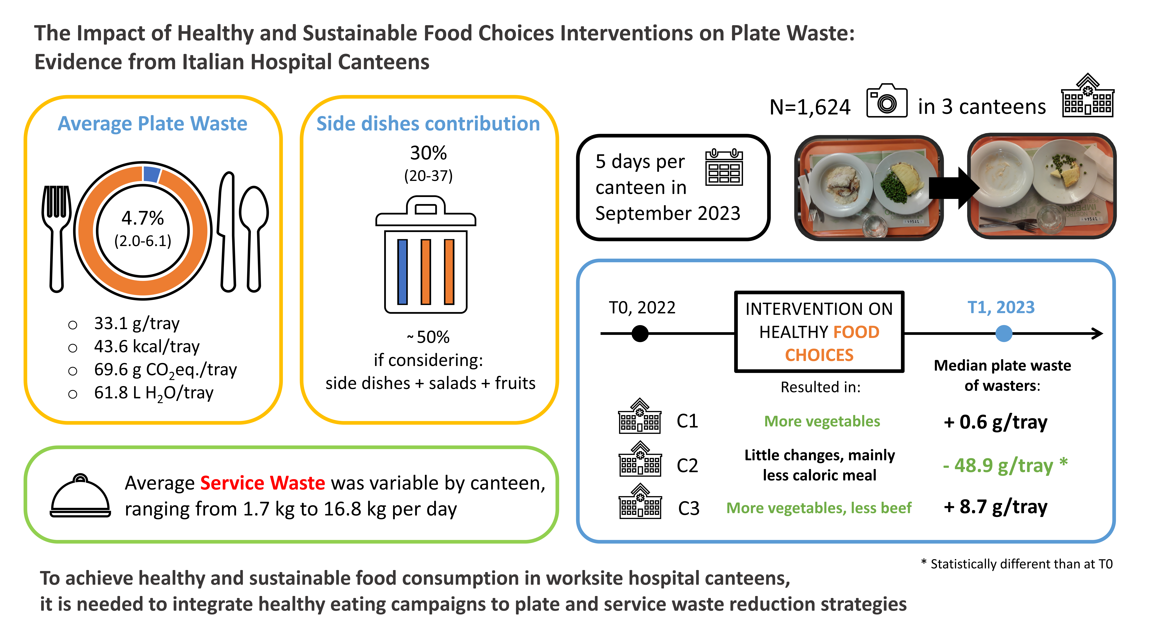
Healthy and sustainable food consumption implies not only making conscious food choices but also limiting waste. In fact, interventions targeting choices are effective only if the healthier food selected is not wasted on the plate. The aims of the study were: to quantify plate and service waste in hospital canteens; to characterize plate waste (PW) composition and environmental indicators; to compare PW before and after an intervention to improve food choices. Trays of users who gave consent were photographed (N=1,624) in three hospital canteens in Italy. PW was quantified visually, and energy, nutrients, and environmental indicators were estimated using portion sizes and recipes provided by canteen staff. PW was 4.7% (2.0-6.1% by canteen), corresponding on average to 33.1 g/tray, 43.6 kcal/tray, 69.6 gCO2 eq./tray and 61.8 LH2O/tray. Side dishes contributed the most to total PW (30%). The canteen where PW had decreased significantly (median among wasters: -48.9 g/tray) was the one with the poorest result in food choices. PW increased, though not significantly, in the other two canteens. Service waste analysis revealed considerable variability, probably driven by canteen management. In conclusion, the present study highlights the importance of including plate and service waste in public health campaigns.
Keywords:
food waste
; service waste
; workplace canteen
; lunch
; carbon footprint
; water footprint
; sustainability
; energy
; nutrients
Copyright: This open access article is published under a Creative Commons CC BY 4.0 license, which permit the free download, distribution, and reuse, provided that the author and preprint are cited in any reuse.


