

Submitted:
05 May 2026
Posted:
07 May 2026
You are already at the latest version
Abstract
Tropical mid-size cities on alluvial floodplains face compounded flood challenges com-bining pluvial accumulation from intense convective storms, regulated river overflow, and aging drainage networks. This study presents an integrated framework for Mon-teria, Colombia (~450,000 inhabitants; Sinu River, Caribbean lowlands), within Colom-bian Decree 1807/2014 and structured in four phases. (1) Hazard: a Rain-on-Grid 2D HEC-RAS 6.6 model covering 4,090 ha, calibrated against four gauged events, identifies three dominant pluvial mechanisms (poor hydraulic connectivity, limited evacuation capacity, downstream channel overflow), plus 17 critical fluvial erosion points affecting ~289 properties at 100-year return period. (2) Vulnerability: depth-damage functions from 1,465 household surveys yield 36.36% of 3,015 assets in high risk, 57.77% in medium risk. (3) Measures: scenario M2 (channel widening plus dikes, land-raising, retention lagoons) removes 80 ha of flooding while displacing 28 ha at COP 845 million pre-design cost. Non-structural measures include a Sustainable Urban Drainage Master Plan, IoT-based Early Warning System, minimum construction-elevation map, and land-management instruments. A Monte Carlo residual-risk model reduces baseline risk to 19.9% under full implementation. (4) Emergency: a February 2026 cold-front event was addressed with a 4,300 m perimeter dike and six pump stations deployed jointly by the Regional Environmental Authority (CVS) and Municipal Administration.
Keywords:
urban flood modeling
; HEC-RAS 2D
; depth-damage functions
; structural mitigation
; non-structural measures
; nature-based solutions
; perimeter dike
; Sinu River
; Monteria
; Colombia
1. Introduction
Flood risk in tropical cities of the Global South is shaped by rapid urban growth on low-gradient floodplains, insufficient drainage infrastructure, and a rainfall regime dominated by high-intensity, short-duration convective events [1,2]. Monteria, capital of the Cordoba department in the Colombian Caribbean, exemplifies this compound vulnerability: the city sprawls across the right bank of the Sinu River at elevations of 15–30 m above sea level, its drainage system relies on a network of open macro-drainage channels whose hydraulic capacity has not kept pace with urban expansion, and its built environment is predominantly composed of single-story cement-block structures with minimal freeboard against shallow inundation [3,4].
Since the Urra I hydroelectric dam commenced operation in 2000, fluvial flood risk from the Sinu has been substantially attenuated: peak discharges and stages have declined and direct river overtopping of the urban perimeter now occurs only for return periods exceeding 25 years, specifically along Street 41 on the right bank [5]. Paradoxically, this regularization has shifted public and institutional attention away from pluvial flooding, which remains the dominant hazard mechanism. Inundations in Monteria are governed by the accumulation of storm-runoff in flat urban depressions with poor connection to the channel network — a process characterized by high water depths but flow velocities generally below 1 m/s [6,7].
The Colombian regulatory framework further shapes the problem. Decree 1807 of 2014 regulates article 189 of Decree-Law 019 of 2012 and requires the incorporation of risk management into Land Use Plans (Planes de Ordenamiento Territorial, POT), establishing risk as a conditioning factor for land use and occupation with the explicit aim of avoiding the configuration of new risk conditions. Basic studies allow the delimitation and zoning of hazard areas (high, medium, low) and the identification of areas with hazard and risk condition, in which Detailed Flood Risk Studies (Estudios Detallados de Riesgo por Inundacion, EDRI) must be undertaken. These studies determine the risk categorization and establish mitigation measures, which may be structural (physical works) or non-structural (urban planning standards, early-warning systems), and which must be pre-dimensioned on cartography at pre-design level with the corresponding cost estimate.
Despite the scientific maturity of two-dimensional shallow-water hydraulic models for urban flood simulation [31,32] and of depth-damage functions for flood loss quantification [9,10], their integrated application in intermediate Colombian cities remains uncommon. The absence of calibrated local models produces two compounding deficiencies: overconfident hazard zonification that misclassifies ponding as low-risk, and under-calibrated vulnerability curves that either over- or under-estimate economic losses. Furthermore, the link between the scientific risk assessment and the operational intervention — both long-term structural-prospective and rapid-onset emergency — is rarely formalized, leaving events such as the February 2026 cold-front episode that inundated communes 1 and 2 of Monteria without a pre-validated technical framework for containment and evacuation.
This paper addresses these gaps through a four-phase integrated framework: (i) a quantitative hazard characterization using a calibrated and validated Rain-on-Grid 2D hydrodynamic model covering 4,090 ha of the urban perimeter, together with a cold-front-driven Sinu River simulation; (ii) a probabilistic urban risk assessment employing locally derived depth-damage functions and field survey data from 1,465 households; (iii) a portfolio of structural and non-structural intervention measures, pre-dimensioned and articulated along four management axes, with their residual risk quantified through Monte Carlo simulation; and (iv) a real-event emergency response designed and implemented during the February 2026 cold-front inundation, grounded in field-documented water-level elevations and hydraulic analysis of drainage exit options. Together, these phases constitute a replicable governance framework for flood management in Caribbean Colombian cities under the projected intensification of extreme precipitation associated with climate change [1].
2. Study Area
Monteria is situated on the bank of the Sinu River in the Caribbean lowlands of Colombia. The urban perimeter covers approximately 4,090 ha at low elevations, with the river forming a natural eastern boundary and a network of 15 primary macro-drainage channels transporting pluvial runoff westward toward peripheral discharge points. The hydrological setting is characterized by a bimodal rainfall regime with a principal wet season from May to November (September being the most intense month) and a pronounced dry season from December to April. Mean annual precipitation in the urban area ranges from 1,240 to 1,413 mm across the 15 monitoring stations analyzed.
The geomorphology is characterized by a very low gradient (mean slopes of 0.0003–0.0017 m/m in the principal drainage sub-catchments), alluvial deposits with moderate to low infiltration capacity (Hydrologic Soil Groups B and C dominating), and the presence of urban wetlands — notably the Berlin wetland on the left bank — that interact dynamically with the channel network during extreme events. These extremely low slopes — up to two orders of magnitude below the thresholds for which kinematic-wave and 1D routing assumptions remain reliable — constitute the primary methodological justification for adopting a fully 2D Rain-on-Grid approach over lumped or 1D hydrological schemes, since at such gradients backwater effects, bidirectional flow exchange between streets and channels, and ponding dynamics cannot be reproduced by methods that assume a dominant downstream flow direction.
The left bank of the Sinu, encompassing communes 1 and 2, is particularly exposed to compound flooding. Storm-runoff from the La Caimanera sub-catchment — bounded by the Serrania de Abibe to the west, the Sinu River to the east, the Las Palomas corregimiento to the south, and La Madera (San Pelayo) to the north — accumulates in low-lying areas adjacent to the Berlin wetland, and the absence of an adequate perimeter containment barrier allows lateral intrusion of wetland water into the urban fabric during sustained wet spells. This sub-catchment is articulated by two principal streams: Caño Viejo (Caño del Bien Común), which collects runoff from the Serrania de Abibe, and Caño La Caimanera (Caño El Vidrial), together with a network of minor channels and swamp-type water bodies that function as an integrated hydrological system.
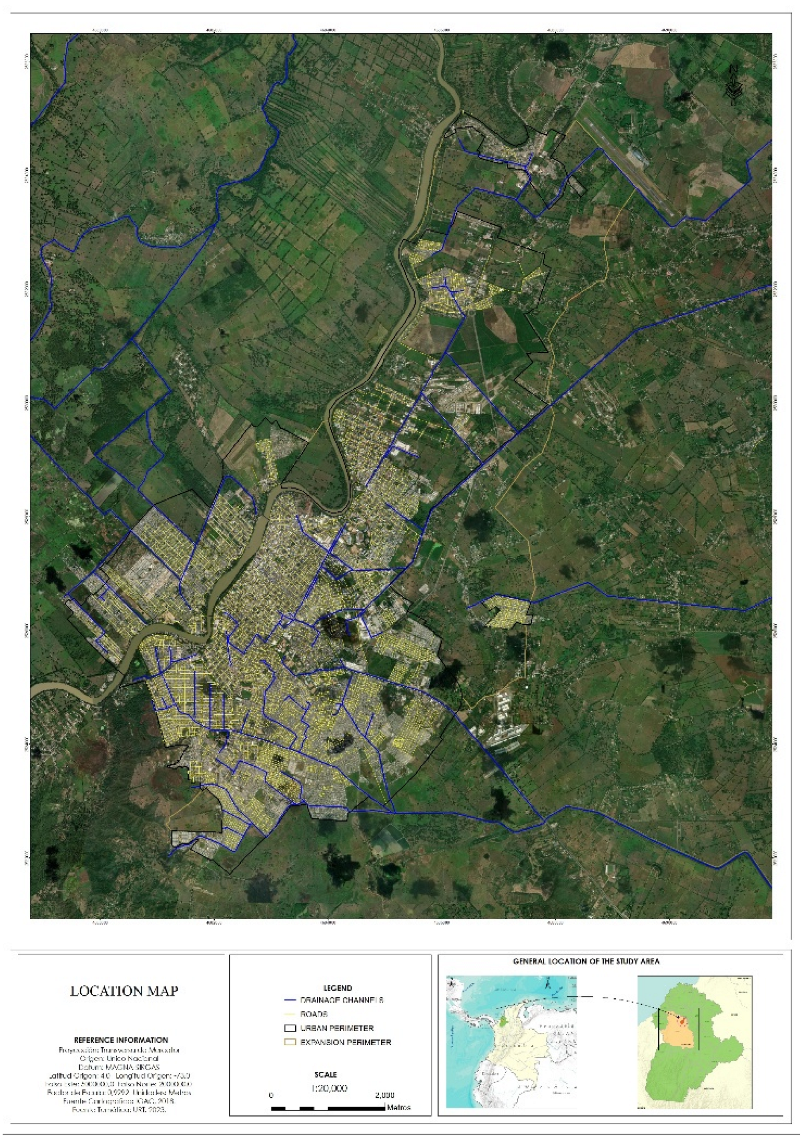
Figure 1.
Location of the study area: Monteria urban perimeter.
3. Materials and Methods
This section describes the rainfall analysis, the hydraulic model setup and calibration, the hazard–vulnerability–risk assessment workflow, the formulation of structural and non-structural intervention measures, and the residual-risk modeling framework. The complete chain links meteorological forcing to design-level mitigation alternatives, including the cold-front-driven simulation that supported the February 2026 emergency response.
3.1. Rainfall Analysis and Design Storms
Daily precipitation records from 15 IDEAM stations within and surrounding Monteria were used. Records span 1960–2024, with all stations retaining more than 80% data availability after removal of years with more than 20% missing observations [11]. Consistency was verified through double-mass analysis (coefficient of determination greater than 0.997 for all pairs), and stationarity was assessed via the Mann–Kendall trend test and the U-test for change in the mean. Intensity–Duration–Frequency curves were synthesized following Vargas and Díaz-Granados [16] for the Caribbean hydrological region, and design storms for return periods of 2.33, 5, 10, 25, 50, and 100 years were generated for use as forcing in the hydrodynamic model.
3.2. Rain-on-Grid 2D Hydrodynamic Model
The flood model was built in HEC-RAS 6.6 using a fully integrated distributed hydrological–hydrodynamic (Rain-on-Grid) approach in which rainfall is applied directly to each computational cell and the shallow-water equations govern the two-dimensional momentum-conserving routing of runoff and channel flow [8]. This methodology is particularly suited to the low-gradient, highly interconnected surface drainage of Monteria, where the distinction between overland and channel flow is blurred and empirical unit-hydrograph methods systematically underestimate travel times and flood depths [7]. The computational mesh was developed from a 20-cm-resolution photogrammetric Digital Terrain Model coupled with detailed bathymetric surveys of the Sinu River and 43 macro-drainage channels. Three mesh refinement levels were tested for mesh-independence: Mesh-A (coarse: 30 m in streets, minimum 1 cell per channel width), Mesh-B (intermediate: 20 m in streets, minimum 1.5 cells per channel width), and Mesh-C (fine: 10 m in streets, more than 2 cells per channel width). Independence was assessed by analyzing the invariance of the outlet hydrograph produced under a constant, spatially uniform rainfall applied over the principal urban sub-catchments; Mesh-C was adopted for all production simulations when the peak discharge and hydrograph shape converged with Mesh-B to within 3%. Surface roughness (Manning’s n) was assigned by land-cover class following Chow [12]: continuous urban fabric n = 0.018, discontinuous urban fabric n = 0.029, and roads n = 0.017. Runoff was partitioned using the SCS Curve Number method [17] under antecedent moisture condition CN(III) (wet), consistent with the sequential intense rainfall characteristic of the Caribbean wet season.
The model was calibrated with 16 liquid gauging records from the Urra I power-plant team (2000–2018) at the Monteria Autonoma limnimetric station. For discharges below 600 m³/s the best-fit Manning’s value was n = 0.055; for peak discharges above 700 m³/s (the range relevant to extreme-event simulation) n = 0.06. The calibrated model was validated against observed water levels along Street 41 for two documented river-overflow events: 23 August 2007 and 17 December 2010, with simulated water levels matching observations with errors below 1%. Urban drainage performance was additionally validated against two intense pluvial events recorded at the Aeropuerto Los Garzones pluviograph: 1 August 2024 and 1 November 2024. Both events generated macro-drainage collapse and were documented through a community survey campaign using ArcGIS Survey123, which collected over 300 georeferenced depth measurements across 12 neighborhoods.
3.3. Channel Hierarchy and Lateral-Inflow Extraction
For the mitigation analysis, channels were ordered hierarchically: first-order channels receive runoff directly from urban surfaces, while higher-order channels collect and convey lower-order contributions progressively toward the main channel. The nomenclature combines a sub-catchment prefix (e.g., CC for Canta Claro) and ascending numbering: first-order channels CC1, CC2, CC3; second-order channels CC_11, CC_12; third-order channels CC_21, CC_22; up to the outlet channel. Numbering follows a clockwise direction starting from the lower-left corner of the sub-catchment. This system is an adaptation of the Strahler [21] and Shreve [22] classifications to the particularities of Monteria’s urban drainage and enables a clear database identification of every reach.
The model separates effective precipitation from total precipitation and propagates the excess through the sub-catchment to the macro-drainage channels as lateral inflow. Second-order and higher channels additionally receive the accumulated discharges from upstream reaches, and the lateral contribution of each reach is computed as Q_lat = Q_downstream − Q_upstream. Zero or negative results were interpreted as absence of contribution — due to low runoff, very short reaches, or losses associated with potential overflows. This procedure distinguishes reaches that merely convey flow from those that actively contribute to it, which is essential for prioritizing structural interventions.
3.4. Hazard Classification
Flood hazard was classified into three categories following adapted Colombian technical guidance [11,13], calibrated to the specific hydrodynamic character of Monteria’s pluvial inundation (low velocity, high ponding depth). High hazard corresponds to depths ≥ 0.4 m and/or velocities ≥ 1.0 m/s; medium hazard to depths of 0.2–0.4 m and velocities of 0.5–1.0 m/s; low hazard to depths below 0.2 m and velocities below 0.5 m/s.
The threshold h = 0.4 m for high hazard was selected based on the IDEAM damage-progression scale and validated empirically. Analysis of 12,551 randomly sampled depth pixels (0.2 m resolution; 3.35 × 10⁹ total pixels) confirms that 65.0% of pixels exceed 0.2 m and 42.5% exceed 0.4 m for the 100-year event. Velocity thresholds were correspondingly adapted, recognizing that only 20.4% of pixels reach v ≥ 0.5 m/s and only 10.7% exceed 1.0 m/s — a distribution consistent with the low-gradient, ponding-dominated hydrodynamic regime that distinguishes Monteria from high-velocity alluvial-fan or mountainous urban settings.
3.5. Vulnerability and Risk Assessment
Urban blocks within the POT 2021–2033 risk polygons were identified through GIS location-selection. Critical facilities (hospitals, schools, public administration, emergency services) were extracted from the POT base cartography and spatially intersected with the risk polygon. Building-level exposure was characterized by 1,465 household surveys (ArcGIS Survey123; 45 neighborhoods; multicriterion geographic quadrant sampling) and 156 commercial-zone interviews.
Vulnerability was expressed through depth-damage functions following Cardona [14] and Salazar [4], giving the expected fractional loss E(p|s) as a function of flood intensity s (maximum depth h): E(p|s) = 1 − exp[ln(0.5) · (s/s₀)^ε], where s₀ is the intensity producing 50% expected loss and ε governs the curve slope. For the central commercial zone, local curves were fitted directly from field interview data (s₀ = 1.20 m, ε = 2.00); for residential and peripheral areas, functions calibrated on the La Mojana Caribbean floodplain [15] were adjusted to Monteria’s predominant cement-block typology using correction factors derived from survey damage ratios (s₀ = 1.50 m, ε = 1.85 for one-story cement-block dwellings). Risk was computed as the convolution of hazard and vulnerability over exposed elements, producing two risk maps — one considering only exposed buildings and another that additionally incorporates road infrastructure as an exposed asset.
3.6. Hydraulic Assumptions for Structural Measures
For the definition of structural measures associated with macro-drainage, an integral urban-drainage analysis was carried out for a design event with a 100-year return period, based on two main premises. First, all runoff water that previously ponded in some areas is now assumed to reach the channels — that is, the micro-drainage system is assumed to convey the entire rainfall excess to the macro-drainage — so that the resulting flood patches correspond only to inundations due to macro-drainage overflow. Second, the most critical projected urban-expansion scenario is considered to evaluate its effect under current drainage conditions and under scenarios with mitigation measures implemented, specifically in the Villa Cielo sector where the expansion affects the coverage of the sub-catchment draining to the main collector channel.
Discharge hydrographs extracted from the flood model were used as input to each macro-drainage channel. Since the total volume of the raw hydrographs
is smaller than the excess precipitation volume
because the rainfall-excess volume retained in ponded areas does not reach the channels — the hydrograph Q is multiplied by a correction factor
so that the corrected discharge
generates a rainfall volume equal to the total rainfall excess. This volume-conservation correction is essential to prevent systematic underestimation of design discharges in the channel-capacity analysis.
3.6.1. Urban Expansion Scenarios (Villa Cielo)
For the Villa Cielo expansion area, a weighted Curve Number of CN = 75.12 was computed over the 5.27 km² polygon under current conditions, in which more than 90% of the surface is covered by forested and weedy pastures (Table 1). Five prospective land-use scenarios were then defined, ranging from fully discontinuous urbanization (Scenario 1, CN = 77) to fully continuous urbanization (Scenario 5, CN = 89), including intermediate 25/75, 50/50, and 75/25 mixes. Each scenario was evaluated with the SCS method to estimate maximum discharges for several return periods (Table 2). The resulting direct-runoff hydrographs were propagated through the main collector channel to evaluate how progressive urbanization modifies the hydraulic response of the expansion sector.
3.7. Sinu River Modeling
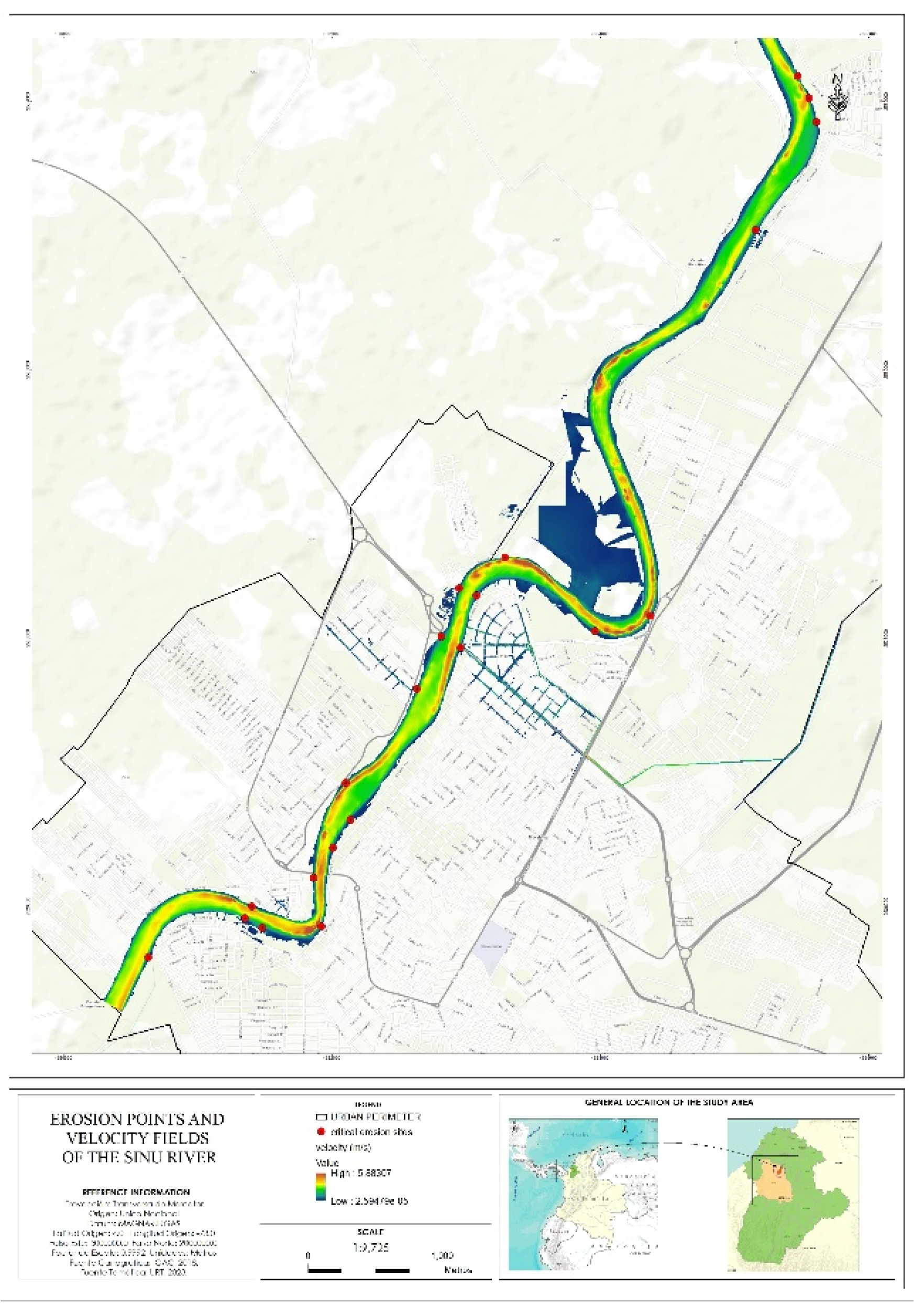
Along the urban reach, the Sinu River presents approximately 17 points of observed fluvial erosion (points of higher shear stress) according to observations by the Regional Environmental Authority (Corporación Autónoma Regional de los Valles del Sinú y del San Jorge, CVS) and to the hydraulic-modeling results of this consultancy. In these reaches, flow velocity and water force are directed toward the outer bank of the curve, generating intense pressure that undermines and erodes the ribera material; the inner banks tend to experience lower shear stress and accumulate sediments. Hydraulic modeling shows that, for a 100-year return period, a discharge of 1,021 m³/s causes the Sinu to overflow into its floodplain, generating inundations in the sector and affecting approximately 289 identified properties.
A dedicated cold-front-driven simulation was performed to reproduce the February 2026 emergency scenario on the left bank. Unlike the convective storms that dominate the wet season, cold-front forcing delivers sustained multi-day rainfall that saturates soils and progressively overwhelms the discharge capacity of the La Caimanera sub-catchment. This simulation provided the hydraulic context for the emergency response described in Section 6 and informed the design basis for the 4,300 m perimeter dike and the six pump-station sectors.
Figure 2.
Identification of critical erosion points and velocity fields of the Sinu River in the urban perimeter (100-year return period).
Figure 2.
Identification of critical erosion points and velocity fields of the Sinu River in the urban perimeter (100-year return period).
4. Results
4.1. Flood Hazard: Mechanisms and Spatial Distribution
The calibrated and validated 2D hydrodynamic model identifies three dominant mechanisms governing pluvial inundation in Monteria for the 100-year event. Mechanism 1 (dominant) is poor hydraulic connectivity: surface runoff accumulates in urban blocks with limited or obstructed connections to the macro-drainage channel network, producing high ponding depths (up to 1.5 m in depressed blocks) and very low velocities (centimeters per second). Mechanism 2 is limited drainage evacuation capacity, where flat or adverse hydraulic gradients at channel-bed level prevent rapid gravitational drainage during the storm peak — particularly evident in the INAT sub-catchment and Villa Cielo. Mechanism 3 is downstream channel overflow, observed mainly at the most downstream reaches of the collector network near the urban periphery.
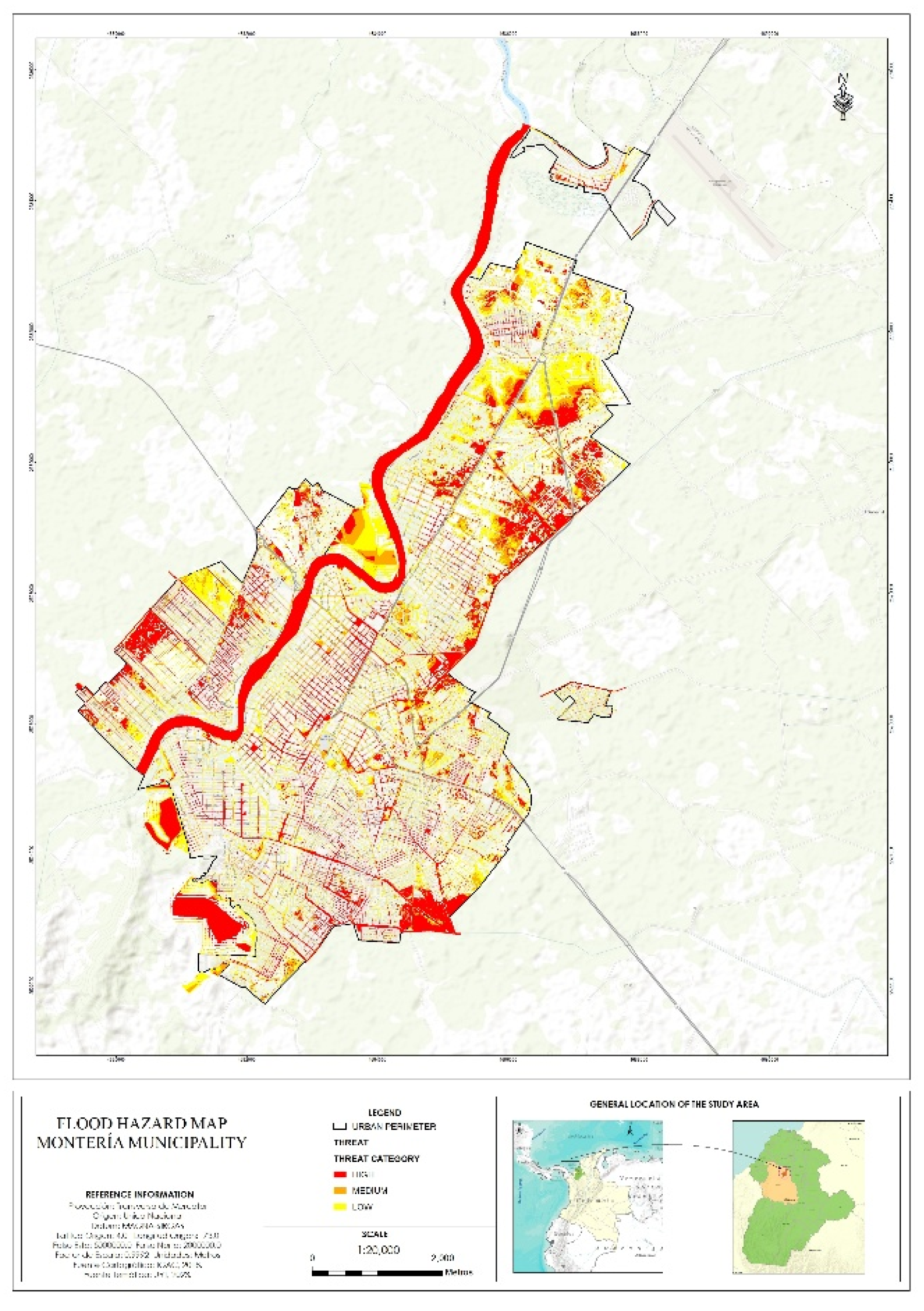
Furatena II leads the neighborhood ranking of absolute high-hazard area with 14.07 ha, followed by San Jeronimo (10.68 ha) and Los Mangos (10.35 ha). The proportional analysis reveals that Barrio Villa Norte has more than 50% of its total area classified as high hazard despite ranking 12th in absolute area. Aggregated across all 205 neighborhoods, the high-hazard category (depth ≥ 0.4 m and/or velocity ≥ 1.0 m/s) covers approximately 375 ha (9.2% of the 4,090 ha urban perimeter); medium hazard (depth 0.2–0.4 m; velocity 0.5–1.0 m/s) accounts for approximately 560 ha (13.7%); and the remaining area is classified as low hazard or outside the inundation envelope. The Sinu River contributes to direct urban inundations only for return periods exceeding 25 years and exclusively at Street 41 (right bank). The 100-year peak discharge at Monteria is 837.7 m³/s; since Urra I commenced regulation in 2000, the historical maximum stage has declined, and the river’s conveyance capacity has increased.
Figure 3.
Detailed hazard map for the city of Monteria (100-year return period).
4.2. Urban Flood Risk: Exposure, Vulnerability, and Asset Classification
Spatial intersection of the 100-year inundation raster with POT risk polygons identified 2,452 exposed urban blocks. The distribution is heterogeneous across communes: Commune 4 concentrates the highest count with 659 blocks (566 in high hazard). A total of 121 strategic facilities lie within risk polygons, of which 65 (54%) belong to the educational sector — a critical finding given that schools serve dual roles as learning centers and emergency shelters during disaster events.
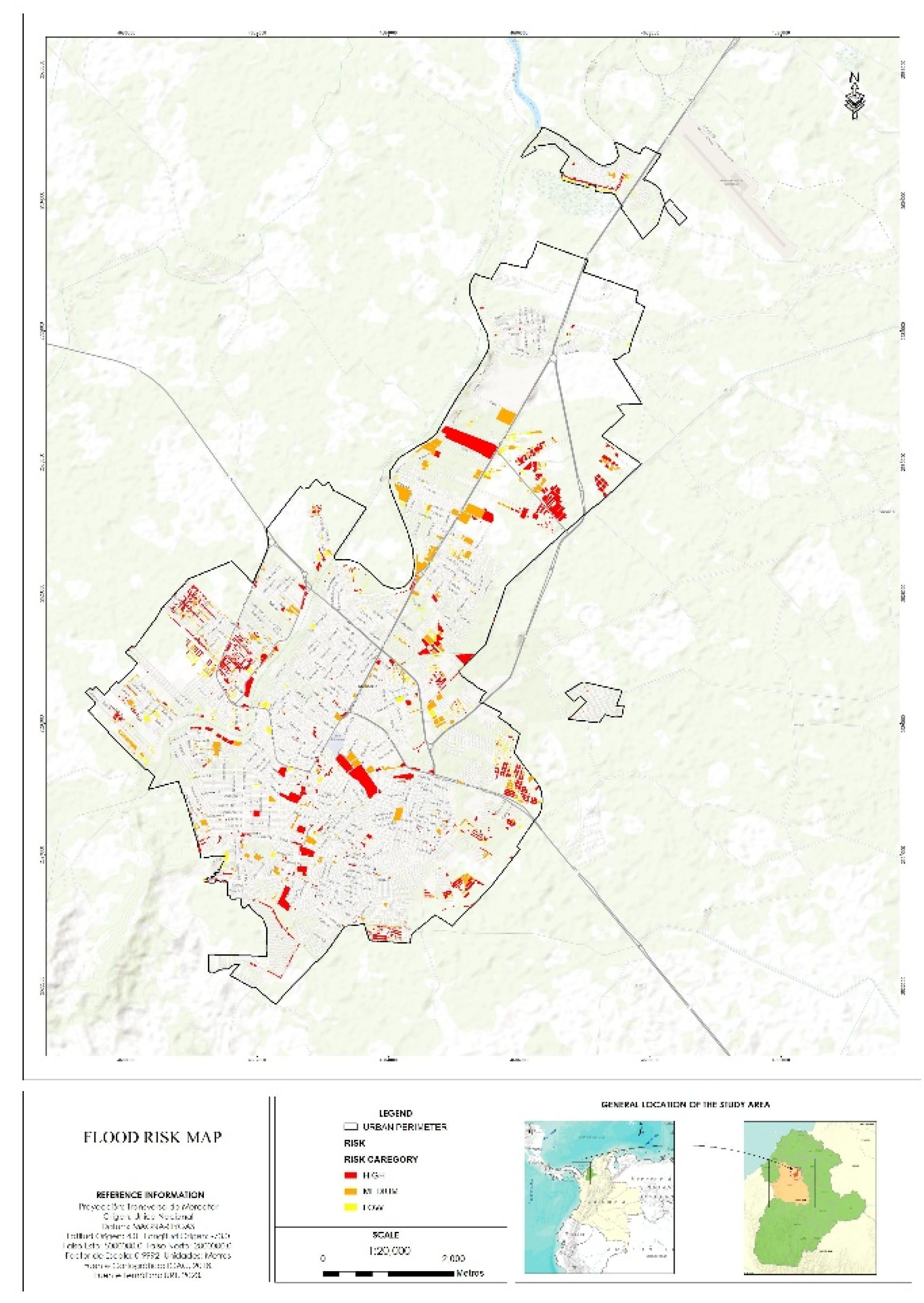
Of 3,015 urban assets scored, 36.36% were classified as high risk, 57.77% as medium risk, and only 5.91% as low risk. The near-absence of low-risk assets reflects the fundamentally flat, poorly drained urban morphology of Monteria, where genuinely safe zones are scarce. High-risk concentrations align with the fluvial margins of the Sinu (289 properties within the 100-year hydraulic corridor) and with channel hydraulic buffers (1,812 dwellings within 12 m of primary channel axes under medium or high hazard).
Survey data characterizes the social dimensions of vulnerability. Wall materials are dominated by cement block (70.78%), reinforced concrete (17.04%), and fired brick (10.32%), with timber representing only 1.45%. Among households reporting flood water entry (26.5% of the sample), 65.9% rehabilitate within one month, indicating rapid recovery capacity for shallow events. Critically, 30.1% of respondents rated their neighborhood drainage system as inadequate, and neighborhoods with high proportions of residents with physical or mental disabilities — Cantaclaro (26), La Gloria (25), Portal de La Candelaria (20) face amplified evacuation risk.
Figure 4.
Detailed flood risk map for the city of Monteria.
4.3. Ranking of Priority Hotspots
To support the spatial prioritization of mitigation, the 205 urban neighborhoods were ranked by both absolute and relatively high-hazard area. The mean high-hazard area per neighborhood is 1.83 ha and the median is 0.86 ha, reflecting a highly skewed distribution in which a small number of neighborhoods concentrate most of the hazard. Furatena II, San Jeronimo, Los Mangos, and Portal de La Candelaria emerge as the absolute hotspots, while Barrio Villa Norte stands out in the relative ranking with more than 50% of its territory in high hazard. The combination of both rankings guides the allocation of structural interventions (channel widening, ground-level raising) and non-structural measures (minimum-elevation compliance, land-management instruments) to the neighborhoods where the expected return on risk reduction is highest. The integration of this ranking into the CURBA platform (see Section 5.2.4) enables the municipal Planning Secretariat and the urban curadurías to translate these technical findings directly into licensing decisions.
5. Intervention Measures
All the analyses carried out indicate that the flood risk in the city of Monteria has the connotation of mitigability in the already-consolidated urban zone and additional mitigation potential in zones that remain urbanized, provided that gradual measures are applied. The general approach for flood management in Monteria is aligned with the planning defined in the POT 2021–2032 regarding peak stormwater discharges, which requires all new developments to reduce by at least 50% the maximum discharge hydrogram (comparing runoff with and without project) and to address the remaining 50% through recovery and expansion of the urban drainage channel system (new drainage systems, rehabilitation of existing systems, new SUDS-type structures). According to the proposed methodology, measures are organized along four axes — Sinu River, Macro-drainage, Micro-drainage, and New residential and building developments — and for each axis structural and non-structural (prospective) typologies are defined.

Table 3.
Structural and non-structural typologies per management axis (adapted from Decree 1807/2014 framework). The non-structural column spans conceptually distinct sub-categories — land-use planning instruments, early-warning technology (SAT), and financial risk-transfer tools — which correspond respectively to the Governance, Enabling conditions, and Economic sub-categories of the IPCC AR6 adaptation taxonomy [1].
Table 3.
Structural and non-structural typologies per management axis (adapted from Decree 1807/2014 framework). The non-structural column spans conceptually distinct sub-categories — land-use planning instruments, early-warning technology (SAT), and financial risk-transfer tools — which correspond respectively to the Governance, Enabling conditions, and Economic sub-categories of the IPCC AR6 adaptation taxonomy [1].
| Axis | Structural | Non-structural (prospective) |
|---|---|---|
| Sinu River | N/A | Relocation of exposed assets; bank-stability studies for new developments; formal 12 m ronda delimitation |
| Macro-drainage | Channel optimization (section, dikes, land-raising, retention lagoons) | 12 m buffer |
| Micro-drainage | Channel section optimization | 12 m buffer; cleaning and maintenance; water parks; downtown drainage plan |
| New developments | N/A | Sustainable construction code; minimum-elevation map; land-management instruments; SAT; CURBA |
5.1. Structural Measures: Scenarios M1 and M2
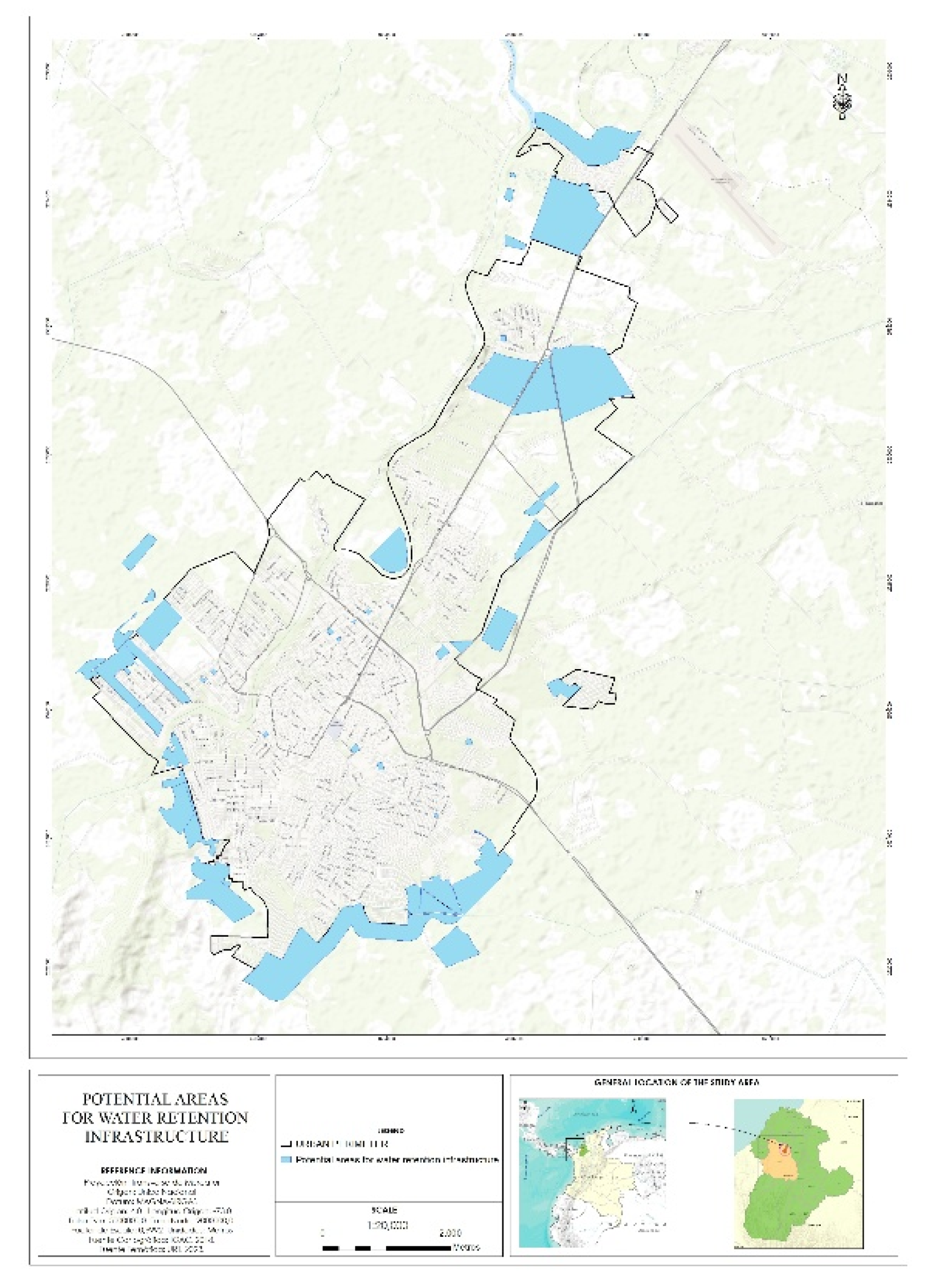
Two structural mitigation scenarios were evaluated. M1 includes channel widening in strategic reaches. M2 combines M1 with three additional components: raising the ground level in the vicinity of the confluence of the southern channels and in the northern zone near the Buenavista Shopping Center; incorporation of protection dikes in the main collector channels; and use of the north-eastern lagoons — no longer functioning as a wastewater treatment system — as a retention and peak-regulation system. These lagoons connect to the INAT channel at the Monteverde neighborhood through a system analogous to an overflow weir: water enters the lagoon during the peak and returns to the same channel further downstream, regulating the discharge that transits through the channel.
Figure 5.
Planimetric location of the proposed mitigation measures (channel widening + weirs + fillings + retention lagoons like wetlands and urban water parks).
Figure 5.
Planimetric location of the proposed mitigation measures (channel widening + weirs + fillings + retention lagoons like wetlands and urban water parks).
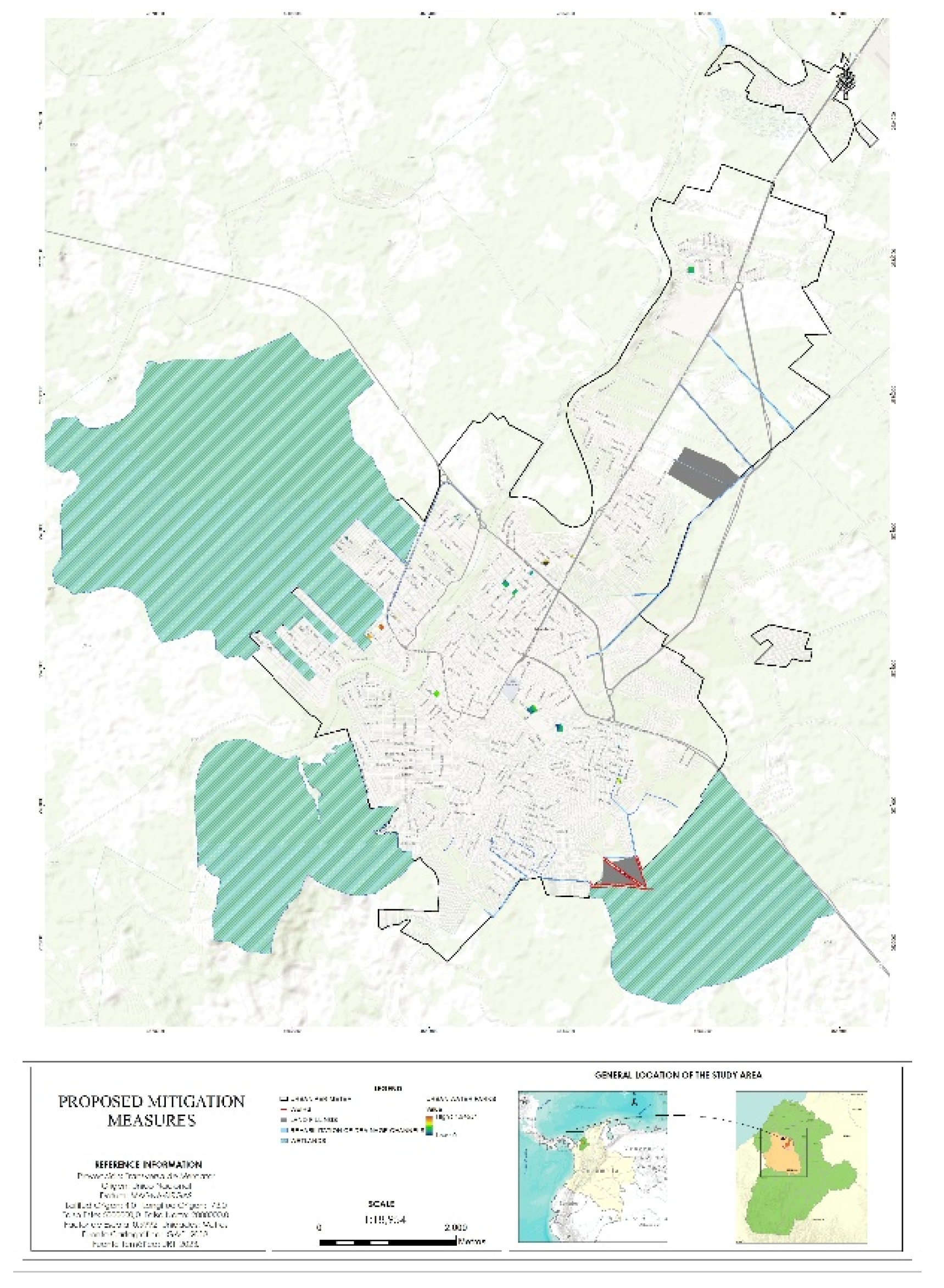
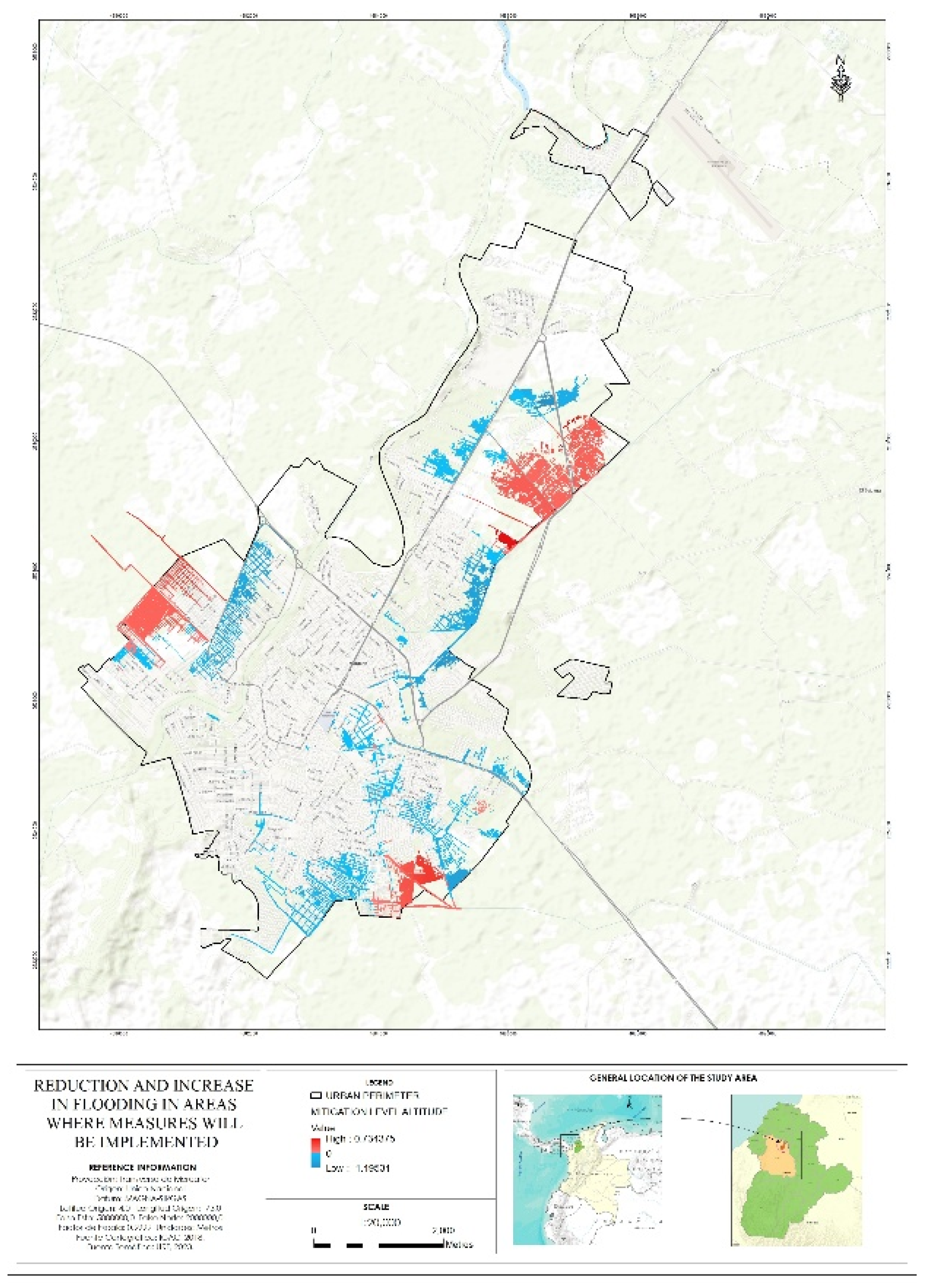
M1 results indicate reductions greater than 15 cm in flood elevation in the initial reaches of the modifications but increases of level in the final reaches because the widening enables faster evacuation, which increases downstream peak discharges and therefore the inundated area. Increases were equal to or less than 5 cm at the outlet of the Purgatorio channel and on the left bank. Overall, 24 hectares were removed from the inundated area, and 12 new hectares were added.
Under M2, reductions greater than 15 cm in flood elevation were observed in the initial reaches, analogous to M1, but the magnitude of the reduction is greater and the increase of level in the final reaches is concentrated around the fillings due to flood displacement. In total, 80 hectares of area no longer flood (including filled areas) and 28 hectares of new flooded areas emerge. At the local scale, at the height of the Monte Verde neighborhood at the INAT channel confluence, the flooding was completely eliminated. The most important assumption of this model is that the entire city drains perfectly toward one of the channel systems and what is analyzed is the hydraulic capacity of the channels to handle this discharge integrally. Ponding must therefore be resolved through the Sustainable Urban Drainage Master Plan (PMDUS) once implemented.
Figure 6.
Effect of Measure on the inundated area (80 ha removed in blue, 28 ha added in red).
These costs are estimates based on a pre-dimensioning that considers only the optimization of the hydraulic capacity of the system and does not include other costs. To refine this value, the corresponding technical, economic, social, and environmental feasibility studies must be carried out.
5.1.1. Urban Drainage Plan for the Downtown Area
An additional structural alternative is the Urban Drainage Master Plan for the Downtown Area developed by Veolia Consulting for the Mayor’s Office of Monteria [26]. It has a direct scope of approximately 296 ha, corresponding to the downtown area from Circunvalar Avenue to Carrera 1 and from Street 21 to Street 44 with Carrera 2. The study area comprises 25 neighborhoods with 49,140 inhabitants; the project also benefits the 27,088 inhabitants of the Monteverde sector. The plan includes widening of the South Collector Channel from Av 9 with Street 22 to Street 27 with Circunvalar Ave, adaptation of the Street 21 channel, widening of the Central Collector Channel from Street 29 to Street 41, and construction of an overflow weir or gate at Street 41. The budget is COP 41,750,647,354 for Stage I and COP 45,922,677,282 for Stage II, including AIU, supervision, and Ministry of Housing review. Feasibility studies are required before execution, given the proposal to use the Sinu as a receiver of treated pluvial waters.
5.2. Non-Structural Measures
5.2.1. Sinu River Ronda Management
The actions contemplated within this measure include, first, the resettlement and relocation of exposed assets that show high vulnerability to flooding due to overflow of the Sinu River, with approximately 35 properties identified in the Municipal property database overlapping with the 100-year flood raster, medium- to long-term execution deadlines, and funding from UNGRD, the Adaptation Fund, or municipal resources. Second, technical recommendations for new urban developments: detailed bank-stability studies of the Sinu (including geophysical tests, shear-strength tests, and slope modeling) are considered a priority, generating recommendations for slope-stabilization works to reduce the probability of a dike-failure event that may generate a breach-induced flood.
5.2.2. Sustainable Urban Drainage Master Plan (PMDUS)
According to hydraulic modeling, the identified mechanisms in urban drainage are (i) poor connection with main channels, (ii) low evacuation capacity, and (iii) channel overflow and accumulation in low-lying areas. The consultancy for the PMDUS is estimated at around COP 300 millions, and its main products are the detailed engineering of each of these problems. It articulates four integrated components.
First, urban-drainage management at the dwelling and building level: a minimum 50% reduction of the maximum discharge hydrogram in new developments is required, exceeding the national requirement of the RAS Technical Regulation (MVCT R330/2017 and its modifications) [25]. This measure targets new developments within the urban perimeter and the expansion area, with short-term implementation led by the Municipality and coordinated with the urban conservation district and the construction sector.
Second, optimization of the existing micro-drainage: the weakness of the micro-drainage network and its low connectivity with the macro-drainage is a critical challenge requiring a strategic and integral approach. Activities include identification and cartography of the existing micro-drainage network (gutters, inlets, secondary pipes) and its connection to the macro-drainage; analysis of design capacity versus actual capacity; condition evaluation; urban hydrological and hydraulic modeling; determination of design discharges for future infrastructure; and integration with the risk study.
Third, water parks (“giant sponges”): these parks are conceived to temporarily retain and store large volumes of rainwater through capture of the rainfall peak, temporary retention, controlled pumped evacuation, and residual-volume management through evaporation. The standardized parametric design has a maximum depth of 80 cm (including storage volume and freeboard); for the design storm, an event with a 25-year return period is selected — 95.0 mm in 1 h 23 min. Specific measures prevent vector proliferation, and OPEX is estimated at USD 0.55–2.20 per m²/year.
Fourth, channel cleaning, maintenance, and citizen awareness: deficiencies in citizen behavior (waste disposal into channels) are a recurrent factor in flooding. A comprehensive plan comprises continuous preventive maintenance (removal of garbage, sediment, and obstructing materials), correct sediment-disposal protocols, active collaboration with waste-collection companies as a strategic channel for household outreach, and permanent condition evaluation through regular inspections and technology (drones, sediment-level sensors). The reference unit cost reported for Monteria is COP 312,968.36 per linear meter.
Figure 7.
Location of potential areas for the implementation of water-retention infrastructure in the city of Monteria.
Figure 7.
Location of potential areas for the implementation of water-retention infrastructure in the city of Monteria.
5.2.3. Early Warning System (SAT) Integrated with Urban Mobility
An IoT-based SAT connected to the urban mobility system is proposed, based on four pillars. Monitoring integrates a network of IoT sensors for real-time river/channel stages and precipitation, three automatic meteorological stations, and a network of trained local observers providing contextual validation. Analysis processes data through IoT platforms and advanced hydrological-forecasting models to predict urban ponding (magnitude and duration), complemented by infiltration-capacity analysis to estimate excess water that the terrain cannot absorb. Dissemination combines SMS alerts, email notifications, sirens, megaphones, flags, and emergency-light systems to reach the maximum population — especially vulnerable communities with limited technological access. Preparation activates clear alarms, evacuation of risk zones, and continuous communication with the Monteria Risk Management Group, together with detailed evacuation plans and inter-institutional coordination.
Integration with the mobility system includes automatic identification of alternative routes based on real-time flood information, implemented through Intelligent Transportation Systems (ITS) that automatically divert traffic or adjust signal timing; variable-message signs (VMS), mobile applications, and on-road water-level sensors activating flashing warning beacons; and a unified command center integrating SAT and traffic-management data for real-time decision-making with transit authorities. The initial investment is estimated at COP 300 millions.
5.2.4. CURBA Integration and Minimum Construction-Elevation Map
CURBA is the Monteria municipal web-based information system, designed to administer land-use-concept requests; it uses QR codes to prevent plagiarism of land-use certificates and has a CURBA Rural version that functions as a GIS for predictive mapping. Integrating the detailed risk-study outputs (mitigable and non-mitigable high-risk zones, minimum construction-elevation criteria, structural determinants) directly into CURBA enables informed decision-making for urbanization, optimization of the licensing process (eliminating additional procedures currently required of developers and reducing costs and timelines), reduction of high-risk zones on the city’s risk cartography, and strengthening of proactive urban planning.
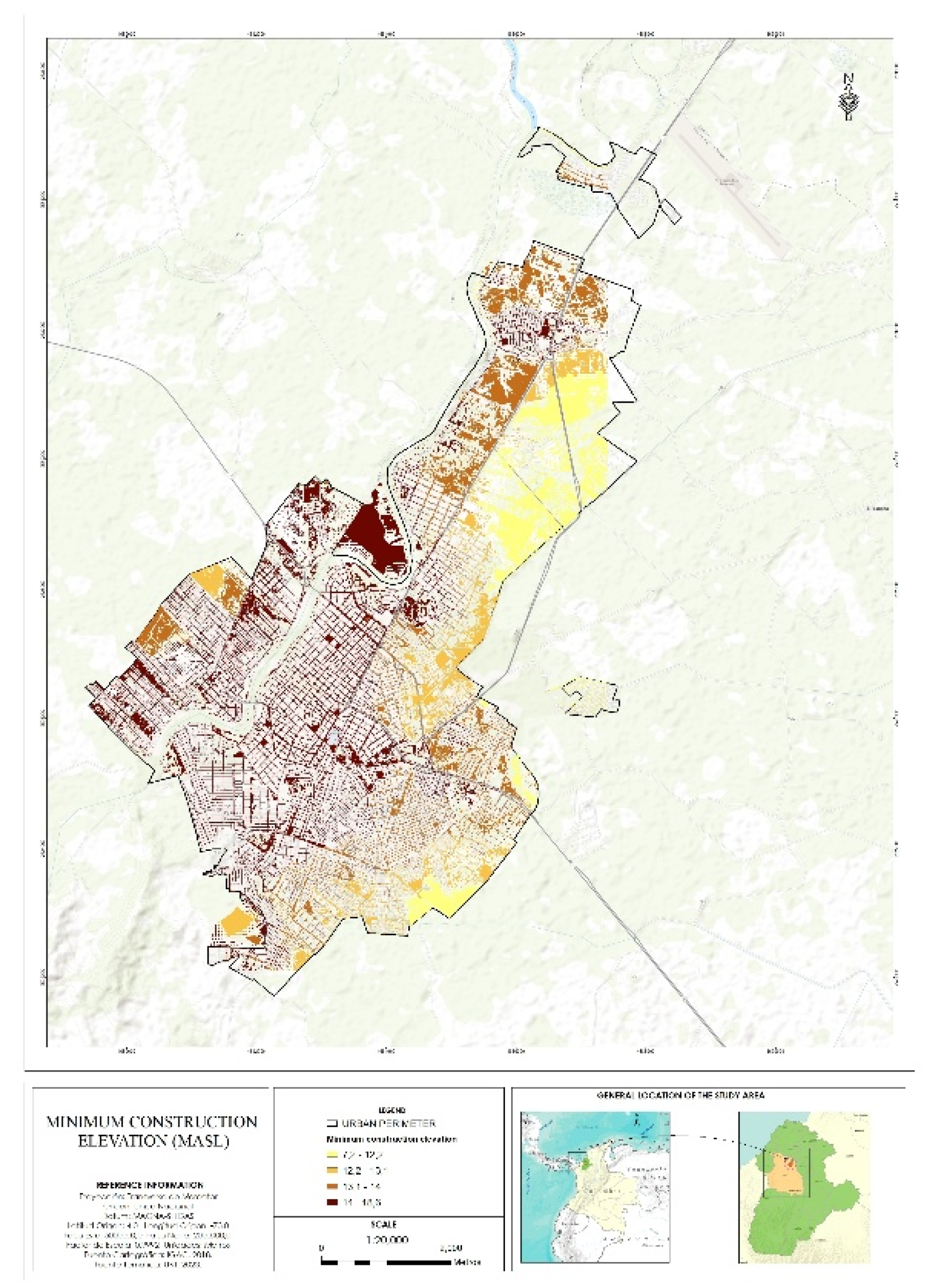
The minimum construction-elevation map was produced from advanced hydraulic modeling for a 100-year return-period event and complemented with a 60 cm freeboard safety factor following FEMA risk-management standards [27]. This additional height incorporates a protection margin for model uncertainties, climatic variations, and unforeseen drainage obstructions. The map is a technical-guidance tool and not a rigid normative instrument: it does not substitute detailed studies at the property scale, which may refine the suggested elevations through site-specific modeling. Wetland filling is prohibited; Nature-Based Solutions (connectivity corridors, green infrastructure, passive-recreation spaces) are preferred instead.
Figure 8.
Minimum construction-elevation map for the city of Monteria.
5.2.5. Land-Management Instruments
Four instruments are proposed to guide development away from high-risk areas and to finance mitigation. Transfer of Development Rights (TDR, existing in Colombia since 1997) allows the transfer of construction rights from flood-prone or hydrologically vital areas (wetlands, floodplains, ronda zones along the Sinu) to higher-elevation, lower-risk zones, incentivizing owners not to develop in risk areas. Value Capture allows the city to capture a portion of the increase in land value generated by public urban actions such as green-infrastructure investments. Betterment Levies allow the city to recover part of the public investment in drainage improvements or flood-mitigation projects through contributions from benefited property owners, fostering co-responsibility for maintenance. Impact/Development Fees are contributions that developers make to the city (in land or money) for the impact of their projects; new developments near the river or drainage system can be required to incorporate flood-mitigation measures within their own projects, and monetary contributions can be allocated to a specific flood-risk-management fund.
5.3. Residual Risk Analysis (Monte Carlo Model)
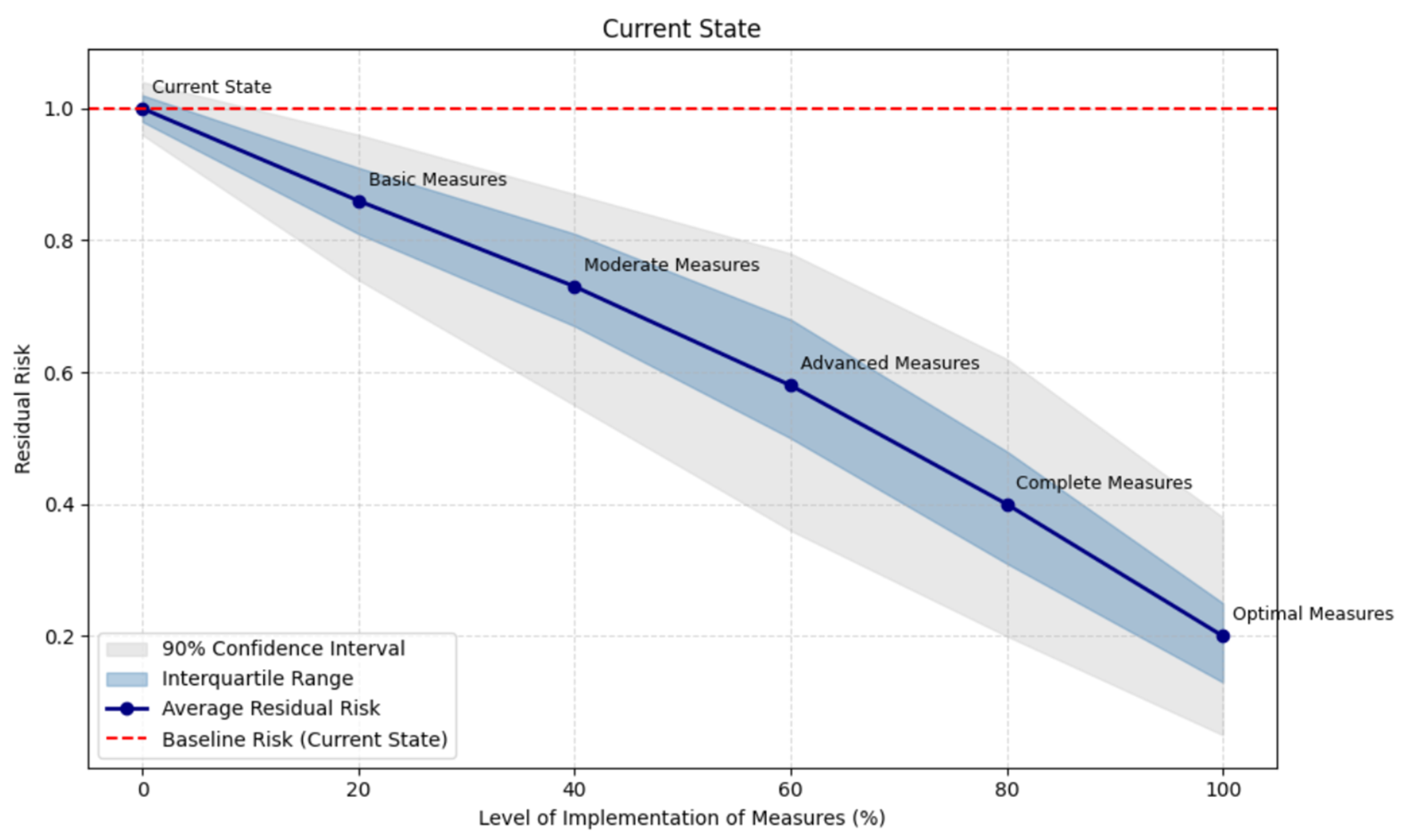
A theoretical residual-risk model was formulated to be validated as measures are implemented and evaluated. The model aims to analyze the reduction of residual risk under different implementation scenarios, identify the most sensitive and effective measures, and provide a theoretical basis for decision-making. Base risk is set at 1.0 (100%), representing the current state. Measure efficiencies and impact weights are: improved drainage (70% efficiency, 30% impact), early-warning systems (80%, 25%), institutional capacity (75%, 20%), community preparedness (65%, 15%), and quality of hydrological–hydraulic models (85%, 10%). Six implementation scenarios were considered, from 0% (risk 100%) to 100% (expected risk 15%). The model uses Monte Carlo simulation with 10,000 iterations per scenario, a Beta distribution for efficiencies adjusted to the implementation level, and a normal distribution with variable standard deviation for uncertainty. The residual risk is calculated as
Risk reduction does not follow a linear progression: a diminishing-returns phenomenon is observed, where initial efforts are notably more effective than later ones. The first 20 percentage points of implementation achieve a risk reduction of 14.1%, while the following 20 points achieve a smaller reduction of 12.4%. The inherent uncertainty is maximum in intermediate scenarios (40–60% implementation) and minimum in the extreme 0% and 100% states. The staged implementation confirms incremental benefits: basic measures (20%) reduce risk to 85.8%, moderate (40%) to 73.9%, advanced (60%) to 58.2%, complete (80%) to 40.1%, and optimal (100%) to 19.9%.
Figure 9.
Residual-risk curve as a function of the implementation level of conceptual measures (10,000 Monte Carlo iterations per scenario).
Figure 9.
Residual-risk curve as a function of the implementation level of conceptual measures (10,000 Monte Carlo iterations per scenario).
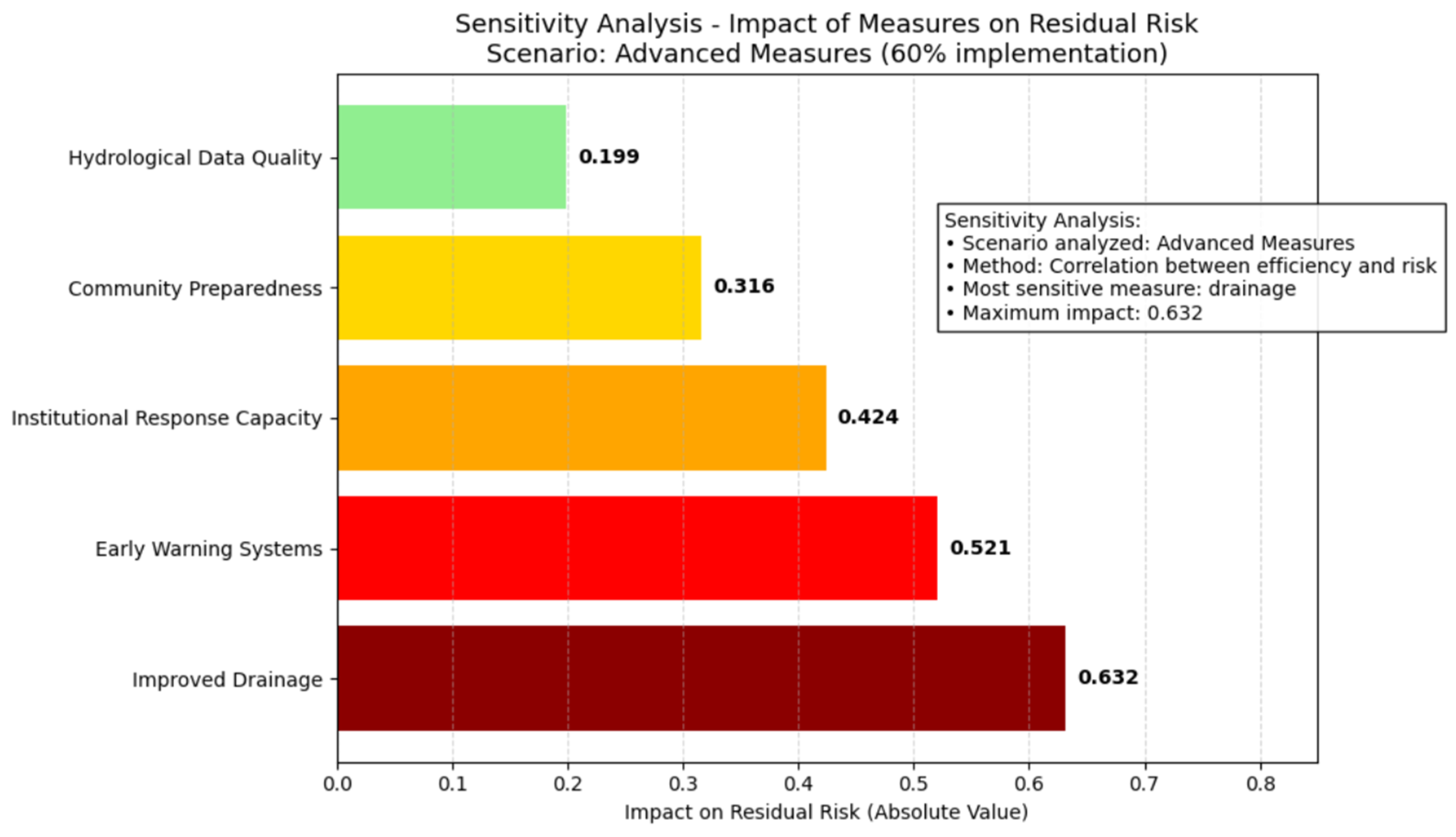
Sensitivity analysis identifies improved drainage as the dominant measure, with a correlation of 0.632 with risk reduction — the highest base efficiency among structural measures (70%) and the highest weight in the model (30%). Early-warning systems follow with a correlation of 0.521 and the highest base efficiency of the entire model (80%), making them the second priority because of their favorable cost–benefit ratio. Institutional response capacity shows medium dominance (correlation 0.424). Economic implications are clear: a relatively low initial investment produces a significant risk reduction, with the 20–60% implementation range being the most cost-effective and 60% implementation marking the inflection point where reduction becomes substantial.
Figure 10.
Sensitivity analysis of the impact of mitigation measures on residual risk (scenario: advanced measures, 60% implementation). Drainage shows the highest absolute impact (0.632), followed by early-warning systems (0.521), institutional capacity (0.424), community preparedness (0.316), and data quality (0.199).
Figure 10.
Sensitivity analysis of the impact of mitigation measures on residual risk (scenario: advanced measures, 60% implementation). Drainage shows the highest absolute impact (0.632), followed by early-warning systems (0.521), institutional capacity (0.424), community preparedness (0.316), and data quality (0.199).
6. Emergency Response: February 2026 Cold-Front Event
6.1. Event Characterization and Hydrological Context
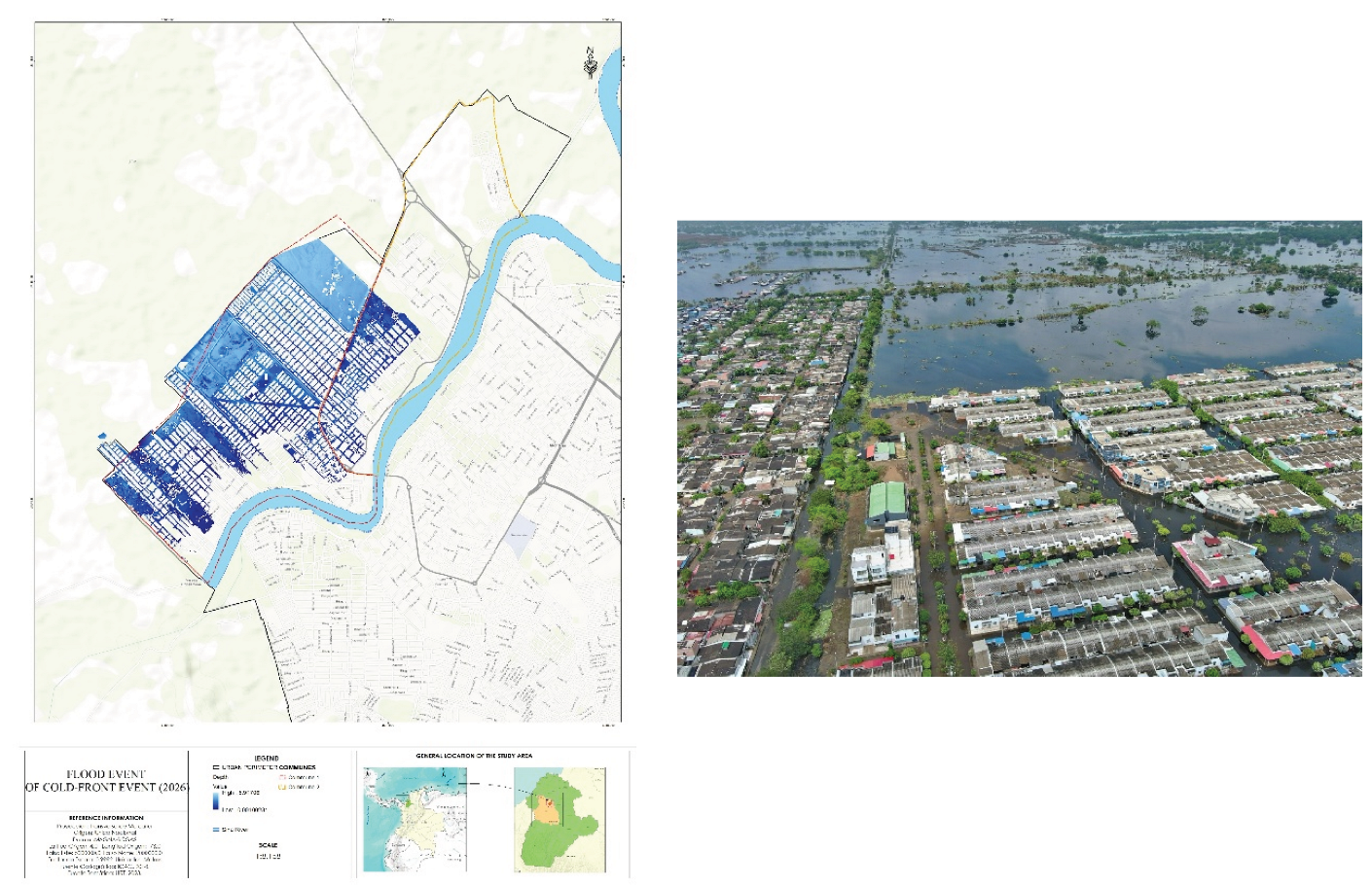
In February 2026, an atypical cold front entered the Colombian Caribbean — an event type uncommon during the dry season (December–March) but consistent with anomalous atmospheric circulation documented for early 2026. Unlike the convective storms that dominate the wet season, the cold front delivered sustained multi-day rainfall that saturated soils and progressively overwhelmed the discharge capacity of the La Caimanera sub-catchment on the left bank. The affected area — communes 1 and 2 — covers the left-bank urban and peri-urban strip bounded by the Berlin wetland to the west and the Sinu River to the east. Lateral wetland intrusion, surface-runoff accumulation, and inadequate perimeter containment produced prolonged inundation with depths of 50–70 cm in critical zones (notably Barrio El Poblado) and submergence of road surfaces in La Ribera, República de Panamá, Villa Nazaret, and adjacent sectors.
Figure 11.
Flood extent of the February 2026 cold-front event on the left bank of the Sinu River (communes 1 and 2 left) and aerial photograph of the flooded area (commune 2 right).
Figure 11.
Flood extent of the February 2026 cold-front event on the left bank of the Sinu River (communes 1 and 2 left) and aerial photograph of the flooded area (commune 2 right).
6.2. Field Documentation of Water-Surface Elevations
Field teams conducted systematic topographic-leveling campaigns across 12 neighborhoods within the inundated zone, documenting the maximum water-surface elevation (cota máxima de lámina de agua) at selected reference points and at the junctions of the primary urban channels. These observations served two complementary purposes: validation of the hydraulic model for a real cold-front forcing scenario, and design basis for the gravity-outlet and pumping alternatives analyzed for emergency water evacuation.
An important key findings was located at the Vallejo–Berlin interface, the maximum water-surface elevation coincided with the highest historical inundation level recorded in adjacent dwellings, confirming that the Berlin wetland level controls the lateral boundary condition for the left-bank urban drainage. The Channel Vallejo–Dorado carries water at near-bankfull capacity, with the earthen berm separating Channel Dorado from the adjoining borrow pit limiting the effective hydraulic cross-section and impeding rapid drainage of the Vallejo and El Poblado sub-sectors. Channel INAT showed free-surface elevations consistent with blockage-induced backwater at its downstream discharge point into the Sinu. The documented elevations were used directly to dimension the crest elevation (minimum 1.7 m above street level in the most critical section at Vallejo–Berlin) and the discharge capacity of the proposed containment dike.
6.3. Three-Front Mitigation Strategy
Based on the hydraulic analysis and field documentation, a multi-component emergency mitigation strategy was designed and implemented jointly by Consorcio Riesgos Monteria, the Regional Environmental Authority (CVS), and the Municipal Administration of Monteria. The strategy comprises three integrated fronts of operation.
6.3.1. Front 1 — Perimeter Containment Dike (4,300 m, Commune 1)
A perimeter dike was constructed and/or reinforced along a 4,300 m alignment encircling Commune 1, from Barrio Los Colores (northern limit) to Barrio El Dorado (southern limit). Construction used heavy machinery wherever soil conditions and maneuvering space were allowed, through two simultaneous fronts progressing toward the center of the perimeter (approximately behind the Vallejo urbanization). The first front, in the Los Colores sector, began from the Vía a Las Palomas, bordering the neighborhood to the channel at its end and then along the channel dikes. The second front, in the El Dorado sector, began from the Arboletes road. The dike crest was designed to the maximum recorded water-surface elevation plus a freeboard of at least 0.5 m, with a minimum height of 1.7 m at the Vallejo–Berlin interface.
Two construction methods were evaluated (Table 4): geotextile bags with compacted impervious fill (sandbags filled with calcareous or clayey material, encased in non-woven geotextile to form a large containment bag), and geocontainers or hydrotubes (large-format geotextile bags filled with impervious material). Anti-return gates were installed at channel–street intersections within the dike alignment to prevent backflow from the channels into the protected urban area during high Sinu stages; their locations were selected at the junctions of the channels to guarantee water evacuation and prevent the generation of a piston effect. In parallel, Channel Vallejo–Dorado hydraulic optimization was identified as imperative: reshaping and raising the banks of the earthen berm to the documented maximum elevation is required to provide an adequate hydraulic gradient and prevent backwater toward the urbanized area.
6.3.2. Front 2 — High-Capacity Pump Stations
In parallel with dike construction, pumping equipment was deployed in six operational sectors within communes 1 and 2. Major stations were sized for at least 1,000 L/s (1 m³/s), complemented by 3-inch motor pumps for localized ponding zones. The objective was to control evacuation of water trapped between the urbanized zone and the perimeter dike through pumping to the external side of the dike, without allowing water to re-enter dried sectors. Sectors that become fully or partially dry retain oversaturated soils from which water may re-emerge — since hydrostatic pressure from the column outside the dike drives re-infiltration — and pumping equipment must therefore remain on standby for residual evacuation. Table 5 summarizes the operational sectors and field observations.
Table 6.
Operational sectors of Communes 1 and 2 for pumping-equipment deployment during the February 2026 event.
Table 6.
Operational sectors of Communes 1 and 2 for pumping-equipment deployment during the February 2026 event.
| Sector | Neighborhoods | Observation |
|---|---|---|
| 1 | La Ribera; Panamá neighborhood | Evacuating through Channel Centenario, redirected to Pitolandia property. |
| 2 | La Navarra; El Portal I–III; Los Colores; Los Ébanos; Villa Nazaret; La Vid | Much of the territory is already dry. |
| 3 | La Palma; Rancho Grande; Mi Ranchito; Nuevo Horizonte; Sector Campano | Mostly dry; lower-capacity pumps are required to remove stagnant water. |
| 4 | Caracolí; El Níspero I–II; Vallejo | Critical zone adjacent to Berlin wetland. Strategy: perimeter dike + 6–8 × 3” motor pumps; tractor pump at Channel Vallejo intersection (highest cota). |
| 5 | El Dorado; El Poblado | Standing water 50–70 cm average in El Poblado; intervention on Channel Pitolandia dike and high-capacity tractor pump recommended. |
| 6 | Commune 2 | Water has already evacuated to Channel Centenario. |
6.3.3. Front 3 — Channel Vallejo–Dorado Hydraulic Optimization
The earthen berm dividing Channel Dorado from the adjacent borrow pit was identified as the critical hydraulic bottleneck. Field measurements of maximum water-surface elevations in adjacent dwellings defined the required design section: the berm must be reconformed and raised to at least the documented maximum cota to provide an adequate hydraulic gradient and prevent backwater toward the urbanized area. This structural intervention is recommended as a priority permanent measure following the emergency phase.
7. Discussion
The four-phase workflow presented here — hazard characterization, risk assessment, intervention measures, and emergency response — demonstrates the operational value of maintaining a calibrated urban hydrodynamic model as a standing decision-support tool rather than a one-time planning artifact. The November 2024 validation event closely approached the 100-year design storm and its simulated inundation extent matched field observations; this provided the technical credibility that underpinned the emergency decisions made during the February 2026 cold-front episode and the design basis for the long-term structural portfolio. The finding that three pluvial mechanisms (poor connectivity, limited evacuation, downstream overflow) account for virtually all urban flood damage, while fluvial overflow from the Sinu is restricted to return periods greater than 25 years, has direct implications for investment prioritization: expenditure focused exclusively on fluvial protection addresses only the residual tail of the risk distribution, and the dominant return on investment lies in improving hydraulic connectivity between residential ponding zones and the macro-drainage channel network.
The structural analysis quantifies the trade-offs between scenarios M1 and M2. Pure channel widening (M1) is insufficient on its own: only 24 ha of net flood-area reduction, with 12 additional displaced hectares downstream, reflect the transfer of peak discharges to already-saturated reaches. This counterintuitive result — whereby isolated channel enlargement increases water levels downstream by up to 5 cm — is a manifestation of peak-flow synchronization: widening one reach accelerates hydraulic transit and causes the tributary peak to arrive at the collector simultaneously with peaks from other sub-catchments that previously lagged in time. In flat, low-gradient urban drainage systems where storage in the channel network buffers timing differences between sub-catchments, this synchronization effect can offset or reverse the local benefits of increased conveyance capacity. The finding is consistent with documented experience in low-lying coastal cities where piecemeal channel improvement programs have produced similar downstream aggravation, but has received limited systematic documentation in Caribbean Colombian urban contexts. It underscores that isolated structural works must be evaluated at the system scale — not reach by reach — and that the additional retention and peak-regulation components included in M2 (dikes, land-raising, lagoon activation) are necessary precisely to counteract this synchronization mechanism. The combined M2 strategy increases net reduction to 80 ha with 28 ha of displacement, eliminating flooding at the Monte Verde–INAT confluence. The pre-design cost of COP 84.5 billion is substantial but comparable, on a per-capita basis, to the Veolia downtown-drainage alternative (COP 87.7 billion benefiting 49,140 + 27,088 inhabitants). Both alternatives require subsequent technical, economic, social, and environmental feasibility studies.
Physical vulnerability is compounded by social vulnerability: 30.1% of households consider their drainage inadequate, neighborhoods with high disability populations face amplified evacuation barriers, and approximately 26.5% of households experienced direct water entry during documented flood events. These social indicators argue for an equity-weighted spatial prioritization in which neighborhoods combining high hydraulic exposure, poor infrastructure quality, and limited socioeconomic recovery capacity receive preferential attention in mitigation programming — a principle embedded in the risk-classification framework of Colombian Decree 1077/2015 [13]. The non-structural portfolio (PMDUS, IoT-based SAT, CURBA, land-management instruments) directly address these dimensions, concentrating development in safer areas while financing mitigation.
The February 2026 emergency response validates the operational model. The event exemplifies compound flooding on the left bank: cold-front-driven multi-day rainfall saturates soils, the Berlin wetland controls the lateral boundary, and the Channel Vallejo–Dorado hydraulic bottleneck impedes evacuation. The three-front strategy (4,300 m perimeter dike with anti-return gates, six sector-based pump stations with ≥ 1,000 L/s major-station capacity, and Channel Vallejo–Dorado optimization) demonstrates that a calibrated model, coupled with systematic field-leveling of water-surface elevations and the institutional coordination of CVS, the municipality, and external advisors, can deliver a technically sound response in real time. The dike crest was sized directly from field-recorded maximum cotas plus 0.5 m freeboard, and the pumping-sector layout explicitly accounts for re-emergence from oversaturated soils after initial drying — details that textbook specifications would miss.
Under IPCC SSP5-8.5 [1], late-21st-century precipitation intensification of up to 20% for the Caribbean region would increase 100-year design-storm totals to approximately 155–165 mm, substantially expanding high-hazard areas in the INAT, Villa Cielo, and Canta Claro sub-catchments. The framework is designed for iterative updating: as climate-downscaling products are refined and new gauge data accumulate, the hazard rasters, depth-damage curves, and risk classifications can be recalculated without rebuilding the model from sAvtch. The February 2026 cold-front experience further adds a documented event to the calibration-validation database, strengthening the model’s credibility for future operational use.
7.1. From EDRI to Implementation: Governance Considerations
A technical flood-risk framework has limited value if it is not translated into territorial-planning norms and executable works. Within the Colombian National Disaster Risk Management System, Detailed Flood Risk Studies (EDRI) correspond to the risk-knowledge phase, which is the mandatory input for the subsequent Risk Reduction phase. The transition is a legal obligation under Decree 1077/2015 [13] and Law 1523/2012 [24]: once the EDRI is approved, the risk-management strategies constitute norms of superior hierarchy in the POT, imposing two operational mandates — a Prospective Mandate (prohibition of new developments in identified risk areas) and a Corrective Mandate (structural mitigation works or resettlement programs in Non-Mitigable High-Risk Zones, ZARNM).
The principal challenge is not technical but operational: the preparation of an EDRI is costly, and once a municipality with limited resources completes the Knowledge phase it often encounters difficulties financing the Reduction phase, which entails even greater costs. An inherent risk is that finalizing an EDRI transforms a potential hazard into a liability recognized by the State: the formal delimitation of ZARNM zones automatically creates a legal obligation to invest in protection or relocation. Two strategic responses are therefore required. First, the land-management instruments proposed in Section 5.2.5 (TDR, value capture, betterment levies, impact fees) can mobilize private capital toward the costly corrective works while steering development away from risk zones. Second, the creation of a specialized Urban Drainage Management Unit with budgetary autonomy — as endorsed by the analyses in Section 5.1 and Section 5.2 — is essential to coordinate the implementation, maintenance, and monitoring of the structural and non-structural portfolio. In sum, mitigability is a condition, not a consummated fact: the municipality must be strict in applying preventive urban standards while using land-management instruments to finance the corrective structural works that sustain the promise of mitigability.
7.2. Limitations and Future Work
Several limitations should be explicitly acknowledged. First, the structural-measure analysis assumes that the micro-drainage conveys runoff perfectly to the macro-drainage — an idealization that justifies the separate treatment of ponding through the PMDUS but that must be progressively replaced as PMDUS components are implemented and monitored. Second, the Monte Carlo residual-risk model assumes independence among measures (no synergies or antagonisms) and linear contributions; the efficiencies and impact weights are expert-elicited estimates that require validation with post-implementation monitoring. Third, the vulnerability curves were calibrated on cement-block typology, and their transfer to other construction typologies requires specific adjustment factors. Fourth, the fluvial-erosion analysis of the 17 critical Sinu points is observational rather than geotechnical; dedicated slope-stability and dike-breach studies are required to quantify the associated probability of occurrence. Fifth, cost estimates are pre-design figures based on hydraulic-capacity optimization alone and must be refined through feasibility studies that include property acquisition, social management, and environmental permits. Future work will address these limitations through the PMDUS detailed engineering, post-event validation of the February 2026 emergency works, and the integration of climate-downscaling products under IPCC SSP scenarios into the hazard rasters.
8. Conclusions
This study has developed and applied an integrated flood-risk and intervention framework for Monteria, combining a Rain-on-Grid 2D HEC-RAS 6.6 model with a depth-damage vulnerability assessment, a structural and non-structural intervention portfolio, a Monte Carlo residual-risk model, and a documented real-event emergency response. From a methodological standpoint, the framework represents a significant technical contribution to the state of the art for Caribbean Colombian cities: a fully distributed Rain-on-Grid hydrodynamic model operating on a 20-cm-resolution photogrammetric DTM, with channel-reach refinements down to 50 cm cell size, covering a 4,090 ha urban domain and calibrated against four independent flood events — including two gauged river-overflow events (2007, 2010), two intense pluvial events (August and November 2024), and a cold-front-driven multi-day episode (February 2026) — constitutes, to the authors’ knowledge, the most extensively calibrated urban 2D Rain-on-Grid model published for an intermediate Colombian city. The model accurately reproduces flood patterns across the full urban perimeter. Three dominant pluvial mechanisms govern inundation — poor hydraulic connectivity (dominant), limited evacuation capacity, and downstream channel overflow — while Sinu overflow is restricted to return periods exceeding 25 years since Urra I regulation commenced in 2000. Additionally, 17 critical fluvial-erosion points along the urban reach represent a latent risk of dike-breach flooding.
A locally calibrated hazard classification (high: ≥ 0.4 m; medium: 0.2–0.4 m; low: < 0.2 m) was statistically validated on the 100-year raster and mapped across 205 urban neighborhoods. Of 3,015 scored urban assets, 36.36% are in high risk and 57.77% in medium risk, with 121 strategic facilities — 54% in the educational sector — located within risk polygons. Depth-damage functions derived from 1,465 household surveys constitute a replicable local vulnerability model applicable to similar Caribbean Colombian cities.
The structural mitigation portfolio combines channel widening with protection dikes, strategic land-raising, and retention-lagoon activation (scenario M2), removing 80 ha from flooded areas and displacing 28 ha at a pre-design cost of COP 84,495,690,431; it is complemented by the Veolia downtown alternative, the PMDUS (~COP 3 billion), an IoT-based SAT integrated with urban mobility (~COP 3 billion), CURBA integration, a minimum construction-elevation map with 60 cm freeboard, and four land-management instruments. The Monte Carlo residual-risk model (10,000 iterations) indicates that full implementation reduces baseline risk to 19.9%, with the 20–60% implementation band as the most cost-effective and improved drainage, SAT, and institutional capacity as the most sensitive measures.
The February 2026 cold-front event inundated communes 1 and 2 with depths reaching 50–70 cm in critical zones; field-documented water-surface elevations provided the design basis for a three-component emergency strategy (4,300 m perimeter dike, six pump-station sectors with a minimum of 1,000 L/s per major station, anti-return gates) coordinated by CVS, and the Municipal Administration. Monteria must transition toward a proactive peak-discharge management model in which gray infrastructure is complemented by Nature-Based Solutions applied from the dwelling to the catchment scale. Five priority recommendations are addressed to the competent authorities: (i) permanent updating of the studies and models incorporating real-time monitored data; (ii) prioritization of PMDUS execution beginning at identified critical connectivity points; (iii) establishment of an Urban Drainage Management Unit with technical capacity and budgetary autonomy; (iv) urgent implementation of the SAT with IoT sensors and predictive models integrated with the mobility system; and (v) development of an innovative financing program combining land-management instruments with multilateral-bank and national-fund resources. Residual risk will always exist; the effectiveness of the proposed measures is subject to their integral implementation, continuous maintenance, and periodic updating according to the evolution of urban and climatic conditions.
Author Contributions
Conceptualization, Humberto Tavera Quiróz and Jorge de la Ossa; methodology, Samuel Pinto Argel, Humberto Tavera Quiróz, Mauricio Rosso Pinto and Jorge de la Ossa; hydrology and hydraulics, Gabriel Narváez and Fernando Narváez; vulnerability assessment and field surveys, Samuel Pinto Argel, Humberto Tavera Quiróz; structural and non-structural measures design, Samuel Pinto Argel, Humberto Tavera Quiróz, Mauricio Rosso Pinto; residual-risk Monte Carlo modeling, Humberto Tavera Quiróz, Mauricio Rosso Pinto; emergency-response design and field documentation, Samuel Pinto Argel, Humberto Tavera Quiróz, Mauricio Rosso Pinto; writing — original draft preparation, Samuel Pinto Argel, Mauricio Rosso Pinto; writing — review and editing, Humberto Tavera Quiróz; visualization, Samuel Pinto Argel, Humberto Tavera Quiróz and Jorge de la Ossa; supervision, Humberto Tavera Quiróz; project administration, Humberto Tavera Quiróz and Jorge de la Ossa; funding acquisition, Humberto Tavera Quiróz and Jorge de la Ossa. All authors have read and agreed to the published version of the manuscript.
Funding
This research was funded by the Municipality of Monteria under contract CMA-SPM-002-2024, for detailed flood and mass-movement risk studies in urban areas under risk condition according to the POT 2021–2033.
Data Availability Statement
The hydraulic model files, raster outputs, CAD files of the proposed structural measures, detailed risk maps, and survey datasets are available upon reasonable request from the corresponding author, subject to municipal data-sharing agreements.
Acknowledgments
The authors thank the technical teams of CVS, the Secretariat of Planning of the Municipality of Monteria, the community respondents who participated in the ArcGIS Survey123 field campaigns, the operational staff of Urra I for providing historical gauging records, and Veolia Consulting for the downtown drainage plan. The emergency response in February 2026 benefited from the coordinated intervention of CVS engineers, municipal technical advisors, and local community leaders.
Conflicts of Interest
The authors declare no conflicts of interest.
References
- IPCC. Climate Change 2021: The Physical Science Basis. Contribution of Working Group I to the Sixth Assessment Report of the IPCC; Cambridge University Press: Cambridge, UK, 2021. [Google Scholar]
- UNISDR. Terminology on Disaster Risk Reduction; United Nations International Strategy for Disaster Reduction: Geneva, Switzerland, 2019. [Google Scholar]
- Cardona, O.D. Modelación de vulnerabilidad ante inundaciones y definición de curvas de vulnerabilidad para la Región de La Mojana; Fondo Adaptación: Bogotá, Colombia, 2014. [Google Scholar]
- Salazar, S. Methodology for the Analysis and Reduction of Flood Risk: Application in La Rambla del Poyo (Valencia). Ph.D. Thesis, Universidad Politécnica de Valencia, Spain, 2013. [Google Scholar]
- Cardona, O.D. Risk theory and disasters. In Vulnerability: Concepts, Sectors and Applications; Universidad Nacional de Colombia: Manizales, Colombia, 2005; pp. 93–132. [Google Scholar]
- Dutta, D.; Herath, S.; Musiake, K. A mathematical model for flood loss estimation. J. Hydrol. 2003, 277, 24–49. [Google Scholar] [CrossRef]
- Tucci, C.E.M. Hidrologia: Ciência e Aplicação, 4th ed.; ABRH: Porto Alegre, Brazil, 2009. [Google Scholar]
- USACE. HEC-RAS River Analysis System: Hydraulic Reference Manual, Version 6.5; U.S. Army Corps of Engineers, Hydrologic Engineering Center: Davis, CA, USA, 2024. [Google Scholar]
- Messner, F.; Penning-Rowsell, E.; Green, C.; Meyer, V.; Tunstall, S.; Van der Veen, A. Evaluating Flood Damages: Guidance and Recommendations on Principles and Methods; FLOODsite Consortium: Wallingford, UK, 2007. [Google Scholar]
- Smith, K.; Ward, R. Floods: Physical Processes and Human Impacts; Wiley: Chichester, UK, 1998. [Google Scholar]
- IDEAM. Leyenda Nacional de Coberturas de la Tierra. Metodología CORINE Land Cover adaptada para Colombia, Escala 1:100,000. IDEAM: Bogotá, Colombia, 2010.
- Chow, V.T. Hidráulica de Channeles Abiertos; McGraw-Hill: Bogotá, Colombia, 1994. [Google Scholar]
- Ministerio de Vivienda; Ciudad y Territorio. Decreto 1077 de 2015. MVCT: Bogotá, Colombia, 2015.
- Cardona, O.D. Modelación de vulnerabilidad ante inundaciones y definición de curvas de vulnerabilidad para los elementos expuestos existentes en la Región de la Mojana; Fondo Adaptación: Bogotá, Colombia, 2014. [Google Scholar]
- Cardona, O.D.; Bernal, G.; Zuloaga, D.; Escovar, M.; Suárez, D.; Pérez, M.; Villegas, C.; Molina, J.; Olaya, J. Modelación probabilista de inundaciones en La Mojana. ResearchGate 2017. [Google Scholar]
- Vargas, M.R.; Díaz-Granados, O.M. Curvas Sintéticas Regionalizadas de Intensidad–Duración–Frecuencia para Colombia; Universidad de los Andes: Bogotá, Colombia, 1998. [Google Scholar]
- USDA. Urban Hydrology for Small Watersheds. Technical Release TR-55; NRCS: Washington, DC, USA, 1986.
- UNGRD; PNUD. Guía Metodológica para la Elaboración de Planes Departamentales para la Gestión del Riesgo; UNGRD: Bogotá, Colombia, 2012. [Google Scholar]
- Ministerio de Vivienda; Ciudad y Territorio. Guía Metodológica para el Inventario de Asentamientos en Zonas de Alto Riesgo; MVCT: Bogotá, Colombia, 2014. [Google Scholar]
- Applied Technology Council. Earthquake Damage Evaluation Data for California. ATC-13 Report; ATC: Redwood City, CA, USA, 1985.
- Strahler, A.N. Hypsometric (area–altitude) analysis of erosional topology. Geol. Soc. Am. Bull. 1952, 63, 1117–1142. [Google Scholar] [CrossRef]
- Shreve, R.L. Statistical law of stream numbers. J. Geol. 1966, 74, 17–37. [Google Scholar] [CrossRef]
- Decreto 1807 de 2014. Gobierno de Colombia: Bogotá, Colombia, 2014.
- Ley 1523 de 2012. Congreso de Colombia: Bogotá, Colombia, 2012.
- MVCT. Resolución 330 de 2017: RAS. MVCT: Bogotá, Colombia, 2017.
- Veolia Consulting. Plan de Drenaje Urbano Zona Centro Municipio de Montería; Alcaldía de Montería: Montería, Colombia, 2025. [Google Scholar]
- FEMA. Freeboard—Glossary. Available online: https://www.fema.gov/about/glossary/freeboard (accessed on 18 April 2026).
- POT Montería 2021–2032. Alcaldía de Montería: Montería, Colombia, 2021.
- Resolución No. 2-6855 de 2019, Acta de Concertación POT Montería–CVS. CVS: Montería, Colombia, 2019.
- Informe Técnico: Propuesta de estrategias de contención y evacuación de aguas acumuladas en las comunas 1 y 2 de la margen izquierda de Montería; Consorcio—CVS—Alcaldía: Montería, Colombia, 17 February 2026.
- Costabile, P.; Costanzo, C.; Ferraro, D.; Barca, P. Is HEC-RAS 2D accurate enough for storm-event hazard assessment? Lessons learnt from a benchmarking study based on rain-on-grid modelling. J. Hydrol. 2021, 603, 126962. [Google Scholar] [CrossRef]
- Dazzi, S.; Shustikova, I.; Domeneghetti, A.; Castellarin, A.; Vacondio, R. Comparison of two modelling strategies for 2D large-scale flood simulations. Environ. Model. Softw. 2021, 146, 105225. [Google Scholar] [CrossRef]
Table 1.
Curve Number (CN) values for the land-cover units within the Villa Cielo expansion area.
| Land use | Area (km²) | % area | CN |
|---|---|---|---|
| Forested pastures | 3.59 | 68.04 | 75 |
| Weedy pastures | 1.18 | 22.47 | 72 |
| Continuous urban fabric | 0.25 | 4.83 | 89 |
| Discontinuous urban fabric | 0.24 | 4.53 | 77 |
| Roads | 0.00 | 0.08 | 92 |
| Artificial water bodies | 0.00 | 0.04 | 98 |
| Urban green areas / bare land | 0.00 | 0.01 | 80–85 |
| Total (weighted CN = 75.12) | 5.27 | 100.0 | — |
Table 2.
Maximum discharges (m³/s) for the current situation and urbanization scenarios.
| TR (yr) | CN = 75 | CN = 77 | CN = 80 | CN = 83 | CN = 86 | CN = 89 |
|---|---|---|---|---|---|---|
| 2.33 | 20.18 | 22.49 | 23.73 | 26.31 | 27.65 | 30.41 |
| 5 | 33.92 | 36.70 | 38.12 | 40.99 | 42.44 | 45.56 |
| 10 | 38.31 | 41.18 | 42.64 | 45.57 | 47.04 | 50.27 |
| 25 | 44.52 | 47.50 | 48.99 | 51.98 | 53.56 | 56.85 |
| 50 | 54.13 | 57.22 | 58.75 | 61.91 | 63.60 | 66.92 |
| 100 | 65.43 | 68.61 | 70.18 | 73.61 | 75.32 | 78.65 |
Table 4.
Cost estimate of pre-dimensioned structural works (scenario M1 and M2).
| Measure | Quantity | Unit cost (COP) | Total cost (COP) |
|---|---|---|---|
| Channel optimization | 17,151.1 m | 3,074,638 / m | 52,734,653,931 |
| Ground-level raising | 299,521 m³ | 95,000 / m³ | 28,454,495,000 |
| Protection dikes | 34,806 m³ | 95,000 / m³ | 3,306,541,500 |
| TOTAL | — | — | 84,495,690,431 |
Table 5.
Construction alternatives for the 4,300 m perimeter dike: advantages and disadvantages.
| Alternative | Advantages | Disadvantages |
|---|---|---|
| Geotextile bags with impervious bag-soil fill | Lower cost | Reduced maneuverability |
| Geocontainers / hydrotubes | Greater installation speed; superior hydraulic containment | Higher unit cost |
Disclaimer/Publisher’s Note: The statements, opinions and data contained in all publications are solely those of the individual author(s) and contributor(s) and not of MDPI and/or the editor(s). MDPI and/or the editor(s) disclaim responsibility for any injury to people or property resulting from any ideas, methods, instructions or products referred to in the content. |
© 2026 by the authors. Licensee MDPI, Basel, Switzerland. This article is an open access article distributed under the terms and conditions of the Creative Commons Attribution (CC BY) license.
Copyright: This open access article is published under a Creative Commons CC BY 4.0 license, which permit the free download, distribution, and reuse, provided that the author and preprint are cited in any reuse.


