

Submitted:
03 May 2026
Posted:
05 May 2026
You are already at the latest version
Preprints on COVID-19 and SARS-CoV-2
Abstract
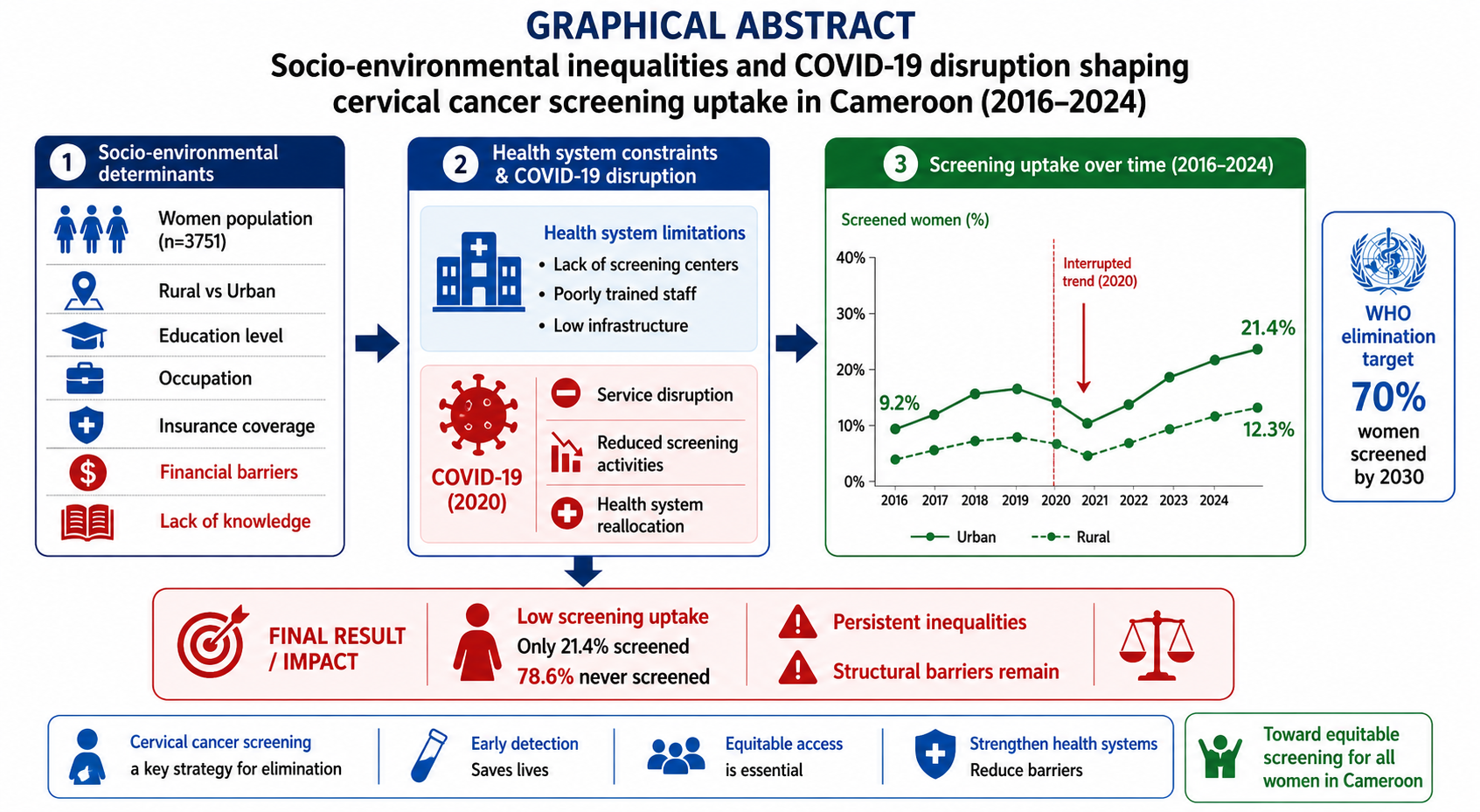
Background: Cervical cancer ranks among the highest causes of mortality in females in Cameroon. Although there are effective screening tools, namely Pap age and HPV tests, women, especially in rural or underserved populations, do not have access to screening utilization. Vulnerability in addressing socio-environmental and healthcare access disparities perpetuates prevention and early detection. Methodology: A descriptive, cross-sectional study was undertaken from January 2018 into December 2024, in five regions of Cameroon: the Centre, South, North, Far North, and Littoral regions. A total of 3,751 women ages 25-65 years agreed to participate and were interviewed with semi-structured questionnaires, as well as health care workers, service providers, and health professionals. The data collected, captured access to screening services, perceived socio-economic and environmental barriers, and actual use of cytological and HPV tests. Results: Participants reported a low screening uptake (78.6% of women screened never). Reporting non-use of services was significantly related to living in rural locations (OR=0.55, p=0.001), low education attainment (OR=1 for none, OR=1.45 for higher education, p=0.003), and lower social coverage (OR=1 for uninsured, OR = 2.30 for insured, p=0.001). The top barriers to accessing services reported by participants were cost, distance to services, and poor information providing (all p=0.001). Less than 10% of health facilities surveyed had the capacity to provide screening services based on technical platforms: no Integrated Health Centers were documented as being equipped, only 1 of 25 Sub-divisional Medical Centers had the capacity to care for screening, and only 3 of 5 district hospitals were functional in care. Conclusion: Barriers such as socio-environmental inequalities, poor infrastructure, and inadequate personnel inhibit the early diagnosis of cervical cancer in Cameroon. Strategies focused on strengthening technical capacity, training staff, and increasing community awareness are essential to improving the uptake of screening and reducing mortality.
Keywords:
cervical cancer
; screening uptake
; cameroon
; rural-urban disparity
; socioeconomic barriers
; health infrastructure
Background
Cervical cancer continues to be a significant public health issue in Cameroon and in many low- and middle-income nations. The World Health Organization (WHO) reported that this disease is the second most frequent cause of cancer death among women in sub-Saharan Africa, with very high incidence and mortality rates [1]. For Cameroon, this trend is not surprising. The National Cancer Registry, in its reports, estimates more than 2,000 new cases and nearly 1,500 deaths per year [2]. Nonetheless, cervical cancer can largely be prevented through timely screening and treatment of pre-cancerous lesions. The Papanicolaou test and the HPV test are primarily recommended by the World Health Organization (WHO) for identifying the disease in an early stage [1]. In spite of these recommendations, Cameroon's locality is still significantly delayed in executing effective mass screening programs and particularly so, in rural settings. In Cameroon, there is an overall concentration of health apparatus and trained personnel in major urban settings, even at the expense of rural zones. This uneven allocation contributes to the regional and socioeconomic inequalities that have been previously diagnosed in various national and international studies [3].
Furthermore, several studies conducted in Cameroon have confirmed the low level of awareness of cervical cancer and the need for screening among women, which continues to be a barrier [4]. These inadequacies are faced with low social coverage, high examination fees, distance to health facilities, and cultural practices that limit screening and lead to late case detection [5]. In this setting, this study is part of an in-depth exploration of the socio-environmental, organizational, and individual factors limiting cervical cancer screening in Cameroon, which assesses inequalities in access to screening, reviews barriers women have experienced, as well as the opportunities available in terms of infrastructure and trained personnel, from an integrated approach of quantitative data and observations in the field. Exploring the types of factors limiting screening can assist in building health policy, resource planning, and designing interventions tailored to the Cameroonian socio-cultural context. This reflection is all the more urgent given that Cameroon is committed to implementing the WHO recommendations under the Global Strategy for the Elimination of Cervical Cancer by 2030.
Methodology
Study Design
A cross-sectional descriptive study was conducted over a nine-year period from January 2016 to December 2024. The design was employed to measure socio-environmental vulnerabilities and inequalities to access cervical cancer screening in women, in Cameroon.
Study Setting and Population
The study was conducted in five regions of Cameroon, Centre, Littoral, South, North, and Far North. These regions were selected based on the socio-demographic diversity and healthcare infrastructure inequalities. The study population was women, aged 25 to 65 years, which is the group that the World Health Organization (WHO) recommends receive cervical cancer screening.
Selection Criteria
- -
- Inclusion Criteria:
Participants were women aged 25-65 years, living in one of the selected areas, and providing informed consent to participate.
- -
- Exclusion Criteria:
Participants were women with a medical contraindication to participate, those aged outside the target group, or non-residents of the study area.
Sampling Method
A stratified random sampling technique was employed to ensure representation across urban and rural contexts, and varying socio-economic strata. Within each stratum, participants were randomly selected from community lists or health center registries. Overall, 3751 women were included in the final sample.
Questionnaire
Data collection involved a structured and pre-tested questionnaire, and was done using face-to-face interviews with trained field workers. The questionnaire consisted of socio-demographic characteristics, knowledge and perception of cervical cancer, access to screening services, as well as perceived barriers to screening from socio-economic and environmental perspectives. Observation checklists were also used to assess the availability of diagnostic platforms (Pap smear and HPV testing) in health facilities, and semi-structured interviews were used with providers to assess their levels of training in screening techniques.
Data Management and Statistical Analysis
The data were imported into SPSS version 25 and cleaned as necessary before analysis. Descriptive statistics included frequencies, percentages, and means were used to summarize the data. Chi-square tests and correlation analyses were used to examine associations between socio-environmental factors and access to screening. Statistically significant associations were evaluated at p < 0.05.
Ethical Considerations
The procedures for conducting this study adhered to the ethical principle guidelines for conducting research on human participants. Prior to data collection, we obtained ethical clearance from the National Ethics Committee for Human Health Research in Cameroon. All participants were informed that participation was completely voluntary. They were given an information sheet outlining the objectives and procedures of the study, as well as any risks and benefits, presented in a clear and understandable manner. Informed consent was obtained from each participant in writing, as well as verbally prior to their enrolment in the study. For the respect of confidentiality and privacy, no personally identifiable information was collected or recorded. Data collected from each participant was anonymized during the collection process and stored securely for use by the research team only. Participants also had the right to withdraw at any time, without any consequences. Efforts were made to reduce any type of discomfort experienced during the data collection, especially when collecting sensitive data on health status or access to health care services. The interviews with women were conducted in private venues, ensuring the privacy and comfort of the participants. In addition to women, participation in the interviews was voluntary for the health professionals who participated in the study, and their professional identities were not disclosed in reports or publications.
Resultats
- 1-
- Socio demographical data
Below, Table 1 below, presents an extensive outline of relevant sociodemographic factors in the participants of the study. There were significant differences in place of residence, education level, occupation, and social insurance status; all of which appears to be influential sociodemographic factors in the context of the study. The non-significant finding for marital status suggests this would not be a key or crucial factor in the outcomes of the current study. The even split of urban-rural participants offers balanced representation within the sample. This characterization is valuable in understanding the population and in providing context for analysis or findings.
2. Status of cervical cancer screening in the study population
The data displayed in Figure 1 below indicates that only a small percentage of surveyed women (78.6%) had never undergone cervical cancer screening or not. The extremely low cervical cancer screening rate indicates a significant gap in access to or use of preventive services in the study group which may partially explain the high cervical cancer mortality in Cameroon.
Based on Socio-demographic datapoints
Factors associated with Cervical Cancer screening
Table 2 below, highlighted several socio-demographic factors associated with cervical cancer screening in the surveyed women.
1. Place of Residence:
Place of residence has a strong impact on screening. Women residing in urban areas had a screening rate of 28%, while only 14.8% of women screened in rural areas (p < 0.001). This evidence suggests that territorial inequalities exist, with rural locations being disadvantaged regarding access to information and care.
2. Level of Education:
The uptake of the screening is significantly different based on the level of education (p < 0.001). Women at a higher level of education have a higher screening rate (31%) than women with no education (22.1%) or primary education (18%). However, it is worth noting that this is not entirely a linear trend, and other factors (economic, cultural, and geographical) are also at play.
3. Marital Status:
There was no significant difference when we examined screening by marital status (p = 0.08, not significant). Either single, married, or widow/divorced, the rates of screening were quite similar at approximately 21%, which also indicates that marital status does not appear to be a key factor in determining screening behavior in this population.
4. Occupation:
Occupational status significantly influenced screening behavior (p < 0.001). Female civil servants (26.8%) and self-employed women (23.1%) were proportionally more likely to have screening compared to unemployed or housewives (17.6%). This also suggests that socio-economic status affects access to health services.
5. Social Coverage:
Table 2, below presented that having social health coverage was also strongly associated with screening (p < 0.001). Approximately 38.7% of women who were social insurance covered had undergone screening, versus 18% with no coverage. This illustrates the important role social protection can play in alleviating financial barriers commonly faced for preventive care services.
cervical cancer screening and factors independently associated with
Table 3 below shows results of cervical cancer screening and factor associated. The results show that all women living in rural areas were significantly less likely to be screened (p < 0.001) than women who lived in urban environments, indicating inequalities based on the location of residence. Significantly results (P =0.003) concerning women screened were obtained from women with advanced education (OR=1.45) than women with no education. Female civil servants were 1.5 times more likely to be screened, and self-employed women also reported a modest but statistically significant increase in screening uptake. Social health coverage was found to be relatively strongly associated with screening, highlighting the role of social protection mechanisms. When compared to the 25-35 age cohort, women aged 46-55 were statistically significantly (P = 0.03) more likely to be screened, while no significant differences observed in other age cohorts.
Perceived barriers to cervical cancer screening according to screening status
According to our results table 4 below presents, the primary perceived barriers were the high cost of exams, distance to specialists, and lack of knowledge of screening. These results were significantly associated with never having been screened (P < 0.001 for all). Among those who had never been screened, 68.3% indicated cost as a major barrier, 59%, identified geographic distance to screening, and 77.4% reported lack of knowledge. Conversely, women who had been screened were often not reporting barriers to screening (69.5%). This emphasizes that cost, distance and lack of knowledge are major, cumulative barriers to accessing cervical cancer screening.
Access to technical platforms and trained staff for cervical cancer screening, by type of health facility (5 Regions)
There were no Integrated Health Centers with a technical platform for cervical cancer screening. Out of 25 Sub-divisional Medical Centers, only 1 was equipped for cervical cancer screening. Three of the five regional district hospitals had a cervical cancer screening technical platform and a mostly trained staff. The foregoing establishes a substantial gap in technical resources and trained personnel, especially at the periphery, which truly restricts access to cervical cancer screening.

Table 4.
Perceived barriers according to screening status.
| Perceived barriers | Screened n (%) | Never screened n (%) | Total n | p-value* |
|---|---|---|---|---|
| Cost considered too high | 80 (10.0) | 2.011 (68.3) | 2.091 | < 0.001 |
| Distance to facilities | 70 (8.7) | 1.741 (59.0) | 1.811 | < 0.001 |
| Lack of information | 95 (11.8) | 2.281 (77.4) | 2.376 | < 0.001 |
| No barrier reported | 558 (69.5) | 659 (22.4) | 1.217 | < 0.001 |
Discussion
Low cervical cancer screening rates
The very low levels of cervical cancer screening among Cameroonian women aged 25 to 65 is one of the key findings of this research. In fact, 78.6% of respondents reported never being screened, indicating extremely limited access to this vital preventive service. This is troubling as regular screening is known to be one of the best approaches to reducing morbidity and mortality due to cervical cancer. The World Health Organization (WHO, 2020) states that screening allows for precancerous lesions to be diagnosed promptly and treated before they progress to invasive cancer. WHO suggests a target coverage of 70% of eligible women being screened as part of national strategies to eliminate cervical cancer. Our results suggest that Cameroon is not near producing enough coverage to meet this target. These findings are in agreement with other studies in sub-Saharan Africa. For example, Tebeu et al. (2020) reported a cervical cancer screening rate of just 19.6% in Cameroon [6].
Similarly, studies in Chad, Nigeria, and the Republic of Congo reported screening rates below 15% [7]. Studies conducted in Cameroon indicated that 61% and 86% of women, respectively, had never been screened [8]. These data suggest that low screening rates are not unique to Cameroon but reflect a broader regional challenge in accessing preventive healthcare services. Likewise, screening rates were less than 15% in Chad, Nigeria, and the Republic of Congo [9].
Factors Associated with Screening
Our multivariate analysis identified several independent factors associated with cervical cancer screening. Women aged 46-55 were more likely to be screened than women aged 25-35 (OR = 1.25, 95% CI: 1.02-1.54, p = 0.03). This finding is consistent with previous studies in sub-Saharan Africa [10] and Jamaica in which older women reported higher screening rates that may be due to their increased contact with healthcare, usually over their lifetime for pregnancy [11]. Women in Africa tend to consider themselves as low risk and feel cervical cancer only happens in older women.
Education level was also a significant factor associated with screening. Comparing women with high schooling to women with lower levels of schooling, women with higher education reported more screening, which is consistent with studies from Nigeria, South Africa, and sub-Saharan Africa [12]. Educated women have better knowledge about cervical cancer, understand the importance of early detection, have greater access to healthcare, and feel comfortable navigating the health system.
Another factor affecting screening uptake was occupational status. Women in civil service and those who were self-employed had higher odds of having ever been screened than unemployed women or homemakers, consistent with prior research from sub-Saharan Africa, Ghana and China [13]. Employment allows health-related financial resources, knowledge about health and health systems, and workplace health promotion programs that potentially increase access to preventive services. Health insurance was also a strong predictor of ever having been screened. Insured women had more than twice the odds of having being screened as uninsured women (OR = 2.30; 95% CI: 1.85–2.85, p < 0.001), in line with studies conducted in Ghana, Ivory Coast and the USA [14]. Health insurance limits financial barriers, maximizes access to health care, and supports early detection of the disease, which ultimately has a favorable impact on health outcomes.
Perceived barriers to screening
Perceived obstacles were recognized as primary drivers of non-utilization. The costs of exams were cited as a barrier by 56% of women, distance to screening was cited by 48.3%, and lack of information was cited as a barrier by 65.1%. Among the women who had never been screened, 68.3% cited cost, 59% cited distance, and 77.4% cited lack of information. [15]. High costs limit HPV or Pap testing access, particularly for low-income women. Furthermore, geographical access issues are worsened by screening facilities tending to be in urban centers [16]. Lack of information is indicative of a lack of awareness campaigns, especially for rural women and less educated women [17].
Furthermore, it is important to consider that perceived barriers may indicate structural constraints: if the absence of a facility is present, women may cite costs or distance for not using screening services. Cultural issues such as social norms and beliefs also impact acceptability, as previously documented [18]. Addressing perceived barriers require integrated strategies including; financial support or free screenings, increased access to rural services, and culturally-tailored awareness campaigns.
Disparities in Access
The research documented significant disparities in screening using a geographic location and educational level. Women who lived in a rural area were substantially less likely to be screened (adjusted OR = 0.55, p < 0.001), which is consistent with other studies in Cameroon, Senegal, and Ethiopia [19]. The range of inequities was due to the concentration of services in urban areas, poverty, low educational attainment, and a rudimentary level of social protection.
Inequities in education levels were also associated with screening. Women who had completed secondarily or higher education were more likely to be screened (adjusted OR = 2.1, p < 0.001) consistent with similar evidence identified in other studies [20]. In some eyes, education increases understanding of health messages, agency or capacity to act, and skills for mitigating practical obstacles, while a lower level of education would interact with poverty and rural residency to exacerbate inequities [21].
Availability of facilities and trained personnel
The research documented profound structural limitations surrounding the availability of facilities and trained personnel. None of the CSIs were screening ready, only one CMA had the required physic at their platform and only three district hospitals provided services. Less than 23% of health personnel had specific training. This gap directly translates into low screening uptake, as women who are informed and motivated cannot access services without the requisite infrastructure and or trained staff [22]. Historically, curative care has been prioritized over preventive care, and financing of health has concentrated resources into urban areas. It is clear from lessons of Rwanda and Zambia, providing training to frontline personnel and mobile services for screening can effectively enhance access. In Cameroon, equipping primary healthcare facilities and training personnel in low-cost techniques, such as visual inspection with acetic acid (VIA), could be double affected to reduce inequalities and increase coverage [23].
Limitations
- -
- Methodological limitations: The cross-sectional design prevents causal inference, and self-reported data on screening history and perceived barriers may be subject to recall and social desirability bias.
- -
- Geographical and service assessment limitations: The study included only five regions, limiting generalizability, and the assessment of healthcare facilities focused on technology and trained staff without evaluating service quality or patient satisfaction.
- -
- Study strengths: Despite these limitations, the large sample size and the use of a multilevel approach support the robustness and relevance of the findings.
Conclusion
The very low cervical cancer screening uptake rates reported in Cameroon are a result of a complex interplay between structural challenges and socio-economic and information barriers. Screening uptake is shaped by a woman’s age, education, occupation, insurance status, and geographic residence. A woman’s perceived barriers of cost, distance, and lack of information contribute to these barriers. Structural barriers include lack of available facilities with staff and infrastructure to deliver appropriate care leading to low access. These structural barriers are most problematic for rural women and women with less education. Solutions must be multi-faceted and include expanding the healthcare infrastructure (both personnel and facilities), sustainable subsidizing of services, and educational campaigns that target information dissemination. In summary, these solutions must be implemented and scaled to move toward WHO targets to eliminate cervical cancer in Cameroon.
What is already known on this topic
- -
- High burden and low screening uptake: Cervical cancer remains a leading cause of cancer-related deaths among women in Sub-Saharan Africa, including Cameroon, despite the availability of effective screening methods such as Pap tests and HPV testing.
- -
- Socioeconomic and geographic barriers: Low screening utilization is strongly associated with poor economic status, low educational level, rural residence, financial constraints, long distances to health facilities, and limited awareness of available screening services.
- -
- Health system limitations: Inadequate health delivery systems and insufficient training of healthcare providers in cervical cancer screening and diagnosis contribute significantly to delayed detection and low screening coverage.
What this study adds
- -
- Comprehensive multi-regional assessment: The study provides one of the largest multi-regional, population-based analyses in Cameroon, combining data from 3.751 women with evaluations of healthcare facilities and human resource capacity to examine socio-environmental inequalities in cervical cancer screening.
- -
- Inequalities and enabling factors: Significant urban–rural disparities in cervical cancer screening uptake were identified, while social health insurance was shown to play an important role in improving access to screening services.
- -
- Structural barriers: The lack of technological platforms and adequately trained healthcare professionals at the primary healthcare level emerged as the main barriers to accessing available cervical cancer screening services.
Funding
This research was not supported by any specific funding from any funding agency in the public, commercial, or not-for-profit sectors.
Acknowledgments
The authors would like to thank each of the women who participated in this study for their time and cooperation. We would also like to thank the health workers, facility managers, and regional health authorities who helped us obtain the data for this study. The authors would like to thank the field investigators and data collectors for their commitment to this study. The authors wish to thank the Centre for Research in Health and Priority Diseases (CRSPP) and the Institute of Medical Research and Medicinal Plant Studies (IMPM) for providing institutional support.
Competing interests
The authors declare that they have no competing interests.
References
- Global strategy to accelerate the elimination of cervical cancer as a public health problem. Available online: https://www.who.int/publications/i/item/9789240014107 (accessed on 3 January 2026).
- Mapoko, B.S.E.; Mayeh, A.M.M.; Mapenya, R.R.M.; Mbassi, E.D.B.; Okobalemba, E.A.; Sango, A.J.F.; et al. Aspects épidémiologiques et cliniques des cancers du col de l´utérus au Cameroun: expérience de l´Hôpital Général de Douala. Pan Afr. Med. J. 2022, 42(109). [Google Scholar] [CrossRef]
- Li, S.; Cao, X.; Liu, L.; Li, A. Inequality of divided and shared socio-economic resources in 15-minute cities of China. Geogr. Sustain. 2025, 6(5), 100337. [Google Scholar] [CrossRef]
- Woks, N.I.E.; Anwi, M.M.; Kefiye, T.B.; Sama, D.J.; Phuti, A. Disparities in cervical cancer screening programs in Cameroon: a scoping review of facilitators and barriers to implementation and uptake of screening. Int. J. Equity Health 2023, 22, 156. [Google Scholar] [CrossRef]
- Antaon, J.S.S.; Malanda, J.N.; Suh, S.A.; Nemy, J.H.; Essi, M.J.; Tebeu, P.M. Facteurs Associés aux Barrières d’Accès au Dépistage du Cancer du Col de l’Utérus à Brazzaville. HEALTH Sci. Dis. 2021, 22(6). [Google Scholar] [CrossRef]
- Tebeu, P.M.; Antaon, J.S.S.; Adjeba, M.; Pikop, F.; Fouogue, J.T.; Ndom, P. Connaissances, attitudes et pratiques des professionnels de santé sur le cancer du col de l’utérus au Cameroun. St.é Publique 2020, 32(5), 489–496. [Google Scholar]
- Kazaura, M. Knowledge, attitude and practices about dengue fever among adults living in Pwani Region, Tanzania in 2019. Afr. Health Sci. 2020, 20(4), 1601–9. [Google Scholar] [CrossRef]
- Eakin, C.; Ekollo, R.; Nembulefack, D.; Halle-Ekane, G.; Tangui, G.; Brady, R.; et al. Cervical Cancer Screening Beliefs and Prevalence of LSIL/HSIL Among a University-Based Population in Cameroon. J. Low. Genit. Tract. Dis. 2018, 22(4), 274–279. [Google Scholar] [CrossRef]
- Department of Sociology and Anthropology Faculty of Social and Management Sciences, University of Buea, Cameroon., Neh Fru C, Tassang A, Buea Regional Hospital, Annex, Cameroon. Socioeconomic Challenges to Cervical Cancer Screening in Underserved Communities: Doukoula, Extreme North -Cameroon. JCOR. 2024;3(2). [CrossRef]
- Ba, D.M.; Ssentongo, P.; Musa, J.; Agbese, E.; Diakite, B.; Traore, C.B.; et al. Prevalence and Determinants of Cervical Cancer Screening in Five Sub-Saharan African Countries: A Population-Based Study. Cancer Epidemiol. 2021, 72, 101930. [Google Scholar] [CrossRef]
- Ncube, B.; Bey, A.; Knight, J.; Bessler, P.; Jolly, P.E. Factors associated with the uptake of cervical cancer screening among women in portland, Jamaica. N Am. J. Med. Sci. 2015, 7(3), 104–113. [Google Scholar]
- Mupenzi, C.; Manirafasha, E.N.; Gbadamosi, M.A. Factors Associated with Cervical Cancer Screening among Women at Selected District Hospital, Rwanda. Rwanda J. Med. Health Sci. 2025, 8(2), 208–220. [Google Scholar] [CrossRef]
- Anaba, E.A.; Alor, S.K.; Badzi, C.D.; Mbuwir, C.B.; Muki, B.; Afaya, A. Drivers of breast cancer and cervical cancer screening among women of reproductive age: insights from the Ghana Demographic and Health Survey. BMC Cancer 2024, 24, 920. [Google Scholar] [CrossRef]
- Matousek, S.B.; Lehman-White, N. Social Determinants: Working Upstream to Solve Health Problems Before They Start. In The Affordable Care Act as a National Experiment: Health Policy Innovations and Lessons; Selker, H.P., Ed.; Springer International Publishing: Cham, 2021; pp. 73–85. [Google Scholar]
- Costa, J.M.; Pimentel, A.L.; Duarte, I.; Moreira, A.C.; Santos, J.I.; Nazaré, I.; et al. Barriers to cervical cancer screening: a cross-sectional study of non-adherent Portuguese women. BMC Prim. Care 2025, 26, 406. [Google Scholar] [CrossRef] [PubMed]
- Smith, D.G.; Dantes, E.M.; Beyl, R.; de Koter, Y.X.A.; Bourg, M.; Smith, C.D.; et al. Perceived Risk and HPV Vaccination Awareness Among Women in Rural and Underserved Communities in the State of Louisiana. J. Community Health 2025, 50(5), 826–832. [Google Scholar] [CrossRef]
- Dessalegn, F.N.; Astawesegn, F.H.; Hankalo, N.C. Factors Associated with Maternal Near Miss among Women Admitted in West Arsi Zone Public Hospitals, Ethiopia: Unmatched Case-Control Study. J. Pregnancy 2020, 2020, 6029160. [Google Scholar] [CrossRef]
- Srinath, A.; van Merode, F.; Rao, S.V.; Pavlova, M. Barriers to cervical cancer and breast cancer screening uptake in low- and middle-income countries: a systematic review. Health Policy Plan. 2022, 38(4), 509–527. [Google Scholar] [CrossRef]
- Lamichhane, B.; Adhikari, B.; Poudel, L.; Pandey, A.R.; Kakchhapati, S.; C, S.P.K.; et al. Factors associated with uptake of breast and cervical cancer screening among Nepalese women: Evidence from Nepal Demographic and Health Survey 2022. PLoS Glob. Public Health 2024, 4(3), e0002971. [Google Scholar] [CrossRef]
- Emagneneh, T.; Mulugeta, C.; Ejigu, B.; Alamrew, A.; Abebaw, N.; Yessuf, A.; et al. Uptake of cervical cancer screening and its associated factors in Africa: an umbrella review of systematic reviews and meta-analyses. BMC Public Health 2025, 25, 2968. [Google Scholar] [CrossRef] [PubMed]
- Zeuko’o, E.M.; Tendem, A.; Ngounou, E.; Egbe, T.O. Knowledge of cervical cancer, associated risk factors, and practice of cervical cancer screening among female students in higher education institutions in Buea, Cameroon, a cross-sectional study. Clin. Epidemiol. Glob. Health 2025, 36. [Google Scholar] [CrossRef]
- Mantula, F.; Toefy, Y.; Sewram, V. Strategies for strengthening cervical cancer screening programmes in Gwanda district, Zimbabwe: a qualitative study. BMC Public Health 2025, 25, 235. [Google Scholar] [CrossRef] [PubMed]
- Martin Koanga, M.; Albert, M.S.; Annie, N.N.; Elisee, E. Prevalence of precancerous lesions of the uterine cervix according to VIA, VILI and cytological aspect: analysis of usefulness of combination. Int. J. Res. Biosci. (IJRBS) 2016, 5(1), 10–15. [Google Scholar]
Figure 1.
Overall status of cervical cancer screening among participants.
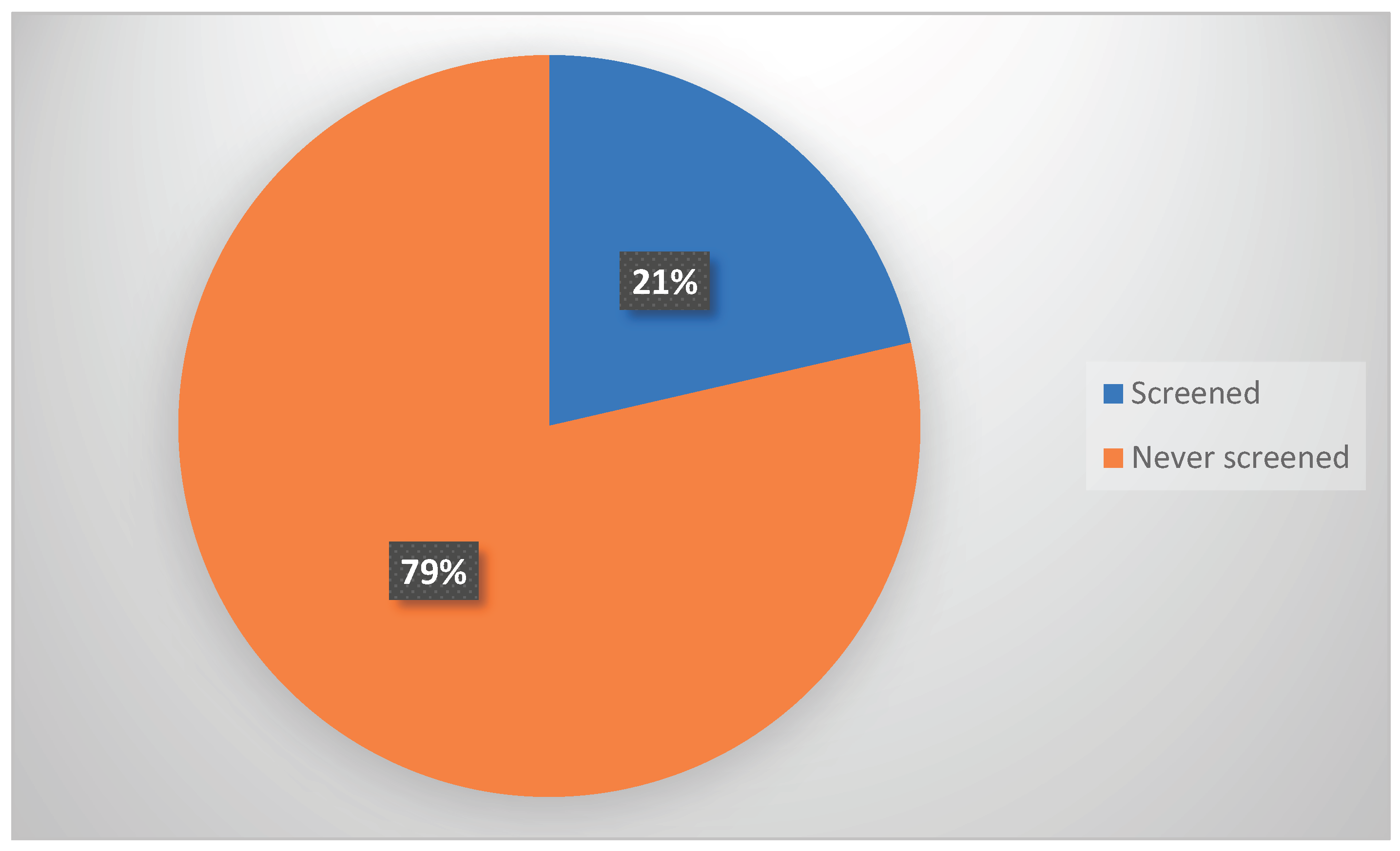
Table 1.
Distribution of participants according to sociodemographic characteristics.
| Variables | Categories | Frequency (n = 3751) | Percentage (%) | p-value* |
|---|---|---|---|---|
| Age (years) | 25-35 | 1350 | 36.0 | - |
| 36-45 | 1402 | 37.4 | ||
| 46-55 | 678 | 18.1 | ||
| 56-65 | 321 | 8.5 | ||
| Place of residence | Urban | 1875 | 50.0 | < 0.001 |
| Rural | 1876 | 50.0 | ||
| Level of education | None | 530 | 14.1 | < 0.001 |
| Primary | 1230 | 32.8 | ||
| Secondary | 1391 | 37.1 | ||
| Higher | 600 | 16.0 | ||
| Marital status | Single | 1256 | 33.5 | 0.08 (NS) |
| Married or in union | 2010 | 53.6 | ||
| Widow/Divorced | 485 | 12.9 | ||
| Occupation | Unemployed/Housewife | 1475 | 39.3 | < 0.001 |
| Self-employed | 1082 | 28.8 | ||
| Civil servant | 694 | 18.5 | ||
| Farmer | 500 | 13.3 | ||
| Social insurance coverage | Yes | 620 | 16.5 | < 0.001 |
| No | 3131 | 83.5 |
Table 2.
Status according to the sociodemographic characteristics of participants.
| Variables | Categories | Screened n (%) | Never Screened n (%) | Total n | p-value |
|---|---|---|---|---|---|
| Place of Residence | Urban | 525 (28.0) | 1.350 (72.0) | 1.875 | < 0.001 |
| Rural | 278 (14.8) | 1.598 (85.2) | 1.876 | ||
| Level of Education | None | 117 (22.1) | 413 (77.9) | 530 | < 0.001 |
| Primary | 221 (18.0) | 1.009 (82.0) | 1.230 | ||
| Secondary | 278 (20.0) | 1.113 (80.0) | 1.391 | ||
| Higher | 186 (31.0) | 414 (69.0) | 600 | ||
| Marital Status | Single | 260 (20.7) | 996 (79.3) | 1.256 | 0.08 (NS) |
| Married/Union | 440 (21.9) | 1.570 (78.1) | 2.010 | ||
| Widowed/Divorced | 103 (21.2) | 382 (78.8) | 485 | ||
| Occupation | Unemployed/Housewife | 259 (17.6) | 1.216 (82.4) | 1.475 | < 0.001 |
| Self-employed | 250 (23.1) | 832 (76.9) | 1.082 | ||
| Civil Servant | 186 (26.8) | 508 (73.2) | 694 | ||
| Farmer | 107 (21.4) | 393 (78.6) | 500 | ||
| Social Coverage | Yes | 240 (38.7) | 380 (61.3) | 620 | < 0.001 |
| No | 563 (18.0) | 2.568 (82.0) | 3.131 |
NS: Not significant.
Table 3.
Factors associated with cervical cancer Screening.
| Variables | Categories | Adjusted OR (95% CI) | P-value |
|---|---|---|---|
| Age (years) | 25-35 | 1 (Reference) | - |
| 36-45 | 1.10 (0.95-1.28) | 0.20 | |
| 46-55 | 1.25 (1.02-1.54) | 0.03 | |
| 56-65 | 1.05 (0.80-1.37) | 0.70 | |
| Place of residence | Urban | 1 (Reference) | - |
| Rural | 0.55 (0.47-0.65) | <0.001 | |
| Level of education | None | 1 (Reference) | - |
| Primary | 0.85 (0.68-1.05) | 0.13 | |
| Secondary | 0.95 (0.76-1.17) | 0.63 | |
| Higher | 1.45 (1.13-1.86) | 0.003 | |
| Occupation | Unemployed/Housewife | 1 (Reference) | - |
| Self-employed | 1.20 (1.01-1.43) | 0.04 | |
| Civil Servant | 1.50 (1.18-1.91) | <0.001 | |
| Farmer | 1.10 (0.87-1.39) | 0.43 | |
| Social coverage | No | 1 (Reference) | - |
| Yes | 2.30 (1.85-2.85) | <0.001 |
Disclaimer/Publisher’s Note: The statements, opinions and data contained in all publications are solely those of the individual author(s) and contributor(s) and not of MDPI and/or the editor(s). MDPI and/or the editor(s) disclaim responsibility for any injury to people or property resulting from any ideas, methods, instructions or products referred to in the content. |
© 2026 by the authors. Licensee MDPI, Basel, Switzerland. This article is an open access article distributed under the terms and conditions of the Creative Commons Attribution (CC BY) license (http://creativecommons.org/licenses/by/4.0/).
Copyright: This open access article is published under a Creative Commons CC BY 4.0 license, which permit the free download, distribution, and reuse, provided that the author and preprint are cited in any reuse.