

Submitted:
03 May 2026
Posted:
05 May 2026
Read the latest preprint version here
Abstract
Chronic migraine has traditionally been framed as a disabling but self-limited pain disorder. Recent large-scale epidemiology, Mendelian randomisation, and neuroimaging converge on a different reading: midlife chronic migraine, particularly with aura, precedes and predicts Alzheimer's dementia in a manner consistent with a causal direction rather than mere association. We propose a hierarchical model in which recurrent cortical spreading depression initiates a feed-forward network: transient glymphatic closure with stasis of amyloid-β and tau; brain insulin resistance and interictal energy failure; and sustained, TNF-α-centred neuroinflammation, with each level feeding back to lower the threshold for the others. Sleep, mood, and vascular comorbidities are repositioned as bidirectional amplifiers rather than independent confounders. We outline falsifiable predictions, discuss the ambiguous neurocognitive profile of CGRP-pathway blockade, and argue that midlife migraine prevention warrants evaluation as a candidate disease-modifying strategy for Alzheimer's dementia.
Keywords:
chronic migraine
; Alzheimer's dementia
; cortical spreading depression
; glymphatic system
; brain insulin resistance
; TNF-alpha
; Mendelian randomisation
; CGRP
; feed-forward hypothesis
Introduction
The global prevalence of dementia — approximately 57 million people in 2019 — is projected to rise to 153 million by 2050, driven largely by population ageing and the persistent difficulty of modifying the disease after clinical onset [1]. The 2024 Lancet Commission on dementia prevention identified 14 potentially modifiable midlife and late-life risk factors accounting for around 45% of dementia cases worldwide, but migraine was not among them [2]. Yet migraine, which affects more than one billion people and peaks in prevalence during the fourth and fifth decades of life, has emerged over the past five years as a robust, independent midlife risk factor for dementia and is plausibly amenable to intervention [3,4,5].
A 2025 meta-analysis of 11 cohort studies comprising 6 964 353 participants reported that people with migraine had a 26% higher risk of all-cause dementia (hazard ratio [HR] 1·26, 95% CI 1·09–1·46), a 32% higher risk of Alzheimer's dementia (HR 1·32, 1·26–1·38), and a 28% higher risk of vascular dementia (HR 1·28, 1·24–1·32) [3]. Meta-regression found no evidence that region, sex, diagnostic criteria, or follow-up duration moderated the effect [3]. Parallel work using the UK Biobank (404 318 participants) and two-sample Mendelian randomisation has gone further, providing genetically supported evidence consistent with a causal direction from migraine to Alzheimer's dementia — not merely a shared phenotype or a consequence of prodromal cognitive decline [6]. Multivariable Mendelian randomisation has nominated TNF-α as the most consistent inflammatory mediator of this effect [7].
Migraine's absence from dementia-prevention frameworks reflects an outdated framing as benign and episodic rather than as a repetitive neurovascular insult with cumulative consequences. Here we synthesise the epidemiological, genetic, neuroimaging, and translational evidence into a single falsifiable hierarchical model.
Relation to Prior Reviews
Six overlapping reviews (2024–2026) establish the context but do not integrate it. Fernandes and Gil-Gouveia describe migraine-related cognitive dysfunction as multidimensional without proposing causal primacy [8]. Cermelli and colleagues establish the migraine–dementia association meta-analytically without a mechanistic account [4]. Three 2026 reviews consolidate a metabolic-first Alzheimer's paradigm but none identifies migraine as a disease-specific driver [9,10,11]. Ravyts and colleagues quantify depression–chronic-headache comorbidity without linking it to dementia [12]. The present Personal View integrates these four domains into a single directional hierarchy anchored in the glymphatic system, and specifies falsifiable predictions absent from the prior literature.
Epidemiological Foundation: Dose-Response, Aura, and Chronicity
Three features distinguish the migraine-to-dementia signal from nonspecific chronic-pain effects. First, the risk scales with attack frequency. A nationwide Korean study reported that migraine patients had an increased risk of Alzheimer's dementia compared with controls, with the effect larger in people younger than 65 years than in older cohorts — implying that the pathological clock starts well before the cognitive phenotype is apparent [13]. Second, migraine with aura carries a disproportionate burden. Large registry cohorts report higher all-cause dementia incidence in people with migraine with aura than in people with migraine without aura or in the general population [3]. Third, chronic migraine (ICHD-3: headache on ≥15 days per month for >3 months, with ≥8 days bearing migrainous features) carries excess risk beyond episodic migraine [4].
Mendelian randomisation extends these observations from association toward a directional causal inference. Using migraine GWAS data (13 971 cases, 470 627 controls) combined with independent Alzheimer's disease datasets (Bellenguez and FinnGen), Xu and colleagues reported an odds ratio of 1·54 (95% CI 1·18–2·00; p<0·01) for migraine on Alzheimer's dementia in univariable analyses, with Steiger's test supporting the migraine → Alzheimer's direction and rejecting the reverse [7]. In the UK Biobank cohort, genetically predicted migraine likewise increased Alzheimer's risk (OR 2·32, 1·03–5·23; p=0·002), whereas genetic liability for Alzheimer's had no detectable effect on migraine (OR 1·00; p=0·97) [6]. These analyses partially address the scenario — plausible on purely clinical grounds — in which subclinical cognitive decline alters pain perception and increases migraine frequency before dementia is detectable: because genetic liability for migraine, not for Alzheimer's, predicts the association, classical reverse causality is rendered unlikely [6,7].
Two caveats travel with these estimates. Horizontal pleiotropy — migraine-associated variants influencing Alzheimer's risk through migraine-independent pathways — is the largest threat to causal inference from Mendelian randomisation and cannot be ruled out on Steiger directionality alone. Before mediation fractions (such as the 28·2% thalamic estimate below) are treated as established network quantities, MR-Egger, weighted-median, and MR-PRESSO outlier-corrected estimators, together with fully bidirectional MR using independent exposure and outcome GWAS, must become routine. Two-sample analyses to date also rely on European-ancestry GWAS and need ancestrally diverse replication. We therefore treat the genetic evidence as probabilistically supportive of a causal direction — not as proof of causation.
A Hierarchical Mechanistic Model
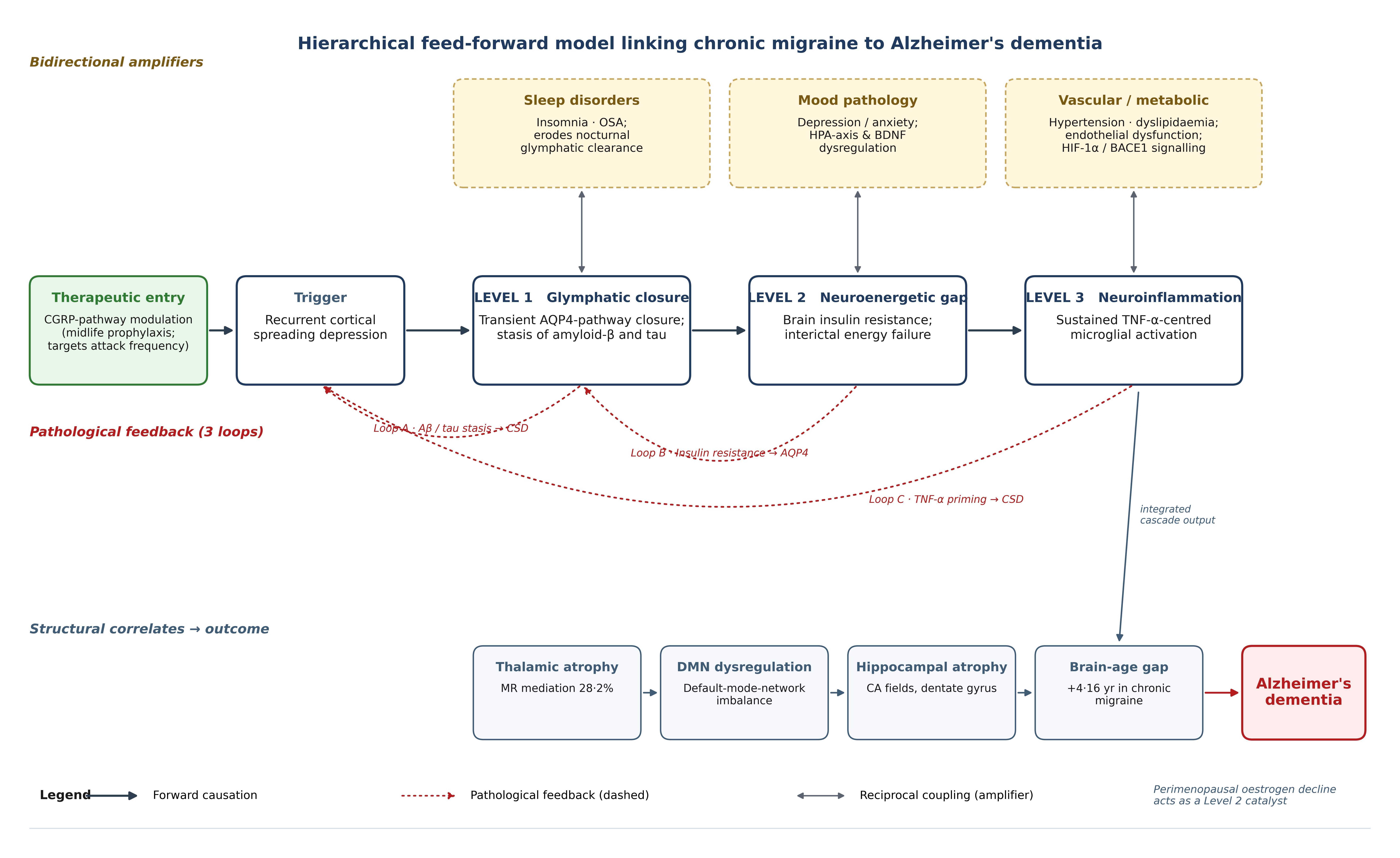
We propose that repeated cortical spreading depression (CSD) is the initiating trigger of a three-level feed-forward network that links a pain disorder to neurodegeneration (Figure 1). CSD retains chronological primacy — it is the earliest identifiable event on the pathological clock — but once the cascade is active, each downstream level reciprocally lowers the threshold for renewed CSD and reinforces the others. The architecture is therefore directional in time but mutually amplifying in state space, and it is this self-sustaining loop that distinguishes episodic migraine from the progressive chronic form.
Level 1 — Glymphatic Closure and Impaired Parenchymal Clearance
The glymphatic system — the AQP4-dependent perivascular pathway through which cerebrospinal fluid exchanges with interstitial fluid and clears amyloid-β and tau — is now recognised as a central mechanism of brain waste removal [14]. CSD, the slowly propagating wave of depolarisation that underlies migraine aura and is increasingly suspected in subclinical form during attacks without aura, is associated with massive ionic shifts, extreme metabolic demand, transient blood–brain-barrier disruption, and a protracted oligaemic phase [15]. Landmark work showed that experimental induction of CSD produces rapid, near-complete closure of penetrating periarterial and perivenous paravascular spaces at the cortical surface, with recovery requiring approximately 30 minutes per event [15].
In episodic migraine this functional stasis is probably tolerated. We hypothesise that in chronic migraine — with attacks recurring up to 20 times per month — the accumulation of these short closures produces a chronic regional clearance deficit. A rodent-to-human extrapolation suggests several hours per month of impaired cortical solute clearance, but true human kinetics are unmeasured and the inference rests on the contested assumption that subclinical CSD also occurs in attacks without aura, supported by indirect neurophysiological and neuroimaging evidence rather than direct human cortical recording. If the inference holds, extracellular amyloid-β and tau accumulate, and tau stasis promotes prion-like uptake into adjacent neurons. We therefore propose, as a testable hypothesis, that chronic migraine behaves as a disorder of recurrent, regional glymphatic failure — a mechanism not currently included in dementia-prevention frameworks [2].
Level 2 — Brain Insulin Resistance and the Neuroenergetic Gap
Del Moro and colleagues developed the neuroenergetic / brain insulin resistance hypothesis of migraine in a 2022 scoping review [16] and extended it in 2024 to bridge migraine and Alzheimer's disease through brain insulin resistance [5]. In their framework, downregulation of neuronal and astrocytic insulin receptors, impaired astrocyte–neuron lactate shuttling, and reduced glycogen synthesis create an interictal “energy gap” that is exposed whenever cerebral energy demand rises, notably in the build-up to an attack. Recent metabolic-first reviews of Alzheimer's disease have converged on brain insulin resistance and cerebral glucose hypometabolism as upstream drivers of amyloid-tau pathology [9,10].
Our model places these frameworks in a specific causal ordering: CSD, trigeminovascular activation, and glymphatic stasis degrade cortical energetics over time; chronic adenosine triphosphate (ATP) deficiency compromises endoplasmic-reticulum protein folding; misfolded amyloid-β and hyperphosphorylated tau accumulate. Brain insulin resistance in chronic migraine is therefore not a comorbid trait but a predictable consequence of the attack pattern.
The level 2 deficit is not sex-neutral. Women carry approximately three-fold higher migraine prevalence and close to two-thirds of Alzheimer's dementia cases, and perimenopausal oestrogen decline independently reduces cerebral glucose metabolism and mitochondrial neuroprotection. Where chronic migraine has imposed a decades-long interictal energy gap, the perimenopausal transition is best modelled as a physiological catalyst that compounds rather than replaces that deficit, exponentiating the coupled risk in the fifth and sixth decades. Any sex-stratified analysis that ignores the migraine × menopause interaction is likely to underestimate the dementia-relevant window for intervention.
Level 3 — TNF-α-Centred Neuroinflammation
The multivariable Mendelian randomisation analysis of Xu and colleagues offers mechanistic specificity [7]. When 33 pre-specified covariates — stroke, diabetes, atrial fibrillation, BMI, sleep apnoea, hypertension, education, alcohol use, and inflammatory cytokines — were entered sequentially into Mendelian randomisation models, the causal effect of migraine on Alzheimer's dementia remained robust against all but two adjustments: TNF-α (OR 1·24, p=0·29) and diastolic blood pressure (OR 1·41, p=0·18). IL-1α, IL-1β, and IL-6 did not attenuate the effect [7].
This pattern is consistent with chronic migraine sustaining a reactive-astrocyte and M1-polarised microglial state that drives prolonged TNF-α production, NF-κB transcription, reactive oxygen species, blood–brain-barrier dysfunction, suppressed neurogenesis, and BACE1-mediated amyloidogenic APP cleavage — mechanisms established in Alzheimer's disease more generally [17]. The migraine-to-Alzheimer's axis is thus not a diffuse inflammatory penumbra but a specific, TNF-α-centred, pharmacologically addressable pathway.
Pathological Feedback Loops
Three reciprocal loops close the network. First, interictally elevated TNF-α primes microglia, impairs astrocytic glutamate uptake, and enhances cortical excitability, lowering the threshold for renewed CSD — level 3 drives new attacks rather than merely reflecting them [17]. Second, brain insulin resistance downregulates astrocytic AQP4 polarisation and perivascular water flux, degrading the glymphatic machinery whose closure initiates level 1 [5,14]. Third, interstitial amyloid-β and tau stasis from level 1 further sensitises cortex to spreading depolarisation, closing a loop with the root node. The hierarchy is falsifiable as a temporal ordering, but the pathological phenotype emerges only when these loops engage.
Comorbidities as Bidirectional Amplifiers
Prevailing epidemiological practice adjusts for sleep disorders, depression, and cardiovascular disease as independent risk factors. We instead treat them as bidirectional amplifiers. These conditions possess well-established independent aetiologies — obstructive sleep apnoea arises from pharyngeal anatomy and obesity, metabolic syndrome from insulin-resistant adiposity and genetic dyslipidaemia, depression from polygenic and psychosocial risk — and each can, in its own right, trigger or chronify migraine [4,12]. Once established, however, they share mechanistic surfaces with levels 1–3: they amplify the primary cascade and are amplified by it (Table 1). Standard adjustment therefore over-controls for mediators and under-recognises reciprocal reinforcement.
Deep NREM sleep is when glymphatic exchange is most efficient; its erosion by insomnia or obstructive sleep apnoea removes the principal nocturnal amyloid-clearance window and compounds the diurnal glymphatic closures discussed above [4]. Depression is a well-recognised prodromal and risk feature of dementia;2 in older Chinese adults depressive symptoms mediated 65·25% of the chronic-pain → dementia relationship [18]. Sustained HPA-axis activation, chronic cortisol exposure, BDNF suppression, and hippocampal neurogenesis inhibition link mood pathology to Alzheimer's risk along the same axis engaged by chronic migraine. Vascular and metabolic comorbidities — atherosclerosis, endothelial dysfunction, white-matter hyperintensities, metabolic syndrome — are over-represented in migraine with aura and independently raise HIF-1α-driven amyloidogenic signalling [7].
Two therapeutic corollaries follow. Treating the bidirectional amplifiers without reducing attack frequency is unlikely to neutralise the dementia trajectory; conversely, reducing attack frequency while leaving severe comorbid apnoea, insomnia, or metabolic dysregulation untreated will also under-perform. Both are testable (see Predictions).
Structural Evidence of Premature Neurodegeneration
If the proposed cascade is correct, people with chronic migraine should already show structural and biochemical signatures of incipient neurodegeneration before dementia becomes clinical.
MRI-based brain age models estimate that people with chronic migraine have brains on average 4·16 years older than their chronological age (versus −0·56 years in healthy controls; p=0·01); the brain-age gap correlated with subclinical deficits in declarative memory and processing speed [19]. Morphometric studies additionally show volume loss in the hippocampus (Cornu Ammonis fields and dentate gyrus) and thalamus — regions that are both essential for memory consolidation and among the earliest to be affected in Alzheimer's disease.
The thalamus, the somatosensory relay for trigeminovascular afferents, is continuously stimulated in chronic migraine. A Mendelian-randomisation mediation analysis showed that migraine accelerates longitudinal thalamic atrophy, which mediates 28·2% of the causal effect of migraine on Alzheimer's disease (β=0·038, p=0·040) [20]. Nearly one-third of the genetic risk signal flows through a single measurable structural change.
A bridge is required between a pain-network lesion and the hippocampal–entorhinal pathology that defines Alzheimer's dementia. We propose two convergent routes. Dense reciprocal thalamic–default-mode-network connectivity means that thalamic attrition destabilises DMN–task-positive competition — an imbalance already linked to amyloid deposition and episodic-memory decline. Superimposed on this drift, anterograde trans-synaptic tau propagation and Wallerian-type degeneration of thalamocortical and thalamo-hippocampal fibres supply an anatomical route from pain relay to memory circuit, consistent with the thalamus–DMN–medial-temporal atrophy gradient observed in preclinical Alzheimer's cohorts. Biomarker studies additionally report elevated GFAP in chronic migraine — especially with medication-overuse headache — consistent with astrocytic stress and blood–brain-barrier compromise.
The CGRP Question: Neuroprotector Silenced or Inflammation Checked?
The clinical implications converge on calcitonin-gene-related-peptide (CGRP) pathway modulation. CGRP-targeting monoclonal antibodies and gepants reduce attack frequency and, on the present model, should suppress CSD burden, restore glymphatic function, reduce TNF-α tone, and dampen comorbid amplifiers.
Two hypotheses compete. In the first, CGRP is an endogenous neuroprotector whose long-term systemic blockade could leave the ageing brain vascularly under-defended — with specific theoretical concern for impaired microvascular autoregulation and collateral perfusion during ischaemic stress, and for unmasking of cerebral amyloid angiopathy in susceptible patients. This clinical safety signal is not currently contradicted by short-term trial data but would only be detectable over 10–20 years of exposure. In the second — supported at present only by emerging and unverified evidence — chronic CGRP signalling might contribute actively to Alzheimer's-relevant neuroinflammation: a 2025 bioRxiv preprint reported that CGRP-receptor inhibition in 5xFAD mice reduced soluble Aβ₁₋₄₂ oligomer-induced neuronal death and microglial activation through HDAC11/LXRβ/ABCA1-mediated lipid reprogramming [21]. Until this finding has been independently replicated and formally peer-reviewed, it should be treated as hypothesis-generating rather than as a mechanistic basis for clinical reassurance. The positions need not be contradictory — CGRP may be protective acutely but pathogenic when chronically elevated as part of sustained trigeminovascular inflammation — but the decisive question is empirical and requires long-term registry data on cognitive and cerebrovascular outcomes in CGRP-treated patients.
Falsifiable Predictions
Six predictions test the model. They split across drug classes by available follow-up window.
1. Glymphatic imaging. Non-invasive glymphatic indices (e.g. DTI-ALPS) should be impaired in chronic migraine in proportion to attack frequency and worsen during and after aura. Because the human glymphatic estimate is inferential, confirmation requires invasive human kinetic studies — intrathecal or intravenous gadolinium-enhanced MRI of CSF dynamics, timed to ictal and interictal states — alongside longitudinal DTI-ALPS.
2. Thalamic trajectory. Longitudinal thalamic atrophy rate in chronic migraine should exceed age- and sex-matched controls and correlate with subsequent cognitive decline. The 28·2% mediation fraction should survive MR-PRESSO outlier correction and bidirectional Mendelian randomisation.
3. TNF-α specificity. In multivariable Mendelian randomisation mediation analyses using pleiotropy-robust estimators (MR-Egger, weighted-median, MR-PRESSO), TNF-α — but not IL-1 or IL-6 — should consistently account for the largest mediated fraction of the migraine → Alzheimer's effect.
4. Prophylactic effect — legacy agents (retrospective). Effective midlife prophylaxis with topiramate, onabotulinumtoxinA, propranolol, and candesartan — prescribed at scale since the 1990s–2000s — should, in existing datasets (UK CPRD, the Danish National Prescription Registry, US Medicare linkage), attenuate the Alzheimer's incidence curve at a 10–20-year lag, using active-comparator new-user designs and target-trial emulation to address confounding by indication.
5. Prophylactic effect — CGRP-pathway class (prospective). Because CGRP-targeting monoclonal antibodies and gepants entered large-scale clinical use only from 2018, no existing dataset supplies the 10–20-year follow-up required for late-life cognitive outcomes. This prediction therefore requires new international prospective registries with pre-specified biomarker and cognitive endpoints: plasma amyloid-β 42/40 ratio and amyloid-PET as amyloid-specific indices that directly test the level 1 glymphatic-clearance hypothesis; plasma p-tau217 as the current optimal tauopathy marker; NfL and GFAP as non-specific neurodegenerative and astrocytic stress markers; and incident Alzheimer's dementia as the terminal endpoint. First-decade results should report no earlier than approximately 2038. Claims of CGRP-pathway neuroprotection resting on current 1–2-year follow-up must not be conflated with evidence for disease modification.
6. Subtype specificity — with a subclinical-CSD caveat. If the incidence gap between aura and non-aura subtypes is driven purely by CSD burden, CSD-suppressing prophylaxis should mirror that gap. However, because subclinical CSD is plausibly common in migraine without aura, the protective differential between subtypes is likely narrower than a pure CSD-burden model predicts; a small between-subtype effect should not be treated as a decisive falsification. Treating bidirectional amplifiers alone without reducing attack frequency should nonetheless fail to neutralise the excess Alzheimer's risk.
Each prediction is quantitatively specifiable and falsifiable in existing or planned cohort, imaging, and pharmaco-epidemiological datasets, with the explicit qualification that prediction 5 requires datasets that do not yet exist.
Clinical Implications
Three practice changes follow if the hierarchical model holds. Frequent midlife migraine should be assessed as a candidate modifiable cognitive-risk factor alongside hypertension, hearing loss, and physical inactivity [2]. Chronic migraine with aura accompanied by insomnia, depression, or vascular-risk accumulation — and in women, when coinciding with the perimenopausal transition — should be flagged as a high-risk phenotype warranting intensified prevention. The therapeutic goal of prophylaxis deserves re-framing from “reduction of days with pain” to “reduction of cumulative neurodegenerative insult”, with long-term neurocognitive endpoints added to trials. The retrospective case for legacy prophylaxis is approachable in existing pharmaco-epidemiological datasets; the CGRP-pathway case requires new prospective registries. The argument is for accelerating those trials, not waiting a further decade.
Limitations and Outstanding Questions
Five limitations temper the conclusions. Mendelian randomisation provides a direction-of-effect inference not biological proof; pleiotropy-robust and bidirectional estimators (MR-Egger, weighted-median, MR-PRESSO, independent exposure-outcome GWAS) must be prerequisites, not post-hoc checks. CSD-induced glymphatic closure is largely rodent-derived, and subclinical CSD in attacks without aura is inferred from indirect human evidence. Selection bias in migraine cohorts may inflate associations, and ancestrally diverse replication is required. No randomised trial has evaluated cognition as a primary endpoint of midlife prophylaxis, and observational follow-up is short. CGRP-pathway evidence has a structural follow-up ceiling — routine use only since 2018 — so its therapeutic claim awaits prospective registries reporting no earlier than the late 2030s. The model is best read as a testable synthesis, not as established aetiology.
Conclusions
Cumulative epidemiological, genetic, neuroimaging, and translational evidence no longer fits comfortably with the traditional framing of migraine as benign and episodic. Chronic migraine — particularly with aura — behaves as an active, progressive process whose hallmark is not acute pain but the slow structural and metabolic attrition of the brain. Recognising it as such opens a neglected midlife window for Alzheimer's prevention, and challenges the field to test whether one of neurology's most effective recent drug classes is also among its most important preventive tools.
Author Contributions
GAS conceived, researched, wrote and revised the manuscript, and is guarantor.
Funding
No external funding was received for this work.
Institutional Review Board Statement
Not applicable; no primary data, no human subjects, no animal experiments.
Data Availability Statement
No primary data were generated. All cited studies are publicly accessible via the listed DOIs.
Use: of generative AI
Generative AI (Claude, Anthropic) was used to assist with literature synthesis, reference verification, and language editing; all scientific claims, attributions, and conclusions were authored, verified, and approved by the author.
Conflicts of Interest
In 2025, under a formal personal consultancy agreement with AbbVie, the author participated in two advisory meetings on migraine care-pathway optimisation and received personal honoraria totalling EUR 1 254. AbbVie manufactures atogepant (Qulipta), ubrogepant (Ubrelvy), and onabotulinumtoxinA (Botox), which are CGRP-pathway and chronic-migraine therapeutics discussed in this manuscript. This disclosure is made in accordance with ICMJE guidance; the consultancy did not concern the scientific content of this manuscript and did not influence its conception, conduct, interpretation, or conclusions. Beyond this single disclosure, the author declares no other competing interests.
References
- GBD 2019 Dementia Forecasting Collaborators. Estimation of the global prevalence of dementia in 2019 and forecasted prevalence in 2050: an analysis for the Global Burden of Disease Study 2019. Lancet Public Health 2022, 7, e105–25. [Google Scholar] [CrossRef]
- Livingston, G.; Huntley, J.; Liu, K.Y.; et al. Dementia prevention, intervention, and care: 2024 report of the Lancet standing Commission. Lancet 2024, 404, 572–628. [Google Scholar] [CrossRef]
- Zhu, W.; Zhan, Y.; Pei, J.; et al. Migraine is a risk factor for dementia: a systematic review and meta-analysis of cohort studies. J. Headache Pain 2025, 26, 136. [Google Scholar] [CrossRef] [PubMed]
- Cermelli, A.; Roveta, F.; Giorgis, L.; et al. Is headache a risk factor for dementia? A systematic review and meta-analysis. Neurol. Sci. 2024, 45, 1017–1030. [Google Scholar] [CrossRef] [PubMed]
- Del Moro, L.; Pirovano, E.; Rota, E. Mind the metabolic gap: bridging migraine and Alzheimer's disease through brain insulin resistance. Aging Dis. 2024, 15, 2526–2553. [Google Scholar] [CrossRef]
- Geng, C.; Chen, C. Migraine association with Alzheimer's disease risk: evidence from the UK Biobank cohort study and Mendelian randomization. Can. J. Neurol. Sci. 2024, 52, 44–52. [Google Scholar] [CrossRef] [PubMed]
- Xu, C.; Wu, W.; Fan, Y.; Zhu, S. Independent causal effect of migraines on Alzheimer's disease risk: a multivariate Mendelian randomization study. Front Neurol. 2024, 15, 1401880. [Google Scholar] [CrossRef]
- Fernandes, C.; Gil-Gouveia, R. Deciphering the mechanisms: pathophysiology of migraine-related cognitive dysfunction. Cephalalgia 2025, 45, 3331024251368328. [Google Scholar] [CrossRef]
- Suswidiantoro, V.; Tang, K.S.; Rahman, K.; et al. Metabolic drivers of Alzheimer's disease: integrating brain hypometabolism, insulin resistance, and systemic dysregulation. Front Neuroendocrinol. 2026, 81, 101248. [Google Scholar] [CrossRef]
- Christodoulou, R.C.; Eller, D.; Papageorgiou, P.S.; et al. Metabolic dysfunction in Alzheimer's disease: brain glucose hypometabolism as an early precursor to amyloid and tau pathology. J. Clin. Med. 2026, 15, 1884. [Google Scholar] [CrossRef]
- Verma, A.; Sharma, M.; Alam, O.; Anwer, T. Type 3 diabetes: a molecular link between cerebral insulin resistance and neurodegeneration via AGE-RAGE signaling. Eur. J. Neurosci. 2026, 63, e70364. [Google Scholar] [CrossRef] [PubMed]
- Ravyts, S.G.; Carnahan, N.; Harte, N.; et al. Depression and anxiety in adults with chronic headache conditions: a systematic review and meta-analysis. J. Pain 2025, 39, 105610. [Google Scholar] [CrossRef]
- Hurh, K.; Jeong, S.H.; Kim, S.H.; Jang, S.Y.; Park, E.C.; Jang, S.I. Increased risk of all-cause, Alzheimer's, and vascular dementia in adults with migraine in Korea: a population-based cohort study. J. Headache Pain 2022, 23, 108. [Google Scholar] [CrossRef]
- Iliff, J.J.; Wang, M.; Liao, Y.; et al. A paravascular pathway facilitates CSF flow through the brain parenchyma and the clearance of interstitial solutes, including amyloid beta. Sci. Transl. Med. 2012, 4, 147ra111. [Google Scholar] [CrossRef]
- Schain, A.J.; Melo-Carrillo, A.; Strassman, A.M.; Burstein, R. Cortical spreading depression closes paravascular space and impairs glymphatic flow: implications for migraine headache. J. Neurosci. 2017, 37, 2904–2915. [Google Scholar] [CrossRef]
- Del Moro, L.; Rota, E.; Pirovano, E.; Rainero, I. Migraine, brain glucose metabolism and the “neuroenergetic” hypothesis: a scoping review. J. Pain 2022, 23, 1294–1317. [Google Scholar] [CrossRef] [PubMed]
- Heneka, M.T.; Carson, M.J.; El Khoury, J.; et al. Neuroinflammation in Alzheimer's disease. Lancet Neurol. 2015, 14, 388–405. [Google Scholar] [CrossRef]
- Duan, W.; Huang, J.; Huang, Q.; Dong, B. Relationship between pain and dementia: the mediating effect of depression among Chinese elderly. Actas Esp. Psiquiatr 2024, 52, 114–121. [Google Scholar] [CrossRef] [PubMed]
- Navarro-González, R.; García-Azorín, D.; Guerrero-Peral, Á.L.; Planchuelo-Gómez, Á.; Aja-Fernández, S.; de Luis-García, R. Increased MRI-based brain age in chronic migraine patients. J. Headache Pain 2023, 24, 133. [Google Scholar] [CrossRef]
- Zhao, L.; Tang, Y.; Tu, Y.; Cao, J. Genetic evidence for the causal relationships between migraine, dementia, and longitudinal brain atrophy. J. Headache Pain 2024, 25, 93. [Google Scholar] [CrossRef]
- Inhibition of CGRP receptor ameliorates AD pathology by reprogramming lipid metabolism through HDAC11/LXRβ/ABCA1 signalling. bioRxiv, Preprint — not peer-reviewed; peer-reviewed version should be substituted if available at submission.; 2025. [CrossRef]
Figure 1.
Hierarchical feed-forward model linking chronic migraine to Alzheimer's dementia. The initiating trigger is recurrent cortical spreading depression (CSD), which produces transient glymphatic closure (level 1), brain insulin resistance and interictal energy failure (level 2), and sustained TNF-α-centred neuroinflammation (level 3). Solid arrows show the direction of initial causation; dashed red return arrows show three pathological feedback loops: TNF-α lowers the threshold for renewed CSD, brain insulin resistance impairs astrocytic AQP4-dependent glymphatic flux, and interstitial amyloid-β/tau stasis sensitises cortex to further spreading depolarisation. Sleep, mood, and vascular comorbidities (right panel) are modelled as bidirectional amplifiers with independent aetiologies that reciprocally amplify the primary cascade. Structural correlates — thalamic atrophy, DMN dysregulation, hippocampal atrophy, increased brain-age gap — sit at the interface of mechanism and outcome, with the thalamus→DMN→hippocampus bridge inferred from trans-synaptic tau propagation and Wallerian-type degeneration. The proposed therapeutic entry point (CGRP-pathway modulation at midlife) targets attack frequency and therefore the entire network.
Figure 1.
Hierarchical feed-forward model linking chronic migraine to Alzheimer's dementia. The initiating trigger is recurrent cortical spreading depression (CSD), which produces transient glymphatic closure (level 1), brain insulin resistance and interictal energy failure (level 2), and sustained TNF-α-centred neuroinflammation (level 3). Solid arrows show the direction of initial causation; dashed red return arrows show three pathological feedback loops: TNF-α lowers the threshold for renewed CSD, brain insulin resistance impairs astrocytic AQP4-dependent glymphatic flux, and interstitial amyloid-β/tau stasis sensitises cortex to further spreading depolarisation. Sleep, mood, and vascular comorbidities (right panel) are modelled as bidirectional amplifiers with independent aetiologies that reciprocally amplify the primary cascade. Structural correlates — thalamic atrophy, DMN dysregulation, hippocampal atrophy, increased brain-age gap — sit at the interface of mechanism and outcome, with the thalamus→DMN→hippocampus bridge inferred from trans-synaptic tau propagation and Wallerian-type degeneration. The proposed therapeutic entry point (CGRP-pathway modulation at midlife) targets attack frequency and therefore the entire network.
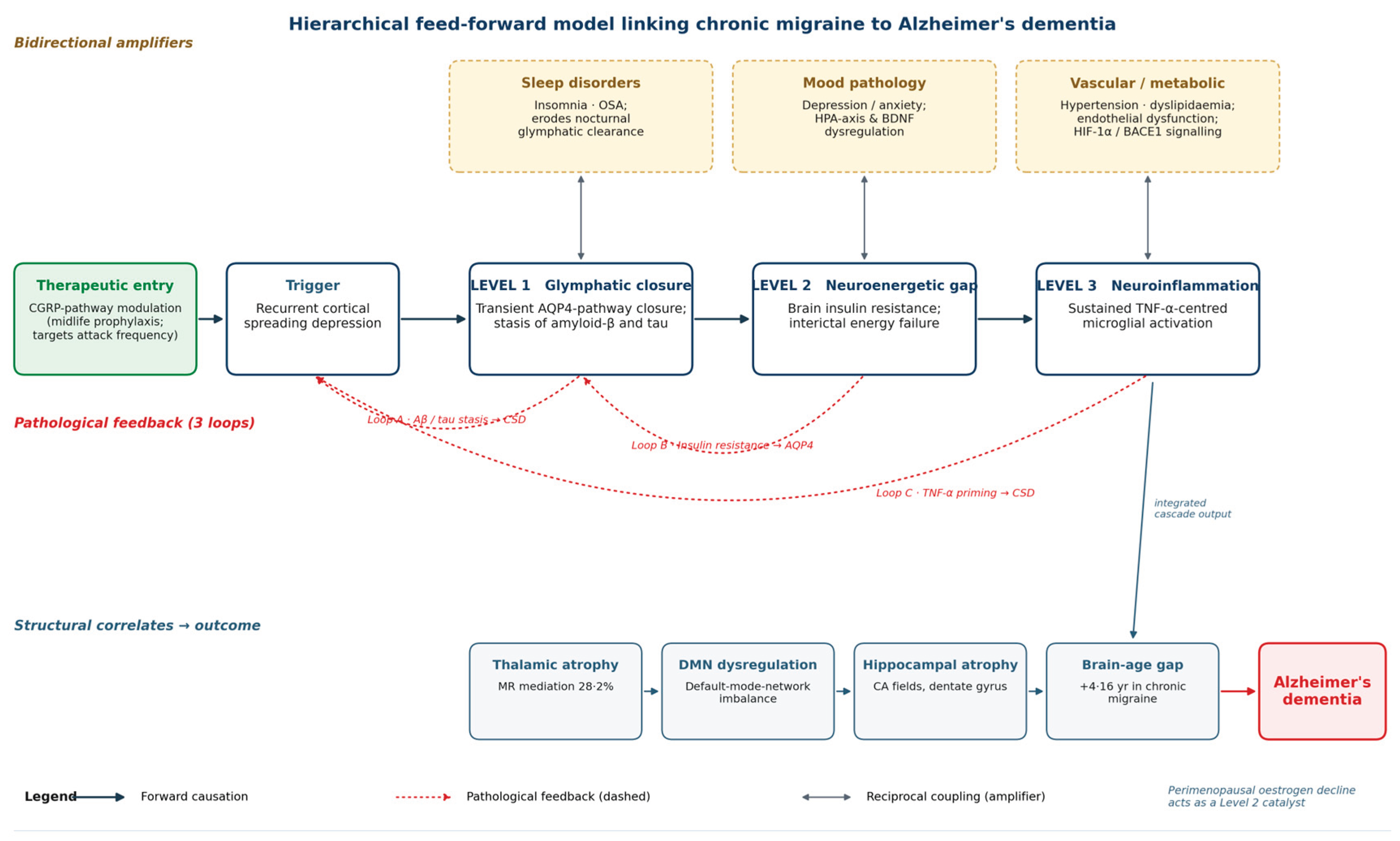

Table 1.
Migraine comorbidities as bidirectional amplifiers in the hierarchical model.
| Bidirectional amplifier | Independent aetiology | Mechanism of interaction with the migraine–AD cascade | Reported epidemiological risk (AD) |
| Chronic insomnia | Primary circadian, psychosocial, or psychiatric insomnia | Triggered and deepened by persistent nociceptive signalling; elimination of deep NREM sleep removes the nocturnal glymphatic amyloid-clearance window and compounds diurnal stasis | Insomnia raises AD risk in meta-analyses; adds to migraine-driven diurnal stasis (see ref [2]) |
| Obstructive sleep apnoea | Pharyngeal anatomy, obesity, male sex | Intermittent nocturnal hypoxia exacerbates neuroinflammation and amyloid aggregation; also chronifies migraine by fragmenting sleep architecture and sensitising trigeminovascular afferents | Established midlife modifiable risk factor for dementia in the 2024 Lancet Commission [2] |
| Depression / anxiety | Polygenic risk, psychosocial adversity, medical comorbidity | Shared HPA-axis dysregulation, cortisol exposure, BDNF suppression; lowers cognitive reserve; mediates 65·25% of chronic-pain → dementia association in one aged cohort18 | Depression raises dementia risk; 43–46% pain–headache comorbidity in meta-analysis [12] |
| Vascular disease / metabolic syndrome | Hypertension, insulin-resistant adiposity, genetic dyslipidaemia | Endothelial dysfunction and white-matter hyperintensities; HIF-1α-driven BACE1 upregulation and amyloidogenic APP cleavage; amplifies migraine-with-aura phenotype | Migraine is associated with cerebrovascular disease and vascular-dementia risk (HR 1·28) [3] |
Disclaimer/Publisher’s Note: The statements, opinions and data contained in all publications are solely those of the individual author(s) and contributor(s) and not of MDPI and/or the editor(s). MDPI and/or the editor(s) disclaim responsibility for any injury to people or property resulting from any ideas, methods, instructions or products referred to in the content. |
© 2026 by the authors. Licensee MDPI, Basel, Switzerland. This article is an open access article distributed under the terms and conditions of the Creative Commons Attribution (CC BY) license (http://creativecommons.org/licenses/by/4.0/).
Copyright: This open access article is published under a Creative Commons CC BY 4.0 license, which permit the free download, distribution, and reuse, provided that the author and preprint are cited in any reuse.