
Submitted:
01 May 2026
Posted:
05 May 2026
You are already at the latest version
Abstract
Coastal strata contain various architectural elements, which differ from both typical marine and terrestrial deposits. These architectural elements represent novel habitats for marine benthos, and some may even serve as a gateway for colonization into aquatic environments on land. Here, I present vertical burrows from the Wulongqing Formation (Cambrian Series 2) in the Longbaoshan area, Yunnan, China, suggesting that early Cambrian burrowers colonized gravelly coastal channels within a fluvio-tidal system. The succession is dominated by mudstone (> 80% of total thickness), with conglomerate beds present at its basal part. The characteristics of the mudstone (lenticular sands, mud drapes, bioturbations) demonstrate tidal influence and benthic activity. The conglomerates are interpreted as coastal channel deposits, characterized by sheet-like geometry (width to thickness ratio > 500), trough cross-stratifications (CXt), and inclined gravel-sand stratifications (CXgs). Furthermore, statistical analysis reveals that the occurrence frequency of vertical burrows at the contact between mudstones and overlying conglomerates (4 in 7) is significantly higher (p-value< 0.01) than within mudstones (5 in 51), indicating that burrowers colonized these coastal channels. Given the similarity between these sheet-like conglomerates and pre-Devonian sheet-braided conglomerates, this colonization implies colonization at the marine end of fluvial systems during the Cambrian explosion.
Keywords:
Cambrian colonization
; Wulongqing Formation
; fluvio-tidal system
; sheet-like conglomerate
; vertical burrows
; coastal channels
1. Introduction
Numerous modern case studies demonstrate that continuous expansion into new habitats is the overriding feature of all adaptive radiation (Schluter, 2000). This general pattern might be clearly exemplified by the Cambrian Explosion, a hallmark radiation event in the early evolution of animals (Zhang & Shu, 2021). In addition to the manifestation of marine animal phyla in body fossils (Zhang & Shu, 2014; Zhang & Shu, 2021), ichnological and sedimentary evidence reveals that marine animals expanded their habitats into coastal environments (Buatois et al., 2022; Mangano & Buatois, 2016). Coasts are the areas of interface between the sea and the land, and the coastal environments are characterized by diverse hydrodynamic conditions (Leeder, 2011; Nichols, 2009), which created numerous distinctive habitats that differ from shallow marine settings and landward migrating route for marine benthos (Catuneanu, 2006; Little, 1983; Minter et al., 2017). Channels could occur in coastal settings, which represent an integral component of the channel system stretching from uplands to coasts (Leeder, 2011), provide large habitats with suspended food and also offer hydrological routes leading to terrestrial aquatic environments (Buatois & Mangano, 2011; Buatois et al., 2022; Little, 1983; McCabe, 2011; Minter et al., 2017). Furthermore, the Skolithos ichnofacies, which emerged during the Cambrian Explosion (Mangano & Buatois, 2016), may also occur in high-energy environments from marine to continental settings (Buatois & Mangano, 1998; Knaust, 2017). However, compared to our understanding of the expansions of benthos in the unconfined flow elements of Cambrian coasts, such as tidal flats and beaches (Droser & Bottjer, 1989; Desjardins et al., 2010; Mangano & Buatois, 2016), our knowledge of their expansion in coastal channels remains limited.
This paper reveals vertical burrows, which occur at the contact between mudstones and overlying conglomerates of Wulongqing Formation (Series 2), are statistically significantly associated with these conglomerates interpreted as coastal channels within a fluvio-tidal system. The aims of this case study are as follows: (1) to document the novel but significant correlation (p-value<0.01) between vertical burrows and conglomerates in the lower part of the Wulongqing Formation, Longbaoshan area, Kunming, Yunnan, China; (2) to provide a paradigm for revealing palaeoecological implication through statistical correlation between vertical burrows and architectural elements, based on fieldwork carried out at a hundred-meter lateral scale; and (3) to interpret vertical burrow distribution in context of benthic habitats and discuss the significance of the early Cambrian colonization of coastal channels in this case within the framework of the pre-Devonian channel system and the Cambrian radiation.
2. Study Area
The Wulongqing Formation is assigned to Cambrian Series 2 (Peng, 2013; Zhu et al., 2019) (Figure 1A). The deposits of the Wulongqing Formation were deposited on the Yangtze continental shelf adjacent to the Kangdian old land (Ma et al., 2009; Mou et al., 2016). The Wulongqing Formation crops out in the Longbaoshan area (coordinates: 24°57′40″ N, 102°50′20″ E), Kunming City, eastern Yunnan, China (Figure 1B). The outcrop exposed in the Longbaoshan area is dominated by mudstone, with conglomerate present at its basal part (Hu et al., 2013). The mudstone is interpreted to have been deposited under the influence of tides, waves and storms, as evidenced by lenticular bedded sands, synaeresis cracks, wave ripples, graded laminated silts present within it (Hu et al., 2010, 2013; Wener et al., 2012; Ding et al., 2018). The basal conglomerates of the Wulongqing Formation are widely distributed across eastern Yunnan (Zhang et al., 1996). In the Malong area (approximately 100 km northeast of Longbaoshan), well-sorted and rounded quartz pebbles, gravelly imbricated structures, gravelly trough cross-stratifications and gravelly inverse gradings have been reported and interpreted as products of high-energy fluvial channel settings (Shan, 1996, 1997). Well-sorted and rounded quartz pebbles have also been observed in the Longbaoshan area and were interpreted to have formed under marine conditions, supported by the presence of trilobites and brachiopods in the mudstone underlying and overlying the conglomerate (Hu et al., 2010, 2013). Moreover, trails, tracks (e.g., Cruziana, Diplichnites), and abundant burrows (e.g., Planolites, Skolithos) are commonly present (Hu et al., 2010, 2013; Wener et al., 2012; Ding et al., 2018), indicating intense benthic activity within this conglomerate-bearing depositional system.
3. Methods and Materials
Based on field surveys and rock-slab observations, this study collects: (1) the thickness, lateral extension and external geometries of each stratum (e.g., sheet-like, lens-like); (2) internal characteristics of each stratum (lithology and sedimentary structures of rock slabs collected from each stratum); (3) occurrence of vertical burrows in rock slabs; and (4) positions of rock slabs relative to each stratum.
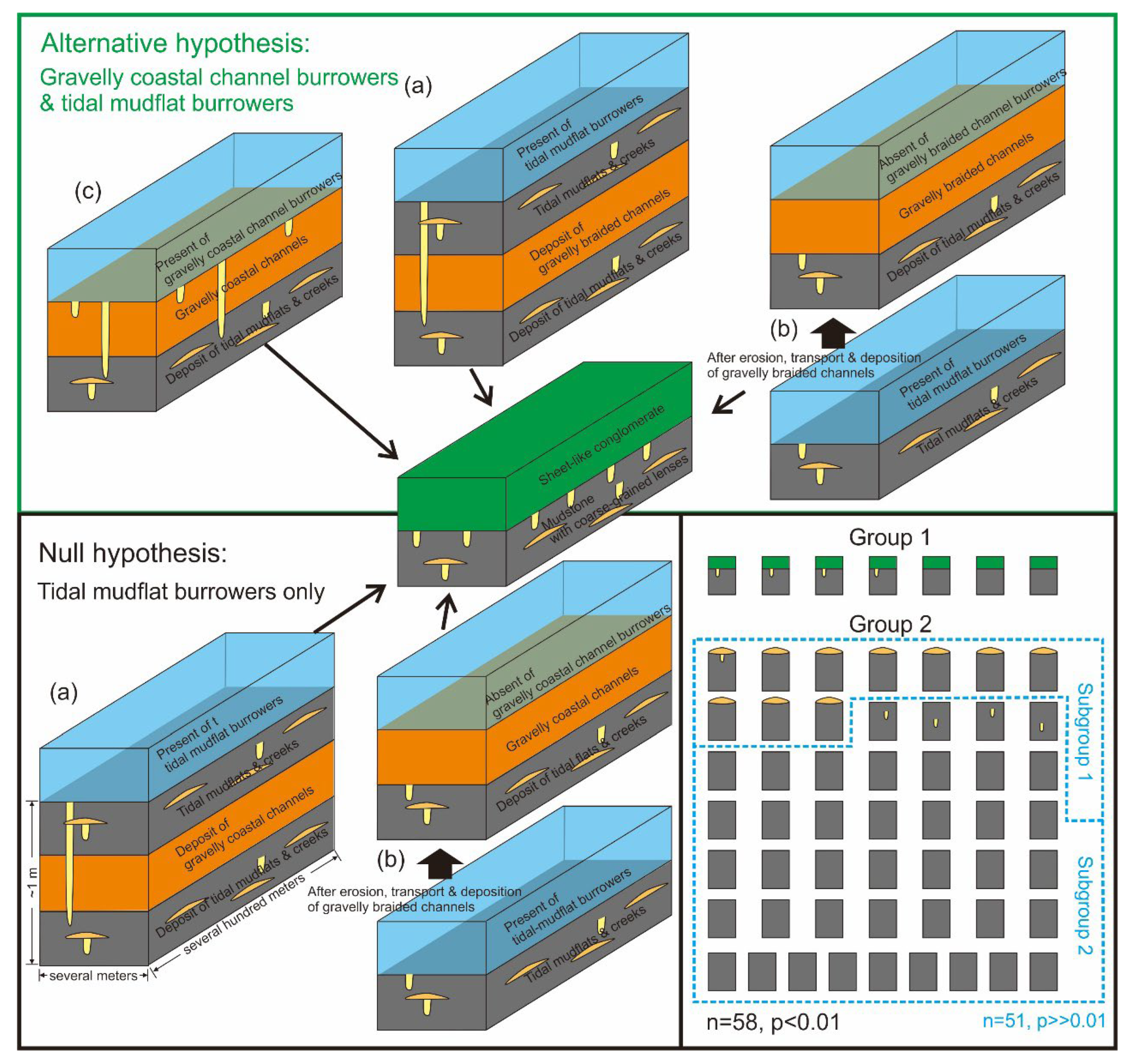
In the Longbaoshan area, the stratigraphic succession of the Wulongqing Formation consists of mudstones interbedded with conglomerate strata and sandstone strata (Figure 1C). These conglomerate strata and sandstone strata are laterally continuous between outcrop A and B, which are separated by more than 200 meters (Figure 1C). After outcrop cleaning and observation, no laterally extensive burrow-bearing horizon occurs within the mudstone. The method of random sampling was adopted for the mudstone strata, while bed-by-bed sampling was applied to conglomerate strata and sandstone strata (Figure 1F). The rock samples were collected using a hammer. their sampling position were recorded, and the samples were marked with geopetal signs. Each sample was packed in a muslin bag to prevent fragmentation during the subsequent transport. In the laboratory, 138 rock slabs (average height: 8 cm; average width: 11 cm; minimum height>3 cm; minimum width>5 cm) were prepared to identify sedimentary characteristics and biogenic structures. At this scale, mesoform characteristics (dunes rather than ripples) could be identified (Allen, 1964; Jackson, 1975; Leeder, 2011). Vertical burrows have been observed on the rock slabs. A total of 58 samples were included in the statistical analysis. Given the small size of samples, the Fisher exact test was employed (Fisher, 1958), the significance level was set at 0.01. This test can provide robust and statistically significant results even with such a small sample size (Kim, 2017; Thomas & Conlon, 1992). Two separate Fisher exact tests were performed. For both tests, the column variable (dependent variable) was the presence or absence of vertical burrows. In the first test, which includes a total of 58 samples from randomly sampled collection of mudstones with coarse-grained lenses, the row variable (independent variable) was the relative position: either at the contact between mudstone bearing coarse-grained lenses with overlying sheet-like conglomerates (Group 1) or within mudstones with coarse-grained lenses (Group 2) (Figure 7). The second test comprised 51 samples, corresponding to the first test excluding Group 1, the row variable (independent variable) was relative position too: either at the contact between mudstone matrix and overlying coarse-grained lenses (Subgroup 1) or within mudstone matrix (Subgroup 2) (Figure 7).
4. Results
Lithologies, centimeter-scale sedimentary structures observed on the rock slabs, and hundred-meter-scale external geometries measured between Outcrop A and Outcrop B were used to define four architectural elements, which stacked on an approximately 6 m-thick vertical profile on the longbaoshan area: 1) mudstones with coarse-grained lenses (40% of the total thickness); 2) sheet-like conglomerates (12% of the total thickness); 3) sheet-like sandstones (4% of the total thickness); and 4) mudstones without coarse-grained lenses (44% of the total thickness) (Figure 2). Thirteen facies were identified through rock-slab observations. A summary of the facies is provided in Table 1. Representative photographs of these facies are displayed in Figure 3. The contingency table was presented graphically in Figure 7.
4.1. Facies Description
4.1.1. Pebbly Conglomerate (CMp)
Pebbly conglomerate has only been observed in the sample set of the sheet-like conglomerates (Figure 2). It is composed of rounded pebbles within a mud-sand matrix (Figure 3A). Gravel-sized framework clasts are quartzose and rounded, and its thickness ranges from 5 cm to 10 cm. In the field, this facies occurs at the top of the sheet-like conglomerates (Figure 4A). Similarly, it also consistently occur in high stratigraphic positions on the rock slabs (Figure 4B–E). This facies overlies facies SgGi-n, CGn, SgM, and CXt (see below). Its lower boundaries exhibit abrupt or gradual contacts with flat or irregular morphologies (Figure 4). Intraformational mudstone clasts are present in some cases (Figure 4D).
4.1.2. Well-Sorted Conglomerate (CMw)
Well-sorted conglomerate is observed in the sample sets of the sheet-like conglomerates and the mudstones with coarse-grained lenses (Figure 2). It consists of well-sorted, quartzose and rounded granular grains, exhibits a clast supported fabric, and lacks internal laminae (Figure 3B). The grain size is predominantly granular, with rare pebbles present. Mud and sand are present in low abundance, its bedding thickness ranges from 3 cm to 10 cm. Mud drapes are observed in the sample set of the mudstones with coarse-grained lenses (Figure 5A, B), whereas no mud drapes are detected in the sheet-like conglomerate samples.
4.1.3. Crudely Trough Cross-Stratified Conglomerate (CXt)
Crudely trough cross-stratified conglomerate has only been observed in the sample set of the sheet-like conglomerates (Figure 2). It comprises sandy gravels arranged into trough cross-bedding, with coarser gravels aligned obliquely within the bedding planes (Figure 3C). The gravels are sub-rounded to rounded. Its bedding thickness ranges from 5 cm to 8 cm. This facies has been observed to underlie facies CMp (Figure 4E).
4.1.4. Inclined Gravel-Sand Stratified Conglomerate (CXgs)
Inclined gravel-sand stratified conglomerate has only been observed in the sample set of the sheet-like conglomerates. It is characterized by alternating inclined layers of gravel and sand (Figure 3D). Individual layers exceed 1 cm in thickness, and the associated bedding of this facies reaches up to 10 cm in thickness.
4.1.5. Normally Graded Sandy Conglomerate (CGn)
Normally graded sandy conglomerates have been observed in the sample sets of the sheet-like conglomerates and the mudstones with coarse-grained lenses (Figure 2). It exhibits a gradual fining-upward sequence, ranging from granule-sized clasts at the base to fine-sand-sized clasts at the top (Figure 3E). Mud-sized fractions are practically absent under visual inspection. The bedding thickness of this facies ranges from 3 cm to 10 cm in rock slabs.
4.1.6. Inverse-Then-Normal Graded Gravelly Sandstone (SgGi-n)
Inverse-then-normal graded gravelly sandstone has only been observed in the sample set of the sheet-like conglomerates (Figure 2). It consists of a sequence characterized by variations in gravel abundance within a sandy matrix: from the base to the top, the proportion of gravel-sized clasts first increases in the lower part and then decreases in the upper part (Figure 3F). The bedding thickness of this facies has reached 10 cm in rock slabs.
4.1.7. Inversely Graded Pebbly Sandstone (SpGi)
Inversely graded pebbly sandstone has only been observed in the sample set of the mudstones with coarse-grained lenses (Figure 2). It consists of gravels within a well-sorted sand matrix, with gravel abundance increasing upward and pebbles frequently present at the top (Figure 3G). The bedding thickness of this facies is less than 10 cm, as determined via field measurements. Intraformational mudstone clasts has been observed in some instances (Figure 3G).
4.1.8. Massive Gravelly Sandstone (SgM)
Massive gravelly sandstone has been observed in the sample sets of the sheet-like conglomerates, the mudstones with coarse-grained lenses, and the sheet-like sandstones (Figure 2). It is characterized by well-sorted sands arranged into massive bedding, with scattered gravels present in some instances (Figure 3H). The bedding thickness of this facies ranges from 3 cm to 10 cm in rock slabs. Intraformational mudstone clasts are observed in samples from the sheet-like conglomerates (Figure 4D).
4.1.9. Crudely Cross-Stratified Gravelly Sandstone (SgX)
Crudely cross-stratified gravelly sandstone has only been observed in the sample set of the mudstones with coarse-grained lenses (Figure 2). It comprises gravelly sand arranged into cross stratification, with coarser sand grains aligned along oblique bedding planes (Figure 3I). Individual layers exceed 1 cm in thickness, and the bedding thickness of this facies reaches up to 4 cm in rock slabs.
4.1.10. Lenticular-Stratified Sandy Mudstone (MsL)
Lenticular-stratified sandy mudstone has been observed in the sample sets of the mudstones with coarse-grained lenses and the mudstones without coarse-grained lenses (Figure 2). It is composed of lenticular sand bodies, with mud layers between them (Figure 3J). The clasts within the lenticular sand bodies consist mainly of fine sands and medium sands. The bedding surfaces of the lenticular sand bodies are wavy, parallel, discontinuous or continuous. The thickness of the sand bodies is less than 2 cm. Syneresis cracks are observed in one out of 51 slabs from the mudstones with coarse-grained lenses (Figure 7G). Mud drapes and outsized clasts are observed in the samples from both the mudstones with coarse-grained lenses and the mudstones without coarse-grained lenses. Starved ripples are observed in the samples from the mudstones without coarse-grained lenses (Figure 5F). The ichnofabric index of this facies ranges from 1 to 3. Vertical burrows assigned to the ichnogenera Skolithos and Arenicolites are present (Figure 7D, E).
4.1.11. Deformed Sandy Mudstone (MsD).
Deformed sandy mudstone has been observed in the sample sets of the mudstones with coarse-grained lenses and the mudstones without coarse-grained lenses (Figure 2). It consists of irregular sand masses within a mud matrix, though the fabric is not homogenized (Figure 3K). Outsized clasts have been observed. The ichnofabric index of this facies ranges from 4 to 5. Vertical burrows assigned to the ichnogenera Skolithos are present (Figure 7C).
4.1.12. Poorly Sorted Gravelly Muddy Sandstone (SgmP)
4.1.13. Laminated Mudstone (ML)
Laminated mudstone has only been observed in the sample set of the mudstones without coarse-grained lenses (Figure 2). It is mainly composed of mud and exhibits laminated bedding; the laminae are distinguished based on color differences (Figure 3M). The light color of the laminae is attributed to the aggregation of silt. The bedding surfaces of the silty laminae are discontinuous, even, or wavy, and frequently nonparallel. Scour-and-fill structures have been observed with 12 out of 16 slabs. No outsized clasts are observed via rock slabs. The ichnofabric index of this facies ranges from 1 to 3. Vertical burrows assigned to the ichnogenera Skolithos and Arenicolites are present (Figure 3M).
4.2. Lateral Facies Assemblages
The lateral facies assemblages observed in the sample sets of each element are present in Figure 2. These facies were observed at varying frequencies. The vertical succession identified in the Longbaoshan area transitions from the lower part—consisting of mudstones with coarse-grained lenses interbedded with the sheet-like conglomerates—to the upper part composed of the mudstones without coarse-grained lenses interbedded with the sheet-like sandstones (Figure 2).
4.2.1. Mudstones with Coarse-Grained Lenses
The mudstones with coarse-grained lenses are interbedded with the sheet-like conglomerates (Figure 2); their thickness ranges from 8cm to 120 cm with total thickness of 220 cm. Within the mudstones with coarse-grained lenses, lenses are commonly less than 5 cm in thickness. Although some conglomerate lenses can reach 10 cm in thickness, their width to thickness ratio is consistently less than 50:1.
75 slabs were prepared from the sample set of mudstones with coarse-grained lenses. From these slabs, 9 facies are identified (Figure 2)—noting that a single slab may exhibit more than one facies, so the sum of occurrence frequencies exceeds 100%. Sorted by occurrence frequency in descending order: MsL (57%), MsD (21%), SgM (10%) with a thickness less than 5 cm, CGn (10%) with a thickness ranging from 3 cm to 10 cm, CMw (6%) with a thickness less than 5 cm, SgmP (6%) and SgGi-n (4%), CXt (3%) with a thickness less than 5 cm, SgX (3%). The mudstone exhibits three facies: MsL, MsD and SgmP. The coarse-grained lenses exhibit six facies: SgM, CGn, CMw, SpGi, CXt or SgX. Mud drapes (Figure 5E), outsized clasts and syneresis cracks (Figure 7G) are observed in the mudstones; and mud drapes are observed in the coarse-grained lenses (Figure 5A, B).
4.2.2. Sheet-Like Conglomerates
The sheet-like conglomerates are physically continuous from Outcrop A to Outcrop B (Figure 1C). These two sheet-like conglomerates have a single-layer thickness ranging from 18 cm to 45 cm, a width-to-thickness ratio more than 500:1, and a total thickness of approximately 70 cm. The sheet-like conglomerates are interbedded with the mudstones with coarse-grained lenses (Figure 2).
21 slabs were prepared from the sample set of the sheet-like conglomerates. From these slabs, 7 facies were identified. Sorted by occurrence frequency in descending order, they are: SgM (38%) with a thickness of more than 5 cm, CMw (29%) with a thickness of more than 5 cm, CMp (24%) which has only been observed in the sheet-like-conglomerate sample set, CXt (19%) , CGn (10%) with a thickness of more than 5 cm, CXgs (5%) and SgGi-n (5%) which have only been observed in the sheet-like-conglomerate sample set. In addition, intraformational mudstone clasts are observed in 4 out of 21 slabs (Figure 5), and no mud drapes have been observed in this sample set.
4.2.3. Sheet-Like Sandstones
The sheet-like sandstones are interbedded with the mudstones with coarse-grained lenses and the mudstones without coarse-grained lenses (Figure 2). The sheet-like sandstones have a single-layer thickness ranging from 8 cm to 15 cm, a width-to-thickness ratio more than 2000:1, and a total thickness of approximately 25 cm (Figure 2). These sandstones are extremely friable, such that only two intact block samples were successfully transported to the laboratory; moreover, Facies SgM is the only facies identified from these samples. However, mud drapes are observed in the field (Figure 5C, D). Notably, a dense assemblage of Skolithos has been discovered at the basal bedding plain of the sheet-like sandstones (Figure 7A, B).
4.2.4. Mudstones Without Coarse-Grained Lenses
The mudstones without coarse-grained lenses are interbedded with sheet-like sandstone (Figure 2), individual beds range in thickness from 50 cm to 120 cm, with a total cumulative thickness of approximately 250 cm. No coarse-grained lenses were observed in the field from Outcrop A to Outcrop B (Figure 2).
42 slabs were prepared from the sample set of the mudstones without coarse-grained lenses. From these slabs, 3 facies were identified. Sorted by occurrence frequency in descending order, they are: MsL (59%) which has also been identified from the mudstones with coarse-grained lenses, ML (38%) which has only been observed in this sample set, and MsD (31%) which has also been identified from the mudstones with coarse-grained lenses. Scour-and-fill structures are observed in 12 out of 16 slabs exhibiting facies ML. Mud drapes and starved ripples have been observed associated with facies MsL (Figure 6F). Outsized clasts have been observed in association with Facies MsL and Facies MsD, whereas they are absent in Facies ML.
4.3. The Occurrence and Distribution of Vertical Burrows
4.3.1. Dense Skolithos Assemblage at the Base Contact of Sheet-Like Sandstones
A dense Skolithos assemblage, hosted in mudstones without coarse-grained lenses, has been observed at the base contact of sheet-like sandstones in the field and on the slabs (Figure 6A, B). Vertical burrows are present on all mudstone slabs at the base contact of sheet-like sandstones, and two ichnogenera of vertical burrows can be identified. Skolithos is characterized by its straight, tube-like structure filled with sand and subvertical orientation (Figure 3M, 6A); Arenicolites is distinguished by its U-shaped structure filled with sand and subvertical orientation (Figure 3M, 6A). These morphological features of Skolithos and Arenicolites observed on mudstone slabs are consistent with those of Skolithos and Arenicolites identified from the cores (Knaust, 2017).
4.3.2. Vertical Burrows at the Base Contact of Sheet-Like Conglomerates
Unlike sheet-like sandstones, no dense Skolithos assemblage was observed at the basal bedding plane of the sheet-like conglomerates in the field. However, among mudstone slabs at the base contact of sheet-like conglomerates, four vertical burrows have been observed (Figure 6C-F). Given the morphological similarity between these sand-fill vertical structures and the Skolithos and Arenicolites present at the basal bedding plane of sheet-like sandstones, these vertical burrows are identified as Skolithos and Arenicolites. While syneresis cracks observed from mudstone slabs also exhibit similar sand-fill and subvertical orientation (Figure 6G), their crinkles shapes and V-shaped bases differ distinctly from those of vertical burrows proposed above, whereas vertical burrows have uncrinkled shape and rounded base (Figure 6A-F).
Vertical burrows have been observed at the base contact of sheet-like conglomerates on 4 mudstone slabs. One of these burrows, assigned to Skolithos, was observed to be possibly associated with muddy linings within the sheet-like conglomerate (Figure 6F), the others were observed to lack any structures within the conglomeratic bodies.
4.3.3. Distribution of Vertical Burrows of Mudstones with Coarse-Grained Lenses
Vertically, the sheet-like conglomerates are superposed exclusively with the mudstones with coarse-grained lenses in the Longbaoshan area (Figure 2). The mudstones with coarse-grained lenses consists of mudstone matrix and coarse-grained lenses. A total of 75 slabs were randomly collected from these mudstones, and 17 slabs from the coarse-grained lenses, in which no vertical burrows were observed. The remaining 58 slabs from the mudstone matrix: 7 were collected at the contact of the mudstone matrix with overlying sheet-like conglomerates, 10 at the contact with overlying coarse-grained lenses, and 41 within the mudstone matrix. Of these, 9 slabs have exhibited vertical burrows (Figure 7). These 58 slabs are included in statistical study and divided into two study groups: Group 1 consists of 7 slabs at the contact with overlying sheet-like conglomerates, 4 of which were observed with vertical burrows; Group 2 consists of 51 slabs within mudstones with coarse-grained lenses (10 at the contact with overlying coarse-grained lenses, 41 within the mudstone matrix), 5 of which were observed with vertical burrows (Figure 7). The first Fisher’s exact test was performed to compare the vertical burrow occurrence frequency between Group 1 and Group 2, and the result yielded a p-value<0.01 (Figure 7), indicating a statistically significant difference exists in vertical burrow occurrence frequency between the contact with sheet-like conglomerates and the interior of mudstones with coarse-grained lenses. Divide 51 slabs of Group 2 into two subgroups. Subgroup 1 consists of 10 slabs at the contact with coarse-grained lenses, 1 of which were observed with vertical burrows (Figure 7). Subgroup 2 consists of the 41 slabs within the mudstone matrix, 4 of which are observed with vertical burrows (Figure 6D). The second Fisher’s exact test was performed to compare the vertical burrow occurrence frequency between these two subgroups, and the result yielded a p-value of 0.68, much greater than 0.01 (Figure 7), indicating that not statistically significant difference was observed between the contact with coarse-grained lenses and the interior of mudstone matrix.
Figure 7.
An illustrative example of the occurrence frequency of vertical burrows in different groups of slabs and the underlying hypothesis. Group 1: slabs at the contact between mudstones bearing coarse-grained lenses and overlying sheet-like conglomerate; Group 2: slabs within mudstone bearing coarse-grained lenses. Null hypotheses: vertical burrows originated from muddy tidal mudflat burrowers only by (a) and (b). Alternative hypothesis: vertical burrows originated from muddy tidal mudflat burrowers and gravelly braided-channel burrowers by (a), (b) and (c). Subgroup 1: slabs at the contact between mudstone matrix and overlying coarse-grained lenses; Group 2: slabs within mudstone matrix. Null hypotheses: the contrast between coarse-grained and fine-grained materials has no significant effect on the preservation of vertical burrows. Alternative hypothesis: the contrast between coarse-grained and fine-grained materials has a significant effect on the preservation of vertical burrows.
Figure 7.
An illustrative example of the occurrence frequency of vertical burrows in different groups of slabs and the underlying hypothesis. Group 1: slabs at the contact between mudstones bearing coarse-grained lenses and overlying sheet-like conglomerate; Group 2: slabs within mudstone bearing coarse-grained lenses. Null hypotheses: vertical burrows originated from muddy tidal mudflat burrowers only by (a) and (b). Alternative hypothesis: vertical burrows originated from muddy tidal mudflat burrowers and gravelly braided-channel burrowers by (a), (b) and (c). Subgroup 1: slabs at the contact between mudstone matrix and overlying coarse-grained lenses; Group 2: slabs within mudstone matrix. Null hypotheses: the contrast between coarse-grained and fine-grained materials has no significant effect on the preservation of vertical burrows. Alternative hypothesis: the contrast between coarse-grained and fine-grained materials has a significant effect on the preservation of vertical burrows.
5. Interpretation and Discussion
5.1. Lateral Facies Assemblages-Interpretation
5.1.1. Mudstones with Coarse-Grained Lenses-Interpretation
Facies MsL, MsD and SgmP consist of the mudstone matrix of mudstones with coarse-grained lenses. The lenticular bedding of facies MsL–which is the most common facies in the sample set (Figure 2)–is interpreted as tide-influenced mud deposits, indicating a coastal setting rather than a shallow marine environment. The tide-influenced interpretation is also supported by the presence of mud drapes associated with MsL (Figure 5E). Mud drapes frequently occur in tidal deposits and are used as evidence for tidal conditions in many cases (Dalrymple & Choi, 2007; Shchepetkina et al., 2019). Accordingly, in the present study, the presence of mud drapes is used as evidence of tidal influence, whereas their absence indicates limited tidal effects. Specifically, as bipolar cross-stratification, reactivation surfaces and tidal bundles have not been observed in this area, an architectural element is interpreted as having formed under tidal influence only if mud drapes are present. Syneresis cracks have been interpreted as subaqueous shrinkage cracks formed due to the changes in salinity of surrounding water (Burst, 1965), although in other studies, their existence in natural systems has been evaluated as unlikely (Tanner, 1998). Here, they are interpreted as an indicator of salinity fluctuations. Syneresis cracks occur in the sample set of mudstones with coarse-grained lenses, but are absent from mudstones without coarse-grained lenses (Figure 6G, Figure 2), indicating that the former is likely associate with the freshwater supply, an environment where salinity fluctuations are tend to occur (Leeder, 2011). However, rare syneresis cracks, with a frequency less than 5% (Figure 2), suggests that the extent of salinity changes was likely insufficient to cause a significant deviation from normal marine conditions. This interpretation of insignificant deviation from normal marine salinity is also in line with the documented presence of diverse trace fossils (at least 14 ichnogenus) in this area (Hu et al., 2010, 2013; Wener et al., 2012; Ding et al., 2018). Specifically, such high ichnodiversity contrasts with the low ichnodiversity of Teichichnus ichnofacies, which is typical of brackish-water environments (Gingras et al., 2025), but is consistent with Skolithos-Cruziana ichnofacies under normal marine salinity (Shchepetkina et al., 2019; Gingras et al., 2025). The common occurrence of Facies MsD with bioturbations, with a frequency of 20%–40% (Figure 2), reflects that benthic activity was prevalent in the study area during the deposition of this element. Outsized clasts are observed in association with both facies MsL and MsD (Figure 3J, K), suggesting proximity to a gravel source. As the fabric of facies SgmP is like that of typical debris-flow deposits (Mulder & Alexander, 2001; Mutti et al., 2009), it is interpreted as debris-flow deposits. Its sporadic occurrence, with a frequency less than 10%, indicates occasional debris flow events. The mudstone matrix is interpreted as tidal mudflat deposits, characterized by diverse and common benthic activity, with occasional debris flows. Freshwater input was rare and exerted no discernible effect on the normal marine salinity.
Facies CXt, SgX, Cg, SgGi, SgM, CMw, SgX consist of the coarse-grained lenses. These lenses were interpreted as deposits of the tidal creeks scattered across the mud substrates, based on their geometry and host mudstone configuration (Figure 2). The presence of mud drapes within the coarse-grained lens demonstrates the tidal influence (Figure 5A, B). The dimensions of cross-stratification of facies CXt and SgX indicate that these structures represent dunes formed under sustained flow conditions within a shallow water depth of several meters (Allen, 1982). Different gravel contents may correspond to differences in the bedload carried by varying tidal creeks. The normal grading of facies CGn is interpreted as rapid accumulation of sandy gravels transported by waning flows; correspondingly, the inverse grading of facies SgGi is interpreted as the rapid accumulation of pebbly sands transported by waxing flows. Particularly, the pebble content of facies SgGi suggests that this facies was formed near a pebble source. The massive bedding of facies SgM and CMw is interpreted as the rapid accumulations gravelly sand or granules under steady flow conditions. The analogs of these facies can be observed in channel deposits of varying scales (Allen, 1964; Steel & Thompson, 1983; Miall, 1985; Siegenthaler & Huggenberger, 1993). Although gravels, sandy gravels and gravelly sands analogous to these facies (SgM, CGn, CMw, SgGi, CXt and SgX) have been reported in deposits of high-density-turbidity currents and sieve deposits, they rarely exhibit a lentiloid geometry—with dimensions of a few centimeters in thickness and a few decimeters in width (Sanders, 1965; Buscombe & Masselink, 2006; Mutti et al., 2009).
Collectively, the mudstones with coarse-grained lenses is interpreted to have been deposited in a tidal environment. The tidal mudflat is broadly characterized by widespread benthic colonization and common tidal creeks (Figure 8).
5.1.2. Sheet-Like Conglomerates-Interpretation
Facies SgM, CMw, Cmp, CXt, CGn, CXgs and SgGi-n consist of sheet-like conglomerates (Figure 2), revealing pronounced lateral variations in sedimentary conditions during deposition. Although sheet-like conglomerates are interbedded within mudstones bearing coarse-grained lenses (interpreted to represent a tidal environment), their thickness accounts for less than one-third of that of the associated mudstones. The external sheet-like geometry and cross-stratified facies (CXt and CXgs) of the sheet-like conglomerates are similar to those of Cambrian sheet-braided channel deposits (Davies et al., 2012), which indicates the influence of fluvial processes. The abundance of mudstone (60% of the total thickness) in the Longbaoshan succession stands in contrast to the typical rarity of mudstone in the Cambrian fluvial system (Dalrymple et al., 1992; Davies et al., 2012). So, in this case, the sheet-like conglomerates stacked with mudstones bearing coarse-grained lenses (Figure 2) are interpreted as gravelly coastal channels that developed within a fluvio-tidal system (4.2.1) rather than a fluvial setting (Figure 6), analogous to fluvio-tidal system recorded in the Lower McMurray Formation (Melnyk & Gingras, 2019). Records of tidal mudstones are by no means lacking in the Cambrian Period (Buatois & Mangano, 2011; Mangano & Buatois, 2016; Minter et al., 2017). Notably, in this case, the river mouth was probably an ordinary one, intermediate between the estuary and delta end members (Nichols, 2009), where there was no significant mixing of water and no obvious progradation (evident by the absence of a coarsening-up pattern).
Facies CXgs is interpreted as the lateral accretion of bars, which forms under alternating bedload transport of gravels and sands (Figure 3D). Similar style of inclined heterolithic stratification, sometimes abbreviated to “IHS” (Nichols, 2009), characterized by alternating layers of sand and mud, widely recognized as a feature of fluvial influence ((Melnyk & Gingras, 2019; Shchepetkina et al., 2019). The IHS likely form due to two depositional conditions: (1) bedload deposition under combined flow during ebb tides, where tidal ebb acts together with river; and (2) suspended load deposition under slack water during flood tides, where tidal flood counteracts river flow, reducing velocity to near-zero and allowing mud to settle. However, in this case, the inclined stratification is characterized by alternating gravel and sand layers, which reflects variations among bedload depositions, in contrast to the alternation of bedload and suspended load. Analogous gravel-sand stratification has been documented in braided channels, where individual layers reach a thickness of 10 cm and the associated bedding attains a total thickness of 50 cm (Siegenthaler & Huggenberger, 1993). Then, the occurrence of facies CXgs supports the interpretation of a fluvial influence, particularly that associated with braided river system, rather than tidal channels formed solely by ebb or flood currents (Dalrymple et al., 1992; Dalrymple & Choi, 2007).
In the field, facies CMp has been observed at the top of sheet-like conglomerates (Figure 4A). On the slabs, facies CMp has consistently been observed at high stratigraphic levels (Figure 4B-E). An analogous phenomenon of poorly sorted gravels occurring in high stratigraphic position has been documented in the Rhine braided gravels as sheetflood deposits (i.e., the brown gravels in Siegenthaler & Huggenberger, 1993). Accordingly, Facies Cmp with high stratigraphic levels here could be interpreted as a sheetflood deposit. In addition, this occurrence pattern of CMp is also consistent with the platform-supraplatform hypothesis (Bluck, 1971). If the scenario proposed by this hypothesis holds true, it would suggest that the deposition occurred in proximal positions within the fluvio-tidal system. Both interpretations imply that the persistently occurring CMp in stratigraphically high levels is related to the influence of braided river processes.
Although facies SgGi-n does not seem to correspond to a braided channel system directly, its analogs are commonly interpreted as corresponding to variations in the flood hydrograph (Mulder et al., 2003)—this may not be inconsistent with, but rather compatible with, the interpretation that the sheet-like conglomerates were deposited within a fluvio-tidal system. In addition, other facies (SgM, CMw, and CGn) indicate rapid accumulations of gravelly sands and granules from sustained and waning flows. analogs of these facies are commonly observed in fluvio-tidal system (Allen, 1965; Melnyk & Gingras, 2019; Shchepetkina et al., 2019). A higher frequency of intraformational mudstone clasts (~20%) than that in the Cambrian Alderney Sandstone (sheet-braided channels) may be due to these deposits having formed adjacent to tidal mudflats within a fluvio-tidal system, rather than in a fluvial setting (Davies & Gibling, 2010).
In terms of thickness and lithology, sheet-like conglomerates are also similar to beach ridge deposits (Andrew et al., 2000). However, these conglomerates interbed with mudstone, whereas beach ridge conglomerates are mostly interbedded with sandstone (Andrew et al., 2000; Buscombe & Maasselink, 2006). Furthermore, these conglomerates noticeably show low to moderate textural maturity characterized by facies CMp (29%), CXt (19%) and SgGi-n (5%) (Table 1, Figure 2), which differ from typical clean beach deposits. Beach deposits are frequently winnowed by wave action, resulting in low matrix content and high textual maturity (Andrew et al., 2000; Buscombe & Maasselink, 2006; Nichols, 2009).
5.1.3. Sheet-Like Sandstones-Interpretation
As mud drapes were observed in the field, the sheet-like sandstones are interpreted as tidal sandflat deposits. Notably, a dense Skolithos assemblage has been observed at the basal bedding plane of the sheet-like sandstones—both in the field and on the slabs—specifically on the sandstone-mudstone interface, which corresponds to the top of the underlying mudstone (Figure 7A, B). No vertical burrows were identified within the sandstone bodies, either in the field or on the slabs (Figure 7A); this may be due to poor visibility of biogenic structures in monotonous lithologies (Bromley, 1996). Nonetheless, this dense development of vertical burrows consists with the high-energy character of the inferred tidal sandflat setting (Figure 8).
5.1.4. Mudstones Without Coarse-Grained Lenses-Interpretation
The common occurrence of ML, with a frequency of 20%–40% (Figure 2), reflects a depositional setting pervasively influenced by currents, yet in a position distal to coarse-grained provenance areas. In this study, owing to its vertical superposition with the deposits of the tidal sandflats, it is interpreted as a mud shelf setting seaward of the subtidal sandflats. This interpretation is consistent with the views in previous studies, which hold that mudstones with silty laminae form in offshore transition zone (Hu et al., 2010; Hu et al., 2013). However, this study primarily clarifies its position seaward or landward relative to tidal flats, without providing specific constraints on the configuration of the storm wave base and fair-weather wave base. The configuration of the scour-and-fill structures observed with Facies ML also supports the distal to coarse-grained provenance, given their parallel laminated silt directly overlies on the V-shape scour without coarse-grained intervals (Figure 3M). This configuration indicates that the depositional setting where facies ML formed had sufficient flow energy to erode mud—comparable to transport coarse-grained clasts—yet lacked a supply of such clasts. Starved ripples observed in Facies MsL also suggest a limited amount of sand available for forming the ripples, which in consistent with features of Facies ML. The frequent occurrence of MsL with mud drapes (Figure 3E, F), which is analogous to the mudstones with coarse-grained lenses (Figure 2), reflects the influence of tides. The occurrence of MsD is comparable to that in the mudstones with coarse-grained lenses (Figure 2); This reflects that benthic activities were widespread in the depositional settings represented by these two elements.
5.1.5. Depositional Setting
The stacked elements that occur in the Longbaoshan area are interpreted as fluvio-tidal in origin, due to the pervasive tidal influence and the pronounced fluvial influence. From the shoreward to seaward direction, there are gravelly coastal channels (probably associated with a braided system), tidal mudflats and tidal creeks, followed by subtidal sandflats, and finally tidally influenced mud shelves. Moreover, the tidal mudflats were widely colonized by benthos, while the subtidal sandflats were densely inhabited by vertical burrowers (Figure 8).
5.2. Burrowers Colonized High-Energy Coastal Channels Associated with Braided System
From the perspective of the living environment of tracemakers, vertical burrows occur at the interface between the sheet-like conglomerate and the underlying mudstones, and they may have been formed by two distinct ecological assemblages of burrowers. 1) tidal mudflat burrowers, which could have either (a) penetrated the underlying sheet-like conglomerate deposits from the overlying tidal mudflat muddy substrates and left vertical structures at the base contact of the sheet-like conglomerate deposits (Figure 8). This scenario is supported by the fact that the disturbance depth of Cambrian Skolithos can reach 1 m (Davies et al., 2009)—or (b) produced vertical structures in the muddy substrates of tidal mudflats, which were then cast and overlain by the sheet-like conglomerate deposits (Figure 7); 2) Gravelly coastal channel burrowers, which could have (c) produced vertical structures at the channel floor of the gravelly coastal channels (Figure 7).
The abundance of animals under fast current velocities may be significantly different from that under slow current velocities (Barmuta, 1990). Given this, the occurrence frequency of vertical burrows is assumed to differ between the tidal mudflat burrowers and the gravelly coastal channel burrowers, but not to differ significantly within each ecological assemblage. Then the null hypothesis could be set as: vertical burrows are emplaced by tidal mudflat burrowers only, and the alternative hypothesis is that vertical burrows are emplaced by tidal mudflat burrowers and gravelly coastal channel burrowers. If the null hypothesis is true, there should be no statistically significant difference in the occurrence frequency of vertical burrows between Group 1 and Group 2. The small p-value (p-value<0.01) serves as statistical evidence to reject the null hypothesis, which supports the existence of gravelly coastal channel burrowers. Additionally, the presence of internal structures within the sheet-like conglomerate also supports the existence of coastal channel burrowers (Figure 6F). Moreover, significant phenotype-environment correlation is the first indication of adaptation in the sense of utility (Schluter, 2000). The significantly (p<0.01) higher occurrence frequency (57%) of the vertical burrows at the base contact of sheet-like conglomerates. This likely suggests that these burrowers have developed a well-adapted lifestyle for high-energy coastal channels capable of transporting gravel as bed load, rather than being temporary appearance in such harsh environments. In addition, the occurrence of muddy linings within conglomerate associated with vertical burrow also supports that these burrowers were adapted to shifting gravelly sediments. Although the hydrodynamic conditions of the channel are strong, the substrate gravels are unstable (Dorgan & Arwade, 2023), the early Cambrian burrowers may anchor themselves into the underlying cohesive muddy deposits to resist hydrodynamic drag, and line their burrows with mud to stabilize against shifting non-cohesive grains. In such a setting, burrowers could avoid high turbidity in fluvio-tidal system (Dalrymple et al., 1992), and thrive in high-energy flowing water conditions, facilitating suspension feeding. This may be comparable to the cases in Skolithos ichnofacies and Skolithos piperock (Desjardins et al., 2010; Seilacher, 1964).
Hydrodynamic conditions are important factors influencing the living ranges of animals (Vogel, 1994). In pre-Devonian formations, fluvial channel systems most likely existed as sheet-braided systems (Cotter, 1978; Davies & Gibling, 2011; Gibling et al., 2012; 2013). These systems are universally preserved as sandstone bodies composed of thin sheets, and the sheets are dominantly cross-stratified with accretionary bar forms but with minimal mudstone (Todd & Went, 1991; Went, 2013; Gibling et al., 2013; Santos et al., 2013). Similarities between the sheet-like conglomerates in this study and sheet-braided records also suggest an association with a braided fluvial system (Figure 8). Then, in this case of the Wulongqing Formation, burrows at the base of the conglomerates suggest that during the Cambrian explosion, benthos had already colonized the marine-facing end of fluvial system, even though this setting was characterized by normal marine salinity. Nevertheless, these colonizers had already adapted to fluvial hydrodynamic regimes and substrate conditions.
From the perspective of ichnological taphonomy, another highly plausible hypothesis can explain the difference in vertical burrow frequency between Group 1 and Group 2. The hypothesis is that the contrast of material affects the preservation potential of vertical burrows. High contrast (fine-grained material to coarse-grained material) enhances the preservation potential of burrow casts, while low material contrast (fine-grained material to fine-grained material) reduces it (Bromley, 1996). Given this, the occurrence frequency of vertical burrows is assumed to differ between those occurring at top contact of the mudstone matrix with overlying coarse-grained lenses (Subgroup 1) and those within mudstone matrix (Subgroup 2). Yet no statistically significant difference was found between Subgroup 1 and Subgroup 2 (Figure 7). Although the hypothesis is reasonable, the non-significant p-value indicates that the differences observed in this case cannot be distinguished from random variation.
From the perspective of ichnofacies, a third hypothesis is that the increased frequency of vertical burrows results from depositional hiatuses, as seen in the Glossifungites ichnofacies (Pemberton et al., 2004; Buatois & Mangano, 2011). However, at the Longbaoshan section, apart from the bases of sandstone or conglomerate beds, no intervals with dense occurrences of such vertical burrows were found within the mudstone. This suggests that the behavioral response reflected by the dense occurrence of vertical burrows is associated with sandy or gravelly depositional environments, rather than depositional hiatuses within mudstone successions.
6. Conclusions
From the Wulongqing Formation (Cambrian Stage 3–4) in the Longbaoshan area, Yunnan, China, four architectural elements and thirteen facies have been identified through field measurements and rock slab observations. 1) the mudstones with coarse-grained lenses is interpreted as the deposits of tidal mudflats and tidal creeks, based on the presence of both mud drapes and syneresis cracks. 2) the sheet-like conglomerates are interpreted as the deposits of gravelly braided channels, mainly based on its sheet-like geometry (width-to-thickness ratio > 500) and the presence of trough cross-bedding (facies CXt) and lateral accretionary bar forms (facies CXgs). 3) the sheet-like sandstone is interpreted as the deposits of tidal sandflats, based on its sheet-like geometry (width-to-thickness ratio > 2000) and the presence of mud drape. 4) the mudstones without coarse-grained lenses is interpreted as the deposits of tide-influenced mud shelf, based on the presence of mud drapes and silty laminae (facies ML). The distribution of depositional settings is reconstructed as follows: from the shoreward to seaward direction, the settings consist of gravelly coastal channels, tidal mudflats, and tidal creeks, followed by subtidal sandflats, and finally tide-influenced mud shelf. Moreover, vertical burrows are observed at the basal bedding plain of the sheet-like conglomerates via rock slabs. Using Fisher’s exact test, the occurrence frequency of vertical burrows at the contact of mudstones bearing coarse-grained lenses with overlying sheet-like conglomerates (57%) is identified to be significantly higher (p<0.01) than that within mudstones bearing coarse-grained lenses (10%). This small p-value supports the existence of gravelly coastal channel burrowers as distinct from tidal mudflat burrowers. From the perspective of hydrodynamic and substrate conditions, these burrows may suggest that benthos had already colonized the marine end of fluvial systems during the Cambrian Explosion.
Data Availability Statement
All data are available in the main text. Correspondence and requests for materials should be addressed to Boxin Kang (kangboxin@stumail.nwu.edu.cn).
Acknowledgments
I thank Yanchun Yao for his assistance in making all polished slabs; Xu Zhang and Dinglong Liu for their assistance in obtaining access to fieldwork and excavation in the Longbaoshan area; and Deng Wang for his sharing of his comments and relevant literature that benefitted this article immeasurably. Thanks also to professor Xingliang Zhang, who gave me financial support and constructive feedback throughout the conceptualization and development of this article.
References
- Allen, J. R. L. A review of the origin and characteristics of recent alluvial sediments. Sedimentology 1964, 5, 89–191. [Google Scholar] [CrossRef]
- Andrew, J. E.; Boomer, I.; Bailiff, I.; Balson, P.; Bristow, C.; Chroston, P. N.; Funnell, B. M.; Harwood, G. M.; Jones, R.; Maher, B. A.; Shimmield, B. Sedimentary evolution of the north Norfolk barrier coastline in the context of Holocene sea-level change. In Holocene land-ocean interaction and environmental change around the North Sea; Sepecial Publications, 166; Shennan, I., Andrew, J., Eds.; Geological Society: London, 2000; pp. 219–251. [Google Scholar]
- Barmuta, L. A. Interaction between the effects of substratum, velocity and location on stream benthos: an ecperiment. Freshw. Res. 1990, 41, 557–573. [Google Scholar]
- Bluck, B. J. Sedimentation in some Scottish river of low sinuosity. Transactions R. Soc. Edinb. 1976, 69(18), 425–456. [Google Scholar] [CrossRef]
- Bromley, R. G. Trace Fossils: Biology, taphonomy and applications; Chapman & Hall, Wilts, 1996; pp. 1–141. [Google Scholar]
- Buatois, L.; Mangano, M. G. Ichnology: organism-substrate interactions in space and time; Cambridge university press, 2011; pp. 38–48. [Google Scholar]
- Buatois, L. A.; Mangano, M. G. Trace fossil analysis of lacustrine facies and basins. Palaeogeogr. Palaeoclimatol. Palaeoecol. 1998, 140, 367–382. [Google Scholar] [CrossRef]
- Buatois, L. A.; Davies, N. S.; Gibling, M. R.; Krapovickas, V.; Labandeira, C. C.; MacNaughton, R. B.; Mangano, M. G.; Minter, N. J.; Shillito, A. P. The invasion of the land in deep time: integrating Paleozoic records of Paleobiology, Ichnology, Sedimentology, and Geomorphology. Integr. Comp. Biol. 2022, 62, 297–331. [Google Scholar] [CrossRef]
- Buatois, L. A.; Mangano, M. G.; Maples, C. G.; Lanier, W. P. The paradox of nonmarine ichnofaunas in tidal rhythmites: integrating sedimentologic and ichnologic data from the late Carboniferous of eastern Kansas, USA. PALAIOS 1997, 12, 467–481. [Google Scholar] [CrossRef]
- Buscombe, D.; Maasselink, G. Concepts in gravel beach dynamics. Earth-Sci. Rev. 2006, 79, 33–52. [Google Scholar] [CrossRef]
- Butois, L. A.; Gingras, M. K.; Maceachern, J.; Mangano, M. G.; Zonneveld, J.; Pemberton, S. G.; Netto, R. G.; Martin, A. Colonization of brackish-water systems through time: evidence from the trace-fossil record. PALAIOS 2005, 25, 321–347. [Google Scholar] [CrossRef]
- Cotter, E. The evolution of fluvial style, with special reference to the central Appalachian Paleozoic. In Fluvial Sedimentology. Canadian Society of Petroleum Geologists Memoir; Miall, A. D., Ed.; 1978; Volume 5, pp. 361–383. [Google Scholar]
- Dalrymple, R. W.; Choi, K. Morphologic and facies trends through the fluvial-marine transition in tide-dominated depositional systems: A schematic framework for environmental and sequence-stratigraphic interpretation. Earth-Sci. Rev. 2007, 81, 135–174. [Google Scholar] [CrossRef]
- Dalrymple, R. W.; Zaitlin, B. A.; Boyd, R. Estuarine facies models: conceptual basis and stratigraphic implications. J. Sediment. Petrol. 1992, 62, 1130–1146. [Google Scholar] [CrossRef]
- Dashtgard, S. E.; Gingras, M. K. Marine invertebrate neoichnology; Knaust, D., Ed.; 2012. [Google Scholar]
- Davies, N. S.; Gibling, M. R. Cambrian to Devonian evolution of alluvial systems: the sedimentological impact of the earliest plants. Earth-Sci. Rev. 2010, 98, 171–200. [Google Scholar] [CrossRef]
- Davies, N. S.; Gibling, M. R.; Rygel, M. C. Alluvial facies evolution during the Palaeozoic greening of the continents: case studies, conceptual models and modern analogues. Sedimentology 2011, 58, 220–258. [Google Scholar] [CrossRef]
- Death, R. G. Disturbance and riverine benthic communities: what has it contributed to general ecological theory? River. Res. Applic. 2010, 26, 15–25. [Google Scholar] [CrossRef]
- Desjardins, P. R.; Mangano, M. G.; Buatois, L. A.; Pratt, B. R. Skolithos pipe rock and associated ichnofabrics from the southern Rocky Mountains, Canada: colonization trends and environmental controls in an early Cambrian sand-sheet complex. Lethaia 2010. [Google Scholar] [CrossRef]
- Ding, Y.; Liu, J.; Chen, F. Ichnology, palaeoenvironment, and ecosystem dynamics of the Early Cambrian (Stage 4, Series 2) Guanshang Biota, South China. Geol. J. 2018, 1–18. [Google Scholar]
- Dorgan, K. M.; Arwade, S. R. Material properties of sediments steer burrowers and effect bioturbation. J. Geophys. Res. Biogeosciences 2023, 128, e2022JG007269. [Google Scholar] [CrossRef]
- Fisher, R. A. Statistical methods for research workers (13th ED); Hafner publishing company inc: new York, 1958; pp. 96–97. [Google Scholar]
- Gibling, M. R.; Davies, N. S. Palaeozoic landscapes shaped by plant evolution. Nat. Geosci. 2012, 5, 99–105. [Google Scholar] [CrossRef]
- Gibling, M. R.; Davies, N. S.; Falcon-Lang, H. J.; Bashforth, A. R.; DiMichele, W. A.; Rygel, M. C.; Lelpi, A. Palaeozoic co-evolution of rivers and vegetation: a synthesis of current knowledge. In Proceedings of the Geologists’ Association, 2013. [Google Scholar] [CrossRef]
- Gingras, M. K.; Maceachern, J. A.; Dashtgard, S. E.; Bann, K. L. The Teichichnus ichnofacies: its neoichnological basis and identification in the rock record. Sedimentology 2025, 72, 408–441. [Google Scholar] [CrossRef]
- Hu, S. X.; Zhu, M. Y.; Luo, H. L.; Steiner, M.; Zhao, F. C.; Li, G. X.; Liu, Q.; Zhang, Z. F. The Guanshan Biota; Yunnan Science and Technology Press: Kunming, 2013; pp. 31–33. [Google Scholar]
- Hu, S. X.; Zhu, M. Y.; Steiner, M.; Luo, H. L.; Zhao, F. C.; Liu, Q. Biodiversity and taphonomy of the Early Cambrian Guanshan biota, eastern Yunnan. Sci. China Earth Sci. 2010, 53, 1765–1773. [Google Scholar] [CrossRef]
- Jackson, R. G., II. Hierarchical attributes and a unifying model of bed forms composed of cohesionless material and produced by shearing flow. Geol. Soc. Am. Bull. 1975, 86, 1523–1533. [Google Scholar] [CrossRef]
- Kim, Hae Young. Statistical notes for clinical researchers: Chi-squared test and Fisher’s exact test. Restor. Dent. Endod. 2017, 42(2). [Google Scholar] [CrossRef] [PubMed]
- Knaust, D. Atlas of trace fossils in well core: Appearance, Taxonomy and Interpretation; Springer Nature: Cham, 2017; p. 30. [Google Scholar]
- Leeder, M. Sedimentology and Sedimentary Basins: From Turbulence to Tectonics; Wiley-Blackwell: West Sussex, 2011; pp. 248–252. [Google Scholar]
- Little, C. The colonization of land: Origins and adaptations of terrestrial animals; Cambridge University Press: Cambridge, 1983; pp. 1–6. [Google Scholar]
- Ma, Y. S.; Chen, H. D.; Wang, G. L. in Sequence Stratigraphy and Palaeogeography in Southern China; (in Chinese). Science Press: Beijing, 2009; pp. 261–266. [Google Scholar]
- Mángano, M. G.; Buatois, L. A. Decoupling of body-plan diversification and ecological structuring during the Ediacaran–Cambrian transition: evolutionary and geobiological feedbacks. Proc. R. Soc. B 2014, 281, 20140038. [Google Scholar] [CrossRef] [PubMed]
- Mángano, M. G.; Buatois, L. A. The trace-fossil record of major evolutionary events. In Precambrian and Paleozoic; Springer Nature: Dordreche, 2016; Volume 1. [Google Scholar]
- Mángano, M. G.; Buatois, L. A.; Astini, R.; Rindsberg, A. K. Trilobites in early Cambrian tidal flats and the landward expansion of the Cambrian explosion. Geology 2013. [Google Scholar] [CrossRef]
- Mazzucco, R.; Nguyen, T. V.; Kim, D.; Kim, D.; Chon, T.; Dieckmann, U. Adaptation of aquatic insects to the current flow in streams. Ecol. Model. 2015, 309, 143–152. [Google Scholar] [CrossRef]
- McCabe, D. Rivers and streams: life in flowing water. Nat. Educ. Knowl. 2011, 3(10), 19. [Google Scholar]
- Melnyk, S.; Gingras, M. K. Using ichnological relationships to interpret heterolithic fabrics in fluvio-tidal settings. Sedimentology 2020, 67, 1069–1083. [Google Scholar] [CrossRef]
- Miall, A. D. Architectural-Element Analysis: A New Method of Facies Analysis Applied to Fluvial Deposits. Earth-Sci. Rev. 1985, 22, 261–308. [Google Scholar] [CrossRef]
- Minter, N. J.; Buatois, L. A.; Mangano, M. G.; Davies, N. S.; Gibling, M. R.; MacNaughton, R. B.; Labandeira, C. C. Early bursts of diversification defined the faunal colonization of land. Nat. Ecol. Evol. 2017, 1, 0175. [Google Scholar] [CrossRef]
- Mou, C. L.; Zhou, C. C.; Chen, X. W. in Zhongguo Yanxiang Gudili Tuti: Aidikalaji-Zhiliuji; (in Chinese). Geology Press: Beijing, 2016; pp. 22–23. [Google Scholar]
- Mulder, T.; Alexander, J. The physical character of subaqueous sedimentary density flows and their deposits. Sedimentology 2001, 48, 269–299. [Google Scholar] [CrossRef]
- Mulder, T.; Syvitski, J. P. M.; Migeon, S.; Faugeres, J.; Savoya, B. Marine hyperpycnal flows: initiation, behavior and related deposits. A review. Mar. Pet. Geol. 2003, 20, 861–882. [Google Scholar] [CrossRef]
- Murray, J. W. Ecology and applications of benthic foraminifera; Cambridge university press: Cambridge, 2009; pp. 61–115. [Google Scholar]
- Mutti, E.; Bernoulli, D.; Lucchi, F. R.; Tinterri, R. Turbidites and turbidity currents from Alpine ‘flysch’ to the exploration of continental margins. Sedimentology 2009, 56, 267–318. [Google Scholar] [CrossRef]
- Nichols, G. Sedimentology and stratigraphy; Wiley-Blackwell: West Sussex, 2009. [Google Scholar]
- Nichols, M. M.; Johnson, G. H.; Peebles, P.C. Modern sediments and facies model for a microtidal coastal plain estuary, the James estuary, Virginia. J. Sediment. Petrol. 1991, 61, 883–899. [Google Scholar]
- Pemberton, S. G.; MaEachern, J. A.; Saunders, T. Stratigraphic applications of substrate-specific ichnofacies: delineating discontinuities in the rock record. In Geological Society, London, Special Publications; 2004; Volume 228, pp. 29–62. [Google Scholar]
- Peng, S. C. The stratigraphical correlation of plat-form facies (eastern Yunnan, eastern three gorges) and slope facies (western Hunan, eastern Guizhou) in Yangtz domain. In Dicengxue yu gushengwuxue yanjiusheng hua’nan yewai shixi zhinan; (in Chinese). University of Science and Technology of China Press: Hefei, 2013; pp. 218–226. [Google Scholar]
- Santos, M.G.M.; Almeida, R.P.; Godinho, L.P.S.; Marconato, A.; Mountney, N.P. Distinct styles of fluvial deposition in a Cambrian rift basin. Sedimentology 2013, 61, 881–914. [Google Scholar] [CrossRef]
- Schluter, D. The ecology of Adaptive Radiation; Oxford University Press: Oxford, 2000. [Google Scholar]
- Seilacher, A. Biogenic Sedimentary Structure. In Approaches to Paleoecology; Imbrie, J., Newll, N., Eds.; John Wiley & Sons: New York, 1964; pp. 297–316. [Google Scholar]
- Shchepetkina, A.; Gingras, M. K.; Mangano, M. G.; Buatois, L. A. Fluvio-tidal transition zone: Terminology, sedimentological and ichnological characteristics, and significance. Earth-Sci. Rev. 2019, 192, 214–235. [Google Scholar] [CrossRef]
- Siegenthaler, C.; Huggenberger, P. Pleistocene Rhine gravel: deposits of a braided river system with dominant pool preservation. In Braided Rivers; Bests, J. L., Bristow, C. S., Eds.; Geological Society Special Publication, 1993; Volume 75, pp. 147–162. [Google Scholar]
- Steel, R. J.; Thompson, D. B. Structures and textures in Triassic braided stream conglomerates ('Bunter' pebble Beds) in the Sherwood Sandstone Group, North Staffordshire, England. Sedimentology 1983, 30, 341–367. [Google Scholar] [CrossRef]
- Tanner, P. W. Interstratal dewatering origin for polygonal patterns of sand-filled cracks: a case study from late Proterozoic metasediments of Islay, Scotland. Sedimentology 1998, 45, 71–89. [Google Scholar] [CrossRef]
- Thomas, R. G.; Conlon, M. Sample size determination based on Fisher’s exact test for use in 2×2 comparative trials with low event rates. Control. Clin. Trials 1992, 13, 134–147. [Google Scholar] [CrossRef]
- Thrush, S. F.; Hewitt, J. E.; Kraan, C.; Lohrer, A. M.; Pilditch, C. A.; Douglas, E. Changes in the location of biodiversity-ecosystem function hot spots across the seafloor landscape with increasing sediment nutrient loading. Proc. R. Soc. B. 2016, 284, 20162861. [Google Scholar] [CrossRef] [PubMed]
- Todd, S.P.; Went, D.J. Lateral migration of sand-bed rivers: examples from the Devonian Glashabeg Formation, SW Ireland and the Cambrian Alderney Sandstone Formation, Channel Islands. Sedimentology 1991, 38, 997–1020. [Google Scholar] [CrossRef]
- Vogel, S. Life in moving fluids: the physical biology of flow; Princeton university press: Princeton, 1983; pp. 174–203. [Google Scholar]
- Weber, B.; Hu, S. X.; Sterner, M.; Zhao, F. C. A diverse ichnofauna from the Cambrian Stage 4 Wulongqing Formation near Kunming (Yunnan Province, South China). Bull. Geosci. 2012, 87, 71–92. [Google Scholar] [CrossRef]
- Went, D. J. Pre-vegetation alluvial fan facies and processes: an example from the Cambro-Ordovician Rozel Conglomerate Formation, Jersey, Channel Islands. Sedimentology 2005, 52, 693–713. [Google Scholar] [CrossRef]
- Zhang, X. L.; Shu, D. G. Current understanding on the Cambrian Explosion: questions and answers. PalZ 2021, 95, 641–660. [Google Scholar] [CrossRef]
- Zhang, Z. Y.; Zhang, D. H.; Liu, S. R.; Xue, A. G.; Huang, M. Q.; Yang, Z. R.; Peng, H. Z.; Li, Y.; Zhang, S. H.; He, T. Q. The lithostratigraphy of Yunnan; (in Chinese). China University of Geoscience Press: Wuhan, 1996; pp. 63–64. [Google Scholar]
- Zhu, M.; Yang, A.; Yuan, J.; Li, G.; Zhang, J.; Zhao, F.; Ahn, S.; Miao, L. Cambrian integrative stratigraphy and timescale of China. Earth Sci. Sci. CHINA 2019, 62, 25–60. [Google Scholar] [CrossRef]
Figure 1.
A: Chronostratigraphy, biostratigraphy and lithostratigraphy of the Wulongqing Formation in eastern Yunnan, China. The biostratigraphic unit is defined and subdivided based on trilobite assemblages. B: Location and geology of the Longbaoshan area. C: Aerial photograph of the Longbaoshan area. Yellow triangles indicate the location of outcrop A and outcrop B. Yellow line indicates the lateral extend of the sandy strata, while green line indicates that of conglomeratic strata. D and E: Outcrop photographs of conglomeratic strata and interbedded muddy strata at the bottom of the Wulongqing Formation. The contacts of these strata are indicated by the green lines. Staking patterns are illustrated by the general lithological log to the right.
Figure 1.
A: Chronostratigraphy, biostratigraphy and lithostratigraphy of the Wulongqing Formation in eastern Yunnan, China. The biostratigraphic unit is defined and subdivided based on trilobite assemblages. B: Location and geology of the Longbaoshan area. C: Aerial photograph of the Longbaoshan area. Yellow triangles indicate the location of outcrop A and outcrop B. Yellow line indicates the lateral extend of the sandy strata, while green line indicates that of conglomeratic strata. D and E: Outcrop photographs of conglomeratic strata and interbedded muddy strata at the bottom of the Wulongqing Formation. The contacts of these strata are indicated by the green lines. Staking patterns are illustrated by the general lithological log to the right.
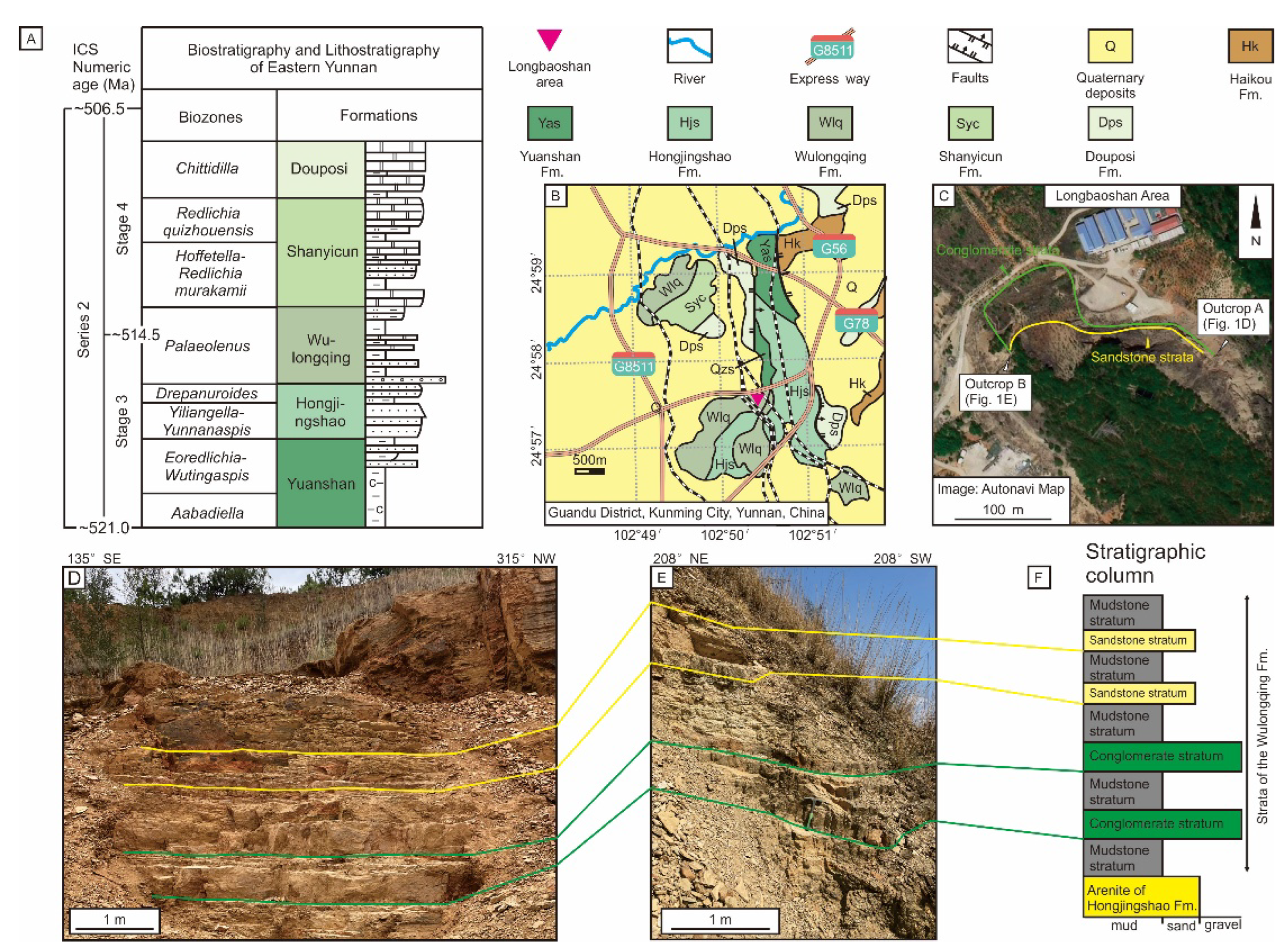
Figure 2.
Characteristics, photographs and organization of strata at the bottom of the Wulongqing Formation in the Longbaoshan area. Green arrows denote sheet-like conglomerates that bounded by abrupt bedding planes (green dashed lines), white arrows denote coarse-grained lenses that bounded by abrupt bedding planes (white dotted-dashed lines), yellow arrows denote sheet-like sandstones that bounded by abrupt planes (yellow dashed lines).
Figure 2.
Characteristics, photographs and organization of strata at the bottom of the Wulongqing Formation in the Longbaoshan area. Green arrows denote sheet-like conglomerates that bounded by abrupt bedding planes (green dashed lines), white arrows denote coarse-grained lenses that bounded by abrupt bedding planes (white dotted-dashed lines), yellow arrows denote sheet-like sandstones that bounded by abrupt planes (yellow dashed lines).
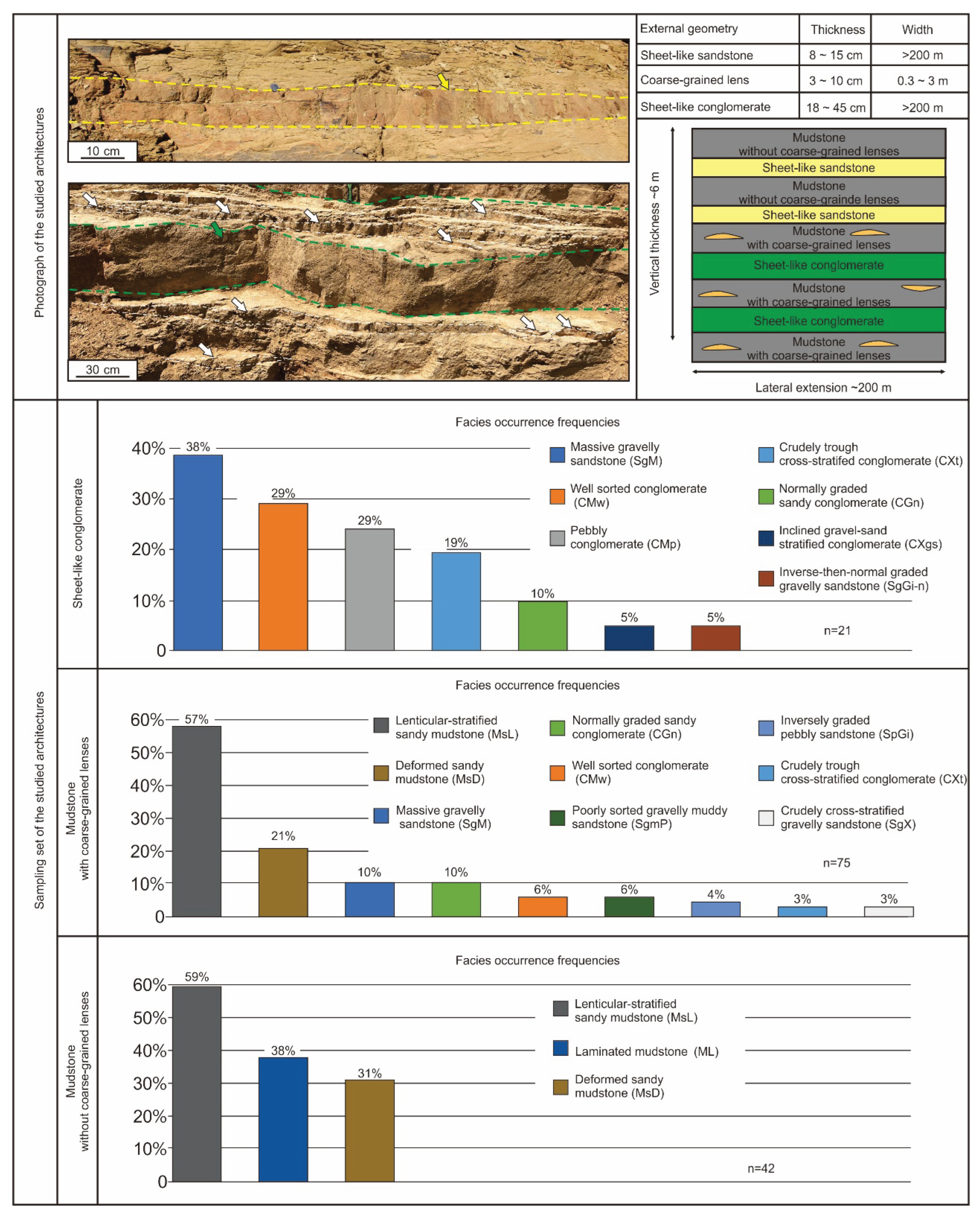
Figure 3.
Representative photographs of the facies observed in slabs. Scale bars = 1 cm. A: Matrix-supported pebbly conglomerate (Facies CMp), LBS23051707-2. B: Well sorted conglomerate (Facies CMw), LBS23060202-1. C: Crudely trough cross-stratified conglomerate (Facies CXt), LBS23053001. D: Inclined layers of alternating sandstone and conglomerate (Facies CXgs), LBS23060201. E: Normally graded conglomerate (Facies CGn), normal grading (white triangle), LBS23060202-2. F: Inverse-then-normal graded gravelly sandstone (Facies SgGi-n), inverse-then-normal grading (white rhombus), LBS23051704. G: Inversely graded pebbly sandstone (Facies SpGi), inverse grading (white inverted triangle), intraformational mudstone clasts (IC), LBS23060208-1. H: Gravelly sandstone (Facies SgM), LBS23051707-1. I: Crudely cross-stratified gravelly sandstone (Facies SgX), LBS23051710. J: Lenticular bedded sandy mudstone (Facies MsL), out-sized clasts (OC), LBS23051801-1. K: Deformed sandy mudstone (Facies MsD), out-sized clasts (OC), LBS23060102-4. L: Gravelly muddy sandstone (Facies SgmP), out-sized clasts (OC), LBS23060113-1. M: Laminated mudstone (Facies ML), Skolithos (Sk), Arenicolites (Ar), scour-and-fill structures (S&F), LBS23060210-3.
Figure 3.
Representative photographs of the facies observed in slabs. Scale bars = 1 cm. A: Matrix-supported pebbly conglomerate (Facies CMp), LBS23051707-2. B: Well sorted conglomerate (Facies CMw), LBS23060202-1. C: Crudely trough cross-stratified conglomerate (Facies CXt), LBS23053001. D: Inclined layers of alternating sandstone and conglomerate (Facies CXgs), LBS23060201. E: Normally graded conglomerate (Facies CGn), normal grading (white triangle), LBS23060202-2. F: Inverse-then-normal graded gravelly sandstone (Facies SgGi-n), inverse-then-normal grading (white rhombus), LBS23051704. G: Inversely graded pebbly sandstone (Facies SpGi), inverse grading (white inverted triangle), intraformational mudstone clasts (IC), LBS23060208-1. H: Gravelly sandstone (Facies SgM), LBS23051707-1. I: Crudely cross-stratified gravelly sandstone (Facies SgX), LBS23051710. J: Lenticular bedded sandy mudstone (Facies MsL), out-sized clasts (OC), LBS23051801-1. K: Deformed sandy mudstone (Facies MsD), out-sized clasts (OC), LBS23060102-4. L: Gravelly muddy sandstone (Facies SgmP), out-sized clasts (OC), LBS23060113-1. M: Laminated mudstone (Facies ML), Skolithos (Sk), Arenicolites (Ar), scour-and-fill structures (S&F), LBS23060210-3.
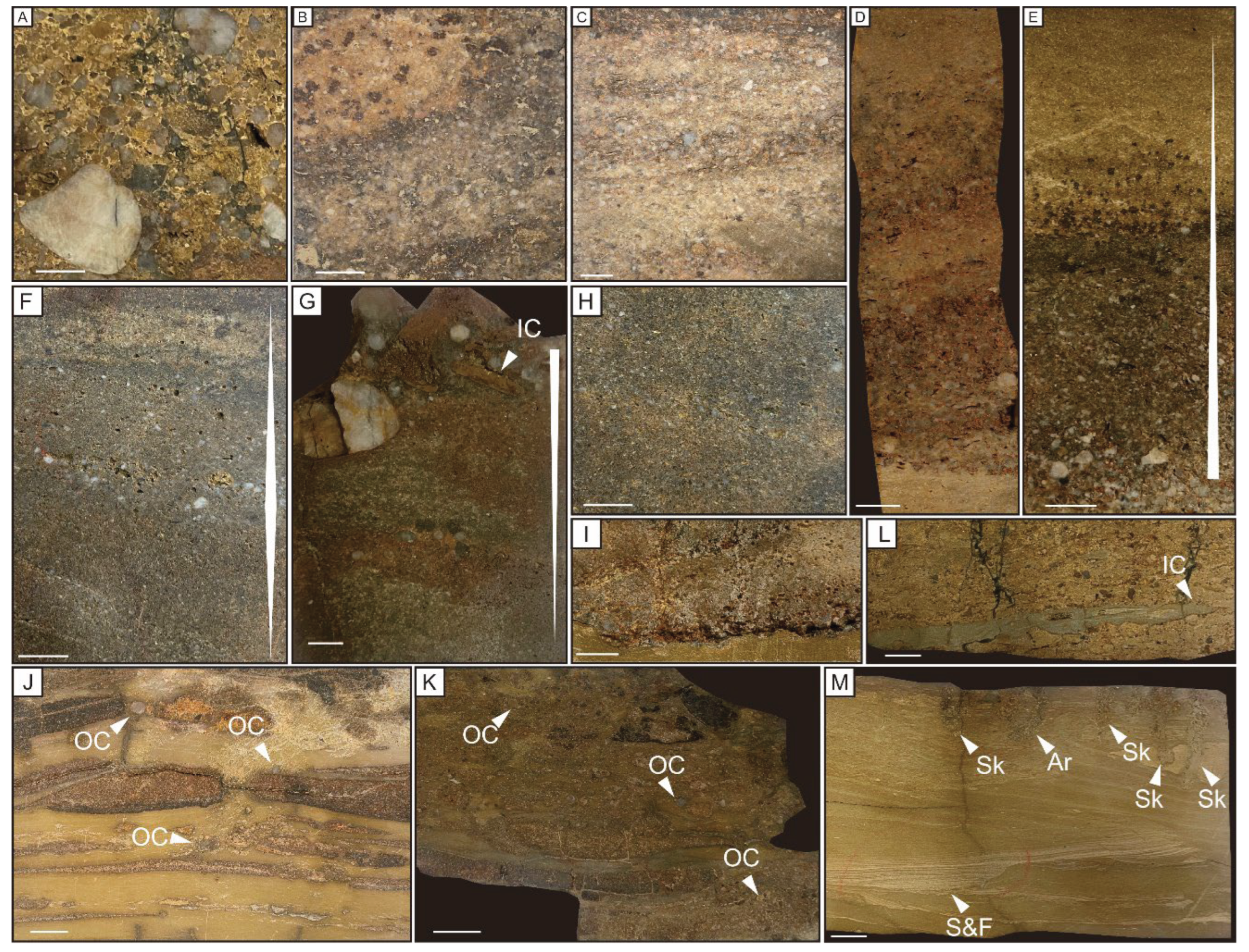
Figure 4.
Pebbly conglomerate (Facies CMp) at higher stratigraphic level. Scale bars = 1 cm A: Pebbly conglomerate occurring at the top of the sheet-like conglomerate. B: Pebbly conglomerate (Facies CMp) overlying inverse-then-normal graded gravelly sandstone (Facies SgGi-n), LBS23051704. C: Pebbly conglomerate (Facies CMp) overlying normally graded conglomerate (Facies CGn), LBS23051707-2. D: Pebbly conglomerate (Facies CMp) overlying massive gravelly sandstone (Facies SgM), intraformational mudstone clasts (IC), LBS23051707-1. E: Pebbly conglomerate (Facies CMp) overlying crudely trough cross-stratified conglomerate (Facies CXt), LBS23053001.
Figure 4.
Pebbly conglomerate (Facies CMp) at higher stratigraphic level. Scale bars = 1 cm A: Pebbly conglomerate occurring at the top of the sheet-like conglomerate. B: Pebbly conglomerate (Facies CMp) overlying inverse-then-normal graded gravelly sandstone (Facies SgGi-n), LBS23051704. C: Pebbly conglomerate (Facies CMp) overlying normally graded conglomerate (Facies CGn), LBS23051707-2. D: Pebbly conglomerate (Facies CMp) overlying massive gravelly sandstone (Facies SgM), intraformational mudstone clasts (IC), LBS23051707-1. E: Pebbly conglomerate (Facies CMp) overlying crudely trough cross-stratified conglomerate (Facies CXt), LBS23053001.
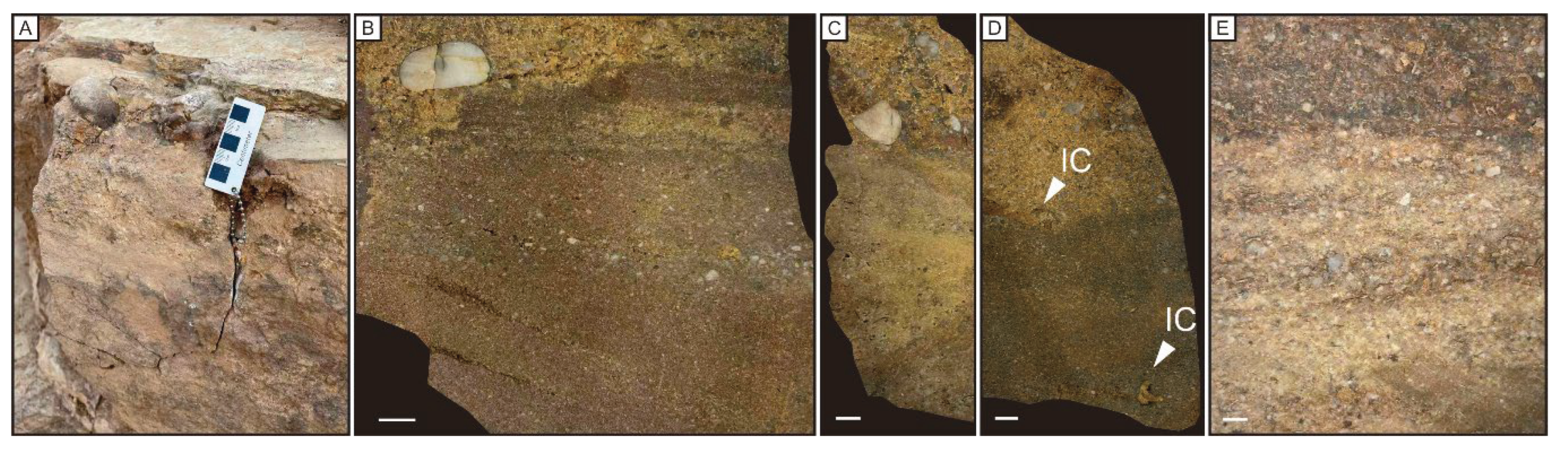
Figure 5.
Mud drapes in different architectures. A and B: Mud drapes (MD) in a coarse-grained lens of the mudstone with coarse-grained lenses, LBS23052301, Scale bar = 1cm. C and D: Mud drapes (MD) in two sheet-like sandstones, coin diameter = 22 mm. E: Mud drapes (MD) in the mudstone of the mudstone with coarse-grained lenses, scale bar = 1 cm. F: Mud drapes (MD) in a mudstone of the mudstone without coarse-grained lenses, starved ripple (SR), scale bar = 1 cm.
Figure 5.
Mud drapes in different architectures. A and B: Mud drapes (MD) in a coarse-grained lens of the mudstone with coarse-grained lenses, LBS23052301, Scale bar = 1cm. C and D: Mud drapes (MD) in two sheet-like sandstones, coin diameter = 22 mm. E: Mud drapes (MD) in the mudstone of the mudstone with coarse-grained lenses, scale bar = 1 cm. F: Mud drapes (MD) in a mudstone of the mudstone without coarse-grained lenses, starved ripple (SR), scale bar = 1 cm.
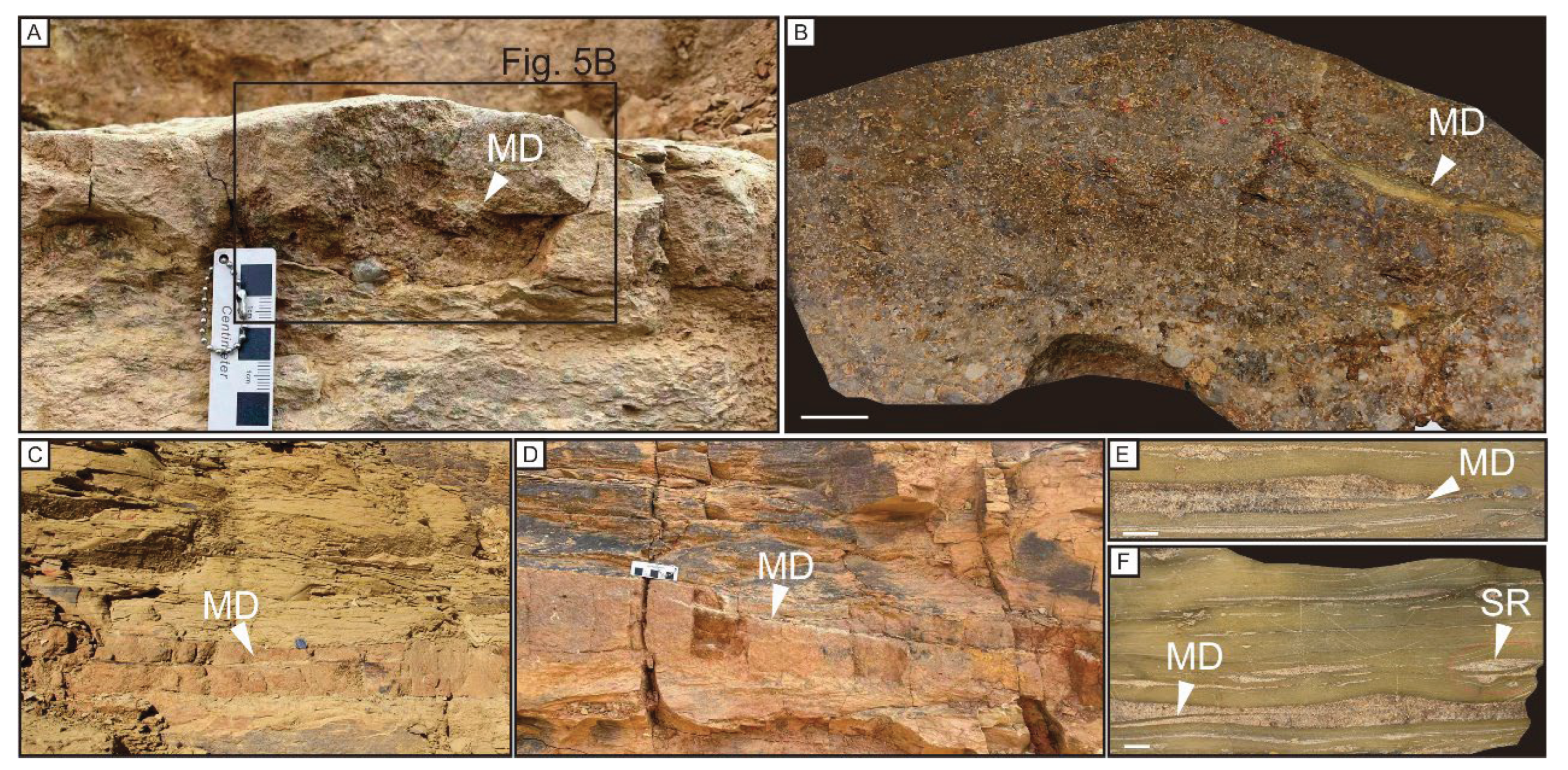
Figure 6.
Vertical burrows on slabs. A: Section view of the dense Skolithos assemblage at the basal bedding plane of the sheet-like sandstone. Skolithos (Sk), Arenicolites (Ar), sacle bar = 1 cm. B: Plane view of the dense Skolithos assemblage at the basal bedding plane of the sheet-like sandstone, Skolithos (Sk), Arenicolites (Ar), scale bar = 1 cm, LBS23050503-1. C and D: Vertical burrow, Skolithos (Sk), on slabs from the interior mudstone of the mudstone with coarse-grained lenses, scale bars = 1cm. C, LBS23051508; D, LBS23051710-1. E: Vertical burrow, Arenicolites (Ar), adhering the basal bedding plane of the sheet-like conglomerate, scale bar = 1cm, LBS23051601-4. F: Vertical burrow, Skolithos (Sk), adhering the basal bedding plane of the sheet-like conglomerate, inferred mud linings (black arrows), scale bar = 1 cm, LBS23051601-2. G: Syneresis crack from the mudstone with coarse-grained lenses, scale bar = 1 cm. Note that the crack exhibits a crinkled shape, and its bottom is V-shaped. LBS23060118.
Figure 6.
Vertical burrows on slabs. A: Section view of the dense Skolithos assemblage at the basal bedding plane of the sheet-like sandstone. Skolithos (Sk), Arenicolites (Ar), sacle bar = 1 cm. B: Plane view of the dense Skolithos assemblage at the basal bedding plane of the sheet-like sandstone, Skolithos (Sk), Arenicolites (Ar), scale bar = 1 cm, LBS23050503-1. C and D: Vertical burrow, Skolithos (Sk), on slabs from the interior mudstone of the mudstone with coarse-grained lenses, scale bars = 1cm. C, LBS23051508; D, LBS23051710-1. E: Vertical burrow, Arenicolites (Ar), adhering the basal bedding plane of the sheet-like conglomerate, scale bar = 1cm, LBS23051601-4. F: Vertical burrow, Skolithos (Sk), adhering the basal bedding plane of the sheet-like conglomerate, inferred mud linings (black arrows), scale bar = 1 cm, LBS23051601-2. G: Syneresis crack from the mudstone with coarse-grained lenses, scale bar = 1 cm. Note that the crack exhibits a crinkled shape, and its bottom is V-shaped. LBS23060118.
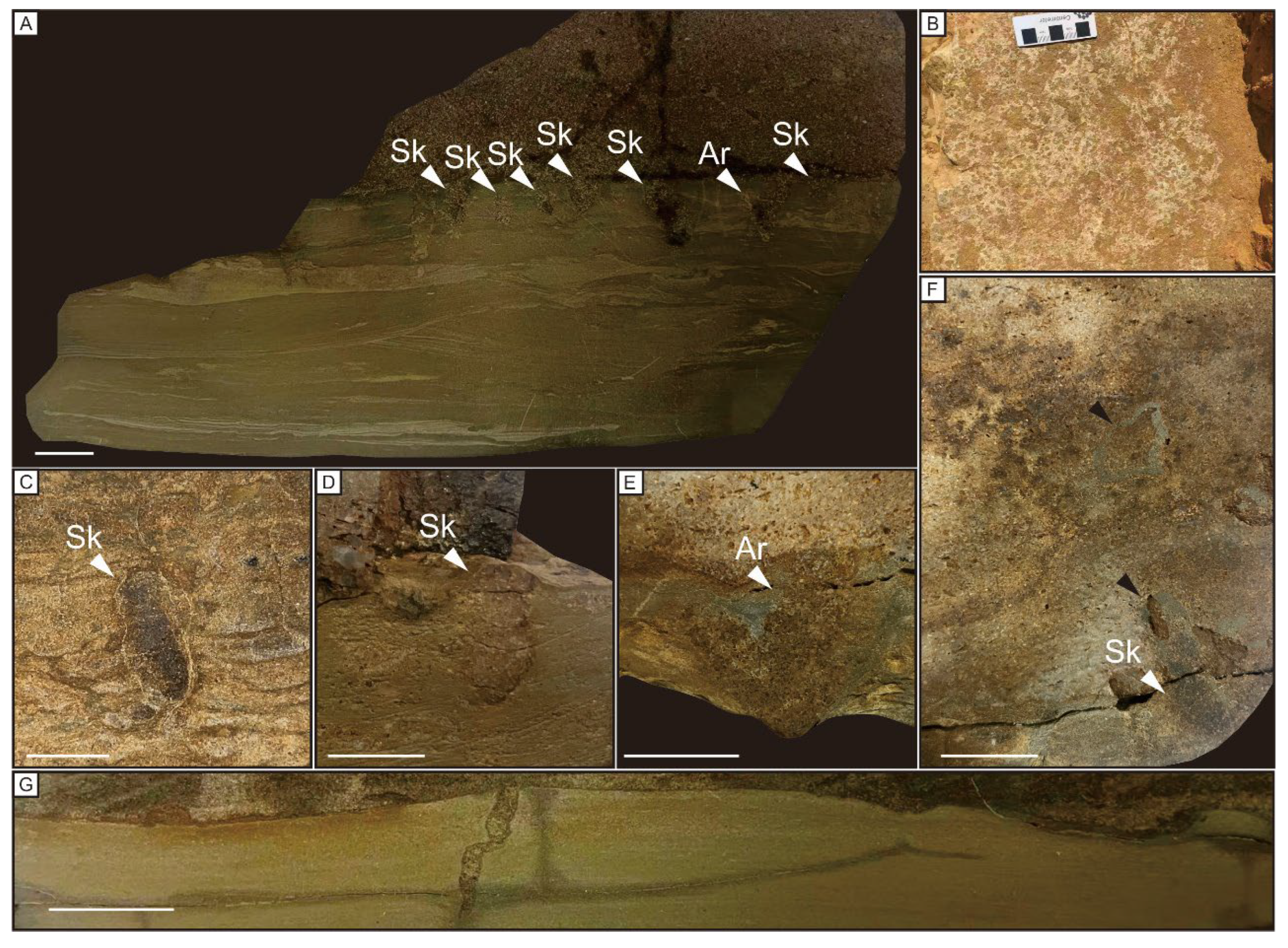
Figure 8.
Block diagram illustrating the depositional environments of the lower part of the Wulongqing Formation in the Longbaoshan area. Note that the gravelly coastal channels are posit within a fluvio-tidal system and vertical burrows are probably present within these channels (see Discussion).
Figure 8.
Block diagram illustrating the depositional environments of the lower part of the Wulongqing Formation in the Longbaoshan area. Note that the gravelly coastal channels are posit within a fluvio-tidal system and vertical burrows are probably present within these channels (see Discussion).
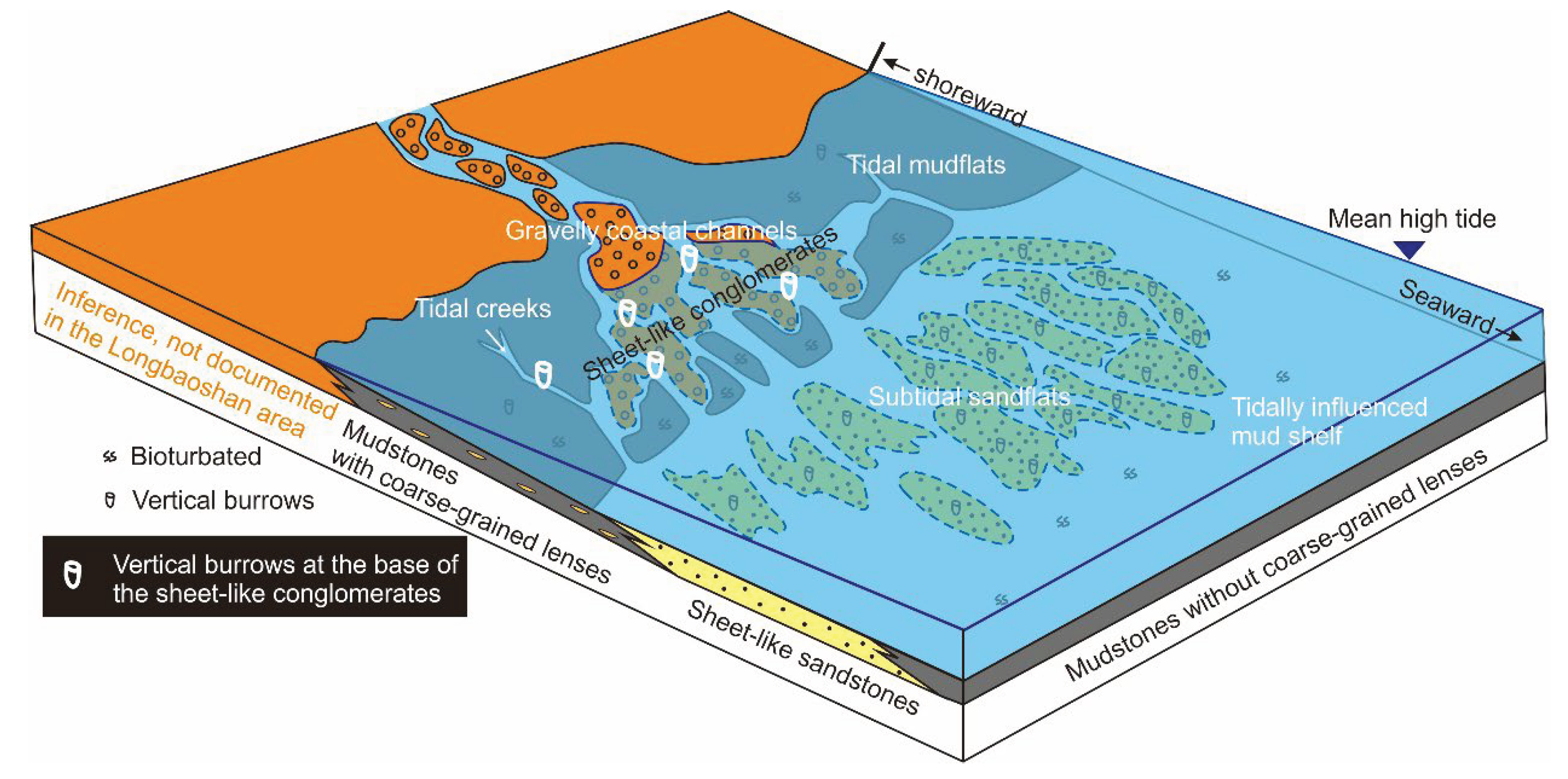

Table 1.
Summary of facies characteristics.
| Facies code | Facies description | Textural maturity and sedimentary structures | Process interpretation |
| CMp | Pebbly, horizontally bedded conglomerate | Poorly sorted, pebbles are sub-rounded to rounded; intrafomational mud clasts | Debris flow |
| CMw | No visible internal stratifications, conglomerate | Well sorted, sub-rounded to rouned granules | Rapid gravel accumulation under sustained flow conditions |
| CXt | Crudely trough cross-stratified conglomerate | Moderately sorted, sub-rouded to rounded, mainly granules | Deposition as sinuous crested dunes under bedload transport of gravels |
| CXgs | Inclined stratified layers of sand and gravel, sandy conglomerate | Well sorted sands; moderately sorted, sub-rounded to rounded, mainly granules | Lateral accretion of bars under alternating bedload transport of gravels and sands |
| CGn | Normally graded, sandy conglomerate | Well sorted, granule to fine or medium sands | Waning of currents carrying gravels and sands |
| SgGi-n | Inverse-then-normal graded, pebbly sandstone | Moderately sorted, granule to medium sands | Waxing-then-waning of currents carrying gravels and sands. |
| SpGi | Inversely graded, pebbly sandstone | Moderately sorted, pebbles are sub-rouded to rounded, pebble to medium sands | Waxing of currents carrying sands and pebbly gravels |
| SgM | No visible internal stratifications, gravelly sandstone | Well sorted, granule to medium sands | Rapid gravelly sand accumulation under sustained flow conditions |
| SgX | Crudely cross-stratified gravelly sandstone | Moderately sorted, sub-rouded to rounded, granule to medium sands | Deposition as crested dunes under bedload transport of gravelly sands |
| MsL | Lenticular stratified sand, sandy mud | muds to medium sands; out-sized clasts; mud drapes | Fluctuation of tidal conditions: alternating deposition of sands and muds |
| MsD | strongly disturbed, sandy mudstone | muds to medium sands; out-sized clasts | Intense biotubation cases of the MsL |
| SgmP | No visible internal stratification, gravelly muddy sandstone | poorly sorted, muds to gravels; intraformational mud clasts | Debris flow |
| ML | non-parallel, truncated often, light color laminae, mudstone | mud; scour-and-fill structures | Intermittent current scours on muddy deposits with a lack of coarse-grained sediments in their vincity |
Disclaimer/Publisher’s Note: The statements, opinions and data contained in all publications are solely those of the individual author(s) and contributor(s) and not of MDPI and/or the editor(s). MDPI and/or the editor(s) disclaim responsibility for any injury to people or property resulting from any ideas, methods, instructions or products referred to in the content. |
© 2026 by the authors. Licensee MDPI, Basel, Switzerland. This article is an open access article distributed under the terms and conditions of the Creative Commons Attribution (CC BY) license (http://creativecommons.org/licenses/by/4.0/).
Copyright: This open access article is published under a Creative Commons CC BY 4.0 license, which permit the free download, distribution, and reuse, provided that the author and preprint are cited in any reuse.


