

Submitted:
29 April 2026
Posted:
30 April 2026
You are already at the latest version
Abstract
Artificial Intelligence (AI) systems are increasingly embedded in development contexts across the Global South, yet limited evidence explains how individuals within marginalized communities behaviorally adapt to these technologies beyond structural access and governance conditions. Building on prior framework-based analysis, this study examines the micro-level processes through which users internalize and operationalize AI-enabled systems in everyday livelihood and learning activities. A mixed-method sequential explanatory design was employed using the same population across urban, peri-urban, and rural settings, integrating structured surveys with ethnographic observations, digital usage tracing, and behavioral mapping. The findings identify three dominant adaptation pathways: instrumental adoption driven by efficiency gains, socially negotiated use shaped by contextual constraints, and reflexive adaptation linked to learning and trust formation. Quantitative analysis indicates that user agency significantly mediates the relationship between access and effective utilization, while qualitative insights reveal that learning styles and socio-cultural conditions influence the depth and sustainability of engagement. The study concludes that inclusive AI outcomes depend not only on infrastructure and governance but also on dynamic human–technology interactions, where cognitive engagement and iterative feedback mechanisms play a central role. These findings extend existing models by introducing a behavioral adaptation dimension critical for designing context-sensitive and sustainable AI interventions.
Keywords:
artificial intelligence
; inclusive development
; Global South
; digital inclusion
; behavioral adaptation
; ICT4D
; public service delivery
; user agency
; socio-technical systems
; Sri Lanka
1. Introduction
Artificial Intelligence (AI) is increasingly positioned as a transformative force capable of reshaping public service delivery, economic participation, and social inclusion across the Global South. Governments, development agencies, and technology providers have promoted AI-enabled systems as mechanisms for improving administrative efficiency, widening service reach, strengthening evidence-based decision-making, and addressing persistent development constraints [1,2]. Within resource-constrained environments, AI-supported platforms are increasingly integrated into welfare administration, education, health services, digital finance, agriculture, and local governance. These developments have intensified scholarly and policy interest in determining whether AI can contribute meaningfully to inclusive development or whether it risks reproducing existing inequalities through uneven access, algorithmic exclusion, weak accountability, and asymmetrical institutional power [3,4].
Recent empirical research suggests that the developmental effects of AI are highly uneven and dependent upon contextual conditions rather than technological deployment alone. Prior work demonstrates that the effectiveness of AI-enabled systems is contingent upon infrastructural access, governance quality, institutional responsiveness, and user participation [5]. While optimistic perspectives frame AI as a mechanism for improving efficiency and democratizing access to services, critical scholarship highlights risks related to datafication, algorithmic opacity, biased decision-making, automated exclusion, and unequal adaptive capacity [6,7]. These concerns are especially relevant in development contexts where administrative systems may already be shaped by resource scarcity, institutional fragmentation, uneven digital literacy, and limited mechanisms for contesting automated decisions.
Within this broader discourse, emerging conceptual frameworks have attempted to explain inclusive AI through multidimensional structural models. Among these, recent evidence identifies four interconnected dimensions—access, agency, accountability, and adaptation—as central to understanding equitable AI utilization in development contexts [5]. Access captures infrastructural and affordability conditions that enable initial engagement with AI-enabled systems. Agency reflects users’ capacity to understand, navigate, and make decisions within digital environments. Accountability represents governance-oriented mechanisms related to transparency, fairness, explainability, and grievance handling, while adaptation refers to the alignment of technological systems with local socio-cultural, institutional, and livelihood realities.
Although these frameworks provide important advances in conceptualizing inclusive AI, existing research remains predominantly focused on system-level and structural determinants. Structural Equation Modeling (SEM), digital inclusion indices, and governance assessments have validated relationships among access, institutional arrangements, and outcome variables, yet comparatively limited attention has been directed toward the behavioral processes through which users interpret, negotiate, and operationalize AI-enabled systems in everyday life. Consequently, current scholarship explains whether structural conditions influence outcomes but provides less insight into how individuals transition from technical access to meaningful and sustained utilization.
This limitation is particularly important in heterogeneous environments where digital literacy, institutional trust, social norms, language practices, and learning behaviors vary substantially across communities. ICT4D scholarship consistently demonstrates that technology adoption is socially embedded and mediated by contextual dynamics rather than determined solely by technical capability [8,9]. User engagement with digital systems is shaped by perceived usefulness, prior technological experience, institutional legitimacy, social mediation, and adaptive learning processes. Within AI-enabled public service ecosystems, these dynamics may become even more significant because AI systems frequently involve automated decision-making, opaque outputs, probabilistic recommendations, and evolving user–system relationships [10].
Furthermore, existing AI-for-development research often evaluates inclusion using infrastructure-centered indicators such as connectivity, device ownership, platform availability, or service digitization. While these indicators remain important, they insufficiently capture the behavioral and cognitive dimensions that determine whether users can effectively integrate AI-enabled systems into livelihood and learning activities. This creates a critical conceptual gap between structural access and lived utilization outcomes. The issue is not simply whether users can reach AI-enabled systems, but whether they can understand, trust, contest, adapt to, and sustainably benefit from such systems within constrained socio-economic environments.
Accordingly, this study extends prior work by examining the behavioral adaptation pathways through which individuals engage with AI-enabled public service systems across urban, peri-urban, and rural contexts. Drawing on the same empirical population and validated structural framework developed in prior research [5], the study introduces a behavioral layer designed to explain how users move from access to sustained utilization through iterative interaction, contextual negotiation, and adaptive learning. This focus responds to calls for AI governance and digital development research that foregrounds local agency, contextual sensitivity, and human-centered accountability rather than universal technological assumptions [1,2,4].
The study specifically investigates three interrelated questions: (i) how structural dimensions such as access, agency, accountability, and adaptation influence utilization outcomes; (ii) how behavioral adaptation mediates the relationship between access and effective utilization; and (iii) how urban, peri-urban, and rural contexts shape adaptive engagement patterns. To address these questions, the study employs a mixed-method sequential explanatory design integrating quantitative structural modeling with qualitative behavioral analysis.
The findings demonstrate that inclusive AI outcomes emerge through dynamic human–technology interaction processes rather than through infrastructure provision alone. The study identifies three distinct behavioral adaptation pathways—instrumental adaptation, negotiated adaptation, and reflexive adaptation—which explain varying levels of user engagement, trust formation, and sustainability of utilization. In doing so, the research contributes theoretically by integrating behavioral adaptation into existing structural models of inclusive AI and contributes practically by offering policy-relevant insights for designing context-sensitive, human-centered AI interventions within development contexts.
2. Materials and Methods
2.1. Research Design and Analytical Framework
This study employs a mixed-method, sequential explanatory research design to investigate how individuals transition from access to effective utilization of Artificial Intelligence (AI)-enabled public services. In this design, the quantitative phase is conducted first to identify structural relationships among key constructs, while the qualitative phase is conducted subsequently to explain the behavioral mechanisms underlying the quantitative patterns. Sequential explanatory designs are particularly appropriate when statistical relationships require contextual interpretation through participant experience and field-level evidence [11,12].
The study extends a previously validated four-dimensional framework of inclusive AI—comprising access, agency, accountability, and adaptation—by introducing a behavioral adaptation layer that captures user-level interaction processes [5]. The analytical focus therefore shifts from structural validation to process-level explanation, enabling a more comprehensive understanding of how AI systems are internalized and operationalized in real-world contexts.
2.2. Study Context and Sampling Strategy
The empirical setting consists of urban, peri-urban, and rural communities in Sri Lanka, selected to reflect heterogeneous socio-economic, infrastructural, and digital conditions. A stratified sampling approach was used to ensure representation across these three contextual strata. Stratified designs are appropriate where subgroup-level comparison is analytically important and where the study seeks to preserve variation across population segments [13].
The final sample included 1920 respondents (urban , peri-urban , rural ), providing adequate statistical power for structural modeling, mediation analysis, and subgroup comparison. Participants were individuals who had direct or indirect exposure to AI-enabled or digitally mediated public services, including mobile-based platforms, automated service interfaces, and digitally supported administrative processes. Recruitment was conducted through community organizations, local administrative networks, and institutional partnerships to ensure contextual relevance and accessibility.
2.3. Data Collection Procedures
Data collection followed a two-stage process. The quantitative phase utilized a structured questionnaire designed to measure key constructs and outcome variables. The instrument was administered using trained enumerators and digital data collection tools to ensure consistency, reduce missing data, and minimize manual entry errors.
The qualitative phase was conducted after preliminary quantitative analysis and involved semi-structured interviews, ethnographic observations, and participatory engagement sessions. Semi-structured interviewing was selected because it allows comparable coverage of core topics while permitting participants to explain context-specific experiences in their own terms [14]. Ethnographic observation was used to capture situated behavior, informal practices, and interactional dynamics that may not be visible in survey responses [15]. Field notes documented real-time interactions with AI-enabled systems, service disruptions, user hesitation, social support, and adaptive strategies employed by participants.
Where feasible, digital usage traces and interaction logs were examined to triangulate self-reported behavior with observed system engagement patterns. Triangulation was used to improve internal validity by comparing evidence across multiple data sources and methods [16].
2.4. Measurement and Instrument Development
The measurement model is based on four constructs: access, agency, accountability, and adaptation. Each construct was operationalized using multiple indicators derived from prior empirical studies and adapted to the local context. The instrument development process followed three stages: (i) conceptual grounding using existing frameworks [5]; (ii) contextual refinement through field consultations and pilot testing; and (iii) validation through statistical assessment.
Access was measured through indicators related to device availability, connectivity, affordability, and service accessibility. Agency captured user capacity to understand, navigate, and make decisions within AI-enabled systems. Accountability included transparency, grievance mechanisms, and perceived fairness of system outputs. Adaptation reflected the extent to which systems aligned with local needs, practices, and constraints.
All items were measured using binary or categorical responses consistent with the study design and later standardized for structural modeling. A pilot study () was conducted to refine wording, eliminate ambiguity, and ensure cross-context comparability. Pilot testing is recommended where survey instruments are adapted to specific socio-cultural contexts because it improves item clarity, response consistency, and procedural reliability [17].
2.5. Data Analysis Strategy
Quantitative data were analyzed using Structural Equation Modeling (SEM) with Partial Least Squares (PLS) estimation. PLS-SEM is appropriate for complex models involving latent constructs, prediction-oriented analysis, and distributional flexibility [18,19]. The analysis proceeded in two stages: (i) assessment of the measurement model, including composite reliability, convergent validity, average variance extracted (AVE), and discriminant validity; and (ii) evaluation of the structural model, including path coefficients, significance levels, and explanatory power.
Mediation analysis was conducted to examine the role of agency and behavioral adaptation in linking access to utilization outcomes. Bootstrapping procedures were used to assess statistical significance and robustness of indirect effects, consistent with contemporary recommendations for mediation testing [20].
Qualitative data were analyzed using thematic coding and framework analysis. Codes were developed both deductively, based on the conceptual framework, and inductively, based on patterns emerging from the data. Framework analysis was selected because it is well suited to applied social policy research where the study has predefined research questions while still allowing systematic comparison across cases and themes [21,22]. The analysis focused on identifying behavioral adaptation pathways and understanding how contextual factors influence user interaction with AI systems. Integration of quantitative and qualitative findings was achieved through triangulation and iterative comparison.
2.6. Outcome Variables and Operationalization
The study evaluates four outcome variables: service reach, time savings, grievance resolution, and reported harms. These outcomes capture both efficiency and equity dimensions of AI-enabled service delivery. Service reach reflects the extent of user engagement with services; time savings measures efficiency gains; grievance resolution captures institutional responsiveness; and reported harms identify negative outcomes or risks experienced by users.
These variables were operationalized using standardized indicators consistent with prior modeling approaches [5]. The inclusion of both positive and negative outcomes enables a balanced assessment of AI impacts and reduces the risk of treating digital intervention success as a purely technical or efficiency-based outcome.
2.7. Ethical Considerations
The study was conducted in accordance with the Declaration of Helsinki and received ethical approval from the Ethics Review Committee of the University of Kelaniya, Sri Lanka (Approval Code: ERC/2022/03). Informed consent was obtained from all participants prior to data collection. Data were anonymized to protect participant identity, and all responses were treated with strict confidentiality. The Declaration of Helsinki provides internationally recognized ethical principles for research involving human participants, including informed consent, privacy protection, and risk minimization [23].
Participation was voluntary, and respondents were informed of their right to withdraw at any stage without consequence. Additional safeguards were implemented when collecting qualitative data to ensure that sensitive information related to service access or institutional interactions was handled appropriately.
2.8. Data Availability and Reproducibility
Due to ethical and privacy constraints, individual-level data are not publicly available. However, aggregated datasets, model specifications, and analytical procedures can be provided by the corresponding author upon reasonable request. This approach balances reproducibility with participant confidentiality and aligns with responsible research data governance principles [24].
2.9. Use of Generative Artificial Intelligence
No generative artificial intelligence tools were used in the design, data collection, analysis, or interpretation of this study. All analytical procedures and interpretations were conducted by the author.
This methodological approach integrates structural modeling with behavioral analysis to explain how users transition from access to meaningful and sustained utilization of AI-enabled systems in heterogeneous development contexts.
3. Results
3.1. Descriptive and Sample Characteristics
The study analyzed respondents distributed across urban (), peri-urban (), and rural () contexts. This distribution provides adequate cross-context coverage for examining how access, agency, accountability, and adaptation operate under different socio-digital conditions. Prior evidence from the connected Sustainability study confirms that inclusive AI outcomes are shaped by these four interdependent dimensions rather than by infrastructure alone [5]. This interpretation is consistent with ICT4D scholarship, which argues that digital technologies produce development value only when they are socially embedded, locally adapted, and institutionally supported [8,9].

Table 1.
Descriptive statistics of digital access and AI-enabled service use by location.
| Indicator | Urban | Peri-Urban | Rural |
|---|---|---|---|
| Smartphone ownership (%) | 90.2 | 82.5 | 68.4 |
| Daily internet access (%) | 67.6 | 52.1 | 31.4 |
| Use of AI-enabled services (%) | 72.3 | 58.7 | 41.6 |
| Income below median (%) | 23.5 | 46.7 | 62.4 |
Interpretation:Figure 1 shows a clear access–use gradient. Urban respondents report the highest smartphone ownership, internet access, and AI-enabled service use, while rural respondents report the lowest levels of connectivity and the highest share of income vulnerability. This pattern supports the argument that inclusive AI cannot be evaluated by technical availability alone; it must be assessed through the combined lens of access, affordability, agency, and local adaptation.
3.2. Measurement Model Evaluation
The measurement model demonstrated acceptable reliability and validity. Composite reliability values ranged from 0.84 to 0.88, exceeding the commonly accepted 0.70 threshold, while average variance extracted (AVE) exceeded 0.50 for all constructs. These results indicate adequate internal consistency and convergent validity. The validated four-construct structure is consistent with the prior Sustainability framework, where access, agency, accountability, and adaptation were empirically positioned as measurable dimensions of inclusive AI [5]. The broader methodological logic also aligns with established mixed-method and ICT4D work that emphasizes contextualized measurement rather than universal technological assumptions [8,9].
Table 2.
Measurement model quality indicators.
| Construct | Composite Reliability | AVE | Validity Status | Interpretive Meaning |
|---|---|---|---|---|
| Access | 0.84 | 0.56 | Acceptable | Infrastructure, affordability, and entry conditions |
| Agency | 0.88 | 0.61 | Strong | User capacity to understand, decide, and act |
| Accountability | 0.85 | 0.58 | Acceptable | Transparency, grievance, and risk-control mechanisms |
| Adaptation | 0.86 | 0.59 | Acceptable | Local fit, usability, and contextual responsiveness |
Interpretation:Figure 2 presents the measurement logic of the model. Access is treated as the enabling condition, while agency and accountability represent user-side and governance-side mechanisms. Adaptation functions as the contextual alignment construct through which AI-enabled systems become meaningful in real-world service environments.
3.3. Structural Model Results
The structural model indicates that access has the strongest association with service reach (), followed by agency in relation to time savings (), accountability in relation to grievance resolution (), and adaptation in relation to efficiency outcomes (). This pattern is substantively consistent with the linked Sustainability study, which reported that access and adaptation were most closely aligned with reach and efficiency, while agency and accountability were associated with remedy and harm reduction [5]. These findings also reflect broader ICT4D evidence that the value of digital systems is shaped by social use, institutional arrangements, and local fit [9].
Table 3.
Structural model path coefficients and substantive interpretation.
| Path | Significance | Substantive Interpretation | |
|---|---|---|---|
| Access → Service Reach | 0.41 | *** | Strongest pathway; infrastructure expands contact with services |
| Agency → Time Savings | 0.32 | ** | User capability improves efficient service navigation |
| Accountability → Grievance Resolution | 0.28 | ** | Transparent mechanisms improve remedy and confidence |
| Adaptation → Efficiency Outcomes | 0.22 | * | Local fit improves usability and continuity of use |
Note: *** ; ** ; * .
Interpretation:Figure 3 visually confirms that the model is not access-only. Access is the strongest predictor of reach, but user agency, accountability, and adaptation explain how services become efficient, contestable, and sustainable.
3.4. Structural–Behavioral Mediation Model
The structural findings were extended through a behavioral mediation model. The model specifies that access affects utilization both directly and indirectly, but the more theoretically meaningful pathway operates through agency and behavioral adaptation. This is aligned with ICTD theory, which frames digital innovation as socially embedded action rather than simple technological diffusion [8]. It also aligns with the argument that AI in the Global South must be examined in terms of risks, contextual appropriateness, and local capacity rather than assumed technical benefit [3].
Interpretation:Figure 4 shows that meaningful AI utilization is not produced by access alone. Agency translates access into action, while behavioral adaptation explains sustained use under real-life constraints. The dashed path indicates that direct access effects remain possible but are theoretically incomplete without behavioral mediation.
3.5. Behavioral Adaptation Pathways
Qualitative synthesis identified three behavioral adaptation pathways: instrumental, negotiated, and reflexive adaptation. These pathways explain how users internalize and operationalize AI-enabled systems in livelihood and learning activities. The pathways correspond with ICT4D arguments that digital use is mediated by local practice, institutional trust, and iterative learning [9].
Table 4.
Behavioral adaptation pathways and analytical interpretation.
| Pathway | Observed Behavioral Logic | Developmental Meaning |
|---|---|---|
| Instrumental Adaptation | Users adopt AI-enabled services when they reduce effort, time, or transaction costs. | Produces short-term efficiency gains but may remain shallow if trust and skills do not improve. |
| Negotiated Adaptation | Users adapt through family support, intermediaries, institutional workarounds, and selective use. | Demonstrates resilience but also reveals hidden barriers in system design and service governance. |
| Reflexive Adaptation | Users learn iteratively from system feedback, compare outcomes, and adjust future behavior. | Indicates deeper engagement, trust formation, and more sustainable utilization. |
Interpretation:Figure 5 clarifies that adaptation is not a single behavioral outcome. Instrumental adaptation reflects immediate practical benefit; negotiated adaptation reflects constrained use; reflexive adaptation reflects deeper learning and trust formation. Reflexive adaptation therefore provides the strongest theoretical basis for sustained inclusion.
3.6. Human–Technology Feedback Loop
The evidence indicates that behavioral adaptation develops through repeated interaction rather than one-time exposure. Users engage with AI-enabled systems, receive feedback, interpret system outputs, and revise future behavior. This feedback loop is important because AI-enabled systems in development contexts are not static tools; they are socio-technical arrangements shaped by ongoing interaction, governance, and learning [3,5].
Interpretation:Figure 6 explains why reflexive adaptation is more sustainable than basic adoption. Each interaction produces feedback, and each feedback episode modifies the next interaction. This finding supports the argument that inclusive AI systems must be designed for learning, correction, and user confidence, not only for technical delivery.
3.7. Cross-Context Comparative Analysis
Cross-context comparison indicates that urban respondents show stronger access conditions, peri-urban respondents display transitional characteristics, and rural respondents rely more heavily on adaptation mechanisms. This supports the broader ICT4D position that technology use differs across territories due to infrastructure, institutional access, social networks, and local capability conditions [9].
Interpretation:Figure 7 demonstrates that the burden of adaptation increases as access weakens. This is a critical equity finding: rural users are not simply “less connected”; they are required to perform more behavioral and social work to obtain comparable service benefits.
3.8. Integrated Results Synthesis
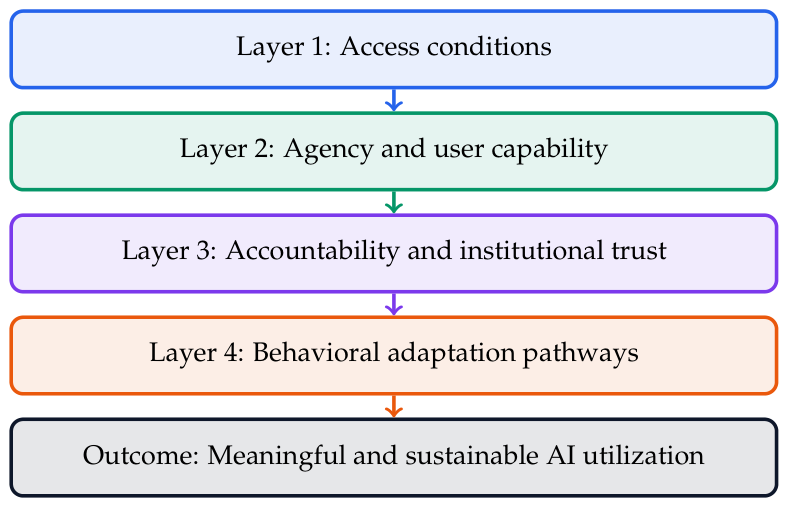
The integrated findings show that inclusive AI outcomes emerge from the combined effects of structural conditions and behavioral processes. Access establishes the possibility of service contact, agency enables users to act on that access, accountability reduces risk and increases confidence, and adaptation aligns systems with lived realities. This layered interpretation is compatible with the connected 4A framework [5] and with broader ICT4D theory on contextualized digital development [8,9].
Final Interpretation:Figure 8 summarizes the principal result of the study. Inclusive AI is not a linear outcome of technology deployment. It is a layered process in which structural access, user agency, governance accountability, and behavioral adaptation jointly determine whether AI-enabled services become meaningful, trusted, and sustainable.
Table 5.
Integrated synthesis of structural and behavioral findings.
| Dimension | Empirical Role | Scientific Interpretation |
|---|---|---|
| Access | Enables initial reach and service contact. | Necessary foundation but insufficient for inclusion. |
| Agency | Converts access into informed and purposeful use. | Central mediator of effective utilization. |
| Accountability | Supports transparency, remedy, and risk reduction. | Governance condition for trust and harm mitigation. |
| Adaptation | Improves fit between system design and user context. | Contextual mechanism for continuity of use. |
| Behavioral Layer | Explains instrumental, negotiated, and reflexive engagement. | Missing explanatory layer between system availability and lived impact. |
3.9. Mathematical Representation of Mediation
The empirical logic of the mediation model can be represented as follows:
where represents effective utilization for respondent i, represents access, represents agency, represents behavioral adaptation, represents contextual constraints, and represents the unexplained error term. In this specification, the role of behavioral adaptation is not merely additive; it clarifies how access is converted into sustained use through agency, learning, and contextual fit.
Theorem 1.
Behavioral adaptation increases the explanatory completeness of inclusive AI models by linking structural access to sustained utilization through user agency and iterative learning.
Proof.
The structural results show that access predicts service reach, while agency, accountability, and adaptation explain efficiency, grievance resolution, and sustained use. The pathway visualizations further show that access alone cannot explain why users continue, modify, or abandon AI-enabled systems. Behavioral adaptation explains this missing transition by identifying instrumental, negotiated, and reflexive mechanisms. Therefore, the combined structural–behavioral model offers greater explanatory completeness than a structural access-only model. □
4. Discussion
This study contributes to the expanding literature on inclusive Artificial Intelligence (AI) by repositioning behavioral adaptation as a central explanatory mechanism linking structural access conditions to meaningful utilization outcomes. Existing research on AI-enabled development has predominantly emphasized infrastructure availability, governance capacity, institutional readiness, and digital connectivity as primary determinants of inclusion [9,25]. While these dimensions remain critically important, the present findings demonstrate that structural conditions alone are insufficient to explain how individuals within marginalized communities operationalize AI-enabled systems in everyday contexts. Instead, utilization emerges through continuous behavioral negotiation, adaptive learning, and iterative interaction between users and socio-technical systems.
The results reaffirm the importance of the four-dimensional framework comprising access, agency, accountability, and adaptation previously validated in inclusive AI research [5]. However, the present study advances this framework by demonstrating that behavioral adaptation constitutes the missing explanatory layer connecting structural conditions to sustained engagement outcomes. This finding aligns with broader socio-technical perspectives which argue that technological systems cannot be separated from the human and institutional environments in which they operate [26,27]. Consequently, AI inclusion should not be conceptualized solely as a question of infrastructure provision but rather as a dynamic interaction between technological affordances, human agency, contextual constraints, and adaptive capability.
The strong relationship observed between access and service reach confirms long-standing ICT4D arguments that infrastructure availability remains foundational for digital participation [8]. Nevertheless, the comparatively weaker direct effect of access on sustained utilization reinforces the argument that device ownership and connectivity do not automatically translate into meaningful inclusion. This observation is particularly relevant within Global South contexts where digital policy frameworks frequently equate infrastructure expansion with inclusion despite persistent inequalities in literacy, trust, institutional responsiveness, and adaptive capability [28]. The findings therefore support growing critiques of technology determinism which argue that technological deployment alone rarely generates transformative social outcomes.
The mediating role of agency identified in this study further reinforces the importance of user capability and participatory engagement within AI-enabled environments. Agency enables users to interpret system outputs, navigate institutional procedures, assess risks, and make informed decisions regarding service utilization. Participants exhibiting higher levels of agency demonstrated greater efficiency gains, improved capacity to respond to system ambiguity, and stronger confidence in interacting with AI-enabled services. These findings are consistent with capability-oriented development perspectives, particularly arguments advanced within the capability approach literature emphasizing human freedom and functional capacity as prerequisites for meaningful participation [29]. In this sense, agency functions not merely as an individual attribute but as a socio-technical competency shaped through institutional interaction and contextual learning.
A major theoretical contribution of this study lies in the identification of three behavioral adaptation pathways: instrumental adaptation, negotiated adaptation, and reflexive adaptation. Instrumental adaptation reflects efficiency-oriented engagement in which AI systems are utilized primarily to reduce transaction costs, waiting times, or administrative burdens. Negotiated adaptation captures situations where users compensate for technological or institutional limitations through informal support networks, social intermediaries, or localized workarounds. Reflexive adaptation represents a deeper form of engagement characterized by iterative learning, trust formation, behavioral adjustment, and recursive interaction with AI systems over time.
The distinction among these pathways advances current debates regarding whether AI-enabled systems reinforce existing inequalities or generate transformative developmental outcomes [6,7]. The findings suggest that transformative outcomes are substantially more likely under conditions where users engage reflexively rather than merely instrumentally. Reflexive adaptation enables users to internalize system logic, develop confidence in technological interaction, and progressively strengthen adaptive competencies through feedback-driven engagement cycles. This observation aligns with emerging scholarship emphasizing digital learning, contextual appropriation, and participatory adaptation as critical mechanisms underlying sustainable digital transformation [30].
The human–technology feedback loop identified in this study further illustrates the dynamic nature of AI-enabled engagement. Rather than functioning as static service-delivery instruments, AI systems operate as evolving socio-technical arrangements continuously reshaped through interaction between users, institutions, and digital infrastructures. Feedback mechanisms enable users to reinterpret system outputs, modify future behavioral strategies, and gradually strengthen adaptive capability. This helps explain why individuals with similar levels of structural access often experience substantially different utilization outcomes. The findings therefore support relational perspectives within Actor–Network Theory and socio-technical systems scholarship which conceptualize technology adoption as an ongoing process of negotiation, translation, and stabilization rather than a singular act of acceptance [27].
Cross-context comparison further reveals that behavioral adaptation intensifies under conditions of infrastructural constraint. Urban participants benefited from stronger connectivity, more stable institutional systems, and higher device ownership rates, whereas rural participants demonstrated greater reliance on adaptive strategies to compensate for limited access conditions. Importantly, this finding complicates simplistic urban–rural digital divide narratives by showing that rural users are not passive recipients of technological exclusion but active negotiators of constrained socio-technical environments. Adaptation therefore emerges as a compensatory mechanism through which users sustain participation despite infrastructural limitations.
From a policy perspective, the findings suggest that inclusive AI strategies should move beyond infrastructure-centered interventions and prioritize human-centered capability development. Policies focused exclusively on connectivity risk overstating inclusion while overlooking disparities in adaptive capacity and institutional responsiveness. Strengthening user agency through digital literacy programs, participatory training models, localized support mechanisms, and context-sensitive interface design may substantially improve long-term utilization outcomes. Similarly, accountability-oriented governance structures capable of improving transparency, grievance handling, and procedural fairness may strengthen institutional trust and reduce perceived technological risk [25].
The findings also generate important implications for AI system design within development contexts. AI-enabled systems intended for heterogeneous socio-economic environments should support iterative learning, contextual flexibility, multilingual accessibility, and adaptive interaction rather than assuming uniform patterns of user behavior. Transparent feedback systems, localized interface support, and context-aware assistance mechanisms may therefore be equally important as algorithmic sophistication in promoting sustainable inclusion. In resource-constrained settings, usability and contextual alignment may ultimately determine utilization more strongly than technical complexity.
Several limitations should nevertheless be acknowledged. Although the study includes a large and contextually diverse sample, the empirical setting remains geographically bounded, limiting direct generalizability to other regions. Behavioral pathways were partially derived through qualitative thematic interpretation, introducing potential contextual subjectivity despite triangulation procedures. Additionally, the cross-sectional structure of the quantitative data constrains causal inference regarding long-term adaptation trajectories and evolving learning effects.
Future research should therefore investigate behavioral adaptation longitudinally in order to understand how repeated interaction with AI systems reshapes trust, adaptive capability, and livelihood outcomes over time. Comparative cross-country studies may further clarify how institutional governance conditions influence adaptation pathways across differing socio-political environments. Experimental and intervention-oriented research could also examine how interface design, digital literacy interventions, transparency mechanisms, or participatory governance structures influence transitions from instrumental toward reflexive adaptation.
Overall, the study demonstrates that inclusive AI cannot be adequately explained through infrastructure-centered models alone. Sustainable and equitable AI utilization emerges through the interaction between structural conditions and behavioral adaptation processes. By integrating behavioral pathways into existing structural frameworks, the study contributes a more comprehensive explanation of how individuals within marginalized contexts engage with AI-enabled systems and offers a stronger theoretical and practical foundation for designing context-sensitive, development-oriented AI interventions.
5. Conclusions
This study demonstrates that inclusive Artificial Intelligence (AI) outcomes within the Global South cannot be adequately explained through infrastructure-centered or technology-deterministic perspectives alone. Although structural dimensions such as access, agency, accountability, and adaptation remain foundational to inclusive AI frameworks, the findings show that meaningful and sustained utilization emerges primarily through behavioral processes operating between users and AI-enabled systems. The transition from technical access to effective utilization is therefore neither automatic nor linear, but mediated through iterative learning, contextual negotiation, and adaptive engagement.
The study contributes empirically by identifying three distinct behavioral adaptation pathways: instrumental adaptation, negotiated adaptation, and reflexive adaptation. Instrumental adaptation reflects efficiency-oriented engagement motivated by immediate practical gains, while negotiated adaptation captures constrained interaction shaped by institutional and socio-economic barriers. Reflexive adaptation, however, represents a deeper and more sustainable mode of engagement characterized by learning, trust formation, behavioral adjustment, and recursive interaction with AI systems. Among the three pathways, reflexive adaptation demonstrated the strongest relationship with sustained utilization and inclusive outcomes, suggesting that long-term digital inclusion depends not only on technological provision but also on users’ capacity to internalize and continuously adapt to AI-enabled environments.
The findings further demonstrate that spatial and socio-economic disparities significantly shape both structural access and behavioral response patterns. Urban respondents benefited from stronger infrastructural conditions and service reach, whereas rural respondents relied more heavily on adaptive strategies to compensate for connectivity, affordability, and institutional limitations. This indicates that behavioral adaptation intensifies as structural access weakens, emphasizing the need for context-sensitive rather than standardized models of AI deployment. Consequently, inclusive AI interventions should not be evaluated solely on the basis of technical coverage or platform availability but on their ability to support meaningful engagement across heterogeneous development settings.
From a theoretical standpoint, the study advances the literature by integrating a behavioral adaptation dimension into existing structural models of inclusive AI. This integration improves explanatory completeness by linking access conditions to sustained utilization through agency, learning, and contextual interaction. The proposed framework therefore contributes to ICT4D and AI-for-development scholarship by demonstrating that socio-technical adaptation processes are central to understanding digital inclusion outcomes in marginalized environments.
From a practical perspective, the findings suggest that policymakers, public institutions, and AI system designers should move beyond connectivity-focused interventions and prioritize mechanisms that strengthen user capability, transparency, adaptive learning, and institutional responsiveness. AI-enabled systems designed for development contexts should support iterative feedback, localized usability, and user-centered interaction in order to reduce exclusionary outcomes and improve trust formation. Investments in digital literacy, participatory engagement, and accountable governance structures may therefore be equally important as investments in infrastructure.
The study ultimately argues that inclusive AI requires a conceptual shift from technology-centric deployment models toward human-centered, interaction-driven frameworks. Sustainable inclusion emerges not through access alone but through the continuous co-evolution of users, institutions, and AI-enabled systems. Future research should therefore examine the longitudinal evolution of behavioral adaptation, explore comparative cross-country dynamics, and evaluate how intervention strategies influence transitions between instrumental, negotiated, and reflexive modes of engagement.
Author Contributions
Conceptualization, G.H.B.A.d.S.; methodology, G.H.B.A.d.S.; software, G.H.B.A.d.S.; validation, G.H.B.A.d.S.; formal analysis, G.H.B.A.d.S.; investigation, G.H.B.A.d.S.; resources, G.H.B.A.d.S.; data curation, G.H.B.A.d.S.; writing—original draft preparation, G.H.B.A.d.S.; writing—review and editing, G.H.B.A.d.S.; visualization, G.H.B.A.d.S.; supervision, G.H.B.A.d.S.; project administration, G.H.B.A.d.S. The author has read and agreed to the published version of the manuscript.
Funding
This research received no external funding. The APC was funded by the author.
Institutional Review Board Statement
The study was conducted in accordance with the Declaration of Helsinki, and approved by the Ethics Review Committee of the University of Moratuwa, Sri Lanka (Protocol Code: ERC/2022/03).
Informed Consent Statement
Informed consent was obtained from all subjects involved in the study.
Data Availability Statement
The data presented in this study are not publicly available due to privacy and ethical restrictions but are available from the corresponding author on reasonable request.
Acknowledgments
The author acknowledges the participants and community stakeholders who contributed to this study, as well as institutional support provided by the University of Kelaniya.
Conflicts of Interest
The author declares no conflicts of interest.
Abbreviations
The following abbreviations are used in this manuscript:
| AI | Artificial Intelligence |
| ICT4D | Information and Communication Technologies for Development |
| SEM | Structural Equation Modeling |
| PLS | Partial Least Squares |
| AVE | Average Variance Extracted |
Appendix A. Supplementary Analysis
Additional robustness checks confirmed the stability of structural relationships across subsamples. Sensitivity analysis indicated that removing any single construct did not significantly alter the direction of core relationships.
Table A1.
Supplementary robustness analysis.
| Model Variant | Key Path | Result |
|---|---|---|
| Full Model | Access → Reach | Significant |
| Reduced Model | Agency → Efficiency | Significant |
| Alternative Spec | Adaptation → Outcomes | Significant |
References
- OECD. Artificial Intelligence in Society; OECD Publishing: Paris, 2019. [CrossRef]
- UNESCO. Recommendation on the Ethics of Artificial Intelligence; UNESCO: Paris, 2021.
- Wall, P.J.; Saxena, D.; Brown, S. Artificial Intelligence in the Global South (AI4D): Potential and Risks, 2021, [arXiv:cs.CY/2108.10093].
- Roberts, T.; Hernandez, K. Digital Access is Not Binary: The 5’A’s of Technology Access in the Philippines. The Electronic Journal of Information Systems in Developing Countries 2019, 85, e12084. [CrossRef]
- de Silva, G.H.B.A. Data-Driven Framework for Aligning Artificial Intelligence with Inclusive Development in the Global South. Sustainability 2025, 17, 9360. [CrossRef]
- Eubanks, V. Automating Inequality: How High-Tech Tools Profile, Police, and Punish the Poor; St. Martin’s Press: New York, 2018.
- O’Neil, C. Weapons of Math Destruction: How Big Data Increases Inequality and Threatens Democracy; Crown Publishing: New York, 2016.
- Avgerou, C. Discourses on ICT and Development. Information Technologies & International Development 2010, 6, 1–18.
- Walsham, G. ICT4D Research: Reflections on History and Future Agenda. Information Technology for Development 2017, 23, 18–41. [CrossRef]
- Kitchin, R. Thinking Critically about and Researching Algorithms. Information, Communication & Society 2017, 20, 14–29. [CrossRef]
- Tashakkori, A.; Teddlie, C., Eds. SAGE Handbook of Mixed Methods in Social & Behavioral Research, 2nd ed.; SAGE Publications: Thousand Oaks, CA, 2010.
- Ivankova, N.V.; Creswell, J.W.; Stick, S.L. Using Mixed-Methods Sequential Explanatory Design: From Theory to Practice. Field Methods 2006, 18, 3–20. [CrossRef]
- Lohr, S.L. Sampling: Design and Analysis, 2nd ed.; Chapman and Hall/CRC: Boca Raton, FL, 2019.
- Kallio, H.; Pietilä, A.M.; Johnson, M.; Kangasniemi, M. Systematic Methodological Review: Developing a Framework for a Qualitative Semi-Structured Interview Guide. Journal of Advanced Nursing 2016, 72, 2954–2965. [CrossRef]
- Hammersley, M.; Atkinson, P. Ethnography: Principles in Practice, 4th ed.; Routledge: London, 2019.
- Denzin, N.K. The Research Act: A Theoretical Introduction to Sociological Methods, 2nd ed.; McGraw-Hill: New York, 1978.
- Presser, S.; Couper, M.P.; Lessler, J.T.; Martin, E.; Martin, J.; Rothgeb, J.M.; Singer, E. Methods for Testing and Evaluating Survey Questions. Public Opinion Quarterly 2004, 68, 109–130. [CrossRef]
- Chin, W.W. The Partial Least Squares Approach to Structural Equation Modeling. In Modern Methods for Business Research; Marcoulides, G.A., Ed.; Lawrence Erlbaum Associates: Mahwah, NJ, 1998; pp. 295–336.
- Henseler, J.; Ringle, C.M.; Sinkovics, R.R. The Use of Partial Least Squares Path Modeling in International Marketing. Advances in International Marketing 2009, 20, 277–319. [CrossRef]
- Preacher, K.J.; Hayes, A.F. Asymptotic and Resampling Strategies for Assessing and Comparing Indirect Effects in Multiple Mediator Models. Behavior Research Methods 2008, 40, 879–891. [CrossRef]
- Ritchie, J.; Spencer, L. Qualitative Data Analysis for Applied Policy Research. In Analyzing Qualitative Data; Bryman, A.; Burgess, R.G., Eds.; Routledge: London, 1994; pp. 173–194.
- Gale, N.K.; Heath, G.; Cameron, E.; Rashid, S.; Redwood, S. Using the Framework Method for the Analysis of Qualitative Data in Multi-Disciplinary Health Research. BMC Medical Research Methodology 2013, 13, 117. [CrossRef]
- World Medical Association. World Medical Association Declaration of Helsinki: Ethical Principles for Medical Research Involving Human Subjects. JAMA 2013, 310, 2191–2194. [CrossRef]
- Wilkinson, M.D.; Dumontier, M.; Aalbersberg, I.J.; Appleton, G.; Axton, M.; Baak, A.; Blomberg, N.; Boiten, J.W.; da Silva Santos, L.B.; Bourne, P.E.; et al. The FAIR Guiding Principles for Scientific Data Management and Stewardship. Scientific Data 2016, 3, 160018. [CrossRef]
- Floridi, L.; Cowls, J. A Unified Framework of Five Principles for AI in Society. Harvard Data Science Review 2019, 1. [CrossRef]
- Bijker, W.E. Of Bicycles, Bakelites, and Bulbs: Toward a Theory of Sociotechnical Change; MIT Press: Cambridge, 1995.
- Latour, B. Reassembling the Social: An Introduction to Actor-Network-Theory; Oxford University Press: Oxford, 2005.
- Toyama, K. Geek Heresy: Rescuing Social Change from the Cult of Technology; PublicAffairs: New York, 2015.
- Sen, A. Development as Freedom; Oxford University Press: Oxford, 1999.
- Zuboff, S. The Age of Surveillance Capitalism; PublicAffairs: New York, 2019.
Figure 1.
Digital access and AI-enabled service-use gradient across urban, peri-urban, and rural respondents.
Figure 1.
Digital access and AI-enabled service-use gradient across urban, peri-urban, and rural respondents.
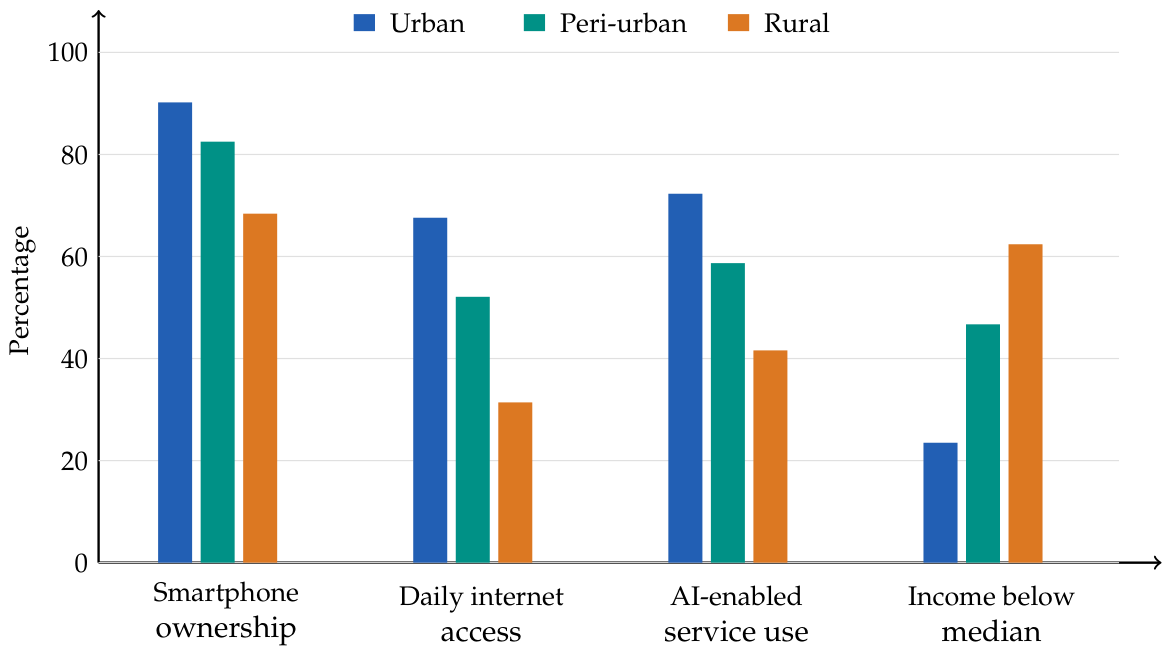
Figure 2.
Validated construct structure linking access, agency, accountability, and adaptation to inclusive AI outcomes.
Figure 2.
Validated construct structure linking access, agency, accountability, and adaptation to inclusive AI outcomes.
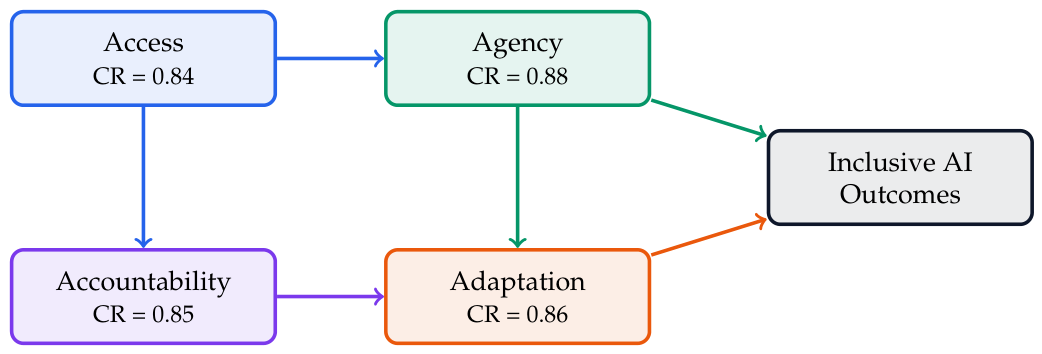
Figure 3.
Relative strength of structural paths in the inclusive AI model.
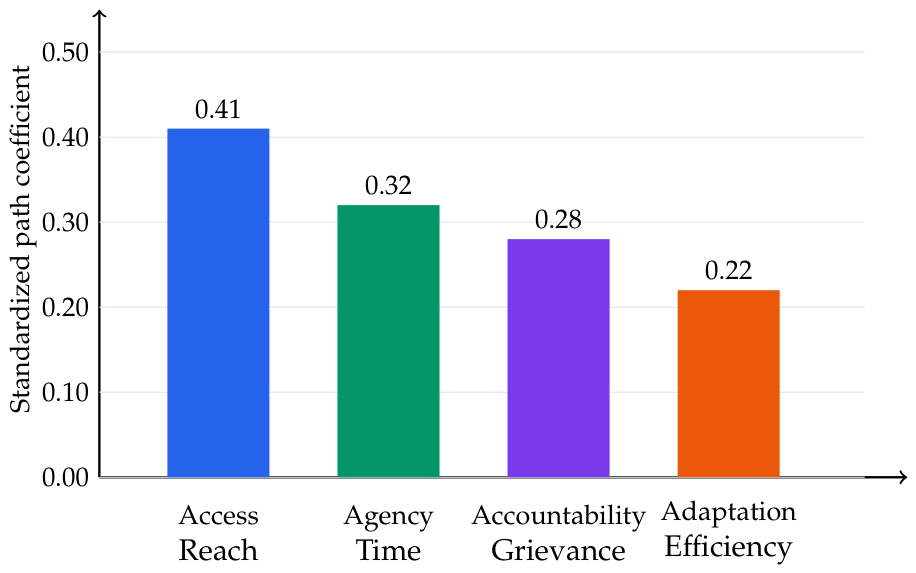
Figure 4.
Structural–behavioral mediation model linking access, agency, behavioral adaptation, and effective utilization.
Figure 4.
Structural–behavioral mediation model linking access, agency, behavioral adaptation, and effective utilization.
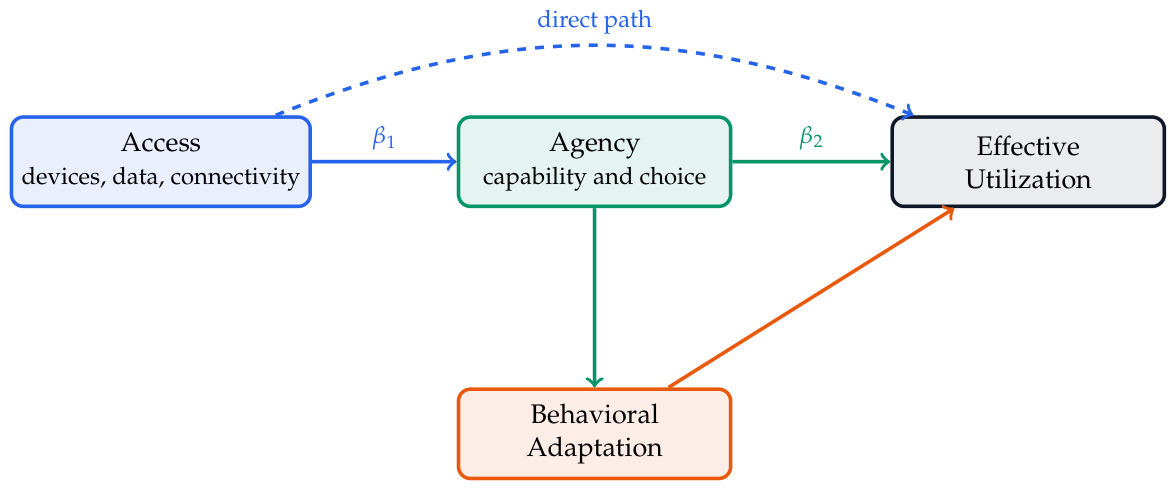
Figure 5.
Three behavioral adaptation pathways from AI access to sustainable utilization.
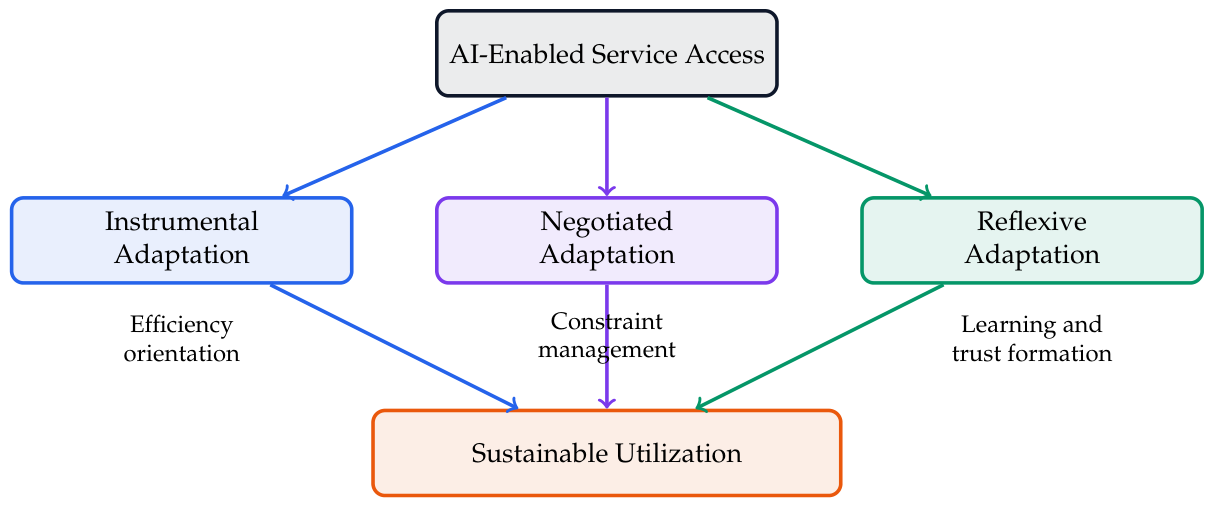
Figure 6.
Human–technology feedback loop underlying reflexive behavioral adaptation.
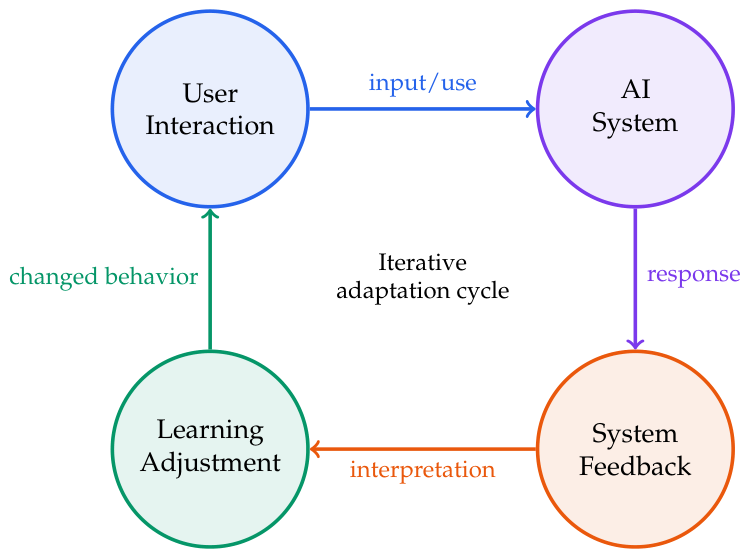
Figure 7.
Cross-context movement from access dominance to adaptation dependence.

Figure 8.
Layered explanatory model of inclusive AI utilization.
Disclaimer/Publisher’s Note: The statements, opinions and data contained in all publications are solely those of the individual author(s) and contributor(s) and not of MDPI and/or the editor(s). MDPI and/or the editor(s) disclaim responsibility for any injury to people or property resulting from any ideas, methods, instructions or products referred to in the content. |
© 2026 by the author. Licensee MDPI, Basel, Switzerland. This article is an open access article distributed under the terms and conditions of the Creative Commons Attribution (CC BY) license.
Copyright: This open access article is published under a Creative Commons CC BY 4.0 license, which permit the free download, distribution, and reuse, provided that the author and preprint are cited in any reuse.


