

Submitted:
30 April 2026
Posted:
30 April 2026
You are already at the latest version
Abstract
Sport-related mild traumatic brain injury (mTBI) or concussion is common and has long-term impacts. Lack of diagnostically accurate, rapid and easy to administer tests exacerbates the problem. We evaluated the objectiveFIELD Analyser® (OFA®) for mTBI. This cross-sectional study included athletes who had concussion, and 2 groups of controls: the putative control group (pCG) of rugby players who claimed never had concussion, and a non-rugby normal control group (nCG). Two OFA tests, the 8-minute (OFA30) and the rapid 90-second (OFA30-12) were performed. Analysis was performed against both the control groups using Area Under Receiver Operating Curves (AUROC) and Hedge’s g standardised effect-size. The athletes were divided into: Acute Group with 42 athletes tested within 15.4 ± 13.6 days of mTBI; and Chronic Group with 23 athletes tested within 941.5 ± 769.0 days. Subjects were age matched (22.4 ± 3.06 y). For the nCG OFA30-12 performed better than OFA30: with Hedge’s g of 1.22 in acute and 1.45 in chronic cases; c.f. 0.93 for acute and 1.00 for chronic cases. AUROCs performed similarly. Notably, when compared with the pCG the both tests showed poorer diagnostic power. OFA perimetry showed the potential as a reliable and rapid test in the assessment of concussion.
Keywords:
concussion
; functional loss
; objective perimetry
; sport-related brain injury
; traumatic brain injury
; visual field defects
Introduction
Traumatic brain injury (TBI) is characterised by alterations in brain function or other signs of brain damage due to external forces [1]. TBI can range from mild (mTBI) (e.g. concussion) to severe forms, and potentially leads to long-term cognitive, physical, and emotional impairments, and is a major health problem [2]. It may lead to severely diminished quality of life for both survivors, their families and the community at large [3] posing an enormous economic burden with annual costs estimated at around $400 billion globally [4]. In Australia, 190,000 to 200,000 cases of TBI occur annually, of which about 180,000 are mild, including concussion [5]. Essentially, all concussions are mild TBIs, but not all TBIs are concussions [6]. TBIs are classified based on the Glasgow Coma Scale, whereas concussions are defined by temporary changes in brain function and can occur with or without loss of consciousness [7]. These functional changes occur due to rapid release of neurotransmitters causing ionic disequilibrium across neuronal membranes [8].
Due to absence of any established test or biomarker for concussion, the current diagnostic approach includes confirming the presence of a constellation of symptoms and signs after a person has experienced a trauma to the head. Neuroimaging is applicable in more severe BTIs but not in concussion [9]. Functional tests are more useful in concussion, but most functional tests are subjective and have their own limitations [10]. Therefore, these are not performed as often as required to account for the high variability. Visual field defects in persons with loss of consciousness due to concussion within 30 minutes have been reported although no definitive pattern was identified [11]. Previously, we reported correlations between per-region response delays and retinal thickness in concussed persons with a multifocal pupillographic objective perimeter (mfPOP) [12], now commercially available as the objectiveFIELD Analyser® (OFA®). One of the tests used here has been shown to be comparable or better diagnostic power than standard automated perimetry (SAP) in Glaucoma [13] and early diabetic retinopathy [14]. The cortical basis of the responses to OFA’s transient yellow stimuli is well established [15,16] and even been used to study visual attention [17]. OFA tests have also been reported to have high diagnostic [18] and prognostic [19] power in multiple sclerosis. OFA safety and diagnostic power data have also been reported for migraine [20] and epilepsy [20]. Any established pattern of functional changes would be useful to guide the diagnosis of the severity of concussion. The current study investigated the diagnostic power of an older 8-minute and a new rapid 90-second OFA test in athletes who suffered concussion during sports in both acute and chronic cases.
Materials and Methods
Study Design and Ethics
This cross-sectional study was approved by the Australian Capital Territory Human Research Ethics Committee (ETH01499), and informed written consent were obtained from all the participants. The research adhered to the tenets of the Declaration of Helsinki.
Subjects
We collaborated with local Canberra rugby clubs, and public and private physiotherapy clinics in the Canberra region to recruit athletes who had suffered concussions and also those who claimed never to have had concussion. We included mostly male and two female athletes who suffered concussion during sports (test subjects). We categorised them into two groups: the Acute Group with concussion occurring within 45 days from the test day; and the Chronic Group with concussion occurring more than 2 months before the test day. The athletes were judged to have been concussed by an accredited sports physiologist or physiotherapist on the field of play, and that the TBI was serious enough for them to be asked to leave the field for a day, whether or not they lost consciousness. We also recruited 2 groups of control subjects – a group of rugby players who claimed never to have been concussed (Putative Control Group), and another group of non-athlete male individuals (Normal Control Group).
OFA Tests and Stimuli
OFA tests both eyes simultaneously and independently. It provides two vital data types: changes in retinal sensitivity measured as the sensitivity in decibels (db) from the relative amplitude of pupillary constriction; and the response delay measured as the time-to-peak constriction in milliseconds (ms). These are measured at all tested visual field locations. The response delay is unique advantage of the OFA and is more crucial for the assessment of brain and neurological disorders such as multiple sclerosis [18]. Given the success of our initial study of concussion [12], we decided to explore a larger group. Two OFA tests were investigated: the 4th-generation high spatial resolution, 8-minute test, OFA30 (Figure 1A,B); and the new rapid 5th-generation 90-second, OFA30-12 test (Figure 1C). Both the tests assess the central 60 degrees and were tested in random order.
Ophthalmic Examinations
All test procedures were performed on both the test and control subjects in similar settings. OFA tests were followed by other tests on the same day. We performed 24-2 visual field testing with the Matrix perimeter (Carl Zeiss Meditec Inc., Dublin, CA), best corrected visual acuity (BCVA) with Early Treatment Diabetic Retinopathy Study (ETDRS) chart, slit-lamp examination including 90-dioptre bio-microscopy to rule out pupillary abnormality, media opacity and retinal disorders; measured intraocular pressure (IOP) with Goldmann applanation tonometry; and corneal curvature with auto-refractometer (ARK-1s NIDEK co. Ltd, AICHI Japan). Macular retinal thickness posterior pole scans providing both 8×8 grid data and 9 ETDRS subfield data with 25 ART frames, 61 sections and line spacing of 120 µm, and retinal nerve fibre layer (RNFL) scanning were performed with a Spectralis Optical Coherence Tomography (OCT) (Heidelberg Engineering GmbH, Germany).
Analysis
The normative models were visual field maps created by taking the median value of measures of retinal sensitivity and response delay at each visual field location of the control subject groups - athletes or non-athletes separately. All controls were males of a similar age. We felt that the subject numbers did not warrant more complex models. We examined Pattern Deviations (PDs) (deviations from the normative data less than the 86th percentile of the field) for the per-region sensitivities and delays. In particular, we examined combined per-regions scores of the sensitivity and delay PDs, which performed the best overall as reported here. Area Under Receiver Operating Curve plots (AUROC) was assessed for the single worst point, the mean of the worst 2, 3, and so on [21]. The worst two points were discarded from every field before formation of the means. Standardised effect-size was determined by Hedge’s g, which is Cohen’s d corrected for different group sizes to make them comparable. The conventions for effect-size are illustrated in Table 1.
Results
Demographic Characteristics
The study included a total of 65 test subjects with concussion, and 31 subjects in Normal Control Group and 14 athletes in Putative Control Group. The Acute Group included the first 42 subjects who had their concussion within 41 days of testing - 20 of them within 36 days and 22 of them within 41 days (range 3 days to 41 days, mean ± SD 15.4 ± 13.6 days). The Chronic Group consisted of 23 subjects who had their concussion within 69 to 2961 days (941.5 ± 769.0) of testing. All but two of the subjects were males, mostly rugby players with mean age of 22.4 ± 3.06 years (age range between 18 years and 33 years). The Putative Control Group comprised 14 male rugby players aged 22.3 ± 2.37 years. The Normal Control Group had 31 subjects - 17 subjects aged 22.4 ± 4.11 years for OFA30-12, and 14 subjects aged 22.2 ± 3.60 years for OFA30.
Diagnostic Power of OFA Tests
Interestingly, the outcomes depended critically upon which control group was used: the Putative Control Group (Table 2A) or the Normal Control Group (Table 2B). The data are based upon the combined per-regions scores of the sensitivity and delay PDs, and are reported for the mean of the worst 6 or 9 regions per field (most deviating from normal). When the Normal Control Group was used for comparison the OFA30-12 diagnostic power was within the mean + standard errors (SEs) for the AUROC data, and often effect-sizes of >1.2 (‘Very Large’) for Hedge’s g. The rapid OFA30-12 performed better than the longer OFA30 test - Hedge’s g of 1.22 in acute and 1.45 in chronic cases c.f. 0.93 in acute and 1.00 in chronic cases. The AUROC values were also superior for OFA30-12 for both acute and chronic concussion. When compared with the Athlete controls the OFA30-12 and OFA30 tests showed poorer diagnostic power. However, in both scenarios, the diagnostic power of both OFA30-12 test was superior to the OFA30 test with both AUROC and effect-size. The best performance was for about mean of the 9 most differing from normal regions. Better OFA performance with AUROC and effect-size was obtained for the Chronic Group than for the Acute Group for both OFA30-12 and OFA30 tests.
Discussion
There has been a growing concern about both the short-term impacts and long-term consequences of concussion. In the short-term, premature return to play may increase the risks of adverse outcomes and impacts the individual more severely causing permanent damage [22]. Emphasis is given to accurate diagnosis and management of concussions in sports [23]. However, diagnosing the severity concussion is challenging because symptoms can be subtle, delayed, or inconsistent, and there are no definitive guidelines for the confirmatory diagnosis of concussion [24]. There are also no reliable radiological or laboratory investigations that assist with the diagnosis of concussion [25]. Other challenges include the fact that a concussion is an invisible injury that cannot be seen on any medical imaging, patients may not report symptoms, or they may downplay their injury, especially during sports. Cognitive and emotional symptoms are often the most telling, but can be misinterpreted or overlapping with other conditions such as anxiety, depression or influence of the game [26]. Therefore, it is imperative to establish standard methods and set guidelines for the diagnosis of concussion on playing fields. A concussion is primarily a functional impairment resulting from biochemical and neurometabolic changes in the brain, rather than gross structural damage that can be visible on standard imaging like computerised tomography (CT) scan or magnetic resonance imaging (MRI) [27]. Therefore, any functional test providing reliable reports is desirable. Visual field dysfunction has been reported in war fighters following blast and non-blast mTBI with subjective perimeters [11]. In this study, we have validated an objective perimeter, OFA, in the assessment of concussion.
With the growing evidence that the pupillary function is controlled by higher cortical as well as mid-brain centres [28,29], the OFA stimuli have been deliberately designed to stimulate responses from cortical pathways [15,16]. Not surprisingly then, OFA has demonstrated utility in migraine [20], epilepsy [20] and visual attention [17]. The clinical utility of OFA30-12 has been demonstrated in multiple sclerosis [18,19].We have shown that pupil-based functional testing can be useful in diagnosing acute concussion [16]. In the current study, OFA has shown strong diagnostic power with the AUROC and Hedge’s g effect-size for both acute and chronic concussion. For comparison with studies reporting p-values we note that an effect-size of 1.4 means that when calculating the difference of two independent groups at p=0.01 and a power of 0.99 requires only 24 persons per group. The Putative Control subjects who claimed never to have had any concussion might have had some level of concussion, but it was not noticed, not diagnosed or not reported. This assumption is supported by studies showing a high prevalence of unreported and unrecognized concussions, with some players intentionally not reporting injuries [30]. Besides the unreported cases, the tip of the iceberg phenomenon is compounded by sub-concussive hits, lack of education and pressure to play sport [30]. A study on diagnosed, unreported, and unrecognised concussions among community rugby players reported the prevalence rates of 66.5%, 32.4%, and 42.2%, respectively. This study also reported that the players with diagnosed concussions had a 7.2-fold higher prevalence of nondisclosure, and a longer playing history was related to a greater nondisclosure [31]. The poor diagnostic results of OFA when the Putative Control Group was used might suggest that they have cumulative damage, even though they claim not to have had a concussion serious enough to be asked to leave the field. All these findings suggest that the test data must be compared with non-athlete control data for accuracy. Secondly, these findings also point out that the OFA has demonstrated strong efficacy in differentiating athletes with concussion and even sub-clinical concussion from non-concussion athletes or normal subjects. The OFA30-12 produced usable diagnostic power [32] when the Normal Control Group data was used. In a comparative review of 44 functional and structural tests from 23 studies in the detection of early diabetic eye damage OFA had the best diagnostic power [33], confirming the utility of the pupil response in detecting early metabolic changes in the retina. The OFA is known to diagnose early-stage or even pre-clinical retinal diseases such as diabetic retinopathy [34] and early age-related macular degeneration [35]. With high efficacy in diagnosing functional loss, the OFA may be valuable in assessing concussion.
The other advantage of utilising OFA is the objective nature of evaluation of function, providing more repeatable and reliable results compared to all other visual field test methods [36]. The OFA provides a rapid testing of both eyes in under 90 seconds as previously evaluated in an AMD study [37], and can similarly evaluate the athletes with suspected concussion. Besides the AUROC and effect-size, the other variable that can be evaluated among the athletes with concussion is the changes in the retinal structure, including thickness as reported by some studies [12,38,39]. Specifically, there is thinning of retinal nerve fibre layer (RNFL), which has been correlated with the cerebral white matter loss and neurodegeneration [40]. The RNFL thinning in mild TBI is associated with visual field defects [39]. Better OFA performance was obtained for the Chronic Group than for the Acute Group, which may reflect the cumulative damage acquired over many years or the delayed threshold for neurodegeneration to impact pupillary responses.
Previously, at least one study has reported retinal structural changes with OCT correlated with the functional changes with the OFA in mTBI [12]. The current study is the first to evaluate the diagnostic power of the rapid 5th-generation (OFA30-12) compared to longer 4th-generation (OFA30) test of concussion. Our study is limited by a small number of test subjects. The patients were categorised into acute and chronic groups arbitrarily, which does not comply with the clinical classification. We did not have cases within the first 3 days of concussion, and so we could not report on how the OFA performs in within 3 days of concussion. A further study with a larger number of participants, including acute cases is needed for further evaluation.
Conclusions
Rapid objective perimetry, OFA30-12 performed well and produced useable diagnostic power in assessing mTBI or concussion. This might make it viable as a track-side test at sporting events, and or a test that might be conducted after a week or more to gauge recovery. Further evaluation with larger number of subjects, including athletes with immediate head trauma is advised.
Author Contributions
FS, CFC and TM designed and managed the study. BBR, EMFR, provided clinical oversight. CFC, EMFR, BBR, and FS did participant testing. CFC and JPvK created the OFA stimuli. TM and JPvK provided anlaysis. FS provided particpants. TM provided funding. All authors particpated in conceptualisation or design of the work as well as drafting and reviewing the manuscript. All authors approved the final version and to be accountable for all aspects of the work.
Data Availability Statement
Data available on request due to restrictions
Acknowledgments
This research was supported by the ANU Our Health in Our Hands intramural grant, the ARC Centre of Excellence in Vision Science (CE0561903), and Konan Medical USA Inc.
Conflicts of Interest
Prof Ted Maddess has received grant support from Konan Medical USA Inc who manufacturers the objectiveFIELD Analyser (OFA). Prof Ted Maddess, Drs Bhim Rai, Corinne F Carle, Joshua van Kleef, and Faran Sabeti could be paid royalties for the sale of the OFA. Dr Rohan has no conflicts to disclose. Prof Maddess is an unpaid Director of an Australian subsidiary of Konan Medical USA.
References
- Zhong, H.; Feng, Y.; Shen, J.; Rao, T.; Dai, H.; Zhong, W.; Zhao, G. Global Burden of Traumatic Brain Injury in 204 Countries and Territories From 1990 to 2021. Am. J. Prev. Med. 2025, 68((4)), 754–763. [Google Scholar] [CrossRef] [PubMed]
- Yan, J.; Wang, C.; Sun, B. Global, regional, and national burdens of traumatic brain injury from 1990 to 2021. Front Public Health 2025, 13, 1556147. [Google Scholar] [CrossRef]
- Stocchetti, N.; Zanier, E. R. Chronic impact of traumatic brain injury on outcome and quality of life: a narrative review. Crit. Care 2016, 20((1)), 148. [Google Scholar] [CrossRef]
- Maas, A. I. R.; Menon, D. K.; Manley, G. T.; Abrams, M.; Akerlund, C.; Andelic, N. Investigators, Traumatic brain injury: progress and challenges in prevention, clinical care, and research. Lancet Neurol. 2022, 21((11)), 1004–1060. [Google Scholar] [CrossRef]
- Curtin University, Everyday Australians help deliver better treatment for concussions; Curtin University: Perth, Western Australia, 23 September 2022.
- Yoo, R. E.; Choi, S. H.; Youn, S. W.; Hwang, M.; Kim, E.; Oh, B. M.; Sohn, C. H. Myelin Content in Mild Traumatic Brain Injury Patients with Post-Concussion Syndrome: Quantitative Assessment with a Multidynamic Multiecho Sequence. Korean J. Radiol. 2022, 23((2)), 226–236. [Google Scholar] [CrossRef]
- Giza, C. C.; Kutcher, J. S. An introduction to sports concussions. Continuum (Minneap Minn) 2014, 20((6 Sports Neurology)), 1545–51. [Google Scholar] [PubMed]
- Giza, C.; Greco, T.; Prins, M. L. Chapter 6 - Concussion: pathophysiology and clinical translation. In Handbook of Clinical Neurology; Hainline, B., Stern, R. A., Eds.; Elsevier, 2018; Vol. 158, pp. 51–61. [Google Scholar]
- Lee, B.; Newberg, A. Neuroimaging in traumatic brain imaging. NeuroRx 2005, 2((2)), 372–83. [Google Scholar] [CrossRef]
- Machamer, J.; Temkin, N. R.; Manley, G. T.; Dikmen, S. Functional Status Examination in Patients with Moderate-to-Severe Traumatic Brain Injuries. J. Neurotrauma 2018, 35((10)), 1132–1137. [Google Scholar] [CrossRef]
- Walsh, D. V.; Capo-Aponte, J. E.; Jorgensen-Wagers, K.; Temme, L. A.; Goodrich, G.; Sosa, J.; Riggs, D. W. Visual field dysfunctions in warfighters during different stages following blast and nonblast mTBI. Mil. Med. 2015, 180((2)), 178–85. [Google Scholar] [CrossRef]
- Sabeti, F.; Carle, C. F.; Jaros, R. K.; Rohan, E. M. F.; Waddington, G.; Lueck, C. J. Maddess, T., Objective Perimetry in Sporting-Related Mild Traumatic Brain Injury. Ophthalmology 2019, 126((7)), 1053–1055. [Google Scholar] [PubMed]
- Maddess, T.; Carle, C. F.; Kolic, M.; Essex, R. W.; Sarac, O.; Rohan, E. M. F.; van Kleef, J. P. Diagnostic power and reproducibility of objective perimetry in glaucoma. J. Glaucoma 2024, 32((12)), 940–950. [Google Scholar] [CrossRef]
- Sabeti, F.; van Kleef, J. P.; Iyer, R. M.; Carle, C. F.; Nolan, C. J.; Chia, R. H.; Maddess, T. Discriminating early-stage diabetic retinopathy with subjective and objective perimetry. Front. Endo 2024, 14((1333826)), 1–12. [Google Scholar] [CrossRef]
- Carle, C. F.; James, A. C.; Kolic, M.; Essex, R. W.; Maddess, T. Blue multifocal pupillographic objective perimetry in glaucoma. Invest Ophthalmol. Vis. Sci. 2015, 56, 6394–6403. [Google Scholar] [CrossRef] [PubMed]
- Sabeti, F.; James, A. C.; Carle, C. F.; Essex, R. W.; Bell, A.; Maddess, T. Comparing multifocal pupillographic objective perimetry (mfPOP) and multifocal visual evoked potentials (mfVEP) in retinal diseases. Sci. Rep. 2017, 7, 45847. [Google Scholar] [CrossRef]
- Rosli, Y.; Carle, C. F.; Ho, Y.; James, A. C.; Kolic, M.; Rohan, E. M. F.; Maddess, T. Retinotopic effects of visual attention revealed by dichoptic multifocal pupillography. Sci. Rep. 2018, 8, 2991. [Google Scholar] [CrossRef]
- Maddess, T.; van Kleef, J. P.; Rohan, E. M. F.; Carle, C. F.; Baird-Gunning, J.; Rai, B. B. Lueck, C. J., Rapid, non-contact multifocal visual assessment in multiple sclerosis. Neurol. Sci. 2023, 44((1)), 273–279. [Google Scholar] [CrossRef]
- Maddess, T.; Carle, C. F.; Rohan, E. M. F.; Baird-Gunning, J.; van Kleef, J. P.; Lueck, C. J. Objective perimetry and progression of multiple sclerosis. eNeurol Sci. 2022, 100430, 1–6. [Google Scholar] [CrossRef]
- Ali, E. N.; Carle, C. F.; Lueck, C. J.; Kolic, M.; Maddess, T. Assessing migraine patients with multifocal pupillographic objective perimetry. BMC Neurol. 2021, 21((211)), 1–12. [Google Scholar] [CrossRef]
- Bell, A.; James, A. C.; Kolic, M.; Essex, R. W.; Maddess, T. Dichoptic multifocal pupillography reveals afferent visual field defects in early Type 2 Diabetes. Invest Ophthalmol. Vis. Sci. 2010, 51, 602–608. [Google Scholar] [CrossRef] [PubMed]
- Makdissi, M.; Davis, G.; McCrory, P. Clinical challenges in the diagnosis and assessment of sports-related concussion. Neurol. Clin. Pract. 2015, 5((1)), 2–5. [Google Scholar] [CrossRef] [PubMed]
- McCrory, P.; Meeuwisse, W.; Aubry, M.; Cantu, B.; Dvorak, J.; Echemendia, R. J. Tator, C. H., Consensus statement on concussion in sport--the 4th International Conference on Concussion in Sport held in Zurich, November 2012. Clin. J. Sport Med. 2013, 23((2)), 89–117. [Google Scholar] [CrossRef] [PubMed]
- Silverberg, N. D.; Iaccarino, M. A.; Panenka, W. J.; Iverson, G. L.; McCulloch, K. L.; Dams-O'Connor, K. American Congress of Rehabilitation Medicine Brain Injury Interdisciplinary Special Interest Group Mild, T. B. I. T. F., Management of Concussion and Mild Traumatic Brain Injury: A Synthesis of Practice Guidelines. Arch. Phys. Med. Rehabil. 2020, 101((2)), 382–393. [Google Scholar] [CrossRef]
- McRae, B.; Stay, S. Assessment and management of sport-related concussion in general practice. Aust. J. Gen. Pract. 2024, 53((3)), 121–126. [Google Scholar] [CrossRef]
- Sandel, N.; Reynolds, E.; Cohen, P. E.; Gillie, B. L.; Kontos, A. P. Anxiety and Mood Clinical Profile following Sport-related Concussion: From Risk Factors to Treatment. Sport Exerc Perform. Psychol. 2017, 6((3)), 304–323. [Google Scholar] [CrossRef]
- Signoretti, S.; Lazzarino, G.; Tavazzi, B.; Vagnozzi, R. The pathophysiology of concussion. PM R. 2011, 3((10) Suppl 2, S359–68. [Google Scholar] [CrossRef]
- Gamlin, P. D. The pretectum: connections and oculomotor-related roles. Prog. Brain Res. 2006, 151, 379–405. [Google Scholar] [PubMed]
- Peinkhofer, C.; Knudsen, G. M.; Moretti, R.; Kondziella, D. Cortical modulation of pupillary function: systematic review. Peerj 2019, 7. [Google Scholar]
- Marshall, S. W.; Spencer, R. J. Concussion in Rugby: The Hidden Epidemic. J. Athl. Train. 2001, 36((3)), 334–338. [Google Scholar] [PubMed]
- Wittmer, R.; Buckley, T. A.; Swanik, C. B.; Costantini, K. M.; Ryan, L.; Daly, E. Hunzinger, K. J., Unrecognized and Unreported Concussions Among Community Rugby Players. Sports 2025, 13((8)). [Google Scholar]
- Hedges, L. V. Distribution Theory for Glass's Estimator of Effect Size and Related Estimators. J. Educ. Stat. 1981, 6((2)), 107–128. [Google Scholar] [CrossRef]
- Rai, B. B.; van Kleef, J. P.; Sabeti, F.; Vlieger, R.; Suominen, H.; Maddess, T. Early diabetic eye damage: Comparing detection methods using diagnostic power. Surv. Ophthalmol. 2024, 69, 24–33. [Google Scholar] [CrossRef] [PubMed]
- Rai, B. B.; Maddess, T.; Carle, C. F.; Rohan, E. M. F.; van Kleef, J. P.; Barry, R. C.; Sabeti, F. Comparing objective perimetry, matrix perimetry, and regional retinal thickness in mild diabetic macular edema. Transl. Vis. Sci. Technol. 2021, 10((13)), 32. [Google Scholar] [CrossRef]
- Rai, B. B.; Essex, R. W.; Sabeti, F.; Maddess, T.; Rohan, E. M. F.; van Kleef, J. P.; Carle, C. F. An objective perimetry study of central versus. peripheral sensitivities and delays in age-related macular degeneration. Trans. Vis. Sci. Tech. 2021, 10((14(24))), 1–14. [Google Scholar] [CrossRef] [PubMed]
- Rai, B. B.; Sabeti, F.; Carle, C. F.; Maddess, T. Visual Field Tests: A Narrative Review of Different Perimetric Methods. J. Clin. Med. 2024, 13, 9. [Google Scholar] [CrossRef] [PubMed]
- Rai, B. B.; Sabeti, F.; Carle, C. F.; Rohan, E. M. F.; van Kleef, J. P.; Essex, R. W. Maddess, T., Rapid objective testing of visual function matched to the ETDRS-grid, and its diagnostic power in AMD. Ophthalmol. Sci. 2022, 2((2)), 1–9. [Google Scholar] [CrossRef]
- Bixenmann, B.; Bigsby, K.; Hasselfeld, K.; Khoury, J.; Mangine, R.; Pyne-Geithman, G.; Clark, J. Retinal and balance changes based on concussion history: a study of division 1 football players. Int. J. Phys. Med. Rehabil. 2014, 2. [Google Scholar]
- Kumar Das, N.; Das, M. Structural changes in retina (Retinal nerve fiber layer) following mild traumatic brain injury and its association with development of visual field defects. Clin. Neurol. Neurosurg. 2022, 212, 107080. [Google Scholar] [CrossRef]
- Kelman, J. C.; Hodge, C.; Stanwell, P.; Mustafic, N.; Fraser, C. L. Retinal nerve fibre changes in sports-related repetitive traumatic brain injury. Clin. Exp. Ophthalmol. 2020, 48((2)), 204–211. [Google Scholar] [CrossRef]
Figure 1.
Representations of the 2 OFA stimulus types of the study. A) shows contours of the 44 regions of OFA30. In practice the regions are never presented overlapping. B) The left and right halves of the 5 rings of OFA30 stimuli showing their relative intensities. C) The stimuli of the 90 second OFA30-12 wide-field array. Stimuli are shown as for left eyes, right eye stimuli were left-right mirror symmetric.
Figure 1.
Representations of the 2 OFA stimulus types of the study. A) shows contours of the 44 regions of OFA30. In practice the regions are never presented overlapping. B) The left and right halves of the 5 rings of OFA30 stimuli showing their relative intensities. C) The stimuli of the 90 second OFA30-12 wide-field array. Stimuli are shown as for left eyes, right eye stimuli were left-right mirror symmetric.
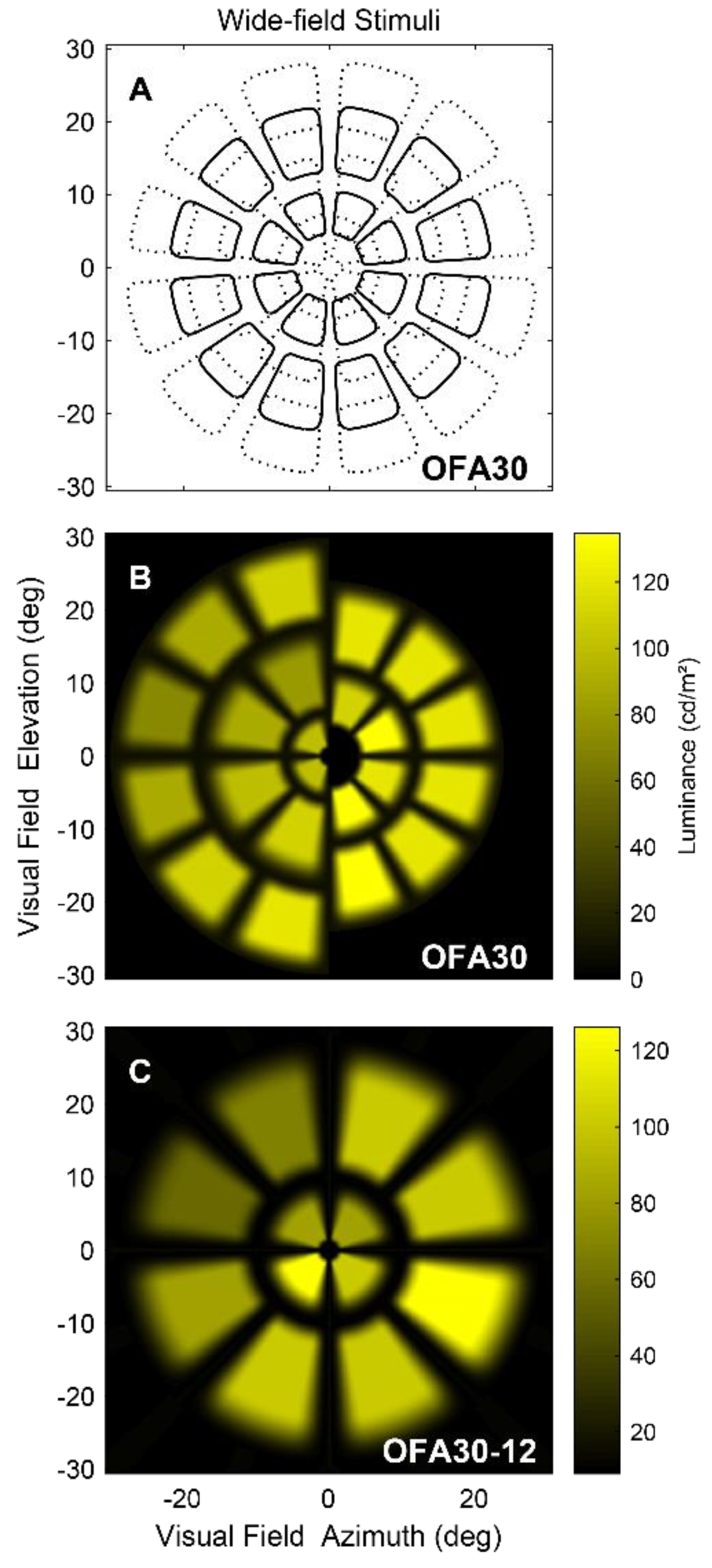

Table 1.
Standardised Effect-size levels for Hedge’s g.
| Effect-size | Hedge’s g |
| Small | 0.2 |
| Medium | 0.5 |
| Large | 0.8 |
| Very large | 1.2 |
| Huge | 2.0 |
Table 2.
Diagnostic power of OFA tests.
| Athlete Controls |
AUROC+ (N=6) |
AUROC+ (N=9) |
Hedge’s g (N=6) |
Hedge’s g N=9 |
| OFA30-12 - ACUTE | 73.5 ± 6.14 | 74.0 ± 6.17 | 0.82 | 0.79 |
| OFA30-12 - CHRONIC | 65.1 ± 6.98 | 63.2 ± 7.06 | 0.32 | 0.27 |
| OFA30- ACUTE | 48.9 ± 4.11 | 49.4 ± 4.17 | 0.15 | 0.14 |
| OFA30 - CHRONIC | 57.4 ± 7.11 | 57.5 ± 7.17 | 0.22 | 0.21 |
| Non- Athlete Controls | ||||
| OFA30-12 - ACUTE | 79.4 ± 4.11 | 77.9 ± 4.47 | 1.22 | 1.11 |
| OFA30-12 - CHRONIC | 82.6 ± 5.19 | 82.9 ± 4.99 | 1. 45 | 1.44 |
| OFA30- ACUTE | 76.0 ± 5.53 | 75.6 ± 5.59 | 0.93 | 0.94 |
| OFA30 - CHRONIC | 78.1 ± 5.28 | 78.4 ± 5.25 | 1.00 | 1.00 |
+Area Under Receiver Operating Curve plot; N refer to number of worst cases; Acute and Chronic refer to recent (within 45 days) and much earlier (longer than 2 months) concussions. Values in bold are ≥ 1.2, i.e. very large effect-size (Table 1).
Disclaimer/Publisher’s Note: The statements, opinions and data contained in all publications are solely those of the individual author(s) and contributor(s) and not of MDPI and/or the editor(s). MDPI and/or the editor(s) disclaim responsibility for any injury to people or property resulting from any ideas, methods, instructions or products referred to in the content. |
© 2026 by the authors. Licensee MDPI, Basel, Switzerland. This article is an open access article distributed under the terms and conditions of the Creative Commons Attribution (CC BY) license (http://creativecommons.org/licenses/by/4.0/).
Copyright: This open access article is published under a Creative Commons CC BY 4.0 license, which permit the free download, distribution, and reuse, provided that the author and preprint are cited in any reuse.


