

Submitted:
29 April 2026
Posted:
30 April 2026
You are already at the latest version
Abstract
The removal of thorium from contaminated water sources is crucial for environmental protection and nuclear waste management. Herein, we present a dual-strategy design of a thiophene-integrated porphyrin covalent organic framework (TAPP-BTD-COF) that combines rigid macrocyclic scaffolds with flexible thiophene linkages, incorporating complementary N and S donor sites. This tailored COF achieves efficient and selective capture of Th(IV) from acidic aqueous solutions. By leveraging the topological arrangement of the porphyrin core to modulate the conformation of thiophene-based connectors, a coordination environment with N–S synergistic sites is created, which significantly enhances Th(IV) selectivity over competing ions. At pH 4.5, the synthesized TAPP-BTD-COF exhibits a high adsorption capacity of 437.18 mg g-1 and reaches equilibrium within 20 minutes. It demonstrates exceptional selectivity for Th(IV), with a separation factor exceeding 2.6×10³ relative to common interfering ions, and retains over 90% adsorption capacity after three consecutive cycles. Mechanistic studies confirm that the high performance originates from N–Th / S–Th dual-dentate coordination. This work provides a strategic design of functional COFs for thorium recovery and represents a highly efficient adsorbent system for Th(IV) removal from aqueous streams.
Keywords:
covalent organic framework
; thorium adsorption
; N-S synergy
; selectivity
; radioactive wastewater treatment
1. Introduction
With the rapid development of the nuclear energy industry, the importance of fourth-generation Thorium-based Molten Salt Reactor has become increasingly prominent [1]. However, thorium-containing wastewater generated from thorium mining, utilization and spent fuel reprocessing poses risks of persistent radioactive contamination [2,3]. In the rare earth industry, thorium is usually associated with rare earths, leading to potential leakage and ecological risks during mining [2,3,4,5]. Additionally, thorium plays important roles in scientific research and medical fields, such as in nuclear chemistry and radiopharmaceuticals development [6,7]. Therefore, developing efficient materials for thorium separation is of great significance for the sustainable development of nuclear energy and for environmental protection.
Solid phase adsorption (SPA) is a widely used method for actinide separation. Compared with other techniques, it offers advantages such as easy phase separation, minimal tendency to form a third phase, simple operation with compact equipment, reduced use of organic solvents, and lower secondary waste generation, leading to its broad application in industrial settings [1,5,8,9,10,11,12,13,14]. Covalent Organic Frameworks (COFs) have recently gained attention in the adsorption field due to their structural regularity, low density, high specific surface area, and ease of modification, positioning them at the forefront of research on metal ion adsorption[15,16,17,18,19,20,21].
Current studies on Th(IV) adsorption using COFs have primarily focused on materials containing either N or S sites [2,8,11,22,23]. Notable examples include the Py-TFIm-25 series developed by Liu et al., which detailed the effect of N sites on Th(IV) adsorption [16,20]; the sp²-carbon-conjugated DFB-TMT COFs reported by Li et al., which showed high adsorption capacity and fast kinetics[24]; and the N,O-functionalized two-dimensional COF (TAPT-DHTA) prepared by Zhong et al., which utilized an N-O synergistic mechanism to achieve ultra-high adsorption capacity for Th(IV) [25,26]. Furthermore, Liu et al. demonstrated that the high surface area and porosity of three-dimensional COFs (e.g., DL-229) could further enhance Th(IV) adsorption performance [16].
The chemical properties of Th⁴⁺ are similar to those of U⁴⁺ and Ce⁴⁺, showing a tendency to form stable coordination bonds with ligands containing O, N, or S [27]. According to the Hard-Soft Acid-Base theory [28], sulfur—as a soft base—can form strong complexes with Th⁴⁺, a soft acid, by providing a lone pair of electrons for coordination, analogous to oxygen. While N-O synergy has been established as an effective adsorption mechanism [26], the potential of N-S synergy remains unexplored. In N-O systems, oxygen exhibits strong affinity for metal ions but often lacks selectivity, whereas nitrogen offers better selectivity for Th(IV) though with somewhat lower binding strength. The N-O combination effectively balances high affinity with selectivity. Similarly, substituting oxygen with sulfur may further enhance the adsorption capacity of COFs toward Th(IV) while maintaining high selectivity.
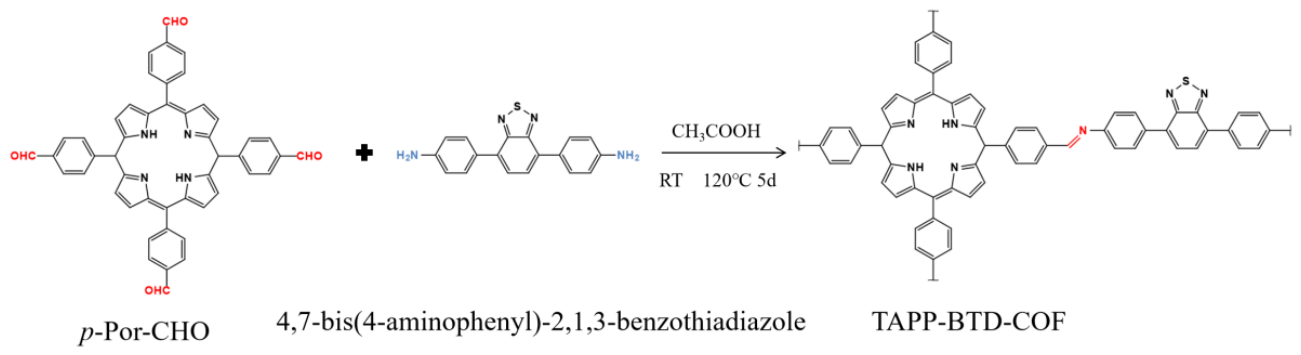
Therefore, in this study, a novel thiophene-incorporated porphyrin-based COF, termed TAPP-BTD-COF, was synthesized via a solvothermal method using p-Por-CHO and 4,7-bis(4-aminophenyl)-2,1,3-benzothiadiazole as building blocks. The introduction of S atoms provided additional active sites and enabled N-S synergistic adsorption of Th(IV). Furthermore, density functional theory (DFT) calculations were employed to evaluate the adsorption configuration, differential charge density, and electronic density of states between thorium ions and adsorption sites, thereby clarifying the mechanism of N-S synergistic adsorption. This work not only offers a new direction for designing materials with high selectivity and adsorption capacity but also provides a theoretical basis for developing novel adsorbents for radionuclide separation.
2. Materials and Methods
2.1. Materials
From MACKLIN:p-Por-CHO(≥99.5%), 4,7-bis(4-aminophenyl)-2,1,3-benzothiadiazole(≥99.8%), N-Dimethylformamide (DMF, ≥ 99.5%), and methanol (CH₃OH, AR), Tetrahydrofuran (THF, AR), Acetic acid (CH3COOH, AR), Butyl alcohol (n-BuOH, AR).
From Aladdin: nitrates of strontium (Sr(NO₃)₂), cesium (CsNO₃), and rare earth elements including lanthanum (La(NO₃)₃·6H₂O), europium (Eu(NO₃)₃·6H₂O), praseodymium (Pr(NO₃)₃·6H₂O), neodymium (Nd(NO₃)₃·6H₂O), gadolinium (Gd(NO₃)₃·6H₂O), and samarium (Sm(NO₃)₃·6H₂O) (all ≥ 99%).
Specialty source: Thorium nitrate tetrahydrate (Th(NO₃)₄·4H₂O, ≥ 99%) and Uranium nitrate tetrahydrate (UO₂(NO₃)₂·6H₂O, ≥ 99%) was obtained from the China Institute of Atomic Energy.
Ultrapure water (18.25 MΩ·cm) was produced using a Millipore Direct 8 system (USA).
2.2. Methods
2.2.1. Synthesis of TAPP-BTD-COF Composite
TAPP-BTD-COF was synthesized via a solvothermal method. Specifically, p-Por-CHO (21.8 mg, 0.03 mmol) and 4,7-bis(4-aminophenyl)-2,1,3-benzothiadiazole (19.104 mg, 0.06 mmol) were weighed and placed into a Pyrex tube. Then, 3.6 mL of n-butanol was added, and the tube was sonicated for 20 minutes to ensure homogeneous dispersion of the reactants. After sonication, the tube was quickly frozen in liquid nitrogen until the mixture solidified completely. Subsequently, 0.4 mL of 6 M acetic acid aqueous solution was added dropwise to the frozen mixture. The tube was then subjected to a freeze-pump-thaw cycle for degassing. The opening of the tube was sealed under vacuum using a flame torch. The sealed tube was placed in an oven at 120 °C and reacted for 5 days. After the reaction, the tube was opened, and the contents were collected by filtration. The resulting solid was washed sequentially with N,N-dimethylacetamide, tetrahydrofuran, and methanol, with each washing step lasting 24 hours. Finally, the product was dried under vacuum to obtain a dark purple solid powder in approximately 83% yield.
Figure 1.
Synthesis design of TAPP-BTD-COF.
2.2.2. Characterization
A variety of analytical and characterization techniques were employed to investigate the chemical structure and adsorption behavior of the COF material. Solid-state ¹³C NMR spectroscopy was used to identify carbon atoms in different chemical environments within the COF framework. Fourier-transform infrared (FT-IR) spectroscopy (range: 400–4000 cm⁻¹) was performed to analyze the chemical bonds in the materials, identify bond types, and compare spectral changes before and after adsorption. Thermogravimetric analysis (TGA) was conducted to assess the thermal stability of the COF under a nitrogen atmosphere from 25 °C to 800 °C at a heating rate of 10 °C min⁻¹. The surface morphology and particle size were examined using scanning electron microscopy (SEM). Energy-dispersive X-ray spectroscopy (EDS) mapping was also performed during SEM analysis to evaluate the elemental distribution before and after adsorption. Prior to SEM observation, vacuum-dried samples were mounted on stubs using conductive adhesive and sputter-coated with gold for 80 s.
X-ray diffraction (XRD) was employed to evaluate the crystallinity and phase purity of the COF. Measurements were carried out using Cu Kα radiation (40 kV, 40 mA, λ = 1.542 Å) over a 2θ range of 1.5–30.0° with a scan speed of 10° min⁻¹. Pore structure parameters, including pore-size distribution and specific surface area, are essential for porous COFs. The pore-size distribution was derived from non-local density functional theory (NLDFT) modeling, and the specific surface area was calculated using the Brunauer–Emmett–Teller (BET) method based on N₂ adsorption-desorption isotherms measured at 77 K. Before analysis, the COF sample was degassed under vacuum at 120 °C for 12 h. X-ray photoelectron spectroscopy (XPS) was conducted using an Al Kα X-ray source (1486.6 eV) to determine the surface elemental composition and chemical states of the COF material.
2.2.3. Thorium Adsorption and Desorption Experiments
2.2.3.1. Batch Experiments
The adsorption experiments involved the use of a 15 mL centrifuge tube containing a Th(IV) solution, which was then subjected to pH adjustment using a mixture of 0.1 M NaOH and 0.1 M HNO3. Following this adjustment, the COF adsorbent samples were added in the desired proportions to the Th(IV) solution. Adsorption was then carried out using a constant-temperature water bath at 298 K and 150 rpm. After the adsorption process had run for a certain time, solid-liquid separation was carried out using a 0.45 µm filter membrane. The Th(IV) concentration in the solution was tested before and after adsorption using X-ray fluorescence. The adsorption capacity and removal rate were calculated using Equations (1) and (2).
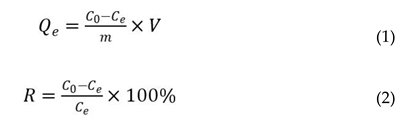
Where Qe and R are the adsorption capacity and removal rate, respectively, C0 and Ce are the concentrations of Th(IV) in an aqueous solution before and after adsorption, V(L) is the volume of the solution, and m (g) is the mass of the adsorbents.
2.2.3.2. Adsorption Kinetics and Isotherms
The investigation into the adsorption kinetics of these materials was conducted utilising two kinetic models in the present thesis, with the objective of achieving a more precise fit to the adsorption process. As demonstrated in Equations (3) and (4), the pseudo-first-order and pseudo-second-order models are presented.
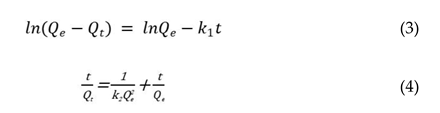
where Qt (mg g-1) is the amount of adsorbates adsorbed at a specific time t (min), while k1 (min-1) and k2 (g mg-1 min-1) represent the pseudo-first-order and pseudo-second-order adsorption rate constants, respectively.
Solutions of Th(IV) with different concentrations were prepared for the purpose of investigating adsorption isotherms. The Langmuri and Freundlich models were selected for the purpose of fitting the adsorption process, with the following equations being employed:
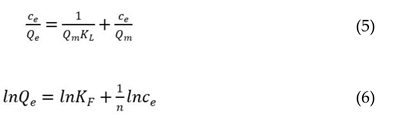
where Qm (mg g-1) means the maximum adsorption; KL (L mg-1) is the Langmuir constant, which corresponds to the affinity of binding sites; KF (mg/g) and n are both Freundlich constants, representing the adsorption capacity and adsorption favorability, respectively.
2.2.3.4. Multicomponent Adsorption Experiment
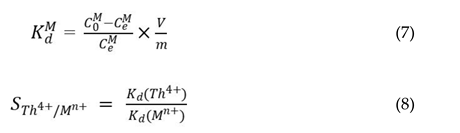
Mixed solutions were configured to study the selective adsorption capacity of the materials. The solutions comprised ten metal ions, including actinides, Th(IV) and U(VI), and lanthanides La(III), Pr(III), Nd(III), Sm(III), Eu(III), Gd(III), as well as Cs(I) and Sr(II). The adsorption affinities for different metal ions were expressed in terms of partition coefficients (mL g⁻¹), which were calculated according to the method outlined in Eq. (7). The selectivity coefficients were calculated from Eq. (8).
2.2.3.5. Desorption Experiment
Following the attainment of adsorption equilibrium, the individual adsorbents were introduced to a 0.1 M L-1 HNO3 solution. The solid-liquid ratio was maintained at 1:5, and the mixture was subjected to agitation for a duration of six hours prior to the process of separation.

2.2.4. The Density Functional Theory (DFT) Calculations
The DFT calculations were conducted utilising mixed Gaussian and plane-wave basis sets, employing the CP2K program as the executing software 29. The description of these electrons is based on model-conserving Goedecker-Teter-Hutter pseudopotentials 30. Furthermore, the wave functions of the valence electrons are expanded by utilising a double zeta basis set with polarisation functions, in conjunction with an auxiliary plane-wave basis set with a cutoff energy of 400 ev 31. The generalized gradient approximation exchange-correlation energies are described by Perdew, Burke, and Enzerhof (PBE) generalized functions, and all configurations are optimised by the Broyden-Fletcher-Goldfarb-Shanno (BFGS) algorithm with a SCF convergence criterion of 1.0 × 10⁻⁶ a.u. The SCF convergence criteria are determined by the BFGS algorithm 32. In order to compensate for the long-range van der Waals dispersion interactions between the adsorbent and the adsorbate, damped dispersion corrections were performed using DFT-D3, a method developed by Grimme et al 33.
3. Results and Discussions
3.1. Materials Characterization
The IR pattern (Figure 2a)shows that the characteristic telescopic vibrational peaks of C=O, -NH2 are significantly weakened, and a characteristic peak of telescopic vibration of C=N is found at 1625.7 cm-1 , which proves that the reaction occurs correctly.The XRD pattern (Figure 2b)shows that the synthesized material is highly crystalline, and the 2D crystalline model of TAPP-BDP-COF is constructed, which is modified by Pawley refinement (Rwp = 2.48% and Rp = 2.21%), the corresponding peaks at 2θ = 5.8°, 6.75°, 9.7°, 11.55°, and 17.35° are (120), (210), (121), (022), and (740) crystal faces, respectively. The nitrogen adsorption-desorption curves(Figure 2e) of the TAPP-BDP-COF belong to the typical IV-type adsorption curves due to the introduction of porphyrin to increase the the degree of conjugation between the layers, which improves the attraction between the layers and makes the two-dimensional stacking closer. The specific surface area calculated by the BET method was 133.13 m2 g-1, and the pore size estimated by the NLDFT theory was 0.83 nm
3.2. Thorium Adsorption Studies
The adsorption of Th(IV) is highly pH-dependent, primarily due to the pH-sensitive speciation of thorium in aqueous solution. To evaluate the effect of pH on the adsorption performance of TAPP-BTD-COF toward Th(IV), experiments were conducted across a pH range of 1.0 to 4.5. As shown in Figure 3a, the adsorption capacity remained low at pH < 4, but increased sharply above pH 4. To understand this trend, the thorium speciation as a function of pH was analyzed (Figure 3b). The diagram indicates that above pH 4, Th4(OH)124+ becomes the dominant soluble species, suggesting that adsorption is mainly driven by interaction with this hydrolyzed polynuclear ion rather than through precipitation of Th(OH)₄. Therefore, pH 4.5 was selected as the optimum condition for subsequent experiments. Notably, at lower pH values, the adsorption capacity of most ligand-based adsorbents decreases significantly due to protonation of active sites.
Adsorption kinetics play a crucial role in assessing Th(IV) removal performance. To investigate the dynamic adsorption process, changes in Th(IV) concentration were monitored over time using TAPP-BTD-COF. As shown in Figure 3c, the adsorption curve indicates that TAPP-BTD-COF reaches to 90% of the maximum adsorption within approximately 10 min and attains equilibrium in about 20 min. This rapid adsorption kinetics can be attributed to the well-ordered crystalline structure and regular one-dimensional pore channels of the COF, which provide efficient diffusion pathways for Th(IV) ions.
The adsorption kinetics were evaluated using the pseudo-first-order and pseudo-second-order models. As shown in Figure 3c, the equilibrium adsorption capacity of the COF for Th(IV) was determined to be 235.82 mg·g-1. The correlation coefficient (R2) for the pseudo-first-order model was 0.982, while the pseudo-second-order model yielded a higher R2 of 0.991. The superior fit of the pseudo-second-order model indicates that the adsorption process is predominantly controlled by chemical adsorption. This suggests that the adsorption of Th(IV) onto TAPP-BTD-COF involves strong interactions such as coordination or complexation with the active N and S donor sites on the framework, rather than being limited by physical diffusion or electrostatic effects. These results further support the proposed dual-dentate coordination mechanism between Th(IV) and the synergistic N–S binding sites within the COF structure.
The adsorption isotherm of Th(IV) on TAPP-BTD-COF was investigated as a function of initial Th(IV) concentration (Figure 3d). The adsorption capacity increased with rising concentration until reaching a plateau, indicating saturation of the available binding sites. The experimental data were fitted with the Langmuir and Freundlich isotherm models. The Langmuir model yielded a higher correlation coefficient (R2=0.991) than the Freundlich model (R2=0.974), indicating that the adsorption process follows a Langmuir-type monolayer mechanism. The calculated maximum adsorption capacity based on the Langmuir model was 437.18 mg·g-1.
In this study, to simulate the practical multi-metal coexistence in radioactive wastewater, the selectivity of TAPP-BTD-COF toward Th(IV) was systematically evaluated in the presence of nine competing ions: U(VI), Cs(I), Sr(II), La(III), Pr(III), Nd(III), Sm(III), Eu(III), and Gd(III). As shown in Figure 4a, the material exhibited excellent separation performance under polymetallic mixed conditions at pH 4.5, with a separation factor of 2.6 × 10³ mL g⁻¹, demonstrating promising potential for industrial application. Reusability was further assessed through cyclic adsorption–desorption experiments using 0.01 mol L-1 HNO3 as the eluent. The results (Figure 4b) indicate that after three consecutive cycles, TAPP-BDP-COF retained high adsorption capacity for Th(IV),confirming its structural stability and practical reusability.
3.3. Adsorption Mechanism
To elucidate the chemical adsorption mechanism of the COF, a series of characterization analyses were performed. SEM-EDS mapping of the post-adsorption sample (Figure 5, Figure 6, Figure 7, Figure 8 and Figure 9) revealed a uniform distribution of Th on the material, confirming the successful uptake of Th(IV) into the COF framework. Comparison of the XRD patterns before and after adsorption (Figures 5–10b) showed that the crystalline structure remained largely intact, though a decrease in peak intensity was observed, which can be attributed to the presence of hydrated Th ions within the pores. Analysis of the FTIR spectra (Figures 5–10a) further indicated the formation of N–Th coordination, as evidenced by a characteristic peak at 1380.4 cm⁻¹[34]. Additionally, a new stretching vibration peak appeared at 662.4 cm⁻¹[35], corresponding to a metal–S bond, which confirms the coordination between Th and sulfur sites in the framework.
To elucidate the adsorption mechanism of Th(IV) on TAPP-BTD-COF, X-ray photoelectron spectroscopy (XPS) was employed to investigate the coordination environment. Analysis of the N1s and S2p spectra before and after Th(IV) adsorption (Figure 6c and Figure 6d) revealed distinct shifts in the binding energy peaks, indicating chemical coordination at the active sites. In the N1s spectrum, the peaks corresponding to C–N and C=N groups shifted by 0.05 eV and 0.09 eV, respectively, after Th(IV) uptake. In the S2p spectrum, the C–S-derived 2p3/2 and 2p1/2 peaks shifted by 0.11 eV and 0.24 eV, respectively. Notably, the magnitude of the shift was more pronounced for sulfur-containing groups than for nitrogen-containing groups, suggesting that sulfur sites play a dominant role in coordinating Th(IV), while nitrogen atoms from imine and porphyrin moieties participate as auxiliary coordination sites. The observed shifts reflect a decrease in electron density around the coordinating atoms due to electron donation toward Th(IV). These results underscore the cooperative binding of S and N functional groups during Th(IV) uptake and provide molecular-level insight into the adsorption mechanism of TAPP-BTD-COF.
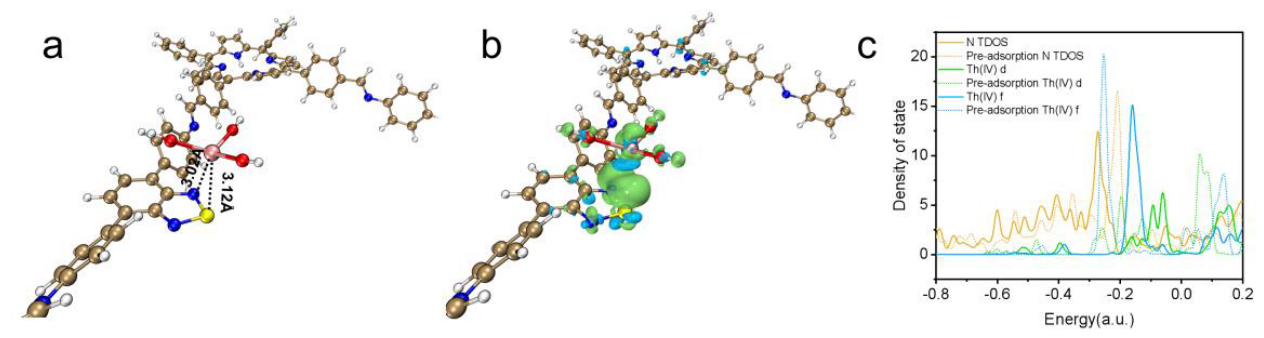
To further elucidate the role of sulfur in the adsorption mechanism, density functional theory (DFT) calculations were performed to model and optimize the coordination structure. As shown in Figure 7a, a structural model featuring Th(OH)₃⁺ coordinated to the N-S heterocycle within the COF framework was established and geometrically relaxed. The optimized configuration shows the Th center positioned above the N–S bond, confirming that adsorption proceeds through cooperative N,S-donor coordination. The calculated adsorption energy is Eads= 1.84 eV. The corresponding Th–N and Th–S bond lengths are 3.02 Å and 3.12 Å, respectively. According to Lewis acid–base theory, sulfur acts as a weaker Lewis base than nitrogen, which accounts for the marginally longer Th–S bond. The small difference in bond lengths nevertheless reflects effective synergistic interaction between the two donor atoms.
The differential charge density plot (Figure 7b) further reveals pronounced electron redistribution directly along both the Th–N and Th–S bonds, indicating substantial charge transfer associated with coordination. In addition, the density of states (DOS) diagrams before and after adsorption demonstrate clear shifts in the electronic energy levels of Th, N, and S, along with partial overlap of their respective orbitals. Collectively, these computational results verify that nitrogen and sulfur sites in the COF function synergistically as dual-dentate coordination centers for the adsorption of Th(IV).
4. Conclusion
In summary, this study presents a novel sulfur-integrated porphyrin-based covalent organic framework, TAPP-BTD-COF, designed with explicit N–S synergistic coordination sites for the targeted capture of Th(IV). The integration of electron-donating sulfur from the thiophene bridge and hard nitrogen donors from the porphyrin core creates a dual-dentate coordination environment, which is key to its high performance. TAPP-BDP-COF exhibits a high adsorption capacity (437.18 mg·g⁻¹ at pH 4.5), rapid kinetics reaching equilibrium within 20 minutes, and exceptional selectivity for Th(IV) over competing ions, evidenced by a separation factor exceeding 2.6×10³. The material also demonstrates practical reusability, retaining over 90% of its capacity after three cycles. Mechanistic studies, supported by XPS analysis and DFT calculations, confirm that the high affinity and selectivity originate from the cooperative coordination of Th(IV) to both N and S atoms, with optimized bond lengths indicating an effective synergistic interaction.These attributes—targeted design, high efficiency, selectivity, and stability—position TAPP-BTD-COF as a promising adsorbent for the practical and sustainable recovery of thorium from complex aqueous waste streams. This work not only advances a specific material but also provides a strategic design principle, highlighting the potential of tailoring heteroatom synergy in COFs for the efficient separation of critical metal ions.
Data Availability Statement
The original contributions presented in this study are included in the article. Further inquiries can be directed to the corresponding authors.
Acknowledgments
This work was supported by NSFC(U2441290).
Conflicts of Interest
The authors declare no conflict of interest.
Declaration of Competing Interest: The authors declare that they have no known competing financial interests or personal relationships that could have appeared to influence the work reported in this paper.
References
- D. Humelnicu, C. Blegescu, D. Ganju, Removal of uranium(VI) and thorium(IV) ions from aqueous solutions by functionalized silica: kinetic and thermodynamic studies. J. Radioanal. Nucl. Chem. 299 (2014) 1183-1190. [CrossRef]
- P.D. Bhalara, D. Punetha, K. Balasubramanian, Kinetic and isotherm analysis for selective thorium(IV) retrieval from aqueous environment using eco-friendly cellulose composite. Int. J. Environ. Sci. Technol. 12 (2015) 3095-3106. [CrossRef]
- Q. Sun, B. Chen, Q. Li, X. Wei, Distribution and mineralogical features of thorite in the Bayan Obo deposit: Implications for hydrothermal metasomatic Th re-enrichment. Ore Geol. Rev. 164 (2024) 105831. [CrossRef]
- L.K. Phon, B.D. Dung, N.D. Chau, N.T.H. Van, Estimation of effective dose rates caused by radon and thoron for inhabitants living in rare earth field in northwestern Vietnam (Lai Chau province). J. Radioanal. Nucl. Chem. 306 (2015) 309-316. [CrossRef]
- E.S. Aziman, A.F. Ismail, Removal of Thorium from industrial waste via electrosorption technique. IOP Conf. Ser. Mater. Sci. Eng. 785 (2020) 012048. [CrossRef]
- H. Heyerdahl, N. Abbas, E.M. Brevik, Ø.S. Bruland, Fractionated therapy of HER2-expressing breast and ovarian cancer xenografts in mice with targeted alpha emitting 227Th-DOTA-p-benzyl-trastuzumab. PLoS One 7 (2012) e42345. [CrossRef]
- C. Kratochwil, F. Bruchertseifer, F.L. Giesel, M. Weis, F.A. Verburg, F. Mottaghy, 225Ac-PSMA-617 for PSMA-Targeted α-Radiation Therapy of Metastatic Castration-Resistant Prostate Cancer. J. Nucl. Med. 57 (2016) 1941-1944. [CrossRef]
- H. Zhang, X. Wang, Y. Jiang, D. Chen, H. Wang, Z. Xu, Natural illite as an efficient adsorbent for thorium removal. Int. J. Res. 3 (2017) 19-34.
- L.A. Yousef, A.R. Bakry, A.A. Ahmad, Thorium ions recovery using activated carbon modified with triphenyl phosphine oxide: Kinetic and equilibrium studies. SN Appl. Sci. 1 (2019) 974. [CrossRef]
- Luhar, S. Luhar, M.M.A.B. Abdullah, Solidification/Stabilization Technology for Radioactive Wastes Using Cement: An Appraisal. Materials 16 (2023) 954. [CrossRef]
- Y. Wang, Z. Zhang, Q. Li, J. Guo, Adsorption of thorium from aqueous solution by HDTMA+-pillared bentonite. J. Radioanal. Nucl. Chem. 293 (2012) 519-528. [CrossRef]
- P. Wu, Y. Wang, X. Hu, H. Liu, Synthesis of magnetic graphene oxide nanoribbons composite for the removal of Th(IV) from aqueous solutions. J. Radioanal. Nucl. Chem. 319 (2019) 1111-1118. [CrossRef]
- N. Gumber, R.V. Pai, J. Bahadur, T. Suresh, S. Neogy, S. Mukerjee, γ-Resistant Microporous CAU-1 MOF for Selective Remediation of Thorium. ACS Omega 8 (2023) 12268-12282. [CrossRef]
- N. Zhang, L. Yuan, W. Guo, Z. Luo, S. Zeng, H. He, Extending the Use of Highly Porous and Functionalized MOFs to Th(IV) Capture. ACS Appl. Mater. Interfaces 9 (2017) 25216-25224. [CrossRef]
- X. Liu, H. Pang, X. Liu, Q. Li, N. Zhang, L. Mao, M.S.A. Hossain, J. Na, J. Tang, Y. Yamauchi, Orderly Porous Covalent Organic Frameworks-based Materials: Superior Adsorbents for Pollutants Removal from Aqueous Solutions. The Innovation 2 (2021) 100076. [CrossRef]
- X. Liu, S. Xiao, T. Jin, Y. Liu, G. Wang, Selective entrapment of thorium using a three-dimensional covalent organic framework and its interaction mechanism study. Sep. Purif. Technol. 296 (2022) 121413. [CrossRef]
- P. Hu, R. Yang, X. Ma, Y. Yi, L. Gao, S. Liu, Imidazole-rich covalent organic frameworks for efficient and selective thorium ion capture. Sep. Purif. Technol. 368 (2025) 132986. [CrossRef]
- H. Alyousef, B.M. Alotaibi, M. Ben Yahia, V. Tirth, A. Mohamed, M. Ubaidullah, M.S. El-Shahate, A.A. Alasmari, New insights on microscopic properties of metal-porphyrin complexes attached to quartz crystal sensor. Sci. Rep. 11 (2021) 8316. [CrossRef]
- Y. Chen, P. Gong, Y. Ren, L. Liu, X. Meng, J. Wang, Z. Zhang, Interlayer Quasi-Bonding Interactions in 2D Layered Materials: A Classification According to the Occupancy of Involved Energy Bands. J. Phys. Chem. Lett. 12 (2021) 11998-12004. [CrossRef]
- T.F. Machado, M.E. Serra, D. Murtinho, A.J.M. Valente, Covalent Organic Frameworks: Synthesis, Properties and Applications—An Overview. Polymers 13 (2021) 970. [CrossRef]
- T. Luan, L. Du, J. Wang, N. Song, J. Yang, X. Wang, Y. Yang, Highly Effective Generation of Singlet Oxygen by an Imidazole-Linked Robust Photosensitizing Covalent Organic Framework. ACS Nano 16 (2022) 21565-21575. [CrossRef]
- A.E.V. Gorden, M.A.I. DeVore, B.A. Maynard, Coordination Chemistry with f-Element Complexes for an Improved Understanding of Factors That Contribute to Extraction Selectivity. Inorg. Chem. 52 (2013) 3445-3458. [CrossRef]
- Y. Khazaei, H. Faghihian, M. Kamali, Removal of thorium from aqueous solutions by sodium clinoptilolite. J. Radioanal. Nucl. Chem. 289 (2011) 529-536. [CrossRef]
- X. Li, Z. Zhang, Y. Zhao, H. Yu, W. Li, J. Wang, Y. Deng, Efficient and rapid adsorption of thorium by sp2c-COF with one-dimensional regular micropores channels. J. Environ. Chem. Eng. 12 (2024) 114066. [CrossRef]
- W. Zhong, M. Wang, H. Hu, Z. Zhao, T. Sun, X. Liu, D. Liu, L. Ma, Ultrahigh-Efficient N,O-Functionalized covalent organic framework towards thorium adsorption from uranium and rare earth elements. Sep. Purif. Technol. 347 (2024) 127603. [CrossRef]
- H. Shi, Z. Zhang, Y. Ouyang, W. Li, X. Li, Y. Deng, J. Wang, Lewis base anchored DhaTph covalent-organic framework for effective capture of thorium(IV) ion. Sep. Purif. Technol. 328 (2024) 125021. [CrossRef]
- S.D. Barritt, The controls of radioelement distribution in the Etive and Cairngorm granites: Implications for heat production, Ph.D. Thesis, The Open University, Milton Keynes, UK, 1984.
- S.V. Avery, J.M. Tobin, Mechanism of adsorption of hard and soft metal ions to Saccharomyces cerevisiae and influence of hard and soft anions. Appl. Environ. Microbiol. 59 (1993) 2851-2856. [CrossRef]
- J. Hutter, M. Iannuzzi, F. Schiffmann, J. VandeVondele, cp2k: atomistic simulations of condensed matter systems. WIREs Comput. Mol. Sci. 4 (2014) 15-25. [CrossRef]
- M. Teter, J. Hutter, S. Goedecker, Separable dual-space Gaussian pseudopotentials. Phys. Rev. B 54 (1996) 1703-1710. [CrossRef]
- M. Guidon, J. Hutter, J. VandeVondele, Auxiliary Density Matrix Methods for Hartree−Fock Exchange Calculations. J. Chem. Theory Comput. 6 (2010) 2348-2364. [CrossRef]
- K. Burke, M. Ernzerhof, J.P. Perdew, Generalized Gradient Approximation Made Simple. Phys. Rev. Lett. 77 (1996) 3865-3868. [CrossRef]
- S. Grimme, J. Antony, S. Ehrlich, H. Krieg, A consistent and accurate ab initio parametrization of density functional dispersion correction (DFT-D) for the 94 elements H-Pu. J. Chem. Phys. 132 (2010) 154104. [CrossRef]
- T. Radoske, J. März, M. Patzschke, M. Walter, P.W. Roesky, Bonding Trends in Tetravalent Th–Pu Monosalen Complexes. Chem. Eur. J. 26 (2020) 16853-16859. [CrossRef]
- J.A. Bogart, C.N. Bates, P.M. van der Sluys, A.J. Lewis, E.J. Schelter, A Thorium Chalcogenolate Series Generated by Atom Insertion into Thorium–Carbon Bonds. J. Am. Chem. Soc. 139 (2017) 10465-10468. [CrossRef]
Figure 2.
(a) FT-IR spectra; (b) PXRD patterns; (c)pH text; (d)TGA text; (e)N2 adsorption-desorption curves; (f) Pore size distribution diagram.
Figure 2.
(a) FT-IR spectra; (b) PXRD patterns; (c)pH text; (d)TGA text; (e)N2 adsorption-desorption curves; (f) Pore size distribution diagram.
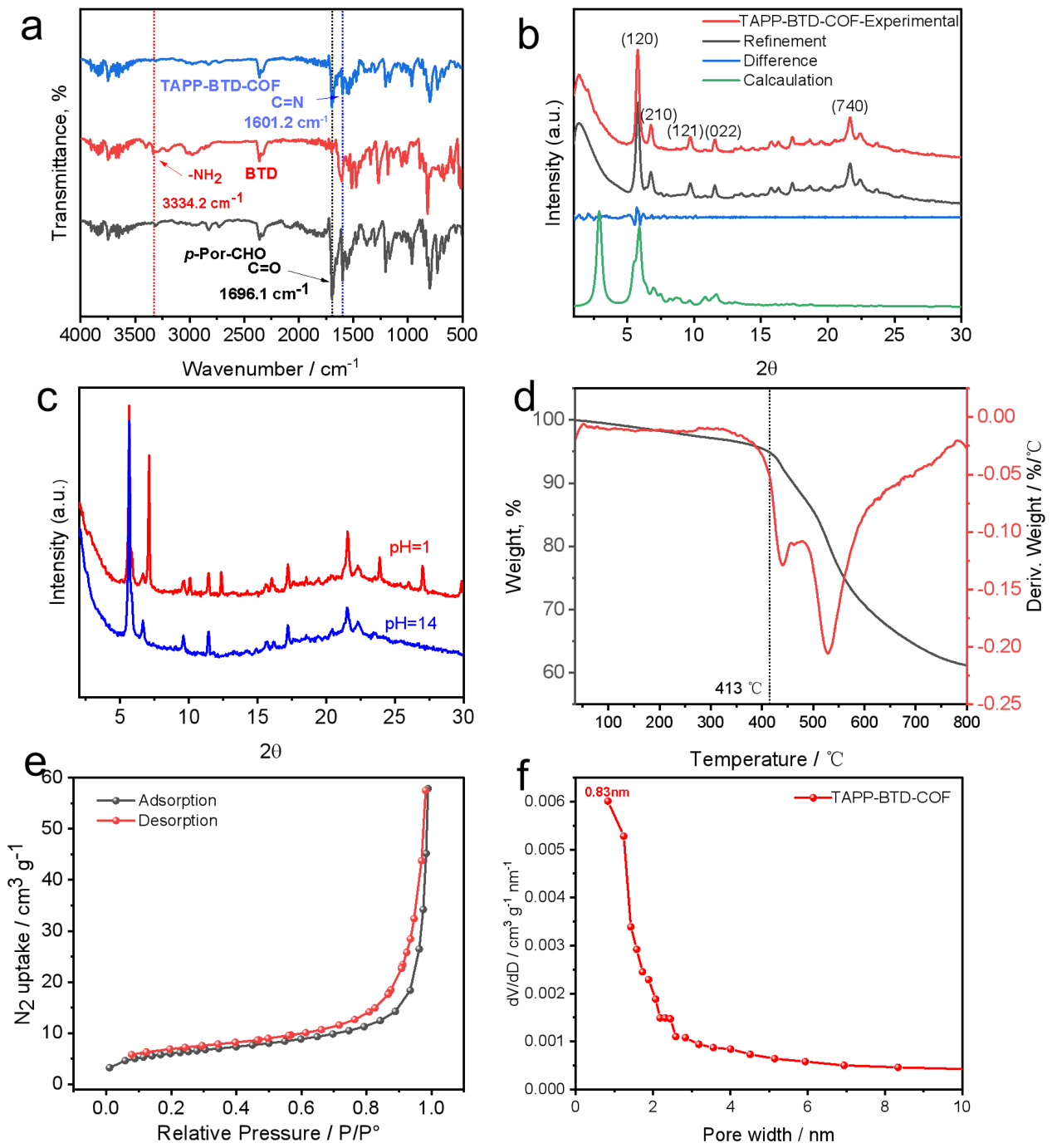
Figure 3.
(a) The effect of pH on the adsorption of Th(IV); (b) Speciation distribution diagrams of Th(IV) at different pH values; (c) Adsorption of Th(IV) by TAPP-BTD-COF over time; (d) Langmuir and Freundlich model fittings.
Figure 3.
(a) The effect of pH on the adsorption of Th(IV); (b) Speciation distribution diagrams of Th(IV) at different pH values; (c) Adsorption of Th(IV) by TAPP-BTD-COF over time; (d) Langmuir and Freundlich model fittings.
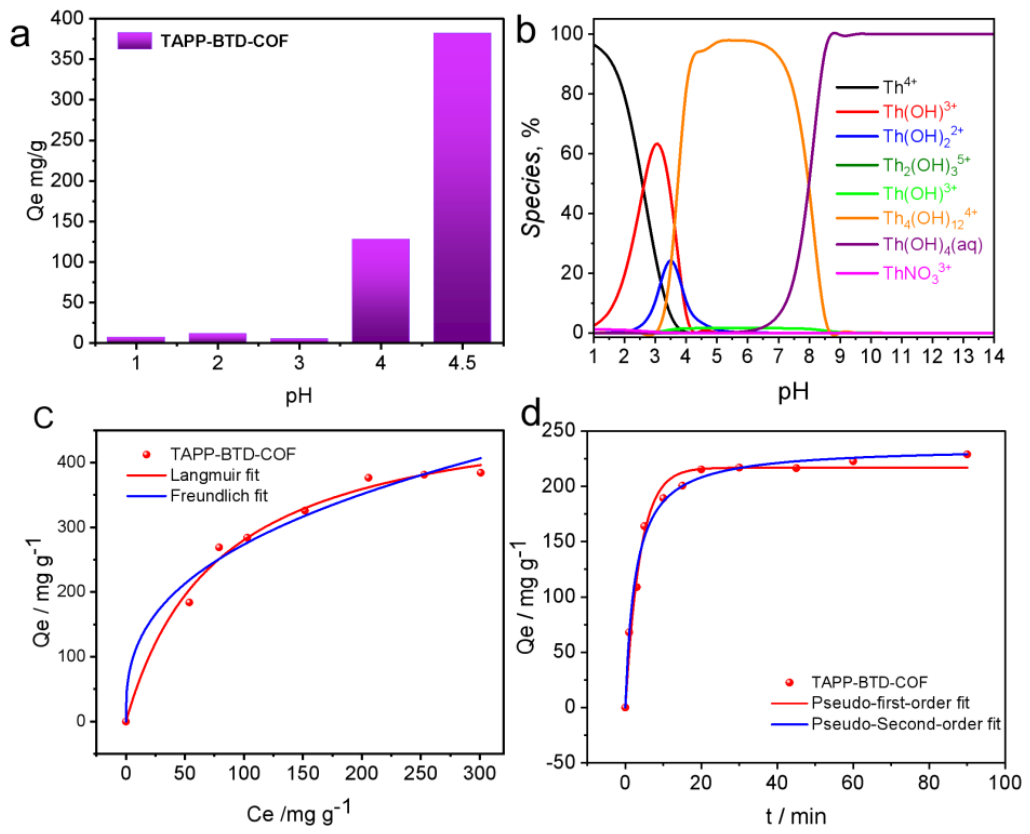
Figure 4.
(a) Effect of coexisting ions on the adsorption of Th(IV); (b) Regeneration and reusability of adsorption capacit.
Figure 4.
(a) Effect of coexisting ions on the adsorption of Th(IV); (b) Regeneration and reusability of adsorption capacit.
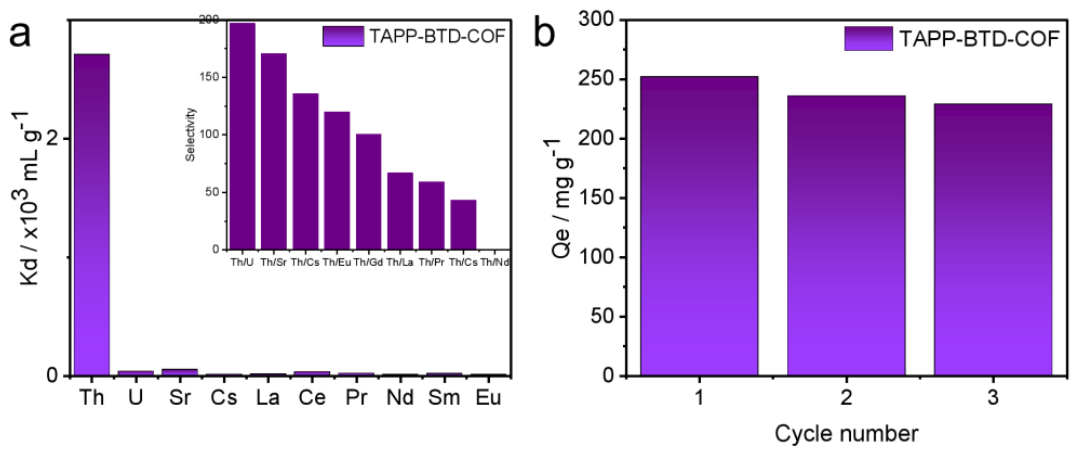
Figure 5.
Element Distribution Maps of C, N, S, and Th in TAPP-BTD-COF.
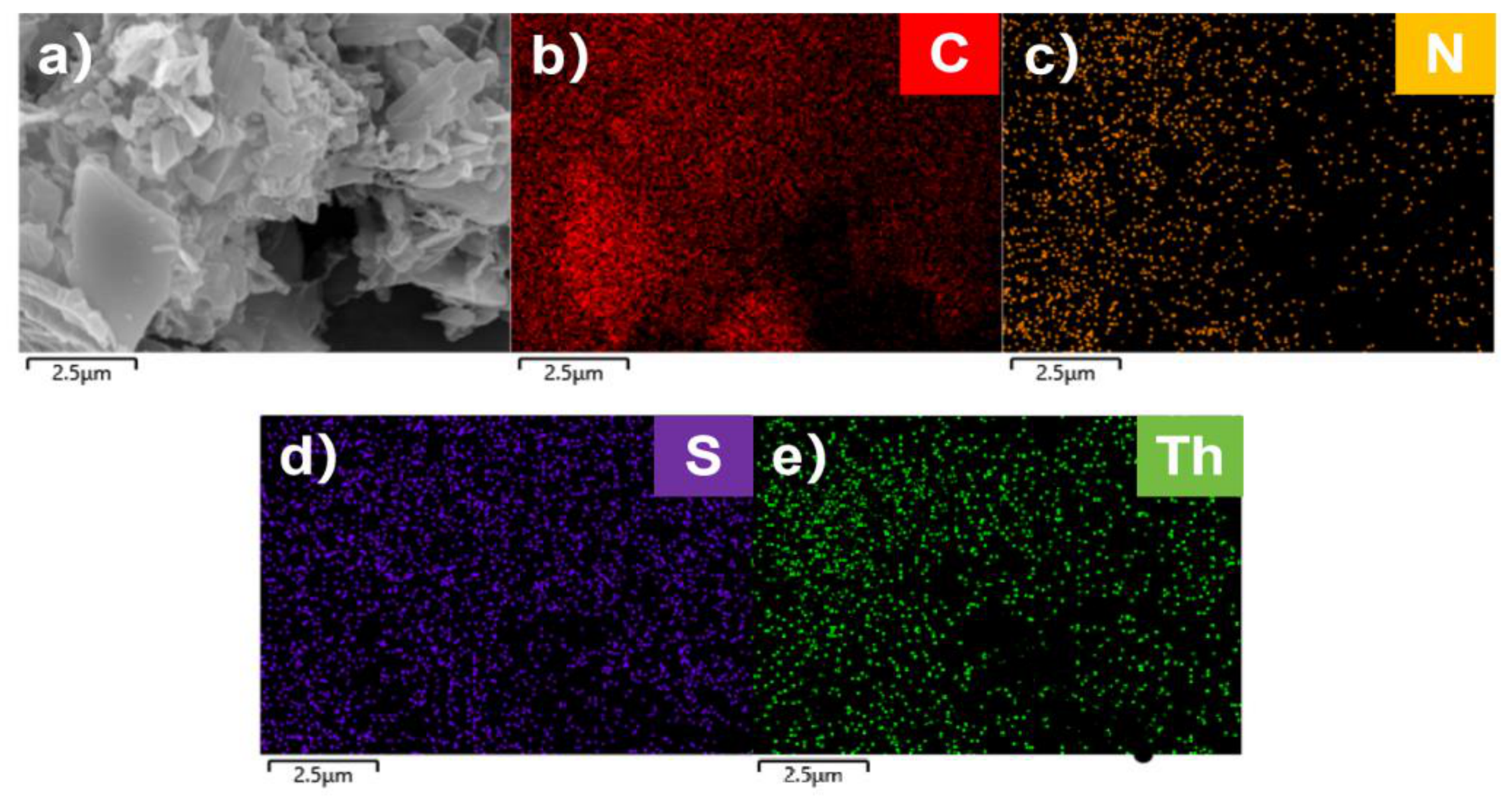
Figure 6.
(a) Infrared spectra ofTAPP-BTD-COF before and after adsorption; (b) XRD patterns of TAPP-BTD-COF before and after adsorption; (c) N1s XPS spectra of TAPP-BTD-COF before and after adsorption;(d) S2p XPS spectra of TAPP-BTD-COF before and after adsorption.
Figure 6.
(a) Infrared spectra ofTAPP-BTD-COF before and after adsorption; (b) XRD patterns of TAPP-BTD-COF before and after adsorption; (c) N1s XPS spectra of TAPP-BTD-COF before and after adsorption;(d) S2p XPS spectra of TAPP-BTD-COF before and after adsorption.
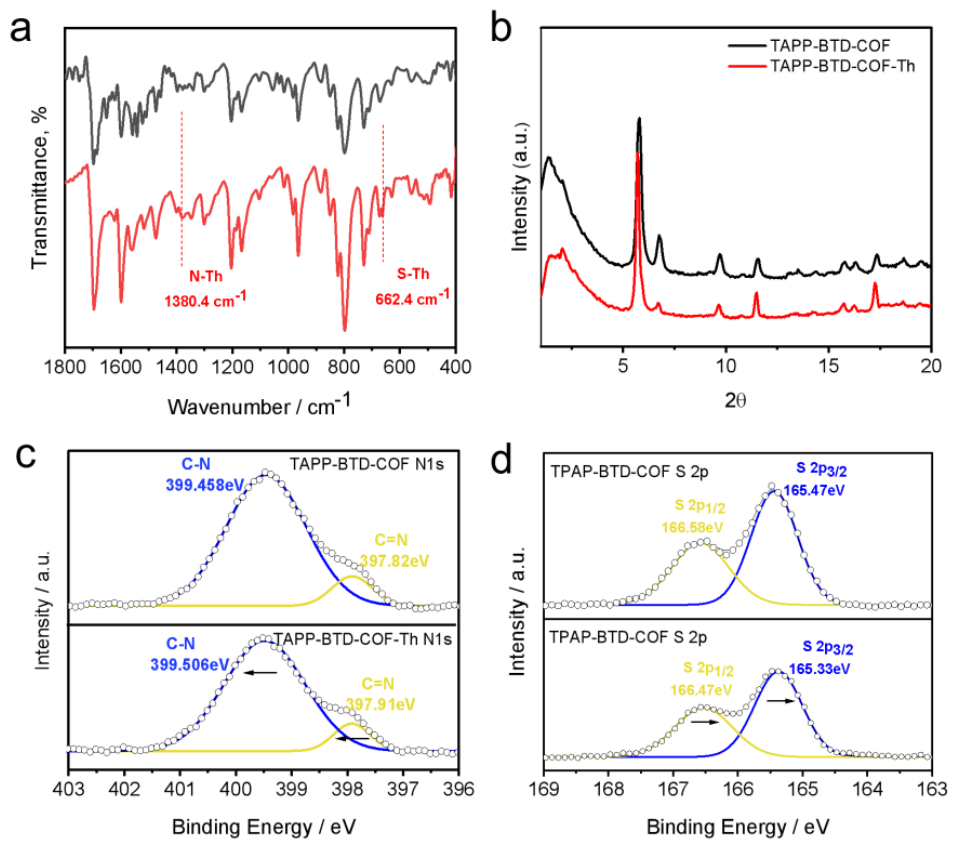
Figure 7.
(a) Adsorption configurations of Th(IV) on TAPP-BTD-COF; (b) Differential charge density map; (c) Density of states diagram for Th(IV) adsorbed on TAPP-BTD-COF.
Figure 7.
(a) Adsorption configurations of Th(IV) on TAPP-BTD-COF; (b) Differential charge density map; (c) Density of states diagram for Th(IV) adsorbed on TAPP-BTD-COF.
Disclaimer/Publisher’s Note: The statements, opinions and data contained in all publications are solely those of the individual author(s) and contributor(s) and not of MDPI and/or the editor(s). MDPI and/or the editor(s) disclaim responsibility for any injury to people or property resulting from any ideas, methods, instructions or products referred to in the content. |
© 2026 by the authors. Licensee MDPI, Basel, Switzerland. This article is an open access article distributed under the terms and conditions of the Creative Commons Attribution (CC BY) license (http://creativecommons.org/licenses/by/4.0/).
Copyright: This open access article is published under a Creative Commons CC BY 4.0 license, which permit the free download, distribution, and reuse, provided that the author and preprint are cited in any reuse.