

Submitted:
28 April 2026
Posted:
29 April 2026
You are already at the latest version
Abstract
Background: Allergic conjunctivitis (AC) is a frequent inflammatory ocular surface disease that significantly affects quality of life, particularly in children. Current treatments mainly provide temporary symptom relief and often require prolonged use. Bacterial suspensions have emerged as potential immunomodulatory treatments for other allergies, but have not been completely explored in ocular allergy. Objective: To describe the clinical ophthalmological and quality of life changes in patients with AC treated with a bacterial suspension (BS) as complementary therapy. Methods: A before-and-after clinical study was conducted in 5 children aged 6 to 12 years with a diagnosis of moderate-to-severe persistent allergic conjunctivitis and negative skin prick test results. Clinical ocular signs and symptoms, quality of life, and changes in CD19+IL-10+ cells were assessed. Results: After 90 days of BS treatment, a significant reduction in allergic symptoms, including itching, light sensitivity, and burning, was observed, along with a marked reduction of ocular inflammation. Evaluation of quality of life revealed improvement across all evaluated domains and an increase in CD19+IL-10+ cells. Conclusions: BS therapy demonstrated favorable clinical and immune-modulatory effects in children with AC, supporting its potential as a promising complementary therapeutic option.
Keywords:
allergic conjunctivitis
; bacterial suspension
; immunomodulation
; IL-10
; regulatory B cells
; tear film
; pediatric allergy
; ocular surface inflammation
1. Introduction
Allergic conjunctivitis (AC) is an inflammatory disease of the ocular surface that develops in previously sensitized individuals following exposure to one or more allergens [1]. Epidemiological studies have reported that the prevalence of ocular allergy symptoms ranges from 6% to 30% of the population, representing a considerable public health burden. Furthermore, in recent decades, this condition has been shown to cause ophthalmological impairment and to deteriorate patients’ quality of life by interfering with school, work, and social activities [2,3,4].
To improve clinical management, various research groups have characterized acute AC and developed international treatment reports and guidelines that recognize the importance of diagnosis based on clinical signs and symptoms [5,6]. Although symptomatic therapy is well established, a key limitation has been identified: antihistamines, mast cell stabilizers, and nonsteroidal anti-inflammatory drugs provide only transient relief, and symptoms recur once treatment is discontinued [4,5,6]. This characteristic of symptomatic treatment often leads to prolonged and chronic use of medications, increasing the risk of adverse effects, decreasing therapeutic adherence, and negatively impacting patients’ quality of life. Several studies have documented that this situation can cause anxiety, stress, and significant emotional impairment [3,7,8]. Given these limitations, there has been growing interest in immunomodulatory therapies, particularly allergen-specific immunotherapy; however, these approaches require prior identification of the clinically relevant allergen through in vivo or in vitro detection of specific IgE [9,10].
Clinical trials and systematic reviews have demonstrated that bacterial therapies can reduce symptoms and the frequency of recurrences in allergic diseases such as asthma, allergic rhinitis, or dermatitis [11,12,13,14], but these therapies have not been fully explored in ocular allergy. Thus, the main objective of this study is to describe the clinical, ophthalmological, and quality-of-life changes in patients with allergic conjunctivitis treated with a bacterial suspension, and to provide preliminary evidence of its usefulness as a complementary therapeutic strategy in this condition.
2. Materials and Methods
2.1. Patients
The patients included in this study were five children (one woman and four men) with moderate to severe AC, defined as ocular symptoms present for more than 4 days per week for at least 4 consecutive weeks, according to the Consensus Document on Allergic Conjunctivitis (DECA) [15]. Clinical severity was assessed by an ophthalmologist and an allergist to ensure uniform diagnostic criteria. Patients with other inflammatory eye diseases, systemic conditions, or treatments that modified the immune response were excluded. All were evaluated before and after the use of the BS, after having shown a lack of response to conventional treatment. At each medical visit, participants independently completed a standardized quality-of-life questionnaire (RQLQ) [16,17], allowing evaluation of the subjective impact of treatment.
2.2. Study Design
It was a quasi-experimental before-and-after study.
2.3. Clinical Assessment Tools
2.3.1. Symptom Score
A clinical evaluation of the symptoms, including itching, tearing, photophobia, a foreign body sensation, and burning. A numerical value was assigned to assess the frequency of occurrence: 0: no symptoms; 1: symptoms present once a week; 2: symptoms present 1 or 2 days a week; 3: symptoms present 3 or 4 days a week; 4: symptoms present 5 or 6 days a week; 5: symptoms present every day of the week.
After assigning a value to define the frequency of occurrence, it was classified as absent, mild, moderate, or severe according to the Consensus Document on Allergic Conjunctivitis (DECA) [15].
2.3.2. Ophthalmological Score
Ophthalmological clinical signs were evaluated by a cornea specialist using a standardized 0–4 grading scale to quantify the severity of each finding. The variables analyzed included conjunctival hyperemia and swelling, as well as the tarsal conjunctiva’s inflammatory response.
Conjunctival hyperemia and swelling were graded according to the intensity of redness, edema, and the presence of folds or plica formation in the conjunctival sac fundus. A score of 0 was assigned when no hyperemia or edema was present. A score of 1 corresponded to mild hyperemia (1+ to 2+) with approximately one-third conjunctival edema of a pink appearance, without plica formation in the conjunctival sac fundus. A score of 2 was assigned for moderate hyperemia (2+ to 3+) with approximately two-thirds conjunctival redness and edema and/or slight plica formation in the fornix. A score of 3 corresponded to moderately severe hyperemia (>3+) with more than two-thirds conjunctival edema and localized engorgement of the ciliary vessels, accompanied by moderate plica formation in the sac fundus. Finally, a score of 4 was assigned for severe hyperemia (>3+) with generalized engorgement of the ciliary vessels and severe plica or conjunctival folding in the sac fundus.
In the tarsal conjunctiva, the inflammatory response and the presence and extent of papillae were evaluated, ranging from minimal papillary hyperplasia to macropapillae with fibrosis or symblepharon formation. A score of 0 was assigned when no papillary hyperplasia or follicles were observed. A score of 1 corresponded to papillae involving less than one-third of the tarsal conjunctiva, with a size of approximately 0.3 mm and visible, uniformly distributed tarsal vessels. A score of 2 was assigned for moderate papillary involvement (one-third to two-thirds of the tarsal conjunctiva), with papillae measuring 0.3–0.5 mm and thin but visible tarsal vessels. A score of 3 corresponded to the presence of cobblestone papillae, involving more than two-thirds of the tarsal conjunctiva, with papillae approximately 0.75 mm in size, with or without fibrosis, and irregular tarsal vasculature. Finally, a score of 4 was assigned for large papillae (>0.75 mm) with fibrosis or macropapillae, extrusion, and possible fornix foreshortening (symblepharon), or a generalized pale appearance of the tarsal conjunctiva with absence of normally visible tarsal vessels.
2.3.3. Schirmer Test
A strip of paper with a millimeter scale (AMCON Tear Flo Test Strips Nomax, Inc. St. Louis) was placed on the lower eyelid of each eye. Both strips were applied simultaneously and removed 5 minutes after application. The moisture content of the paper was then measured, and the result was reported in millimeters.
2.3.4. Tear Break Up Time (TBUT)
The procedure was performed using fluorescein strips and a drop of tetracaine (Bio Glo Fluorescein Sodium Ophthalmic Strips HUB Pharmaceuticals Cucamonga CA: 91730) applied to the lower conjunctival sac. The patient was asked to blink several times to distribute the dye throughout the tear film. The time elapsed from the last blink until the appearance of the first dry spot was then observed under a slit lamp with a cobalt blue light filter.
2.3.5. Quality of Life Questionnaire on Rhinoconjunctivitis (RQLQ)
Patients responded to each of the 28 items on the 7-domain questionnaire on a scale from 0 (Not at all bothersome) to 6 (Very bothersome). The total score was calculated from the mean score of all items. Scores for each of the 7 domains (activity limitation, sleep problems, nasal symptoms, eye symptoms, non-nose/eye symptoms, practical problems, and emotional functioning) were obtained from the mean score of the items within each domain. Scores for individual items were also obtained. The primary outcome measure was a change from baseline in the overall, domain, and individual item scores of the RQLQ of at least 0.5 (minimum important difference [MID]). The degree of impairment in quality of life was defined as follows: less than -0.5 was considered unfavorable, -0.5 to 0.5 was considered no effect, and greater than 0.5 was considered favorable [16,17].
2.4. Treatment
2.4.1. Conventional Treatment
Patients received standardized ophthalmological treatment: Olopatadine 0.2% ophthalmic solution, one drop in each eye once daily for three months (Patanol), and lubricant eye tear drops (Goma Guar, Polietilenglicol, Polyquad (poliquaternium-1), Propilenglicol (Systane), one drop in both eyes every six hours for three months, both from Alcon Laboratories INC, US.
2.4.2. Treatment of the Study
As an adjuvant to the conventional treatment, patients received BS, 2 sublingual drops (20 x 106 dead complete bacteria) (IPI ASAC, Mexico). See Supplementary Table S1. Medication intake was monitored through a daily log in which each patient recorded storage conditions, the administered dose, and any adverse reactions that occurred on the day of administration. Additionally, a questionnaire for detecting adverse reactions was administered at each clinical evaluation.
2.5. Evaluation of CD19+ IL-10+ Cells
To evaluate changes in the percentage of CD19⁺ IL-10⁺ cells before and after treatment, peripheral blood samples were labeled with mouse monoclonal antibodies conjugated to allophycocyanin (APC) anti-human CD19 and phycoerythrin (PE) anti-human IL-10 (BD Biosciences, San Jose, CA, USA). Samples were analyzed on a BD FACSVerse™ flow cytometer using FACSuite software version 1.0.5.3841, acquiring 10,000 events per sample. The identification strategy included single-cell selection using FSC-A vs. FSC-H, delineation of the lymphocyte population by size, identification of CD19⁺ cells, and finally, evaluation of intracellular IL-10 expression within this population.
2.6. Statistical Analysis
The results described in this work use median and interquartile rank (IQR), according to the data distribution. Comparisons were performed using a Wilcoxon signed-rank test for paired samples, with a p-value < 0.05 considered statistically significant. The PRISMA 10.6.1 GraphPad software was used.
2.7. Ethics Statement
The study was conducted in accordance with the Declaration of Helsinki and approved by the Institutional Review Board: Biosecurity, Scientific and Ethics Committees of the Institute of Ophthalmology Conde de Valenciana Foundation, in accordance with current Mexican regulations, and registered under the following registration numbers: CI-046-2016, CB-046-2016, CEI-2016/10/03. Informed and assent consents were obtained from all subjects involved in the study.
3. Results
3.1. Pre-Treatment Evaluation
The study population consisted of five patients, whose demographic characteristics are presented as medians and interquartile ranges (IQRs) and depicted in Table 1 and the Supplementary Table S2.
3.2. Symptom Evaluation
During the initial clinical and immunological evaluation of AC, ocular itching was observed in all patients, with a mean frequency of 3 to 4 days per week over the previous three months. Tearing was present in three of the five patients, with a similar frequency of 3 to 4 days per week among the affected cases. Photophobia was recorded in four patients, with individual variability and a median of 3 to 4 days per week. A gritty sensation was present in all patients, although less frequently, occurring 1 to 2 days per week. A burning sensation was reported by four patients, with a mean frequency of 3 to 4 days per week.
In the individual clinical evaluation of patients with CA, a decrease in the frequency and intensity of ocular symptoms was observed after treatment with BS. Ocular pruritus, present in all cases before the intervention with a frequency of 3 to 4 days per week, showed complete resolution in most patients and a significant reduction in the remainder. Similarly, tearing, which was initially described as occurring 4 to 5 days a week, decreased in most patients. Photophobia, present in 4 patients before treatment, resolved in almost all cases; only one case reported mild persistence of this symptom. The gritty sensation, considered one of the most bothersome symptoms, was reported by all 5 patients, indicating a reduction in discomfort after treatment. Finally, the burning sensation, which affected all patients before treatment, resolved in all cases. These results are detailed in Table 2.
3.3. Ophthalmological Evaluation
At the initial ophthalmological evaluation, all five patients presented with mild to moderate signs of ocular inflammation. After BS treatment, hyperemia and swelling of the conjunctiva (p=0.03), and the inflammatory response of the tarsal conjunctiva diminished significantly (p=0.03). According to the DECA, one patient (20%) was classified as having persistent moderate AC, while four patients (80%) presented with persistent severe AC at baseline. After BS treatment, four patients were classified as having mild AC, and all participants were classified as having intermittent AC.
Analysis of tear film changes before and after treatment revealed significant changes in tear functional parameters, reflecting improved tear film stability and regulation of secretory volume, suggesting normalization of tear secretion and functional equilibrium after treatment. Table 3 summarizes results.
3.5. Quality of Life of Patients with AC Before and After Treatment with BS
Regarding daily activities, the mean score was 8.3 times lower after treatment (p < 0.0001), with a minimum important difference of 2.2 points. Ocular symptoms (itching, tearing, burning) reduced 7.5 times at the end of treatment (p=0.004) with a MID of 1.4. Nasal symptoms (congestion, rhinorrhea, sneezing) were reduced 5.5 times (p=0.006) with a MID of 1.8 points. The emotional dimension (irritability, frustration, and annoyance) decreased 5.2-fold (p=0.02), with a minimum important difference of 2.1. Sleep dimension diminished 2.8 times (p= 0.05), MID of 1.6. Other symptoms (fatigue, lack of concentration, or headache) decreased 3.8 times (p = 0.01). Similarly, practical problems (tissue use, eye rubbing) decreased 3.3 times, both with a MID of 1.4.
Finally, the total questionnaire score decreased 5.5 times (p=0.001), with a minimum important difference of 1.7 points after 90 days of treatment. (Figure 1).
3.6. Adverse Reactions Caused by BS
Adverse reactions reported by patients are depicted in Table 4.
3.7. Changes in the Percentage of CD19+ IL-10+ Cells in Peripheral Blood
Peripheral blood samples were collected before and after BS treatment and analyzed by flow cytometry to determine the percentages of CD19⁺IL-10⁺ cells and assess immunological changes. The proportion of CD19⁺IL-10⁺ cells increased 9.6-fold, from 3% at baseline (IQR, 2.5–3) to 29% (IQR, 22.5–32) at the end of treatment (p = 0.0003).
4. Discussion
In recent years, several research groups have explored the use of bacterial products as immunomodulatory therapies for the treatment of allergic diseases. These therapeutic approaches aim to restore the altered immune balance characteristic of these conditions by modulating the inflammatory response. A relevant example is a study of children with recurrent wheezing treated with bacterial mucosal sublingual immunotherapy combined with inactivated bacteria, showing a significant reduction in wheezing frequency and discomfort [18]. Despite their widespread use in respiratory allergies, therapy with bacterial suspensions alone has been explored insufficiently in ocular allergies; thus, the objective of our study was to evaluate ophthalmological changes and quality of life in children with allergic conjunctivitis who received bacterial suspensions added to topical treatment.
In our study, we observed a significant reduction in ocular symptoms and signs after 3 months of treatment with a bacterial suspension, accompanied by improvement in ocular surface and tear film stability. Consistent with our results, a preliminary clinical study evaluating the topical application of Lactobacillus acidophilus for four weeks in patients with vernal keratoconjunctivitis reported a significant reduction in signs and symptoms of the disease [19]. From a pathophysiological perspective, controlling ocular surface inflammation is fundamental to restoring tear film homeostasis. Chronic conjunctival inflammation may compromise tear film stability, alter goblet cell function, and modify mucin production, thereby contributing to ocular surface deterioration. In this context, available evidence indicates that subcutaneous or sublingual immunotherapy and ophthalmic solutions reduce inflammation, restore tear film stability, and improve tear secretion parameters [20,21], consistent with the effects observed in patients treated with a bacterial suspension. These findings suggest that bacterial products may be beneficial for controlling the inflammatory process, independent of the administration route, but further studies are needed to understand the effects of the administration route on ocular inflammation.
Regarding quality of life, we observed a significant improvement across all domains after BS treatment, particularly in daily activities, followed by eye symptoms. However, the minimum important difference was mainly in daily activities, followed by the emotional dimension. Similar to our study, a double-blind clinical trial in patients with allergic rhinitis treated with probiotics demonstrated a significant reduction in ocular and nasal symptoms, with improvements in quality-of-life scores [22]. These findings reinforce the evidence that modulation of the immune response through bacterial-based interventions can translate into clinically relevant benefits in ocular allergy; however, more clinical studies are needed to evaluate the quality of life in patients with allergic conjunctivitis treated with bacterial suspensions. Improvement of the ocular surface and tear film stability, as assessed by TBUT, also directly affects patients’ quality of life, reducing ocular inflammation and eye symptomatology [23].
Bacterial-based treatments for several diseases have generally demonstrated favorable safety profiles in most clinical trials (controlled and non-randomized), with predominantly mild and transient adverse events, including gastrointestinal discomfort, abdominal distension, and headache [24,25]. Consistent with that evidence, in our study, the most frequent adverse events were also gastrointestinal; all patients described them as mild, tolerable, and self-limited, resolving on the same day of onset, which reinforces the adequate tolerability of this intervention.
Immunotherapy with Lactobacillus plantarum in combination with Bifidobacterium longum to treat allergic rhinitis has demonstrated increased IL-10 production after 4 weeks of treatment, reduced clinical symptoms, and improved quality-of-life scores [26]. Similar to Kang et al., we observed an increased number of IL-10-producing cells in patients treated with bacterial suspension. IL-10 modulates the balance between Th1 and Th2 immune responses, promoting a more tolerogenic immune profile [27,28], and in vitro studies have demonstrated that BS stimulation induces CD19+IL-10+ cells [29]. This mechanism may contribute to the reduction of clinical symptoms and the improvement in quality of life observed in our study.
Despite the favorable outcomes observed in our study, several limitations should be considered when interpreting these findings. First, the small sample size may limit the analysis’s statistical power and the generalizability of the results to broader patient populations. In addition, most patients included were male, which may have influenced the observed outcomes, as sex-related biological and immunological differences can affect both disease expression and treatment response. Therefore, the predominance of male participants should be considered when interpreting the results and extrapolating them to more diverse populations. Long-term follow-up was challenging due to variability in patient availability for subsequent evaluations, which may restrict the ability to determine whether the observed clinical and immunological benefits are sustained over time. Nevertheless, the structured evaluation of clinical outcomes, together with the systematic assessment of immunological parameters, provides relevant preliminary evidence supporting the potential role of BS as a complementary therapeutic strategy in allergic conjunctivitis. Future studies with larger sample sizes and longer follow-up periods will be necessary to confirm its clinical efficacy and further elucidate the underlying immunomodulatory mechanisms.
Overall, the evidence from our study suggests that bacterial suspension treatment is associated with significant improvements in clinical symptoms, reduced ocular surface inflammation, and a positive impact on patients’ quality of life, while maintaining a high safety profile. From an immunological perspective, the observed modulation could be mediated by CD19⁺ IL-10⁺ cells. In this sense, the integration of these findings suggests that bacterial-based therapies, such as the one used in our study, represent a promising complementary therapeutic strategy in the management of allergic conjunctivitis, particularly in scenarios where identification of the specific allergen is complex or limited, opening new perspectives for the development of more effective immunomodulatory interventions.
Supplementary Materials
The following supporting information can be downloaded at the website of this paper posted on Preprints.org, Table S1: Types of bacteria included in the bacterial suspension. Table S2. Individual results before and after bacterial suspension treatment.
Author Contributions
Conceptualization, Israel Casanova-Méndez and María C. Jiménez-Martínez; methodology and formal analysis, Israel Casanova-Méndez, Lorenzo Islas-Vázquez and Henry Velazquez-Soto; investigation, Israel Casanova-Méndez, José L. Alcalá-Gallegos; clinical methodology, Guillermo A. Quintana-Mexiac and Michelle Pacheco-Quito, Concepción Santacruz-Valdés; writing—original draft preparation, Israel Casanova-Méndez, José L. Alcalá-Gallegos; writing—review and editing, Lorenzo Islas-Vázquez and Henry Velazquez-Soto, and María C. Jiménez-Martínez; visualization, Israel Casanova-Méndez; supervision, María C. Jiménez-Martínez; project administration, Israel Casanova-Méndez; resources and funding acquisition, María C. Jiménez-Martínez. All authors have read and agreed to the published version of the manuscript.
Funding
This research was funded by the Institute of Ophthalmology “Conde de Valenciana Foundation” and the Department of Biochemistry, Faculty of Medicine, National Autonomous University of Mexico, Mexico.
Institutional Review Board Statement
The study was conducted in accordance with the Declaration of Helsinki, and approved by the Institutional Review Board: Biosecurity, Scientific, and Ethics Committee of the Institute of Ophthalmology Conde de Valenciana Foundation, according to the current Mexican regulations, and registered under the following registration numbers: CI-046-2016, CB-046-2016, CEI-2016/10/03 on June 2024.
Informed Consent Statement
Informed consent was obtained from all subjects involved in the study.
Data Availability Statement
The original contributions presented in this study are included in the article/supplementary material. Further inquiries can be directed to the corresponding author.
Acknowledgments
The authors express their special thanks to the Private Assistance Foundation, the Institute of Ophthalmology Conde de Valenciana, and the Department of Biochemistry at the Faculty of Medicine of the National Autonomous University of Mexico for their support. The authors also thank Olga Tamayo Martínez, Verónica Martínez Romero, and Sofía M. Pascual Marcos for their valuable support and time. In memory of Dr. Francisco Raúl Chávez Sánchez, we are grateful for his teachings and mentorship.
Conflicts of Interest
The authors declare no conflicts of interest.
Abbreviations
The following abbreviations are used in this manuscript:
| BS | Bacterial Suspension |
| AC | Allergic conjunctivitis |
| IL | Interleukin |
| IQR | Interquartile Rank |
| RQLQ | Quality of Life Questionnaire on Rhinoconjunctivitis. |
| CD | Cluster differentiation. |
| MID | Minimum Importance Difference. |
| DECA | Consensus Document on Allergic Conjunctivitis. |
| TBUT | Tear Break Up Time. |
References
- Tariq, F. Allergic conjunctivitis: Review of current types, treatments, and trends. Life 2024, 14, 650. [CrossRef]
- Rosario, N.; Bielory, L. Epidemiology of allergic conjunctivitis. Curr. Opin. Allergy Clin. Immunol. 2011, 11, 471–476. [CrossRef]
- Gomes, P.J. Trends in prevalence and treatment of ocular allergy. Curr. Opin. Allergy Clin. Immunol. 2014, 14, 451–456. [CrossRef]
- La Rosa, M.; Lionetti, E.; Reibaldi, M.; Russo, A.; Longo, A.; Leonardi, S. Allergic conjunctivitis: A comprehensive review of the literature. Ital. J. Pediatr. 2013, 39, 18. [CrossRef]
- Leonardi, A.; Bogacka, E.; Fauquert, J.L.; Kowalski, M.L.; Groblewska, A.; Jedrzejczak-Czechowicz, M. Ocular allergy: Recognizing and diagnosing hypersensitivity disorders of the ocular surface. Allergy 2012, 67, 1327–1337. [CrossRef]
- Bielory, L.; Delgado, L.; Katelaris, C.; et al. ICON: Diagnosis and management of allergic conjunctivitis. Ann. Allergy Asthma Immunol. 2019, 124, 118–134. [CrossRef]
- Juniper, E.F.; Thompson, A.K.; Ferrie, P.J.; Roberts, J.N. Development and validation of the mini Rhinoconjunctivitis Quality of Life Questionnaire. Clin. Exp. Allergy 2000, 30, 132–140. [CrossRef]
- Anish, D.; Biswas, R.; R.H., S.R.; Komarla, N.P.; K., P.; Ruhana, S.; S., S.; L., A. A study on therapeutic management of allergic conjunctivitis and assessment of quality of life in patients. Int. J. Basic Clin. Pharmacol. 2025, 14, 797–802. [CrossRef]
- Dhami, S.; Nurmatov, U.; Arasi, S.; Khan, T.; Asaria, M.; Zaman, H.; Agarwal, A.; Netuveli, G.; Roberts, G.; Pfaar, O.; Muraro, A.; Ansotegui, I.J.; Calderon, M.; Cingi, C.; Durham, S.; van Wijk, R.G.; Halken, S.; Hamelmann, E.; Hellings, P.; Jacobsen, L.; Sheikh, A. Allergen immunotherapy for allergic rhinoconjunctivitis: A systematic review and meta-analysis. Allergy 2017, 72, 1597–1631. [CrossRef]
- Velázquez-Soto, H.; Jiménez Martínez, M. Fundamentals of Molecular Allergy: From Bench to Bedside. In Allergic Disease - New Developments in Diagnosis and Therapy; IntechOpen: London, UK, 2023. [CrossRef]
- Li, C.; Zhou, H.; Zhang, W.; Che, D. Bacterial lysate treatment in allergic disease: A systematic review and meta-analysis. Pediatr. Allergy Immunol. 2021, 32, 1813–1823. [CrossRef]
- Bodemer C, Guillet G, Cambazard F, Boralevi F, Ballarini S, et al. (2017) Adjuvant treatment with the bacterial lysate (OM-85) improves management of atopic dermatitis: A randomized study. PLOS ONE 12(3): e0161555. [CrossRef]
- Li C, Zhou H, Zhang W, Che D. Bacterial lysate treatment in allergic disease: A systematic review and meta-analysis. Pediatr Allergy Immunol. 2021;32:1813–1823. [CrossRef]
- Licari, A.; Manti, S.; Castagnoli, R.; Marseglia, A.; Foiadelli, T.; Brambilla, I.; Marseglia, G.L. Immunomodulation in Pediatric Asthma. Front. Pediatr. 2019, 7, 289. [CrossRef]
- Sánchez-Hernández, M.C.; Montero, J.; Rondon, C.; Benitez del Castillo, J.M.; Velázquez, E.; Herreras, J.M.; Fernández-Parra, B.; Merayo-Lloves, J.; Del Cuvillo, A.; Vega, F.; Valero, A.; Panizo, C.; Montoro, J.; Matheu, V.; Lluch-Bernal, M.; González, M.L.; González, R.; Dordal, M.T.; Dávila, I.; Colás, C.; Spanish Group Ocular Surface-GESOC. Consensus document on allergic conjunctivitis (DECA). J. Investig. Allergol. Clin. Immunol. 2015, 25, 94–106.
- Juniper, E.F.; Thompson, A.K.; Ferrie, P.J. Validation of the standardized version of the rhinoconjunctivitis quality of life questionnaire. J. Allergy Clin. Immunol. 1999, 104, 364–369. [CrossRef]
- Juniper, E.F.; Guyatt, G.H.; Griffith, L.E. Interpretation of quality of life questionnaire data in rhinoconjunctivitis. J. Allergy Clin. Immunol. 1996, 98, 843–845. [CrossRef]
- Nieto, A.; Mazón, A.; Calderón, R. Bacterial mucosal immunotherapy with MV130 prevents recurrent wheezing in children: A randomized, double-blind, placebo-controlled clinical trial. Am. J. Respir. Crit. Care Med. 2021, 204, 462–472. [CrossRef]
- Iovieno, A.; Lambiase, A.; Sacchetti, M.; Stampachiacchiere, B.; Micera, A.; Bonini, S. Preliminary evidence of the efficacy of probiotic eye-drop treatment in patients with vernal keratoconjunctivitis. Graefes Arch. Clin. Exp. Ophthalmol. 2008, 246, 435–441. [CrossRef]
- Li, Y.; Li, R.; Liu, Z.-C.; et al. Analysis of the correlation between tear film changes of allergic conjunctivitis and dry eye. Guoji Yanke Zazhi (Int. Eye Sci.) 2014, 14, 1272–1274. [CrossRef]
- Mahesh, P.A.; Samajdar, S.S.; Nagarajan, S.A.; Murthy, G.M.V.; Moitra, S. Immunotherapy: Current indications and recommendations in the management of ocular allergy. Indian J. Ophthalmol. 2025, 73, 526–536. [CrossRef]
- Peng, G.C.; Hsu, C.H. The efficacy and safety of heat-killed Lactobacillus paracasei for treatment of allergic rhinitis: a randomized controlled trial. Allergy Asthma Proc. 2005, 26, 433–438. [CrossRef]
- Bore, M. Managing ocular allergy in resource-poor settings. Community Eye Health 2016, 29, 47–49.
- Hempel, S.; Newberry, S.; Ruelaz, A.; Wang, Z.; Miles, J.N.; Suttorp, M.J.; Johnsen, B.; Shanman, R.; Slusser, W.; Fu, N.; Smith, A.; Roth, B.; Polak, J.; Motala, A.; Perry, T.; Shekelle, P.G. Safety of probiotics used to reduce risk and prevent or treat disease. Evid. Rep. Technol. Assess. 2011, 200, 1–645.
- Whelan, K.; Myers, C.E. Safety of probiotics in patients receiving nutritional support: A systematic review of case reports, randomized controlled trials, and nonrandomized trials. Am. J. Clin. Nutr. 2010, 91, 687–703. [CrossRef]
- Kang, M.G.; Han, S.W.; Kang, H.R.; Hong, S.J.; Kim, D.H. Probiotic NVP-1703 alleviates allergic rhinitis by inducing IL-10 expression: A four-week clinical trial. Nutrients 2020, 12, 1427. [CrossRef]
- Akdis, C.A.; Akdis, M. Mechanisms of immune tolerance to allergens: Role of IL-10 and Tregs. J. Clin. Invest. 2014, 124, 4678–4680. [CrossRef]
- Rosser, E.C.; Mauri, C. Regulatory B cells: Origin, phenotype, and function. Immunity 2015, 42, 607–612. [CrossRef]
- Salazar, A.; Nieto, J.E.; Velazquez-Soto, H.; Jiménez-Martínez, M.C. Activation of IL-10+ B cells: A novel immunomodulatory mechanism for therapeutic bacterial suspensions. SAGE Open Med. 2020, 8, 2050312120901547.
Figure 1.
Comparison of Quality-of-Life Questionnaire on Rhinoconjunctivitis (RQLQ) scores before and after treatment with BS. Bars represent the mean and standard deviation. Asterisks indicate statistically significant differences (* p < 0.05; ** p < 0.01; ***p < 0.001).
Figure 1.
Comparison of Quality-of-Life Questionnaire on Rhinoconjunctivitis (RQLQ) scores before and after treatment with BS. Bars represent the mean and standard deviation. Asterisks indicate statistically significant differences (* p < 0.05; ** p < 0.01; ***p < 0.001).
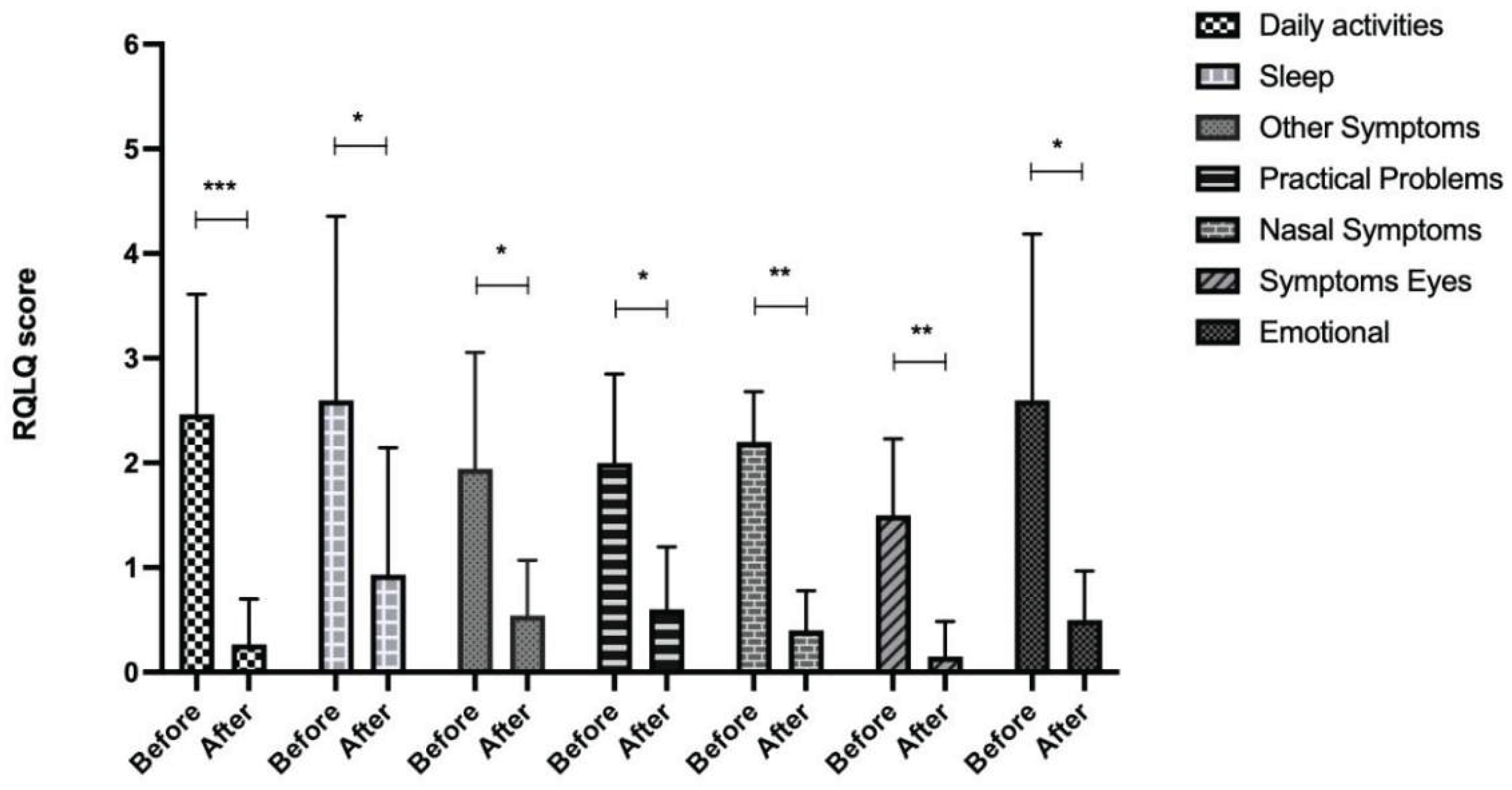

Table 1.
Demographic Characteristics.
| Variable | Median (IQR) |
|---|---|
| Age (years) | 8 (7–9) |
| Peripheral blood eosinophils (%) | 2 (1–11.2) |
| Serum IgE (IU/ mL) | 73.2 (43.3–127.5) |
| Serial Stool Examination (3 samples) |
Negative in all patients |
| Skin Prick Test (3 samples) |
Negative in all patients |
IQR, interquartile rank.
Table 2.
Symptom Severity.
| Symptom | Severity Before Value (Medians, IQR) |
Severity After Value (Medians, IQR) |
p Value Comparisons (Wilcoxon) |
|---|---|---|---|
| Itching | 2 (1-3) | 0 (0-0.5) | 0.012 |
| Tearing | 2 (0-4) | 0 (0-1) | 0.143 |
| Light Sensitivity | 2 (0-4) | 0 (0-0.5) | 0.044 |
| Gritty Sensation | 1 (1-2) | 0 (0-0.5) | 0.020 |
| Burning Sensation | 2 (0-4) | 0 (0-0.5) | 0.020 |
Table 3.
Comparison of tear characteristics before and after BS.
| Value before Median (IQR) |
Value after Median (IQR) |
P-value Comparisons (Wilcoxon) |
|
|---|---|---|---|
| TBUT (sec) | 5 (4.0-6.5) | 9 (7-10) | 0.002 |
| Schirmer I (mm) | 29 (17.5-35) | 12 (11-14) | 0.004 |
IQR, interquantile rank; TBUT, Tear Break Up Time.
Table 4.
Description of adverse reactions observed during treatment with BS.
| Description | Relationship | Start date | Severity | Resolution | Aftermath |
|---|---|---|---|---|---|
| Diarrhea 10012727 |
Possible | 3 | Mild | Resolved | No |
| Nausea 10028817 |
Possible | 3 | Mild | Resolved | No |
| Abdominal pain 10000087 | Possible | 1 | Mild | Resolved | No |
| Vomit 10028817 |
Possible | 30 | Mild | Resolved | No |
| Diarrhea 10012727 |
Possible | 63 | Mild | Resolved | No |
| Nausea 10028817 |
Possible | 1 | Mild | Resolved | No |
| Abdominal pain 10000087 | Possible | 1 | Mild | Resolved | No |
| Dysgeusia 10013911 |
Possible | 3 | Mild | Resolved | No |
| Weight loss 10047900 |
Unlikely | 30 | Mild | Resolved | No |
| Abdominal pain 10000087 | Possible | 1 | Mild | Resolved | No |
Disclaimer/Publisher’s Note: The statements, opinions and data contained in all publications are solely those of the individual author(s) and contributor(s) and not of MDPI and/or the editor(s). MDPI and/or the editor(s) disclaim responsibility for any injury to people or property resulting from any ideas, methods, instructions or products referred to in the content. |
© 2026 by the authors. Licensee MDPI, Basel, Switzerland. This article is an open access article distributed under the terms and conditions of the Creative Commons Attribution (CC BY) license (http://creativecommons.org/licenses/by/4.0/).
Copyright: This open access article is published under a Creative Commons CC BY 4.0 license, which permit the free download, distribution, and reuse, provided that the author and preprint are cited in any reuse.


