

Submitted:
28 April 2026
Posted:
30 April 2026
You are already at the latest version
Abstract
The origin of zongzi — rice and millet wrapped in leaves — has long been debated owing to a millennium-long gap between its legendary association with Qu Yuan (c. 340–278 BC) and the earliest unequivocal evidence, which dates only to the Song Dynasty. Here we present well-dated archaeological evidence of plant bundles (c. 2200 cal. BP) from the Wuwangdun Site, the first well-excavated tomb of King Kaolie of Chu. These plant bundles share the essential characteristics of modern zongzi and overlap both temporally and geographically with the Qu Yuan legend. They consist of Quercus dentata leaves containing rice (Oryza sativa, 43.6%), broomcorn millet (Panicum miliaceum, 26.1%) and foxtail millet (Setaria italica, 28.5%), secured with cords made from Panicoideae and Chloridoideae plants — a wrapping practice structurally identical to that of modern zongzi. Most seeds were preserved as whole husks, indicating that the bundles were used as funerary offerings rather than for consumption, which aligns with the legend that zongzi were thrown into the river to commemorate Qu Yuan. Notably, Q. dentata leaves are still used to wrap zongzi in regions that once formed the northern border of the Chu Kingdom. Our findings demonstrate that the plant bundles from the Wuwangdun Site most likely represent the prototype of zongzi, bridging the gap between legend and material culture and showing that the tradition of wrapping grains for ritual purposes began in the Chu Kingdom no later than 2200 years ago.
Keywords:
zongzi
; Dragon boat festival
; Wuwangdun Site
; Chu Kingdom
; funerary offering
China has a long and continuous civilisation that has fostered numerous traditions. The Dragon Boat Festival is one of China’s most important traditional festivals, celebrated by eating zongzi: rice or millet wrapped in leaves. Zongzi are traditionally linked to the commemoration of Qu Yuan (c. 340–278 BC), a poet and politician of the Chu Kingdom who, according to legend, drowned himself in the Miluo River. To prevent fish from consuming his body, people threw zongzi into the river as offerings. However, the earliest unequivocal evidence of zongzi dates only to the Song Dynasty [1,2], leaving its origin and function debated owing to a lack of archaeological evidence.
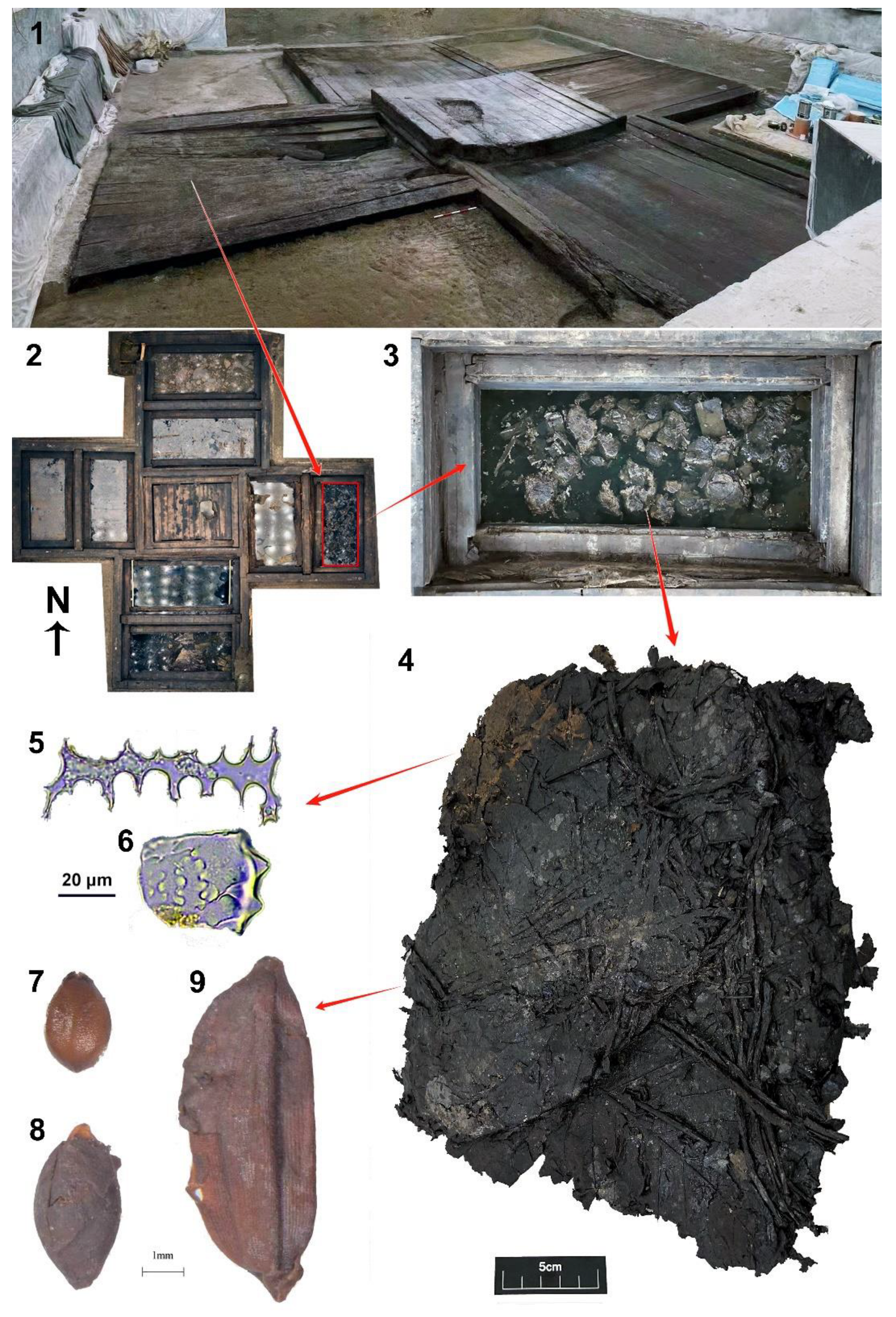
Here we present well-dated evidence of plant bundles from the Wuwangdun Site, the first well-excavated tomb of King Kaolie of Chu (d. 238 BC) from the Warring States period (Figure 1 and Supplementary Data: Site information). AMS ¹⁴C dating of plant material from the bundles yielded a radiocarbon age of approximately 2200 cal. BP (Table S1 and Figure S1), placing them chronologically within the late Warring States period and contemporary with the historical context of the Qu Yuan legend. We argue that these bundles represent a funerary practice structurally identical to zongzi, thereby bridging the gap between legend and material culture.
Several piles of plant bundles were discovered in the East I Chamber of the Wuwangdun Site, well preserved owing to waterlogged conditions. These bundles consist of compact plant material and externally appear to have been wrapped in leaves and tied with cords. After laboratory cleaning, twelve bundles were randomly selected and carefully unwrapped, revealing brown residues and plant seeds. The leaves, cords, residues and seeds were subjected to morphological and microfossil analyses.
Morphological analysis revealed that the leaves are oblong-oblanceolate to obovate, with a short acute apex, a broadly cuneate to subrounded base, and sinuate-dentate margins (Figure S2). The venation is pinnate and camptodromous, featuring a straight midvein, regularly arranged secondary veins, and tertiary veins perpendicular to the secondaries that are either unbranched or dichotomously branched — a pattern identical to that of modern Quercus dentata. This identification was further supported by a comparative analysis of leaf epidermal cells between the archaeological specimens and their modern counterparts.
The binding material was found wrapped around the leaves, securing them in a bundle. Microscopic examination revealed no diagnostic fibres of typical hemp (Cannabis sativa), only plant cell and tissue debris, suggesting that the cordage was not made from hemp. Further phytolith analysis of two cord samples identified a large proportion of bilobate, saddle and bulliform phytoliths derived from the subfamilies Panicoideae and Chloridoideae (Table S2 and Figure S3). Notably, in cord sample E1-643, some bilobate phytoliths remained articulated, accounting for 25.38% of the total assemblage. In E1-610, some bulliform phytoliths remained articulated, accounting for 35.74% of the total assemblage. These findings indicate that the cordage may have had multiple origins and was most likely manufactured from plants in the subfamilies Panicoideae and Chloridoideae.
Morphological identification of 456 seeds from ten bundles revealed that rice (Oryza sativa, 43.6%), broomcorn millet (Panicum miliaceum, 26.1%) and foxtail millet (Setaria italica, 28.5%) dominated the assemblage (Table S3). Most seeds were preserved only as husks (Figure 1-7, 1-8 and 1-9); a single partially decayed rice grain was recovered. Although glutinous rice and glutinous broomcorn millet are the typical grains used in zongzi today, it remains unknown whether the archaeological specimens represent sticky or non-sticky varieties. Other finds included one seed of Zanthoxylum bungeanum, one of Malva sp. and six of Scirpus juncoides (Figure S4). The first two are aromatic species known as spices, whereas S. juncoides is a common rice-paddy weed, suggesting possible admixture during harvesting.
The dominance of husks and the near-absence of intact grains indicate that the bundles were not intended for consumption by the living. Their presence in a tomb context, however, suggests a funerary function. In early Chinese mortuary practice, grains symbolised agricultural wealth and sustaining power. The Qin wooden slip Taiyuanyousizhe (Taiyuan Has a Dead Man, c. late Warring States to Qin dynasty, 3rd century BC) records that the dead valued soybeans as gold and millet as money for paying taxes in the underworld [3]. This indicates that grain held a symbolic, ritual value beyond its role as food. We therefore interpret these bundles not as provisions for the deceased but as offerings—a functional parallel to the zongzi later cast into rivers in memory of Qu Yuan.
Thin layers of brown residue were observed inside the wrapping leaves and were initially thought to be rice or millet flour, given the presence of seeds. Four samples were therefore subjected to microfossil analysis. Starch grain analysis revealed no starch grains, ruling out the possibility that the brown residue was flour or dough made from ground grains. Instead, the residue yielded hundreds of Poaceae pollen grains — with no other pollen types present — indicating a strong association with Poaceae inflorescences. Further phytolith analysis revealed elongate dendritic phytoliths, a type diagnostic of the inflorescence bracts of wheat and barley [4]. Their proportion reached 9.59% in sample E643-2, and ranged from 0.66% to 2.61% in three other samples (Table S2). This finding expands the range of cereals represented in the bundles to include at least four of the ancient “five grains”. Because the pollen and phytoliths derive from the non-edible, chaff parts of the inflorescence, their presence — together with the husks of the rice and millet seeds — argues against the interpretation of the bundles as food offerings for the deceased. We conclude instead that these plant parts were deliberately included as symbolic components of a ritual offering.
Taken together, the plant bundles reveal a consistent wrapping practice: rice, millet and other cereals wrapped in Q. dentata leaves and bound with cords made from Poaceae plants. This is consistent with the modern method of making zongzi — sticky rice or millet wrapped in leaves and tied with rope. Although these ancient bundles are not identical to modern zongzi, they share the same essential characteristics. This practice is also recorded in historical texts. The Fengtu Ji (Records of Local Customs and Conditions, c. 236–297 AD), written by Chu Zhou of the Jin Dynasty, states that zongzi was made by wrapping sticky rice with millet in Zizania latifolia leaves. The Xu Qixie Ji (Sequel to the Records of Strange Things, c. 510–520 AD), a collection of supernatural tales by Jun Wu of the Liang Dynasty, records that five-colour ropes were used to bind zongzi with Melia azedarach leaves to prevent flood dragons from stealing offerings intended for Qu Yuan. These historical accounts corroborate the distinct linkage — leaves wrapping grains bound with cords — observed in the archaeological finds, the legends and modern zongzi.
The archaeological findings are contemporary with Qu Yuan and the legends associated with him, both rooted in the Chu Kingdom. Similar bundles from Tomb 8 at the Chengyangcheng Site (c. 2350–2195 years ago) used Q. dentata leaves and contained rice and broomcorn millet, with Z. bungeanum present in the coffin but not inside the bundles [5]. The consistency in morphology and materials between the Chengyangcheng finds and our study suggests that wrapping grains for funerary rituals was common in the Chu Kingdom during the Warring States period. Given that these plant bundles served as funerary offerings, they align with the legend of zongzi being used to commemorate Qu Yuan. Notably, Q. dentata leaves are still used today to wrap zongzi in parts of Shandong, Shanxi and Henan provinces [6] — regions that once lay along the northern border of the Chu Kingdom — reflecting a culinary tradition that has persisted for over two millennia. Thus, where legend and archaeological evidence converge, these bundles most likely represent the prototype of zongzi.
Collectively, our findings demonstrate that the tradition of wrapping grains for funerary rituals — using plant leaves to contain rice, millet and other cereals, secured with cord — began in the Chu Kingdom no later than 2200 years ago. This tradition was subsequently carried forward and transformed, becoming an enduring element of regional cultural identity.
Acknowledgements
This work was supported by the National Natural Science Foundation of China (42277445 and 42472041), the Archaeological Talent Promotion Program of China [grant number 2024-266], and the National Social Science Foundation of China [grant number 23&ZD268].
Conflict of Interest Statement: The authors declare that they have no conflict of interest.
References
- Sun, J., Zongzi from the Song Dynasty (in Chinese). Agricultural Archaeology, 1989(2): p. 294-295.
- Anhui Provincial Institute of Cultural Relics and Archaeology Commission for Preservation of Ancient Monuments, N.C., The Excavation of the Tombs of the Song Dynasty at Tieguai in Nanling, Anhui (in Chinese). Cultural Relics, 2016(12): p. 34-49.
- Li, L., An introduction to the Qin wooden slip Taiyuanyousizhe collected by the Peking University (in Chinese). Cultural Relics, 2012(6): p. 81-84.
- Ball, T., et al., Phytoliths as a tool for investigations of agricultural origins and dispersals around the world. Journal of Archaeological Science, 2016. 68: p. 32-45.
- Lan, W., Identification and analysis of the macro plant remains in the Tomb 8 of the Chengyangcheng Site, Xinyang (in Chinese). Huaxia Archaeology, 2020(5): p. 66-70.
- Lin, F., et al., Plant leaves for wrapping zongzi in China: an ethnobotanical study. Journal of Ethnobiology and Ethnomedicine, 2019. 15(1): p. 63.
Figure 1.
Overview of the Wuwangdun site, plant bundles and main findings. 1. The Wuwangdun excavation site. 2. Top view of Tomb 1 after removal of the cover woods. 3. Waterlogged East I chamber with plant bundles floating everywhere. 4. The cord-wrapped plant bundle, showing brown residue enclosed by the leaves. 5. Elongate dendritic phytolith (cereal type), recovered from the brown residue. 6. Double-peaked phytolith from rice, recovered from the brown residue. 7. Setaria italica husk wrapped in leaves. 8. Panicum miliaceum husk wrapped in leaves. 9. Oryza sativa husk wrapped in leaves.
Figure 1.
Overview of the Wuwangdun site, plant bundles and main findings. 1. The Wuwangdun excavation site. 2. Top view of Tomb 1 after removal of the cover woods. 3. Waterlogged East I chamber with plant bundles floating everywhere. 4. The cord-wrapped plant bundle, showing brown residue enclosed by the leaves. 5. Elongate dendritic phytolith (cereal type), recovered from the brown residue. 6. Double-peaked phytolith from rice, recovered from the brown residue. 7. Setaria italica husk wrapped in leaves. 8. Panicum miliaceum husk wrapped in leaves. 9. Oryza sativa husk wrapped in leaves.
Disclaimer/Publisher’s Note: The statements, opinions and data contained in all publications are solely those of the individual author(s) and contributor(s) and not of MDPI and/or the editor(s). MDPI and/or the editor(s) disclaim responsibility for any injury to people or property resulting from any ideas, methods, instructions or products referred to in the content. |
© 2026 by the authors. Licensee MDPI, Basel, Switzerland. This article is an open access article distributed under the terms and conditions of the Creative Commons Attribution (CC BY) license (http://creativecommons.org/licenses/by/4.0/).
Copyright: This open access article is published under a Creative Commons CC BY 4.0 license, which permit the free download, distribution, and reuse, provided that the author and preprint are cited in any reuse.