
Submitted:
28 April 2026
Posted:
29 April 2026
You are already at the latest version
Abstract
Background: South Africa has one of the largest HIV epidemics globally, with over 7.5 million people living with HIV. The Eastern Cape Province has a high antenatal HIV prevalence (36.5%), second only to KwaZulu-Natal (40.3%). Although the widespread use of antiretroviral therapy (ART) has significantly reduced HIV-related mortality and vertical transmission, adverse maternal and perinatal outcomes remain a public health concern. This study aimed to assess the effect of maternal HIV infection on maternal and neonatal outcomes in the era of universal ART at Nelson Mandela Academic Hospital. Methods: A retrospective case–control study was conducted using clinical records of 600 women (300 HIV-positive and 300 HIV-negative) who delivered in 2019. Maternal demographic, obstetric, clinical, and neonatal outcomes were compared between groups. Categorical variables were presented as frequencies and percentages, while continuous variables were summarized as means ± standard deviations. Associations were assessed using Chi-square tests, multivariate logistic regression, and Cox proportional hazards models. Statistical significance was defined as p < 0.05. Results: HIV-positive women had significantly higher rates of anaemia (38% vs. 23%), hypertensive disorders, and inadequate antenatal care attendance. HIV exposure was associated with increased risks of adverse neonatal outcomes, including preterm birth (26.3% vs. 20.3%), low Apgar scores, and stillbirths. Low birth weight was an independent predictor of neonatal mortality (hazard ratio (HR) = 2.40, p < 0.001). Although vertical transmission was low (1.7%), incomplete infant testing data (8.6%) limited a comprehensive assessment. ART initiation during pregnancy was associated with modestly improved maternal and neonatal outcomes compared to delayed initiation. Conclusions: Maternal HIV infection remains significantly associated with adverse maternal and neonatal outcomes despite widespread ART coverage. From a public health perspective, these findings highlight the need to strengthen integration of HIV care within antenatal services, promote early ART initiation, and improve continuity of maternal and neonatal care to optimize outcomes in high-burden settings.
Keywords:
1. Introduction
2. Methods
2.1. Study Design and Setting
2.2. Study Population and Data Source
2.3. Data Collection
2.4. Statistical Analysis
3.1. Maternal Demographic Characteristics
3.2. Maternal Clinical Characteristics
3.3. Neonatal Outcomes
3.4. Effect of ART Timing on Birth Outcomes
3.5. Predictors of Adverse Maternal Outcomes
3.6. Predictors of Low Birth Weight
3.7. Predictors of Neonatal ICU Admission
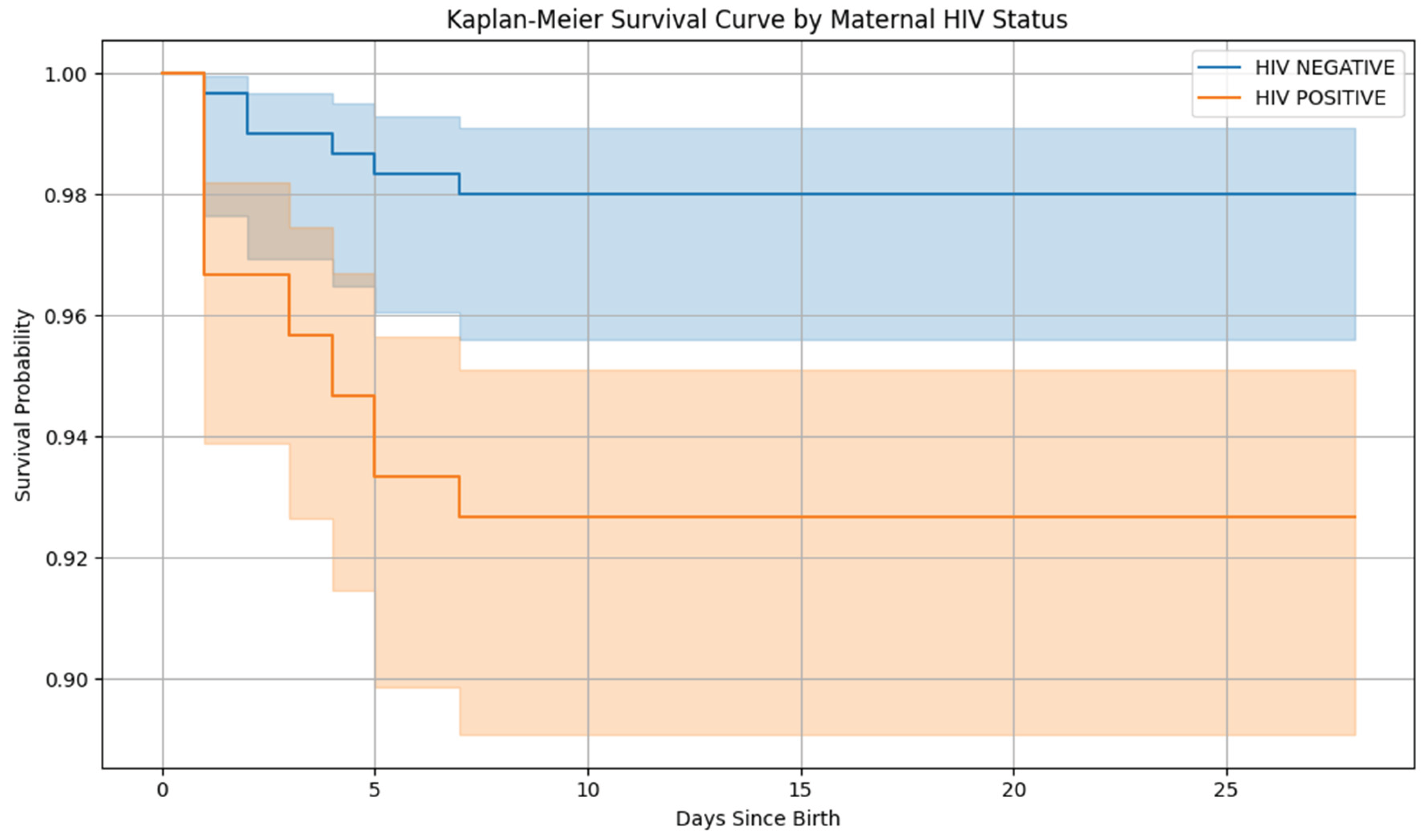
3.8. Neonatal Survival Analysis
3.9. Kaplan–Meier Survival Analysis
4. Discussion
4.1. Strengths and Limitations
4.2. Recommendations
5. Conclusions
Acknowledgments
Conflicts of Interest
Author Contributions
Funding
Institutional Review Board Statement
Conflicts of Interest
Abbreviations
| ANC – Antenatal Care AOR – Adjusted Odds Ratio ART – Antiretroviral Therapy CI – Confidence Interval C/S – Caesarean Section DM – Diabetes Mellitus HDP – Hypertensive Disorders of Pregnancy HIV – Human Immunodeficiency Virus HR – Hazard Ratio IQR – Interquartile Range LBW – Low Birth Weight MTCT – Mother-to-Child Transmission NICU – Neonatal Intensive Care Unit NMAH – Nelson Mandela Academic Hospital PMTCT – Prevention of Mother-to-Child Transmission SD – Standard Deviation WHO – World Health Organization |
References
- Joint United Nations Programme on HIV/AIDS (UNAIDS). 2023 Global and Regional Snapshots on HIV and AIDS; UNICEF: New York, NY, USA, 2023; Available online: https://www.childrenandaids.org/documents/2023-global-and-regional-snapshots-hiv-and-aids (accessed on 20 April 2026).
- Woldesenbet, S.A.; Kufa, T.; Lombard, C.; Mogashoa, M.; Cheyip, M.; Ayalew, K.; Goga, A.E. Risk factors for mother-to-child transmission of HIV in a national cohort of HIV-exposed infants in South Africa. Pediatr. Infect. Dis. J. 2021, 40, 213–219. [Google Scholar]
- Hansoti, B.; Mwinnyaa, G.; Hahn, E.; Rao, A.; Black, J.; Chen, V.; Clark, K.; Clarke, W.; Eisenberg, A.L.; Fernandez, R.; et al. Targeting the HIV epidemic in South Africa: The need for testing and linkage to care in emergency departments. EClinicalMedicine 2019, 15, 14–22. [Google Scholar] [CrossRef] [PubMed]
- Joint United Nations Programme on HIV/AIDS (UNAIDS). Global HIV & AIDS statistics—Fact sheet. 2023. Available online: https://www.unaids.org/en/resources/fact-sheet (accessed on 17 July 2025).
- World Health Organization (WHO). WHO Recommendations on Maternal and Newborn Care for a Positive Postnatal Experience; WHO: Geneva, Switzerland, 2020. [Google Scholar]
- Asferie, W.N.; Aytenew, T.M.; Kassaw, A.; et al. Effect of maternal HIV infection on birth outcomes among HIV-positive women in sub-Saharan Africa: A systematic review and meta-analysis. BMC Public Health 2025, 25, 459. [Google Scholar] [CrossRef]
- Siqithi, S.; Durojaiye, O.C.; Adeniyi, O.V. Effects of the timing of maternal antiretroviral therapy initiation, CD4 count, and HIV viral load on birth outcomes in the Eastern Cape province of South Africa: A secondary data analysis. PLoS ONE 2024, 19, e0308374. [Google Scholar] [CrossRef] [PubMed]
- Gill, M.M.; Khumalo, P.N.; Hoffman, H.J.; Chouraya, C.; Kunene, M.; Dlamini, F.; Tukei, V.; Scheuerle, A.E.; Nhlabatsi, B.; Mofenson, L. Birth defects and adverse pregnancy outcomes in hospital-based birth surveillance in Eswatini. Pediatr. Infect. Dis. J. 2025. [Google Scholar] [CrossRef]
- Maswine, R.; Barugahare, J.; Karamagi, C.; Atuhairwe, S. Risk factors for neonatal mortality among low-birth-weight infants at a tertiary hospital in Uganda. BMC Pediatr. 2021, 21, 47. [Google Scholar]
- Yang, Y.; Zash, R.; Makhema, J.; Isaacson, A.; Mmalane, M.; Essex, M.; Lockman, S.; Shapiro, R.L. Birth outcomes in HIV-positive women taking antiretroviral therapy in Botswana. Lancet Glob. Health 2019, 7, e513–e523. [Google Scholar]
- Chetty, T.; Knight, S.; Giddy, J. Preconception antiretroviral therapy and obstetric outcomes in HIV-positive women. BMC Pregnancy Childbirth 2018, 18, 1. [Google Scholar]
- Malaba, T.R.; Newell, M.L.; Madlala, H.P.; Phillips, T.K.; Myer, L. Antiretroviral therapy use during pregnancy and adverse birth outcomes in South African women. J. Infect. Dis. 2017, 216, 1256–1263. [Google Scholar] [CrossRef] [PubMed]
- Twabi, H.; Phiri, H.; Mndala, L.; Banda, J.; Daire, J. Predictors of poor perinatal outcomes among HIV-positive pregnant women. PLoS ONE 2020, 15, e0234300. [Google Scholar]
- Fleșeriu, T.; Meliț, L.E.; Mărginean, C.O.; Pop, A.V.; Văsieșiu, A.-M. Maternal HIV infection and antiretroviral therapy in pregnancy. Pathogens 2025, 14, 818. [Google Scholar] [CrossRef]
- Panel on Treatment of HIV During Pregnancy and Prevention of Perinatal Transmission. Recommendations for the use of antiretroviral drugs during pregnancy. NIH Clinical Info. 2024. Available online: https://clinicalinfo.hiv.gov/en/guidelines/perinatal (accessed on 24 April 2026).
- Naidoo, K.; Singh, M.; Penfold, M.E.; Chersich, M.F. Antenatal care practices and pregnancy outcomes in HIV-positive women. S. Afr. J. HIV Med. 2016, 17, 1–7. [Google Scholar]
- Moodley, T.; Goga, A.E.; Ramokolo, V.; Manda, S.; Ngandu, N.K.; Woldesenbet, S.A.; Singh, Y.; Sherman, G.G. PMTCT coverage in South Africa. S. Afr. Med. J. 2018, 108, S51–S57. [Google Scholar]
- Mabuka, S.; Lowane, M.P.; Nesengani, T.V.; Simbeni, T.V. Adherence and knowledge of HIV PMTCT programme. S. Afr. J. HIV Med. 2025, 26, a1648. [Google Scholar] [CrossRef]
- Human Sciences Research Council (HSRC). Turning the Tide—SA HIV Survey; HSRC: Pretoria, South Africa, 2024. [Google Scholar]
- Oosthuizen, A. SABSSM VI: An evolving epidemic. HSRC Rev. 2024, 22, 2–13. [Google Scholar]
- Risher, K.A.; Cori, A.; Reniers, G.; et al. Age patterns of HIV incidence in eastern and southern Africa. Lancet HIV 2021, 8, e429–e439. [Google Scholar] [CrossRef] [PubMed]
- Butler, I.; MacLeod, W.; Majuba, P.P.; Tipping, B. HIV infection in older adults in South Africa. S. Afr. J. HIV Med. 2018, 19, a838. [Google Scholar] [CrossRef]
- Tunkyi, K.; Moodley, J. Anaemia in pregnancy in high HIV prevalence settings. S. Afr. J. Infect. Dis. 2017, 32, 138–141. [Google Scholar]
- Slogrove, A.L.; Bovu, A.; de Beer, S.; et al. Maternal and birth outcomes in HIV. AIDS 2024, 38, 59–67. [Google Scholar] [CrossRef]
- Bengtson, A.M.; Phillips, T.K.; le Roux, S.M.; et al. Hypertension and birth outcomes in HIV. Pregnancy Hypertens. 2021, 23, 79–86. [Google Scholar] [CrossRef] [PubMed]
- Naidoo, N.; Moodley, J.; Naicker, T. Endothelial dysfunction in HIV-related preeclampsia. Hypertens. Res. 2021, 44, 386–398. [Google Scholar] [CrossRef]
- Bouabida, K.; Chaves, B.G.; Anane, E. Barriers to HIV care engagement. Front. Reprod. Health 2023, 5, 1201087. [Google Scholar] [CrossRef]
- Fleșeriu, T.; Meliț, L.E.; Mărginean, C.O.; Văsieșiu, A.-M. Maternal HIV and birth outcomes. Pathogens 2024, 13, 808. [Google Scholar] [CrossRef] [PubMed]
- Haksari, E.L.; Irawan, G.; Lusyati, S.D.; et al. Neonatal mortality in low-birth-weight infants. Sci. Rep. 2025, 15, 31607. [Google Scholar] [CrossRef] [PubMed]
- Fentie, E.A.; Yeshita, H.Y.; Bokie, M.M. Low birth weight among HIV-positive mothers. PLoS ONE 2022, 17, e0263812. [Google Scholar]
- Minda, Z.; Oljira, L. HIV vertical transmission and virological failure. AIDS Res. Ther. 2025, 22, 127. [Google Scholar] [CrossRef]
- South African National Department of Health. Guideline for Vertical Transmission Prevention; NDoH: Pretoria, South Africa, 2023. [Google Scholar]
- Nyandwi, J.; Bazikamwe, S.; Nisubire, D.; et al. PMTCT outcomes in Burundi. East Afr. Health Res. J. 2018, 2, 112–117. [Google Scholar] [CrossRef]
- World Health Organization (WHO). Mother-to-child transmission of HIV. 2022. Available online: https://www.who.int/teams/global-hiv-hepatitis-and-stis-programmes/hiv/prevention/mother-to-child-transmission-of-hiv (accessed on 24 April 2026).
- Joint United Nations Programme on HIV/AIDS (UNAIDS). 2024 Global AIDS Update; UNAIDS: Geneva, Switzerland, 2024. [Google Scholar]

| Variable | HIV-Negative (n = 300), n (%) | HIV-Positive (n = 300), n (%) | χ² | p-Value |
|---|---|---|---|---|
| Age category | 70.71 | <0.001 | ||
| <20 years | 58 (19.3) | 4 (1.3) | ||
| 20–34 years | 184 (61.3) | 173 (57.6) | ||
| >35 years | 58 (19.3) | 123 (41.0) | ||
| Parity | 25.99 | <0.001 | ||
| 0 | 116 (38.6) | 62 (20.6) | ||
| 1 | 66 (22.0) | 73 (24.4) | ||
| 2 | 66 (22.0) | 73 (24.4) | ||
| 3 | 36 (12.0) | 64 (21.4) | ||
| ≥4 | 13 (4.3) | 19 (6.3) |
| Variable | HIV-Negative (n = 300), n (%) | HIV-Positive (n = 300), n (%) | χ² | p-Value |
|---|---|---|---|---|
| Hypertensive disorders (HDP) | 149 (49.7) | 198 (66.0) | 14.86 | 0.005 |
| Previous C/S (1–3) | 95 (31.7) | 60 (20.0) | ||
| Diabetes mellitus (DM) | 48 (16.0) | 30 (10.0) | ||
| Maternal infections | 5 (1.6) | 8 (2.7) | ||
| Other conditions | 3 (1.0) | 4 (1.3) |
| Variable | HIV-Negative (n = 300), n (%) | HIV-Positive (n = 300), n (%) | χ² | p-Value |
|---|---|---|---|---|
| Birth weight (kg), Mean ± SD | 2.92 ± 0.55 | 2.74 ± 0.61 | — | — |
| Gestational age (weeks), Mean ± SD | 37.5 | 36.1 | — | — |
| Preterm birth (<37 weeks) | 61 (20.3) | 79 (26.3) | 4.02 | 0.045 |
| Low Apgar score (<7 at 5 min) | 28 (9.2) | 44 (14.7) | 4.62 | 0.032 |
| Stillbirth | 12 (4.0) | 22 (7.3) | 3.91 | 0.048 |
| Neonatal anaemia | 45 (15.0) | 90 (30.0) | 16.47 | <0.001 |
| Neonatal mortality | 15 (5.0) | 17 (5.7) | — | 0.66 |
| ART Regimen Group | Birth Weight (g), Mean ± SD | F-statistic | p-Value |
|---|---|---|---|
| Pre-pregnancy ART initiation (n = 205) | 2415 ± 385 | ||
| Antenatal ART initiation (n = 77) | 2512 ± 340 | 2.87 | 0.060 |
| Variable | Adjusted OR | 95% CI | p-Value |
|---|---|---|---|
| HIV-positive status | 0.35 | 0.22–0.55 | <0.001 |
| Maternal age (>35 years) | 1.42 | 0.90–2.25 | 0.127 |
| Pre-pregnancy ART | 1.68 | 1.02–2.76 | 0.041 |
| Unsuppressed viral load | 1.94 | 0.91–4.12 | 0.085 |
| Variable | Adjusted OR | 95% CI | p-Value |
|---|---|---|---|
| HIV-positive status | 1.88 | 1.18–3.00 | 0.008 |
| Maternal age (>35 years) | 1.31 | 0.84–2.05 | 0.230 |
| Pre-pregnancy ART | 1.12 | 0.71–1.78 | 0.628 |
| Unsuppressed viral load | 1.47 | 0.79–2.75 | 0.220 |
| Variable | Adjusted OR | 95% CI | p-Value |
|---|---|---|---|
| HIV-positive status | 1.11 | 0.68–1.82 | 0.674 |
| Pre-pregnancy ART | 1.36 | 0.77–2.42 | 0.292 |
| Low birth weight | 2.45 | 1.46–4.11 | <0.001 |
| Variable | Hazard Ratio (HR) | 95% CI | p-Value |
|---|---|---|---|
| HIV-positive status | 1.75 | 1.12–2.71 | 0.015 |
| Low birth weight | 2.40 | 1.55–3.70 | <0.001 |
| Pre-pregnancy ART | 1.38 | 0.87–2.20 | 0.172 |
| Unsuppressed viral load | 2.05 | 1.13–3.73 | 0.018 |
Disclaimer/Publisher’s Note: The statements, opinions and data contained in all publications are solely those of the individual author(s) and contributor(s) and not of MDPI and/or the editor(s). MDPI and/or the editor(s) disclaim responsibility for any injury to people or property resulting from any ideas, methods, instructions or products referred to in the content. |
© 2026 by the authors. Licensee MDPI, Basel, Switzerland. This article is an open access article distributed under the terms and conditions of the Creative Commons Attribution (CC BY) license (http://creativecommons.org/licenses/by/4.0/).


