

Submitted:
28 April 2026
Posted:
29 April 2026
You are already at the latest version
Abstract
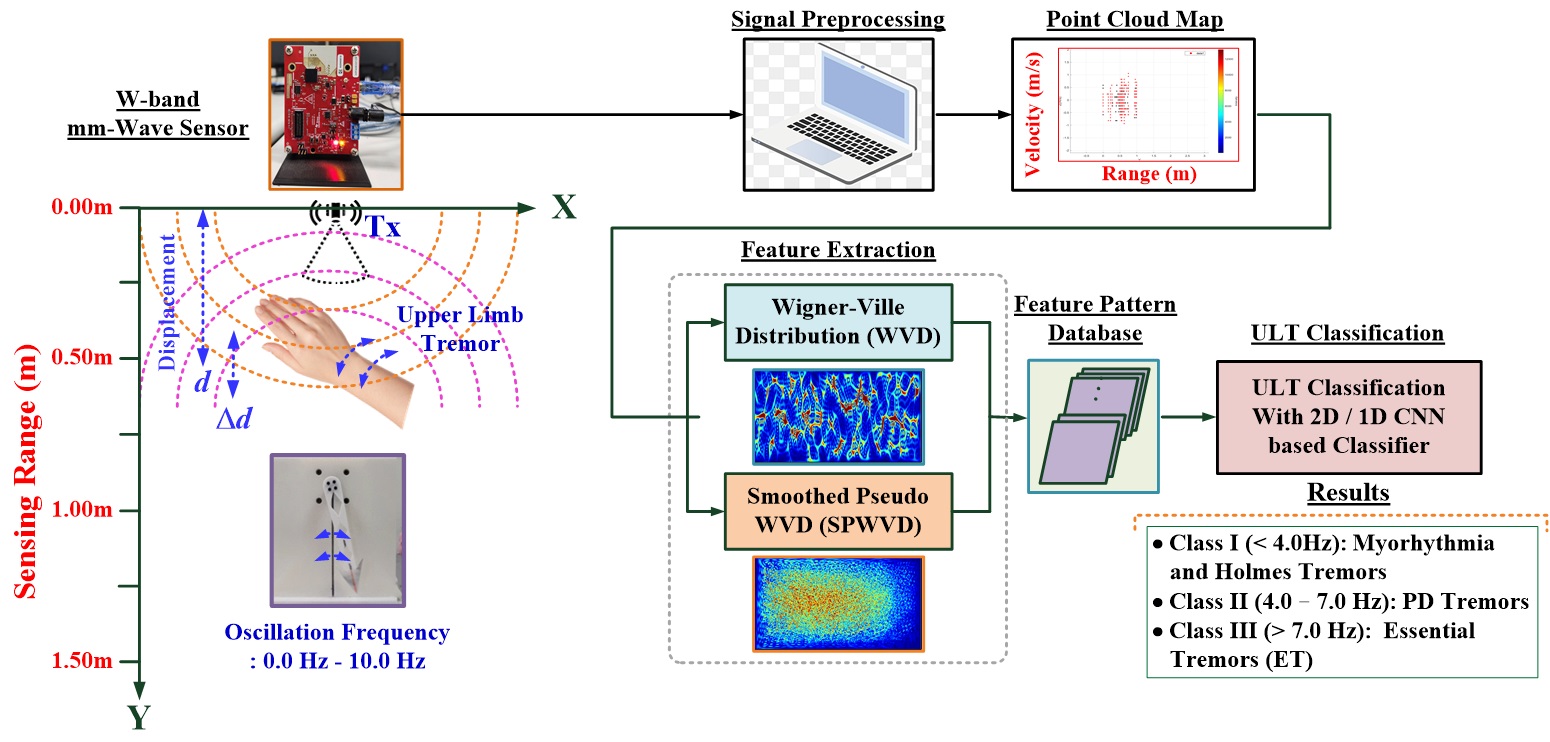
Parkinson’s disease (PD) is a neurodegenerative disorder with an increasing incidence, sig-nificantly affecting patients' motor functions and quality of life. Involuntary upper limb tremor (ULT) commonly manifests unilaterally, affecting either the left or right upper limb. Clinically, the ULT frequencies are categorized into three distinct classes, including low-frequency (< 4.0 Hz), mid-frequency (4.0 – 7.0 Hz), and high-frequency (> 7.0 Hz) tremors. These ULT move-ments manifest as either oscillatory or rotational (angular displacement) motions, the so-called micro-Doppler effect (mDE). This study aims to develop a short-range (< 1.0 m) and contactless sensing method based on Doppler millimeter-wave (mm-Wave) radar for ULTs detection. The reflected electromagnetic waves indicate the time-varying frequency characteristics, which can be analyzed by using time-frequency transform (TFT) methods, such Wigner-Ville distribution (WVD) and smoothed pseudo WVD (SPWVD) methods. These TFT methods are used to extract the mDE features, which are subsequently visualized as color-coded spectrograms for ULTs classification. Then, a two- dimensional (2D) convolutional neural network (CNN) is employed to automatically recognize the visual feature patterns for ULTs classification based on frequency and amplitude information. In the experimental setup, the W-band (76 - 81 GHz) Doppler mm-Wave biosensor is implemented for sensing and extracting feature patterns. The proposed classifiers based on “WVD + 2D CNN” and “SPWVD + 2D CNN” are trained and validated by using the collected datasets, with 60% randomly selected for training datasets and 40% for testing datasets in each fold validation. The ten-fold cross-validation method is applied to evaluate the classifier’s performances, achieving an average Precision of 95.92%, average Recall of 95.89%, average F1-score of 0.9509, and average Accuracy of 95.89%, respectively. The experimental results demonstrate the feasibility of the proposed classifier for real-time ULTs classification in PD patients using short-range (< 1.0 m) and contactless sensing.
Keywords:
Parkinson’s disease
; upper limb tremor (ULT)
; micro-Doppler effect (mDE)
; point cloud map
; short-range and contactless
; time-frequency transform (TFT)
; convolutional neural network (CNN)
Copyright: This open access article is published under a Creative Commons CC BY 4.0 license, which permit the free download, distribution, and reuse, provided that the author and preprint are cited in any reuse.


