

Submitted:
27 April 2026
Posted:
29 April 2026
You are already at the latest version
Abstract
Background and Objectives: Professional ballet dancers endure high occlusal loads, increasing cervical defect prevalence. Conventional composites fail frequently under such conditions. This randomized clinical trial (RCT) compared 24month performance of a polymerinfiltrated ceramic network (PICN, VITA Enamic) versus a selfcuring bioactive composite (Stela) for cervical restorations. Materials and Methods: Twenty professional ballet dancers (40 cervical defects: 21 carious, 19 abfraction) were enrolled in a splitmouth RCT. Each received one PICN inlay and one selfcuring composite restoration on two nonadjacent defects. Restorations were assessed at 6, 12, and 24 months using United States Public Health Service (USPHS) criteria (primary: marginal integrity) and a dye penetration test. Secondary outcomes included secondary caries, hypersensitivity, and Oral Health Impact Profile-14 (OHIP14). Statistical tests: McNemar, Fisher’s exact, Kaplan–Meier, logrank (α=0.05). Results: At 24 months, no PICN restoration failed (0%). Selfcuring composite failures were 20% (carious) and 30% (abfraction) (exploratory uncorrected p=0.031; nonsignificant after correction). Dye penetration was lower for PICN in abfraction defects (11% vs. 60%, adjusted p=0.048) but not in carious defects (9% vs. 30%, adjusted p=0.317). Kaplan–Meier survival favoured PICN (logrank p=0.001); 24month survival probability: PICN 100% (95% CI: 83–100%), selfcuring composite 75% (95% CI: 55–95%). No secondary caries or serious adverse events occurred. Conclusions: PICN hybrid ceramic provided superior marginal integrity and zero failures over 24 months in cervical restorations of professional ballet dancers, outperforming the selfcuring composite. PICN inlays are recommended for abfraction defects. The selfcuring composite may be considered for carious defects when light curing is problematic, but patients should be informed of higher failure risk. Longer studies are needed.
Keywords:
polymer-infiltrated ceramic network
; PICN
; self- curing composite
; cervical restoration
; abfraction defect
; ballet dancers
; randomised controlled trial
; split-mouth design
; marginal integrity
; USPHS criteria
1. Introduction
Professional ballet dancers are exposed to extreme and sustained physical demands from early childhood throughout their careers [1]. The constant tension of facial and masticatory muscles, combined with parafunctional habits such as intense teeth clenching, leads to occlusal disturbances, accelerated tooth wear, and a high prevalence of temporomandibular joint disorders [2,3]. These specific loading patterns generate bending stress in the cervical region of teeth, promoting the loss of calcium ions from hydroxyapatite and contributing to the formation of abfraction lesions [4].
Caries prevalence among ballet dancers approaches 100% across all age groups, with the Decayed, Missing, and Filled Teeth index (DMFT) index rising progressively with age and professional experience [5]. Poor oral hygiene, low motivation for preventive care, and a high-carbohydrate diet further increase the susceptibility of the cervical area to both carious (Class V) and non-carious (abfraction) defects [6,7,8].
Conventional treatment of cervical defects relies on direct nano-hybrid composite restorations using adhesive techniques. However, under high cyclic occlusal loads, such restorations show high rates of marginal deterioration, secondary caries, and premature failure [4]. The mismatch in elastic modulus between conventional composites and tooth structure leads to stress concentration at the tooth–restoration interface, ultimately compromising long-term marginal integrity.
Recent advances in restorative dentistry have introduced two innovative classes of materials that may overcome these limitations. The first class comprises polymer-infiltrated ceramic network (PICN) materials, also known as hybrid ceramics or resin-matrix ceramics. PICN restorations combine the favourable elastic modulus and damage tolerance of a polymer phase with the wear resistance of a ceramic network, closely mimicking the biomechanical properties of natural dentin and enamel [9]. Long-term prospective clinical studies have demonstrated excellent survival rates and marginal stability of PICN restorations in high-stress applications, including the treatment of severe tooth wear and cervical defects [10]. Systematic reviews and meta-analyses have confirmed the favourable clinical performance of resin-matrix ceramics, with low complication rates and acceptable wear behaviour [11].
The second class comprises smart bioactive self-curing composites. Contemporary self-cure bulk-fill composites utilise a hydroperoxide-based initiator system that provides unlimited depth of cure and low volumetric shrinkage, virtually eliminating polymerisation stress and achieving a gap-free interface [12,13]. This technological approach represents a paradigm shift from conventional light-cured composites, as it reduces marginal gap formation and pre-test failures without the need for complex layering techniques. In addition to its self-curing polymerisation, Stela contains bioactive ion-releasing glass fillers (ionglass™), which have been shown to release calcium, fluoride, and strontium ions [12]. Such ion release may contribute to remineralisation of adjacent tooth structures and provide anti-cariogenic benefits, which is particularly relevant in patients with high caries prevalence [13].
Despite the individual promise of both material classes, no clinical study has directly compared PICN hybrid ceramics with a smart bioactive self-curing composite in the restoration of cervical defects. Moreover, no randomised controlled trial has evaluated these advanced materials specifically in professional ballet dancers—a population that serves as an ideal in-vivo model for testing restorative durability under predictable and extreme masticatory loads [3,5].
Aim of the study: to compare the clinical performance of PICN hybrid ceramic (VITA Enamic) versus a smart bioactive self-curing composite (Stela) for cervical restorations in professional ballet dancers, assessed over 24 months in a split-mouth randomised controlled trial.
Hypothesis: PICN hybrid ceramic restorations will demonstrate superior marginal integrity and lower failure rates compared with the self-curing composite; however, the self-curing composite may offer advantages in terms of simplified placement technique and reduced polymerisation stress.
2. Materials and Methods
2.1. Study Design
This study was designed as a prospective, split-mouth, randomized controlled trial with a 24-month follow-up. The protocol was approved by the Local Ethics Committee of I.M. Sechenov First Moscow State Medical University (Protocol No. 22/21, 9 December 2021) and was registered at ClinicalTrials.gov. The trial was conducted in accordance with the Consolidated Standards for Reporting Trials (CONSORT) 2010 guidelines [14] for randomized trials and followed the Oral Health Statistics (OHStat) recommendations [15] for reporting of dental research. All participants provided written informed consent before enrolment.
2.2. Participants and Eligibility Criteria
Participants were recruited from the Centre for Sports and Ballet Trauma and Rehabilitation of the Priorov National Medical Research Centre of Traumatology and Orthopaedics (Moscow, Russian Federation). Eligible individuals were current or retired professional ballet dancers with at least ten years of professional experience, aged 18 to 50 years, and presenting at least two non-adjacent cervical defects (Class V carious lesions or abfraction defects) located in different quadrants. Cervical defects were classified as carious (Class V) or non-carious (abfraction) based on clinical and radiographic criteria (presence of caries detected visually and radiographically, absence of caries in abfraction lesions). Each defect had a depth of at least 1.5 mm and a width not exceeding 4 mm. Teeth had to be vital, free of active periodontal disease (probing depth ≤ 3 mm), and without clinical or radiographic signs of pulpal pathology.
Exclusion criteria were severe bruxism requiring occlusal splint therapy, uncontrolled systemic diseases (e.g., diabetes mellitus, autoimmune disorders), pregnancy or lactation, known allergic reactions to any component of the restorative materials, and inability to attend scheduled follow-up visits.
After initial assessment, 20 of 26 screened individuals met the eligibility criteria and were enrolled.
2.3. Randomization, Allocation Concealment, and Blinding
For each participant, the two eligible cervical defects were randomly allocated to one of the two restorative materials using a computer-generated randomization sequence with a 1:1 allocation ratio and a block size of four. Stratification by defect type was not feasible because the two defects within a participant could differ in type, and the number of possible combinations was insufficient for blocked stratification. The balance of defect types between material groups was assessed post-hoc (see Table 1). Allocation concealment was achieved by sequentially numbered, opaque, sealed envelopes that were opened immediately before the restorative procedure.
Blinding was applied as follows: the outcome assessor—a calibrated dentist who did not perform any of the restorations—was kept unaware of the material assignment. Participants were not informed which material was placed on which tooth. The operating dentist who performed all restorations could not be blinded owing to the inherently different handling characteristics of the two materials.
2.4. Sample Size Calculation
The required sample size was calculated a priori using G*Power software (version 3.1.9.7; Heinrich Heine University, Düsseldorf, Germany). Based on pilot data, a difference of 30% in the proportion of restorations demonstrating marginal defects was anticipated between the two groups (expected 40% in the control group versus 10% in the experimental group). Using a two sided paired proportions test (split mouth design) with α = 0.05 and β = 0.20 (power = 80%), the required number of paired defects was 28. To account for an anticipated 20% dropout rate at 24 months, 40 defects (20 per material group) from 20 participants were included in the final analysis. The primary analysis was powered to detect an overall difference between materials without stratification by defect type. Comparisons within subgroups (carious vs. abfraction defects) were not accounted for in the sample size calculation and are therefore exploratory. Results from subgroup analyses should be interpreted with caution due to limited statistical power.
2.5. Restorative Procedures
All restorative procedures were performed by a single experienced operator under local anaesthesia (4% articaine with epinephrine 1:100,000). For each cervical defect, cavity preparation was kept minimally invasive: carious lesions underwent conventional caries removal with a round bur, application of a caries detector, and acid etching (37% orthophosphoric acid, 15 s for enamel, 10 s for dentin). No additional mechanical preparation was performed for abfraction defects; the existing lesion shape was used as the cavity form for the indirect restoration.
Group A—PICN hybrid ceramic (VITA Enamic, VITA Zahnfabrik, Bad Säckingen, Germany). After cavity preparation, an impression was taken using polyvinyl siloxane, and the inlay was fabricated by a dental laboratory. At the second visit, the inlay was bonded with a dual-cure resin cement (G-CEM ONE, GC Corporation, Tokyo, Japan) strictly following the manufacturer’s instructions.
Group B—Smart bioactive self-curing composite (Stela, SDI, Victoria, Australia). Stela is a self-curing bulk-fill composite that utilizes a hydroperoxide-based initiator system. The manufacturer’s two-step protocol was applied: Stela Primer was applied to the cavity for 15 s, followed immediately by bulk placement of Stela (single increment). No light-curing was required. After setting, finishing was performed with fine diamond burs and polishing discs.
All restorations were adjusted to occlusal contacts using articulating paper, and final polishing was performed with silicon polishing points.
2.6. Outcome Assessment
Patients were recalled for clinical evaluation at 6, 12, and 24 months after restoration placement. Two calibrated examiners (intra-examiner kappa = 0.86; inter-examiner kappa = 0.82), who were blinded to the material assignment, performed the assessments independently.
Primary outcomes included:
Marginal integrity—evaluated using the modified United States Public Health Service (USPHS) criteria (Alpha, Bravo, Charlie, Delta) with a dental mirror, probe, and additional light source.
Dye penetration—assessed by the Borovsky–Aksamit test: a 2% methylene blue solution was applied to the restoration margin for 2 min, then rinsed; the presence (+) or absence (–) of dye penetration at the tooth–restoration interface was recorded.
Secondary outcomes included the development of secondary caries (clinical and radiographic assessment), postoperative hypersensitivity (measured on a visual analogue scale), and patient satisfaction (using the Oral Health Impact Profile-14 (OHIP-14) questionnaire).
2.7. Statistical Analysis
Statistical analysis was performed using StatTech v. 3.1.6 (Stattech LLC, Russia). The Shapiro–Wilk test was used to assess normality of continuous data. For paired binary outcomes (marginal integrity defects and dye penetration) at each time point, McNemar’s test was applied. For inter-group comparisons of failure rates, Fisher’s exact test was used when expected cell counts were below 5; otherwise the chi-square test was employed. Differences in failure rates between carious and abfraction defects within each material group were assessed using the chi-square test or Fisher’s exact test, as appropriate. Ninety-five percent confidence intervals (CI) for differences in proportions were calculated using the Wilson method. To control type I error, we applied the Holm–Bonferroni correction sequentially: first across the three follow-up time points (6, 12, and 24 months) for each outcome separately (adjusted α = 0.017 per comparison), and second across the two co-primary outcomes (marginal integrity and dye penetration), with an adjusted significance level of α = 0.025 for each co-primary outcome. No further correction was applied for comparisons between defect types (carious vs. abfraction) or for the descriptive subgroup analyses, as these were designated as exploratory. The uncorrected p-values are reported for exploratory comparisons, and readers should interpret them with caution. All p-values reported for primary outcomes in Table 2 and Table 3 are corrected for two comparisons unless stated otherwise. Restoration survival (failure defined as USPHS Charlie or Delta) was analysed using Kaplan–Meier survival curves, and the log-rank test was used to compare survival distributions between the two groups. A two-tailed p-value < 0.05 was considered statistically significant. All analyses followed the intention-to-treat principle. No missing data occurred; intention-to-treat (ITT) analysis was equivalent to per-protocol analysis.
3. Results
3.1. Participant Flow and Baseline Characteristics
Of the 26 professional ballet dancers initially assessed for eligibility, 20 met the inclusion criteria and were enrolled. All 20 participants (mean age 34.2 ± 8.7 years; 14 females, 6 males) completed the 24-month follow-up without any dropouts. No adverse events or postoperative hypersensitivity requiring intervention were reported in either group.
A total of 40 cervical defects (21 carious lesions, 19 abfraction defects) were restored (20 with PICN hybrid ceramic, 20 with self-curing composite). Within each material group, the distribution of defect types was balanced (PICN: 11 carious, 9 abfraction; self-curing: 10 carious, 10 abfraction). Baseline characteristics are reported at the patient level because of the split-mouth design. All 20 patients received both materials (one on each of two non-adjacent cervical defects). The distribution of defect types between the two material groups was balanced (Table 1).
Figure 1 presents the CONSORT 2010 flow diagram for participant enrolment, allocation, follow-up, and analysis. Of 26 professional ballet dancers assessed, 6 were excluded, and 20 were randomised. All 20 participants completed the 24-month follow-up with no dropouts.
3.2. Marginal Integrity (USPHS Criteria) by Defect Type
Marginal integrity was assessed at 6, 12, and 24 months using USPHS criteria (Alpha = excellent, Bravo = visible gap not reaching dentino-enamel junction (DEJ), Charlie = gap to dentine, Delta = restoration loss). Failure was defined as Charlie or Delta.
At 24 months, no PICN restoration failed in either carious or abfraction defects. In contrast, self-curing composite restorations showed a cumulative failure rate of 20% for carious defects and 30% for abfraction defects. The difference between defect types within the self-curing group was 15% (95% CI for the difference: −5% to 45%; uncorrected p = 0.031; after correction p = 0.093 (or >0.025), not significant, chi-square test). Importantly, this comparison was not pre-specified in the primary analysis plan and is exploratory; the p-value is not adjusted for multiple subgroup testing. Table 2 presents the detailed distribution.
Kaplan–Meier survival analysis (Figure 2) confirmed significantly better survival for PICN restorations overall (log-rank p = 0.001), with separation of curves evident from 6 months.
3.3. Dye Penetration Test (Borovsky–Aksamit)
Dye penetration at the tooth-restoration interface increased over time. At 24 months, it was significantly lower for PICN restorations only in abfraction defects (adjusted p = 0.048), while the difference in carious defects was not significant (adjusted p = 0.317). As shown in Table 3, dye penetration was higher for self-curing composite than for PICN in both defect types, but the difference was statistically significant only for abfraction defects (adjusted p = 0.048). Results are summarised in Table 3.
3.4. Secondary Outcomes
No secondary caries was detected in any restoration. Postoperative hypersensitivity occurred in two participants (one in each group) and resolved spontaneously. OHIP-14 scores showed high satisfaction with no inter-group differences.
3.5. Summary of Findings
PICN hybrid ceramic restorations (VITA Enamic) demonstrated superior marginal integrity and lower dye penetration compared with self-curing composite (Stela) in both carious and abfraction cervical defects of professional ballet dancers over 24 months. Self-curing composite performed worse in abfraction defects (30% failure) than in carious defects (20% failure), whereas PICN showed 0% failure regardless of defect type.
4. Discussion
4.1. Principal Findings in Context
PICN restorations showed no clinical failures (USPHS Charlie/Delta) in either carious or abfraction defects throughout the observation period, with excellent marginal integrity and minimal dye penetration. In contrast, the bioactive self-curing composite exhibited cumulative failure rates of 20% in carious defects and 30% in abfraction defects at 24 months, with significantly higher dye penetration. Within the self-curing group, abfraction defects performed worse than carious defects, suggesting that non-carious cervical lesions pose a greater challenge for polymer-based direct restorations.
4.2. Performance of PICN Hybrid Ceramic
The excellent performance of PICN (VITA Enamic) in the cervical region can be explained by its unique microstructure. PICN belongs to the class of polymer-infiltrated ceramic network materials, which consist of a porous feldspar ceramic network infiltrated with a polymer matrix [16]. This structure provides an elastic modulus (approximately 30 GPa) that closely mimics that of dentin and enamel, thereby reducing stress concentration at the tooth-restoration interface during cyclic loading, as demonstrated in vitro by Comba et al. [9]. In our study, the absence of any PICN restoration loss or Charlie-rated marginal defects at 24 months aligns with previous long-term clinical data. Oudkerk et al. [10] reported excellent 5-year wear resistance of PICN Computer-Aided Design andComputer-Aided Manufacturing (CAD-CAM) restorations in patients with severe tooth wear, and Kanaan et al. [17] found that indirect restorations, including PICN, outperformed direct composites in high-stress situations. A recent systematic review and meta-analysis by Alghauli et al. [11] confirmed low complication rates and high survival of resin-matrix ceramics, with an estimated annual failure rate of less than 2% for PICN-based restorations. Similarly, Banh et al. [18] reported favourable long-term longevity for PICN and zirconia-reinforced lithium silicate restorations. In the cervical region specifically, the indirect technique used for PICN restorations allows for precise marginal adaptation and the use of dual-cure resin cements, which provide stronger and more durable adhesion than direct composite placement [4,5]. Mahrous et al. [19] demonstrated that resin-matrix ceramics also exhibit good colour stability over time, an important aesthetic consideration for anterior cervical restorations. Bayraktar et al. [20] confirmed that PICN materials have superior wear characteristics and microhardness compared to many other CAD/CAM materials. Tissanavasoontra et al. [21] showed that PICN materials can be reliably repaired when necessary, a practical advantage in clinical practice. Finally, Bagratuni et al. [22] reported favourable 24-month clinical performance of PICN implant-supported crowns, further supporting the material’s reliability under occlusal loading. Taken together, these data provide strong evidence that PICN hybrid ceramics are well-suited for cervical restorations, particularly in patients with high occlusal loads.
4.3. Performance of the Bioactive Self Curing Composite (Stela)
Stela is a chemically-cured bulk-fill composite that utilises a hydroperoxide-based initiator system, which virtually eliminates polymerisation shrinkage stress and achieves a gap-free interface in vitro [23]. Beyond its self-curing behaviour, Stela incorporates ion-releasing fillers (ionglass™) that provide bioactive properties. In vitro studies have demonstrated that such materials can release calcium, phosphate, and fluoride ions over time, and bioactive ion release has been associated with reduced bacterial activity and potential remineralisation [24]. Several clinical studies have evaluated Stela in posterior restorations. Loguercio et al. [25] reported an 18-month multicenter double-blind RCT showing that Stela performed comparably to a conventional light-cured composite in Class I and II cavities, with no significant differences in marginal adaptation or secondary caries. The same group [26] also published 6-month results confirming good clinical performance. Salem and Agila [27] found acceptable 6-month clinical outcomes for Stela in posterior teeth. However, these studies focused on occlusal restorations, where compressive stresses dominate. In our cervical restorations, especially in abfraction defects, the material is subjected to bending and tensile stresses—a more demanding environment. The higher failure rate of Stela in abfraction defects (30%) compared to carious defects (20%) likely reflects this difference.
In vitro studies provide additional insights. Thadathil Varghese et al. [28] compared self-cure and dual-cure composites and found that while self-cure materials reduce polymerisation stress, their flexural strength and fracture toughness are slightly inferior to those of well-cured light-cure composites. Laporte et al. [29] evaluated the mechanical and physico-chemical properties of three polymer-based direct restorative materials and noted that self-cure composites may have lower antibacterial properties and reduced long-term stability under cyclic loading. Fibryanto et al. [30] reported that self-cure composites have higher volumetric polymerisation shrinkage compared to some light-cure alternatives, which could contribute to marginal gap formation over time. Albelasy et al. [23] examined internal adaptation and micromorphology of a new self-cure resin composite (Stela) and confirmed excellent initial adaptation, but long-term clinical data in high-stress regions are still lacking. Aliberti et al. [24] studied ionic release from restorative materials and noted that bioactive properties may be beneficial for caries prevention, but Stela does not claim the best bioactive ion release. Çarıkçıoğlu et al. [31] evaluated colour stability of self-cure bulk-fill composites and found acceptable results, but this does not address mechanical durability. Our clinical data suggest that the self-curing mechanism, which eliminates polymerisation shrinkage stress and creates a gap-free interface, may be insufficient when the restoration is repeatedly flexed at the cervical margin, particularly on sclerotic dentin typical of abfraction lesions. The suboptimal bond to hypermineralised dentin, combined with ongoing flexural stresses, likely overwhelms the material’s resistance to marginal failure.
4.4. Specific Challenges of Abfraction Defects in Ballet Dancers
Abfraction defects are non-carious cervical lesions resulting from excessive occlusal forces that cause flexure and microfracture of enamel and dentin at the cemento-enamel junction [4,5]. Ballet dancers, due to constant tension of facial and masticatory muscles and parafunctional clenching, are particularly susceptible to these defects [2,3,8]. Our baseline data showed that the prevalence of abfraction lesions was high (19 out of 40 defects), and these lesions had a worse prognosis with the self-curing composite. The sclerotic, hypermineralised dentin surface of abfraction defects is notoriously difficult to bond reliably [5,7]. The self-curing composite relies on its proprietary primer to initiate setting and adhesion; while this system works well on sound dentin, its performance on sclerotic dentin has not been extensively studied. In contrast, PICN restorations were luted with a dual-cure resin cement after acid etching of the cavity, providing a more predictable and durable bond even on sclerotic dentin. Clinicians should be aware that abfraction lesions in high-risk patients may require more robust restorative solutions than direct self-cure composites.
4.5. Clinical Implications for Ballet Dancers and Athletes
Our findings have direct clinical relevance for the management of cervical defects in professional dancers and, by extension, other patients with heavy occlusal loads (e.g., athletes, bruxers). For abfraction defects, PICN hybrid ceramic inlays should be the preferred restorative option, given their 0% failure rate at 24 months. For carious cervical defects, the self-curing composite may be considered a less invasive, light-free alternative in patients who cannot tolerate lengthy light-curing procedures, but patients should be informed of a 20–30% risk of marginal deterioration over 24 months. Regardless of material choice, regular 6-month recalls are essential to detect early marginal gaps and prevent secondary caries. The use of protective occlusal splints, as advocated by Kopetsky and Vasiliev [6], should be strongly recommended for ballet dancers to reduce parafunctional loads and prolong the lifespan of any restoration.
4.6. Strengths and Limitations
This study has several strengths. It is the first randomised controlled trial directly comparing a PICN hybrid ceramic with a modern self-curing composite in cervical defects. The split-mouth design eliminated inter-patient variability and allowed paired statistical analyses. The unique population of professional ballet dancers provides high external validity for other patient groups with heavy occlusal loads. Blinded outcome assessment, CONSORT-compliant reporting [14], and adherence to OHStat guidelines [15] enhanced internal validity. The dropout rate was 0%.
Limitations include the relatively small sample size (40 defects, 20 per material); subgroup analyses by defect type had limited statistical power. Furthermore, subgroup analyses by defect type were not pre-specified in the sample size calculation; consequently, the p-values reported for these comparisons (e.g., p = 0.031 within the self-curing group) are descriptive and exploratory only. The 24-month observation period is short for drawing conclusions about long-term survival; longer follow-up (3–5 years) is required to assess late failures, wear, and secondary caries. Operator blinding was not possible due to obvious differences in material handling (indirect vs. direct technique), although outcome assessor blinding was ensured. The exact mechanism of marginal deterioration (e.g., crack propagation vs. adhesive failure) was not directly visualised in this clinical study; we relied on indirect measures (dye penetration, marginal integrity). Finally, our results may not generalise to other PICN or self-curing composites with different formulations.
4.7. Future Research Directions
Several avenues for further research are warranted. Longer-term prospective studies (3–5 years) with larger sample sizes are needed to confirm the durability of PICN in cervical defects and to evaluate the fate of self-curing composite restorations beyond 24 months. Biomechanical finite element modelling could simulate the stress distribution at the cervical margin of PICN versus composite restorations under cyclic loading, explaining the mechanistic basis for our clinical observations. Studies focusing specifically on self-curing composites on sclerotic dentin, with improved adhesive protocols (e.g., selective enamel etching, use of universal adhesives), are needed to enhance bond strength in abfraction defects. Cost-effectiveness analyses comparing the higher initial cost of CAD-CAM PICN inlays versus the lower chair-time and material cost of direct self-curing composites would inform clinical decision-making. Finally, translation to other high-risk populations (e.g., patients with severe bruxism, cerebral palsy, or sports-related trauma) would validate the external applicability of our findings.
5. Conclusions
This 24-month split-mouth randomised controlled trial provides the first clinical comparison of PICN hybrid ceramic (VITA Enamic) and a smart bioactive self-curing composite (Stela) for cervical restorations in professional ballet dancers—a population exposed to extreme occlusal loads. PICN restorations demonstrated superior marginal integrity with zero clinical failures (USPHS Charlie/Delta) in both carious and abfraction defects, significantly outperforming the self-curing composite, which showed cumulative failure rates of 20% in carious and 30% in abfraction defects at 24 months. The self-curing composite performed worse in non-carious cervical lesions, likely due to the challenging bonding substrate of sclerotic dentin and the demanding flexural environment.
For ballet dancers and other patients with high occlusal loads, PICN hybrid ceramic inlays should be considered the material of choice for cervical restorations, particularly for abfraction defects. The self-curing composite may be an acceptable, light-free alternative for carious cervical defects when patient-related factors limit light-curing procedures, but patients should be informed of a substantial risk of marginal deterioration. Longer-term studies (3–5 years) are required to confirm the durability of both materials and to evaluate the clinical relevance of gap-free self-curing mechanisms under cyclic cervical loading.
Author Contributions
Conceptualization, Maria Timoshina and Anton Timoshin; Data curation, Aglaya Kazumova and Sergey Mironov; Formal analysis, Aglaya Kazumova and Anton Timoshin; Investigation, Aglaya Kazumova and Svetlana Danshina; Methodology, Aglaya Kazumova and Maria Timoshina; Project administration, Aglaya Kazumova; Resources, Aglaya Kazumova and Sergey Mironov; Software, Aglaya Kazumova and Svetlana Danshina; Supervision, Aglaya Kazumova and Anton Timoshin; Validation, Aglaya Kazumova and Maria Timoshina; Visualization, Aglaya Kazumova and Sergey Mironov; Writing—original draft, Aglaya Kazumova and Maria Timoshina; Writing—review & editing, Aglaya Kazumova, Maria Timoshina, Sergey Mironov, Anton Timoshin and Svetlana Danshina. All authors have read and agreed to the published version of the manuscript.
Funding
This research received no external funding.
Institutional Review Board Statement
The study was conducted in accordance with the Declaration of Helsinki, and approved by the Institutional Ethics Committee of Sechenov University (Protocol No. 22/21, 9 December 2021).
Informed Consent Statement
Informed consent was obtained from all subjects involved in the study.
Data Availability Statement
The datasets generated and analyzed during the current study are not publicly available due to patient privacy and institutional data protection policies. An anonymized minimal dataset is available from the corresponding author upon reasonable request and after approval by the Institutional Ethics Committee.
Conflicts of Interest
The authors declare no conflicts of interest.
Abbreviations
The following abbreviations are used in this manuscript:
| RCT | Randomized Controlled Trial |
| PICN | Polymer-Infiltrated Ceramic Network |
| USPHS | United States Public Health Service |
| OHIP-14 | Oral Health Impact Profile (14-item) |
| DMFT | Decayed, Missing, and Filled Teeth index |
| CONSORT | Consolidated Standards of Reporting Trials |
| OHStat | Oral Health Statistics guidelines |
| ITT | Intention-to-Treat |
| CI | Confidence Interval |
| SD | Standard Deviation |
| DEJ | Dentino-Enamel Junction |
| CAD/CAM | Computer-Aided Design/Computer-Aided Manufacturing |
| vs. | versus |
References
- Bragin, E.A.; Dolgaev, A.A.; Bragareva, N.V. Features of examination and treatment of patients with complete dentition and occlusive disorders. Fundam. Res. 2014, 2, 44–47. [Google Scholar]
- Zangieva, O.T.; Sevbitov, A.V.; Epifanov, S.A.; et al. Features of functional and structural changes of the temporomandibular joint in ballet dancers. Bull. Volgogr. State Med. Univ. 2024, 21, 93–99. [Google Scholar] [CrossRef]
- Mironov, S.N.; Danshina, S.D.; Timoshina, M.D.; et al. Features of dental status in ballet dancers. Indo Am. J. Pharm. Sci. 2019, 6, 1–4. [Google Scholar]
- Derevyanchenko, S.P.; Makedonova, Y.u.A.; Klurfeld, V.D.; et al. Comparative assessment of the effectiveness of restorations in the cervical region of teeth by direct and indirect method. Bull. Volgogr. State Med. Univ. 2023, 20, 44–48. [Google Scholar] [CrossRef]
- Timoshina, M.D.; Sevbitov, A.V.; Borisov, V.V.; et al. Assessment of the level of oral hygiene and the condition of dental hard tissues among ballet dancers of various age groups. Med. Alph. 2023, 1, 24–27. [Google Scholar] [CrossRef]
- Makeeva, I.M.; Avdeenko, O.E. Features of dental status among members of organized groups and professional communities. Dentistry 2016, 95, 63–66. [Google Scholar]
- Alexandrov, M.T.; Olesova, V.N.; Dmitrieva, E.F. Problematic issues of assessing the hygienic condition of the oral cavity and their clinical solution. Dentistry 2020, 99, 21–26. [Google Scholar]
- Kopetsky, I.S.; Vasiliev, Y.L. The role of individual protective dental mouthguards in the prevention of sports injuries in the maxillofacial region. Dent. Forum 2016, 3, 32–34. [Google Scholar]
- Comba, A.; Baldi, A.; Carossa, M.; et al. Post fatigue fracture resistance of lithium disilicate and polymer infiltrated ceramic network indirect restorations over endodontically treated molars with different preparation designs: An in vitro study. Polymers 2022, 14, 5084. [Google Scholar] [CrossRef] [PubMed]
- Oudkerk, J.; Herman, R.; Eldafrawy, M.; et al. Intraoral wear of PICN CAD CAM composite restorations used in severe tooth wear treatment: 5 year results of a prospective clinical study using 3D profilometry. Dent. Mater. 2024, 40, 1056–1063. [Google Scholar] [CrossRef]
- Alghauli, M.A.; Al Gabri, R.S.; Keshk, A.; Mirah, M.A.; Alqutaibi, A.Y. Clinical complications and survival rate of resin matrix ceramic restorations: A systematic review and meta analysis. J. Esthet. Restor. Dent. 2025, 37, 1721–1739. [Google Scholar] [CrossRef]
- Kontiza, A.; Kartsonakis, I. Smart composite materials with self healing properties: A review on design and applications. Polymers 2024, 16, 2115. [Google Scholar] [CrossRef]
- Sun, J.; Jiang, J.; Huang, Z.; et al. Smart biomaterials in restorative dentistry: Recent advances and future perspectives. Mater. Today Bio 2025, 35, 102349. [Google Scholar] [CrossRef]
- Schulz, K.F.; Altman, D.G.; Moher, D.; CONSORT Group. CONSORT 2010 statement: Updated guidelines for reporting parallel group randomised trials. BMJ 2010, 340, c332. [Google Scholar] [CrossRef] [PubMed] [PubMed Central]
- Best, A.M.; Lang, T.A.; Greenberg, B.L.; Gunsolley, J.C.; Ioannidou, E.; Task Force on Design and Analysis in Oral Health Research. The OHStat Guidelines for Reporting Observational Studies and Clinical Trials in Oral Health Research: Manuscript Checklist. J. Endod. 2024, 50, 1655–1661. [Google Scholar] [CrossRef] [PubMed]
- Pereira, F.M. Update on the new polymer infiltrated ceramic network material (PICN). PQDT-Global. 2019.
- Kanaan, M.; Brabant, A.; Eckert, G.; Hara, A.; Carvalho, J.C. Randomized clinical trial on the performance of direct and indirect restorations in adults with severe tooth wear: A pilot study. J. Dent. 2025, 165, 106268. [Google Scholar] [CrossRef]
- Banh, W.; Hughes, J.; Sia, A.; et al. Longevity of polymer-infiltrated ceramic network and zirconia-reinforced lithium silicate restorations: A systematic review and meta-analysis. Materials 2021, 14, 5058. [Google Scholar] [CrossRef] [PubMed]
- Mahrous, A.; Salama, A.A.; Shabaan, A.; Abdou, A.; Radwan, M. Color stability of two different resin matrix ceramics: Randomized clinical trial. BMC Oral Health 2023, 23, 665. [Google Scholar] [CrossRef]
- Bayraktar, E.T.; Türkmen, C.; Atali, P.Y.; et al. In-vitro evaluation of wear characteristics, microhardness and color stability of dental restorative CAD/CAM materials. Dent. Mater. J. 2024, 43, 74–83. [Google Scholar] [CrossRef]
- Tissanavasoontra, K.; Tantilertanant, Y.; Srisawasdi, S. The effect of different surface treatments of shear bond strength of repaired polymer-infiltrated ceramic network materials. Oral. Sci. Rep. 2025, 46, 111–119. [Google Scholar] [CrossRef]
- Bagratuni, M.; Bruhnke, M.; Bohner, L.; et al. Clinical performance and occlusal wear of polymer-infiltrated ceramic network and zirconia-reinforced ceramic implant-supported single crowns fabricated via a digital workflow on two titanium implant systems: A 12-month prospective randomized trial. Int. J. Implant. Dent. 2026, 20, 10. [Google Scholar] [CrossRef]
- Albelasy, E.H.; Raghip, A.G.; Ismail, H. Internal adaptation and micromorphological analysis of a new self-cure resin composite. J. Clin. Exp. Dent. 2025, 17, e912–e919. [Google Scholar] [CrossRef]
- Aliberti, A.; Garcia-Godoy, F.; Borges, A.L.; et al. Calcium, phosphate and fluoride ionic release from dental restorative materials for elderly population: An in vitro analysis. Front. Oral Health 2025, 6, 1609502. [Google Scholar] [CrossRef]
- Loguércio, A.; Carpio-Salvatierra, B.; Ñaupari-Villasante, R.; et al. Clinical Evaluation of a New Chemically-Cured Bulk-Fill Composite in Posterior Restorations: 18-Month Multicenter Double-Blind Randomized Clinical Trial. J. Dent. 2025, 162, 106031. [Google Scholar] [CrossRef] [PubMed]
- Loguercio, A.D.; Carpio-Salvatierra, B.; Ñaupari-Villasante, R.; et al. Clinical evaluation of a new chemically-cured bulk-fill composite in posterior restorations: 6-month multicenter double-blind randomized clinical trial. J. Dent. 2024, 149, 105246. [Google Scholar] [CrossRef] [PubMed]
- Salem, S.A.; Agila, N. Clinical comparison of Stela chemically-cured bulk-fill composite and conventional light-cured composite in posterior restorations: A 6-month clinical study. Libyan J. Med. Appl. Sci. 2025, 3, 14–21. [Google Scholar] [CrossRef]
- Thadathil Varghese, J.; Raju, R.; Farrar, P.; Prentice, L.; Prusty, B.G. Comparative analysis of self-cure and dual cure-dental composites on their physico-mechanical behaviour. Aust. Dent. J. 2024, 69, 124–138. [Google Scholar] [CrossRef]
- Laporte, C.; Bourgi, R.; Jmal, H.; et al. Mechanical, antibacterial, and physico-chemical properties of three different polymer-based direct restorative materials: An in vitro study. Polymers 2025, 17, 1272. [Google Scholar] [CrossRef]
- Fibryanto, E.; Wijaya, I.B.; Eljabbar, F.D.; Elline, E. Comparative evaluation of volumetric polymerization shrinkage and diametral tensile strength of self-cure and light-cure composite resins: An in vitro study. Int. J. Prosthodont. Restor. Dent. 2026, 16, 17–22. [Google Scholar] [CrossRef]
- Çarıkçıoğlu, B.; Şimşek, İ.A.; Arıkan, V.; Sarıyılmaz, E. Color stability of a novel self-cure bulk-fill composite compared to light-cure bulk-fill and injectable composite resins. BMC Oral Health 2025, 25, 1478. [Google Scholar] [CrossRef] [PubMed]
Figure 1.
CONSORT 2010 flow diagram of participant enrolment, randomisation, follow-up, and analysis.
Figure 1.
CONSORT 2010 flow diagram of participant enrolment, randomisation, follow-up, and analysis.
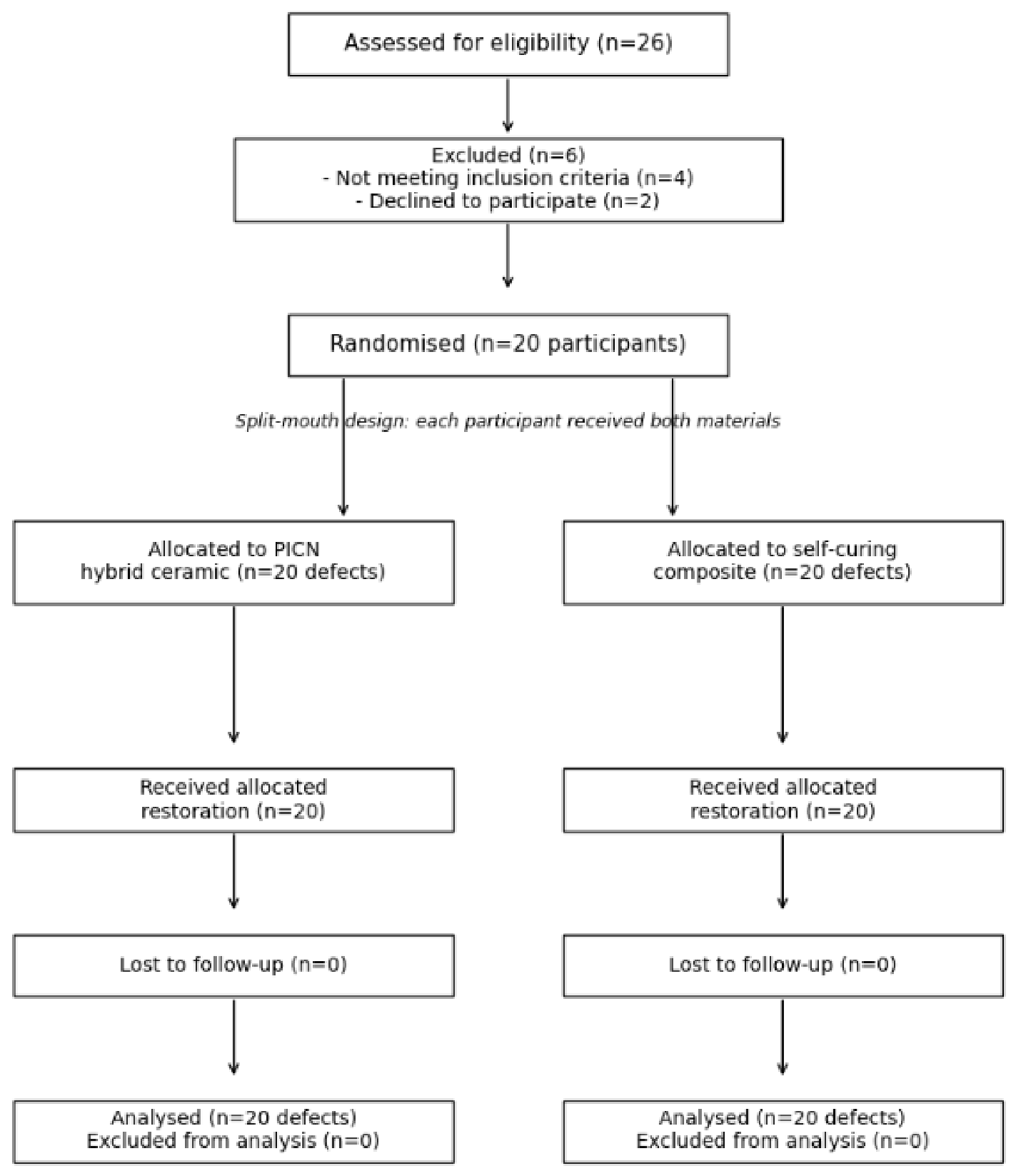
Figure 2.
Kaplan–Meier survival analysis. Shaded areas represent 95% confidential intervals (CI). PICN = polymer-infiltrated ceramic network.
Figure 2.
Kaplan–Meier survival analysis. Shaded areas represent 95% confidential intervals (CI). PICN = polymer-infiltrated ceramic network.
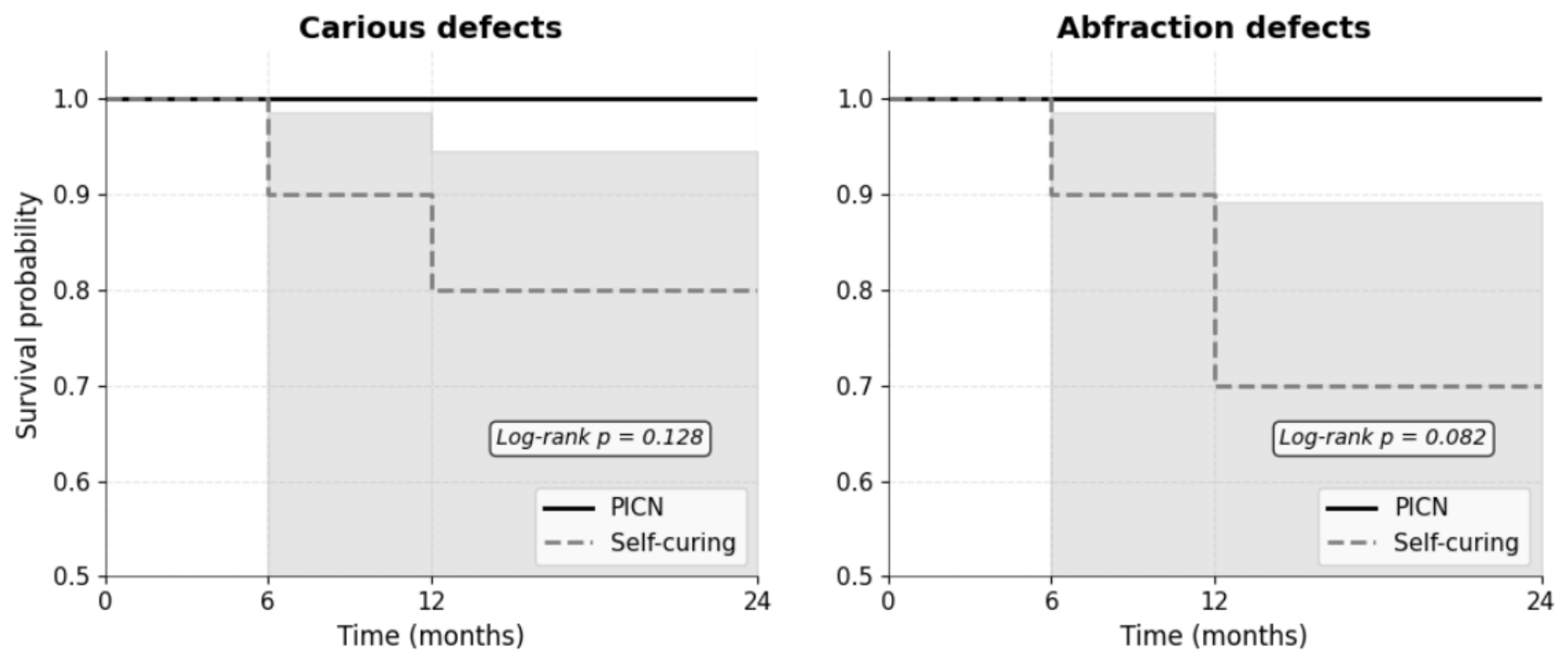

Table 1.
Baseline characteristics (n = 20 patients).
| Characteristic | Total (n = 20) |
|---|---|
| Age (years), mean ± standard deviation (SD) | 34.2 ± 8.7 |
| Female/Male | 14/6 |
| Professional experience (years) | 18.4 ± 6.2 |
| OHI S, median (Q1–Q3) | 1.5 (1.2–2.0) |
| DMFT, median (Q1–Q3) | 5.0 (3.0–8.0) |
| Defect type distribution: carious/abfraction (within the 40 defects) | 21/19 |
| Defect type per material | PICN—carious 11, abfraction 9; self curing—carious 10, abfraction 10 |
Table 2.
Marginal integrity by defect type over 24 months (number of restorations, %).
| Defect type | Material | Time | Alpha | Bravo | Charlie | Delta | Failure Rate (%) | 95% CI | p Value 1 |
|---|---|---|---|---|---|---|---|---|---|
| Carious (n = 21) | PICN (n = 11) | 6 m | 11 (100) | 0 | 0 | 0 | 0 | 0.0–28.5 | — |
| 12 m | 10 (91) | 1 (9) | 0 | 0 | 0 | 0.0–28.5 | — | ||
| 24 m | 10 (91) | 1 (9) | 0 | 0 | 0 | 0.0–28.5 | 0.083 2 | ||
| Self-curing (n = 10) | 6 m | 9 (90) | 1 (10) | 0 | 0 | 0 | 0.0–30.1 | — | |
| 12 m | 8 (80) | 1 (10) | 1 (10) | 0 | 10 | 0.5–40.4 | — | ||
| 24 m | 7 (70) | 1 (10) | 1 (10) | 1 (10) | 20 | 5.7–51.0 | — | ||
| Abfraction (n = 19) | PICN (n = 9) | 6 m | 9 (100) | 0 | 0 | 0 | 0 | 0.0–33.6 | — |
| 12 m | 9 (100) | 0 | 0 | 0 | 0 | 0.0–33.6 | — | ||
| 24 m | 8 (89) | 1 (11) | 0 | 0 | 0 | 0.0–33.6 | 0.052 2 | ||
| Self-curing (n = 10) | 6 m | 9 (90) | 1 (10) | 0 | 0 | 0 | 0.0–30.1 | — | |
| 12 m | 7 (70) | 2 (20) | 1 (10) | 0 | 10 | 0.5–40.4 | — | ||
| 24 m | 5 (50) | 2 (20) | 2 (20) | 1 (10) | 30 | 11.9–54.3 | 0.031 3 |
PICN = polymer-infiltrated ceramic network; CI = confidential interval. 1 p-values are adjusted for two co-primary outcomes using the Holm–Bonferroni method (α = 0.025). 2 Fisher’s exact test comparing PICN vs. self-curing for the same defect type at 24 months (PICN failure 0% vs. self-curing failure rate, p = 0.083 for carious, p = 0.052 for abfraction—not significant, but trend consistent). 3 Chi-square test comparing failure rates between carious and abfraction defects within self-curing group at 24 months. Exploratory comparison only; p-value is uncorrected for multiple testing. After applying the Holm–Bonferroni correction for the two co-primary outcomes (α = 0.025), this difference is not statistically significant.
Table 3.
Dye penetration (positive) by defect type over 24 months.
| Defect type | Material | 6 Months | 12 Months | 24 Months |
p Value (24 Months) 1 |
|---|---|---|---|---|---|
| Carious | PICN | 0/11 (0%) | 0/11 (0%) | 1/11 (9%) | 0.317 |
| Self curing | 1/10 (10%) | 2/10 (20%) | 3/10 (30%) | ||
| Abfraction | PICN | 0/9 (0%) | 1/9 (11%) | 1/9 (11%) | 0.048 |
| Self curing | 1/10 (10%) | 4/10 (40%) | 6/10 (60%) |
1 McNemar’s test for paired comparison within defect type (PICN vs. self-curing at 24 months). Based on 9 evaluable pairs for abfraction defects. p-values are adjusted for two co-primary outcomes using the Holm–Bonferroni method (α = 0.025).
Disclaimer/Publisher’s Note: The statements, opinions and data contained in all publications are solely those of the individual author(s) and contributor(s) and not of MDPI and/or the editor(s). MDPI and/or the editor(s) disclaim responsibility for any injury to people or property resulting from any ideas, methods, instructions or products referred to in the content. |
© 2026 by the authors. Licensee MDPI, Basel, Switzerland. This article is an open access article distributed under the terms and conditions of the Creative Commons Attribution (CC BY) license (http://creativecommons.org/licenses/by/4.0/).
Copyright: This open access article is published under a Creative Commons CC BY 4.0 license, which permit the free download, distribution, and reuse, provided that the author and preprint are cited in any reuse.


