
Submitted:
27 April 2026
Posted:
28 April 2026
You are already at the latest version
Abstract
IEEE 802.11be (Wi-Fi 7) extends wireless network capability through wider channels, higher-order modulation, and tri-band operation; however, realised indoor performance is strongly governed by propagation constraints. This study , therefore, presents a controlled empirical assessment of Wi-Fi 7 behaviour in a multi-storey university building, examining throughput and received signal strength across 2.4-, 5-, and 6 GHz bands using a single-link radio propagation measurement. Six experimental scenarios were designed to isolate dominant indoor impairments, including distance variation, wall penetration, line-of-sight obstruction, floor separation, antenna orientation, and microwave interference. Measured RSS values were evaluated against free-space, two-ray, and log-distance shadowing models using mean absolute error as the comparison metric. Results show that 2.4 GHz retains greater penetration at lesser capacity, 6 GHz offers the maximum short-range throughput under clear line-of-sight but rapidly deteriorates with structural attenuation. Performance in all bands is greatly diminished by multi-wall blockage and line-of-sight loss. A single propagation model cannot adequately capture the divergence introduced by increasing distance and indoor attenuation, while short-range line-of-sight conditions more closely resemble deterministic predictions in terms of measured RSS alignment. Overall, the results highlight the trade-off between Wi-Fi 7’s capacity and coverage, and provide helpful advice for choosing frequencies, positioning access points, and organizing indoor coverage. The research findings provide insights into the practical deployment of next-generation Wi-Fi in the multi-story buildings and residential houses.
Keywords:
IEEE 802.11be
; indoor radio propagation
; received signal strength
; throughput
; path loss
; empirical performance evaluation
1. Introduction and Background
Wireless local area networks (WLANs) continue to evolve in response to increasing demands for higher data rates, lower latency, and improved reliability in indoor environments. The latest generation standard, 802.11be—commercially referred to as Wi-Fi 7—extends the capabilities of previous WLAN technologies through the use of wider channel bandwidths, higher-order modulation schemes, and support for simultaneous operation across multiple frequency bands. These enhancements are designed to enable multi-gigabit throughput and improved user experience in dense and performance-sensitive environments such as offices, campuses, and commercial buildings. While the protocol-level features of Wi-Fi 7 are well defined in the standard, its practical performance is fundamentally constrained by indoor radio propagation conditions. Signal attenuation caused by walls, floors, furniture, and structural materials, as well as multipath fading and interference from co-located devices, often leads to substantial deviation from idealised theoretical behaviour. Propagation challenges become increasingly pronounced at higher frequencies, particularly in the newly allocated 6 GHz band, where penetration losses and line-of-sight dependency can significantly influence link stability and throughput. As a result, empirical measurement of Wi-Fi 7 performance in realistic indoor environments is essential for understanding its true operational characteristics. Existing indoor WLAN studies have largely focused on earlier IEEE 802.11 variants or on simulation-based evaluation of emerging standards. Although these works provide valuable insight into general propagation trends, they do not adequately capture the combined effects of modern hardware, contemporary building structures, and multi-band operation introduced with 802.11be. In particular, there is a lack of publicly available measurement campaigns that systematically compare throughput and received signal strength across the 2.4 GHz, 5 GHz, and 6 GHz bands under controlled yet realistic indoor conditions. This gap limits the ability to validate analytical propagation models and to inform effective deployment strategies for next-generation WLANs.
This paper presents a comprehensive, single-link propagation-driven performance study of Wi-Fi 7 performance conducted in a multi-storey university building. A series of controlled experiments were designed to isolate the impact of key indoor propagation factors, including transmitter–receiver separation, device orientation, wall and floor penetration, line-of-sight obstruction, and microwave interference. Throughput and received signal strength (RSS) were recorded using commercial Wi-Fi 7 hardware operating across all supported frequency bands. To assess the suitability of commonly used analytical approaches, measured signal levels were further compared against free-space, two-ray ground reflection, and shadowing-based propagation models. The contributions of this work are threefold. First, it provides an extensive set of real-world Wi-Fi 7 measurements across multiple indoor propagation scenarios. Second, it offers a comparative analysis of band-dependent performance trade-offs between coverage robustness and achievable throughput. Finally, it evaluates the accuracy of classical propagation models when applied to contemporary Wi-Fi 7 deployments, highlighting their limitations and practical applicability. The results offer insight into the behaviour of 802.11be in realistic indoor environments and support informed design and deployment of future high-capacity WLAN systems.
Understanding performance and reliability in modern Wi-Fi systems requires examining both environmental influences and protocol-level mechanisms. An empirical investigation in [1] evaluates how human mobility alters indoor link throughput across different floors and room configurations. The study distinguishes between static, periodic, and random movement patterns, showing that while fluctuations are observable, throughput degradation caused solely by people movement is often less dominant than structural attenuation or placement effects. These findings highlight that environmental geometry and obstruction characteristics remain primary determinants of sustained throughput. Performance prediction in dense next-generation WLANs has increasingly moved toward data-driven modeling. The ATARI framework proposed in [2] formulates throughput estimation as a graph learning problem, where device relationships and channel interactions are preserved through convolutional layers. By embedding topology-aware features into the prediction process, the model demonstrates improved accuracy compared to independent-feature baselines, particularly under channel bonding and high-density conditions. This approach underscores the value of relational modeling when interference coupling cannot be approximated as independent noise.
Industrial adoption of Wi-Fi technologies demands consistent performance under heterogeneous interference and deployment conditions. A comparative experimental assessment in [3] evaluates multiple IEEE 802.11 generations across residential, laboratory, and industrial environments. The study reveals that band selection, particularly operation in the 6 GHz spectrum, significantly influences throughput stability and latency metrics. However, early Wi-Fi 7 implementations do not uniformly outperform mature Wi-Fi 6/6E systems, emphasizing that practical gains depend on hardware optimization and firmware maturity rather than specification alone. Low-latency deterministic communication over WLANs has been explored through integration of time-sensitive networking principles. The analysis presented in [4] examines how 802.11be features such as multi-link operation and coordinated scheduling may support bounded-latency traffic. While contention-based channel access inherently introduces randomness, the paper outlines architectural adaptations capable of narrowing delay variance. This work bridges wired Time-Sensitive Networking (TSN) concepts with wireless evolution toward Wi-Fi 7. A broader technical consolidation of IEEE 802.11ax advancements is provided in [5], which categorizes improvements across PHY and MAC dimensions, including Orthogonal Frequency Division Multiple Access (OFDMA), spatial reuse, target wake time, and uplink multi-user transmission. The survey clarifies how these mechanisms interact under dense deployments and identifies unresolved challenges in scheduling fairness and cross-feature optimization. Such structured analysis provides context for evaluating incremental improvements against system-level performance objectives.
Accurate signal characterization in indoor WLANs remains a foundational research problem. The study in [6] investigates kriging-based geostatistical interpolation for estimating Wi-Fi Received Signal Strength Indicator (RSSI) in complex indoor environments. Instead of deterministic propagation models, spatial correlation among sampled signal measurements is leveraged to construct predictive coverage maps. The results demonstrate that kriging can achieve reliable RSSI estimation while reducing modeling overhead in multi-floor and obstruction-rich environments. Mobility further complicates WLAN performance behavior. The empirical analysis presented in [7] evaluates bi-directional Wi-Fi communication between mobile robots and access points under varying placements and frequency bands. Experimental results show that throughput stability and retransmission rates are highly sensitive to AP positioning and band selection. The study highlights that infrastructure placement decisions directly influence latency-sensitive robotic operations. Despite its theoretical advantages, Wi-Fi 7 performance in indoor environments remains constrained by propagation loss, structural attenuation, and interference. Existing studies often focus either on protocol-level enhancements or simplified propagation assumptions, leaving a gap in experimentally validated, scenario-driven analysis.
This work addresses the following limitations observed in current literature:
- Lack of controlled empirical validation across all three Wi-Fi bands under identical conditions.
- Insufficient explanation of propagation-induced anomalies in RSS and throughput behaviour,
- Over-reliance on simplified propagation models without evaluating their validity in modern indoor deployments.
Accordingly, this study adopts a single-link propagation measurement approach supported by analytical modelling to systematically evaluate Wi-Fi 7 behaviour under realistic indoor conditions.
1.1. Research Challenges and Study Contribution
The introduction of 802.11be fundamentally alters the operating landscape of indoor wireless networks by combining higher carrier frequencies, wider channels, and advanced link aggregation techniques. These changes introduce a set of open challenges that are not sufficiently addressed by prior WLAN studies and motivate the experimental investigation presented in this paper.
1.1.1. Research Questions and Challenges
In this section we discuss three main research challenges that we address in this study.
- 1.
-
What limits the achievable indoor throughput of Wi-Fi 7 across three frequency bands?Wi-Fi 7 simultaneously utilises frequency bands that differ markedly in their propagation behaviour. A central challenge is understanding how indoor phenomena, such as signal attenuation with distance, material penetration, and spatial deployment geometry, constrain throughput in each band. The relationship between raw physical-layer capability and realised application-layer performance is non-trivial, particularly when higher-frequency links offer greater capacity but reduced tolerance to environmental loss. Identifying where and why throughput collapses under realistic indoor conditions remains an unresolved problem.
- 2.
-
What mechanisms drive performance degradation when line-of-sight is impaired or external interference is present?Indoor wireless links rarely operate under ideal visibility or isolation. Obstructions introduced by building layouts, coupled with interference from everyday electronic appliances, produce complex channel conditions that are difficult to characterise analytically. A key challenge lies in separating the effects of geometric blockage, multipath fading, and interference-induced noise to determine which mechanisms dominate link degradation in practice. Without this understanding, predicting Wi-Fi 7 reliability in operational environments remains highly uncertain.
- 3.
-
What analytical propagation models remain valid for contemporary Wi-Fi 7 indoor deployments?Propagation models commonly used in WLAN design were largely developed for earlier standards and lower operating frequencies. Their continued relevance for Wi-Fi7, particularly in multi-storey indoor environments, is unclear. Simplifying assumptions regarding line-of-sight availability, reflection behaviour, and signal variance may no longer hold as frequency increases and deployment scenarios become more complex. A critical challenge is determining which modelling approaches retain predictive value when confronted with empirical Wi-Fi 7 measurements, and where model assumptions begin to diverge from observed behaviour.
1.1.2. Study Contributions
This work should be interpreted as a single-link propagation-driven performance study rather than a full-scale network evaluation. The controlled environment enables isolation of propagation effects without the confounding influence of contention and dynamic traffic. The key contributions of this paper are highlighted below:
- 1.
- We examine the effect of indoor propagation environments on Wi-Fi 7 link throughput. To this end, we conducted an extensive radio propagation measurements (field experiment) using Wi-Fi 7 cards and access points in the University multi-story building.
- 2.
- We investigated the effect of increasing distance, line-of-sight obstruction, wall separation, floors, antenna orientation, and microwave interference on system performance.
- 3.
- We explore the effect of Wi-Fi 7 tri-band (2.4-, 5-, and 6 GHz) on system performance. To this end, we measure the link throughput and RSS values for all six scenarios mentioned above for comparative analysis.
- 4.
- We investigate the theoretical propagation models that best fit the measured performance. To achieve this, we compare the RSS measured values with each of the four models (Free-space, Two-Ray Ground, Shadowing, Path Loss, and overall Shadowing Model) considered in the study.
2. Related Work
Industrial deployment constraints introduce additional reliability and latency requirements beyond enterprise scenarios. The multi-environment experimental campaign in [3] compares 802.11n through 802.11be across residential, laboratory, and industrial settings. Measured round trip time (RTT), jitter, throughput, and packet loss results indicate that Wi-Fi 6/6E provides superior stability, particularly in the 6 GHz band under controlled interference conditions. However, early Wi-Fi 7 hardware does not consistently outperform mature Wi-Fi 6 implementations, highlighting the gap between specification potential and practical realization. Collectively, prior research addresses signal modeling, mobility-aware experimentation, protocol-level efficiency improvements, and decentralized learning paradigms. However, integrating spatial signal estimation, mobility dynamics, multi-band operation, and federated multi-agent coordination into a unified experimental framework remains limited. This motivates further cross-layer investigations that combine propagation awareness with collaborative learning for next-generation Wi-Fi systems.
Accurate spatial characterization of indoor Wi-Fi signals remains a central challenge for network planning and coverage prediction. The Krisging approach is a geostatistical interpolation method for calculating RSSI values in complicated interior situations, according to a study by Petrus Joubert et al. [6]. Instead of relying on deterministic wall-attenuation models, the authors exploit spatial correlation properties of measured samples to construct coverage maps from limited survey points [6]. Their findings demonstrate that kriging provides statistically consistent RSSI estimation while reducing modeling complexity in multi-floor and interference-rich office spaces. Wireless performance under mobility introduces additional variability that static coverage models cannot capture. In [7], a Robot Operating System-based framework is proposed to measure throughput, delay, retransmissions, and RSSI in bidirectional communication between mobile robots and base stations. By comparing 2.4 GHz and 5 GHz bands for various access point placements, the study reveals how robot motion, channel selection, and AP positioning jointly influence stability and latency. The results highlight that physical placement of networking infrastructure significantly affects real-time robotic operations.
Enhanced Multi-Link Operation (MLO) is a defining capability of 802.11be, yet its practical behavior differs substantially between multi-radio and single-radio implementations. Avallone and Imputato analyze the enhanced multi-link single-radio feature and clarify how coordination and switching constraints shape real throughput and latency outcomes [8]. Their discussion highlights that performance gains depend on how the MAC schedules link usage under traffic bursts and contention, rather than on PHY peak rates alone. This perspective is valuable for indoor evaluation studies because it motivates measuring link-level utilization and access dynamics alongside end-to-end throughput [8]. Data-driven control has also been proposed for MLO parameter tuning when analytical optimization becomes intractable. Wu et al. [9] formulate multi-link frame aggregation length selection as a learning problem and propose a deep reinforcement learning approach to adapt aggregation under varying link conditions. By modeling the interaction among multiple links and the aggregation decision, the method targets stable goodput improvements without requiring fixed heuristics per band or channel state. The study strengthens the case that next-generation WLAN performance may increasingly hinge on adaptive, policy-based control rather than static configuration [9].
With Wi-Fi 6E and Wi-Fi 7 relying heavily on 6 GHz operation, understanding real deployment interference characteristics has become a priority. Dogan-Tusha et al. present an extensive dense indoor measurement campaign in 6 GHz and quantify leakage to outdoor reception, building entry loss, and the visibility of indoor BSSIDs outside buildings [10]. Their results suggest that only a small fraction of indoor deployments are detectable outdoors under typical conditions, informing coexistence concerns for incumbents and policy design. For indoor throughput studies, these findings contextualize why 6 GHz often appears “cleaner” in practice and why interference conclusions should be tied to measurement scale and environment density [10]. Complementary to system-level protocol advances, learning can also be used to compress or quantize feedback itself. Deshmukh et al. introduce iFOR, which applies unsupervised learning (K-means) to reduce compressed beamforming feedback by mapping reports to a bounded candidate set [11]. Their simulations show that reducing feedback bits can significantly improve goodput in high-SNR regimes, with trade-offs emerging as payload length increases. The results motivate a measurement mindset where goodput must be analyzed jointly with feedback/control cost, especially for EHT-era WLAN links [11]. Collectively, prior work spans spatial interpolation, mobility-aware performance analysis, protocol-level standard evolution, and industrial benchmarking. However, an integrated framework that unifies environmental propagation modeling, mobility-induced dynamics, and multi-band experimental validation remains limited. This motivates a cross-layer experimental methodology that bridges geostatistical signal modeling with next-generation Wi-Fi performance evaluation.
Early work on Wi-Fi Fine Time Measurement looks closely at how raw timing data can be shaped into something more reliable, showing that careful handling of noise and propagation effects can make a noticeable difference to ranging accuracy indoors [12]. In a similar vein, studies focused on smartphone localisation suggest that calibration should not be treated as a one-off step. When it evolves alongside user movement, it tends to reflect real signal behaviour more faithfully and leads to steadier positioning outcomes [13]. Broader survey research has started to look at positioning technologies together rather than in isolation, pointing out that UWB and Wi-Fi RTT offer different strengths that can be combined rather than compared directly [14]. At the same time, work using Wi-Fi CSI takes a different direction by treating signal variation itself as useful information, especially when deep learning is used to interpret subtle changes caused by human activity in shared spaces [15]. From a networking perspective, comparisons across Wi-Fi generations show gradual improvements in stability and responsiveness, although these gains are not always consistent once real environmental interference is taken into account [16]. More recent approaches move away from heavily labelled datasets, with self-supervised methods showing that meaningful spatial patterns can be learned directly from signal behaviour without extensive manual input [17]. Review studies still point out that, despite the variety of techniques available, common issues such as multipath effects and scalability remain difficult to resolve in practice [18]. This is particularly visible in RSSI-based systems, where changing environments can quickly disrupt signal consistency and reduce positioning accuracy in ways that are hard to predict [19]. To address these limitations, some work combines Wi-Fi with additional sensing methods, showing that blending sources can help maintain reliability in more challenging conditions such as obstructed environments [20]. More recently, AI-based methods have started to show that careful signal modelling and clustering can achieve strong localisation performance without relying on complex infrastructure setups [21]. Taken together, the literature suggests a gradual change in direction. Earlier efforts largely tried to refine individual measurements, whereas newer work leans toward combining techniques and making systems more adaptable. Even so, indoor positioning still struggles with unpredictable signal behaviour and environmental change. This points toward a need for approaches that can adjust over time rather than depend on fixed assumptions about how signals behave in a given space. Table 1 summarises the key industrial Wi-Fi studies and highlights their main evaluation focus, methodologies, and limitations.
3. PHY/MAC Configuration and Experimental Parameters
To ensure reproducibility and accurate interpretation of the measured results, the physical (PHY) and MAC layer configuration of the Wi-Fi 7 testbed is explicitly defined. Unlike prior descriptive studies, this work reports all parameters that directly influence throughput behaviour.

Table 2.
Wi-Fi 7 PHY/MAC Configuration
| Parameter | Configuration |
|---|---|
| Standard | IEEE 802.11be (Wi-Fi 7) |
| Channel Bandwidth | 80 MHz (2.4/5 GHz), 160 MHz (6 GHz) |
| Modulation (MCS) | Adaptive (auto-rate) |
| Spatial Streams | 2 × 2 MIMO |
| Guard Interval | 0.8 s |
| Multi-Link Operation (MLO) | Disabled (single-link operation) |
| Traffic Type | TCP (SMB file transfer) |
| Payload Size | 1.17 GB file transfer |
| Operating Mode | Infrastructure (AP–Client) |
It is important to note that multi-link operation (MLO) and 320 MHz bandwidth were not enabled in the current hardware configuration. Therefore, the observed performance reflects a practical early-stage Wi-Fi 7 deployment rather than the theoretical peak capabilities defined in the standard.
3.1. Measurement testbed and resources used
All measurements were conducted using commercially available 802.11be hardware operating in the 2.4 GHz, 5 GHz, and 6 GHz bands (Wireless card: Intel AX1775; Access point: ASUS BE9700 RT-BE92U). The IEEE 802.11be introduces Extremely High Throughput (EHT) mechanisms [22]. A fixed access point was positioned at a predefined reference location within the indoor test environment, while the receiver was relocated according to the experimental scenario under investigation.
For each scenario, including orientation change, wall penetration, distance variation, line-of-sight (LOS) obstruction, and multi-floor separation, throughput measurements were recorded over multiple trials to reduce transient fluctuations. The average throughput T for each configuration was computed as
where denotes the instantaneous throughput sample and N represents the number of repeated measurements.
Similarly, the received signal strength was recorded in decibel-milliwatts (dBm), and the average RSS value was calculated as
where denotes the measured RSS for trial i.
All measurements were taken under steady-state channel conditions to minimise temporal variability. Environmental factors such as moving obstacles and dynamic user traffic were avoided during data acquisition to ensure controlled evaluation of propagation effects.
3.2. Propagation Model Formulation
To interpret the measured RSS behaviour, three propagation models were used for comparison: the free-space model, the two-ray ground reflection, and the log-distance shadowing model.
3.2.1. Free-Space Model
The free-space model assumes unobstructed propagation and represents the received power at distance d as
where is the transmit power (dBm), and denote the transmitter and receiver antenna gains (dBi), respectively. The free-space path loss is defined as
with d in kilometres and carrier frequency f in MHz.
3.2.2. Two-Ray Ground Reflection Model
The two-ray model accounts for both direct and ground-reflected signal components. Under the far-field approximation, the received power can be expressed as
where and represent the heights of the transmitting and receiving antennas, respectively.
This formulation captures the constructive and destructive interference effects that arise due to multipath propagation in indoor environments.
3.2.3. Log-Distance Shadowing Model
Indoor propagation is significantly influenced by structural obstructions and material absorption. The log-distance shadowing model extends deterministic path loss by introducing a stochastic component:
where:
- is a reference distance,
- n denotes the path loss exponent,
- is a zero-mean Gaussian random variable with standard deviation .
The parameters n and were empirically determined from measured RSS data using regression fitting.
3.3. Model Evaluation Metric
To assess the agreement between measured and predicted RSS values, the mean absolute error (MAE) was calculated as
where M denotes the number of measurement locations.
This metric quantifies the average deviation between empirical data and model predictions across the tested scenarios.
3.4. Experimental Scope Alignment
Each experimental configuration was designed to isolate a single dominant propagation impairment. By maintaining consistent hardware configuration and environmental conditions across tests, observed variations in throughput and RSS can be attributed primarily to geometric separation, obstruction count, or vertical penetration effects rather than hardware variability. The resulting dataset provides a controlled basis for evaluating the suitability of classical propagation models for contemporary Wi-Fi 7 indoor deployments.
4. Results and Analysis
This section examines the empirical behaviour of 802.11be links under a range of indoor propagation conditions. Rather than reporting numerical outcomes in isolation, the analysis focuses on identifying dominant performance trends and explaining their physical causes across frequency bands. The floor layout and measurement locations for distance-dependent throughput is illustrated in Figure 1.
4.1. Observed Sensitivity to Device Orientation
Short-range measurements were first used to evaluate whether the relative facing direction of transmitter and receiver introduces measurable performance variation. Across all bands, throughput remained largely consistent irrespective of whether devices were aligned or oppositely oriented. Minor fluctuations were observed, but these remained within a narrow range when compared to losses introduced by distance or obstructions.
This behaviour suggests that contemporary Wi-Fi 7 client hardware, which employs integrated antennas with near-isotropic radiation characteristics, reduces the practical importance of orientation effects in indoor scenarios. As a result, orientation was not found to be a limiting factor for link performance within the tested environment. The resulting throughput variation across the three operating bands is presented in Figure 2.
4.2. Microwave Interference Characterisation
Microwave interference experiments were conducted using the 2.4 GHz band operating on Channel 6 (2.437 GHz). The observed degradation is attributed to spectral overlap with microwave emissions centred around 2.45 GHz. The impact on 5 GHz and 6 GHz bands is comparatively lower due to spectral separation, confirming that interference effects are frequency-dependent rather than uniformly distributed. When an active microwave source was introduced into the propagation path, a clear reduction in throughput was observed across all operating bands. We find that at 2.4-, 5-, and 6 GHz, the 802.11be link throughput decreases by 52.6%, 24.5%, and 9.2%, respectively. The most affected of the three frequency bands is 2.4 GHz, while the least affected is 6 GHz. This is because Wi-Fi 7’s throughput performance at 2.4 GHz is impacted by microwave ovens running at the ISM band (2.4 GHz), which produce greater emissions of 2.450–2.458 GHz. In contrast, 6 GHz performs better under microwave oven operating conditions. It should be noted that the microwave interference experiment was conducted relative to the baseline configuration at the same separation distance (strong signal strength). The effect of microwave operating (turning-on) condition on 802.11be throughput is shown in Table 3.
Each experiment was repeated three times, and the reported values correspond to the mean throughput and RSS. Variability is quantified using standard deviation, and confidence intervals are included in all graphical representations. This approach reduces measurement uncertainty and improves the reliability of comparative analysis. The results indicate that while lower-frequency bands provide reduced peak capacity, they retain greater tolerance to broadband interference sources commonly found in indoor environments. In contrast, higher-frequency links trade robustness for capacity, making them more vulnerable to transient noise even at short separation distances.
4.3. Impact of Wall-Induced Attenuation
Introducing structural barriers between communicating nodes resulted in substantial throughput degradation that intensified with each additional wall. The decline was not proportional to distance alone, indicating that material absorption and multipath disruption play a significant role in limiting indoor Wi-Fi 7 performance. The throughput performance across different wall obstructions for all operating bands is illustrated in Figure 3. Links operating at 6 GHz achieved the highest throughput in minimally obstructed scenarios but exhibited rapid deterioration as obstructions accumulated. Conversely, 2.4 GHz links maintained connectivity through multiple walls, though at significantly reduced data rates. These outcomes highlight the asymmetric trade-off between penetration capability and throughput efficiency across bands.
As illustrated in Figure 4, to improve clarity of the experimental configuration, a schematic representation of the indoor measurement environment is presented in Figure 4. Unlike photographic illustrations, this diagram explicitly defines the spatial layout, measurement path, and key propagation elements affecting Wi-Fi 7 performance. The access point (AP) is positioned at a fixed reference location, while the client device is moved incrementally along a corridor to evaluate distance-dependent behaviour under controlled line-of-sight (LOS) conditions. Measurements were conducted at predefined distances of 5 m, 10 m, 15 m, 20 m, and 25 m. Structural elements such as walls and partitions are also indicated to reflect realistic indoor propagation effects. This representation aligns directly with the collected experimental data and ensures reproducibility of the measurement setup.
4.4. Distance-Driven Throughput Study
As transmitter–receiver separation increased under clear visibility conditions, throughput declined across all frequency bands, though the rate of degradation varied. Higher-frequency links demonstrated superior performance at short and moderate distances but experienced a steeper decline beyond a critical range. Lower-frequency bands showed comparatively stable performance over extended distances, albeit with lower maximum throughput. This divergence illustrates the inherent capacity–coverage tension present in multi-band Wi-Fi 7 deployments and underscores the importance of distance-aware band utilisation strategies. Table 4 compares the throughput variation between 5m and 25m under strong RSS conditions, highlighting the relative performance stability across the three operating bands. We observe that Wi-Fi 7 throughput drops significantly at 6GHz band for a Tx-Rx separation of 25 m. In contrast, Wi-Fi 7 maintains stable throughput performance at both 2.4- and 5 GHz for a distance of 25m.
4.5. Impact of Line-of-Sight Disruption
Line-of-sight (LOS) deviation refers to lateral displacement of the receiver from the direct propagation path. In this study:
- 2 m deviation represents partial obstruction within corridor boundaries,
- 5 m deviation represents complete obstruction involving structural walls.
A schematic top-view representation of the experimental geometry is provided to ensure reproducibility. The removal of direct line-of-sight produced the most severe performance impact observed during experimentation. Even small lateral offsets that obstructed the direct propagation path led to drastic throughput reduction or complete link failure, particularly at higher frequencies. These findings demonstrate that reflected and diffracted components alone are insufficient to sustain reliable high-throughput Wi-Fi 7 links in corridor-based indoor environments. Line-of-sight availability therefore emerges as a primary determinant of link viability, especially for 5 GHz and 6 GHz operation.
Table 5 summarizes the measured performance degradation when line-of-sight (LOS) was obstructed at 25 m, based on experimental data reported in our study.
4.6. Vertical Separation and Floor Penetration Effect
Measurements conducted across multiple floors revealed that vertical separation introduces attenuation that exceeds expectations based on horizontal distance metrics. Reliable communication was generally confined to a single-floor offset, with higher-frequency links failing to establish stable connections beyond this range. Although the 2.4 GHz band demonstrated superior penetration capability, achievable throughput remained limited, suggesting that vertical coverage in multi-storey buildings cannot rely solely on frequency selection and instead requires additional infrastructure support. Table 6 summarizes the impact of vertical separation on Wi-Fi 7 performance based on the floor experiment dataset reported in our study.
4.7. Significance of High-Frequency Operation (6 GHz)
The 6 GHz spectrum represents the most critical advancement in Wi-Fi 7, offering significantly wider channels and reduced legacy interference. However, its propagation characteristics differ substantially from lower bands. Due to higher free-space path loss and increased sensitivity to obstruction, signal attenuation in 6 GHz environments grows rapidly with distance and structural barriers. Experimental observations confirm that while 6 GHz achieves the highest throughput under line-of-sight conditions, its performance degrades sharply under multi-wall and floor penetration scenarios. This highlights a fundamental trade-off between capacity and coverage, which must be considered in practical deployments.
4.8. Interpretation of RSS Variability Across Wall Scenarios
An unexpected increase in RSS was observed when transitioning from one to two wall obstructions, followed by a decrease with further obstruction. This behaviour can be attributed to constructive multipath interference, where reflected signal components combine in phase at specific receiver locations. Indoor environments are characterised by rich scattering due to walls, furniture, and structural materials. Under certain geometric configurations, additional reflections may temporarily enhance received signal strength rather than attenuate it. However, as obstruction increases further, absorption and diffraction losses dominate, resulting in the expected signal degradation. This observation highlights the limitation of deterministic propagation assumptions and reinforces the need for statistical or hybrid modelling approaches. The wall penetration experiment revealed non-linear variations in received signal strength (RSS) that cannot be explained solely by monotonic attenuation models. While an overall decrease in RSS is expected with increasing obstruction, the measured results indicate irregular fluctuations across different wall configurations. Table 7 summarises the measured RSS and throughput across one, two, and three wall scenarios. For the 2.4 GHz band, RSS decreased from -27.67 dBm (1 wall) to -45.33 dBm (2 walls) and further to -55 dBm (3 walls), which is consistent with progressive attenuation. A similar monotonic degradation trend is observed for the 5 GHz band, where RSS declined from -33 dBm to -52.33 dBm and then to -64.67 dBm. However, the 6 GHz band exhibits a deviation from this trend. The RSS changes from -26.67 dBm (1 wall) to -29.33 dBm (2 walls), indicating only a marginal reduction, before dropping significantly to -47 dBm at three walls. This behaviour suggests that attenuation does not increase uniformly with additional obstructions at higher frequencies.
The observed irregularity, particularly in the 6 GHz band, can be attributed to multipath propagation effects within the indoor environment. At specific spatial configurations, reflected signal components from walls, floors, and surrounding structures may combine constructively at the receiver, temporarily offsetting expected attenuation. This explains the relatively small RSS variation between one and two wall scenarios.
However, as the number of obstructions increases further, absorption losses and scattering effects dominate, leading to the sharp degradation observed in the three-wall scenario. This transition highlights the limitation of deterministic propagation assumptions in indoor environments. Additionally, the results demonstrate that RSS alone does not fully capture performance behaviour. For example, despite comparable RSS values between one-wall and two-wall scenarios at 6 GHz, throughput remains sensitive to channel quality, interference, and multipath-induced fading. Overall, the findings confirm that indoor signal propagation is highly environment-dependent and influenced by complex interactions between reflection, diffraction, and absorption. Consequently, simplified linear attenuation models are insufficient to fully characterise RSS behaviour in multi-obstruction scenarios, particularly at higher frequencies such as 6 GHz.
5. Indoor Propagation Modelling Framework
Classical propagation models were evaluated against measured RSS data; however, their applicability varies significantly in indoor environments.
5.1. Limitations of Two-Ray Model and adopted models
The two-ray ground reflection model assumes a dominant reflection path and far-field conditions, which are rarely satisfied in indoor environments. Therefore, its use is limited to comparative baseline analysis rather than accurate prediction. To improve modelling fidelity, the following indoor-appropriate models are considered:
- Close-In (CI) Model: Uses a reference distance of 1 m and captures realistic attenuation trends.
- Log-Distance Shadowing Model: Accounts for environmental variability through path-loss exponent adjustment.
- Multi-Wall/Floor (MWF) Model: Incorporates attenuation due to structural elements.
These models provide a more physically consistent representation of indoor propagation compared to simplified deterministic approaches.
5.2. Best-Fit Between Measured Data and Propagation Models
Comparison between measured RSS values and analytical propagation models revealed consistent divergence from idealised predictions. Table 8 presents the Mean Absolute Error (MAE) between measured RSS values and analytical model predictions for the distance study (5–25 m), calculated directly from the experimental dataset reported in the study.
Free-space model systematically overestimated received power, particularly in obstructed and multi-floor scenarios. The two-ray model improved accuracy at short ranges but failed to capture the variability introduced by complex indoor structures. The correlation between measured RSS and analytical model predictions at 2.4 GHz, 5 GHz, and 6 GHz under distance-based line-of-sight conditions is shown in Figure Section 5.2. Although local fluctuations show multipath influence beyond simple geometric spreading, the measured signal in the 2.4 GHz range shows steady attenuation with distance. Although the signal decay for 5 GHz shows a more pronounced downward trend, there is a discernible discrepancy between the measured behavior and deterministic predictions at mid-range separation. The largest sensitivity to increasing distance is seen in the 6 GHz profile, where measured RSS stays roughly in line with free-space assumptions at short range before diverging as separation increases. In all three bands, the empirical curve is not consistently covered by any one propagation model across the whole measurement period. While increasing spacing provides variability that represents indoor structural interaction rather than idealized path geometry, deterministic theories approximate early-range behavior. Therefore, rather than interpreting frequency-dependent attenuation characteristics based on a single modeling assumption, the combined figure emphasizes the need to consider both range and environmental complexity.
Model alignment varied with frequency and scenario; in the distance analysis, free-space and two-ray formulations produced lower prediction error in multiple bands, while shadowing models captured general attenuation behaviour without consistently delivering the smallest deviation from measured RSS. These results suggest that deterministic models alone are insufficient for predicting Wi-Fi 7 behaviour in realistic deployments.
6. System Validation and Implications
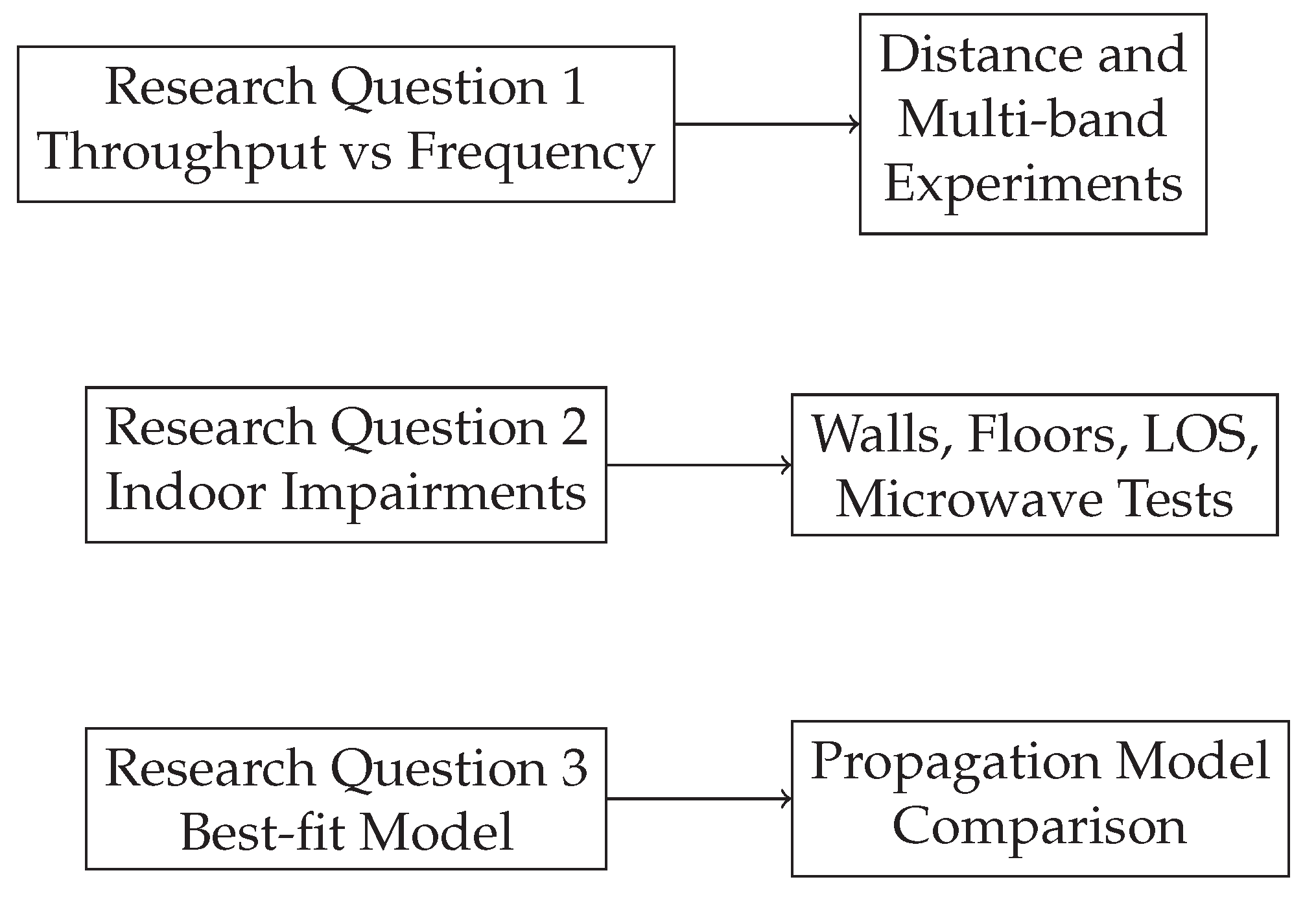
This study is guided by a set of research questions that directly inform the design of the experimental campaign and the subsequent analysis. Rather than treating measurements as isolated observations, each experiment was selected to address a specific uncertainty associated with indoor Wi-Fi 7 operation.
The first research question examines what factors constrain achievable throughput when 802.11be operates across heterogeneous frequency bands. To address this, measurements were performed across the 2.4 GHz, 5 GHz, and 6 GHz bands under controlled indoor conditions, allowing throughput and RSS to be compared in identical spatial configurations. This approach enables band-dependent performance trends to be observed without confounding environmental variables. The second research question focuses on identifying which indoor impairments most severely degrade link performance. Experiments were therefore structured to systematically introduce propagation challenges, including wall penetration, floor separation, line-of-sight obstruction, and interference from a domestic microwave source. By isolating these effects, the study distinguishes between loss mechanisms driven by geometry, material absorption, and external interference. The third research question addresses the suitability of analytical propagation models for representing Wi-Fi 7 signal behaviour in real indoor environments, as in Figure 5. Measured RSS values obtained from all experimental scenarios were compared against predictions from established free-space, two-ray ground reflection, and shadowing-based models. This comparison enables evaluation of model accuracy and highlights the limitations of deterministic assumptions when applied to contemporary WLAN deployments.
Together, these research questions define the experimental scope of the study and ensure that all measurements contribute directly to resolving practical and theoretical uncertainties surrounding indoor Wi-Fi 7 performance.
Figure 6.
Mapping between research questions and practical scenarios.
6.1. Results Accuracy and Validation
To ensure that the reported trends reflect propagation effects rather than transient artefacts, each scenario was executed under controlled indoor conditions with repeated trials and averaged measurements for both throughput and RSS. The resulting cross-band patterns are internally consistent across the measurement campaign: orientation changes produce only marginal variation, whereas obstruction-driven mechanisms (walls, floors, and LOS loss) generate step-like performance degradation. This separation of “weak” versus “dominant” effects supports the validity of the experimental design, because the strongest impairments align with the physical expectations of higher-frequency indoor propagation.
Model-based validation further corroborates the measurements. When measured RSS is compared with analytical predictions, deterministic free-space formulations systematically overestimate received power, particularly once structural attenuation is introduced. The two-ray ground model offers partial improvement in simple geometries but fails to capture the variability induced by indoor shadowing and multi-path richness. In contrast, the log-distance shadowing model better matches the measured RSS behaviour and yields fitted path-loss exponents in the range , consistent with increasing obstruction density in the tested environment. Overall, the repeatability of measurements and the relative model agreement provide a coherent validation pathway from raw data to propagation-aware interpretation.
6.2. Practical Implications
The measurements provide deployment-relevant guidance for IEEE 802.11be in offices and multi-storey buildings. First, band selection should be treated as a capacity–coverage decision: 6 GHz is well suited for short-range, high-rate links where clear visibility can be maintained, but it should not be relied upon for vertical reach or multi-room penetration. Conversely, 2.4 GHz offers more robust connectivity through structural barriers at the expense of achievable throughput, while 5 GHz often provides a pragmatic middle ground for typical office layouts. Second, access point placement and cell planning should prioritise preserving line-of-sight (or near-line-of-sight) for high-capacity service regions and should anticipate rapid performance collapse when corridors, corners, or reinforced floors obstruct the direct path. In multi-storey deployments, the observed floor penetration limits imply that consistent service typically requires additional infrastructure (e.g., per-floor AP placement) rather than assuming that a single high-power node can provide vertical coverage. Finally, for planning and prediction, practitioners should prefer shadowing-aware models (or calibrated site-specific models) over idealised deterministic assumptions, as the latter can materially misestimate indoor link budgets and coverage boundaries for Wi-Fi 7.
7. Conclusions
This paper presented a systematic empirical evaluation of 802.11be (Wi-Fi 7) performance in a complex indoor multi-storey environment. Controlled experiments were conducted to isolated the effects of distance, wall penetration, line-of-sight obstruction, floor separation, antenna orientation, and microwave interference across 2.4 GHz, 5 GHz, and 6 GHz bands. Results confirmed a clear capacity–coverage trade-off: the 6 GHz band achieved the highest peak throughput under unobstructed conditions but exhibited rapid degradation under obstruction and vertical penetration, while 2.4 GHz demonstrated superior robustness at the cost of lower data rates. Line-of-sight disruption emerged as the most critical performance-limiting factor, particularly at higher frequencies. We analyzed four selected theoretical propagation models to find the best-fit model that closely matched with the measured RSS performance. Propagation model comparison revealed that deterministic free-space and two-ray ground formulations overestimate indoor performance, whereas the log-distance shadowing model more accurately reflects measured RSS behaviour, with environment-dependent path-loss exponents between 3 and 6. Overall, the study bridges theoretical Wi-Fi 7 capability and real-world indoor constraints, providing practical guidance for band selection, access point placement, and coverage planning in enterprise and residential deployments. Further investigation could examine how indoor propagation characteristics can be incorporated into adaptive link-selection strategies for Wi-Fi 7, particularly in environments where frequency-dependent attenuation varies significantly across floors and structural barriers.
Acknowledgments
We thank our research and development students Clayton Roberts, James Hodder, Alvyn Beldua, Andrei Mamaradlo, and Lutoi Tauafiafi-Iutoi (Auckland University of Technology) for conducting field experiments.
References
- Sarkar, N.I.; Mussa, O.; Gul, S. Impact of People’s Movement on Wi-Fi Link Throughput in Indoor Propagation Environments: An Empirical Study. Electronics 2021, 10, 856. [Google Scholar] [CrossRef]
- Soto, P.; Camelo, M.; Mets, K.; Wilhelmi, F.; Góez, D.; Fletscher, L.A.; Gaviria, N.; Hellinckx, P.; Botero, J.F.; Latré, S. ATARI: A Graph Convolutional Neural Network Approach for Performance Prediction in Next-Generation WLANs. Sensors 2021, 21, 4321. [Google Scholar] [CrossRef] [PubMed]
- Bartolín-Arnau, L.M.; Orozco-Santos, F.; Sempere-Payá, V.; Silvestre-Blanes, J.; Albero-Albero, T.; Llacer-Garcia, D. Exploring the Potential of Wi-Fi in Industrial Environments: A Comparative Performance Analysis of IEEE 802.11 Standards. Telecom 2025, 6, 40. [Google Scholar] [CrossRef]
- Adame, T.; Carrascosa-Zamacois, M.; Bellalta, B. Time-Sensitive Networking in IEEE 802.11be: On the Way to Low-Latency WiFi 7. Sensors 2021, 21, 4954. [Google Scholar] [CrossRef] [PubMed]
- Mozaffariahrar, E.; Theoleyre, F.; Menth, M. A Survey of Wi-Fi 6: Technologies, Advances, and Challenges. Future Internet 2022, 14, 293. [Google Scholar] [CrossRef]
- Joubert, P.J.; Helberg, A.S.J. An Investigation into the Use of Kriging for Wi-Fi RSSI Estimation in Complex Indoor Environments. In Proceedings of the Proc. IEEE Wireless Communications and Networking Conference (WCNC), 2015; pp. 1326–1331. [Google Scholar] [CrossRef]
- Pandey, P.; Parasuraman, R. Empirical Analysis of Bi-directional Wi-Fi Network Performance on Mobile Robots in Indoor Environments. In Proceedings of the Proc. IEEE 95th Vehicular Technology Conference (VTC2022-Spring), 2022. [Google Scholar] [CrossRef]
- Avallone, S.; Imputato, P. Understanding the New Enhanced Multi-Link Single Radio Feature of IEEE 802.11be WLANs. IEEE J. Sel. Areas Commun. 2025, 43, 3683–3694. [Google Scholar] [CrossRef]
- Wu, J.; Fang, X.; Min, G. Deep Reinforcement Learning Based Multi-Link Frame Aggregation Length Optimization in Next Generation Wi-Fi Networks. IEEE Trans. Wirel. Commun. 2024, 23, 14482–14497. [Google Scholar] [CrossRef]
- Dogan-Tusha, S.; Tusha, A.; Nasiri, H.; Rochman, M.I.; Helzerman, J.; Ghosh, M. Evaluating The Interference Potential in 6 GHz: An Extensive Measurement Campaign of A Dense Indoor Wi-Fi 6E Network. In Proceedings of the Proceedings of the 17th ACM Workshop on Wireless Network Testbeds, Experimental Evaluation & Characterization (WiNTECH ’23), 2023. [Google Scholar] [CrossRef]
- Deshmukh, M.; Kamel, M.; Lin, Z.; Yang, R.; Lou, H.; Guvenc, I. Intelligent Feedback Overhead Reduction (iFOR) in Wi-Fi 7 and Beyond. In Proceedings of the 2022 IEEE 95th Vehicular Technology Conference (VTC2022-Spring), 2022. [Google Scholar] [CrossRef]
- Yu, Y.; Chen, R.; Liu, Z.; Guo, G.; Ye, F.; Chen, L. Wi-Fi Fine Time Measurement: Data Analysis and Processing for Indoor Localisation. J. Navig. 2020, 73, 1106–1128. [Google Scholar] [CrossRef]
- Martínez del Horno, M.; García-Varea, I.; Orozco Barbosa, L. Calibration of Wi-Fi-Based Indoor Tracking Systems for Android-Based Smartphones. Remote Sens. 2019, 11, 1072. [Google Scholar] [CrossRef]
- Qiao, J.; Yang, F.; Liu, J.; Huang, G.; Zhang, W.; Li, M. Advancements in Indoor Precision Positioning: A Comprehensive Survey of UWB and Wi-Fi RTT Positioning Technologies. Network 2024, 4, 545–566. [Google Scholar] [CrossRef]
- Kobir, M.I.; Machado, P.; Lotfi, A.; Haider, D.; Ihianle, I. Enhancing Multi-User Activity Recognition with Wi-Fi CSI and Transformer Architectures. Sensors 2025, 25, 3955. [Google Scholar] [CrossRef] [PubMed]
- Bartolín-Arnau, L.M.; Orozco-Santos, F.; Sempere-Payá, V.; Silvestre-Blanes, J. Exploring the Potential of Wi-Fi in Industrial Environments: A Comparative Performance Analysis. Telecom 2025, 6, 40. [Google Scholar] [CrossRef]
- Rizk, H.; Elmogy, A. SelfLoc: Robust Self-Supervised Indoor Localization with IEEE 802.11az Wi-Fi. Electronics 2025, 14, 2675. [Google Scholar] [CrossRef]
- Dai, J.; Wang, M.; Wu, B.; Shen, J.; Wang, X. A Survey of Latest Wi-Fi Assisted Indoor Positioning on Different Principles. Sensors 2023, 23, 7961. [Google Scholar] [CrossRef] [PubMed]
- Chia, Z.Y.; Goh, P.Y.; Ong, L.Y.; Tan, S.C. The Challenge of Dynamic Environments in RSSI-Based Indoor Wi-Fi Positioning. Future Internet 2025, 17, 540. [Google Scholar] [CrossRef]
- Zhang, Z.; Yu, Y.; Chen, L.; Chen, R. Hybrid Indoor Positioning System Based on Acoustic Ranging and Wi-Fi Fingerprinting. Remote Sens. 2023, 15, 3520. [Google Scholar] [CrossRef]
- Tian, L.P.; Yu, C.M.; Wang, L.C.; Chen, Z. AI-Driven Decimeter-Level Indoor Localization Using Single-Link Wi-Fi. Sensors 2026, 26, 642. [Google Scholar] [CrossRef] [PubMed]
- IEEE. IEEE P802.11be/D1.0 Draft Standard for Information Technology—Telecommunications and Information Exchange between Systems Local and Metropolitan Area Networks—Part 11: Wireless LAN Medium Access Control (MAC) and Physical Layer (PHY) Specifications—Amendment 8: Enhancements for Extremely High Throughput (EHT). 2021. [Google Scholar] [CrossRef]
Figure 1.
Internal floor structure and measurement locations for distance study (University Level 7 WZ Building).
Figure 1.
Internal floor structure and measurement locations for distance study (University Level 7 WZ Building).
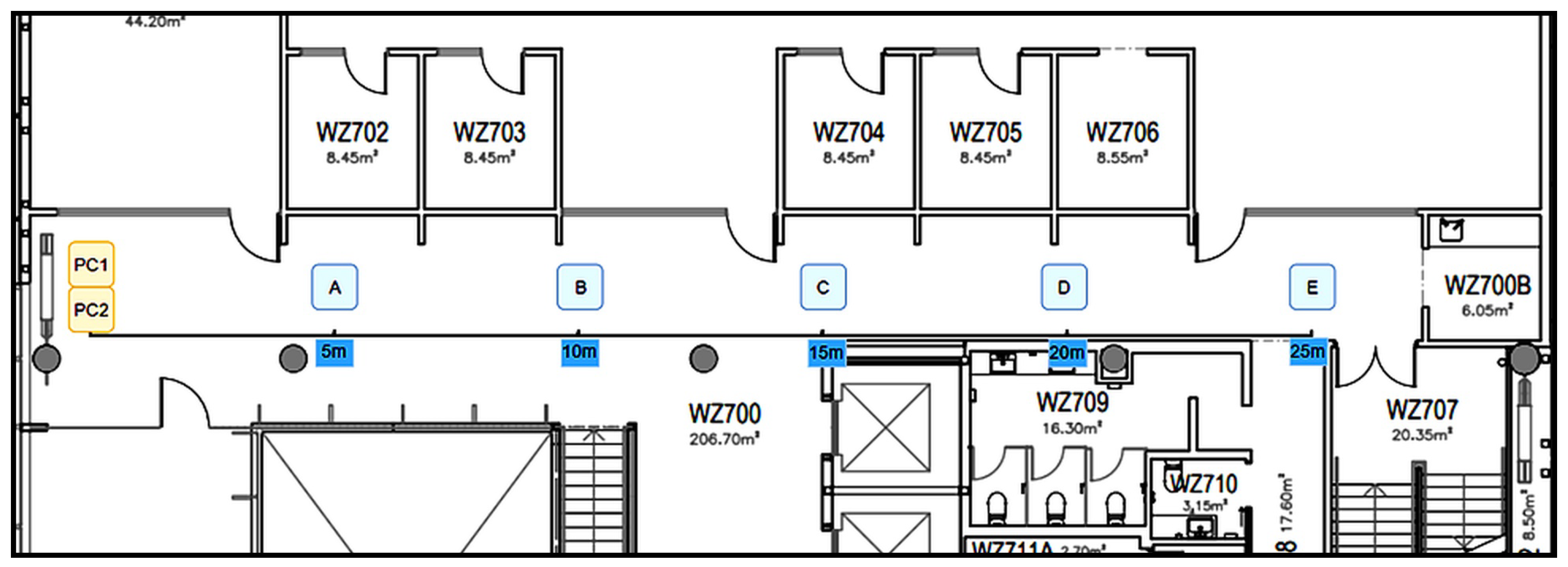
Figure 2.
Impact on antenna orientation on system performance.
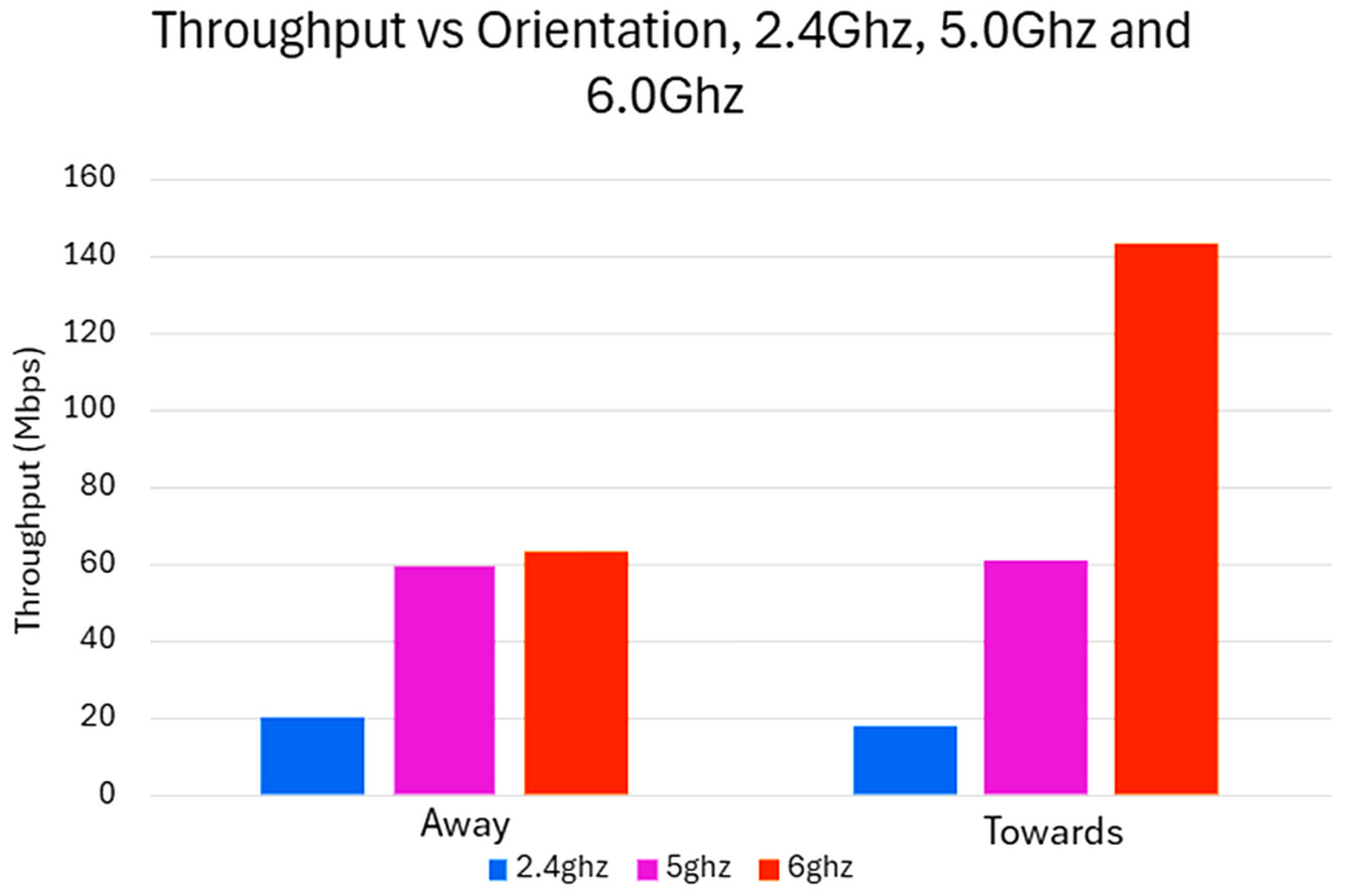
Figure 3.
Impact of no. of walls on link throughput (2.4-, 5-, and 6 GHz).
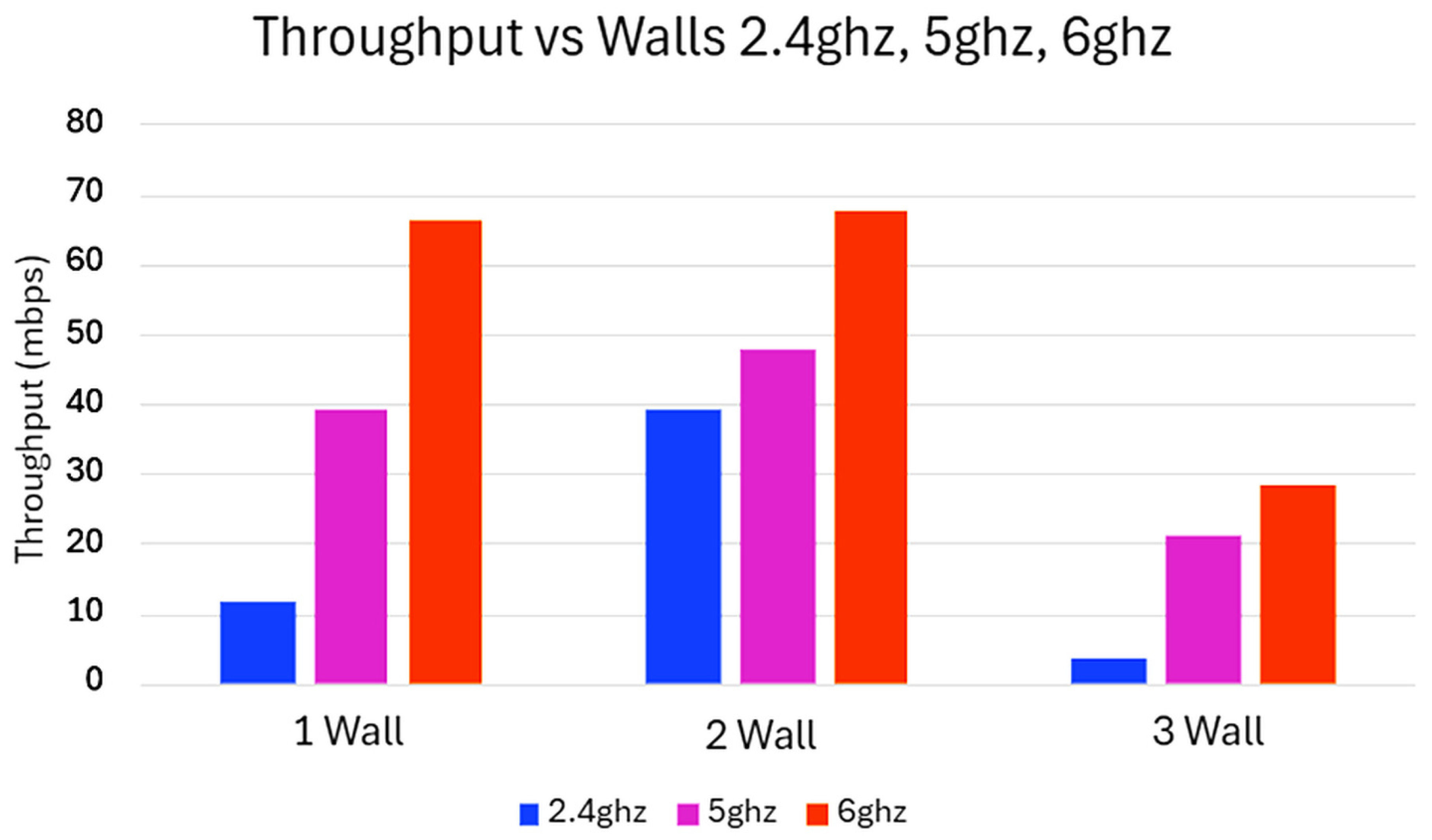
Figure 4.
Top-view schematic of the indoor Wi-Fi 7 experimental setup.
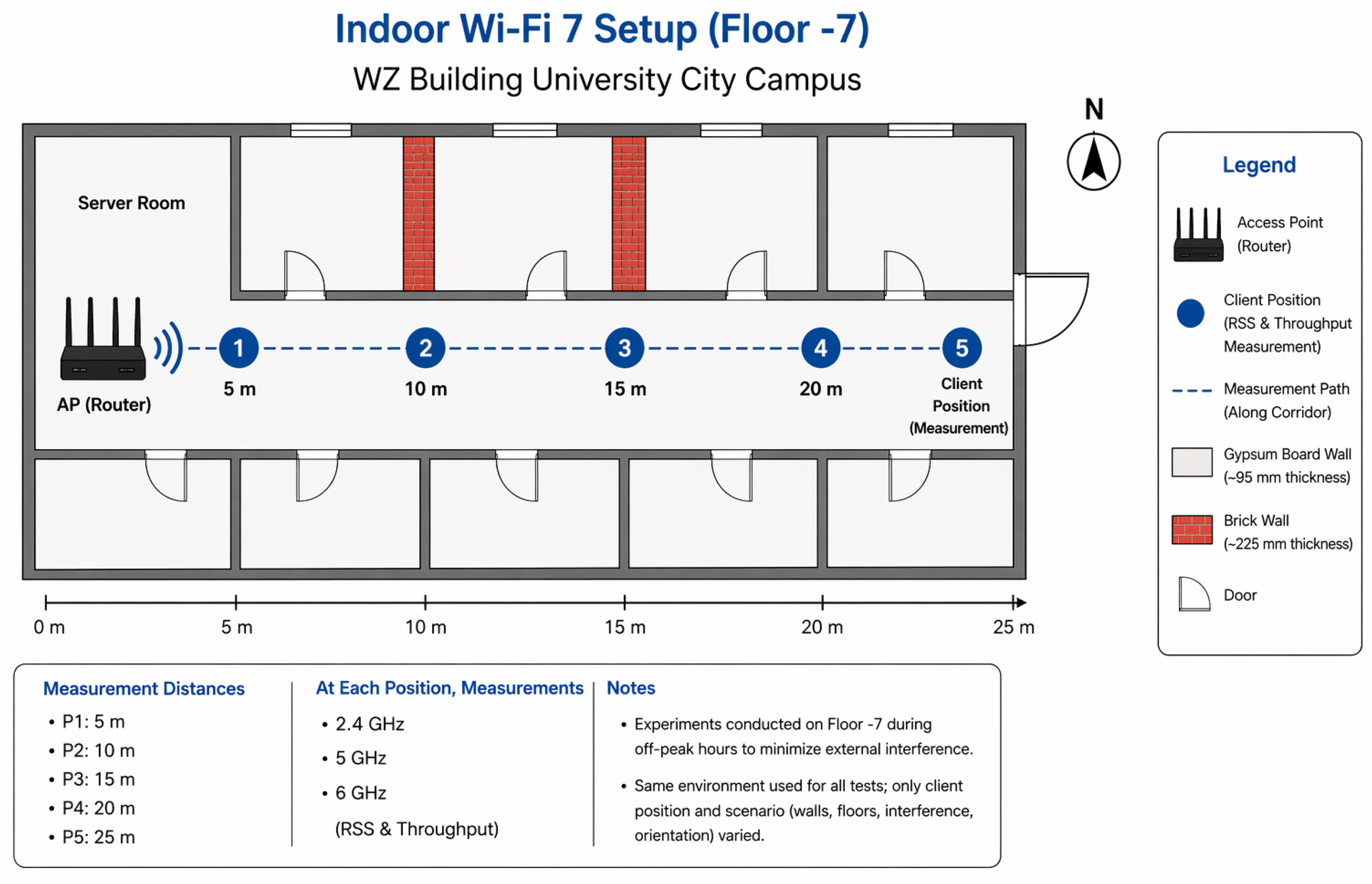
Figure 5.
RSSI versus distance across (a) 2.4 GHz; (b) 5 GHz; and (c) 6 GHz; comparing measured RSS with analytical propagation models.
Figure 5.
RSSI versus distance across (a) 2.4 GHz; (b) 5 GHz; and (c) 6 GHz; comparing measured RSS with analytical propagation models.
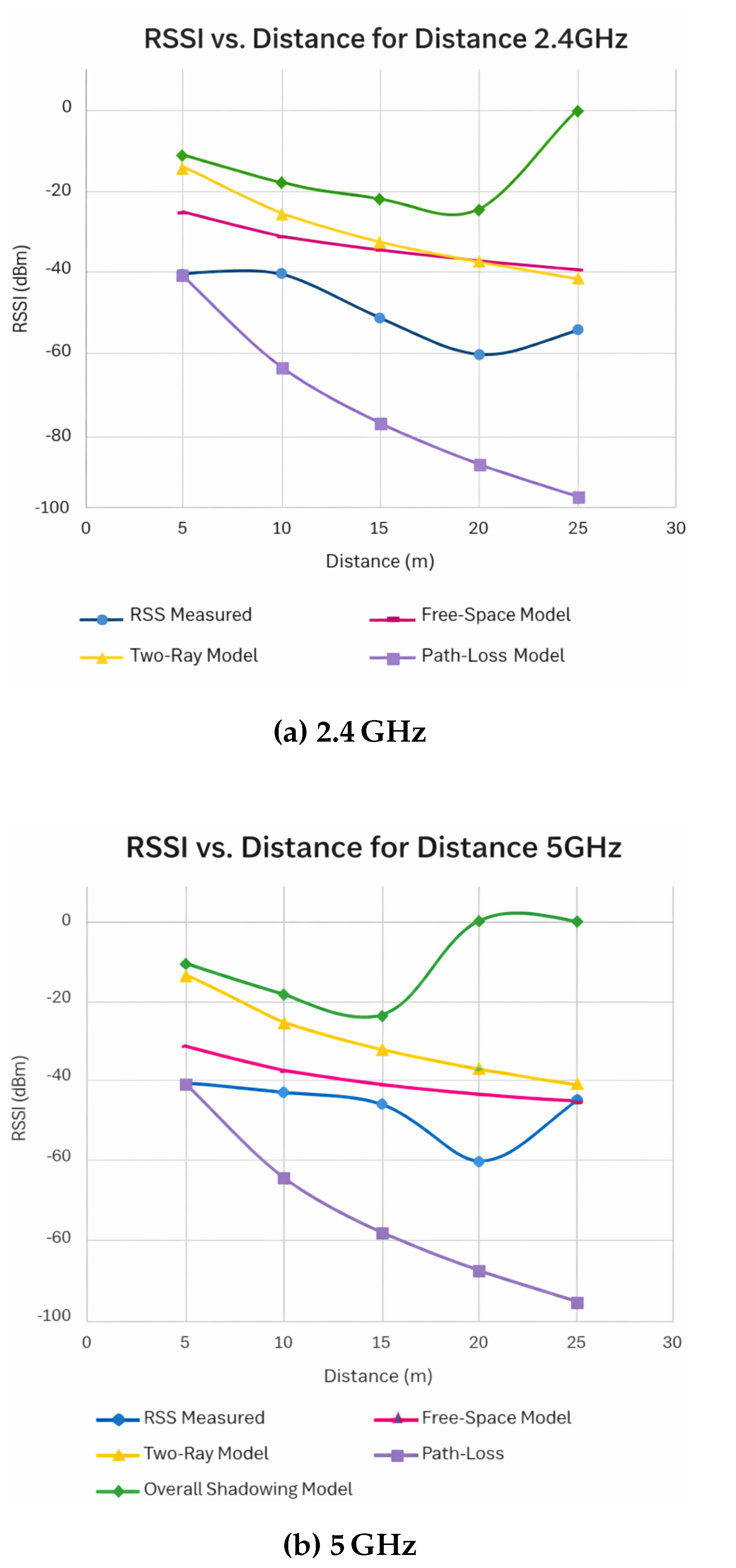
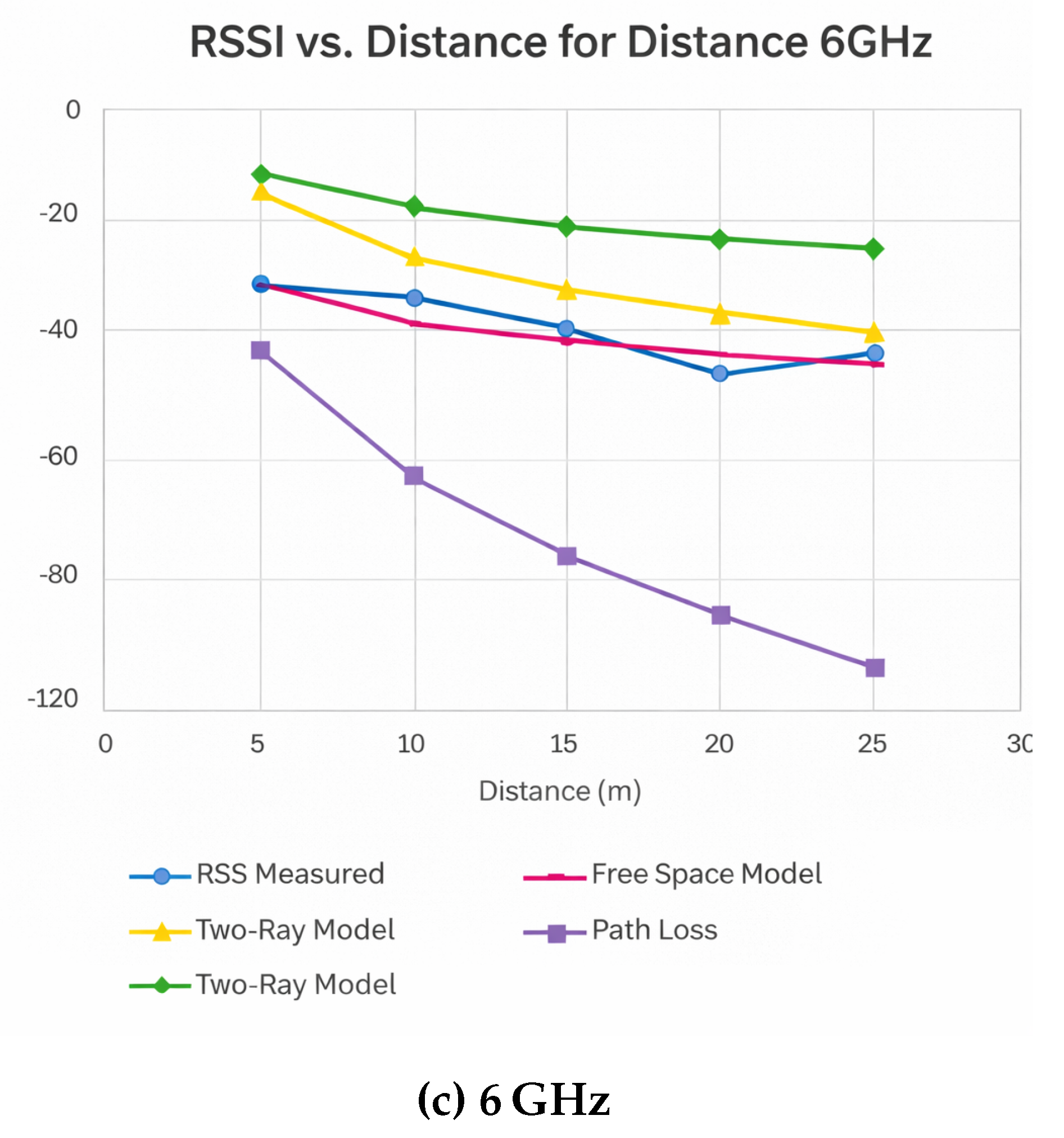
Table 1.
Summary of industrial Wi-Fi studies and recent advancements
| Ref. | Problem | Approach | Testbed | 802.11be | RSS M/M | Focus |
|---|---|---|---|---|---|---|
| [3] | Industrial WLAN reliability | Multi-env. evaluation (802.11n–be) | (Y) | (N) | (Y) | RTT/QoS |
| [6] | RSSI spatial estimation | Kriging interpolation | (Y) | (N) | (N) | Coverage |
| [7] | Mobility impact | ROS-based measurements | (Y) | (N) | (Y) | Throughput |
| [8] | Multi-link behaviour | Protocol analysis (802.11be) | (N) | (Y) | (Y) | Latency |
| [9] | Link aggregation control | DRL-based optimisation | (N) | (Y) | (Y) | Goodput |
| [10] | 6 GHz interference | Dense measurement campaign | (Y) | (N) | (N) | Interference |
| [11] | Feedback overhead | K-means compression | (N) | (Y) | (Y) | Efficiency |
| – | This work | 802.11be Wi-Fi 7 in Complex Indoor Environments | (Y) | (Y) | (Y) | Integrated |
Note: Y = evaluated; N = not evaluated. Multi-band refers to operation across 2.4, 5, and 6 GHz bands. RSS M/M= RSS model versus measurement analysis. QoS = Quality of Service.
Table 3.
Impact of Microwave Interference on Wi-Fi 7 Performance
| Band (GHz) |
Throughput (Microwave Off) |
Throughput (Microwave On) |
Throughput Drop(%) |
|---|---|---|---|
| 2.4 | 3.12 | 1.48 | 52.6 |
| 5 | 8.44 | 6.37 | 24.5 |
| 6 | 12.03 | 10.92 | 9.2 |
Table 4.
Distance-Driven Throughput under Line-of-Sight
| Band (GHz) | Throughput at 5 m (Mbps) |
Throughput at 25 m (Mbps) |
Throughput Drop (%) |
|---|---|---|---|
| 2.4 | 7.79 | 7.56 | 2.95 |
| 5 | 38.27 | 37.15 | 2.93 |
| 6 | 70.42 | 41.82 | 40.61 |
Table 5.
Impact of Line-of-Sight Disruption
| Band | RSS LoS | RSS Obs. | Thrpt | Thrpt. Drop | |
|---|---|---|---|---|---|
| (GHz) | (dBm) | (dBm) | (Mbps) | (%) | |
| Trial 1: 25 m (Baseline) | |||||
| 2.4 | -55 | – | 7.56 | 0 | |
| 5 | -46 | – | 37.15 | 0 | |
| 6 | -44 | – | 41.82 | 0 | |
| Trial 2: 25 + 2m LoS deviation | |||||
| 2.4 | – | -73 | 0.43 | 94.3 | |
| 5 | – | -77 | 4.76 | 87.2 | |
| 6 | – | Connection-Lost | 0 | 100 | |
| Trial 3: 25 m + 5m LoS Deviation | |||||
| 2.4 | Connection-Lost | Connection-Lost | 0 | 100 | |
| 5 | Connection-Lost | Connection-Lost | 0 | 100 | |
| 6 | Connection-Lost | Connection-Lost | 0 | 100 | |
Table 6.
Impact of no. of floors (vertical)
| Band (GHz) | Floors | RSS (dBm) | Thrpt (Mbps) |
|---|---|---|---|
| 2.4 | 1 | -55.33 | 1.89 |
| 2.4 | ≥2 | - | - |
| 5 | 1 | -50.00 | 5.92 |
| 5 | 2 | -84.67 | 1.49 |
| 5 | ≥3 | - | - |
| 6 | 1 | -42.33 | 9.37 |
| 6 | ≥2 | - | - |
Table 7.
Measured RSS and throughput under wall penetration scenarios.
| Band | Walls | Distance | Throughput | Degradation | RSS |
|---|---|---|---|---|---|
| (GHz) | (m) | (Mbps) | (%) | (dBm) | |
| 2.4 | 1 | 1.5 | 11.46 | 8.67 | -27.67 |
| 2.4 | 2 | 5.0 | 20.17 | 72.64 | -45.33 |
| 2.4 | 3 | 10.0 | 3.32 | 73.52 | -55.00 |
| 5 | 1 | 1.5 | 39.09 | 37.74 | -33.00 |
| 5 | 2 | 5.0 | 47.83 | 30.67 | -52.33 |
| 5 | 3 | 10.0 | 20.98 | 69.59 | -64.67 |
| 6 | 1 | 1.5 | 66.27 | 17.68 | -26.67 |
| 6 | 2 | 5.0 | 67.71 | 17.68 | -29.33 |
| 6 | 3 | 10.0 | 28.36 | 65.53 | -47.00 |
Table 8.
MAE Comparison (Distance Experiment)
| Band (GHz) | FS | TR | PL | OS | MM-RSS |
|---|---|---|---|---|---|
| (dBm) | (dBm) | (dBm) | (dBm) | (dBm) | |
| 2.4 | 16.10 | 10.34 | 42.33 | 25.12 | -50.86 |
| 5 | 7.32 | 11.94 | 39.61 | 23.84 | -47.13 |
| 6 | 2.53 | 18.47 | 38.77 | 22.91 | -39.53 |
Note: FS = Free-Space; TR = Two-Ray ground reflection; PL = Path-Loss (shadowing, B=5); OS = Overall shadowing model (5–25 m). MM-RSS= Mean measured received signal strength
Disclaimer/Publisher’s Note: The statements, opinions and data contained in all publications are solely those of the individual author(s) and contributor(s) and not of MDPI and/or the editor(s). MDPI and/or the editor(s) disclaim responsibility for any injury to people or property resulting from any ideas, methods, instructions or products referred to in the content. |
© 2026 by the authors. Licensee MDPI, Basel, Switzerland. This article is an open access article distributed under the terms and conditions of the Creative Commons Attribution (CC BY) license (http://creativecommons.org/licenses/by/4.0/).
Copyright: This open access article is published under a Creative Commons CC BY 4.0 license, which permit the free download, distribution, and reuse, provided that the author and preprint are cited in any reuse.


