
Submitted:
28 April 2026
Posted:
28 April 2026
You are already at the latest version
Abstract
Guizhou Province, a typical karst mountainous region in southwest China, features a complex geographical environment and diverse ethnic cultures, which together have fostered unique traditional village landscapes. Taking 757 national and provincial-level ethnic traditional villages in Guizhou as the research object, this study employs methods including GIS spatial analysis, the nearest neighbor index, and kernel density estimation to quantitatively reveal the geographical distribution characteristics, spatial differentiation patterns, and underlying causes of Miao, Dong, Bouyei, and Han Tunpu villages from the perspectives of two core physical geographic factors: topography and river systems. The results show that: (1)In terms of topographic distribution, village sites exhibit a significant vertical differentiation pattern: the Miao people "reside in the mountains", the Dong and Bouyei people "stay close to water", and the Han Tunpu settlements "occupy strategic passages". Meanwhile, a slight preference for sunny slopes is observed (52.4% of villages are on sunny slopes), but no overwhelming "sun-seeking, shade-avoiding" tendency exists. (2)Regarding river system distribution, different ethnic groups display distinct patterns of water utilization: the Dong and Bouyei people form a tight "ribbon along rivers" dependency (over 70% of villages are within 1 km of a river), the Miao people rely on mountain streams with a pattern of "far from large rivers, close to small ones", and the Han Tunpu settlements adopt an "engineered" transformation and utilization pattern. (3)Quantitative analysis shows that the spatial distribution of villages is significantly clustered, forming three high-density core areas: the Duliu River, Qingshui River, and Tunpu areas. Elevation, slope gradient, and distance to rivers are key natural constraint factors. This study reveals a "non-random" three-dimensional distribution pattern of ethnic traditional villages in Guizhou, which represents an optimal spatial response of various ethnic groups to the complex karst environment based on their historical migration memories, livelihood strategies, and cultural adaptability. This finding is of great value for understanding the mechanism of ethnic-environment interaction and for the conservation of traditional villages.
Keywords:
ethnic traditional villages
; geographical distribution
; karst mountainous area
; spatial differentiation
; GIS spatial analysis
; Guizhou
1. Introduction
As important carriers of agricultural civilization, traditional villages embody rich historical memories, cultural genes, and vernacular wisdom. In Guizhou, a karst mountainous province in Southwest China, the intricate geographical environment and the diverse, symbiotic ethnic cultures intertwine, giving birth to a large number and wide variety of ethnic traditional villages [3]. These villages are not only spatial units for the production and daily life of various ethnic groups but also products of long-term human-nature interaction. Their geographical distribution pattern profoundly reflects how different ethnic groups perceived, adapted to, and transformed the mountainous environment during specific historical periods.
Karst landforms account for 73.8% of Guizhou’s total land area, and the characteristic of “nine parts mountain, half part water, and half part farmland” has shaped a unique human-land relationship [11]. Historically, due to differences in migration routes, livelihood strategies (upland dry farming, valley rice farming, and military-agricultural colonies), and cultural adaptation strategies among the Miao, Dong, Bouyei, Han, and other ethnic groups, they experienced complex human-land interaction processes over long historical periods, ultimately forming a “stepped” three-dimensional distribution pattern [15]. This pattern is not random or disorderly but rather the product of a “spatial game” played by each ethnic group within the limited and fragmented karst environment, based on their own historical memories and practical needs [17].
Existing research on traditional villages in Guizhou has mostly focused on case-specific conservation and renewal from an architectural perspective [19], interpretation of cultural landscapes from an ethnological perspective [9,16], or macro-level spatial distribution of traditional villages across the province [3]. However, research that deeply integrates the dimensions of “ethnicity” and “geography”, systematically compares the distributional differences of traditional villages of different ethnic groups in key natural elements such as terrain and river systems, and uses quantitative methods to reveal their intrinsic patterns and coupling mechanisms remains insufficient. In particular, there is a lack of studies that, from the perspectives of “historical process” and “survival choice”, explain how the natural foundation (terrain, river systems, etc.) has been endowed with differentiated cultural meanings by different ethnic groups, ultimately shaping the classic spatial pattern of “the Miao living in the mountains, the Dong and Bouyei near the water, and the Tunpu (military-agricultural colonies) occupying strategic passes” [8,12] (Figure 1).
Based on this, this paper attempts to answer the following questions: What quantitative characteristics and differences do the main ethnic traditional villages (Miao, Dong, Bouyei, and Han) in Guizhou exhibit in terms of terrain and river system distribution? What are the natural constraints and cultural driving forces behind this spatial differentiation? To address these questions, this study comprehensively employs quantitative methods such as GIS spatial analysis and kernel density estimation [10], combined with historical documents and ethnographic data, striving to systematically reveal the regularity and underlying causes of the geographical distribution of ethnic traditional villages in Guizhou from the perspective of the coupling of “natural foundation” and “survival choice”. The research findings not only help deepen the understanding of the spatial adaptation wisdom of ethnic groups in the mountainous areas of Southwest China but also provide a scientific basis for the conservation of traditional villages and rural revitalization in the region [19].
2. Study Area, Data and Research Methods
2.1. Overview of the Study Area
Guizhou Province is located in southwestern China, on the eastern transitional slope of the Yunnan-Guizhou Plateau. The terrain is higher in the west and lower in the east, with an average elevation of approximately 1,100 meters. Its landforms are dominated by plateaus and mountains, interspersed with hills and basins (flatlands). Karst landforms are highly developed and extremely typical, creating a complex geographical environment characterized by high and steep mountains, fragmented terrain, and significant elevation differences. The climate is a subtropical humid monsoon climate [1,11], with rain and heat occurring in the same season, and a dense network of rivers belonging to the Yangtze River and Pearl River systems.
Guizhou is a multi-ethnic province, with a relatively high proportion of minority populations including the Miao, Dong, and Bouyei. Historically, distinctive cultural spheres have formed [13]. The Miao are mainly distributed in southeastern and southern Guizhou. Their history is an epic of continuous migration in search of suitable habitats, creating the spatial impression of the “Miao of the high mountains” [4,8]. The Dong are concentrated in the Duliu River and Qingshui River basins of southeastern Guizhou, known for their rice cultivation culture and waterborne transportation [9]. The Bouyei mainly inhabit the Nanpan River, Beipan River, and Hongshui River basins in southern and southwestern Guizhou, and are a typical valley rice-farming people. The Han Tunpu villages, formed as a result of the Ming Dynasty’s “Expedition to the South from the North” (Tiaobei Zhengnan), are mainly distributed in central Guizhou centered around Anshun, and are characterized by distinct military defense and immigrant cultural features [18]. The relative spatial clustering and marked cultural differences among these four major ethnic groups provide natural samples for comparative research.
2.2. Data Sources and Preprocessing
The data used in this study mainly include:
1, Village point data: 757 representative ethnic traditional villages in Guizhou Province were collected, covering Miao, Dong, Bouyei, and Han (Tunpu) villages. Village information was mainly derived from the “List of Traditional Chinese Villages”, the list published by the Guizhou Provincial Cultural Heritage Bureau, and field survey data from the research team.
2, Geographic base data: including (a) a Digital Elevation Model (DEM) with 30-meter resolution, used to extract elevation, slope, and aspect information; (b) a 1:250,000 river system map of Guizhou Province, used to calculate the distance from villages to rivers. All data underwent projection transformation and coordinate registration to ensure consistency in spatial analysis.
2.3. Research Methods
To scientifically reveal the distribution patterns of villages, this study comprehensively employs a variety of spatial statistical and analytical methods:
1, Nearest Neighbor Index (NNI): Used to determine the spatial distribution type (clustered, random, or uniform) of point features (villages). The formula is R=rˉo/rˉeR=rˉo/rˉe, where rˉorˉo is the observed mean nearest neighbor distance and rˉerˉe is the expected mean nearest neighbor distance. If R<1R<1, it indicates a clustered distribution.
2, Kernel Density Estimation (KDE): Used to identify high-density and sub-high-density areas of village distribution, providing an intuitive visualization of spatial clustering characteristics. The principle is to calculate the density contribution within a certain surrounding range for each point as a center using a kernel function.
3, Overlay Analysis and Statistical Analysis: Village point data are spatially overlaid with layers such as DEM and river systems to extract attributes including elevation, slope, aspect, and distance to rivers for each village. These attributes are then classified and statistically analyzed by ethnic type to reveal the site selection preferences of different ethnic groups.
3. Results Analysis
3.1. Topographic Distribution Characteristics: Vertical Differentiation and Slope Aspect Preference
The complex terrain of Guizhou is the primary natural factor influencing village site selection. Based on their historical development and production practices, different ethnic groups exhibit clear preferences for elevation, slope, and aspect, forming a significant “stepped” vertical distribution pattern [15].
By overlaying village point data with DEM data (Figure 2), significant differences in elevation selection among ethnic groups can be observed. Overall, traditional villages in Guizhou are most frequently found at elevations between 400 and 1,200 meters, accounting for more than 65% of the total. Among them, Bouyei villages are mainly concentrated at elevations of 400–600 meters, and Dong villages mainly at 500–700 meters; both are located in low-heat valley flatland areas suitable for developing double-cropping rice agriculture. Miao villages, in contrast, are mainly concentrated at elevations of 800–1,200 meters, with some even located in high-altitude mountainous areas above 1,500 meters, representing a typical “high-mountain” distribution pattern [15]. This preference for high elevations is closely related to the Miao’s historical migration memory of “fleeing from unrest and seeking refuge in distant places” [4,5,8]. At the same time, the cooler climate at high altitudes is well suited to their dry-farming (corn, millet) and mixed forest-agriculture livelihood strategies.
In terms of slope selection (Table 1), the differences are equally pronounced. Over 80% of Dong and Bouyei villages are distributed on gentle slopes (0–15°) or flatland areas, which facilitate the construction of rice paddies and public buildings (such as drum towers and wind-rain bridges). In contrast, Miao villages have a proportion exceeding 40% on steeper slopes of 15°–25° and 25°–35°. To adapt to steep terrain, the Miao people developed the exquisite architectural technique of stilt houses (also known as diaojiaolou) [16]. By adopting a layout that “occupies the sky but not the ground,” they skillfully resolved the conflict between living space and terrain, thereby creating a distinctive mountainous settlement landscape [3].
Slope aspect directly affects village lighting, temperature, humidity, and microclimate, which in turn influences residents’ living comfort and agricultural production. Statistical analysis of slope aspects for 757 villages (Table 2) shows that village site selection exhibits a tendency to “prefer sunny slopes over shady ones”. The numbers of villages on southeast- and south-facing slopes are the highest, reaching 109 (14.29%) and 107 (14.15%) respectively, together accounting for 28.44% of the total, indicating a strong preference for south-oriented areas with superior sunlight conditions [7]. In contrast, the number of villages on northeast-facing slopes is the lowest, only 69 (9.13%).
According to the classification standard defining sunny slopes as 90°–270° and shady slopes as 0°–90° and 270°–360°, the statistics show a total of 396 villages on sunny slopes and 360 on shady slopes, giving a sunny-to-shady ratio of 1.1. This means that for every 10 villages on shady slopes, there are 11 on sunny slopes. Although this ratio does not show extreme polarization, when combined with the high proportions of south- and southeast-facing villages, it convincingly demonstrates that sunnier slopes have an advantage in attracting village clustering [15] (Table 3). Against the backdrop of fragmented and small-scale farmland in Guizhou, village site selection with respect to slope aspect exhibits the characteristic of “preferring sunny slopes without complete dependence, and also inhabiting shady slopes”. This reflects the complexity of the mountainous environment—shady slopes may be utilized because local topography blocks cold winds, proximity to water sources, or suitable soil moisture. Due to the scarcity of arable land, villagers have to “seize every available patch”, cultivating and settling on non-optimal aspects, which weakens slope aspect differentiation compared to plains or arid regions. Overall, the distribution of traditional villages in Guizhou reflects both rational choices regarding light and thermal conditions and constraints from limited arable land and terrain, presenting a pattern of “sunny slopes are slightly preferred, while shady slopes are not abandoned”.
3.2. Characteristics of River System Distribution: Hydrophilicity and Differentiated Utilization
River systems are the “lifeblood” of Guizhou’s mountainous ecosystem and the lifeline for the survival and development of traditional villages. Based on different livelihood strategies and cultural traditions, various ethnic groups have formed differentiated water-affinity patterns (Figure 3).
As typical rice-farming peoples, the Dong and Bouyei ethnic groups exhibit the highest degree of dependence on river systems. Buffer analysis (Table 4) reveals a very high positive correlation between their village distribution and river systems. More than 70% of traditional Dong and Bouyei villages are located within a straight-line distance of 1 km from major rivers (third-order and above), and the village density drops sharply with increasing distance [9]. This distribution pattern of “forming belts along rivers and stopping at water” originates from the rigid demand of rice agriculture for stable water sources. Villages are often sited on the depositional banks (convex banks) of rivers or at river confluences, which facilitates irrigation and also follows the traditional feng shui concept of “storing wind and gathering qi” – it is believed that such locations favor prosperity and population growth. At the same time, rivers serve as important transportation and cultural exchange corridors, sustaining inter-ethnic interactions (e.g., the Dong dragon boat races and antiphonal singing) and trade [9].
Miao villages generally exhibit a “high-mountain” character. Although seemingly distant from large rivers, they actually follow a very refined logic for utilizing mid- and small-scale mountain water systems [4,8]. At the macro level, the distribution density of Miao villages shows a negative correlation with distance from major rivers, reflecting their historical choice to actively avoid large rivers to escape floods and warfare (Table 4). At the micro level, however, Miao village sites are invariably close to stable mountain springs or streams. Using simple water-conveyance facilities such as bamboo pipes or wooden troughs, villagers channel spring water into the settlement, creating a vertical circulation system of “mountain – water – forest – paddy fields – village” [14]. This water-use pattern of “far from large rivers but close to small water sources” meets both domestic needs and dry-farming irrigation requirements, while embodying the wisdom of adapting to mountainous environments and making full use of dispersed water sources. As a people who have undergone long-term migration, the Miao ancestors, for survival and conflict avoidance, chose higher, easily defensible mountain tops or slopes. The Miao are an agricultural people well aware of the importance of flat land for rice cultivation. Therefore, they follow the principle of “planting rice in flat valleys and building homes on sloping land”. The survival pressure of scarce arable land forces villagers to reserve all high-quality, gentle-slope land for grain production, while building their villages on steeper slopes [20].
The water system distribution of Ming-Dynasty Tunpu villages exhibits strong characteristics of military defense and artificial modification [18]. Tunpu villages constitute a unique “anomaly” on Guizhou’s landscape, as their site selection was a direct product of the central dynasty’s state will and military strategy. In the early Ming Dynasty, to consolidate the southwestern frontier, the court implemented the “Expedition to the South from the North” and “Tiannan” (Filling the South) garrison-farming system. Tunpu villages are strictly distributed according to military units, serving as outposts of state power extending into the frontier. They are mostly sited at strategic points where flatlands intersect with courier roads, built relying on rugged terrain and fortified with strong walls and gates for enemy observation and defense. Because they are mostly located along major traffic routes and at the edges of flatlands, the Tunpu people not only utilized natural rivers but also excelled in constructing reservoirs (ponds), canals, and other water conservancy facilities. These artificial water systems both irrigated the garrison farmland and served as defensive moats, together with the sturdy stone walls of the Tunpu, forming a tight defense system. The distribution of Tunpu villages is often organized around artificial water systems, and their “engineered” water conservancy networks reflect the capacity of state power to transform nature and achieve long-term garrison settlement in frontier regions [18].
3.3. Quantitative Analysis of Geographical Distribution: Clustering Pattern and Factor Interaction
The results of the Nearest Neighbor Index (NNI) analysis show that the overall NNI of traditional villages in Guizhou Province is R=0.38R=0.38, which is far less than 1, indicating a significantly clustered spatial distribution pattern. By ethnic group, the Dong villages exhibit the highest degree of clustering (the smallest RR value). This is because they are constrained by the scarce and arable land resources in valley flatlands, forcing them to be “squeezed together” in narrow river valley areas, forming high-density ribbon-like settlements. Although Miao villages are also clustered overall, their clustering intensity is slightly lower than that of the Dong due to the relatively more dispersed mountainous land, presenting a pattern of “large-scale dispersion with small-scale agglomeration” [3]. The Han Tunpu villages also show a relatively high degree of clustering, mainly distributed in a patchy (clustered) pattern around core areas such as Anshun and Zhenning [18].
3.4. High-Density Core Areas: Three Cultural-Geographical Plates
The Kernel Density Estimation (KDE) map clearly identifies three high-density core areas of ethnic traditional villages in Guizhou (Figure 4):
1, The Dong high-density core area in the Duliu River basin: Centered on Liping, Congjiang, and Rongjiang, distributed in a belt-like pattern along the Duliu River and its tributaries. This area has the most concentrated and best-preserved Dong culture (drum towers, wind-rain bridges, Grand Songs) [9].
2, The Miao high-density core area in the upper Qingshui River basin: Centered on Leishan, Taijiang, and Kaili, distributed in a planar pattern around Leigong Mountain and the upper Qingshui River. This is the area with the highest concentration of Miao population and the most flourishing Miao culture (silver ornaments, embroidery, stilt houses) [8,14].
3, The Tunpu culture high-density core area: Centered on Anshun and Zhenning, located in the central Guizhou plain (flatland) area. This is the most concentrated area of descendants of the Ming-Dynasty Tunpu people, presenting a stone architectural landscape and Jianghuai cultural relics that are distinctly different from the surrounding minority villages [18].
These three core areas maintain a high degree of consistency with major river systems and special geomorphic units, confirming the fundamental shaping role of the natural geographical environment on the spatial pattern of villages [1,6] (Table 5). Within Guizhou’s karst landscapes, the site-selection differences among ethnic groups have also formed a macro-level spatial structure. The Tunpu people occupied the best flatlands and courier roads, symbolizing the presence of central power. Ethnic groups such as the Miao, due to historical reasons, were “squeezed out” of the core areas and moved into mountainous land that was difficult to cultivate, surviving in the interstices. Meanwhile, the Dong and Bouyei were more integrated into river valleys and flatlands, coexisting harmoniously with nature. This spatial division profoundly reflects the complex historical interactions among the state, ethnic groups, and land in Guizhou.
4. Conclusion
This study comprehensively employs GIS spatial analysis and geodetector methods to systematically reveal the geographical distribution characteristics and causes of traditional villages of the Miao, Dong, Bouyei, and Han (Tunpu) ethnic groups in Guizhou. The following conclusions are drawn:
(1) In terms of topographic distribution, each ethnic group exhibits significant vertical differentiation and slope aspect preference. The Miao “live in the mountains” (elevation 800–1200 m, steep slopes), the Dong and Bouyei “live near water” and “on flatlands” (elevation 400–800 m, gentle slopes), and the Han Tunpu “occupy strategic passes” (transportation routes and flatland margins). All ethnic groups show a slight preference for sunny slopes (villages on sunny slopes account for 52.4%), but there is no overwhelming tendency of “seeking sunny slopes and avoiding shady ones” [15].
(2) In terms of river system distribution, three typical utilization patterns have formed: the “ribbon-like along rivers” tightly attached pattern of the Dong and Bouyei (over 70% within 1 km of rivers), the “far from large rivers but close to small streams” mountain-spring-dependent pattern of the Miao, and the “engineered” transformation and utilization pattern of the Han Tunpu [9,18].
(3) In terms of spatial pattern, the village distribution is significantly clustered, forming three high-density core areas: the Dong area in the Duliu River basin, the Miao area in the Qingshui River basin, and the Tunpu area in central Guizhou [1,3,10].
(4) In terms of formation mechanism, this distribution pattern is the result of the coupling of “natural foundation” and “survival choice”. The karst landforms and river systems provide the basic framework, while each ethnic group’s historical migration memories [4,8], livelihood strategy choices [9], and cultural adaptability [17] have produced differentiated yet highly rational spatial responses within this framework.
By introducing the “ethnicity” variable into the study of the geographical distribution of traditional villages through quantitative methods, this study reveals the spatial differentiation patterns of ethnic cultures under natural environmental constraints, thereby enriching the explanatory power of the “human-land relationship” theory at the micro-spatial scale. The findings can also provide a scientific basis for the categorized protection of traditional villages and regional rural revitalization planning in Guizhou: for villages of different ethnic groups and different geographical units, a “one-size-fits-all” protection model should be avoided; instead, differentiated protection and development strategies should be adopted based on their unique site-selection logics and cultural adaptation mechanisms [19].
5. Discussion: Coupling of Natural Foundation and Survival Choice
The quantitative analysis above reveals the regularity of the geographical distribution of ethnic traditional villages in Guizhou, and the core mechanism lies in the profound coupling of “natural foundation” and “survival choice” [3,17]. The natural foundation – namely the fragmented terrain of karst mountains and the dense river network – constitutes the “hard constraint” for village site selection [1,11]. It provides differentiated living spaces for each ethnic group: high-altitude mountains are suitable for forest-based and dry farming livelihoods, while low-heat valley flatlands are suitable for rice agriculture. This constraint is objective and primary. However, faced with similar natural environments, different ethnic groups have made markedly different choices, and the driving force behind this is survival choice. The “high-mountain” distribution of the Miao is essentially a product of the need for repeated migration and “seeking refuge” embedded in their historical memory [4,5,8]. The geographical characteristics of high, dangerous mountains that are easy to defend but difficult to attack have been transformed into a cultural defense strategy. The “valley” distribution of the Dong and Bouyei, on the other hand, is rooted in the rice-farming civilization genes of their Baiyue ancestry [9]. Their extreme pursuit of water, heat, and flat land is a spatial projection of their production mode. The “strategic-pass occupation” and “engineered” characteristics of the Han Tunpu villages reflect their special identity as a military immigrant group [18]. Controlling transportation hubs and building sturdy defensive installations are micro-expressions of state power’s spatial strategy in frontier regions. Furthermore, the degree of topographic relief profoundly influences the pattern of population concentration and dispersion [6], which is consistent with the village distribution patterns found in this study. The vertical differentiation of settlements in Guizhou’s karst areas is not only the result of natural adaptation but also the spatial sedimentation of long-term historical practices of various ethnic groups [15].
Therefore, the “stepped” three-dimensional distribution pattern of ethnic traditional villages in Guizhou is a stable spatial form formed through the tension and synergy between natural constraints and cultural logics over a long historical period of human-land interaction. It is not only a product of the geographical environment but also a “spatial masterpiece” of ethnic cultures [17]. The “non-arbitrariness” of this pattern lies precisely in its accurate reflection of the distinctive cultural adaptation paths taken by different ethnic groups when facing the same complex mountainous environment.
Research Prospects
This study mainly focuses on two natural elements – topography and river systems. Future research can further incorporate more natural factors such as climate (e.g., temperature, precipitation), vegetation, and geological disaster risk, as well as human factors including transportation, administrative divisions, and economic development, to construct a more comprehensive model of influencing factors. At the same time, long-term historical documents and ancient maps can be integrated to carry out dynamic evolution studies from the perspective of historical geography, thereby more completely revealing the formation process of the spatial pattern of traditional villages [12,13].
Author Contributions
Conceptualization, Fang He and Yinsheng Tian; methodology, Fang He; software, Fang He; validation, Fang He; formal analysis, Fang He; investigation, Fang He; resources, Fang He; data curation, Fang He; writing—original draft preparation, Fang He; writing—review and editing, Fang He; visualization, Fang He; supervision, Yinsheng Tian; project administration, Fang He; funding acquisition, Fang He. All authors have read and agreed to the published version of the manuscript.
Funding
This research received no external funding.
Data Availability Statement
No new data were created or analyzed in this study. Data sharing is not applicable to this article.
Conflicts of Interest
The authors declare no conflicts of interest.
References
- Cheng, D. Y.; Li, X. D. Analysis of Spatial Distribution Pattern and Utilization of Plateau Terrain in Guizhou. Plateau Sci. Res. 2019, 3(03), 61–74. [Google Scholar]
- Guo, Y. L. Correlation Mechanism between Habitat Differentiation of Tibetan and Qiang Settlements in the Upper Minjiang River and Climate Change. Master’s thesis, Southwest University of Science and Technology, 2018. [Google Scholar]
- Du, J. A Study on the Morphology of Ethnic Traditional Rural Settlements in the Karst Mountainous Areas of Guizhou. Doctoral dissertation, Zhejiang University, 2017. [Google Scholar]
- Jiao, J. C. On the Migration History of the Miao People from the Perspective of Their Oral Ancient Books. Guizhou Ethn. Stud. 2018, 39(11), 190–194. [Google Scholar]
- Xu, M. Z. Mobility and Wisdom: Migration as a Survival and Development Strategy of the Miao People. Ind. Technol. Forum 2021, 20(03), 72–74. [Google Scholar]
- Zhong, J.; Lu, T. Population Distribution and Evolution in Southwest China Based on Topographic Relief. Acta Ecol. Sin. 2018, 38(24), 8849–8860. [Google Scholar]
- Ji, X. Preliminary Analysis on the Location and Layout of Rural Settlements in Northwest Yunnan: A Case Study of Diqing Prefecture, Yunnan Province. Rural Pract. Technol. 2020, 9, 57–58. [Google Scholar]
- Shi, C. J. A History of Miao Migration in the World; Guizhou People’s Publishing House: Guiyang, 2006; pp. 180–195. [Google Scholar]
- Yang, Z. H. Social and Historical Survey of the Dong Ethnic Group; Nationalities Publishing House: Beijing, 2009; pp. 115–122. [Google Scholar]
- Wei, Z. L. A Study on the Inheritance of Shui Culture and Shui Script; Guizhou Ethnic Publishing House: Guiyang, 2017; pp. 50–58. [Google Scholar]
- Xiong, K. N.; Li, P.; Xiao, S. Z. Karst Rocky Desertification and Ecological Restoration in Guizhou; Science Press: Beijing, 2018; pp. 25–32. [Google Scholar]
- Lan, Y. Historical and Geographical Interpretation of Southwest China; Zhonghua Book Company: Beijing, 2010; pp. 305–315. [Google Scholar]
- Hou, S. Z.; Shi, J. Z.; Weng, J. L. Ancient History of Guizhou; Guizhou People’s Publishing House: Guiyang, 2013; pp. 320–328. [Google Scholar]
- Liu, F.; Zhang, S. H. Guzang Festival: The Miao Ancestor Worship Ceremony; Intellectual Property Publishing House: Beijing, 2012; pp. 85–92. [Google Scholar]
- Zhou, X. F.; Zhou, Y. Z.; Ouyang, J. Vertical Differentiation of Settlements in Karst Areas of Guizhou. China Popul. Resour. Environ. 2011, 21(12), 158–162. [Google Scholar]
- Zhang, J. S. A Cultural Study on the Stilt Houses of Ethnic Minorities in Southwest China; Yunnan University Press: Kunming, 2016; pp. 88–96. [Google Scholar]
- Zhang, J. J. Social Change and Cultural Adaptation in Ethnic Minority Areas: A Case Study of Guizhou; Nationalities Publishing House: Beijing, 2018; pp. 150–158. [Google Scholar]
- Luo, Y. N. A Study on the Defensibility of the Traditional Fortified Village of Benzhai in Anshun, Guizhou. Master’s thesis, Hunan University of Science and Technology, 2021; pp. 90–98. [Google Scholar]
- Luo, D. Q. Conservation and Utilization of Vernacular Architecture in China; Southeast University Press: Nanjing, 2017; pp. 75–82. [Google Scholar]
- Li, T. Y. Wisdom of the Mountains: Xijiang Thousand-Household Miao Village; Guizhou Ethnic Publishing House: Guiyang, 2024. [Google Scholar]
Figure 1.
Slope distribution grades of ethnic traditional villages in Guizhou.
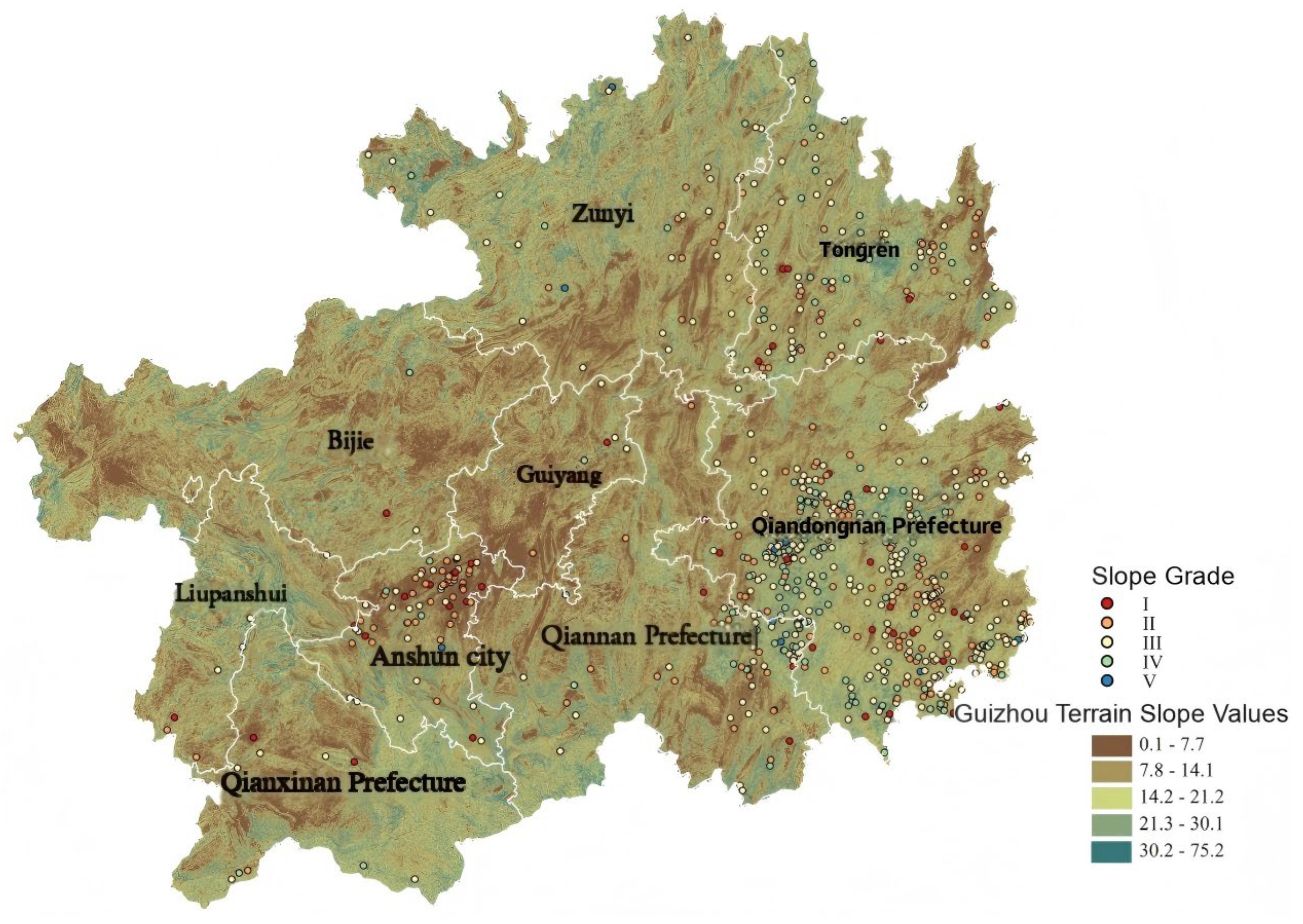
Figure 2.
Elevation map of traditional village distribution.
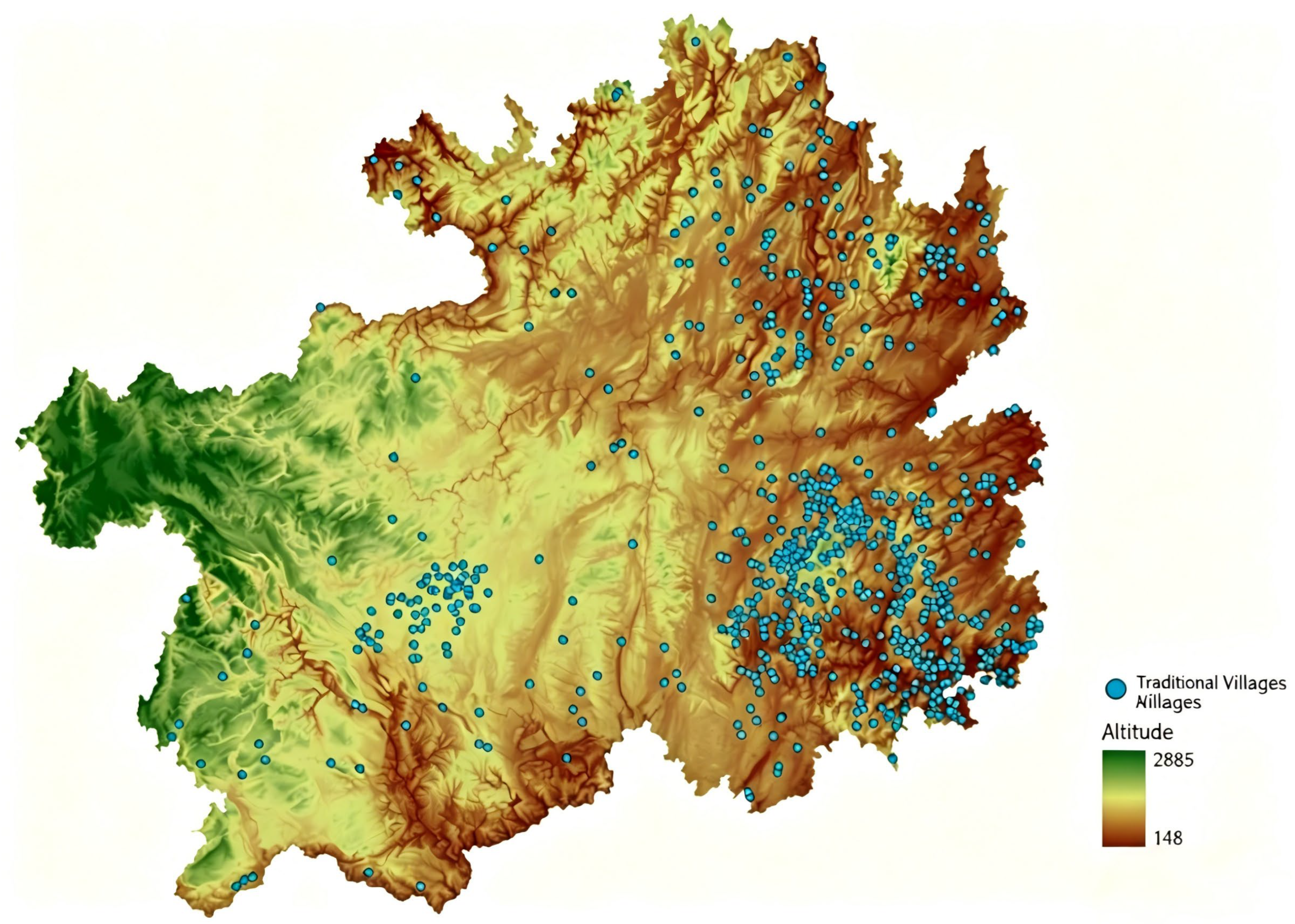
Figure 3.
Map of River System Distribution and Distribution of Ethnic Traditional Villages.
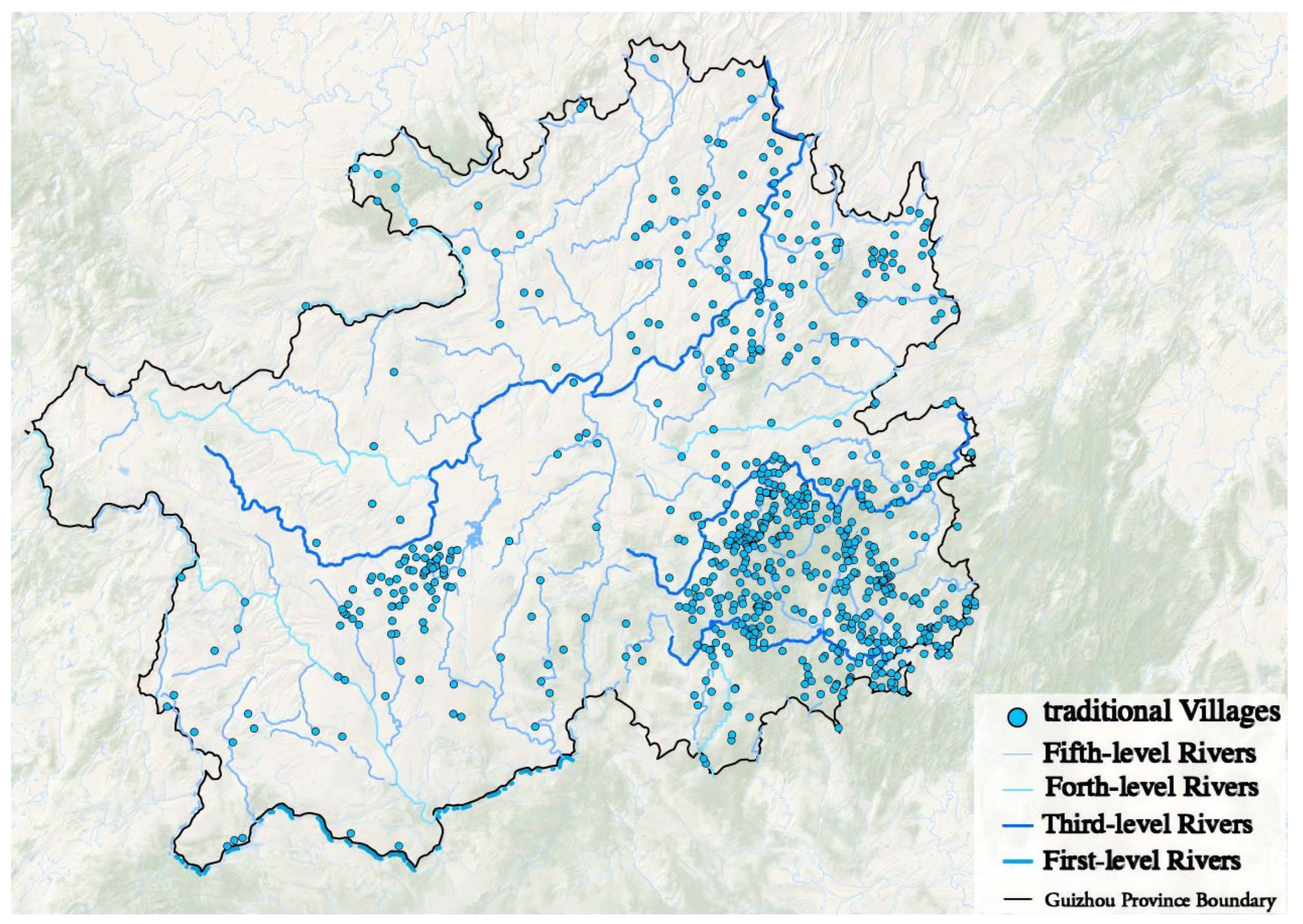
Figure 4.
Kernel density estimation map.
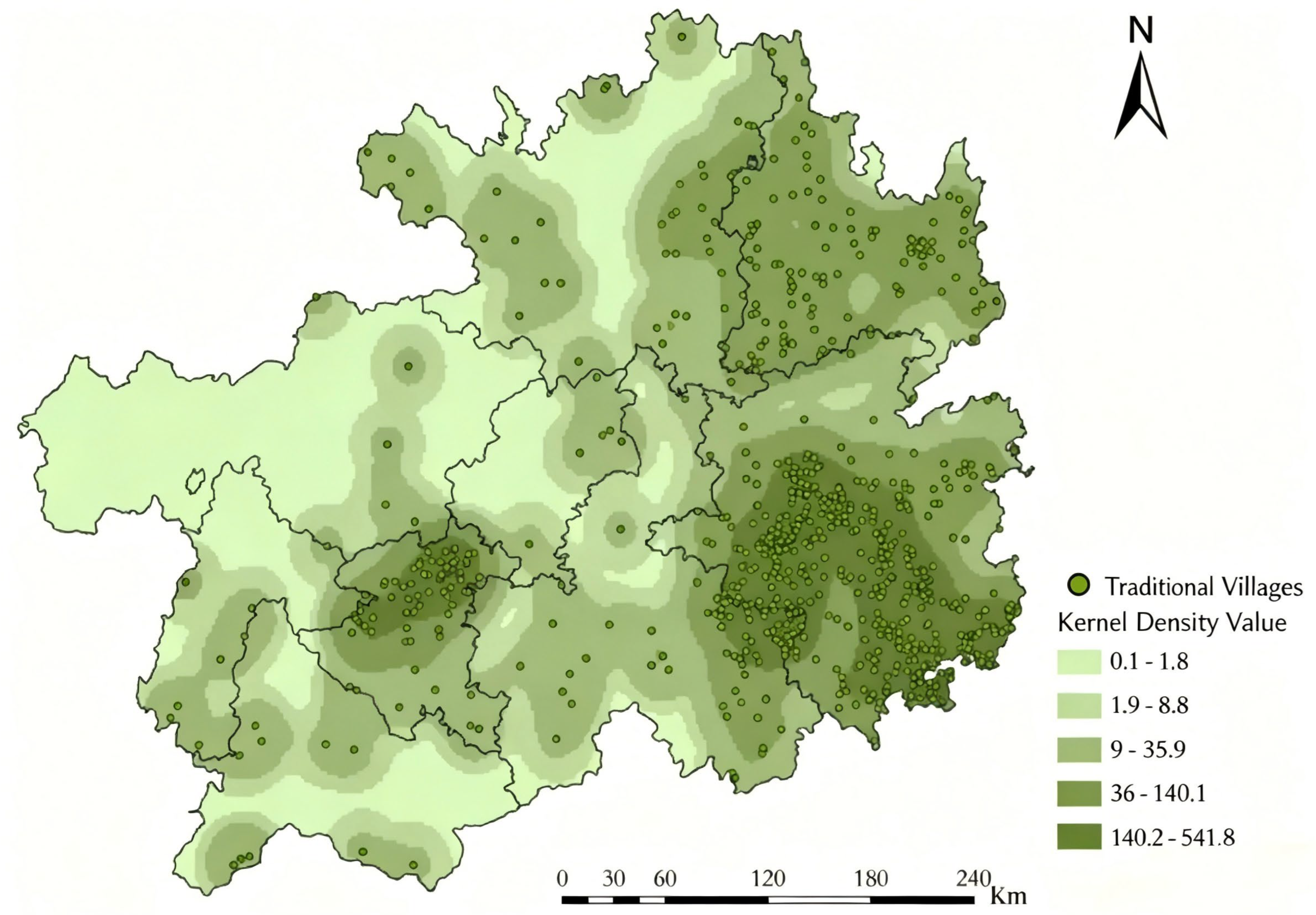

Table 1.
Topographic Distribution Characteristics of Traditional Villages of Major Ethnic Groups in Guizhou.
Table 1.
Topographic Distribution Characteristics of Traditional Villages of Major Ethnic Groups in Guizhou.
| Ethnic Category | Typical Elevation (m) |
Main Slope Range (°) | Preferred Geomorphic Position | Core Logic of Site Selection | Representative Areas | Architectural Adaptation Form |
|---|---|---|---|---|---|---|
| Miao | 800–1500+ | 25–35° | Mountainside, mountaintop, ridge terrace | Refuge and defense, avoiding miasma, forest hunting and gathering | Leigong Mountain, Yueliang Mountain, Wuling Mountain area | Stilt houses (Diaojiaolou, semi-stilted), adapting to the terrain |
| Dong | 400–800 | < 15° | River valley banks, alluvial fans, basin margins | Rice cultivation and water management, fishing, convenient transportation | Duliu River basin, lower Qingshui River | Stilt houses (column-and-beam), dense contiguous layout |
| Bouyei | 300–700 | < 10° | Valley terraces, low-heat flatlands | Rice farming, irrigation, flood avoidance | Nanpan River, Beipan River, Hongshui River basins | Stone slab houses, semi-stilted, built near water |
| Han (Tunpu) | 500–1000 | 5–20° | Strategic passes, defiles, shallow hills and flatlands | Military control, self-sufficient屯田 (garrison farming), communication and liaison | Anshun area, central Guizhou hinterland | Stone villages, courtyard houses (Siheyuan), defensive watchtowers |
| Gelao | 600–1200 | 15–30° | Dissolution depressions, intermontane trough valleys | Mining (historical), mountain farming, concealment | Wuchuan, Daozhen and other northern Guizhou areas | Stilt houses, earth-stone mixed structure |
Table 2.
Proportion of village distribution by slope aspect.
| Slope Aspect | North | Northeast | East | Southeast | South | Southwest | West | Northwest |
|---|---|---|---|---|---|---|---|---|
| Number of villages | 100 | 69 | 83 | 109 | 107 | 99 | 101 | 89 |
| Proportion (%) | 13.23 | 9.13 | 10.98 | 14.29 | 14.15 | 13.1 | 13.36 | 11.77 |
Table 3.
Village distribution and sunny/shady slope ratio.
| Slope Aspect | Sunny Slope | Shady Slope | Sunny/Shady Slope Ratio |
|---|---|---|---|
| Aspect range (°) | 90°–270° | 0°–90°, 270°–360° | |
| Number of villages | 396 | 360 | 1.1 |
Table 4.
Comparison of River System Distribution Characteristics of Traditional Villages of Major Ethnic Groups in Guizhou.
Table 4.
Comparison of River System Distribution Characteristics of Traditional Villages of Major Ethnic Groups in Guizhou.
| Ethnic Category | Relationship with Main Rivers | Typical Buffer Distance (m) | Water Source Dependency Type | River System Utilization Method | Water-Related Cultural Concepts | Flood Risk Response |
|---|---|---|---|---|---|---|
| Miao | Avoid / stay away | > 1,000 (macro) / < 200 (micro streams) | Mountain springs, streams, groundwater | Bamboo-pipe water diversion, domestic use, small-scale irrigation | Reverence for mountains and water; sacred water sources (sacred trees protect springs) | Site selection on high ground; natural flood avoidance |
| Dong | Closely attached | < 500 | Rivers, streams, ponds | Paddy irrigation, fish farming, transportation (shipping), washing | Worship of dragon gods; wind-rain bridges “lock the water outlet” | Build embankments for flood control; stilt houses raised above ground |
| Bouyei | Closely attached | < 800 | Rivers, outlets of underground rivers | Large-scale rice farming, lift irrigation, waterwheels | Worship water gods; Water-Splashing Festival (San Yue San / third day of the third lunar month) | Choose high terraces for residence; build stone embankments |
| Han (Tunpu) | Controlled utilization | 500–1,500 | Rivers, artificial ponds/reservoirs | Military-garrison irrigation, moats, shipping | Feng shui principles of qi regulation; combination of dredging and blocking | Build canal systems; defensive city walls |
| Shui | Distributed along rivers | < 600 | Streams, small rivers | Rice farming, fishing | Duan Festival horse racing; water rituals | Nestled against mountains and near water, with flood-prevention considerations |
Table 5.
Quantitative Analysis Indicators for the Geographical Distribution of Ethnic Traditional Villages in Guizhou.
Table 5.
Quantitative Analysis Indicators for the Geographical Distribution of Ethnic Traditional Villages in Guizhou.
| Analysis Dimension | Quantitative Indicator / Method | Miao Traditional Village Characteristic Values | Dong Traditional Village Characteristic Values | Bouyei Traditional Village Characteristic Values | Han (Tunpu) Village Characteristic Values | Conclusion and Mechanism |
|---|---|---|---|---|---|---|
| Spatial Pattern | Nearest Neighbor Index (R) | 0.45–0.55 (clustered) | 0.30–0.40 (strongly clustered) | 0.35–0.45 (strongly clustered) | 0.50–0.60 (moderately clustered) | All ethnic groups show clustered distribution; rice-farming peoples are more clustered due to limited flatland resources. |
| Elevation Distribution | Dominant elevation range (m) | 800–1400 | 400–700 | 300–600 | 500–900 | Significant vertical differentiation; Miao occupy high ecological niches, while Bouyei/Dong occupy low ecological niches. |
| Slope Adaptation | Average slope (°) | 18–25° | 8–12° | 5–10° | 10–15° | The Miao have the strongest adaptability to steep slopes, with stilt-house architecture being a key supporting factor. |
| Water System Association | Average distance to river (m) | > 1000 (large rivers) / < 200 (streams) | < 500 | < 600 | 500–800 | Dong and Bouyei are “water-attached”; Miao are “far from large rivers but close to small streams”, reflecting different flood response strategies. |
| Clustering Center | Kernel density peak area | Leigong Mountain, Yueliang Mountain hinterland | Duliu River, lower Qingshui River | Nanpan River, Beipan River, Hongshui River valley | Anshun, Pingba area | Distinct ethno-cultural geographical zones have formed, highly consistent with historical migration routes. |
Disclaimer/Publisher’s Note: The statements, opinions and data contained in all publications are solely those of the individual author(s) and contributor(s) and not of MDPI and/or the editor(s). MDPI and/or the editor(s) disclaim responsibility for any injury to people or property resulting from any ideas, methods, instructions or products referred to in the content. |
© 2026 by the authors. Licensee MDPI, Basel, Switzerland. This article is an open access article distributed under the terms and conditions of the Creative Commons Attribution (CC BY) license (http://creativecommons.org/licenses/by/4.0/).
Copyright: This open access article is published under a Creative Commons CC BY 4.0 license, which permit the free download, distribution, and reuse, provided that the author and preprint are cited in any reuse.


