Submitted:
27 April 2026
Posted:
28 April 2026
You are already at the latest version
Abstract
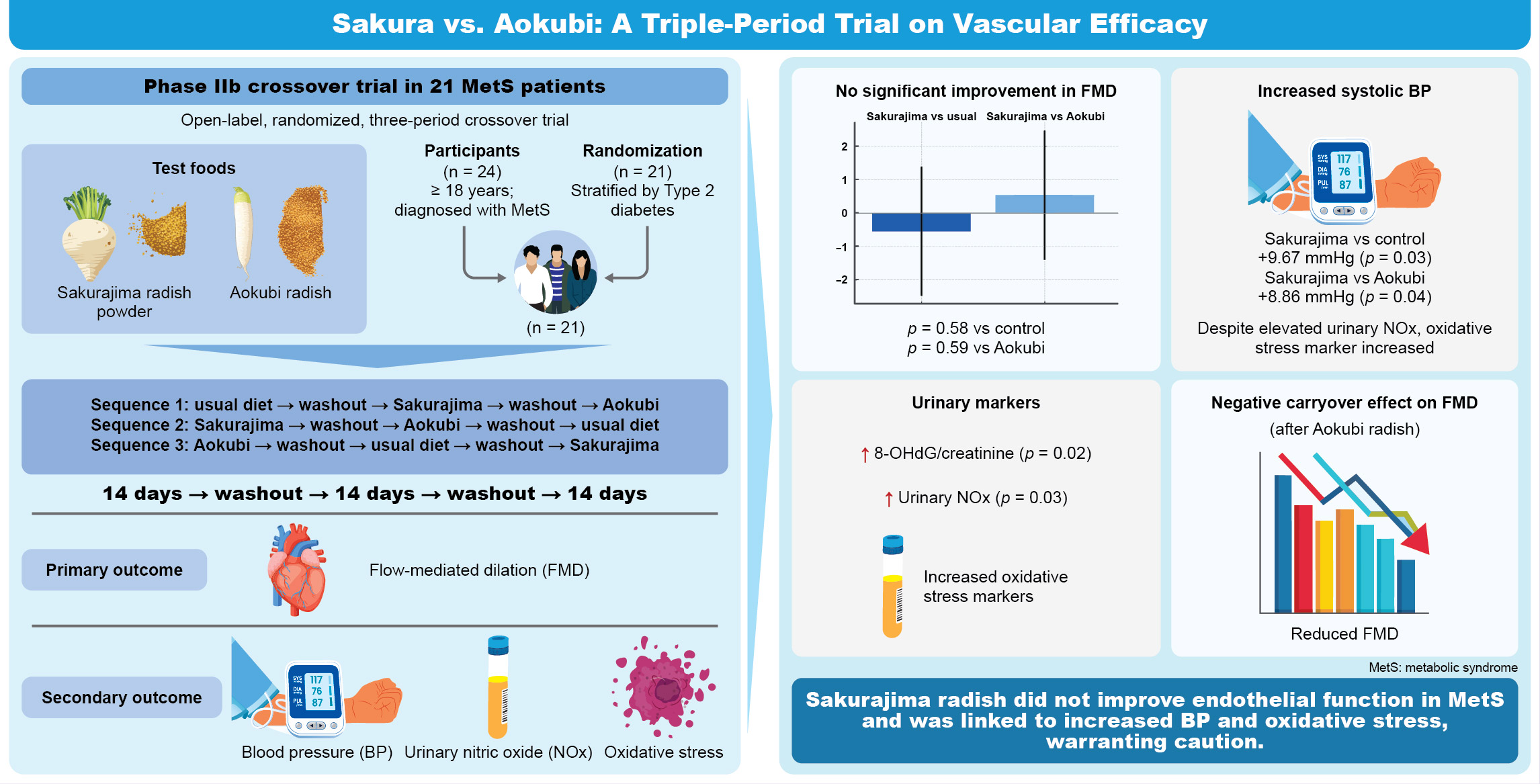
Background/Objectives: We aimed to evaluate the efficacy and safety of trigonelline-rich Sakurajima radish on vascular endothelial function in patients with metabolic syndrome (MetS). Methods: In this multicenter, open-label, randomized, three-period crossover phase IIb trial, 21 patients with MetS were assigned to three 14-day sequences: Sakurajima radish powder, Aokubi radish powder, and a usual diet, separated by 14-day washouts. The primary outcome was flow-mediated dilation (FMD). The secondary outcomes included blood pressure (BP), urinary nitric oxide metabolites (NOx), and oxidative stress markers (8-hydroxy-2′-deoxyguanosine [8-OHdG]). Results: Twenty-one participants were included in this study. Sakurajima radish did not significantly improve FMD compared with the usual diet (control) (p = 0.58) or Aokubi radish (p=0.59). Unexpectedly, systolic BP was significantly higher with Sakurajima radish compared with control (+9.67 mmHg, p = 0.03) and Aokubi radish (+8.86 mmHg, p = 0.04). Urinary 8-OHdG/creatinine levels were also significantly higher with Sakurajima radish compared with control (p = 0.02), despite a significant elevation in urinary NOx levels (p = 0.03). A significant negative carryover effect on FMD was observed after the Aokubi radish period. Conclusions: Consumption of Sakurajima radish does not improve endothelial function in patients with MetS. Contrary to expectations, the intervention is associated with increased systolic BP and oxidative stress, despite elevated NOx levels. These findings suggest the need for caution regarding its cardiovascular application in patients with MetS.