

Submitted:
27 April 2026
Posted:
28 April 2026
You are already at the latest version
Abstract
Non-O1/non-O139 Vibrio cholerae (NOVC) species are typically non-toxic and are regarded as etiological agents of infrequent, but mild to severe human gastroenteritis. In response to the 2022-2023 cholera outbreak in Tshwane, this study investigated the occurrence of NOVC isolates in wastewater within the Tshwane district, South Africa. A total of 341 wastewater samples were screened using Thiosulfate citrate bile salts sucrose (TCBS) media, with subsequent confirmation of Vibrio cholerae (V. cholerae) isolates by multiplex-PCR assays. Rep-PCR was performed to determine genetic relatedness of the isolates. Selected isolates were subjected to whole genome sequencing (WGS). Of the 341 samples; PCR confirmed 143 isolates as NOVC. Genetic fingerprinting grouped these isolates into 12 distinct clusters, from which 12 representative isolates were selected for WGS, all of which were confirmed as NOVC. The isolates harboured pathogenicity-related genes, such as hlyA, rtxA, trkH, tnaA, gyrB and gyrA. Drug resistance was mostly observed to first-line antibiotics, ciprofloxacin, chloramphenicol, and trimethoprim-sulfamethoxazole. Plasmid analysis showed seven isolates harboured plasmids (pA, p21L, PVN84) bearing multiple resistance determinants. Phylogenetic analysis showed evidence of genetic diversity amongst the isolates. Although the isolates lacked classical toxigenic genes, they carried other virulence determinants associated with pathogenicity, posing a potential risk for clinical infection, highlighting the need for sustained surveillance.
Keywords:
V. cholerae
; non-O1/non-O139
; whole genome sequencing
; wastewater
; South Africa
1. Introduction
Vibrio cholerae (V. cholerae) is a curved, motile, Gram-negative organism found in marine habitats, which causes acute, watery diarrheal disease known as cholera [1]. V. cholerae may survive in a wide range of radically diverse conditions, including fresh and salty water; it can also live as cells that circulate freely or in biofilms on abiotic surfaces like zooplankton or phytoplankton; and it’s capable of infecting the organism that hosts it [2]. Currently, about 200 different V. cholerae serogroups have been identified. However, O1 and O139 toxin-producing serogroups have been shown to be responsible for all significant known epidemics and pandemics [3,4]. Non-O1/non-O139 V. cholerae (NOVC) are isolates of V. cholerae that are unable to agglutinate with O1 or O139 antiserum. These isolates are typically non-toxic and are regarded as etiological agents of infrequent but mild to severe human gastroenteritis [5]. Several investigations have documented the relevance of these strains in human infections [6,7], even though their clinical significance was previously disregarded [8]. Parenteral invasive infections and sporadic gastroenteritis are the most frequent infections of NOVC [9]. Due to the immediate results of genetic exchange processes, such as genetic recombination and horizontal gene transfer (HGT), NOVC strains are also thought to have the ability to aid in the formation of new virulent strains, including strains that can cause an epidemic [8]. In light of the recent cholera outbreak in Tshwane, it is therefore imperative to assess the potential public health risks posed by these NOVC isolates and to advise on surveillance programs in the district.
2. Materials and Methods
2.1. Study Area and Sample Collection
Wastewater samples were collected from seven different wastewater treatment plants (WWTPs), namely, Babelegi, Temba, Rietgat, Daspoort, Sunderland Ridge, Zeekoegat, and Baviaanspoort, all within the Tshwane District, South Africa (Figure 1).
2.2. Identification of V. cholerae
The collected wastewater samples were enriched by inoculating 10 ml of each sample into 15 ml of alkaline peptone water (APW) (Thermo Fisher, UK) and incubating at 35-37 °C for 24 hours. Following incubation, the enriched samples were streaked onto TCBS (Thiosulfate citrate bile salts sucrose) agar (Thermo Fisher, UK) to facilitate the selective isolation of Vibrio species identified by yellow, smooth and shiny colonies. The presumptive V. cholerae colonies were purified by sub-culturing on Mueller-Hinton agar (MHA) (Scharlab, Spain). The isolates were further characterised using Gram staining and oxidase test, with Gram-negative, comma-shaped, oxidase-positive colonies indicative of V. cholerae.
2.3. Genus-Specific PCR
Genomic DNA of NOVC isolates was extracted using the boiling method [10]. Briefly, a bacterial suspension of a pure culture was prepared in one mL of saline. The suspension was vortexed for 20 seconds and centrifuged at 13,000 rpm for 10 minutes. The supernatant was then resuspended in 200 µL of PCR-grade water. To extract DNA, the suspension was boiled on a heating block and ruptured using a cell disruptor. The suspension was centrifuged at 13 000 rpm for 10 minutes, after which, the supernatant (200 µL) containing DNA was assessed using a NanodropTM LITE spectrophotometer (Thermo ScientificTM, USA) for purity and concentration. Genotypic confirmation of isolates was performed using multiplex conventional PCR targeting ompW, ctxA and tcpA genes, with primer sequences shown in (Supplementary Table S1). All primers used in this study were synthesised by Inqaba Biotechnical Industries (Pty) Ltd, Pretoria, South Africa. A 25 μL PCR reaction mix was prepared consisting of 12.5 μL MyTaq™ Red Mix (Bioline; UK), 0.5 μL of each primer (forward and reverse), 6.5 μL of PCR grade-water (BioConcept Ltd, Switzerland), and 5 μL of DNA template. Amplification was conducted in a T100TM Thermal cycler (Bio-Rad, USA), following conditions shown in (Supplementary Table S1). Amplicons were resolved by gel electrophoresis on a 2% agarose gel prepared in 1X Tris-Borate-EDTA buffer with 5 µl ethidium bromide (Promega, USA) and ran at 100 V for 60 minutes. DNA bands were visualised using the Gel Doc™ EZ system (Bio-Rad, USA).
2.4. Identification of Non-O1/Non-O139 V. cholerae
NOVC isolates were distinguished from O1/O139 strains using multiplex conventional PCR targeting O1- and O139-specific sequences. Isolates that showed no amplification for O1/O139 were subsequently subjected to further analysis. The target genes, primer sequences, amplicon sizes and the optimised PCR conditions are listed in (Supplementary Table S1). The PCR reaction mix was prepared as in Section 2.3 and amplified in a T100TM Thermal cycler (Bio-Rad, USA), using the conditions listed on (Supplementary Table S1). Amplicons were detected and visualised as in Section 2.3.
2.5. Repetitive Extragenic Palindromic PCR
Rep-PCR was performed to assess the genetic relatedness of the isolates. The primers and cycling conditions used for Rep-PCR are listed in (Supplementary Table S2). Amplification was conducted using the T100TM Thermal cycler (Bio-Rad, USA). Preparation of the reaction, amplicon detection and visualisation was conducted as in Section 2.3. Representative isolates from each cluster were subsequently subjected to whole genome sequencing (WGS) for further characterisation.
2.6. Whole Genome Sequencing
DNA was extracted using the Zymo Quick-DNA Fungal/Bacteria Miniprep kit (Zymo Research, USA). The resultant ultra-pure DNA was quality-checked and quantified using a Qubit 4.0 fluorometer (Thermo Fisher Scientific, USA). The Rapid Barcoding Kit 96 V14 (SQK-RBK114.96, Oxford, England) was used for library preparation following the NO-MISS protocol and loaded onto the Oxford Nanopore Technologies Minion R10.4.1 flow cell (FLO-MIN114, Oxford, England). Whole-genome sequencing was performed on a Minion Mk1C sequencer platform (Oxford Nanopore Technology, England) for a 72-hour run length and 200 bp minimum read length. Basecalling and demultiplexing of the raw FAST5 data were performed using Guppy v 6.5.7 with the super accuracy model through MinKNOW v24.02 software, which converted data to FASTQ format. The FASTQ files were subsequently uploaded to the cloud-based EPI2ME platform for further bioinformatics analysis.
2.6. Bioinformatics Analysis
FASTQ files were uploaded to EPI2ME cloud-based platform and analysed using bacterial genome workflow. These files were concatenated using fastcat v0.18.6 (github.fastcat). The quality control of sequencing reads was performed using flye [11] and medaka (github.medaka) and high-quality reads were generated by removing low-quality reads (q< 10). The read quality ranged from 15.89 to 10.23, with an average median read length ranging from 10.38 to 2.40 kb, and a total yield of 7 to 47.21 Mb. De novo assembly of bacterial genomes was done using Flye v2.9.5-b1801 [11]. Consensus sequences were polished using medaka v2.0.0 (github.medaka). Prokka v1.14.5 was used to annotate the resulting contigs. In-silico antimicrobial resistance genes were identified using Resfinder v3.10 [12]. Multilocus sequence typing (MLST) was done using MLST v2.23 [13]. Genome mapping was constructed using proksee (https://proksee.ca/). Resistance genes on a genome map constructed from proksee were predicted using the comprehensive antibiotic resistance database (CARD) resistance gene identifier (RGI) v6.0.3 [14]. Different virulence genes were predicted using Coding DNA Sequence (CDS). Mobile genetic elements were predicted on proksee using mobileOG-db v1.1.3 [15]. For plasmid analysis and profiling, the contigs belonging to different isolates were subjected to blast searches on NCBI database (https://blast.ncbi.nlm.nih.gov/Blast.cgi) to identify plasmid sequences exhibiting the highest sequence similarity. Thereafter, the contigs were annotated using PLannotate and Bakta on Proksee.
2.6. Phylogenetic Analysis
To investigate the evolutionary history and genetic relationships of NOVC isolates obtained from wastewater samples, genomic data from ten reference isolates originating from different countries were retrieved from the National Centre for Biotechnology Information (NCBI) (https://www.ncbi.nlm.nih.gov/) and compared with twelve locally obtained NOVC isolates. Sequence alignment using ClustalW and phylogenetic analysis was performed with MEGA version 12.0 (https://www.megasoftware.net). Phylogenetic analysis was performed using the Neighbor-joining method [17], with branch reliability assessed by 1,000 bootstrap replicates [18]. Evolutionary distances were calculated using the Maximum Composite Likelihood method [19]. Positions with gaps or missing data were excluded by complete deletion, resulting in a final data set of 70 positions.
3. Results
3.1. Phenotypic and Molecular Identification of NOVC Isolates
Of the 341 wastewater samples collected and analysed, 319 yielded presumptive V. cholerae isolates. Among these, 189 were confirmed as V. cholerae by PCR targeting the ompW gene, with the ctxA and tcpA virulence genes detected in 52 and 51 isolates, respectively. Multiplex-PCR targeting the O1 and O139 serogroups identified 49 isolates positive for O1, while 143 isolates showed no amplification for either serogroup. Rep-PCR analysis further clustered these isolates into twelve different clonal groups, from which twelve representative isolates were selected for WGS and subsequently confirmed as NOVC.
3.2. Whole Genome Characteristics of NOVC Isolates
The genomic annotations of twelve NOVC isolates generated using EPI2ME are presented in Table 1. Ten isolates were identified as V. cholerae, with the remaining two classified as Vibrio species. Genome sizes ranged from 3.73 to 3.95 Mb. No sequence types matched entries in the MLST database.
3.3. Genomic Characteristics of NOVC Isolates
Table 2 summarises the key genomic features of NOVC isolates, as predicted by the Proksee genome analysis software. The analysed genomes exhibit a total number of genes ranging from 3,562 to 8,446, with the CDS ranging from 3,430 to 8,302 and the GC (guanine+cytosine) content showing significant variation across the genomes. The number of open reading frames (ORFs) ranged from 5,221 to 9,591, which is widely distributed throughout the chromosomes. For RNA elements, the number of tRNA (transfer RNA) and rRNA (ribosomal RNA) genes ranged from 88 to 109 and 20 to 34, respectively. tmRNA (transfer-messenger RNA) genes were present in eleven out of twelve genomes, and CRISPR elements found in ten out of twelve genomes. This overview provides insights into the genomic structure of the isolates.
3.4. Mobile Genetic Elements
Table 3 summarises functional categories consisting of various mobile genetic elements (MGEs) identified in NOVC isolates, which were analysed using MobileOG in Proksee software. Multiple functional categories were detected across all isolates, with the phage-related elements and DNA repair-recombination-repair elements being the most prevalent. These findings highlight the potential role of MGEs in genomic plasticity, virulence and the dissemination of antimicrobial resistance among environmental V. cholerae populations.
3.5. Plasmids
Plasmid profiling based on BLAST analysis from the NCBI database revealed that out of the twelve examined isolates, seven harboured plasmids. The sizes of these plasmids ranged from 3,200 bp to 28,683 bp. Among these, three distinct plasmid profiles (pA, PVN84 and p21L) were identified in the isolates, including some unnamed plasmids. Most of the isolates in this study harboured plasmids which carried multiple resistance determinants, genes encoding toxin-antitoxin systems, as well as replicase and relaxases. Figure 2 and Supplementary Figure S3 present circular plasmid maps indicating the distribution of CDS, CARD and toxin-antitoxin genes. These genes confer resistance mainly to trimethoprim and quinolones. The analysis revealed that some of the isolates carried more than one plasmid as indicated in Figure 3. The presence of these plasmids underscores the potential role of mobile genetic elements in disseminating antimicrobial resistance among environmental V. cholerae populations.
3.6. Antibiotic Resistance Profiles of NOVC Isolates
The analysis predicted 30 antibiotic resistance genes across the isolates, mostly associated with resistance mechanisms such as efflux pump, antibiotic inactivation, target protection, enzymatic degradation, enzymatic inactivation, antibiotic efflux, and target replacement. The predicted resistance genes conferred resistance against multiple drug classes such as aminoglycosides (streptomycin), cephalosporins (ceftazidime), fluoroquinolones (ciprofloxacin), tetracyclines (tetracycline), phenicols (chloramphenicol), folate pathway inhibitors (trimethoprim, sulfamethoxazole), macrolide (erythromycin) and beta-lactams (ampicillin, amoxicillin, piperacillin) as detailed in Supplementary Table S4. These genes were associated with resistance to various drug classes, including Aminoglycosides (Alph (6)-id, Alph (3")-Ib, rsmA), Tetracyclines (TXR), Beta-lactams (CARB-9), Glycopeptides (VanT in VanG cluster and VanY in VanB cluster), Fluoroquinolones (parE, QnrVC4, adeF,), Phenicols (flor and adeF), Trimethoprim (dfrA31) and Sulfonamides (sul2). The distribution and functional classification of these genes is illustrated in Figure 4 and Supplementary Figure S5. These results highlight diverse AMR potential present in environmental V. cholerae isolates.
3.7. Virulence-Associated Genes of NOVC Isolates
The virulence-associated genes identified in NOVC isolates were categorised by functional groups. Cytolytic factors included hlyA, rtxA, and stn; adhesion and colonization factors comprised mshA, ompU, tcpA, HA/P, and nagH; secretion system components included T3SS, T6SS, rtxC, VPI-1, and VPI-2; biofilm-associated genes comprised VSP1/VSP2, als, and makA; and regulatory/metabolic elements included toxR, VSPR, rfbv, rfbc, trkH, tnaA, gyrA, and gyrB. These results highlight the extensive virulence potential present in environmental NOVC isolates. The distribution of the virulence genes in NOVC and the functional groups is depicted in Supplementary Table S6.
3.8. Circular Representation of a Whole Genome Map of NOVC Isolates
Genome maps of the twelve NOVC isolates (B12, DS13, BS13, DS14, BS14, ZG14, RT14, SR14, DS12, ZG12, RT12, and SR12) were generated using Proksee (Supplementary Figure S5). A circular map of one of the isolates is shown as a representation of the results obtained in Figure 4. The maps were annotated to display key genomic features, including virulence genes (CDS), resistance genes (CARD), G+C content, and GC skew. Notable virulence genes detected among the isolates included hlyA, gyrA/B, trkH, tnaA, while resistance genes comprised rsmA, CRP, APH (6)-Id, floR, dfrA31, almF, and QnrVC4. The G+C content of these genomes ranged from 44% to 50%, reflecting variability among the isolates. These genomic analyses highlight both the virulence potential and antimicrobial resistance profiles of NOVC from wastewater.
3.9. Phylogenetic Analysis of the gyrB Gene in NOVC Isolates
To gain a global perspective on the genetic relationships of NOVC isolates, a Neighbor-Joining phylogenetic tree was constructed based on the gyrB gene. Reference genomes were selected from diverse regions including, South Africa, the Netherlands, China, USA, Ghana, Russia, India, Japan, France, and Australia, to ensure broad representation. The resulting phylogeny revealed notable genetic diversity among the wastewater-derived NOVC isolates and reference genomes, which clustered into two distinct groups relative to the international strains. This pattern highlights both local and global genetic relationship and suggests the presence of genetically divergent lineages circulating in the Tshwane District wastewater treatment plants, potentially reflecting multiple sources or evolutionary pathways. The relationship between the NOVC isolates and the reference genome is shown in Figure 5.
4. Discussion
Wastewater-based epidemiology is an important tool for monitoring the transmission of V. cholerae in communities [21]. Several studies have detected both the toxigenic and non-toxigenic strains in wastewater samples [21,22]. The epidemiological significance of environmental V. cholerae strains remains unclear, as most strains recovered from environmental sources do not produce cholera toxin and lack the virulence gene cassette [6]. Strains of the non-O1/non-O139 serogroups are indigenous in the marine, estuarine, and inland water environments. This study aimed to characterise NOVC isolates in wastewater in the Tshwane district. Of the 341 wastewater samples analysed, 319 yielded V. cholerae isolates, of which 143 were identified as NOVC by PCR. A similar study was conducted by Baron et al (2017), which reported the presence of NOVC in 75% of wastewater samples in comparison to other samples used in the study [23].
Whole genome sequencing (WGS) is an important technique used to investigate and characterise information carried by the genome of bacterial pathogens, such as genetic relatedness between different isolates and organisms, the mechanism of antimicrobial resistance (AMR) in bacterial organisms and virulence factors [24]. A total of twelve isolates were fully sequenced, and ten isolates identified as V. cholerae, while two were identified as Vibrio species. The sequence types of these isolates were not identified, and this could be attributed to limitations in existing MLST databases or the presence of novel allelic profiles not yet represented in current MLST schemes, a scenario commonly observed among diverse NOVC populations [25]. In this study, whole genome sequencing combined with comparative genomics offers valuable insights into the genetic diversity of the NOVC isolates from wastewater. The genomic features of NOVC, such as genome size, total number of CDS, tRNA, rRNA, tmRNA, sORF, CRISPR elements, and GC content reported in this study, are similar to those of other NOVC strains [4].
WGS further revealed that none of the isolates harboured toxigenic genes associated with virulence, confirming their classification as NOVC. The ctxA and tcpA genes, traditionally associated with cholera epidemics and pandemics, are usually absent from these strains [26,27]. Similar findings were documented in a study conducted by Mkhize et al (2025) in Johannesburg, South Africa, where a total of 24 isolates lacked ctxA and tcpA, and were subsequently identified as NOVC species [28]. Several other studies have found that some NOVC strains lack important virulence genes such as ctxA and tcpA [29,30]. However, these environmental isolates may still possess other virulence factors contributing to their pathogenicity [29,30]. The isolates analysed in this study were found to harbour several other virulence-associated genes, including hylA, rtxA, ompU, gyrB, gyrA, trkH, and tnaA, which are implicated in various infection-related processes and may contribute to the pathogenic potential of these strains. V. cholerae contains a large amount of hylA, which has a unique structural domain that binds to target cells and may be a major factor in NOVC's capacity to enter the bloodstream [31].
The emergence of antimicrobial resistance (AMR) in NOVC strains is being reported with increasing frequency worldwide, particularly in regions affected by recurrent cholera outbreaks [32]. The consequent decline in the effectiveness of widely accessible antibiotics poses a serious risk to public health [32]. The genetic antibiotic resistance profiles of the twelve NOVC isolates in this study were characterised using CARD and ResFinder (EPI2ME). In-silico analysis identified multiple resistance genes, which confer resistance to a broad range of antimicrobial agents, including the first-line drugs such as trimethoprim-sulfamethoxazole, ampicillin, and ciprofloxacin. A study conducted in China by Tang et al. (2023), also revealed the presence of CRP, varG, almG, and QnrVC4 genes conferring resistance to multiple antibiotics [33]. The isolates also consisted of regulatory genes (CRP, rsmA and AmlF) involved in controlling efflux pump genes and systems which play a significant role in the resistance of V. cholerae against antibiotics [34].
Furthermore, these isolates also carried genes conferring resistance to fluoroquinolones (parE, QnrVC4), aminoglycosides (aph (6)-Id, aph(3”)-Ib), polymyxins (AlmF), glycopeptides (vanT in vanG cluster), trimethoprim-sulfamethoxazole (dfrA31), and β-lactams (CARB-9). V. cholerae typically acquires antimicrobial resistance through mechanisms such as target replacement, target protection, and enzymatic inactivation through hydrolysis [35]. This prevents access to the target site by altering membrane permeability and actively exporting antibiotics from cells [35]. Mobile genetic elements, plasmids in particular, play a crucial role in the spread of antibiotic resistance [37]. The analysis of NOVC isolates using mobileOG-db revealed various MGEs across the study isolates. The presence of phages, replication/recombination/repair, stability/transfer/defense, integration/excision and transfer functional groups enables these isolates to contribute to disease development, AMR, phage infection and facilitate HGT [15]. A high prevalence of replication, recombination, and repair (RRR) genes, as well as phage-associated elements was observed across the isolates. These functional modules are commonly associated with plasmids and phages, which often carry RRR proteins that have close homologs in chromosomal DNA [38].
Plasmids have been implicated in HGT and contribute significantly to evolution of microorganisms [39]. In this study, several plasmids were identified within contigs carrying several resistance, virulence, and toxin antitoxin genes. Sequence analysis revealed that the plasmids encoded a range of functional elements, including resistance determinants, relaxase, replicase, metabolic, hydrolase and transport membrane genes, toxin-antitoxin systems, and hypothetical proteins, indicating the dissemination of antimicrobial resistance and virulence traits. Resistance genes such as dfrA31, dfrA6, dfrA1 QNR_VIBPA, dhfrI, qnrVC and qnrVC5 were found exclusively in plasmids belonging to three distinct isolates, DS13 (contig nine and ten), RT14 (contig six) and BS14 (contig 94). These genes are known to confer resistance to trimethoprim and quinolones. Plasmids of different enteric pathogens, including V. cholerae, have been reported to have several physically connected genetic determinants that confer resistance to various antibiotic classes [40].
The replication initiation protein (rep) was identified in a plasmid from one isolate, BS13 (contig 42). This protein is essential for plasmid replication and maintenance and is often used as a marker for plasmid compatibility [41]. A pseudoknot structure of the regulatory region of the repBA gene was also detected in the same isolate. This structure plays an important role in controlling plasmid replication by regulating translation of the repA replication initiator protein and influencing gene expression at the RNA level [40]. All plasmids carried hypothetical proteins, which are uncharacterised since their function is unknown and no close homologs could be identified [41]. Mobilisable plasmids typically possess a mobilisation (mob) region that encodes specific components of the relaxosome and the origin of transfer (oriT) [42]. Plasmids carrying genes encoding relaxase enzymes were identified in several isolates, including BS13, BS14, ZG12, and SR12. Relaxases are essential components of the relaxosome, responsible for initiating DNA transfer in both conjugative and mobilisable plasmids [43]. The MobM protein was found in two plasmids from isolates BS12 (contig 1) and BS14 (contig 94). This protein encodes a relaxase enzyme, which plays a key role in conjugative transfer [44]. Additionally, MobA and MobB proteins were identified in a plasmid from isolate BS13 (contig 42), while MobC was detected in two plasmids from distinct isolates, BS13 (contig 42) and ZG12 (contig 8). MobC forms the relaxosome complex by interacting with MobA and MobB [45]. To facilitate DNA transfer, MobA proteins bind and nick double-stranded DNA at the origin of transfer (oriT) site [46]. MobB is also essential for efficient mobilization, as it stabilises the relaxosome and increases the proportion of plasmid molecules nicked at oriT [47].
MbeA and MbeC proteins were also identified in a plasmid from isolate BS13 (contig 42). The MbeA protein is essential for plasmid mobilisation, while MbeC plays a key role in facilitating the specific transfer of the plasmid during conjugation [45]. Detection of relaxase/mobilisation nuclease domain-containing protein in a plasmid from BS13 (contig 42) supports its potential role in HGT [48]. These plasmids are classified as mobilisable plasmids due to the presence of relaxase genes. The presence of multiple relaxase enzymes may affect various aspects of the bacterial life cycle beyond their role in horizontal gene transfer [49]. Relaxases are not limited to initiating conjugative transfer from their corresponding oriT sites; they can also participate in additional cellular processes that affect plasmid maintenance, DNA processing, and host adaptation [49].
The TraY protein was identified in plasmids from isolates DS13 (contig 9) and RT14 (contig 6) and is an important factor for DNA transfer, typically found in conjugative plasmids [44]. Among the seven isolates analysed, plasmids from two isolates, BS14 (contig 39) and SR12 (contig 1) were found to encode the MipA protein, which is involved in the synthesis and degradation of peptidoglycan, a major component of the bacterial cell wall [50]. DUF3552 domain-containing protein was found in a plasmid belonging to isolate DS13 (contig 9). The biological function of this protein is not fully understood and remains uncharacterised [51]. DUF (Domain of Unknown Function) families comprise of functionally uncharacterised protein fragments, as designated by curators, and are often highly conserved among bacterial plasmids [52]. To the best of our current knowledge, there are no documented reports describing the DUF3552 domain, suggesting that this plasmid may encode a novel or poorly understood gene. Other plasmids belonging to isolates DS13 (contig 9), BS14 (contig 94) and RT14 (contig 06) carried toxin–antitoxin genes (parD1, parD, parE, toxin, toxin-antitoxin system, antitoxin component, ribbon-helix-helix domain protein), which act as plasmid stabilization systems. These genes help ensure plasmid survival by supporting DNA replication and translation, and by giving bacteria tolerance to antibiotics, especially under stress [45].
Plasmids are capable of acquiring genes from various organisms through HGT, a mechanism that plays a crucial role in bacterial evolution, enabling genetic adaptation and transmission of traits such as stress tolerance and antibiotic resistance [54]. In this study, several proteins often associated with other organisms were identified in plasmids within various isolates. For example, the CppC protein was detected in the plasmid of isolate BS13 (contig 42), this protein has previously been associated with Neisseria gonorrhoeae [55] Additional genes, including udg, ugd, eco47IIM, haeIIIM, ybbA, lolD, ESTE_VIBMI, atpF, atpE, atpB, atpA, mnmE, parB, mioC, mnmG, rsmG, soJ, and fabV, were found to share similarity with sequences from different organisms such as Escherichia coli, Salmonella enterica, Salmonella typhimurium, V. cholerae O1 serotype, Haemophilus influenzae, Psychromonas ingrahamii, Idiomarina loihiensis, Coxiella burnetii, Vibrio mimicus, Bacillus subtilis, and Clostridium acetobutylicum. These genes play a significant role in the adaptability, metabolic flexibility, and plasmid partitioning of the organism [56]. L-asparaginase and CbiA were also detected in isolates BS14 (contig 94) and RT14 (contig 6). These enzymes contribute to the organism’s ability to adapt to nitrogen-limited environments, thereby enhancing its metabolic flexibility and ecological fitness [57].
All plasmids in this study were smaller than 50 kb, which explains why they carried only a few resistance genes. This is consistent with earlier studies which showed that multidrug-resistant plasmids are usually larger than 50 kb, are self-conjugative, and have more complex systems to control their copy number and replication [45]. Interestingly, all plasmids lacked the usual origin of replication, except a plasmid belonging to isolate BS14 (contig 19). Reports suggest that such plasmids may use other replication mechanisms. For example, other plasmids have been shown to replicate using the ColE1 model of replication [40]. These findings highlight various plasmids found and their significant role in drug resistance, virulence, toxin acquisition, and their overall contribution to the adaptive biology of V. cholerae.
5. Conclusions
Wastewater-based epidemiology is a valuable approach for early detection of infectious diseases within communities. In this study, WGS was used to investigate virulence and antimicrobial resistance in NOVC isolates from wastewater. Although these isolates did not carry the toxigenic genes, they harboured alternative virulence factors that may contribute to pathogenicity, posing a potential risk for clinical infection. Resistance to several first-line antibiotics was also observed, underscoring the urgent need for continuous surveillance to prevent the emergence of these strains as a significant public health threat.
Supplementary Materials
The following supporting information can be downloaded at the website of this paper posted on Preprints.org.
Author Contributions
Conceptualization, M.A.M. and M.N.; methodology, R.O. and B.J.Y.; validation, M.A.M. and M.N.; formal analysis, R.O, M.A.M, B.J.Y; investigation, R.O, M.A.M, B.J.Y, M.S.I.; resources, M.A.M.; data curation, R.O.; writing—original draft preparation, R.O.; writing—review and editing, R.O, B.J.Y, R.S, M.K, M.S.I, N.M and M.AM T.S.; supervision, M.A.M, M.S.I, B.J.Y; project administration, M.A.M and N.M.; funding acquisition, M.A.M. All authors have read and agreed to the published version of the manuscript.
Funding
This research was funded by International Centre for Genetic Engineering and Biotechnology (ICGEB), grant number: ZAF/HDI/CRP/018.
Institutional Review Board Statement
The study protocol was reviewed and approved by the School of Medicine Research Ethics Committee (SREC) and the Sefako Makgatho Health Sciences University Research Ethics Committee (SMUREC) under reference number “SMUREC/M/215/2024:PG”. As the study involved bulk wastewater samples with no traceable personal identifiers, there was no risk of infringing on individual ethical rights.
Informed Consent Statement
Not applicable.
Data Availability Statement
All data generated or analysed during this study are included in this article and its Supplementary Materials files.
Acknowledgments
The authors acknowledge the technical support accorded to this study by the staff of the Department of Microbiological Pathology, School of Medicine, Sefako Makgatho Health Sciences. The authors also gratefully acknowledge the South African Medical Research Council (SAMRC) for providing the wastewater samples used in this study, as well as the funders for their financial support of this research.
Conflicts of Interest
The authors declare no conflicts of interest. The funders had no role in the design of the study; in the collection, analyses, or interpretation of data; in the writing of the manuscript; or in the decision to publish the results.
References
- Montero, D.A.; Vidal, R.M.; Velasco, J.; George, S.; Lucero, Y.; Gómez, L.A.; et al. Vibrio cholerae, classification, pathogenesis, immune response, and trends in vaccine development. Front Med [Internet]. 5 May 2023, 10. Available online: https://www.frontiersin.org/journals/medicine/articles/10.3389/fmed.2023.1155751/full.
- Ortega, D.R.; Kjær, A.; Briegel, A. The chemosensory systems of Vibrio cholerae. Mol. Microbiol. 2020, 114(3), 367–76. [Google Scholar] [CrossRef]
- Liang, K.Y.H.; Orata, F.D.; Islam, M.T.; Nasreen, T.; Alam, M.; Tarr, C.L.; et al. A Vibrio cholerae Core Genome Multilocus Sequence Typing Scheme To Facilitate the Epidemiological Study of Cholera. J. Bacteriol. 2020, 202(24). [Google Scholar] [CrossRef] [PubMed]
- Wang, H.; Yang, C.; Sun, Z.; Zheng, W.; Zhang, W.; Yu, H.; et al. Genomic epidemiology of Vibrio cholerae reveals the regional and global spread of two epidemic non-toxigenic lineages. PLoS Neglected Trop. Dis. 2020, 14(2), e0008046. [Google Scholar] [CrossRef] [PubMed]
- Bhandari, M.; Jennison, A.V.; Rathnayake, I.U.; Huygens, F. Evolution, distribution and genetics of atypical Vibrio cholerae – A review. Infect. Genet. Evol. 2021, 89, 104726. [Google Scholar] [CrossRef]
- Singh, D.V.; Matte, M.H.; Matte, G.R.; Jiang, S.; Sabeena, F.; Shukla, B.N.; et al. Molecular Analysis of Vibrio choleraeO1, O139, non-O1, and non-O139 Strains: Clonal Relationships between Clinical and Environmental Isolates. Appl. Environ. Microbiol. 2001, 67(2), 910–21. [Google Scholar] [CrossRef]
- Fu, S.; Hao, J.; Jin, S.; Wu, K.; Wang, Y.; Ye, S.; et al. A Human Intestinal Infection Caused by a Novel Non-O1/O139 Vibrio cholerae Genotype and Its Dissemination Along the River. Front Public Health [Internet] 2019, 7. Available online: https://www.frontiersin.org/journals/public-health/articles/10.3389/fpubh.2019.00100/full. [CrossRef]
- Vezzulli, L.; Baker-Austin, C.; Kirschner, A.; Pruzzo, C.; Martinez-Urtaza, J. Global emergence of environmental non-O1/O139 Vibrio cholerae infections linked with climate change: a neglected research field? Environ. Microbiol. 2020, 22(10), 4342–55. [Google Scholar] [CrossRef]
- Li, X.; Wu, Y.; Sun, X.; Ma, J.; Li, X.; Liu, C.; et al. Non-O1/non-O139 Vibrio cholerae bacteraemia in mainland China from 2005 to 2019: clinical, epidemiological and genetic characteristics. Epidemiol. Infect. 2020, 148, e186. [Google Scholar] [CrossRef]
- le Roux, W.J.; Masoabi, D.; de Wet, C.M.E.; Venter, S.N. Evaluation of a rapid polymerase chain reaction based identification technique for Vibrio cholerae isolates. Water Sci. Technol. 2004, 50(1), 229–32. [Google Scholar] [CrossRef]
- Kolmogorov, M.; Yuan, J.; Lin, Y.; Pevzner, P.A. Assembly of long, error-prone reads using repeat graphs. Nat. Biotechnol. 2019, 37(5), 540–6. [Google Scholar] [CrossRef] [PubMed]
- Bortolaia, V.; Kaas, R.S.; Ruppe, E.; Roberts, M.C.; Schwarz, S.; Cattoir, V.; et al. ResFinder 4.0 for predictions of phenotypes from genotypes. J. Antimicrob. Chemother. 2020, 75(12), 3491–500. [Google Scholar] [CrossRef]
- Jolley, K.A.; Maiden, M.C. BIGSdb: Scalable analysis of bacterial genome variation at the population level. BMC Bioinform. 2010, 11(1), 595. [Google Scholar] [CrossRef]
- Alcock, B.P.; Huynh, W.; Chalil, R.; Smith, K.W.; Raphenya, A.R.; Wlodarski, M.A.; et al. CARD 2023: expanded curation, support for machine learning, and resistome prediction at the Comprehensive Antibiotic Resistance Database. Nucleic Acids Res. 2023, 51(D1), D690–9. [Google Scholar] [CrossRef]
- Brown, C.L.; Mullet, J.; Hindi, F.; Stoll, J.E.; Gupta, S.; Choi, M.; et al. mobileOG-db: a Manually Curated Database of Protein Families Mediating the Life Cycle of Bacterial Mobile Genetic Elements. Appl. Environ. Microbiol. 2022, 88(18), e00991-22. [Google Scholar] [CrossRef] [PubMed]
- Saitou, N.; Nei, M. The neighbor-joining method: a new method for reconstructing phylogenetic trees. Mol. Biol. Evol. 1987, 4(4), 406–25. [Google Scholar]
- Felsenstein, J. Phylogenies and the comparative method. Am. Nat. 1985, 125(1), 1–5. [Google Scholar] [CrossRef] [PubMed]
- Tamura, K.; Nei, M.; Kumar, S. Prospects for inferring very large phylogenies by using the neighbor-joining method. Proc. Natl. Acad. Sci. 2004, 101(30), 11030–5. [Google Scholar] [CrossRef]
- Street, R.; Nkambule, S.; Mahlangeni, N.; Mthethwa, M.; Blose, N.; Genthe, B.; et al. Wastewater and environmental surveillance for Vibrio cholerae: a scoping review. J. Water Health 2025, 23(6), 715–26. [Google Scholar] [CrossRef]
- Hounmanou, Y.M.; Mdegela, R.H.; Dougnon, T.V.; Mhongole, O.J.; Mayila, E.S.; Malakalinga, J.; Makingi, G.; Dalsgaard, A. Toxigenic Vibrio cholerae O1 in vegetables and fish raised in wastewater irrigated fields and stabilization ponds during a non-cholera outbreak period in Morogoro, Tanzania: an environmental health study. BMC Res. Notes 2016, 9(1), 466.6. [Google Scholar] [CrossRef] [PubMed]
- Baron, S.; Larvor, E.; Chevalier, S.; Jouy, E.; Kempf, I.; Granier, S.A.; et al. Antimicrobial Susceptibility among Urban Wastewater and Wild Shellfish Isolates of Non-O1/Non-O139 Vibrio cholerae from La Rance Estuary (Brittany, France). Front Microbiol [Internet]. 2017, 8. Available online: https://www.frontiersin.org/journals/microbiology/articles/10.3389/fmicb.2017.01637/full.
- Uelze, L.; Grützke, J.; Borowiak, M.; Hammerl, J.A.; Juraschek, K.; Deneke, C.; et al. Typing methods based on whole genome sequencing data. One Health Outlook 2020, 2(1), 3. [Google Scholar] [CrossRef]
- Octavia, S.; Salim, A.; Kurniawan, J.; Lam, C.; Leung, Q.; Ahsan, S.; et al. Population Structure and Evolution of Non-O1/Non-O139 Vibrio cholerae by Multilocus Sequence Typing. PLoS ONE 2013, 8(6), e65342. [Google Scholar] [CrossRef]
- Arteaga, M.; Velasco, J.; Rodriguez, S.; Vidal, M.; Arellano, C.; Silva, F.; Carreño, L.J.; Vidal, R.; Montero, D.A. Genomic characterization of the non-O1/non-O139 Vibrio cholerae strain that caused a gastroenteritis outbreak in Santiago, Chile, 2018. Microb. Genom. 2020, 6(3), e000340. [Google Scholar] [CrossRef]
- Luo, Y.; Ye, J.; Jin, D.; Ding, G.; Zhang, Z.; Mei, L.; et al. Molecular analysis of non-O1/non-O139 Vibrio choleraeisolated from hospitalised patients in China. BMC Microbiol. 2013, 13(1), 52. [Google Scholar] [CrossRef]
- Mkhize, L.; Marimani, M.; Duze, S.T. Characterization of Vibrio cholerae from the Jukskei River in Johannesburg, South Africa. Lett. Appl. Microbiol. 2025, 78(3), ovaf036. [Google Scholar] [CrossRef]
- Iyer, L.; Vadivelu, J.; Puthucheary, S.D. Detection of virulence associated genes, haemolysin and protease amongst Vibrio cholerae isolated in Malaysia. Epidemiol. Infect. 2000, 125(1), 27–34. [Google Scholar] [CrossRef]
- Rajpara, N.; Vinothkumar, K.; Mohanty, P.; Singh, A.K.; Singh, R.; Sinha, R.; et al. Synergistic Effect of Various Virulence Factors Leading to High Toxicity of Environmental V. cholerae Non-O1/ Non-O139 Isolates Lacking ctx Gene: Comparative Study with Clinical Strains. PLoS ONE 2013, 8(9), e76200. [Google Scholar] [CrossRef]
- Yang, W.; Li, P.; Lei, S.; Yu, Y.; Liu, S.; You, C. Case report: Characterization and bioinformatics analysis of non-O1/O139 Vibrio cholerae strain isolated from a choledochoduodenal fistula patient with septicemia. Front Med. [Internet] 2024, 11. Available online: https://www.frontiersin.org/journals/medicine/articles/10.3389/fmed.2024.1458143/full.
- Dutta, D.; Kaushik, A.; Kumar, D.; Bag, S. Foodborne Pathogenic Vibrios: Antimicrobial Resistance. Front Microbiol [Internet]. 30 June 2021, 12. Available online: https://www.frontiersin.org/journals/microbiology/articles/10.3389/fmicb.2021.638331/full.
- Tang, J.; Li, S.; Zhang, M.; Li, F.; Tang, Y.; Yang, F. Whole Genome Analysis of a Non-O1, Non-O139 Vibrio cholerae Detected from Human Blood in China. Infect. Drug. Resist. 2023, 16, 5453–61. [Google Scholar] [CrossRef] [PubMed]
- Lepuschitz, S.; Baron, S.; Larvor, E.; Granier, S.A.; Pretzer, C.; Mach, R.L.; et al. Phenotypic and Genotypic Antimicrobial Resistance Traits of Vibrio cholerae Non-O1/Non-O139 Isolated From a Large Austrian Lake Frequently Associated With Cases of Human Infection. Front Microbiol [Internet]. 8 Nov 2019, 10. Available online: https://www.frontiersin.org/journals/microbiology/articles/10.3389/fmicb.2019.02600/full.
- Mevada, V.; Patel, R.; Dudhagara, P.; Chaudhari, R.; Vohra, M.; Khan, V.; JH Shyu, D.; Chen, Y.Y.; Zala, D. Whole Genome Sequencing and Pan-Genomic Analysis of Multidrug-Resistant Vibrio cholerae VC01 Isolated from a Clinical Sample. Microorganisms 2023, 11(8), 2030. [Google Scholar] [CrossRef] [PubMed]
- Nohejl, T.; Valcek, A.; Papousek, I.; Palkovicova, J.; Wailan, A.M.; Pratova, H.; et al. Genomic analysis of qnr-harbouring IncX plasmids and their transferability within different hosts under induced stress. BMC Microbiol. 2022, 22(1), 136. [Google Scholar] [CrossRef] [PubMed]
- Chen, Y.T.; Tang, H.J.; Chao, C.M.; Lai, C.C. Clinical Manifestations of Non-O1 Vibrio cholerae Infections. PLoS ONE 2015, 10(1), e0116904. [Google Scholar] [CrossRef]
- MacLean, R.C.; San Millan, A. Microbial Evolution: Towards Resolving the Plasmid Paradox. Curr. Biol. 2015, 25(17), R764–7. [Google Scholar] [CrossRef]
- Carattoli, A. Plasmids and the spread of resistance. Int. J. Med. Microbiol. 2013, 303(6), 298–304. [Google Scholar] [CrossRef]
- Ceccarelli, D.; Garriss, G.; Choi, S.Y.; Hasan, N.A.; Stepanauskas, R.; Pop, M.; et al. Characterization of Two Cryptic Plasmids Isolated in Haiti from Clinical Vibrio cholerae Non-O1/Non-O139. Front Microbiol. 2017, 8, 2283. [Google Scholar] [CrossRef] [PubMed]
- Praszkier, J.; Pittard, A.J. Control of replication in I-complex plasmids. Plasmid 2005, 53(2), 97–112. [Google Scholar] [CrossRef] [PubMed]
- Zatyka, M.; Thomas, C.M. Control of genes for conjugative transfer of plasmids and other mobile elements. FEMS Microbiol. Rev. 1998, 21(4), 291–319. [Google Scholar] [CrossRef]
- Rawlings, D.E.; Tietze, E. Comparative biology of IncQ and IncQ-like plasmids. Microbiol. Mol. Biol. Rev. 2001, 65(4), 481–96. [Google Scholar] [CrossRef]
- Piergentili, P.; Castellani-Pastoris, M.; Fellini, R.D.; Farisano, G.; Bonello, C.; Rigoli, e; et al. Transmission of Non O Group 1 Vibrio cholerae by Raw Oyster Consumption. Int. J. Epidemiol. 1984, 13(3), 340–3. [Google Scholar] [CrossRef]
- Vollmer, W.; von Rechenberg, M.; Höltje, J.V. Demonstration of Molecular Interactions between the Murein Polymerase PBP1B, the Lytic Transglycosylase MltA, and the Scaffolding Protein MipA of Escherichia coli *. J. Biol. Chem. 1999, 274(10), 6726–34. [Google Scholar] [CrossRef] [PubMed]
- Francia, M.V.; Varsaki, A.; Garcillán-Barcia, M.P.; Latorre, A.; Drainas, C.; de la Cruz, F. A classification scheme for mobilization regions of bacterial plasmids. FEMS Microbiol. Rev. 2004, 28(1), 79–100. [Google Scholar] [CrossRef]
- Hays, J.P.; Eadie, K.; Verduin, C.M.; Verbrugh, H.; van, Belkum A. A novel plasmid (pEMCJH03) isolated from moraxella catarrhalis possibly useful as a cloning and expression vector within this species. Plasmid 2005, 53(3), 263–8. [Google Scholar] [CrossRef]
- Perwez, T.; Meyer, R. MobB protein stimulates nicking at the R1162 origin of transfer by increasing the proportion of complexed plasmid DNA. J. Bacteriol. 1996, 178(19), 5762–7. [Google Scholar] [CrossRef]
- Polyvalent Proteins, a Pervasive Theme in the Intergenomic Biological Conflicts of Bacteriophages and Conjugative Elements | Journal of Bacteriology [Internet]. 4 Nov 2025. Available online: https://journals.asm.org/doi/full/10.1128/jb.00245-17.
- Guzmán-Herrador, D.L.; Llosa, M. The secret life of conjugative relaxases. Plasmid 2019, 104, 102415. [Google Scholar] [CrossRef] [PubMed]
- Díaz-Orejas, R.; Espinosa, M.; Yeo, C.C. The Importance of the Expendable: Toxin–Antitoxin Genes in Plasmids and Chromosomes. Front Microbiol [Internet]. 4 Aug 2017, 8. Available online: https://www.frontiersin.org/journals/microbiology/articles/10.3389/fmicb.2017.01479/full.
- Bateman, A.; Coggill, P.; Finn, R.D. DUFs: families in search of function. Acta Cryst. F. 2010, 66(10), 1148–52. [Google Scholar] [CrossRef]
- Goodacre, N.F.; Gerloff, D.L.; Uetz, P. Protein domains of unknown function are essential in bacteria. MBio 2014, 5(1), 10–128. [Google Scholar] [CrossRef] [PubMed]
- Díaz-Orejas, R.; Espinosa, M.; Yeo, C.C. The importance of the expendable: toxin–antitoxin genes in plasmids and chromosomes. Front. Microbiol. 2017, 8, 1479. [Google Scholar] [CrossRef]
- Harrison, E.; Brockhurst, M.A. Plasmid-mediated horizontal gene transfer is a coevolutionary process. Trends Microbiol. 2012, 20(6), 262–7. [Google Scholar] [CrossRef]
- Korch, C.; Hagblom, P.; Ohman, H.; Göransson, M.; Normark, S. Cryptic plasmid of Neisseria gonorrhoeae: complete nucleotide sequence and genetic organization. J. Bacteriol. 1985, 163(2), 430–8. [Google Scholar] [CrossRef] [PubMed]
- Hasan, N.A.; Grim, C.J.; Haley, B.J.; Chun, J.; Alam, M.; Taviani, E.; et al. Comparative genomics of clinical and environmental Vibrio mimicus. Proc. Natl. Acad. Sci. 2010, 107(49), 21134–9. [Google Scholar] [CrossRef]
- Srikhanta, Y.N.; Atack, J.M.; Beacham, I.R.; Jennings, M.P. Distinct physiological roles for the two l-asparaginase isozymes of Escherichia coli. Biochem. Biophys. Res. Commun. 2013, 436(3), 362–5. [Google Scholar] [CrossRef]
Figure 1.
Geographic distribution of wastewater treatment plants in the Tshwane District where wastewater samples were collected. The map was produced using ArcGIS 10.6.1. Abbreviations: N1; National route 1, N4; National route 4.
Figure 1.
Geographic distribution of wastewater treatment plants in the Tshwane District where wastewater samples were collected. The map was produced using ArcGIS 10.6.1. Abbreviations: N1; National route 1, N4; National route 4.
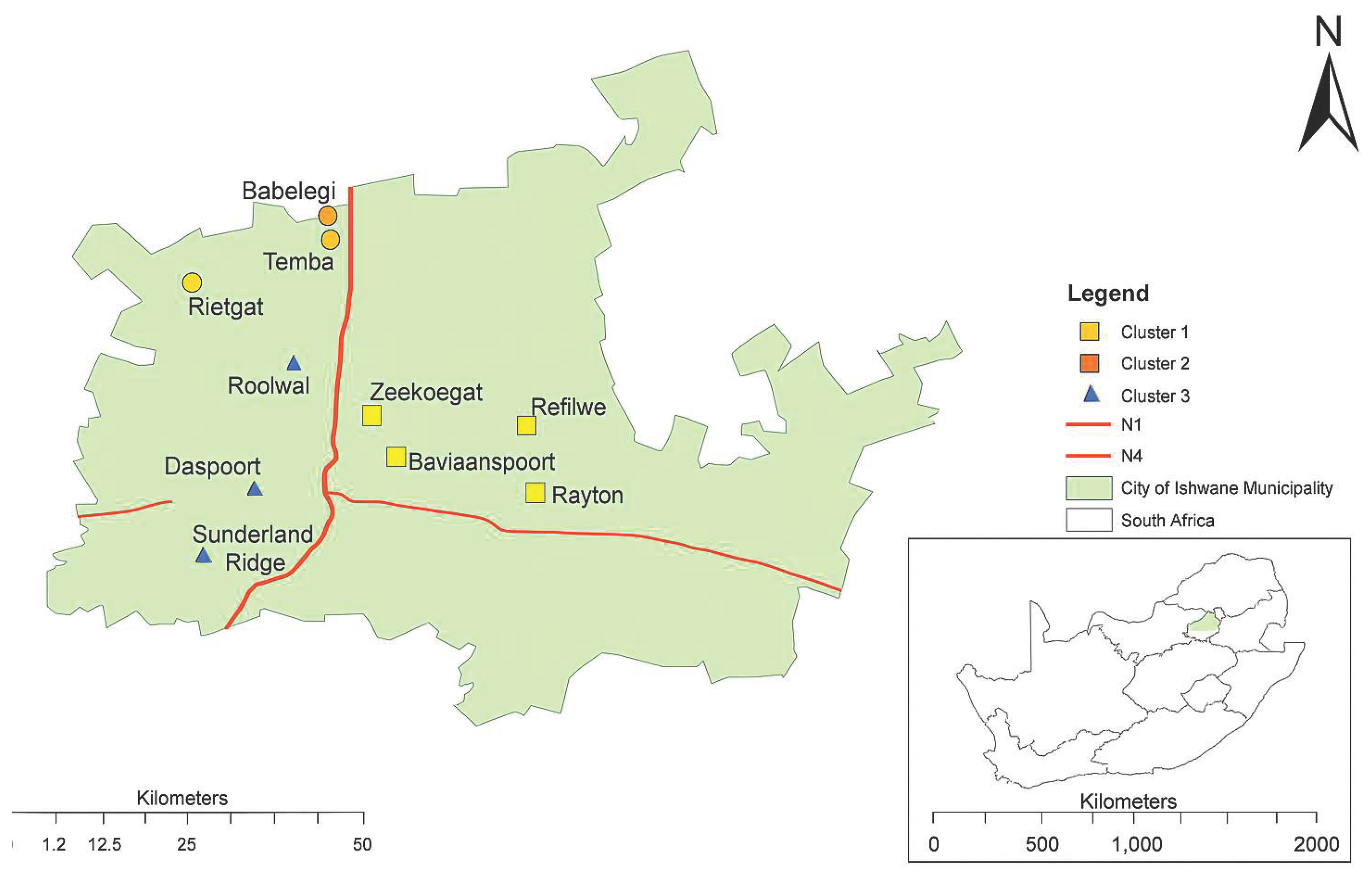
Figure 2.
Circular map of a plasmid from a NOVC isolate RT14 highlighting CDS, antimicrobial resistance determinants and toxin-antitoxin genes. Plasmid profiling was conducted based on BLAST analysis from the NCBI database and annotated using pLannotate and bakta on Proksee.
Figure 2.
Circular map of a plasmid from a NOVC isolate RT14 highlighting CDS, antimicrobial resistance determinants and toxin-antitoxin genes. Plasmid profiling was conducted based on BLAST analysis from the NCBI database and annotated using pLannotate and bakta on Proksee.
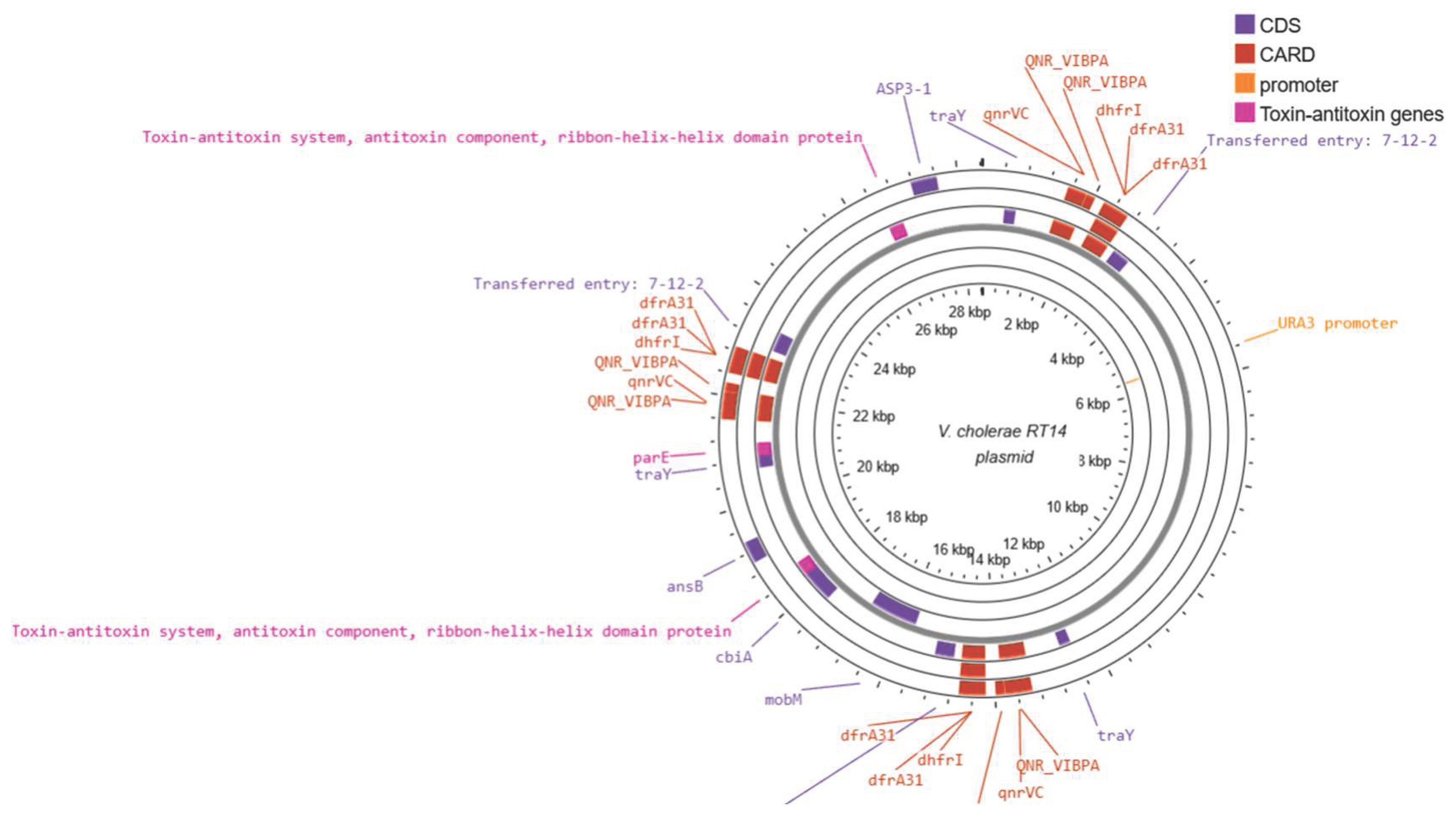
Figure 3.
Linear representation of the whole genome of NOVC isolate BS12, illustrating the location and integration of plasmids within the genomic sequence which are indicated in an arrow above.
Figure 3.
Linear representation of the whole genome of NOVC isolate BS12, illustrating the location and integration of plasmids within the genomic sequence which are indicated in an arrow above.
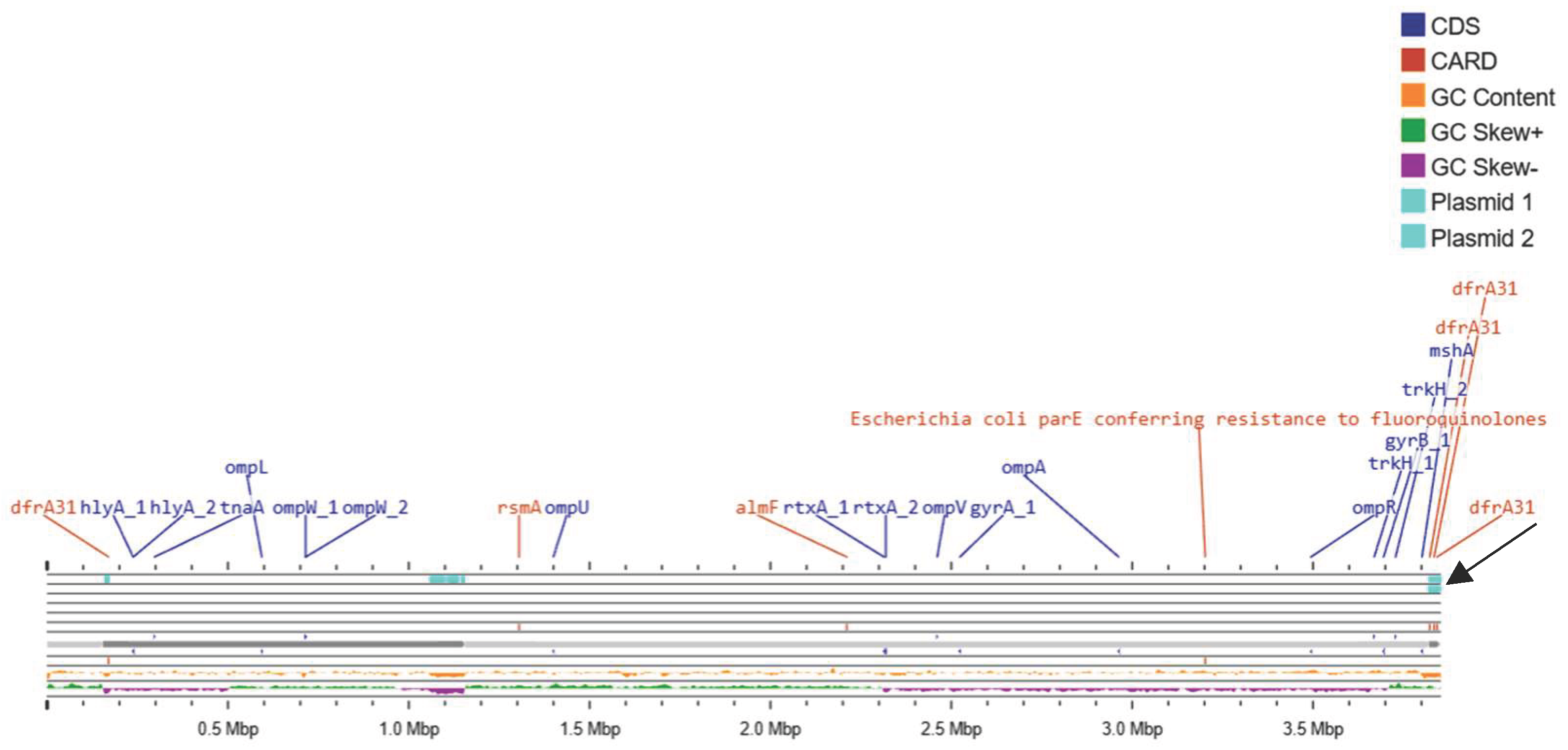
Figure 4.
Complete genome annotation of the NOVC isolate BS12. The innermost rings represent the G+C content and GC skew, while the outermost rings display coding DNA sequences (CDS) and antimicrobial resistant genes identified using the CARD. CDS homologous to known virulence genes (hlyA, gyrA/B, outer membrane proteins (ompW, ompV, ompA, ompR and ompH), trkH and tnaA) are highlighted, alongside CARD-annotated resistance genes (rsmA, CRP). This genomic map provides a visual overview of both the virulence potential and antimicrobial resistance profile of isolate BS12.
Figure 4.
Complete genome annotation of the NOVC isolate BS12. The innermost rings represent the G+C content and GC skew, while the outermost rings display coding DNA sequences (CDS) and antimicrobial resistant genes identified using the CARD. CDS homologous to known virulence genes (hlyA, gyrA/B, outer membrane proteins (ompW, ompV, ompA, ompR and ompH), trkH and tnaA) are highlighted, alongside CARD-annotated resistance genes (rsmA, CRP). This genomic map provides a visual overview of both the virulence potential and antimicrobial resistance profile of isolate BS12.
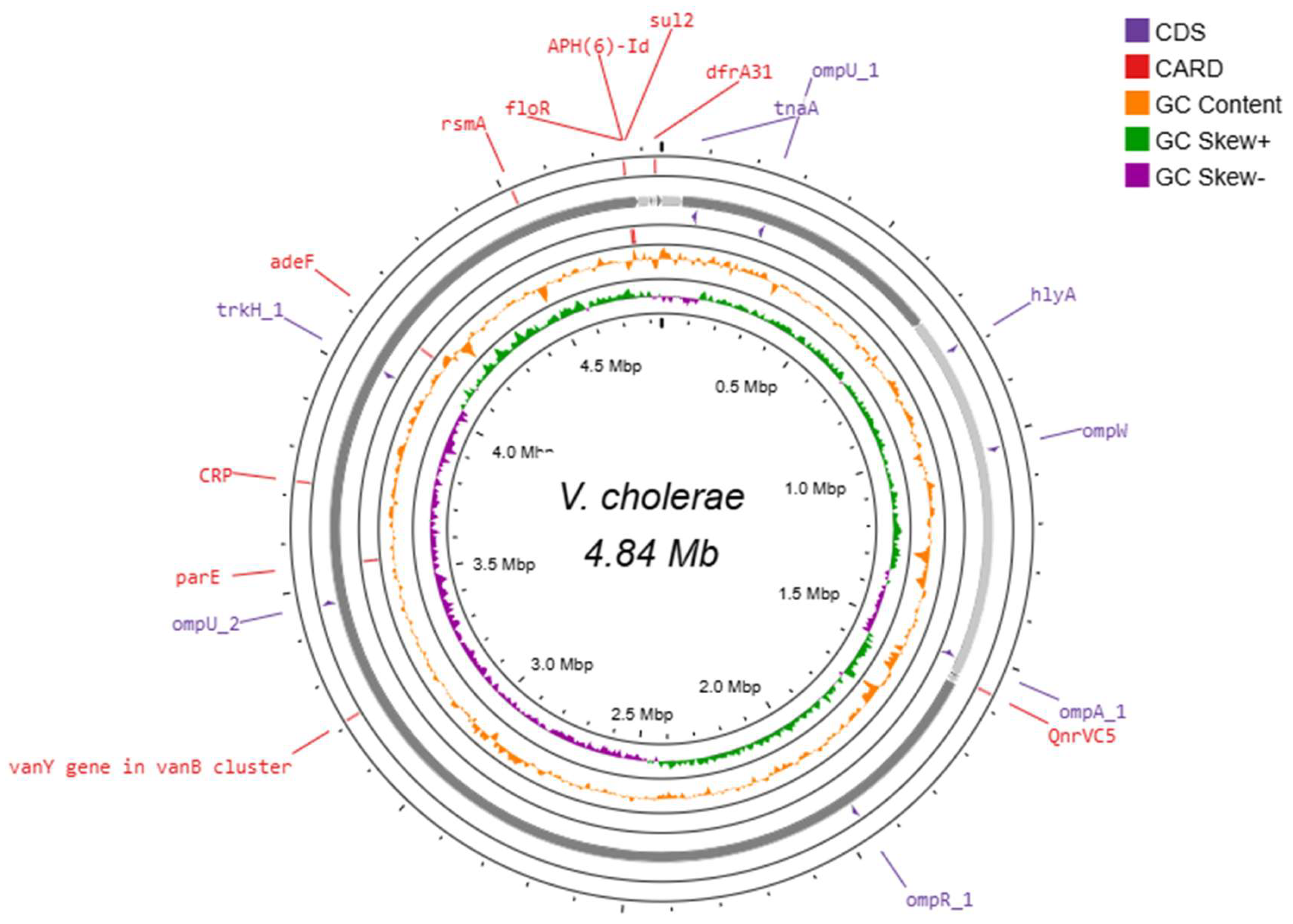
Figure 5.
Neighbour-Joining phylogenetic tree constructed using MEGA v12.0. The tree is based on concatenated nucleotide sequences of the gyrB gene from twelve NOVC isolates recovered from wastewater and ten reference sequences obtained from NCBI. Sequences of the wastewater isolates are highlighted in dots. Alignments were performed using ClustalW, and bootstrap values at the internodes, calculated from 1,000 replicates, indicate the robustness of each cluster.
Figure 5.
Neighbour-Joining phylogenetic tree constructed using MEGA v12.0. The tree is based on concatenated nucleotide sequences of the gyrB gene from twelve NOVC isolates recovered from wastewater and ten reference sequences obtained from NCBI. Sequences of the wastewater isolates are highlighted in dots. Alignments were performed using ClustalW, and bootstrap values at the internodes, calculated from 1,000 replicates, indicate the robustness of each cluster.
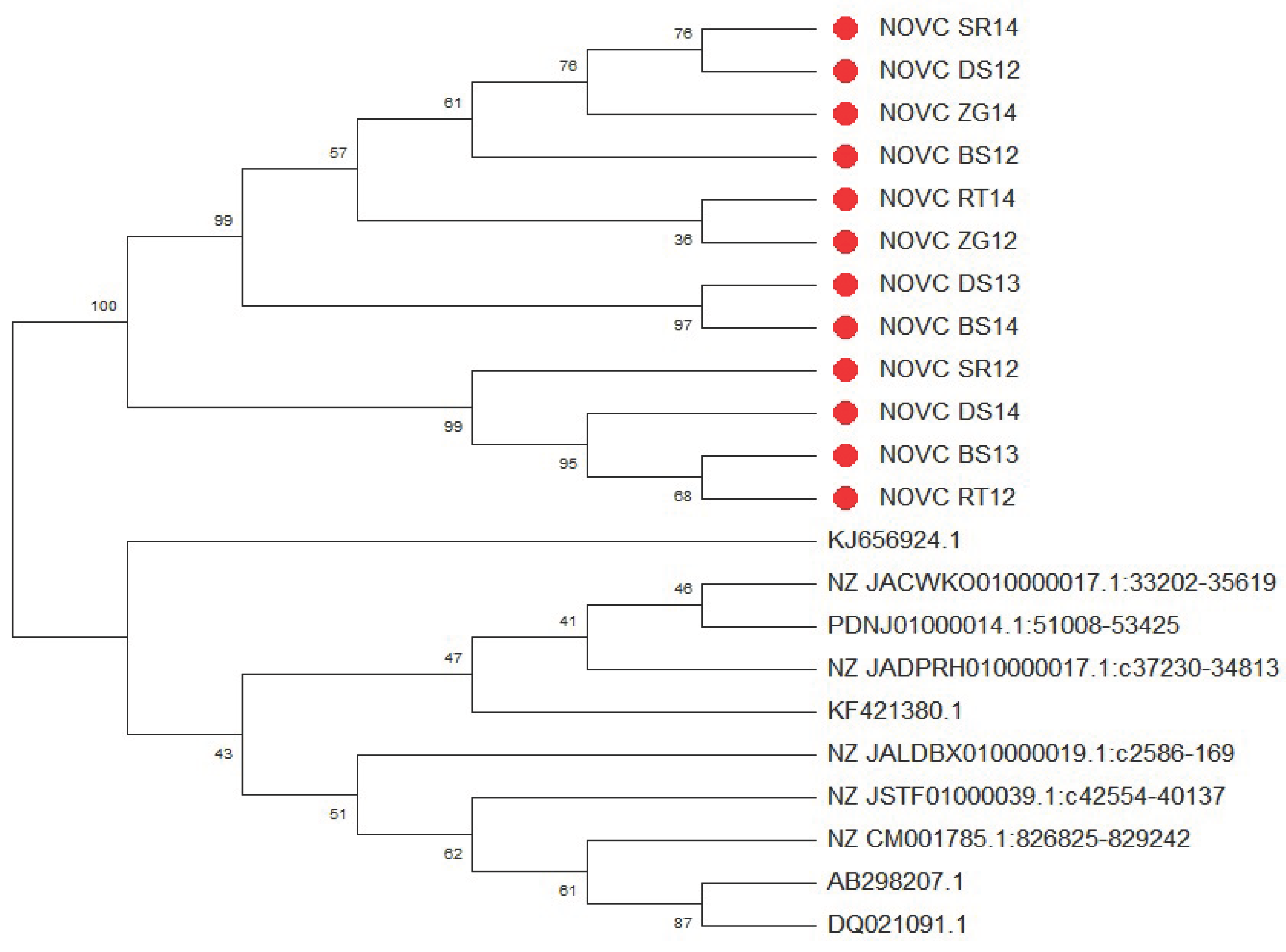

Table 1.
Taxonomic classification and genome annotation of NOVC isolates, including genome size and contig information.
Table 1.
Taxonomic classification and genome annotation of NOVC isolates, including genome size and contig information.
| Isolate ID | Taxon | Genome size |
|---|---|---|
| BS12 | V. cholerae | 3.87 Mb |
| BS13 | V. cholerae | 4.25 Mb |
| BS14 | V. cholerae | 3.73 Mb |
| DS12 | Vibrio spp. | 4.81 Mb |
| DS13 | Vibrio spp. | 4.84 Mb |
| DS14 | V. cholerae | 3.95 Mb |
| ZG12 | V. cholerae | 4.13 Mb |
| ZG14 | V. cholerae | 4.92 Mb |
| RT12 | V. cholerae | 3.95 Mb |
| RT14 | V. cholerae | 3.86 Mb |
| SR12 | V. cholerae | 3.84 Mb |
| SR14 | V. cholerae | 3.86 Mb |
Table 2.
Genomic features of NOVC isolates recovered from wastewater treatment plants in the Tshwane District.
Table 2.
Genomic features of NOVC isolates recovered from wastewater treatment plants in the Tshwane District.
| Isolate id | G+C content (%) | Genes | CDS | tRNA | tmRNA | rRNA | sORF | CRISPR |
|---|---|---|---|---|---|---|---|---|
| BS12 | 48% | 6,459 | 6,328 | 96 | 1 | 33 | 6,800 | 1 |
| BS13 | 47% | 7,152 | 7,031 | 90 | 1 | 29 | 7,273 | 1 |
| BS14 | 48% | 7,474 | 7,365 | 88 | 0 | 20 | 6,180 | 1 |
| DS13 | 50% | 5,320 | 5,179 | 108 | 1 | 31 | 9,591 | 1 |
| DS12 | 50% | 4,919 | 4,787 | 105 | 1 | 25 | 9,283 | 1 |
| DS14 | 48% | 4,289 | 4,157 | 102 | 1 | 28 | 5,983 | 1 |
| ZG12 | 47% | 3,761 | 3,624 | 100 | 1 | 32 | 5,221 | 1 |
| ZG14 | 48% | 8,446 | 8,302 | 109 | 1 | 34 | 8,727 | 0 |
| RT12 | 48% | 3,562 | 3,430 | 102 | 1 | 29 | 5,385 | 0 |
| RT14 | 47% | 5,154 | 5,022 | 100 | 1 | 29 | 6,297 | 2 |
| SR12 | 47% | 3,564 | 3,434 | 101 | 1 | 27 | 5,221 | 1 |
| SR14 | 44% | 4,527 | 4,397 | 98 | 1 | 27 | 4,672 | 4 |
Table 3.
Prevalence and distribution of functional categories in NOVC isolates.
| Isolate ID | P | IE | RRR | STD | T | Total |
|---|---|---|---|---|---|---|
| BS12 | 69 | 31 | 118 | 24 | 29 | 271 |
| BS13 | 41 | 112 | 119 | 24 | 30 | 326 |
| BS14 | 74 | 29 | 122 | 19 | 22 | 266 |
| DS12 | 64 | 45 | 79 | 11 | 23 | 222 |
| DS13 | 53 | 111 | 88 | 12 | 30 | 294 |
| DS14 | 33 | 45 | 77 | 47 | 21 | 223 |
| ZG12 | 30 | 65 | 69 | 26 | 15 | 205 |
| ZG14 | 127 | 54 | 125 | 25 | 37 | 378 |
| RT12 | 27 | 29 | 70 | 21 | 12 | 159 |
| RT14 | 44 | 43 | 100 | 11 | 28 | 226 |
| SR12 | 29 | 26 | 66 | 15 | 16 | 152 |
| SR14 | 32 | 152 | 99 | 44 | 51 | 378 |
P(Phage), Integration/ Excision (IE), Replication/Recombination/Repair (RRR), Stability /Transfer / Defense (STD), and Transfer (T).
Disclaimer/Publisher’s Note: The statements, opinions and data contained in all publications are solely those of the individual author(s) and contributor(s) and not of MDPI and/or the editor(s). MDPI and/or the editor(s) disclaim responsibility for any injury to people or property resulting from any ideas, methods, instructions or products referred to in the content. |
© 2026 by the authors. Licensee MDPI, Basel, Switzerland. This article is an open access article distributed under the terms and conditions of the Creative Commons Attribution (CC BY) license (http://creativecommons.org/licenses/by/4.0/).
Copyright: This open access article is published under a Creative Commons CC BY 4.0 license, which permit the free download, distribution, and reuse, provided that the author and preprint are cited in any reuse.


