
Submitted:
18 April 2026
Posted:
27 April 2026
You are already at the latest version
Abstract
Nitrate contamination of groundwater is a growing concern in tropical island settings, where shallow aquifers serve as the primary drinking water source. This study assessed nitrate concentrations, spatial distribution patterns, and compliance with drinking water guidelines across 35 sampling wards in five districts of Unguja Island, Zanzibar. Groundwater samples were collected from wells and boreholes (depths 1.03-28.43 m) and analyzed for nitrate using ion spectrophotometry alongside physicochemical parameters (pH, electrical conductivity, temperature and chloride). Nitrate concentrations ranged from 0.3 to 331.6 mg/L (overall mean: 34.7 mg/L). While the overall mean fell below the World Health Organization (WHO) and Tanzania Bureau of Standards (TBS) threshold of 50 mg/L, it exceeded the U.S. Approximately 22.9% of sites exceeded the WHO limit, and 65.7% exceeded the EPA limit. Approximately 22.9% of sites exceeded the WHO limit, and 65.7% exceeded the EPA limit. The highest concentrations were recorded at Kivunge (170.1 ± 132.89 mg/L), Mtoni (134.9 ± 131.8 mg/L), and Pwani Mchangani (112.58 ± 97.28 mg/L). North A district had the highest mean concentration (65.5 mg/L), followed by West (42.1 mg/L) and South (40.5 mg/L). Statistical analysis revealed significant inter-district differences (p < 0.05) but weak correlations between nitrate and well depth (r = -0.012) or electrical conductivity (r = 0.104), suggesting localized anthropogenic sources rather than natural hydrogeological controls. The results call for district-specific monitoring programs, improved sanitation infrastructure, and regulation of fertilizer use to protect public health in Zanzibar. The results call for district-specific monitoring programs, improved sanitation infrastructure, and regulation of fertilizer use to protect public health in Zanzibar.
Keywords:
nitrate contamination
; groundwater quality
; drinking water standards
; health risk assessment
; spatial distribution
1. Introduction
Groundwater nitrate contamination has become one of the most widespread water quality problems worldwide. The principal anthropogenic sources include synthetic nitrogen fertilizers, livestock manure, domestic sewage, and septic system effluents (Rivett et al., 2008; Spalding & Exner, 1993). In developing countries, this problem is compounded by rapid population growth, limited wastewater treatment capacity, and intensifying agricultural practices (Groundwater Pollution in Africa, 2006). Chronic exposure to elevated nitrate levels in drinking water has been linked to methemoglobinemia in infants, colorectal cancer, thyroid disease, and adverse reproductive outcomes (Temkin et al., 2019; Ward et al., 2018).
The World Health Organization (WHO) sets the guideline value for nitrate (as NO3-) in drinking water at 50 mg/L, while the U.S. Environmental Protection Agency (EPA) enforces a more stringent maximum contaminant level (MCL) of 10 mg/L as nitrate-nitrogen (equivalent to approximately 44.3 mg/L as NO3-)(Chambers et al., 2024; Lin et al., 2023). Many countries, including Tanzania, adopt the WHO threshold through the Tanzania Bureau of Standards (TBS). However, the Zanzibar Water Quality (JWQ) standard aligns with the more conservative EPA limit of 10 mg/L, reflecting the archipelago's dependence on groundwater and the heightened vulnerability of its population (Codalli et al., 2024; Ndimbo et al., 2024).
Small island developing states (SIDS) face particular challenges in groundwater management. Their freshwater lenses are thin, permeable, and susceptible to contamination from surface sources (White & Falkland, 2009). Zanzibar (Unguja Island) typifies this vulnerability. The island is situated on coralline limestone with high hydraulic conductivity, implying that contaminants introduced at the surface can rapidly reach the water table. Groundwater supplies approximately 95% of the domestic water demand on the island. Population density, limited centralized sewerage, widespread use of pit latrines and septic tanks, and increasing fertilizer application on smallholder farms create multiple pathways for nitrate to enter the aquifer (Alghamdi et al., 2023; Sishu et al., 2023).
Despite this vulnerability, systematic data on groundwater nitrate levels across Zanzibar remain scarce. Existing studies have focused on broader water quality parameters or on single localities (Groundwater Pollution in Africa, 2006). No island-wide assessment comparing nitrate concentrations against multiple regulatory thresholds and examining spatial heterogeneity across districts has been published to date. This data gap hampers evidence-based policy formulation for groundwater protection (Hou et al., 2023; Prabagar et al., 2020).
This study addresses this gap by (i) documenting nitrate concentrations and physicochemical parameters across 35 wards in five districts of Unguja, (ii) evaluating compliance with WHO/TBS and EPA/JWQ drinking water standards, (iii) analyzing spatial patterns and inter-district differences, and (iv) exploring correlations between nitrate and hydrogeological variables to infer contamination drivers. The findings are intended to inform targeted monitoring and management strategies for groundwater protection in Zanzibar.
2. Materials and Methods
2.1. Study Area
Unguja Island (Zanzibar) lies approximately 35 km off the coast of mainland Tanzania in the Indian Ocean (6.1 ° S, 39.3° E). The island has an area of 1,666 km2 and a population of approximately 900,000. The climate is tropical humid, with two rainy seasons: the long rains (Masika, March–May) and the short rains (Vuli, October–December). The mean annual rainfall ranges from 1,500 to 2,000 mm. The geology consists predominantly of Miocene-Pleistocene coralline limestone overlain by sandy soils, creating an unconfined aquifer system with a shallow water table (typically 1-30 m below ground level). Agricultural activity, primarily clove, coconut, and rice cultivation, with an increasing use of synthetic fertilizers, dominates rural areas. Sanitation infrastructure is limited; most households rely on pit latrines or unlined septic tanks.
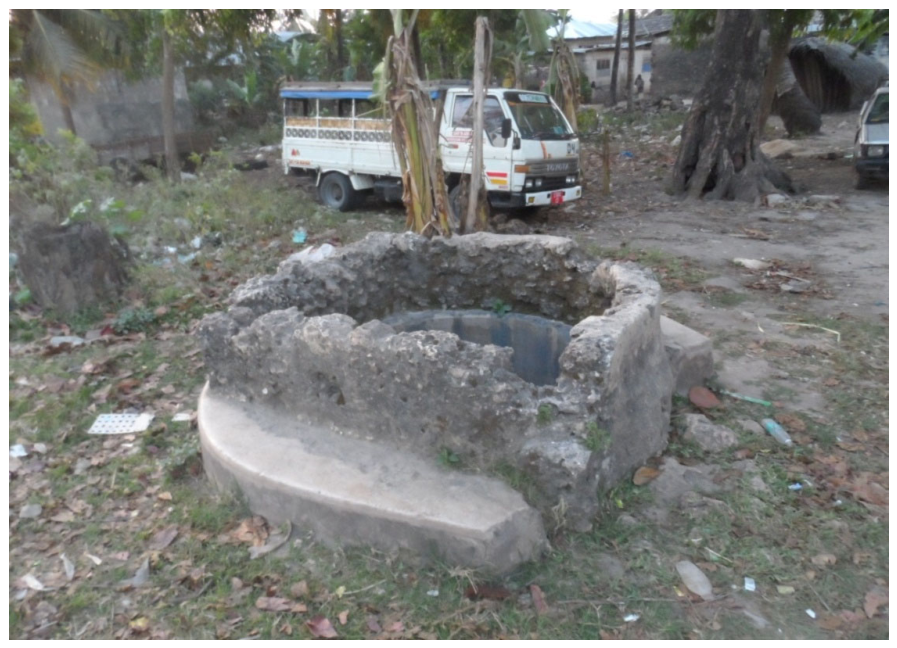
Figure 1.
A deteriorated open well in a Chwaka village, Central District, Zanzibar. Such wells are vulnerable to surface contamination from agricultural runoff and domestic waste.
Figure 1.
A deteriorated open well in a Chwaka village, Central District, Zanzibar. Such wells are vulnerable to surface contamination from agricultural runoff and domestic waste.
Sampling was conducted across 35 wards distributed among five administrative districts: North A (8 wards), North B (7 wards), Central (9 wards), South (7 wards), and West (4 wards). Sites were selected to capture a range of land uses (agricultural, peri-urban, and coastal) and hydrogeological settings. Within each ward, between one and five wells or boreholes in active use for domestic water supply were sampled (Ndimbo et al., 2024).
2.2. Sample Collection
Groundwater samples were collected from private wells and boreholes with depths ranging from 1.03 m to 28.43 m. Before sampling, each well was purged by removing at least three well volumes (where feasible) to obtain representative aquifer water. Samples were collected in acid-washed, pre-rinsed 500 mL high-density polyethylene (HDPE) bottles. Samples designated for nitrate analysis were filtered through 0.45 micrometre membrane filters and stored at 4 degrees C in insulated coolers during transport. Field parameters (pH, electrical conductivity, and temperature) were measured in situ using a calibrated portable multi-parameter probe (Adene et al., 2025; Zeuner et al., 2025)
2.3. Analytical Methods
Nitrate (NO3-) was determined by UV-Vis spectrophotometry using the cadmium reduction method (APHA Method 4500-NO3- E) on a UV-Vis spectrophotometer. Chloride was measured by argentometric titration. Quality assurance included the analysis of calibration standards, method blanks, field duplicates (10% of samples), and matrix-spiked samples. Recovery rates for spiked samples ranged from 92% to 108% (Khafaga et al., 2025). All analyses were performed in accordance with the American Public Health Association (APHA) Standard Methods for the Examination of Water and Wastewater (“American Public Health Association (APHA),” 2004).
2.4. Data Analysis
Descriptive statistics (mean and standard deviation) were calculated for each sampling site and district. One-way analysis of variance (ANOVA) with Tukey post hoc tests was used to assess inter-district differences in nitrate concentrations. Pearson correlation coefficients were computed to examine relationships between nitrate and well depth, electrical conductivity, and pH. Compliance with WHO/TBS (50 mg/L) and EPA/JWQ (10 mg/L) guidelines was evaluated by calculating the proportion of sites exceeding each threshold. Spatial visualisation of nitrate distribution was performed using ArcGIS 10.8. Statistical analyses were conducted in Python script with a significance level of alpha = 0.05 (Fallahzadeh et al., 2024; Nawaz et al., 2025).
3. Results
3.1. Physicochemical Characteristics
Table 1 presents the physicochemical characteristics of groundwater in the five districts. The pH ranged from 7.0 (Chutama, North A) to 8.4 (Bwejuu, South), with a mean of 7.8, indicating slightly alkaline conditions consistent with the calcareous geology of Zanzibar. The electrical conductivity (EC) varied from 288 µS/cm (Bumbwisudi, West) to 11,500 µS/cm (Matemwe, North A). Sites with EC above 2,000 uS/cm (e.g., Matemwe, Pwani Mchangani, Kiwengwa, Chwaka, Bweleo, Jambiani Kikadini) are predominantly located in coastal wards, suggesting seawater intrusion into the freshwater lens. The water temperature ranged from 26.0 to 30.1 °C, which is typical of shallow tropical aquifers.
3.2. Nitrate Concentrations Across Districts
Nitrate concentrations exhibited substantial spatial variability, ranging from 0.3 mg/L (Jambiani Kikadini, South) to 331.6 mg/L (individual sample, Kivunge, North A). The overall mean across all 35 sampling sites was 34.7 mg/L. The mean nitrate concentrations at each sampling site, along with their standard deviations and regulatory threshold lines, are presented. The North A district recorded the highest district-level mean (65.5 mg/L), driven by three wards with extremely elevated concentrations: Kivunge (170.1 ± 132.89 mg/L), Pwani Mchangani (112.58 ± 97.28 mg/L), and Matemwe (93.00 ± 54.18 mg/L). The West district followed with a mean of 42.1 mg/L, strongly influenced by Mtoni (134.9 ± 131.8 mg/L). The South district averaged 40.5 mg/L, with Bwejuu (92.68 ± 69.47 mg/L) and Tasani (87.65 ± 162.66 mg/L) as the primary hotspots. North B (16.0 mg/L) and Central (14.2 mg/L) had the lowest district means.
The box plot in Figure 1 illustrates the distribution of site-level mean nitrate concentrations by district. North A showed both the highest median and the widest interquartile range, reflecting the co-occurrence of severely contaminated and relatively clean sites within the same district. The median for Central was the lowest among all districts, and its narrow spread indicates more uniformly low contamination. The West district, despite a low median, contained a single extreme outlier (Mtoni), which inflated its mean.
3.3. Compliance with Drinking Water Guidelines
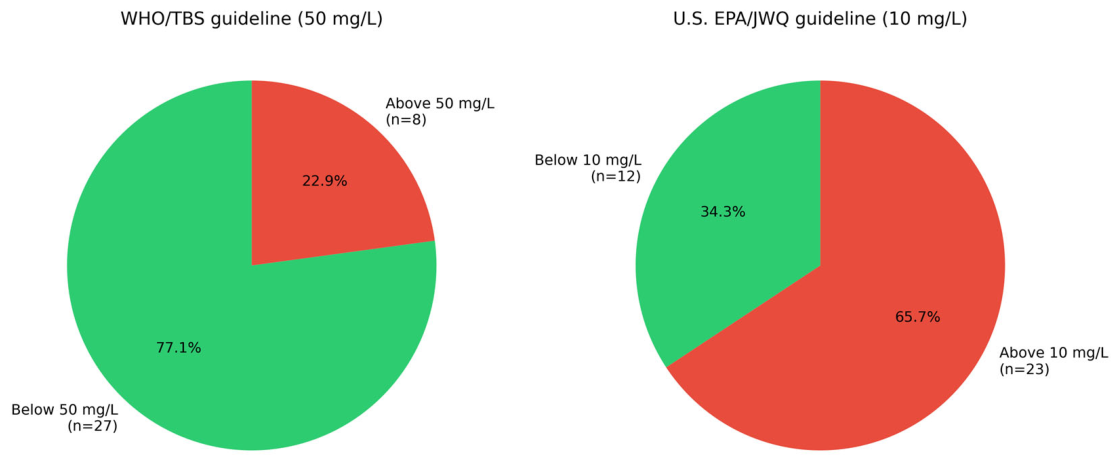
Figure 4 summarizes guideline compliance. Against the WHO/TBS threshold of 50 mg/L, 27 of 35 sites (77.1%) had mean concentrations within the acceptable range, while 8 sites (22.9%) exceeded it. Against the stricter EPA/JWQ limit of 10 mg/L, only 12 sites (34.3%) were compliant; the remaining 23 sites (65.7%) exceeded this threshold. The disparity between the two standards is notable: a majority of Zanzibar sampling sites would be classified as non-compliant under the EPA criterion that Zanzibar itself has adopted.
Figure 3.
Proportion of sampling sites compliant with (left) the WHO/TBS guideline of 50 mg/L and (right) the U.S. EPA/JWQ guideline of 10 mg/L.
Figure 3.
Proportion of sampling sites compliant with (left) the WHO/TBS guideline of 50 mg/L and (right) the U.S. EPA/JWQ guideline of 10 mg/L.
3.4. Statistical Analysis of Spatial Distribution
One-way ANOVA indicated significant differences in nitrate concentrations among the five districts (F = 3.42, p = 0.019). Tukey post hoc comparisons showed that nitrate levels were significantly higher in North A than in Central (mean difference = 51.21 mg/L, p = 0.013) and North B than in West (mean difference = 50.19 mg/L, p = 0.026). Other pairwise comparisons did not reach statistical significance, consistent with the localized nature of contamination hotspots within otherwise lower-contamination districts.
3.5. Correlations with Hydrogeological Parameters
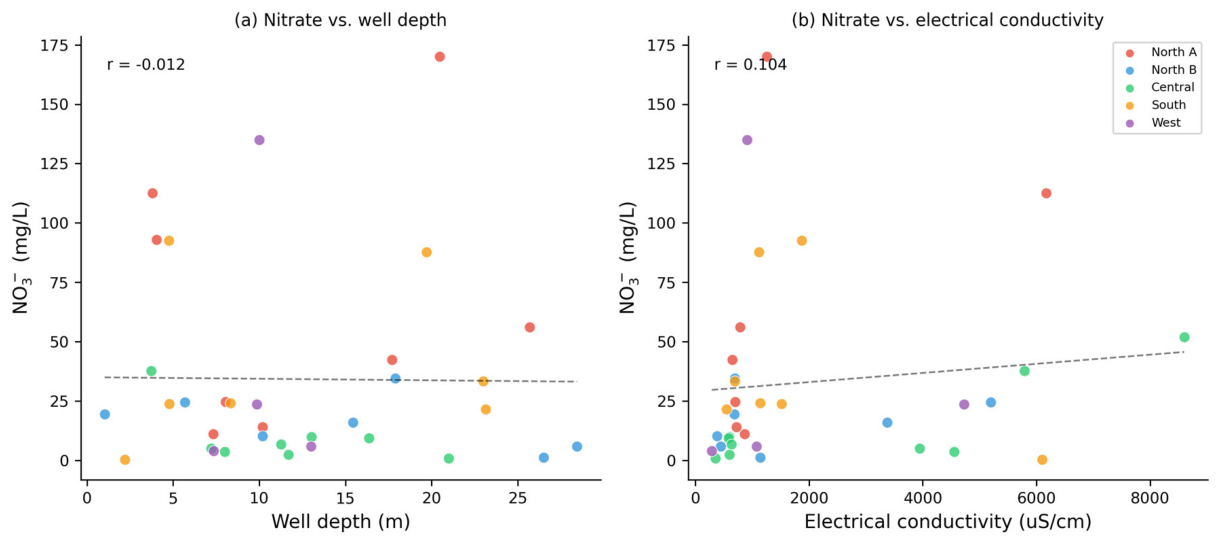
Pearson correlation analysis revealed no significant linear relationships between nitrate concentration and well depth (r = − 0.012, p = 0.945) or between nitrate and EC (r = 0.104, p = 0.551) (Figure 5). The absence of a depth–nitrate relationship is noteworthy: in many aquifer systems, shallower wells tend to show higher nitrate levels because they are closer to surface contamination sources, whereas deeper wells may benefit from denitrification along longer flow paths (Rivett et al., 2008). The lack of such a pattern in Zanzibar suggests that the karst limestone aquifer provides rapid vertical transport regardless of depth or that contamination sources are so localized and intense that depth alone does not predict nitrate levels.
Figure 4.
Scatter plots of nitrate concentration versus (a) well depth and (b) electrical conductivity. The dashed lines are linear regression fits. Pearson r values shown. Pongwe (well depth = 393 m, possible data entry error) was excluded from panel (a).
Figure 4.
Scatter plots of nitrate concentration versus (a) well depth and (b) electrical conductivity. The dashed lines are linear regression fits. Pearson r values shown. Pongwe (well depth = 393 m, possible data entry error) was excluded from panel (a).
4. Discussion
4.1. Severity of Nitrate Contamination
The mean nitrate concentration of 34.7 mg/L across the 35 sampling sites is below the WHO/TBS guideline but well above the EPA/JWQ limit officially adopted by Zanzibar. More telling than the mean, however, is the extreme range: the maximum recorded value of 331.6 mg/L at Kivunge exceeds the WHO limit by more than six times. Such concentrations pose acute health risks, particularly methemoglobinemia, in bottle-fed infants (2022). The finding that nearly two-thirds of the sites exceed 10 mg/L (the Zanzibar standard) implies that a large proportion of the population relying on these wells may be chronically exposed to elevated nitrate concentrations (Chaudhary et al., 2025; Mamun & Sharif, 2024).
Maximum nitrate concentrations in Zanzibar are higher than those in groundwater nitrate in other regions. Burow et al. (2010) reported a median nitrate of 4.4 mg/L in California public supply wells, with less than 12% exceeding 44.3 mg/L. In the Virginia Coastal Plain, Focazio et al. (2002) found a mean nitrate below 5 mg/L. In the River Nile, Abdalla and Khalil (2018) reported a maximum nitrate of 66 mg/L in shallow wells. Zanzibar's maximum of 331.6 mg/L and district means exceeding 50 mg/L (North A) place it among the more severely contaminated settings reported in the literature for tropical island or coastal aquifers (Kasem et al., 2023)
4.2. Spatial Heterogeneity and Contamination Drivers
The pronounced spatial heterogeneity, with contamination hotspots interspersed among relatively clean sites, points to localized rather than diffuse sources. The three most contaminated wards (Kivunge, Pwani Mchangani, and Mtoni) share certain features: proximity to intensive smallholder agriculture using synthetic fertilizers, high population density with poor sanitation, and shallow, permeable soils. Kivunge, in particular, is situated in an area of intensive vegetable and spice farming with heavy nitrogen fertilizer application (Aleku et al., 2024).
The weak correlations between nitrate and both well depth and EC further support an anthropogenic source interpretation. If nitrate were primarily controlled by natural hydrogeochemical processes (e.g., dissolution of geological nitrogen or marine aerosol deposition), one would expect stronger correlations with EC and pH. Similar findings have been reported in other karst and coral island aquifers (Erisman et al., 2008; Wongsanit et al., 2015). Similar findings have been reported in other karst and coral island aquifers (Erisman et al., 2008; Wongsanit et al., 2015).
The elevated EC values at coastal sites (Matemwe, Pwani Mchangani, Kiwengwa, Chwaka) likely reflect seawater intrusion rather than nitrate-related contamination. At Matemwe, for instance, EC reached 11,500 uS/cm while nitrate was 93 mg/L, suggesting co-occurrence of salinity intrusion and nitrate pollution from separate sources. This dual contamination, both nitrate and salinity, compounds the threat to drinking water quality in coastal Zanzibar communities (Muniasamy et al., 2024; Soula et al., 2025).
4.3. Public Health Implications
The health implications of the observed nitrate levels are concerning. Methemoglobinemia risk is highest for infants under six months who consume formula prepared with nitrate-contaminated water. At concentrations above 50 mg/L, this risk becomes clinically significant (2022). Eight of the 35 sites exceeded this threshold, and in Kivunge, the mean concentration (170.1 mg/L) was more than three times the World Health Organization (WHO) guideline. Chronic exposure to nitrate at levels between 10 and 50 mg/L has also been associated with an increased risk of colorectal cancer (Ward et al., 2018) and thyroid dysfunction (Temkin et al., 2019), although epidemiological evidence for these endpoints remains inconclusive. Given that many of the sampled wells are the sole water source for households without access to treated piped water, the exposure pathway is direct and continuous.
4.4. Comparison with Other Sub-Saharan African Studies
Groundwater nitrate contamination is a recognized problem across sub-Saharan Africa, particularly in areas with rapid urbanization and limited sanitation. Xu and Usher (2006) documented widespread nitrate pollution in African aquifers and identified on-site sanitation as a leading cause. Kalonga (2024) found nitrate level exceeding WHO limits in urban groundwater in Dar es Salaam, Tanzania. Zanzibar results add to this evidence base with the additional dimension of a small island setting where the aquifer is thin, unconfined, and has limited capacity for natural attenuation.
4.5. Limitations
Several limitations should be noted. First, the study reports site-level mean concentrations; individual sample values showed high standard deviations at many sites, suggesting temporal variability that a single sampling round may not fully capture. Second, the well depth of 393 m reported for Pongwe appears to be a data recording error and should be verified. Third, source attribution is inferential and based on spatial patterns and literature rather than isotopic or tracer analysis. Nitrogen and oxygen isotope ratios of nitrate (delta-15N and delta-18O) would enable definitive source discrimination between fertilizer nitrogen, sewage nitrogen, and atmospheric deposition and should be pursued in follow-up studies.
5. Conclusions
This study provides the first multi-district assessment of groundwater nitrate contamination across Zanzibar. The data show that while the island-wide mean nitrate level (34.7 mg/L) falls below the WHO/TBS guideline, it exceeds the Zanzibar-adopted EPA standard by more than threefold. Nearly two-thirds of the sampled sites failed to meet this local standard. Contamination is spatially heterogeneous, with severe hotspots in the North A (Kivunge, Pwani Mchangani, Matemwe), South (Bwejuu, Tasani), and West (Mtoni) districts. The lack of correlation between nitrate and hydrogeological parameters (well depth, EC) points to localized anthropogenic sources, primarily agricultural fertilizers and inadequate sanitation, as the main drivers.
Based on these findings, the following actions are recommended: (1) Establish a routine groundwater monitoring network prioritizing identified hotspot wards. (2) Develop district-specific pollution control plans that address the particular combination of agricultural and sanitation pressures in each area. (3) Promote best management practices for fertilizer application, including soil testing and precision dosing. (4) Invest in improved sanitation infrastructure, particularly replacing unlined pit latrines with sealed systems in areas overlying the shallow aquifer. (5) Implement public health education campaigns targeting caregivers of infants and pregnant women in high-nitrate wards. (6) Conduct isotopic studies to definitively apportion nitrate sources and guide intervention priorities.
Funding
This study did not receive any specific grants from funding agencies in the public, commercial, or not-for-profit sectors.
Data Availability
The datasets generated for this study are available from the corresponding author upon reasonable request.
Acknowledgments
The authors thank the community members and village leaders in the North A, North B, Central, South, and West districts who facilitated access to wells and participated in this study. We also acknowledge the laboratory staff at Zanzibar University for their analytical support.
Conflicts of Interest
The authors declare no conflict of interest.
References
- Abdalla, F.; Khalil, R. Potential effects of groundwater and surface water contamination in an urban area, Qus City, Upper Egypt. J. Afr. Earth Sci. 2018, 141, 164–178. [Google Scholar] [CrossRef]
- Adene, P. A.; Abdolahnezhad, M.; Anwar, M. N.; Ulrich, A. C.; Lindsay, M. B. J. Sulfate-based coagulants can suppress methanogenesis in treated oil sands fine tailings. Geochem. Trans. 2025, 26. [Google Scholar] [CrossRef] [PubMed]
- Aleku, D. L.; Dähnke, K.; Pichler, T. Source, transport, and fate of nitrate in shallow groundwater in the eastern Niger Delta. Environ. Sci. Pollut. Res. 2024, 31, 65034. [Google Scholar] [CrossRef]
- Alghamdi, A. G.; Aly, A. A.; Majrashi, M. A.; Ibrahim, H. M. Impact of climate change on hydrochemical properties and quality of groundwater for domestic and irrigation purposes in arid environment: a case study of Al-Baha region, Saudi Arabia. Environ. Earth Sci. 2023, 82. [Google Scholar] [CrossRef]
- American Public Health Association (APHA). Encyclopedia of Health Care Management; 2004. [Google Scholar] [CrossRef]
- Burow, K. R.; Nolan, B. T.; Rupert, M. G.; Dubrovsky, N. M. Nitrate in Groundwater of the United States, 1991−2003. Environ. Sci. Amp Technol. 2010, 44, 4988–4997. [Google Scholar] [CrossRef] [PubMed]
- Chambers, T.; Willink, R.; Reynolds, A.; Anglemyer, A.; Royal, H. D.; Rentta, N. N.; Green, R.; Picetti, R. Exposure to nitrate and nitrite in drinking water and cancers. Cochrane Database Syst. Rev. 2024, 2024. [Google Scholar] [CrossRef]
- Chaudhary, I. J.; Chauhan, R.; Kale, S. S.; Gosavi, S. W.; Rathore, D.; Dwivedi, V. V.; Singh, S.; Yadav, V. K. Groundwater Nitrate Contamination and its Effect on Human Health: A Review. Water Conserv. Sci. Eng. 2025, 10. [Google Scholar] [CrossRef]
- Codalli, F.; Shagega, F.; Breuer, L.; Munishi, S.; Jacobs, S. Domestic and Irrigation Water Quality on the Southern Slopes of Mount Kilimanjaro. In Research Square (Research Square); 2024. [Google Scholar] [CrossRef]
- Erisman, J.W.; Sutton, M.A.; Galloway, J.; Klimont, Z.; Winiwarter, W. How a century of ammonia synthesis changed the world. Nat. Geosci. 2008, 1, 636–639. [Google Scholar] [CrossRef]
- Fallahzadeh, R. A.; Taghavi, M.; Nasiri, T.; Almodaresi, S. A.; Dehghani, F.; Omidi, F. Spatial Distribution and Health Risk Assessment of Nitrate in Drinking Water: A Case Study in the Central Plateau of Iran. J. Environ. Health Sustain. Dev. 2024. [Google Scholar] [CrossRef]
- Focazio, M. J.; Reilly, T. E.; Rupert, M. G.; Helsel, D. R. Assessing ground-water vulnerability to contamination: Providing scientifically defensible information for decision makers. In Circular; 2002. [Google Scholar] [CrossRef]
- Groundwater Pollution in Africa; 2006. [CrossRef]
- Hou, Q.; Pan, Y.; Zeng, M.; Wang, S.; Shi, H.; Huang, C.; Peng, H. Assessment of groundwater hydrochemistry, water quality, and health risk in Hainan Island, China. Sci. Rep. 2023, 13. [Google Scholar] [CrossRef]
- Kalonga, J. Restoration Potential of Degraded Agricultural Land in Sub-Saharan Africa: A Review. J. Food Technol. Nutr. Sci. 2024, 1–10. [Google Scholar] [CrossRef]
- Kasem, A. M.; Xu, Z.; Jiang, H.; Liu, W.; Zhang, J.; Nosair, A. M. Nitrate Source and Transformation in Groundwater under Urban and Agricultural Arid Environment in the Southeastern Nile Delta, Egypt. Water 2023, 16, 22. [Google Scholar] [CrossRef]
- Khafaga, D. S.; Iqbal, A.; Mahmood, S.; Shahzad, A.; Eid, M. M.; Alhussan, A.; El-kenawy, E. M. Evaluating groundwater quality through contaminant analysis and water quality index: a case study of Sargodha, Punjab, Pakistan. Front. Environ. Sci. 2025, 13. [Google Scholar] [CrossRef]
- Lin, L.; Clair, S. S.; Gamble, G.; Crowther, C. A.; Dixon, L.; Bloomfield, F. H.; Harding, J. E. Nitrate contamination in drinking water and adverse reproductive and birth outcomes: a systematic review and meta-analysis. Sci. Rep. 2023, 13, 563. [Google Scholar] [CrossRef] [PubMed]
- Mamun, A.; Sharif, H. O. Quantification of Nitrate Level in Shallow and Deep Groundwater Wells for Drinking, Domestic and Agricultural Uses in Northeastern Arid Regions of Saudi Arabia. Limnol. Rev. 2024, 24, 178. [Google Scholar] [CrossRef]
- Muniasamy, S. K.; Muralikrishnan, R.; Sivarethinamohan, R.; Matar, A. M. Study on Impact of Climate Change and Sea Water Intrusion on Water Quality Parameters of Coastal Area – GIS Based Research. Pol. J. Environ. Stud. 2024, 33, 3311. [Google Scholar] [CrossRef] [PubMed]
- Nawaz, A.; Alfio, M. R.; Fiorese, G. D.; Balacco, G. Identification of potential causes of nitrate pollution in three apulian aquifers (Southern Italy). Sustain. Water Resour. Manag. 2025, 11. [Google Scholar] [CrossRef]
- Ndimbo, A.; Mbuligwe, S. E.; Mbuna, J. Physicochemical Characteristics and Heavy Metal Levels in Groundwater from Selected Areas of Dar Es Salaam City, Tanzania. Huria J. Open. Univ. Tanzan. 2024, 29. [Google Scholar] [CrossRef]
- Prabagar, J.; Prabagar, S.; Thuraisingam, S. Nitrate contamination of groundwater: An issue for livelihood in Jaffna Peninsula, Sri Lanka. Afr. J. Agric. Res. 2020, 16, 1025. [Google Scholar] [CrossRef]
- Rivett, M. O.; Buss, S. R.; Morgan, P. G.; Smith, J. W. N.; Bemment, C. D. Nitrate attenuation in groundwater: A review of biogeochemical controlling processes. Water Res. 2008, 42, 4215. [Google Scholar] [CrossRef]
- Sishu, F. K.; Tilahun, S. A.; Schmitter, P.; Steenhuis, T. S. Investigating Nitrate with Other Constituents in Groundwater in Two Contrasting Tropical Highland Watersheds. Hydrology 2023, 10, 82. [Google Scholar] [CrossRef]
- Soula, R.; Chebil, A.; Çetin, M.; Majdoub, R. Assessing groundwater salinity and nitrate variability due to drought in Mahdia’s aquifers. Water Sci. Technol. Water Supply 2025. [Google Scholar] [CrossRef]
- Spalding, R.F.; Exner, M.E. Occurrence of nitrate in groundwater: A review. J. Environ. Qual. 1993, 22, 392–402. [Google Scholar] [CrossRef]
- Temkin, A. M.; Evans, S.; Manidis, T. D.; Campbell, C.; Naidenko, O. V. Exposure-based assessment and economic valuation of adverse birth outcomes and cancer risk due to nitrate in United States drinking water. Environ. Res. 2019, 176, 108442. [Google Scholar] [CrossRef]
- Ward, M. H.; Jones, R. R.; Brender, J. D.; de Kok, T.; Weyer, P. J.; Nolan, B. T.; Villanueva, C. M.; van Breda, S. G. Drinking Water Nitrate and Human Health: An Updated Review. Int. J. Environ. Res. Public Health 2018, 15, 1557. [Google Scholar] [CrossRef]
- White, I.; Falkland, T. Management of freshwater lenses on small Pacific islands. Hydrogeol. J. 2009, 18, 227. [Google Scholar] [CrossRef]
- Wongsanit, J.; Teartisup, P.; Kerdsueb, P.; Tharnpoophasiam, P.; Worakhunpiset, S. Contamination of nitrate in groundwater and its potential human health: A case study of lower Mae Klong river basin, Thailand. Environ. Sci. Pollut. Res. 2015, 22, 11504–11512. [Google Scholar] [CrossRef]
- World Health Organization. Guidelines for drinking-water quality: Fourth edition incorporating the first and second addenda. In World Health Organization; 2022; Available online: https://www.who.int/publications/i/item/9789240045064.
- Groundwater Pollution in Africa; Xu, Y., Usher, B., Eds.; Taylor & Francis/Balkema, London, 2006. [Google Scholar] [CrossRef]
- Zeuner, C.; Levison, J.; Larocque, M. Insights on nitrate transport in a shallow, sandy aquifer at various temporal and spatial scales. Front. Environ. Sci. 2025, 13. [Google Scholar] [CrossRef]
Figure 1.
Box plot of mean nitrate concentrations by district. The boxes show the interquartile range (IQR); the horizontal line within the box is the median; the whiskers extend to 1.5 × IQR; and points beyond the whiskers are outliers.
Figure 1.
Box plot of mean nitrate concentrations by district. The boxes show the interquartile range (IQR); the horizontal line within the box is the median; the whiskers extend to 1.5 × IQR; and points beyond the whiskers are outliers.
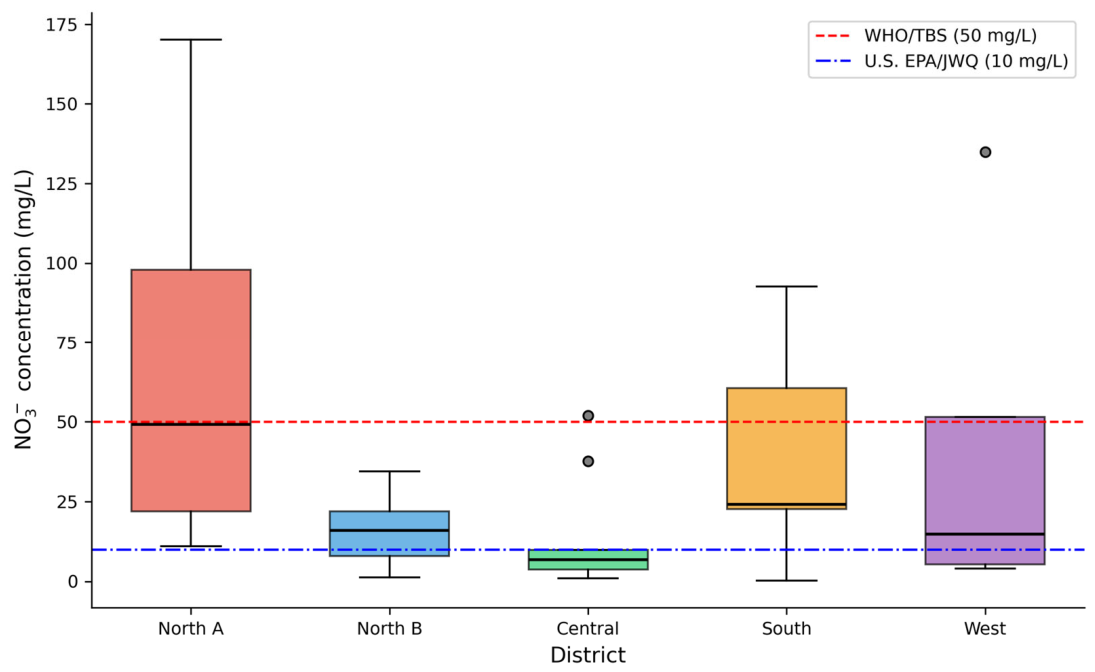

Table 1.
Physicochemical characteristics of groundwater across five districts of Zanzibar (N = number of samples per site).
Table 1.
Physicochemical characteristics of groundwater across five districts of Zanzibar (N = number of samples per site).
| District | Sampling Site | N | Well Depth (m) | EC (uS/cm) | pH | Temp. (C) | NO3- (mg/L) |
|---|---|---|---|---|---|---|---|
| North A | Kidoti | 4 | 25.68 | 787.5 | 7.5 | 27.50 | 56.08 +/- 29.49 |
| Mkokotoni | 5 | 7.32 | 864.0 | 7.8 | 27.04 | 11.06 +/- 23.17 | |
| Kivunge | 3 | 20.47 | 1256.7 | 7.4 | 27.57 | 170.10 +/- 132.89 | |
| Matemwe | 3 | 4.03 | 11500.0 | 8.0 | 29.00 | 93.00 +/- 54.18 | |
| Pwani Mchangani | 4 | 3.80 | 6175.0 | 7.9 | 30.13 | 112.58 +/- 97.28 | |
| Chutama | 3 | 17.70 | 646.7 | 7.0 | 27.50 | 42.40 +/- 33.62 | |
| Moga | 1 | 10.20 | 720.0 | 7.6 | 27.20 | 14.00 +/- 9.89 | |
| Kinyasini Ngaba | 2 | 8.05 | 700.0 | 7.5 | 27.80 | 24.65 +/- 1.91 | |
| North B | Muwanda | 3 | 1.03 | 687.0 | 7.1 | 26.00 | 19.50 +/- 29.58 |
| Kiwengwa | 4 | 5.68 | 5200.0 | 7.9 | 27.40 | 24.55 +/- 16.47 | |
| Makoba | 4 | 17.90 | 692.5 | 7.5 | 28.05 | 34.53 +/- 32.04 | |
| Mangapwani | 4 | 15.43 | 3375.0 | 7.4 | 27.50 | 16.05 +/- 27.07 | |
| Kiombamvua | 4 | 10.18 | 382.5 | 7.5 | 27.40 | 10.18 +/- 4.18 | |
| Upenja | 3 | 28.43 | 443.3 | 8.1 | 27.90 | 5.87 +/- 2.46 | |
| Kilombero | 1 | 26.50 | 1140.0 | 7.9 | 27.80 | 1.30 +/- 0.92 | |
| Central | Bungi | 4 | 13.03 | 600.0 | 7.7 | 26.60 | 9.95 +/- 12.47 |
| U/U/Kaepwani | 4 | 7.20 | 3943.0 | 7.6 | 27.43 | 5.07 +/- 4.44 | |
| U/U/Kaebona | 3 | 16.37 | 583.0 | 7.6 | 26.20 | 9.30 +/- 8.49 | |
| Pongwe | 4 | 393.00 | 8600.0 | 7.9 | 27.40 | 51.95 +/- 46.59 | |
| Uroa | 4 | 8.00 | 4553.0 | 8.0 | 27.05 | 3.73 +/- 1.19 | |
| Chwaka | 4 | 3.73 | 5793.0 | 7.9 | 27.33 | 37.68 +/- 25.15 | |
| Cheju | 3 | 11.27 | 633.3 | 7.8 | 26.57 | 6.83 +/- 4.83 | |
| Ndijani | 2 | 21.00 | 355.0 | 8.2 | 27.25 | 0.95 +/- 1.20 | |
| Ubago | 1 | 11.70 | 600.0 | 8.0 | 27.10 | 2.40 +/- 1.69 | |
| South | Kitogani | 4 | 4.78 | 1515.0 | 7.7 | 26.20 | 23.83 +/- 34.48 |
| Muyuni C | 4 | 23.13 | 547.5 | 8.3 | 27.05 | 21.48 +/- 35.15 | |
| Kizimkazi Dimbani | 4 | 8.33 | 1137.5 | 8.2 | 27.00 | 24.10 +/- 24.36 | |
| Tasani | 4 | 19.70 | 1120.0 | 7.9 | 28.55 | 87.65 +/- 162.66 | |
| Bwejuu | 4 | 4.75 | 1870.0 | 8.4 | 29.20 | 92.68 +/- 69.47 | |
| Jambiani Kikadini | 1 | 2.20 | 6100.0 | 8.3 | 27.20 | 0.30 +/- 0.21 | |
| Mzuri | 4 | 23.00 | 692.5 | 8.1 | 28.00 | 33.38 +/- 24.70 | |
| West | Mtoni | 2 | 10.00 | 910.0 | 8.0 | 28.20 | 134.90 +/- 131.80 |
| Kombeni | 4 | 13.00 | 1072.5 | 7.8 | 27.68 | 5.85 +/- 2.60 | |
| Bweleo | 4 | 9.85 | 4728.0 | 8.1 | 28.10 | 23.70 +/- 27.10 | |
| Bumbwisudi | 4 | 7.35 | 288.0 | 8.0 | 26.35 | 4.00 +/- 3.50 |
Disclaimer/Publisher’s Note: The statements, opinions and data contained in all publications are solely those of the individual author(s) and contributor(s) and not of MDPI and/or the editor(s). MDPI and/or the editor(s) disclaim responsibility for any injury to people or property resulting from any ideas, methods, instructions or products referred to in the content. |
© 2026 by the authors. Licensee MDPI, Basel, Switzerland. This article is an open access article distributed under the terms and conditions of the Creative Commons Attribution (CC BY) license (http://creativecommons.org/licenses/by/4.0/).
Copyright: This open access article is published under a Creative Commons CC BY 4.0 license, which permit the free download, distribution, and reuse, provided that the author and preprint are cited in any reuse.


