

Submitted:
24 April 2026
Posted:
27 April 2026
You are already at the latest version
Abstract
Generation Z, a cohort defined by digital connectivity, sensitivity to social influence, and environmental awareness, has attracted considerable scholarly attention in sustainable consumption research. Yet a persistent gap between their expressed pro-sustainability attitudes and actual purchasing decisions remains well-documented. This study examines whether Gen Z characteristics help bridge that gap by directly influencing sustainable purchase behavior and by moderating the role of purchase intention in that process. A quantitative design was employed using survey responses from 302 Gen Z consumers. The findings suggest that while Gen Z characteristics significantly predicted actual sustainable purchasing and purchase intention exerted a positive direct effect, the interaction between the two was negative and statistically significant. Conditional effects analysis further revealed that the influence of generational characteristics on purchasing behavior is stronger at lower levels of purchase intention and progressively weaker as intention increases. These results suggest that traits such as digital responsiveness, social embeddedness, and environmental orientation do not merely reinforce existing intentions but appear to compensate for their absence, activating sustainability-aligned behavior even when motivational commitment is limited. The study repositions the intention-behavior gap among Gen Z as something modulated by generational characteristics that drive purchasing behavior when intention alone falls short.
Keywords:
sustainable consumption
; gen Z
; purchase intention
; consumer behavior
; actual purchase
; generational traits
1. Introduction
Sustainable consumption has emerged as a central preoccupation across marketing, public policy, and consumer research, driven by mounting pressure to address environmental degradation at a societal scale [1]. Yet despite widespread awareness of climate change, resource depletion, and concerns over ethical production, the conversion of positive environmental attitudes into sustained purchasing behavior continues to elude researchers and practitioners alike [2]. A substantial body of research [3,4,5] documents this persistent intention-behavior gap, in which consumers articulate strong support for environmentally responsible products yet consistently fail to act on those stated intentions. Identifying the conditions under which this gap narrows or widens is therefore not merely an academic exercise but it carries direct implications for both theoretical development and practical intervention in sustainability-oriented markets.
Generation Z occupies a particularly significant position within this conversation [6]. As the first cohort to have grown up entirely within digital environments, Gen Z consumers are deeply enmeshed in social media ecosystems, routinely exposed to peer reviews and online influencers, and often active participants in brand communities [7]. Their environmental awareness is frequently cited as a defining generational trait [8]. Collectively, these characteristics suggest that Gen Z may represent a meaningful force in the broader shift toward sustainable consumption. That said, this cohort is also characterized by pragmatism and price sensitivity, which complicates any straightforward optimism about their purchasing behavior [9]. The interplay of digital fluency, social responsiveness, economic constraint, and environmental values renders Gen Z a particularly instructive group through which to examine how sustainable consumption actually unfolds [6].
Despite the breadth of existing research, several important gaps persist. Much of the prior literature has concentrated disproportionately on purchase intention rather than observable purchasing behavior [10,11,12,13]. Intention is, of course, a meaningful predictor of action, but an exclusive reliance on intention-based measures tends to overstate the effectiveness of sustainability-related messaging while underweighting the structural and contextual factors that drive real purchasing decisions. A second limitation concerns the fragmented treatment of generational characteristics. Existing studies tend to isolate individual determinants of sustainable consumption, such as environmental concern, perceived consumer effectiveness, or price sensitivity, without accounting for the broader constellation of traits that collectively define a generational cohort [14,15]. In the case of Gen Z, attributes such as digital immersion, social influence responsiveness, participation in online communities, and visual orientation are often discussed separately and descriptively, rarely modeled as an integrated set of generational characteristics with collective explanatory power [16,17,18]. This fragmentation obscures how such traits operate in combination to shape market behavior.
Perhaps the most consequential oversight, however, concerns the intention-behavior gap itself. Existing models have examined this gap predominantly through motivational and cognitive variables [5,19,20], with relatively little attention to the possibility that generational characteristics may condition how strongly intention translates into action. The prevailing assumption is that the intention-behavior link is relatively stable, moderated primarily by situational constraints or perceptions of behavioral control [21,22]. What remains largely unexplored is whether generational traits function as a contextual layer that either amplifies or attenuates the behavioral impact of intention. The degree to which sustainable intentions convert into actual purchases may, in other words, vary systematically depending on how strongly consumers embody the characteristics associated with their generation.
The present study addresses these gaps by examining how Gen Z characteristics shape actual sustainable purchasing behavior and by testing their moderating role in the relationship between purchase intention and behavior. Drawing on survey data from 302 Gen Z consumers and employing moderation analysis, the study investigates whether generational traits can help close the intention-behavior gap by activating purchasing, particularly among consumers whose intentions are not yet firmly established. The contribution of this work operates on three levels. Theoretically, it extends the sustainable consumption literature by incorporating generational characteristics into existing models of the intention-behavior gap and by reorienting the analytical focus from intention-based measures toward behavioral outcomes. Conceptually, it advances understanding of how digital and social generational traits interact with motivational factors to shape sustainable action. Empirically, it responds to calls for more rigorous behavioral evidence by grounding the analysis in actual purchase behavior rather than stated intentions. For practitioners, the findings offer actionable guidance for sustainability-oriented brands seeking to develop targeted strategies for Gen Z consumers, particularly those at earlier stages of behavioral commitment. In this way, the study contributes to a more context-sensitive understanding of sustainable consumption within the contemporary digital landscape.
2. Literature Review
2.1. Sustainable Consumption and the Intention Behavior Gap
Sustainable consumption is broadly understood as a pattern of purchasing and use that minimizes environmental harm, upholds principles of social equity, and supports long-term economic viability without compromising the capacity to meet individual needs [23,24]. In consumer research, it is typically operationalized through the acquisition of products that are environmentally friendly, ethically produced, and socially responsible [25,26]. As ecological pressures mount and public scrutiny of corporate conduct intensifies, sustainable consumption has established itself as a central preoccupation in both marketing scholarship and industry practice [27]. Yet the relationship between awareness and action remains fraught. A well-documented body of research points to the persistence of an intention-behavior gap, capturing the recurring inconsistency between what consumers say they intend to do and what they actually do in the marketplace [20,21,22]. Even among those who express genuine environmental concern, contextual barriers, competing priorities, and situational pressures frequently erode the link between intention and follow-through [28]. This raises a fundamental question about the sufficiency of intention as an explanatory variable, particularly for younger cohorts whose decision-making is deeply embedded in digital and socially mediated environments [29].
The Theory of Planned Behavior offers a well-established conceptual entry point for examining sustainable purchasing decisions [30]. In its original formulation, the theory positions behavioral intention as the proximate determinant of action, itself arising from three antecedents: attitudes toward the behavior, subjective norms, and perceived behavioral control [31]. Applied to sustainable consumption, the logic is relatively straightforward. Consumers who hold favorable attitudes toward sustainability, perceive social expectations to act responsibly, and feel capable of purchasing sustainable products should form stronger intentions, which in turn predict actual purchasing. In practice, however, the picture is considerably more complicated. Empirical evidence consistently demonstrates that the intention-behavior relationship is probabilistic rather than deterministic [4,32]. Habit, economic calculation, and a range of contextual factors can either reinforce or undermine the degree to which intention actually manifests in behavior [33,34]. Generation Z characteristics can be meaningfully situated within this theoretical construct. As digital natives, Gen Z consumers are immersed in environments saturated with peer evaluations, online reviews, influencer content, and brand communities, all of which amplify normative pressures and actively shape perceived social expectations [35,36]. Their environmental orientation and value-driven dispositions tend to cultivate favorable attitudes toward sustainable products [37]. On both counts, Gen Z characteristics appear well-positioned to contribute to the formation of sustainable purchase intention. Yet the TPB also recognizes that intention does not fully determine behavior; perceived behavioral control and contextual influences can exert direct behavioral effects that bypass or supplement intentional processes [38]. In environments where sustainability-related content is ubiquitous, where social validation is near-instantaneous, and where community engagement is woven into everyday digital life, purchasing behavior may be activated directly, even when underlying intention remains moderate. This points to the possibility that Gen Z characteristics exert an influence on actual purchase behavior that is, at least in part, independent of how strong those intentions happen to be.
The Theory of Planned Behavior accounts well for the motivational pathway through which attitudes and norms give rise to intention and, eventually, behavior [31]. What it captures less adequately, however, is the dynamic role of environmental stimuli, particularly within the kinds of digital contexts that define everyday life for Gen Z. The Stimulus-Organism-Response framework offers a useful complement in this respect. At its core, the framework holds that external stimuli act upon internal cognitive and affective states, which in turn generate behavioral responses [39]. Mapped onto sustainable consumption, this logic translates readily: digital exposure, social interaction, and the generational traits that shape how consumers engage with both can be understood as stimuli that configure internal evaluative states such as purchase intention, which subsequently drive purchasing behavior. From this point, Gen Z characteristics constitute a coherent bundle of socially and digitally embedded stimuli that operate on both the organism state, as reflected in purchase intention, and the behavioral response, as reflected in actual purchasing conduct. This framing also accommodates the possibility that the relationship between generational characteristics and behavior is not constant, but varies with the level of internal motivational engagement.
Bringing TPB and the S-O-R framework together generates a more nuanced account of how generational traits interact with motivational factors in the domain of sustainable consumption [39,40]. When purchase intention is already high, behavior is largely steered by motivational commitment, and the incremental contribution of generational characteristics may be correspondingly modest. When intention is weaker, however, traits such as digital engagement, sensitivity to social influence, and environmental orientation may take on a compensatory function, facilitating behavioral enactment in the absence of strong prior motivation. This interaction between motivational and generational factors is precisely what existing single-framework models tend to overlook. The integrated theoretical approach adopted in this study advances the sustainable consumption literature in two related ways. It positions Gen Z characteristics as relevant not only to the formation of purchase intention but also to the direct activation of purchasing behavior. Equally, it reframes the intention-behavior gap as something that is conditioned by generational context rather than uniform across consumer populations, a departure from models that treat the intention-behavior link as a fixed quantity. Together, these contributions provide a more textured and empirically testable account of how sustainable consumption is enacted among Generation Z.
2.2. Gen Z Characteristics in the Digital Era
Generation Z is widely recognized as the first fully digital cohort, having come of age in an environment defined by social media platforms, mobile connectivity, algorithmic content curation, and near-constant online interaction [6]. What distinguishes this generation from its predecessors is not simply the use of digital tools but a thoroughgoing embeddedness within digitally mediated ecosystems that organize how information is accessed, products are evaluated, preferences are formed, and identity is performed [41,42]. These conditions have given rise to a distinctive behavioral configuration that bears directly on marketplace decision-making, especially in domains like sustainable consumption where social signaling and value expression carry particular weight [43].
Digital nativeness stands as perhaps the most fundamental of these characteristics [44]. Growing up with continuous access to digital interfaces has normalized the use of online reviews, influencer endorsements, visual content, and viral trends as the default sources of product information [45,46,47]. Rather than being shaped primarily by conventional advertising, Gen Z consumers tend to privilege peer-generated content and digitally mediated cues when forming brand evaluations [7,48]. Within the Theory of Planned Behavior, such pervasive digital exposure plays a central role in configuring subjective norms, given that individuals are continuously absorbing the opinions and behaviors of others in their networks [49]. The influence of online reviews exemplifies this dynamic since reviews operate as decentralized information signals that reduce uncertainty and provide a form of social validation grounded in collective experience [50]. Influencer impact, meanwhile, speaks to the role of parasocial relationships and perceived authenticity in shaping attitudes and behavioral intentions, a process consistent with Social Influence Theory's emphasis on the informational and normative dimensions of consumer decision-making [51]. Online buzz impact captures something slightly different; the way in which the visibility and virality of sustainability-related content reinforce collective awareness and social expectations, making sustainable behavior feel not just desirable but socially normative [52]. Visual elements impact rounds out this picture by reflecting Gen Z's pronounced orientation toward visual communication formats, including short-form video, aesthetic branding, and symbolic sustainability cues [53]. Such visual signals tend to function as heuristic shortcuts that shape attitudes rapidly, a process well captured by the S-O-R framework's account of how external stimuli condition internal evaluations and the behavioral responses that follow [54]. Taken together, these dimensions articulate the depth of Gen Z's digital immersion and provide strong justification for their inclusion as core components of the Gen Z characteristics construct.
Beyond their digital orientation, Gen Z consumers are frequently characterized as value-driven and socially conscious [55]. Existing scholarship suggests this cohort attaches considerable weight to authenticity, ethical positioning, and environmental responsibility in their consumption choices [56]. Within the TPB framework, such orientations connect directly to attitudes toward behavior since favorable evaluations of sustainability increase the probability of forming positive purchase intentions [57,58]. The environmental responsibility dimension captures this value-driven orientation with particular clarity, as environmental concern may serve as an organizing principle that shapes both what consumers intend to do and what they actually do [59]. Sustainable products are often experienced as vehicles for enacting personal and collective responsibility, a dynamic that resonates with value-based theoretical traditions and with the Value-Belief-Norm perspective, which foregrounds the role of moral considerations in shaping pro-environmental behavior [60]. Gen Z decision-making is also deeply entangled with peer networks, where social validation mechanisms carry substantial influence [61,62]. Likes, shares, comments, and visible endorsements shape perceptions of product legitimacy and desirability in ways that are difficult to disentangle from more deliberate evaluative processes [45]. The influence of online reviews, online buzz, and influencer content can be further understood through Social Influence Theory and the logic of social proof, whereby individuals tend to align their behavior with what they perceive to be socially accepted or endorsed [63,64]. In the context of sustainable consumption, this dynamic takes on added significance: purchasing behavior functions not only as an individual decision but as a socially legible act that communicates shared values and signals collective identity.
A further defining characteristic of Gen Z is a strong orientation toward community and collective identity [65]. Brand communities, digital platforms, and social networks serve as arenas for interaction and engagement around shared interests, including sustainability [6,66,67]. The brand community impact dimension reflects the degree to which identification with such communities shapes consumer behavior [68]. Social Identity Theory offers a compelling explanatory approach here, suggesting that individuals derive part of their self-concept from group membership and are inclined to behave in ways that are congruent with group norms [69,70]. In sustainability contexts, participation in brand communities may intensify normative pressures and reinforce value-consistent conduct, with downstream effects on both purchase intention and actual purchasing behavior. Economic caution constitutes a further dimension worth acknowledging. A notable proportion of Gen Z consumers are either in early career stages or still in education, circumstances that frequently constrain financial resources. Sustainable purchasing, in this context, often entails negotiating a tension between ethical preference and economic practicality [6,71,72]. The product price impact dimension is designed to capture this friction between price sensitivity and value consciousness. Within the TPB framework, such economic considerations map onto perceived behavioral control since elevated prices can diminish consumers' sense of being able to act on their sustainability intentions, even when the relevant attitudes and social norms are otherwise supportive [73].
Considered collectively, the dimensions of online reviews impact, influencers impact, online buzz impact, visual elements impact, environmental responsibility impact, product price impact, and brand community impact constitute a multidimensional operationalization of Gen Z characteristics in the digital era. These components capture the principal features that distinguish Gen Z as a consumer cohort that illustrates the depth of their digital immersion, their responsiveness to social influence, their value-driven orientations, their embeddedness in community structures, and their economic calculus. By integrating these elements into a higher-order construct labeled Gen Z characteristics, this study treats generational traits not as background demographic attributes but as behaviorally consequential drivers of sustainable consumption. This conceptualization aligns coherently with both the Theory of Planned Behavior and the Stimulus-Organism-Response framework. Gen Z characteristics can be understood as external and social stimuli that configure internal evaluative states such as attitudes and purchase intention, while simultaneously exerting a direct influence on behavior through contextual and socially reinforced mechanisms. This dual role underscores the importance of situating sustainable consumption research within generational context and provides the conceptual grounding for understanding how digitally embedded characteristics shape both intention formation and actual purchasing conduct.
In summary, Gen Z characteristics represent a multifaceted construct that integrates digital immersion, social influence responsiveness, value orientation, community engagement, and economic considerations into a single analytical framework. Drawing on both the Theory of Planned Behavior and the Stimulus-Organism-Response perspective, these characteristics function as drivers of internal evaluation and as contextual factors shaping behavioral responses. More specifically, Gen Z characteristics are expected to influence purchase intention through their effects on attitudes, subjective norms, and perceived behavioral control, while also acting on actual purchasing behavior through digitally mediated and socially reinforced pathways. Given the persistent intention-behavior gap in sustainable consumption research, it is further important to examine whether the relationship between generational characteristics and actual purchasing behavior varies as a function of purchase intention. The following section develops the hypotheses that guide the empirical investigation.
2.3. Hypotheses Development
Building on the theoretical foundations established in the preceding discussion, this section develops a set of hypotheses concerning the role of Gen Z characteristics in sustainable consumption. Gen Z characteristics are conceptualized here as a multidimensional construct encompassing digital immersion, social influence sensitivity, environmental orientation, community engagement, and economic evaluation processes, each of which is expected to bear on both purchase intention and actual sustainable purchasing behavior.
Within the Theory of Planned Behavior, purchase intention occupies the position closest to behavior, formed through the antecedents of attitudes, subjective norms, and perceived behavioral control [74,75,76]. Gen Z characteristics are theoretically well-positioned to shape each of these components. Environmental responsibility and value-driven consumption orientations strengthen favorable attitudes toward sustainable products, since alignment between personal values and product attributes enhances the positive evaluation of environmentally responsible choices [77,78]. The social and digital embeddedness of Gen Z, manifested through exposure to online reviews, influencers, online buzz, and brand communities, amplifies subjective norms by reinforcing perceived social expectations and lending legitimacy to sustainable purchasing [7,79]. Access to online information and visual cues may additionally enhance perceived behavioral control by reducing informational uncertainty and supporting more confident decision-making [80]. The Stimulus-Organism-Response framework complements this picture [39,81] and Gen Z characteristics can be positioned as external stimuli that configure internal cognitive and affective states, including purchase intention. Digital exposure and social validation mechanisms act upon the organism state, which then steers behavioral responses [39,49]. These converging theoretical arguments support the proposition that Gen Z characteristics play a meaningful role in shaping sustainable purchase intention.
H1: Gen Z characteristics affect purchase intention.
Beyond establishing a directional effect, the question of whether Gen Z characteristics meaningfully account for variance in purchase intention carries its own empirical importance. Demonstrating predictive capacity strengthens the construct's relevance within sustainable consumption models.
H3: Gen Z characteristics predict purchase intention.
While purchase intention functions as a key predictor of behavior, sustainable purchasing is also subject to contextual and generational influences that may act on behavior directly, bypassing or supplementing the intentional pathway [14,15]. The Theory of Planned Behavior itself acknowledges that perceived behavioral control and situational factors can shape behavior independently of intention [30,31,32]. In digitally embedded environments, exposure to online reviews, influencer endorsements, brand communities, and sustainability-related visual content may activate purchasing behavior even when underlying intention remains moderate [6,35,36]. The Stimulus-Organism-Response framework reinforces this point suggesting that external stimuli do not operate exclusively through the organism state but may also produce more direct behavioral reactions [54]. Prominent online buzz or community endorsement, for instance, can trigger socially reinforced purchasing decisions, while price considerations may either facilitate or constrain behavior regardless of how firmly intention is established. Given that Gen Z characteristics encompass both motivational and contextual dimensions, a direct effect on actual sustainable purchasing behavior is anticipated.
H2: Gen Z characteristics affect actual purchase behavior.
H4: Gen Z characteristics predict actual purchase behavior.
Although the Theory of Planned Behavior positions intention as the primary proximate determinant of behavior, the extent to which generational traits translate into action may itself depend on the level of purchase intention. When intention is high, behavior is largely driven by motivational commitment, and the additional explanatory contribution of generational characteristics may be correspondingly limited. When intention is lower or not yet firmly established, however, traits such as digital immersion, social influence sensitivity, community orientation, and environmental responsibility may compensate for weaker motivation, activating behavior through normative reinforcement and contextual stimulation. The Stimulus-Organism-Response perspective supports this reasoning since intention represents the organism state, while Gen Z characteristics constitute the stimulus conditions. The interaction between these two elements shapes the behavioral response. Where intention is weak, stimuli associated with Gen Z characteristics may play a stronger activating role; where intention is strong, the incremental influence of those stimuli is likely to diminish. This argument speaks directly to the intention-behavior gap in sustainable consumption, proposing that generational characteristics condition how effectively intention converts into action.
H5: Purchase intention moderates the relationship between Gen Z characteristics and actual purchase behavior.
2.4. Conceptual Model
This study proposes a conceptual model designed to explain sustainable consumption among Generation Z by bringing together three core elements: generational characteristics, purchase intention, and actual purchase behavior. The model draws on the theoretical architecture of both the Theory of Planned Behavior and the Stimulus-Organism-Response framework, positioning Gen Z characteristics as the primary independent construct. This construct is conceptualized as a higher-order configuration encompassing digital immersion, social influence sensitivity, environmental responsibility, community orientation, and economic evaluation processes, operationalized through the impacts of online reviews, influencers, online buzz, visual elements, environmental responsibility, product price, and brand community engagement. Rather than treating these dimensions as isolated predictors, the model integrates them into a coherent generational profile that captures the behavioral distinctiveness of Gen Z consumers within the contemporary digital landscape. Purchase intention occupies a central position within the model as the primary motivational mechanism, reflecting an individual’s internal commitment to engage in sustainable purchasing behavior. Within the Stimulus-Organism-Response framework, this motivational state corresponds to the organism component, shaped by incoming external stimuli. Gen Z characteristics are expected to bear on this internal state by influencing the attitudes, subjective norms, and perceptions of behavioral control that underpin sustainable consumption decisions. The model therefore specifies a direct relationship between Gen Z characteristics and purchase intention. At the same time, the model does not assume that sustainable behavior is fully channeled through intention. Drawing on extensions of the Theory of Planned Behavior and the logic of the Stimulus-Organism-Response perspective, generational characteristics may also act on actual purchase behavior more directly, through contextual activation, social reinforcement, and digitally mediated cues. This allows the model to accommodate both motivational and stimulus-driven pathways simultaneously, rather than privileging one at the expense of the other.
A moderating mechanism is incorporated into the model specifically to address the intention-behavior gap. Purchase intention is proposed to moderate the relationship between Gen Z characteristics and actual purchase behavior, with the underlying premise that the strength of the link between generational traits and behavioral outcomes is not fixed but varies with the level of motivational commitment. When intention is high, behavior is expected to be predominantly steered by that motivational commitment, with generational traits contributing less additional explanatory weight. When intention is lower, however, Gen Z characteristics may take on a more pronounced compensatory role, activating behavior through social influence, digital engagement, and contextual stimulation. Taken as a whole, the proposed model (Figure 1) integrates motivational, contextual, and generational perspectives into a unified explanatory framework for sustainable consumption among Gen Z. By examining the effects of Gen Z characteristics on both purchase intention and actual behavior, while also modeling the moderating role of intention, the framework moves beyond prior research that has concentrated predominantly on intention-based explanations. The model is empirically tested using survey data from Gen Z consumers, employing moderation analysis to evaluate both direct effects and the interaction between generational characteristics and motivational commitment.
3. Materials and Methods
3.1. Research Design
This study adopted a quantitative research design to investigate the relationships among Gen Z characteristics, purchase intention, and actual sustainable purchase behavior. Data were collected through a cross-sectional survey, a method well-suited to gathering standardized information from a defined population and supporting statistical tests of hypothesized relationships among constructs [82]. The research is explanatory in orientation, concerned with establishing both direct and moderating effects within the proposed conceptual framework.
3.2. Sample and Data Collection
The target population comprised Generation Z consumers, defined in this study as individuals born between 1997 and 2012 [6,7,83]. The sampling frame consisted of undergraduate students aged 18 years or older, a criterion that ensured all participants satisfied both the generational boundary and ethical eligibility requirements for participation. Initial selection relied on convenience sampling, a practical choice given the researchers' direct access to the relevant population and a method commonly employed in behavioral research where access to specific groups is necessary [84,85]. To introduce greater rigor into the selection process and improve the generalisability of the findings, convenience sampling was supplemented by a systematic sampling procedure. Participants were drawn from an ordered list (without alphabetical order) using a fixed-interval pattern, specifically the 1st, 3rd, 6th, and 9th positions, yielding a structured and reproducible selection of respondents. The final sample comprised 302 participants. Sample adequacy was evaluated through an a priori power analysis using G Power analysis [86,87]. With a medium effect size (f² = 0.15), a significance threshold of α = 0.05, statistical power set at 0.95, and seven predictors entered into the model, the minimum sample required for multiple regression was estimated at approximately 153 respondents. The obtained sample of 302 comfortably exceeds this benchmark, providing statistical power to detect both main effects and interaction effects. This is of particular relevance in moderation analysis, where detecting reliable interaction terms typically requires larger samples [88].
3.3. Measures
All constructs were assessed using structured questionnaire items adapted from established instruments in the sustainable consumption and digital consumer behavior literatures. Items were measured on Likert-type scales, a format extensively used in behavioral research for capturing attitudes, perceptions, and behavioral tendencies [89]. Gen Z characteristics were operationalized as a multidimensional construct comprising seven dimensions: online reviews impact, influencers impact, online buzz impact, visual elements impact, environmental responsibility impact, product price impact, and brand community impact. These dimensions collectively capture the digital, social, value-driven, and economic aspects of Gen Z consumer behavior, and a composite score was computed to represent the overall construct. Purchase intention [90,91] and actual purchase behavior [92] were each assessed using well-validated scales with established application in consumer behavior and sustainable consumption research. Purchase intention reflected the degree of willingness and commitment to engage in sustainable purchasing, while actual purchase behavior was assessed through self-reported engagement in environmentally responsible purchasing within a specified reference period. The use of validated scales supports the reliability and cross-study comparability of the measurements.
3.4. Data Analysis and Analytical Model
Data analysis was carried out in SPSS following a structured sequential procedure. Descriptive statistics were first computed to characterize the sample and examine distributional properties. Internal consistency was assessed using Cronbach's alpha, and exploratory factor analysis was performed to evaluate construct validity and examine the dimensional structure of the Gen Z characteristics construct [89]. Hypothesis testing was conducted using regression-based moderation analysis via the PROCESS macro developed by Hayes [93]. The effects of Gen Z characteristics on purchase intention and actual purchase behavior were examined to test both directional and predictive relationships. The moderating role of purchase intention was assessed by introducing an interaction term between Gen Z characteristics and purchase intention as a predictor of actual purchase behavior. Bootstrapping with 5,000 resamples was used to generate bias-corrected confidence intervals for the interaction effects, strengthening the robustness of the inferences drawn [93]. Prior to computing the interaction term, all variables were mean-centered to mitigate potential multicollinearity [88]. A statistically significant interaction coefficient was taken as evidence of moderation, and conditional effects were subsequently examined at low, moderate, and high levels of purchase intention to characterize the nature of the interaction. Overall model performance was evaluated using the coefficient of determination (R²), F-statistics, and incremental variance explained by inclusion of the interaction term.
3.5. Ethical Considerations
The study was conducted in accordance with established ethical standards for social science research, including the principles set out in the Declaration of Helsinki [94]. Participation was entirely voluntary, and all respondents were briefed on the aims of the research before completing the survey. Informed consent was obtained from each participant, and strict confidentiality and anonymity were maintained throughout. No personally identifiable information was collected or retained, and participants were explicitly informed of their right to withdraw at any point without consequence. Data were used solely for academic purposes, consistent with recognized ethical guidelines for social science inquiry [95].
4. Results
4.1. Gen Z Characteristics Scale Reliability and Validity Assessment
The construct validity of the Gen Z characteristics measures was examined through Exploratory Factor Analysis using Principal Component Analysis. Before proceeding with factor extraction, the dataset was assessed for suitability using two standard diagnostics: the Kaiser-Meyer-Olkin measure of sampling adequacy and Bartlett's Test of Sphericity. As shown in Table 1, the KMO value was 0.728, comfortably above the recommended minimum of 0.60, indicating that the variables share sufficient common variance and that the sample is appropriate for factor analysis. Bartlett's Test of Sphericity returned a statistically significant result (χ² = 2714.382, df = 253, p < .001), confirming that the correlation matrix departs meaningfully from an identity matrix. Taken together, these diagnostics support proceeding with factor extraction. Seven factors were identified, corresponding to the seven conceptual dimensions used to operationalize Gen Z characteristics: online reviews impact, influencers impact, online buzz impact, visual elements impact, environmental responsibility impact, product price impact, and brand community impact. The solution is therefore fully consistent with the theoretical structure underpinning the construct. Collectively, the seven factors accounted for 67.195% of total variance, a figure that surpasses the 60% threshold widely regarded as acceptable in social science research. This level of explained variance indicates that the factor solution captures a substantial share of the variability in the observed items and provides empirical support for the multidimensional structure of the Gen Z characteristics construct.
Communalities and the rotated component matrix for the construct items are reported in Table 2. Communality values across items range from 0.502 to 0.784, indicating that each item shares a satisfactory proportion of variance with the extracted factors. Values above 0.50 are generally regarded as acceptable in the literature, and the present results confirm that all items contribute meaningfully to the underlying factor structure. Inspection of the rotated component matrix reveals strong item-to-factor relationships throughout. The majority of factor loadings exceed 0.70, reflecting clear and robust associations between items and their designated constructs. Items 1 and 2, for instance, load prominently on Component 1, with values of 0.863 and 0.833 respectively, while Items 3 to 5 cluster coherently on Component 2, a pattern that is broadly replicated across the remaining components. The consistency of these high loadings constitutes evidence of convergent validity: items designed to capture the same conceptual dimension demonstrate strong co-variation with a common factor. Equally important is what the factor structure reveals about discriminant validity. The components exhibit clear separation, with items loading predominantly on a single factor and showing little evidence of substantial cross-loadings on others. This clean structure supports the interpretation that the seven dimensions, while related, represent conceptually distinct facets of the Gen Z characteristics construct rather than overlapping or redundant indicators of the same underlying phenomenon.
Considered as a whole, the exploratory factor analysis offers compelling support for the validity of the Gen Z characteristics construct. The satisfactory KMO value, the significant Bartlett's Test result, the substantial proportion of explained variance, adequate communality values, and consistently high factor loadings converge in confirming that the measurement items reliably capture the multidimensional structure of Gen Z characteristics within the sustainable consumption context. Regarding internal consistency, Cronbach's alpha coefficients were computed for each construct and are reported in Table 3. Reliability values range from 0.595 to 0.934, reflecting a span from acceptable to excellent internal consistency across the measurement scales. Most constructs exceed the commonly cited threshold of 0.70, with several exhibiting notably high alpha values that point to strong coherence among their constituent items. Two constructs return somewhat lower coefficients, though these values remain in close proximity to the threshold and should not be treated as disqualifying. Prior methodological work [97] suggests that alpha values in the region of 0.60 can be considered adequate when constructs are operationalized with a limited number of items, which is the case here for the scales in question. The exploratory orientation of the study further supports a degree of tolerance in this regard. On balance, the reliability analysis indicates that the measurement scales perform satisfactorily and provide a sound basis for the subsequent statistical analyses. The items measuring Gen Z characteristics, purchase intention, and actual purchase behavior each demonstrate sufficient internal consistency to be regarded as coherent reflections of their respective constructs.
4.2. Descriptive Analysis
Table 4 summarizes the demographic characteristics of the study sample. Gender distribution is reasonably balanced, with female respondents accounting for 52.3% of participants and male respondents making up the remaining 47.7%. This near-equal representation is a useful feature of the sample, as it reduces the risk of gender-related bias in the findings and supports broader applicability within the Gen Z population. In terms of educational attainment, the sample is dominated by current university students (85.4%), a profile that aligns closely with the typical life stage of Generation Z. A smaller share of respondents hold a Bachelor's degree (11.2%), while 2.7% have completed postgraduate education at the Master's level, and 0.7% entered the study having completed secondary school only. The overall educational composition reflects the transitional academic and early career stage that characterizes much of this cohort. The distribution of family income is reasonably spread across the available categories. The largest single group reports household income in the range of 10,000 to 20,000 euros (41.7%), followed by those with income above 20,000 euros (39.1%), while 19.2% of respondents come from households earning below 10,000 euros annually. This variation across income bands means the sample is not skewed toward any particular socioeconomic stratum, which strengthens confidence in the diversity of the respondent pool. Participants ranged in age with a mean of 20.52 years and a standard deviation of 2.35, confirming that the sample falls squarely within the Generation Z age bracket. Taken together, the demographic profile of the sample is consistent with the defining characteristics of this generational cohort and supports the suitability of the dataset for examining sustainable consumption behavior among Gen Z consumers.
Table 5 reports descriptive statistics for all constructs included in the study, covering the individual dimensions of Gen Z characteristics, the composite Gen Z characteristics construct, purchase intention, and actual purchase behavior. Mean values across most constructs fall in the moderate range, pointing to a sample that is neither uniformly enthusiastic nor uniformly dismissive in its self-assessments. Among the seven dimensions of Gen Z characteristics, online reviews impact (M = 3.92, SD = 1.01) and product price impact (M = 3.85, SD = 0.93) return the highest mean scores, suggesting that respondents regard these as the most salient features of their generational profile. Influencers impact, by contrast, yields a noticeably lower mean (M = 2.68, SD = 1.14), indicating that direct influencer engagement is perceived as less central to this sample's consumer identity than other digital characteristics. The remaining dimensions, online buzz impact, visual elements impact, environmental responsibility impact, and brand community impact, cluster modestly above the scale midpoint, reflecting a tempered but generally positive recognition of these traits among respondents. When aggregated into a composite measure, the overall Gen Z characteristics construct returns a mean of 3.36 (SD = 0.66), consistent with the moderate pattern observed across the individual dimensions. The relatively constrained standard deviation at this level suggests that responses converge reasonably around this midpoint once the dimensions are combined. For the outcome variables, purchase intention (M = 3.00, SD = 0.89) sits precisely at the scale midpoint, while actual purchase behavior (M = 3.59, SD = 0.85) is somewhat higher, a gap worth noting as it hints at a degree of behavioral enactment that outpaces stated motivational commitment. Standard deviations across all variables are moderate, indicating adequate response variability and a sample that captures a reasonable range of orientations and behaviors. In sum, the descriptive statistics paint a picture of a sample with moderate but genuine engagement with the constructs under investigation.
4.3. Relationship of Gen Z Characteristics with Purchase Intention and Actual Purchase
Table 6 reports the correlation coefficients between the dimensions of the Gen Z characteristics construct and the two primary outcome variables, purchase intention and actual purchase behavior. These bivariate associations offer a preliminary reading of the data before hypothesis testing and provide an initial basis for evaluating the plausibility of the proposed conceptual model. The general pattern across dimensions is one of positive and statistically significant associations with both outcome variables, suggesting that the generational traits captured in the construct are meaningfully linked to sustainable consumption patterns. With respect to purchase intention, significant positive correlations emerge for influencers impact, online buzz impact, visual elements impact, environmental responsibility impact, and brand community impact, indicating that higher endorsement of these characteristics tends to accompany stronger intentions to purchase sustainably. The picture for actual purchase behavior is broadly similar, though not identical. Online reviews impact, online buzz impact, visual elements impact, environmental responsibility impact, product price impact, and brand community impact all show significant positive relationships with actual purchasing. Visual elements impact and online buzz impact stand out as among the stronger correlates, pointing to the possibility that visually rich and socially visible digital environments are particularly influential in activating sustainable purchasing among this cohort. Two exceptions are observed from the overall pattern. Influencers impact, despite its significant association with purchase intention, does not show a statistically significant relationship with actual purchase behavior. This suggests that while influencer-related content may contribute to shaping motivational states, it does not appear to translate directly into reported purchasing activity within this sample. Product price impact presents the inverse pattern: it is not significantly correlated with purchase intention but does show a significant association with actual behavior, hinting that price considerations bear more on the act of purchasing than on the formation of intentions to do so. On balance, the correlation analysis lends preliminary support to the relational structure proposed in the conceptual model. The breadth and consistency of significant associations across dimensions justify proceeding to regression and moderation analyses, which will allow for a more rigorous evaluation of the predictive and interaction effects specified in the study hypotheses.
4.4. Prediction of Purchase Intention and Actual Purchase by Gen Z Characteristics
To assess the explanatory capacity of Gen Z characteristics across both motivational and behavioral outcomes, two separate multiple regression analyses were carried out. In each model, the same seven predictors were entered: online reviews impact, influencers impact, online buzz impact, visual elements impact, environmental responsibility impact, product price impact, and brand community impact. The dependent variable differed across the two models, with purchase intention serving as the outcome in the first and actual purchase behavior in the second. Both models account for meaningful variance in their respective outcomes, though with some difference in magnitude. The regression predicting purchase intention yields R² = 0.323, meaning that the seven Gen Z characteristics dimensions collectively explain approximately 32.3% of the variance in respondents' sustainable purchase intentions. The model predicting actual purchase behavior returns R² = 0.250, indicating that 25.0% of the variance in purchasing behavior is accounted for by the same set of predictors. While both figures reflect genuine explanatory power, the somewhat lower value for actual behavior is consistent with the theoretical expectation that behavior is shaped by a broader range of factors beyond generational characteristics alone. Adjusted R² values for both models confirm that their explanatory capacity holds up after accounting for the number of predictors included, lending further credibility to the findings (Table 7).
The ANOVA results reported in Table 8 confirm the statistical significance of both regression models. The model predicting purchase intention yields F = 19.982 (p < .001), while the model predicting actual purchase behavior returns F = 14.035 (p < .001). In both cases, the predictor set jointly accounts for statistically significant variation in the outcome, lending credibility to the overall model specifications. The notably higher F value for the purchase intention model suggests that the Gen Z characteristics dimensions, as a collective, achieve a stronger fit when predicting motivational outcomes than when predicting behavioral ones, a pattern consistent with the broader theoretical expectation that actual behavior is subject to a wider range of influences beyond those captured in the present model.
A closer examination of the regression coefficients (Table 9) reveals that the predictors of purchase intention and actual purchase behavior are not identical in their composition or relative strength, a distinction that carries meaningful theoretical implications. Purchase intention is most strongly predicted by brand community impact (β = 0.281, p < .001), followed by environmental responsibility impact (β = 0.213, p = .001) and online buzz impact (β = 0.167, p = .012). This configuration points to a motivational landscape shaped largely by social belonging, personal values, and the perceived collective endorsement of sustainable behavior. Visual elements impact (β = 0.142, p = .028) and influencers impact (β = 0.119, p = .041) also reach statistical significance, suggesting that aesthetic and aspirational cues contribute to the formation of sustainable intentions, albeit in a supporting rather than primary capacity. The predictors of actual purchase behavior tell a somewhat different story. Here, the leading contributors are visual elements impact (β = 0.201, p = .002), online buzz impact (β = 0.153, p = .023), and online reviews impact (β = 0.148, p = .013), all of which reflect exposure to digitally visible, socially circulating, and informationally grounded stimuli. The shift away from value-based and community-oriented predictors toward more immediate digital cues suggests that the transition from intention to behavior among Gen Z consumers may be less a matter of conviction and more a matter of contextual activation through the digital environments they inhabit.
Taken together, the regression findings point to a meaningful divergence in the factors that drive purchase intention and those that drive actual purchase behavior. Intention formation appears to be anchored in normative, value-driven, and identity-related processes since environmental responsibility and community belonging emerge as the dominant forces, suggesting that sustainable intentions among Gen Z are cultivated primarily through alignment with personal values and social group membership. Behavior, by contrast, is more responsive to contextual and stimulus-driven inputs, particularly visual communication, social visibility, and peer-generated information circulating in digital environments. This divergence reffers directly to the complexity of the intention-behavior gap. It suggests that the psychological foundations of wanting to consume sustainably and actually doing so are not simply points on the same continuum but draw on partly distinct motivational and contextual resources. Gen Z consumers may arrive at sustainable intentions through a process that is fundamentally social and value-laden, yet the behavioral follow-through depends to a greater extent on the digital stimuli they encounter at or near the point of decision. The consumption environment, in other words, carries weight that stated values alone cannot fully account for. From a theoretical standpoint, these findings reinforce the case for treating intention and behavior as analytically separable outcomes rather than collapsing them into a single measure of sustainable engagement. They also suggest that effective interventions in this space will need to operate on two fronts: cultivating the normative and value-based conditions that support intention formation, while simultaneously designing the digital environments through which actual purchasing decisions are made.
4.5. Moderation Analysis for the Impact of Purchase Intention on the Relationship of Gen Z Characteristics and Actual Purchase
The moderation analysis conducted using PROCESS Model 1 yielded a statistically significant overall model, F(3,298) = 44.24, p < .001, with the predictor set accounting for 30.8% of the variance in actual purchase behavior (R² = .308), as reported in Table 10. Both primary predictors contributed significantly to the model. Gen Z characteristics emerged as a significant positive predictor of actual purchase behavior (b = 0.891, SE = 0.177, p < .001), and purchase intention likewise exerted a significant positive effect (b = 0.802, SE = 0.197, p < .001). Of particular theoretical interest is the interaction term. The product of Gen Z characteristics and purchase intention was negative and statistically significant (b = -0.145, SE = 0.055, p = .009, 95% CI [-0.252, -0.037]), accounting for an incremental 1.6% of explained variance beyond the main effects (ΔR² = .016). The negative sign of this coefficient indicates that the positive relationship between Gen Z characteristics and actual purchasing behavior weakens as purchase intention increases. In other words, purchase intention functions as a moderator, but not in the straightforward amplifying role that might be expected. Rather, it appears to attenuate the contribution of generational characteristics to behavioral outcomes, suggesting that when motivational commitment is already high, the additional activating influence of Gen Z traits becomes less consequential.
Conditional effects analysis provided further insight into the nature of this moderating relationship (Table 11). The positive effect of Gen Z characteristics on actual purchase behavior proved strongest at low levels of purchase intention (b = 0.601, p < .001), diminished at moderate levels (b = 0.457, p < .001), and weakest when purchase intention was high (b = 0.341, p < .001). Notably, the effect remains statistically significant across all three levels, indicating that Gen Z characteristics consistently predict purchasing behavior regardless of motivational strength, but with meaningfully different magnitudes depending on how committed the consumer already is. The pattern carries a substantive interpretation. Among consumers with relatively low purchase intention, generational characteristics such as digital engagement, responsiveness to online influence, environmental orientation, and community involvement appear to play a particularly decisive role in activating actual purchasing. These traits seem to compensate for the absence of strong prior motivation, translating latent or partial commitment into behavioral action through digitally mediated and socially reinforced pathways. Where purchase intention is already high, by contrast, behavior is largely driven by that motivational commitment itself, and the incremental contribution of generational characteristics is accordingly reduced. The implication is not that generational traits become irrelevant at high levels of intention, but rather that their unique explanatory contribution narrows as motivational factors take on a more dominant role (Figure 2).
From a practical standpoint, these findings carry clear implications for how sustainability-oriented brands might allocate their efforts across different consumer segments. Digital and socially driven strategies appear to be most consequential for consumers who are uncertain or only moderately committed to sustainable purchasing, precisely the group where generational characteristics exert the strongest activating influence. Targeting this segment through visually compelling content, peer-generated information, and community-embedded messaging may be a more efficient use of resources than attempting to further strengthen the intentions of already-committed consumers. For the latter group, the analysis suggests diminishing returns to intention-building interventions. Among consumers whose motivational commitment is already high, the primary obstacles to behavioral follow-through are more likely to be practical in nature: price, availability, convenience, and the structural features of the purchasing environment. Managerial attention in this context is therefore better directed toward removing those friction points than toward reinforcing values that are already well-established. Stepping back, while the interaction effect is statistically significant, its magnitude is modest. Purchase intention remains the dominant driver of actual sustainable purchasing behavior, and Gen Z characteristics function in a complementary rather than competing capacity. Their most substantive contribution lies in narrowing the intention-behavior gap among consumers who have not yet formed strong motivational commitments, offering a generational pathway through which sustainability-aligned behavior can be activated even in the absence of fully crystallized intent.
5. Discussion
This study set out to understand how Gen Z characteristics shape sustainable consumption, with particular attention to purchase intention, actual purchase behavior, and the conditions under which the intention-behavior gap might be narrowed. What emerges from the analysis is a layered picture in which different generational traits carry different weight depending on whether one is examining the formation of intentions or the execution of behavior. At the bivariate level, most dimensions of Gen Z characteristics show positive and significant associations with both purchase intention and actual purchasing, a pattern consistent with prior research linking digital engagement, social influence, and environmental concern to sustainable consumption among younger consumers [6,7,10,11,12,46,60]. Within the Theory of Planned Behavior, this makes conceptual sense since environmental responsibility, social influence, and digital exposure contribute to intention formation by shaping attitudes and perceived social norms, a dynamic that resonates with established findings in the sustainable consumption literature [6,30,31,75,76]. The regression analysis for purchase intention sharpens this picture considerably. Hypotheses 1 and 3 are both supported: Gen Z characteristics significantly influence purchase intention, and the model accounts for a substantial share of its variance. Brand community impact, environmental responsibility, and online buzz emerge as the primary drivers, with visual elements and influencers playing a secondary but significant role. This configuration is broadly consistent with prior work grounded in value-based theories and social identity theory [14,45,51], which foreground moral alignment and group belonging as central motivators of pro-environmental intentions among younger consumers. However, not all findings align so neatly with prior literature. The non-significant effects of online reviews and product price on purchase intention are worth pausing over, given that perceived value and price sensitivity have featured prominently in previous studies of consumer intentions [9,14,15,37,55]. One interpretation is that Gen Z consumers, when forming intentions, are driven less by utilitarian calculations and more by questions of identity and social belonging. Whether this reflects a genuine generational orientation or a feature specific to the present sample is a question that warrants further investigation.
The picture for actual purchase behavior is more complicated, and Hypotheses 2 and 4 receive only partial support. While the bivariate correlations suggest broad associations between Gen Z characteristics and behavior, the multivariate model narrows the field considerably since only online reviews, online buzz, and visual elements emerge as significant predictors of actual purchasing. Electronic word-of-mouth and digital visibility thus appear to be the operative mechanisms at the behavioral stage, consistent with prior work in this area [100,101]. Furthermore, environmental responsibility, which is among the strongest predictors of intention, does not exert a significant direct effect on behavior in the regression model. This suggests its influence may be largely indirect, channeled through purchase intention rather than acting on behavior independently, a finding that sits in some tension with studies positioning environmental values as direct behavioral drivers [56,59,77,78]. This divergence between the predictors of intention and behavior is one of the more theoretically significant results of the current study. Intention formation appears anchored in normative and value-driven processes, while behavioral execution is more responsive to immediate digital stimuli and contextual cues. The implication is that sustainable action among Gen Z is not simply an extension of sustainable belief but it depends on a distinct set of activating conditions encountered in the consumption environment. This pattern aligns with prior arguments that values and attitudes, while necessary, are insufficient on their own to guarantee behavioral follow-through [102].
The moderation analysis offers what is arguably the study's most distinctive contribution and provides strong support for Hypothesis 5. The negative and statistically significant interaction between Gen Z characteristics and purchase intention indicates that the relationship between generational traits and actual purchasing weakens as motivational commitment increases. This finding introduces meaningful nuance into the existing literature. It suggests that generational traits are not uniformly influential across the motivational spectrum but operate most powerfully as behavioral activators precisely where intention is underdeveloped. Where intention is already strong, behavior is predominantly guided by that motivational commitment, and the incremental contribution of generational characteristics diminishes accordingly. This positions generational traits as a form of compensatory mechanism, capable of bridging the gap between weak intention and observable behavior through socially reinforced and digitally mediated pathways. Theoretically, these findings engage with the existing literature in a productive tension. They confirm the central role of intention within a broadly TPB-consistent framework while also demonstrating that the intention-behavior relationship is not fixed but varies with generational context. The results similarly validate the Stimulus-Organism-Response framework's contention that external stimuli can activate behavior through pathways that bypass or supplement the motivational route, a point especially relevant when internal commitment is limited. Taken together, the two frameworks offer complementary rather than competing explanations, and their integration appears productive for capturing the multi-stage nature of sustainable consumption.
The study also responds to a recognized gap in the literature. Prior research has disproportionately relied on intention as a proxy for sustainable engagement and has tended to examine individual predictors in isolation [24,26,43]. By treating Gen Z characteristics as a multidimensional construct and examining intention, behavior, and their interaction simultaneously, the present study offers a more complete account of how generational traits shape sustainable consumption across its different stages. Practically, the findings argue for a more differentiated approach to sustainability-oriented marketing. Social and value-driven messaging appears well-suited to cultivating intentions, particularly among consumers for whom community belonging and environmental identity are already salient. For consumers who have not yet formed strong purchase intentions, however, the activation of behavior may depend more on the quality and visibility of the digital environments they inhabit (visually compelling content, socially circulating endorsements, and accessible peer-generated information). The finding that influencer marketing correlates with intention but not with actual behavior is a particularly pointed observation for practitioners who assume a direct line from influencer exposure to sales. Overall, sustainable consumption among Gen Z is shaped by a combination of motivational, social, and contextual factors that operate differently at different stages of the consumption process. Some findings reinforce existing assumptions while others complicate them. What the study ultimately underscores is the value of moving beyond single-stage, single-predictor models toward a more dynamic and contextually grounded understanding of how sustainable behavior is formed, activated, and ultimately enacted.
6. Conclusion
This study examined the role of Gen Z characteristics in shaping sustainable consumption, with purchase intention and actual purchase behavior treated as distinct yet related outcomes, and the moderating function of intention in bridging the gap between the two as a central analytical concern. The findings establish Gen Z characteristics as a meaningful and multidimensional construct whose influence on sustainable consumption operates through both motivational and contextual channels. Purchase intention remains a primary determinant of behavior, yet generational traits, particularly digital engagement, responsiveness to online stimuli, and social influence, make a complementary contribution that is most pronounced precisely where motivational commitment is weakest. The analysis further reveals that not all dimensions of Gen Z characteristics carry equal explanatory weight. Digitally and visually oriented factors, specifically online reviews, online buzz, and visual elements, emerge as the most consistent predictors of actual purchasing behavior, while the moderation results underscore that these generational traits are particularly consequential in activating behavior among consumers who have not yet formed strong intentions. In this way, the study offers a concrete account of one mechanism through which the intention-behavior gap may be narrowed. More broadly, it contributes to the literature by incorporating generational characteristics into sustainable consumption models and by advancing a more granular understanding of the conditions under which intention converts into action.
6.1. Limitations
The study is subject to a number of limitations that should be acknowledged when interpreting its findings. The convenience sampling approach constrains the generalizability of the results beyond the specific population of undergraduate Gen Z consumers from which the sample was drawn. While the application of a systematic sampling procedure within the sampling frame introduced a degree of structure into the selection process and partially strengthened representativeness, the reliance on convenience sampling remains a boundary condition on the conclusions that can reasonably be drawn. Additionally, the study measures actual purchase behavior through self-report, a method that is susceptible to social desirability bias and the kinds of recall inaccuracies that tend to inflate estimates of pro-environmental conduct. The cross-sectional design presents a further constraint, as it precludes causal inference and offers no window into how the relationships among the study variables evolve over time. Additionally, the exclusion of Gen Z consumers below the age of 18 constitutes a meaningful boundary on the generalizability of the findings. Younger members of this cohort may differ from their older counterparts in terms of purchasing autonomy, financial independence, and the nature of their digital engagement, all of which are central to the constructs examined in this study. As a result, the extent to which the findings extend to the full generational spectrum of Gen Z remains an open question. Finally, while the Gen Z characteristics construct integrates multiple behaviorally relevant dimensions, it does not exhaust the full range of generational influences; factors such as cultural context, psychological dispositions, and broader socioeconomic conditions were not captured and may account for variance that the present model leaves unexplained.
6.2. Future Research
Future research could address several of these limitations productively. Probability-based sampling across more diverse Gen Z populations, including those outside university settings, would substantially strengthen the generalizability of findings in this area. Longitudinal designs would allow researchers to trace how the relationships between generational characteristics, purchase intention, and actual behavior shift over time, providing a more dynamic picture of sustainable consumption. Behavioral or transactional data could complement or replace self-reported measures, reducing reliance on respondents' retrospective accounts of their own purchasing. There is also room to broaden the construct space by incorporating cultural, psychological, and structural factors that may shape how generational characteristics translate into consumption outcomes. Finally, cross-generational comparative studies would help establish whether the patterns identified here are specific to Gen Z or reflect more general consumer dynamics, an important step toward building cumulative theoretical knowledge in this field.
6.3. Practical and Managerial Implications
The findings carry several concrete implications for practitioners and policymakers working to promote sustainable consumption among Gen Z consumers. The prominence of digitally and visually oriented factors in the analysis points to a clear strategic priority where organizations should invest in visually engaging, socially shareable content when communicating sustainability messages. Campaigns that draw on online reviews, user-generated content, and social visibility are likely to resonate more effectively with this cohort precisely because they align with the digital environments Gen Z consumers already inhabit and trust. The results also complicate some widely held assumptions about influencer marketing. While influencer-related content appears to contribute to intention formation, its relationship to actual purchasing behavior is weaker than practitioners might expect. This suggests that influencer endorsements, deployed in isolation, may not be sufficient to drive behavioral outcomes. A more productive approach likely involves building credibility through transparent communication, consistent sustainability practices, and genuine consumer engagement over time. Authenticity, in other words, appears to be a more reliable behavioral driver than visibility alone. The moderating role of purchase intention adds a further layer of strategic nuance. Consumers at lower levels of motivational commitment represent a segment where activating mechanisms, social proof, digital engagement, and visual storytelling, can make a genuine difference in stimulating purchasing behavior. For consumers whose intention is already strong, however, the priority shifts. Continued efforts to reinforce attitudes that are already favorable may yield diminishing returns; what these consumers more likely need is the removal of practical obstacles such as price, limited availability, and inconvenience. For policymakers, the implications follow a similar logic. Interventions that combine informational content with digitally native engagement strategies are likely to outperform those relying on traditional communication channels, particularly when delivered through the platforms and formats that align with how Gen Z actually consumes media. Across both managerial and policy contexts, the overarching message is the same: promoting sustainable consumption among this generation requires a differentiated, context-sensitive approach that accounts for where consumers are in their motivational journey, rather than treating them as a homogeneous group.
Author Contributions
Conceptualization, D.T., G.T., G.H. and I.S.; methodology, D.T., G.T., G.H. and I.S.; software, D.T.; validation, D.T.; formal analysis, D.T.; data curation, D.T.; writing—original draft preparation, D.T. and G.T.; writing—review and editing, D.T., G.T., G.H. and I.S.; visualization, D.T. and G.T.; supervision, G.T. and I.S. All authors have read and agreed to the published version of the manuscript.
Funding
This research was funded by the grant titled “An Exploratory Study of Online Consumer Behavior in Technological Products, Entrepreneurial Innovation, Communication, and Services Management”, awarded by the Special Account for Research Funds of the International Hellenic University. It falls under task 2 of the program “Measures to Promote Research through Financial Support to Laboratories and Institutes of the International Hellenic University” (Code No. 82156).
Institutional Review Board Statement
The research is a part of the first author’s PhD thesis. The whole study was conducted in accordance with the Declaration of Helsinki and approved by Department of Organizations Marketing and Tourism International Hellenic University (IHU) (protocol code 1/7-01-21 and 24 April 2024).
Informed Consent Statement
Informed consent was obtained from all subjects involved in the study.
Data Availability Statement
The data presented in this study are available on request from the corresponding author.
Conflicts of Interest
The authors declare no conflicts of interest.
References
- Kráľ, Š.; Kráľová, L.; Fedorko, R.; Herichová, B. Analysis of Consumer Attitudes and Preferences Towards Sustainable Practices in E-Commerce. J. Sustain. Res. 2026, 8, 1–14. [Google Scholar] [CrossRef]
- Ssenoga, D.; Walugembe, A.; Alinda, K.; Nkurunziza, G. Environmental beliefs and personal norms on green purchase behavior among academic staff in Ugandan universities. Manag. Sustain. An. Arab Rev. 2025. [Google Scholar] [CrossRef]
- Sheeran, P.; Webb, T.L. The intention–behavior gap. Soc. Personal. Psychol. Compass 2016, 10, 503–518. [Google Scholar] [CrossRef]
- Conner, M.; Norman, P. Understanding the intention-behavior gap: The role of intention strength. Front. Psychol. 2022, 13, 923464. [Google Scholar] [CrossRef] [PubMed]
- Carrington, M.J.; Neville, B.A.; Whitwell, G.J. Lost in translation: Exploring the ethical consumer intention–behavior gap. J. Bus. Res. 2014, 67, 2759–2767. [Google Scholar] [CrossRef]
- Theocharis, D.; Tsekouropoulos, G. Sustainable consumption and branding for Gen Z: How brand dimensions influence consumer behavior and adoption of newly launched technological products. Sustainability 2025, 17, 4124. [Google Scholar] [CrossRef]
- Theocharis, D. Peer dynamics in digital marketing: How product type shapes the path to purchase among Gen Z consumers. Businesses 2025, 5, 43. [Google Scholar] [CrossRef]
- Pinho, M.; Gomes, S. Environmental sustainability from a generational lens-A study comparing generation X, Y, and Z ecological commitment. Bus. Soc. Rev. 2024, 129, 349–372. [Google Scholar] [CrossRef]
- Musallimah, Z. The Pragmatic Digital Believer: Why Gen Z Prioritizes Value over Religious Identity in the Shopee Ecosystem. J. Digit. Econ. Stud. 2026, 1, 81–98. [Google Scholar]
- Ninan, N.; Roy, J.C.; Cheriyan, N. K. Influence of social media marketing on the purchase intention of Gen Z. Int. J. Adv. Sci. Technol. 2020, 29, 1692–1702. [Google Scholar]
- Veybitha, Y.; Alfansi, L.; Salim, M.; Darta, E. Critical review: Factors affecting online purchase intention generation Z. J. Int. Conf. Proc. 2021, 4, 354–363. [Google Scholar] [CrossRef]
- Muralidhar, A.; Raja, A.S. Understanding the purchase intention characteristics of Gen Y and Gen Z and introspecting the modern demand variables in fashion industry. Int. J. Sci. Eng. Res. 2019, 10, 144–170. [Google Scholar]
- Theocharis, D.; Tsekouropoulos, G.; Hoxha, G.; Simeli, I. Location-based moderation in digital marketing and E-commerce: Understanding gen Z’s online buying behavior for emerging tech products. J. Theor. Appl. Electron. Commer. Res. 2025, 20, 161. [Google Scholar] [CrossRef]
- Yue, B.; Sheng, G.; She, S.; Xu, J. Impact of consumer environmental responsibility on green consumption behavior in China: The role of environmental concern and price sensitivity. Sustainability 2020, 12, 2074. [Google Scholar] [CrossRef]
- Tan, C.N.L.; Fauzi, M.A.; Harun, S.A.B. From perceived green product quality to purchase intention: the roles of price sensitivity and environmental concern. Mark. Intell. Plan. 2025, 43, 1329–1348. [Google Scholar] [CrossRef]
- Hudayah, S.; Ramadhani, M.A.; Sary, K.A.; Raharjo, S.; Yudaruddin, R. Green perceived value and green product purchase intention of Gen Z consumers: Moderating role of environmental concern. Environ. Econ. 2023, 14, 87. [Google Scholar] [CrossRef]
- Choi, L.S.L.; Chan, K.W.; Fock, H. Deepening exploration of socially responsible consumption in generation z: the impacts of environmental knowledge and perceived consumer effectiveness. J. Consum. Mark. 2025, 42, 877–892. [Google Scholar] [CrossRef]
- Abdullah, N.; Mokhtar, N.; Abdul Halim, T.F.; Shamsol, S.A.S. Digital influences on online shopping among Gen Z in Kedah: The role of social media interaction, online reviews, and price sensitivity. ESTEEM J. Soc. Sci. Humanit. 2025, 9, 112–129. [Google Scholar] [CrossRef]
- Casais, B.; Faria, J. The intention-behavior gap in ethical consumption: mediators, moderators and consumer profiles based on ethical priorities. J. Macromarketing 2022, 42, 100–113. [Google Scholar] [CrossRef]
- Zhao, C. Examining the intention-behavior gap in consumer switching: the moderating role of switching costs. Mark. Intell. Plan. 2025, 43, 894–911. [Google Scholar] [CrossRef]
- Sheeran, P.l.; Orbell, S.; Trafimow, D. Does the temporal stability of behavioral intentions moderate intention-behavior and past behavior-future behavior relations? Personal. Soc. Psychol. Bull. 1999, 25, 724–734. [Google Scholar] [CrossRef]
- Chi, C.G.; Chi, O.H.; Xu, X.; Kennedy, I. Narrowing the intention-behavior gap: The impact of hotel green certification. Int. J. Hosp. Manag. 2022, 107, 103305. [Google Scholar] [CrossRef]
- Sharma, P.C. Identification of various behavioral obstacles to sustainable consumption. Nudging Green. Behav. Econ. Environ. Sustain. 2024, 243–261. [Google Scholar]
- Lorek, S.; Spangenberg, J.H. Sustainable consumption within a sustainable economy–beyond green growth and green economies. J. Clean. Prod. 2014, 63, 33–44. [Google Scholar] [CrossRef]
- Young, W.; Hwang, K.; McDonald, S.; Oates, C.J. Sustainable consumption: green consumer behaviour when purchasing products. Sustain. Dev. 2010, 18, 20–31. [Google Scholar] [CrossRef]
- Finney, S.L. Encouraging sustainable consumption: An exploration of consumer behaviour. Mark. Rev. 2014, 14, 189–203. [Google Scholar] [CrossRef]
- Spaargaren, G. Sustainable consumption: a theoretical and environmental policy perspective. In The ecological modernisation reader; Routledge, 2020; pp. 318–333. [Google Scholar]
- Gabler, C.B.; Butler, T.D.; Adams, F.G. The environmental belief-behaviour gap: Exploring barriers to green consumerism. J. Cust. Behav. 2013, 12, 159–176. [Google Scholar] [CrossRef]
- D'Acunto, D. The Gen Z attitude-behavior gap in digital green activism. In Social Mobilisation for Climate Change; Routledge, 2024; pp. 88–110. [Google Scholar]
- Amoako, G.K.; Dzogbenuku, R.K.; Abubakari, A. Do green knowledge and attitude influence the youth's green purchasing? Theory of planned behavior. Int. J. Product. Perform. Manag. 2020, 69, 1609–1626. [Google Scholar] [CrossRef]
- Ajzen, I. The theory of planned behavior. Organ. Behav. Hum. Decis. Process. 1991, 50, 179–211. [Google Scholar] [CrossRef]
- Godin, G.; Conner, M. Intention-behavior relationship based on epidemiologic indices: an application to physical activity. Am. J. Health Promot. 2008, 22, 180–182. [Google Scholar] [CrossRef]
- Ouellette, J.A.; Wood, W. Habit and intention in everyday life: The multiple processes by which past behavior predicts future behavior. Psychol. Bull. 1998, 124, 54. [Google Scholar] [CrossRef]
- Sheeran, P. Intention-behavior relations: a conceptual and empirical review. Eur. Rev. Soc. Psychol. 2002, 12, 1–36. [Google Scholar] [CrossRef]
- Dragolea, L.L.; Butnaru, G.I.; Kot, S.; Zamfir, C.G.; Nuţă, A.C.; Nuţă, F.M.; Ştefănică, M. Determining factors in shaping the sustainable behavior of the generation Z consumer. Front. Environ. Sci. 2023, 11, 1096183. [Google Scholar] [CrossRef]
- Pradhan, D.; Kuanr, A.; Anupurba Pahi, S.; Akram, M. S. Influencer marketing: When and why gen Z consumers avoid influencers and endorsed brands. Psychol. Mark. 2023, 40, 27–47. [Google Scholar] [CrossRef]
- Suttharattanagul, S.L.; Santipiriyapon, S.; Daengrasmisopon, T. Mindful consumption and sustainability values: shaping purchase intentions and well-being among generation Z. Sustainability 2025, 17, 9725. [Google Scholar] [CrossRef]
- Hagger, M.S.; Cheung, M.W.L.; Ajzen, I.; Hamilton, K. Perceived behavioral control moderating effects in the theory of planned behavior: A meta-analysis. Health Psychol. 2022, 41, 155. [Google Scholar] [CrossRef]
- Saputro, E.P.; Setyaningrum, D.P.; Febriyanto, A. Understanding Generation Z Muslims in Indonesia to switching intention to buy green products: a stimulus-organism-response approach. J. Islam. Mark. 2025, 16, 2617–2640. [Google Scholar] [CrossRef]
- Pasaribu, R.M.; Simanjuntak, J.; Purba, J.; Sembiring, R.; Matondang, V. Stimulus Organism Response Perspective on Understanding Gen Z's Loyalty in Shopping on the TikTok Shop. J. Ilm. Manaj. Dan Bisnis 2023, 8, 151–165. [Google Scholar] [CrossRef]
- Chan, C.K.Y.; Lee, K.K. The AI generation gap: Are Gen Z students more interested in adopting generative AI such as ChatGPT in teaching and learning than their Gen X and millennial generation teachers? Smart Learn. Environ. 2023, 10, 60. [Google Scholar] [CrossRef]
- Balon, R. An Explanation of Generations and Generational Changes: Generations. The Real Differences Between Gen Z, Millennials, Gen X, Boomers, and Silents-and What They Mean for America’s Future. Jean M. Twenge; Atria Books; New York; 2023; ISBN 9781982181611; pp 554. Acad. Psychiatry 2024, 48, 280–282. [Google Scholar]
- Kara, A.; Min, M.K. Gen Z consumers’ sustainable consumption behaviors: influencers and moderators. Int. J. Sustain. High. Educ. 2024, 25, 124–142. [Google Scholar] [CrossRef]
- Sofa, N.; Rakhmi, F.P.; Mariam, I.; Onida, M. Language Learning Strategies Among Vocational Generation Z Students: Insights from A Digital Native Perspective. J. Engl. Lang. Stud. 2025, 10, 267–288. [Google Scholar]
- Lunda, P. A Study on the Impact of Influencer Endorsement in Shaping Brand Perception Among Gen Z Consumers. Int. J. Med. Sci. Res. Pract. 2025, 12, 9–18. [Google Scholar]
- Singh, P.; Arora, L.; Bhatt, V.; Kumar, P.; Sinha, B. The Viral Effect: Unpacking the Influence of Viral Marketing Campaigns on Generation Z’s Purchase Intentions. SAGE Open. 2025, 15, 21582440251346110. [Google Scholar] [CrossRef]
- Matsa Prasanna, A. Marketing to Gen Z: Understanding the preferences and behaviors of next generation. Int. J. Multidiscip. Res. 2024, 6, 1–8. [Google Scholar]
- Theocharis, D.; Tsekouropoulos, G.; Athanasios, G. The Digital Generation: Branding and Consumer Behavior in Tech Adoption. Rural Reg. Dev. 2025, 3, 10009. [Google Scholar] [CrossRef]
- Lee, K. Understanding Hong Kong adolescents’ environmental intention: the roles of media exposure, subjective norm, and perceived behavioral control. Appl. Environ. Educ. Commun. 2011, 10, 116–125. [Google Scholar] [CrossRef]
- Park, J.Y.; Heo, W.; Lee, J.; Jung, S. A novel approach to online review analysis: integrating theory of planned behavior and machine learning techniques. Int. J. Contemp. Hosp. Manag. 2025, 37, 2448–2468. [Google Scholar] [CrossRef]
- Davlembayeva, D.; Chari, S.; Papagiannidis, S. Virtual influencers in consumer behaviour: A social influence theory perspective. Br. J. Manag. 2025, 36, 202–222. [Google Scholar] [CrossRef]
- Teixeira, N.; Pereira, H.G.; Dionísio, P. Online consumer generated content it's for real! the rise of social influence marketing. Bus. Manag. Rev. 2018, 9, 358–366. [Google Scholar]
- Wibowo, M.C.; Zainudin, A.; Sugiarto, S. The influence of minimalist design elements on visual preferences of Generation Z: A quantitative study. Int. J. Graph. Des. 2024, 2, 236–247. [Google Scholar] [CrossRef]
- Xia, Y.; Deng, Y.; Tao, X.; Zhang, S.; Wang, C. Digital art exhibitions and psychological well-being in Chinese Generation Z: An analysis based on the SOR framework. Humanit. Soc. Sci. Commun. 2024, 11, 1–15. [Google Scholar] [CrossRef]
- Wahyudi, T. Analysis Of Value Alignment Between Personal Beliefs And Corporate Social Responsibility In Retaining Generation Z Talent Within Creative Enterprises. Int. J. Soc. Sci. 2026, 2, 1–8. [Google Scholar]
- Emon, M.M.H.; Chowdhury, M.S.A.; Jahan, S.; Tasnim, Z.; Hamid, A.B.A. Ethical Consumption in the Age of Generational Values: Navigating the Expectations of Gen Z and Millennials. In Ethical Marketing for Shifting Consumer Behaviors and Values; IGI Global Scientific Publishing, 2026; pp. 235–266. [Google Scholar]
- Loera, B.; Murphy, B.; Fedi, A.; Martini, M.; Tecco, N.; Dean, M. Understanding the purchase intentions for organic vegetables across EU: a proposal to extend the TPB model. Br. Food J. 2022, 124, 4736–4754. [Google Scholar] [CrossRef]
- Tsekouropoulos, G.; Koliouska, C.; Theocharis, D.; Andreopoulou, Z. Green products: Digital marketing and consumer behavior for sustainability. Agric. Econ. Rev. 2018, 19, 12–27. [Google Scholar]
- Sawicka, J.; Marcinkowska, E. Environmental CSR and the purchase declarations of Generation Z consumers. Sustainability 2023, 15, 12759. [Google Scholar] [CrossRef]
- Shang, D.; Wu, W.; Schroeder, D. Exploring determinants of the green smart technology product adoption from a sustainability adapted value-belief-norm perspective. J. Retail. Consum. Serv. 2023, 70, 103169. [Google Scholar] [CrossRef]
- Thangavel, P.; Pathak, P.; Chandra, B. Consumer decision-making style of gen Z: A generational cohort analysis. Glob. Bus. Rev. 2022, 23, 710–728. [Google Scholar] [CrossRef]
- Dimitriou, C.K.; AbouElgheit, E. Understanding generation Z’s travel social decision-making. Tour. Hosp. Manag. 2019, 25, 311–334. [Google Scholar] [CrossRef]
- Sridhar, S.; Srinivasan, R. Social influence effects in online product ratings. J. Mark. 2012, 76, 70–88. [Google Scholar] [CrossRef]
- Han, J.; Balabanis, G. Meta-analysis of social media influencer impact: Key antecedents and theoretical foundations. Psychol. Mark. 2024, 41, 394–426. [Google Scholar] [CrossRef]
- Barsallo, G.; Ortiz, V.; Yanis-Orobio, R.; Mendoza, E. Generational Identity, Values, and Sense of Belonging. Soc. Sci. 2024, 13, 641. [Google Scholar] [CrossRef]
- Confetto, M.G.; Covucci, C.; Addeo, F.; Normando, M. Sustainability advocacy antecedents: how social media content influences sustainable behaviours among Generation Z. J. Consum. Mark. 2023, 40, 758–774. [Google Scholar] [CrossRef]
- Theocharis, D.; Tsekouropoulos, G. Customer engagement model and consumer behaviour within omnichannel retailing. Int. J. Technol. Mark. 2022, 16, 131–144. [Google Scholar] [CrossRef]
- Habibi, M.R.; Laroche, M.; Richard, M.O. Testing an extended model of consumer behavior in the context of social media-based brand communities. Comput. Hum. Behav. 2016, 62, 292–302. [Google Scholar] [CrossRef]
- Zeugner-Roth, K.P.; Žabkar, V.; Diamantopoulos, A. Consumer ethnocentrism, national identity, and consumer cosmopolitanism as drivers of consumer behavior: A social identity theory perspective. J. Int. Mark. 2015, 23, 25–54. [Google Scholar] [CrossRef]
- Wang, T. Social identity dimensions and consumer behavior in social media. Asia Pac. Manag. Rev. 2017, 22, 45–51. [Google Scholar] [CrossRef]
- Anjum, S.; Nadarajan, G.; Mutai, N.; Kamali, A.; Silwizya, K.; Ibeh, L.; Cuong, N.M. Understanding The Impact Of Sustainable Marketing Influences Towards Malaysia’s Gen Z’s Green Consumption Intentions. J. Namib. Stud. Hist. Politics Cult. 2023, 36, 864–893. [Google Scholar]
- Van Hoang, D.; Le Thanh, T. Relationship between environmental concern, green perceived value and green purchase behaviour: The moderating role of price consciousness. Organ. Mark. Emerg. Econ. 2024, 15, 248–287. [Google Scholar] [CrossRef]
- Velaoras, K.; Menegaki, A.N.; Polyzos, S.; Gotzamani, K. The mediation effect of perceived behavioral control in ethical consumerism: A TPB approach to willingness to pay for eco-certified hotels. Tour. Hosp. Res. 2025, 14673584251329535. [Google Scholar] [CrossRef]
- Hasan, H.N.; Suciarto, S. The influence of attitude, subjective norm and perceived behavioral control towards organic food purchase intention. J. Manag. Bus. Environ. (JMBE) 2020, 1, 132. [Google Scholar] [CrossRef]
- Sun, W. Toward a theory of ethical consumer intention formation: Re-extending the theory of planned behavior. AMS Rev. 2020, 10, 260–278. [Google Scholar] [CrossRef]
- Xu, Y.; Du, J.; Khan, M.A.S.; Jin, S.; Altaf, M.; Anwar, F.; Sharif, I. Effects of subjective norms and environmental mechanism on green purchase behavior: An extended model of theory of planned behavior. Front. Environ. Sci. 2022, 10, 779629. [Google Scholar] [CrossRef]
- Jing, H.; Rasiah, R. The role of environmental responsibility in mediating value-driven low-carbon consumption intentions: evidence from Shanxi province, China. Sustain. Futur. 2025, 101007. [Google Scholar] [CrossRef]
- Olsen, S.O.; Tuu, H.H. Core values and personality traits in exploring sustainable attitudes, care for the future and sustainable consumption behaviours: comparing person-and variable-centred approaches. Curr. Psychol. 2025, 44, 3360–3385. [Google Scholar] [CrossRef]
- Rajput, A.; Gandhi, A. Impact of social media influencer content on generation Z sustainable tourism choices. Discov. Sustain. 2025, 6, 1121. [Google Scholar] [CrossRef]
- Sudaryanti, D.; Adib, N.; Sari, A.F.K.; Fakriyyah, D.D. Gen Z and Uncertainty: Study of Management Accounting Decision-Making Behavior Based on Prospect Theory. In SHS Web of Conferences; EDP Sciences, 2025; Volume 217, p. 01006. [Google Scholar]
- Pasaribu, R.M.; Simanjuntak, J.; Purba, J.; Sembiring, R.; Matondang, V. Stimulus Organism Response Perspective on Understanding Gen Z's Loyalty in Shopping on the TikTok Shop. J. Ilm. Manaj. Dan Bisnis 2023, 8, 151–165. [Google Scholar] [CrossRef]
- Bryman, A. Social research methods, 5th ed.; Publisher: Oxford university press: United Kingdom, 2016. [Google Scholar]
- Gold, M.; Cantrell, M.S.; Orsini, J. Analyzing Talent Trends of Generation Z Students in College of Agriculture Classrooms. NACTA J. 2023, 67, 233–241. [Google Scholar] [CrossRef]
- Peterson, R.A.; Merunka, D.R. Convenience samples of college students and research reproducibility. J. Bus. Res. 2014, 67, 1035–1041. [Google Scholar] [CrossRef]
- Novielli, J.; Kane, L.; Ashbaugh, A.R. Convenience sampling methods in psychology: A comparison between crowdsourced and student samples. Can. J. Behav. Sci. Can. Des. Sci. Du. Comport. 2025, 57, 229. [Google Scholar] [CrossRef]
- Kang, H. Sample size determination and power analysis using the G* Power software. J. Educ. Eval. Health Prof. 2021, 18, 1–12. [Google Scholar] [CrossRef]
- Faul, F.; Erdfelder, E.; Buchner, A.; Lang, A.G. Statistical power analyses using G* Power 3.1: Tests for correlation and regression analyses. Behav. Res. Methods 2009, 41, 1149–1160. [Google Scholar] [CrossRef]
- Aiken, L.S.; West, S.G.; Reno, R.R. Multiple regression: Testing and interpreting interactions; Sage publications: Publisher; United states of America, 1991. [Google Scholar]
- Hair, J.F., Jr.; Lds Gabriel, M.; da Silva, D.; Braga Junior, S. Development and validation of attitudes measurement scales: fundamental and practical aspects. RAUSP Manag. J. 2019, 54, 490–507. [Google Scholar] [CrossRef]
- Juniwati, J. Influence of perceived usefulness, ease of use, risk on attitude and intention to shop online. Eur. J. Bus. Manag. 2014, 6, 218–229. [Google Scholar]
- Hutter, K.; Hautz, J.; Dennhardt, S.; Füller, J. The impact of user interactions in social media on brand awareness and purchase intention: the case of MINI on Facebook. J. Product. Brand Manag. 2013, 22, 342–351. [Google Scholar] [CrossRef]
- Wee, C.S.; Ariff, M.S.B.M.; Zakuan, N.; Tajudin, M.N.M.; Ismail, K.; Ishak, N. Consumers perception, purchase intention and actual purchase behavior of organic food products. Rev. Integr. Bus. Econ. Res. 2014, 3, 378. [Google Scholar]
- Hayes, A.F. PROCESS: A versatile computational tool for observed variable mediation, moderation, and conditional process modeling. 2012. [Google Scholar]
- Ashcroft, R.E. The declaration of Helsinki. Oxf. Textb. Clin. Res. Ethics 2008, 21, 141–148. [Google Scholar]
- Barrow, J.M.; Brannan, G.D.; Khandhar, P.B. Research ethics; StatPearls Publishing: Publisher; Treasure Island (FL), 2017. [Google Scholar]
- Chan, L.L.; Idris, N. Validity and reliability of the instrument using exploratory factor analysis and Cronbach’s alpha. Int. J. Acad. Res. Bus. Soc. Sci. 2017, 7, 400–410. [Google Scholar]
- Hair, J.F.; Black, W.C.; Babin, B.J.; Anderson, R.E. Multivariate data analysis, 7th Ed. ed; Prentice Hall, United Kingdom: Publisher, 2010. [Google Scholar]
- Tiwari, P.; Joshi, H. Factors influencing online purchase intention towards online shopping of Gen Z. Int. J. Bus. Compet. Growth 2020, 7, 175–187. [Google Scholar] [CrossRef]
- Singh, P. What drives or decelerates Generation Z? An empirical study navigating consumer buying intentions in online shopping. Sage Open. 2024, 14, 21582440241263173. [Google Scholar] [CrossRef]
- Sudirjo, F.; Astuti, A.K.; Kowey, W.O.; Transistari, R. Analysis of the influence of electronic word of mouth, brand awareness and digital accessibility on purchase decision of Sayurbox consumers. J. Inf. Dan Teknol. 2023, 53–58. [Google Scholar] [CrossRef]
- Moran, G.; Muzellec, L.; Nolan, E. Consumer moments of truth in the digital context: How “search” and “e-word of mouth” can fuel consumer decision making. J. Advert. Res. 2014, 54, 200–204. [Google Scholar] [CrossRef]
- Carrington, M.J.; Neville, B.A.; Whitwell, G.J. Why ethical consumers don’t walk their talk: Towards a framework for understanding the gap between the ethical purchase intentions and actual buying behaviour of ethically minded consumers. J. Bus. Ethics 2010, 97, 139–158. [Google Scholar] [CrossRef]
Figure 1.
Conceptual model.
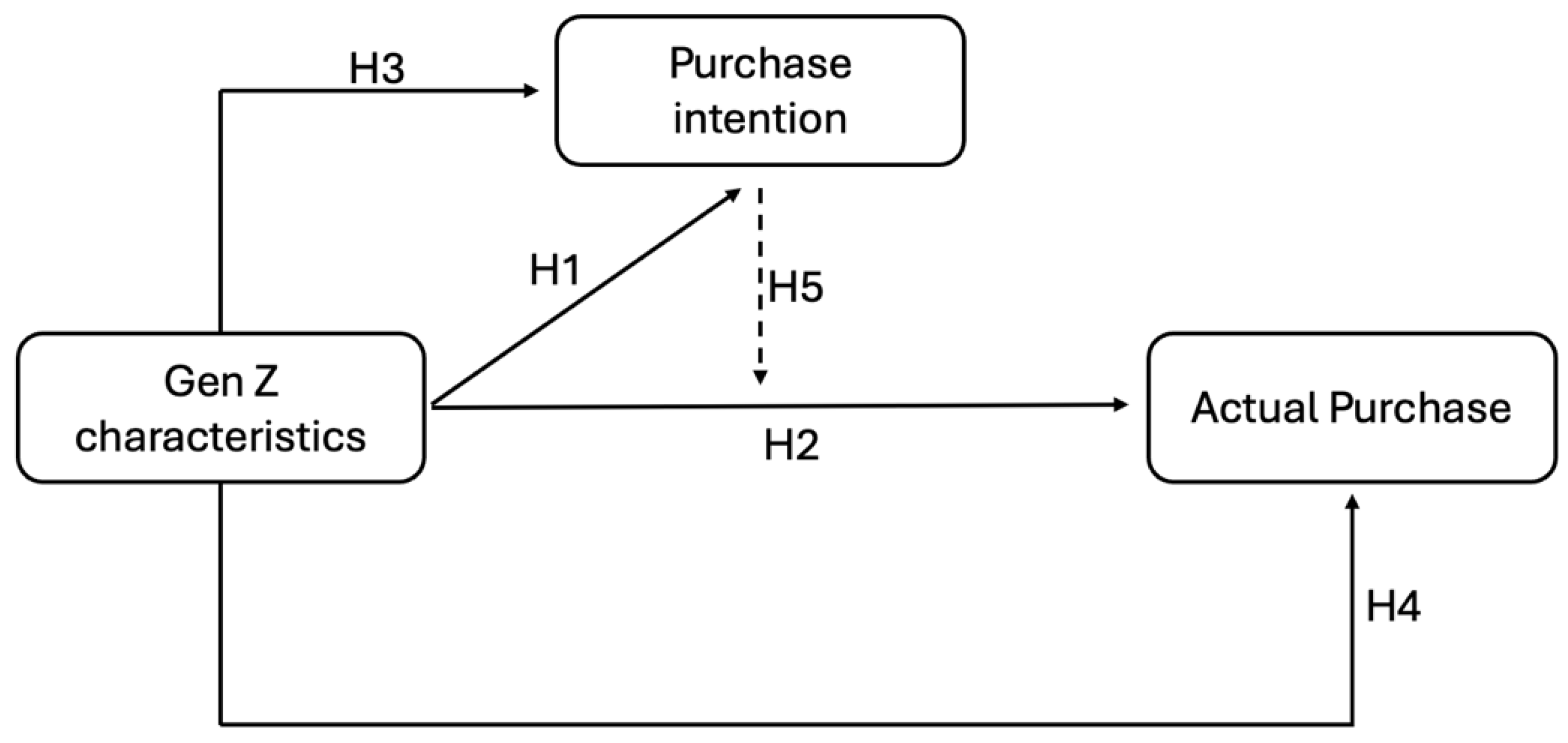
Figure 2.
Moderation of the Relationship between Gen Z characteristics and Actual Purchase by Purchase Intention.
Figure 2.
Moderation of the Relationship between Gen Z characteristics and Actual Purchase by Purchase Intention.
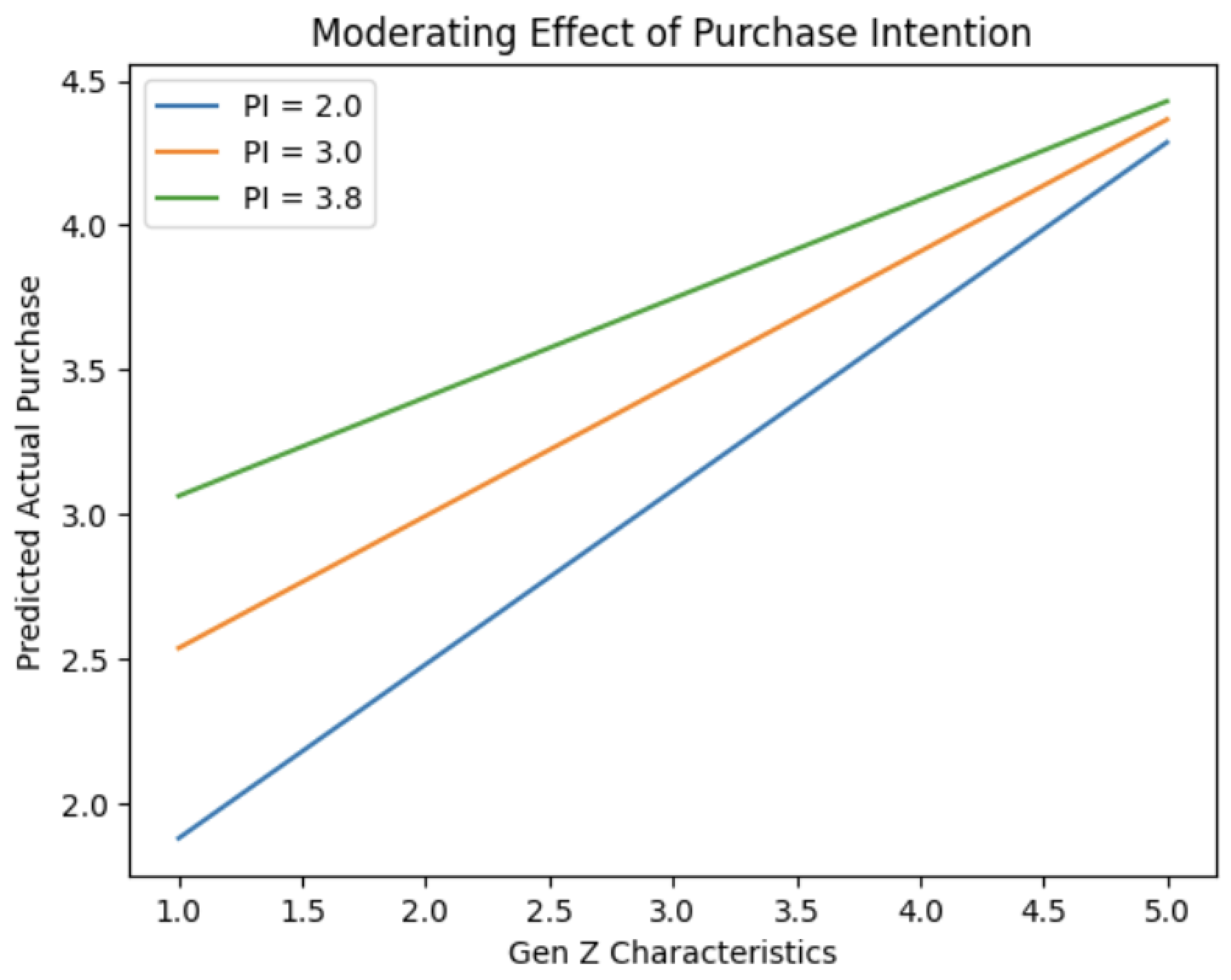

Table 1.
KMO and Bartlett's Test for Gen Z characteristics.
| KMO and Bartlett's Test | ||
|---|---|---|
| Kaiser-Meyer-Olkin Measure of Sampling Adequacy. | .728 | |
| Bartlett's Test of Sphericity | Approx. Chi-Square | 2714.382 |
| df | 253 | |
| Sig. | .000 | |
| Factors extracted | 7 | |
| Variance Explained Factor 1 | % | 13.104 |
| Variance Explained Factor 2 | % | 11.892 |
| Variance Explained Factor 3 | % | 10.447 |
| Variance Explained Factor 4 | % | 9.216 |
| Variance Explained Factor 5 | % | 8.763 |
| Variance Explained Factor 6 | % | 7.681 |
| Variance Explained Factor 7 | % | 6.092 |
| Total Variance Explained | % | 67.195 |
Table 2.
Communalities and component matrix for Gen Z characteristics.
| Communalities | Rotated Component Matrix | ||||||||
|---|---|---|---|---|---|---|---|---|---|
| Initial | Extraction | Comp. 1 | Comp. 2 | Comp. 3 | Comp. 4 | Comp. 5 | Comp. 6 | Comp. 7 | |
| Item 1 | 1.000 | .784 | .863 | ||||||
| Item 2 | 1.000 | .732 | .833 | ||||||
| Item 3 | 1.000 | .753 | .844 | ||||||
| Item 4 | 1.000 | .662 | .786 | ||||||
| Item 5 | 1.000 | .734 | .837 | ||||||
| Item 6 | 1.000 | .686 | .805 | ||||||
| Item 7 | 1.000 | .605 | .736 | ||||||
| Item 8 | 1.000 | .615 | .724 | ||||||
| Item 9 | 1.000 | .701 | .708 | ||||||
| Item 10 | 1.000 | .703 | .563 | ||||||
| Item 11 | 1.000 | .654 | .782 | ||||||
| Item 12 | 1.000 | .712 | .765 | ||||||
| Item 13 | 1.000 | .502 | .525 | ||||||
| Item 14 | 1.000 | .723 | .808 | ||||||
| Item 15 | 1.000 | .706 | .804 | ||||||
| Item 16 | 1.000 | .524 | .440 | ||||||
| Item 17 | 1.000 | .547 | .521 | ||||||
| Item 18 | 1.000 | .575 | .703 | ||||||
| Extraction Method: Principal Component Analysis. | |||||||||
Table 3.
Reliability Analysis.
| Scale | Cronbach’s Alpha | Items |
|---|---|---|
| Online reviews impact | .732 | 2 |
| Influencers impact | .611 | 3 |
| Online buzz impact | .707 | 2 |
| Visual elements impact | .754 | 3 |
| Environmental responsibility impact | .595 | 3 |
| Product price impact | .934 | 2 |
| Brand community impact | .919 | 3 |
| Purchase intention | .801 | 5 |
| Actual purchase | .827 | 4 |
Table 4.
Demographic characteristics.
| Variable | Categories | Percentage |
|---|---|---|
| Gender | Male | 47.7 |
| Female | 52.3 | |
| Educational level | High school | 0.7 |
| University student | 85.4 | |
| Bachelor’s degree | 11.2 | |
| Masters’ degree | 2.7 | |
| Family income | <10.000 euros | 19.2 |
| 10-20.000 euros | 41.7 | |
| >20.000 euros | 39.1 | |
| Age | Mean | SD |
| 20.52 | 2.350 |
Table 5.
Constructs’ mean scores.
| Variables | M | SD |
|---|---|---|
| Online reviews impact | 3.92 | 1.008 |
| Influencers impact | 2.68 | 1.137 |
| Online buzz impact | 3.26 | .962 |
| Visual elements impact | 3.40 | .992 |
| Environmental responsibility impact | 3.19 | 1.087 |
| Product price impact | 3.85 | .932 |
| Brand community impact | 3.21 | 1.152 |
| Overall Gen Z characteristics | 3.36 | .660 |
| Purchase intention | 3.00 | .888 |
| Actual purchase | 3.59 | .854 |
Table 6.
Relationship of Gen Z characteristics with Purchase intention and Actual purchase.
| Purchase intention | Actual purchase | |||
|---|---|---|---|---|
| Online reviews impact | .125* | .328** | ||
| Influencers impact | .205** | .079 | ||
| Online buzz impact | .222** | .380** | ||
| Visual elements impact | .195** | .435** | ||
| Environmental responsibility impact | .259** | .316** | ||
| Product price impact | -.010 | .276** | ||
| Brand community impact | .387** | .354** | ||
*. Correlation is significant at the 0.05 level (2-tailed), **. Correlation is significant at the 0.01 level (2-tailed).
Table 7.
Model Summary for the prediction of Purchase intention and Actual purchase.
| Dependent Variable | R | R2 | Adjusted R2 | SE |
|---|---|---|---|---|
| Purchase Intention | .568 | .323 | .307 | .741 |
| Actual Purchase | .500 | .250 | .233 | .748 |
Table 8.
ANOVA for the prediction of Purchase intention and Actual purchase.
| Dependent Variable | SS Regression | df | MS Regression | F | p |
|---|---|---|---|---|---|
| Purchase Intention | 68.214 | 7 | 9.745 | 19.982 | <.001 |
| Actual Purchase | 55.008 | 7 | 7.858 | 14.035 | <.001 |
Table 9.
Coefficient summary for the prediction of Purchase intention and Actual purchase.
| Predictor | Purchase Intention (β) | p | Actual Purchase (β) | p |
|---|---|---|---|---|
| Online reviews impact | .071 | .197 | .148 | .013 |
| Influencers impact | .119 | .041 | -.092 | .098 |
| Online buzz impact | .167 | .012 | .153 | .023 |
| Visual elements impact | .142 | .028 | .201 | .002 |
| Environmental responsibility impact | .213 | .001 | .097 | .115 |
| Product price impact | -.024 | .668 | .029 | .598 |
| Brand community impact | .281 | <.001 | .110 | .075 |
Table 10.
Moderation of the Relationship between Gen Z characteristics and Actual Purchase by Purchase Intention.
Table 10.
Moderation of the Relationship between Gen Z characteristics and Actual Purchase by Purchase Intention.
| Predictor | B | SE | t | p | 95%CI |
|---|---|---|---|---|---|
| Constant | -0.33 | 0.61 | -0.54 | .593 | [-1.52, 0.87] |
| Gen Z Characteristics (GZC) | 0.89 | 0.18 | 5.02 | <.001 | [0.54, 1.24] |
| Purchase Intention (PI) | 0.80 | 0.20 | 4.08 | <.001 | [0.42, 1.19] |
| GZC x PI | -0.15 | 0.05 | -2.65 | .009 | [-0.25, -0.04] |
| Model Summary | |||||
| R = .56 | |||||
| R2 = .31 | |||||
| F(3,298) = 44.24, p < .001 | |||||
| ΔR2 (interaction) = .02 | |||||
Table 11.
Conditional effects of Gen Z characteristics on Actual purchase.
| Purchase Intention Level | B | SE | t | p | 95% CI |
|---|---|---|---|---|---|
| Low (2.00) | 0.60 | 0.09 | 6.99 | < .001 | [0.43, 0.77] |
| Medium (3.00) | 0.46 | 0.07 | 6.93 | < .001 | [0.33, 0.59] |
| High (3.80) | 0.08 | 0.08 | 4.33 | < .001 | [0.19, 0.50] |
Disclaimer/Publisher’s Note: The statements, opinions and data contained in all publications are solely those of the individual author(s) and contributor(s) and not of MDPI and/or the editor(s). MDPI and/or the editor(s) disclaim responsibility for any injury to people or property resulting from any ideas, methods, instructions or products referred to in the content. |
© 2026 by the authors. Licensee MDPI, Basel, Switzerland. This article is an open access article distributed under the terms and conditions of the Creative Commons Attribution (CC BY) license (http://creativecommons.org/licenses/by/4.0/).
Copyright: This open access article is published under a Creative Commons CC BY 4.0 license, which permit the free download, distribution, and reuse, provided that the author and preprint are cited in any reuse.


