
Submitted:
24 April 2026
Posted:
27 April 2026
You are already at the latest version
Abstract
Introduction: Systemic inflammation is a key contributor to the pathophysiology of carotid plaque burden (CpB). Increasing evidence supports a link between periodontitis and systemic conditions, including endothelial dysfunction, and CpB. This study aimed to explore the relationship between periodontal status, inflammatory biomarkers, and CpB, as well as the potential impact of periodontal therapy. Methods: A pilot study was conducted on subjects presenting with both periodontitis and CpB. Of 87 initially screened participants, 10 met the inclusion criteria and completed the study. Periodontal parameters—probing pocket depth (PPD), clinical attachment loss (CAL), and bleeding on probing (BOP)—were recorded. Systemic inflammatory biomarkers, including matrix metalloproteinase-8 (MMP-8), myeloperoxidase (MPO), lipoprotein-associated phospholipase A2 (Lp-PLA2), and soluble CD40 ligand (sCD40L), were analyzed. Results: Participants demonstrated severe periodontal disease, with mean PPD of 5.5 mm (maximum 8 mm), mean CAL of 6.46 mm (maximum 12 mm), and BOP of 67%. High serum Lp-PLA2 levels were associated with increased periodontal tissue destruction and inflammatory burden, supporting its role in both periodontitis and CpB pathophysiology. MMP-8 and MPO showed positive correlations with periodontal parameters, although these did not consistently reach statistical significance. Following periodontal therapy, a significant reduction in MMP-8 and Lp-PLA2 levels was observed, while MPO and sCD40L exhibited a decreasing trend without statistical significance. Conclusion: Inflammatory biomarkers may represent important mechanistic links between periodontitis and carotid artery disease. Within the limitations of this pilot study, non-surgical periodontal therapy was associated with reductions in selected systemic inflammatory biomarkers, supporting the feasibility of investigating the periodontitis–carotid plaque axis in larger translational cohorts. Larger studies are needed to validate these findings.
Keywords:
periodontitis
; inflammatory biomarkers
; cardiovascular risk
; carotid artery disease
; systemic inflammation
1. Introduction
Carotid artery stenosis is a well-recognized risk factor for ischemic stroke, accounting for approximately 10–20% of strokes and transient ischemic attacks [1]. The visualization and quantification of subclinical atherosclerosis using noninvasive vascular imaging are playing an increasingly important role in cardiovascular risk assessment. There are studies showing that subclinical atherosclerosis burden, including carotid plaque burden (CpB) in asymptomatic individuals was independently associated with all-cause mortality, and disease progression was likewise independently predictive of mortality risk [2]. So, atherosclerosis is a chronic, degenerative disorder affecting large- and medium-sized arteries. It is characterized anatomically by the formation of lipid-rich, fibrocellular lesions—composed of viable cells and extracellular matrix (ECM) components—that disrupt the normal histological architecture of the intima and encroach upon the vascular lumen. These lesions are commonly known as atheromas or atherosclerotic plaques [3]. Even though, the atherosclerotic process begins early in life; however, it is influenced by a complex interplay of intrinsic and extrinsic factors that modulate its initiation and progression. Thrombosis secondary to plaque rupture or superficial erosion represents a major complication of atherosclerosis and may lead to sudden luminal occlusion, resulting in acute ischemic syndromes. Infectious agents may also contribute to the inflammatory response, thereby promoting lesion destabilization [4]. Systemic inflammation plays a significant role in the pathophysiology of CpB and can be evaluated using several inflammatory biomarkers, which may be linked to a higher risk of complications and increased mortality in patients with CpB [5].
On the other hand, periodontitis is a complex, multifactorial inflammatory condition that arises in response to periodontal pathogens, leading to the progressive destruction of the supporting structures of the teeth. If left untreated, this process can ultimately result in tooth loss [6]. Increasing evidence from recent studies has demonstrated a significant association between periodontitis and various systemic disorders, including diabetes mellitus, endothelial dysfunction, and carotid artery stenosis (CS) [2,4,7].
CS is characterized by the accumulation of atherosclerotic plaque within the carotid artery, leading to a broad spectrum of clinical manifestations, including blurred vision and confusion or paralysis secondary to ischemic stroke. The condition often has an insidious course, with symptoms typically becoming evident only in advanced stages of stenosis, underscoring the importance of early diagnosis, timely intervention, and appropriate lifestyle modification.
The pathogenesis of CS mirrors that of atherosclerosis in general, beginning with endothelial injury of the arterial lumen and progressing to the development of a fibrous cap overlying a lipid-rich necrotic core composed of foam cells. Over the last years, numerous shared biological mediators have been identified as key contributors to the pathogenesis of both periodontitis and CS. These include the secretion and release of toxic metabolites [11,12], along with proinflammatory cytokines such as interleukins (ILs) and matrix metalloproteinases (MMPs) [13,14].
Periodontitis and CpB have been shown to share common etiopathogenetic mechanisms. Several studies have sought to establish correlations between the presence of oral bacteria within atherothrombotic tissues and their detection in subgingival plaque or serum samples from the same individuals. These investigations suggest that patients with periodontitis exhibit an increased risk of CS [15,16]. The proposed pathophysiological mechanisms underlying this association involve transient bacteremia and subsequent systemic inflammatory responses, characterized by elevated levels of C-reactive protein and enhanced oxidative stress [16].
Evidence indicates that both periodontitis and CpB are characterized by a marked increase, at local (oral) and systemic levels, in a range of inflammatory mediators: C-reactive protein (CRP), prostaglandins, interleukins (IL-1, IL-6, IL-10), and various matrix metalloproteinases (MMPs), which are elevated in response to host immune activation triggered by specific periodontal pathogens [15,16,17,18]. Notably, several studies have demonstrated that MMP expression is significantly upregulated in periodontitis compared to gingivitis or periodontal health, suggesting that dysregulated MMP activity contributes to the accelerated destruction of periodontal tissues [19,20]. Moreover, among matrix metalloproteinases, MMP-9 has been widely recognized as a key mediator of inflammatory progression in both periodontitis [17] and CpB [21,22]. It is primarily released by activated macrophages in response to pathogenic stimuli and serves as a subclinical marker of vascular homeostasis [23]. MMP-9 modulates several proinflammatory mediators, including IL-1, IL-6, IL-8, and prostaglandins [24,25], and its elevated expression has been correlated with active periodontal tissue destruction [25,26]. Increased MMP-9 levels in gingival crevicular fluid (GCF) have been linked to early periodontitis [27,28], suggesting a role in neoangiogenesis during host–pathogen interactions [29]. Furthermore, MMP-9, in concert with C-reactive protein (CRP), may suppress nitric oxide (NO) bioavailability, potentially impairing endothelial function and increasing CVD risk [30]. Matrix metalloproteinase-8 (MMP-8), together with myeloperoxidase (MPO), lipoprotein-associated phospholipase A2 (Lp-PLA2), and soluble CD40 ligand (sCD40L)—play distinct but complementary roles in the pathophysiology of atherosclerosis and plaque instability [31,32,33]. MMP-8, a collagen-degrading enzyme, contributes to extracellular matrix breakdown and weakening of the fibrous cap, thereby promoting plaque vulnerability [31]. MPO, released by activated neutrophils and monocytes, generates reactive oxygen species and enhances oxidative stress, leading to endothelial dysfunction and lipid oxidation [34].
Lp-PLA2, primarily associated with low-density lipoproteins, hydrolyzes oxidized phospholipids and produces pro-inflammatory mediators that further drive vascular inflammation and plaque progression [33].
sCD40L, expressed by activated platelets and immune cells, mediates inflammatory signaling and promotes thrombogenic activity, linking inflammation with thrombus formation. There is evidence that indicates that elevated levels of sCD40L are independently associated with increased cardiovascular risk in patients with asymptomatic low-grade CS [35].
Together, these markers reflect key mechanisms underlying atherosclerotic disease, including inflammation, oxidative stress, matrix degradation, and thrombosis, making them valuable indicators of cardiovascular risk and plaque instability. These findings underscore the growing interest in identifying early biomarkers to assess subclinical susceptibility to both periodontitis and CVD. Advances in understanding the pathophysiology of CpB are opening new avenues for prevention and treatment. In particular, recognition of the central role of inflammation has highlighted the potential for therapeutic strategies aimed at selectively inhibiting the inflammatory cascade within the vessel wall. Targeting inflammatory triggers may contribute to improved clinical outcomes in patients with CpB.
Therefore, based on this evidence, this study aimed to evaluate the serum levels of MMP8, MPO, Lp-PLA2, sCD40L in patients with periodontitis and CpB. The primary aim of this pilot study was to explore whether non-surgical periodontal therapy is associated with short-term changes in circulating inflammatory mediators implicated in both periodontitis and carotid plaque biology. A secondary aim was to examine the direction and strength of associations between baseline biomarker levels and periodontal clinical parameters.
2. Materials and Methods
To ensure a homogeneous sample and minimize potential confounding factors related to age and sex, the participants were aged 35–65 years. Data were collected for all participants, including demographic characteristics such as sex, age, and educational level. Clinical and lifestyle-related variables were also recorded, including body mass index (BMI), medication use, and the presence of systemic comorbidities.
The overall health status was assessed using complementary imaging investigations, including carotid Doppler ultrasonography or carotid CT angiography, followed by venous blood sampling for laboratory analyses, all performed at the “Niculae Stăncioiu” Heart Institute in Cluj-Napoca. The study group included patients who underwent ultrasonographic evaluation of the supra-aortic trunks at the Heart Institute during September- November 2024.
Subsequently, participants underwent a periodontal examination at the Picos Dental Clinic (16 Avram Iancu Street, Cluj-Napoca). Periodontal parameters were recorded at six sites per tooth, and two indices — the Oral Hygiene Index and the Bleeding Index — were calculated. These procedures were non-invasive and minimally-invasive.
The periodontal treatment consisted of three phases: non-surgical periodontal therapy, involving subgingival instrumentation; carious lesions treatment and infection control; re-evaluation, during which all periodontal indices and measurements were reassessed. At three months post-treatment, a follow-up examination was performed, and venous blood samples were collected again to determine the concentrations of proinflammatory mediators.
Inclusion and Exclusion Criteria
For patients with periodontitis [6], inclusion criteria were:
- Presence of ≥16 natural teeth;
- Interdental clinical attachment loss (CAL) of ≥ 2 non-adjacent teeth.
- Buccal or oral CAL ≥ 3 mm with pocketing ≥ 3 mm, detectable at ≥ 2 teeth.
At least one site exhibiting ≥2 mm crestal bone loss confirmed radiographically using periapical technique [6].
Among patients with CpB, eligibility required an age of ≥18 years, no prior history of cardiovascular disease (myocardial infarction, stroke, angina, heart failure, or arterial revascularization), no ongoing cancer treatment, and no conditions limiting long-term participation.
Exclusion criteria included: (1) severe allergies; (2) antibiotic, anti-inflammatory, or immunosuppressive therapy within 3 months prior to enrollment; (3) alcohol consumption; (4) use of contraceptives; (5) pregnancy or lactation; (6) medications inducing gingival hypertrophy or hyperplasia; (7) periodontal treatment within 3 months before the study.
Carotid Plaque Burden Assessment
CpB was assessed at baseline using a high-resolution, 2-dimensional 9L-D linear array transducer using a Vivid E95 ultrasound system (GE HealthCare), with scanning in longitudinal and cross-sectional orientations from the proximal common carotid artery to the distal internal carotid artery on each side. On carotid ultrasound, an atherosclerotic plaque was defined as a focal thickening of the vessel wall, typically measuring > 1.5 mm from the intima-lumen interface to the media-adventitia interface, or a thickening that was 50% greater than the surrounding intima-media thickness (IMT). Plaques were classified by their ultrasound appearance—soft/hypoechoic (fat-rich, unstable) or hard/hyperechoic (calcified, stable).
At the initial visit, medical and dental data were obtained, including cardiovascular diagnostic evaluations (e.g., electrocardiography and carotid ultrasound), as well as venous blood samples. Individuals with both periodontitis and CpB fulfilled the inclusion criteria for both groups.
Of 87 initially screened participants, 22 were excluded for not meeting inclusion criteria, 29 declined participation, 24 did not attend the baseline visit and 2 did not attend the reevaluation visit. Ultimately, 10 subjects were included: 2 with periodontitis, 1 with CpB, and 7 with both periodontitis and CpB – Figure 1.
2.1. Laboratory Analyses
Fasting antecubital venous blood samples were collected in the morning prior to the procedure. Serum and plasma were separated by centrifugation at 3.000g for 10 minutes and stored at −80°C until analysis. The concentrations of MMP-8, MPO, Lp-PLA2, and sCD40L were determined using commercially available enzyme-linked immunosorbent assay (ELISA) kits, according to the manufacturers’ instructions. The lower limits of detection were as follows: MMP-8, 0.10 ng/mL; MPO, 0.028 ng/mL; Lp-PLA2, 0.19 ng/mL; and sCD40L, 0.0375 ng/mL. All measurements were performed in duplicate, and the mean values were used for statistical analysis. Intra- and interassay coefficients of variation were all under 10%.
2.2. Assessment of Traditional Cardiovascular Risk Factors
In addition, major cardiovascular risk factors were systematically assessed – Table 1. Cardiovascular risk factors were assessed through a combination of patient interviews, medical record review, physical examination, and laboratory measurements. Hypertension was defined as a history of antihypertensive treatment or repeated blood pressure measurements ≥140/90 mmHg. Diabetes mellitus was defined as a prior diagnosis, use of antidiabetic medication, or fasting plasma glucose ≥126 mg/dL. Dyslipidemia was defined as total cholesterol ≥200 mg/dL, low-density lipoprotein cholesterol (LDL-C) ≥130 mg/dL, triglycerides ≥150 mg/dL, high-density lipoprotein cholesterol (HDL-C) <40 mg/dL in men or <50 mg/dL in women, or current lipid-lowering therapy. Smoking status was categorized as current, former, or never smoker. Obesity was defined as a body mass index (BMI) ≥30 kg/m², according to standard guidelines.
2.3. Periodontal Charting
Comprehensive periodontal charting was performed for each patient, including measurements of clinical attachment loss (CAL), probing depth (PD), bleeding on probing (BOP), and plaque index (PI) [36]. CAL was determined using the cementoenamel junction as a reference point and calculated as the sum of PD and gingival recession. All periodontal parameters were recorded at six sites per tooth for all teeth present in the dental arch. All parameters were recorded by two independent calibrated examiners (principal and control examiner) using a periodontal probe (UNC-15, Hu-Friedy, Chicago, IL, USA). The gingival bleeding index (GBI) was calculated as the percentage of sites showing bleeding upon gentle probing out of the total number of sites examined.
2.4. Statistical Analysis
All statistical analysis was carried out using RStudio Desktop (RStudio©, PBC RStudio v2026.01.0+392, Boston, MA, USA). Prior to comparative analysis, the distribution of quantitative variables was assessed using the Shapiro-Wilk test for normality.
For variables that followed a normal distribution, paired Student’s t-test was applied to compare pre- and post-intervention values. When the data did not follow a normal distribution, the Wilcoxon signed-rank test was used instead of the paired Student’s t-test. The Spearman correlation coefficient and its corresponding p-value were used to assess the correlation between non-normally distributed quantitative variables. For all statistical tests, the two-tailed p-value was reported, and a 0.05 value was considered as the level of statistical significance.
All qualitative variables were excluded from the analysis prior to testing.
3. Results
All patients enrolled in this study were diagnosed with periodontitis, categorized into stage II as well as stage III/IV, indicating the absence of any other periodontal conditions, with the objective of characterizing both clinical periodontal parameters and inflammatory biomarkers. Continuous variables are reported using mean values, standard deviations, and minimum–maximum ranges.
Clinical periodontal assessment confirmed the presence of moderate to severe periodontal disease within the study group: Probing Depth (PPD) demonstrated a mean value of approximately 5.5 mm, with maximum values reaching 8 mm, consistent with pathological periodontal pocket formation; Clinical Attachment Loss (CAL) showed a mean of 6.46 mm, with values extending up to 12 mm, indicating substantial loss of periodontal support structures; Bleeding on Probing (BOP) presented a mean value of 0.67 (67%), reflecting widespread gingival inflammation and active disease in the majority of patients. Table 2 summarizes the clinical periodontal characteristics of the study population. Mean probing pocket depth and clinical attachment loss values indicate moderate to severe periodontal destruction. The high mean percentage of bleeding on probing reflects persistent gingival inflammation in most patients.
Table 2 summarizes the clinical periodontal characteristics of the study population. Mean probing pocket depth and clinical attachment loss values indicate moderate to severe periodontal destruction. The high mean percentage of bleeding on probing reflects persistent gingival inflammation in most patients.
The analysis of inflammatory biomarkers revealed considerable interindividual variability, reflecting differences in disease activity among patients. MMP-8 showed a mean value of 25.64 in initial samples (I) and approximately 31.9 in reevaluation samples (D). MPO presented a mean concentration of 57.58, with values ranging up to 197. Lp-PLA2 exhibited elevated mean values, supporting the involvement of inflammatory and immune-mediated mechanisms in the pathophysiology of periodontitis and CpB. sCD40L was available for a smaller number of cases.
Figure 2.
Systemic inflammatory biomarker levels before and after periodontal therapy are presented as mean ± standard deviation.
Figure 2.
Systemic inflammatory biomarker levels before and after periodontal therapy are presented as mean ± standard deviation.
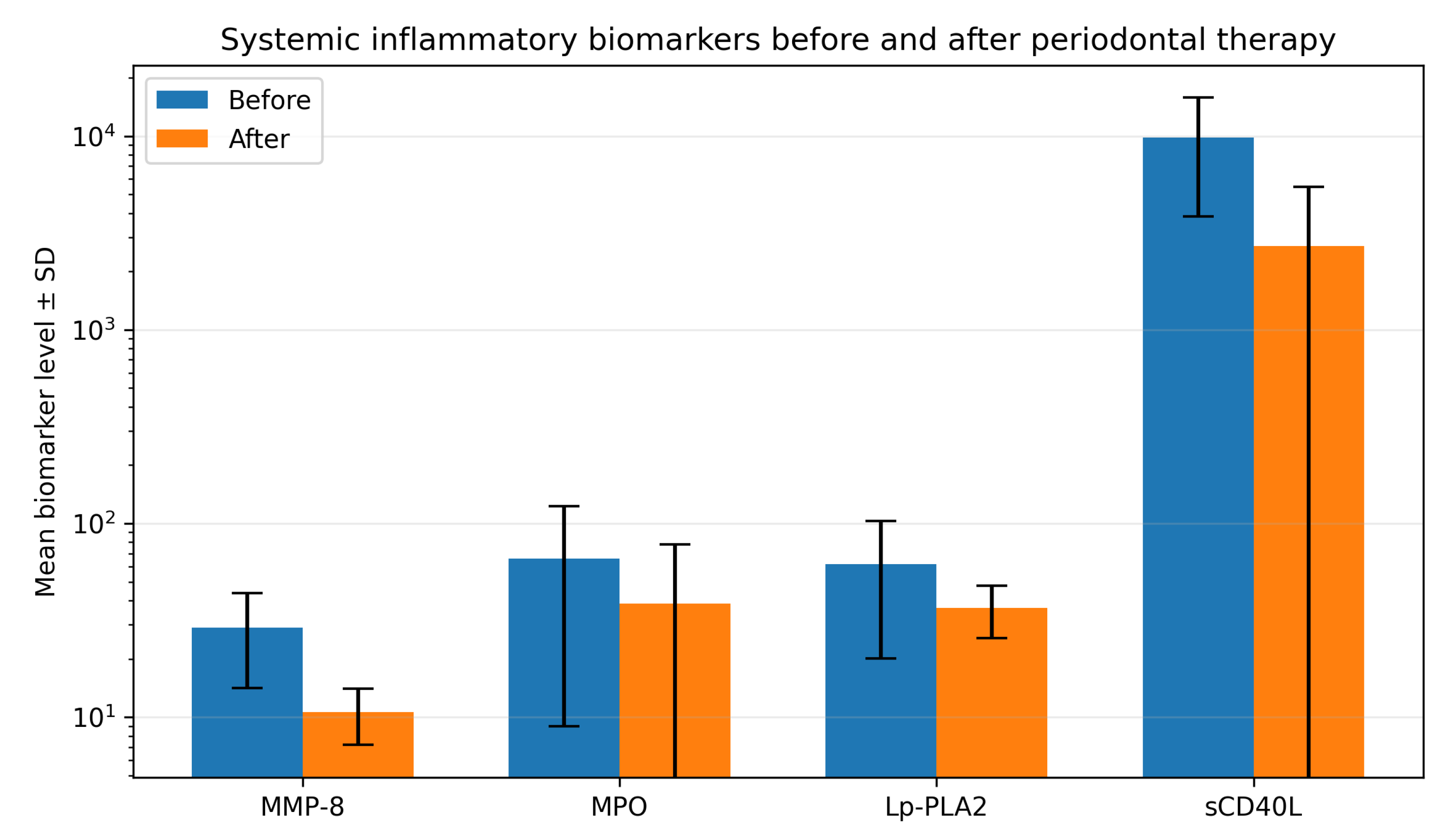
As shown in Table 3, inflammatory biomarkers exhibited wide ranges and elevated mean values, indicating marked interindividual variability. Increased MMP-8 and MPO levels suggest active collagen degradation and neutrophil-mediated inflammation, respectively. Lp-PLA2 and sCD40L values further support the presence of a systemic inflammatory response in patients with periodontitis and CpB.
The results of the paired statistical analysis comparing inflammatory biomarker levels before and after the intervention are presented, using either the paired Student’s t-test or the Wilcoxon signed-rank test, depending on the data distribution.
As shown in Table 4, a statistically significant decrease was observed for MMP-8 levels after the intervention (p = 0.010). The mean value decreased from 25.64 at baseline to 10.6 after treatment. This finding suggests that the intervention was effective in reducing periodontal tissue-destructive processes mediated by MMP-8.
Similarly, Lp-PLA2 levels showed a statistically significant reduction following treatment (p = 0.0195), with values decreasing from 46.8 to 35.3. This result reflects a decrease in inflammatory mediator activity and supports the effectiveness of the intervention in modulating inflammatory pathways involved in periodontitis.
In contrast, although MPO levels decreased numerically from 45.5 to 23.5, this change did not reach statistical significance (p = 0.097). Likewise, sCD40L levels showed a reduction from 9538 to 1642, but the difference was not statistically significant (p = 0.156). These findings suggest a trend toward reduced inflammatory and platelet activation activity; however, the observed changes were insufficient to demonstrate a statistically significant effect within the studied sample size.
In summary, Table 4 demonstrates a statistically significant post-treatment reduction in MMP-8 and Lp-PLA2 levels, while MPO and sCD40L showed non-significant decreasing trends.
Spearman correlation analysis was performed to evaluate the relationship between baseline circulating inflammatory biomarkers and clinical periodontal parameters. Overall, limited associations were observed between systemic inflammatory marker concentrations and measures of periodontal disease severity.
Baseline MMP-8 levels showed no significant correlations with probing pocket depth, clinical attachment loss or bleeding on probing. Similarly, circulating MPO concentrations were not significantly associated with periodontal parameters, although a moderate positive trend was noted between MPO and clinical attachment loss.
Baseline Lp-PLA2 concentrations also failed to demonstrate significant relationships with periodontal clinical parameters, suggesting that systemic vascular inflammatory activity reflected by this biomarker does not directly parallel local periodontal tissue destruction.
In contrast, a significant inverse correlation was identified between baseline sCD40L levels and probing pocket depth, indicating that higher circulating sCD40L concentrations were associated with lower periodontal pocket depth values. A negative trend was also observed between sCD40L and bleeding on probing, although this did not reach statistical significance.

Table 5.
Values represent Spearman correlation coefficients (ρ) with corresponding p-values; statistical significance was set at p < 0.05.
Table 5.
Values represent Spearman correlation coefficients (ρ) with corresponding p-values; statistical significance was set at p < 0.05.
| PPD | CAL | BOP | |
| MMP-8 | −0.08 (0.825) | −0.14 (0.696) | −0.29 (0.413) |
| MPO | −0.15 (0.650) | 0.39 (0.205) | −0.27 (0.402) |
| Lp-PLA2 | 0.06 (0.841) | 0.13 (0.676) | −0.20 (0.504) |
| sCD40L | −0.77 (0.015) | 0.09 (0.828) | −0.61 (0.081) |
These findings suggest that most systemic inflammatory biomarkers evaluated in this study were not strongly related to the clinical severity of periodontal disease at baseline. However, a strong negative correlation was observed between sCD40L and probing pocket depth (PPD) (ρ = −0.77, p = 0.015), indicating that higher sCD40L levels were associated with lower PPD values. Additionally, sCD40L showed a strong negative, although not statistically significant, correlation with bleeding on probing (BOP) (ρ = −0.61, p = 0.081). No other significant correlations were identified.
4. Discussion
Emerging evidence highlights a significant link between periodontitis and an increased risk of cardiovascular events, including carotid atherosclerosis [36]. Experimental studies further support this association; in atherosclerotic mouse models, periodontal inflammation is more severe and accompanied by distinct alterations in lipid profiles, suggesting a mechanistic interplay between systemic lipid metabolism and periodontal pathology [36].
Despite these findings, there remains a substantial unmet need for effective strategies for early detection and risk stratification in this high-risk population. In this context, the identification of shared inflammatory pathways may provide valuable insights into the biological mechanisms linking periodontal disease and CpB. Therefore, the present study investigated the potential inflammatory links between periodontal disease and CpB in patients without a history of major cardiovascular disease. Previous research has established associations between oral disease and coronary heart disease, coronary events, and stroke; however, the present investigation appears to be among the first specifically designed to characterize multiple inflammatory pathways connecting periodontal disease with subclinical carotid atherosclerosis. Furthermore, to the best of our knowledge, no studies to date have examined the role of the biomarkers investigated in this study in the pathophysiological link between periodontitis and carotid artery disease.
4.1. Carotid Artery Anatomy and Plaque Burden (CpB)
The common carotid arteries are paired vessels supplying the head and neck. The right common carotid artery arises from the brachiocephalic trunk, while the left originates directly from the aortic arch. Both ascend within the carotid sheath in the neck, where they lie medial to the internal jugular vein and anterior to the vagus nerve. Each common carotid artery bifurcates into the external carotid artery, which supplies the face and neck, and the internal carotid artery, which supplies the brain and contributes to the circle of Willis. At the bifurcation, the carotid sinus contains baroreceptors that regulate blood pressure, while the carotid body functions as a chemoreceptor involved in respiratory control.
While the degree of carotid stenosis remains a key determinant in guiding the optimal management of carotid artery disease, plaque characteristics also play a crucial role in risk stratification and therapeutic decision-making [37]. There is substantial scientific evidence indicating that various inflammatory biomarkers influence the composition of carotid atherosclerotic plaques, leading to increased plaque vulnerability and a higher risk of embolic events [38]. Among these markers, hsCRP, IL-6, osteopontin, Lp-PLA2, sCD40L and MMP have been investigated in relation to carotid plaque processes resulting in plaque rupture [38,39]. Accordingly, growing recognition of novel inflammatory biomarkers associated with CpB may contribute significantly to the diagnosis and prognosis of symptomatic CS, underscoring the need for further investigation in clinical and translational research.
4.2. Imaging Approaches to Carotid Plaque Morphology in Relation to Inflammatory Biomarkers
In recent years, advanced imaging techniques—including ultrasound, magnetic resonance imaging (MRI), and positron emission tomography (PET)—have been increasingly integrated into clinical practice to enable detailed plaque characterization. Carotid ultrasonography is a cost-effective method for evaluating plaque morphology and characteristics; however, compared with MRI, it has lower sensitivity and specificity for detecting lipid-rich necrotic core, intraplaque hemorrhage, and plaque ulceration [1].
Also, molecular imaging has demonstrated a significant correlation with carotid plaque inflammation. Positron emission tomography (PET) using ^18F-fluoro-2-deoxy-D-glucose (^18F-FDG) and ^18F-fluorocholine is central to this approach, as these tracers reflect the extent of macrophage infiltration within atherosclerotic plaques [38]. Patients with symptomatic CS exhibit increased tracer uptake, particularly in macrophage-rich regions, which are associated with carotid plaque vulnerability [38].
Bueno A. et al. showed in 2020 that symptomatic patients exhibit increased ^18F-FDG uptake in carotid plaques, accompanied by higher plasma Lp-PLA2 and hs-CRP levels, supporting the link between inflammatory activity and plaque instability. Notably, both PET/CT-derived ^18F-FDG uptake and circulating Lp-PLA2 were significantly associated with symptomatic plaque status. [40]. There is evidence suggesting that also MPO levels show a relationship with vessel wall 18F-FDG uptake [41]. In contrast, no significant association was observed between MMP-3 or MMP-9 levels and vessel wall ^18F-FDG uptake [41].
Advanced imaging modalities are increasingly used in clinical practice for risk stratification in patients with both low- and high-grade carotid artery stenosis. For instance, the identification of intraplaque hemorrhage on MRI in patients with low-grade carotid stenosis has been associated with a higher risk of failure of medical therapy, and evidence suggests that such patients may derive greater benefit from carotid endarterectomy [1]. MRI plaque imaging has proven useful in selecting appropriate candidates for revascularization. Moreover, both elevated serum hsCRP and MRI features of plaque vulnerability have been shown to independently predict recurrent stroke risk. Their combined assessment may improve risk stratification, facilitating more precise identification of high-risk individuals and guiding targeted preventive interventions [42].
4.3. Inflammatory Physiopathological Links Between Periodontal Disease and CpB
The prevalence of both periodontitis and carotid atherosclerosis is high; therefore, even relatively modest associations between them have significant public health implications. Atherosclerotic narrowing of the internal carotid artery accounts for approximately 8–15% of ischemic strokes in symptomatic individuals. In addition, asymptomatic carotid stenosis is present in about 1–2% of the adult population [43]. The societal costs associated with the consequences of CpB are substantial. Importantly, periodontitis is both treatable and preventable. Beck JD. et al showed in the ARIC study that individuals with severe periodontal disease were found to have 1.3 times higher odds of presenting with increased carotid arterial wall thickness (≥1 mm) compared with those with less severe periodontal disease, even after adjusting for traditional atherosclerotic risk factors [44]. However, there is recent research which has raised doubts about this association [45,46]. The observed inconsistency may result from differences in study design, definitions of periodontitis, outcomes examined, and residual confounding, particularly from smoking [47].
Emerging evidence suggests that periodontal disease, highly prevalent in adults, may represent a significant non-traditional risk factor contributing to the development of atherosclerotic cardiovascular disease, including coronary artery disease, carotid atherosclerosis, and stroke [48].
CpB has been already associated with elevated circulating inflammatory markers, contributing to oxidative stress within the vascular wall [38]. Atherosclerotic plaques act as active sources of cytokines, exerting both local and systemic pro-inflammatory effects that promote disease progression. These processes lead to plaque progression, resulting in vulnerable plaques [38].
There are studies showing that patients with CS have significantly higher levels of inflammatory markers, including hsCRP, soluble vascular cell adhesion molecule (sVCAM), and IL-6 compared to age- and sex-matched controls [49]. These findings support the role of inflammatory mediators as biomarkers of carotid stenosis, with hsCRP (16,31,32) and IL-6 (33) being the most extensively validated. There is strong evidence that IL-6 and hsCRP play a direct role in endothelial injury, plaque formation, and plaque destabilization leading to rupture [50].
Aligning with our results, high serum hsCRP levels are foud in patients with periodontitis and CpB [45]. Also, there are studies showing that plasma hsCRP levels show a strong association with plaque stability [51].
There is evidence suggesting that MMP-8 gene polymorphisms are associated with an increased risk of carotid atherosclerosis [52].
While periodontal treatment resulted in a significant reduction in circulating Lp-PLA2 levels, baseline concentrations were not significantly correlated with periodontal disease severity measures. This may indicate that Lp-PLA2 primarily reflects systemic vascular inflammation and metabolic status rather than the extent of local periodontal tissue breakdown. For other biomarkers, including MMP-8 and MPO, positive correlations with periodontal parameters were identified, although these did not consistently achieve statistical significance. Importantly, post-treatment analyses demonstrated a significant reduction in MMP-8 and Lp-PLA2 levels, while MPO and sCD40L showed a downward trend that did not reach statistical significance.
If the results of this study are confirmed by further experimental research, periodontitis could represent another common and preventable factor contributing to the burden of carotid atherosclerosis, thereby providing clinicians and public health professionals with an additional opportunity to help reduce the impact of cardiovascular atherosclerotic diseases.
5. Conclusions
Inflammatory biomarkers represent important pathophysiological links between periodontitis and carotid artery disease. The present study suggests that appropriately performed periodontal treatment is associated with a reduction in inflammatory markers known to be involved in the etiopathogenesis of carotid atherosclerosis, contributing to decreased systemic and local carotid inflammation, attenuation of plaque vulnerability, and a potential reduction in embolic event risk.
Although these findings are derived from a relatively small cohort and should be interpreted with caution, they provide valuable insights into a still incompletely understood area of research, with potentially significant socio-economic implications.
Author Contributions
AMH: Writing – review & editing, Writing – original draft, Visualization, Validation. AP: Visualization, Conceptualization, Writing – original draft, Validation. AD-P: Methodology, Visualization, Validation, Conceptualization, Writing – original draft. RT: Visualization, Resourses, Writing – original draft, Validation. HR– review & editing, Visualization, Validation. IT – Investigation (laboratory analyses), Formal analysis (statistical analysis). MP: Writing – original draft, Validation, Conceptualization, Supervision, Writing – review & editing.
Funding
The author(s) declared that financial support was not received for this work and/or its publication.
Institutional Review Board Statement
The study was conducted in accordance with the Declaration of Helsinki, and the protocol was approved by Medical Ethics Committee of Iuliu Hatieganu University of Medicine and Pharmacy (number 215 /13 September 2023), Cluj-Napoca.
Informed Consent Statement
Written informed consent was obtained from all participants prior to enrollment. Written informed consent has been obtained from the patients to publish this paper.
Data Availability Statement
The data presented in this study are available on request from the corresponding author due to the presence of personal data that are not relevant to the study.
Conflicts of Interest
The authors declared that this work was conducted in the absence of any commercial or financial relationships that could be construed as a potential conflict of interest.
Abbreviations
The following abbreviations are used in this manuscript:
| CpB | Carotid Plaque Burden |
| CVD | Cardiovascular disease |
| IL-1β | Interleukin-1 beta |
| IL-6 | Interleukin-6 |
| TNF-α | Tumor Necrosis Factor α |
| CRP | C-reactive Protein |
| PPD | Periodontal Pocket Depth |
| CAL | Clinical Attachment Loss |
| BOP | Bleeding on Probing |
| PD | Probing Depth |
| ELISA | Enzyme-Linked Immunosorbent Assay |
| MMP-8 | Matrix Metalloproteinase-8 |
| MMP-9 | Matrix Metalloproteinase-9 |
| MPO | Myeloperoxidase |
| Lp-PLA2 | Lipoprotein-Associated Phospholipase A2 |
| sCD40L | Soluble CD40 Ligand |
| ECM | Extracellular Matrix |
References
- Brinjikji, W.; Huston, J., 3rd; Rabinstein, A.A.; Kim, G.M.; Lerman, A.; Lanzino, G. Contemporary carotid imaging: from degree of stenosis to plaque vulnerability. J. Neurosurg. 2016, 124, 27–42. [Google Scholar] [CrossRef]
- Fuster, V.; García-Álvarez, A.; Devesa, A.; et al. Influence of Subclinical Atherosclerosis Burden and Progression on Mortality. JACC 2024, 84(15), 1391–1403. [Google Scholar] [CrossRef]
- Bentzon, J.F.; Otsuka, F.; Virmani, R.; Falk, E. Mechanisms of plaque formation and rupture. Circ. Res. 2014, 114, 1852–1866. [Google Scholar] [CrossRef] [PubMed]
- De Meyer, G.R.Y.; Zurek, M.; Puylaert, P.; Martinet, W. Programmed death of macrophages in atherosclerosis: mechanisms and therapeutic targets. Nat. Rev. Cardiol. 2024, 21, 312–325. [Google Scholar] [CrossRef] [PubMed]
- Scalise, E.; Costa, D.; Bolboacă, S.D.; Ielapi, N.; Bevacqua, E.; Cristodoro, L.; et al. The role of inflammation biomarkers in carotid artery stenosis procedures. Ann. Vasc. Surg. 2025, 110, 34–46. [Google Scholar] [CrossRef] [PubMed]
- Tonetti, M.S.; Greenwell, H.; Kornman, K.S. Staging and grading of periodontitis: Framework and proposal of a new classification and case definition. J. Periodontol. 2018, 89, S159–S172. [Google Scholar] [CrossRef] [PubMed]
- Ismail, A.; Ravipati, S.; Gonzalez-Hernandez, D.; Mahmood, H.; Imran, A.; Munoz, E.J.; et al. Carotid artery stenosis: diagnostic and management strategies and related complications. Cureus 2023, 15, e38794. [Google Scholar] [CrossRef] [PubMed]
- Widén, C.; Holmer, H.; Sättlin, S.; Renvert, S.; Lernmark, Å.; Persson, G.R. Periodontal conditions, retinopathy, and serum markers in individuals with type 1 diabetes. J. Periodontol. 2020, 91, 1436–1443. [Google Scholar] [CrossRef] [PubMed]
- Polizzi, A.; Santonocito, S.; Vaccaro, M.; Fichera, G.; Torrisi, S.; Ronsivalle, V.; et al. Relationship between periodontitis and psychosocial impact in patients with systemic sclerosis: a clinical study. Mediterr. J. Clin. Psychol. 2020, 8, 2. [Google Scholar]
- Bilgin Çetin, M.; Önder, C.; Orhan, K.; Kumbasar, D.; Serdar, M.A.; Ünsal, E. Relationship of periodontitis and edentulism to angiographically diagnosed coronary artery disease: a cross-sectional study. J. Periodontal Res. 2020, 55, 895–904. [Google Scholar] [CrossRef]
- Schmidt, J.; Strecker, P.; Kreuz, M.; Löffler, M.; Kiess, W.; Hirsch, C.; et al. Stress-related hormones in association with periodontal condition in adolescents—results of the epidemiologic LIFE Child study. Clin. Oral. Investig. 2018, 23, 1793–1802. [Google Scholar] [CrossRef]
- Holmlund, A.; Holm, G.; Lind, L. Number of Teeth as a Predictor of Cardiovascular Mortality in a Cohort of 7,674 Subjects Followed for 12 Years. J. Periodontol. 2010, 81, 870–876. [Google Scholar] [CrossRef] [PubMed]
- Li, C.; Lv, Z.; Shi, Z.; Zhu, Y.; Wu, Y.; Li, L.; et al. Periodontal therapy for the management of cardiovascular disease in patients with chronic periodontitis. Cochrane Database Syst. Rev. 2014, 8, CD009197. [Google Scholar] [CrossRef]
- Senini, V.; Amara, U.; Paul, M.; Kim, H. Porphyromonas gingivalis lipopolysaccharide activates platelet Cdc42 and promotes platelet spreading and thrombosis. J. Periodontol. 2019, 90, 1336–1345. [Google Scholar] [CrossRef]
- Sanz, M.; Del Castillo, A.M.; Jepsen, S.; Gonzalez-Juanatey, J.R.; D’Aiuto, F.; Bouchard, P.; et al. Periodontitis and cardiovascular diseases: consensus report. Glob. Heart 2020, 15, 1. [Google Scholar] [CrossRef]
- Schenkein, H.A.; Loos, B.G. Inflammatory mechanisms linking periodontal diseases to cardiovascular diseases. J. Clin. Periodontol. 2013, 40, S51–S69. [Google Scholar] [CrossRef]
- Noack, B.; Kipping, T.; Tervahartiala, T.; Sorsa, T.; Hoffmann, T.; Lorenz, K. Association between serum and oral matrix metalloproteinase-8 levels and periodontal health status. J. Periodontal Res. 2017, 52, 824–831. [Google Scholar] [CrossRef]
- Lahdentausta, L.; Paju, S.; Mäntylä, P.; Buhlin, K.; Pietiäinen, M.; Tervahartiala, T.; et al. Smoking confounds the periodontal diagnostics using saliva biomarkers. J. Periodontol. 2019, 90, 475–483. [Google Scholar] [CrossRef]
- Bastos, M.F.; Tucci, M.A.; Siqueira, A.; Faveri, M.; Figueiredo, L.C.; Vallim, P.C.; et al. Diabetes may affect the expression of matrix metalloproteinases and their inhibitors more than smoking in chronic periodontitis. J. Periodontal Res. 2016, 52, 292–299. [Google Scholar] [CrossRef] [PubMed]
- Widén, C.; Holmer, H.; Coleman, M.; Tudor, M.; Ohlsson, O.; Sättlin, S.; et al. Systemic inflamma- tory impact of periodontitis on acute coronary syndrome. J. Clin. Periodontol. 2016, 43, 713–719. [Google Scholar] [CrossRef] [PubMed]
- Yabluchanskiy, A.; Ma, Y.; Iyer, R.P.; Hall, M.E.; Lindsey, M.L. Matrix Metalloproteinase-9: Many Shades of Function in Cardiovascular Disease. Physiology 2013, 28, 391–403. [Google Scholar] [CrossRef]
- Rupprecht, S.; Finn, S.; Hoyer, D.; Guenther, A.; Witte, O.W.; Schultze, T.; et al. Association between systemic inflammation, carotid arteriosclerosis, and autonomic dysfunction. Transl. Stroke Res. 2020, 11, 50–59. [Google Scholar] [CrossRef]
- Nagase, H. Activation mechanisms of matrix metalloproteinases. Biol. Chem. 1997, 378, 151–160. [Google Scholar]
- Boelen, G.-J.; Boute, L.; D’Hoop, J.; Ezeldeen, M.; Lambrichts, I.; Opdenakker, G. Matrix metalloproteinases and inhibitors in dentistry. Clin. Oral. Investig. 2019, 23, 2823–2835. [Google Scholar] [CrossRef]
- Kim, H.D.; Kim, S.; Jeon, S.; Kim, S.J.; Cho, H.J.; Choi, Y.N. Diagnostic and Prognostic ability of salivary MMP-9 and S100A8 for periodontitis. J. Clin. Periodontol. 2020, 47, 1191–1200. [Google Scholar] [CrossRef]
- Chang, Y.-C.; Chu, S.-C.; Yang, S.-F.; Hsieh, Y.-S.; Yang, L.-C.; Huang, F.-M. Examination of the signal transduction pathways leading to activation of gelatinolytic activity by interleukin-1alpha and Porphyromonas gingivalis in human osteosarcoma cells. J. Periodontal Res. 2004, 39, 168–174. [Google Scholar] [CrossRef]
- Ionel, A.; Lucaciu, O.; Tabaran, F.; Berce, C.; Toader, S.; Hurubeanu, L.; et al. Histological and clinical expression of periodontal disease related to the systemic inflammatory response. Histol. Histopathol. 2017, 32, 379–384. [Google Scholar]
- Schenkein, H.A.; Loos, B.G. Inflammatory mechanisms linking peri- odontal diseases to cardiovascular diseases. J. Clin. Periodontol. 2013, 40, S51–S69. [Google Scholar] [CrossRef]
- Holtfreter, B.; Empen, K.; Gläser, S.; Lorbeer, R.; Völzke, H.; Ewert, R.; et al. Periodontitis is associated with endothelial dysfunction in a general population. PLoS ONE 2013, 8, e84603. [Google Scholar] [CrossRef]
- Gurav, A.N. The implication of periodontitis in vascular endothelial dysfunction. Eur. J. Clin. Investig. 2014, 44, 1000–1009. [Google Scholar] [CrossRef]
- Herman, M.P.; Sukhova, G.K.; Libby, P.; Gerdes, N.; Tang, N.; Horton, D.B.; et al. Expression of neutrophil collagenase (matrix metalloproteinase-8) in human atheroma. Circulation 2001, 104, 1899–1904. [Google Scholar] [CrossRef]
- Rahman, M.; Zhang, S.; Chew, M.; Syk, I.; Jeppsson, B.; Thorlacius, H. Platelet shedding of CD40L is regulated by matrix metalloproteinase-9 in abdominal sepsis. J. Thromb. Haemost. 2013, 11, 1385–1398. [Google Scholar] [CrossRef] [PubMed]
- Li, D.; Qian, Y.; Wan, L.; Zhang, K.; Song, L.; Zhang, X.; et al. Lipoprotein-associated phospholipase A2 (Lp-PLA2): a key hub linking lipid metabolism and immune inflammation. Front Immunol. 2026, 17, 1705738. [Google Scholar] [CrossRef]
- Lin, W.; Chen, H.; Chen, X.; Guo, C. The Roles of Neutrophil-Derived Myeloperoxidase (MPO) in Diseases: The New Progress. Antioxidants 2024, 13, 132. [Google Scholar] [CrossRef]
- Novo, S.; Basili, S.; Tantillo, R.; Falco, A.; Davì, V.; Novo, G.; et al. Soluble CD40L and cardiovascular risk in asymptomatic low-grade carotid stenosis. Stroke 2005, 36, 673–675. [Google Scholar] [CrossRef]
- Zhang, M.; Cai, J.; Cao, Q.; Chen, Z.; Maimaitiaili, S.; Yuan, S.; et al. Radiomic features and carotid stenosis in periodontitis: a multimodal machine learning study. Sci. Rep. 2026, 16, 8177. [Google Scholar] [CrossRef]
- Takasaki, M.; Saito, K.; Fukushima, K.; Yamada, N.; Ishibashi-Ueda, H.; Iihara, K. Plaque imaging of carotid stenosis: an update and future perspective. Brain Nerve (In Japanese) 2011, 63, 963–968. [Google Scholar] [PubMed]
- Wijeratne, T.; Menon, R.; Sales, C.; Karimi, L.; Crewther, S. Carotid artery stenosis and inflammatory biomarkers: the role of inflammation-induced immunological responses affecting the vascular systems. Ann. Transl. Med. 2020, 8, 1276. [Google Scholar] [CrossRef] [PubMed] [PubMed Central]
- Ding, S.; Zhang, M.; Zhao, Y.; Chen, W.; Yao, G.; Zhang, C.; et al. The Role of Carotid Plaque Vulnerability and Inflammation in the Pathogenesis of Acute Ischemic Stroke. Am. J. Med. Sci. 2008, 336, 27–31. [Google Scholar] [CrossRef]
- Bueno, A.; March, J.R.; Garcia, P.; Cañibano, C.; Ferruelo, A.; Fernandez-Casado, J.L. Carotid Plaque Inflammation Assessed by 18F-FDG PET/CT and Lp-PLA2 Is Higher in Symptomatic Patients. Angiology 2021, 72, 260–267. [Google Scholar] [CrossRef] [PubMed]
- Duivenvoorden, R.; Mani, V.; Woodward, M.; et al. Relationship of Serum Inflammatory Biomarkers With Plaque Inflammation Assessed by FDG PET/CT: The dal-PLAQUE Study. J. Am. Coll. Cardiol. Img 2013, 6, 1087–1094. [Google Scholar] [CrossRef]
- Wang, L.; Chen, T.; Yuan, C.; Hatsukami, T.; Zhao, X.; Shen, M.; et al. Carotid Plaque Characteristics Combined With Serum Inflammatory Biomarkers Predict Recurrent Ischemic Stroke. Brain Behav. 2025, 15, e70909. [Google Scholar] [CrossRef]
- Bonati, L.H.; Jansen, O.; de Borst, G.J.; Brown, M.M. Management of atherosclerotic extracranial carotid artery stenosis. Lancet Neurol. 2022, 21, 273–283. [Google Scholar] [CrossRef] [PubMed]
- Beck, J.D.; Elter, J.R.; Heiss, G.; Couper, D.; Mauriello, S.M.; Offenbacher, S. Relationship of periodontal disease to carotid artery intima-media wall thickness: the atherosclerosis risk in communities (ARIC) study. Arterioscler. Thromb. Vasc. Biol. 2001, 21, 1816–1822. [Google Scholar] [CrossRef] [PubMed]
- Howell, T.H.; Ridker, P.M.; Ajani, U.A.; Hennekens, C.H.; Christen, W.G. Periodontal disease and risk of subsequent cardiovascular disease in U.S. male physicians. J. Am. Coll. Cardiol. 2001, 37, 445–450. [Google Scholar] [CrossRef]
- Hujoel, P.P.; Drangsholt, M.; Spiekerman, C.; Derouen, T.A. Examining the link between coronary heart disease and the elimination of chronic dental infections. J. Am. Dent. Assoc. 2001, 132, 883–889. [Google Scholar] [CrossRef]
- Desvarieux, M.; Demmer, R.T.; Rundek, T.; Boden-Albala, B.; Jacobs, D.R., Jr.; Papapanou, P.N.; et al. Periodontal disease and carotid plaque. Stroke 2003, 34, 2120–2125. [Google Scholar] [CrossRef]
- Schillinger, T.; Kluger, W.; Exner, M.; Mlekusch, W.; Sabeti, S.; Amighi, J.; et al. Dental status and carotid atherosclerosis progression. Stroke 2006, 37, 2271–2276. [Google Scholar] [CrossRef]
- Debing, E.; Peeters, E.; Demanet, C.; De Waele, M.; Van den Brande, P. Markers of inflammation in patients with symptomatic and asymptomatic carotid artery stenosis: a case-control study. Vasc. Endovasc. Surg. 2008, 42, 122–127. [Google Scholar] [CrossRef]
- Mendoza, M.F.; Anzelmo, M.A.; Suan, N.M.; Cuccia, C.S.; Lavie, C.J. Inflammatory mechanisms linking periodontal and cardiovascular disease. Biomedicines 2025, 13, 1512. [Google Scholar] [CrossRef]
- Xu, B.; Jiang, X.; Li, H.; Wei, K.; Ma, H.; Jiang, S.; et al. Impact of biomarkers on carotid artery disease and stroke. Sci. Rep. 2025, 15, 27821. [Google Scholar] [CrossRef]
- Djurić, T.; Stanković, A.; Končar, I.; Radak, D.; Davidović, L.; Alavantić, D.; et al. MMP-8 polymorphisms and carotid atherosclerosis. Atherosclerosis 2011, 219, 673–678. [Google Scholar] [CrossRef] [PubMed]
Figure 1.
Flow diagram illustrating participant selection, allocation, and analysis in the study.
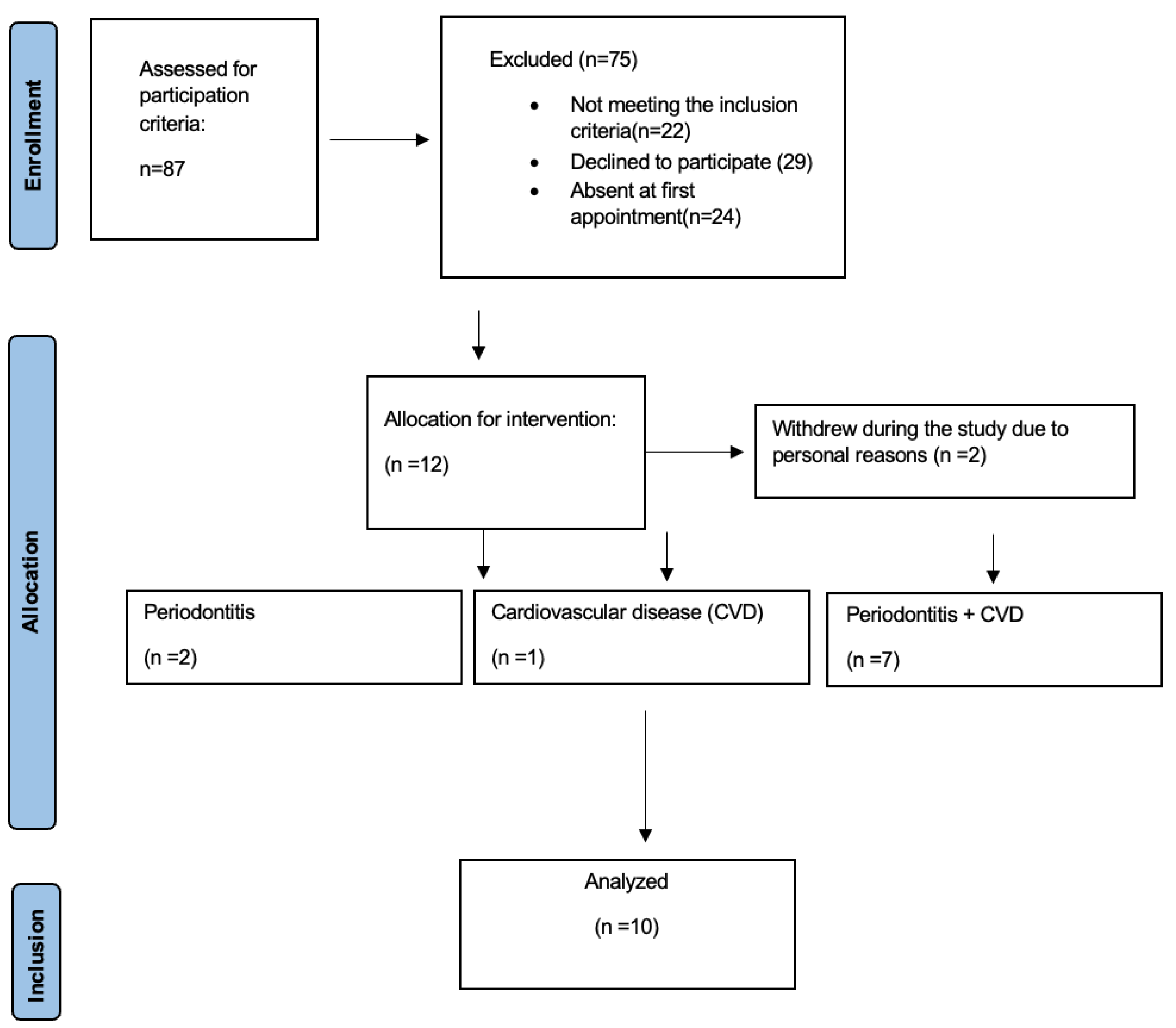
Table 1.
Cardiovascular risk factors and parameters that provide an overview of individual cardiovascular risk profiles.
Table 1.
Cardiovascular risk factors and parameters that provide an overview of individual cardiovascular risk profiles.
| No. | Age | Sex | Total Cholesterol (mg/dL) | HDL | LDL | Triglycerides | CRP | ESR | Weight (kg) | Height (cm) | BMI (kg/m²) | Diabetes mellitus | Smoking |
| 1 | 52 | F | 152 | 43.3 | 93 | 138 | 12.4 | 7 | 82 | 161 | 31.63 | no | no |
| 2 | 71 | M | 228 | 40.2 | 160 | 210 | 11.3 | 6 | 90 | 180 | 27.8 | no | no |
| 3 | 76 | M | 120 | 38.9 | 182 | 270 | 16.5 | 10 | 95 | 182 | 28.7 | no | no |
| 4 | 67 | M | 215 | 35.7 | 162 | 267 | 9.7 | 15 | 89 | 174 | 29.4 | no | no |
| 5 | 67 | M | 233 | 60.1 | 176 | 211 | 6.9 | 14 | 97 | 175 | 31.7 | no | no |
| 6 | 57 | M | 260 | 58.2 | 188 | 167 | 12.5 | 14 | 93 | 169 | 32.6 | yes | no |
| 7 | 33 | M | 254 | 62.1 | 132 | 180 | 13.5 | 18 | 125 | 180 | 38.6 | no | no |
| 8 | 76 | F | 182 | 55.2 | 148.8 | 189 | 6.2 | 14 | 70 | 167 | 25.1 | no | no |
| 9 | 59 | M | 284 | 36.6 | 87.9 | 220 | 7.6 | 16 | 88 | 180 | 26.5 | no | no |
| 10 | 73 | M | 320 | 38.6 | 166.2 | 272 | 24.6 | 47 | 110 | 175 | 35.9 | no | yes |
| 11 | 44 | M | 241 | 66.2 | 102 | 150 | 38.7 | 45 | 84 | 174 | 27.7 | yes | no |
| 12 | 74 | M | 221 | 52.6 | 115 | 151 | 18.2 | 17 | 93 | 169 | 32.6 | no | no |
| 13 | 52 | M | 205 | 66.2 | 98 | 156 | 13.8 | 17 | 82 | 176 | 26.5 | yes | yes |
Table 2.
Descriptive statistics of clinical periodontal parameters.
| Variable | Mean | SD | Minimum | Maximum |
| PPD (mm) | 5.54 | 2.03 | 3 | 8 |
| CAL (mm) | 6.46 | 3.67 | 2 | 12 |
| BOP (%) | 66.92 | 21.69 | 38 | 98 |
Table 3.
Descriptive statistics of inflammatory biomarkers in patients with periodontitis.
| Variable | Value | Range |
| MMP-8 | 25.64 ± 20.31 | 3.00–78.00 |
| MPO | 46.00 (median) | 6.00–197.00 |
| Lp-PLA2 | 46.60 (median) | 62.00–402.00 |
| sCD40L | 3.91 (median) | 1.20–6.80 |
Table 4.
Reduction in biomarker levels after periodontal therapy, with significant decreases observed for MMP-8 and Lp-PLA2, while MPO and sCD40L exhibited non-significant changes.
Table 4.
Reduction in biomarker levels after periodontal therapy, with significant decreases observed for MMP-8 and Lp-PLA2, while MPO and sCD40L exhibited non-significant changes.
| Biomarker | Baseline | Post-treatment | p-value |
| MMP-8 | 25.64 ± 20.31 | 10.60 ± (SD) | 0.010 |
| MPO | 45.50 (median) | 23.50 (median) | 0.097 |
| Lp-PLA2 | 46.80 (median) | 35.30 (median) | 0.020 |
| sCD40L | 9538 (median) | 1642 (median) | 0.156 |
Disclaimer/Publisher’s Note: The statements, opinions and data contained in all publications are solely those of the individual author(s) and contributor(s) and not of MDPI and/or the editor(s). MDPI and/or the editor(s) disclaim responsibility for any injury to people or property resulting from any ideas, methods, instructions or products referred to in the content. |
© 2026 by the authors. Licensee MDPI, Basel, Switzerland. This article is an open access article distributed under the terms and conditions of the Creative Commons Attribution (CC BY) license.
Copyright: This open access article is published under a Creative Commons CC BY 4.0 license, which permit the free download, distribution, and reuse, provided that the author and preprint are cited in any reuse.


