

Submitted:
26 April 2026
Posted:
27 April 2026
You are already at the latest version
Abstract
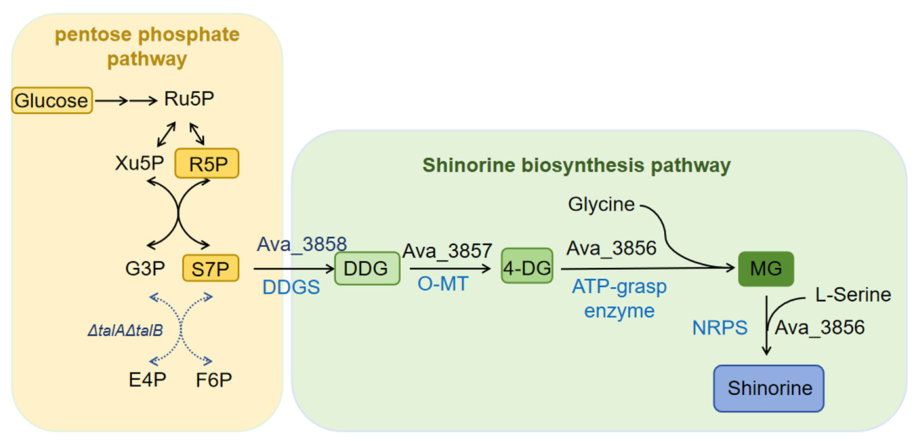
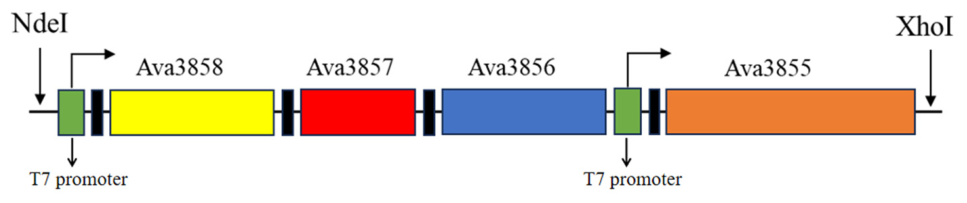
Shinorine, a naturally occurring UV-absorbing compound belonging to the class of mycosporine-like amino acids (MAAs), has attracted considerable attention for its applications in pharmaceuticals, cosmetics, and biomaterials. However, conventional production methods based on extraction from marine organisms are constrained by low yield, limited availability, and environmental sustainability concerns. In this study, we developed a microbial cell factory for the efficient biosynthesis of shinorine in Escherichia coli. Specifically, the transaldolase gene in the pentose phosphate pathway (PPP) was precisely disrupted to block the metabolic conversion of sedoheptulose-7-phosphate (S7P), thereby enhancing its intracellular accumulation. In parallel, a cyanobacterial shinorine biosynthetic gene cluster (Ava_3858–Ava_3855) was heterologously expressed in the engineered strain, enabling the reconstruction of a functional biosynthetic pathway utilizing S7P as a key precursor. This integrated metabolic engineering strategy effectively overcomes the limitations of traditional extraction methods and significantly improves shinorine production. Moreover, the approach provides a versatile framework for the microbial synthesis of other high-value natural products, with broad implications for sustainable biomanufacturing.
Keywords:
1. Introduction
2. Results
2.1. E. Coli BL21 (DE3) Knockout
2.2. Construction of Recombinant Plasmid of Pet29b Vector
2.3. Induction and Expression of Recombinant Plasmids
2.4. Extraction and Yield Optimization of the Product Shinorine

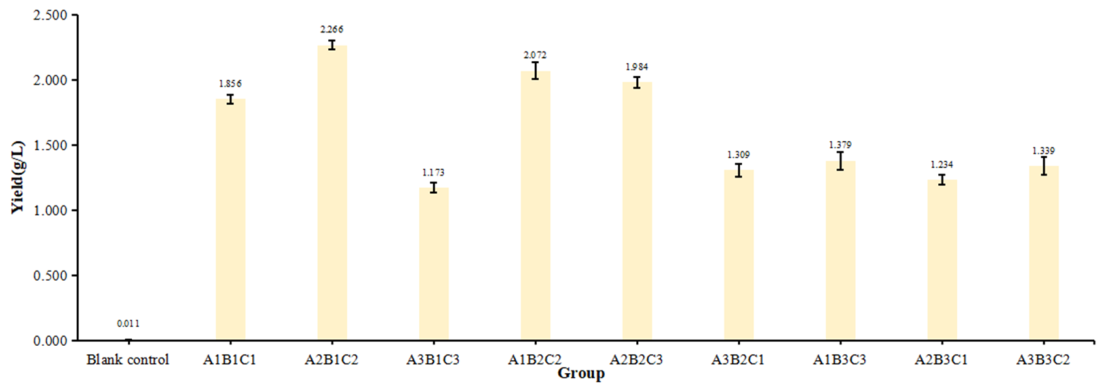
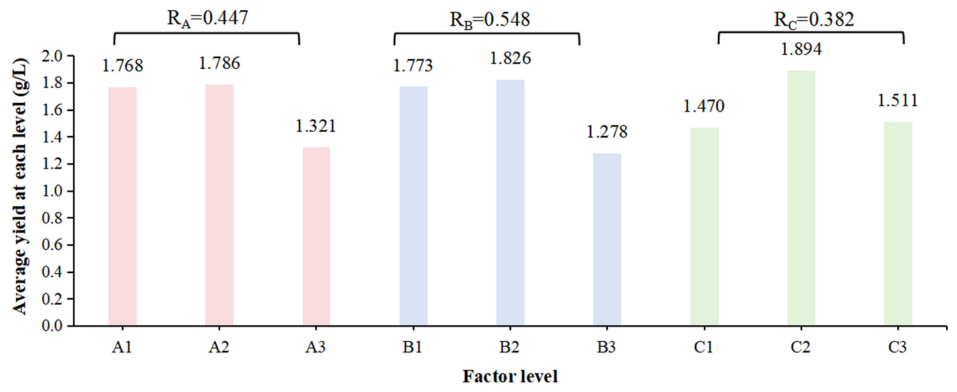
| Ingredient | Concentration 1 | Concentration 2 | Concentration 3 |
| Amino acid(A): | 2.5 mM(A1) | 5 mM(A2) | 10 mM(A3) |
| Glucose(B): | 2 g/L(B1) | 5 g/L(B2) | 10 g/L(B3) |
| IPTG(C): | 0.5 mM(C1) | 1 mM(C2) | 1.5 mM(C3) |
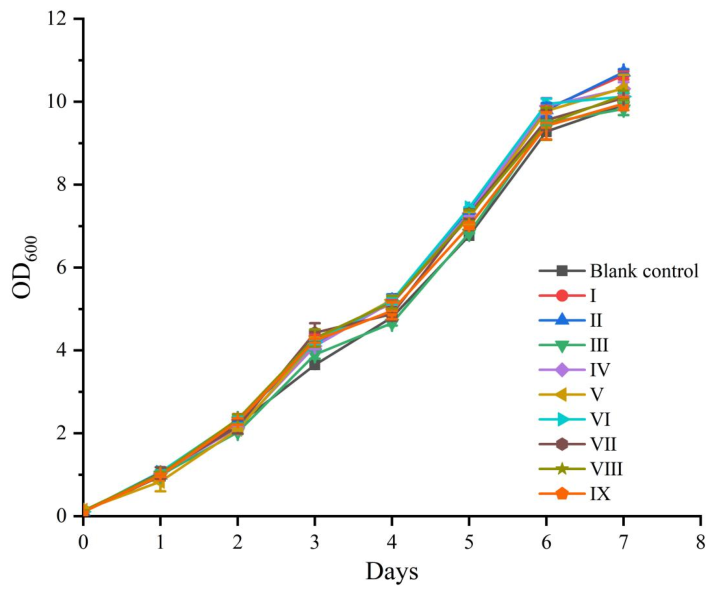
| Orthogonal experiment group | ||
| Blank control | 0 IPTG, 0 Glucose, 0 Amino acid | |
| A1B1C1(I) | A1B2C2(II) | A1B3C3(III) |
| A2B1C2(IV) | A2B2C3(V) | A2B3C1(VI) |
| A3B1C3(VII) | A3B2C1(VIII) | A3B3C2(IX) |
2.4. Effect of Substrate and Induction Conditions on Shinorine Yield
2.5. Identification of Shinorine by HPLC–MS
3. Discussion
4. Materials and Methods
4.1. E. Coli BL21 (DE3) Knockout
4.2. Construction of Recombinant Plasmid of Pet29b Vector
4.3. Extraction and Purification of the Product
4.4. Preparation of Shinorine Standard
4.5. Product Identification
4.6. Optimization of Substrates and Inducers
5. Conclusions
Author Contributions
Funding
Conflicts of Interest
References
- Hengardi, M.T.; Liang, C.; Madivannan, K.; et al. Reversing the directionality of reactions between non-oxidative pentose phosphate pathway and glycolytic pathway boosts mycosporine-like amino acid production in Saccharomyces cerevisiae. Microb. Cell Fact. Published 2024 May 9. 2024, 23(1), 121. [Google Scholar] [CrossRef]
- Pósfai, G.; Plunkett, G., 3rd; Fehér, T.; et al. Emergent properties of reduced-genome Escherichia coli. Science 2006, 312(5776), 1044–1046. [Google Scholar] [CrossRef] [PubMed]
- Sharan, S.K.; Thomason, L.C.; Kuznetsov, S.G.; Court, D.L. Recombineering: a homologous recombination-based method of genetic engineering. Nat. Protoc. 2009, 4(2), 206–223. [Google Scholar] [CrossRef] [PubMed]
- Kruger, N. J.; von Schaewen, A. The oxidative pentose phosphate pathway: structure and organisation. Curr. Opin. Plant Biol. 2003, 6(3), 236–246. [Google Scholar] [CrossRef] [PubMed]
- Zhao, J.; Li, Q.; Sun, T.; Zhu, X.; Xu, H.; Ma, Y. Engineering central metabolic modules of Escherichia coli for improving shikimic acid production. Microb. Cell Fact. 2019, 18(1), 1–14. [Google Scholar]
- Yoshida, S.; Tsunematsu, Y.; Tanaka, M.; Watanabe, K. Engineering of pentose phosphate pathway to improve production of aromatic compounds in yeast. J. Biosci. Bioeng. 2015, 119(1), 12–17. [Google Scholar]
- Shick, J. M.; Dunlap, W. C. Mycosporine-like amino acids and related gadusols: biosynthesis, accumulation, and UV-protective functions in aquatic organisms. Annu. Rev. Physiol. 2002, 64, 223–262. [Google Scholar] [CrossRef]
- Rastogi, R.P.; Sinha, R.P.; Moh, S.H.; Lee, T.K.; Kottuparambil, S.; Kim, Y.J.; Kang, J.W.; Han, T. Mycosporine-like amino acids (MAAs): photoprotective compounds and their prospects in the global cosmeceutical market. Env. Sci. Biotechnol. 2010, 9(3), 197–223. [Google Scholar]
- Balskus, E. P.; Walsh, C. T. The genetic and molecular basis for sunscreen biosynthesis in cyanobacteria. Science 2010, 329(5999), 1653–1656. [Google Scholar] [CrossRef]
- Sinha, R. P.; Häder, D. P. UV-protectants in cyanobacteria. Plant Sci. 2007, 174(3), 278–289. [Google Scholar] [CrossRef]
- de la Coba, F.; Aguilera, J.; Figueroa, F. L.; de Gálvez, M. V.; Herrera, E. Antioxidant activity of mycosporine-like amino acids isolated from three red macroalgae and one marine lichen. J. Appl. Phycol. 2009, 21(2), 161–169. [Google Scholar] [CrossRef]
- Rastogi, R. P.; Incharoensakdi, A. UV radiation-induced biosynthesis, stability and antioxidant activity of mycosporine-like amino acids (MAAs) in a unicellular cyanobacterium Gloeocapsa sp. CU2556. J. Photochem. Photobiol. B Biol. 2014, 130, 287–292. [Google Scholar] [CrossRef]
- Yang, G.; Cozad, M.A.; Holland, D.A.; Zhang, Y.; Luesch, H.; Ding, Y. Photosynthetic Production of Sunscreen Shinorine Using an Engineered Cyanobacterium. ACS Synth. Biol. 2018, 7(2), 664–671. [Google Scholar] [CrossRef] [PubMed]
- Nguyen, A. D.; Tin, C. H. T.; Lee, E. Y. Methanotrophic microbial cell factory platform for simultaneous conversion of methane and xylose to value-added chemicals[J]. Chem. Eng. J. 2020. [Google Scholar]
- Wei, L.; Wang, H.; Xu, N.; et al. Metabolic engineering of Corynebacterium glutamicum for L-cysteine production. Appl. Microbiol. Biotechnol. 2019, 103(3), 1325–1338. [Google Scholar] [CrossRef] [PubMed]
- Miyamoto, K.T.; Komatsu, M.; Ikeda, H. Discovery of gene cluster for mycosporine-like amino acid biosynthesis from Actinomycetales microorganisms and production of a novel mycosporine-like amino acid by heterologous expression. Appl. Env. Microbiol. 2014, 80(16), 5028–5036. [Google Scholar] [CrossRef]
- Jin, H.; Kim, S.; Lee, D.; Ledesma-Amaro, R.; Hahn, J.S. Efficient production of mycosporine-like amino acids, natural sunscreens, in Yarrowia lipolytica. Biotechnol. Biofuels Bioprod. Published 2023 Oct 29. 2023, 16(1), 162. [Google Scholar] [CrossRef]
- Yunus, I. S.; Hudson, G. A.; Chen, Y. Systematic engineering for production of anti-aging sunscreen compound in Pseudomonas putida[J]. Metab. Eng. 2024, 84(000), 14. [Google Scholar] [CrossRef]
- De Leeuw, M.; Matos, M.R.A.; Nielsen, L.K. Omics data for sampling thermodynamically feasible kinetic models. Metab. Eng. 2023, 78, 41–47. [Google Scholar] [CrossRef]
- Kim, S.; Park, B.G.; Jin, H.; et al. Efficient production of natural sunscreens shinorine, porphyra-334, and mycosporine-2-glycine in Saccharomyces cerevisiae. Metab. Eng. 2023, 78, 137–147. [Google Scholar] [CrossRef]
- Sambrook, J.; Russell, D. W. Molecular Cloning: A Laboratory Manual, 3rd ed.; Cold Spring Harbor Laboratory Press, 2001. [Google Scholar]
- Datsenko, K. A.; Wanner, B. L. One-step inactivation of chromosomal genes in Escherichia coli K-12 using PCR products. Proc. Natl. Acad. Sci. 2000, 97(12), 6640–6645. [Google Scholar] [CrossRef]
- Cherepanov, P. P.; Wackernagel, W. Gene disruption in Escherichia coli: TcR and KmR cassettes with the option of Flp-catalyzed excision of the antibiotic-resistance determinant. Gene 1995, 158(1), 9–14. [Google Scholar] [CrossRef] [PubMed]
- Rastogi, R. P.; Sonani, R. R.; Madamwar, D. Characterization and antioxidant functions of mycosporine-like amino acids in the cyanobacterium Nostoc sp. R76DM [J]. Algal Res. 2016, 16, 110–118. [Google Scholar] [CrossRef]
- Liu, Z.; Häder, D. P.; Sommaruga, R. Occurrence of mycosporine-like amino acids (MAAs) in the bloom-forming cyanobacterium. Microcystis aeruginosa. J. Plankton Res. 2004, Volume 26(Issue 8), 963–966. [Google Scholar] [CrossRef]
- Whitehead, K.; Hedges, J. I. Analysis of mycosporine-like amino acids in plankton by liquid chromatography electrospray ionization mass spectrometry. Mar. Chem. 2002, 80(1), 27–39. [Google Scholar] [CrossRef]
- Liu, H.; Valdehuesa, K. N. G.; Nisola, G. M.; Ramos, K. R. M.; Kim, H. T.; Lee, W. K.; Chung, W. J.; Park, S. J. Enhancing NADPH availability for microbial production of value-added chemicals through metabolic engineering. Biotechnol. Adv. 2020, 44, 107614. [Google Scholar]
- Bentley, W. E.; Mirjalili, N.; Andersen, D. C.; Davis, R. H.; Kompala, D. S. Plasmid-encoded protein: the principal factor in the “metabolic burden” associated with recombinant bacteria. Biotechnol. Bioeng. 1990, 35(7), 668–681. [Google Scholar] [CrossRef]
- Wu, G.; Bazer, F. W.; Dai, Z.; Li, D.; Wang, J.; Wu, Z. Amino acid nutrition in animals: protein synthesis and beyond. Annu. Rev. Anim. Biosci. 2016, 2, 387–417. [Google Scholar] [CrossRef]
- Hu, Y.; Zhao, L.; Wang, J.; Yu, X.; Zhang, B. Enhancing non-natural amino acid incorporation in E. coli by improving endogenous precursor biosynthesis. Biotechnol. J. 2022, 17(5), 2100540. [Google Scholar]
- Studier, F. W.; Moffatt, B. A. Use of bacteriophage T7 RNA polymerase to direct selective high-level expression of cloned genes. J. Mol. Biol. 1986, 189(1), 113–130. [Google Scholar] [CrossRef]
- Sørensen, H. P.; Mortensen, K. K. Soluble expression of recombinant proteins in the cytoplasm of Escherichia coli. Microb. Cell Fact. 2005, 4(1), 1. [Google Scholar] [CrossRef] [PubMed]
- Rosano, G. L.; Ceccarelli, E. A. Recombinant protein expression in Escherichia coli: advances and challenges. Front. Microbiol. 2014, 5, 172. [Google Scholar] [CrossRef]
- Li, C.; Bai, Y.; Zhang, H.; Zhang, J.; Liu, X.; Wang, Y. Dynamic regulation strategies for improving microbial synthesis of natural products. Biotechnol. Adv. 2022, 58, 107888. [Google Scholar]
- Xu, P.; Wang, X.; Jones, Z.B.; Li, M.; Koffas, B.S.; Koffas, M.A.G. Modular optimization of multi-gene pathways for microbial biosynthesis. Nat. Commun. 2020, 11, 1–12. [Google Scholar]
- Carbonell, P.; Radivojevic, T.; King, R.D. Opportunities at the intersection of synthetic biology, machine learning, and automation. ACS Synth. Biol. 2019, 8(7), 1474–1477. [Google Scholar] [CrossRef]
- Nielsen, J.; Keasling, J.D. Engineering cellular metabolism. Cell. 2016, 164(6), 1185–1197. [Google Scholar] [CrossRef] [PubMed]
| Host | Yield | Reference |
| Synechocystis sp. | 2.37 mg/L | (Yang G et al. 2018) [13] |
| M. alcaliphilum | 17.1 mg/L | (Nguyen AD et al. 2020) [14] |
| Corynebacterium. glutamicum | 19 mg/L | (Wei L et al. 2019) [15] |
| Streptomyces avermitilis | 154 mg/L | (Miyamoto KT et al. 2014) [16] |
| Y. lipolytica | 207 mg/L | (Jin H et al. 2023) [17] |
| P. putida | 900 mg/L | (Yunus IS et al. 2024) [18] |
| Escherichia coli | 1.2 g/L | (De Leeuw M et al. 2023) [19] |
| Saccharomyces. cerevisiae | 1.6 g/L | (Kim S et al. 2023) [20] |
| Escherichia coli BL21(DE3) | 2.266 g/L | ———— |
Disclaimer/Publisher’s Note: The statements, opinions and data contained in all publications are solely those of the individual author(s) and contributor(s) and not of MDPI and/or the editor(s). MDPI and/or the editor(s) disclaim responsibility for any injury to people or property resulting from any ideas, methods, instructions or products referred to in the content. |
© 2026 by the authors. Licensee MDPI, Basel, Switzerland. This article is an open access article distributed under the terms and conditions of the Creative Commons Attribution (CC BY) license.


