
Submitted:
23 April 2026
Posted:
24 April 2026
You are already at the latest version
Abstract
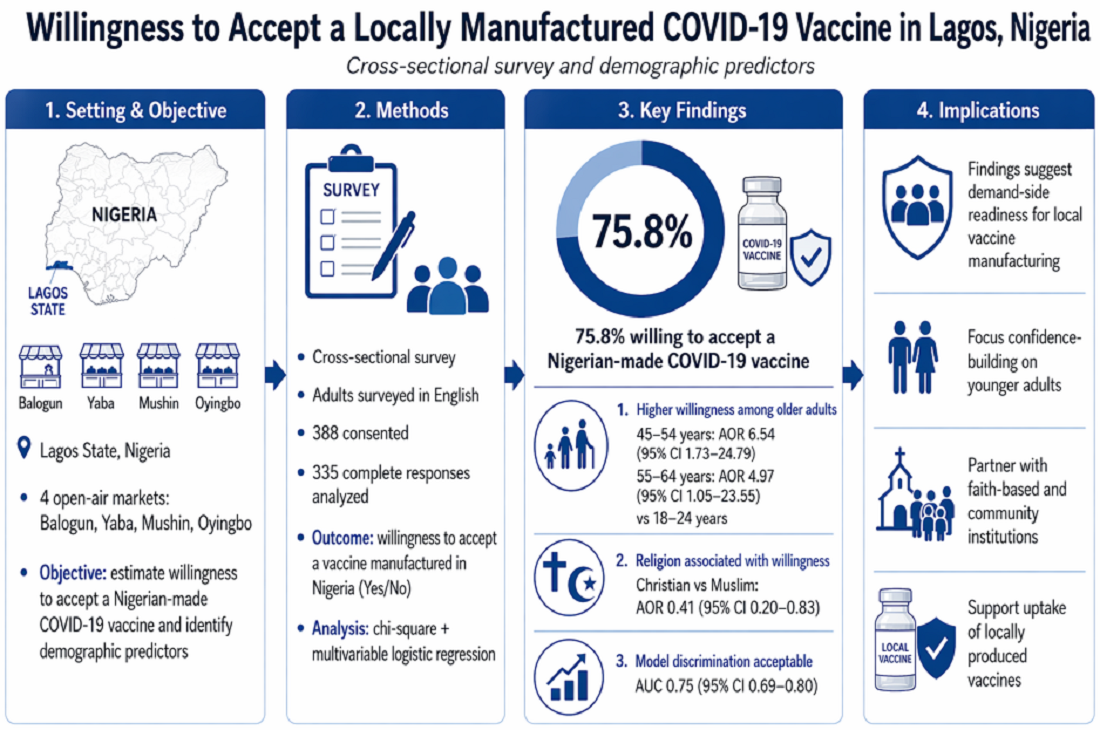
Background: Local vaccine manufacturing is being pursued across Africa to improve pandemic preparedness and reduce reliance on imports. In Nigeria, where COVID-19 vaccines were largely imported, willingness to accept locally produced vaccines is important for sustainable domestic production. The objective of this study was to estimate willing-ness to accept a locally manufactured COVID-19 vaccine among adults in Lagos, Nigeria, and to identify demographic predictors. Methods: We conducted a cross-sectional survey of adults in Lagos State using a questionnaire administered in four open-air markets. The primary outcome was willingness to accept a COVID-19 vaccine manufactured in Nigeria (yes/no). We summarized respondent characteristics, tested bivariate associations with chi-square, and estimated adjusted odds ratios (AORs) using multivariable logistic regression. Model calibration and discrimination were assessed using Hosmer-Lemeshow testing and the area under the ROC curve (AUC). Results: Of 388 consenting respondents, 335 provided complete data (86.3%). 75.8% reported willingness to accept a Nigerian-made COVID-19 vaccine. Willingness differed by age group (p=0.0028; trend p=0.0002) and religion (p=0.0403). In adjusted models, respondents aged 45-54 years (AOR 6.54; 95% CI 1.73-24.79) and 55-64 years (AOR 4.97; 95% CI 1.05-23.55) had higher odds of acceptance than those aged 18-24 years. Christian affiliation was associated with lower odds than Muslim affiliation (AOR 0.41; 95% CI 0.20-0.83). Discrimination was acceptable (AUC 0.75; 95% CI 0.69-0.80). Conclusions: Most respondents were willing to accept a Nigerian-made COVID-19 vaccine, suggesting demand-side readiness. Confidence-building strategies tailored to younger adults and implemented with faith-based and community institutions may support uptake of locally produced vaccines.
Keywords:
COVID-19 vaccines
; local vaccine manufacturing
; vaccine acceptance
; vaccine hesitancy
; Nigeria
; Lagos State
; cross-sectional survey
; demographic predictors
; public confidence
; logistic regression
Copyright: This open access article is published under a Creative Commons CC BY 4.0 license, which permit the free download, distribution, and reuse, provided that the author and preprint are cited in any reuse.


