
Submitted:
23 April 2026
Posted:
24 April 2026
You are already at the latest version
Abstract
Objectives: Sarcopenia impairs physical function and increases healthcare burden among older adults with chronic musculoskeletal disorders. This study estimated the prevalence of sarcopenia and explored factors associated with sarcopenia among Vietnamese elderly outpatients. Methods: A hospital-based cross-sectional study was conducted among 88 outpatients aged 60 years or older with knee osteoarthritis and/or chronic spinal pain at a tertiary hospital in Northern Vietnam from May 2024 to October 2025. Sarcopenia and severe sarcopenia were defined according to the Asian Working Group for Sarcopenia 2019 criteria. Muscle mass, muscle strength, and physical performance were assessed using bioelectrical impedance analysis, handgrip dynamometry, and usual gait speed, respectively. Multivariable logistic regression and an exploratory chi-square automatic interaction detection decision tree were applied. Results: The prevalence of sarcopenia was 40.9%, including 23.9% with sarcopenia and 17.0% with severe sarcopenia. Age >70 years (adjusted odds ratio [AOR] 9.00, 95% confidence interval [CI] 2.40-33.60), history of falls (AOR 6.33, 95% CI 2.77-14.45), low educational attainment (AOR 2.86, 95% CI 1.46-5.61), and poor sleep quality (AOR 1.16, 95% CI 1.02-1.32) were independently associated with sarcopenia. Conclusions: Sarcopenia was common in this outpatient population. Routine case-finding may be particularly relevant in older patients with falls, lower educational attainment, and poor sleep quality. The decision-tree findings should be interpreted as exploratory because of the cross-sectional, single-center design and modest sample size.
Keywords:
sarcopenia
; older adults
; musculoskeletal disorders
; falls
; decision tree
; Vietnam
1. Introduction
The global population is aging at an unprecedented rate, leading to an increased prevalence of geriatric syndromes [1]. Among these, sarcopenia, characterised by the progressive and generalised loss of skeletal muscle mass and strength, has emerged as a major public health concern [2,3]. Sarcopenia is associated with various potential adverse outcomes, including functional decline, increased risk of falls, frailty, and higher mortality rates among the elderly [3,4].
In patients with chronic musculoskeletal disorders, such as knee osteoarthritis (KOA) and chronic spinal pain, the risk of sarcopenia appears to be significantly higher [5]. The interplay between chronic pain and reduced physical activity creates a “vicious cycle”: pain leads to kinesiophobia and immobilisation, which in turn, accelerates muscle atrophy and weakness [6]. In Vietnam, while several studies have addressed sarcopenia in the general community [7], recent evidence has highlighted that related geriatric issues, such as the high risk of falls (nearly 40%), are becoming increasingly prevalent among elderly outpatients in local clinical settings [10]. This underscores the need for more targeted screening tools for muscle-related deficiencies in this population.
Traditional statistical methods, such as logistic regression, are commonly used to identify risk factors. However, these methods often struggle to capture complex, nonlinear relationships and higher-order interactions among variables [9]. Decision tree models, a popular machine learning technique, offer a more intuitive and flexible approach for clinical classification and prediction [10]. By partitioning the study population into smaller, more homogenous subgroups, decision trees can identify the most critical predictors and provide visual clinical pathways that are easy for healthcare providers to interpret in daily practice [9,10].
Therefore, this study was conducted to estimate the prevalence of sarcopenia and explore factors associated with sarcopenia among elderly outpatients with chronic musculoskeletal disorders at Thai Binh University of Medicine and Pharmacy Hospital. In addition to multivariable logistic regression, we used a Chi-square Automatic Interaction Detection (CHAID) decision tree as an exploratory analytic approach to examine hierarchical risk stratification within this specific clinical population. The findings are intended to support hypothesis generation and to inform future studies on early identification of high-risk patients in outpatient settings.
2. Materials and Methods
2.1. Study Design and Setting
A cross-sectional descriptive study with analysis was conducted from May 2024 to October 2025. The study was conducted in the Musculoskeletal Department at Thai Binh University of Medicine and Pharmacy Hospital, Vietnam.
2.2. Participants and Sampling
The study included elderly outpatients who met the following criteria: (1) aged 60 years or older; (2) diagnosed with knee osteoarthritis according to the American College of Rheumatology criteria and/or chronic spinal pain; and (3) agreed to participate in the study. Patients with severe cognitive impairment, acute illness, severe functional limitations preventing physical performance testing, or contraindications to body-composition assessment were excluded. Eligible participants were recruited consecutively during their outpatient visits within the study period. The final analytical sample comprised 88 participants who completed all required assessments. Given the modest sample size and single-center design, the findings should be interpreted with caution, particularly with regard to the exploratory decision-tree analysis.
2.2.1. Sample Size
The minimum sample size was estimated using the single-population proportion formula:
Including:
n: Minimum sample size must be achieved
Z1-α/2: The accuracy of the study should be expected to reach 95% by 1.96
d: The desired error between the research sample and population was d= 0.1.
p: was the expected prevalence of sarcopenia from a previous study. Based on the reference and calculations, we chose p = 0.648 as the proportion of elderly people with sarcopenia in the study by Ngo Hoang Long and colleagues (2023) [11]. Substituting into the formula, we get n = 88 elderly people.
2.3. Data Collection and Measurements
Data were collected through structured interviews and standardized clinical assessments.
Demographic and clinical variables included age, sex, education level, occupation, living situation, body mass index, smoking, alcohol use, history of falls in the previous 12 months, sleep quality assessed by the Pittsburgh Sleep Quality Index, comorbidities, severity of knee osteoarthritis, chronic spinal pain severity, and number of medications used.
Sarcopenia assessment: Sarcopenia was defined according to the Asian Working Group for Sarcopenia (AWGS 2019) criteria. Low muscle mass was defined as an appendicular skeletal muscle mass index <7.0 kg/m2 for men and <5.7 kg/m2 for women. Low muscle strength was defined as handgrip strength <28 kg for men and <18 kg for women. Low physical performance was defined as usual gait speed <1.0 m/s. Sarcopenia was diagnosed when low muscle mass coexisted with low muscle strength and/or low physical performance. Severe sarcopenia was defined as the concomitant presence of low muscle mass, low muscle strength, and low physical performance [3].
Muscle mass: Muscle mass was measured using bioelectrical impedance analysis with a multi-frequency device (InBody 770, InBody Co., Ltd., South Korea). Measurements were performed according to the manufacturer’s instructions, with participants wearing light clothing and removing shoes and metallic accessories before testing. Participants with conditions that could substantially affect BIA validity, such as implanted electrical devices, limb amputation, or marked fluid retention, were excluded from this assessment. Low muscle mass was defined as an appendicular skeletal muscle mass index <7.0 kg/m2 for men and <5.7 kg/m2 for women.
Muscle strength: Grip strength was assessed using a hydraulic hand dynamometer (Jamar Hydraulic Hand Dynamometer, Model J00105, USA). The device was checked and calibrated according to the manufacturer’s recommendations before data collection. Measurements were obtained in the standard seated position, and the highest value from repeated trials was used for analysis. Low muscle strength was defined as handgrip strength <28 kg for men and <18 kg for women.
Physical performance: Physical performance was evaluated by usual gait speed using a marked walkway and a handheld stopwatch. Participants were instructed to walk at their usual pace, and gait speed was calculated in meters per second. Low physical performance was defined as usual gait speed <1.0 m/s.
Chronic Pain: Severity of chronic spinal pain was assessed using the Visual Analogue Scale (VAS, 0–10 points). For analysis, pain severity was categorized as mild/moderate (VAS <7) and severe (VAS 7–10), consistent with the categories reported in the Results section [8].
2.4. Statistical Analysis
All data were double-entered using EpiData 3.1 and analyzed using IBM SPSS Statistics for Windows, version 27.0.
Descriptive statistics were used to summarize participant characteristics according to sarcopenia status. Categorical variables are presented as frequencies and percentages, whereas continuous variables are presented as mean ± standard deviation (SD) for normally distributed data and median (range) for non-normally distributed data.
Bivariable analyses were first performed to assess factors associated with sarcopenia. Variables considered clinically relevant and those showing potential associations in bivariable analyses were then entered into a multivariable logistic regression model to estimate adjusted odds ratios (AORs) and 95% confidence intervals (CIs). Given the modest sample size, regression findings were interpreted cautiously.
A chi-square automatic interaction detection (CHAID) decision tree was additionally constructed as an exploratory classification tool to identify hierarchical subgroups with different sarcopenia rates within the study sample. Model performance was described using risk estimates, standard errors, and overall classification accuracy within the same dataset. Because no external validation dataset was available, the decision-tree findings should be regarded as preliminary and hypothesis-generating rather than definitive for clinical prediction. A p-value < 0.05 was considered statistically significant. No missing data were identified for variables included in the final analysis.
2.5. Ethical Considerations
The study was conducted in accordance with the Declaration of Helsinki and approved by the Ethics Council of Thai Binh University of Medicine and Pharmacy (Decision No. 855, 2 May 2024). Written informed consent was obtained from all participants prior to data collection, and participant confidentiality was strictly protected.
3. Results
3.1. Participant Characteristics and Prevalence of Sarcopenia
The results showed that 9.1% of the elderly patients were classified as frail according to the Fried criteria. Regarding sarcopenia status, the overall prevalence of sarcopenia was 40.9%, including 23.9% with sarcopenia and 17.0% with severe sarcopenia. The coexistence of frailty and sarcopenia was observed in 7.9% of the study population.

Table 1.
Frailty and sarcopenia status among participants (n = 88).
| Characteristics | n | % |
| Frailty status (Fried criteria) | ||
| Frail | 8 | 9.1 |
| Non-frail | 80 | 90.9 |
| Sarcopenia status(AWGS 2019) | ||
| No sarcopenia | 52 | 59.1 |
| Sarcopenia | 21 | 23.9 |
| Severe sarcopenia | 15 | 17.0 |
| Coexistence of frailty and sarcopenia | 7 | 7.9 |
3.2. Factors Associated with Sarcopenia
Table 2 presents the demographic characteristics according to sarcopenia status. Significant differences were observed for age group and occupation. Participants older than 70 years accounted for 55.5% of the sarcopenia group, compared with 19.3% of the non-sarcopenia group (p < 0.05). In addition, a higher proportion of farmers was observed in the sarcopenia group than in the non-sarcopenia group (83.3% vs. 61.5%, p < 0.05). Other variables, including sex, living situation, body mass index, and comorbidities, were not significantly associated with sarcopenia in the bivariable analysis.
With respect to pathological characteristics (Table 3), a history of falls was strongly associated with sarcopenia. Among participants with sarcopenia, 36.1% reported a history of falls, significantly higher than the 11.5% among those without sarcopenia (p<0.001). The severity of knee osteoarthritis and chronic spinal pain did not differ significantly between the two groups in the bivariate comparison.
Multivariable logistic regression analysis identified four variables independently associated with sarcopenia. Age >70 years was the strongest associated factor, with a 9.0-fold higher odds of sarcopenia compared with the 60–65-year age group (AOR = 9.00; 95% CI: 2.40–33.60; p<0.01). History of falls (AOR = 6.33; 95% CI: 2.77–14.45; p<0.001), low education level (AOR = 2.86; 95% CI: 1.46–5.61; p<0.01), and poor sleep quality (AOR = 1.16; 95% CI: 1.02–1.32; p = 0.03) were also significantly associated with sarcopenia. Other variables, including occupation, living situation, and chronic spinal pain severity, did not remain statistically significant after adjustment.
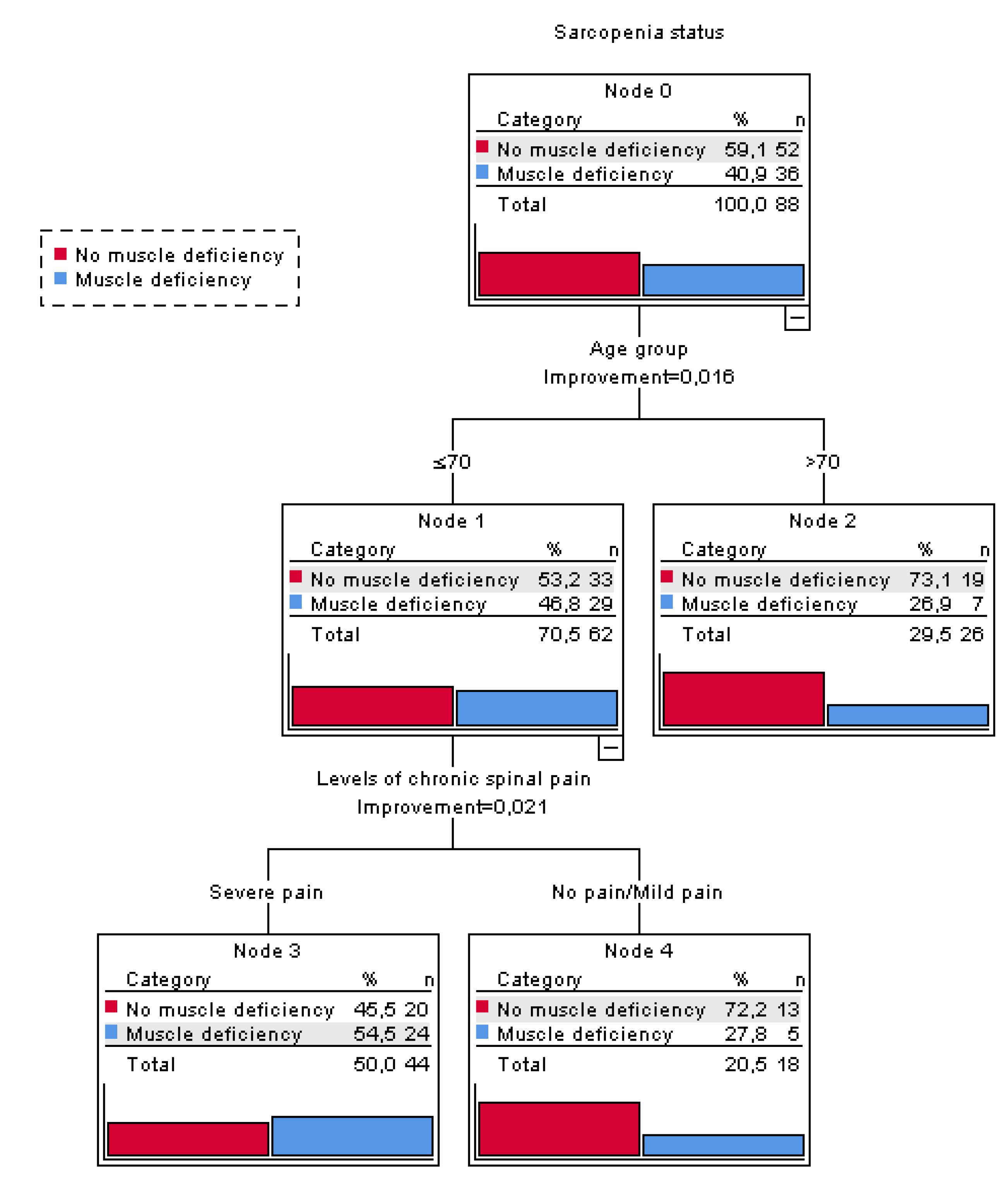
The CHAID decision tree identified age group as the primary splitter. Among participants aged ≤70 years, chronic spinal pain severity further classified subgroups with different sarcopenia prevalence. In this subgroup, severe pain was associated with a higher proportion of sarcopenia than mild/moderate pain (54.5% vs. 27.8%). The overall classification accuracy of the model within the study sample was 70.5%. Because the model was developed and evaluated in the same dataset, these findings should be interpreted as exploratory.
Table 2.
Demographic characteristics according to sarcopenia status (n = 88).
| Characteristics |
Sarcopenia (n=36) n (%) |
No Sarcopenia (n=52) n (%) |
p-value | |
| Age group | <0.05 | |||
| 60-65 years | 5 (13.9) | 23 (44.2) | ||
| 66-70 years | 11 (30.6) | 19 (36.5) | ||
| > 70 years | 20 (55.5) | 10 (19.3) | ||
| Gender | >0.05 | |||
| Male | 8 (22.2) | 11 (21.2) | ||
| Female | 28 (77.8) | 41 (78.8) | ||
| Occupation | <0.05 | |||
| Farmer | 30 (83.3) | 32 (61.5) | ||
| Others (Civil servant, freelance...) | 6 (16.7) | 20 (38.5) | ||
| Living conditions | >0.05 | |||
| Living alone | 6 (16.7) | 5 (9.6) | ||
| Living with relatives | 30 (83.3) | 47 (90.4) | ||
| Body Mass Index (BMI) | >0.05 | |||
| Underweight (< 18.5) | 8 (22.2) | 13 (25.0) | ||
| Normal (≥ 18,5) | 28 (77.8) | 39 (75.0) | ||
| Lifestyle Habits | ||||
| Smoking (Yes) | 3 (8.3) | 4 (7.7) | >0.05 | |
| Alcohol consumption (Yes) | 7 (19.4) | 9 (17.3) | >0.05 | |
| Commonmedicalconditions | ||||
| Hypertension | 9 (25.0) | 17 (32.7) | >0.05 | |
| Diabetes Mellitus | 3 (8.3) | 8 (15.4) | >0.05 | |
| Chronic Kidney Disease | 3 (8.3) | 8 (15.4) | >0.05 | |
| Clinicalcharacteristics of the Musculoskeletalsystem | ||||
| Severity of knee osteoarthritis (Grade 3-4) | 28 (77.8) | 38 (73.1) | >0.05 | |
| Number of medications used (≥ 3) | 15 (41.7) | 22 (42.3) | >0.05 | |
Table 3.
Distribution of pathological characteristics according to sarcopenia status (n = 88).
| Pathological Characteristics |
Sarcopenia (n=36) n (%) |
No Sarcopenia (n=52) n (%) |
p-value |
| Hypertension | >0.05 | ||
| Yes | 9 (25.0) | 17 (32.7) | |
| No | 27 (75.0) | 35 (67.3) | |
| Diabetes Mellitus | >0.05 | ||
| Yes | 3 (8.3) | 8 (15.4) | |
| No | 33 (91.7) | 44 (84.6) | |
| Chronic Kidney Disease | >0.05 | ||
| Yes | 3 (8.3) | 8 (15.4) | |
| No | 33 (91.7) | 44 (84.6) | |
| Severity of knee osteoarthritis | >0.05 | ||
| Grade 3-4 (Severe) | 28 (77.8) | 38 (73.1) | |
| Grade 1-2 (Mild/Moderate) | 8 (22.2) | 14 (26.9) | |
| Chronic back pain | >0.05 | ||
| Severe pain (VAS 7-10) | 27 (75,0) | 39 (75.0) | |
| Mild/moderate pain (VAS <7) | 9 (25.0) | 13 (25.0) | |
| History of falls | <0.001 | ||
| Yes | 13 (36.1) | 6 (11.5) | |
| No | 23 (63.9) | 46 (88.5) |
Table 4.
Multivariable logistic regression analysis of factors associated with sarcopenia (n = 88).
| Independent variables | Category | AOR | 95%CI | p-value |
| Age group | 60 - 65 years (Ref.) | 1.00 | - | - |
| 66 - 70 years | 2.4 | 0.7 – 8.4 | >0.05 | |
| > 70 years | 9.00 | 2.40 – 33.60 | <0.01 | |
| History of Falls | No (Ref.) | 1.00 | - | - |
| Yes | 6.33 | 2.77 – 14.45 | <0.001 | |
|
Low Education (Under Primary school) |
No (Ref.) | 1.00 | - | - |
| Yes | 2.86 | 1.46 – 5.61 | <0.01 | |
| Sleep Quality | Good (Ref.) | 1.00 | - | - |
| Poor (High PSQI) | 1.16 | 1.02 – 1.32 | 0.03 | |
| Living Situation | With Family (Ref.) | 1.00 | - | - |
| Living alone | 0.4 | 0.1 – 1.9 | >0.05 | |
| Occupation | Other occupation (Ref.) | 1.00 | - | - |
| Farmer | 0.4 | 0.1 – 1.2 | >0.05 | |
| Chronic spinal pain | None/Mild (Ref.) | 1.00 | - | - |
| Severe pain | 0.4 | 0.1 – 2.1 | >0.05 |
AOR: adjusted odds ratio; CI: confidence interval; OR: odds ratio.
Figure 1.
Decision tree for factors related to sarcopenia status among elderly participants. Risk estimate (SE): 0.364 (0.051); overall classification accuracy: 70.5%.
Figure 1.
Decision tree for factors related to sarcopenia status among elderly participants. Risk estimate (SE): 0.364 (0.051); overall classification accuracy: 70.5%.
4. Discussion
In this hospital-based cross-sectional study, 40.9% of elderly outpatients with chronic musculoskeletal disorders met the AWGS 2019 criteria for sarcopenia, including 17.0% with severe sarcopenia. This relatively high prevalence may reflect the clinical profile of our sample, which consisted of symptomatic older adults with chronic osteoarticular and spinal conditions rather than community-dwelling older adults from the general population. Our observed prevalence of sarcopenia (40.9%) was lower than the 54.7% reported among older patients attending geriatric clinics in Vietnam, using the AWGS 2019 criteria [12], but substantially higher than the 10.0% observed in Thai community-dwelling elderly outpatients [13]. It was broadly comparable to the 35.5% prevalence reported in Asian women awaiting primary total knee arthroplasty for advanced knee osteoarthritis, another selected musculoskeletal population [14]. In addition, a recent systematic review and meta-analysis applying the AWGS 2019 criteria estimated an overall prevalence of 16.5% among community-dwelling Asian adults aged 60 years and older [15], suggesting that the relatively high burden observed in our study may be related to the symptomatic musculoskeletal profile of our outpatient sample.
Age >70 years was the strongest factor associated with sarcopenia in the multivariable model. This finding is clinically plausible because advancing age is accompanied by progressive declines in muscle mass, neuromuscular reserve, anabolic responsiveness, and physical function [3,4]. Our results suggest that older outpatients with musculoskeletal disorders, particularly those older than 70 years, may benefit from routine sarcopenia case-finding in outpatient settings.
History of falls was also strongly associated with sarcopenia. This association may be bidirectional. Reduced muscle strength and impaired physical performance can increase instability and fall risk, whereas falls may lead to fear of movement, reduced activity, and subsequent deconditioning [4]. Therefore, fall history may serve as a simple and practical clinical marker to prompt sarcopenia screening in elderly musculoskeletal outpatients.
Low educational attainment remained independently associated with sarcopenia after adjustment. This finding may reflect broader social and behavioral pathways, including lower health literacy, reduced awareness of preventive exercise and nutrition, and delayed recognition of functional decline. Poor sleep quality was also independently associated with sarcopenia in our model, suggesting that sleep disturbance may be an important but often overlooked correlate of muscle health in this population.
Although chronic spinal pain severity did not remain statistically significant in the fully adjusted logistic regression model, it emerged as a second-level classifier in the CHAID decision tree among participants aged ≤70 years. This suggests that pain may still be clinically relevant within specific age-defined subgroups, even if it is not an independent factor in the overall multivariable model. The association between chronic spinal pain and sarcopenia may be explained by pain-related kinesiophobia, reduced physical activity, and muscle disuse [16]. Chronic pain has also been linked to systemic low-grade inflammation, with cytokines such as IL-6 and TNF-α contributing to muscle catabolism and functional decline [17]. However, because the decision tree was developed and assessed on the same relatively small dataset, this pattern should be interpreted with caution and regarded as exploratory rather than definitive.
The coexistence of frailty and sarcopenia observed in our sample is also clinically plausible, as previous studies have shown that these two geriatric syndromes frequently overlap in older medical patients [18]. The present findings have several practical implications. First, sarcopenia screening should be considered in elderly outpatients with chronic musculoskeletal disorders, especially among those older than 70 years, those with a history of falls, low educational attainment, or poor sleep quality. Second, management strategies should extend beyond pain relief alone and incorporate resistance exercise, functional training, fall-prevention measures, and health education tailored to vulnerable older adults. Third, the decision-tree approach may help generate clinically interpretable hypotheses for subgroup stratification, but it should not yet be used as a standalone prediction tool in routine practice.
This study also has important limitations. First, the cross-sectional design precludes causal inference, and the observed associations should not be interpreted as evidence of temporal or causal relationships. Second, the sample size was relatively modest, especially for exploratory model development, and the model may therefore be unstable or overfitted. Third, the study was conducted at a single center using outpatient recruitment, which limits generalizability. Fourth, residual confounding cannot be excluded because some factors that may influence sarcopenia risk, such as detailed nutritional status and other clinical variables, were not comprehensively measured. Finally, no external validation dataset was available, and the CHAID model was evaluated only within the same sample used for development. Future multicenter longitudinal studies with larger samples, fuller measurement of potential confounders, and formal internal/external validation are needed before such models can be considered for broader clinical application.
5. Conclusions
Sarcopenia was common among elderly outpatients with chronic musculoskeletal disorders in this study. Older age, history of falls, low educational attainment, and poor sleep quality were independently associated with sarcopenia. The exploratory CHAID analysis additionally suggested that chronic spinal pain severity may help stratify sarcopenia prevalence among participants aged ≤70 years. These findings support the value of routine sarcopenia screening in high-risk outpatient subgroups; however, because of the cross-sectional design, modest sample size, and lack of external validation, the results should be interpreted cautiously and confirmed in larger prospective studies.
Author Contributions
Conceptualization, Nguyen The Diep and Tien Van Nguyen; methodology, Nguyen The Diep and Tien Van Nguyen; investigation, formal analysis, data curation, Nguyen Trong Duynh; writing—original draft preparation, Nguyen The Diep and Tien Van Nguyen; writing—review and editing, Tien Van Nguyen and Nguyen Trong Duynh. All authors have read and agreed to the published version of the manuscript.
Funding
This research received no external funding.
Institutional Review Board Statement
The study was conducted in accordance with the Declaration of Helsinki and approved by the Ethics Council of Thai Binh University of Medicine and Pharmacy (Decision No. 855, 2 May 2024).
Informed Consent Statement
Informed consent was obtained from all subjects involved in the study.
Data Availability Statement
The datasets used and/or analyzed during the current study are available from the corresponding author on reasonable request.
Acknowledgments
The authors thank all study participants and the clinical staff of Thai Binh University of Medicine and Pharmacy Hospital for their support during data collection.
Conflicts of Interest
The authors declare no conflicts of interest.
Abbreviations
The following abbreviations are used in this manuscript:
| AOR | Adjusted odds ratio |
| AWGS | Asian Working Group for Sarcopenia |
| BIA | Bioelectrical impedance analysis |
| BMI | Body mass index |
| CHAID | Chi-square Automatic Interaction Detection |
| CI | Confidence interval |
| KOA | Knee osteoarthritis |
| PSQI | Pittsburgh Sleep Quality Index |
| SD | Standard deviation |
| SE | Standard error |
| VAS | Visual Analogue Scale |
References
- United Nations Population Fund (UNFPA) Viet Nam; General Statistics Office of Viet Nam. The 2019 Viet Nam Population and Housing Census: Completed Results; Statistical Publishing House: Hanoi, 2021. [Google Scholar]
- Tran, G.H.; Ngo, L.P.; Do, A.T.; et al. Prevalence of sarcopenia and associated factors among older adults in Phong Dien district, Can Tho city, Vietnam, 2024. Can Tho Journal of Medicine and Pharmacy 2025, (83), 184–190. [Google Scholar] [CrossRef]
- Chen, L.K.; Woo, J.; Assantachai, P.; et al. Asian Working Group for Sarcopenia: 2019 Consensus Update on Sarcopenia Diagnosis and Treatment. Journal of the American Medical Directors Association 2020, 21(3), 300–307.e2. [Google Scholar] [CrossRef] [PubMed]
- Laskou, F.; Fuggle, N.R.; Patel, H.P.; et al. Associations of osteoporosis and sarcopenia with frailty and multimorbidity among participants of the Hertfordshire Cohort Study. J Cachexia Sarcopenia Muscle 2022, 13, 220–229. [Google Scholar] [CrossRef] [PubMed]
- Sakai, Y.; Matsui, H.; Ito, S.; et al. Sarcopenia in elderly patients with chronic low back pain. Osteoporos Sarcopenia 2017, 3, 195–200. [Google Scholar] [CrossRef] [PubMed]
- Liu, S.; Du, Z.; Song, L.; et al. Factors, characteristics and influences of the changes of muscle activation patterns for patients with knee osteoarthritis: a review. J Orthop Surg Res. 2025, 20, 112. [Google Scholar] [CrossRef] [PubMed]
- Nguyen, A.T.; Nguyen, L.H.; Nguyen, T.X.; et al. Frailty Prevalence and Association with Health-Related Quality of Life Impairment among Rural Community-Dwelling Older Adults in Vietnam. Int J Environ Res Public Health 2019, 16(20), 3834. [Google Scholar] [CrossRef] [PubMed]
- Nguyen, T.D.; Nguyen, T.V.; Nguyen, T.D.; et al. Risk of falls in the older adult at Thai Binh Medical University Hospital and its related factors in 2024. Front Public Health 2025, 13, 1609745. [Google Scholar] [CrossRef]
- Song, Y.Y.; Lu, Y. Decision tree methods: applications for classification and prediction. Shanghai Arch Psychiatry 2015, 27(2), 130–135. [Google Scholar] [CrossRef] [PubMed]
- Loh, W.Y. Classification and regression trees. Wiley Interdiscip Rev Data Min Knowl Discov. 2011, 1(1), 14–23. [Google Scholar] [CrossRef]
- Ngo, H.L.; Huynh, T.H.; Nguyen, T.H.; Pham, H.L.; Lam, P.T.; Pham, H.K. Study of the rate of frailty and some related factors in elderly inpatients at Can Tho University of Medicine and Pharmacy Hospital. CTJUMP 2023, (67), 56–63. [Google Scholar] [CrossRef]
- Nguyen, T.N.; Nguyen, T.N.; Nguyen, A.T.; Nguyen, T.X.; Nguyen, H.T.T.; Nguyen, T.T.H.; et al. Prevalence of sarcopenia and its associated factors in patients attending geriatric clinics in Vietnam: a cross-sectional study. BMJ Open. 2020, 10(9), e037630. [Google Scholar] [CrossRef] [PubMed]
- Therakomen, V.; Petchlorlian, A.; Lakananurak, N. Prevalence and risk factors of primary sarcopenia in community-dwelling outpatient elderly: a cross-sectional study. Sci Rep. 2020, 10, 19551. [Google Scholar] [CrossRef] [PubMed]
- Park, D.; Park, C.J.; Jung, M.G.; Choi, Y.H.; Park, K.S.; Koh, H.S. High prevalence of sarcopenia in Asian female patients awaiting primary total knee arthroplasty: Application of updated diagnostic tools from the Asian Working Group for Sarcopenia. J Orthop Surg (Hong Kong) 2022, 30(2), 10225536221113034. [Google Scholar] [CrossRef] [PubMed]
- Weng, S.E.; Huang, Y.W.; Tseng, Y.C.; Peng, H.R.; Lai, H.Y.; Akishita, M.; et al. The Evolving Landscape of Sarcopenia in Asia: A systematic review and meta-analysis following the 2019 Asian Working Group for Sarcopenia (AWGS) diagnostic criteria. Arch Gerontol Geriatr. 2025, 128, 105596. [Google Scholar] [CrossRef] [PubMed]
- Tandon, S.; et al. Kinesiophobia and its association with muscle atrophy in patients with chronic musculoskeletal pain: A systematic review. J Rehabil Med. 2020, 52(4), jrm00045. [Google Scholar] [CrossRef]
- Visser, M.; et al. Relationship of Interleukin-6 and Tumor Necrosis Factor-alpha with Muscle Mass and Muscle Strength in Elderly Men and Women: The Health ABC Study. J Gerontol A Biol Sci Med Sci. 2002, 57(5), M326–M332. [Google Scholar] [CrossRef] [PubMed]
- Nygaard, H.; Kamper, R.S.; Ekmann, A.; et al. Co-Occurrence of Sarcopenia and Frailty in Acutely Admitted Older Medical Patients: Results from the Copenhagen PROTECT Study. J Frailty Aging 2024, 13, 91–97. [Google Scholar] [CrossRef] [PubMed]
Disclaimer/Publisher’s Note: The statements, opinions and data contained in all publications are solely those of the individual author(s) and contributor(s) and not of MDPI and/or the editor(s). MDPI and/or the editor(s) disclaim responsibility for any injury to people or property resulting from any ideas, methods, instructions or products referred to in the content. |
© 2026 by the authors. Licensee MDPI, Basel, Switzerland. This article is an open access article distributed under the terms and conditions of the Creative Commons Attribution (CC BY) license.
Copyright: This open access article is published under a Creative Commons CC BY 4.0 license, which permit the free download, distribution, and reuse, provided that the author and preprint are cited in any reuse.


