

Submitted:
22 April 2026
Posted:
23 April 2026
You are already at the latest version
Abstract
Background/Objectives: Several novel biologics and small molecule therapies have emerged for the treatment of antihistamine-refractory chronic spontaneous urticaria (CSU), yet no study has directly compared their speed of response. This study aims to provide indirect evidence on the relative time to meaningful clinical response across approved and investigational therapies using a Bayesian network meta-analysis. Methods: Phase 2 and phase 3 randomized controlled trials reporting UAS7 scores in graphical format for antihistamine-refractory CSU were included. The primary outcome was mean time in weeks to minimal clinically important difference (MCID), defined as a UAS7 reduction of 10 points. Data were extracted using WebPlotDigitizer (v4.7) and analyzed via Bayesian random-effects network meta-analysis in MetaInsight (v6.4.0), with placebo as the reference node. Results: All drugs except rilzabrutinib 400mg daily demonstrated faster mean time to MCID than placebo. Fenebrutinib had the fastest mean time to MCID (0.67–0.76 weeks) and tezepelumab the slowest (5.41–5.65 weeks). Only omalizumab 300mg every 4 weeks, dupilumab 300mg every 2 weeks and ligelizumab 72mg and 120mg every 4 weeks achieved statistically significant reductions compared with placebo. All treatments had wide credible intervals reflecting limited direct comparisons. Conclusions: This is the first network meta-analysis comparing time to meaningful symptom control across therapies for antihistamine-refractory CSU. Omalizumab, dupilumab, and ligelizumab demonstrated statistically significant reductions in time to MCID compared with placebo. Head-to-head trials with standardized outcome reporting would enable more definitive comparative conclusions.
Keywords:
chronic spontaneous urticaria
; network meta-analysis
; UAS7
; urticaria activity score
1. Introduction
Chronic spontaneous urticaria (CSU) is an inflammatory skin condition characterized by mast-cell-mediated pruritic wheals, angioedema, or both that persist for more than 6 weeks. Symptoms persist beyond 1 year in most patients and for 3 years or longer in up to two-thirds, with a substantial impact on quality of life comparable to that seen in psoriasis or atopic dermatitis [1].
Second-generation H1-antihistamines are the current first-line therapy for CSU. Escalation of therapy is recommended in patients with inadequate control, defined as persistent symptoms despite up to four times the standard dose of antihistamines for 2–4 weeks [2]. However, fewer than 10% of patients achieve complete disease control at standard doses, and only about 5% do so even with high-dose regimens [1]. Over the last decade, several novel therapies with distinct mechanisms of action have been developed, including anti-IgE (omalizumab, ligelizumab), anti–IL-4/IL-13 (dupilumab), Bruton tyrosine kinase (BTK) inhibitors (remibrutinib, fenebrutinib, rilzabrutinib), and thymic stromal lymphopoietin (TSLP) inhibitors (tezepelumab) [3]. Of these, omalizumab, dupilumab, and remibrutinib are currently approved by the Food and Drug Administration (FDA) for antihistamine-refractory CSU [4].
The Urticaria Activity Score over 7 days (UAS7) is the standard criterion for assessing disease activity in CSU clinical trials and routine care [5], with a change of approximately 10 points considered as the threshold for a clinically meaningful improvement [6]. Given the limited number of head-to-head randomized controlled trials directly comparing therapies for antihistamine-refractory CSU [3], this study aims to provide indirect evidence on the relative speed of response among emerging agents using a Bayesian network meta-analysis. We hypothesize that understanding time to meaningful improvement may not only guide shared decision-making between patients and healthcare providers but also inform expectations for adherence, cost-effectiveness, and the design of future clinical trials.
2. Materials and Methods
A systematic search of the MEDLINE database was conducted to identify randomized controlled trials evaluating biologics and small molecule therapies for antihistamine-refractory chronic spontaneous urticaria. Both FDA-approved and investigational therapies were included. Search terms included “chronic spontaneous urticaria,” “randomized controlled trial,” and “UAS7”. Only phase 2 or phase 3 trials presenting UAS7 scores over time (weeks) in graphical format were included, as this enabled precise estimation of the time required to minimal clinically important difference (MCID). Other study inclusion criteria included a minimum of 10 patients per treatment arm and a comparison arm, both of which were necessary to conduct a meta-analysis. For drugs without phase 3 trial data, all doses evaluated across phase 2 trials were included in the analysis. For drugs with phase 3 trial data, only the doses carried forward into phase 3 were selected from phase 2 trials for comparison. For FDA-approved drugs, only the approved dose(s) were included. Authors independently screened each study to confirm eligibility. Since the analysis is based entirely on previously published, publicly available data, no institutional review board approval or patient consent was necessary.
The primary outcome for this analysis was the average time to MCID in weeks, defined as a UAS7 score reduction of 10 points [6]. WebPlotDigitizer (v4.7) was used to extract data from the graphical UAS7 plots in each included study, with weeks on the x-axis and mean UAS7 scores on the y-axis. The time at which the mean UAS7 score reached a 10-point reduction from baseline, corresponding to the MCID, was determined for each treatment arm and placebo arm. For the placebo arms of each trial, if the predetermined MCID was never reached, the last recorded follow-up was selected as an imputed mean time. Given the varying methodologies of all studies involved, and differences in data reporting, common standard deviations (SD) were not available for each of the studies. To account for this, a common coefficient of variation (CV) was selected and set to 0.5 [7]. This coefficient was then multiplied across each study’s mean time-to-MCID (SD = CV x Mean) to give an approximation of standard deviation for each study.
All extracted data were uploaded into MetaInsight (v6.4.0), and a Bayesian random-effects Network Meta Analysis (NMA) was run. When conducting the NMA, MetaInsight accounts for mean and imputed SD along with sample sizes of each study to perform a weighted analysis of each study in the network. In this analysis, each treatment arm functions as a node within a connected network. Placebo arms were included to ensure network connectivity and served as the reference node for all treatment comparisons [7,8]. The power of the Bayesian NMA is in the modeling of both between-study and within-study variance. Each selected study varies in terms of trial design, drug class, dosing regimen, and study population. The Bayesian NMA accounts for study heterogeneity and generates a distribution of relative treatment effects that reflects the uncertainty in the included data [9].
3. Results
Twelve randomized controlled trials out of sixteen met inclusion criteria and were included in the meta-analysis (Table 1), with 32 unique arms (trial drug vs. placebo) comprising the network comparison. The network was placebo-anchored, with all trials using placebo as the primary comparison, and only two (PEARL-1 and PEARL-2) including alternative medications as secondary comparisons.
Figure 1 shows the network with the included trial arms. Each point represents a trial node, with the lines connecting nodes indicating where comparisons were made. The numbers over each line indicate how many studies are included in that given comparison. This plot shows that each study is consistently compared to the placebo, with limited direct drug-to-drug comparisons. It does not give any information on the strength of the connection or the significance of MCID changes.
The mean time to MCID for each drug-dose combination included in the analysis is shown in Figure 2. All investigated drugs had a faster mean time to MCID than placebo before significance testing. The drug with the fastest reported mean time to MCID was fenebrutinib (0.67, 0.71, and 0.76 weeks at each trial dose). The drug with the slowest overall mean time to MCID was tezepelumab (5.41 and 5.65 weeks). However, the confidence intervals for all drugs overlapped, likely due to limited sample inclusion.
In all evaluated treatments, only three drugs reached statistically significant MCID’s: omalizumab 300mg given every 4 weeks (mean difference -13.0, 95% CI [-20.8 to -5.22]), dupilumab 300mg given every 2 weeks (mean difference -12.5, 95% CI [-23.7 to -1.64]), and ligelizumab. Both doses included in the ligelizumab trial (72mg every 4 weeks and 120mg every 4 weeks) met significance (mean difference -10.2, 95% CI [-20.5 to - 0.110], and mean difference -10.4, 95% CI [-20.7 to -0.123] respectively). All other treatments, except rilzabrutinib 400mg taken daily, were associated with mean reductions in MCID compared with placebo. Notably, the other FDA-approved drug remibrutinib did not reach significance when compared to placebo, potentially due to the limited studies available for inclusion. Mean changes in MCID with associated confidence intervals are shown in Figure 3.
Notably, all treatments included in the analysis had very wide confidence intervals despite consistent and potentially relevant decreases in mean time to MCID. This reflects the substantial uncertainty arising from both inter- and intra-study variance, with limited direct comparisons. Indirect comparisons via placebo nodes introduce imprecision and contribute to wide confidence intervals that could be obscuring more clinically relevant results.
4. Discussion
CSU has been characterized as an autoimmune disease by several authors, based on two recognized endotypes. Type I autoimmune (autoallergic) CSU is mediated by IgE autoantibodies directed against self-antigens such as thyroid peroxidase, while type IIb autoimmune CSU involves mast cell–activating IgG autoantibodies targeting either IgE or its high-affinity receptor (FcεRI). Together, these mechanisms account for mast-cell activation in more than half of patients. When activated, mast cells release bioactive mediators, including histamine and leukotrienes that bind to histamine receptors, causing vasodilation and fluid extravasation from blood vessels, resulting in the characteristic wheals and itch [23,24].
Second-generation H1-antihistamines work by blocking peripheral H1 receptors, preventing histamine from binding and thereby reducing vasodilation and pruritus. Their major limitation is that they target only one downstream mediator while leaving upstream mast-cell activation intact. They do not address the autoimmune mechanisms driving mast cell degranulation, nor do they prevent the release of other inflammatory mediators, such as leukotrienes and cytokines. Additionally, dose escalation increases somnolence (9% vs 5% at standard doses), though second-generation agents cross the blood-brain barrier less than first-generation antihistamines [25].
This is the first study to compare the time to achieving meaningful symptom control across available therapeutic options for the management of antihistamine-refractory CSU using a network meta-analysis framework. Omalizumab at 300mg administered every 4 weeks and dupilumab at 300mg every 2 weeks achieved statistically significant reductions in time to MCID compared with placebo, consistent with their established roles as second-line therapies for CSU. Omalizumab mitigates CSU pathophysiology by reducing free IgE levels and downregulating FcεRI expression on mast cells and basophils. By binding to free IgE, omalizumab prevents IgE from interacting with antigens and eliminates the crosslinking of IgE-FcεRI complexes that trigger mast cell activation. This leads to downregulation of mast cell function and symptom reduction. In clinical practice, omalizumab achieves complete disease control in approximately 72% of patients, representing a major therapeutic advance [1]. Dupilumab binds to the IL-4 receptor alpha subunit and blocks IL-4 and IL-13 signaling. This inhibits type 2 inflammation and reduces proinflammatory cytokine and IgE release, thus decreasing mast cell activation through a pathway distinct from omalizumab. Dupilumab demonstrates efficacy in CSU regardless of baseline IgE levels, suggesting it may benefit patients who do not achieve complete control with omalizumab [10].
Ligelizumab, a next-generation high-affinity anti-IgE monoclonal antibody, also achieved statistically significant reductions in time to MCID at both the 72mg and 120mg doses every 4 weeks in this analysis. While ligelizumab demonstrated superiority over placebo in the PEARL-1 and PEARL-2 phase 3 trials, it failed to show superiority over omalizumab, leading to discontinuation of its development for CSU [12]. Nevertheless, the significant reduction in time to MCID observed in this analysis supports the therapeutic potential of high-affinity IgE blockade for rapid symptom control.
Remibrutinib has recently received FDA approval for the treatment of antihistamine-refractory CSU, further expanding treatment options. It did not reach significance in this analysis, though this should not be interpreted as the absence of efficacy, as it demonstrated meaningful reductions versus placebo in its pivotal trial [15]. The non-significant result most likely reflects the structural limitations of this analysis, including limited direct comparisons and wide credible intervals, rather than true null effects. The remaining investigational agents trended toward benefit but did not reach significance, except rilzabrutinib 400mg daily, which showed no advantage over placebo, possibly reflecting a sub-therapeutic dose.
While this analysis captures the breadth of currently available and emerging therapies, several agents with available trial data were not included, such as lirentelimab, because they did not meet eligibility criteria. Future trials with standardized time-to-response reporting will be beneficial in drawing more definitive comparative conclusions across the expanding therapeutic landscape of antihistamine-refractory CSU [3].
This study benefits from the inclusion of both FDA-approved and investigational therapies, providing a broad comparative view of the current and emerging treatment landscape for antihistamine-refractory CSU. Additionally, the Bayesian network meta-analysis framework is particularly well-suited to this context, as it enables indirect comparisons across trials that differ in design and population. By anchoring all comparisons to a shared placebo node, the model explicitly accounts for between-study heterogeneity, an important consideration given the variability across the included trials.
Several limitations should be considered. Many included therapies are newly developed agents for which clinical trial data remain limited, resulting in a sparse evidence network with relatively few direct head-to-head comparisons. Substantial variability across trials, including differences in study populations, dosing regimens, and outcome reporting, introduces heterogeneity that contributes to wide credible intervals. Because time to MCID was not routinely reported as a trial endpoint, outcome data had to be digitally extracted from published graphical representations. For example, ASTERIA II phase III trial for omalizumab was excluded entirely as it did not report UAS7 as a mean change from baseline [26]. This highlights the need for standardized outcome reporting frameworks in CSU trials, comparable to initiatives such as Harmonizing Outcome Measures for Eczema (HOME) in atopic dermatitis, which mandate consistent reporting of core outcome measures to allow for cross-trial comparisons [27]. Furthermore, standard deviations for time-to-MCID were not consistently available and were therefore imputed, which may influence the estimate precision. Finally, limited sample sizes for certain treatment arms and reliance on indirect comparisons increase uncertainty in relative treatment estimates.
5. Conclusion
In conclusion, this network meta-analysis represents the first indirect comparison of time to meaningful symptom control across approved and investigational therapies for antihistamine-refractory CSU. Omalizumab, dupilumab, and ligelizumab demonstrated statistically significant reductions in time to MCID compared with placebo, highlighting the therapeutic potential of targeted IgE and type 2 inflammatory pathway blockade for rapid symptom control. The wide credible intervals across all treatments emphasizes the need for adequately powered head-to-head trials with standardization of reported outcomes to enable more definitive comparisons across the expanding CSU treatment landscape.
Author Contributions
Conceptualization, A.B.F.J.; data curation, S.B.; methodology, A.B.F.J, S.B, and D.R.C.; formal analysis, D.R.C. and S.B., writing—original draft preparation, S.B. and D.R.C.; writing—review and editing, A.B.F.J., S.B. and D.R.C.; supervision, A.B.F.J. All authors have read and agreed to the published version of the manuscript.
Funding
This research received no external funding.
Institutional Review Board Statement
This retrospective analysis relies exclusively on publicly available, published data and therefore does not require IRB review and approval.
Informed Consent Statement
This retrospective analysis relies exclusively on publicly available, published data and therefore does not require informed consent.
Data Availability Statement
Data can be provided on request to the authors.
Conflicts of Interest
Alan Fleischer is a consultant for Bluefin, Blueprint, Incyte, Novartis, and Regeneron (fees). He is an investigator for Avalo, Biogen, Celldex, Galderma, Incyte, and UCB (research support). He is a speaker for Imedic Healthcare Solutions (Hyderabad India). Other authors declare no conflicts of interest.
References
- Kolkhir, P.; Bonnekoh, H.; Metz, M.; Maurer, M. Chronic Spontaneous Urticaria: A Review. JAMA 2024, 332(17), 1464–1477. [Google Scholar] [CrossRef]
- Kolkhir, P.; Fok, J.S.; Kocatürk, E.; et al. Update on the Treatment of Chronic Spontaneous Urticaria. Drugs 2025, 85(4), 475–486. [Google Scholar] [CrossRef]
- Chu, A.W.L.; Oykhman, P.; Chu, X.; et al. Comparative efficacy and safety of biologics and systemic immunomodulatory treatments for chronic urticaria: Systematic review and network meta-analysis. J Allergy Clin Immunol. 2025, 156(4), 1008–1023. [Google Scholar] [CrossRef]
- Yosipovitch, G.; Maderal, A.D.; Elman, S.A. Chronic Spontaneous Urticaria. JAMA Dermatol. 2025, 161(11), 1179–1180. [Google Scholar] [CrossRef]
- Hawro, T.; Ohanyan, T.; Schoepke, N.; et al. Comparison and Interpretability of the Available Urticaria Activity Scores. Allergy. 2018, 73(1), 251–255. [Google Scholar] [CrossRef]
- Mathias, S.D.; Crosby, R.D.; Zazzali, J.L.; Maurer, M.; Saini, S.S. Evaluating the minimally important difference of the urticaria activity score and other measures of disease activity in patients with chronic idiopathic urticaria. Ann Allergy Asthma Immunol. 2012, 108(1), 20–24. [Google Scholar] [CrossRef] [PubMed]
- Fu, R.; Vandermeer, B.W.; Shamliyan, T.A.; et al. Handling Continuous Outcomes in Quantitative Synthesis; Methods Guide for Effectiveness and Comparative Effectiveness Reviews [Internet]: Rockville (MD); Agency for Healthcare Research and Quality (US), 25 Jul 2013; p. 2008. Available online: https://www.ncbi.nlm.nih.gov/books/NBK154408/.
- Chapter 10: Analysing data and undertaking meta-analyses [last updated November 2024]. In Cochrane Handbook for Systematic Reviews of Interventions version 6.5; Higgins, J.P., Thomas, J., Chandler, J., Cumpston, M., Li, T., Page, M.J., et al., Eds.; Cochrane, 2024; Available from cochrane.org/handbook. [Google Scholar]
- Aggarwal, P.; Fleischer, A.B., Jr. IL-17 and IL-23 Inhibitors Have the Fastest Time to Meaningful Clinical Response for Plaque Psoriasis: A Network Meta-Analysis. J Clin Med. 2024, 13(17), 5139. [Google Scholar] [CrossRef] [PubMed]
- Maurer, M.; Casale, T.B.; Saini, S.S.; et al. Dupilumab in patients with chronic spontaneous urticaria (LIBERTY-CSU CUPID): Two randomized, double-blind, placebo-controlled, phase 3 trials. J Allergy Clin Immunol. 2024, 154(1), 184–194. [Google Scholar] [CrossRef] [PubMed]
- Giménez-Arnau, A.; Ferrucci, S.; Ben-Shoshan, M.; et al. Rilzabrutinib in Antihistamine-Refractory Chronic Spontaneous Urticaria: The RILECSU Phase 2 Randomized Clinical Trial. JAMA Dermatol. 2025, 161(7), 679–687. [Google Scholar] [CrossRef]
- Maurer, M.; Ensina, L.F.; Gimenez-Arnau, A.M.; et al. Efficacy and Safety of Ligelizumab in Adults and Adolescents With Chronic Spontaneous Urticaria: Results of Two Phase 3 Randomised Controlled Trials. Lancet. 2024, 403(10422), 147–159. [Google Scholar] [CrossRef]
- Saini, S.S.; Bindslev-Jensen, C.; Maurer, M.; et al. Efficacy and Safety of Omalizumab in Patients With Chronic Idiopathic/Spontaneous Urticaria Who Remain Symptomatic on H1 Antihistamines: A Randomized, Placebo-Controlled Study (ASTERIA I). J Invest Dermatol. 2015, 135(1), 67–75. [Google Scholar] [CrossRef] [PubMed]
- Kaplan, A.; Ledford, D.; Ashby, M.; et al. Omalizumab in Patients With Symptomatic Chronic Idiopathic/Spontaneous Urticaria Despite Standard Combination Therapy (GLACIAL). J Allergy Clin Immunol. 2013, 132(1), 101–9. [Google Scholar] [CrossRef] [PubMed]
- Maurer, M.; Berger, W.; Giménez-Arnau, A.; et al. Remibrutinib, a Novel BTK Inhibitor, Demonstrates Promising Efficacy and Safety in Chronic Spontaneous Urticaria. J Allergy Clin Immunol. 2022, 150(6), 1498–1506.e2. [Google Scholar] [CrossRef] [PubMed]
- Metz, M.; Giménez-Arnau, A.; Hide, M.; et al. Remibrutinib in Chronic Spontaneous Urticaria. N Engl J Med. 2025, 392(10), 984–994. [Google Scholar] [CrossRef]
- McLaren, J.; Chon, Y.; Gorski, K.S.; et al. Tezepelumab for the Treatment of Chronic Spontaneous Urticaria: Results of the Phase 2b INCEPTION Study. J Allergy Clin Immunol. 2025, 155(6), 1945–1956. [Google Scholar] [CrossRef]
- Metz, M.; Sussman, G.; Gagnon, R.; et al. Fenebrutinib in H1 Antihistamine-Refractory Chronic Spontaneous Urticaria: A Randomized Phase 2 Trial. Nat Med. 2021, 27(11), 1961–1969. [Google Scholar] [CrossRef]
- Maurer, M.; Giménez-Arnau, A.M.; Sussman, G.; et al. Ligelizumab for Chronic Spontaneous Urticaria. N Engl J Med. 2019, 381(14), 1321–1332. [Google Scholar] [CrossRef]
- Maurer, M.; Rosén, K.; Hsieh, H.J.; et al. Omalizumab for the Treatment of Chronic Idiopathic or Spontaneous Urticaria (ASTERIA II). N Engl J Med. 2013, 368(10), 924–935. [Google Scholar] [CrossRef]
- Saini, S.; Rosen, K.E.; Hsieh, H.J.; et al. A Randomized, Placebo-Controlled, Dose-Ranging Study of Single-Dose Omalizumab in Patients With H1-Antihistamine-Refractory Chronic Idiopathic Urticaria. J Allergy Clin Immunol. 2011, 128(3), 567–73.e1. [Google Scholar] [CrossRef]
- Altrichter, S.; Staubach, P.; Pasha, M.; et al. An Open-Label, Proof-of-Concept Study of Lirentelimab for Antihistamine-Resistant Chronic Spontaneous and Inducible Urticaria. J Allergy Clin Immunol. 2022, 149(5), 1683–1690.e7. [Google Scholar] [CrossRef]
- Wong, D.; Waserman, S.; Sussman, G.L. Endotypes of chronic spontaneous urticaria and angioedema. J Allergy Clin Immunol. 2025, 156(1), 17–23. [Google Scholar] [CrossRef]
- Kolkhir, P.; Muñoz, M.; Asero, R.; et al. Autoimmune chronic spontaneous urticaria. J Allergy Clin Immunol. 2022, 149(6), 1819–1831. [Google Scholar] [CrossRef]
- Tbakhi, B.; Ware, K.; Park, H.S.; Bernstein, J.S.; Bernstein, J.A. An Overview of Chronic Spontaneous Urticaria: Diagnosis, Management, and Treatment. Allergy Asthma Immunol Res. 2025, 17(5), 531–546. [Google Scholar] [CrossRef] [PubMed]
- Kaplan, A.; Ferrer, M.; Bernstein, J.A.; et al. Timing and Duration of Omalizumab Response in Patients With Chronic Idiopathic/Spontaneous Urticaria. J Allergy Clin Immunol. 2016, 137(2), 474–481. [Google Scholar] [CrossRef] [PubMed]
- Williams, H.C.; Schmitt, J.; Thomas, K.S.; et al. The HOME Core outcome set for clinical trials of atopic dermatitis. J Allergy Clin Immunol. 2022, 149(6), 1899–1911. [Google Scholar] [CrossRef] [PubMed]
Figure 1.
Network map showing comparisons between trial drugs and placebo. The number on each line represents the number of trials that were compared between the two connected nodes.
Figure 1.
Network map showing comparisons between trial drugs and placebo. The number on each line represents the number of trials that were compared between the two connected nodes.
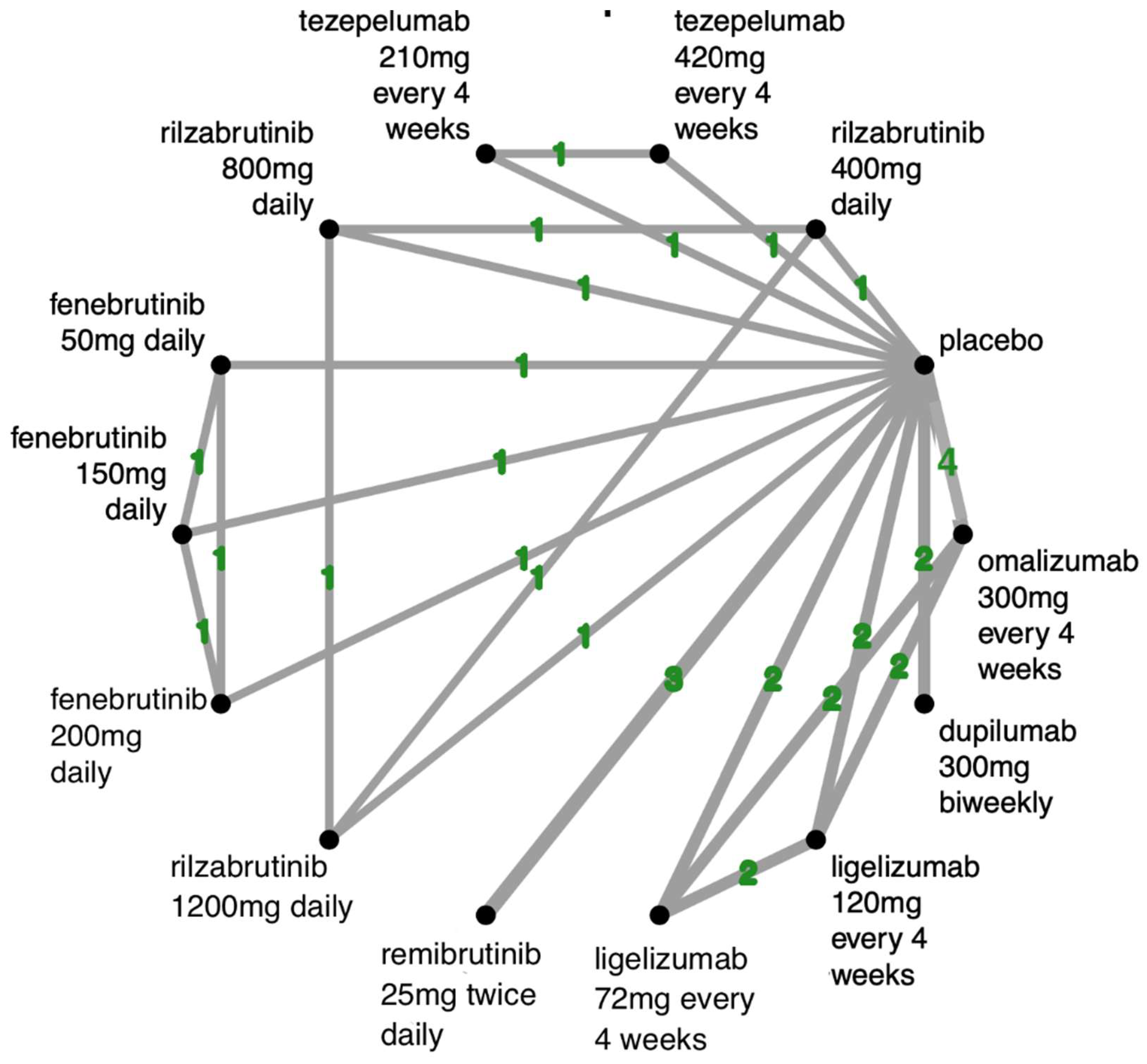
Figure 2.
Mean (95% CI) time in weeks to reach MCID for each drug and dose included in this study.
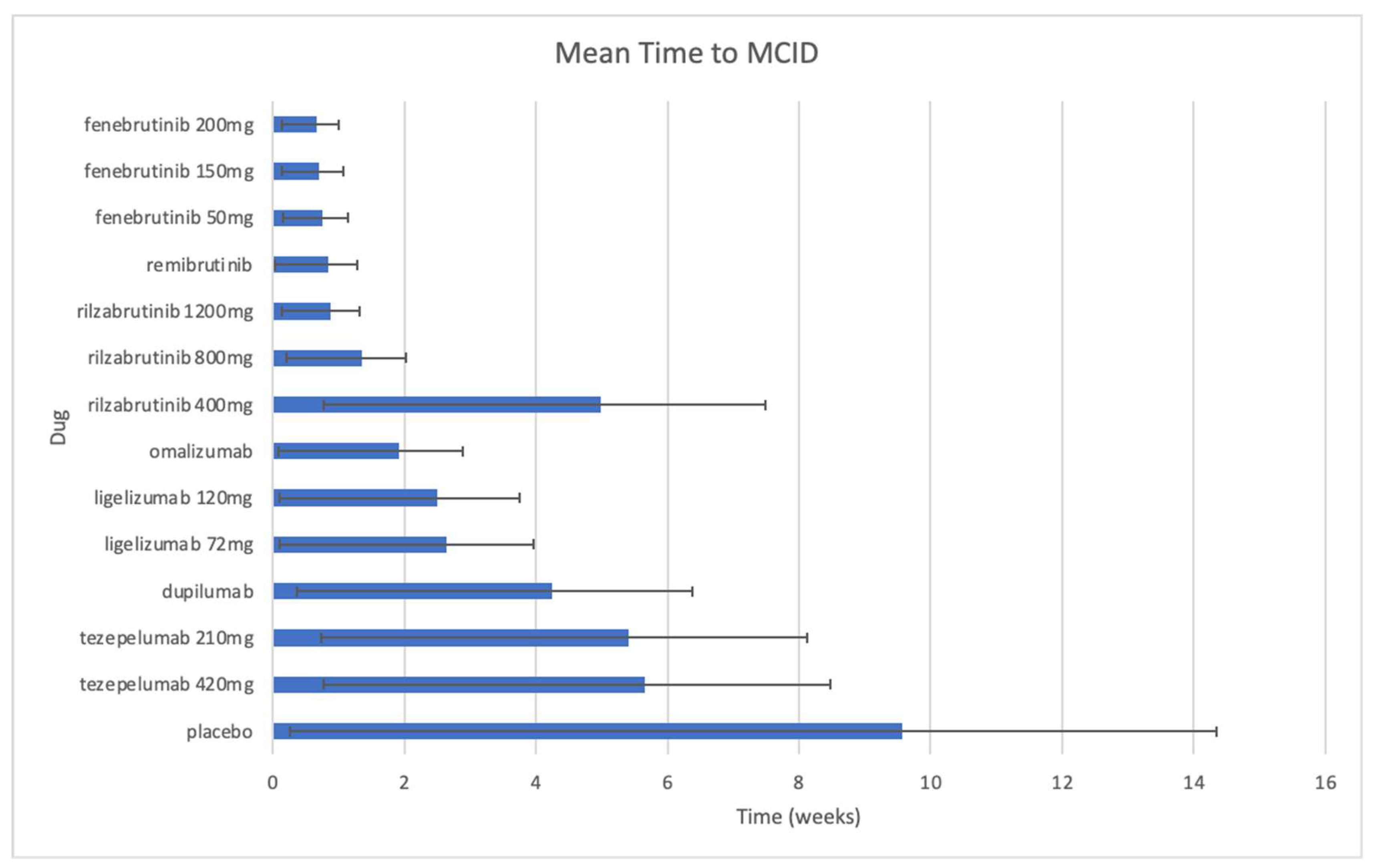
Figure 3.
Forest plot showing the mean difference in time to reach MCID for each included drug and dose compared to placebo.
Figure 3.
Forest plot showing the mean difference in time to reach MCID for each included drug and dose compared to placebo.
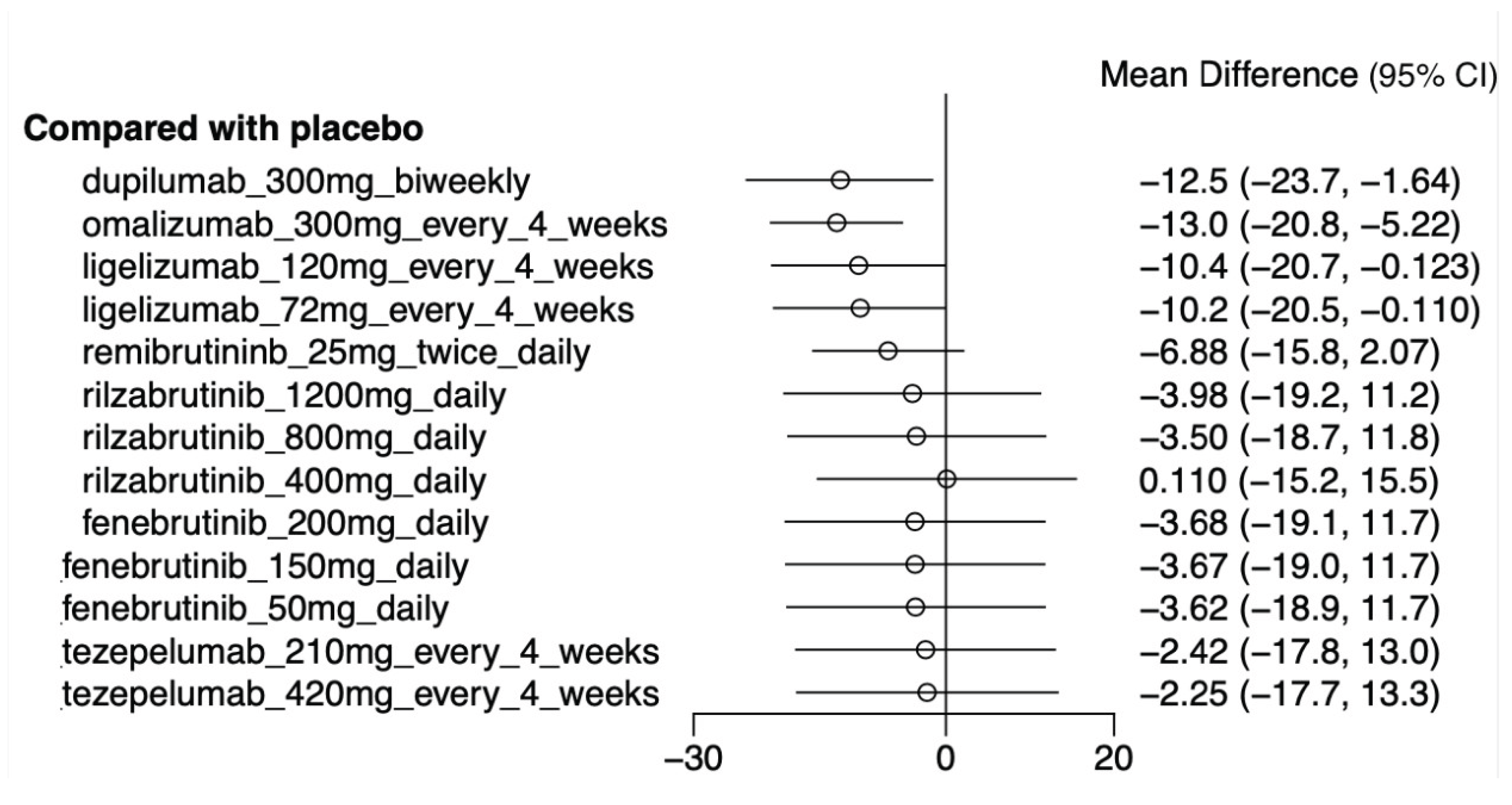

Table 1.
Studies meeting the inclusion criteria for the UAS7 analysis.
| Authors | Article Title | Met Criteria for Analysis |
|---|---|---|
| Maurer et al. [10] | Dupilumab in patients with chronic spontaneous urticaria (LIBERTY-CSU CUPID): Two randomized, double-blind, placebo-controlled, phase 3 trials. (CUPID A) | Yes |
| Maurer et al. [10] | Dupilumab in patients with chronic spontaneous urticaria (LIBERTY-CSU CUPID): Two randomized, double-blind, placebo-controlled, phase 3 trials. (CUPID B) | Yes |
| Giménez-Arnau et al. [11] | Rilzabrutinib in Antihistamine-Refractory Chronic Spontaneous Urticaria: The RILECSU Phase 2 Randomized Clinical Trial. | Yes |
| Maurer et al. [12] | Efficacy and safety of ligelizumab in adults and adolescents with chronic spontaneous urticaria: results of two phase 3 randomised controlled trials (PEARL-1 and PEARL-2). | Yes |
| Maurer et al. [12] | Efficacy and safety of ligelizumab in adults and adolescents with chronic spontaneous urticaria: results of two phase 3 randomised controlled trials (PEARL-1 and PEARL-2). | Yes |
| Saini et al. [13] | Efficacy and Safety of Omalizumab in Patients With Chronic Idiopathic/Spontaneous Urticaria Who Remain Symptomatic on H1 Antihistamines: A Randomized, Placebo-Controlled Study (ASTERIA I) | Yes |
| Kaplan et al. [14] | Omalizumab in patients with symptomatic chronic idiopathic/spontaneous urticaria despite standard combination therapy (GLACIAL) | Yes |
| Maurer et al. [15] | Remibrutinib, a novel BTK inhibitor, demonstrates promising efficacy and safety in chronic spontaneous urticaria | Yes |
| Metz et al. [16] | Remibrutinib in Chronic Spontaneous Urticaria (REMIX-1) | Yes |
| Metz et al. [16] | Remibrutinib in Chronic Spontaneous Urticaria (REMIX-2) | Yes |
| McLaren et al. [17] | Tezepelumab for the treatment of chronic spontaneous urticaria: Results of the phase 2b INCEPTION study | Yes |
| Metz et al. [18] | Fenebrutinib in H1 antihistamine-refractory chronic spontaneous urticaria: a randomized phase 2 trial | Yes |
| Maurer et al. [19] | Ligelizumab for Chronic Spontaneous Urticaria | No |
| Maurer et al. [20] | Omalizumab for the Treatment of Chronic Idiopathic or Spontaneous Urticaria (ASTERIA II) | No |
| Saini et al. [21] | A randomized, placebo-controlled, dose-ranging study of single-dose omalizumab in patients with H1-antihistamine-refractory chronic idiopathic urticaria | No |
| Altrichter at al. [22] | An open-label, proof-of-concept study of lirentelimab for antihistamine-resistant chronic spontaneous and inducible urticaria | No |
Disclaimer/Publisher’s Note: The statements, opinions and data contained in all publications are solely those of the individual author(s) and contributor(s) and not of MDPI and/or the editor(s). MDPI and/or the editor(s) disclaim responsibility for any injury to people or property resulting from any ideas, methods, instructions or products referred to in the content. |
© 2026 by the authors. Licensee MDPI, Basel, Switzerland. This article is an open access article distributed under the terms and conditions of the Creative Commons Attribution (CC BY) license (http://creativecommons.org/licenses/by/4.0/).
Copyright: This open access article is published under a Creative Commons CC BY 4.0 license, which permit the free download, distribution, and reuse, provided that the author and preprint are cited in any reuse.


