

Submitted:
19 April 2026
Posted:
23 April 2026
You are already at the latest version
Abstract
Background/Objectives: The optimal upfront modality selection for real-world aneurysmal subarachnoid hemorrhage (aSAH) remains uncertain. This study evaluated the clinical outcomes associated with an institutional practice change from an endovascular treatment (EVT)-first approach to a more individualized upfront modality-selection strategy. Methods: This single-center retrospective before-and-after cohort study included consecutive patients with aSAH who underwent aneurysm securing during two fixed time periods (pre-change: 1 May 2023 to 31 July 2024; post-change: 1 August 2024 to 31 October 2025). The primary outcome was a favorable 90-day modified Rankin Scale (mRS) score of 0–2. The primary adjusted analysis used Firth penalized logistic regression with adjustment for age (per 10-year increase), pre-morbid mRS ≥ 2, and admission World Federation of Neurosurgical Societies (WFNS) grade IV–V. Conventional logistic regression was performed as a sensitivity analysis. The full 90-day mRS distribution (0–6) was also evaluated using an adjusted proportional odds model. Results: A total of 104 patients were included (pre-change, n = 48; post-change, n = 56). The distribution of securing modalities changed substantially between the two periods (EVT, 79.2% vs. 37.5%; microsurgery, 20.8% vs. 62.5%; p < 0.001). Favorable outcomes occurred in 25/48 patients (52.1%) in the pre-change period and 36/56 patients (64.3%) in the post-change period (p = 0.235). In adjusted analyses, the post-change period was associated with higher odds of a favorable outcome (adjusted odds ratio [aOR], 3.82; 95% confidence interval [CI], 1.31–12.79; p = 0.009), consistent with the sensitivity analysis (aOR, 4.41; 95% CI, 1.43–15.95; p = 0.009). Shift analysis also favored the post-change period (adjusted common OR, 2.36; 95% CI, 1.15–4.91; p = 0.021). Secondary outcomes and perioperative complications were similar between the two periods. Conclusions: In this single-center retrospective before-and-after study, an institutional practice change toward more individualized upfront modality selection was associated with more favorable adjusted 90-day functional outcomes in patients with aSAH. These findings support the potential clinical relevance of individualized modality selection in real-world aSAH management, although confirmation in multicenter studies is warranted.
Keywords:
aneurysmal subarachnoid hemorrhage
; endovascular treatment
; microsurgery
; individualized modality selection
; functional outcome
1. Introduction
Endovascular treatment (EVT) has become increasingly common for aneurysmal subarachnoid hemorrhage (aSAH), supported by pivotal randomized evidence demonstrating favorable outcomes in selected patients [1,2]. In many healthcare systems, this trend has accelerated with advances in microcatheters, coils, adjunctive techniques, and periprocedural imaging, as well as the less invasive nature of EVT and its potential for shorter procedural times [3,4]. In contemporary practice, EVT now accounts for a substantial proportion of aneurysm-securing procedures worldwide; notably, in the international phase 3 REACT trial, 70.0% of patients underwent endovascular coiling, compared with 30.0% who underwent surgical clipping [5].
However, the external validity of randomized trial findings in contemporary real-world populations with aSAH remains a concern. Older patients, those presenting with poor-grade aSAH, and those with concomitant intracerebral hemorrhage (ICH) are often underrepresented in classic trial cohorts [6], although they constitute a substantial proportion of patients treated in routine practice. In this setting, the clinically relevant question extends beyond “EVT versus microsurgery” [7] and instead focuses on identifying the most appropriate securing modality for each patient according to clinical condition and aneurysm morphology. ISAT, for example, predominantly enrolled patients in relatively good clinical condition whose aneurysms were considered suitable for either modality, and its findings cannot necessarily be generalized to all poor-grade or anatomically complex ruptured aneurysms [7,8].
Practically, EVT and microsurgery have complementary advantages. Microsurgery can enable immediate hematoma evacuation and intracranial pressure control when needed and may be advantageous for certain aneurysm locations and configurations [9,10]. Conversely, EVT can avoid surgical exposure and may be preferred for anatomically accessible lesions during clinically vulnerable periods, such as the vasospasm window or in recurrent aneurysms [11,12]. These considerations support individualized modality selection based on clinical status and aneurysm anatomy. At the same time, because EVT has become the first-line treatment in many centers, institutional treatment defaults may influence upfront modality selection, even when some aneurysms retain characteristics more amenable to microsurgery.
Nevertheless, evidence regarding the clinical outcomes associated with changes in upfront modality selection in contemporary real-world aSAH care remains limited. Therefore, this study evaluated the functional outcomes and key secondary events associated with an institutional practice change from an EVT-first approach to a more individualized upfront modality-selection strategy using a retrospective before-and-after design with fixed time windows. We hypothesized that a shift toward more individualized modality selection would be associated with more favorable functional outcomes. This question is particularly relevant in aging populations and in centers managing a substantial proportion of poor-grade presentations [13,14].
2. Materials and Methods
2.1. Study Design and Setting
This single-center, retrospective, before-and-after cohort study was conducted at Iwate Prefectural Central Hospital (Morioka, Japan) to evaluate the clinical outcomes associated with an institutional practice change in upfront modality selection for aSAH. Consecutive patients who underwent aneurysm securing during two pre-specified fixed time windows were included. Two consecutive 15-month periods were analyzed: 1 May 2023 to 31 July 2024 (pre-change) and 1 August 2024 to 31 October 2025 (post-change). Service organization and resource availability were broadly stable across the two periods, except for the institutional practice change in upfront modality selection. In both periods, our institution had three surgeons capable of performing both EVT and microsurgery.
2.2. Participants
Consecutive patients with aSAH who underwent aneurysm securing procedures during the study period were included. Patients who died in the emergency department and those without brainstem reflexes at initial examination were excluded.
2.3. Treatment Strategy
During the pre-change period, an EVT-first strategy was employed as the default approach for upfront treatment planning. Microsurgery was selected for the following predefined situations: (1) very small aneurysms considered technically unfavorable for EVT; (2) ICH with impending herniation requiring urgent intracranial pressure control and hematoma management; and (3) internal carotid artery (ICA) blister-like aneurysms requiring bypass-assisted trapping.
During the post-change period, the upfront treatment-selection pathway was revised to promote more individualized modality selection based on clinical condition and aneurysm anatomy. EVT and microsurgery were considered alternative first-line options, and the securing modality was selected according to clinical condition and aneurysm anatomy. In general, microsurgery was preferentially selected for patients with middle cerebral artery aneurysms and ICH on admission [9,10]. EVT was preferentially selected during the vasospasm window (days 4–14 from symptom onset) [11], for recurrent aneurysms [15], and for posterior circulation aneurysms [3,16] when endovascular access was feasible. If EVT was initially intended but was deemed infeasible after anesthesia induction and diagnostic cerebral angiography, the treatment approach was converted to microsurgery. For analysis, patients were classified according to the treatment actually performed. Microsurgery included clipping and, when required, trapping and/or bypass-assisted procedures. EVT referred to coil embolization with adjunctive techniques as needed.
2.4. Outcomes
The primary outcome was a favorable functional outcome at 90 days, defined as a modified Rankin Scale (mRS) score of 0–2. mRS scores were abstracted by a single investigator from routine clinical records. These records had been documented in routine practice by the treating physicians, with at least four different physicians involved during the study period. For patients transferred to another hospital, functional outcome data were obtained from activities of daily living (ADL) records documented at the receiving institution. The full 90-day mRS distribution (0–6) was also analyzed to evaluate the overall shift in disability.
Secondary outcomes and perioperative events included procedure-related complications, delayed cerebral ischemia (DCI) [17], shunt-dependent hydrocephalus, and imaging-confirmed aneurysm recurrence detected within the first 3 months of follow-up. Procedure-related complications were defined as adverse events occurring intraoperatively or within 30 days after aneurysm securing.
In this study, DCI was defined as a new neurological deficit not attributable to other identifiable causes, with radiographic vasospasm evaluated as a related supportive finding when present. Rescue treatments included intrathecal nicardipine and/or endovascular therapy (percutaneous transluminal angioplasty or intra-arterial papaverine hydrochloride administration). Shunt-dependent hydrocephalus was defined as symptomatic hydrocephalus requiring permanent cerebrospinal fluid diversion in patients with ventriculomegaly on imaging and compatible symptoms (e.g., cognitive decline, gait disturbance, and/or urinary incontinence).
Aneurysm recurrence was assessed using follow-up vascular imaging performed within 3 months after aneurysm securing, including magnetic resonance angiography, computed tomography angiography, or digital subtraction angiography. Follow-up vascular imaging was routinely planned within 3 months of aneurysm securing for all treated patients, although occasional deviations may have occurred.
2.5. Statistical Analysis
Continuous variables are reported as mean (standard deviation [SD]) and categorical variables as n (%). Between-group comparisons were performed using Welch’s t-test for continuous variables and Fisher’s exact test for categorical variables, as appropriate. All tests were two-sided, and p < 0.05 was considered statistically significant.
For the primary outcome (90-day mRS 0–2), multivariable logistic regression with Firth penalized likelihood was used as the primary analysis to mitigate small-sample bias and potential separation [21,22]. The exposure of interest was the study period (post-change vs. pre-change). Prespecified covariates were age (per 10-year increase), pre-morbid functional status (pre-mRS ≥ 2), and admission clinical severity (World Federation of Neurosurgical Societies [WFNS] grades IV–V). Adjusted odds ratios (aORs) with 95% confidence intervals (CIs) are reported. As a sensitivity analysis, the model was repeated using conventional (maximum likelihood) logistic regression with the same covariates.
For the 90-day mRS shift analysis (0–6), an ordinal logistic regression model under the proportional odds assumption was used, and the adjusted common OR with 95% CI was reported.
Statistical analyses were performed using JMP Student Edition (SAS Institute, Cary, NC, USA). Figures were prepared using Microsoft PowerPoint (Microsoft Corp., Redmond, WA, USA) and GraphPad Prism 10 (GraphPad Software, San Diego, CA, USA).
3. Results
3.1. Study Population and Treatment Selection
A total of 104 patients with aSAH who underwent aneurysm securing were included in this study (pre-change, n = 48; post-change, n = 56). Following the institutional practice change in upfront modality selection, the distribution of securing modalities changed substantially. The number of EVT procedures decreased from 38/48 (79.2%) to 21/56 (37.5%), whereas the number of microsurgical procedures increased from 10/48 (20.8%) to 35/56 (62.5%) (p < 0.001). During the post-change period, the intended endovascular approach was converted to microsurgery after anesthesia induction and diagnostic cerebral angiography in 1/56 patients (1.8%) (Figure 1).
3.2. Baseline Characteristics
The baseline patient characteristics are presented in Table 1. The mean age was similar between periods [65.5 (15.0) vs. 65.4 (14.1) years; p = 0.960], as was the proportion of female patients [36/48 (75.0%) vs. 42/56 (75.0%); p = 1.000]. The vascular risk factors and admission severity measures were broadly comparable, including WFNS grades IV–V [14/48 (29.2%) vs. 23/56 (41.1%); p = 0.225], modified Fisher grades 3–4 [30/48 (62.5%) vs. 30/56 (53.6%); p = 0.427], and ICH upon admission [15/48 (31.2%) vs. 13/56 (23.2%); p = 0.383]. The aneurysm location did not differ between the periods (p = 0.649).
3.3. Primary Outcome (90-Day mRS 0–2)
A favorable functional outcome at 90 days (mRS 0–2) was observed in 25/48 (52.1%) patients in the pre-change period and 36/56 (64.3%) patients in the post-change period (p = 0.235). In the prespecified multivariable analysis using Firth penalized logistic regression (adjusted for age per 10-year increase, pre-morbid mRS ≥ 2, and admission WFNS grades IV–V), the post-change period was associated with higher odds of a favorable outcome (aOR 3.82, 95% CI 1.31–12.79; p = 0.009) (Table 2). Findings were consistent in the sensitivity analysis using conventional logistic regression (aOR 4.41, 95% CI 1.43–15.95; p = 0.009). Older age (per 10-year increase) and admission WFNS grades IV–V were also associated with lower odds of a favorable outcome (Table 2).
3.4. Shift Analysis of 90-Day mRS (0–6)
The distribution of 90-day mRS scores (0–6) is shown in Figure 2. In an adjusted proportional odds model (ordinal logistic regression) including age (per 10-year increase), admission WFNS grades IV–V, and pre-morbid mRS ≥ 2, the post-change period was associated with an overall shift toward better functional outcome compared with the pre-change period (adjusted common OR 2.36, 95% CI 1.15–4.91; p = 0.021). A descriptive subgroup analysis stratified by admission WFNS grade is shown in Figure 3. Among patients with WFNS grades I–III, favorable outcomes (mRS 0–2) were numerically more frequent in the post-change period (29/33 [87.9%] vs. 23/34 [67.6%]; p = 0.077). Among patients with WFNS grades IV–V, favorable outcomes were also numerically more frequent (7/23 [30.4%] vs. 2/14 [14.2%]; p = 0.434).
3.5. Secondary Outcomes and Perioperative Events
The secondary outcomes and perioperative events are summarized in Table 3. No statistically significant between-period differences were observed in perioperative complications (7/48 [14.6%] vs. 6/56 [10.7%]; p = 0.569), DCI (8/48 [16.7%] vs. 7/56 [12.5%]; p = 0.586), or cerebrospinal fluid drainage within 0–14 days after symptom onset (30/48 [62.5%] vs. 39/56 [69.6%]; p = 0.533). Clazosentan use within 0–14 days after symptom onset was also similar (34/48 [70.8%] vs. 41/56 [73.2%]; p = 0.829), as were shunt-dependent hydrocephalus (13/48 [27.1%] vs. 16/56 [28.6%]; p = 1.000) and imaging-confirmed aneurysm recurrence detected within the first 3 months of follow-up (7/48 [14.6%] vs. 4/56 [7.1%]; p = 0.338). The distribution of complication types is provided in Supplementary Table S1.
4. Discussion
In this single-center retrospective before-and-after study, an institutional practice change from an EVT-first approach to a more individualized upfront modality-selection strategy was associated with more favorable adjusted 90-day functional outcomes in patients with aSAH. This association was observed in both the dichotomized analysis of favorable outcome (mRS 0–2) and the ordinal shift analysis of the full 90-day mRS distribution.
Since the publication of the International Subarachnoid Aneurysm Trial, EVT has become increasingly common in the treatment of aSAH [1,23]. However, concerns remain regarding the generalizability of randomized trial findings to contemporary real-world practice, particularly because older patients and those with poor-grade presentations are underrepresented in classic trial populations [13,14]. Our cohort reflects routine care during 2023–2025 and includes a substantial proportion of older patients and patients with poor-grade aSAH. In this context, our findings support the potential clinical relevance of individualized upfront modality selection rather than reliance on a single default modality. This issue is increasingly relevant as the aSAH population ages and centers encounter greater heterogeneity in frailty, baseline function, and hemorrhage severity [13,14]. Thus, these findings may complement trial evidence by addressing a pragmatic question in routine care: how the initial securing modality is selected when both EVT and microsurgery are available.
When interpreting these results, the difference between the unadjusted and adjusted analyses should be considered carefully. Although baseline characteristics were broadly similar between periods, the post-change cohort included a higher proportion of patients with poor-grade presentations, which may have biased the unadjusted comparison toward worse outcomes. Adjustment for prespecified prognostic factors, including age, admission WFNS grade, and pre-morbid function, may have reduced part of this imbalance and clarified the association between study period and outcome. At the same time, because of the modest sample size and limited number of outcome events, the adjusted estimates should be interpreted with caution.
Although statistically significant between-period differences were not observed for individual secondary outcomes, the post-change period was associated with more favorable adjusted functional outcomes and a favorable overall mRS shift. This pattern may suggest that the observed association was not driven by a single measurable downstream complication. However, given the observational design and limited sample size, this interpretation should remain cautious. It is possible that more individualized modality selection contributed to better alignment between patient condition, aneurysm anatomy, and the securing modality chosen [9,10,11,12], but this mechanism cannot be directly established from the present data.
The subgroup findings shown in Figure 3 should also be interpreted cautiously. Among patients with WFNS grades I–III, favorable outcome was numerically more frequent in the post-change period, but this difference did not reach statistical significance. A similar pattern was observed among patients with WFNS grades IV–V. Because these analyses were descriptive and based on relatively small numbers, they should not be overinterpreted. Rather, they provide supportive context for the overall findings.
This study has several limitations. As a retrospective single-center before-and-after study, the results may have been influenced by secular trends, time-varying co-interventions, and unmeasured confounding factors, and generalizability may vary across institutions. Although consecutive patients were included within prespecified fixed time windows and major vasospasm-related management variables were reported, concurrent changes in ICU care, perioperative management, endovascular practice, or team experience cannot be fully excluded. In addition, 90-day functional outcomes were abstracted from routine clinical records, and outcome assessment was not blinded. For patients transferred to another hospital, outcome data were obtained from ADL records at the receiving institution, which may have introduced additional heterogeneity in outcome ascertainment. Furthermore, because of the modest sample size, the precision and stability of the adjusted estimates are limited. Despite these limitations, the present study provides pragmatic real-world data on how an institutional practice change in upfront modality selection was associated with functional outcomes in contemporary aSAH care.
In summary, an institutional practice change toward more individualized upfront modality selection was associated with more favorable adjusted 90-day functional outcomes in this real-world aSAH cohort. These findings support the potential clinical relevance of individualized modality selection in routine aSAH care, particularly in aging populations and in centers managing a substantial proportion of poor-grade presentations, although confirmation in multicenter studies is warranted.
5. Conclusions
In this contemporary real-world aSAH cohort, an institutional practice change toward more individualized upfront modality selection was associated with more favorable adjusted 90-day functional outcomes. These findings support the potential clinical relevance of individualized modality selection in routine aSAH care, although confirmation in multicenter studies is warranted.
Supplementary Materials
The following supporting information can be downloaded at the website of this paper posted on Preprints.org, Supplementary Table S1: Distribution of complication types.
Author Contributions
Conceptualization, A.N. and K.U.; data curation, A.N. and R.S.; formal analysis, A.N.; investigation, A.N. and K.U.; supervision, H.E.; writing—original draft preparation, A.N.; writing—review and editing, all authors. All authors have read and agreed to the published version of the manuscript.
Funding
This research received no external funding.
Institutional Review Board Statement
The study was approved by the Institutional Review Board of Iwate Prefectural Central Hospital. (approval Code: No. 130; approval Date: 14 April 2026).
Informed Consent Statement
Patient consent was waived because of the retrospective observational design of the study and the use of anonymized clinical data.
Data Availability Statement
The data presented in this study are available from the corresponding author on reasonable request. The data are not publicly available because of privacy and institutional restrictions.
Acknowledgments
We thank Editage (www.editage.jp) for English language editing.
Conflicts of Interest
The authors declare no conflicts of interest.
References
- Molyneux, A.; Kerr, R.; Stratton, I.; Sandercock, P.; Clarke, M.; Shrimpton, J.; Holman, R.; International Subarachnoid Aneurysm Trial (ISAT) Collaborative Group. International Subarachnoid Aneurysm Trial (ISAT) of Neurosurgical Clipping versus Endovascular Coiling in 2143 Patients with Ruptured Intracranial Aneurysms: A Randomised Trial. Lancet 2002, 360, 1267–1274. [Google Scholar] [CrossRef]
- Molyneux, A.J.; Kerr, R.S.C.; Yu, L.-M.; Clarke, M.; Sneade, M.; Yarnold, J.A.; Sandercock, P.; International Subarachnoid Aneurysm Trial (ISAT) Collaborative Group. International Subarachnoid Aneurysm Trial (ISAT) of Neurosurgical Clipping versus Endovascular Coiling in 2143 Patients with Ruptured Intracranial Aneurysms: A Randomised Comparison of Effects on Survival, Dependency, Seizures, Rebleeding, Subgroups, and Aneurysm Occlusion. Lancet 2005, 366, 809–817. [Google Scholar] [CrossRef]
- Hoh, B.L.; Ko, N.U.; Amin-Hanjani, S.; Chou, S.H.-Y.; Cruz-Flores, S.; Dangayach, N.S.; Derdeyn, C.P.; Du, R.; Hänggi, D.; Hetts, S.W.; et al. 2023 Guideline for the Management of Patients With Aneurysmal Subarachnoid Hemorrhage: A Guideline From the American Heart Association/American Stroke Association. Stroke 2023, 54, e314–e370. [Google Scholar] [CrossRef]
- Robba, C.; Busl, K.M.; Claassen, J.; Diringer, M.N.; Helbok, R.; Park, S.; Rabinstein, A.; Treggiari, M.; Vergouwen, M.D.I.; Citerio, G. Contemporary Management of Aneurysmal Subarachnoid Haemorrhage. An Update for the Intensivist. Intensive Care Med. 2024, 50, 646–664. [Google Scholar] [CrossRef] [PubMed]
- Mayer, S.A.; Bruder, N.; Citerio, G.; Defreyne, L.; Dubois, C.; Gupta, R.; Higashida, R.; Marr, A.; Nguyen, T.N.; Roux, S.; et al. REACT: A Randomized Trial to Assess the Efficacy and Safety of Clazosentan for Preventing Clinical Deterioration Due to Delayed Cerebral Ischemia after Aneurysmal Subarachnoid Hemorrhage. J. Neurosurg. 2025, 142, 98–109. [Google Scholar] [CrossRef] [PubMed]
- Darsaut, T.E.; Jack, A.S.; Kerr, R.S.; Raymond, J. International Subarachnoid Aneurysm Trial—ISAT Part II: Study Protocol for a Randomized Controlled Trial. Trials 2013, 14, 156. [Google Scholar] [CrossRef]
- De Winkel, J.; Roozenbeek, B.; Dijkland, S.A.; Dammers, R.; Van Doormaal, P.-J.; Van Der Jagt, M.; Van Klaveren, D.; Dippel, D.W.J.; Lingsma, H.F. Endovascular versus Neurosurgical Aneurysm Treatment: Study Protocol for the Development and Validation of a Clinical Prediction Tool for Individualised Decision Making. BMJ Open 2022, 12, e065903. [Google Scholar] [CrossRef] [PubMed]
- Schatlo, B.; Fathi, A.-R.; Fandino, J. Management of Aneurysmal Subarachnoid Haemorrhage. Swiss Med. Wkly. 2014, 144, w13934. [Google Scholar] [CrossRef]
- Salaud, C.; Hamel, O.; Riem, T.; Desal, H.; Buffenoir, K. Management of Aneurysmal Subarachnoid Haemorrhage with Intracerebral Hematoma: Is There an Indication for Coiling First? Study of 44 Cases. Interv. Neuroradiol. 2016, 22, 5–11. [Google Scholar] [CrossRef]
- Bohnstedt, B.N.; Nguyen, H.S.; Kulwin, C.G.; Shoja, M.M.; Helbig, G.M.; Leipzig, T.J.; Payner, T.D.; Cohen-Gadol, A.A. Outcomes for Clip Ligation and Hematoma Evacuation Associated with 102 Patients with Ruptured Middle Cerebral Artery Aneurysms. World Neurosurg. 2013, 80, 335–341. [Google Scholar] [CrossRef]
- Koiso, T.; Satow, T.; Hamano, E.; Nishimura, M.; Takahashi, J.C.; Kataoka, H. Coiling for Ruptured Aneurysms in the Vasospasm Period: Safety and Efficacy Based on a Propensity Score Analysis. J. Neuroendovascular Ther. 2022, 16, 141–146. [Google Scholar] [CrossRef]
- Li, W.; Zhu, W.; Sun, X.; Liu, J.; Wang, Y.; Wang, K.; Zhang, Y.; Yang, X.; Zhang, Y. Retreatment With Flow Diverters and Coiling for Recurrent Aneurysms After Initial Endovascular Treatment: A Propensity Score-Matched Comparative Analysis. Front. Neurol. 2021, 12, 625652. [Google Scholar] [CrossRef]
- Ohkuma, H.; Shimamura, N.; Naraoka, M.; Katagai, T. Aneurysmal Subarachnoid Hemorrhage in the Elderly over Age 75: A Systematic Review. Neurol. Med.-Chir. (Tokyo) 2017, 57, 575–583. [Google Scholar] [CrossRef]
- Goldberg, J.; Schoeni, D.; Mordasini, P.; Z’Graggen, W.; Gralla, J.; Raabe, A.; Beck, J.; Fung, C. Survival and Outcome After Poor-Grade Aneurysmal Subarachnoid Hemorrhage in Elderly Patients. Stroke 2018, 49, 2883–2889. [Google Scholar] [CrossRef] [PubMed]
- da Silva Júnior, N.R.; Trivelato, F.P.; Nakiri, G.S.; Rezende, M.T.S.; de Castro-Afonso, L.H.; Abud, T.G.; Vanzin, J.R.; Manzato, L.B.; Ulhôa, A.C.; Abud, D.G.; et al. Endovascular Treatment of Residual or Recurrent Intracranial Aneurysms after Surgical Clipping. J. Cerebrovasc. Endovasc. Neurosurg. 2021, 23, 221–232. [Google Scholar] [CrossRef] [PubMed]
- Fraser, J.F.; Heit, J.J.; Mascitelli, J.R.; Tsai, J.P. Decoding the Data: A Comment on the American Heart Association/American Stroke Association (AHA/ASA) 2023 Guideline for the Management of Patients with Aneurysmal Subarachnoid Hemorrhage. J. NeuroInterv. Surg. 2023, 15, 835–837. [Google Scholar] [CrossRef] [PubMed]
- Vergouwen, M.D.I.; Vermeulen, M.; Van Gijn, J.; Rinkel, G.J.E.; Wijdicks, E.F.; Muizelaar, J.P.; Mendelow, A.D.; Juvela, S.; Yonas, H.; Terbrugge, K.G.; et al. Definition of Delayed Cerebral Ischemia After Aneurysmal Subarachnoid Hemorrhage as an Outcome Event in Clinical Trials and Observational Studies: Proposal of a Multidisciplinary Research Group. Stroke 2010, 41, 2391–2395. [Google Scholar] [CrossRef]
- Della Pepa, G.M.; Scerrati, A.; Albanese, A.; Marchese, E.; Maira, G.; Sabatino, G. Protective Effect of External Ventricular Drainage on Cerebral Vasospasm. A Retrospective Study on Aneurysmal SAH Treated Endovascularly. Clin. Neurol. Neurosurg. 2014, 124, 97–101. [Google Scholar] [CrossRef]
- Wolf, S.; Mielke, D.; Barner, C.; Malinova, V.; Kerz, T.; Wostrack, M.; Czorlich, P.; Salih, F.; Engel, D.C.; Ehlert, A.; et al. Effectiveness of Lumbar Cerebrospinal Fluid Drain Among Patients With Aneurysmal Subarachnoid Hemorrhage: A Randomized Clinical Trial. JAMA Neurol. 2023, 80, 833. [Google Scholar] [CrossRef]
- Endo, H.; Hagihara, Y.; Kimura, N.; Takizawa, K.; Niizuma, K.; Togo, O.; Tominaga, T. Effects of Clazosentan on Cerebral Vasospasm-Related Morbidity and All-Cause Mortality after Aneurysmal Subarachnoid Hemorrhage: Two Randomized Phase 3 Trials in Japanese Patients. J. Neurosurg. 2022, 137, 1707–1717. [Google Scholar] [CrossRef]
- Firth, D. Bias Reduction of Maximum Likelihood Estimates. Biometrika 1993, 80, 27–38. [Google Scholar] [CrossRef]
- Heinze, G.; Schemper, M. A Solution to the Problem of Separation in Logistic Regression. Stat. Med. 2002, 21, 2409–2419. [Google Scholar] [CrossRef] [PubMed]
- Mehta, T.; Datta, N.; Patel, S.; Mehta, K.; Hussain, M.; Kureshi, I.; Ollenschleger, M.; Nouh, A. Trends in Endovascular Treatment of Aneurysmal Subarachnoid Hemorrhages. Interv. Neurol. 2017, 6, 236–241. [Google Scholar] [CrossRef] [PubMed]
Figure 1.
Upfront modality-selection frameworks before and after an institutional practice change in aneurysmal subarachnoid hemorrhage (aSAH). Two consecutive 15-month periods were analyzed: pre-change (1 May 2023 to 31 July 2024; EVT-first) and post-change (1 August 2024 to 31 October 2025; more individualized modality selection). In the pre-change period, EVT was the default approach, with pre-specified exceptions favoring microsurgery (very small aneurysms with anticipated EVT difficulty, admission intracerebral hemorrhage with impending herniation requiring intracranial pressure control and hematoma management, and ICA blister-like aneurysms requiring bypass-assisted trapping). In the post-change period, EVT and microsurgery were considered alternative first-line options and were selected according to clinical condition and aneurysm anatomy. Conversion to microsurgery was allowed when EVT was deemed infeasible after anesthesia induction and diagnostic cerebral angiography. The figure summarizes the observed treatment modalities in each period (pre-change: EVT 38/48, microsurgery 10/48; post-change: EVT 21/56, microsurgery 35/56) and one conversion from intended EVT to microsurgery (1/56). Abbreviations: aSAH, aneurysmal subarachnoid hemorrhage; ICA, internal carotid artery; ICH, intracerebral hemorrhage; ICP, intracranial pressure; EVT, endovascular treatment; MCA, middle cerebral artery.
Figure 1.
Upfront modality-selection frameworks before and after an institutional practice change in aneurysmal subarachnoid hemorrhage (aSAH). Two consecutive 15-month periods were analyzed: pre-change (1 May 2023 to 31 July 2024; EVT-first) and post-change (1 August 2024 to 31 October 2025; more individualized modality selection). In the pre-change period, EVT was the default approach, with pre-specified exceptions favoring microsurgery (very small aneurysms with anticipated EVT difficulty, admission intracerebral hemorrhage with impending herniation requiring intracranial pressure control and hematoma management, and ICA blister-like aneurysms requiring bypass-assisted trapping). In the post-change period, EVT and microsurgery were considered alternative first-line options and were selected according to clinical condition and aneurysm anatomy. Conversion to microsurgery was allowed when EVT was deemed infeasible after anesthesia induction and diagnostic cerebral angiography. The figure summarizes the observed treatment modalities in each period (pre-change: EVT 38/48, microsurgery 10/48; post-change: EVT 21/56, microsurgery 35/56) and one conversion from intended EVT to microsurgery (1/56). Abbreviations: aSAH, aneurysmal subarachnoid hemorrhage; ICA, internal carotid artery; ICH, intracerebral hemorrhage; ICP, intracranial pressure; EVT, endovascular treatment; MCA, middle cerebral artery.
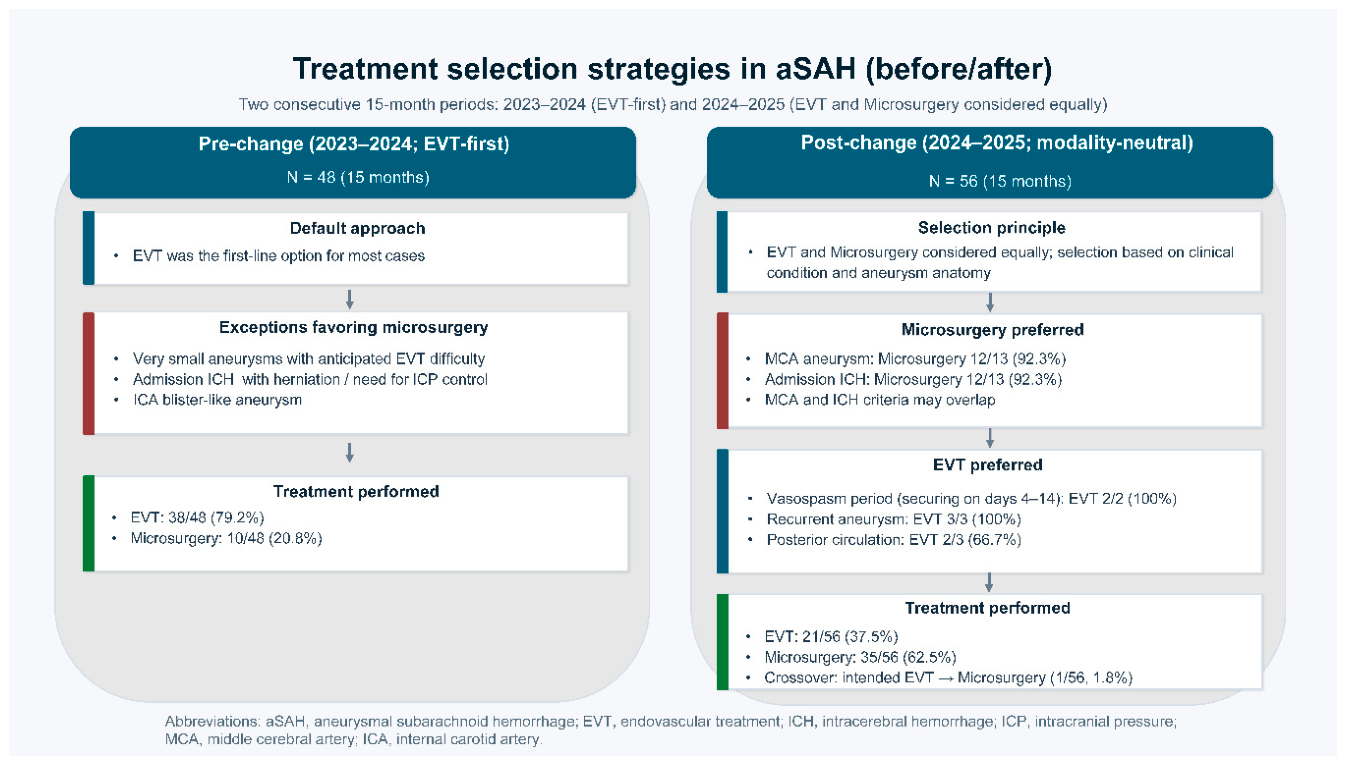
Figure 2.
Distribution of 90-day modified Rankin Scale scores before and after the institutional practice change. Stacked bar charts show the distribution of 90-day mRS scores (0–6) in the pre-change (n = 48) and post-change (n = 56) cohorts. The between-period shift was assessed using an adjusted proportional odds model (ordinal logistic regression) with covariates for age (per 10-year increase), pre-morbid mRS ≥ 2, and admission WFNS grades IV–V. Abbreviations: mRS, modified Rankin Scale; WFNS, World Federation of Neurosurgical Societies.
Figure 2.
Distribution of 90-day modified Rankin Scale scores before and after the institutional practice change. Stacked bar charts show the distribution of 90-day mRS scores (0–6) in the pre-change (n = 48) and post-change (n = 56) cohorts. The between-period shift was assessed using an adjusted proportional odds model (ordinal logistic regression) with covariates for age (per 10-year increase), pre-morbid mRS ≥ 2, and admission WFNS grades IV–V. Abbreviations: mRS, modified Rankin Scale; WFNS, World Federation of Neurosurgical Societies.
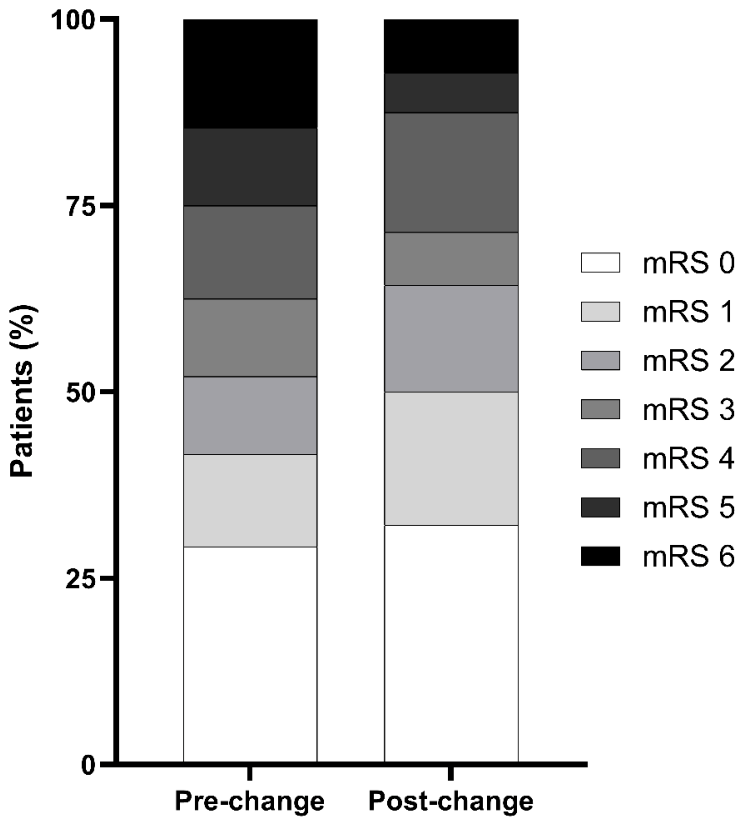
Figure 3.
Distribution of 90-day mRS scores by admission WFNS grade and study period. Stacked bar charts show the distribution of 90-day modified Rankin Scale (mRS) scores (0–6) in the pre-change (2023–2024) and post-change (2024–2025) cohorts stratified by World Federation of Neurosurgical Societies (WFNS) grade (I–III vs. IV–V). Bars represent the proportion of patients within each stratum (pre-change: WFNS I–III, n = 34; WFNS IV–V, n = 14; post-change: WFNS I–III, n = 33; WFNS IV–V, n = 23). Abbreviations: mRS, modified Rankin Scale; WFNS, World Federation of Neurosurgical Societies.
Figure 3.
Distribution of 90-day mRS scores by admission WFNS grade and study period. Stacked bar charts show the distribution of 90-day modified Rankin Scale (mRS) scores (0–6) in the pre-change (2023–2024) and post-change (2024–2025) cohorts stratified by World Federation of Neurosurgical Societies (WFNS) grade (I–III vs. IV–V). Bars represent the proportion of patients within each stratum (pre-change: WFNS I–III, n = 34; WFNS IV–V, n = 14; post-change: WFNS I–III, n = 33; WFNS IV–V, n = 23). Abbreviations: mRS, modified Rankin Scale; WFNS, World Federation of Neurosurgical Societies.
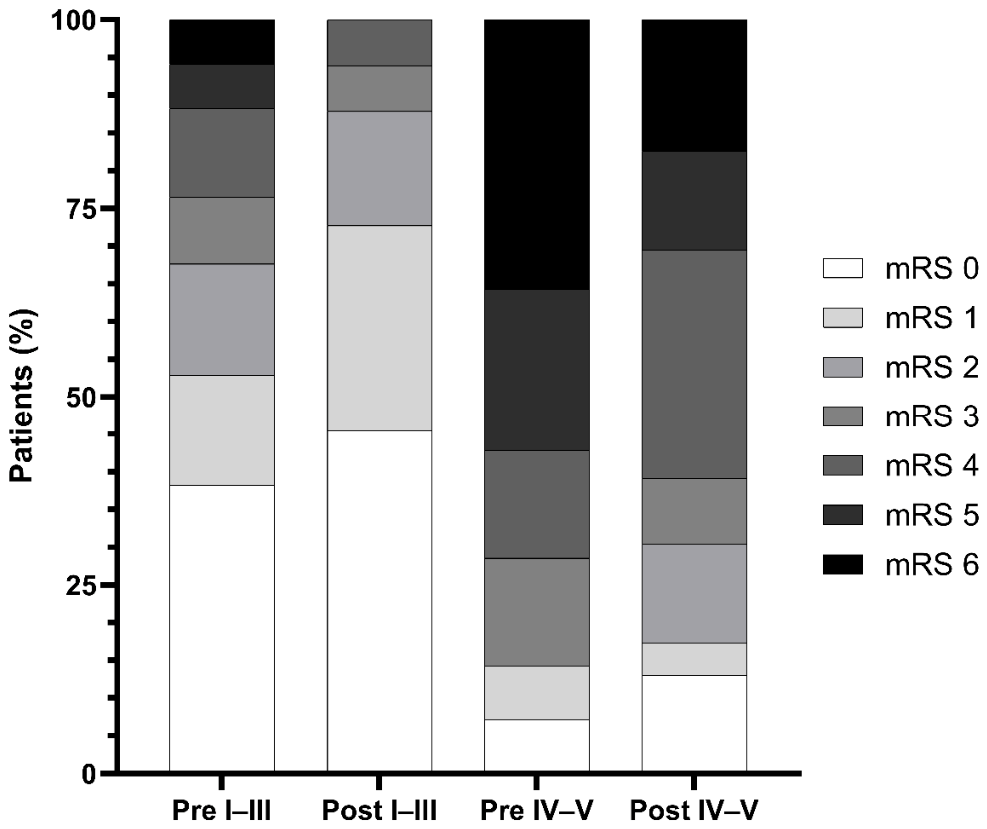

Table 1.
Baseline characteristics.
| Characteristics | Pre-Change (2023–2024) N = 48 |
Post-Change (2024–2025) N = 56 |
p Value |
|---|---|---|---|
| Age, mean (SD), years | 65.5 (15.0) | 65.4 (14.1) | 0.960 |
| Female sex | 36 (75.0%) | 42 (75.0%) | 1.000 |
| Current smoker | 16 (33.3%) | 20 (35.7%) | 0.839 |
| Hypertension | 20 (41.7%) | 22 (39.3%) | 0.843 |
| Dyslipidemia | 12 (25.0%) | 9 (16.1%) | 0.329 |
| Diabetes mellitus | 2 (4.2%) | 7 (12.5%) | 0.172 |
| WFNS grades IV–V | 14 (29.2%) | 23 (41.1%) | 0.225 |
| Modified Fisher grades 3–4 | 30 (62.5%) | 30 (53.6%) | 0.427 |
| ICH on admission | 15 (31.2%) | 13 (23.2%) | 0.383 |
| Aneurysm location | 0.649 | ||
| ACA/ACom | 15 (31.2%) | 24 (42.9%) | |
| MCA | 15 (31.2%) | 13 (23.2%) | |
| ICA | 15 (31.2%) | 16 (28.6%) | |
| Posterior circulation | 3 (6.2%) | 3 (5.4%) | |
| Treatment modality | < 0.001 | ||
| Endovascular treatment | 38 (79.2%) | 21 (37.5%) | |
| Microsurgery | 10 (20.8%) | 35 (62.5%) |
Values are presented as n (%) unless otherwise specified. p values were calculated using Welch’s t-test for age and Fisher’s exact test for categorical variables. ACA, anterior cerebral artery; ACom, anterior communicating artery; ICA, internal carotid artery; ICH, intracerebral hemorrhage; MCA, middle cerebral artery; WFNS, World Federation of Neurosurgical Societies.
Table 2.
Multivariable logistic regression for 90-day favorable outcomes.
| Variable | Contrast | Primary Analysis (Firth) aOR (95% CI) |
p Value | Sensitivity Analysis (Conventional) aOR (95% CI) |
p Value |
|---|---|---|---|---|---|
| Study period | Post-change vs. pre-change |
3.82 (1.31–12.79) | 0.009 | 4.41 (1.43–15.95) | 0.009 |
| Age | Per 10 years | 0.43 (0.25–0.66) | <0.001 | 0.39 (0.22–0.63) | <0.001 |
| Pre-morbid mRS | ≥2 vs. 0–1 | 1.12 (0.14–7.79) | 1.000 | 1.06 (0.11–8.31) | 0.955 |
| WFNS grade | IV–V vs. I–III | 0.05 (0.01–0.15) | <0.001 | 0.03 (0.01–0.12) | <0.001 |
Notes: The outcome was a 90-day favorable outcome (mRS 0–2). Models were adjusted for age (per 10-year increase), pre-morbid mRS score ≥ 2, and admission WFNS grades IV–V. The primary analysis used Firth penalized logistic regression, and the sensitivity analysis used conventional logistic regression. The total sample size was 104, and the number of favorable outcomes was 61 (pre-change, 25/48; post-change, 36/56).
Table 3.
Secondary outcomes and perioperative events.
| Outcome | Time Window | Pre-Change (2023–2024) N = 48 |
Post-Change (2024–2025) N = 56 |
p Value |
|---|---|---|---|---|
| Perioperative complications (any) | Intraoperative or within 30 days |
7 (14.6%) | 6 (10.7%) | 0.569 |
| Delayed cerebral ischemia | During hospitalization | 8 (16.7%) | 7 (12.5%) | 0.586 |
| CSF drainage (EVD or ELD) |
Used within 0–14 days from onset | 30 (62.5%) | 39 (69.6%) | 0.533 |
| Clazosentan use | Administered within 0–14 days from onset | 34 (70.8%) | 41 (73.2%) | 0.829 |
| Shunt-dependent hydrocephalus | Requiring permanent CSF diversion | 13 (27.1%) | 16 (28.6%) | 1.000 |
| Aneurysm recurrence | Imaging-confirmed within 3 months after aneurysm securing | 7 (14.6%) | 4 (7.1%) | 0.338 |
Values are presented as n (%). p-values were calculated using two-sided Fisher’s exact test. See the Methods Section for outcome definitions and time windows. CSF, cerebrospinal fluid; EVD, external ventricular drainage; ELD, external lumbar drainage.
Disclaimer/Publisher’s Note: The statements, opinions and data contained in all publications are solely those of the individual author(s) and contributor(s) and not of MDPI and/or the editor(s). MDPI and/or the editor(s) disclaim responsibility for any injury to people or property resulting from any ideas, methods, instructions or products referred to in the content. |
© 2026 by the authors. Licensee MDPI, Basel, Switzerland. This article is an open access article distributed under the terms and conditions of the Creative Commons Attribution (CC BY) license (http://creativecommons.org/licenses/by/4.0/).
Copyright: This open access article is published under a Creative Commons CC BY 4.0 license, which permit the free download, distribution, and reuse, provided that the author and preprint are cited in any reuse.


