

Submitted:
27 April 2026
Posted:
28 April 2026
You are already at the latest version
Abstract
Zucchelli and Smith described a biomathematical fatigue model for recreational passage-making — the Integrated Fatigue Model (IFM) — with output expressed as a blood-alcohol-concentration (BAC) equivalence anchored on Dawson and Reid (1997). The IFM reproduces the dose-response using simpler linear extrapolations for multi-day fatigue accumulation and a simpler pre-departure accounting; Zucchelli and Smith calibrated and validated the IFM primarily on passages of two days or less. This paper extends the scientific treatment to multi-day offshore passage-making: transits of 48 hours and longer, non-rested departures, and short-handed watch-rotation choices. The engine is rebuilt on the McCauley–Ramakrishnan unified model — a two-state framework with fast homeostatic S and slow allostatic L — and recalibrated against the Dawson–Reid 17 h / 24 h anchors so the BAC output is preserved. Maritime tuning combines sea-state and fragmentation effects multiplicatively on the sleep time constant, yielding effective τs from 4.9 h (calm + deep at sea) to 25.5 h (storm + fragmented); the 4.2 h shore-laboratory baseline is not reachable at sea in the current calibration. A combinatorial consequence — the circadian-burden-distribution property of crew-rotation cycles whose length is coprime with the crew size — formalises the effectiveness of the Swedish watch system.
Keywords:
biomathematical fatigue model
; multi-day offshore passage-making
; watch rotation
; McCauley–Ramakrishnan two-state model
; BAC equivalence
; short-handed sailing
; circadian burden
; maritime safety
1. Introduction
Zucchelli and Smith (2026) synthesised three decades of peer-reviewed evidence into the Integrated Fatigue Model (IFM), resting on the Dawson–Reid BAC equivalence (Dawson & Reid, 1997; Williamson & Feyer, 2000), the Folkard–Åkerstedt three-process framework (Folkard & Åkerstedt, 1987; Åkerstedt & Folkard, 1997), Bonnet fragmentation (Bonnet, 1987; Bonnet & Arand, 2003), Hystad–Eid sea-state coefficients (Hystad & Eid, 2016), and the Van Dongen cumulative-sleep-debt findings (Van Dongen et al., 2003).
The present paper extends the scientific treatment of the IFM — which uses simpler linear extrapolations for multi-day fatigue accumulation and a simpler pre-departure accounting — to the passages that recreational sailors most commonly plan when crossing the limits of short coastal work: legs of two days or more, departures that follow a period of irregular pre-passage sleep, and the choice of watch rotation on short-handed crews. Within its primary validation horizon the IFM continues to describe the dose-response relationships accurately; the extension below addresses regimes that lie outside it.
The scope extension consists of three elements: (i) the adoption of the two-state dynamical system of McCauley et al. (McCauley et al., 2009; McCauley et al., 2013) as the engine of the fatigue scale, preserving the BAC-equivalence output units of Zucchelli and Smith (2026) by recalibration against the Dawson–Reid anchors; (ii) a two-factor maritime tuning of the sleep-recovery time constant, combining sea-state and fragmentation effects multiplicatively; (iii) a combinatorial analysis of crew-rotation cycles that formalises, from first principles, the circadian-burden-distribution property on which the Swedish watch system’s effectiveness depends. Each element broadens a specific feature of the IFM treatment, as identified in §2.
2. Scope Extension from the Integrated Fatigue Model
The IFM as published in Zucchelli and Smith (2026, §7) expresses instantaneous impairment as the product of three terms:
where is a piecewise-linear function of hours awake, is a linear cumulative-day penalty, and is a dual-cosine circadian modulator. Off-watch periods reduce an accumulator of hours-awake at a fixed rate scaled by sea state and fragmentation. This formulation describes the dose-response relationships on which it is calibrated with good fidelity. The following four features of the formulation are tied to that calibration domain; extending the scope to multi-day offshore passage-making requires a complementary treatment of each.
2.1. Representing Pre-Departure Sleep History
The IFM accumulator is a scalar (hours awake since a fixed baseline of 10 h), and does not distinguish between a skipper who has slept 7 h the previous night after a rested week and one who has slept 7 h after a preceding week of partial restriction. Both field observations (Filardi et al., 2020) and laboratory evidence (Rupp et al., 2009) indicate that pre-departure sleep history is a first-order determinant of subsequent impairment on long passages. A formulation with multi-timescale state is required to propagate this information through the trajectory.
2.2. Representing Chronic Partial Sleep Restriction
The 8 %/day linear term is a pragmatic summary of the findings of Van Dongen et al. (2003) appropriate for passages of one to two days. For longer horizons, a formulation capturing the non-linear shape of chronic partial sleep restriction — well described by exponential relaxation of a long-timescale allostatic variable toward a wake asymptote ((McCauley et al., 2013)) — yields both better correspondence to the underlying experimental curves and asymptotic behaviour consistent with a diminishing marginal rate of further degradation as the allostatic variable approaches its upper limit.
2.3. Representing Debt-Dependent Recovery
The IFM sleep-recovery function is a function of sleep duration, sea-state quality, and deep-vs.-shallow classification, with no dependence on the current accumulated impairment. Polysomnographic evidence (Cohen et al., 2010) and the allostatic structure of McCauley et al. (2013) both suggest that recovery efficiency declines as cumulative restriction accumulates: the same 30-minute nap restores less cognitive capacity after several days of short napping than after a single disturbed night. A coupled two-state formulation is required to represent this dependence.
2.4. Extending the Quantitative Horizon
The IFM composes a base dose-response with a linear multi-day multiplier. Zucchelli and Smith (2026) calibrated and validated the IFM primarily on passages of two days or less, the regime where the linear multi-day term is a faithful summary of the chronic-restriction data. Passages of 48–72 hours (Biscay; English Channel round-trip) and longer extend beyond that regime and call for a framework whose parameters are calibrated against the multi-day experimental data of Van Dongen et al. (2003) and Belenky et al. (2003) directly.
Figure 1 compares the two formulations on a 5-day solo 1 h watch / 30 min nap passage (polyphasic regime; 8 h nominal rest per day, all below the 2-h deep-sleep threshold) in rough seas. The IFM’s linear day-factor produces a quasi-monotonic envelope peaking near 0.37 at day 4.5; the McCauley trajectory reaches a circadian-modulated plateau near 0.15, set by the fragmented-recovery equilibrium of (the nominal 8 h/day rest prevents from drifting far from its rested value on this 5-day horizon). Neither is empirically anchored on the BAC axis at these horizons; peak IFM is 2.5× peak McCauley by day 5.
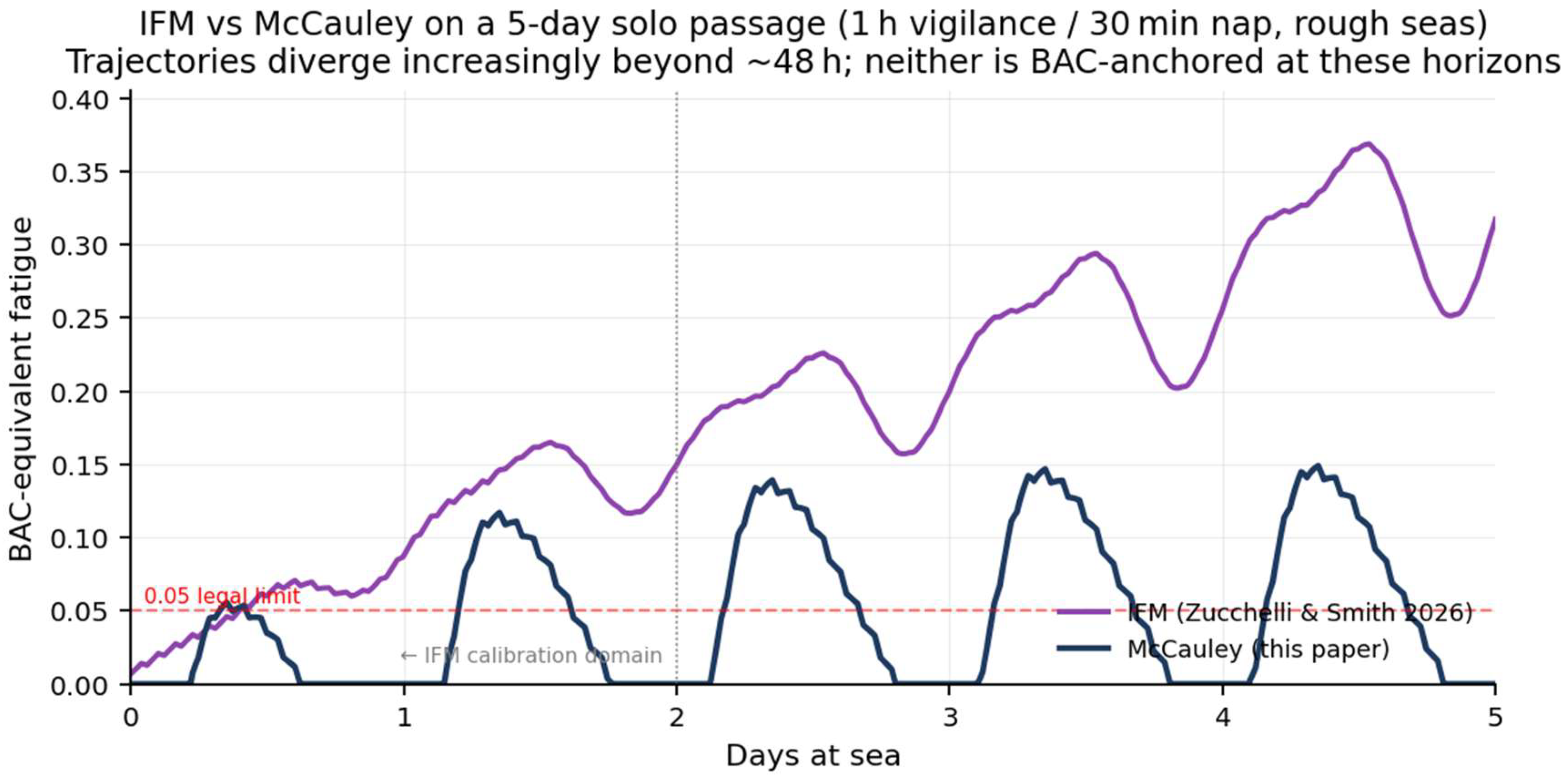
IFM (Zucchelli & Smith 2026) and McCauley formulations compared on a 5-day solo passage, 1 h vigilance / 30 min nap (polyphasic regime; 8 h nominal rest per day, all shallow), rough seas, 7 h pre-departure sleep. The IFM trajectory rises quasi-monotonically to 0.37 BAC-equivalent at day 4.5. The McCauley trajectory plateaus near 0.15 at day 4.3 — a fragmented-recovery equilibrium of S, not an L-saturation effect (at 8 h/day nominal rest L stays close to its rested value on this horizon). Neither is empirically anchored on the BAC axis at multi-day horizons.
3. Model Selection
Three peer-reviewed biomathematical fatigue frameworks were considered as candidate engines. The selection criteria drawn from §2 were: native representation of chronic partial sleep restriction, tractable closed-form evaluation for client-side deployment, calibration against multi-day sleep-restriction experimental data, and full specification in the open literature.
The Three-Process Model of alertness (Folkard & Åkerstedt, 1987; Åkerstedt & Folkard, 1997) — source of the IFM’s circadian term — lacks an allostatic state for chronic restriction. SAFTE (Hursh et al., 2004) is widely deployed operationally in transport regulation (through FAST in aviation and rail); its homeostatic and circadian structure is published, but the partial-restriction treatment has not been fully published in peer-reviewed literature at the level of parameter values needed for independent reimplementation.
The McCauley–Ramakrishnan unified model (McCauley et al., 2009; McCauley et al., 2013), with parameters from Ramakrishnan et al. (2016), expresses fatigue as , with coupled to a slow allostatic process . Four properties make it suitable: (i) is an explicit state whose coupling into the sleep equation produces debt-dependent recovery (§2.3), reproducing the Van Dongen et al. (2003) chronic-restriction curves without ad-hoc fitting; (ii) Ramakrishnan parameters are calibrated against the 72-hour total-sleep-deprivation and 14-day chronic-restriction protocols of Van Dongen et al. (2003) together with the 7-day restriction protocol of Belenky et al. (2003), a calibration domain matching multi-day offshore sailing; (iii) both and have closed-form expressions per epoch, enabling client-side evaluation of 7-day passages in milliseconds; (iv) the 5-harmonic circadian term (§4.2) places the nocturnal fatigue peak near 02:00, aligned with the early-morning-watch peak of fatigue-attributed collisions and groundings reported by Phillips (2004) (peak in the 0000–0400 watch, midpoint 02:00) and the broader nocturnal grounding clustering reported by MAIB (Marine Accident Investigation Branch, 2005). A reference R implementation (FIPS; (Wilson et al., 2020)) provides independent verification. McCauley was selected as the unique candidate satisfying all four criteria.
4. The McCauley–Ramakrishnan unified model
4.1. State Variables and Governing Equations
is the fast homeostatic process of Borbély (1982). is a slow allostatic coupling variable: during sleep relaxes toward , while itself drifts with time constant h, encoding cumulative sleep debt. During wakefulness both variables rise toward a common asymptote :
where is elapsed time since the last wake transition. During sleep relaxes toward and toward :
The state at the start of each epoch determines the trajectory through the next by closed-form substitution; no numerical integration is required.1
4.2. Circadian Modulation
The circadian process in the McCauley framework is a five-harmonic Fourier expansion:
with , amplitudes , and phase — the FIPS implementation values (Wilson et al., 2020) for the Ramakrishnan unified model (Ramakrishnan et al., 2016). The higher-order harmonics shift the fatigue peak from 04: 00 (pure first harmonic) to 02:00–03:00 local, aligning with Phillips’s (Phillips, 2004) early-morning collision-and-grounding peak in the 0000–0400 watch (midpoint 02:00). The broader nocturnal nadir region encompasses the subjective-alertness minimum at 06:00–08:00 reported by Schmidt et al. (2007) and the fatigue-grounding clusters at 04:00–05:00, 17:00–19:00, and 23:00 reported by MAIB (Marine Accident Investigation Branch, 2005). FIPS uses a slightly smaller fifth-harmonic amplitude and a slightly earlier circadian phase than the published Ramakrishnan parameters ( and h in Ramakrishnan et al. 2016); the difference has negligible effect on the predicted trajectory. Figure 2 compares the two formulations.
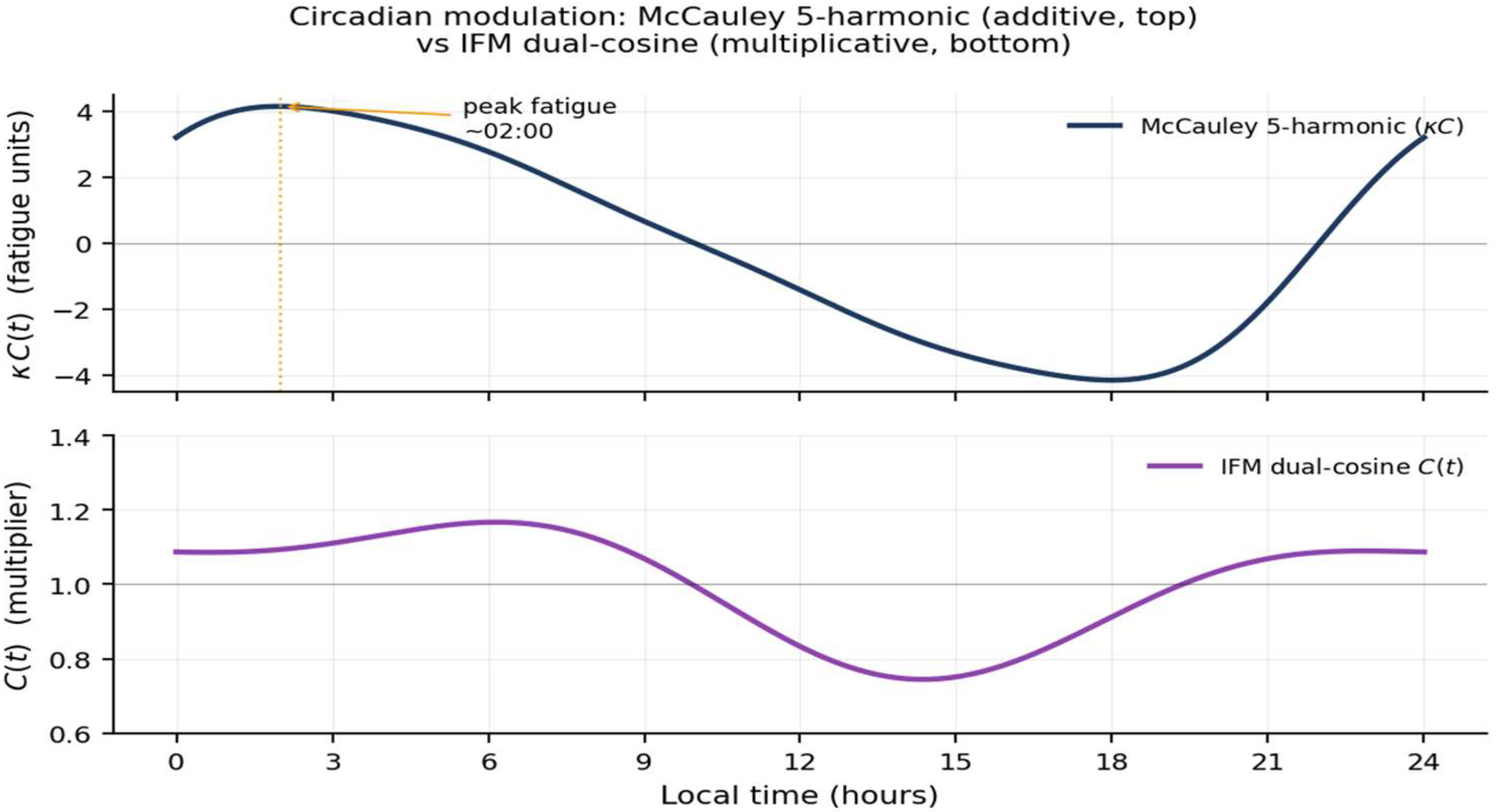
McCauley 5-harmonic circadian term κC(t) (top, additive fatigue units) versus the IFM dual-cosine modulator (bottom, multiplicative). The 5-harmonic peak lies at approximately 02:00 local time. The IFM dual-cosine, by contrast, peaks near 06:00.
Instantaneous fatigue is then:
with . The additive contributes to regardless of sleep state: is an instantaneous cognitive-performance estimate — “what would this person’s performance be if required to act at time ?” — and so is elevated during the circadian trough even while is decaying.
4.3. BAC Calibration Against Dawson–Reid Anchors
The McCauley scale is expressed in units of standardised PVT lapses. To preserve the BAC-equivalence output of Zucchelli and Smith (2026) the fatigue values are post-processed by an affine map. From a fully-rested baseline (the conventional 16 h prior wakefulness + 8 h consolidated sleep of the Van Dongen protocol), the -only trajectory at 17 h and 24 h of sustained wakefulness yields and ; the BAC output is with and , mapping to 0.05 and to 0.10.
The calibration is performed on the -only trajectory; is added afterward. Peak contributes up to BAC-equivalent at the 02:00 trough — sitting between the two Dawson–Reid anchors (0.05 and 0.10), closer to the upper. This contribution is informed by the circadian literature but not anchored on Dawson–Reid data. Peak-BAC rankings in §6 depend on -build comparisons and are robust to -scaling; absolute trough-time magnitudes should not be read as Dawson–Reid-calibrated. averages to 0 over 24 h, so the fully-rested first-day mean reduces to the Dawson–Reid result; once has drifted the daily mean shifts upward. With Ramakrishnan parameters the calibration gives , .
5. Maritime Parameter Tuning
The base sleep time constant h (shore-laboratory value; Borbély (1982), confirmed in (Daan et al., 1984; Achermann et al., 1993) corresponds to McCauley ) represents consolidated sleep in a quiet environment. Maritime conditions degrade recovery along two axes from the IFM paper: sea-state arousal and fragmentation. These enter as a multiplicative correction:
with for calm, moderate, rough, and storm conditions, and for deep (continuous rest ≥2 h) and shallow sleep. These coefficients are the authors” calibration, chosen for consistency with the qualitative findings of Hystad and Eid (Hystad & Eid, 2016; Kerkamm et al., 2023) and Bonnet (Bonnet, 1987; Bonnet & Arand, 2003). The multiplicative form is adopted because sea-state and fragmentation compound: rough seas degrade already-fragmented sleep proportionally more than consolidated sleep. A slower produces a smaller -decrement for the same sleep duration, representing the reduced restorative value of degraded sleep.
The resulting effective values span a factor of approximately 5.2 (from 4.9 h to 25.5 h):
| Deep sleep (≥2 h) | Shallow sleep | |
| Calm () | 4.9 h | 7.6 h |
| Moderate () | 6.2 h | 9.5 h |
| Rough () | 9.0 h | 13.9 h |
| Storm () | 16.5 h | 25.5 h |
The “calm + deep” cell (4.9 h) is 17 % slower than the 4.2 h shore baseline because applies even to ≥2-h at-sea sleep (residual motion). Operationally: for a 2 h off-watch, the fraction recovered is 33 % (calm + deep) vs 7.5 % (storm + fragmented), a 4.4× ratio. The direction and magnitude of this degradation are qualitatively consistent with the ambulatory polysomnographic finding of Kerkamm et al. (2023) that seafarers” sleep efficiency on merchant vessels is substantially degraded relative to shore-based norms (78.3 % efficiency for watchkeepers, vs 87.0 % for day workers); the ratio reported here is a model output, not a calibration against it. Figure 3 presents the landscape graphically.
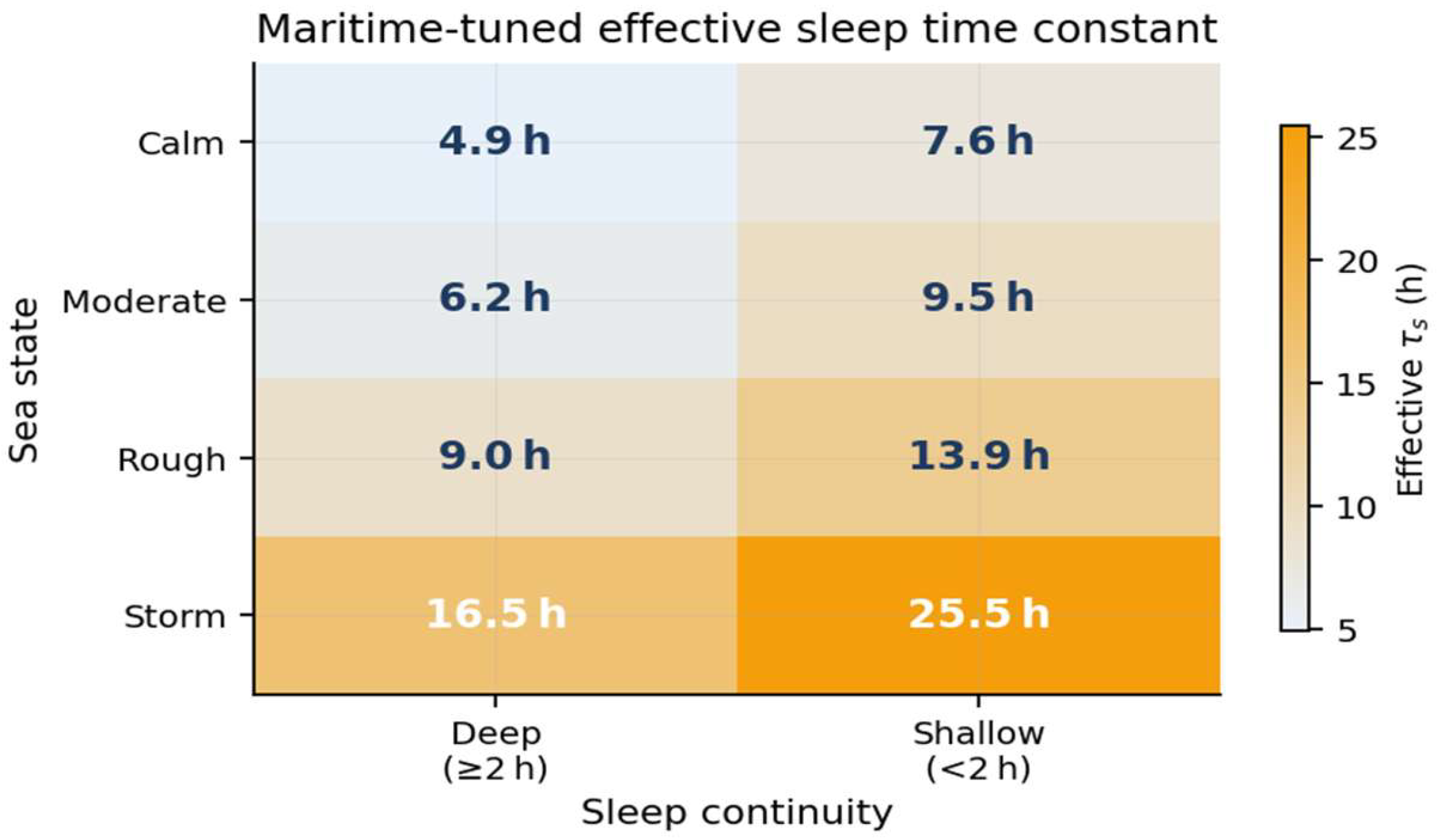
Effective sleep time constant across the four sea-state categories of Hystad and Eid [hystad2016] and the two fragmentation regimes of Bonnet [bonnet1987]. Values range from 4.9 h (calm seas, consolidated rest) to 25.5 h (storm conditions, fragmented sleep).
6. Model-Derived Consequences
The reformulation produces four consequences absent from the IFM: three state-structure outputs and a combinatorial property of anchored cycle rotation.
6.1. Per-Crew Trajectory Divergence
With independent state per crew, McCauley produces per-crew trajectories whose divergence reflects each crew member’s watch-phase alignment with the circadian term. For a 2-crew 3 h / 3 h rotation departing at 18:00, Crew A (slot 0) stands 18:00–21:00, 00:00–03:00, ; their 00:00–03:00 watch (second of the passage) passes the 02:00 peak while is still rising. Crew B’s 03:00–06:00 watch on night 1 begins past the peak. The night-1 per-crew asymmetry — a watch-phase artefact under identical population-mean parameters — is the worst per-crew value of the passage and cannot be represented in a single-state accumulator (Figure 4).
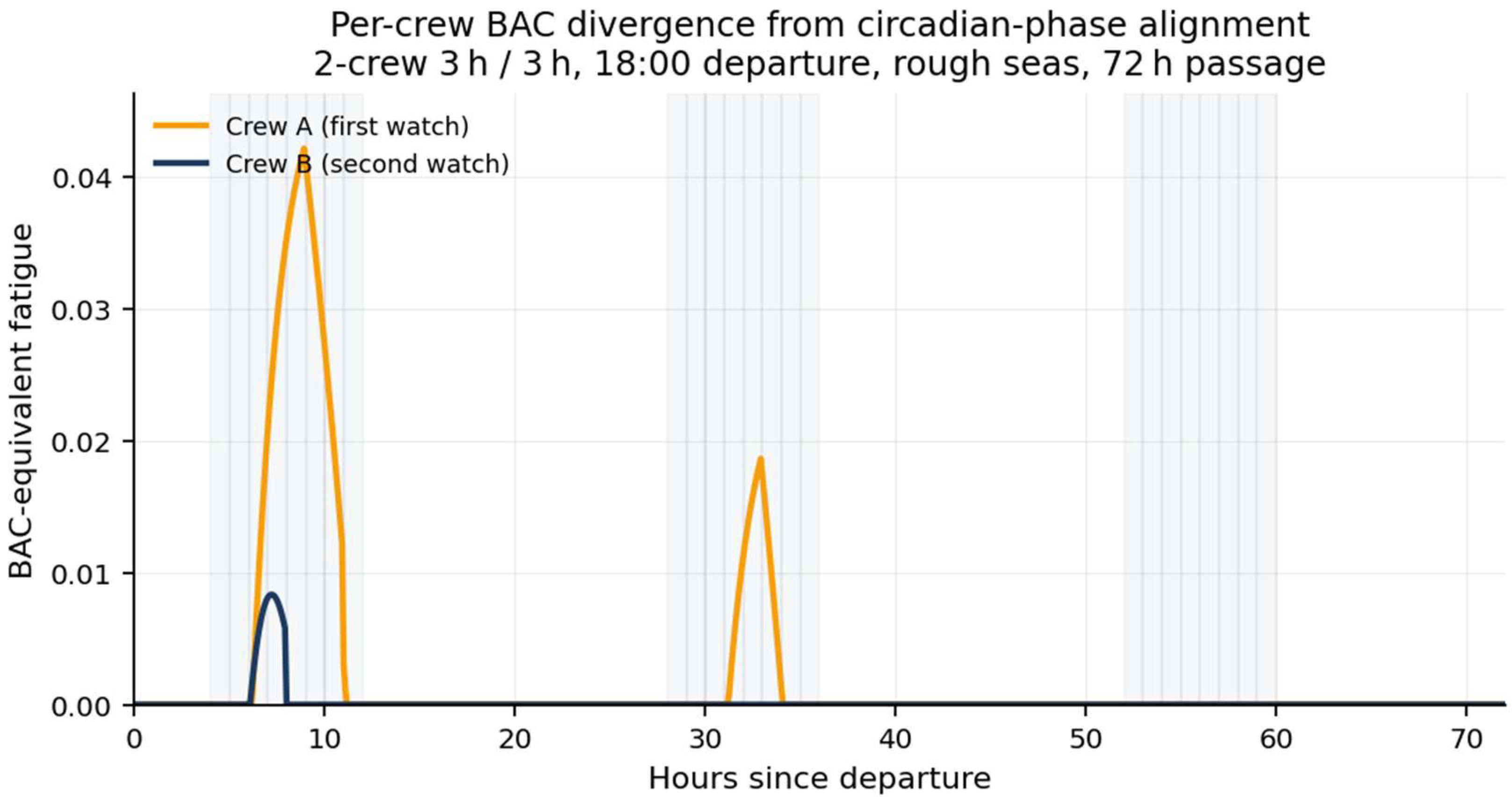
Per-crew BAC trajectories for a 2-crew 3 h / 3 h rotation with 18:00 departure, rough seas, 7-hour pre-departure sleep. Shaded bands indicate local night (22:00–06:00). The crew member assigned the 00:00–03:00 watch on night 1 (their second watch; Crew A) passes the 02:00 circadian peak while S is still building; the paired crew member’s 03:00–06:00 watch begins past the peak. Most of the trajectory lies below the Dawson–Reid affine-map intercept q and is clipped to BAC = 0; only the first night’s peak rises above the intercept on this chart, so the per-crew divergence is most visible there. The distributional importance on longer passages is the accumulation of trough-watch exposures, not the magnitude of a single night’s peak.
6.2. Pre-Departure Conditioning as an Initial-Value Problem
Pre-departure inputs are last-night’s sleep and hours awake; a chronic-history parameter iterates the wake/sleep forms so that at departure reflects allostatic build-up. The three scenarios of Figure 5 — 8 h last night after a rested week, 5 h last night after a rested week, four prior nights of 5 h plus 5 h last night — start from of , , and yield progressively larger first-night peaks.
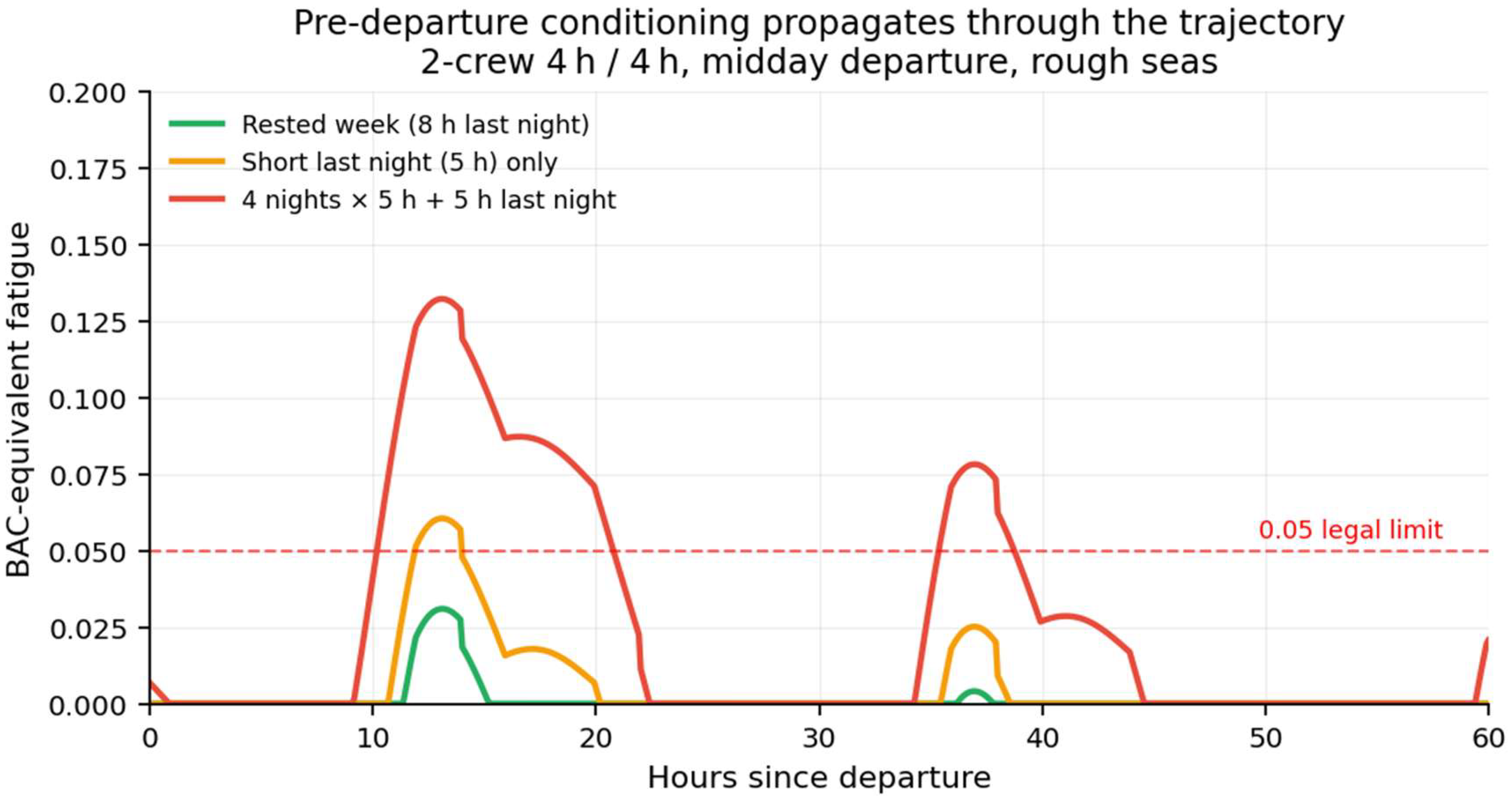
Effect of pre-departure condition on BAC trajectory for an otherwise identical 60-hour passage (2-crew 4 h / 4 h, midday departure, rough seas). Three scenarios differ in the initial (S, L) state: rested week with 8 h last night; rested week with 5 h last night only; four prior nights of 5 h sleep followed by 5 h last night. The chronic-history case enters the passage with L already at 22% of U0 and produces a visibly larger first-night peak than either last-night-only scenario.
6.3. The Allostatic Signature on Multi-Day Passages
Beyond 48 hours the and trajectories separate visibly (Figure 6). oscillates within an envelope set by the watch rotation; drifts quasi-monotonically toward at a rate determined by the awake fraction and the effective . The coupling term of §4.1 means that rising reduces the per-unit recovery from each rest epoch, so short-napping regimes that maintain -amplitude in the first 48 h produce progressive degradation thereafter. For the Vendée-style regime of 2 h vigilance / 20 min nap ( 3.4 h/day fragmented rest, shown in Figure 6), alone reaches a BAC-equivalent of 0.27 by day 7 and the model output BAC rises further at circadian troughs, well beyond the upper Dawson–Reid anchor; continues to build toward its wake asymptote over longer horizons. This is consistent with the observation from solo ocean racers (Hurdiel et al., 2014) that subjective adaptation is not accompanied by objective recovery. The affine map is a linear extrapolation beyond its two anchors; values above 0.10 should be read as order-of-magnitude indicators of severe objective impairment, not precise calibrations.
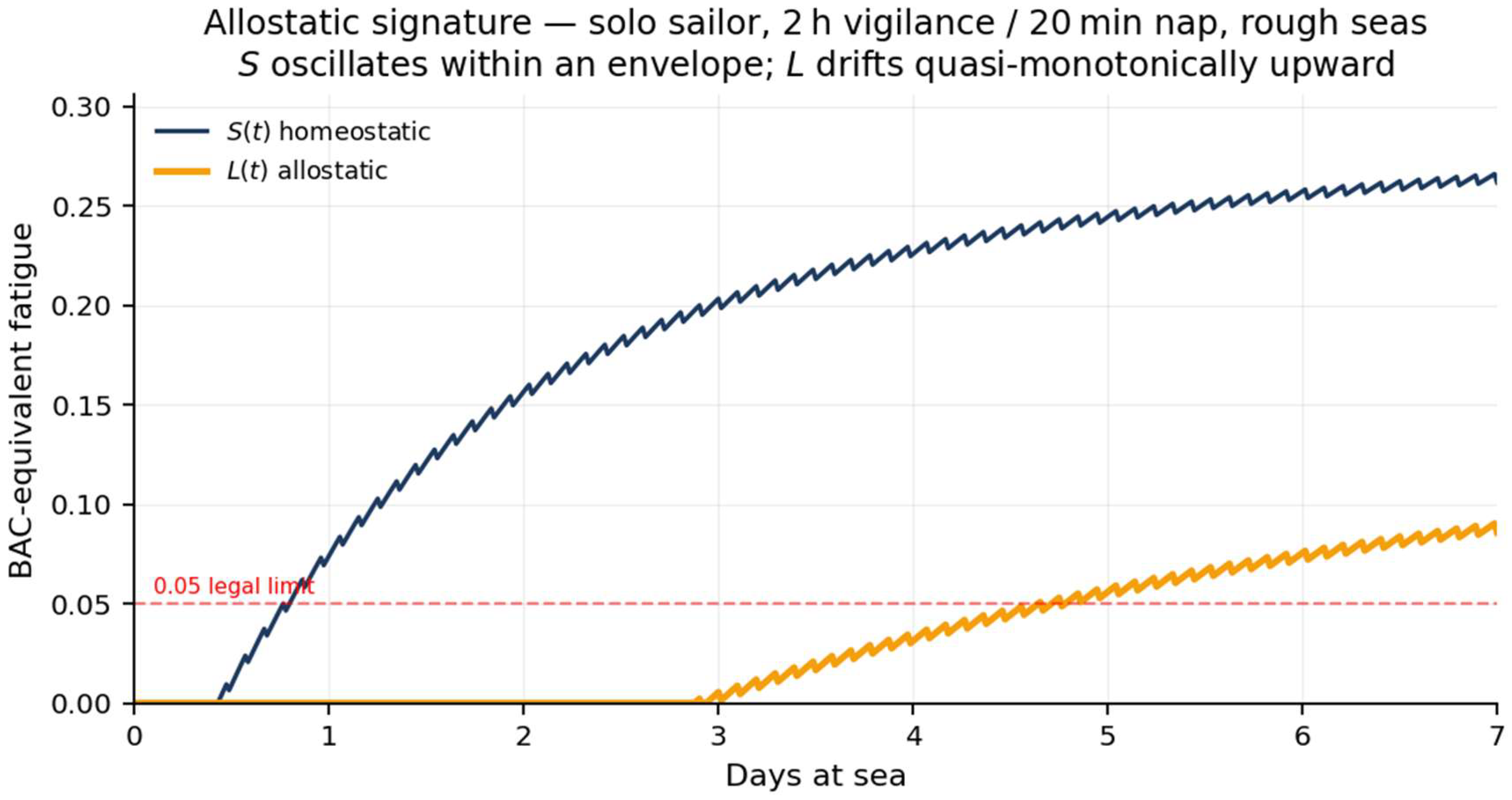
State-variable decomposition, not the instantaneous BAC output, on a 7-day solo passage (2 h vigilance / 20 min nap, rough seas — 3.4 h fragmented rest per day, representative of Vendée-style ultra-passage regimes). S and L are individually mapped through the Dawson–Reid affine transform of §4.3 and clipped to zero below the q ≈ 7.34 intercept: S (navy) oscillates within an envelope set by the watch rotation; L (orange) drifts quasi-monotonically upward as allostatic debt accumulates, appearing on the plot only once it crosses q. The instantaneous fatigue reported as model output is BAC(S + κC), which adds the circadian modulation of §4.2 on top of S; the L-drift visible here is the signature absent from the IFM.
We propose an interpretive reading of the allostatic signature. The BAC scale is anchored against Dawson–Reid objective PVT performance, not subjective sleepiness. Van Dongen et al. (2003) showed that under chronic restriction these diverge: subjective sleepiness plateaus after days while objective performance keeps degrading. We hypothesise that functions as the state-space representation of that divergence — rising corresponds to impairment the sailor does not subjectively perceive. McCauley and Ramakrishnan do not make this identification themselves; it is our reading, consistent with the dynamics but not established by the primary literature. If correct, the scope extension is epistemic as well as quantitative: it makes visible the fatigue component experienced offshore sailors describe themselves as unable to feel.
6.4. A Combinatorial Justification of the Swedish Watch System
Short-handed-sailing practice recognises (Buchan, 2016) that the Swedish watch system — a 2-crew rotation organised as a 5-slot cycle of 4/4/5/6/5 hours — distributes the overnight watch more evenly between crew than the standard 4-on/4-off. The reformulated engine evaluates any user-specified cycle of slots anchored to clock time, rotating crew round-robin, so the property is directly analysable.
Let be the cycle length in slots and the crew size; slot durations are assumed to sum to 24 h, so the clock-phase of slot is stable across cycles. The crew assigned to slot is , and the crew-index sequence at a fixed has period ; each crew member occupies distinct clock-phases over a super-cycle of length .
If , each crew is permanently bound to a subset of clock-phases; the 02:00 block in particular is assigned to a fixed subset, producing a structural asymmetry in trough-exposure counts. If , each crew occupies each clock-phase exactly once per super-cycle, equalising the count across crew. Standard 4/4 on 2 crew has , : one crew takes 00:00–04:00 every night. Swedish 4/4/5/6/5 on 2 crew has , , and a 10-slot super-cycle (48 h); the two crew alternate on the 00:00–04:00 slot over successive super-cycles. The property generalises algebraically to any coprime with (including for ); the absolute peak BAC under those rotations is not reported here and would need separate evaluation. Figure 7 and Figure 8 visualise the effect on 2 crew.
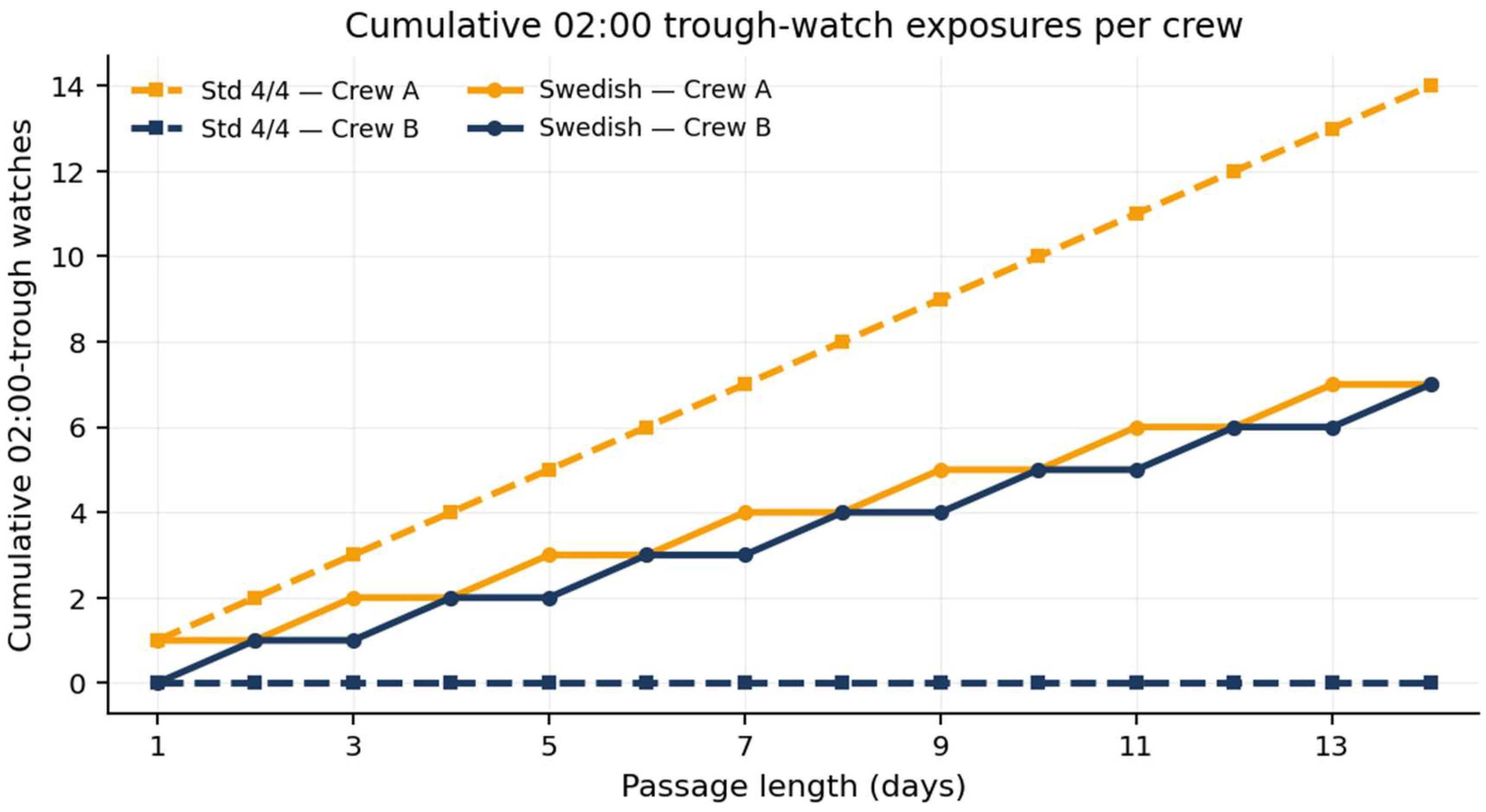
Cumulative 02:00-trough watch exposures per crew as passage length grows, for Standard 4/4 (gcd = 2) and Swedish 4/4/5/6/5 (gcd = 1), 2 crew, midnight-anchored. Standard piles all exposures on one crew; Swedish alternates.
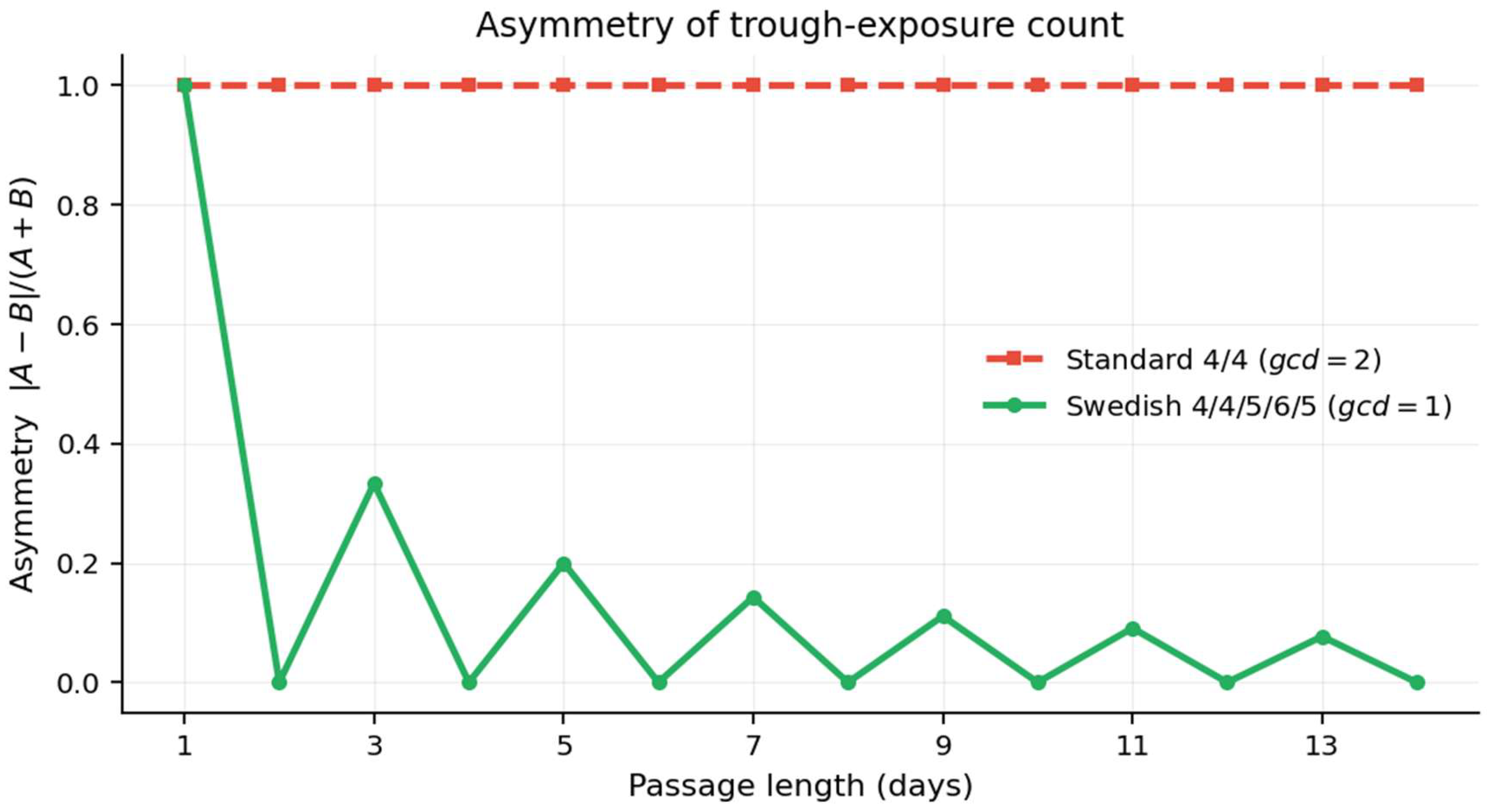
Asymmetry index of trough-exposure count (0 = fully equalised; 1 = one crew bears all exposures). Swedish oscillates within a decaying envelope as successive super-cycles complete; Standard stays pinned at 1.
Figure 9 renders the mapping as a space-time diagram: standard 4/4 produces vertical clock-hour stripes (one crew bound to 02:00); Swedish alternates across super-cycles.
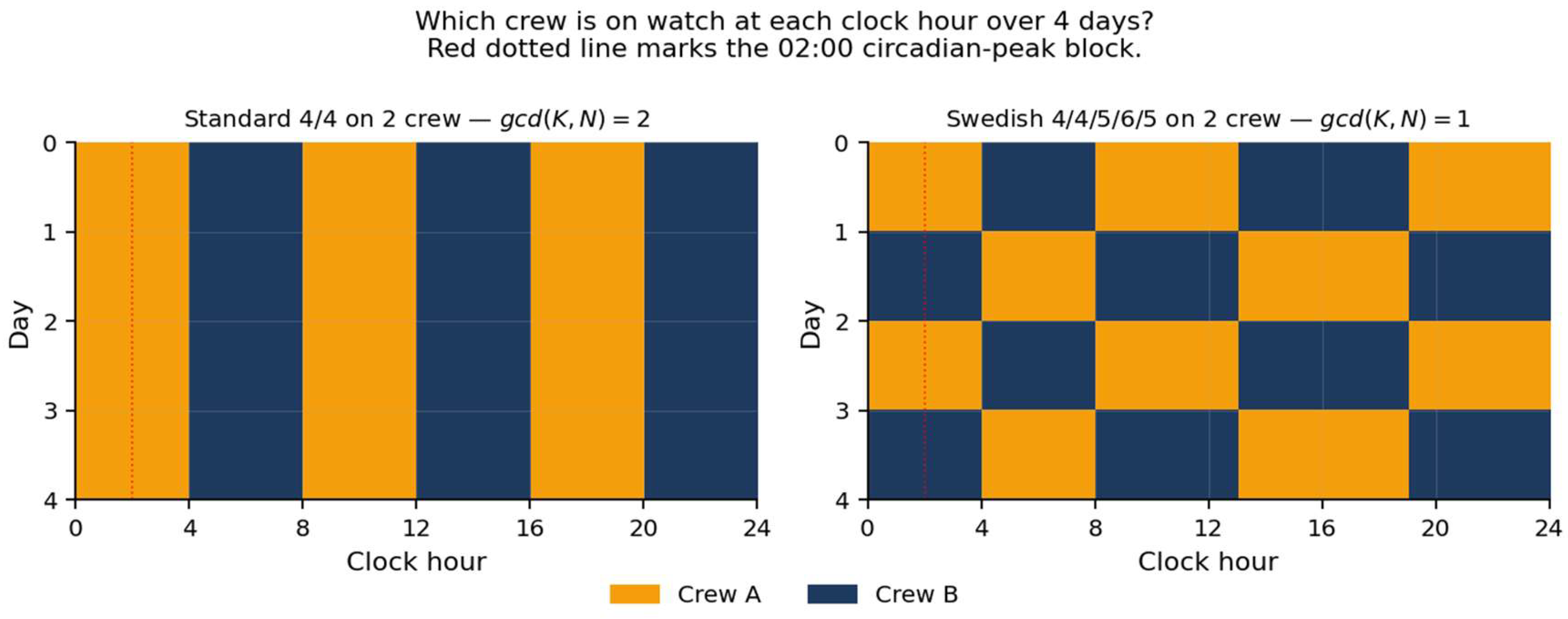
Space-time diagram of watch assignment on 2 crew across a 4-day passage, with midnight anchor. Each cell represents one hour and is coloured by the crew member assigned. The red dotted line marks the 02:00 circadian-peak column. Standard 4/4 (left) produces vertical stripes — the crew-clock mapping is fixed. Swedish 4/4/5/6/5 (right) alternates across super-cycles — every crew member occupies every clock-phase once.
The gcd property is distributional and says nothing about absolute worst-crew peaks, which depend on the length of the block containing 02:00. Figure 10 reports worst-crew peak BAC for four rotations across four departure phases on a 96-hour rough-seas passage. Swedish is the lowest pattern at 06:00 (0.030 vs 3/3’s 0.034, a 12 % margin) but the highest at 12:00 (0.058, where its 6-h slot straddles the trough); at 18:00 Swedish is second-best (0.032) behind 4/4 (0.026); at 00:00 all four patterns cluster within 0.005 (3/3 slightly best at 0.039). The property is therefore best read as protection against concentrating the trough-exposure count on one crew member, not as a universal peak-BAC minimiser.
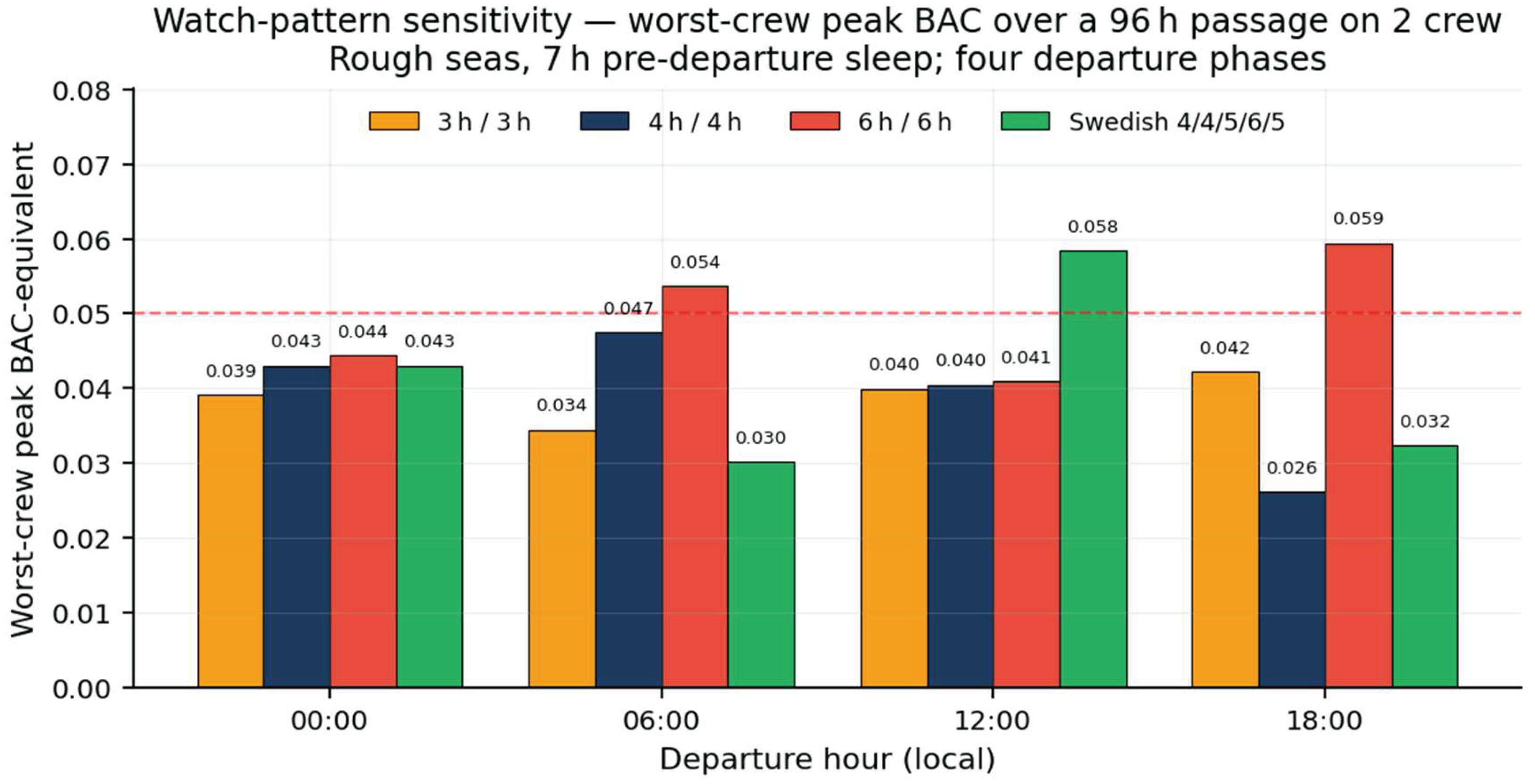
Worst-crew peak BAC-equivalent fatigue over a 96-hour passage on 2 crew under four rotation patterns, evaluated at four departure phases (midnight, 06:00, noon, 18:00). Rough seas, 7 h pre-departure sleep. Swedish is the lowest pattern at 06:00 (by 12 % over 3/3) and the second-lowest at 18:00; all four patterns are within 0.005 BAC at 00:00; Swedish is the highest at 12:00 where its 6 h slot straddles the circadian trough. The gcd = 1 property distributes the trough-exposure count across crew; it does not, by itself, minimise the absolute peak BAC on a 4-day passage.
7. Modelling Boundaries
Three features of the passage-fatigue problem are named explicitly rather than encoded as parameters, because a parameterised “model” of an unobservable or out-of-scope quantity is scientifically worse than a named boundary. All simulations reported in this paper use a 5-minute time step, sufficient to resolve sub-hour rest blocks and watch-block transitions.
7.1. Off-Watch Activity
The engine treats off-watch periods as sleep. In reality off-watch time is allocated between consolidated sleep, meal preparation, sail repairs, navigation, and waking rest in proportions not knowable from pre-passage inputs. Handover-overhead or activity-allocation parameters were considered and rejected: they would encode a guess and collapse the operational distinction between an organised crew and a disorganised one. The model reports fatigue under the assumption that off-watch time is rest; deviations remain a skipper-side interpretation.
7.2. Individual Trait Vulnerability
The Ramakrishnan parameter set represents population means. Van Dongen et al. (2004) demonstrated trait-like individual differences in sleep-loss vulnerability of magnitude comparable to group-mean effects. Without individual PVT calibration data a vulnerability parameter would exceed what the inputs justify; trajectories are therefore population-typical predictions. A per-user parameter would enter the McCauley framework as or a modifier on if field calibration becomes available (e.g., PVT-capable wearables).
7.3. Caffeine
The Ramakrishnan framework (Ramakrishnan et al., 2016) includes a pharmacokinetic extension that offsets by a caffeine-dependent reversible term. The engine does not expose caffeine as an input: recreational dosing is opportunistic and uncalibrated, it is not a pre-planning variable, and any default would be arbitrary. The extension hook exists for any future integration with individual dosing logs.
8. Conclusions
The Integrated Fatigue Model of Zucchelli and Smith (2026) established the scientific principles on which quantitative fatigue estimation for recreational sailing rests, and remains an accurate description of the dose-response within the validation horizon it was designed to represent. The present paper has extended the scope of the scientific treatment to multi-day offshore passage-making, where additional state structure is required to represent pre-departure sleep history, chronic partial sleep restriction, and debt-dependent recovery.
The two-state McCauley–Ramakrishnan unified model with Ramakrishnan parameters serves as the engine for this extension, with output units preserved by recalibration against the Dawson–Reid 17-hour and 24-hour BAC anchors so that the two papers report directly comparable scales. Maritime tuning combines sea-state and fragmentation effects multiplicatively on the sleep time constant, yielding effective recovery rates from 4.9 h to 25.5 h. The model produces per-crew trajectories with circadian-phase sensitivity, propagates pre-departure sleep history through initial values, and generates the allostatic signature characteristic of chronic partial sleep restriction — a signature corresponding to the objective component of fatigue that diverges, under chronic restriction, from what the sailor subjectively perceives.
A derivation from the round-robin rotation of crew through any clock-anchored cycle shows that the circadian-burden-distribution property underlying the Swedish watch system follows from - coprimality in cycle-length and crew-size indices, identifying the standard 4-on/4-off rotation on 2 crew as the structurally asymmetric case; the property is purely distributional and does not by itself bound the absolute worst-crew peak on short passages.
Three determinants are named as boundaries rather than encoded as parameters: the allocation of off-watch time between sleep and other activities, individual trait vulnerability, and caffeine. None is knowable from pre-passage inputs at the required fidelity; stating them plainly is scientifically preferable to a parameterised estimate of the unknowable. The model is deployed as a free, open-access, cross-platform application for Android and iOS; implementation details are beyond scope, but the scientific content above is sufficient for independent reimplementation.
Acknowledgements
The authors thank E. Sneddon for his detailed feedback and direct experience report from short-handed offshore sailing, including his critical review of the first paper (Zucchelli & Smith, 2026), which informed the scope extension reported here.
Use of AI-Assisted Tools: An AI-assisted tool (Claude, Anthropic) was used for editorial support during the preparation of this manuscript. The authors are responsible for all scientific content, analysis, and conclusions.
Conflicts of Interest
Both authors are affiliated with Galvanic Works S.L. The authors declare no other conflicts of interest.
References
- Achermann, P.; Dijk, D. J.; Brunner, D. P.; Borbély, A. A. A model of human sleep homeostasis based on EEG slow-wave activity. Brain Research Bulletin 1993, 31(1-2), 97–113. [Google Scholar] [CrossRef] [PubMed]
- Åkerstedt, T.; Folkard, S. The three-process model of alertness and its extension to performance, sleep latency, and sleep length. Chronobiology International 1997, 14(2), 115–123. [Google Scholar] [CrossRef] [PubMed]
- Belenky, G.; Wesensten, N. J.; Thorne, D. R.; Thomas, M. L.; Sing, H. C.; Redmond, D. P.; Russo, M. B.; Balkin, T. J. Patterns of performance degradation and restoration during sleep restriction and subsequent recovery: A sleep dose-response study. Journal of Sleep Research 2003, 12(1), 1–12. [Google Scholar] [CrossRef]
- Bonnet, M. H. Sleep restoration as a function of periodic awakening, movement, or electroencephalographic change. Sleep 1987, 10(4), 364–373. [Google Scholar] [CrossRef]
- Bonnet, M. H.; Arand, D. L. Clinical effects of sleep fragmentation versus sleep deprivation. Sleep Medicine Reviews 2003, 7(4), 297–310. [Google Scholar] [CrossRef] [PubMed]
- Borbély, A. A. A two process model of sleep regulation. Human Neurobiology 1982, 1(3), 195–204. [Google Scholar]
- Buchan, A. (2016). Short-Handed Sailing. Bloomsbury.
- Cohen, D. A.; Wang, W.; Wyatt, J. K.; Kronauer, R. E.; Dijk, D. J.; Czeisler, C. A.; Klerman, E. B. Uncovering residual effects of chronic sleep loss on human performance. Science Translational Medicine 2010, 2(14), 14ra3. [Google Scholar] [CrossRef]
- Daan, S.; Beersma, D. G. M.; Borbély, A. A. Timing of human sleep: Recovery process gated by a circadian pacemaker. American Journal of Physiology 1984, 246(2), R161–R183. [Google Scholar] [CrossRef]
- Dawson, D.; Reid, K. Fatigue, alcohol and performance impairment. Nature 1997, 388(6639), 235. [Google Scholar] [CrossRef]
- Filardi, M.; Morini, S.; Plazzi, G. Pre-race sleep management strategy and chronotype of offshore solo sailors. Nature and Science of Sleep 2020, 12, 263–269. [Google Scholar] [CrossRef]
- Folkard, S.; Åkerstedt, T. Towards a model for the prediction of alertness and/or fatigue on different sleep/wake schedules. In Contemporary Advances in Shiftwork Research; Oginski, Pokorski, Rutenfranz, Eds.; Medical Academy, 1987; pp. 231–240. [Google Scholar]
- Hurdiel, R.; Van Dongen, H. P. A.; Aron, C.; McCauley, P.; Jacolot, L.; Theunynck, D. Sleep restriction and degraded reaction-time performance in Figaro solo sailing races. Journal of Sports Sciences 2014, 32(2), 172–174. [Google Scholar] [CrossRef]
- Hursh, S. R.; Redmond, D. P.; Johnson, M. L.; Thorne, D. R.; Belenky, G.; Balkin, T. J.; Storm, W. F.; Miller, J. C.; Eddy, D. R. Fatigue models for applied research in warfighting. Aviation, Space, and Environmental Medicine 2004, 75((3) Suppl., A44–A53. [Google Scholar] [PubMed]
- Hystad, S. W.; Eid, J. Sleep and fatigue among seafarers: The role of environmental stressors, duration at sea and psychological capital. Safety and Health at Work 2016, 7(4), 363–371. [Google Scholar] [CrossRef]
- Kerkamm, F.; Dengler, D.; Eichler, M.; Materzok-Köppen, D.; Belz, L.; Neumann, F. A.; Zyriax, B. C.; Harth, V.; Oldenburg, M. Sleep architecture and sleep-related breathing disorders of seafarers on board merchant ships: A polysomnographic pilot field study on the high seas. International Journal of Environmental Research and Public Health 2023, 20(4), 3168. [Google Scholar] [CrossRef]
- Marine Accident Investigation Branch. MAIB Safety Digest 1/2005; MAIB: Southampton, 2005. [Google Scholar]
- McCauley, P.; Kalachev, L. V.; Smith, A. D.; Belenky, G.; Dinges, D. F.; Van Dongen, H. P. A. A new mathematical model for the homeostatic effects of sleep loss on neurobehavioral performance. Journal of Theoretical Biology 2009, 256(2), 227–239. [Google Scholar] [CrossRef] [PubMed]
- McCauley, P.; Kalachev, L. V.; Mollicone, D. J.; Banks, S.; Dinges, D. F.; Van Dongen, H. P. A. Dynamic circadian modulation in a biomathematical model for the effects of sleep and sleep loss on waking neurobehavioral performance. Sleep 2013, 36(12), 1987–1997. [Google Scholar] [CrossRef]
- Phillips, R. Fatigue, watchkeeping and accidents: A content analysis of incidents at sea reports. MPhil thesis, University of Tasmania, 2004. [Google Scholar]
- Ramakrishnan, S.; Wesensten, N. J.; Kamimori, G. H.; Moon, J. E.; Balkin, T. J.; Reifman, J. A unified model of performance for predicting the effects of sleep and caffeine. Sleep 2016, 39(1), 1827–1841. [Google Scholar] [CrossRef]
- Rupp, T. L.; Wesensten, N. J.; Bliese, P. D.; Balkin, T. J. Banking sleep: Realization of benefits during subsequent sleep restriction and recovery. Sleep 2009, 32(3), 311–321. [Google Scholar]
- Schmidt, C.; Collette, F.; Cajochen, C.; Peigneux, P. A time to think: Circadian rhythms in human cognition. Cognitive Neuropsychology 2007, 24(7), 755–789. [Google Scholar] [CrossRef]
- Van Dongen, H. P. A.; Maislin, G.; Mullington, J. M.; Dinges, D. F. The cumulative cost of additional wakefulness: Dose-response effects on neurobehavioral functions and sleep physiology from chronic sleep restriction and total sleep deprivation. Sleep 2003, 26(2), 117–126. [Google Scholar] [CrossRef] [PubMed]
- Van Dongen, H. P. A.; Baynard, M. D.; Maislin, G.; Dinges, D. F. Systematic interindividual differences in neurobehavioral impairment from sleep loss: Evidence of trait-like differential vulnerability. Sleep 2004, 27(3), 423–433. [Google Scholar] [CrossRef]
- Williamson, A. M.; Feyer, A. M. Moderate sleep deprivation produces impairments in cognitive and motor performance equivalent to legally prescribed levels of alcohol intoxication. Occupational and Environmental Medicine 2000, 57(10), 649–655. [Google Scholar] [CrossRef] [PubMed]
- Wilson, M. D.; Strickland, L.; Ballard, T. FIPS: An R package for biomathematical modelling of human fatigue related impairment. Journal of Open Source Software 2020, 5(51), 2340. [Google Scholar] [CrossRef]
- Zucchelli, P.; Smith, N. The science of fatigue at sea: A biomathematical model for recreational sailing. Preprints.org 2026. [Google Scholar] [CrossRef]
| 1 | The third term of contains , finite at Ramakrishnan values but requiring an L’Hôpital expansion if the constants coincide. |
Disclaimer/Publisher’s Note: The statements, opinions and data contained in all publications are solely those of the individual author(s) and contributor(s) and not of MDPI and/or the editor(s). MDPI and/or the editor(s) disclaim responsibility for any injury to people or property resulting from any ideas, methods, instructions or products referred to in the content. |
© 2026 by the authors. Licensee MDPI, Basel, Switzerland. This article is an open access article distributed under the terms and conditions of the Creative Commons Attribution (CC BY) license (http://creativecommons.org/licenses/by/4.0/).
Copyright: This open access article is published under a Creative Commons CC BY 4.0 license, which permit the free download, distribution, and reuse, provided that the author and preprint are cited in any reuse.