
Submitted:
22 April 2026
Posted:
22 April 2026
You are already at the latest version
Abstract
Let k be a positive integer. A polynomial A∈F_2[x] is called k-unitary perfect if the sum of the k-th powers of its distinct unitary divisors equals A^k. In this paper, we focus on the case k=2^n and prove that every 2^n-unitary perfect polynomial over F_2 is necessarily even. Moreover, we obtain a complete classification of all even 2^n-unitary perfect polynomials having at most three distinct irreducible factors. In particular, we characterize all such polynomials of the formA=x^a (x+1)^b P^h,
where P is a Mersenne prime over F_2 and a, b, and h are positive integers.
As a consequence, several explicit infinite families of k-unitary perfect polynomials over F_2 are obtained.
Keywords:
sum of divisors
; unitary divisors
; multiplicative
; polynomials
; finite fields
; characteristic 2
1. Introduction
The study of perfect numbers and their analogues-unitary perfect and bi-unitary perfect numbers has a long and rich history in classical number theory. A classical result of Euclid [12] shows that if is prime (a Mersenne prime), then is an even perfect number. Despite centuries of research, the existence of odd perfect numbers remains an open problem. Similarly, only a few unitary perfect numbers are known (such as ), and the existence of infinitely many remains open. Importantly, no odd unitary perfect integer has been discovered.
Motivated by these classical problems, several authors [1,2,3,4,8,9] have investigated polynomial analogues of perfectness over finite fields. In particular, perfect, unitary perfect, and bi-unitary perfect polynomials over have been studied extensively, leading to strong structural restrictions and complete classifications in certain cases.
Let be a nonzero polynomial. A divisor B of A is unitary (resp. bi-unitary) if (resp. , where denotes the greatest common unitary divisor. The sum of divisors (resp. unitary divisors and bi-unitary divisors) of A is denoted by resp. and . In symbols,
A polynomial is perfect (resp. unitary perfect and bi-unitary perfect) if (resp. and ). Note that in studying perfect or unitary perfect polynomials, the distinction disappears when the polynomial is squarefree.
Also, A is called a bi-unitary superperfect if . Chehade et al. [7] gave all bi-unitary superperfect polynomials divisible by one or two irreducible polynomials over . Note that the functions , and are degree preserving and multiplicative while is a degree preserving function but not a multiplicative one.
2. Preliminary
Throughout this paper, all polynomials are assumed to be monic in . For a polynomial A, we denote by its degree and by the number of its distinct irreducible factors. Unless otherwise stated, the following notations are used.
- (resp. represents the set of non-negative (resp. positive) integers.
- is the polynomial obtained from A with x replaced by , that is .
- is the inverse of the polynomial A with , in this sense .
A polynomial of the form with is called a Mersenne polynomial. If such a polynomial is irreducible over , it is called a Mersenne prime. The first Mersenne primes over are
A polynomial in is called even if it is divisible by x or ; otherwise, it is called odd.
Recently, the divisor function was generalized by summing th powers of divisors, giving rise to the notion of perfect polynomials. Chehade et al. [6] introduced a polynomial analogue of , by defining for any nonzero polynomial as follows: If then
Chehade et al. [6] also defined perfect polynomials over as those polynomials A satisfying . They showed that no odd perfect polynomials exist over and characterized all even perfect polynomials over that have the form , where each is Mersenne and and are positive integers.
2.1. Unitary Perfect Polynomials
Let A be a nonzero polynomial in Define to be the sum of the th powers of its distinct unitary divisors. That is, and if then
The function is multiplicative and degree preserving.
We now introduce the central concept investigated in this work, namely unitary perfect polynomials over .
Definition 1.
Let k be a positive integer. A polynomial A is called unitary perfect over if
Example 1.
Let , then
Hence, A is a unitary perfect polynomial over
The unitary perfect polynomial is studied extensively by Beard and Habrin [1,2,3] and by Gallardo and Rahavandrainy [9] and [10].
When , Definition 1 reduces to the classical notion of unitary perfect polynomials. In this work, we focus primarily on the case where the arithmetic of plays a crucial role. We classify all unitary perfect polynomials over with at most three distinct irreducible factors, proving that no odd such polynomials exist and fully characterizing the even ones of the form where P is a Mersenne prime and and h are positive integers.
Our main result is given in the following theorem.
Theorem 1.
Let and let P be a Mersenne prime in . Then, is a unitary perfect polynomial over if and only if
- if
-
if
for some positive integer
The family may be regarded as an analogue of the family , which corresponds to the trivial instance of perfect polynomials over .
3. Useful Results
We consider the following families of polynomials arising in the computation of :
Note that the polynomials and are irreducible over with
We need the following useful results. Since some of them are straightforward, their proofs are omitted.
Lemma 1.
[9] If is unitary perfect over and if . Then is unitary perfect if and only if is unitary perfect.
Lemma 2.
[9] If is unitary perfect over , then the polynomial is also unitary perfect over .
Lemma 3.
[9] If is unitary perfect over , then is also unitary perfect over , for any .
In [9], Gallardo and Rahavandrainy gave a complete list for all even perfect polynomials with 3 irreducible factors as given in the following lemma.
Lemma 4.
The complete list of even perfect polynomials over with is of the form or where .
The statement in part iii) of the following lemma is a result of Dickson (see [5])
Lemma 5.
i) Any complete polynomial inverts into itself.
ii) If , then either or .
iii) If is Mersenne, then
Corollary 1.
If is Mersenne, then
Lemma 6.([5], Lemmata 4, 5, 6 and Theorem 8) Let and let .
i) If , then .
ii) If , with and is non-constant, then .
iii) If and , then , and .
iv) If any irreducible factor of is Mersenne, then .
v) If , then , for some .
Lemma 7.
- i)
- If divides , then .
- ii)
- If or divides , then .
- iii)
- If or divides , then .
As a special case of ([11], Theorem 2.47), we have
Lemma 8.
The polynomial is irreducible over if and only if is a prime number and 2 is a primitive root in .
Consequently, we get
Lemma 9.
i) The polynomial is irreducible over if and only if .
- ii)
- The polynomial is irreducible over if and only if .
- iii)
- The polynomial is irreducible over if and only if .
Lemma 10.
[9] Any non-constant unitary perfect polynomial over is divisible by x and by . In particular, there is no odd unitary perfect polynomial over .
Lemma 11.
If P is a Mersenne prime, then for any , has always a factor
Lemma 12.
Let P be irreducible and let with Then if and only if
Proof.
gives
In the binomial expansion of reduces to if and only if all intermediate binomial coefficients vanish modulo 2, which occurs precisely when k is a power of 2. □
Corollary 2.
Let where is irreducible, then
The following corollary is a direct consequence of Corollary .
Corollary 3.
is unitary perfect over iff A is unitary perfect over
Lemma 13.
Let be positive integers and let then divides
Proof.
□
Hence if A is a multi-perfect polynomial over divides , then is a multi-perfect polynomial over .
Lemma 14.
Assume P is an irreducible polynomial and then
Proof.
Assume that , then there exists such that with . So, and This means that is a unit in Hence, . This contradicts the fact that P is irreducible in . □
Corollary 4.
Let and let , then A is not unitary perfect, for any irreducible P.
The proof of Corollary 4 can be directly obtained from Lemma 11 or from Corollary .
As a result of corollary 14 and lemma , we have and hence
Lemma 15.
Let . Then
Proof.
Define the map by
Since substitution preserves addition and multiplication, is a ring automorphism of . Hence,
By definition of , the left-hand side equals
which proves the result. □
Lemma 16.
If is unitary perfect over , then the polynomial is also unitary perfect over .
Proof.
Let where the are distinct irreducible polynomials. Since is unitary perfect, we have
Let Since the substitution is a ring automorphism of , it preserves irreducibility and coprimality. Hence, the polynomials are distinct irreducible polynomials in , and the above factorization of is its factorization into powers of distinct irreducibles. So,
By Lemma 15,
Since , it follows that
Therefore, is unitary perfect over . □
Lemma 17.
If P is a Mersenne prime in , then for , for all .
Proof.
If n is even, put where u is odd and
is divisible by then
If n is odd, take □
4. Factorization Patterns for
In this section, we study the unitary divisor sum function p is a prime integer. Explicit factorizations and divisibility properties of and related expressions for obtained here reveal systematic appearances of Mersenne polynomials such as and , which suggest a deeper underlying structure governing . These results provide essential tools for the classification results developed later. Some results are not directly invoked in the proofs of the main classification theorem; however, they are included to emphasize recurring factorization patterns of and are useful in extending the classification to polynomials with larger values of .
The following lemma has a straightforward proof.
Lemma 18.
Let be a prime integer, then
- i)
- ii)
Using Corollary 2 and Lemma 18, we get
Corollary 5.
Let t be a positive integer and let be an odd prime, then
- i)
- ii)
Some values of is Mersenne, are given in the below table:
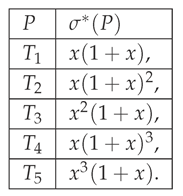
Using and Corollary , we obtain
Lemma 19.
Let t be a positive integer, then
Lemma 20.
Let t be a positive integer, then
Proof.
The proof is done by induction. For we have Hence, the statement is true for . Now assume . Observe that
The proof is now complete. □
Lemma 21.
and are always divisible by
Proof.
Consider the polynomial in . We have
Thus,
and so
For , we have
This implies that
Therefore, is a multiple of . The case of is handled in a similar way. □
Lemma 22.
Proof.
Since we prove by induction on t that . Let be the statement:
For the case . So holds. Now, assume that the statement is true for some integer :
So,
The right hand side of is
This is the left hand side of . Thus, the inductive step is complete. □
Corollary 6.
Let , then
Lemma 23.
is a factor of for all
Proof.
We have Then, follow the same steps as in the proof of Lemma 21. □
A mimic of the preceding two lemmas gives
Lemma 24.
i) is always divisible by
- ii)
- is always divisible by
The proof of the following lemma follows by induction on
Lemma 25.
i)
- ii)
- iii)
Corollary 7.
i)
- ii)
- ii)
5. Proof of Theorem 1
The proof proceeds by working on the possible values of . We first treat the case , then handle the more delicate case For , we show the exponent of the odd prime must be a power of 2 (Lemma 26) and that the irreducible polynomial must be from a specific set (Lemma 27). The final classification arises from the exponent comparison in the remaining cases (Lemmas 28–31).
5.1. Case
Assume where P and Q are irreducible in and a and b are positive integers. We begin by showing that odd unitary perfect polynomials over do not exist.
We begin with a key observation. The following corollary establishes the nonexistence of odd unitary perfect polynomials over .
Corollary 8.
Every non constant unitary perfect polynomial over is divisible by .
Proof.
Follows directly from Lemma 10 and Corollary 3. □
Consequently, both irreducible factors of A must be linear, and therefore
Proposition 1.
Let , then A is unitary perfect over if and only if A is of the form , for some .
Proof.
Sufficiency is immediate from the definition. For necessity, assume hence we must have: and . Hence, , for some . □
The first part of Theorem 1 is done. Consequently the unitary perfect polynomials A with are exactly the perfect polynomials.
5.2. Case
Assume now that A has exactly three distinct irreducible factors. By Corollary 8, A over must be even and has the form P is an odd irreducible polynomial. We begin by restricting the possible exponent of P.
Lemma 26.
If is a unitary perfect polynomial over , then for some .
Proof.
Since A is a unitary perfect polynomial,
The expression must have the factors x, , and P. Considering the factor . Assume , where u is odd and . So
Since P is odd (neither divisible by x nor by ), then is also not divisible by P unless u is a multiple of the characteristic of the field, which is 2. But u is odd. So P and are coprime. Thus, the only possible prime factors of are x and so must be of the form for some integers .
But
The two factors and are coprime and since their product must be of the form , the prime factors of each of these two factors must also be a subset of The only way for these two coprime polynomials to be made of factors of x and is for one of the factors to be equal to 1.
If , the degree of the second factor,
is greater than 0, so it cannot be 1. This forces the case where the second factor is 1, which only happens when the sum has a single term. Thus or .
This implies that , which completes the proof. □
Lemma 27.
Let with r and s are odd. If is a unitary perfect polynomial over , then .
Proof.
Using the identities
and
Lemma 6-i) implies that
By symmetry, this leads to two possible configurations:
By Lemma 5-iii), we have: . □
Once the irreducible factor P is fixed, the equality rigidly determines all remaining exponents.
5.2.1. Subcase:
Lemma 28.
Let r be an odd integer. If is a unitary perfect polynomial over , then and
Proof.
From Case 1 in Lemma 27, we have which implies yields
Comparing the exponents and degrees in 5 gives and So, □
5.2.2. Subcase:
Lemma 29.
Let r be an odd integer. If is a unitary perfect polynomial over , then and and .
Proof.
Here so Comparing exponents in yields and , hence □
5.2.3. Case 2:
We now treat case 2. The symmetry between the factors x and forces identical exponent behavior.
Lemma 30.
Let r and s be odd integers. If is a unitary perfect polynomial over , then P and .
Proof.
Case 2 in Lemma 27 implies
By Corollary 1, this forces PDegree comparison then yields □
Lemma 31.
If is a unitary perfect polynomial over , then
Proof.
A is unitary perfect. Under Case 2 of Lemma 27, symmetry between the factors x and forces Comparing the exponents of on both sides of the equality of then gives □
The proof of Theorem 1 is now complete.
Remark 1.
The classification of unitary perfect polynomials A with a relatively large number is likely to be highly intricate. The development of new methods will be necessary in order to achieve further progress in this direction.
6. Conclusion
We completely classified all unitary perfect polynomials over with at most three distinct irreducible factors. We proved that no odd polynomial can satisfy the unitary perfect condition. The classification shows that such polynomials must have a highly restricted structure, built from powers of x, , and a single Mersenne prime P over .
These results extend previous work on perfect and unitary perfect polynomials and provide a foundation for further investigations involving more irreducible factors or analogous problems over other finite fields.
Author Contributions
All authors contributed equally to this work and have read and approved the final published version of the manuscript.
Funding
This research received no external funding.
Data Availability Statement
Data are contained within the article.
Conflicts of Interest
The authors declare no conflict of interest.
References
- Beard, J., Jr. Unitary perfect polynomials over GF(q). Rend. Accad. Lincei 1977, 62, 417–422. [Google Scholar]
- Beard, J., Jr.; Bullock, A.; Harbin, M. Infinitely many perfect and unitary perfect polynomials. Rend. Accad. Lincei 1977, 63, 294–303. [Google Scholar]
- Beard, J., Jr.; Oconnell, J., Jr.; West, K. Perfect polynomials over GF(q). Rend. Accad. Lincei 1977, 62, 283–291. [Google Scholar]
- Beard, J., Jr. Perfect polynomials revisited. Publ. Math. Debrecen 1991, 38(1-2), 5–12. [Google Scholar] [CrossRef]
- Canaday, E. The sum of the divisors of a polynomial. Duke Math. J. 1941, 8, 721–737. [Google Scholar] [CrossRef]
- Chehade, H.; Alkhezi, Y.; Chehade; Zeid, W. On k-perfect polynomials over F2. Italian Journal of Pure and Applied Mathematics 2023, 50, 201–214. [Google Scholar]
- Chehade, H.; Miari, D.; Alkhezi, Y. Bi-Unitary Superperfect Polynomials over F2, with at Most Two Irreducible Factors. Symmetry 2023, 15(12), 21–34. [Google Scholar] [CrossRef]
- Gallardo, L.; Rahavandrainy, O. Even perfect polynomials over F2 with four prime factors. Int. J. Pure Appl. Math. 2009, 52(2), 301–314. [Google Scholar]
- Gallardo, L.; Rahavandrainy, O. All unitary perfect polynomials over F2 with at most four distinct irreducible factors. J. Symbolic Comput. 2012, 47(4), 492–502. [Google Scholar] [CrossRef]
- Gallardo, L.; Rahavandrainy, O. On (unitary) perfect polynomials over. F2 with only Mersenne primes as odd divisors 2024. [Google Scholar] [CrossRef]
- R. Lidl, H. Niederreiter, Finite Fields, Encyclopedia Math. Appl., Cambridge University Press, 1983, reprinted 1987.
- Riccardi, M. The Perfect Number Theorem and Wilson’s Theorem. Formaliz. Math. 2009, 17.1-4, 123–128. [Google Scholar] [CrossRef]
Disclaimer/Publisher’s Note: The statements, opinions and data contained in all publications are solely those of the individual author(s) and contributor(s) and not of MDPI and/or the editor(s). MDPI and/or the editor(s) disclaim responsibility for any injury to people or property resulting from any ideas, methods, instructions or products referred to in the content. |
© 2026 by the authors. Licensee MDPI, Basel, Switzerland. This article is an open access article distributed under the terms and conditions of the Creative Commons Attribution (CC BY) license (http://creativecommons.org/licenses/by/4.0/).
Copyright: This open access article is published under a Creative Commons CC BY 4.0 license, which permit the free download, distribution, and reuse, provided that the author and preprint are cited in any reuse.


