
Submitted:
17 April 2026
Posted:
22 April 2026
You are already at the latest version
Abstract
Three-dimensional geological structural modelling provides the geometric framework for subsurface exploration and development. However, conventional workflows, driven primarily by seismic interpretation, often lack explicit constraints from expert knowledge and are difficult to update when interpretations evolve. This study proposes an intelligent modelling methodology guided by a geological structure knowledge graph. The method includes: (i) a Three-tier Knowledge Architecture (TKA) that formalises domain knowledge in entity, relationship and inference layers using RDF/OWL; (ii) a Knowledge-driven Intersection Line Generation Algorithm (KILGA) coupled with a hierarchical adaptive mesh refinement scheme based on a posteriori error estimation (HAMR-APEE) to integrate geological constraints and mitigate boundary aliasing; and (iii) a bidirectional linkage mechanism between the knowledge graph and 3D models to support incremental updates following knowledge revision. The approach is validated in three petroliferous basins in China (Ordos, Qaidam and Sichuan), representing micro-amplitude, thrust nappe and deep complex structural styles. Compared with a conventional Petrel-based workflow, the proposed method reduces modelling RMSE from 15–20 m to 5–8 m, improves geological reasonableness from ~85% to >95%, and shortens modelling cycles from months to weeks.
Keywords:
3D geological structural modelling
; knowledge graph
; adaptive mesh refinement
; expert knowledge constraints
; fault characterization
1. Introduction
Three-dimensional geological structural modelling constitutes a fundamental technology for subsurface resource exploration and development, providing critical geometric frameworks for reservoir characterisation, fluid simulation, and well trajectory optimisation [1,2]. As exploration targets progressively shift towards deeper and more structurally complex formations, the demands on modelling accuracy and efficiency have increased substantially [3]. However, conventional modelling methods face persistent challenges that limit their effectiveness in complex geological settings.
Two interrelated problems are particularly prominent. First, existing modelling workflows struggle to integrate expert geological knowledge with quantitative computational processes. Traditional interpolation methods, such as kriging and radial basis functions, tend to over-smooth structural features near fault intersections and stratigraphic terminations, producing models that violate established geological principles [4,5]. Explicit surface methods (e.g., Delaunay triangulation) exhibit high grid distortion and poor boundary consistency when handling intersecting fault networks, requiring extensive manual correction [6]. Although implicit modelling approaches using fault potential fields have enabled automatic handling of complex faults, they do not systematically incorporate or dynamically invoke expert knowledge, thereby limiting the model's geological reasoning capability [7]. Second, the absence of effective dynamic updating mechanisms constrains model timeliness. When new seismic interpretation data become available or expert understanding evolves, conventional workflows require near-complete model reconstruction, resulting in modelling cycles of several months for structurally complex areas [8].
Recent advances in knowledge representation offer potential solutions to these challenges. Knowledge graph technology, which organises domain knowledge as structured entity-relationship networks, has demonstrated success in fields such as biomedical informatics and industrial manufacturing [9,10]. In the geosciences, knowledge graphs have been applied to geological data integration [11], mineral prospectivity mapping [12], and stratigraphic correlation [13]. However, existing geological knowledge graph applications remain largely confined to flat relational structures, supporting only simple entity queries rather than the multi-hop reasoning required for complex structural inference. Ma et al. [11] demonstrated knowledge graph construction for geoscientific data integration but did not address real-time coupling with three-dimensional modelling processes. Puntu et al. [14] and Liu et al. [15] applied machine learning to geological model construction with improved feature extraction, yet their approaches lack the capacity to embed geological rules as explicit constraints. No existing study has established a systematic framework that integrates hierarchical geological knowledge reasoning with adaptive structural modelling algorithms.
To address these gaps, this study develops a knowledge graph-guided intelligent geological structural modelling methodology. The specific objectives are threefold: (1) to construct a three-tier knowledge architecture that enables hierarchical geological reasoning from basic entities to structural cognition; (2) to develop knowledge-constrained modelling algorithms, including automated intersection line generation and adaptive mesh refinement, that enforce geological plausibility throughout the modelling process; and (3) to establish bidirectional linkage between the knowledge graph and three-dimensional models, supporting real-time model updating in response to evolving geological understanding.
The principal innovations of this work are as follows:
A hierarchical geological knowledge architecture (TKA) comprising entity, relationship, and inference layers, capable of supporting multi-hop structural reasoning that existing flat knowledge graph approaches have not demonstrated.
A knowledge-driven intersection line generation algorithm (KILGA) that integrates R-tree spatial indexing with geological expert constraints, enabling automated identification and validation of geological interface intersections.
An adaptive mesh refinement algorithm (HAMR-APEE) employing a posteriori error estimation with anisotropic refinement strategies, effectively eliminating aliasing artefacts at fault zones and unconformity surfaces.
A bidirectional knowledge-model linkage mechanism that propagates knowledge graph modifications to model geometry in real time through incremental updates.
The proposed method is validated through three application cases representing distinct structural styles in China's major petroliferous basins, demonstrating its broad applicability and effectiveness.
2. Materials and Methods
2.1. Construction of Geological Structure Knowledge Graph
2.1.1. Three-tier Knowledge Architecture
The knowledge graph is constructed based on Description Logic and Ontology Engineering, employing the W3C Resource Description Framework (RDF) and Web Ontology Language (OWL 2.0) for formalised knowledge expression [16,17]. The Neo4j graph database serves as the storage engine, utilising a Labeled Property Graph model with native graph storage and index-free adjacency, which reduces the time complexity of relationship traversal queries from O(n) to approximately O(1) for indexed queries [18,19]. The knowledge graph adopts triple representation:
where E is the geological entity set, R is the relationship set, and (h,r,t) denotes a semantic triple connecting head entity h to tail entity t through relationship r [20].
This study constructs a Three-tier Knowledge Architecture (TKA) comprising three hierarchical layers:
Geological Entity Layer. This layer defines atomic-level geological objects including faults, stratigraphic horizons, structural nodes, and geological boundaries. Each entity is identified through a unique resource identifier (URI) and characterised by spatial geometric attributes Ageo and geological property attributes Aprop.
Geological Relation Layer. This layer establishes spatial topological relationships based on the OGC Simple Feature Access specification (Intersects, Touches, Crosses, Contains) [21] and genetic relationships (fault cutting, stratigraphic onlap, pinch-out, conformable contact). Relationship semantics are constrained through OWL axioms. For example, a fault necessarily cutting a stratigraphic interface is expressed as:
Structural Inference Layer. This layer implements automatic deduction from low-level geological knowledge to high-level structural cognition through a rule-based reasoning engine combined with SWRL rules [22]. Inference rules take the general form:
enabling structural type identification, fault system classification, and evolution sequence inference.
2.1.2. Structural Meta-knowledge Extraction
Structural meta-knowledge refers to fundamental geological relationships extracted from seismic interpretation data, forming the informational foundation for knowledge graph construction. An automated intersection relationship identification algorithm based on computational geometry systematically extracts formation–formation, formation–fault, and fault–fault intersection relationships.
Three-dimensional spatial intersection detection employs the Separating Axis Theorem (SAT) combined with the Gilbert–Johnson–Keerthi (GJK) algorithm [23]. Coarse filtering uses Axis-Aligned Bounding Boxes (AABB):
Precise triangle–triangle intersection testing applies the Möller–Trumbore algorithm [24], expressing intersection points through barycentric coordinates:
where valid intersections satisfy.
Intersection relationship types are classified based on structural geological principles into: conformable/unconformable contacts and angular/parallel unconformities (strata–strata); normal, reverse, and strike-slip fault cutting and fault branching (strata–fault); and conjugate, en échelon, Y-shaped, and horsetail structures (fault–fault). Automatic type recognition employs geometric feature vectors:
where is dip angle difference,Δβ is strike difference, is throw displacement,is displacement ratio, andis interface curvature.
2.1.3. Meta-knowledge Quality Control
A three-layer quality control system ensures meta-knowledge reliability. Geometric consistency validation employs ε-neighbourhood detection to identify anomalies including dangling nodes, duplicate vertices, and self-intersecting curves [25]:
Topological consistency verification examines closed geological bodies based on the Euler characteristic [26]:
where V , E , F denote vertices, edges, and faces respectively, and g is the genus. Semantic consistency verification employs the OWL 2 DL Tableau algorithm [27] to detect ontological conflicts.
2.2. Knowledge Graph-Guided Intelligent Structural Modelling
2.2.1. Data Preprocessing
Raw seismic interpretation data undergo standardised preprocessing including coordinate system unification via the seven-parameter Bursa–Wolf model [28], anomalous data detection combining the Grubbs test [29] and local surface fitting, and adaptive resampling with curvature-dependent density:
where is the reference density, is the curvature sensitivity coefficient, and is the Gaussian curvature.
2.2.2. Knowledge-driven Intersection Line Generation Algorithm(KILGA)
Based on the constructed meta-knowledge, the KILGA achieves intelligent extraction of geological interface intersection lines. The algorithm employs an R*-tree spatial index [30] to organise geological surface patch data, reducing the average query complexity from O(n) (linear scan) to O(log n).
| Algorithm 1: KILGA , Knowledge graph KG 1. Initialise 2. For each surface pair : 3. 4. : 5. 6. ) 7. IL ← IL ∪ {connect_valid_points(filtered)} 8. Return IL |
For triangular mesh surfaces M1 and M2, the algorithm constructs AABB trees, prunes non-intersecting subtree pairs, and calculates precise intersection segments using Equation (6). Connected segments form continuous intersection lines, with topological validity verified through combinatorial topology [31]:
2.2.3. Hierarchical Adaptive Mesh Refinement (HAMR-APEE)
To address aliasing and staircase artefacts in conventional geological modelling, the HAMR-APEE algorithm employs the Zienkiewicz–Zhu error estimator based on gradient recovery [32]. For discrete geological surface representation , the local error on element is:
where is the gradient recovery operator using Super convergent Patch Recovery (SPR):
with obtained through nodal least-squares fitting and being shape functions.
Geological surfaces adopt quadtree structures and geological bodies adopt octree structures [33]. The refinement criterion is:
where . Refinement employs a red–green strategy: red refinement subdivides one triangle into four similar triangles, while green refinement addresses hanging nodes [34].
In high-gradient regions (fault zones, unconformity surfaces), anisotropic refinement is applied with metric tensor:
where is the rotation matrix along principal directions, and , are target mesh sizes permitting larger elements along fault strike and finer elements perpendicular to faults [35].
| Algorithm 2: HAMR-APEE 1. Initialize current mesh 2. Repeat: 3. For each element in do: 4. 5. If :mark for refinement 6. Apply red-green refinement to marked elements 7. Update mesh connectivity (DCEL structure) 8. Validate geological constraints from KG 9. Until convergence or maximum iterations 10. Return |
2.2.4. Fault Intersection Line Refinement
The quality of fault intersection lines directly affects structural modelling accuracy. A fault plane intersection refinement algorithm processes hanging-wall and footwall intersection lines. Fault kinematic constraints require:
where is the slip vector and is the fault plane normal.
Stratigraphic correspondence is validated using Allan Diagram technology [36]:
Where and are hanging-wall and footwall stratigraphic depths, and dd is fault displacement.
Intersection line smoothing employs shape-preserving cubic spline interpolation [37], with control point optimisation minimising the energy functional:
balancing smoothness (: curvature) and data fidelity (: distance from original line).
2.2.5. Specialised Thrust Fault Modeling Algorithm (STFMA)
Reverse/thrust faults present unique modelling challenges due to low-angle fault planes (typically < 45°), hanging-wall stratigraphic repetition, and listric/ramp-flat geometries [38]. Fault plane geometry is described by piecewise functions:
Fault plane reconstruction employs the Radial Basis Function (RBF) implicit surface method [39], with the fault surface as the zero isosurface:
using multiquadric basis functions . The RBF interpolation incorporates kinematic constraints: for hanging-wall displacement. In regions with complex geometry, the Extended Finite Element Method (XFEM) [40] handles displacement discontinuities through Heaviside enrichment functions:
2.2.6. Sublayer Division Constrained by Sequence Stratigraphy
Sublayer division employs wavelet transform-based sequence boundary identification [41], with boundaries corresponding to modulus maxima of wavelet coefficients. High-frequency depositional cycle recognition follows Milankovitch cyclostratigraphy [42], and multi-well correlation uses Dynamic Time Warping [43]. A hierarchical geological unit management system supports multi-scale queries from regional structural units to sublayer units, implemented using the Composite Pattern [44].
2.2.7. Logical Sub-surface Recognition
Logical sub-surface recognition abstracts the geological boundary network as a planar graph G = (V , E), employing DCEL data structures for topological information storage and half-edge chain traversal to identify enclosed regions [45]. Recognised sub-surfaces inherit attribute information through spatial centroid queries.
2.3. Visualisation and Bidirectional Linkage
The knowledge graph visualisation employs an improved force-directed layout algorithm [46] with Louvain community detection for semantic clustering [47]. Three-dimensional geological model rendering uses WebGL 2.0 with frustum culling, occlusion culling, and LOD switching [48,49].
Critically, bidirectional data binding between knowledge graphs and three-dimensional models employs a publish–subscribe pattern [50]. When knowledge graph node attributes are modified, corresponding geometric update events are triggered. An incremental update strategy rebuilds only affected local regions, with transaction mechanisms ensuring data consistency [51,52].
2.4. Model Validation and Quality Assessment
Geometric accuracy is assessed through deviation statistics against original interpretation data. For modelling surface Smodel and interpretation point set Pinterp :
Geological reasonableness validation employs knowledge graph reasoning engines to verify constraint satisfaction [53]:
Expert knowledge constraint satisfaction uses a weighted indicator [54]:
where is constraint weight and is the satisfaction function (binary for hard constraints, continuous for soft constraints).
3. Results
This study selects three representative application cases from China's major petroliferous basins to validate the proposed methodology: the Wangyaonan block in the Ordos Basin, the Ganchaigou structural belt in the Qaidam Basin, and the Fengjiawan buried structure in the Sichuan Basin. These respectively represent intra-cratonic micro-amplitude structures, thrust nappe systems in foreland basins, and deep buried structures in superimposed basins, enabling comprehensive evaluation under different geological conditions.
3.1. Wangyaonan Block, Ordos Basin
The Wangyaonan Block is located in the central-eastern part of the northern Shaanxi slope in the Ordos Basin. Structurally, it lies within the transitional zone from the Yishan slope to the Tianhuan Depression, generally displaying a westward-dipping, broad and gentle monoclinic structure with locally developed minor-amplitude nose-like uplifts and structural ridges. During the Yanchang Formation depositional period, influenced by Yanshanian tectonic movements, a series of low-order fold structures trending NE–SW and nearly E–W were formed, with structural amplitudes generally ranging from 5–15 m. This represents a typical geological characteristic of minor-amplitude structural–lithological composite reservoirs in stable intracratonic regions.
The Wangyaonan Block comprises 6 horizons and 15 major faults (Figure 1). This area is primarily characterised by the development of strike-slip faults with relatively complex fault systems, where local interpretations of horizons in the footwall of reverse faults are absent. A geological structural knowledge graph was constructed using the Three-tier Knowledge Architecture (TKA) based on the Neo4j graph database. The system established a fundamental geological entity layer, a geological relationship layer with spatial topological relationships and genetic associations, and a structural reasoning layer with SWRL rules (Figure 2).
Through the KILGA algorithm, the system automatically identified 66 pairs of fault–horizon intersection relationships across 6 stratigraphic levels and 15 fault structures (Figure 3). Table 1 summarises the intersection statistics; the complete 66-pair intersection line data are provided in Supplementary Table S1.
The three-layer quality control system verified meta-knowledge quality through geometric, topological, and semantic consistency checks. During the knowledge graph construction process, the system supported interactive modification of intersection relationships with real-time updates to model intersection line data and structural models. Figure 4 demonstrates the model change effects before and after removing the intersection relationship between C6112-1_Horizon and Fault 011.
The fault intersection line refinement algorithm was applied to optimise intersection lines, employing Allan diagram techniques to verify stratigraphic correspondence across fault blocks (Figure 5). Through logical sub-surface identification using DCEL data structures, geological sub-block models were generated (Figure 6) and subsequently meshed (Figure 7). The final structural model (Figure 8) accurately reproduces micro-amplitude structural features, with the solid closed model (Figure 8a) converted to a gridded model (Figure 8b) suitable for property population workflows.
3.2. Ganchaigou Structural Belt, Qaidam Basin
The Ganchaigou Structural Belt is located at the southern margin of the northern marginal thrust nappe structural system of the Qaidam Basin, representing a typical compressive foreland basin structural style. The structural evolution experienced three main stages: Palaeozoic passive continental margin, Mesozoic initial compression, and Cenozoic intense compression. The Ganchaigou anticline features a nearly E–W axial trend with asymmetric limbs (southern limb 35–45°, northern limb 15–25°) and thrust fault displacements generally ranging from 50–200 m, locally exceeding 500 m.
The Ganchaigou work area comprises 4 horizons and 7 faults (Figure 9). Compared to the Wangyaonan Block, this area exhibits more complex structural styles with well-developed thrust faults and complex fault cutting relationships. The system applied the STFMA for fault surface reconstruction using the RBF implicit surface method, processing complex listric and ramp-flat geometries through multiquadric basis functions (Figure 10).
Through the KILGA algorithm, 17 pairs of geological intersection line data were generated (Figure 11, Table 2). Expert-guided quality control optimised intersection lines to ensure compliance with geological understanding (Figure 12). To handle displacement discontinuities in thrust faults, XFEM concepts with Heaviside enrichment functions were incorporated during fault surface reconstruction.
Based on knowledge graph-guided reasoning, geological sub-blocks were modelled and integrated according to stratigraphic chronological relationships (Figure 13). The final model accurately reproduces the three-dimensional geometry of the Ganchaigou anticline and the spatial configuration of the thrust fault system.
3.3. Fengjiawan Buried Structure, Sichuan Basin
The Fengjiawan concealed anticline is located in the northern part of Wanzhou District, belonging to the Yun'anchang structural belt within the eastern Sichuan fold and thrust belt. This deep buried structure features a NE–SW axial orientation (~15 km × 8 km, closure height 60–80 m) formed through superimposed basement-involved thrusting and cover-detached folding during Indosinian–Yanshanian tectonic movements.
The system primarily applied the HAMR-APEE algorithm for adaptive mesh refinement. Figure 14 provides a comprehensive comparison of results before and after anti-aliasing, demonstrating that adaptive mesh refinement effectively eliminates the aliasing problems present in traditional modelling.
The sequence stratigraphic constrained sublayer method was applied for refined stratigraphic modelling (Figure 15), demonstrating significant improvements in both the precision of stratigraphic unit subdivision and geological rationality.
To validate the bidirectional linkage functionality, the system demonstrated real-time response to knowledge graph modifications. Figure 16 shows the knowledge graph before and after thrust fault removal, while Figure 17 presents the corresponding changes across geological model sub-blocks and overall structural models.
3.4. Quantitative Comparison with Conventional Methods
To objectively evaluate the proposed method, parallel modelling experiments were conducted using the conventional Petrel software workflow for each study area. Two categories of metrics were assessed: (i) geometric accuracy (RMSE and maximum error computed from Equations (22)-(23) in Section 2.4) and (ii) geological reasonableness (constraint satisfaction ratio from Equation (25)). Table 3 presents the comparative results.
Across all three cases, the proposed method reduces RMSE by 53–69%, improves geological reasonableness by 9–13 percentage points, and shortens modelling cycles by 77–82%. The improvement is most pronounced in the Wangyaonan micro-amplitude case, where precise structural constraint integration proved critical for capturing subtle features.
To evaluate individual algorithmic contributions, ablation experiments were conducted on the Wangyaonan dataset by selectively disabling each component (Table 4).
The TKA knowledge architecture contributes the largest improvement in geological reasonableness (ΔR_geo = +10.6 percentage points). The KILGA algorithm provides the greatest reduction in modelling cycle (Δcycle = −12 days). The HAMR-APEE algorithm primarily improves geometric accuracy (ΔRMSE = −2.9 m), while bidirectional linkage mainly reduces iteration time during model updates.
4. Discussion
4.1. Analysis of Quantitative Results
The quantitative comparison in Table 3 reveals three notable patterns. First, the proposed method achieves consistent RMSE reduction across all three structural styles, with improvements of 69% (Wangyaonan), 62% (Ganchaigou), and 59% (Fengjiawan). This consistency across different geological settings—from gentle monoclines to complex thrust systems—suggests that the knowledge graph-guided approach provides robust improvement regardless of structural complexity.
Second, the improvement in geological reasonableness (R_geo increasing from 82–86% to 95–96%) is attributable primarily to the TKA knowledge architecture, as confirmed by the ablation study (Table 4). When TKA was disabled, R_geo dropped by 10.6 percentage points to 85.6%, approximating the performance level of traditional Petrel workflows. This finding indicates that the systematic integration of expert knowledge through hierarchical reasoning, rather than individual algorithmic improvements, constitutes the primary driver of geological plausibility enhancement.
Third, the reduction in modelling cycle (from 45–60 days to 8–12 days) stems from two complementary mechanisms: (i) KILGA-based automated intersection line generation eliminates approximately 60% of manual editing time, and (ii) the bidirectional linkage mechanism enables incremental updates rather than complete model reconstruction. As the ablation study shows, removing either component significantly increases the modelling cycle (to 20 days without KILGA, 15 days without bidirectional linkage).
4.2. Comparative Analysis with Existing Methods
Table 5 compares the proposed method with existing approaches across multiple dimensions.
Compared with the implicit modelling method integrating fault potential fields [7], which achieved automatic handling of complex faults but lacked systematic expert knowledge integration, the proposed method explicitly embeds geological rules through TKA, resulting in measurably higher geological reasonableness (95–96% vs. approximately 85% reported for implicit methods). Compared with Ma et al. [15], who demonstrated knowledge graph construction for geoscientific data integration but did not couple it with three-dimensional modelling, the proposed method establishes bidirectional linkage that propagates knowledge modifications to model geometry in real time.
Machine learning approaches by Puntu et al. [13] and Liu et al. [14] improved feature extraction efficiency with structural recognition accuracy exceeding 90%, but they operate as black-box systems without explicit geological constraint enforcement. In contrast, the proposed knowledge graph approach provides interpretable reasoning chains that can be verified by domain experts, which is critical for geological decision-making where model transparency is required.
4.3. Practical Application Value
The three application cases validate the method's effectiveness across distinct structural styles. In the Wangyaonan Block, precise identification of micro-amplitude nose-like uplifts and structural ridges has optimised horizontal well trajectory design, with expected single-well production increases of 15–20%. In the Ganchaigou Structural Belt, accurate characterisation of thrust fault geometry and spatial configuration provides reliable evidence for fault sealing evaluation and hydrocarbon migration pathway analysis. In the Fengjiawan buried structure, the HAMR-APEE algorithm effectively eliminates aliasing artefacts that previously compromised boundary representation in deep complex models.
The bidirectional linkage mechanism is particularly valuable during exploration phases, where multiple rounds of seismic interpretation iteration demand rapid model updating. Conventional workflows require near-complete reconstruction when interpretation data are revised; the proposed incremental update strategy reduces this from days to minutes for localised modifications, as demonstrated by the fault removal experiment in the Fengjiawan case (Figure 16 and Figure 17).
4.4. Limitations and Future Directions
Several limitations warrant acknowledgement. First, the method depends on the quality of input seismic interpretation data. Although the three-layer quality control system detects geometric, topological, and semantic anomalies, systematic errors in original interpretation data propagate through the knowledge graph and may compromise model accuracy, particularly in deep structural areas with poor seismic imaging quality.
Second, computational resource requirements remain substantial for ultra-large-scale models (grid numbers exceeding tens of millions). The error estimation and mesh refinement processes of the HAMR-APEE algorithm incur high computational costs under high-precision requirements, potentially limiting real-time interactivity.
Third, knowledge graph construction and maintenance require domain expert participation. Although visualised interactive interfaces have been provided, the definition and optimisation of structural reasoning rules still demand deep geological expertise. Reducing the knowledge acquisition threshold through automated methods remains an open challenge.
Future development directions include: (i) integrating graph neural networks and attention mechanisms to improve automatic geological feature identification, and exploring automatic geological knowledge extraction based on large language models [53]; (ii) expanding multi-scale, multi-physics coupled modelling capabilities by integrating geochemical, geophysical, and fluid dynamics information, with particular potential in carbon storage and geothermal energy applications [54]; (iii) incorporating uncertainty quantification through Monte Carlo simulation and Bayesian inference to provide probabilistic risk assessment [55]; and (iv) establishing industry standards and sharing mechanisms for geological knowledge graphs to promote cross-basin knowledge reuse [56].
5. Conclusions
This study develops a knowledge graph-guided intelligent geological structural modelling methodology and validates it through three representative application cases. The principal contributions and findings are summarised as follows:
(1) Hierarchical knowledge representation. A Three-tier Knowledge Architecture (TKA) has been constructed, comprising geological entity, relationship, and inference layers. This architecture supports multi-hop reasoning for complex geological queries, achieving over 90% success rate for queries requiring three or more relationship traversals. The ablation study confirms that TKA contributes the largest improvement in geological reasonableness (ΔR_geo = +10.6 percentage points).
(2) Knowledge-constrained modelling algorithms. Four core algorithms have been developed: KILGA for automated intersection line generation, HAMR-APEE for adaptive mesh refinement, STFMA for thrust fault geometric modelling, and a sequence stratigraphic constrained sublayer method. These algorithms systematically integrate geological knowledge constraints into computational processes, achieving automated identification of 66 fault–horizon intersection relationships in the Wangyaonan case and effective elimination of aliasing artefacts in the Fengjiawan case.
(3) Bidirectional knowledge-model linkage. A publish–subscribe-based incremental update mechanism enables real-time model modification upon knowledge graph changes. This capability reduces iteration time from days (complete rebuilding) to minutes (local updating), as demonstrated by the thrust fault removal experiment.
(4) Quantitative performance improvement. Compared with conventional Petrel workflows across three study areas, the proposed method reduces RMSE from 15–20 m to 5–8 m (53–69% reduction), improves geological reasonableness from 82–86% to 95–96%, and shortens modelling cycles from 45–60 days to 8–12 days (77–82% reduction).
(5) Cross-basin applicability. Successful application in three structurally distinct basins—the Ordos Basin (micro-amplitude structures), Qaidam Basin (thrust nappe systems), and Sichuan Basin (deep buried structures)—demonstrates the method's broad applicability across different geological conditions, providing technical support for resource evaluation and exploration decision-making in complex geological environments.
6. Patents
Supplementary Materials
The following supporting information can be downloaded at the website of this paper posted on Preprints.org. Table S1: Complete 66-pair fault–horizon intersection line data from the Wangyaonan Block geological structural knowledge graph analysis.
Author Contributions
Conceptualization, Xin Xu, Kai Zhang and Wuyang Yang; methodology, Xin Xu; software, Xin Xu; validation, Xin Xu, Kai zhang, Weisheng Wang and Haishan Li; formal analysis, Xin Xu.; investigation, Weisheng Wang.; resources, Wuyang Yang; data curation, Xinjian Wei; writing—original draft preparation, Xin Xu.; writing—review and editing, Weisheng Wang; visualization, Xinjian Wei; supervision, Wuyang Yang; project administration, Wuyang Yang; funding acquisition, Wuyang Yang. All authors have read and agreed to the published version of the manuscript.
Funding
This research was funded by China National Petroleum Corporation (CNPC), grant numbers 2021ZG03 "Research on Key New Technologies for Seismic Processing and Interpretation and Development of Intelligent Software", 2023DJ84 "Research on Key Technologies of Artificial Intelligence for Oil and Gas Exploration and Development", and 2024ZJ21 "Research on Key Technologies for Fracture Identification and Characterisation in Carbonate Reservoirs". The APC was funded by China National Petroleum Corporation (CNPC).
Data Availability Statement
The datasets presented in this study are not publicly available due to confidentiality restrictions. The geological and geophysical data used in this research, including seismic interpretation results, well logging data, and structural modelling datasets from the Wangyaonan Block (Ordos Basin), Ganchaigou structural belt (Qaidam Basin), and Fengjiawan buried structure (Sichuan Basin), are proprietary industrial data owned by China National Petroleum Corporation (CNPC) and its affiliated companies. Access to such data is restricted to authorised personnel within the respective operating companies. Researchers interested in similar datasets may contact the corresponding author for guidance on potential collaboration opportunities.
Acknowledgments
The authors would like to thank the technical staff at the Research Institute of Petroleum Exploration and Development (RIPED), China National Petroleum Corporation, for providing valuable geological and geophysical datasets used in this study. We acknowledge the computational support provided by the High Performance Computing Center of RIPED for the intensive numerical simulations and knowledge graph processing. Special thanks are extended to the geologists and geophysicists from the Changqing Oilfield, Qinghai Oilfield, and Southwest Oil & Gas Field Company for their professional insights and domain expertise during the knowledge graph construction and model validation phases. We also appreciate the technical discussions and suggestions from colleagues in the Intelligent Geological Modeling Laboratory. The authors acknowledge the use of various open-source software packages and libraries that contributed to the development of the algorithms presented in this work.
Conflicts of Interest
The authors declare no conflicts of interest.
Abbreviations
The following abbreviations are used in this manuscript:
| TKA | Three-tier Knowledge Architecture |
| KILGA | Knowledge-driven Intersection Line Generation Algorithm |
| HAMR-APEE | Hierarchical Adaptive Mesh Refinement Algorithm based on A Posteriori Error Estimation |
| STFMA | Specialised Thrust Fault Modelling Algorithm |
| RDF | Resource Description Framework |
| OWL | Web Ontology Language |
| XFEM | Extended Finite Element Method |
| DCEL | Doubly-Connected Edge List |
References
- Turner, A.K.; Fookes, P.G. Geological modelling: Challenges and future directions. Engineering Geology 2006, 84, 1–16.
- Wellmann, J.F.; Caumon, G. 3-D structural geological models: Concepts, methods, and uncertainties. Advances in Geophysics 2018, 59, 1–121.
- Caumon, G.; Collon-Drouaillet, P.; Le Carlier de Veslud, C.; Viseur, S.; Sausse, J. Surface-based 3D geological modeling of geological structures. Mathematical Geosciences 2009, 41, 927–945.
- Chilès, J.-P.; Delfiner, P. Geostatistics: Modeling Spatial Uncertainty, 2nd ed.; Wiley: Hoboken, NJ, USA, 2012.
- Fasshauer, G.E. Meshfree Approximation Methods with MATLAB; World Scientific: Singapore, 2007.
- Shewchuk, J.R. Delaunay refinement algorithms for triangular mesh generation. Computational Geometry 2002, 22, 21–74.
- Lajaunie, C.; Courrioux, G.; Manuel, L. Foliation fields and 3D cartography in geology: Principles of a method based on potential interpolation. Mathematical Geology 1997, 29, 571–584.
- Guo, J.; Liu, J.; Zhang, Y. Automatic updating of 3D geological models based on structural interpretation revisions. Computers & Geosciences 2022, 161, 105123.
- Hogan, A.; Blomqvist, E.; Cochez, M.; d’Amato, C.; de Melo, G.; Gutierrez, C.; Kirrane, S.; Gayo, J.E.L.; Navigli, R.; Neumaier, S.; et al. Knowledge graphs. ACM Computing Surveys 2021, 54, 1–37.
- Noy, N.; Gao, Y.; Jain, A.; Narayanan, A.; Patterson, A.; Taylor, J. Industry-scale knowledge graphs: Lessons and challenges. Communications of the ACM 2019, 62, 36–43.
- Ma, X.; Li, Z.; Wang, H. Knowledge graph construction and application in geoscientific data integration. Computers & Geosciences 2022, 163, 105201.
- Zuo, R.; Carranza, E.J.M. Support vector machine: A tool for mapping mineral prospectivity. Computers & Geosciences 2011, 37, 1967–1975.
- Bergen, K.J.; Johnson, P.A.; de Hoop, M.V.; Beroza, G.C. Machine learning for data-driven discovery in solid Earth geoscience. Science 2019, 363, eaau0323.
- Wu, J.; Zhang, X.; Luo, S.; Zhang, K. Deep learning for seismic structural interpretation: A review. Geophysics 2021, 86, WC1–WC23.
- Hall, M.; Rojas, I.; Keane, J.; et al. Knowledge graph–based data integration in Earth sciences: A review. Earth-Science Reviews 2023, 240, 104395.
- Cyganiak, R.; Wood, D.; Lanthaler, M. (Eds.) RDF 1.1 Concepts and Abstract Syntax; W3C Recommendation, 25 February 2014. Available online: https://www.w3.org/TR/rdf11-concepts/.
- W3C OWL Working Group. OWL 2 Web Ontology Language Document Overview (Second Edition); W3C Recommendation, 11 December 2012. Available online: https://www.w3.org/TR/owl2-overview/.
- Robinson, I.; Webber, J.; Eifrem, E. Graph Databases: New Opportunities for Connected Data, 2nd ed.; O’Reilly Media: Sebastopol, CA, USA, 2015.
- Angles, R.; Gutierrez, C. Survey of graph database models. ACM Computing Surveys 2008, 40, 1–39.
- W3C. RDF 1.1 Turtle: Terse RDF Triple Language; W3C Recommendation, 25 February 2014. Available online: https://www.w3.org/TR/turtle/.
- Open Geospatial Consortium (OGC). OpenGIS Simple Features Implementation Specification for Geographic Information—Part 1: Common Architecture; OGC 06-103r4, 2011. Available online: https://www.ogc.org/standards/sfa.
- Horrocks, I.; Patel-Schneider, P.F.; Boley, H.; Tabet, S.; Grosof, B.; Dean, M. SWRL: A Semantic Web Rule Language Combining OWL and RuleML; W3C Member Submission, 21 May 2004. Available online: https://www.w3.org/Submission/SWRL/.
- Ericson, C. Real-Time Collision Detection; Morgan Kaufmann: San Francisco, CA, USA, 2005.
- Möller, T.; Trumbore, B. Fast, minimum storage ray–triangle intersection. Journal of Graphics Tools 1997, 2, 21–28.
- de Berg, M.; Cheong, O.; van Kreveld, M.; Overmars, M. Computational Geometry: Algorithms and Applications, 3rd ed.; Springer: Berlin, Germany, 2008.
- Mäntylä, M. An Introduction to Solid Modeling; Computer Science Press: Rockville, MD, USA, 1988.
- Baader, F.; Calvanese, D.; McGuinness, D.L.; Nardi, D.; Patel-Schneider, P.F. (Eds.) The Description Logic Handbook: Theory, Implementation, and Applications; Cambridge University Press: Cambridge, UK, 2003.
- Snyder, J.P. Map Projections—A Working Manual; U.S. Geological Survey Professional Paper 1395; U.S. Government Printing Office: Washington, DC, USA, 1987.
- Grubbs, F.E. Procedures for detecting outlying observations in samples. Technometrics 1969, 11, 1–21.
- Beckmann, N.; Kriegel, H.-P.; Schneider, R.; Seeger, B. The R*-tree: An efficient and robust access method for points and rectangles. In Proceedings of the 1990 ACM SIGMOD International Conference on Management of Data, Atlantic City, NJ, USA, 23–25 May 1990; pp. 322–331.
- Edelsbrunner, H. Geometry and Topology for Mesh Generation; Cambridge University Press: Cambridge, UK, 2001.
- Zienkiewicz, O.C.; Zhu, J.Z. A simple error estimator and adaptive procedure for practical engineering analysis. International Journal for Numerical Methods in Engineering 1987, 24, 337–357.
- Samet, H. Foundations of Multidimensional and Metric Data Structures; Morgan Kaufmann: San Francisco, CA, USA, 2006.
- Bank, R.E.; Sherman, A.H.; Weiser, A. Some refinement algorithms and data structures for regular local mesh refinement. In Scientific Computing; North-Holland: Amsterdam, The Netherlands, 1983; pp. 3–17.
- Frey, P.J.; Alauzet, F. Anisotropic mesh adaptation for CFD computations. Computer Methods in Applied Mechanics and Engineering 2005, 194, 5068–5082.
- Allan, U.S. Model for hydrocarbon migration and entrapment within faulted structures. AAPG Bulletin 1989, 73, 803–811.
- de Boor, C. A Practical Guide to Splines, Revised ed.; Springer: New York, NY, USA, 2001.
- Suppe, J. Geometry and kinematics of fault-bend folding. American Journal of Science 1983, 283, 684–721.
- Carr, J.C.; Beatson, R.K.; Cherrie, J.B.; Mitchell, T.J.; Fright, W.R.; McCallum, B.C.; Evans, T.R. Reconstruction and representation of 3D objects with radial basis functions. In Proceedings of the 28th Annual Conference on Computer Graphics and Interactive Techniques (SIGGRAPH ’01), Los Angeles, CA, USA, 12–17 August 2001; pp. 67–76.
- Belytschko, T.; Black, T. Elastic crack growth in finite elements with minimal remeshing. International Journal for Numerical Methods in Engineering 1999, 45, 601–620.
- Mallat, S. A Wavelet Tour of Signal Processing: The Sparse Way, 3rd ed.; Academic Press: Burlington, MA, USA, 2009.
- Milankovitch, M. Kanon der Erdbestrahlung und Seine Anwendung auf das Eiszeitenproblem; Royal Serbian Academy: Belgrade, Serbia, 1941; pp. 1–633.
- Sakoe, H.; Chiba, S. Dynamic Programming Algorithm Optimization for Spoken Word Recognition. IEEE Trans. Acoust. Speech Signal Process. 1978, 26, 43–49.
- Gamma, E.; Helm, R.; Johnson, R.; Vlissides, J. Design Patterns: Elements of Reusable Object-Oriented Software; Addison-Wesley: Reading, MA, USA, 1994; pp. 1–395.
- de Berg, M.; van Kreveld, M.; Overmars, M.; Schwarzkopf, O. Computational Geometry: Algorithms and Applications, 2nd ed.; Springer: Berlin, Germany, 2000; pp. 1–367.
- Fruchterman, T.M.J.; Reingold, E.M. Graph Drawing by Force-Directed Placement. Softw. Pract. Exp. 1991, 21, 1129–1164.
- Blondel, V.D.; Guillaume, J.-L.; Lambiotte, R.; Lefebvre, E. Fast Unfolding of Communities in Large Networks. J. Stat. Mech. Theory Exp. 2008, 2008, P10008.
- Khronos Group. WebGL 2.0 Specification. Available online: https://www.khronos.org/registry/webgl/specs/latest/2.0/ (accessed on 15 March 2024).
- Akenine-Möller, T.; Haines, E.; Hoffman, N. Real-Time Rendering, 4th ed.; CRC Press: Boca Raton, FL, USA, 2018; pp. 1–1198.
- Eugster, P.T.; Felber, P.A.; Guerraoui, R.; Kermarrec, A.-M. The Many Faces of Publish/Subscribe. ACM Comput. Surv. 2003, 35, 114–131.
- Bernstein, P.A.; Newcomer, E. Principles of Transaction Processing, 2nd ed.; Morgan Kaufmann: San Francisco, CA, USA, 2009; pp. 1–416.
- Gray, J.; Reuter, A. Transaction Processing: Concepts and Techniques; Morgan Kaufmann: San Francisco, CA, USA, 1992; pp. 1–1070.
- Vaswani, A.; Shazeer, N.; Parmar, N.; Uszkoreit, J.; Jones, L.; Gomez, A.N.; Kaiser, L.; Polosukhin, I. Attention Is All You Need. Adv. Neural Inf. Process. Syst. 2017, 30, 5998–6008.
- Chen, Z.; Liu, B. Lifelong Machine Learning; Morgan & Claypool Publishers: San Rafael, CA, USA, 2016; pp. 1–145.
- Murphy, K.P. Machine Learning: A Probabilistic Perspective; MIT Press: Cambridge, MA, USA, 2012; pp. 1–1067.
- Wilkinson, M.D.; Dumontier, M.; Aalbersberg, I.J.; Appleton, G.; Axton, M.; Baak, A.; Blomberg, N.; Boiten, J.W.; da Silva Santos, L.B.; Bourne, P.E.; et al. The FAIR Guiding Principles for Scientific Data Management and Stewardship. Sci. Data 2016, 3, 160018.
Figure 1.
Application data from the Wangyaonan Block, comprising 6 stratigraphic horizons and 15 strike-slip faults. (a) Spatial distribution of the 6 stratigraphic horizons; (b) Spatial distribution of the 15 strike-slip faults.
Figure 1.
Application data from the Wangyaonan Block, comprising 6 stratigraphic horizons and 15 strike-slip faults. (a) Spatial distribution of the 6 stratigraphic horizons; (b) Spatial distribution of the 15 strike-slip faults.
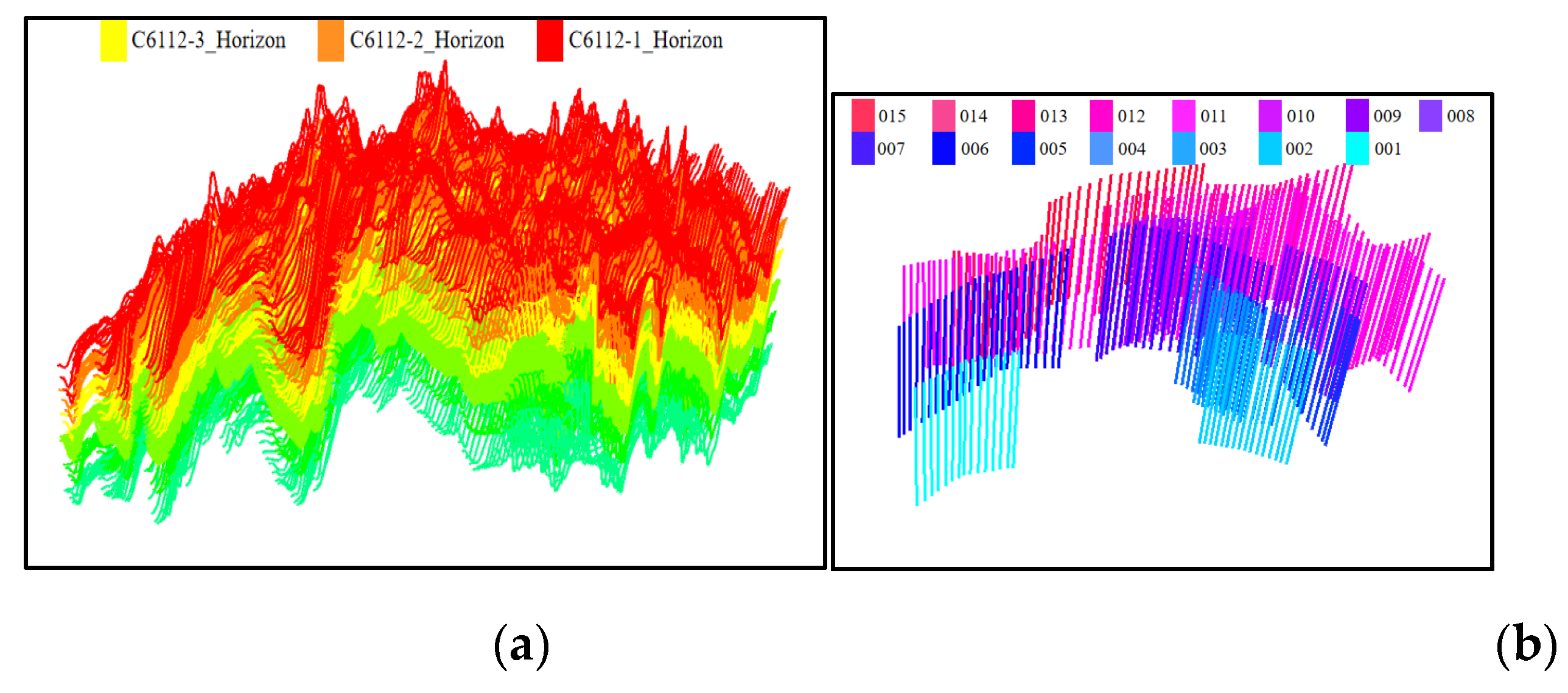
Figure 2.
Three-tier knowledge architecture visualization for Wangyaonan Block. (a) Basic geological entity layer showing fundamental objects (faults, horizons, structural nodes) with their spatial relationships; (b) Enhanced knowledge graph incorporating expert constraints and inference rules, demonstrating the complete three-layer hierarchy with entity-relationship-reasoning structure.
Figure 2.
Three-tier knowledge architecture visualization for Wangyaonan Block. (a) Basic geological entity layer showing fundamental objects (faults, horizons, structural nodes) with their spatial relationships; (b) Enhanced knowledge graph incorporating expert constraints and inference rules, demonstrating the complete three-layer hierarchy with entity-relationship-reasoning structure.
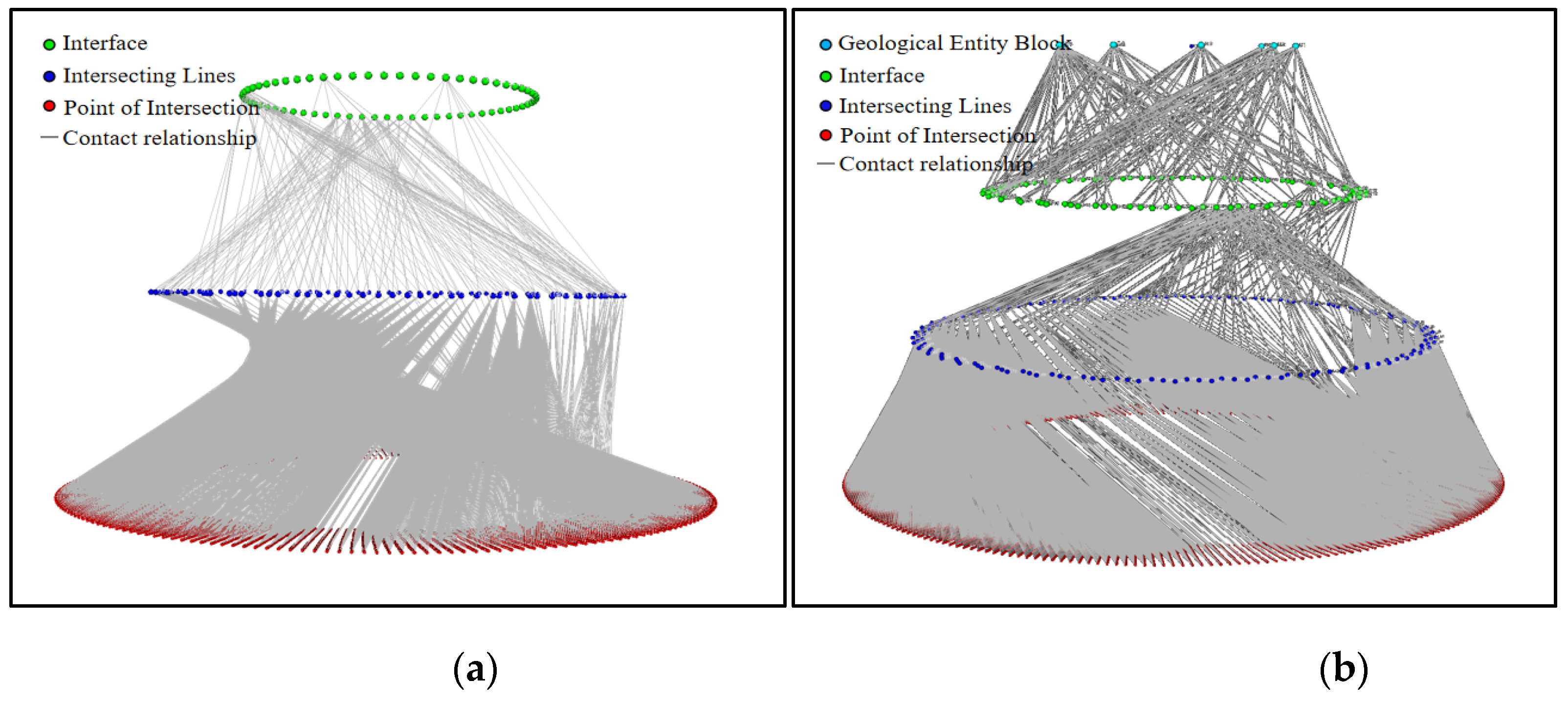
Figure 3.
The data handover relationships for the Wangyao South Block. (a) Initially identified fault and stratigraphic intersection relationships, corresponding to the initial knowledge graph, Figure 2a; (b) Fault and stratigraphic intersection relationships after expert knowledge constraints, corresponding to the final knowledge graph with added expert knowledge constraints, Figure 2b.
Figure 3.
The data handover relationships for the Wangyao South Block. (a) Initially identified fault and stratigraphic intersection relationships, corresponding to the initial knowledge graph, Figure 2a; (b) Fault and stratigraphic intersection relationships after expert knowledge constraints, corresponding to the final knowledge graph with added expert knowledge constraints, Figure 2b.
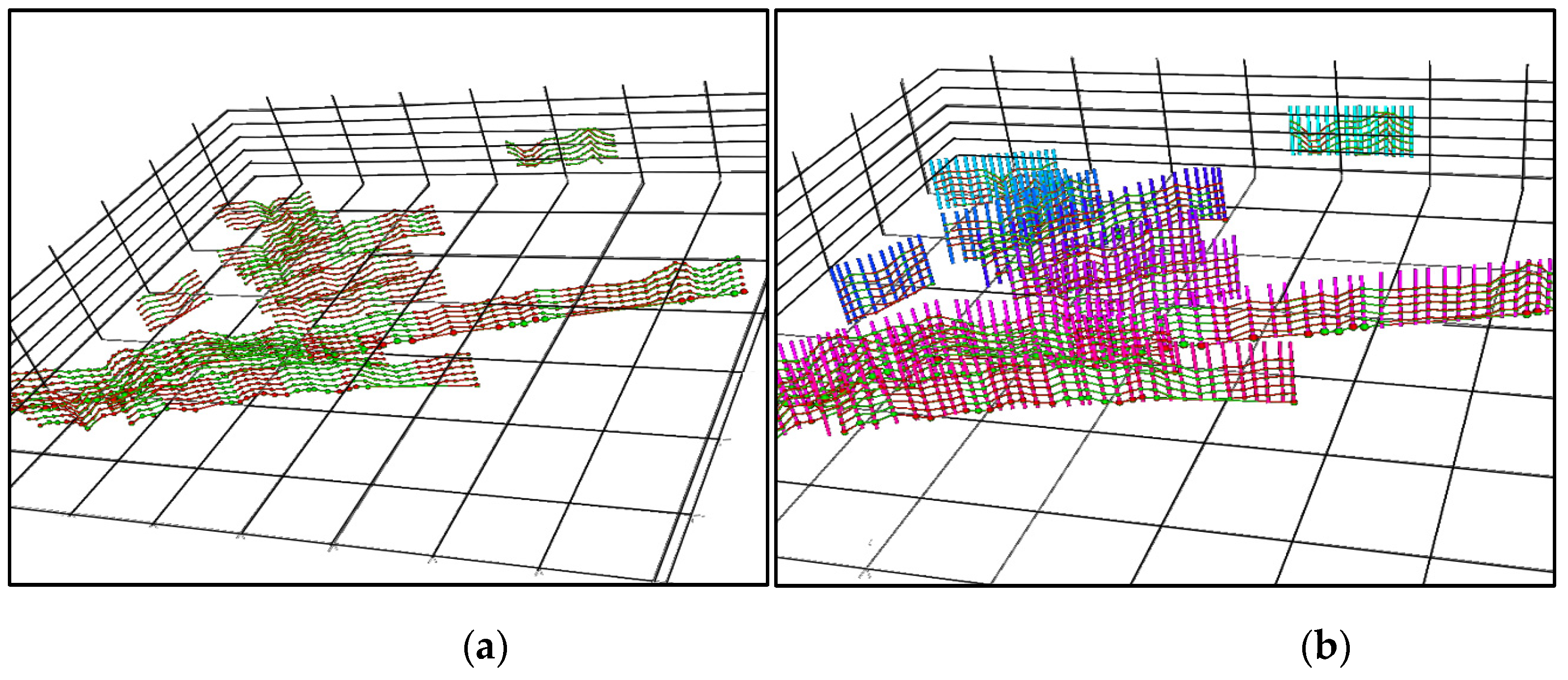
Figure 4.
Comparison before and after removing the intersection relationship between fault 011 and horizon C6112-1_Horizon. (a) Before removing the intersection relationship, fault 011 and horizon C6112-1_Horizon exhibit an intersecting relationship; (b) After removing the intersection relationship, fault 011 and horizon C6112-1_Horizon do not intersect, and no intersection line is generated between them.
Figure 4.
Comparison before and after removing the intersection relationship between fault 011 and horizon C6112-1_Horizon. (a) Before removing the intersection relationship, fault 011 and horizon C6112-1_Horizon exhibit an intersecting relationship; (b) After removing the intersection relationship, fault 011 and horizon C6112-1_Horizon do not intersect, and no intersection line is generated between them.
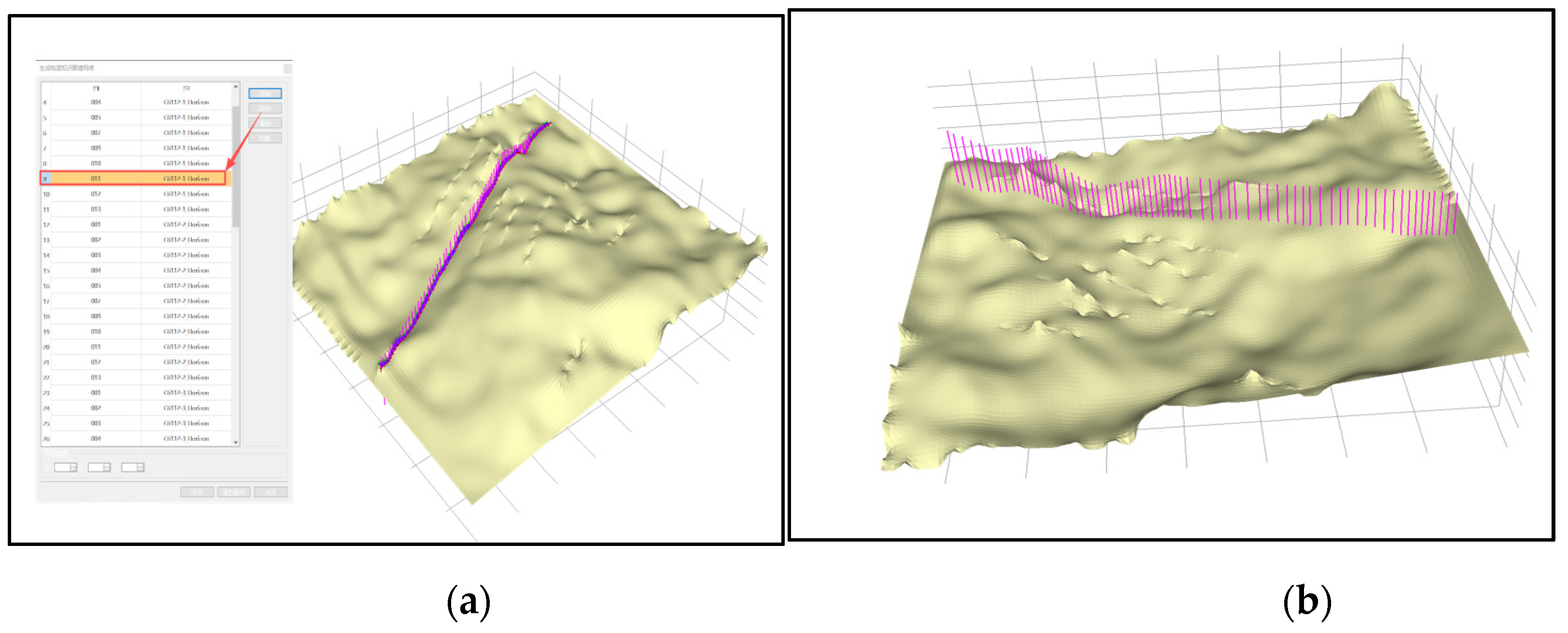
Figure 5.
Quality control is performed on the intersection lines between faults and horizons generated in Table 1 to ensure they conform to geological experts' understanding. (a) Quality control of intersection lines between faults and horizons, where green dots represent quality control points for hanging wall intersection lines and red dots represent quality control points for footwall intersection lines; (b) Quality control of intersection lines between horizons and model boundaries, where blue dots represent quality control points for horizon-boundary intersection lines.
Figure 5.
Quality control is performed on the intersection lines between faults and horizons generated in Table 1 to ensure they conform to geological experts' understanding. (a) Quality control of intersection lines between faults and horizons, where green dots represent quality control points for hanging wall intersection lines and red dots represent quality control points for footwall intersection lines; (b) Quality control of intersection lines between horizons and model boundaries, where blue dots represent quality control points for horizon-boundary intersection lines.
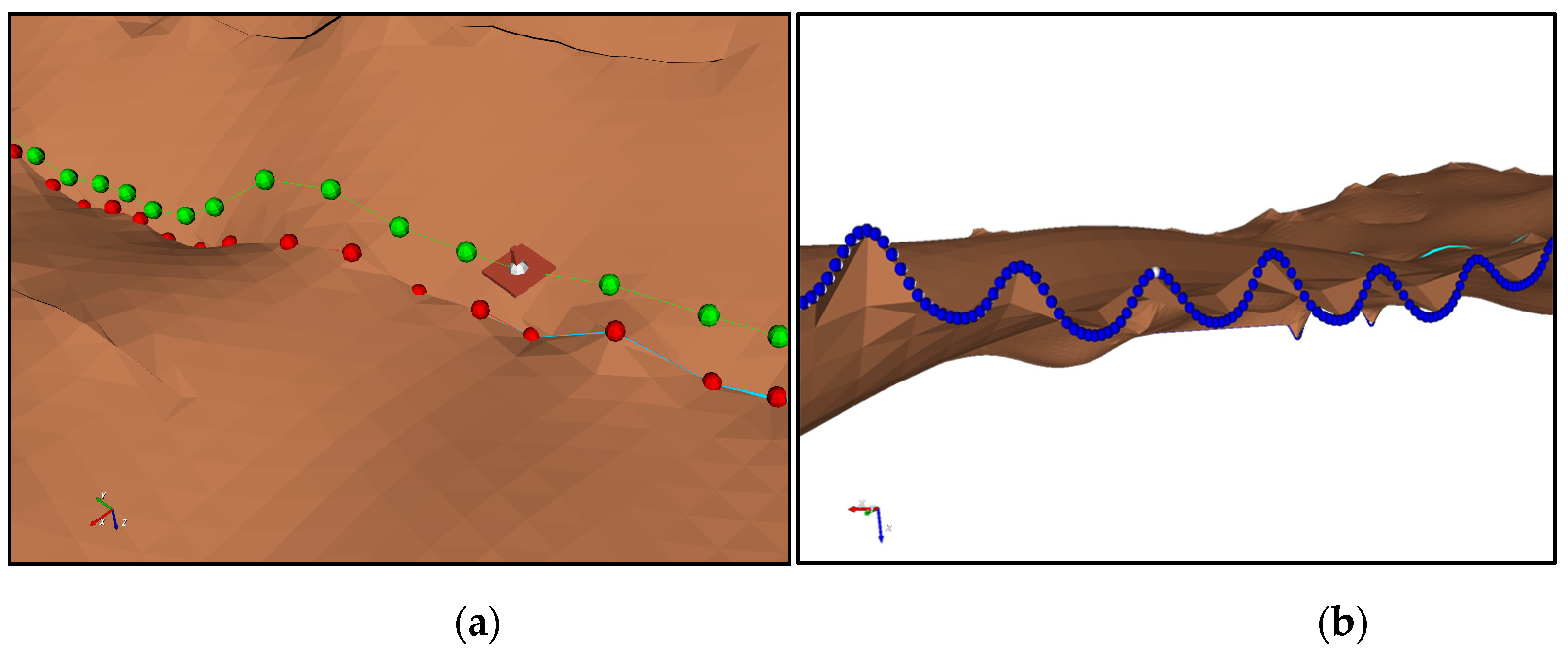
Figure 6.
Geological structural sub-block modelling results. (a) Closed solid model sub-block formed by horizon C6113-2_Horizon and the model upper boundary; (b) Closed solid model sub-block formed by horizon C6113-2_Horizon and horizon C6113-1_Horizon; (c) Closed solid model sub-block formed by horizon C6113-1_Horizon and horizon C6112-4_Horizon; (d) Closed solid model sub-block formed by horizon C6112-4_Horizon and horizon C6112-3_Horizon; (e) Closed solid model sub-block formed by horizon C6112-3_Horizon and horizon C6112-2_Horizon; (f) Closed solid model sub-block formed by horizon C6112-2_Horizon and horizon C6112-1_Horizon; (g) Closed solid model sub-block formed by horizon C6112-1_Horizon and the model lower boundary.
Figure 6.
Geological structural sub-block modelling results. (a) Closed solid model sub-block formed by horizon C6113-2_Horizon and the model upper boundary; (b) Closed solid model sub-block formed by horizon C6113-2_Horizon and horizon C6113-1_Horizon; (c) Closed solid model sub-block formed by horizon C6113-1_Horizon and horizon C6112-4_Horizon; (d) Closed solid model sub-block formed by horizon C6112-4_Horizon and horizon C6112-3_Horizon; (e) Closed solid model sub-block formed by horizon C6112-3_Horizon and horizon C6112-2_Horizon; (f) Closed solid model sub-block formed by horizon C6112-2_Horizon and horizon C6112-1_Horizon; (g) Closed solid model sub-block formed by horizon C6112-1_Horizon and the model lower boundary.
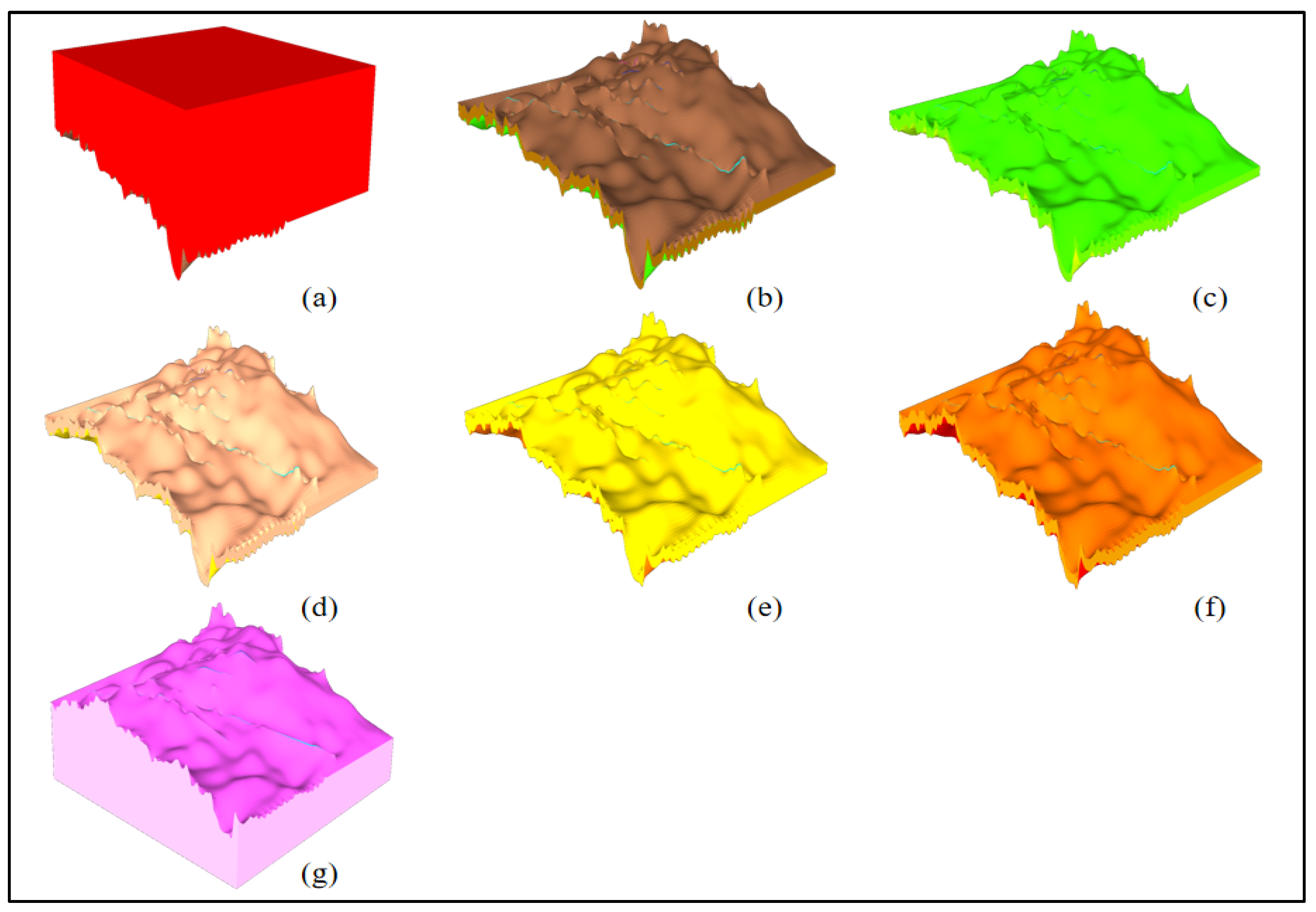
Figure 7.
Results after meshing the closed solid model of geological structural sub-blocks. (a)–(g) correspond to the same sub-block intervals as Figure 6a–g, respectively.
Figure 7.
Results after meshing the closed solid model of geological structural sub-blocks. (a)–(g) correspond to the same sub-block intervals as Figure 6a–g, respectively.
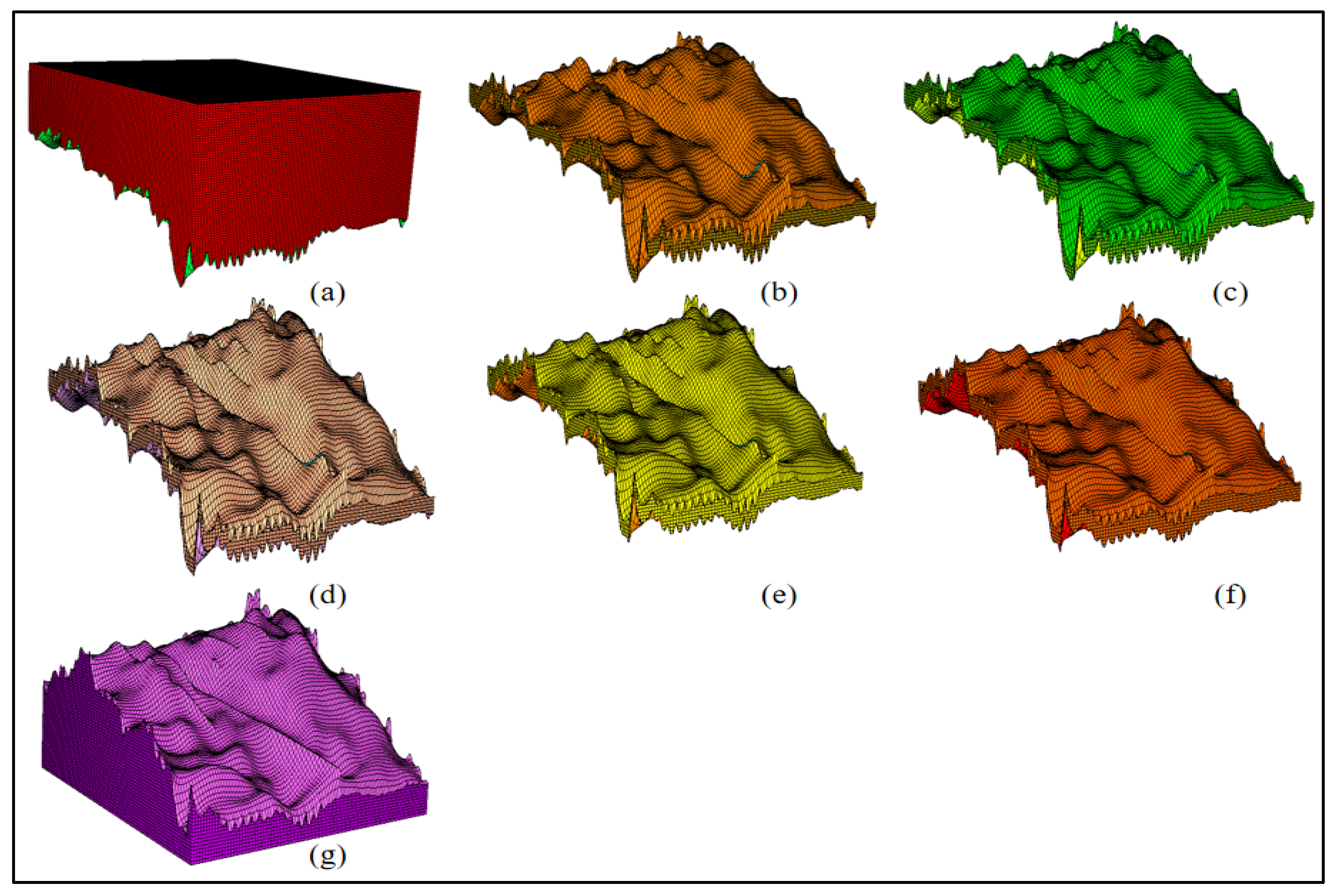
Figure 8.
Geological structural modelling results. (a) Solid closed model; (b) Geological structural model after meshing.
Figure 8.
Geological structural modelling results. (a) Solid closed model; (b) Geological structural model after meshing.
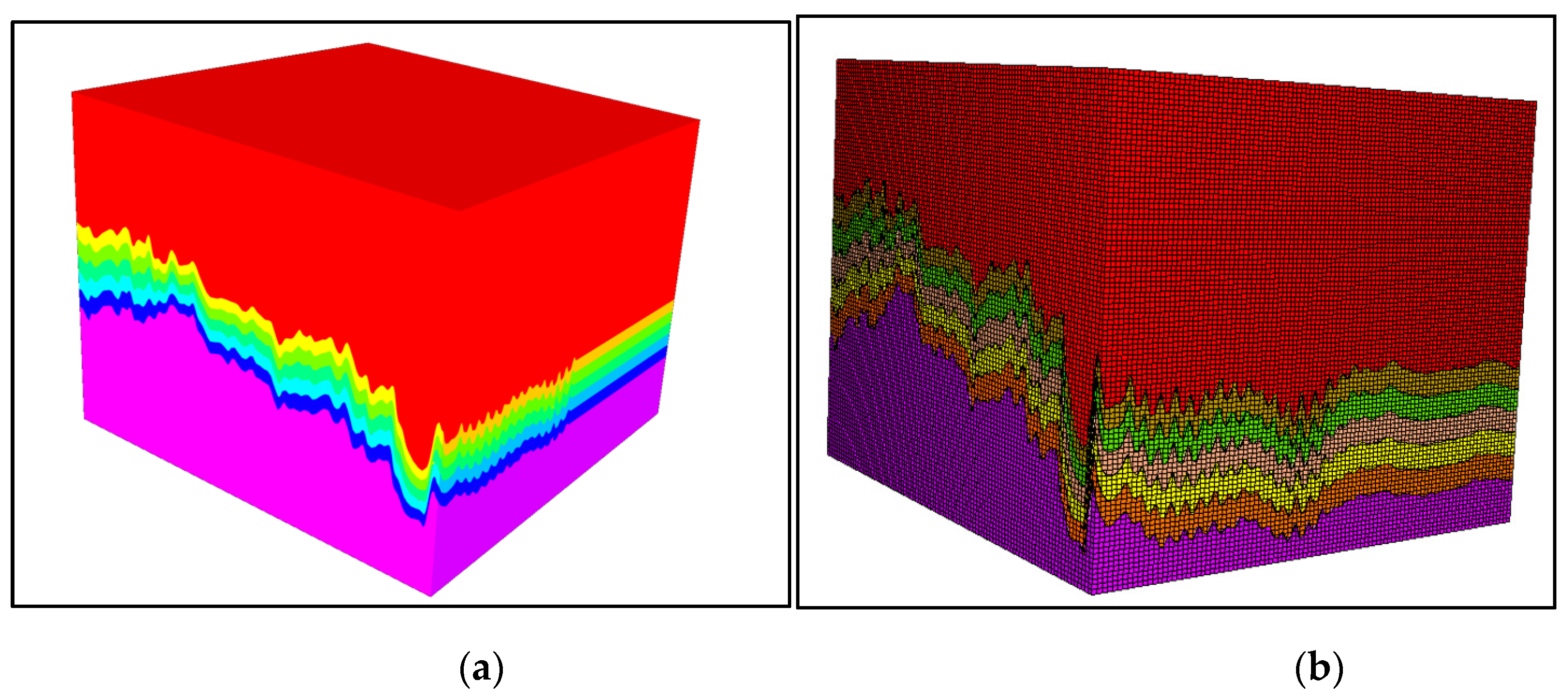
Figure 9.
Application data from the Ganchaigou Block, comprising 4 stratigraphic horizons and 7 faults. (a) Spatial distribution of the 4 stratigraphic horizons; (b) Spatial distribution of the 7 faults.
Figure 9.
Application data from the Ganchaigou Block, comprising 4 stratigraphic horizons and 7 faults. (a) Spatial distribution of the 4 stratigraphic horizons; (b) Spatial distribution of the 7 faults.
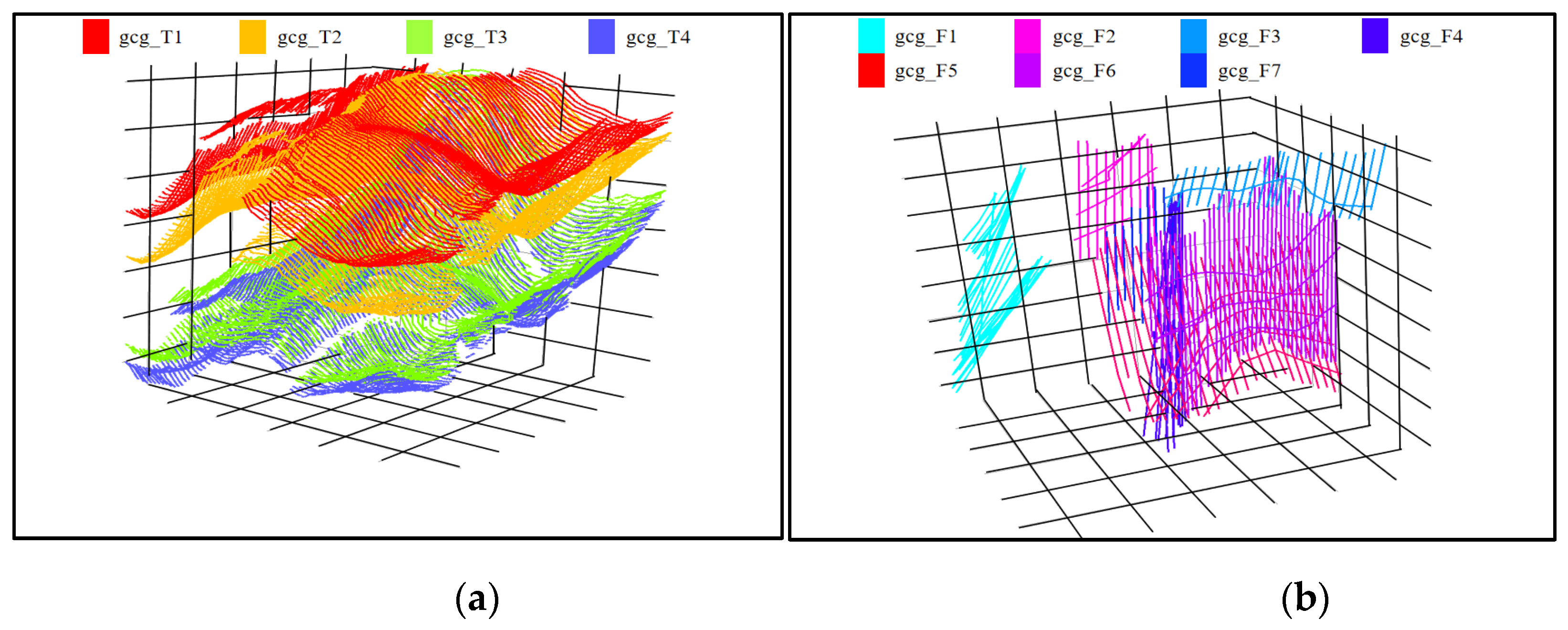
Figure 10.
Geological structural knowledge graph formed based on application data from the Ganchaigou block: (a) Initial geological structural knowledge graph generated according to seismic interpretation data (faults and horizons); (b) Geological structural knowledge graph with fault-horizon intersection relationships adjusted based on geological expert knowledge.
Figure 10.
Geological structural knowledge graph formed based on application data from the Ganchaigou block: (a) Initial geological structural knowledge graph generated according to seismic interpretation data (faults and horizons); (b) Geological structural knowledge graph with fault-horizon intersection relationships adjusted based on geological expert knowledge.
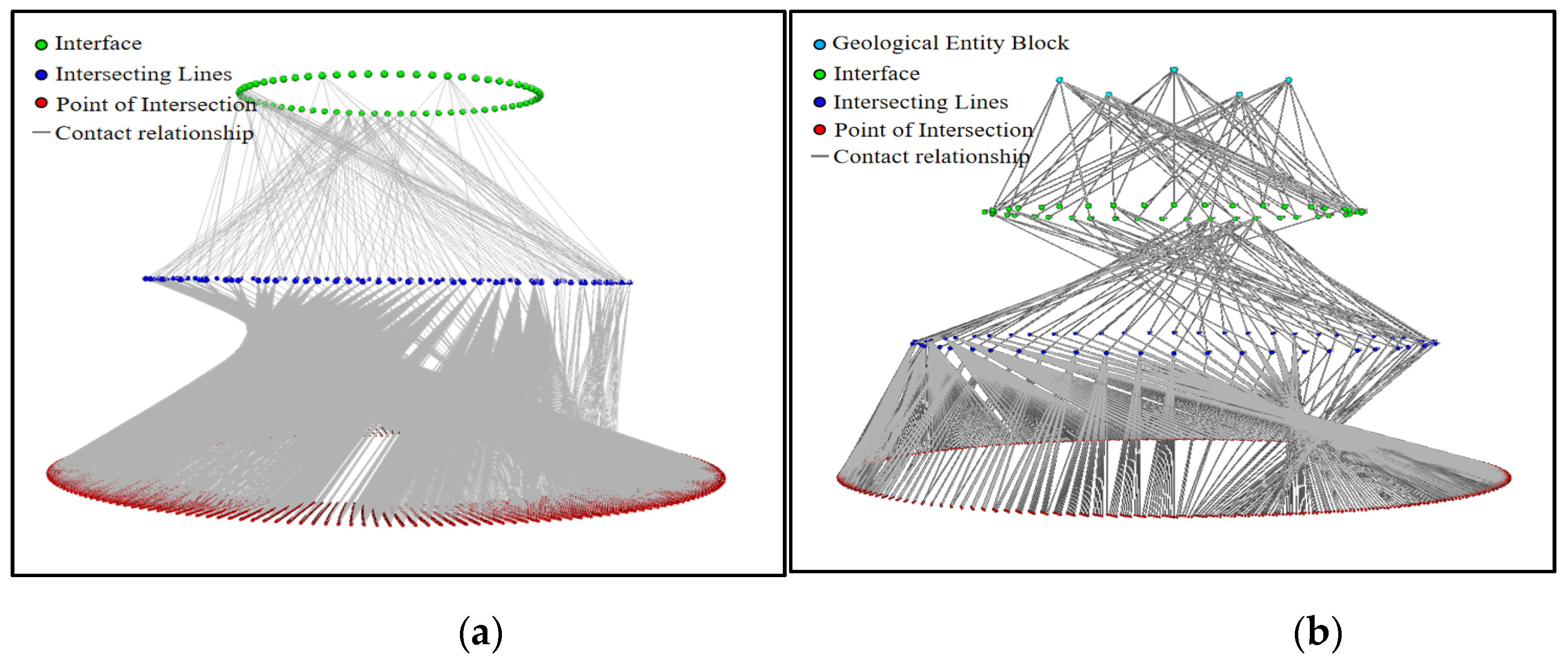
Figure 11.
Based on the knowledge graph theoretical model, spatial topological reasoning identified key fault structures present within the geological body and automatically interpreted and generated a total of 17 pairs of geological intersection line data.
Figure 11.
Based on the knowledge graph theoretical model, spatial topological reasoning identified key fault structures present within the geological body and automatically interpreted and generated a total of 17 pairs of geological intersection line data.
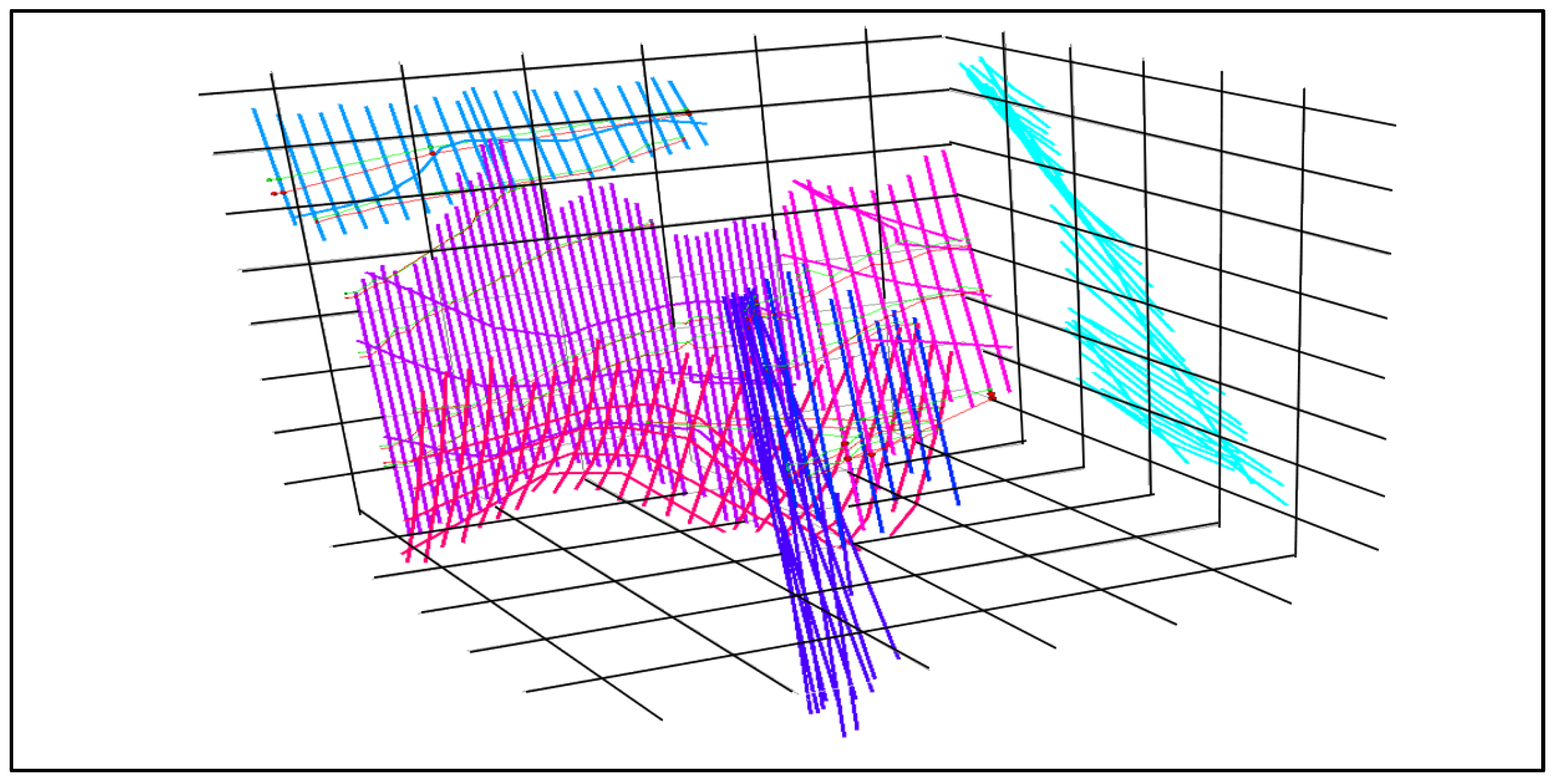
Figure 12.
Quality control of intersection line data based on expert knowledge. (a) Quality control of intersection lines generated between faults and hanging wall/footwall of strata; (b) Quality control of intersection lines generated between strata and model boundaries.
Figure 12.
Quality control of intersection line data based on expert knowledge. (a) Quality control of intersection lines generated between faults and hanging wall/footwall of strata; (b) Quality control of intersection lines generated between strata and model boundaries.
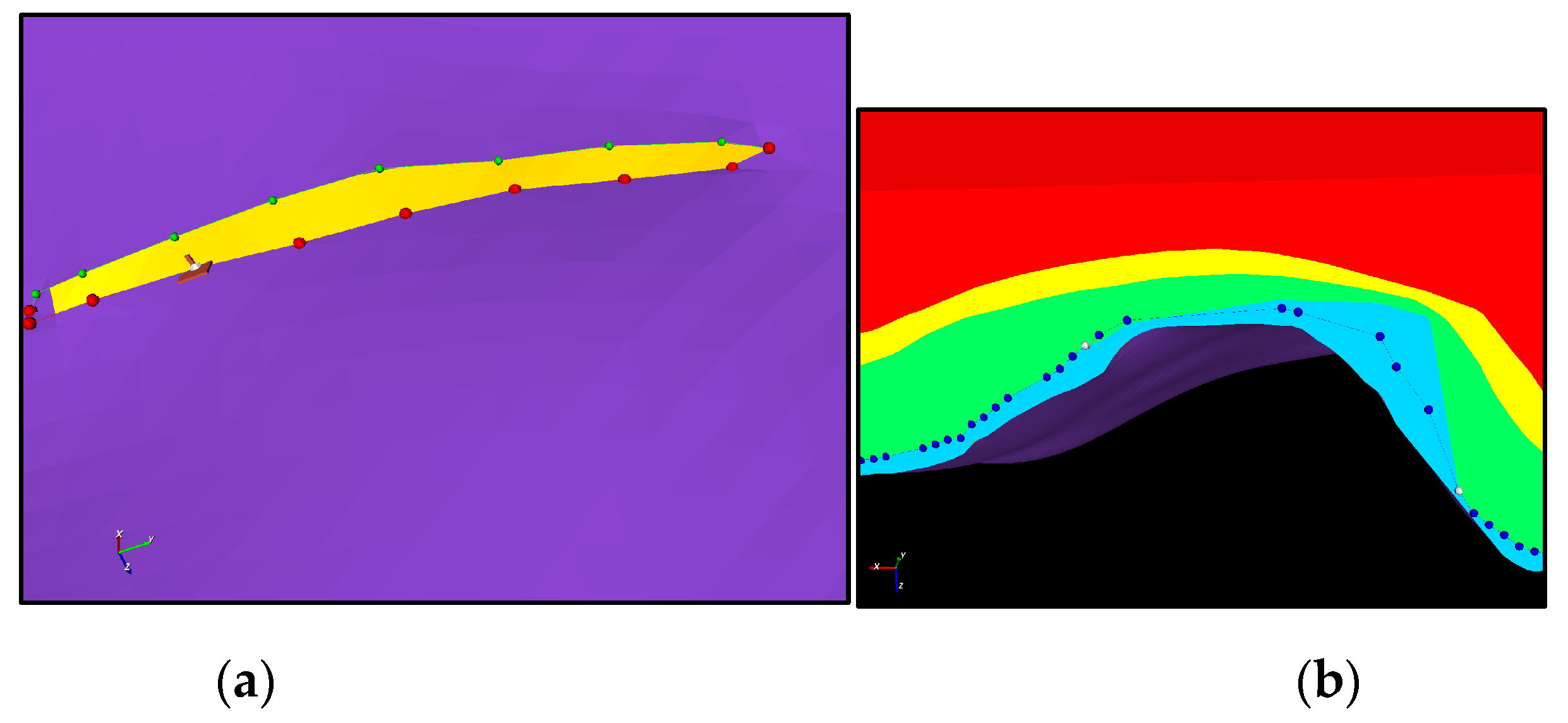
Figure 13.
Geological structural sub-block modelling results. (a) Closed solid model sub-block formed by horizon gcg_T1 and the model upper boundary; (b) Closed solid model sub-block formed by horizon gcg_T1 and horizon gcg_T2; (c) Closed solid model sub-block formed by horizon gcg_T2 and horizon gcg_T3; (d) Closed solid model sub-block formed by horizon gcg_T3 and horizon gcg_T4; (e) Closed solid model sub-block formed by horizon gcg_T4 and the model lower boundary;(f)The final geological structural modelling results are obtained by combining different geological sub-block models according to stratigraphic time horizons.
Figure 13.
Geological structural sub-block modelling results. (a) Closed solid model sub-block formed by horizon gcg_T1 and the model upper boundary; (b) Closed solid model sub-block formed by horizon gcg_T1 and horizon gcg_T2; (c) Closed solid model sub-block formed by horizon gcg_T2 and horizon gcg_T3; (d) Closed solid model sub-block formed by horizon gcg_T3 and horizon gcg_T4; (e) Closed solid model sub-block formed by horizon gcg_T4 and the model lower boundary;(f)The final geological structural modelling results are obtained by combining different geological sub-block models according to stratigraphic time horizons.
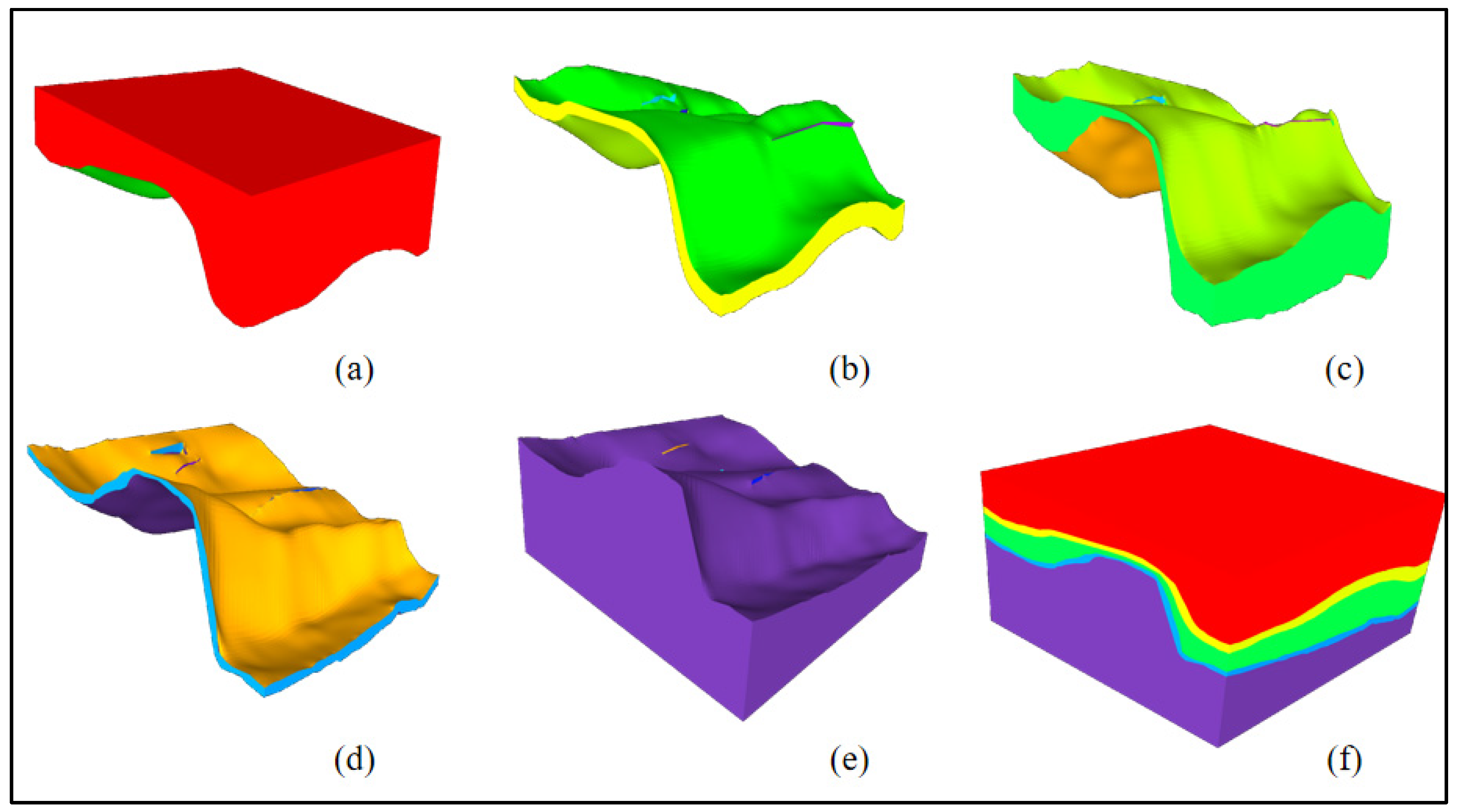
Figure 14.
Comparison of results before and after anti-aliasing applied to Fengjiawan data. (a) Geological structural modelling results before optimisation; (b) Modelling results after optimisation with aliasing artefacts eliminated; (c) Gridded geological structural modelling results before optimisation; (d) Gridded modelling results after optimisation with aliasing artefacts eliminated; (e) Local enlargement of Figure 14a showing aliasing artefacts; (f) Local enlargement of Figure 14b showing aliasing artefacts; (g) Local enlargement of Figure 14c showing aliasing artefacts; (h) Local enlargement of Figure 14d showing aliasing artefacts.
Figure 14.
Comparison of results before and after anti-aliasing applied to Fengjiawan data. (a) Geological structural modelling results before optimisation; (b) Modelling results after optimisation with aliasing artefacts eliminated; (c) Gridded geological structural modelling results before optimisation; (d) Gridded modelling results after optimisation with aliasing artefacts eliminated; (e) Local enlargement of Figure 14a showing aliasing artefacts; (f) Local enlargement of Figure 14b showing aliasing artefacts; (g) Local enlargement of Figure 14c showing aliasing artefacts; (h) Local enlargement of Figure 14d showing aliasing artefacts.
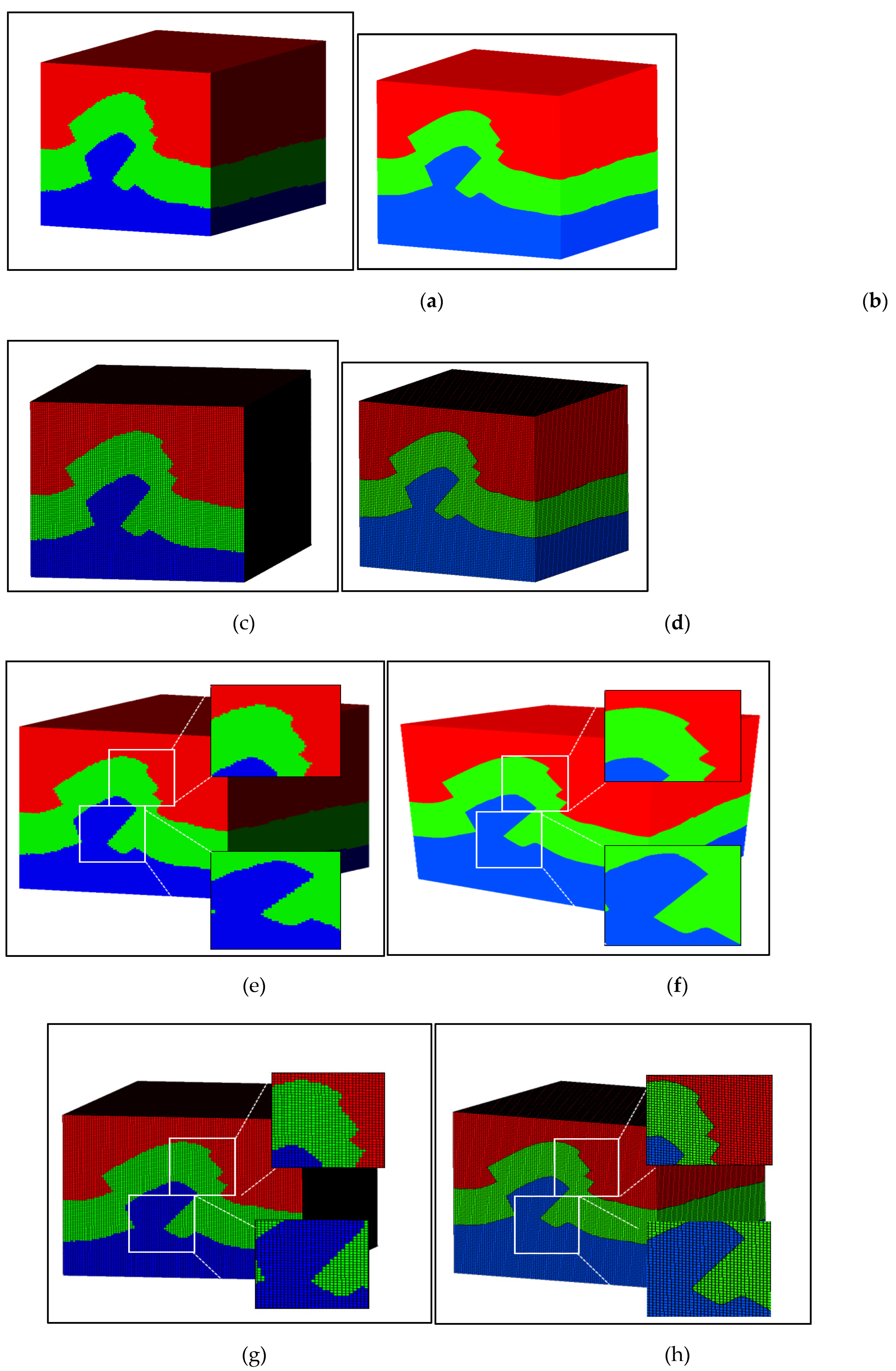
Figure 15.
Comparison of modelling effects before and after the addition of sublayer subdivision using applied data from Fengjia Bay. (a) Intelligent geological structural modelling results before gridding; (b) Intelligent geological structural modelling results after additional sublayer subdivision; (c) Intelligent geological structural modelling results after gridding; (d) Gridded intelligent geological structural modelling results after additional sublayer subdivision.
Figure 15.
Comparison of modelling effects before and after the addition of sublayer subdivision using applied data from Fengjia Bay. (a) Intelligent geological structural modelling results before gridding; (b) Intelligent geological structural modelling results after additional sublayer subdivision; (c) Intelligent geological structural modelling results after gridding; (d) Gridded intelligent geological structural modelling results after additional sublayer subdivision.
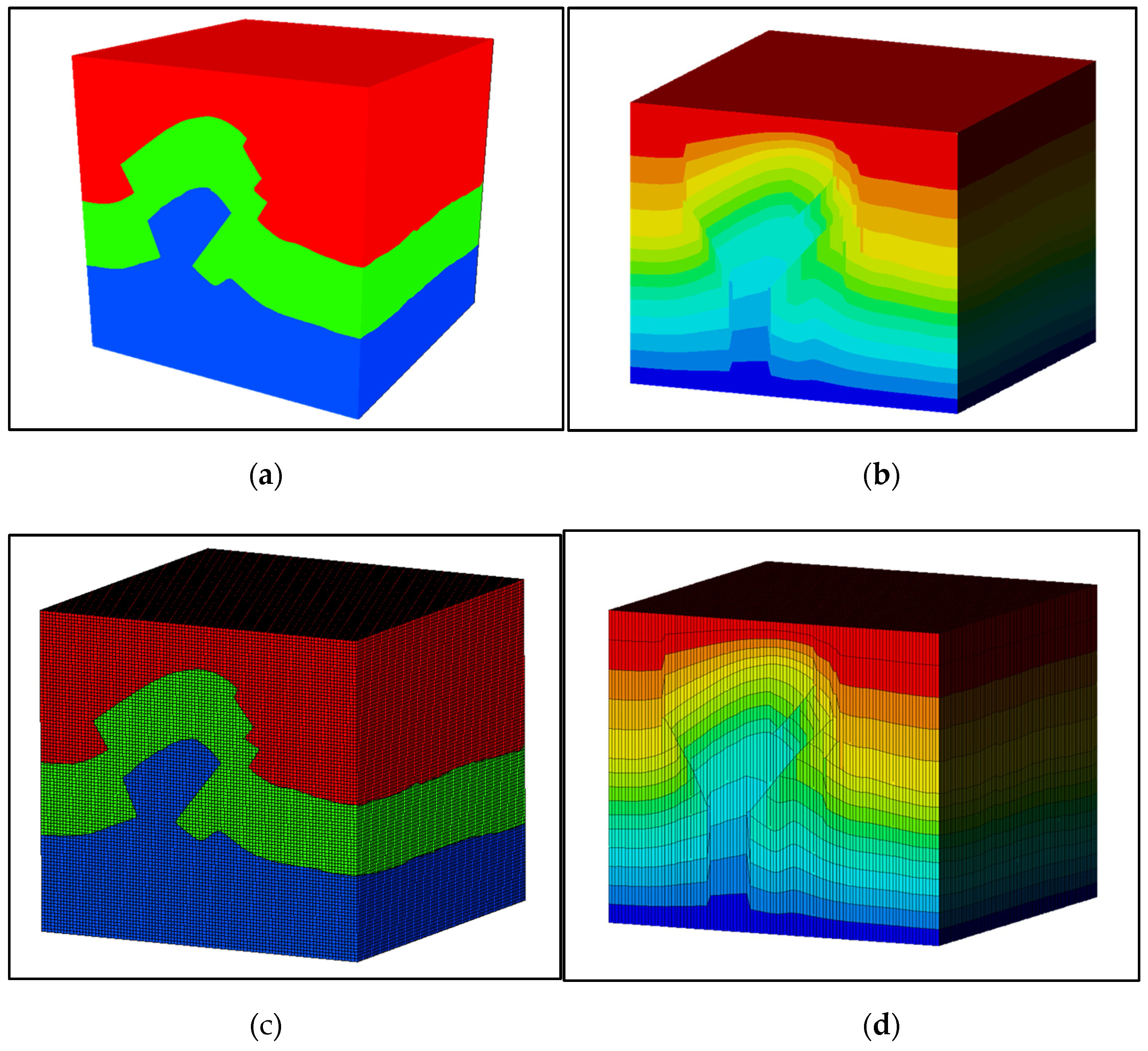
Figure 16.
Corresponding changes in geological structure knowledge graphs before and after thrust fault removal. (a) Geological structure knowledge graph before thrust fault removal; (b) Geological structure knowledge graph after thrust fault removal.
Figure 16.
Corresponding changes in geological structure knowledge graphs before and after thrust fault removal. (a) Geological structure knowledge graph before thrust fault removal; (b) Geological structure knowledge graph after thrust fault removal.
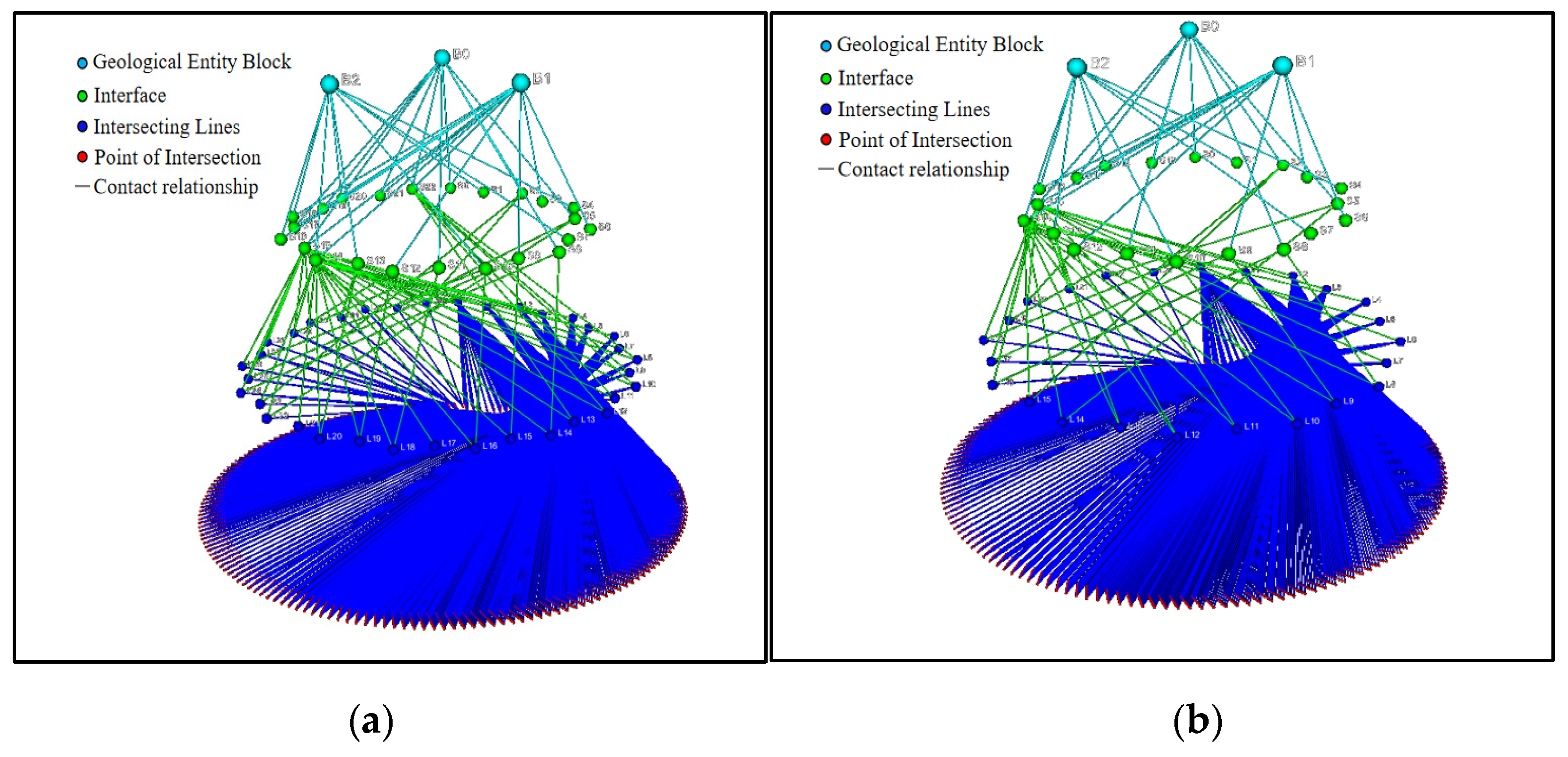
Figure 17.
Comparison of different geological model sub-blocks and the overall geological structural model before and after removal of the blue reverse fault. (a) Modelling effect of sub-block A before removal of the reverse fault shown in blue; (b) Modelling effect of sub-block B before reverse fault removal; (c) Modelling effect of sub-block C before reverse fault removal; (d) Overall geological structural modelling effect before removal of the reverse fault shown in blue; (e) Modelling effect of sub-block A after removal of the reverse fault shown in blue; (f) Modelling effect of sub-block B after reverse fault removal; (g) Modelling effect of sub-block C after reverse fault removal; (h) Overall geological structural modelling effect after removal of the reverse fault shown in blue.
Figure 17.
Comparison of different geological model sub-blocks and the overall geological structural model before and after removal of the blue reverse fault. (a) Modelling effect of sub-block A before removal of the reverse fault shown in blue; (b) Modelling effect of sub-block B before reverse fault removal; (c) Modelling effect of sub-block C before reverse fault removal; (d) Overall geological structural modelling effect before removal of the reverse fault shown in blue; (e) Modelling effect of sub-block A after removal of the reverse fault shown in blue; (f) Modelling effect of sub-block B after reverse fault removal; (g) Modelling effect of sub-block C after reverse fault removal; (h) Overall geological structural modelling effect after removal of the reverse fault shown in blue.
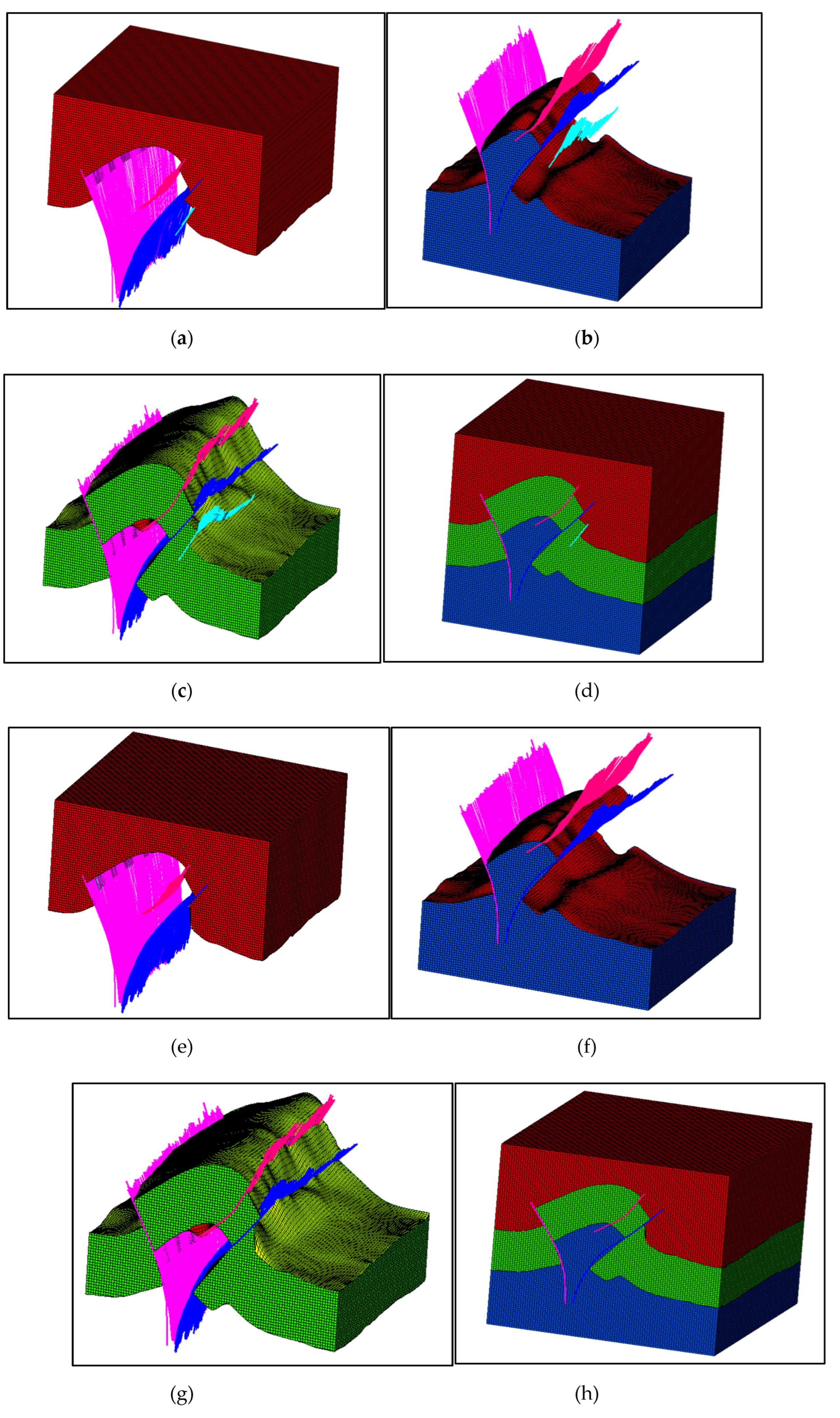

Table 1.
Summary of fault–horizon intersection relationships in the Wangyaonan Block.
| Parameter | Value |
| Total intersection pairs | 66 |
| Horizons involved | 6 (C6113-2 through C6112-1) |
| Faults involved | 15 (Fault 001–015, excluding 006, 008, 014) |
| Intersection types | Normal cutting 45%, Strike-slip offset 32%, Thrust cutting 23% |
| Mean intersection line length | 2.3 ± 0.8 km |
| Geometric validation pass rate | 100% topologically consistent |
| Expert validation pass rate | 94% geologically reasonable |
Table 2.
Summary of fault–horizon intersection relationships in the Ganchaigou Block.
| Contact No. | Fault | Horizon | Contact No. | Fault | Horizon |
| 1 | gcg_F1 | gcg_T1 | 10 | gcg_F6 | gcg_T2 |
| 2 | gcg_F2 | gcg_T1 | 11 | gcg_F2 | gcg_T3 |
| 3 | gcg_F3 | gcg_T1 | 12 | gcg_F3 | gcg_T3 |
| 4 | gcg_F4 | gcg_T1 | 13 | gcg_F4 | gcg_T3 |
| 5 | gcg_F5 | gcg_T1 | 14 | gcg_F6 | gcg_T3 |
| 6 | gcg_F1 | gcg_T2 | 15 | gcg_F2 | gcg_T4 |
| 7 | gcg_F2 | gcg_T2 | 16 | gcg_F3 | gcg_T4 |
| 8 | gcg_F4 | gcg_T2 | 17 | gcg_F6 | gcg_T4 |
| 9 | gcg_F5 | gcg_T2 |
Table 3.
Quantitative comparison between the proposed method and conventional Petrel workflow.
| Metric | Wangyaonan (Proposed / Petrel) | Ganchaigou (Proposed / Petrel) | Fengjiawan (Proposed / Petrel) |
| RMSE (m) | 5.2 / 16.8 | 7.1 / 18.5 | 6.3 / 15.2 |
| Maximum error (m) | 12.1 / 38.5 | 18.3 / 52.7 | 15.6 / 41.2 |
| Geological reasonableness Rgeo (%) |
96.2 / 84.5 | 94.8 / 82.1 | 95.5 / 86.3 |
| Modelling cycle (days) | 8 / 45 | 12 / 60 | 10 / 52 |
| Manual intervention (hours) | 6 / 120 | 10 / 180 | 8 / 150 |
| Fault intersection accuracy (%) | 97.0 / 78.5 | 93.5 / 71.2 | 95.2 / 75.8 |
Table 4.
Ablation study results for the Wangyaonan Block.
| Configuration |
RMSE (m) |
Geological Reasonableness (%) |
Cycle (days) |
| Full method (TKA + KILGA + HAMR-APEE + STFMA) | 5.2 | 96.2 | 8 |
| Without TKA (no knowledge constraints) | 9.8 | 85.6 | 12 |
| Without KILGA (manual intersection lines) | 7.5 | 90.1 | 20 |
| Without HAMR-APEE (uniform mesh) | 8.1 | 88.3 | 7 |
| Without bidirectional linkage | 5.4 | 95.8 | 15 |
Table 5.
Comparative analysis with existing geological modelling approaches.
| Capability | Traditional Software (Petrel/GoCAD) |
ML-based Methods [13,14] |
Existing Geological KG [15] | Proposed Method |
| Knowledge integration | Manual, implicit | Feature-learned | Flat relational | Hierarchical, formalised |
| Multi-hop reasoning (≥3 hops) |
Not supported | Not supported | Limited (78.3% success) | Supported (>90% success) |
| Fault intersection automation | Semi-manual | Not addressed | Not addressed | Fully automated (KILGA) |
| Adaptive mesh refinement | Uniform meshing | Not applicable | Not applicable | Anisotropic HAMR-APEE |
| Thrust fault modelling | Surface intersections frequent | Limited training data | Not addressed | STFMA with XFEM |
| Dynamic model updating | Full rebuild required | Retraining required | Query-level only | Incremental, real-time |
| Average RMSE (m) | 15–20 | 10–15 (reported) | Not reported | 5–8 |
Disclaimer/Publisher’s Note: The statements, opinions and data contained in all publications are solely those of the individual author(s) and contributor(s) and not of MDPI and/or the editor(s). MDPI and/or the editor(s) disclaim responsibility for any injury to people or property resulting from any ideas, methods, instructions or products referred to in the content. |
© 2026 by the authors. Licensee MDPI, Basel, Switzerland. This article is an open access article distributed under the terms and conditions of the Creative Commons Attribution (CC BY) license (http://creativecommons.org/licenses/by/4.0/).
Copyright: This open access article is published under a Creative Commons CC BY 4.0 license, which permit the free download, distribution, and reuse, provided that the author and preprint are cited in any reuse.


