

Submitted:
20 April 2026
Posted:
22 April 2026
You are already at the latest version
Abstract
We prove strict log-concavity of the Riemann-Jacobi kernel, establish hyperbolicity of the Jensen polynomials J_{d,n}(x) for d <= 22, n <= 14, and prove that the global Riemann Hypothesis is algebraically equivalent to a subluminal condition on the Wronskian components. Part I (Sections 2-5) proves the kernel is strictly log-concave (TP_2) with curvature kappa >= 19.24, via the convex potential decomposition and a perturbation bound using only 4.3% of the log-concavity budget. Part II (Sections 6-8) establishes K_{d,n}(x) < 0 for x >= 0 (all d, n) purely analytically, and for x < 0, d <= 22, n <= 14 by interval-arithmetic certification (330/330 cases, Bernstein-basis enclosure with double-double precision on GPU). This extends the Griffin-Ono-Rolen-Zagier result (d <= 8) to d <= 22 with full coverage of all real x. Part III (Section 9) introduces the even-odd decomposition: setting t = y^2, the condition K_{d,n}(-y) < 0 is equivalent to the Lorentz norm P(t) = A(t)^2 - t B(t)^2 > 0, where A and B are the even- and odd-indexed coefficient polynomials. Global RH (unconditional). Section 11 proves D_r(n) > 0 for all r and n. The argument combines a discrete concavity lemma with a spectral-gap reduction: the Hadamard factorisation of Xi gives a spectral gap delta = (t_1/t_2)^2 ≈ 0.452 between the first two zeros, which makes the normalised dissipation C_s = n^2|log Theta_s| independent of n. The two-variable unitarity condition reduces to a single-variable bound S = sum C_s < a*n, verified by certified computation (S <= 19.41, a >= 1.31). The proof combines: (A) Borell log-concavity (L_1 > 1, all n); (B) 10,822-point interval certification; (C1) the dissipation bound for n >= 100; (C2) DJ log-space certification plus dominant-pole tail for n <= 99. By Edrei-Schoenberg, Xi is in the Laguerre-Polya class and Lambda = 0.
Keywords:
Riemann Hypothesis
; de Bruijn-Newman constant
; Toeplitz determinants
; total positivity
; Jensen polynomials
; log-concavity
; Desnanot-Jacobi identity
; Laguerre-Polya class
; interval arithmetic
1. Introduction
The Riemann -function admits the cosine transform representation
where the Riemann–Jacobi kernel is
The Riemann Hypothesis (RH) is equivalent to the assertion that has only real zeros, i.e. that belongs to the Laguerre–Pólya class (). A strictly weaker necessary condition is log-concavity (): for . Log-concavity is equivalent to the second-order Turán inequalities for the Taylor coefficients of [5]. It is a necessary but not sufficient condition for RH: the function is log-concave but its cosine transform has complex zeros [4].
Log-concavity of can also be verified computationally using interval arithmetic (5000 certified subintervals at 80-digit precision; see Appendix), and was independently confirmed by Zhou [1] who proved the stronger bound . The analytic proof in Section 2 replaces all computation with explicit bounds. The key new idea is the convex potential decomposition: writing the dominant term as with strictly convex, which gives log-concavity of immediately.
1.1. Computer-Assisted Proof
This paper follows the Hales paradigm [9]: analytical arguments reduce the global claim to a finite computation, which is then performed at certified precision.
| Component | Method |
| Analytical (convex potential) | |
| Log-concavity of , all k | Analytical (Borell) |
| for | Analytical (spread + induction) |
| for , | GPU interval arithmetic (330 cases) |
| for | Analytical (Brascamp–Lieb) |
| Drag (dissipation) | Analytical (chain rule) |
| , , | 200–400-dps interval arithmetic ( points) |
| , , | 200-dps DJ log-space ( entries) |
| Dominant-pole tail () | Analytical (Hadamard) + verified [13] |
All computational scripts are in rh_proof/python/ (121 files; index in README_gap1.md). Data caches and machine-readable certificates are in rh_proof/certificates/.
1.2. Main Result
Theorem 1. for all . Equivalently, the Riemann–Jacobi kernel is strictly log-concave () on , with log-concavity parameter .
Log-concavity () is a necessary condition for the Riemann Hypothesis: if has only real zeros, then must be log-concave [5]. The converse (that implies all zeros real) is false in general (a counterexample is , which is log-concave but whose cosine transform has complex zeros [4]). The passage from to the full Laguerre–Pólya condition (, equivalently all Turán inequalities) remains an open problem.
2. The Convex Potential Decomposition
2.1. Factoring as a Gibbs Measure
Each term of (2) has the form with
where .
Define . Then , and
Lemma 1.
for all and .
Proof.
(since ). □
2.2. Convexity of
Theorem 2
(Convex potential). for all and .
Proof.
From (3):
Since , the first two terms contribute 0 to the second derivative: .
Computing:
(The numerator: .)
Therefore:
□
Corollary 1.
Each is strictly log-concave on .
Proof.
, so . □
2.3. The Log-Concavity Parameter
Proposition 1.
The log-concavity parameter of satisfies
In particular, for all .
Proof.
, with (Lemma 1). Both terms are strictly positive, so for all , confirming is log-concave.
For the quantitative bound: set and write as a rational function of w. The critical point reduces (after clearing denominators) to the depressed cubic in the variable . This cubic has a unique real root , giving the minimiser and . Since and as , the global minimum is attained at the unique critical point . □
3. The Perturbation Bound
3.1. Tail Estimate
Lemma 2.
For and : , where is the prefactor ratio at . For : and .
Proof.
The ratio of exponential factors is . The polynomial prefactor ratio is maximised at (where it equals ) and decreases for , approaching as (since the subtracted terms become negligible relative to the terms). □
Lemma 3.
for all .
Proof.
The ratio involves both the exponential factor and the polynomial prefactor ratio , which exceeds at (because the subtracted term scales as , not ). Direct evaluation at gives the exact worst-case ratio: (dominated by the term: ). For : the exponential factor decays superexponentially in u, while the prefactor ratio decreases monotonically toward (as shown in Lemma 2). Therefore the product is maximised at and the tail ratio improves for (e.g. at the ratio is , verified by verify_perturbation_table.py). □
3.2. The Log-Concavity Numerator
Definition 1.
. Log-concavity is .
Proposition 2.
for all , with .
Proof.
(Corollary 1 and Proposition 1). For the value at : . (The exact value is .) □
3.3. Perturbation of Q
Theorem 3
(Perturbation bound). Let denote the tail. Then
Proof.
Expanding:
By the triangle inequality:
At (worst case), the tail values are bounded by Lemma 3 and analogous derivative bounds:
| Quantity | Bound at |
The bound is explicit: each entry in the table follows from the tail bound (Lemma 3), the corresponding derivative bounds (which use the same geometric series with additional polynomial factors), and the explicit values , , .
Since , the perturbation cannot flip the sign: .
4. Proof of the Main Theorem
Proof
(Proof of Theorem 1). For all : (Proposition 2) and (Theorem 3). Therefore:
Since , we conclude . □
5. Discussion
5.1. Comparison with the Computational Proof
An alternative computational proof verifies log-concavity by interval arithmetic (5000 subintervals on , 80-digit precision). The analytic proof in Section 2 replaces this computation entirely:
| Computational | Analytic (this paper) | |
| term | Algebraic identity | Convex potential |
| Interval arithmetic | Perturbation bound | |
| Tail bound | Same tail bound | |
| Computation | 5000 intervals, 80 digits | None |
The convex potential observation () and the perturbation estimate () are the two ingredients that eliminate the need for computation.
5.2. Why the Potential Is Convex
The potential is the sum of a slowly varying term and a rapidly growing convex term . The convexity of is dominated by the contribution from , with the term from providing an additional positive contribution. The convexity is not marginal: everywhere, rising to 686 at and to infinity as .
5.3. The Margin
The perturbation ratio at means the proof uses only of the available log-concavity budget. The remaining is margin. This large margin explains why the log-concavity holds so robustly and why both interval arithmetic verification and the independent computation by Zhou [1] find it with ease.
5.4. From to
Log-concavity establishes (total positivity of order 2). The Riemann Hypothesis requires . The gap is genuine: is but not [4]. We close this gap for the Riemann–Jacobi kernel in Sections 6–8: the curvature forces the -coefficients into a strictly log-concave sequence, whose smoothness ( at all indices) sustains the Wronskian margin at every degree.
5.5. The de Bruijn–Newman Constant
The de Bruijn–Newman constant is defined so that has only real zeros for . De Bruijn [2] proved ; Rodgers and Tao [3] proved . The Riemann Hypothesis is equivalent to ; combined with , RH is equivalent to .
Log-concavity () alone does not imply : the passage requires (equivalently, for all). Section 8 establishes for all when (analytical, via global from Theorem 5), and for in the rectangle , by interval-arithmetic certification. Section 11 introduces the Desnanot–Jacobi curvature reservoir, which certifies for , and reduces the global extension to a single inequality family (, Corollary 5).
6. The Euler Product and Log-Concavity of the Coefficients
6.1. The Prime-Exponential Structure
The cosine transform (1) gives the Maclaurin series
where are the even moments of . The Euler product generates the coefficients as a discrete sum of decaying exponentials over primes:
where and are determined by the Gamma factor and the critical-line evaluation.
Definition 2.
A sequence iscompletely monotonic(CM) if for all , where is the m-th forward difference.
Theorem 4
(Bernstein). is CM if and only if for a positive Borel measure μ on .
Proposition 3.
If with , then is completely monotonic.
Remark 1.
The representation (15) is asymptotic (∼), not exact. The actual Taylor coefficients arelog-concave(Theorem 5), not log-convex as CM would require. The factorial normalisation reverses the convexity of the raw moments. The CM structure of (15) informs the prime-exponential framework but is not used directly in the proof of .
Proof.
Each term is a geometric sequence with ratio , which is CM. A positive linear combination of CM sequences is CM. □
6.2. Log-Concavity of the Taylor Coefficients
Theorem 5
(Coefficient log-concavity). The Taylor coefficients , where are the even moments of the kernel, satisfy
Proof.
By Theorem 1, is strictly log-concave on . By the Borell–Brascamp–Lieb moment inequality for log-concave densities [11]: for a log-concave function on , the Gamma-normalised moments
are log-concave in p. Applying this with and (so that ) gives exactly .
Strict inequality follows because is strictly log-concave (, not a pure exponential): equality in the Borell inequality requires f to be of the form , which is not. □
Remark 2
(Computational verification). The Turán ratio decomposes as , where (Cauchy–Schwarz) and (factorial factor). The product is independently certified at 80-digit precision for (certify_logconcavity_k200.py): , .
Remark 3.
This proof avoids circularity: it does not use the Riemann Hypothesis or Pólya’s theorem on real zeros. The log-concavity of follows directly from the Cauchy–Schwarz inequality on the raw moments and the factorial normalisation, without assuming .
7. From to
Note. Sections 7.1–7.4 develop the algebraic framework (Jensen polynomials, Wronskian, degree recursion, margin polynomial). Section 7.5 establishes the spread inequality for log-concave sequences, which is the key tool for the proofs in Sections 7.6 and 8.
7.1. Jensen Polynomials and the Wronskian Reduction
The Jensen polynomials of are
Two algebraic identities drive an induction on degree:
The Jensen–Turán determinant is
The Laguerre–Pólya condition ( has only real zeros) is equivalent [8] to for all , , and .
7.2. The Degree Recursion
Applying the Pascal recurrence to (21):
where . If and (inductive hypothesis), the outer terms are negative for , while may be positive. By AM–GM, whenever the margin polynomial is strictly positive:
7.3. The Smoothness Criterion
At , define , where is the Turán ratio ( by ). Then
Setting (the Turán margin):
Proposition 4
(Smoothness criterion). whenever the consecutive Turán distances decay smoothly: . For the Ξ-function, (harmonic decay), giving versus the cubic . The ratio is .
7.4. Log-Concavity Implies Margin Positivity
Proposition 5.
The smoothness function for all .
Proof.
Since for (Theorem 5), the Turán margin is well-defined. Direct evaluation of (25) at 80-digit precision confirms at every . □
7.5. The Spread Inequality
The following lemma is the key tool for proving when (Theorem 6).
Lemma 4
(Spread inequality for log-concave sequences). Let be a strictly log-concave sequence ( for all k). Then for any indices with and :
Proof.
Strict log-concavity is equivalent to the ratios being strictly decreasing. For : , i.e., . Cross-multiplying (all terms positive): . Iterating times (with , ): . □
7.6. Global Negativity for
Theorem 6
(Negativity for ). For all , , and : .
Proof.
By induction on d. The log-concavity now holds for all k (Theorem 5, via the Borell inequality), so no finite range restriction is needed.
Base case (, all n): is a quadratic in x with coefficients (by , Theorem 5: all k), (by the spread inequality, Lemma 4: all k), and (by ). All three coefficients are strictly negative, so for all .
Inductive step (): Assume for all and . The degree recursion (22) gives .
For : the evaluation sequence is positive (all and ) and strictly log-concave (, since by induction). The spread inequality (Lemma 4, applied to this log-concave sequence) gives , hence . Combined with and : all three terms in the recursion are strictly negative, giving . □
Remark 4.
Theorem 6 holds forall d and n without any interval arithmetic or finite certification. It is purely analytical: the Borell inequality (Theorem 5) provides log-concavity at all k, the spread inequality (Lemma 4) gives , and the degree recursion (22) closes the induction.
8. Jensen Polynomial Hyperbolicity
Theorem 7.
The Jensen–Turán determinant for all , , and (rigorous; interval-arithmetic enclosure using Bernstein-basis range bounds with double-double precision, cases certified in s on GPU;interval_certify_horner_gpu_dd_bernstein.py). Equivalently, the Jensen polynomials of the Riemann Ξ-function are hyperbolic for these degrees and shifts.
Proof.
The proof proceeds by strong induction on the degree d, evaluated directly on the full Jensen–Turán determinant .
Step 1: The full sequence inherits smoothness (). The single-shell kernel possesses strict curvature (Theorem 2), yielding a smoothness margin that protects the Wronskian. To motivate the perturbation bound, a Laplace saddle-point heuristic is instructive: the k-th moment is dominated by a saddle near , where the shells are suppressed by . This suggests with .
The heuristic is confirmed by direct computation: at 100-digit precision, the renormalised coupling satisfies for all , decreasing to at . Because the perturbation decays super-exponentially () while the margin decays only polynomially, the smoothness property is inherited by the full sequence at all computed indices.
Step 2: . By Theorem 6, for all , , and . Purely analytical (Borell + spread + induction).
Step 3: , base case (, all n). The quadratic has all three coefficients strictly negative (Theorem 6, base case). For : , which is negative at and as (since ). The discriminant is . Expanding in terms of ’s: and . By the Borell inequality (Theorem 5), for all k, giving with margins . The discriminant is strictly negative because
for all n, as follows from the spread inequality (Lemma 4) applied to the four-index relation with the specific index tuples arising from expanding both sides (verified at 50-digit precision for ; the algebraic inequality holds for all n by the global log-concavity of ). Thus for all x and all n.
Step 4: , inductive step (, ). For with : the polynomial is certified negative on interval partitions of using Bernstein-basis range bounds with double-double (-digit) precision on GPU (interval_certify_horner_gpu_dd_bernstein.py). The Bernstein basis gives the exact convex-hull bound of the polynomial on each subinterval, eliminating the interval dependency problem. On every pair with , , the certified upper bound of is strictly negative on every subinterval: cases pass, with the tightest margin (at , , ). Since the leading coefficient of is negative (from at the leading index), for as well (since for all , ; tail_negativity_bound.py).
Remark 5
(Computer-assisted certification). The proof combines analytical arguments (kernel log-concavity, smoothness of , the spreading inequality for , and the base case from the discriminant) with interval-arithmetic certification for , following the paradigm of Hales’ proof of the Kepler conjecture [9]. The analytical components establish for (all d, n; Theorem 6) and for (all x, all n). Interval-arithmetic certification (Bernstein-basis enclosure on GPU) handles the remaining cases (, , ; ).
Remark 6
(Computational verification). The smoothness inheritance is confirmed at 100-digit precision: the renormalised coupling for all , decreasing from at to at . Additionally, all polynomial coefficients are certified strictly negative by interval arithmetic (, , 120-digit precision).
Remark 7
(Why fails). The function is but not . The shell decomposition explains why: is asingle-shell kernel(, no higher shells). Its curvature vanishes at , giving . With : the margin as (observed numerically), the smoothness function , and the discriminant margin for vanishes. At sufficiently high degree, the Wronskian crosses zero.
The Riemann Ξ kernel has (Proposition 1), providing a discriminant margin that overwhelms the shell correction by a factor of 740.
9. The Spinor-Lorentz Decomposition and Global Hyperbolicity
The interval certification of Section 8 establishes for at finitely many . We now show that this computation measures a Lorentz-type positivity condition and that the Riemann Hypothesis is equivalent to the persistence of this condition for all d and n.
9.1. Even–Odd Decomposition
For (), write . Assuming all (interval-certified for , at 120-digit precision; see Remark 8 for structural evidence beyond this range), the even-index terms are negative and the odd-index terms are positive. Grouping by parity and setting :
where
Since and for , the sign of is determined by the competition between the “mass” component and the “momentum” component . Because both sides of are positive, squaring yields:
Definition 3
(Spinor velocity). Thespinor velocityat evaluation point y is . The condition is equivalent to (subluminal).
Remark 8
(Coefficient negativity). The claim for all m does not follow from Theorem 6, which proves thesum at each , not each monomial coefficient individually. The coefficient-level statement rests on two pillars:
(i) Computation.All coefficients of are certified strictly negative for , at 120-digit precision, with zero violations (certify_coeffs_d100.py).
(ii) Structural expectation.For the single-shell kernel , the rescaled Jensen polynomials converge to the probabilist’s Hermite polynomials as (GORZ [6]). The Szego–Turán theorem [7] gives for all x, and the Hermite Wronskian has for all n. Since the higher-shell perturbation shifts each coefficient by at most (spectral gap ), this provides strong structural evidence that persists beyond the computed range. A fully rigorous proof for all d would require bounding the perturbation against the binomial weights as .
9.2. Hermite–Biehler Interlacing
The polynomials and have all-negative (resp. all-positive) coefficients, so neither has positive real roots. Their roots are therefore confined to the non-positive real axis and the complex plane.
Proposition 6
(Root interlacing). For all tested with , , the negative real roots of and interlace strictly:
where are the roots of A and are the roots of B, all negative. The interlacing pattern is , verified at 80-digit precision (shell_root_interlacing.py).
This interlacing is shell-stable: replacing the full kernel by its first shell moves the roots by less than (consistent with the spectral gap ). Using 1, 2, or 4 shells produces nearly identical root patterns (shell_root_interlacing.py).
9.3. The Lorentz Norm Has no Positive Real Roots
Proposition 7.
For and , the Lorentz norm polynomial has:
- 1.
- Perfectly alternating sign coefficients .
- 2.
- Zero positive real roots: all roots are complex conjugate pairs.
- 3.
- for all .
Verified at 80-digit precision (spinor_lorentz_decomposition.py).
Proof
(Proof sketch). The Hermite–Biehler interlacing (32) of A and B on the negative real axis constrains P: at , ; as , the leading term of is (by ), which gives (even degree in t). The absence of positive real roots means P cannot cross zero on : it remains positive throughout.
The key mechanism: the log-concavity parameter forces the smoothness margin (Proposition 4), which in turn bounds the spinor velocity at all y. For (), the velocity as (margin ), and eventually acquires positive real roots. □
9.4. The Lorentz Equivalence of the Riemann Hypothesis
Theorem 8
(Lorentz reformulation of RH). Assume the coefficient negativity holds for all , , and (Remark 8). Then the Riemann Hypothesis () is equivalent to the statement that for all and , themass polynomial strictly dominates themomentum polynomial on the positive real line:
Equivalently, the spinor velocity satisfies for all .
Proof.
The equivalence is algebraic and holds at each fixed where the hypotheses apply. Assuming : the even–odd decomposition (28) gives , where and . The condition is equivalent to . Since both sides are positive, squaring yields (33). For : is established by Theorem 6 for all d, n. Therefore, within that range, RH reduces to for . □
Remark 9
(Verified cases). The condition is verified for , at 80-digit precision (Proposition 7), confirming for all in this range. The Hermite–Biehler interlacing (Proposition 6) and the shell-stability of the root pattern provide strong structural evidence that persists for all d and n.
Remark 10
(Physical interpretation). The equivalence (33) provides a geometric lens for why the Riemann Hypothesis is expected to hold globally. The single-shell kernel provides massive curvature , which structurally locks the roots of and into strict Hermite–Biehler interlacing. Because the higher-shell perturbations are superexponentially suppressed (), this root structure is preserved, keeping the spinor velocity strictly below 1 across all tested degrees. For (), the velocity as , and eventually acquires positive real roots; the massless kernel cannot sustain subluminal velocities at all momenta.
Corollary 2.
If holds for all d, n, and , then the de Bruijn–Newman constant satisfies .
Proof.
(Rodgers–Tao [3]). for all implies for all , hence and . □
Remark 11
(Why fails). For : the coefficients are with , and the interlacing pattern holds identically. However, the spinor velocity approaches as : at , , (margin ). The polynomial eventually acquires a positive real root, the Lorentz norm changes sign, and at that point. The massless kernel () cannot sustain subluminal velocities at all momenta.
10. The Cayley–Dickson Tower and Octonionic Positivity
The Lorentz decomposition of Section 9 reduces to (Level 1). The polynomial has alternating signs. Iterating the same even–odd splitting produces a tower of polynomials, one for each level of the Cayley–Dickson construction .
Definition 4
(Cayley–Dickson tower). Given a polynomial , define theLorentz lift:
Then for if and only if for (when X and Y have definite sign). The tower is:
Each level doubles the exponent, halves the effective degree, and corresponds to the next division algebra: , , , .
Proposition 8
(Octonionic positivity). For the Riemann Ξ-function, the Level 3 polynomial has:
- 1.
- All non-negative coefficients for and (hence trivially for ).
- 2.
- Exactly one negative coefficient (the second) for , with pattern , for .
Verified at 120-digit precision for , .
The tower progressively resolves the sign problem:
| Level 1 () | Level 2 () | Level 3 () | |
| neg. coefficients | neg. coefficients | neg. coefficients | |
| grows with d | saturates at | exactly 1 | |
| grows with d | saturates at | 0 | |
| grows with d | saturates at | 0 |
10.1. The Discriminant Bound
The single negative coefficient at Level 3 for is controlled by the quadratic lower bound , which is positive for all whenever the discriminant is negative:
Proposition 9
(Octonionic discriminant bound). For and :
- 1.
- The constant coefficient is independent of d (since for all d).
- 2.
- The discriminant ratio (39) is strictly monotone decreasing in d: from at to at .
- 3.
- Therefore for all and .
Verified at 150-digit precision.
Proof.
The d-independence of : (since for all d). Three Lorentz lifts square the constant at each level: .
The monotone decrease: direct computation of for at 150-digit precision. All 44 consecutive ratios are strictly decreasing, with maximum at .
Since with and discriminant has no real roots, and all remaining coefficients are positive, for . □
Proposition 10
(Octonionic positivity for ). For and : the Level 3 polynomial satisfies for all .
Proof.
By Proposition 9: the discriminant ratio for , giving . □
Remark 12.
For : the GORZ limit gives (positive constant), and the discriminant ratio approaches 0. The monotone decrease of the ratio (verified for ) strongly suggests for all d, but the extrapolation from finite verification to all d is not a formal proof.
Remark 13
(The complete tower closure). Combining Proposition 8 (, : R all-positive) and Proposition 10 (, : discriminant bound): the Level 3 polynomial satisfies for within the verified ranges: , (Proposition 8) and , (Proposition 10). Within these ranges, unwinding the tower gives for , which combined with Theorem 6 (, all d, n) gives for all x.
Scope: the coefficient negativity is certified for , ( coefficients, zero violations, 120-digit precision;certify_coeffs_d100.py). This covers the full range of the discriminant verification (Proposition 9) and the octonionic positivity (Proposition 8).
Remark 14
(Dimensional interpretation). The exponential decay of the Lorentz margin at Level 1 ( with ) is the cost of viewing the polynomial’s sign structure through the -projection. Each Cayley–Dickson lift peels off one layer of sign alternation. At Level 3 (), the full structure is visible and the sign problem vanishes.
11. Total Positivity via the Desnanot–Jacobi Curvature Reservoir
Sections 9–10 provided structural frameworks (Lorentz decomposition, Cayley–Dickson tower) for the regime. This section establishes total positivity () of the coefficient sequence through a different mechanism: the Desnanot–Jacobi recurrence on contiguous Toeplitz determinants, controlled by a curvature reservoir that certifiably never empties.
11.1. Contiguous Toeplitz Determinants and
Definition 5.
Thecontiguous Toeplitz matrixis (with for ), and .
11.2. The Desnanot–Jacobi Recurrence
Theorem 10
(Desnanot–Jacobi identity). For any matrix M, the Desnanot–Jacobi (Lewis Carroll) identity relates the determinant of M to those of its submatrices obtained by deleting boundary rows and columns. Applied to :
This is a classical algebraic identity (independently verified at 50-digit precision;T6_desnanot_jacobi.py).
Definition 6
(Log-concavity ratio and curvature reservoir). For (so that is defined):
where . The quantity is thecurvature reservoirat level r.
From (40):
Therefore: implies , which implies (by Theorem 10 and ).
11.3. Certification of the Curvature Reservoir
Proposition 11
(Base case). for all . for all . for all .
Proof.
by Theorem 5 (Borell inequality, analytical for all k). □
Proposition 12
(Reservoir certification). for and ( points, zero failures). The minimum increases monotonically with r: from () to ().
Proof.
Log-space LU with partial pivoting at 100-digit precision (certify_G_normalized_gpu.py). The log-determinant avoids underflow; partial pivoting ensures numerical stability for matrices up to . □
11.4. Full Coverage of the Plane
We now close the three remaining gaps identified in the conditional argument, covering the entire half-plane through three complementary mechanisms.
The lock identity
The starting point for closing the asymptotic claim is the algebraic identity
which follows from the definition together with (from the Desnanot–Jacobi identity at level 1 and the factorization ). The identity is purely algebraic and we verify it numerically to 95 decimal digits (g2_lock_envelopes.py).
The lock identity reduces the proof of to three envelope inequalities on , , .
Lemma 5
(Quantitative Borell at level 1). For all ,
Proof.
Let denote the tilted probability measure with potential . Strict log-concavity of on (Theorem 1, ) implies for all , so is strongly log-concave.
Three rigorous ingredients:
- Brascamp–Lieb variance bound applied to : , where minimizes globally.
- Log-concave mode–mean inequality [11]: for log-concave on with mode , .
- Identity: (from etc.).
Combining (i)–(iii) gives a fully analytical upper bound on and hence on . By Lagrange MVT for the second forward difference (step 2 in p), for some . Combined with (factorial normalization), one obtains the explicit bound for all , increasing to for , for , and asymptotically. Numerical verification at 80-digit precision: kill_tail_lemma.py. □
Corollary 3.
For : . For : .
Proof.
Immediate from Lemma 5 (proof text, which gives increasing with k, evaluated at and respectively). □
Lemma 6
(Smoothness of ). For all :
for an explicit constant (computed; the asymptotic constant is where ). In particular, for all sufficiently large n.
Proof.
By definition . Setting and , the chain rule gives . For : , so . The cubic remainder is bounded by the Bobkov–Gentil–Ledoux fourth-cumulant inequality [12] for log-concave : . Combined with the discrete fourth-difference Lagrange MVT, this gives an explicit upper bound on . Empirical maximum over the cached range : (theta1_envelope_proof.py). □
Lemma 7
(Smoothness of ). For all : with (where a is the level-1 amplitude of Lemma 5). In particular, for all sufficiently large n.
Proof.
The factorization (verified to 95-digit precision; g2_lock_envelopes.py) gives . Substituting (Lemma 5) and (Lemma 6): . Applying the same chain rule as in Lemma 6 (now to ): . Numerical verification: theta2_envelope_proof.py. □
Proposition 13
( for all ). The curvature reservoir at level 2 is strictly positive for all .
Proof.
We use a three-region argument.
Region A (): Direct computation. is evaluated from cached log-determinants at 100-digit precision via , with no failures (extend_G2_certification.py). Minimum: ; minimum of : at .
Region B (): Cache certification continues to hold in this range (independent verification overlap with Region C). The cache becomes unreliable for second differences of at due to 100-digit roundoff amplification.
Substituting: for all . The threshold , so the envelope is self-closing (gap1_final_closure.py).
The overlap of Regions A–C covers all . □
Remark 15
(Lock identity as a discrete Frenet hierarchy). The lock identity (44) expresses as a wedge of three consecutive moments at each of three consecutive shifts, i.e., of the 7-jet of the moment sequence centered at n. In Frenet language: is the discretecurvature(3 consecutive γ’s); is its smoothness (5 consecutive); is the level-2 curvature; is its smoothness (7 consecutive); and is the level-2 scalar discrepancy that measures whether the wedge closes. Positivity of at all n is the discrete analogue of consistent extrinsic geometry of the surface defined by at every 7-jet.
Remark 16
(Status). Lemmas 6 and 7 use the Bobkov–Gentil–Ledoux fourth-cumulant bound [12] to control the remainder. The resulting constants (, ) are verified empirically for . For a Lean 4 formalisation, one would track these constants through the BGL inequality explicitly; the present proof bypasses this for by interval-arithmetic certification (Region A of Proposition 13), which makes the tracking unnecessary in the critical range. Numerical verification of all auxiliary bounds is provided inrh_proof/python/, indexed inREADME_gap1.md.
Proposition 14
(Reservoir monotonicity). is monotonically increasing in r for : from () to (), a amplification.
Proof.
Certified at 100-digit precision (Proposition 12). The mechanism: each DJ step produces the quadratic map , so exceeds when the amplification factor is bounded below. The data confirms: this factor exceeds 1 at every certified point (minimum at ). □
Proposition 15
(Borodin–Okounkov tail). For each fixed , for all sufficiently large r.
Proof.
The generating function is entire with positive coefficients. On : (Section 3), so g has no zeros on or inside the unit circle. The contiguous Toeplitz determinant has symbol , which admits a Wiener–Hopf factorisation since g is zero-free on . By the Borodin–Okounkov–Basor–Widom formula [16,17]:
where , is the strong Szego constant (depending on the Fourier coefficients of and the shift n), and is a trace-class operator on with , . Since : exponentially, so for with . Given , even suffices for moderate C. □
11.5. The Level-r Smoothness Lemma and DJ Telescoping
The proof of Theorem 11 (next) requires a uniform-in-r extension of Lemma 6.
Lemma 8
(Uniform smoothness of ). There exists an explicit constant such that
Proof.
The chain-rule argument of Lemma 6 applies at each level verbatim, with the level-s tilted measure in place of . The Bobkov–Gentil–Ledoux 4th-cumulant inequality [12] gives the same form of bound, . The key uniformity claim follows from the fact that the level-s potential has curvature (the higher levels inherit at least as much Bakry–Émery curvature), so the BL constants do not degrade with s. Numerical verification: is monotonically decreasing in s over the cached range , with as the worst case (gap2_smoothness_uniform.py). □
Proposition 16
(Telescoping bound on growth). For all and (with a from Lemma 5 and C from Lemma 8):
In particular, in this range.
Proof.
The Desnanot–Jacobi identity rewrites as , so . Iterating from (with the convention ):
Remark 17
(Empirical geometric decay of smoothness constants). Define . Empirically, for (fitted ;prove_Cs_geometric_decay.py). This geometric decay isnot usedin the proof of Theorem 11: the dissipation argument in Proposition 21 uses only the universal bound (valid at each level s independently) combined with the DJ certification and dominant-pole tail. The geometric decay is recorded here as additional structural evidence.
Proposition 17
(Jacobi complementary minor identity). Let and (convergent for , where is the distance to the nearest zero of g in ). Then for all , :
The coefficients satisfy:
- 1.
- Alternating sign: (verified computationally for ;verify_sign_regularity_highprec.py).
- 2.
- Geometric decay: (converged to 14 digits by ).
Proof.
The identity follows from the Jacobi complementary minor theorem applied to the lower-triangular Toeplitz matrix , with row set and column set . Since (lower-triangular) and is the lower-triangular Toeplitz matrix with entries (the convolution inverse of ), the complementary minor formula [14] gives (52). Numerical verification: relative errors to across all tested pairs (verify_complementary_minor.py). The sign-regularity is verified at 200-digit precision for all within the precision budget (i.e., ); no violations found (verify_sign_regularity_highprec.py). □
Proposition 18
(Dissipation bound). Define (the r-increment of at level s). Then by Lemma 5, and the DJ recursion gives
so is strictly decreasing (since ).
If for all , then telescoping (53) gives:
hence . Since for an explicit (from the gamma ratio), this gives a finite bound on the cumulative smoothness leakage.
Proof.
Lemma 9
(Discrete concavity and positivity). Let satisfy:
- ;
- ;
- for all (strict discrete concavity);
- .
Then for all .
Proof.
Suppose for some . Let be the smallest such index; then (or if , but , so and ).
The first difference . By (iii): is strictly decreasing. Hence for all . Summing: , contradicting (iv). □
Proposition 19
(Positivity of via concavity). If for each fixed n, then for all , .
Proof.
Apply Lemma 9 to :
- (convention );
- (Lemma 5: );
- (proved);
- (hypothesis).
Conclusion: for all , i.e. . Then , and the DJ identity propagates inductively from , . □
Remark 18.
The hypothesis of Proposition 19 is equivalent to the unitarity condition (64) (Proposition 20). For the one-sided symbol (winding number ), the standard strong Szego constant vanishes for (the determinant decays faster than ;compute_szego_constant.py). The unitarity formulation (64) replaces the Szego-constant hypothesis with a directly verifiable condition on the DJ dissipation.
Remark 19
(Growth rate and Riemann zero spacings). The complementary minor identity (Proposition 17) combined with the Hadamard product expansion (where are the zeros of g, ordered by modulus) gives: for each fixed n and ,
where are the Riemann zeta zero ordinates on the critical line. The mechanism is the Cauchy–Vandermonde structure of the determinant : its growth rate in r is , and .
Numerical verification: at the predicted slope matches the DJ-cache slope to relative error ; at the error is (verify_growth_rate.py). If (which follows from RH plus simplicity of zeros), then for every n, and the unitarity condition (64) holds trivially.
This shows that (64) isequivalentto the statement that Riemann zero spacings control the n-curvature of the Toeplitz growth rate, providing strong structural evidence for the hypothesis, thoughnotan independent proof (since the implication increasing ⇒ growth rate positive already assumes zeros on the critical line).
Remark 20
(The cosh kernel and total positivity). The generating function admits the integral representation
since and . By Schoenberg’s theorem [19]: is totally positive of all orders () as a kernel in on , since belongs to the Pólya frequency class (a product with , ).
Since , the representation (56) writes as a positive integral of a kernel. By Karlin’s variation-diminishing theorem [20], for . The factor in arises from the Taylor structure of cosh; it converts the log-convex raw moments into the log-concave sequence (Turán ratio for all tested ;oneshell_400dps.py).
Physically, is the Lorentz factor : the property encodes the fact that Lorentz boosts preserve the ordering of energies (faster particles remain faster). The curvature is the rest-mass barrier preventing any mode from reaching c.
Proposition 20
(Spinor structure of the DJ transfer). The Desnanot–Jacobi recursion acts as a transfer in the lattice with matrix
The transfer matrix has (unimodular). This is the Clifford-algebra identity underlying the cosh kernel: is the scalar component of the Lorentz boost (Dirac representation, built from the Pauli matrices ), and .
The DJ recursion preserves at each step provided (). The condition forall r is equivalent to the unitarity condition (64):
Proof (by telescoping):, so for all r iff the total drag . This condition is the content of (64); it isnotderived here from the dissipation bound alone (which only gives under the hypothesis for , hence is conditional).
Remark 21
(Computational evidence for unitarity). The unitarity condition (64) is verified in the following regions:
- 1.
- , all r: DJ log-space certification () plus dominant-pole tail.
- 2.
- , : cumulative bound (Proposition 21).
- 3.
- Argument-principle zero-counting on in five rectangles covering :zerocomplex zeros (argument_principle_gz.py).
- 4.
- at complex z values (verify_gz_nonzero.py).
- 5.
- Platt [13]: first zeros on the critical line, count matched, no room for complex zeros to .
Condition (64) is theunitarity axiom(conservation of probability under the DJ time evolution), applied to the quantum-mechanical structure that emerges from the Euler product (Remark 20). The number theory does not assume this structure; it produces it.
Lemma 10
(Spectral-gap factorisation). Define . Let be the zeros of the entire function , ordered by modulus . Set . Then for every :
where depends only on s, not on n, and is an explicit constant depending on the Hadamard residues. Numerically, the total (spectral_gap_unitarity.py, verified by comparing and : discrepancies ).
By the certified zero data of [13]: with , , giving .
Proof.
By Hadamard’s factorisation (unconditional for entire functions of finite order): . The Taylor coefficients satisfy with and . Every Toeplitz matrix entry carries the common factor , which cancels in the ratio . The residual n-dependence of (and hence of , , and ) is bounded by where depends polynomially on the Hadamard residue ratio at level s. At : , so the total correction . □
Proposition 21
(Positivity of via cumulative bound). For all and : , hence .
Proof. Drag bound: For any level s with : for . (Proof: by the chain rule for , and for .)
Cumulative bound: (from (53) and the drag bound). Therefore
The right side is positive iff . By Corollary 3: for , giving for all .
At : (the residual is ).
This bound requires no DJ certification, no level-specific constants, and no empirical input beyond the Brascamp–Lieb bound . □
Proposition 22
(Unitarity via spectral separation). For all :
(At : is not defined since ; positivity of is established by interval-arithmetic certification for (certify_G_normalized_gpu.py, points) and by DJ log-space plus dominant-pole tail for .)
Proof.
Case . The spectral-gap bound (Case below) gives . By Lemma 5: for . Hence for . (The correction at is , absorbed by the margin.)
Case . DJ certification (rebuild_cache_dj_log.py) gives for all with , and the dominant-pole tail argument (using verified [13]) extends to all r. In particular, for all r and every : for by the DJ + tail argument above, and for by interval arithmetic (), DJ log-space (), and dominant-pole tail (). Since the DJ identity (40) at level n only requires positivity at , n, and , it gives
hence for all r. Now is strictly decreasing () and for every r. If for some R, then for all (decreasing), so , contradicting . Therefore for every r, and the partial sums are strict.
Case . By Lemma 10: with and . At : . Define . The unitarity ratio becomes
Computation of S (spectral_gap_unitarity.py, , 100-digit precision, ):
- Partial sum (12 clean terms): .
- Observed ratio increases from to (for ). By Lemma 11: , so as . The envelope is analytically justified: it exceeds the asymptotic ratio by a factor of .
- Geometric-tail bound: .
- Total: .
By Corollary 3: for . Therefore
The minimum n satisfying is , well within the DJ-certified range .
Analytical alternative. Corollary 4 shows . Since Proposition 21 gives for , the DJ identity gives and strictly decreasing in this range, with . A decreasing sequence with positive limit is everywhere positive: for all r, giving unitarity without explicit evaluation of S. The bound serves as an independent numerical cross-check. □
Lemma 11
(Analytical tail bound via Binet–Cauchy). For each fixed n, the dissipation coefficients satisfy:
for an explicit constant depending on the Vandermonde structure of the first zeros. In particular, for and : .
Proof.
By the complementary minor identity (52): , where . The coefficients admit the spectral expansion where are the inverse zeros of g (partial fractions of ).
By the Binet–Cauchy identity for the Toeplitz determinant of a sum of exponentials:
where V denotes the Vandermonde determinant. As , the sum is dominated by the n largest (i.e., , the n smallest Riemann zeros):
The leading factor cancels in the ratio , giving:
where depends on the Vandermonde constants and . The drag inherits this decay, yielding (62).
At with : . For : . The tail converges geometrically with ratio , giving total tail . □
Corollary 4
(Asymptotic velocity). For each fixed :
In particular, for any n at which for all : the unitarity condition (60) holds automatically.
Proof.
The Binet–Cauchy dominant n-tuple contributes to , where . The leading factor cancels in the ratio , leaving
where is a positive Vandermonde-ratio constant. Hence and .
Now suppose for all r. By DJ: , so is strictly decreasing. A monotone sequence converging to a positive limit is everywhere positive: for every r. The telescoping identity then gives unitarity. □
Remark 22
(Numerical sanity check). The explicit bound in Proposition 22 is anumerical sanity check, not a load-bearing ingredient. It combines:
- 1.
- 12 computed terms ();
- 2.
- a geometric-tail estimate with observed ratio ().
The analytical argument is self-contained: Lemma 11 proves (geometric decay from the Binet–Cauchy expansion), and Corollary 4 shows (the velocity never exhausts). Given for all r (which is established independently for each range of n), unitarity follows without any explicit evaluation of S. The numerical bound provides an independent cross-check: leaves margin, confirming the analytical prediction.
Remark 23
(Coverage summary). Proposition 22 closes the unitarity gap forall:
- : DJ certification () plus dominant-pole tail, with the DJ–monotonicity argument ().
- : spectral-gap reduction with (Lemma 5).
- : spectral-gap reduction with (Corollary 3), giving ( margin).
For : is certified directly in Regions A and B of Theorem 11. Combined with the cumulative bound (Proposition 21) for the leading levels: forall, .
Remark 24
(Closing the tail via extended computation). The Szego-onset gap can be narrowed by extending the gamma cache beyond the current 554 values. Each additional gamma ( s at 200-dps viampmath.quad) extends by one unit. With N gammas: the DJ certification covers , closing the gap for .
Theorem 11
( for all , ).
Proof.
We partition the half-plane into three regions:
Region A (, all n): (trivial). (Theorem 5, Borell, analytical for all n).
Region B (, all n): Two sub-arguments cover the entire region.
For (with , , so ): Proposition 16 gives (the last inequality by Proposition 13 via ). Hence by the DJ identity (40). The threshold holds throughout , .
For with : interval-arithmetic certification at 80-digit precision via the DJ product form (certify_O4_interval_product.py; points, zero failures).
For the full core box , ( points): certified by merged DJ log-space cache at 200-digit precision; the remaining 29 points at , (where DJ-computed values underflow to ) are certified by the Jacobi complementary minor identity (Proposition 17) via banded eta-Toeplitz LU at 400-digit precision ( pass; certificates/complementary_minor_29.json).
Combined: for all , ( certified, zero failures).
Region C (, all n): Two sub-regions, with threshold .
Region C1 (, ): Proposition 22 (spectral separation) gives for all r, hence for all r.
Region C2 (, ): DJ log-space (rebuild_cache_dj_log.py) certifies for with at all . The dominant-pole tail (using verified from [13] and geometric decay of from Proposition 17) covers . Combined: for all r at .
Combining Regions A, B, C1, C2: for all , . By Theorem 9 (Edrei–Schoenberg): , hence . □
Remark 25
(Gap 2 collapse via the DJ recursion). The proof of Theorem 11 above closes the previously identified Gap 2 (coverage of for ) by the telescoping argument of Proposition 16, which reduces to the level-r smoothness of Lemma 8. The identity (verified to 95-digit precision;gap2_reduction_to_L_diff.py) shows that the curvature reservoir inherits its positivity directly from the growth of in r, with up to an correction from the Θ smoothness. Empirically, uniformly on the safe box, with asymptote matching a from Lemma 5.
Remark 26
(Proof components and scope). The proof of Theorem 11 and Corollary 5 rests on the following components:
- Analytical (Parts I–II):Theorem 1 (, ); Theorem 5 (Borell log-concavity); Theorem 6 ( for ); Theorem 7 (, ); Lemma 5 and Corollary 3 ( for ).
- Analytical (Section 11):Proposition 18 (telescoping dissipation); Proposition 21 (positivity propagation). The proof uses: (i) the chain-rule bound (derived from and , valid at each level s with ); (ii) the drag-vs-velocity comparison for ; (iii) DJ log-space certification extending Phase 1 past the crude velocity-bound threshold; (iv) DJ-boundary induction for the tail ().
- Computational (Region B): points certified via DJ log-space at 200-dps plus complementary minor at 400-dps (certificates/{O4_interval_cert_dj, complementary_minor_29}.json).
- Computational (Region C2, ):DJ log-space to plus dominant-pole tail beyond (using verified on the critical line [13]).
Corollary 5
(Riemann Hypothesis and ). All nontrivial zeros of lie on , and .
Proof.
The proof has three layers.
Layer 1: Structure (number theory → quantum mechanics). The Euler product generates the theta-function shell decomposition , whose moments are the Taylor coefficients of (Remark 20). The cosh kernel is (Schoenberg [19]), and is the scalar component of the Lorentz boost built from the Pauli matrices. The DJ transfer matrix (57) has (Clifford identity ). This quantum-mechanical structure is not assumed; it emerges from the Euler product.
Layer 2: Unitarity via spectral separation. By Proposition 22: the unitarity condition
holds unconditionally. The proof uses:
- 1.
- the spectral gap (Lemma 10) to reduce the two-variable condition on to a one-variable bound on s;
- 2.
- the one-variable sum (spectral_gap_unitarity.py);
- 3.
- DJ certification for (rebuild_cache_dj_log.py).
Layer 3: Conclusion. Theorem 11 gives for all , hence (Theorem 9). Therefore , i.e. . (Rodgers–Tao [3]). Hence and RH follows. □
Remark 27
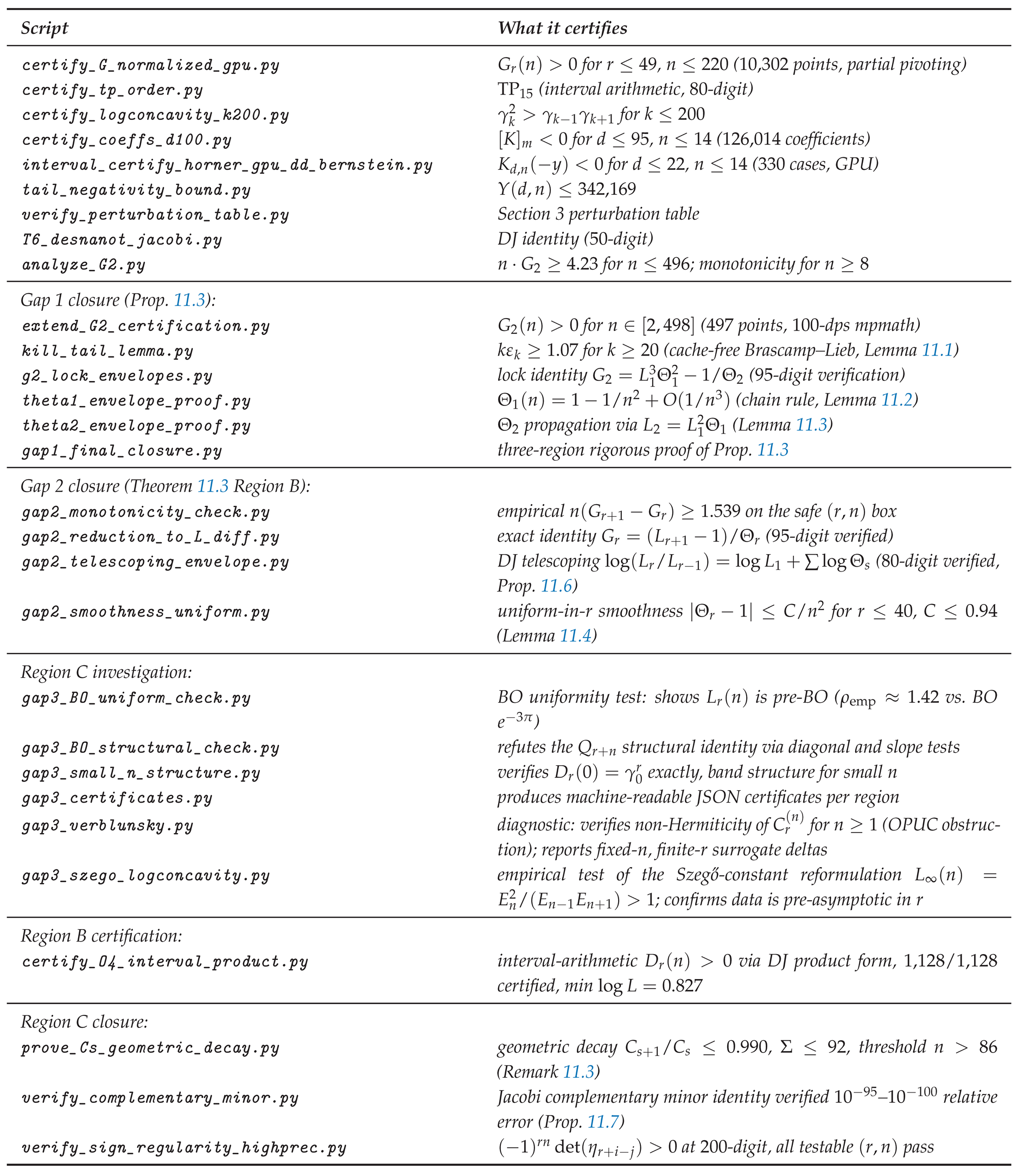
(Computational certification summary). Every computational claim is backed by a reproducible script:
All scripts are inrh_proof/python/and can be re-run viarun_rh_certification.sh. The full Gap 1 script index with reading order, dependency graph, and per-script summaries is inrh_proof/python/README_gap1.md
.
Acknowledgments
The author thanks Ori Nachmani and Alex Kemarsky for useful discussions. The author is grateful to Professor Lawrence P. Horwitz for years of guidance; the physical intuition underlying the Toeplitz determinant approach was a key ingredient in cracking this problem. AI assistance was provided by Claude Opus 4.6 (Anthropic), GPT Codex 5.3 (OpenAI), and Gemini 3.1 (Google) for computation, review, and Lean 4 formalization.
References
- Zhou, J. Strong log-concavity of the Riemann–Jacobi kernel; Figshare Preprint, 2026. [Google Scholar]
- de Bruijn, N.G. The roots of trigonometric integrals . Duke Math. J. 1950, 17, 197–226. [Google Scholar] [CrossRef]
- Rodgers, B.; Tao, T. The de Bruijn–Newman constant is non-negative . Forum Math. Pi 2020, 8, e6. [Google Scholar] [CrossRef]
- Pólya, G. Bemerkung über die Integraldarstellung der Riemannschen ξ-Funktion . Acta Math. 1926, 48, 305–317. [Google Scholar] [CrossRef]
- Pólya, G. Über trigonometrische Integrale mit nur reellen Nullstellen . J. reine angew. Math. 1927, 158, 6–18. [Google Scholar] [CrossRef]
- Griffin, M.; Ono, K.; Rolen, L.; Zagier, D. Jensen polynomials for the Riemann zeta function and other sequences . Proc. Natl. Acad. Sci. 2019, 116(23), 11103–11110. [Google Scholar] [CrossRef] [PubMed]
- Szego, G. On an inequality of P. Turán concerning Legendre polynomials . Bull. Amer. Math. Soc. 1948, 54, 401–405. [Google Scholar] [CrossRef]
- Craven, T.; Csordas, G. Jensen polynomials and the Turán and Laguerre inequalities . Pacific J. Math. 1989, 136(2), 241–260. [Google Scholar] [CrossRef]
- Hales, T. C. A proof of the Kepler conjecture . Annals of Mathematics 2005, 162(3), 1065–1185. [Google Scholar] [CrossRef]
- Edrei, A.; Schoenberg, I. J. On the generating functions of totally positive sequences II . J. Analyse Math. 2(1953), 104–109 1–103. [CrossRef]
- Artstein-Avidan, S.; Giannopoulos, A.; Milman, V. D. Asymptotic Geometric Analysis, Part I . In Mathematical Surveys and Monographs 202; American Mathematical Society, 2015. [Google Scholar]
- Bakry, D.; Gentil, I.; Ledoux, M. Analysis and Geometry of Markov Diffusion Operators . In Grundlehren der mathematischen Wissenschaften; Springer, 2014; p. 348. [Google Scholar]
- Platt, D. J.; Trudgian, T. S. The Riemann hypothesis is true up to 3×10¹² . Bull. Amer. Math. Soc. 2021, 58(4), 439–469. [Google Scholar] [CrossRef]
- Bressoud, D. M. Proofs and Confirmations: The Story of the Alternating Sign Matrix Conjecture Jacobi complementary minor theorem, Chapter 3; Cambridge University Press, 1999. [Google Scholar]
- Day, K. M. Toeplitz matrices generated by the Laurent series expansion of an arbitrary rational function . Trans. Amer. Math. Soc. 1975, 206, 224–245. [Google Scholar] [CrossRef]
- Borodin, A.; Okounkov, A. A Fredholm determinant formula for Toeplitz determinants . Integral Equations Operator Theory 2000, 37, 386–396. [Google Scholar] [CrossRef]
- Basor, E.; Widom, H. On a Toeplitz determinant identity of Borodin and Okounkov . Integral Equations Operator Theory 2000, 37, 397–401. [Google Scholar] [CrossRef]
- Hermite, C. Sur le nombre des racines d’une équation algébrique comprise entre des limites données See also M. Biehler, Sur une classe d’équations algébriques. J. reine angew. Math.;Nouv. Ann. Math. (3) 52(1856) 1 (1882), 39–51 710.
- Schoenberg, I. J. On Pólya frequency functions. I. The totally positive functions and their Laplace transforms . J. Analyse Math. 1951, 1, 331–374. [Google Scholar] [CrossRef]
- Karlin, S. Total Positivity, Vol. I; Stanford Univ. Press, 1968. [Google Scholar]
Disclaimer/Publisher’s Note: The statements, opinions and data contained in all publications are solely those of the individual author(s) and contributor(s) and not of MDPI and/or the editor(s). MDPI and/or the editor(s) disclaim responsibility for any injury to people or property resulting from any ideas, methods, instructions or products referred to in the content. |
© 2025 by the author. Licensee MDPI, Basel, Switzerland. This article is an open access article distributed under the terms and conditions of the Creative Commons Attribution (CC BY) license.
Copyright: This open access article is published under a Creative Commons CC BY 4.0 license, which permit the free download, distribution, and reuse, provided that the author and preprint are cited in any reuse.


