

Submitted:
20 April 2026
Posted:
22 April 2026
You are already at the latest version
Abstract
This article examines whether Local Government Financing Vehicles (LGFVs) help Chinese cities absorb economic shocks or instead deepen urban vulnerability. The question matters because Chinese local governments are expected to stabilise local economies while facing tighter budget constraints, a weakening land-finance model, and mounting scrutiny of off-budget debt. Bringing the urban resilience literature into dialogue with research on local government financialisation, the article conceptualises one welfare-oriented dimension of urban economic resilience as the extent to which urban household consumption is insulated from city-specific output shocks. Using a panel of 283 prefecture-level cities from 2003 to 2019, we estimate whether LGFV issuance moderates the transmission of idiosyncratic output fluctuations to local consumption. The baseline estimates suggest that greater LGFV issuance is associated with a weaker local consumption-output linkage, consistent with a consumption-smoothing role for debt-financed local intervention. This pattern is stronger in cities with higher levels of marketisation and greater fiscal capacity, and weaker under elevated policy uncertainty. The findings contribute to debates on urban resilience and debt-led urban governance by showing that local debt is not simply a financing technique or a fiscal risk. It can also function as a conditional form of urban state capacity whose welfare effects vary across institutional and spatial contexts.
Keywords:
local government financing vehicles
; economic resilience
; fiscal stability
; risk-sharing
; debt management
1. Introduction
Cities are increasingly judged not only by their capacity to generate growth, but also by their ability to absorb shocks while sustaining everyday economic life. In China, this challenge has become especially acute. Slower growth, prolonged adjustment in the property sector, and tighter scrutiny of local debt have narrowed the fiscal room of local governments at the very moment when urban authorities remain responsible for infrastructure provision, employment support, and the continuity of public services. This contradiction is central to contemporary Chinese urbanism. Cities are expected to remain engines of development and buffers against crisis, yet the fiscal foundations on which such expectations rest have become more fragile. Under these conditions, the instruments through which local governments mobilise finance are not merely technical devices. They are constitutive of urban governance and of the uneven capacity of cities to withstand economic shocks.
Among these instruments, Local Government Financing Vehicles, or LGFVs, occupy a particularly ambivalent position. Since the post-2008 stimulus period, LGFVs have become a major channel through which local governments finance infrastructure, land development, and urban construction beyond the formal budget. They have enabled local authorities to sustain investment when conventional fiscal resources were insufficient, and they have provided an important mechanism through which local developmental agendas could continue under fiscal decentralisation. Yet LGFVs are also widely associated with hidden debt accumulation, land dependence, interjurisdictional competition, and the financialisation of local state activity (Cai et al., 2021; Gyourko et al., 2022; Hasenberger, 2024; Bao et al., 2024). Existing debates therefore tend to oscillate between two stylised positions: LGFVs as developmental instruments and LGFVs as fiscal risks. For urban studies, however, this binary is too crude. The more important question is whether, and under what conditions, LGFVs operate as a form of debt-financed local state capacity that can cushion cities against shocks, or whether they instead deepen the vulnerabilities of debt-led urbanisation.
This question sits at the intersection of two literatures that have rarely been brought into direct conversation. The first is the literature on urban economic resilience. Studies of Chinese cities have shown that resilience varies with industrial structure, innovation, regional integration, digital transformation, financial reform, and new infrastructure, among other factors (Tan et al., 2020; Wang and Wei, 2021; Zhou et al., 2021; Hu et al., 2022; Jiang and Jiang, 2024; Jiang et al., 2024; Wen et al., 2024). This literature has been valuable in identifying why some cities resist or recover from shocks more effectively than others. Yet much of it treats local fiscal and financial capacity as a background condition rather than as an object of analysis in its own right. The second is the literature on local government debt, land finance, and local government financialisation. This scholarship has convincingly shown how off-budget borrowing, land-based accumulation, and quasi-market financing have become integral to local state entrepreneurialism in China (Cai et al., 2021; Gyourko et al., 2022; Li et al., 2023; Qu et al., 2023). However, it has focused primarily on financing incentives, debt governance, and development politics, while paying much less attention to whether debt-financed local intervention actually shields urban households from local economic shocks. As a result, we know much more about how LGFVs finance urban growth than about how they shape the welfare consequences of urban volatility.
This article addresses that gap by bringing the risk-sharing literature into dialogue with research on China’s local government financialisation. Rather than treating urban resilience as a single composite score, we focus on one specific and theoretically meaningful dimension of it: the extent to which urban household consumption is insulated from city-specific output shocks. This approach draws on the risk-sharing literature, which interprets a weaker linkage between local output fluctuations and local consumption fluctuations as evidence that shocks are being absorbed through fiscal, financial, or interregional channels (Asdrubali et al., 1996; Kose et al., 2009; Schulhofer-Wohl, 2011; Chan et al., 2014; Du et al., 2022). It also resonates with Hallegatte’s (2014) argument that resilience should ultimately be evaluated in terms of the protection of welfare rather than the preservation of output alone. This is an important move for urban studies. A city may maintain investment and GDP growth while still transmitting volatility to households through employment insecurity, income instability, or the deterioration of public services. Consumption smoothing therefore does not capture the entirety of urban resilience, but it does capture a central welfare dimension of whether urban economies protect residents when shocks occur.
From this perspective, LGFVs may plausibly work in either direction. On the one hand, they may enhance the shock-absorbing capacity of local governments. By relaxing financing constraints, LGFVs can help maintain infrastructure investment, sustain public services, support employment, and prevent abrupt contractions in local demand during downturns. In a fiscally decentralised system, they may also provide local authorities with a degree of temporal and institutional flexibility that formal budgetary channels do not always allow. On the other hand, the stabilising effects of LGFVs are unlikely to be automatic. Borrowing can exacerbate fragility when it fuels hidden liabilities, reinforces inefficient investment, increases dependence on land-related revenues, or raises the probability of future retrenchment. For this reason, the effect of LGFVs on urban economic resilience should be treated as conditional rather than universal. Any consumption-smoothing role is likely to be stronger where market institutions are more developed and fiscal capacity is greater, because those conditions increase the probability that borrowed funds can be translated into effective stabilisation rather than financial overextension. By contrast, the stabilising association should weaken under elevated policy uncertainty, when financing conditions, investment expectations, and local policy coordination become less predictable.
Empirically, we examine this proposition using a panel of 283 prefecture-level cities from 2003 to 2019. We combine city-level data on LGFV bond issuance with annual information on urban household consumption, output, and public finance. The empirical strategy tests whether larger LGFV issuance weakens the transmission of city-specific output fluctuations to city-specific consumption fluctuations. In other words, the analysis asks whether debt-financed local intervention is associated with greater insulation of household welfare from local economic shocks. The baseline estimates suggest that higher LGFV issuance is associated with a weaker local consumption-output linkage. This pattern is reproduced under alternative measures of LGFV exposure and remains most visible in cities with higher levels of marketisation and stronger fiscal resources, while becoming much weaker under heightened policy uncertainty. Taken together, the results suggest that LGFVs should not be understood simply as either a developmental boon or a fiscal danger. They are better interpreted as a conditional and uneven form of urban state capacity whose stabilising potential depends on broader institutional and spatial contexts.
This article makes three contributions. First, it brings the urban resilience literature into direct dialogue with research on local government financialisation, showing that the fiscal-financial instruments of the local state are not peripheral to urban resilience but constitutive of it. Second, it introduces a welfare-oriented measure of urban economic resilience into the study of Chinese cities, thereby moving beyond composite index approaches and clarifying one mechanism through which shocks are transmitted to, or absorbed from, households. Third, it demonstrates the spatially uneven and institutionally contingent character of debt-led stabilisation. LGFVs are not uniformly effective across China’s urban system. Their apparent stabilising role is stronger in some places and weaker in others, which speaks to wider debates in urban studies about variegated state capacity, uneven development, and the territorial politics of financialisation.
The remainder of the article is organised as follows. Section 2 reviews the literature on urban resilience, risk-sharing, and local government financialisation in China. Section 3 describes the data and measurement strategy. Section 4 sets out the empirical framework. Section 5 presents the main results. Section 6 explores comparative mechanisms and heterogeneity. Section 7 discusses the broader implications for urban governance and debt-led development. Section 8 concludes.
2. Research Background & Literature Review
2.1. Development and Economic Role of China’s LGFV
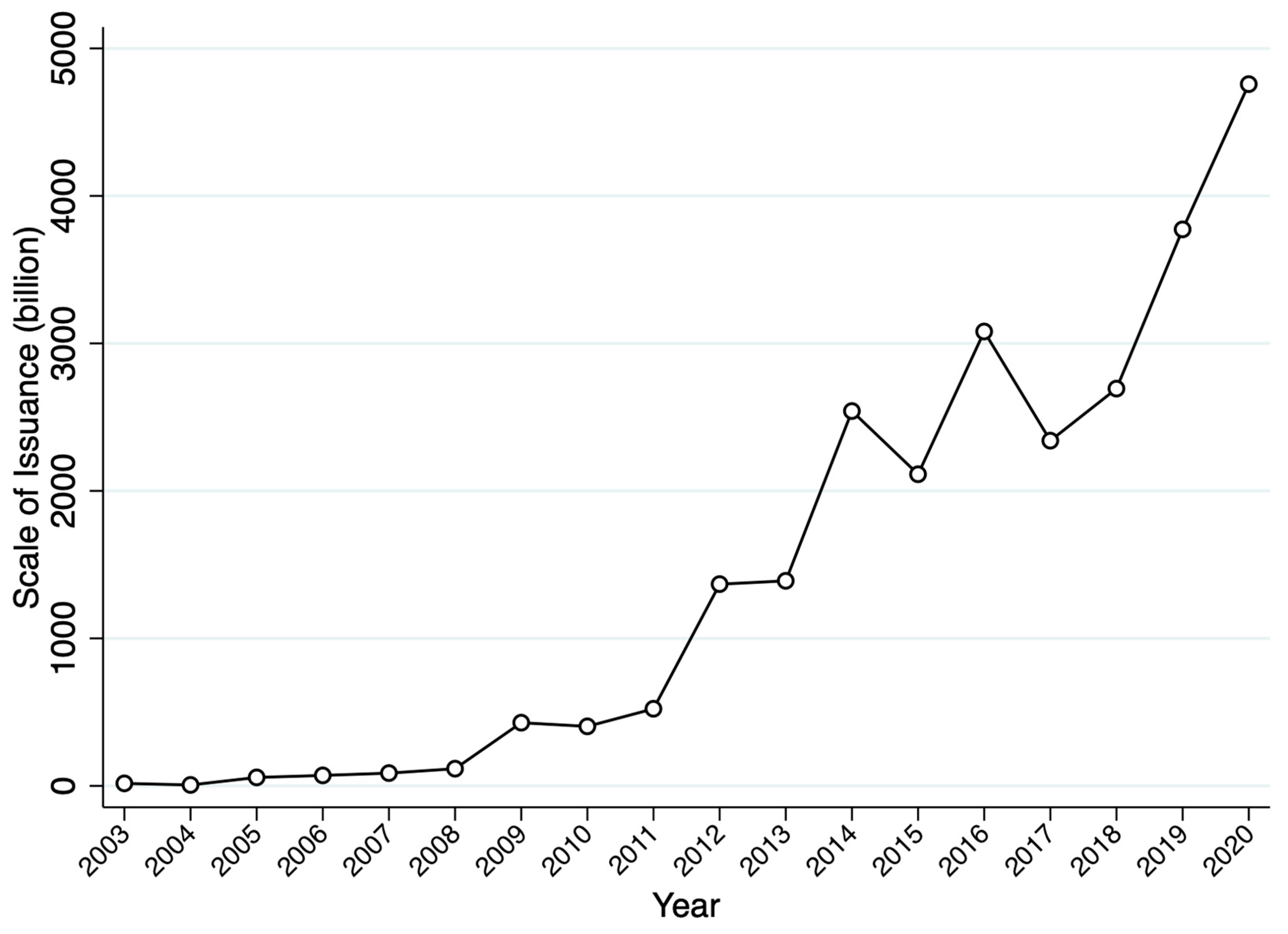
Since the mid-2000s, Local Government Financing Vehicles (LGFVs), often referred to in China as chengtou companies or urban investment platforms, have become a major channel through which local governments finance infrastructure, land development, and urban construction beyond the formal budget. Their expansion is rooted in the structural tension of China’s fiscal decentralisation regime: local governments bear extensive developmental responsibilities, but their formal revenue base is often insufficient to fund large-scale investment needs.
The importance of LGFVs increased sharply after the 2008 global financial crisis, when local governments were encouraged to accelerate infrastructure investment and support growth. In this context, LGFVs provided a flexible financing vehicle through which local authorities could mobilise capital, sustain urban construction, and stabilise local investment when conventional budgetary channels were constrained.
At the same time, LGFVs are not simply developmental instruments. A large body of research links their expansion to hidden debt accumulation, land dependence, interjurisdictional competition, and the broader financialisation of local state activity (Cai et al., 2021; Gyourko et al., 2022; Bao et al., 2024). LGFVs may therefore enhance local state capacity in the short run while also generating longer-term fiscal and governance risks.
Since 2015, central authorities have attempted to regularise this system through debt-swap programmes, tighter budgetary supervision, and the incorporation of some local liabilities into more formal debt-management frameworks (Li et al., 2023). These reforms underscore the ambivalent status of LGFVs in contemporary urban China. They remain important instruments of local development finance, yet they are also focal points of concern in debates over debt governance and urban fiscal sustainability.
Figure 1.
Annual Issuance Scale of LGFV in China (2003–2020).
2.2. Urban Economic Resilience and the Risk Sharing Perspective
Urban economic resilience has become a central concern in urban and regional studies because cities are increasingly exposed to macroeconomic volatility, pandemic disruptions, and policy uncertainty. Recent research on China generally defines resilience as the capacity of urban and regional economies to resist, recover, adapt, and renew after shocks. Empirically, this literature explains variation in resilience through industrial diversity, human capital, innovation, openness, and institutional agency. At the urban scale, recent studies further show that smart city development, regional integration, financial reform, and new type infrastructure can enhance resilience by strengthening coordination capacity, factor mobility, and adaptive governance (Tan et al., 2020; Wang & Wei, 2021; Hu et al., 2022; Zhou et al., 2021; Jiang & Jiang, 2024; Jiang et al., 2024; Wen et al., 2024).
A second strand of literature focuses on how resilience should be measured. Much of the existing urban literature constructs composite indicator systems capturing resistance, recovery, and adaptation. While useful for intercity comparison, such measures often aggregate multiple dimensions and may obscure the welfare channel through which economic shocks are absorbed. By contrast, the risk sharing literature conceptualizes resilience as the ability to smooth household consumption in the face of idiosyncratic output shocks. In this framework, stronger resilience is reflected in a weaker linkage between local output fluctuations and local consumption because shocks are partially absorbed through fiscal, financial, or interregional mechanisms (Asdrubali et al., 1996; Kose et al., 2009; Schulhofer-Wohl, 2011). China focused studies likewise show that interregional risk sharing remains incomplete, although institutional development and deeper market integration can improve shock absorption and resource allocation (Chan et al., 2014; Du et al., 2022). This perspective is especially relevant for urban research because it links macroeconomic stabilization directly to household welfare and living standards (Hallegatte, 2014).
2.3. Local Government Financialisation, Land Finance, and LGFVs in China
Within China’s fiscal decentralization regime, however, urban economic resilience cannot be understood without examining the financialized foundations of local development. Recent scholarship in urban studies and economic geography argues that local governments increasingly rely on market based and quasi market instruments, thereby blurring the boundaries between public finance, land development, and urban governance (Hasenberger, 2024). In China, this process has been especially visible in the nexus of land finance, local debt, and off budget financing arrangements. Research shows that government debt and land financing are deeply intertwined and produce both developmental and distributive consequences (Cai et al., 2021), while broader reviews of land finance emphasize its centrality to infrastructure provision, local accumulation, and urban expansion (Gyourko et al., 2022). More recent work further suggests that the incorporation of local government bonds into the budgetary process represents a partial turn away from financialisation (Li et al., 2023), even as chengtou companies are being restructured to sustain state entrepreneurialism beyond land financing (Liu & Lo, 2026).
LGFVs constitute a core institutional vehicle within this fiscal and financial architecture. Existing studies show that the expansion of urban investment bonds and LGFV financing is strongly shaped by political incentives, market conditions, and interjurisdictional competition. Local officials’ promotion incentives increase the amount of urban investment bond issuance and reduce financing costs, with stronger effects in cities facing greater growth pressure and lower levels of marketization (Yu et al., 2022). At the regional level, local governments that lag behind their competitors in GDP performance tend to expand debt more aggressively, indicating that debt issuance is embedded in tournament style regional competition (Qu et al., 2023). In addition, LGFV debt issuance is closely related to infrastructure provision, land finance, and private sector development dynamics, highlighting the embeddedness of LGFVs in a broader coalition linking the state, land markets, and urban construction (Bao et al., 2024). A small but emerging literature has also begun to connect local debt governance more directly to urban resilience, suggesting that formal improvements in debt governance can strengthen resilience through infrastructure investment and industrial upgrading (Liu et al., 2025).
2.4. Research Gap and Analytical Contribution
Despite these advances, two gaps remain. First, the urban resilience literature has paid far more attention to industrial structure, technology, infrastructure, and policy experimentation than to the specific fiscal and financial instruments through which local governments stabilize urban economies. Second, the LGFV and local debt literature has primarily focused on financing incentives, land dependence, debt governance, and regulatory reform, while giving much less attention to whether LGFV issuance itself serves as a countercyclical mechanism for cushioning urban households against local output shocks. Even when debt related studies address resilience, they typically rely on composite urban resilience indices rather than a consumption smoothing framework (Liu et al., 2025). As a result, the role of LGFVs in urban economic resilience remains insufficiently theorized and empirically identified.
This study addresses these gaps by bringing the risk sharing literature into dialogue with research on China’s local government financialisation. Rather than treating resilience solely as a composite urban outcome, it conceptualizes urban economic resilience through household consumption risk sharing and examines whether LGFV issuance weakens the transmission of idiosyncratic output shocks to local consumption. This approach contributes to the literature in two respects. It reinterprets LGFVs not only as a source of fiscal risk, but also as a potentially stabilizing instrument within a decentralized urban governance system. It also clarifies the institutional conditions under which this stabilizing role is likely to vary, particularly across cities with different levels of marketization, policy uncertainty, and fiscal capacity. In this sense, the present study extends existing work on local debt and urban resilience by identifying a more precise welfare based mechanism through which debt financed local intervention may shape the resilience of Chinese cities.
3. Data and Measurement
3.1. Data Sources and Processing
The primary data for this study are sourced from the Wind database, which provides detailed records on LGFV bonds issued by local government financing platforms across China. This dataset comprises a national panel of prefecture-level cities and includes information on 28,219 bonds issued from 1999 to 2021. To maintain consistency and focus on China’s period of rapid economic growth, we restrict the analysis to the years 2003–2019, thereby avoiding potential distortions arising from the COVID-19 pandemic. This filtered period yields a sample of 4,429 bonds from 283 prefecture-level cities, excluding municipalities and county-level cities.
To complement the LGFV data, annual city-level statistics on consumption, income, and population are obtained from the China Urban Statistical Yearbook, while fiscal expenditure and revenue data are extracted from the Fiscal Statistics of Cities and Counties. For reliability, minority autonomous regions and statistical outliers are excluded. LGFV bond issuance data are aggregated by issuing city on an annual basis and then merged with corresponding fiscal data. For cities without LGFV issuances, a bond issuance value of zero is assigned to ensure the completeness of the sample.
In addition, macroeconomic indicators, such as the marketization index and the policy uncertainty index, are included from publicly available sources. These indicators contextualize the role of LGFV within the broader macroeconomic and policy environment, thereby enhancing the analysis of LGFV’s impact on urban economic resilience.
3.2. Measuring Urban Economic Resilience
To examine the relationship between LGFV and urban resilience, this study operationalizes urban economic resilience as a city’s capacity to maintain stability in the face of external economic shocks, focusing specifically on consumption stability. This resilience is measured through the concept of consumption risk-sharing, based on the premise that stable consumption levels indicate a city’s robustness against economic disturbances and its ability to sustain residents’ quality of life. Following Kose et al. (2009), we measure resilience by calculating the rate of change in per capita urban consumption relative to the national average, denoted as ∆logC. This approach enables us to capture variations in urban resilience across cities, reflecting the extent to which they can shield residents’ consumption from economic fluctuations.
3.3. Control Variables
To account for factors that may influence the risk-sharing capacity linked with LGFV, this study includes several control variables that enhance the analysis’s robustness and comprehensiveness. The Expenditure Ratio, defined as the ratio of local government fiscal expenditure to GDP, captures the potential stabilizing role of public spending on local economies. The Asset Ratio, representing the total assets of listed companies as a percentage of GDP, reflects capital market strength, which can affect consumption risk-sharing. Additionally, the Marketization Index measures the degree of market development, providing insight into how market-oriented reforms may bolster economic resilience. Finally, the China Economic Policy Uncertainty (EPU) Index serves as a proxy for policy environment variability, which helps account for how economic policy uncertainty may impact consumption dynamics at the city level. These control variables allow for a nuanced analysis by considering structural and environmental factors that could influence the relationship between LGFV and urban economic resilience, particularly in terms of consumption risk-sharing across different cities.
3.4. Descriptive Statistics and Preliminary Analysis
Table 1 presents summary statistics for the variables used in the empirical analysis. The dependent variable, ∆logC, captures the city-specific component of consumption growth relative to the national benchmark and shows substantial variation across observations. This dispersion is consistent with the idea that Chinese cities differ meaningfully in the extent to which local consumption is buffered from economic fluctuations.
The main explanatory variable, logLGFV, is the transformed measure of LGFV issuance intensity used in the regressions. Its distribution indicates pronounced heterogeneity across cities, with many observations close to zero and a smaller group of cities displaying much larger issuance intensity. This pattern is in line with the highly uneven geography of local borrowing and development finance in China.
Among the control variables, the Expenditure Ratio has a mean of 0.1653, highlighting differences in fiscal structures that may influence LGFV’s role in local economic risk management. The Asset Ratio also exhibits considerable variance, suggesting that capital market development varies significantly across cities and may impact their ability to manage economic risks.
Overall, the descriptive statistics indicate considerable cross-city variation in consumption growth, output growth, fiscal conditions, and LGFV issuance. These patterns motivate the empirical analysis, but they should not by themselves be interpreted as evidence that LGFV issuance improves urban resilience.
4. Empirical Model
Consumption risk-sharing is used here as a welfare-oriented dimension of urban economic resilience. It captures the extent to which a city can stabilise household consumption in the face of city-specific output shocks. Following Asdrubali et al. (1996) and subsequent work, the empirical strategy asks whether idiosyncratic fluctuations in local output are transmitted to local consumption or instead smoothed through other channels.
4.1. Baseline Model
We begin with a baseline model that relates the city-specific component of consumption growth to the city-specific component of output growth. The purpose is to estimate how strongly local output shocks are passed through to local consumption after national macroeconomic movements have been netted out.
In Equation (1), refers to city and refers to year . and denote the log changes of per capita output and per capita urban household consumption in city at time , while the corresponding national changes are subtracted to isolate the idiosyncratic component of each variable. The coefficient therefore captures the elasticity of city-specific consumption growth with respect to city-specific output growth.
By removing national consumption and output growth, the specification focuses on whether local shocks continue to show up in local consumption. A larger implies a stronger pass-through from city-specific output shocks to city-specific consumption, while a smaller implies that a greater share of the shock is smoothed away. Equations (2) to (4) simply rearrange the baseline relationship and motivate the risk-sharing measure defined below.
This set of equations provides the basis for the annual risk-sharing coefficient used later in the paper.
4.2. Extended Model with LGFV Issuance
To examine whether LGFV issuance moderates the local transmission of shocks, we extend the baseline model by interacting city-specific output growth with the LGFV issuance measure:
where is the per capita LGFV issuance for city in year . is the coefficient that captures the marginal effect of LGFV issuance on risk-sharing. If is significantly negative, it indicates that LGFV issuance improves the city’s risk-sharing capacity. In other words, cities with higher LGFV issuance are better able to absorb economic shocks, leading to reduced consumption volatility. This suggests that LGFV serve as a financial mechanism through which cities can stabilize consumption during times of economic distress. On the other hand, if is significantly positive, it implies that LGFV issuance increases consumption volatility, thereby weakening urban economic resilience. This would indicate that LGFV issuance exposes cities to higher risks, potentially due to excessive debt burdens or inefficient use of funds.
In this model, we include a set of control variables, , to account for other factors that may influence consumption risk-sharing and to improve the robustness of our analysis. These controls include: Expenditure Ratio, Asset Ratio, Marketization Index, and China Economic Policy Uncertainty (EPU) Index. By including these controls, we can more precisely isolate the marginal effect of LGFV issuance on consumption smoothing and risk-sharing, ensuring that observed effects are not confounded by other factors affecting economic stability.
4.3. Defining and Calculating the Risk-Sharing Coefficient
The key quantity recovered from Equations (1) to (4) is , the annual coefficient linking the city-specific component of consumption growth to the city-specific component of output growth. If = 1, city-specific output shocks are fully transmitted to local consumption, implying no consumption smoothing. If = 0, local consumption is orthogonal to city-specific output shocks, implying full smoothing. Following this logic, we define the risk-sharing coefficient as . Under this definition, a larger value of indicates stronger risk-sharing because a smaller share of local output volatility is passed through to local consumption.
We estimate the baseline model separately for each year from 2003 to 2019 and then compute the annual risk-sharing coefficient as . To reduce sensitivity to year-specific noise, Figure 2 reports a two-year moving average of this annual series. The figure is therefore descriptive: it summarises how the estimated degree of consumption smoothing evolves over time, but it should not be interpreted as identifying the causal effect of any single policy event.
Figure 2 shows that the average value of is positive over the sample period, indicating that Chinese cities were able to smooth at least part of city-specific output shocks. The descriptive pattern suggests a lower degree of consumption smoothing before 2008 and a generally higher level thereafter. This temporal shift is consistent with, but does not on its own prove, the view that post-crisis fiscal and financial arrangements altered the way local shocks were absorbed.
5. Results
5.1. Baseline Results
This section presents the empirical findings on the relationship between LGFV issuance and urban economic resilience across China’s prefecture-level cities. Table 2 summarizes the core impact of LGFV issuance on urban resilience, initially excluding control variables to isolate the direct effect.
In column (1) of Table 2, the results show that the interaction term between changes in per capita GDP and LGFV issuance is negative and statistically significant. This finding is consistent with our empirical model, indicating that an increase in LGFV issuance enhances urban economic resilience. Specifically, cities with higher levels of LGFV issuance demonstrate a stronger capacity to mitigate the adverse effects of economic fluctuations, as reflected by a higher resilience coefficient, (). In other words, LGFV issuance appears to play a stabilizing role, directly supporting cities’ capacities to weather economic shocks.
A regional breakdown reveals that the resilience-enhancing effect of LGFV issuance is particularly pronounced in China’s eastern cities. The expanded LGFV issuance in this region significantly bolsters their ability to manage economic risks. This heightened impact in the east may be attributed to more mature market structures and stronger economic foundations, which allow for more effective risk dispersion through LGFV financing and consequently, a greater reduction in the negative effects of external shocks.
Overall, these findings underscore the role of LGFV issuance as an effective tool for managing urban economic risks, particularly in economically advanced and highly marketized regions. By leveraging LGFV, local governments can secure essential financial resources to counteract economic volatility, thereby promoting urban resilience and supporting sustainable development.
To verify the robustness of our baseline results, we conduct several additional tests by adjusting the specifications and definitions of key variables. First, in column (2) of Table 2, we replace per capita LGFV issuance with the ratio of LGFV issuance to fiscal revenue. The results remain significantly negative, supporting the stability of our findings. Second, in column (3), we introduce a control variable based on 2003 per capita GDP, adjusted by year, to control for initial economic conditions and inflation effects. This modification also yields a significantly negative coefficient, further confirming the robustness of the results. Lastly, in column (4), we expand the definition of LGFV issuance to include both prefecture-level cities and their subordinate counties. The negative and significant coefficient at the 10% level reinforces the initial findings, indicating that the resilience-enhancing effects of LGFV issuance hold across different definitions. These tests collectively validate the robustness of our main results, affirming that LGFV issuance significantly contributes to urban economic resilience.
5.2. Endogenous Concern
Endogeneity remains an important concern in this study. The main issue is not simply contemporaneous co-movement between consumption and output, but the possibility that LGFV issuance itself responds to local growth slowdowns, fiscal stress, land-market conditions, or policy expectations that may also affect the consumption-output linkage. Given these concerns, the strategies in this section are best understood as sensitivity checks that probe the robustness of the baseline association rather than as definitive solutions to causal identification.
5.2.1. Bartik IV
We first employ a Bartik-style instrument to examine whether the baseline pattern remains visible when LGFV issuance is instrumented with a combination of initial local exposure and aggregate issuance growth. This strategy exploits cross-city differences in pre-existing LGFV reliance while using national issuance dynamics to generate time variation. As with any Bartik design, however, the exclusion restriction cannot be tested directly, so the results should be interpreted with caution.
In the first-stage regression reported in Table 3, the Bartik-style instrument is strongly correlated with observed LGFV issuance, and the corresponding F-statistic comfortably exceeds conventional weak-instrument thresholds. In the second stage, the interaction term remains negative and statistically significant, which suggests that the baseline association is not easily explained by simple reverse causality alone.
Taken together, the Bartik IV results are broadly consistent with the baseline estimates. They strengthen the interpretation that LGFV issuance may play a stabilising role, but they do not fully eliminate concern about shared macro shocks or other omitted channels.
5.2.2. K-Nearest Neighbor IV
As a further sensitivity check, we use a K-nearest-neighbour IV that proxies local LGFV issuance with the average issuance of economically similar neighbouring cities within the same province. The rationale is that nearby cities face related financing environments and policy conditions, which may predict local issuance. At the same time, this design is open to the concern that neighbouring cities may share unobserved shocks, so the exclusion restriction is again stronger than can be verified directly.
In the first-stage regression (Table 3, Panel B, column 2-4), the K-Nearest Neighbor IV shows a strong, significant correlation between the LGFV issuance of the target city and its neighboring city. The F-statistic again exceeds the threshold, confirming the strength of the instrument. In the second-stage results, the coefficients of the interaction terms are negative and statistically significant, consistent with our primary findings. This reinforces the conclusion that higher LGFV issuance enhances cities’ risk-sharing capacity and economic resilience, thereby reducing the vulnerability to economic shocks.
The application of both the Bartik IV and K-Nearest Neighbor IV provides robust support for the causal relationship between LGFV issuance and urban economic resilience, ensuring that our findings are not driven by endogeneity biases. Together, these results validate the effectiveness of LGFV issuance as a stabilizing financial mechanism in promoting resilience against economic fluctuations.
5.3. Placebo Test
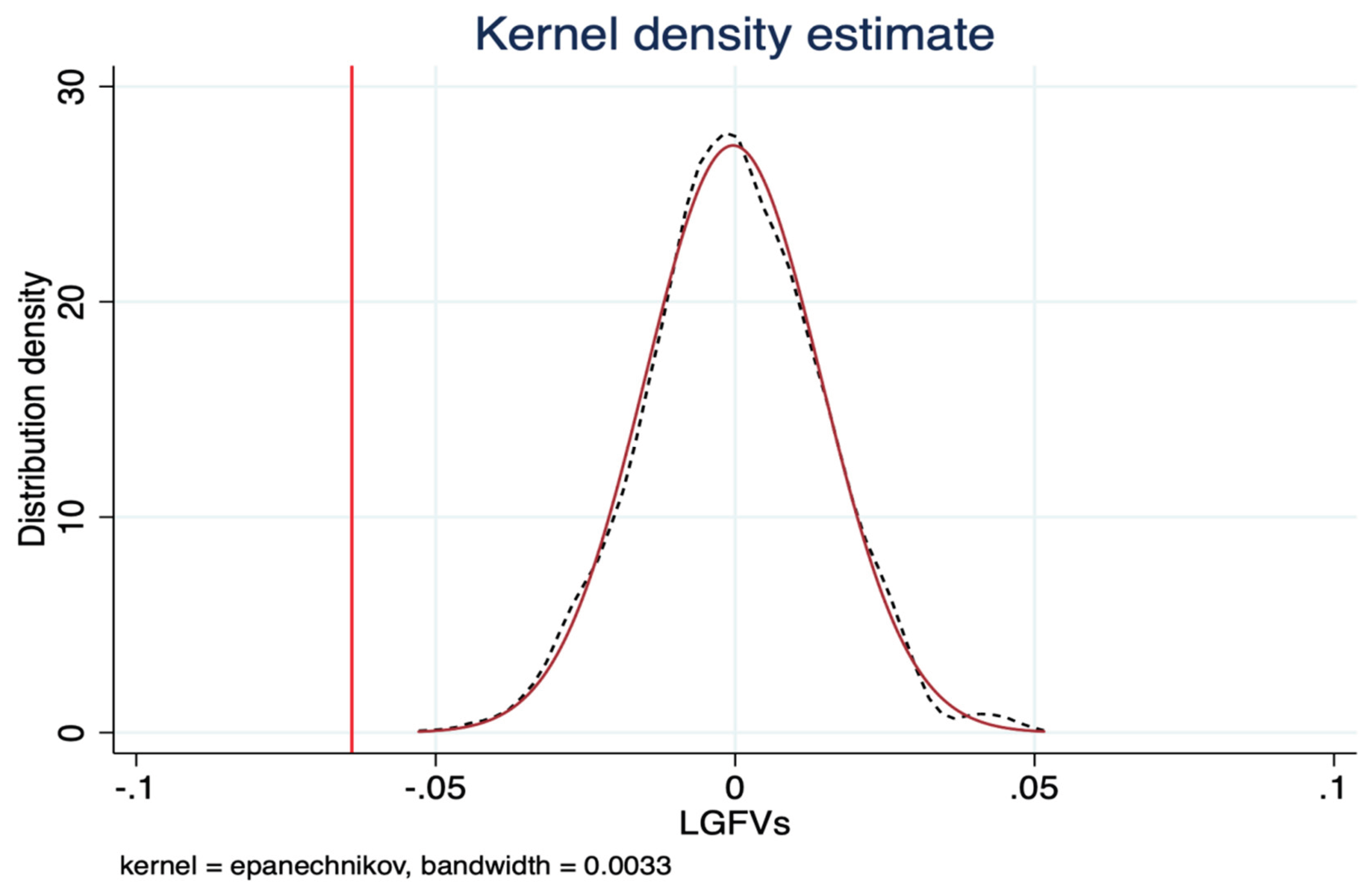
To verify the causal relationship of our findings, we conducted a placebo test following the methods of Li et al. (2016) and Cantoni et al. (2017). In this test, we randomly generated treatment groups to assess the risk-sharing effects of LGFV issuance, helping to rule out the possibility that the observed results are due to random factors.
We randomly generated treatment groups and performed 1,000 repeated experiments, then extracted the coefficients from these placebo results and plotted them. By comparing the actual policy effects with those from the placebo test, we observed that the real policy effects are significantly different from the placebo results, indicating that our findings are unlikely to be driven by random variation. Specifically, the placebo test results show no significant impact on economic risk-sharing, whereas the actual policy effects remain substantial. This strengthens our confidence that the positive role of LGFV issuance in enhancing urban resilience is due to intrinsic mechanisms rather than random factors.
Figure 3.
Kernel Density Estimate of LGFV Issuance Impact on Distribution Density.
6. Further Analysis
This section offers two supplementary analyses. The first compares LGFV with other potential channels through which cities may smooth shocks. The second examines whether the LGFV association differs across institutional and fiscal contexts. Both exercises are exploratory and should be read as descriptive extensions of the main results.
6.1. Illustrative Comparison of Alternative Risk-Sharing Channels
In addition to LGFV, other mechanisms, such as fiscal expenditure and capital markets, also contribute to economic risk management in cities. To evaluate the relative effectiveness of these mechanisms, we compare the impact of fiscal expenditure and capital market instruments on economic resilience with that of LGFV.
Table 4 presents the regression results for different risk-sharing mechanisms. In column (1), the interaction term between fiscal expenditure (Expenditure Ratio) and output growth is negative but statistically insignificant, suggesting that fiscal expenditure alone does not significantly enhance a city’s capacity for economic risk-sharing. One possible explanation is that while fiscal expenditure may alleviate short-term pressures, its long-term effectiveness may be limited by resource allocation efficiency and the debt burden on local governments.
In column (2), the interaction term between capital market assets (Asset Ratio) and output growth is -0.037, significant at the 5% level, indicating that capital markets play a substantial role in economic risk-sharing. By enabling efficient resource allocation and risk diversification, mature capital markets provide an effective buffer against external economic shocks, enhancing urban stability.
Column (3) combines fiscal expenditure, capital markets, and LGFV, and reveals that the interaction term for LGFV issuance has the largest absolute coefficient (-0.050), statistically significant at the 1% level. This indicates that while fiscal expenditure and capital markets contribute to risk-sharing, LGFV have a more pronounced effect in enhancing urban resilience. This may be due to the strong policy backing and high acceptance of LGFV, enabling them to provide more substantial support in times of economic instability.
In summary, while fiscal expenditure and capital markets contribute to economic risk management, LGFV demonstrate a more significant and direct impact on urban economic resilience. For local governments, these findings suggest that LGFV should be prioritized in risk-sharing strategies, with fiscal expenditure and capital markets serving as complementary mechanisms. This comprehensive approach can more effectively support cities in adapting to and recovering from economic shocks.
6.2. Heterogeneity Analysis
This section investigates how the impact of LGFV issuance on urban economic resilience varies according to cities’ economic characteristics, focusing on marketization, policy uncertainty, and per capita fiscal expenditure.
Table 5 shows the results for cities grouped by marketization level. In highly marketized cities, the interaction term between LGFV issuance and output growth is -0.078, significant at the 1% level, indicating that mature markets enable cities to leverage LGFV more effectively for risk mitigation. In contrast, in low-marketization cities, the coefficient is positive (0.140) and significant at the 1% level, suggesting that LGFV issuance may actually increase economic risks. This could be due to underdeveloped markets and inefficiencies in LGFV use, potentially leading to fiscal strain and instability.
We next examine the influence of policy uncertainty on LGFV effectiveness. In cities with low policy uncertainty, the interaction term is -0.121 and significant at the 1% level, indicating that stable policy environments enhance the resilience effect of LGFV issuance. Conversely, in cities with high policy uncertainty, the interaction term is close to zero (-0.002) and statistically insignificant, suggesting that in volatile policy environments, the stabilizing effect of LGFV is weakened, likely due to the destabilizing impact of uncertainty on financial conditions.
Finally, we analyze LGFV effectiveness based on per capita fiscal expenditure. In high-expenditure cities, the interaction term is -0.042 and significant at the 5% level, implying that greater fiscal resources support more effective LGFV utilization for risk management. In contrast, in cities with low fiscal expenditure, the interaction term is negative but not significant (-0.107), indicating that limited resources restrict the resilience benefits of LGFV issuance, leaving these cities more vulnerable to shocks.
Overall, the heterogeneity analysis reveals that LGFV issuance has the greatest positive impact on economic resilience in cities with high marketization, low policy uncertainty, and substantial fiscal resources. Conversely, its effectiveness diminishes—and may even be counterproductive—in cities with low marketization, high policy uncertainty, or limited fiscal resources.
7. Discussion
The empirical results suggest that LGFV issuance is associated with a weaker pass-through from city-specific output shocks to local consumption, particularly in settings with stronger market institutions and greater fiscal resources. Rather than treating this pattern as proof that LGFVs uniformly enhance urban resilience, the discussion below interprets it as evidence consistent with a conditional form of debt-financed local state capacity. This interpretation helps explain why the estimated association varies across institutional contexts and why its policy meaning remains ambivalent.
7.1. Possible Channels Linking LGFV Issuance and Consumption Smoothing
7.1.1. Fiscal-Smoothing Channel
One plausible interpretation of the baseline pattern is that LGFVs provide local governments with a fiscal-smoothing channel during downturns. By relaxing financing constraints, LGFVs may help sustain public investment, maintain project continuity, and reduce abrupt contractions in local demand. In this sense, the estimated negative interaction is consistent with the idea that debt-financed local intervention can cushion the welfare effects of local shocks. It is important, however, not to treat LGFVs as automatic stabilisers in the narrow public-finance sense. Their use is discretionary, institutionally mediated, and deeply embedded in local political and financial arrangements.
7.1.2. Infrastructure and Service Continuity
A second possible channel operates through infrastructure and service continuity. When formal budgetary resources tighten, LGFVs may allow local governments to continue financing transport, utilities, and other urban infrastructure that support everyday economic activity. To the extent that this prevents interruptions to local services and investment, it can reduce the extent to which output shocks are transmitted to households. At the same time, this channel is likely to be uneven, since borrowed funds can also be diverted into low-return projects or generate future repayment pressures.
7.1.3. Local State Flexibility Under Fiscal Decentralisation
A third interpretation emphasises flexibility under fiscal decentralisation. LGFVs may widen the room for local governments to respond to place-specific shocks when formal intergovernmental transfers or on-budget borrowing channels are insufficient. This helps explain why the apparent stabilising association is stronger where marketisation is higher and fiscal capacity is greater: those settings may be better able to deploy borrowed funds effectively. The same logic also implies limits. In weaker institutional environments, borrowing may amplify rather than absorb vulnerability.
7.2. Conditionality, Debt Risk, and Interpretation
Any stabilising role of LGFVs must be interpreted alongside their well-known risks. The same borrowing capacity that may smooth shocks in the short run can also generate hidden liabilities, reinforce dependence on land-related revenues, and constrain future fiscal space. The heterogeneous results reported above are therefore substantively important: they suggest that the welfare effects of LGFV borrowing are conditional on local institutions and fiscal capacity rather than being universally positive.
These concerns are especially relevant for cities with weaker market institutions, narrower fiscal bases, or greater exposure to policy uncertainty. In such contexts, LGFV borrowing may finance less productive projects or leave cities more vulnerable to later retrenchment. This is why the empirical pattern documented in the paper should not be read as an unconditional endorsement of debt-led urban governance.
In sum, LGFVs appear capable of performing a short-run smoothing function in some settings, but this potential must be weighed against longer-run issues of debt sustainability, governance quality, and uneven urban development. The central analytical point is therefore not that LGFVs are inherently good or bad, but that they constitute an ambivalent form of debt-financed local state capacity.
7.3. Implications and Future Research
The findings have two main implications. First, debates over urban resilience in China need to take the fiscal-financial instruments of the local state seriously rather than treating them as background conditions. Second, debt governance reforms should not focus only on risk containment, but also on the uneven capacity of different cities to absorb shocks without excessive reliance on off-budget borrowing. A more balanced policy approach would recognise both the stabilising potential and the longer-term risks of LGFVs.
Future research could build on this analysis in several ways. One priority is to identify more clearly the mechanisms through which LGFV borrowing affects household welfare, for example through employment, wage stability, infrastructure continuity, or fiscal expenditure composition. Another is to examine the longer-run interaction between short-run stabilisation and debt sustainability. These questions are crucial for assessing whether debt-led urban governance mitigates volatility only temporarily or contributes to more durable forms of urban resilience.
8. Conclusions
This article examines whether LGFV issuance is associated with a welfare-oriented dimension of urban economic resilience in Chinese cities: the extent to which local household consumption is insulated from city-specific output shocks. Using panel data for 283 prefecture-level cities from 2003 to 2019, the analysis finds a negative interaction between LGFV issuance and city-specific output growth. Under the paper’s risk-sharing framework, this means that cities with greater LGFV issuance tend to display a weaker local consumption-output linkage, which is consistent with a consumption-smoothing role for debt-financed local intervention.
At the same time, the results should be interpreted carefully. The empirical design relies on observational data, and the available IV strategies and placebo exercise can only partially address the identification problem. The findings therefore support a cautious claim about conditional association rather than a definitive causal estimate.
More broadly, the paper argues that LGFVs are best understood neither as an unqualified stabiliser nor as a purely technical financing device. They represent a conditional form of debt-financed local state capacity whose welfare effects depend on market institutions, fiscal resources, and the broader policy environment. This interpretation helps connect urban resilience research with the literature on local government financialisation, while also underscoring that any stabilising function of LGFVs must be weighed against longer-term concerns over debt sustainability, land dependence, and uneven urban development.
References
- Asdrubali, P.; Sørensen, B. E.; Yosha, O. Channels of interstate risk sharing: United States 1963–1990. The Quarterly Journal of Economics 1996, 111, 1081–1110. [Google Scholar] [CrossRef]
- Bao, H. X. H.; Wang, Z.; Wu, R. L. Understanding local government debt financing of infrastructure projects in China: Evidence based on accounting data from local government financing vehicles. Land Use Policy 2024, 136, 106964. [Google Scholar] [CrossRef]
- Bo, L.; Mear, F. C. J.; Huang, J. New development: China’s debt transparency and the case of urban construction investment bonds. Public Money & Management 2017, 37, 225–230. [Google Scholar] [CrossRef]
- Cai, M.; Fan, J.; Ye, C.; Zhang, Q. Government debt, land financing and distributive justice in China. Urban Studies 2021, 58, 2329–2347. [Google Scholar] [CrossRef]
- Chan, K. S.; Lai, J. T. Consumption risk sharing and self-insurance across provinces in China: 1952–2008. China Economic Review 2014, 30, 66–85. [Google Scholar] [CrossRef]
- Du, J.; He, Q.; Zhang, C. Risk sharing and industrial specialization in China. Journal of Comparative Economics 2022, 50, 599–626. [Google Scholar] [CrossRef]
- Fratzscher, M.; Imbs, J. Risk sharing, finance, and institutions in international portfolios. Journal of Financial Economics 2009, 94, 428–447. [Google Scholar] [CrossRef]
- Gyourko, J. E.; Shen, Y.; Wu, J.; Zhang, R. Land finance in China: Analysis and review. China Economic Review 2022, 76, 101868. [Google Scholar] [CrossRef]
- Hallegatte, S. Economic resilience: Definition and measurement (Policy Research Working Paper No. 6852). World Bank. 2014; Available online: https://openknowledge.worldbank.org/handle/10986/18341.
- Hasenberger, H. What is local government financialisation? Four empirical channels to clarify the roles of local government. Urban Studies 2024, 61, 2039–2059. [Google Scholar] [CrossRef]
- Hu, X.; Li, L.; Dong, K. What matters for regional economic resilience amid COVID-19? Evidence from cities in Northeast China. Cities 2022, 120, 103440. [Google Scholar] [CrossRef] [PubMed]
- Jiang, N.; Jiang, W. How does regional integration policy affect urban resilience? Evidence from urban agglomeration in China. Environmental Impact Assessment Review 2024, 104, 107298. [Google Scholar] [CrossRef]
- Jiang, N.; Jiang, W.; Wang, Y.; Zhang, J. Impact of financial reform on urban resilience: Evidence from the financial reform pilot zones in China. Socio-Economic Planning Sciences 2024, 94, 101962. [Google Scholar] [CrossRef]
- Ju, Z.; Chen, J.; Wu, Y. Research on the problems and countermeasures of China’s urban investment bond market: “Sixth Division SCP001 of the Corps” default event as an example. Journal of Finance and Economics 2021. [Google Scholar]
- Kose, M. A.; Prasad, E. S.; Terrones, M. E. Does financial globalization promote risk sharing? Journal of Development Economics 2009, 89, 258–270. [Google Scholar] [CrossRef]
- Li, Z.; Wu, F.; Zhang, F. State de-financialisation through incorporating local government bonds into the budgetary process in China. Journal of Economic Geography 2023, 23, 1169–1190. [Google Scholar] [CrossRef]
- Liu, M.; Lo, K. Beyond land financing: State entrepreneurialism and the restructuring of chengtou companies to sustain urban development. Urban Studies. 2026. [Google Scholar] [CrossRef]
- Liu, X.; Yang, F.; Xie, C. Local government debt governance and urban economic resilience. Finance Research Letters 2025, 85, 107905. [Google Scholar] [CrossRef]
- Qu, X.; Xu, Z.; Yu, J.; Zhu, J. Understanding local government debt in China: A regional competition perspective. Regional Science and Urban Economics 2023, 98, 103859. [Google Scholar] [CrossRef]
- Schulhofer-Wohl, S. Heterogeneity and tests of risk sharing. Journal of Political Economy 2011, 119, 925–958. [Google Scholar] [CrossRef] [PubMed]
- Shi, C.; Lu, J. Unlocking economic resilience: A new methodological approach and empirical examination under digital transformation. Land 2024, 13, 621. [Google Scholar] [CrossRef]
- Tan, J.; Hu, X.; Hassink, R.; Ni, J. Industrial structure or agency: What affects regional economic resilience? Evidence from resource based cities in China. Cities 2020, 106, 102906. [Google Scholar] [CrossRef]
- Wang, L.; Wang, C.; Chen, J.; Chang, J. The hidden crowding out effect: How does local government implicit debt pressure influence enterprise productivity in China? Managerial and Decision Economics 2024. [Google Scholar] [CrossRef]
- Wang, Z.; Ning, Z.; Wu, F. Local government debt and firm’s outward foreign direct investment. International Journal of Emerging Markets 2024. [Google Scholar] [CrossRef]
- Wang, Z.; Wei, W. Regional economic resilience in China: Measurement and determinants. Regional Studies 2021, 55, 1228–1239. [Google Scholar] [CrossRef]
- Wen, H.; Liu, Y.; Zhou, F. New type infrastructure and urban economic resilience: Evidence from China. International Review of Economics & Finance 2024, 96, 103560. [Google Scholar] [CrossRef]
- Wu, H.; Yang, J.; Yang, Q. The pressure of economic growth and the issuance of urban investment bonds: Based on panel data from 2005 to 2011 in China. Journal of Asian Economics 2021. [Google Scholar] [CrossRef]
- Xu, J.; Carey, R. Exploring China’s impacts on development thinking and policies. OpenDocs. 2021. Available online: https://opendocs.ids.ac.uk/opendocs/handle/20.500.12413/16962.
- Yu, R.; Xia, X.; Huang, T.; Zhang, S.; Zhou, W. Has the establishment of high-tech zones improved urban economic resilience? Evidence from prefecture-level cities in China. Land 2024, 13, 241. [Google Scholar] [CrossRef]
- Yu, M.; Jia, J.; Wang, S. Local officials’ promotion incentives and issuance of urban investment bonds. Research in International Business and Finance 2022, 63, 101791. [Google Scholar] [CrossRef]
- Zhou, Q.; Zhu, M.; Qiao, Y.; Zhang, X.; Chen, J. Achieving resilience through smart cities? Evidence from China. Habitat International 2021, 111, 102348. [Google Scholar] [CrossRef]
Figure 2.
Annual Risk-Sharing Coefficients for Chinese Cities (2003–2019).
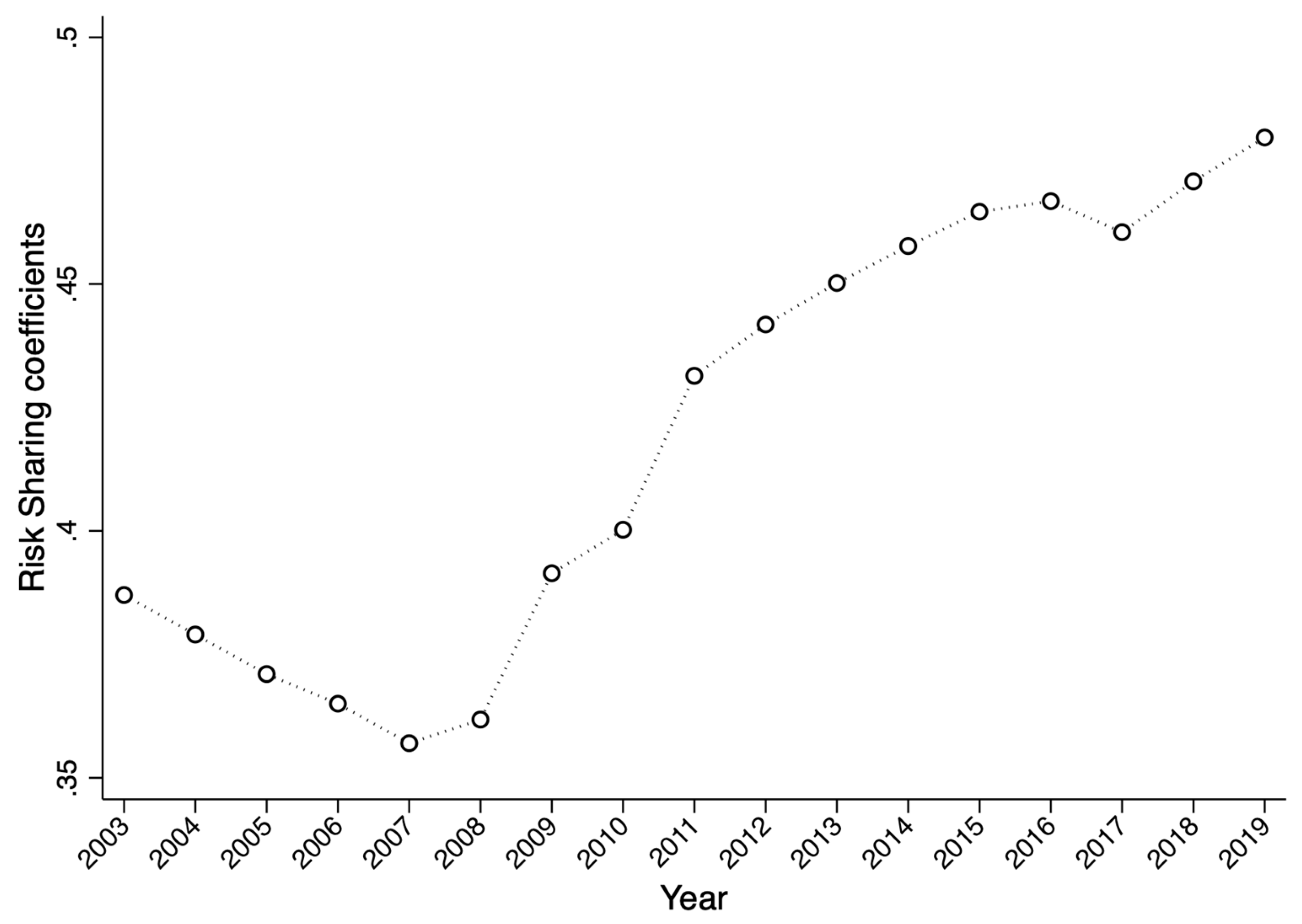

Table 1.
Summary Statistics.
| Variable | Description | Observations | Mean | SD | Min | Max |
|---|---|---|---|---|---|---|
| Explained Variable | ||||||
| △logC | Change in urban consumption relative to national consumption | 4472 | -0.0297 | 0.2347 | -0.6382 | 1.2252 |
| △logY | Changes in urban GDP relative to national GDP | 4725 | -0.2728 | 0.6799 | -2.0505 | 2.7894 |
| Explanatory Variables | ||||||
| Log LGFV | Log of total LGFV issuance | 4739 | 0.0017 | 0.0045 | 0 | 0.0592 |
| Log LGFV(Broad) | Log of broad LGFV issuance | 4739 | 0.0026 | 0.0075 | 0 | 0.1216 |
| Log LGFV ratio | Log of the ratio of LGFV issuance to local budget revenue | 4706 | 0.0090 | 0.0184 | 0 | 0.1863 |
| Log LGFV ratio_broad | Log of the ratio of broad LGFV issuance to local budget revenue | 4706 | 0.0120 | 0.0225 | 0 | 0.1863 |
| Control Variables | ||||||
| Expenditure ratio | Ratio of local fiscal budget expenditure to regional GDP | 4706 | 0.1653 | 0.0974 | 0.0313 | 1.9364 |
| Asset ratio | Ratio of total assets of listed companies to regional GDP | 4726 | 0.0591 | 0.1716 | 0 | 5.5056 |
| Marketization Index | Index of marketization progress by province, lagged by one period | 4448 | 6.6343 | 1.6664 | 2.33 | 11.39 |
| China EPU Index | Economic Policy Uncertainty Index | 4746 | 213.74 | 183.64 | 55.69 | 791.87 |
Table 2.
Baseline Regression Results and Robustness Test.
| Variables | △logC | |||
|---|---|---|---|---|
| (1) | (2) | (3) | (4) | |
| Prefecture-level cities and districts | ||||
| △logY·logLGFV | -0.064*** | -0.034*** | ||
| (-3.625) | (-3.714) | |||
| △logY·LGFV ratio | -0.447*** | |||
| (-4.034) | ||||
| △logY·logLGFV_broad | -0.028* | |||
| (-1.915) | ||||
| △logY | 0.141*** | 0.143*** | 0.129*** | 0.143*** |
| (14.663) | (14.855) | (13.222) | (14.777) | |
| Constant | 0.004 | 0.005 | -0.043*** | 0.004 |
| (0.668) | (0.758) | (-4.742) | (0.723) | |
| N | 4,429 | 4,429 | 4,429 | 4,429 |
| R2 | 0.058 | 0.059 | 0.073 | 0.056 |
Note: a Two neighboring cities refer to selecting two cities in the same province with the closest GDP growth rate as the city’s neighbors, and using the average urban investment bond issuance amount of the neighboring cities as the urban investment bond issuance amount of the city. instrumental variables. Three neighboring cities and five neighboring cities are similarly defined.
Table 3.
Regression Results of Bartik IV and K-Nearest Neighbor IV.
| Panel A:Second Stage | ||||
|---|---|---|---|---|
| (1) | (2) | (3) | (4) | |
| Bartik IV | K-Nearest Neighbor IV | |||
| Two Neighboring Citiesa | Three Neighboring Cities | Five Neighboring Cities | ||
| △logY·logLGFV | -0.090*** | -0.077** | -0.185*** | -0.105*** |
| (-3.588) | (-1.981) | (-5.187) | (-2.905) | |
| △logY | 0.141*** | 0.141*** | 0.138*** | 0.140*** |
| (14.553) | (14.534) | (14.132) | (14.449) | |
| Constant | 0.004 | 0.004 | 0.003 | 0.004 |
| (0.630) | (0.649) | (0.489) | (0.607) | |
| N | 4,429 | 4,429 | 4,429 | 4,429 |
| Panel B:First Stage | ||||
| (1) | (2) | (3) | ||
| △logY·(LGFV_pred) | 16.71*** | |||
| (64.19) | ||||
| △logY·logLGFV_two | 0.328*** | |||
| (33.16) | ||||
| △logY·logLGFV_three | 0.257*** | |||
| (37.28) | ||||
| △logY·logLGFV_five | 0.493*** | |||
| (36.16) | ||||
| △logY | -0.011* | -0.0117 | -0.014* | -0.008 |
| (-1.84) | (-1.56) | (-1.88) | (-1.05) | |
| Constant | -0.004 | -0.003 | -0.003 | -0.002 |
| (-1.03) | (-0.66) | (-0.75) | (-0.38) | |
| N | 4,429 | 4,429 | 4,429 | 4,429 |
| F value | 243.2 | 70.13 | 86.76 | 82.07 |
Table 4.
Comparison of Different Consumption Risk-Sharing Mechanisms.
| Variances |
|||
|---|---|---|---|
| Fiscal Expenditure | Capital Market | LGFV | |
| (1) | (2) | (3) | |
| △logY·Expenditure ratio | -0.011 | 0.015 | |
| (-0.237) | (0.307) | ||
| Expenditure ratio | 0.197*** | 0.201*** | |
| (3.533) | (3.593) | ||
| △logY·Asset ratio | -0.037** | -0.029* | |
| (-2.265) | (-1.779) | ||
| Asset ratio | 0.027*** | 0.024** | |
| (2.737) | (2.378) | ||
| △logY·logLGFV | -0.050*** | ||
| (-2.756) | |||
| △logY | 0.159*** | 0.149*** | 0.158*** |
| (14.249) | (15.211) | (13.821) | |
| Constant | -0.012 | 0.004 | -0.013* |
| (-1.507) | (0.699) | (-1.661) | |
| N | 4,428 | 4,429 | 4,428 |
| R2 | 0.064 | 0.058 | 0.067 |
Table 5.
Heterogeneity Analysis.
| △logC | ||||||
|---|---|---|---|---|---|---|
| (1) | (2) | (3) | (4) | (5) | (6) | |
| High Marketization Index | Low Marketization Index | Low China EPU Index | High China EPU Index | High Per Capita Fiscal Expenditure | Low Per Capita Fiscal Expenditure | |
| △logY·logLGFV | -0.078*** | 0.140*** | -0.121*** | -0.002 | -0.042** | -0.107 |
| (-4.107) | (2.795) | (-3.18) | (-0.07) | (-2.485) | (-0.665) | |
| △logY | 0.102*** | 0.168*** | 0.164*** | 0.108*** | 0.089*** | 0.151*** |
| (7.572) | (11.634) | (10.34) | (8.62) | (6.996) | (9.012) | |
| Constant | 0.093*** | -0.050*** | 0.009 | 0.009 | 0.183*** | -0.016* |
| (9.584) | (-5.275) | (1.30) | (1.58) | (6.052) | (-1.758) | |
| N | 2,366 | 2,105 | 2,145 | 2,326 | 2,160 | 2,311 |
| R2 | 0.077 | 0.107 | 0.067 | 0.040 | 0.074 | 0.053 |
Disclaimer/Publisher’s Note: The statements, opinions and data contained in all publications are solely those of the individual author(s) and contributor(s) and not of MDPI and/or the editor(s). MDPI and/or the editor(s) disclaim responsibility for any injury to people or property resulting from any ideas, methods, instructions or products referred to in the content. |
© 2026 by the authors. Licensee MDPI, Basel, Switzerland. This article is an open access article distributed under the terms and conditions of the Creative Commons Attribution (CC BY) license (http://creativecommons.org/licenses/by/4.0/).
Copyright: This open access article is published under a Creative Commons CC BY 4.0 license, which permit the free download, distribution, and reuse, provided that the author and preprint are cited in any reuse.


